


Abstract
Background: Chimeric Antigen Receptor T-cell (CAR-T) cell therapy has revolutionized cancer treatment and is now being explored as a novel approach to treat refractory autoimmune diseases by targeting autoreactive immune components, especially B cells. Objective: Our aim was to provide a narrative review of the current evidence, mechanisms, efficacy, safety, and future directions of CAR-T cell therapy in autoimmune diseases. Methods: A structured literature search was conducted in MEDLINE via PubMed using keywords such as “CAR-T”, “chimeric antigen receptor T-cell”, “autoimmune diseases”, “lupus”, “rheumatoid arthritis”, “multiple sclerosis”, and “vasculitis”. Studies on CAR-T mechanisms, efficacy, safety, and clinical outcomes were included. Results: CAR-T cell therapies, especially CD19-directed constructs, demonstrated sustained drug-free remission in all patients across early SLE case series (n = 5–7), with normalization of serological markers and improved renal outcomes. Emerging preclinical and early clinical data in rheumatoid arthritis, multiple sclerosis, ANCA-associated vasculitis, juvenile autoimmune diseases, and idiopathic inflammatory myopathies also report clinical improvement and biomarker normalization. Reported adverse events in autoimmune cohorts were limited to mild cytokine release syndrome in a minority of cases, with no severe neurotoxicity or life-threatening infections, suggesting a more favorable safety profile compared to oncology settings. In parallel, next-generation innovations—including dual-target CARs, CAR-Tregs, and molecular safety switches—are advancing toward clinical translation. Conclusions: CAR-T cell therapy is emerging as a transformative strategy for autoimmune disease management, especially in refractory cases. Although initial outcomes are promising, long-term safety, cost-effectiveness, and broader accessibility remain key challenges. Future research should focus on optimizing cell targets, minimizing off-target effects, and improving affordability.
1. Introduction
Chimeric Antigen Receptor T-cell (CAR-T) therapy stands as one of the most celebrated milestones in modern immunotherapy. Initially developed for hematological malignancies such as leukemia and lymphoma, CAR-T cell therapy involves extracting autologous T cells from patients, genetically modifying them to express synthetic receptors—typically directed at the CD19 surface antigen on B cells—and reinfusing them to eliminate disease-causing cells [1,2,3]. This approach has demonstrated profound success in patients with relapsed or refractory cancers who have failed conventional treatments [4,5,6], and its entry into routine oncology care has redefined the concept of “curative intent” in immunotherapy.
Inspired by its success in oncology, researchers are now exploring the broader immunological potential of CAR-T cells, particularly in autoimmune diseases such as systemic lupus erythematosus (SLE), rheumatoid arthritis (RA), and multiple sclerosis (MS). These disorders are characterized by pathological immune activation, often driven by hyperactive B cells and the generation of autoantibodies [7]. The idea that these dysregulated B-cell populations could be selectively eliminated—much like malignant clones—has opened new therapeutic horizons for patients who fail to respond to traditional immunosuppressive regimens [2].
Recent pilot studies in autoimmune diseases, particularly in SLE, have reported remarkable outcomes. Several patients with severe, treatment-refractory lupus have entered prolonged drug-free remission following a single infusion of CD19-targeted CAR-T cells [8]. While these outcomes are striking, they are derived from small, uncontrolled cohorts and must be interpreted cautiously. Importantly, they highlight both the promise and the challenge of CAR-T in autoimmunity: the therapy may act as a cellular reset, but whether such remissions can be consistently replicated, sustained beyond one to two years, or generalized across diverse patient populations remains uncertain. These questions underscore the need for multicenter randomized trials and longer-term follow-up [9,10,11,12]. In this respect, CAR-T cell therapy represents a shift from chronic management toward durable immune modulation.
However, the application of CAR-T cell therapy in autoimmunity requires reimagining its design and intent. The objective is not to eradicate diseased tissue, but to reestablish immune tolerance. Unlike cancer, where tumor destruction is the endpoint, autoimmune therapy demands finesse—to suppress or recalibrate autoreactive cells without crippling host immunity. This necessitates the development of CAR-T cells that can not only deplete autoreactive B cells, but also target specific autoantigens, suppress inflammatory pathways, or promote regulatory immune cell function [13,14,15]. Early prototypes such as CAR-Tregs and dual-antigen CARs are being investigated to achieve these goals, reflecting a more sophisticated engineering philosophy.
Crucially, this transition is not without challenges. Autoimmune diseases are diverse and dynamic; their pathogenesis is multi-cellular, and the same antigen target may not be relevant across all patients. Moreover, the risks of cytokine release syndrome, neurotoxicity, long-term B-cell aplasia, and manufacturing bottlenecks raise practical and ethical considerations. Yet, despite these hurdles, the conceptual leap that CAR-T represents in autoimmune disease therapy is profound—from blanket immunosuppression to selective, durable immune reprogramming.
This review critically evaluates the landscape of CAR-T cell therapy in autoimmune diseases. We synthesize current knowledge, assess mechanistic and clinical insights, explore design innovations, and anticipate the next generation of immune engineering. Beyond simply describing what CAR-T has achieved so far, this article argues that CAR-T cell therapy represents a move toward precision immune modulation rather than broad suppression [4,16].
This review aims to bridge a critical gap in the field by synthesizing emerging preclinical and clinical evidence on CAR-T cell therapy in autoimmune diseases and framing it within the broader context of precision immunotherapy. Building upon these preliminary findings, future studies must expand to larger, controlled cohorts. By critically evaluating both mechanistic advances and translational challenges—including cost, safety, and scalability—this review underscores the scientific and clinical relevance of CAR-T cells as a transformative platform. Our goal is not only to summarize existing knowledge, but also to articulate how CAR-T technology may redefine the future of autoimmune disease management, thereby advancing discourse and guiding future research directions.
Objective of the Review
To provide a critical and narrative synthesis of current evidence on CAR-T cell therapy in autoimmune diseases—examining not only its mechanistic underpinnings, efficacy, and safety but also its transformative potential as a precision immunotherapy platform. This review highlights the conceptual shift from broad immunosuppression to immune recalibration, discusses innovations such as CAR-Tregs and dual-target CARs, and outlines future directions for optimizing design, delivery, and clinical integration across diverse autoimmune conditions.
2. Methods—Literature Search Strategy
This review was conducted using a structured narrative methodology, guided by the principles outlined in the Scale for the Assessment of Narrative Review Articles (SANRA). We aimed to comprehensively synthesize peer-reviewed literature evaluating the use of CAR-T cell therapy in autoimmune diseases.
We performed a systematic literature search of the MEDLINE database via PubMed, covering publications up to June 2025. The search strategy employed a combination of MeSH terms and keywords, including: (“CAR-T” OR “chimeric antigen receptor T-cell”) AND (“autoimmune diseases” OR “lupus” OR “systemic lupus erythematosus” OR “rheumatoid arthritis” OR “multiple sclerosis” OR “vasculitis” OR “autoantibody”). Only English-language articles were included.
Eligible sources comprised observational studies, clinical trials, case series, experimental models, and comprehensive reviews that addressed the mechanism, clinical application, safety, efficacy, or translational advances of CAR-T cell therapy in autoimmune contexts. Editorials, commentaries, and conference abstracts without full-text data were excluded.
In addition, we performed backward citation tracking by manually reviewing reference lists of key included studies to identify any missed relevant publications. Where necessary, supplementary information from preprint servers and regulatory reports was consulted to contextualize emerging therapies.
The inclusion criteria were determined a priori and focused on relevance to human autoimmune disease, translational insights, and mechanistic innovation. All selected articles were assessed for methodological quality, relevance, and data richness to ensure a balanced and coherent synthesis across disease indications and CAR-T cell engineering strategies.
In total, 112 records were screened and approximately 60 relevant publications were included, spanning preclinical models, case series, early clinical trials, and reviews. We selected a structured narrative review model rather than a systematic review or meta-analysis because the current evidence base on CAR-T cell therapy in autoimmune diseases is still in its infancy. Most available data consist of case reports, small case series, pilot studies, and preclinical models, which are too heterogeneous and limited in number to permit meaningful meta-analytical synthesis. A narrative approach therefore allows for critical interpretation, integration of mechanistic and translational insights, and contextualization of emerging innovations such as dual-target CARs, kill switches, and CAR-Tregs. This framework enables us to capture both established findings and forward-looking perspectives, which would not be feasible with a more rigid systematic review methodology at this stage of the field.
3. Mechanisms of Action
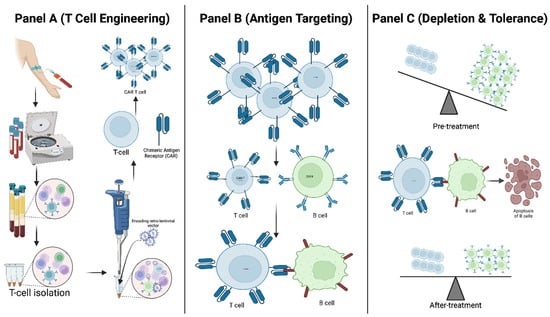
At its core, CAR-T cell therapy involves the genetic reprogramming of autologous T lymphocytes to enhance their ability to recognize and eliminate target cells. This is achieved by introducing a synthetic construct—known as a chimeric antigen receptor (CAR)—that redirects T-cell specificity toward a chosen antigen. While this approach has revolutionized cancer therapy by enabling precise targeting of tumor-associated antigens, it is now being adapted to the context of autoimmune diseases, where pathogenic immune cells, rather than malignant clones, drive tissue destruction [4] (Figure 1).
Figure 1.
Schematic of CAR-T cell engineering and immune modulation in autoimmune disease. Autologous T cells are extracted, genetically modified to express a chimeric antigen receptor (CAR), expanded, and reinfused to eliminate autoreactive B cells and reset immune homeostasis. While early constructs focus on CD19-directed B-cell depletion, this framework also provides the basis for next-generation innovations—including dual-target CARs, CAR-Tregs, and integrated kill switches—designed to enhance specificity, safety, and durability in the treatment of autoimmune diseases.
In hematological cancers, the prototypical CAR-T design targets CD19, a surface protein expressed on B cells. B cells, while central to protective immunity through antibody production, can also play a destructive role in autoimmunity by producing autoantibodies, presenting autoantigens, and sustaining inflammatory networks. As such, CD19-directed CAR-T cells can deplete both autoreactive and normal B cells, thereby disrupting the autoimmune cascade and inducing disease remission in conditions such as SLE and RA [2,17].
Evidence from small-scale studies has demonstrated that CD19-specific CAR-T cell therapy can lead to durable, drug-free remission in patients with refractory SLE—an effect attributed to deep B-cell depletion and immune system reprogramming [5] (Table 1). Importantly, the goal here is not cytotoxic eradication per se, but resetting immune homeostasis by eliminating key drivers of autoimmunity.
Table 1.
Clinical studies of CAR-T cell therapy in systemic lupus erythematosus (SLE).
However, autoimmune diseases are immunologically complex and heterogeneous. A one-size-fits-all CD19-targeted approach may not suffice. Newer CAR designs are now being developed to recognize disease-specific autoantigens, such as citrullinated peptides in RA or myelin basic protein in multiple sclerosis [10] This antigen-directed strategy offers the potential to spare non-pathogenic immune cells, reducing the risk of immunodeficiency while increasing therapeutic specificity.
An even more nuanced innovation involves engineering regulatory T cells (Tregs) with CARs—termed CAR-Tregs. Rather than eliminating target cells, CAR-Tregs modulate immune responses and promote tolerance in a localized, antigen-specific manner [13]. This strategy is particularly attractive in chronic inflammatory diseases such as juvenile idiopathic arthritis and inflammatory bowel disease, where immune hyperactivation leads to progressive tissue damage [15]. CAR-Tregs represent a pivot from immune suppression to immune rehabilitation, potentially offering sustained disease control without global immunosuppression.
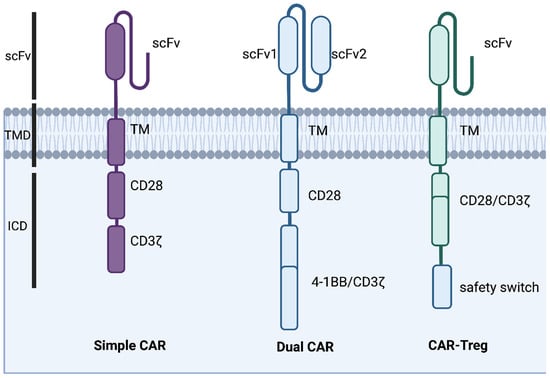
The structural design of CARs has also evolved. In addition to the extracellular antigen-recognition domain, CARs now incorporate intracellular co-stimulatory domains such as CD28 or 4-1BB, which enhance T-cell persistence, proliferation, and function [14]. Moreover, safety switches are being encoded into CAR constructs—molecular “kill switches” that allow clinicians to deactivate the cells in the event of adverse reactions such as cytokine release syndrome or off-target effects [11].
Despite these advances, challenges remain. Autoimmune diseases involve diverse immune pathways, and not all patients will benefit from a single antigen-targeted CAR. Additionally, immune adaptation or antigen escape may result in therapeutic resistance. To address this, dual CAR constructs are being developed to recognize two distinct antigens simultaneously, enhancing both specificity and durability while reducing relapse rates [12,17] (Table 2).
Table 2.
CAR-T construct designs and modifications for autoimmunity.
In sum, the mechanisms of CAR-T cell therapy in autoimmunity are rapidly evolving from a single-target, cytotoxic model to a highly adaptable platform for precision immunomodulation. Through antigen-specific targeting, Treg engineering, and synthetic control circuits, CAR-T technologies offer not just immune suppression, but the possibility of restoring immune tolerance at its roots.
4. Efficacy in Autoimmune Diseases
CAR-T cell therapy has rapidly transitioned from an oncological innovation to a promising investigational strategy for treating autoimmune conditions that are unresponsive to conventional immunosuppressants. Originally designed to eradicate malignant B cells in hematologic cancers, CAR-T cell therapy has demonstrated potential in reprogramming immune responses in complex autoimmune diseases, including SLE, RA, and MS (4;18). Early clinical observations suggest that CAR-T cell therapy may induce long-term remission by selectively depleting autoreactive lymphocytes and modulating pathogenic immune circuits (Table 3).
Table 3.
Summary of efficacy of CAR-T cell therapy by autoimmune indication.
4.1. Systemic Lupus Erythematosus (SLE)
SLE is a prototypic autoimmune disease characterized by systemic inflammation driven by autoreactive B cells and autoantibodies, resulting in multi-organ damage, including to the skin, joints, kidneys, and central nervous system. Although corticosteroids and immunosuppressants remain the cornerstone of therapy, many patients exhibit treatment resistance or suffer from cumulative toxicity [2].
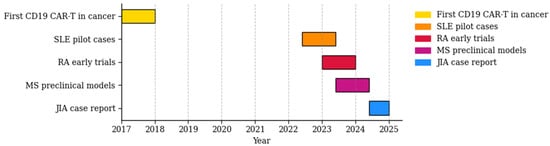
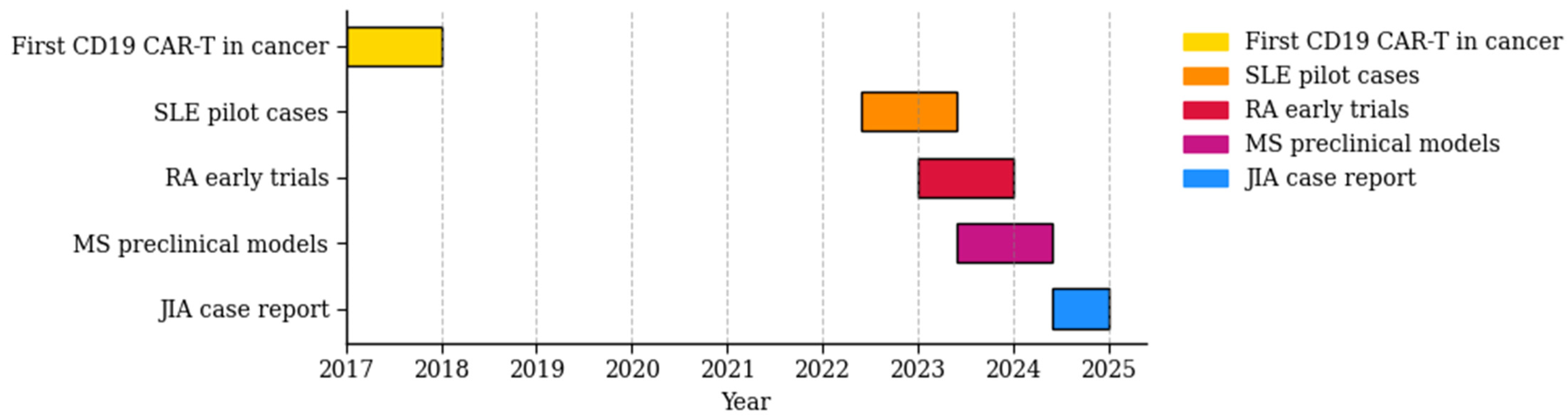
Recent studies have demonstrated the transformative potential of CAR-T cell therapy in SLE. In a landmark case series, five patients with refractory disease received a single infusion of CD19-targeted CAR-T cells and achieved sustained, drug-free remission, with elimination of autoreactive B cells and a marked decline in autoantibody titers [5]. Follow-up data showed improved renal function in lupus nephritis patients and normalization of inflammatory biomarkers [9,17,18,19] (Figure 2). Importantly, these outcomes were observed in individuals who had failed to respond to multiple biologics and immunosuppressants, underscoring the capacity of CAR-T cell therapy to reset immune tolerance rather than merely suppress disease symptoms [6].
Figure 2.
Development timeline of CAR-T cell therapy for autoimmune indications. Early applications (2019–2021) focused on CD19-directed CAR-T in refractory systemic lupus erythematosus (SLE). Subsequent milestones include pilot studies in rheumatoid arthritis (RA), multiple sclerosis (MS), juvenile idiopathic arthritis (JIA). Next-generation innovations—such as dual-target CARs to reduce antigen escape, CAR-Tregs to promote tolerance, and safety switches (e.g., suicide genes, antibody-activated off switches)—are emerging as critical design elements, advancing the field toward safer and more precise immune modulation.
Although the results of early SLE case series are highly encouraging, they are based on very small patient numbers and uncontrolled settings. The durability of remission beyond two years remains uncertain, and whether similar outcomes will be achieved in more diverse populations or in patients with less severe disease is not yet known. These limitations highlight both the promise and fragility of the current evidence base.
4.2. Rheumatoid Arthritis (RA)
RA is a chronic autoimmune disease driven by sustained synovial inflammation and joint destruction, where both B cells and autoantibodies such as anti-citrullinated protein antibodies (ACPA) play central roles. Despite the availability of targeted biologics, a subset of patients remains refractory to current treatment paradigms.
Preclinical studies in murine models have shown that CD19-directed CAR-T cell therapy significantly reduced synovial inflammation and bone erosion [19]. Early-phase translational efforts are now evaluating CAR-T cell therapy in patients with RA who are refractory to methotrexate, TNF inhibitors, or JAK inhibitors [12]. In parallel, regulatory CAR-T cells (CAR-Tregs) are being explored for their ability to suppress inflammation without depleting immune cells, potentially offering a safer, immune-tolerant approach to long-term disease control [13].
Preclinical RA data provide proof of principle that B-cell depletion with CAR-T can suppress synovitis and erosions; however, the translation to humans is still at an exploratory stage. Unlike SLE, RA has heterogeneous pathogenic drivers, suggesting that CAR-T efficacy may be variable across patient subsets. It is therefore premature to assume that RA outcomes will parallel those observed in lupus.
4.3. Multiple Sclerosis (MS)
MS is an immune-mediated demyelinating disease of the central nervous system, driven by autoreactive T and B cells. Disease-modifying therapies provide partial control but fail to prevent progression in many patients with aggressive forms of the disease. Although MS is traditionally classified as a neuro-autoimmune disorder, it shares core immunologic mechanisms with rheumatologic diseases, justifying its inclusion for cross-disciplinary relevance.
Although still in early development, CAR-T cells targeting B cells implicated in MS pathogenesis are being engineered to cross the blood–brain barrier and attenuate neuroinflammation [11]. In animal models, CAR-T cell therapy has been shown to reduce brain inflammation, preserve myelin, and improve neurological function [10]. Combination strategies pairing CAR-T cell therapy with neuroprotective agents or checkpoint inhibitors may further enhance efficacy in future clinical trials [11].
While preclinical MS studies suggest potential benefit, translation faces additional hurdles, including central nervous system penetration and the risk of neuroinflammation exacerbation. At present, claims of efficacy in MS remain largely speculative, underscoring the need for cautious interpretation until human trials provide clarity.
4.4. Juvenile Autoimmune Diseases
Pediatric autoimmune diseases such as juvenile idiopathic arthritis (JIA) and juvenile-onset SLE pose additional challenges due to disease severity, growth concerns, and steroid toxicity. In case reports, CAR-T cell therapy has been explored as a rescue intervention in children with refractory disease. Early outcomes suggest that it may reduce reliance on long-term corticosteroids and promote clinical remission [15]. Given the plasticity of the pediatric immune system, these patients may be uniquely responsive to immune reprogramming via CAR-T cells.
Isolated case reports in pediatric populations must be interpreted with extreme caution. Children may display heightened responsiveness due to immune plasticity, but they also face unique safety concerns such as impaired vaccine responses and long-term infection risk. Thus, while early signals are promising, broader validation is essential before pediatric CAR-T use can be considered beyond salvage therapy.
4.5. ANCA-Associated Vasculitis
Anti-neutrophil cytoplasmic antibody (ANCA)-associated vasculitis—including granulomatosis with polyangiitis and microscopic polyangiitis—is characterized by autoantibody-mediated inflammation of small blood vessels. These diseases often require prolonged immunosuppression with significant infection risk.
Preclinical data and early anecdotal reports suggest that B cell depletion via CAR-T cell therapy can suppress ANCA production and induce disease remission. By reducing reliance on long-term cytotoxic agents, CAR-T cell therapy may offer durable disease control while minimizing cumulative toxicity [4]. However, large-scale clinical trials are needed to validate efficacy and identify biomarkers for response.
Evidence in AAV is anecdotal and cannot yet inform practice. The complexity of vasculitic syndromes, with both B-cell-dependent and -independent pathways, raises uncertainty as to whether CD19-directed CAR-T alone will be sufficient. Controlled studies are needed to determine which patient subsets may benefit.
4.6. Idiopathic Inflammatory Myopathies (IIMs)
In a recent case series, three patients with treatment-refractory idiopathic inflammatory myopathies received CD19-specific CAR-T cell therapy and demonstrated clinical improvements in muscle strength, reductions in creatine kinase levels, and decreased systemic inflammation [7]. These findings highlight the broader applicability of CAR-T cell therapy to B-cell-driven autoimmune muscle diseases and emphasize the need for expanded trials.
Although early reports on myositis show improvement in muscle strength and biomarker normalization, these findings come from only a handful of patients. Given the heterogeneity of myositis subtypes and their distinct immune mechanisms, extrapolation to the entire disease spectrum is premature.
4.7. Systemic Sclerosis
Recent clinical data now extend the potential of CAR T-cell therapy to fibrotic autoimmune diseases such as diffuse cutaneous systemic sclerosis (dcSSc). Auth et al. reported the first detailed case series of CD19-targeting CAR T-cell therapy in six patients with severe, treatment-refractory dcSSc. Each patient received a single infusion of autologous CD19-CAR T cells (1 × 10⁶ cells per kg) following fludarabine/cyclophosphamide lymphodepletion and was followed for a median of 487 days. No progression events were recorded during follow-up, and the therapy was generally well tolerated—cytokine-release syndrome was mild (grade 1–2 in all cases) with no neurotoxicity. Clinical responses were striking:
- Modified Rodnan Skin Score decreased by a median 31% (≈8 points) within 100 days.
- EUSTAR-Activity Index declined by ~47%.
- FVC improved by a median 195 mL, and CT imaging showed a 4% reduction in ground-glass opacities with stability of the reticular fibrotic pattern.
- Digital ulcers and Raynaud’s pain improved.
- Autoantibody titers (anti-topoisomerase I, anti-RNA polymerase III) markedly decreased, in some cases becoming undetectable.
These results demonstrate that deep B-cell depletion through CD19-CAR T therapy can intercept fibrotic progression in SSc, improving both skin and pulmonary manifestations without serious toxicity. The study provides the first proof of concept that CAR T therapy may reset immune–fibrotic homeostasis in systemic sclerosis, warranting confirmation in larger controlled trials (e.g., CASTLE Phase 1/2, NCT06347718) [1].
4.8. General Clinical Observations and Outcomes
Across disease indications, early-phase CAR-T studies have demonstrated encouraging efficacy signals. Most patients achieved clinical remission within weeks of infusion, accompanied by depletion of pathogenic B cells and normalization of inflammatory markers [16]. Longitudinal follow-up reveals that remission may persist for months to over a year, even in the absence of additional therapy—a stark contrast to the relapse-prone course observed with conventional agents [14].
Notably, a prospective longitudinal study of CAR-T cell therapy across autoimmune diseases reported that over 80% of participants experienced sustained disease improvement without flare-ups [8]. These data support the hypothesis that CAR-T cell therapy offers a mechanistically distinct and potentially curative modality by interrupting the underlying autoimmune circuitry.
However, caution is warranted. Most current evidence is derived from small case series or pilot studies. Large, randomized, controlled trials are essential to confirm these results, define long-term safety, and optimize CAR-T constructs for disease-specific applications [7].
5. Safety and Complications
CAR-T cell therapy, while offering transformative potential, is not without risks. Much of the safety profile of CAR-T has been characterized in oncology, where the therapy was first implemented. In the context of autoimmune diseases, emerging data suggest that the adverse event spectrum may be milder, but long-term safety remains incompletely understood [4] (Table 4).
Table 4.
Safety profile and complications in autoimmune populations.
5.1. Typical Side Effects of CAR-T Cell Therapy
One of the hallmark toxicities of CAR-T cell therapy is cytokine release syndrome (CRS). CRS results from rapid immune activation and massive cytokine secretion following CAR-T infusion. Clinically, CRS manifests as fever, hypotension, hypoxia, and in severe cases, multi-organ dysfunction [7]. Prompt management using IL-6 receptor blockade (e.g., tocilizumab) or corticosteroids can mitigate these effects, but vigilance is critical.
Neurotoxicity, often referred to as immune effector cell-associated neurotoxicity syndrome (ICANS), is another significant complication. Symptoms range from headache and confusion to aphasia, seizures, or coma. While most episodes are reversible with supportive therapy, severe ICANS can be life-threatening if unrecognized [3].
Notably, the severity of these toxicities tends to be lower in autoimmune patients compared to cancer patients. This difference is likely due to the lower CAR-T cell doses administered, the absence of a high tumor burden, and the use of less aggressive lymphodepletion regimens [4].
A comparison with oncology populations highlights important differences. In large oncology cohorts, CRS occurs in ~70–90% of patients, with 10–20% experiencing Grade ≥ 3 severity. ICANS is reported in 30–40% of cancer patients, with severe events in 10–15%. In contrast, across published autoimmune case series (n < 20), CRS has been reported in <15% of patients, all Grade 1–2, with no severe neurotoxicity to date. Similarly, cytopenias—common in oncology populations, where prolonged cytopenias are seen in up to 40–50% of patients—appear to be milder and transient in autoimmune settings. While these observations suggest a more favorable safety profile in autoimmunity, they must be interpreted cautiously given the small sample sizes and limited follow-up.
It is important to note, however, that the apparently milder toxicity profile in autoimmune cohorts may reflect patient selection, lower CAR-T doses, or limited follow-up, rather than an inherently safer biology. Until larger datasets are available, assumptions of superior safety compared to oncology must remain tentative.
5.2. Autoimmune-Specific Safety Observations
Early clinical experience with CAR-T cell therapy in autoimmune diseases has been encouraging. In trials involving lupus patients, no cases of life-threatening CRS or severe neurotoxicity have been reported. The most common adverse events were transient flu-like symptoms, mild cytopenias, and self-limited fever [5]. This suggests a potentially more favorable safety profile when CAR-T is used for immune recalibration rather than tumor eradication.
However, B cell aplasia—a predictable on-target effect of CD19-directed CAR-T cell therapy—remains a concern. Prolonged B cell depletion increases susceptibility to infections and may necessitate immunoglobulin replacement therapy during immune reconstitution [7]. While expected, this effect underscores the need for careful patient monitoring.
Another potential risk is off-target toxicity, where CAR-T cells inadvertently recognize antigens expressed on healthy tissues. Although rare, such events could result in organ damage or non-specific immune activation [10].
Importantly, over-depletion of immune cells could have unique implications in younger or comorbid patients, leading to impaired host defense. Thus, patient selection, pre-infusion immune profiling, and long-term follow-up are essential to minimize risks [15].
5.3. Long-Term Risks and Unknowns
As CAR-T cell therapy is still nascent in autoimmune diseases, its long-term safety profile remains largely unknown. Persistence of CAR-T cells—beneficial for preventing relapses in cancer—may have ambiguous implications in autoimmune patients. On one hand, prolonged CAR-T activity may sustain remission; on the other, it could lead to chronic immune suppression or dysregulation [19].
There is also theoretical concern for secondary autoimmune phenomena triggered by immune reconstitution or unintended immune reshaping. Although such events have not been observed in early trials, ongoing surveillance is warranted [12].
Encouragingly, next-generation CAR constructs are addressing many of these safety concerns. Regulatory CAR-T cells (CAR-Tregs), for example, are engineered to dampen immune activation rather than eliminate entire B-cell populations. Early data suggest they carry a lower risk of CRS and neurotoxicity, positioning them as a safer long-term strategy for diseases driven by chronic inflammation [13].
The safety challenges of CAR-T cell therapy in autoimmunity must be viewed against the high morbidity and toxicity burden of conventional therapies, which often require lifelong immunosuppression. The emerging evidence suggests that with judicious patient selection and optimized CAR designs, the risk–benefit balance strongly favors CAR-T in refractory, severe cases. However, long-term registries and multicenter trials are critical to fully establish safety, particularly for pediatric and young adult populations.
6. Future Perspectives
CAR-T cell therapy represents one of the most promising frontiers in the treatment of autoimmune diseases. Its early success in inducing durable remissions in refractory cases of systemic lupus erythematosus and other immune-mediated conditions has validated the potential of cell-based therapies to go beyond symptom control and offer immune recalibration. However, for CAR-T to transition from experimental promise to routine practice, key technical, clinical, and logistical hurdles must be addressed.
6.1. Technical and Clinical Challenges
A central challenge in applying CAR-T to autoimmunity is the selection of appropriate disease-specific targets. While CD19-directed CAR-T cells have shown efficacy in B-cell-driven diseases like SLE, RA, and ANCA-associated vasculitis, not all autoimmune diseases are mediated by B cells, and even among B cell-driven disorders, the antigenic drivers differ. Autoimmune pathogenesis is often multifactorial, involving combinations of autoreactive B and T cells, cytokine cascades, and organ-specific contexts [4]. Tailoring CAR-T designs to target these diverse pathways—such as citrullinated peptides in RA or myelin proteins in MS—will be critical for efficacy and safety.
Striking the right balance of immune suppression is equally complex. Unlike in cancer, where the therapeutic goal is cytolytic destruction, in autoimmunity the aim is to reestablish tolerance without eroding essential immune defense. Overactivation of CAR-T cells can trigger adverse effects such as cytokine release syndrome (CRS) or neurotoxicity, while underactivation may fail to produce clinical benefits [3,12]. Dosing strategies, vector design, and co-stimulatory domains must therefore be carefully optimized for autoimmune indications.
Manufacturing complexity and access limitations present further barriers. CAR-T production involves harvesting autologous T cells, genetically modifying them in a specialized laboratory, and reinfusing them after expansion—a process that is time-intensive, expensive, and currently limited to advanced centers [7]. In its current form, CAR-T cell therapy remains largely inaccessible to most patients worldwide (Table 5).
Table 5.
Future challenges and mitigation strategies.
6.2. Innovations on the Horizon: Dual CARs, Safety Switches, and CAR-Tregs
Next-generation CAR designs are being developed to address these limitations and enhance both efficacy and safety.
Dual CAR-T cells, which recognize two antigens simultaneously, are being explored to improve specificity and reduce off-target effects. These constructs can be activated only when both antigenic signals are present, minimizing collateral damage to healthy tissue while addressing the redundancy of autoimmune pathways [10,18] (Table 2).
Safety switches—such as suicide genes or inducible on/off systems—enable clinicians to halt CAR-T activity in the event of severe toxicity. These mechanisms are especially important in autoimmune diseases, where patient variability and systemic inflammation may amplify risk [16].
CAR-T regulatory cells (CAR-Tregs) represent another exciting innovation. Rather than killing target cells, CAR-Tregs function by promoting immune tolerance in an antigen-specific manner. In early studies of inflammatory bowel disease and rheumatoid arthritis, CAR-Tregs have demonstrated the ability to suppress inflammation while preserving immune surveillance, making them particularly suited for chronic, relapsing diseases [13,15] (Table 2).
While these innovations are intellectually appealing, most remain at the preclinical stage, and it is unclear whether they can be manufactured and scaled at reasonable cost. Overemphasis on engineering sophistication without clinical feasibility risks widening the gap between concept and practice.
6.3. Limitations and Economic Barriers
An important limitation of this review is that, as a structured narrative synthesis, it did not include a formal risk of bias assessment or systematic quality appraisal of included studies. This reflects the current evidence base, which is dominated by case reports, small case series, and preclinical models, where formal grading would not yield meaningful comparisons. Instead, we adopted a structured narrative approach to integrate mechanistic, translational, and early clinical insights. While this limits reproducibility, it allows for broader contextual interpretation and critical appraisal, which are essential at this early stage of CAR-T development in autoimmune diseases.
Despite clinical promise, the economic and infrastructural barriers to CAR-T cell therapy are substantial. Current costs range from USD 373,000 to 530,000 per patient—excluding hospitalization and post-treatment care—placing it well beyond reach for most health systems. Moreover, manufacturing timelines and capacity constraints hinder scalability and responsiveness, especially in rapidly progressing diseases.
Nonetheless, CAR-T cell therapy could prove cost-effective over the long term, particularly in severe, relapsing conditions like ANCA-associated vasculitis or refractory SLE, where the lifetime cost of biologics and immunosuppressants may exceed $100,000 annually. Development of off-the-shelf (allogeneic) CAR-T products, improvements in vector technology, and automation of cell processing are urgently needed to reduce costs and expand access [9].
7. Areas for Future Research and Trials
Several Directions Warrant Priority in Future Investigations
- Disease Expansion: To date, most CAR-T trials in autoimmunity have focused on lupus. Future studies should explore broader indications, including type 1 diabetes, psoriasis, myasthenia gravis, and autoimmune encephalitis [14].
- Long-Term Safety and Durability: Although many patients have remained in remission for over one year, the durability of response beyond this time horizon remains unknown. Longitudinal studies must evaluate risks of delayed relapse, sustained immunosuppression, or new-onset secondary autoimmune diseases [9].
- Universal Donor Platforms: The development of allogeneic or universal CAR-T cells derived from healthy donors could dramatically reduce production time and cost, making therapy more scalable and equitable [19]. However, such products must overcome barriers of host-versus-graft immune responses.
- Combination Strategies: CAR-T cell therapy may be synergistic with other modalities, including biologics (e.g., anti-IL-6, anti-CD20), immune checkpoint inhibitors, or tolerogenic agents. Rational combinations could enhance efficacy while mitigating toxicity [6].
In summary, CAR-T cell therapy in autoimmune diseases is on the cusp of a paradigm shift—from proof of principle to platform technology. Achieving this will require collaborative, multidisciplinary innovation across immunology, synthetic biology, clinical rheumatology, and health systems science. With continued progress, CAR-T cell therapy could become not just a salvage option, but a cornerstone in the management of refractory and relapsing autoimmune disease.
8. Conclusions
CAR-T cell therapy is redefining the landscape of autoimmune disease management. What began as a revolutionary intervention in hematologic malignancies is now emerging as a disruptive technology in rheumatology, with the capacity to induce deep, durable remissions in patients with treatment-refractory autoimmune diseases such as SLE, RA, and MS [11].
Early-phase studies—although limited in size—have demonstrated impressive clinical responses, including drug-free remissions after a single infusion, minimal toxicity compared to oncologic applications, and signs of immune recalibration rather than transient suppression [7]. These findings signal a paradigm shift: from chronic immunosuppression to precision-guided immune modulation.
Key advances—including dual-target CARs, safety switches, and regulatory CAR-T cells (CAR-Tregs)—are already being integrated into next-generation platforms, enhancing specificity, safety, and long-term efficacy. Moreover, the emergence of disease-specific CAR constructs and efforts to personalize cell engineering based on individual immunophenotypes signal a move toward precision rheumatology (Figure 3).
Figure 3.
Next-generation CAR constructs for autoimmune disease therapy. Schematic representation of advanced designs including dual-target CAR-T cells (targeting both CD19 and disease-specific autoantigens), CAR-Tregs (engineered regulatory T cells for localized immune tolerance), and molecular safety switches (e.g., iCasp9 suicide switch, antibody-activated off modules). Together, these platforms enhance specificity, durability, and safety, shifting the paradigm from broad immunosuppression to precision immune recalibration.
Yet the journey toward routine clinical adoption remains incomplete. Realizing the full potential of CAR-T cell therapy in autoimmune diseases will require:
- Large-scale, multicenter trials with long-term follow-up.
- Mechanistic biomarkers to stratify responders.
- Scalable manufacturing platforms.
- Health system-level reforms to enable equitable access.
If these challenges are addressed, CAR-T cell therapy could become not just a salvage strategy for refractory cases, but a first-line option for immune restoration in selected high-risk autoimmune conditions.
In summary, CAR-T cell therapy is no longer confined to oncology—it represents a frontier in immunological medicine. With sustained investment, collaborative innovation, and thoughtful clinical integration, CAR-T cells may soon stand alongside biologics and small molecules as pillars of autoimmune disease treatment—and perhaps, for some patients, a pathway to a cure.
Author Contributions
Conceptualization, A.C. and C.C.-G.; methodology, A.C., C.C.-G. and A.A.; investigation, A.C., C.C.-G., A.A. and A.L.G.; resources, R.A.; writing—original draft preparation, A.C. and C.C.-G.; writing—review and editing, A.A., A.L.G. and R.A.; supervision, R.A. All authors have read and agreed to the published version of the manuscript.
Funding
This research received no external funding.
Institutional Review Board Statement
Not applicable.
Informed Consent Statement
Not applicable.
Data Availability Statement
No new data were created or analyzed in this study.
Conflicts of Interest
The authors declare no conflict of interest.
References
- Auth, J.; Müller, F.; Völkl, S.; Bayerl, N.; Distler, J.H.W.; Tur, C.; Raimondo, M.G.; Fakhouri, S.C.; Atzinger, A.; Coppers, B.; et al. CD19-targeting CAR T-cell therapy in patients with diffuse systemic sclerosis: A case series. Lancet Rheumatol. 2025, 7, e83–e93. [Google Scholar] [CrossRef] [Scilit] [PubMed]
- Chan, V.S.F.; Tsang, H.H.L.; Tam, R.C.Y.; Lu, L.; Lau, C.S. B-cell-targeted therapies in systemic lupus erythematosus. Cell. Mol. Immunol. 2013, 10, 133–142. [Google Scholar] [CrossRef] [Scilit] [PubMed]
- Chohan, K.L.; Siegler, E.L.; Kenderian, S.S. CAR-T cell therapy: The efficacy and toxicity balance. Curr. Hematol. Malig. Rep. 2023, 18, 9–18. [Google Scholar] [CrossRef] [Scilit] [PubMed]
- Chung, J.B.; Brudno, J.N.; Borie, D.; Kochenderfer, J.N. Chimeric antigen receptor T cell therapy for autoimmune disease. Nat. Rev. Immunol. 2024, 24, 830–845. [Google Scholar] [CrossRef] [Scilit] [PubMed]
- Guffroy, A.; Jacquel, L.; Guffroy, B.; Martin, T. CAR-T cells for treating systemic lupus erythematosus: A promising emerging therapy. Jt. Bone Spine 2024, 91, 105702. [Google Scholar] [CrossRef] [Scilit] [PubMed]
- Isaacs, J.D. CAR T cells—A new horizon for autoimmunity? N. Engl. J. Med. 2024, 390, 758–759. [Google Scholar] [CrossRef] [Scilit] [PubMed]
- Ji, X.; Sun, Y.; Xie, Y.; Gao, J.; Zhang, J. Advance in chimeric antigen receptor T therapy in autoimmune diseases. Front. Immunol. 2025, 16, 1533254. [Google Scholar] [CrossRef] [Scilit] [PubMed]
- Taubmann, J.; Müller, F.; Fagni, F.; Bergmann, C.; Tur, C.; Bucci, L.; Völkl, S.; Aigner, M.; Hagen, M.; Grieshaber-Bouyer, R.; et al. Op0027 long-term safety and efficacy of Car-T cell treatment in severe and treatment refractory autoimmune disease. Ann. Rheum. Dis. 2024, 83, 137. [Google Scholar] [CrossRef] [Scilit]
- Zhou, J.; Lei, B.; Shi, F.; Luo, X.; Wu, K.; Xu, Y.; Zhang, Y.; Liu, R.; Wang, H.; Zhou, J.; et al. CAR T-cell therapy for systemic lupus erythematosus: Current status and future perspectives. Front. Immunol. 2024, 15, 1476859. [Google Scholar] [CrossRef] [Scilit] [PubMed]
- Li, Y.R.; Lyu, Z.; Chen, Y.; Fang, Y.; Yang, L. Frontiers in CAR-T cell therapy for autoimmune diseases. Trends Pharmacol. Sci. 2024, 45, 839–857. [Google Scholar] [CrossRef] [Scilit] [PubMed]
- Liu, J.; Zhao, Y.; Zhao, H. Chimeric antigen receptor T-cell therapy in autoimmune diseases. Front. Immunol. 2024, 15, 1492552. [Google Scholar] [CrossRef] [Scilit] [PubMed]
- Ohno, R.; Nakamura, A. Advancing autoimmune Rheumatic disease treatment: CAR-T Cell Therapies-Evidence, Safety, and future directions. Semin. Arthritis Rheum. 2024, 67, 152479. [Google Scholar] [CrossRef] [Scilit] [PubMed]
- Riet, T.; Chmielewski, M. Regulatory CAR-T cells in autoimmune diseases: Progress and current challenges. Front. Immunol. 2022, 13, 934343. [Google Scholar] [CrossRef] [Scilit] [PubMed]
- Sadeqi Nezhad, M.; Seifalian, A.; Bagheri, N.; Yaghoubi, S.; Karimi, M.H.; Adbollahpour-Alitappeh, M. Chimeric antigen receptor based therapy as a potential approach in autoimmune diseases: How close are we to the treatment? Front. Immunol. 2020, 11, 603237. [Google Scholar] [CrossRef] [Scilit] [PubMed]
- Jouret, M.; Viel, S.; Fournier, B.; Benezech, S.; Avouac, J.; Scherlinger, M.; Belot, A. CAR-T cell therapy for juvenile-onset autoimmune diseases: A promising future? Arthritis Res. Ther. 2025, 27, 102. [Google Scholar] [CrossRef] [Scilit] [PubMed]
- Vukovic, J.; Abazovic, D.; Vucetic, D.; Medenica, S. CAR-engineered T cell therapy as an emerging strategy for treating autoimmune diseases. Front. Med. 2024, 11, 1447147. [Google Scholar] [CrossRef] [Scilit] [PubMed]
- Yang, Z.; Ha, B.; Wu, Q.; Ren, F.; Yin, Z.; Zhang, H. Expanding the horizon of CAR T cell therapy: From cancer treatment to autoimmune diseases and beyond. Front. Immunol. 2025, 16, 1544532. [Google Scholar] [CrossRef] [Scilit] [PubMed]
- Yu, J.; Yang, Y.; Gu, Z.; Shi, M.; La Cava, A.; Liu, A. CAR immunotherapy in autoimmune diseases: Promises and challenges. Front. Immunol. 2024, 15, 1461102. [Google Scholar] [CrossRef] [Scilit] [PubMed]
- Kumar, J.G.; Kumar, A.; Jiladia, M.A.; Vaishnov, R.S.; Pathak, V.; Joshi, P.; Singh, M.; Tyagi, S.; Tandey, R. Advancing Cell Therapies in the Treatment of Autoimmune Conditions. World J. Pharm. Res. 2023, 13, 164–207. [Google Scholar]

Disclaimer/Publisher’s Note: The statements, opinions and data contained in all publications are solely those of the individual author(s) and contributor(s) and not of MDPI and/or the editor(s). MDPI and/or the editor(s) disclaim responsibility for any injury to people or property resulting from any ideas, methods, instructions or products referred to in the content. |
© 2025 by the authors. Licensee MDPI, Basel, Switzerland. This article is an open access article distributed under the terms and conditions of the Creative Commons Attribution (CC BY) license (https://creativecommons.org/licenses/by/4.0/).