


Abstract
Metal additive manufacturing relies on fine powders whose properties influence flow, spreading, and airborne release during processing, yet published data on powder characteristics, reuse effects, and emissions remain fragmented and difficult to compare. This study reviews quantitative measurements reported for metallic feedstocks used in laser powder bed fusion and directed energy deposition. A numerical evaluation model is developed to connect powder properties, process conditions, dispersion tendency, and material recovery. Particle size distribution values, density metrics, flow test results, reuse-related oxidation, and nanoparticle counts were compiled from the literature and normalized on a 0–1 scale. Four independent indices were defined: Material Fingerprint, process–powder interaction, airborne dispersion potential, and recovery. Adaptiveness refers to index sensitivity to changes in powder, reuse, and process conditions. The results indicate stable spreading for gas-atomized feedstocks, while wider particle size distributions and rougher surfaces increase cohesion and agglomeration, particularly under humid conditions and during reuse. Emission data indicate nanoparticle formation during processing, with recovery efficiency dependent on cyclone or high-efficiency particulate air filtration selection. The proposed model offers a screening approach for comparing powders and planning recovery strategies using data already available in the literature.
1. Introduction
Metal additive manufacturing uses fine powders as the primary feedstock in Powder Bed Fusion (PBF) and Directed Energy Deposition (DED) processes [1]. Industrial interest in metal powders has increased due to their ability to support complex geometries with low material waste and short prototyping cycles, as demonstrated in aerospace, energy, and medical implant applications [2]. Powder behavior affects layer formation, melt stability, and final part densification, so feedstock characteristics are treated as a key parameter in additive manufacturing (AM) workflows [3].
Metal powder feedstocks present technology-specific particle size distributions. The 15–45 μm fractions are commonly used in Laser Powder Bed Fusion (LPBF), while DED powders extend up to 200 μm [4]. Gas atomization produces spherical particles with D10 = 26.92 μm, D50 = 38.70 μm, and D90 = 53.17 μm for 316L, an apparent density of 4.41 g/cm3, and a flow time of 21.5 s/50 g, while water atomization yields an apparent density of 3.80 g/cm3 and 29.7 s/50 g [5]. Particle morphology and surface roughness affect flowability, layer spreading, and fine particle formation during recoating.
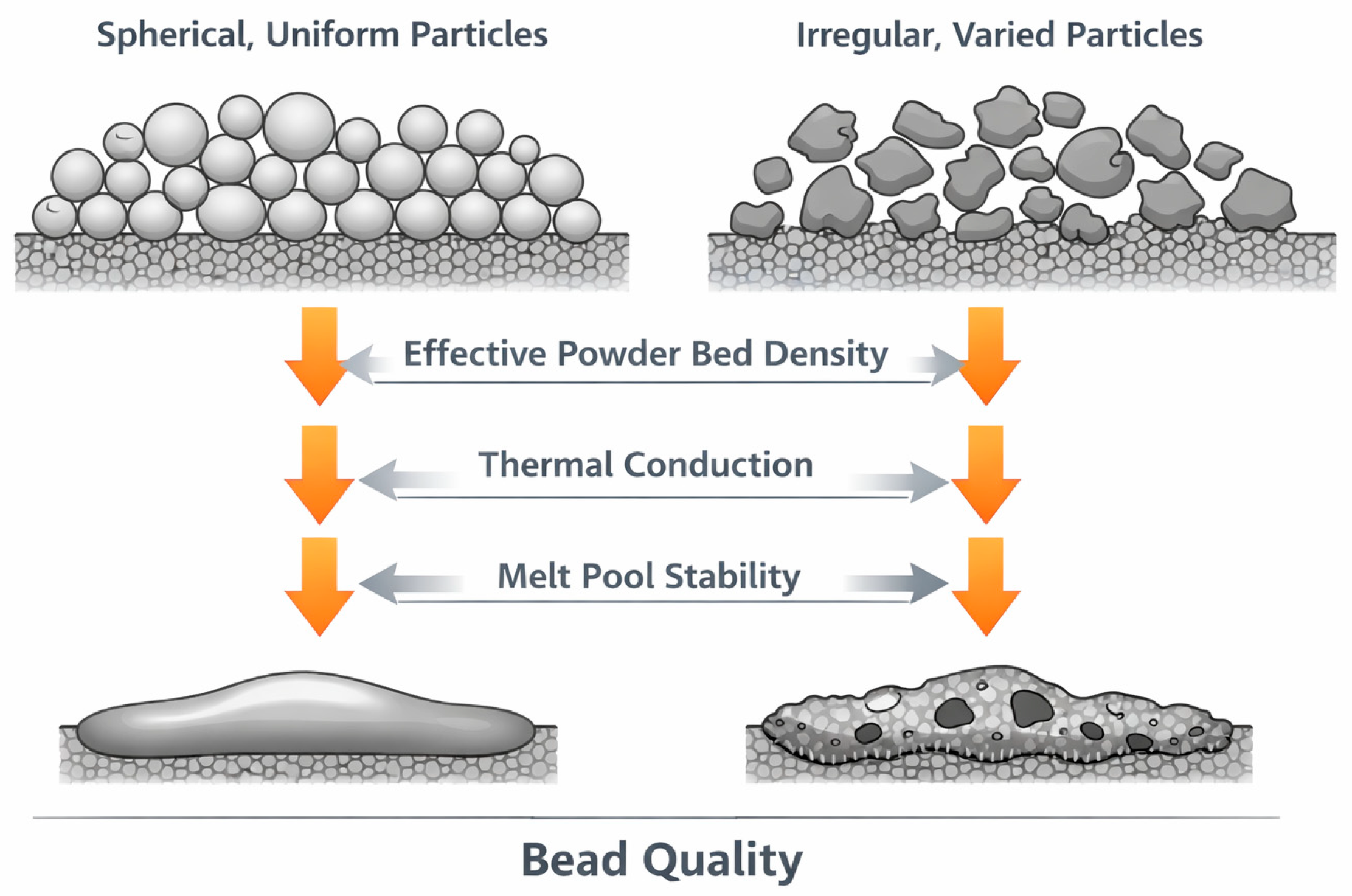
Particle morphology affects process performance through its influence on powder bed effective density. Spherical particles with narrow size distributions promote dense and uniform packing, increasing solid–solid contact and conductive heat transfer within the powder layer. Irregular particles and wide size distributions reduce bed density, increase local porosity, and raise thermal resistance before melting. These variations modify melt pool dimensions and stability, leading to changes in bead geometry, surface roughness, and porosity formation during fusion.
Numerical studies support this mechanism. Coupled DEM-CFD analyses indicate that particle size distribution and morphology govern powder layer density and gas-driven particle displacement during recoating, directly affecting layer uniformity and stability [6]. Thermal modeling studies suggest that variations in powder bed density alter heat transfer paths and melt pool behavior, leading to measurable differences in bead continuity and surface quality [7]. Figure 1 illustrates the process mechanism connecting particle morphology and size distribution to powder bed density, thermal response, and resulting bead quality.
Figure 1.
Powder morphology–process–bead quality mechanism.
Powder quality determines layer packing and the level of residual porosity. High sphericity and narrow particle size distributions reduce interparticle friction and improve spreading [8]. The presence of satellites and agglomerates lowers flowability and can lead to local variations in densification. Routine handling and storage conditions can modify powder flow behavior through moisture uptake and environmental exposure, even in the absence of processing-induced reuse effects [9]. Powders with particle sizes below 20 μm absorb moisture faster, increasing cohesion and promoting clustering [10].
From a process improvement perspective, powder morphology functions as a controllable input within the process. Particle size distribution and shape influence recoating stability, powder bed density, and local thermal response during melting, which affect melt pool behavior and bead continuity. This relationship permits the use of numerical tools, such as discrete element method (DEM) models for recoating analysis and thermal models for melt pool evolution, to predict process sensitivity to powder state. By accounting for particle morphology, process parameters such as recoater speed, shielding gas velocity, and energy input can be adjusted to maintain stable spreading and consistent melting for a given powder condition.
Multiple reuse cycles introduce microstructural changes, including increased porosity and oxygen pickup. Experimental studies on recycled and reused powders report measurable changes in particle size distribution, shape factors, and flowability after reuse cycles, whereas nominal alloy specifications are maintained [11]. For stainless steel 316L, studies report oxygen growth during successive recycling cycles, typically in the range of 200–400 ppm, depending on powder handling and storage. Reused powder maintains most mechanical properties, but particle size distribution shifts and fine particles can appear during repeated processing. These trends suggest that powder reuse must be evaluated for each alloy and process condition [12].
Powder behavior inside the AM chamber is influenced by more than just morphological properties. Process parameters, volumetric energy input, recoating conditions, and inert gas flow affect particle detachment and airborne fraction generation [13]. PBF and DED systems can release nano- to submicron-sized particles, with reported concentrations ranging from 1100 to 17,000 particles/cm3, containing respirable metals such as Cr, Ni, and Mn. Experimental studies using parallel measurement techniques report large variability in particle number and size distributions during powder handling and post-processing operations, depending on the instrument and sampling location [14]. Particle capture relies on ventilation and filtration systems, typically using cyclones or HEPA filters, yet selection is based on operational practice without standardized criteria to match powder properties with filtration efficiency, which complicates material recovery [15]. Studies on particle safety in additive manufacturing report the presence of micro- and nanoscale airborne particles during powder handling, processing, and post-processing, while highlighting the lack of standardized relationships between powder properties and emission behavior.
Reviews on metal powders in additive manufacturing for powder-based processes focus on feedstock production, physical characterization, powder reuse, or particle emissions, usually as separate topics [8,13]. These studies report valuable measurements, but they do not convert powder, process, and emission data into a common numerical format that permits comparison, particularly when flowability and packing behavior are assessed using different test methods and instruments [16]. This study does not attempt to cover all research on metal powders in additive manufacturing. It focuses on quantitative variables that can be extracted from published data and used for comparative evaluation of dispersion and recovery behavior. As a result, powder selection, dispersion risk estimation, and recovery system choice remain largely empirical and dependent on individual case studies.
In this context, studies do not provide a simple model that connects powder properties, process parameters, and airborne dispersion risks. Most studies focus on powder characterization or part performance, while data on aerosol losses and material recovery remain scattered across the literature. This fragmentation limits the ability to compare powders, reuse states, and process configurations using a unified criterion, creating the need for a structured numerical approach.
This analysis focuses on L-PBF and DED technologies, as these processes involve handling of loose metal powders, active recoating or carrier-gas transport, and enclosed gas-flow environments that are relevant to dispersion and recovery mechanisms. These characteristics define the boundary conditions under which an integrative, indicator-based approach can be formulated using literature-reported data.
The Adaptive Powder Behavior Model responds to this gap. The model uses reported powder properties and process conditions to estimate airborne dispersion potential and recovery needs. The term adaptive refers to recalculated indicator values that reflect changes in powder state and process configuration, without implying real-time control or active adjustment. Published data are normalized into four independent indices, built on measurable parameters describing material characteristics, powder–process interaction, airborne dispersion potential, and recovery.
2. Materials and Methods
2.1. Data Context and Scope
This study applies a data-driven data integration approach in which published numerical values are used as inputs for model formulation. The work follows a narrative, model-oriented review strategy that focuses on studies reporting measurable powder, process, and emission parameters relevant to dispersion and recovery. The scope does not include an exhaustive survey of additive manufacturing powder literature. Studies were considered based on the availability of extractable numerical data compatible with the APBM input structure. The analysis used reported values describing feedstock behavior, including particle size distribution (D10/D50/D90), apparent or tap density, Hall or Carney flow time, oxygen increase during reuse, airborne particle concentration measured during LPBF or DED operation, and information on filtration or material recovery. Data were retained as published in the sources, and unit conversion was applied only when direct equivalence existed.
Published numerical data were considered usable only when they could be mapped onto the parameters of the proposed framework. Published sources that did not report extractable numerical values for the defined parameters could not be incorporated into the quantitative formulation of the indices.
2.2. Thematic Organization
Following data extraction, each publication was assigned to a thematic domain based on the type of information reported and the measurable parameters available. Studies focused on powder production, atomization route, and reuse behavior were grouped under feedstock and degradation. Publications reporting physical characterization, including particle size distribution, density, and flow rate, formed a second domain. Studies on process–powder interaction, including energy input and spreading behavior during LPBF or DED, were indexed as process interaction. A final domain covered dispersion and recovery, where works documented airborne particle release or filtration and capture performance. This thematic structure supported synthesis by aligning extracted variables with the index model developed later in the study and created a path for mapping measurable quantities into the M-index, P-index, ADP, and recovery domains.
2.3. Data Analysis
All numerical values extracted from the selected publications were transferred into a dataset for further processing. Continuous variables such as particle size distribution (D10/D50/D90), apparent or tap density, flow rate, oxygen increase during reuse, and airborne particle counts were treated as quantitative inputs and analyzed without averaging across materials or studies to preserve variability. Data originating from different measurement setups were aligned only when units were directly convertible. Normalizing was performed using a min–max scaling approach derived from the structure of the dataset and the requirement to place all parameters on a comparable 0–1 interval. The applied relation was
where x is the reported measurement, and xmin and xmax mark the lowest and highest values identified within the dataset. This scaling forms a common basis for index calculation and allows comparison between powders even when initial values come from different testing methods. Missing data points were not estimated or interpolated, and index values were computed only when the required parameters were available. The dataset was then used to compute four independent index maps (M-index, P-index, ADP, and recovery), with no weighting applied between parameters or domains.
2.4. Index Development and Model Structure
The numerical evaluation framework used in this study is referred to as the Adaptive Powder Behavior Model (APBM). Extracted parameters were assigned to four domains describing Material Fingerprint, process interaction, airborne dispersion potential, and recovery feasibility. The M-index includes particle size distribution (D10/D50/D90), sphericity or satellite presence when available, and apparent density as indicators of packing and flow tendency. The P-index reflects interaction with the process through volumetric energy input, scan speed, and observed spreading behavior reported in the original measurements. The ADP index characterizes airborne dispersion using fine-fraction content, humidity sensitivity confirmed by measured values, and nano-submicron particle emissions. The recovery index relates particle size distribution to the capture range of cyclone or High-Efficiency Particulate Air (HEPA) filtration systems referenced in the dataset. Each index is obtained independently after normalization, which gives a direct comparison basis between powders without merging values into a single composite score at the methodology stage.
2.5. Bias Control
Bias results from heterogeneous measurement protocols across studies. Particle Size Distribution (PSD) and flowability were obtained using different instruments (Hall or Carney funnels, static or dynamic angle tests), and reuse behavior varied with alloy chemistry and cycle count. Nano-emission data were limited, with only a small number of publications reporting complete particle size distributions. All values were processed as reported, without averaging between methods. Normalization reflects the numerical range observed inside the dataset rather than theoretical limits.
3. Results
3.1. Structure of the Reviewed Dataset and APBM Inputs
The reviewed dataset comprises quantitative data types extracted from the literature and used as inputs for the Adaptive Powder Behavior Model. These data describe powder morphology, particle size distribution, flow behavior, reuse-induced changes, airborne particle release, and recovery-related characteristics. Table 1 summarizes the extracted data types and their mapping to the APBM input parameters and indicators.
Table 1.
Quantitative data extracted from literature and mapped to APBM indicators.
All extracted data types correspond to numerical or categorical information explicitly reported in the cited literature. APBM indicators are model-derived quantities obtained through normalization of these inputs and are not directly reported by individual sources.
Table 2 presents the numerical ranges reported in the reviewed literature for key powder and emission parameters relevant to the APBM inputs.
Table 2.
Quantitative ranges reported in the literature for powder behavior and emissions in metal AM.
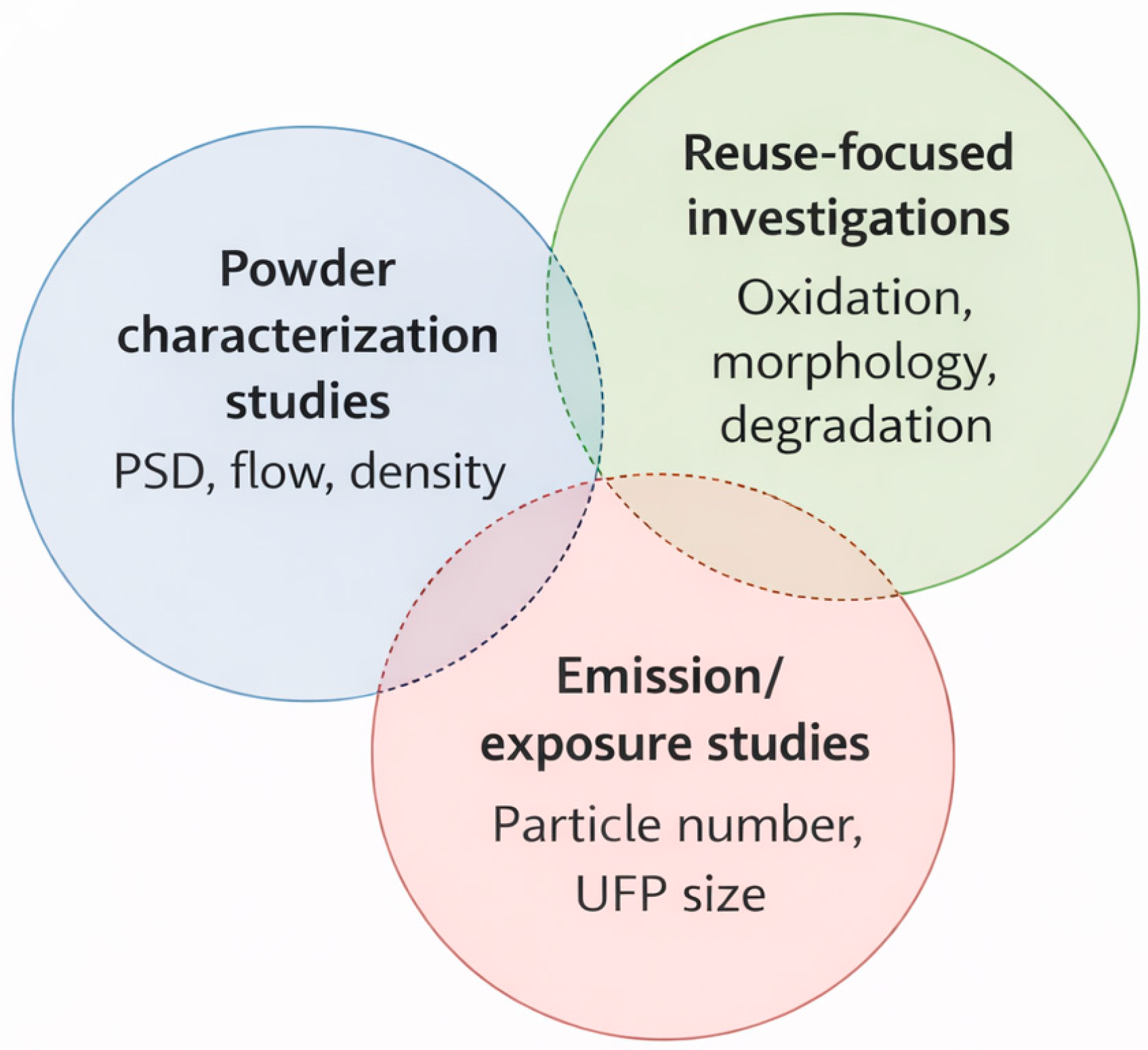
The reported variables differ substantially across publications. Powder characterization studies frequently report particle size and flow metrics without emission measurements. Exposure-focused investigations report airborne particle concentrations without detailed feedstock characterization. This separation of reported parameters limits directs cross-comparison and motivates the normalization strategy adopted in the APBM formulation. Figure 2 illustrates the distribution of the reviewed studies across powder characterization, reuse-focused, and emission-oriented domains.
Figure 2.
Distribution of quantitative domains in the reviewed literature.
3.2. Powder Production Routes
Gas atomization produces near-spherical metal powders with narrow PSDs and low satellite content, which improves spreading uniformity and flow stability in LPBF [17]. Water-atomized powders retain higher surface roughness and oxide films, increasing particle interlocking and reducing flow consistency during recoating [18]. Plasma atomization and Plasma Rotating Electrode Process (PREP) processes generate highly spherical droplets solidified into regular particles, used mainly for Ti-based and reactive alloys where controlled oxygen levels and surface purity are required [19,20].
Post-atomization sieving is used to narrow particle size distribution and remove fines or oversized fractions. Experimental data report shorter flow time and improved packing after classification, accompanied by reduced usable material mass [18,19]. Powder reuse has been reported for stainless steel 316L, cobalt–chromium alloy Stellite® 21, and duplex stainless steel UNS S32750. Oxidation increases with cycle count, and fine particle accumulation shifts PSD toward smaller fractions, modifying recoating behavior and melt pool stability [21,22]. Some stainless steel batches retain hardness during reuse, but printed parts exhibit density variation, indicating morphological evolution without full mechanical degradation [22].
Feedstock origin dictates subsequent behavior during processing. Gas-atomized powders maintain stable recoating, low cohesion forces, and predictable flow. Water-atomized powders display higher sensitivity to humidity and increased agglomeration risk. Plasma-derived powders provide highly controlled morphology at a higher production cost and lower throughput, which places them in applications requiring stable melt behavior [18,19,20,21,22].
3.3. Physical Characteristics Influencing Flow and Packing
Particle size distribution controls layer packing and powder mobility during the recoating process. Gas-atomized feedstock for 316L and AlSi10Mg is characterized by narrow D10–D90 intervals, favoring uniform spreading in LPBF [5,18]. Water-atomized powders present a broader PSD and a higher fraction of irregular particles, which increases interparticle friction and leads to local packing scatter on the powder bed [19]. In PBF, spherical particles promote constant layer thickness, while angular particles increase resistance to the recoater blade and generate local void initiation [20].
Sphericity and satellite content are direct indicators of flow stability. Scanning Electron Microscopy (SEM) observations on gas-atomized stainless steels describe high roundness with limited satellites, whereas surface-rough particles retain attached fragments and display cohesion during spreading [18,19]. Satellite presence reduces flowability measured in standard funnel tests and correlates with non-uniform layer deposition under identical recoating parameters [5]. Surface oxidation identified in reused stainless-steel powders increases cohesion and changes discharge time, even when PSD remains within nominal process limits [21,22].
Apparent and tap density describe packing efficiency more accurately than PSD alone. Higher density in gas-atomized powders aligns with stable bed formation and lower disturbance sensitivity in flowing gas environments [5,20]. Flow time measurements indicate that fine-fraction enrichment increases discharge time and humidity-driven agglomeration below approximately 20 μm [18,21]. Reuse cycles shift PSD towards finer fragments due to spatter, producing measurable changes in bulk density and flow repeatability [21,22].
These parameters form the Material Fingerprint input in APBM. PSD, roundness, satellite incidence, density metrics, and flow behavior remain the primary quantitative variables used to characterize spreading quality and bed stability.
3.4. Process Parameters Influencing Powder Behavior
Laser power, scan speed, and hatch spacing define the volumetric energy applied to the powder layer. Higher energy input increases melt pool depth but intensifies particle lift-off near the laser track when the gas flow interacts with loose fines [20]. Low scan speed increases heat accumulation and promotes denser fusion, while high speed decreases melt stability and leaves partially sintered particles available for resuspension [18]. Hatch spacing modifies track overlap and influences the amount of unmolten powder exposed to shielding gas during recoating [19].
The interaction between metallic powder and the shielding gas strongly affects particle trajectories during deposition, particularly for low-inertia particles. Studies on jet-based additive manufacturing note that powder grains closely follow complex gas velocity fields, leading to recirculation and spatial redistribution before reaching the substrate [23].
Recoater type controls mechanical interaction with the powder bed. Blade systems produce consistent layers on spherical feedstock but induce drag when irregular grains or satellites are present [18,19]. Brush or soft recoaters adapt better to mixed PSD feedstock but increase the chance of particle embedding and local bed defects [20]. Recoater velocity also affects surface shear. Higher speed reduces cycle time but increases particle displacement and airborne fines, especially in reused or oxidation-rich batches [21].
Shielding gas conditions define powder entrainment and movement above the bed. Gas velocity and flow pattern determine whether fines remain in the recoating zone or enter the extraction path. Stable laminar flow improves powder removal from the laser track, while turbulent circulation zones increase recirculation and secondary redeposition [18,22]. Chamber geometry and nozzle orientation contribute to local acceleration regions where fines detach more easily from the bed.
DED systems introduce powder through a carrier gas stream, where the feed rate directly affects the melt pool loading. Higher feed rate increases deposition thickness but reduces melting efficiency when powder flux exceeds thermal capacity. Excess material forms spatter and fragmented fines that return to the bed or become airborne [21,22]. The interaction between feed rate and gas flow defines capture or escape trajectories for sub-45 µm particles.
Collectively, energy input, scan strategy, recoater mechanics, and gas flow determine how powder moves, detaches, and mixes during AM. These variables form the basis of the process interaction block within APBM, where process-induced fines and flow-induced lift-off are expressed later as P-index parameters.
3.5. Aerosolization and Redeposition in AM
Particle release in metal AM occurs during laser exposure, recoating, and gas sweeping. Measurements in metal AM environments report nano- and submicron airborne particles generated during processing, with emission levels influenced by process phase and ventilation conditions [24]. Measurements in LPBF chambers report nano- and submicron aerosols generated from spatter fragmentation and melt pool vapor, with particle count rising during active exposure phases [13,25]. Inert gas flow transports fines above the bed, where turbulence increases residence time and promotes recirculation while limiting extraction [26]. Direct measurements of inert gas flow in LPBF chambers revealed strong spatial velocity gradients and localized recirculation zones above the powder bed [27]. Regions with non-uniform velocity act as accumulation zones, sending particles back toward the melt area or into optical paths.
DED generates additional entrainment through the carrier gas stream. Powder bypassing the melt pool forms spatter, cools rapidly, and fractures into fines with aerodynamic diameters below the initial feedstock range [28]. Recoater shear amplifies lift-off when PSD includes fines or when oxidation increases cohesion variability. These detached particles can redeposit on the surface, attach to partially molten tracks, or enter the filtration stream depending on the flow gradient and nozzle geometry [26,28].
Most airborne mass detected during processing lies below 1 µm, while feedstock peaks remain in the tens of micrometers, indicating aerosolization driven by secondary break-up processes independent of the initial PSD [13,26,29]. Humidity and repeated thermal cycles increase the fine fraction in reused powders, shifting emission response and raising capture demand [30]. The parameters extracted from these observations are used in the ADP layer of APBM, where emission count, fine proportion, and chamber transport behavior define dispersion tendency. The presence of ultrafine airborne particles in metal AM environments has direct implications for occupational exposure and qualitative and quantitative risk assessment [31].
3.6. Recovery and Filtration Strategies
Metal powder capture systems rely on flow-driven separation, interception, or electrostatic mechanisms. LPBF installations typically operate with gas extraction ducts connected to multi-stage recovery paths that include pre-filters and HEPA units [13]. Efficiency depends on particle diameter. Fines in the nano and submicron range escape coarse capture stages and require high-efficiency filtration. Aerosol size spectra measured in AM environments fall below the cutoff of cyclone separators, which limits recovery unless operated with high tangential velocity [26].
Cyclones separate particles above tens of micrometers by inertial motion and are suitable for capturing coarse feedstock losses from recoater overflow. Submicron particles pass through unless paired with secondary filtration. HEPA systems capture >99.97% of particles around 0.3 µm and represent the final stage of airflow circuits in LPBF and DED machines [13,26]. Electrostatic precipitators provide higher performance for fine aerosols under controlled humidity and stable flow patterns, reducing filter load when placed upstream of HEPA modules [28].
Recovery efficiency decreases when reuse shifts PSD towards finer fragments. Reused powder drifts toward smaller fractions and higher filter load compared to virgin feedstock [30]. Recovery design depends on the expected fine fraction and airflow regime. In the APBM framework, these parameters enter the recovery module to relate the ADP outcome with appropriate capture routes.
Recovered powder particles are not considered equivalent to virgin feedstock, as reuse alters surface condition, fine particle fraction, and flow behavior. Recovery yield relative to scrap is not quantified because it depends on machine configuration and operating parameters. Recovery is treated through relative recovery classes in the Adaptive Powder Behavior Model (APBM).
3.7. Adaptive Powder Behavior Model (APBM)
APBM is formulated as a comparative, indicator-based framework derived from published quantitative data on metal additive manufacturing. The framework has not been experimentally validated and does not provide calibrated predictions of airborne concentrations. The model uses the extracted dataset to quantify metal powder behavior in AM by structuring and normalizing heterogeneous powder and process data into relative indicators that enable comparison across powders, reuse states, and process configurations in LPBF and DED environments. This level of abstraction reflects the intended use of the model as a screening and decision-support tool, distinct from detailed physical or exposure models.
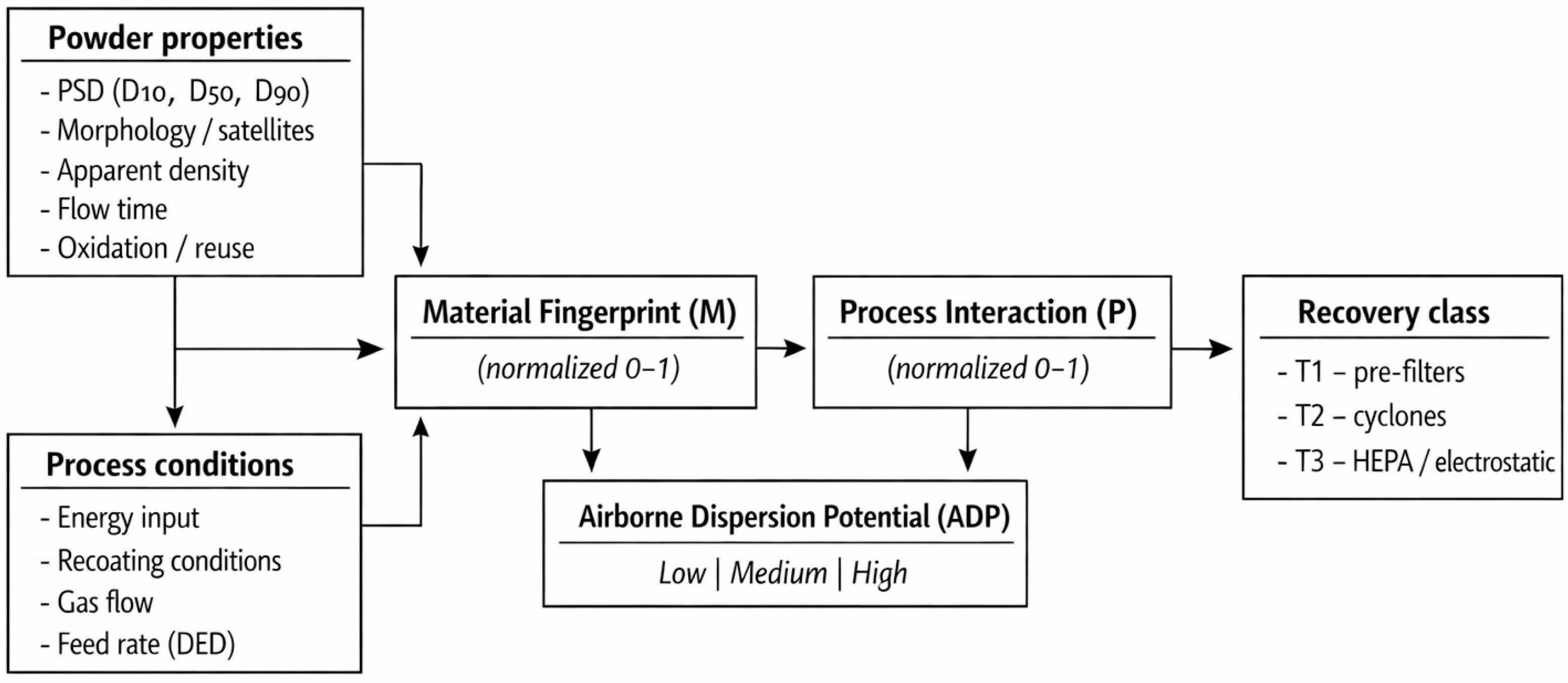
The model is structured into four independent modules, each based on normalized parameters in the 0–1 range. The domains correspond to Material Fingerprint, process interaction, airborne dispersion potential, and recovery feasibility. Figure 3 summarizes the structure of the APBM and the relation between powder properties, process conditions, airborne dispersion potential, and recovery class.
Figure 3.
Conceptual structure of the Adaptive Powder Behavior Model (APBM).
Each module yields a standalone index comparable across alloys and studies. No weighting or aggregation into a single score is applied at this stage. Within each module, independently normalized parameters are combined using arithmetic averaging to obtain a single index value. This aggregation step preserves parameter independence and supports consistent comparison across datasets. The formulation does not assume linear physical relationships between powder or process variables and is not intended as a statistical representation of variability. It is defined as a comparative construct for screening-level assessment.
3.7.1. Material Fingerprint (M)
The Material Fingerprint M quantifies powder attributes that govern spreading behavior and powder bed stability. All variables are normalized to the 0–1 interval and represent the size distribution, particle morphology, surface condition, and flow performance. A simple Material Fingerprint index is
where msize reflects the suitability of the D10–D50–D90 distribution for stable recoating, mshape expresses sphericity and satellite presence observed in microscopy, mpor accounts for porosity or surface oxidation that increases cohesion, and mflow is derived from flow time measurements (Hall or Carney funnel results). All scores are dimensionless between 0 and 1. Higher values indicate powders that spread uniformly and maintain consistent layer thickness. Lower values correspond to cohesive behavior and increased probability of fine particle detachment.
3.7.2. Process and Powder Interaction Index (P)
The process interaction index, P, groups the operational parameters that influence powder displacement during AM. The score reflects the combined effect of energy input, material feed, inert gas flow, and recoating conditions. All variables are normalized to a 0–1 scale. The process interaction index P is
where penergy represents volumetric energy density or heat input applied to the powder bed, pfeed describes powder feed rate in DED or delivery stability in LPBF, pgas reflects shielding gas velocity and flow pattern near the melt zone, and precoat accounts for recoater type and translation speed. Higher values indicate process conditions that favor powder lift-off, fine particle formation, or entrainment into the gas stream. Lower values correspond to lower disturbance intensity and reduced resuspension. The index does not replace detailed thermal or Computational Fluid Dynamics (CFD) models but offers a comparative scale for evaluating process configurations with respect to airborne powder generation.
3.7.3. Airborne Dispersion Potential (ADP)
The ADP quantifies the probability of powder becoming airborne under specified process conditions. The index associates material properties with operational parameters through the product of the Material Fingerprint and the process–powder Interaction scores, expressed on a normalized scale.
ADP takes values between 0 and 1. Higher values indicate an increased probability of powder detachment or entrainment in the gas stream during exposure to thermal input, gas flow, or recoating. Lower values reflect stable spreading and reduced fine release. Chamber geometry or recirculation intensity may adjust this tendency, and correction can be integrated when measured data are available.
For interpretation, ADP can be classified into ranges:
- ADP < 0.3: low dispersion;
- 0.3 ≤ ADP ≤ 0.6: medium dispersion;
- ADP > 0.6: high dispersion.
Thresholds serve as reference values and may be updated if validation data are collected in controlled trials.
3.7.4. Recovery Optimization Index (R)
The recovery module connects airborne dispersion to filtration strategy selection. The recovery index R reflects the level of recovery performance required to retain powder and reduce airborne losses.
where T denotes the recovery technology class available for deployment.
Technology classes are defined as operational intensity levels:
- T = 1: coarse system, such as gravity settling or pre-filters;
- T = 2: medium-grade solutions, such as cyclones or fabric filters;
- T = 3: high-efficiency devices, such as HEPA or electrostatic collectors.
As a practical selection guide,
- ADP < 0.3: T = 1 or T = 2;
- 0.3 ≤ ADP ≤ 0.6: T = 2;
- ADP > 0.6: T = 2 or T = 3 used in combination.
The index informs early design decisions and process comparison. Detailed sizing still relies on aerodynamic design equations. The model is used to relate powder behavior to recovery intensity.
3.8. Demonstrative Case Study: AlSi7Mg
In this demonstrative case study, indicator values for the reused powder scenario are derived within the APBM framework based on literature-reported trends and are not based on experimental measurements. They are used solely to illustrate the model response to changes in powder state.
The first illustrative case considers virgin gas-atomized AlSi7Mg powder used under LPBF conditions. AlSi7Mg gas-atomized powder reports D10 = 26.92 µm, D50 = 38.70 µm, D90 = 53.17 µm, an apparent density of 4.41 g/cm3, and a Hall flow time of 21.5 s/50 g [5]. SEM analyses in the same study indicate a predominantly spherical morphology with limited satellite presence. These values allow direct computation of the Material Fingerprint M after normalization according to min–max ranges extracted from the dataset.
Considered dataset limits: PSD range for AM powders: ≈20–60 µm; apparent density range: 3.8–4.6 g/cm3; flow time range: 15–32 s/50 g.
Normalized material scores: msize = (38.7 − 20)/(60 − 20) = 0.47, mshape = 0.75, mpor = (4.41 − 3.8)/(4.6 − 3.8) = 0.76 and mflow = 1 − (21.5 − 15)/(32 − 15) = 0.62.
Process parameters for LPBF were set using typical industrial operating windows reported in the literature [1,3]. A medium volumetric energy density and moderate gas velocity scenario was selected.
Normalized process scores: penergy = 0.65, pfeed = 0.60, pgas = 0.55, and precoat = 0.70.
An ADP of 0.40 falls in the medium dispersion interval. According to the recovery index logic, the recommended system is class T2, corresponding to the cyclone or fabric-filter level. For continuous operation or powder reuse cycles, a secondary HEPA stage is advised to retain sub-20 µm fines. This example illustrates how APBM converts powder and process data into a decision-oriented dispersion and recovery indicator using experimental input available in the literature without calibration.
The second illustrative case considers the same AlSi7Mg powder after multiple reuse cycles reported in the literature. To examine the response of the APBM to powder reuse, the same AlSi7Mg powder was considered after multiple reuse cycles reported in the literature. Reuse is associated with oxygen pickup and an increased fine fraction, while the median particle size often remains within the nominal LPBF range. Across reported studies, these reuse-induced changes reduce flow consistency and increase interparticle cohesion, which lowers the material-related components mpor and mflow without modifying the process settings.
Based on reuse-related trends reported in the literature, the material-related components were conservatively adjusted within the same normalization ranges used for the virgin powder case. The following values were considered, msize = 0.45, mshape = 0.70, mpor = 0.60, and mflow = 0.50, reflecting increased surface oxidation and fine particle accumulation. The resulting Material Fingerprint is M = 0.56.
Under identical LPBF conditions the process interaction index remains unchanged (P = 0.62). The corresponding airborne dispersion potential is ADP = 0.35. Compared to the virgin powder case, reuse leads to a higher dispersion tendency within the medium ADP range, indicating an increased probability of fine particle detachment during recoating and laser exposure. According to the recovery classification, this increase requires combined medium- and high-efficiency capture stages (T2–T3) during extended reuse cycles. Similar experimental LPBF studies report measurable effects of particle morphology and powder flowability on powder layer density and part quality [32].
Table 3 summarizes the results for the evaluated virgin and reused AlSi7Mg scenarios.
Table 3.
Summary of APBM results for the demonstrative AlSi7Mg scenarios under LPBF conditions.
Values for the reused powder case were derived by adjusting material-related components (mpor, mflow) within the same normalization ranges, based on reuse-induced trends reported in the literature. T2 denotes a medium-efficiency recovery class, such as cyclones or fabric filters, as defined in the APBM framework. T2–T3 denotes a combined recovery strategy in which medium-efficiency separation is supplemented by high-efficiency filtration to address increased fine particle dispersion.
4. Discussion
Current practice in metal additive manufacturing often selects filtration and recovery systems based on machine configuration or operational habit, without reference to quantified dispersion risk. As a result, capture efficiency may be mismatched with powder condition, especially during reuse cycles when fine fraction and oxidation increase. APBM converts reported powder and process data into dispersion-oriented indicators of material stability and process disturbance.
Analysis of the reviewed dataset suggests that powder behavior in metal AM is driven by a combined effect of morphology, fines fraction, surface state, and process-induced disturbance. Gas-atomized powders are characterized by high sphericity and regular droplets, which reduce frictional contacts during spreading and generate uniform packing [5,18]. Water-atomized feedstock maintains irregular surfaces and thicker oxide films that increase capillary cohesion and local packing variance [19,20]. In APBM, these differences map directly to higher mshape and mflow, and lower values for powders with satellites or roughened surfaces. The multi-parameter representation avoids PSD-only conclusions, improving reproducibility when material batches differ in shape or surface chemistry despite similar median size.
Several studies report that morphology-driven flow differences persist when particle size distributions overlap, particularly in gas-atomized versus water-atomized powders [18,19,20]. SEM-based analyses show that satellite attachment and surface roughness increase interparticle friction and cohesion, effects that are not captured by PSD metrics alone. Experimental comparisons of classified powders suggest that similar D50 values may correspond to markedly different spreading behavior and layer stability, depending on surface state and satellite incidence [18,19]. These findings record the APBM assumption that morphology-related parameters must be treated independently from size descriptors when assessing dispersion and reuse behavior.
Flow behavior deteriorates more strongly under reuse than PSD trends alone indicate. Studies documenting oxygen pickup and fines accumulation in 316L indicate that flow repeatability drops even when D50 remains within specification [22]. This justifies treating mpor and mflow as independent input channels. In APBM, a decrease in any single material parameter lowers M without requiring the recalculation of others, which replicates realistic powder aging conditions. This modularity permits laboratories to monitor degradation using simple flow and density measurements, without requiring full metallurgical characterization.
Literature on powder reuse reports oxygen accumulation and fine particle generation as cumulative effects of repeated processing and handling [21,22]. For reused 316L and AlSi alloys, oxidation-induced cohesion modifies flow repeatability and discharge behavior even when the median particle size remains within nominal limits. These observations indicate that reuse-related degradation follows non-linear trajectories that cannot be inferred from PSD trends alone. The separation of reuse-sensitive parameters into distinct APBM inputs reflects this behavior and aligns with experimental findings that report decoupled evolution of size, surface chemistry, and flow properties during reuse cycles.
Experimental investigations on reused stainless steel and aluminum alloy powders document progressive changes in flowability, surface chemistry, and fine fraction accumulation during repeated processing cycles, even when inert atmospheres and nominal process windows are maintained. These observations align with the inclusion of reuse-sensitive inputs in APBM, which capture degradation pathways not reflected by median particle size alone [9,11].
Process parameters act as a second disturbance mechanism, independent but cumulative with material conditions. Higher gas velocity increases aerodynamic drag at the powder surface and promotes detachment of fine particles (<20 µm), while high volumetric energy density intensifies spatter and melt pool plume dynamics [3,13]. Combined, these factors increase airborne fractions even for powders with good flowability. In APBM, such conditions elevate pgas and penergy, which propagate into ADP. This separation between material-driven stability (M) and process-driven disturbance (P) preserves interpretability and accounts for situations where two batches of the same alloy respond differently under modified laser or gas settings.
Process-focused studies highlight that gas flow conditions and energy input influence airborne particle release independently of feedstock quality [3,13]. Measurements inside LPBF chambers demonstrate that local gas velocity gradients and recirculation zones amplify fine particle lift-off, mainly for particles below 20 µm [13,24]. High energy density intensifies melt pool dynamics and spatter formation, contributing to secondary fine generation. These effects have been reported for virgin and reused powders, suggesting that process-induced disturbance represents a separate contribution to dispersion risk. The APBM separation between material-related stability and process-driven disturbance mirrors this distinction observed in experimental studies.
Measurement-based assessments conducted in metal additive manufacturing facilities report higher concentrations of nano- and submicron particles during active processing and powder handling phases. These findings indicate a separation between material-related stability and process-induced disturbance, as airborne release is observed for powders with measured flow characteristics when exposed to specific gas flow and energy input conditions [14,16].
The ADP formulation integrates dimensions by multiplication, avoiding weighted addition. This choice prioritizes coupling and penalizes instability originating from either side. A powder with high sphericity processed under turbulent gas flow can yield a similar ADP to a mid-quality powder processed under gentle flow. The model reflects operational risk in addition to nominal material grade. The calculated ADP of 0.40 for AlSi7Mg aligns with medium dispersion behavior, consistent with the current use of cyclano-filtration as the first stage of capture in LPBF. If reuse pushes oxygen above the reported 35% and fines increase, mpor and mflow decrease, and ADP grows without additional calibration [22]. This sensitivity to degradation informs early-stage decision-making, where powder can be screened before large build jobs.
Filtration decisions found in the reviewed work rarely follow measured criteria. Cyclones handle coarse fractions effectively at low pressure drop, but capture efficiency declines sharply for <10 µm aerosols, while HEPA or electrostatic stages are required for sub-micron retention [13,15]. In most practical reports, filtration upgrades occur post-exposure or empirically, not based on quantifiable powder behavior. The recovery index R formalizes this gap by connecting ADP to recovery intensity (T1–T3). For an ADP value above ~0.6, high-efficiency retention is required. This transforms extraction system selection from operator-driven into data-driven, improving inter-facility reproducibility.
Reports on filtration performance in metal AM environments indicate that capture system selection is often based on equipment availability instead of on measured particle size spectra or emission rates [13,15]. Studies measuring aerosol size distributions consistently show dominant fractions below cyclone cut-off diameters, particularly during active laser exposure and powder handling [13,26]. Recovery system upgrades are frequently implemented only after exposure concerns arise. By associating dispersion indicators with recovery class requirements, APBM provides a decision logic that reflects reported filtration limitations and performance thresholds.
Studies quantifying particle size distributions in LPBF chambers illustrate dominant aerosol fractions below the effective cut-off of cyclone-based recovery systems during laser exposure and recoating. This mismatch between emitted particle size and capture efficiency highlights the limitations of equipment-driven filtration selection and supports the use of dispersion-informed recovery criteria [17].
APBM uses only measurable variables: PSD (D10/D50/D90), flow time, apparent density, gas velocity, and laser input. No empirical tuning coefficients are embedded. This means that any lab using Hall flow and density cup measurements can reproduce M and P, provided the dataset min–max ranges are known. As new materials are added, boundaries update while the index formula remains constant. This property satisfies reproducibility criteria demanded in modern research and allows transfer between LPBF, DED, or EBM systems without changing the model. ADP thresholding can be externally validated through emission sampling; once enough datasets exist, weighting can be introduced without altering the structure.
Research on metal powders in AM reports PSD values, flowability, reuse effects, and emission data, but these results are usually presented as separate findings and not in a common numerical format [5,18,19]. Most publications quantify single parameters without placing heterogeneous measurements on a common scale. Studies reporting detailed particle size metrics focus on powder spreading stability and flow behavior and do not quantify airborne particle release. In contrast, emission-focused investigations measure particle number concentration and ultrafine size distribution without reporting D10–D90 values or flow parameters. Reuse-oriented studies quantify oxidation and morphological change but rarely extend analysis to airborne dispersion. No study within the reviewed set integrates all three quantitative domains within a single experimental framework. This fragmentation limits reproducibility across studies and complicates the transfer of results between alloys and process configurations. APBM responds to this gap by normalizing reported values on a 0–1 interval and grouping them into Material Fingerprint, process interaction, and airborne dispersion domains. The framework does not replace CFD or rheological modeling. The approach serves as an early screening tool that ranks powders and process setups using data already available in most characterization studies. This guides feedstock selection, dispersion estimation, and filtration class decisions before testing.
A recurring limitation across the reviewed literature is the lack of a common numerical framework for comparing heterogeneous measurements. Powder characterization studies typically report PSD, flowability, or oxidation metrics in isolation, while emission studies focus on airborne concentration without reference to feedstock condition [5,18,19,24]. As a result, cross-study comparison remains largely qualitative. The normalization strategy adopted in APBM places diverse measurements on a unified scale, on which relationships between powder condition, process disturbance, and dispersion behavior can be evaluated across studies.
In practice, APBM can be used in powder management and process setup for LPBF and DED operations. The framework compares powder batches using reported particle size distribution (D10–D90), flow time, bulk density, and oxidation changes induced by reuse. These parameters capture differences in spreading stability and fine generation that are not evident from nominal size classes alone. For example, two AlSi7Mg powders with similar median particle size and identical laser and recoating settings may behave differently after several reuse cycles. An increased fine fraction or surface oxidation leads to higher dispersion potential under the same gas flow conditions. Based on the resulting APBM indicators, operators can decide whether reuse should continue, whether powder should be reclassified to remove fines, or whether higher-efficiency filtration stages are required.
Reports describing powder handling, reuse management, and exposure control in metal additive manufacturing environments indicate that dispersion behavior, fine generation, and recovery performance remain tightly coupled to both powder condition and process configuration. Structuring these observations into comparative indicators provides a consistent basis for reuse decisions and recovery system selection across different operational contexts [11,16].
In this way, APBM connects routine powder characterization data with concrete decisions on reuse limits, powder handling, and recovery system configuration before excessive airborne release occurs.
The framework further evaluates process configurations where gas flow velocity, chamber recirculation, or recoating conditions differ. Setups characterized by higher fine residence time or increased recirculation potential can be identified using published flow and emission data, allowing recovery intensity and powder reuse limits to be adjusted accordingly. These examples illustrate how APBM translates literature-reported parameters into practical criteria for powder reuse management and airborne particle control.
Nano-emission reporting remains limited. A few studies cover the sub-micron region, which restricts calibration of the ADP component [24,29]. More controlled data on gas flow, scan speed, and reuse cycles would improve resolution. Coupling APBM with CFD or machine telemetry could evolve the recovery module into an optimization step beyond rule-based decision logic. This model offers a repeatable way to compare powder batches, reduce empirical trials, and support planning of recovery systems.
The reviewed literature highlights the need for intermediate assessment tools that connect experimentation and decision-making. While CFD simulations and in situ measurements provide high-resolution insight, they are rarely available during early powder selection or reuse planning. Empirical rules lack transferability across materials and machines. APBM occupies this intermediate space by formalizing literature-reported measurements into comparative indicators that reflect trends observed across studies, without introducing fitted coefficients or case-specific assumptions.
This study has several limitations related to data availability and measurement heterogeneity in the published literature. The APBM framework is based exclusively on quantitative data reported in the literature. As a result, index resolution depends on the availability and consistency of published measurements, particularly for fine and nanoparticle fractions. Emission data remain limited for several alloys and process configurations, which constrains dispersion threshold refinement.
The framework does not intend to replace thermal or flow simulations and does not account for machine-specific chamber geometry or transient gas flow effects. APBM is intended as a comparative screening tool for powder behavior and recovery planning, not as a substitute for process-level optimization or exposure assessment.
Within this context, the effect of individual factors is interpreted in terms of directional influence without assigning absolute ranking. Particle sphericity and stable flow behavior are associated with improved powder bed stability and lower dispersion tendency, while increased fine particle fraction and surface oxidation reduce flow stability and promote particle detachment. Process-related factors, such as gas velocity and applied energy input, further modulate these trends by amplifying airborne release even when material properties remain within nominal ranges. Dispersion behavior reflects the combined influence of powder condition and process disturbance.
5. Conclusions
This study presents a numerical approach for interpreting published powder data in additive manufacturing. The APBM framework converts measurable powder properties into four independent scores that describe material behavior, process interaction, airborne dispersion potential, and recovery feasibility. Feedstock characteristics are thus directly related to dispersion behavior and recovery requirements, using parameters reported in existing studies.
The framework applies to early stages of material selection and process planning, where decisions are frequently based on empirical criteria. The approach is used to rank powder batches, estimate the risk of airborne fraction, and define filtration intensity relative to powder condition and process settings.
The proposed framework targets research and engineering activities in metal additive manufacturing, with relevance for occupational safety assessments where dispersion behavior is poorly quantified and recovery choices lack systematic comparison.
Model calibration requires controlled emission data and extended datasets covering nanoparticle fractions, humidity effects, and multi-cycle reuse. Integration with emission measurements or process-resolved flow analysis represents the next development step of the framework toward predictive assessment of powder dispersion and recovery performance. From a technical perspective, the results suggest that powder dispersion and recovery behavior in metal additive manufacturing are governed by the combined influence of particle morphology, fine fraction, surface condition, and process-induced disturbance. The APBM framework translates these coupled effects into comparable indicators using parameters already reported in the literature, without introducing empirical fitting or machine-specific assumptions. From an industrial perspective, the framework guides early-stage decisions on powder reuse management, screening of powder batches, and selecting an appropriate recovery intensity. The model provides an approach to compare powder states and process configurations and to anticipate increased dispersion risk during reuse or under aggressive process conditions. This positions APBM as a decision-support tool for powder handling and recovery planning and not as a substitute for machine-level optimization.
Funding
This research received no external funding.
Institutional Review Board Statement
Not applicable.
Informed Consent Statement
Not applicable.
Data Availability Statement
The original contributions presented in this study are included in the article. Further inquiries can be directed to the corresponding author.
Conflicts of Interest
The author declares no conflicts of interest.
References
- Gibson, I.; Rosen, D.; Stucker, B.; Khorasani, M.; Rosen, D.; Stucker, B.; Khorasani, M. Additive Manufacturing Technologies; Springer: Cham, Switzerland, 2021; Volume 17. [Google Scholar] [CrossRef] [Scilit]
- Frazier, W.E. Metal Additive Manufacturing: A Review. J. Mater. Eng. Perform. 2014, 23, 1917–1928. [Google Scholar] [CrossRef] [Scilit]
- DebRoy, T.; Wei, H.L.; Zuback, J.S.; Mukherjee, T.; Elmer, J.W.; Milewski, J.O.; Beese, A.M.; Wilson-Heid, A.; De, A.; Zhang, W. Additive Manufacturing of Metallic Components—Process, Structure and Properties. Prog. Mater. Sci. 2018, 92, 112–224. [Google Scholar] [CrossRef] [Scilit]
- Herzog, D.; Seyda, V.; Wycisk, E.; Emmelmann, C. Additive Manufacturing of Metals. Acta Mater. 2016, 117, 371–392. [Google Scholar] [CrossRef] [Scilit]
- Muñiz-Lerma, J.A.; Nommeots-Nomm, A.; Waters, K.E.; Brochu, M. A Comprehensive Approach to Powder Feedstock Characterization for Powder Bed Fusion Additive Manufacturing: A Case Study on AlSi7Mg. Materials 2018, 11, 2386. [Google Scholar] [CrossRef] [Scilit]
- Cook, P.S.; Phua, A.; Davies, C.H.J.; Delaney, G.W. Modelling the influences of powder layer depth and particle morphology on powder bed fusion using a coupled DEM-CFD approach. Powder Technol. 2023, 429, 118927. [Google Scholar] [CrossRef] [Scilit]
- Foteinopoulos, P.; Papacharalampopoulos, A.; Stavropoulos, P. On thermal modeling of Additive Manufacturing processes. CIRP J. Manuf. Sci. Technol. 2018, 20, 66–83. [Google Scholar] [CrossRef] [Scilit]
- Cooke, A.; Slotwinski, J. Properties of Metal Powders for Additive Manufacturing: A Review of the State of the Art of Metal Powder Property Testing; NIST Interagency/Internal Report (NISTIR); National Institute of Standards and Technology: Gaithersburg, MD, USA, 2012. [Google Scholar] [CrossRef] [Scilit]
- Grubbs, J.; Sousa, B.C.; Cote, D. Exploration of the Effects of Metallic Powder Handling and Storage Conditions on Flowability and Moisture Content for Additive Manufacturing Applications. Metals 2022, 12, 603. [Google Scholar] [CrossRef] [Scilit]
- Chu, F.; Zhang, K.; Shen, H.; Liu, M.; Huang, W.; Zhang, X.; Liang, E.; Zhou, Z.; Lei, L.; Hou, J.; et al. Influence of Satellite and Agglomeration of Powder on the Processability of AlSi10Mg Powder in Laser Powder Bed Fusion. J. Mater. Res. Technol. 2021, 11, 2059–2073. [Google Scholar] [CrossRef] [Scilit]
- Svozilova, S.; Zetková, I.; Marin, J.F.S.; Garay, J.A.T. Evaluation of Recycled and Reused Metal Powders for DMLS 3D Printing. Materials 2024, 17, 6184. [Google Scholar] [CrossRef] [Scilit] [PubMed]
- Douglas, R.; Lancaster, R.; Jones, T.; Barnard, N.; Adams, J. The Influence of Powder Reuse on the Properties of Laser Powder Bed-Fused Stainless Steel 316L: A Review. Adv. Eng. Mater. 2022, 24, 2200596. [Google Scholar] [CrossRef] [Scilit]
- Stefaniak, A.B.; Du Preez, S.; Du Plessis, J.L. Additive Manufacturing for Occupational Hygiene: A Review of Processes, Emissions, & Exposures. J. Toxicol. Environ. Health B 2021, 24, 173–222. [Google Scholar] [CrossRef] [Scilit]
- Graff, P.; Ståhlbom, B.; Nordenberg, E.; Graichen, A.; Johansson, P.; Karlsson, H. Evaluating Measuring Techniques for Occupational Exposure during Additive Manufacturing of Metals: A Pilot Study. J. Ind. Ecol. 2017, 21, S120–S129. [Google Scholar] [CrossRef] [Scilit]
- Bau, S.; Rousset, D.; Payet, R.; Keller, F.-X. Characterizing Particle Emissions from a Direct Energy Deposition Additive Manufacturing Process and Associated Occupational Exposure to Airborne Particles. J. Occup. Environ. Hyg. 2019, 17, 59–72. [Google Scholar] [CrossRef] [Scilit] [PubMed]
- Alijagić, A.; Engwall, M.; Särndahl, E.; Karlsson, H.; Hedbrant, A.; Andersson, L.; Karlsson, P.; Dalemo, M.; Scherbak, N.; Färnlund, K.; et al. Particle Safety Assessment in Additive Manufacturing: From Exposure Risks to Advanced Toxicology Testing. Front. Toxicol. 2022, 4, 836447. [Google Scholar] [CrossRef] [Scilit] [PubMed]
- Zegzulka, J.; Gelnar, D.; Jezerska, L.; Prokes, R.; Rozbroj, J. Characterization and flowability methods for metal powders. Sci. Rep. 2020, 10, 21004. [Google Scholar] [CrossRef] [Scilit]
- Mathias, L.E.T.; Pinotti, V.E.; Batistão, B.F.; Rojas-Arias, N.; Figueira, G.; Andreoli, A.; Gargarella, P. Metal powder as feedstock for laser-based additive manufacturing, From production to powder modification. J. Mater. Res. 2024, 39, 19–47. [Google Scholar] [CrossRef] [Scilit]
- Lewis, G. Aspects of the powder in metal additive manufacturing, A review. World J. Eng. Technol. 2022, 10, 363–409. [Google Scholar] [CrossRef]
- Ladani, L.; Sadeghilaridjani, M. Review of Powder Bed Fusion Additive Manufacturing for Metals. Metals 2021, 11, 1391. [Google Scholar] [CrossRef] [Scilit]
- Lanzutti, A.; Marin, E. The Challenges and Advances in Recycling/Re-Using Powder for Metal 3D Printing: A Comprehensive Review. Metals 2024, 14, 886. [Google Scholar] [CrossRef] [Scilit]
- Pereira, J.C.; Irastorza, U.; Solana, A.; Soriano, C.; García, D.; Ruiz, J.E.; Lamikiz, A. Effect of Powder Reuse on Powder Characteristics and Properties of DED Laser Beam Metal Additive Manufacturing Process with Stellite® 21 and UNS S32750. Metals 2024, 14, 1031. [Google Scholar] [CrossRef] [Scilit]
- Peters, B.; Pozzetti, G. Flow Characteristics of Metallic Powder Grains for Additive Manufacturing. EPJ Web Conf. 2017, 140, 13001. [Google Scholar] [CrossRef] [Scilit]
- Spierings, A.; Herres, N.; Levy, G. Influence of the particle size distribution on surface quality and mechanical properties in AM steel parts. Rapid Prototyp. J. 2011, 17, 195–202. [Google Scholar] [CrossRef] [Scilit]
- Noskov, A.; Ervik, T.K.; Tsivilskiy, I.; Gilmutdinov, A.; Thomassen, Y. Characterization of Ultrafine Particles Emitted during Laser-Based Additive Manufacturing of Metal Parts. Sci. Rep. 2020, 10, 20989. [Google Scholar] [CrossRef] [Scilit]
- Slotwinski, J.A.; Garboczi, E.J.; Stutzman, P.E.; Ferraris, C.F.; Watson, S.S.; Peltz, M.A. Characterization of metal powders used for additive manufacturing. J. Res. Natl. Inst. Stand. Technol. 2014, 119, 460–493. [Google Scholar] [CrossRef] [Scilit]
- Weaver, J.; Schlenoff, A.; Deisenroth, D.; Moylan, S. Inert Gas Flow Speed Measurements in Laser Powder Bed Fusion Additive Manufacturing. In NIST Advanced Manufacturing Series 100-43; National Institute of Standards and Technology: Gaithersburg, MD, USA, 2021. [Google Scholar] [CrossRef] [Scilit]
- Meier, C.; Weissbach, R.; Weinberg, J.; Wall, W.A.; Hart, A.J. Critical influences of particle size and adhesion on the powder layer uniformity in metal additive manufacturing. J. Mater. Process. Technol. 2019, 266, 484–501. [Google Scholar] [CrossRef] [Scilit]
- Roth, G.A.; Geraci, C.L.; Stefaniak, A.; Murashov, V.; Howard, J. Potential Occupational Hazards of Additive Manufacturing. J. Occup. Environ. Hyg. 2019, 16, 321–328. [Google Scholar] [CrossRef] [Scilit] [PubMed]
- Yang, H.; Li, S.; Li, Z.; Ji, F. Experimental and Numerical Study on the Packing Densification of Metal Powder with Gaussian Distribution. Metals 2020, 10, 1401. [Google Scholar] [CrossRef] [Scilit]
- Sousa, M.; Arezes, P.; Silva, F. Occupational Exposure to Ultrafine Particles in Metal Additive Manufacturing: A Qualitative and Quantitative Risk Assessment. Int. J. Environ. Res. Public. Health 2021, 18, 9788. [Google Scholar] [CrossRef] [Scilit] [PubMed]
- Haferkamp, L.; Haudenschild, L.; Spierings, A.; Wegener, K.; Riener, K.; Ziegelmeier, S.; Leichtfried, G.J. The Influence of Particle Shape, Powder Flowability, and Powder Layer Density on Part Density in Laser Powder Bed Fusion. Metals 2021, 11, 418. [Google Scholar] [CrossRef] [Scilit]

Disclaimer/Publisher’s Note: The statements, opinions and data contained in all publications are solely those of the individual author(s) and contributor(s) and not of MDPI and/or the editor(s). MDPI and/or the editor(s) disclaim responsibility for any injury to people or property resulting from any ideas, methods, instructions or products referred to in the content. |
© 2026 by the author. Licensee MDPI, Basel, Switzerland. This article is an open access article distributed under the terms and conditions of the Creative Commons Attribution (CC BY) license.