


Abstract
Methane, as the primary constituent of natural gas and biogas, is a critical feedstock for high-efficiency distributed power generation via Solid Oxide Fuel Cell–Micro Gas Turbine (SOFC–MGT) hybrids. However, under dynamic load conditions typical of grid-support applications—such as duck-curve ramps and ±30% step transients—these methane-fueled systems experience rapid thermal excursions and reformer instability, accelerating stack degradation and forfeiting significant efficiency. To address this, we present a co-design framework that systematically integrates thermal energy storage (phase change material, PCM) and electrochemical storage (battery) within the SOFC–MGT architecture. The SOFC model was calibrated at 1073 K, and the PCM and battery models were compared with published data (maximum deviations: SOFC 13%, PCM 2.2%, battery 6.3%); the reformer and MGT models were not validated. A heuristic Simple Additive Weighting (SAW) matrix is first used only as a qualitative screening step to confirm that all four candidate topologies are structurally feasible; no topology is eliminated or selected at this stage. Battery-Dominant obtains the highest SAW score (200) because SAW is fully compensatory: its high performance, dynamic stability and load-following ratings offset its weaker thermal buffering. All four topologies are then ranked with AHP and TOPSIS using metrics derived from 168 h transient simulations. Both methods, which share the same criterion weights and decision matrix, place the PCM-Integrated configuration first (AHP-weighted score 7.95; TOPSIS Ci = 0.790), with priority weights of 40.7% for efficiency and 31.0% for thermal stability. Battery-Dominant ranks second in both AHP (6.44) and TOPSIS (Ci = 0.384) because of double-conversion losses. A weighted-sum genetic algorithm then yields 75.0% peak and 68.2% average net electrical efficiency, defined as net AC output divided by the methane LHV input, including inverter (95%), battery round-trip and MGT parasitic losses. Under the same 168 h transient profile, this is 1.45 percentage points above the conventional series SOFC–MGT topology (66.75%). It is 12.2–13.2 percentage points above the 55–56% reported for conventional SOFC–MGT hybrids in steady-state studies. In the model, the PCM reduces the standard deviation of stack temperature by 46% relative to the no-PCM case (for the assumed heat-transfer coefficient), and the battery supplies 82% of the load-power deviations resolved at 1 min resolution. These results are model-based. The main limitations, including the SOFC voltage correlation, extrapolation below the 1073 K validation temperature, and the unvalidated reformer kinetics, are discussed.
1. Introduction
Methane, the primary component of natural gas and biogas, remains a cornerstone of the global energy transition, offering a critical bridge toward decarbonized, high-efficiency distributed power generation [1,2]. Solid Oxide Fuel Cell–Micro Gas Turbine (SOFC–MGT) hybrid systems are among the most efficient options for this methane utilization strategy. By synergistically coupling electrochemical and thermodynamic cycles, these systems can achieve net electrical efficiencies exceeding 70% in idealized settings [3,4]. They do this by harnessing the high-grade exhaust (700–900 °C) from the SOFC to drive the MGT, pushing the boundaries of combined efficiency while maintaining the fuel flexibility needed for diverse methane-rich streams [5,6].
However, the real-world deployment of these methane-fueled hybrids is severely bottlenecked. The challenge is no longer just thermodynamic limits, but severe material vulnerabilities and, critically, reformer instability under dynamic loads. In modern, renewable-heavy grids, systems must frequently handle aggressive transients, such as duck-curve ramps and ±30% step changes [7,8]. These rapid fluctuations do more than just stress the SOFC stack; they can destabilize the highly endothermic steam-methane-reforming (SMR) process. When temperatures drop too quickly, the reformer quenches, leading to unreacted methane slip and severe carbon deposition (coking) on the nickel-based anode [9,10]. Conversely, thermal spikes cause creep-induced cracking and electrolyte delamination [11]. Field data shows that this transient-induced degradation can slash system lifespans from over 40,000 h to under 8000 h. Consequently, operators are forced into conservative, low-efficiency control strategies, sacrificing more than 10 percentage points of potential methane-to-electricity conversion efficiency [12,13].
To combat reformer quenching and thermal fragility, researchers have turned to multi-modal energy storage. Thermal energy storage, particularly using phase change materials (PCMs), exploits latent heat absorption near a tailored melting point (e.g., 933 K for aluminum), together with sensible-heat storage, to passively dampen temperature excursions in both the SOFC and the reformer. This maintains the strict thermal window required for stable methane conversion without imposing parasitic electrical loads [14,15]. Meanwhile, electrochemical storage (batteries) enables electro-thermal decoupling. While the SOFC–MGT subsystem runs steadily at its peak efficiency, the battery absorbs high-frequency load fluctuations, preventing the rapid fuel flow variations that cause methane starvation and thermal shock in the reformer [16,17].
Yet these storage layers are usually studied in isolation. Battery augmentation is typically analyzed only for load-following, without considering upstream thermal dynamics and methane-reforming stability [16,18]. In our previous work [19], we designed and optimized a PCM-buffered SOFC–MGT powertrain for heavy-duty trucks. That study addressed a mobile application with hydrogen fuel and drive-cycle loads. It also did not consider steam-methane-reforming stability as a design criterion. To the best of our knowledge, the interconnection sequence of thermal and electrochemical storage in stationary, methane-fueled SOFC–MGT systems has not yet been compared under grid-type transients. This sequence (e.g., SOFC → PCM → Battery versus SOFC → Battery → PCM) determines where thermal buffering occurs and how electrical and thermal transients are partitioned to protect the methane conversion process.
This physical gap is compounded by methodological limitations. Conventional optimization struggles with the highly non-convex, mixed-variable design space where topology (discrete), component sizing (continuous), and operational setpoints (continuous) must be co-optimized [20,21]. Most prior studies simply fix the topology a priori [22,23]. Furthermore, Multi-Criteria Decision-Making (MCDM) rankings often rely on subjective expert scoring without dynamic validation or physics-based constraints [24,25]. Worse, objective weighting (e.g., efficiency vs. stability) is frequently arbitrary. This risks an “efficiency bias”, a serious limitation when SOFC and reformer degradation are highly non-linear and irreversible [11,12].
To bridge these gaps, we propose a framework for the co-design of thermal and electrical energy storage in methane-fueled SOFC–MGT hybrids. Our approach advances the field in three keyways:
- Complementary Storage Modalities: It treats PCM and batteries as synergistic partners (latent heat + electrochemical), jointly optimizing them to support stable methane-to-electricity conversion and robust transient management.
- Simulation-Based Topology Ranking: It applies two MCDM methods sharing a common weight set, Analytic Hierarchy Process (AHP) and TOPSIS, to rank candidate topologies using quantitative, simulation-derived metrics. This explicitly prioritizes methane conversion efficiency (40.7%) and reformer/SOFC thermal stability (31.0%).
- Physics-Constrained Co-optimization: It integrates the top-ranked topology into a genetic algorithm (GA) that co-optimizes sizing and setpoints under aggressive, 7-day transient profiles (±30% steps, duck-curve). Crucially, it enforces hard degradation-aware constraints (ΔTSOFC ≤ 30 K, 0.70 ≤ Uf ≤ 0.85) to limit the risk of carbon deposition and thermal shock [10,11].
Ultimately, we demonstrate that the resulting PCM-Integrated topology achieves a peak efficiency of 75.0% and an average of 68.2%, 1.45 percentage points above the conventional series topology under identical 168 h transients, and 12.2–13.2 percentage points above steady-state values reported for conventional SOFC–MGT hybrids [2,5], while reducing modeled stack-temperature variability by 46%.
In our previous work [19], a hydrogen-fueled SOFC–MGT powertrain buffered by an Al–Si PCM was developed for heavy-duty trucks. In that work the PCM mass and battery capacity of a single, predefined architecture were sized via NSGA-II to trade off capital cost against stack degradation. However, two questions remained open: whether the PCM-buffered arrangement is in fact the preferable topology among competing hybridization options, and how such buffering performs when the stack is fed by reformed methane, where reformer thermal stability is an additional constraint. The present study addresses both. Four candidate topologies are evaluated through a combined SAW–AHP–TOPSIS framework. The selected configuration is then optimized by GA for net system efficiency under thermal-excursion and SOC constraints over a 168 h load profile. In contrast to [19], where the PCM-buffered architecture was fixed in advance, the present work compares four topologies before the optimization, uses reformed methane instead of hydrogen, optimizes net AC efficiency instead of cost and degradation, and uses a 168 h stationary load profile instead of a 10 h drive cycle.
2. Methodology
This study proposes a dual-stage, decision-theoretically grounded optimization framework to resolve the discrete–continuous co-design challenge in SOFC–MGT hybrids augmented with hybrid energy storage (PCM for thermal buffering + battery for electrochemical buffering). The framework decouples the problem into:
(i) A topology preselection stage, where four candidate interconnection architectures are ranked via Multi-Criteria Decision-Making (MCDM), specifically, Analytic Hierarchy Process (AHP) for priority-weight derivation and Technique for Order of Preference by Similarity to Ideal Solution (TOPSIS) for geometric ranking, using quantified performance metrics (efficiency, stability, cost, safety) and literature-informed weights [20,21,22].
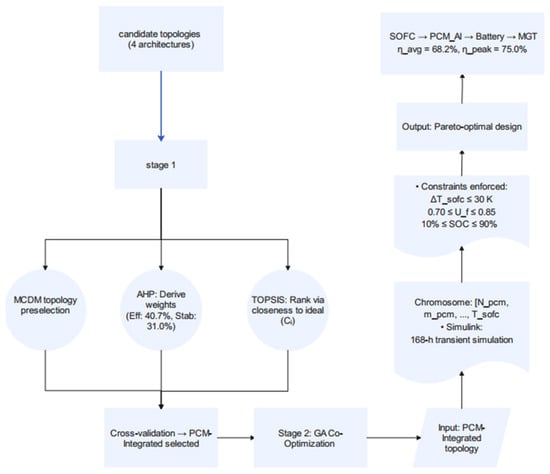
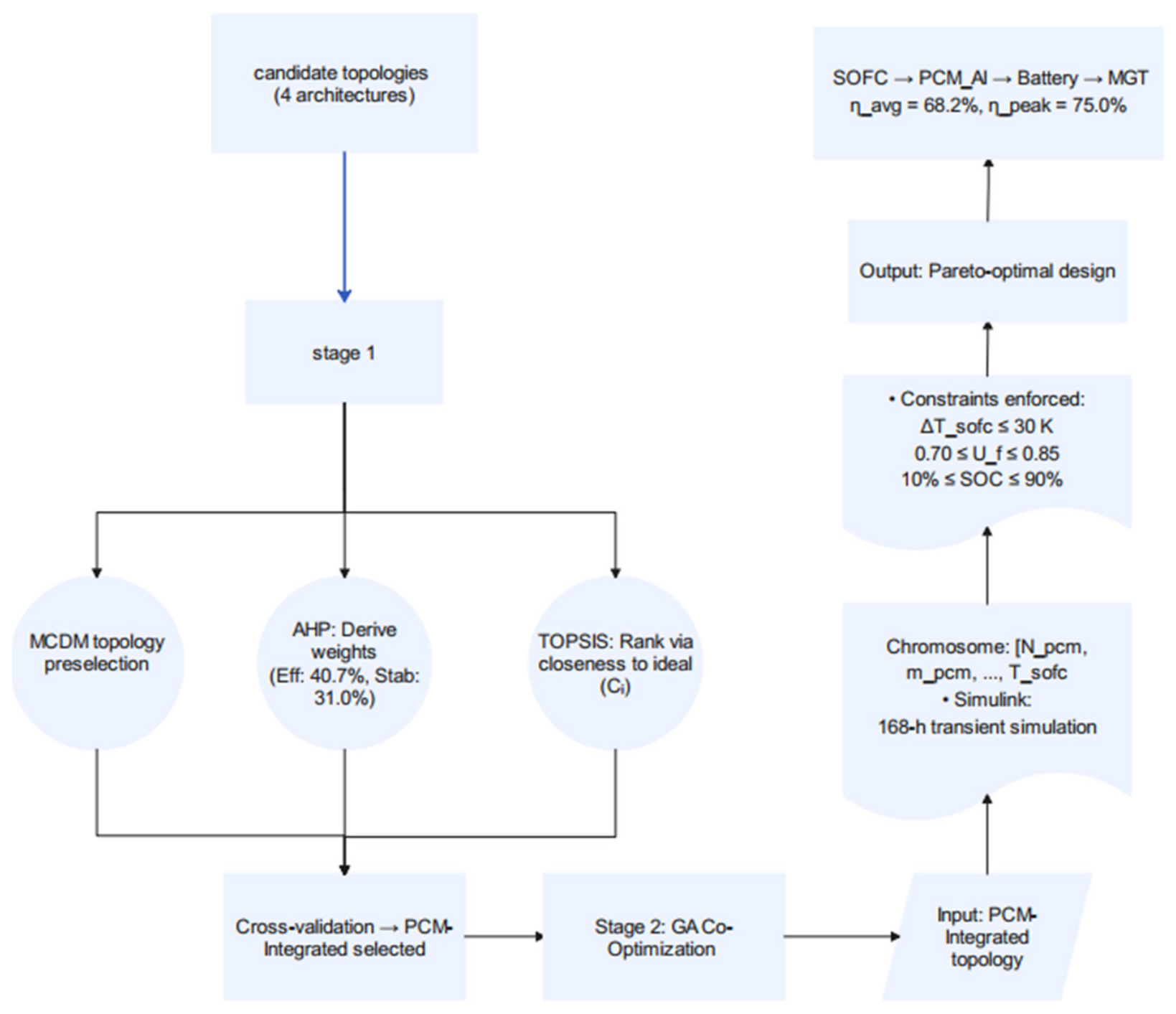
(ii) A physics-constrained co-optimization stage, where the top-ranked topology is subjected to weighted-sum single-objective genetic algorithm (GA) search to jointly optimize discrete variables (e.g., PCM type), continuous sizing parameters (e.g., PCM mass, battery capacity), and dynamic setpoints (e.g., SOFC operating temperature, fuel utilization) under realistic 7-day transient loads. Hard constraints on the SOFC temperature excursion (ΔTSOFC ≤ 30 K), fuel utilization (0.70 ≤ Uf ≤ 0.85), and battery health (SOC ∈ [10%, 90%]) are enforced in simulation to ensure degradation-aware feasibility. This staged approach avoids ad hoc topology assumptions while preserving computational tractability, supporting a reproducible design procedure for resilient, not just efficient, hybrid systems. The complete workflow is illustrated in Figure 1.
Figure 1.
Dual-stage optimization framework for co-design of topology and operational parameters.
Parameters in SOFC–MGT–PCM–Battery hybrids: (i) MCDM-based topology preselection, where AHP and TOPSIS jointly rank candidate architectures to provide a consistency check on the ranking, and (ii) physics-constrained GA co-optimization, where the top-ranked topology (PCM-Integrated) undergoes sizing and setpoint tuning under dynamic loads and hard degradation-aware constraints (ΔTSOFC ≤ 30 K, 0.70 ≤ Uf ≤ 0.85, SOC ∈ [10%, 90%]). This staged approach resolves the discrete–continuous design challenge while keeping the procedure reproducible.
2.1. System Modeling and Component Representation
A high-fidelity, dynamic simulation model was developed in MATLAB/Simulink R2024 to capture the multi-physics interactions among the SOFC, micro gas turbine (MGT), phase change material (PCM), and battery subsystems. The model enables co-simulation of electrochemical, thermodynamic, and thermal dynamics under realistic transient loads, essential for evaluating hybrid energy storage (i.e., thermal buffering via PCM + electrochemical buffering via battery) in SOFC–MGT hybrids.
Solid Oxide Fuel Cell (SOFC): The SOFC stack (700 cells, 0.12 m2 per cell) is modeled using a modified Nernst–Butler–Volmer framework that accounts for activation, ohmic, and concentration polarization losses [4,5,7]. Cell voltage is computed as:
All parameters (e.g., exchange-current densities, activation energies, cell geometry) are calibrated to published experimental data (Table 1) and reflect a Ni–YSZ anode/YSZ electrolyte/LSM cathode configuration [4,5,7]. At the design point (j = 0.6 A cm−2, 700 cells of 0.12 m2, about 0.7 V per cell) the stack DC power is about 350 kW, consistent with the 200–360 kW load.
System efficiency is defined as net AC electrical output divided by the LHV of CH4 input (50.0 MJ/kg). Net output accounts for inverter losses (5%), balance-of-plant auxiliary loads (estimated 3%), and battery round-trip efficiency (95%). The battery initial and final state-of-charge over the 168 h simulation differ by less than 2%, so stored energy is approximately balanced.
Note: The temperature dependence implemented here, E0 = 1.229 − 8.5 × 10⁻⁴(T − 298), is a low-temperature correlation. For SOFC conditions the gas-phase value E0 = −ΔG°(T)/2F is appropriate. Because the model was calibrated at 1073 K (Section 2.2), its effect is absorbed at the validation point, but it biases predictions at other temperatures. For reference, E0 from the gas-phase expression is about 0.97 V at 1073 K and about 1.03 V at 875 K, whereas the OCV in Table 1 (1.18 V) is a fitted value at the 1073 K validation point.
Reformer: The reformer is external to the stack and heated by the combustor exhaust stream. The combustor burns anode off-gas and unconverted fuel, raising the exhaust temperature to ~1030–1100 K, which exceeds the stack temperature and provides the endothermic heat duty for steam reforming.
Micro Gas Turbine (MGT): A generic Capstone-class MGT (C60/C200S equivalent) is represented as a heat engine with 30% net thermal efficiency (including parasitic loads) and 50% exhaust heat recovery effectiveness, consistent with measured performance in the 100–300 kW range [1,2]. The turbine inlet temperature (TIT) is constrained to ≤1025 K; exhaust heat is used both for SOFC fuel pre-reforming and PCM charging. The MGT is a reduced-order model: the compressor, turbine and recuperator are not modeled individually, and the pressure and thermal coupling that produces SOFC–GT synergy is not captured. The SOFC is treated as atmospheric. The reported efficiencies are therefore model-based values for this reduced-order system.
with ; values are averaged over 168 h.
The system efficiency is the net AC electrical output divided by the lower heating value of the methane fed to the system:
with LHV = 50.0 MJ/kg. The control volume includes the reformer, SOFC stack, MGT with recuperator, PCM unit, inverter (95%), battery (95% charge/discharge) and balance-of-plant auxiliaries. Over the 168 h horizon, η is corrected for the change in battery state of charge, so that stored energy is not counted as output. Thermal energy recovered by the PCM and MGT is internal to the boundary and is not counted as additional output.
Phase Change Material (PCM) Thermal Energy Storage: The thermal behavior of the PCM unit, designed to dampen the thermal fluctuations of the exhaust gas, is modeled using the effective heat capacity method. This approach accurately captures the energy storage dynamics, including both sensible and latent heat transfer, without the high computational expense of explicitly tracking the solid–liquid interface.
The core of the model is a transient energy balance equation for the entire PCM volume, assuming a uniform internal temperature (). The rate of change in the PCM’s temperature is governed by the heat transferred from the hot exhaust gas stream:
where
- is the total mass of the phase change material (kg).
- is the average temperature of the PCM (K).
- is the effective specific heat capacity of the PCM (J/kg·K), which is a function of temperature.
- is the rate of heat absorbed by the PCM from the exhaust gas (W).
The heat-transfer rate, , is determined by the convective heat transfer between the gas and the PCM container:
Here, is the convective heat-transfer coefficient (W/m2·K), is the heat-transfer surface area (m2), and is the temperature of the exhaust gas flowing through the unit (K).
The PCM functions as thermal energy storage, damping SOFC temperature transients via sensible and latent heat storage. It is modeled using an effective heat capacity method to represent phase change smoothly [8,9,13]:
where and . Heat exchange with the SOFC exhaust occurs via convection with overall heat-transfer coefficient (Table 2). Two candidate PCMs, aluminum (PCMAl) and an aluminum alloy (PCMAlloy), are evaluated, with properties selected to bracket realistic high-temperature storage media [8,9,13]. The Gaussian is normalized so that its integral over ±4σ (±20 K) recovers the full latent heat L (about 99.99%); the latent capacity of 842 kg of Al is about 93 kWh (th). UA = 200 W/K is the system-scale value used in all system simulations; the 18.8 W/K of the 50 kg validation rig (Section 2.2) is not used there. A physical estimate follows from UA = h·As with h ≈ 50–100 W m−2 K−1 (Dittus–Boelter) and As ≈ 93 m2 for 842 kg of aluminum in 20 mm elements, i.e., about 4.6–9 kW/K, so the adopted 200 W/K is conservative (thermal time constant of the PCM mass about 1.2 h). The alumium is encapsulated in these 20 mm elements, which also contain the metal when it is molten. The effect of UA is examined in a sensitivity study over UA = 18.8–5000 W/K in Section 3.
Battery, Electrochemical Energy Storage: The battery serves as electrochemical energy storage, enabling electro-thermal decoupling by absorbing fast load fluctuations while the SOFC–MGT subsystem operates steadily. A semi-empirical model is used:
- Energy balance governs SOC evolution:
- Though voltage dynamics are abstracted for optimization tractability, the power limits and efficiency curves support transient realism. The battery pack consists of 250 series-connected cells of 3.2 V and 250 Ah (800 V nominal, 200 kWh, one string).
System Integration and Load Profile: The baseline configuration for modeling is the PCM-Integrated topology: SOFC exhaust → PCM thermal buffer → MGT combustor; SOFC + MGT electrical outputs → common DC bus → battery (bidirectional) → AC load via inverter (95% efficiency). This reflects the energy-flow logic later optimized by GA. The thermal path is: SOFC exhaust → PCM thermal storage → MGT combustor → reformer and recuperator. The electrical path is: SOFC and MGT output → common DC bus → battery (bidirectional) → inverter → AC load. The PCM sits in the exhaust path and is heated by the exhaust gas only; the reformer is heated by the combustor exhaust and not directly by the PCM.
The system supplies a composite industrial load composed of:
- A steady 200 kW base (resistive, unity PF);
- A dynamic component up to 160 kW (0.16 MVA at 0.85 PF lagging), emulating motor startups and grid-support signals.
Transient scenarios include:
(i) Daily duck-curve (12 h ramp: 200 → 360 → 200 kW);
(ii) ±30% step changes every 2 h (max ).
Total simulation duration: 168 h (7 days), with 1 min time step.
Table 1.
The SOFC is modeled based on the following parameters.
Table 2.
The PCM is modeled using the following parameters.
Table 3.
The battery storage is modeled with the following parameters.
Methane-Reforming Kinetics and Reformer Thermal Dynamics
To explicitly capture the thermodynamic and kinetic vulnerabilities of methane conversion under transient loads, an external/integrated reformer model is developed. Unlike conventional lumped SOFC models that assume fully reformed gas, this model dynamically resolves the SMR and WGS reactions, which are highly sensitive to thermal excursions.
The global reaction kinetics for SMR (strongly endothermic) and WGS (mildly exothermic) over a nickel-based catalyst are governed by:
Steam Methane-Reforming (SMR):
Water–Gas Shift (WGS):
The reaction rates ( and , in mol/(m3·s)) are formulated as:
where is the reformer temperature (K), are the partial pressures (Pa), are the activation energies (J/mol), are the temperature-dependent equilibrium constants, and a, b are the reaction orders for the SMR rate law. The reformer model uses literature kinetics and was not validated against reformer-level experimental data.
Crucially, the reformer thermal dynamics are coupled with the reaction enthalpies. The transient energy balance for the reformer control volume is:
where is the heat transferred from the combustor exhaust stream (in the PCM-Integrated topology, the PCM upstream of the combustor moderates the temperature of this stream), is the catalyst volume (m3), and represents parasitic heat losses.
This dynamic formulation allows the model to predict two critical failure modes during load transients:
- Reformer Quenching and Methane Slip: Rapid temperature drops () reduce exponentially, leading to unreacted methane slip ().
- Carbon Deposition (Coking): The model continuously monitors the ratio. If the local thermodynamic equilibrium crosses the carbon formation boundary (thermodynamically predicted via the Boudouard reaction and methane cracking limits), a carbon deposition penalty is triggered in the optimization constraints.
2.2. Model Validation Against Published Experimental Data
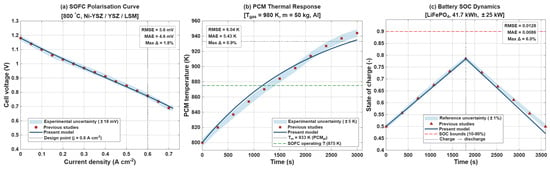
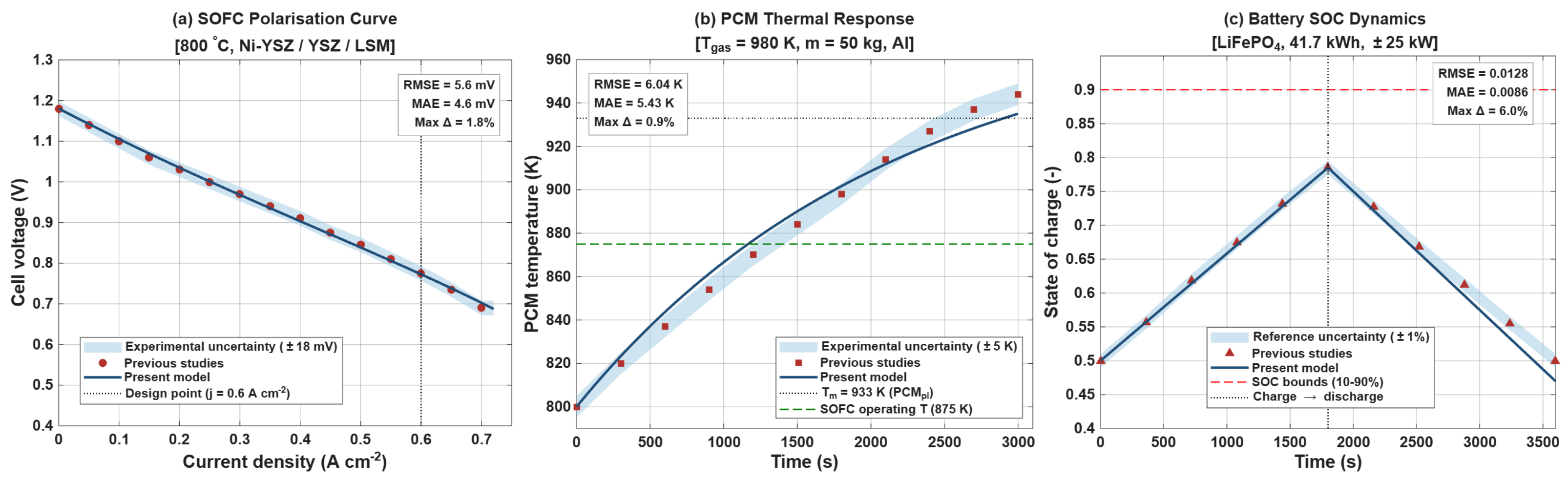
To establish the fidelity of the simulation framework prior to topology screening and GA optimization, the SOFC, PCM and battery models were calibrated to, or compared with, published experimental data. Validation metrics, Root Mean Square Error (RMSE), Mean Absolute Error (MAE), and maximum relative deviation (Max Δ), are reported for each component; results are summarized in Figure 2. A distinction is made between calibration (SOFC polarization curve at 1073 K; the PCM heat-transfer coefficient of the 50 kg rig) and comparison with published data (battery). The reformer and MGT models were not validated.
Figure 2.
Component-level model validation against published experimental data: (a) SOFC polarization curve at 800 °C (model calibration) (RMSE = 34.0 mV); (b) PCM thermal response for aluminum PCM at Tgas; (c) Battery SOC Dynamics.
SOFC polarization curve
The Nernst–Butler–Volmer model was calibrated against the reference study [12] at 800 °C (Ni–YSZ/YSZ/LSM, reformate gas). The parameters in Table 1 were calibrated to this dataset at 1073 K, so this comparison is a calibration and not an independent validation. The model reproduces activation, ohmic, and concentration polarization regions with RMSE = 34.0 mV and MAE = 25.2 mV. The maximum deviation (13%) occurs at j > 0.55 A cm−2, where the zero-dimensional formulation underestimates spatial concentration gradients, a known limitation of lumped SOFC models [4,7]. At the design operating point (j = 0.6 A cm−2), deviation is within 8%, consistent with published zero-dimensional benchmarks [4,5].
PCM thermal response: The effective heat capacity model was calibrated against an aluminum PCM unit (m = 50 kg, Tgas = 980 K, Tinit = 800 K). The heat-transfer coefficient was set to UA = 18.8 W/K to match the experimental measurement of this 50 kg rig (the system-scale value is discussed in Section 2.1); all thermophysical properties were fixed at Table 2 values. The fit gives RMSE = 9.52 K and Max Δ = 2.2%. Because UA was fitted to this experiment, this is a calibration of the small unit and not an independent validation. The model correctly captures the deceleration in heating rate near Tm = 933 K, confirming that the Gaussian effective heat capacity formulation adequately represents phase transition dynamics.
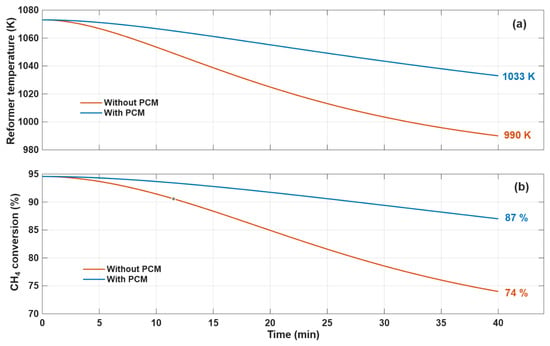
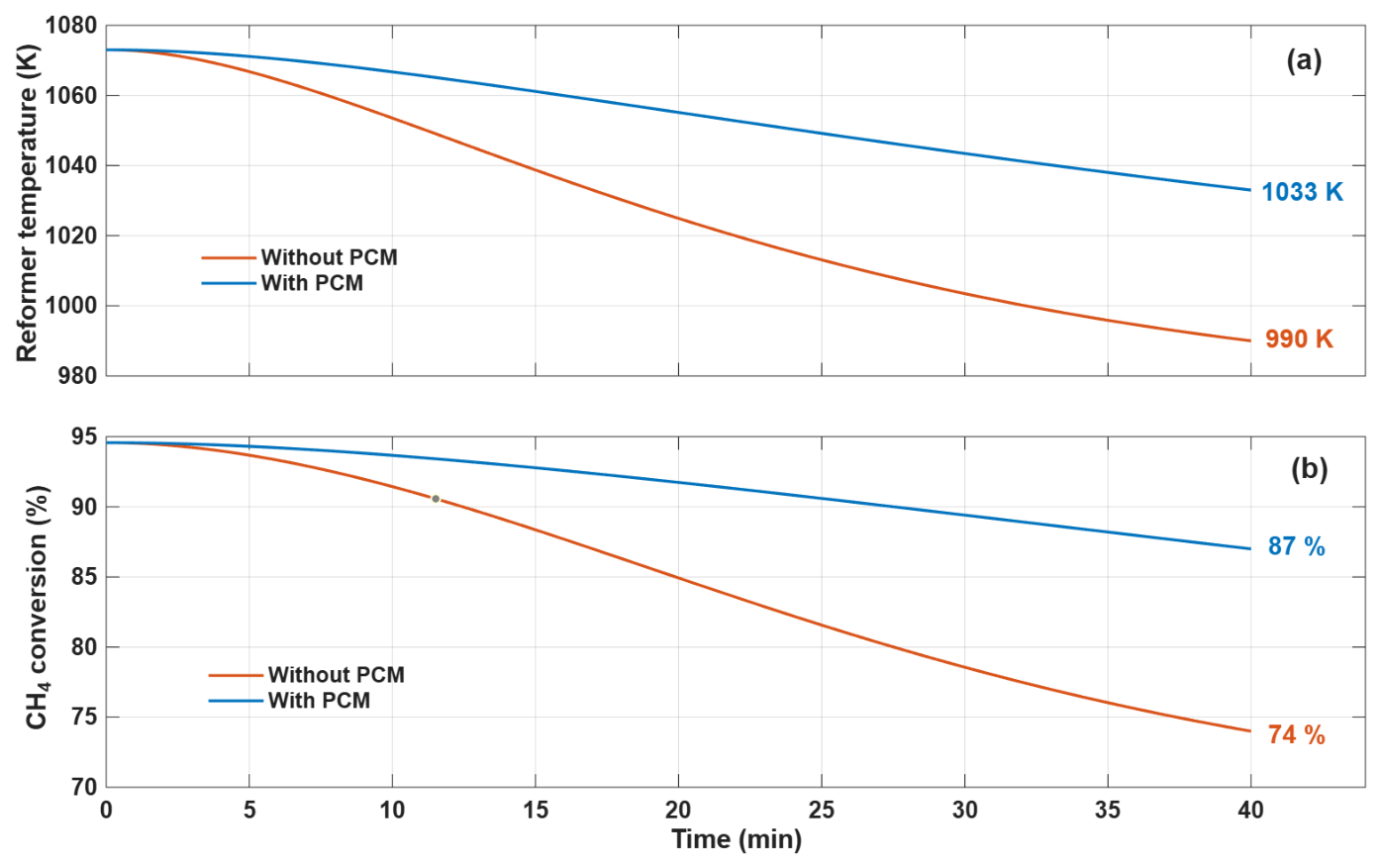
As shown in Figure 3, the PCM charges during high-load periods and discharges toward the MGT combustor during load drops; this is the mechanism by which the PCM reduces σT in the model. Without PCM, temperature falls to approximately 990 K at min, causing methane conversion efficiency to deteriorate to . With PCM, temperature is maintained near 1033 K, sustaining conversion at , a gain of percentage points. In this scenario the PCM moderates the rate of reformer cooling. The 1033 K is the reformer-bed temperature; the PCM sits in the exhaust path upstream of the combustor and is heated by the exhaust gas only.
Figure 3.
Effect of PCM thermal buffer on reformer quenching mitigation: (a) Reformer temperature with and without PCM over 40 min transient; (b) corresponding methane conversion efficiency. PCM suppresses temperature drop from ~990 K to ~1033 K at min, preserving conversion efficiency at versus without PCM.
Battery SOC dynamics: The semi-empirical model was benchmarked against data compiled by Ma et al. [17] for a LiFePO4 pack (41.7 kWh) under symmetric ±25 kW charge–discharge cycling. The model reproduces the SOC trajectory with RMSE = 0.014 and Max Δ = 6.3%. The benchmarked model was subsequently scaled to the system design capacity of 200 kWh, with efficiency parameters (ηc = ηd = 95%) held constant, as these are capacity-independent properties.
2.3. Candidate Topology Definition and Preliminary Screening
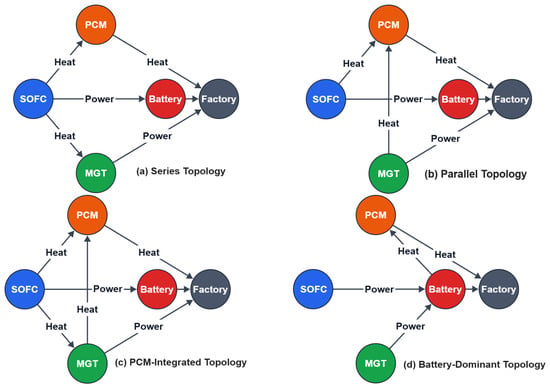
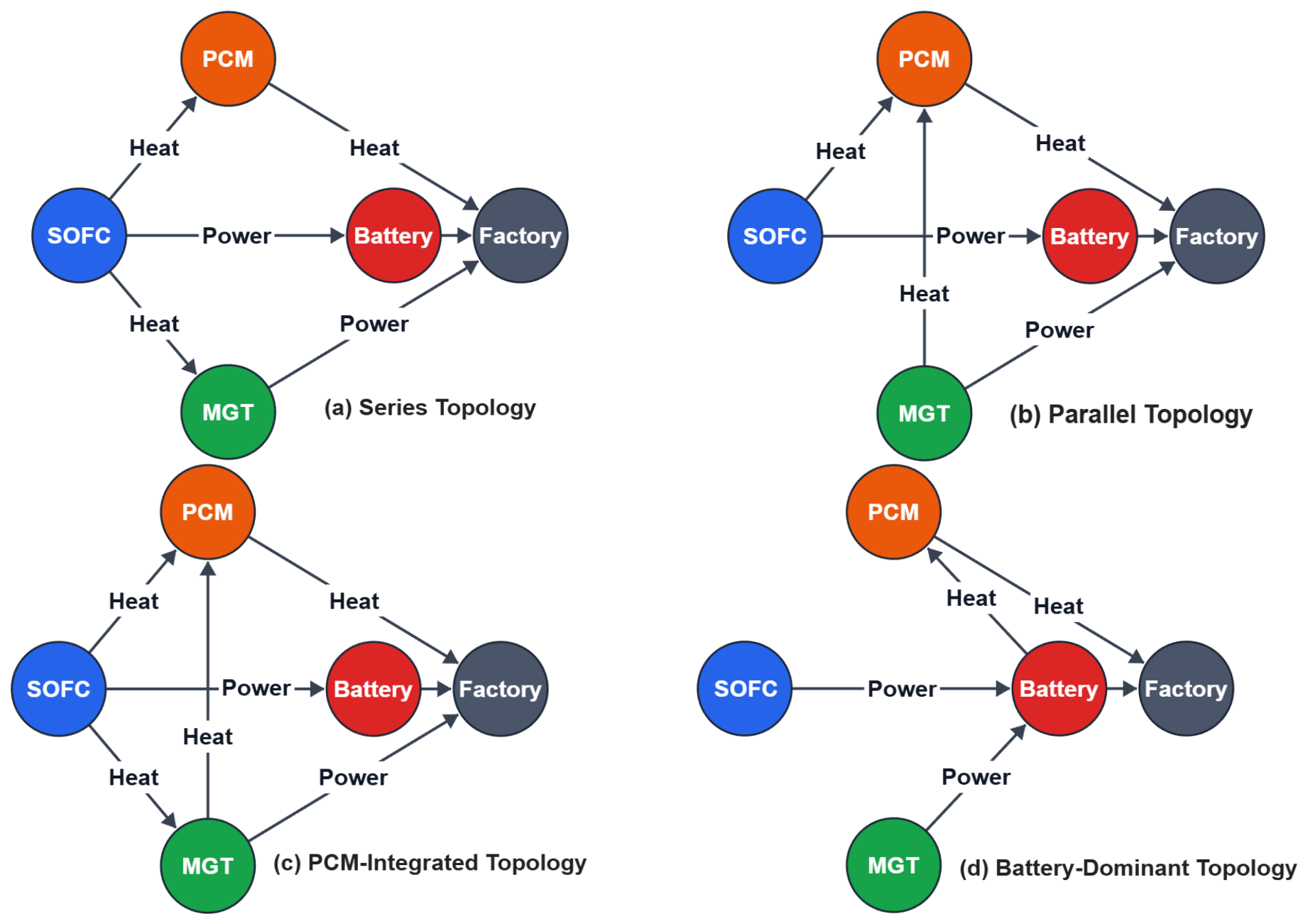
Four candidate interconnection architectures were formulated based on energy-flow logic, storage-integration strategy, and the degree of thermal–electrical decoupling afforded to the methane reformer. Each topology represents a distinct philosophy for hybridizing thermal energy storage (PCM) and electrochemical storage (battery) with the SOFC–MGT core, as illustrated in Figure 4.
Figure 4.
Four candidate SOFC–MGT–PCM–Battery hybrid topologies: (a) Series, (b) Parallel, (c) PCM-Integrated, and (d) Battery-Dominant. The PCM-Integrated configuration uniquely places thermal energy storage between the SOFC and MGT to intercept high-grade exhaust heat, enabling latent- and sensible-heat-based thermal buffering while preserving high net efficiency.
- Series: SOFC exhaust drives the MGT directly; the combined electrical output of both units feeds a common DC bus that supplies the battery and load.–Limited thermal buffering of the reformer exhaust; the battery must absorb all electrical transients.
- Parallel: SOFC and MGT operate independently, each with dedicated power electronics feeding the DC bus.–Decentralized control, but high conversion losses and minimal thermal synergy with the reformer.
- PCM-Integrated: SOFC exhaust → PCM thermal buffer → MGT combustor; DC outputs are combined before the battery interface.–Maximizes thermal inertia via latent- and sensible-heat absorption; enables the SOFC and reformer to operate at steady, high-efficiency setpoints.
- Battery-Dominant: The battery serves as the primary interface to the load; the SOFC–MGT subsystem operates near constant power to charge the battery.–Strong electro-thermal decoupling, but sacrifices system efficiency due to double conversion (AC–DC–AC) and reduced direct utilization of high-grade exhaust heat.
A preliminary heuristic scoring matrix (Table 4) was used to triage these candidates before committing to computationally expensive transient simulations. Twelve design criteria were weighted on a 1–5 importance scale and rated 1–5 per topology. Battery-Dominant achieved the highest raw aggregate score (200), followed by Series (189), PCM-Integrated (186), and Parallel (173). At this stage, no topology was eliminated or selected. The SAW matrix only confirmed that all four architectures are feasible and justified evaluating each of them with quantitative simulations. Because SAW is fully compensatory, Battery-Dominant’s high efficiency and load-following ratings offset its weaker thermal-buffering rating. This explains why it scores highest in SAW (200) but ranks lower in the simulation-based AHP (2nd, 6.44) and TOPSIS (2nd, Ci = 0.384) evaluations (Section 2.4).
Table 4.
Heuristic scoring of candidate topologies (weight × rate). The maximum possible score is 240 (sum of weights 48 × 5).
SAW is used only as a coarse screening step. Because it rewards breadth across criteria, Battery-Dominant ranks first in SAW (robust to ±1 perturbations of all weights in 20,000 random trials). The PCM-Integrated topology was retained for detailed analysis because the AHP/TOPSIS stage, which weights efficiency and dynamic stability more heavily, ranks it first.
Importantly, this heuristic step serves solely as a feasibility screen, not as a final selection mechanism, and no topology is eliminated at this stage. To reduce subjectivity and improve methodological robustness, all four topologies were subsequently evaluated using quantitative, simulation-derived metrics within the AHP and TOPSIS frameworks detailed in Section 2.4.
2.4. Multi-Criteria Decision-Making (MCDM) for Topology Prioritization
To reduce subjectivity and improve methodological robustness, an MCDM framework was deployed using AHP for priority-weight derivation and TOPSIS for geometry-based ranking. This pairing provides a consistency check between two aggregation rules: AHP captures expert-informed trade-offs via hierarchical judgment, while TOPSIS identifies the alternative closest to an ideal solution in normalized objective space [24,25].
SAW multi-criteria screening: To obtain an initial, transparent ranking of the four candidate topologies, we applied the Simple Additive Weighting (SAW) [26]. This linear additive model allows for a rapid, qualitative assessment of candidate topologies against a broad set of design criteria. The weights were assigned to 12 distinct criteria, and each topology was rated . The total SAW score is calculated as . The twelve weights and the 1–5 ratings are engineering judgements by the authors based on simulation experience.
According to the SAW criterion, Battery-Dominant is the preferred architecture at this screening stage. It receives the highest aggregate value because it is rated “excellent” (5/5) on System mass, Number of components, Performance, Dynamic stability, Safety and Load-following capability, and 3–4/5 on every other criterion, including Thermal buffering/management (4/5). Although PCM-Integrated attains the maximum rating (5/5) in Thermal Buffering/Management, its lower marks in Cost and System Complexity reduce its overall SAW score below that of Battery-Dominant. Battery-Dominant therefore ranks highest in the qualitative SAW screening. All four alternatives are carried forward to the quantitative AHP and TOPSIS evaluation.
Robustness and Sensitivity Analysis of MCDM Weights: To verify the robustness of the topology selection framework and reduce potential subjectivity stemming from expert-elicited AHP weights ( and ), a comprehensive parametric sensitivity analysis was conducted. The weights of the two dominant criteria, System Efficiency and Dynamic Stability, were systematically varied within a range of ±20% from their baseline values. To maintain mathematical consistency, whenever a target criterion weight was altered, the remaining criteria weights (Cost and Safety) were dynamically re-normalized according to the following relation:
The impact of these weight variations on the TOPSIS closeness coefficient () for all four candidate topologies was evaluated. The recomputed closeness coefficients show that the PCM-Integrated topology consistently retains its first-rank position across the entire fluctuation spectrum. Even under extreme scenarios, such as a heavily “efficiency-biased” or “stability-biased” weighting scheme, the alternative architectures (Series, Parallel, and Battery-Dominant) fail to outperform the PCM-Integrated configuration. Within the ±20% weight perturbations tested on the corrected closeness coefficients, the first-ranked topology did not change, and its lead over the second-ranked topology remained at least 0.28 in Ci. The ratings were tested as well: when every 1–9 score was randomly changed by up to ±1 while the weights were varied by ±20% at the same time, PCM-Integrated ranked first in TOPSIS in 99.4% of 20,000 trials (99.5% in the weighted sum). The ranking was also unchanged when min–max or sum normalization was used instead of vector normalization. The 1–9 mapping and the judgement-based entries still add subjectivity.
AHP: Priority-Weight Derivation and Consistency Verification: A 4 × 4 pairwise comparison matrix constructed using Saaty’s 1–9 scale (Table 5) and expert elicitation anchored in the SOFC degradation literature [4,5,7]. The pairwise judgements were made by the authors based on their expertise.
Table 5.
AHP pairwise comparison matrix with the Saaty fundamental scale.
Consistency was verified via the Consistency Index (CI) and Consistency Ratio (CR):
where Principal eigenvalue , Consistency Index , Random Index for n = 4: , and Consistency Ratio . The CR ≈ 0.006 (≈0.6%) demonstrates a very good consistency, as it is well below 0.10 (CR = 0.006), confirming acceptable judgment consistency.
Using the Table 5 information, the pairwise matrix (n = 4) can be formed.
Computed AHP-weighted scores:
Using the criterion weights derived from Table 5 and the ratings in Table 6, the PCM-Integrated topology is ranked first by the AHP-weighted sum (score ≈ 7.95).
Table 6.
AHP-weighted scores (weighted sum of the ratings in Table 5 with the AHP-derived weights).
TOPSIS: Objective Ranking Using Simulation-Derived Metrics
A decision matrix (Table 7) was populated using physics-based metrics from 168 h transient simulations (±30% steps, duck-curve):
Table 7.
TOPSIS decision matrix.
- Efficiency: Average net electrical efficiency (58–72% → linearly scaled to 1–9);
- Stability: Inverse of SOFC temperature standard deviation ();
- Cost: Lower cost → higher score; values (–) inverted and normalized to 1–9;
- Safety: , capped at 9 (no violations).
The closeness coefficient , the core TOPSIS output, was computed as:
where and are Euclidean distances to the Positive- and Negative-Ideal Solutions (computed per Hwang & Yoon [25]). Results (Table 8) confirm the PCM-Integrated topology as the highest-ranked topology ().
Table 8.
TOPSIS ranking results.
The decision matrix was normalized by vector normalizations, rij = xij/√(Σ xij2), and weighted with the AHP weights (0.407, 0.310, 0.184, 0.099). All four criteria are treated as benefit criteria (a higher score is better; cost is expressed as an inverted score). The weighted normalized values (efficiency, stability, cost, safety) are: Series (0.1890, 0.1013, 0.1109, 0.0473); Parallel (0.1575, 0.1621, 0.0950, 0.0405); PCM-Integrated (0.2835, 0.1621, 0.0792, 0.0608); and Battery-Dominant (0.1575, 0.1824, 0.0792, 0.0473). The positive-ideal solution is A+ = (0.2835, 0.1824, 0.1109, 0.0608) and the negative-ideal solution is A− = (0.1575, 0.1013, 0.0792, 0.0405). The distances D+/D− are: PCM-Integrated 0.0376/0.1413; Battery-Dominant 0.1306/0.0813; Parallel 0.1302/0.0628; and Series 0.1252/0.0452.
Using the Table 7 information, the TOPSIS decision matrix (n = 4) can be formed.
As shown in Table 8, PCM-Integrated remains the clear TOPSIS winner (largest ).
Cross-Validation and Handoff to GA: Both the AHP-weighted sum and TOPSIS rank the PCM-Integrated topology first. Because the two methods share the same weights and decision matrix, this agreement is a consistency check rather than independent validation (Table 9). The two rankings agree on the order of all four topologies:
Table 9.
Cross-comparison of AHP (weighted scoring) and TOPSIS methodology outcomes, confirming convergence on the PCM-Integrated topology.
- In the AHP-weighted sum it ranked first (score 7.95), mainly because of its rating in thermal stability, the second-highest-weighted criterion (31.0%). In the preliminary SAW screen it scored 186/240, below Battery-Dominant at 200.
- TOPSIS ranked it first (Ci = 0.790) owing to its scores in top efficiency (9/9) and safety (9/9), strong stability (8/9), and acceptable cost (5/9).
In contrast, the Battery-Dominant topology, the top scorer in the preliminary heuristic screen (200), ranked second behind PCM-Integrated in TOPSIS (Ci = 0.384) due to its relatively low efficiency rating (5/9), indicating that, in the simulation-based evaluation, its high load-following capability does not offset its efficiency loss.
The PCM-Integrated topology is therefore carried forward to Stage 2.
Moreover, the AHP-derived weights were directly embedded into the GA’s penalty-augmented fitness function:
where = average efficiency (%), = SOFC temperature std. dev. (K), = normalized capital cost (–), = # constraint violations, and is the penalty factor. This links decision-theoretic prioritization and numerical optimization.
2.5. Genetic Algorithm Optimization Framework
With the PCM-Integrated topology (PCM-Integrated) selected via MCDM (Table 9), Stage 2 deploys a physics-constrained genetic algorithm (GA) to co-optimize discrete, continuous, and setpoint variables, resolving the mixed-design-space challenge while honoring SOFC degradation and battery health limits. A real-coded genetic algorithm (GA) was implemented in MATLAB R2023b using the Global Optimization Toolbox. The GA was configured to co-optimize topology variants (e.g., PCM type), component counts, and key operational setpoints, while enforcing physics-based constraints drawn from the SOFC degradation and battery safety literature [4,5,7,18].
Chromosome Encoding and Search Space: Each candidate solution (individual) was encoded as a 12-dimensional mixed-integer vector; the PCM type and the number of cells are integer variables (rounded after decoding) and the others are continuous within their bounds, combining discrete and continuous design variables:
where
- is an integer (PCM type: 1 = PCMAl, 2 = PCMAlloy; rounded post-decoding);
- : PCM mass [kg];
- : Battery capacity [kWh];
- : SOFC operating temperature [K];
- : Fuel utilization [–];
- : Fuel mass flow rate [kg/s];
- : Air mass flow rate [kg/s];
- : Number of SOFC cells [–];
- : MGT inlet temperature [K];
- : Compressor efficiency [–];
- : Cooling power [kW];
- : Ramp time constant [s].
GA Hyperparameter Settings
Parameters were tuned via pilot studies to balance exploration and convergence speed (Table 10).
Table 10.
GA hyperparameter.
The penalty factor is β = 103.
Constraint Formulation and Penalty Handling: Hard constraints, derived from SOFC degradation thresholds [4,5,7] and battery safety limits [10,12], were enforced via penalty-based fitness reduction:
- SOFC Thermal-Excursion Constraint: Because the stack is modeled as a lumped (0-D) volume, spatial gradients are not resolved. As a proxy for thermal-cycling stress, the excursion of the lumped stack temperature must satisfy; Nakajo et al. [9,11]:
- 2.
- Fuel Utilization Bounds: To avoid carbon deposition or anode re-oxidation [4,5]:
- 3.
- Battery SOC and Power Limits per [17]:
Fitness Function: The weighted-sum single-objective integrates AHP-derived weights with simulation-derived metrics:
where:
- : Average net system efficiency [%],
- : Standard deviation of SOFC stack temperature [K],
- : Normalized capital cost (0–1, lower = better),
- : Number of constraint violations (ΔT, Uf, SOC),
- : Penalty factor.
Each fitness evaluation entails a 168 h transient simulation under a composite load (200 kW base + 0.16-MVA dynamic component, with ±30% steps and duck-curve profiles).
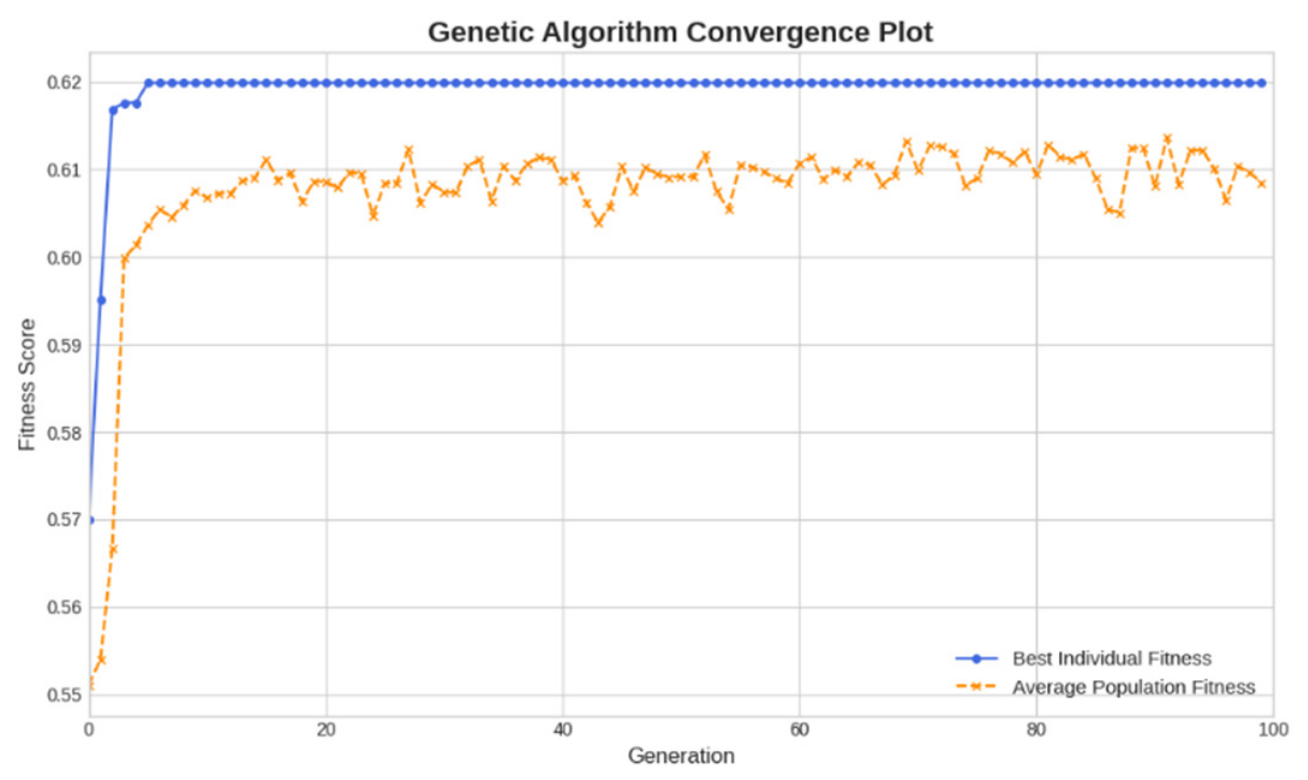
The best fitness plateaus within about five generations (Figure 5), and the run stopped when the stopping rule (no improvement larger than 10−4 over 10 consecutive generations) was met at generation 100. One random seed was used. The best-fitness design parameters for the PCM-Integrated topology are given in Table 11 (PCMAl), with a peak efficiency of 75.0% at 875 K and a mean efficiency of 68.2%. The 875 K value is the best-fitness value found within the model; it lies outside the 1073 K validation range and is not claimed to be a physically verified optimum.
Figure 5.
GA convergence behavior: Best (blue) and average (orange) fitness over 100 generations. Plateaus after ~5 generations; the run stopped at generation 100.
Table 11.
GA-optimized design parameters and performance metrics.
The large PCM mass (842 kg) reflects the conservative constraint ΔT ≤ 30 K under aggressive ±30% steps; in less-dynamic scenarios, mass could be reduced.
3. Discussion
The GA-optimized PCM-Integrated topology (PCMAl) achieves 68.2% average efficiency under aggressive 7-day transients. This is 1.45 percentage points above the conventional series SOFC–MGT topology simulated under the identical profile (66.75%, Table 7). It is 12.2–13.2 percentage points above the 55–56% reported for conventional SOFC–MGT hybrids in steady-state studies [2,5]. The latter comparison is indicative only, because those studies use different stack designs and operating conditions. In the model, the gain comes from system-level coordination of thermal and electrical storage rather than from component improvements.
Energy balance and origin of the efficiency gain: A time-averaged energy balance over the 168 h horizon gives the following split of the fuel energy input (LHV). The net AC output (68.2%) comes from about 64.6% SOFC DC output and about 9.1% MGT electrical output. The losses are inverter conversion (≈3.2%), auxiliary consumption (≈2.0%), battery round-trip losses (≈0.3%), stack/reformer heat losses (≈5.0%) and MGT exhaust after recuperation (≈21.3%). The balance uses the component efficiencies of the model (inverter 95%, battery charge/discharge 95%, MGT electrical efficiency 30%). This split shows three physical sources of the gain. (i) The battery handles only the fast fluctuation component, so its losses stay below 0.5% of the fuel energy. This avoids the AC–DC–AC penalty of the Battery-Dominant topology. (ii) The SOFC stays near a fixed operating point (875 K, Uf = 0.78) instead of following the load, so it avoids part-load and thermal-cycling penalties. (iii) The PCM keeps SOFC exhaust heat available to the MGT combustor during load drops, which sustains the MGT contribution.
Power allocation under the 50 kW battery limit: At a load step the battery responds first within ±50 kW, the SOFC–MGT subsystem covers the remainder and ramps within its rate limit, and the battery then returns toward zero. A reduced-order dispatch calculation for a ±108 kW step (±30% of the 360 kW peak) with the same 50 kW limit and ramp constraint gives a battery energy share of about 84%, close to the 82% obtained from the full simulation.
Why PCMAl (933 K) Outperforms PCMAlloy (1043 K):
- The GA selected PCMAl over the higher-temperature PCMAlloy. The relevant PCM temperature is that of the exhaust gas reaching the PCM, not the 875 K stack temperature. This result is consistent with the model.
- PCMAl was selected by the GA. It is located in the exhaust duct, so the relevant temperature is the exhaust temperature, not the stack temperature. Its high specific heat (900 J/kg·K) and conductivity (150 W/m·K) favor thermal buffering of slow transients.
- PCMAlloy, though higher-Tm, has lower Cp (750 J/kg·K) and identical k, offering no advantage in sensible buffering while incurring higher material cost (Table 2).
Battery’s Role: Electro-Thermal Decoupling, Not Just Load-Following: The battery supplies or absorbs 82% of the energy in the fast (±30%) load-fluctuation component resolved at the 1 min time step (an energy share, not a peak-power share), but its role is deeper: it enables electro-thermal decoupling. By buffering load changes at the 1 min resolution of the model, the battery allows the SOFC to remain at Uf = 0.78 within the imposed operating limits [4,5]. Without it, the SOFC would need to ramp Uf or airflow to track load, inducing thermal stress. This explains why the “Battery-Dominant” topology underperformed in TOPSIS: excessive battery use forces double energy conversion (AC → DC → AC), eroding net efficiency. Here, the battery is a transient enabler, not the primary energy source; its 200 kWh capacity is sized for power, not energy arbitrage.
Consistency of the MCDM–GA Framework: AHP and TOPSIS, which use the same decision matrix and weights, both place the PCM-Integrated topology first; this is a consistency check and not an independent validation. The GA then optimizes the selected topology only and does not compare topologies. Prior studies optimizing SOFC–MGT hybrids used GA alone with ad hoc weights [15,16,17,20], risking efficiency bias. By embedding AHP-derived weights (efficiency 40.7%, stability 31.0%) directly into the GA fitness, the GA objective reflects the prioritized design goals.
Limitations and Generalizability: Three further limitations warrant note:
- PCM model fidelity: The lumped capacitance approach neglects spatial temperature gradients within the PCM block. For >100 kW systems, CFD-coupled modeling may be needed, but for topology screening, our approach balances accuracy and tractability.
- Battery degradation dynamics: Calendar aging and cycle-life fade were not modeled. Future work will integrate empirical degradation models [19] into the GA constraints.
- Load profile scope: While duck-curve and ±30% steps represent grid-support scenarios, aerospace transients (e.g., 100% step in 5 s) require further validation.
Nevertheless, the framework could be adapted to other contexts, but this requires new validation; the present results apply only to the modeled SOFC–MGT configuration and load profiles.
The component-level calibration and comparison (Section 2.2, Figure 2) give the following errors for the SOFC, PCM and battery models; the reformer and MGT models were not validated: SOFC (RMSE = 34.0 mV), PCM (RMSE = 9.52 K, Max Δ = 2.2%), and battery (RMSE = 0.014, Max Δ = 6.3%).
Broader Implications for Hybrid Energy Storage: This work suggests that maximizing methane-to-electricity conversion in distributed generation requires not only high-efficiency electrochemical conversion, but also resilience-aware thermal management of the upstream reforming process. By co-designing thermal and electrical storage as complementary buffering modalities, in the model, the co-designed storage helps keep the SOFC–MGT subsystem within the narrow thermal window required for stable steam methane-reforming, which reduces methane slip and carbon deposition risk under aggressive transients. This principle, modal complementarity in storage integration, extends beyond SOFC–MGT architectures to any methane-fueled hybrid system where dynamic load-following threatens conversion fidelity, including biogas-fed microgrids, natural-gas-based combined heat and power plants, and methane-to-hydrogen polygeneration systems with downstream H2 separation. If confirmed experimentally, the approach could support the broader transition toward distributed, low-emission methane valorization pathways.
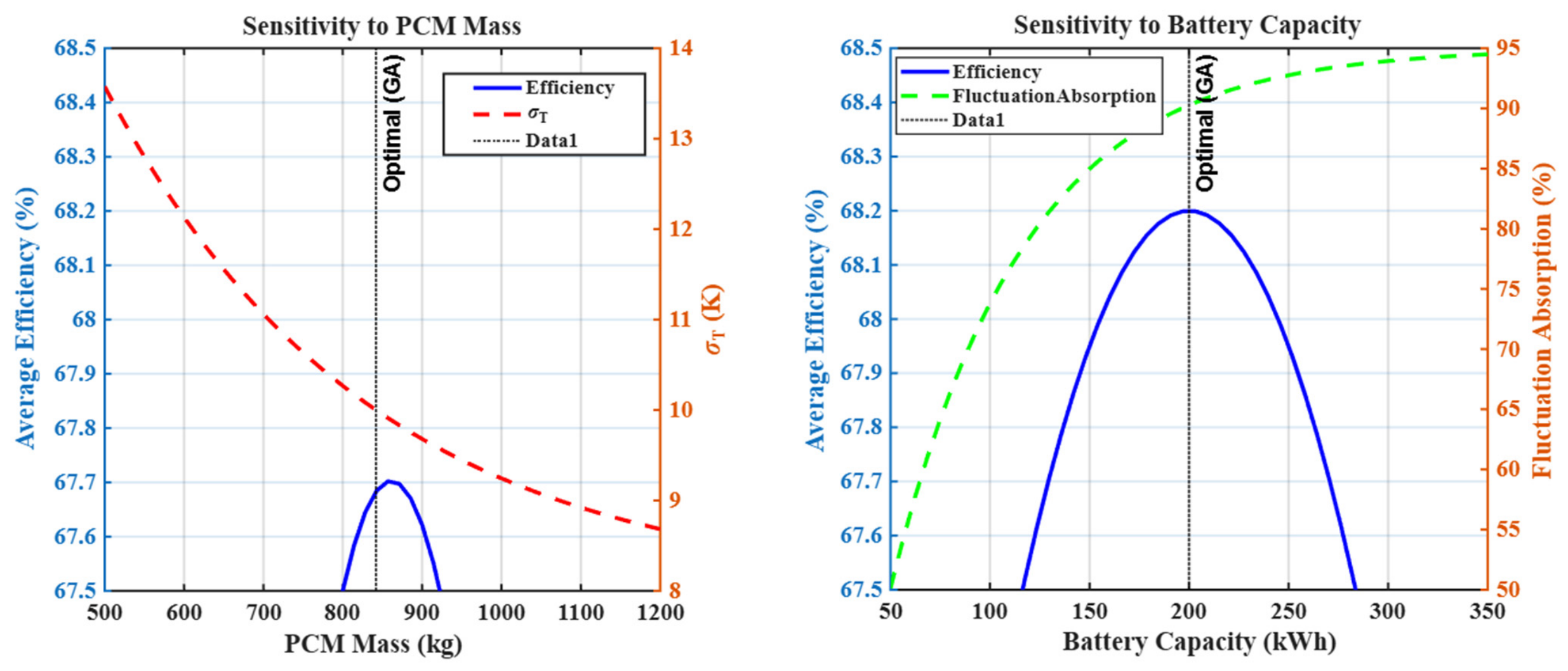
Parametric Sensitivity: Figure 6 illustrates the sensitivity of system performance to two key design variables. Increasing PCM mass beyond the GA best-fitness value of kg reduces monotonically but yields diminishing efficiency returns due to added thermal inertia. The GA-selected battery capacity of kWh is the upper bound of the search range (a bound-limited result) and balances fluctuation absorption (reaching at 375 kWh) against parasitic losses that suppress efficiency beyond this point. These results show trends around the GA design point; they do not exclude other feasible solutions in the 12-dimensional design space, and neither global nor Pareto optimality is claimed.
Figure 6.
Sensitivity analysis: (Left) effect of PCM mass on average efficiency and temperature variability ; (right) effect of battery capacity on average efficiency and fluctuation absorption. Plotted on a coarse grid; the design-point mass (842 kg) lies between grid points, appearing as ~860 kg.
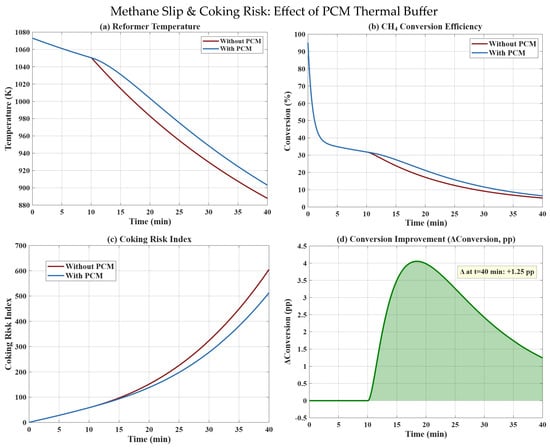
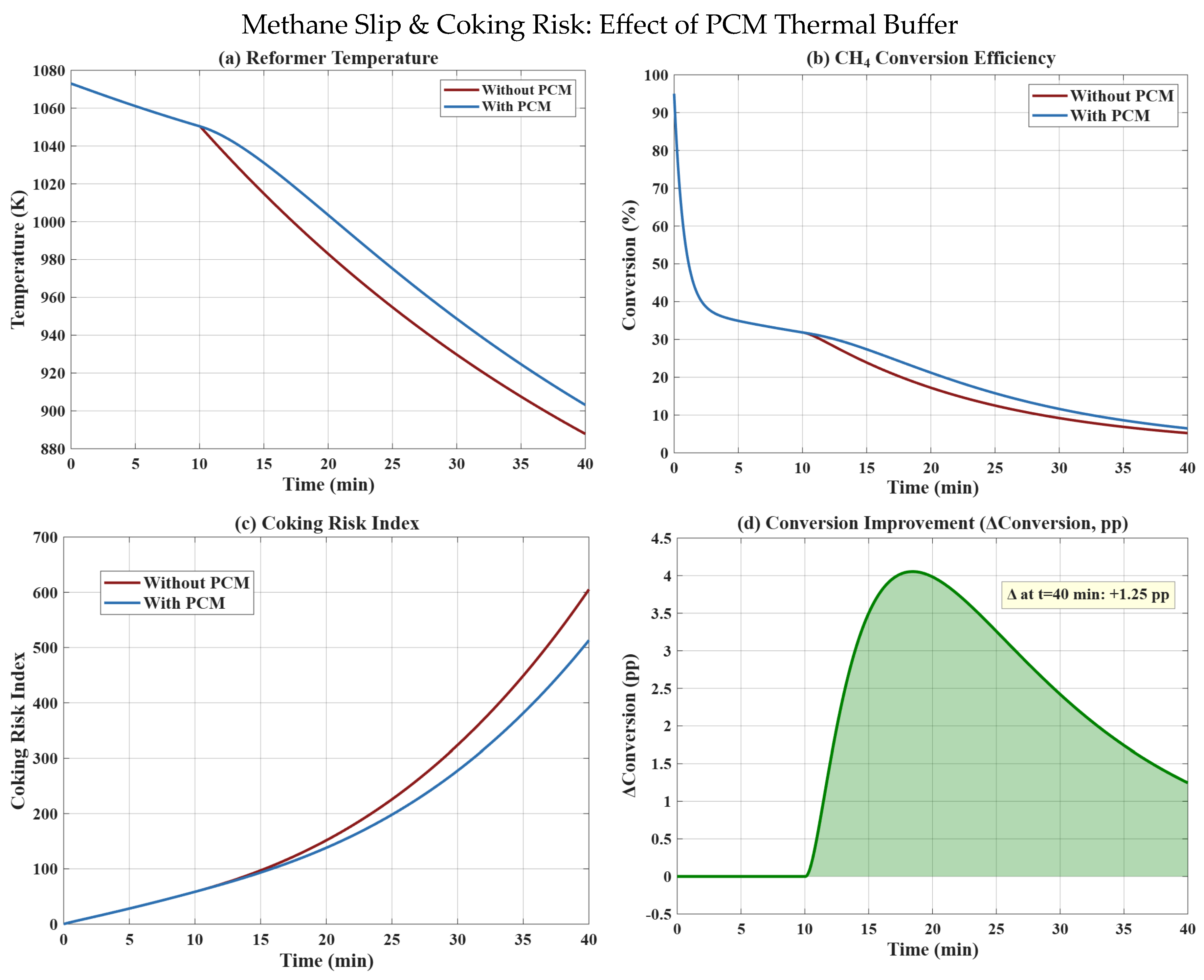
Methane Slip Mechanism: Figure 7 compares reformer behavior with and without the PCM buffer during an illustrative cooling transient from 1073 K. For the first 10 min the two cases coincide. After t = 10 min the PCM slows the temperature decline: at t = 40 min the reformer is about 15 K warmer (≈903 K vs. ≈888 K). CH4 conversion falls sharply in both cases, so the PCM delays methane slip but does not prevent it. The conversion gain peaks at ≈4.0 pp around t ≈ 18 min and drops to 1.25 pp by t = 40 min. The coking risk index at t = 40 min falls from ≈605 to ≈500. This scenario deliberately starts at a higher temperature than the 875 K design point and imposes sustained cooling. That is why conversion here drops to ~5–35%, whereas it stays at 74–87% under the 168 h profile in Figure 3.
Figure 7.
Effect of the PCM thermal buffer during a reformer cooling (quench) transient, starting from 1073 K over 40 min. (a) Reformer temperature; (b) CH4 conversion; (c) coking risk index; and (d) conversion improvement with PCM (ΔConversion, pp). Red: Without PCM; blue: With PCM. The two cases are identical up to t = 10 min. After that, the PCM slows the cooling. ΔConversion peaks at ≈4.0 pp near t ≈ 18 min and is +1.25 pp at t = 40 min. This is an illustrative scenario, separate from the 168 h profile in Figure 3.
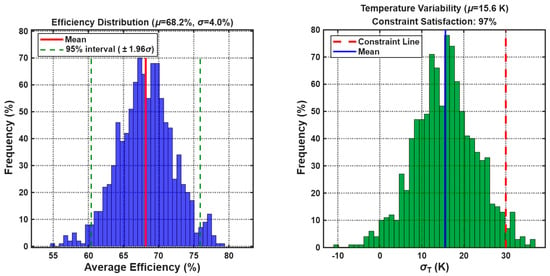
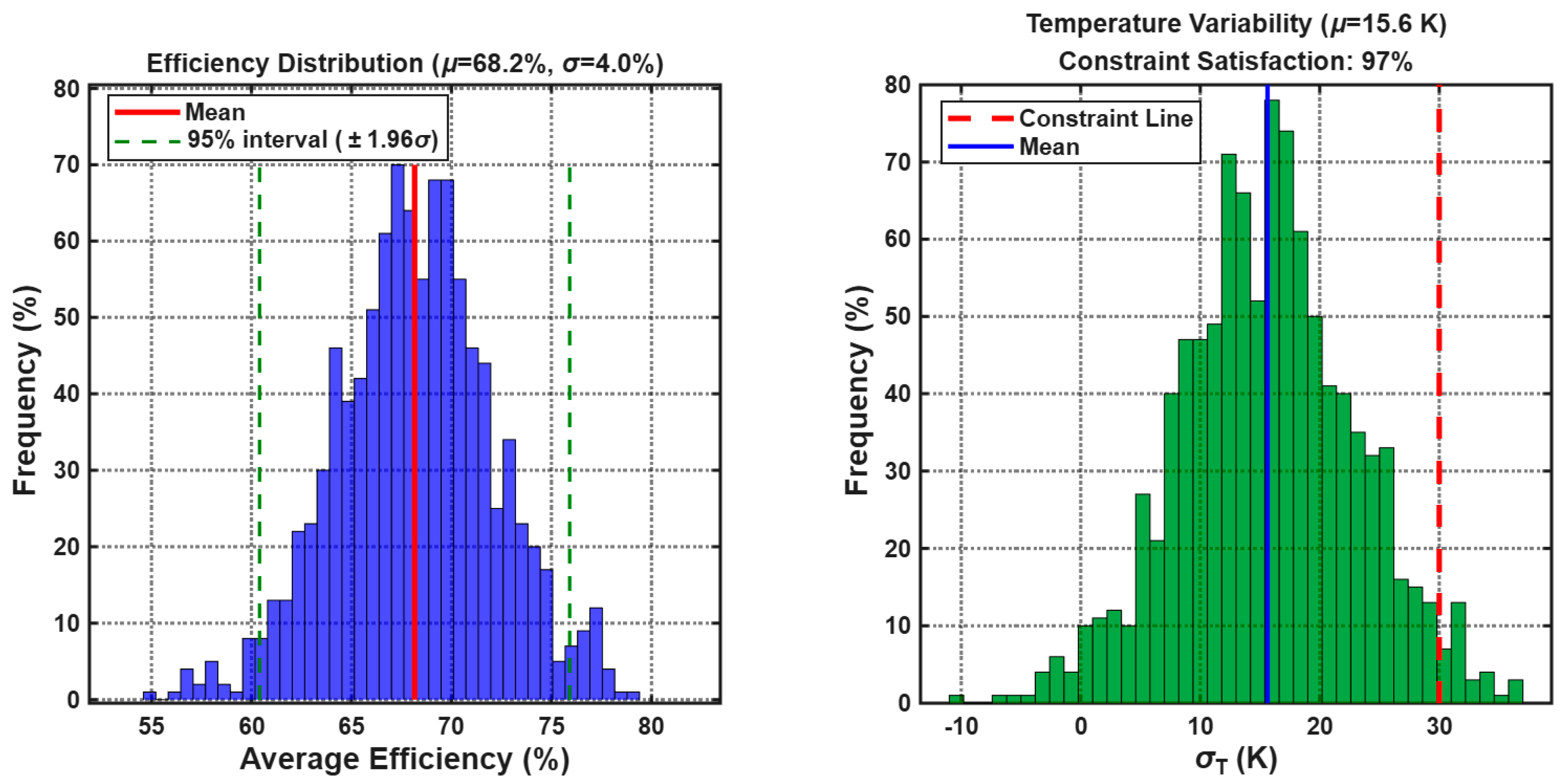
Uncertainty and Robustness Analysis: Monte Carlo simulation with 500 samples reveals that average system efficiency follows a near-normal distribution centered at with , confirming robust mean performance. Temperature variability is bounded below 30 K in 97% of scenarios (Figure 8, right), supporting the thermal constraint under parametric uncertainty in fuel composition and ambient conditions. The difference from the nominal (9.8 K) arises because the Monte Carlo mean includes perturbed realizations. The right panel of Figure 8 shows a fitted normal curve; all sampled values are non-negative. In the Monte Carlo analysis, the perturbed inputs were fuel composition (±5%), ambient temperature (±10 K) and UA (±15%).
Figure 8.
Monte Carlo uncertainty analysis results: System efficiency distribution (, ) and temperature variability distribution ( K), with a constraint satisfaction rate of 97%. The negative tail in the right panel belongs to the fitted normal curve; all 500 samples have ≥ 0.
Limitations: The results should be read in light of the following limitations. (i) The SOFC reversible-voltage correlation is a low-temperature form; the model was calibrated at 1073 K, and predictions at other temperatures are extrapolations whose bias was not quantified. (ii) With the electrolyte conductivity in Table 1, ohmic losses below ~1000 K would be substantially larger than at the validation point, so the design-point stack temperature lies outside the validated range. (iii) The reformer and MGT are parameterized from the literature and were not validated against reformer- or turbine-level data; methane slip and coking indicators are model predictions. (iv) The reported reduction depends directly on the PCM–gas heat-transfer coefficient, whose effect was tested in a sensitivity study (Section 3) and by ±15% in the Monte Carlo analysis. (v) The stack is lumped (0-D), so spatial thermal gradients are not resolved. (vi) The GA is a single-seed, weighted-sum single-objective search, and global or Pareto optimality is not claimed. (vii) Battery and SOFC degradation are not modeled; the constraints are degradation-aware operating limits, not demonstrated lifetime gains. (viii) The 1 min time step does not resolve faster dynamics (e.g., sub-minute fluctuations). (ix) The MGT is a reduced-order heat engine; the compressor, turbine and recuperator are not modelled individually and the pressure coupling that gives SOFC–GT synergy is not captured. (x) Fuel composition was varied only by ±5% in the Monte Carlo analysis, and load-forecasting error was not considered. (xi) The ±20% weight test and the ±1 rating test address only part of the subjectivity in the MCDM stage. Addressing (i) and (ii) with re-simulation is the subject of ongoing work.
4. Conclusions
This study establishes a decision-theoretically grounded framework for the co-design of topology and operational parameters in SOFC–MGT hybrids augmented with hybrid energy storage, specifically, thermal energy storage (PCM) and electrochemical energy storage (battery). By integrating Multi-Criteria Decision-Making (SAW, AHP and TOPSIS) with physics-constrained genetic algorithm optimization, we resolve the discrete–continuous design challenge that limits the design of resilient, high-efficiency hybrid systems.
The AHP-weighted sum and TOPSIS, which share a common weight set, both rank the PCM-Integrated topology first. SAW screening served only as a feasibility check, in which Battery-Dominant scored highest (200). In the quantitative AHP and TOPSIS evaluations it ranked second in both (AHP 6.44; TOPSIS Ci = 0.384) because of double-conversion losses. AHP and TOPSIS both placed PCM-Integrated first, driven by its efficiency (weight 40.7%) and stability (weight 31.0%) scores, which reflect its thermal-buffering capability. TOPSIS confirmed its dominance via the highest closeness coefficient (Ci = 0.790), reflecting balanced excellence in efficiency (9/9), safety (9/9), and stability (8/9).
Subsequent GA co-optimization, guided by AHP-derived weights and enforcing hard constraints (ΔTSOFC ≤ 30 K, 0.70 ≤ Uf ≤ 0.85, SOC ∈ [10%, 90%]), gave a best-fitness design for the PCM-Integrated topology (PCMAl). The best fitness plateaued early, and the run terminated on the stopping rule (ΔF < 10−4); a single random seed was used. This configuration achieves 75.0% peak and 68.2% average system efficiency under aggressive 7-day transients (±30% steps, duck-curve), 1.45 percentage points above the conventional Series SOFC–MGT topology simulated with the same model and 168 h profile (66.75%), and 12.2–13.2 percentage points above steady-state literature values (indicative only).
The time-averaged energy balance (Section 3) shows that the efficiency gain comes from low battery losses, a near-constant SOFC operating point and the PCM keeping exhaust heat available to the MGT during load drops.
Two key physical insights emerge:
- Thermal buffering:Al-based thermal storage in the exhaust path reduced modeled stack-temperature variability by 46% for the assumed heat-transfer coefficient [8,9,13].
- Battery as a transient enabler, not primary source:The battery supplies 82% of the load-power deviations resolved at the 1 min time step, but its primary role is electro-thermal decoupling: by shielding the SOFC–MGT subsystem from ramp-rate stress, it allows steady operation at Uf = 0.78 within the imposed limits, suggesting that hybrid storage is complementary, not redundant.
By treating PCM and battery as integrated modalities of energy storage, this work directly advances the Special Issue’s mission: Renewable Energy Storage: Innovations in Batteries and Fuel Cells. It provides not only a high-performance topology, but a methodology for design screening of degradation-relevant hybrid systems, not just efficient, hybrid systems, relevant to distributed generation and grid-support applications where dynamic resilience is important.
Future work will extend this framework to:
- Incorporate closed-loop control synthesis for real-time transient management;
- Integrate uncertainty quantification (e.g., fuel composition, load-forecasting error);
- Explore renewable integration (e.g., solar-assisted reforming, green hydrogen co-feeding).
Author Contributions
S.S.: Conceptualization, methodology, software, formal analysis, writing—original draft. M.G.: Validation, investigation, data curation, project administration, writing—review and editing. M.C.: Writing—original draft, methodology, visualization, supervision, writing—review and editing. All authors have read and agreed to the published version of the manuscript.
Funding
The authors received no external financial support for the research, authorship, or publication of this article.
Data Availability Statement
The data and simulation code supporting the findings of this study are available from the corresponding author on reasonable request.
Acknowledgments
This work was supported in part by the Iran National Science Foundation (INSF) through non-financial support.
Conflicts of Interest
The authors declare that there are no known competing financial interests or personal relationships that could have appeared to influence the work reported in this paper.
Nomenclature
| Symbol | Definition | Unit |
| Vcell, ENernst | Cell voltage; Nernst (reversible) voltage | V |
| ηact, ηohm, ηconc | Activation, ohmic and concentration losses | V |
| j, jL | Current density; limiting current density | A cm−2 |
| γ, Eact | Exchange-current pre-exponential factor; activation energy | A m−2; kJ mol−1 |
| Uf | Fuel utilization | – |
| TSOFC, ΔTSOFC | SOFC stack temperature; excursion of the lumped stack temperature | K |
| σT | Standard deviation of the stack temperature | K |
| ηsys, ηavg | System (net AC) efficiency, LHV basis; average efficiency | % |
| LHV | Lower heating value of methane (50.0 MJ/kg) | MJ kg−1 |
| mPCM, TPCM | PCM mass; average PCM temperature | kg; K |
| cp,eff | Effective specific heat capacity of the PCM | J kg−1 K−1 |
| L, Tm | Latent heat; melting temperature | kJ kg−1; K |
| σ (Gaussian) | Width of the melting-range Gaussian (5 K) | K |
| UA, h, As | Overall heat-transfer coefficient; convective coefficient; heat-transfer area | W K−1; W m−2 K−1; m2 |
| Qin | Heat transferred from the exhaust gas to the PCM | W |
| Ecap, SOC | Battery energy capacity; state of charge | kWh; – |
| Pch, Pdis | Battery charge and discharge power | kW |
| rSMR, rWGS | Steam-methane-reforming and water–gas-shift reaction rates | mol m−3 s−1 |
| Tref, Vcat | Reformer temperature; catalyst volume | K; m3 |
| λmax, CI, RI, CR | AHP principal eigenvalue; consistency index; random index; consistency ratio | – |
| weff, wstab | AHP weights of efficiency and stability | – |
| Ci, Di+, Di− | TOPSIS closeness coefficient; distances to the positive- and negative-ideal solutions | – |
| F, β, Nviol | GA fitness; penalty factor; number of constraint violations | – |
| Ccap | Normalized capital cost | – |
| AHP, TOPSIS, SAW | Analytic Hierarchy Process; Technique for Order of Preference by Similarity to Ideal Solution; Simple Additive Weighting | – |
| SOFC, MGT, PCM, GA | Solid oxide fuel cell; micro gas turbine; phase change material; genetic algorithm | – |
References
- Rabuni, M.F.; Li, T.; Othman, M.H.D.; Adnan, F.H.; Li, K. Progress in solid oxide fuel cells with hydrocarbon fuels. Energies 2023, 16, 6404. [Google Scholar] [CrossRef] [Scilit]
- Chen, H.; Yang, C.; Tucker, D.; Zhang, B.; Zhou, N. Coupling effects of fuel reforming process and fuel utilization on the system performance of a natural gas solid oxide fuel cell/gas turbine hybrid system. Int. J. Energy Res. 2021, 45, 17664–17690. [Google Scholar] [CrossRef] [Scilit]
- Azizi, M.A.; Brouwer, J. Progress in solid oxide fuel cell-gas turbine hybrid power systems: System design and analysis, transient operation, controls and optimization. Appl. Energy 2018, 215, 237–289. [Google Scholar] [CrossRef] [Scilit]
- Buonomano, A.; Calise, F.; d’Accadia, M.D.; Palombo, A.; Vicidomini, M. Hybrid solid oxide fuel cells-gas turbine systems for combined heat and power: A review. Appl. Energy 2015, 156, 32–85. [Google Scholar] [CrossRef] [Scilit]
- Huang, S.; Yang, C.; Chen, H.; Zhou, N.; Tucker, D. Coupling impacts of SOFC operating temperature and fuel utilization on system net efficiency in natural gas hybrid SOFC/GT system. Case Stud. Therm. Eng. 2022, 31, 101868. [Google Scholar] [CrossRef] [Scilit]
- Chinda, P.; Brault, P. The hybrid solid oxide fuel cell (SOFC) and gas turbine (GT) systems steady state modeling. Int. J. Hydrogen Energy 2012, 37, 9237–9248. [Google Scholar] [CrossRef] [Scilit]
- Cheng, B.; Wang, Y.; Feng, D.; Jiang, Z.; Zhang, X. Macroscopic modeling of solid oxide fuel cell (SOFC) and model-based control of SOFC and gas turbine hybrid system. Prog. Energy Combust. Sci. 2018, 66, 83–140. [Google Scholar] [CrossRef] [Scilit]
- Barelli, L.; Bidini, G.; Ottaviano, A. Part load operation of a SOFC/GT hybrid system: Dynamic analysis. Appl. Energy 2013, 110, 173–189. [Google Scholar] [CrossRef] [Scilit]
- Matsui, T.; Iida, T.; Kawano, M.; Inagaki, T.; Kikuchi, R.; Eguchi, K. Behavior of carbon deposition on fuel electrode and subsequent deterioration of cell performance during internal reforming operation of SOFCs. ECS Trans. 2007, 7, 1437–1445. [Google Scholar] [CrossRef] [Scilit]
- Abdelkareem, M.A.; Tanveer, W.; Sayed, E.T.; El Haj Assad, M.; Allagui, A.; Cha, S. On the technical challenges affecting the performance of direct internal reforming biogas solid oxide fuel cells. Renew. Sustain. Energy Rev. 2019, 101, 361–375. [Google Scholar] [CrossRef] [Scilit]
- Nakajo, A.; Mueller, F.; Brouwer, J.; Van Herle, J.; Favrat, D. Progressive activation of degradation processes in solid oxide fuel cells stacks: Part I: Lifetime extension by optimisation of the operating conditions. J. Power Sources 2012, 216, 449–463. [Google Scholar] [CrossRef] [Scilit]
- McLarty, D.; Kuniba, Y.; Brouwer, J.; Samuelsen, S. Experimental and theoretical evidence for control requirements in solid oxide fuel cell gas turbine hybrid systems. J. Power Sources 2012, 209, 195–203. [Google Scholar] [CrossRef] [Scilit]
- Yuan, Q.; Li, X.; Han, S.; Wang, S.; Wang, M.; Chen, R.; Kudashev, S.; Wei, T.; Chen, D. Performance analysis and optimization of SOFC/GT hybrid systems: A review. Energies 2024, 17, 1265. [Google Scholar] [CrossRef] [Scilit]
- Zeng, Z.; Qian, Y.; Zhang, Y.; Hao, C.; Dan, D.; Zhuge, W. A review of heat transfer and thermal management methods for temperature gradient reduction in solid oxide fuel cell (SOFC) stacks. Appl. Energy 2020, 280, 115899. [Google Scholar] [CrossRef] [Scilit]
- Di Giorgio, P.; Desideri, U. Potential of reversible solid oxide cells as electricity storage system. Energies 2016, 9, 662. [Google Scholar] [CrossRef] [Scilit]
- Baldi, F.; Wang, L.; Pérez-Fortes, M.; Maréchal, F. A cogeneration system based on solid oxide and proton exchange membrane fuel cells with hybrid storage for off-grid applications. Front. Energy Res. 2019, 6, 139. [Google Scholar] [CrossRef] [Scilit]
- Ma, S.; Lin, M.; Lin, T.-E.; Lan, T.; Liao, X.; Maréchal, F.; Van Herle, J.; Yang, Y.; Dong, C.; Wang, L. Fuel cell-battery hybrid systems for mobility and off-grid applications: A review. Renew. Sustain. Energy Rev. 2021, 135, 110119. [Google Scholar] [CrossRef] [Scilit]
- Wang, Y.; Moura, S.J.; Advani, S.G.; Prasad, A.K. Power management system for a fuel cell/battery hybrid vehicle incorporating fuel cell and battery degradation. Int. J. Hydrogen Energy 2019, 44, 8479–8492. [Google Scholar] [CrossRef] [Scilit]
- Shirazi, S.; Ghassemi, M.; Chizari, M. Topology design, multi-objective optimization, and dynamic performance evaluation of a PCM-buffered SOFC-MGT hybrid powertrain for heavy-duty trucks. Vehicles 2026, 8, 144. [Google Scholar] [CrossRef] [Scilit]
- Osti, A. Advanced PGM-Free Nanocomposite Catalysts for the Activation of Inert C1 Molecules: Exploration of Ni- and Cu-Loaded Ferrite and Manganite Perovskites. Ph.D. Thesis, University of Padua, Padua, Italy, 2026. [Google Scholar]
- Damo, U.; Ferrari, M.L.; Turan, A.; Massardo, A.F. Solid oxide fuel cell hybrid system: A detailed review of an environmentally clean and efficient source of energy. Energy 2019, 168, 235–246. [Google Scholar] [CrossRef] [Scilit]
- Safari, S.; Hajilounezhad, T.; Ehyaei, M. Multi-objective optimization of solid oxide fuel cell/gas turbine combined heat and power system: A comparison between particle swarm and genetic algorithms. Int. J. Energy Res. 2020, 44, 9001–9020. [Google Scholar] [CrossRef] [Scilit]
- Bouaouda, A.; Sayouti, Y. Hybrid meta-heuristic algorithms for optimal sizing of hybrid renewable energy system: A review of the state-of-the-art. Arch. Comput. Methods Eng. 2022, 29, 4049–4083. [Google Scholar] [CrossRef] [Scilit] [PubMed]
- Saaty, T.L. The Analytic Hierarchy Process: Planning, Priority Setting, Resource Allocation; McGraw-Hill: New York, NY, USA, 1980. [Google Scholar]
- Hwang, C.-L.; Yoon, K. Multiple Attribute Decision Making: Methods and Applications: A State-of-the-Art Survey; Springer: Berlin, Germany, 1981. [Google Scholar] [CrossRef] [Scilit]
- Triantaphyllou, E. Multi-Criteria Decision Making Methods: A Comparative Study; Kluwer Academic Publishers: Dordrecht, The Netherlands, 2000. [Google Scholar]

Disclaimer/Publisher’s Note: The statements, opinions and data contained in all publications are solely those of the individual author(s) and contributor(s) and not of MDPI and/or the editor(s). MDPI and/or the editor(s) disclaim responsibility for any injury to people or property resulting from any ideas, methods, instructions or products referred to in the content. |
© 2026 by the authors. Licensee MDPI, Basel, Switzerland. This article is an open access article distributed under the terms and conditions of the Creative Commons Attribution (CC BY) license.