


Abstract
Clear orthodontic aligners, primarily composed of thermoplastic polymers, are increasingly popular but susceptible to degradation through thermal, chemical, and mechanical stress. This preliminary pilot study assessed the release of microplastics from two commercial aligner brands under simulated oral conditions. Aligners were exposed to daily cycles of Coca-Cola® or artificial saliva, with mechanical agitation replicating masticatory friction. Fourier-transform infrared spectroscopy confirmed microplastic release in both environments, with a notably higher particle count after Coca-Cola® exposure. These findings indicate the potential health and environmental risks linked to acidic beverage consumption during orthodontic treatment. Further comprehensive studies are required to validate and expand upon these results.
1. Introduction
Since the introduction of clear thermoplastic orthodontic aligners by Invisalign® in 1997, their use has grown substantially due to their aesthetic and functional advantages. As removable devices, clear orthodontic aligners (COAs) require strict patient compliance to ensure effective treatment outcomes. Typically, each aligner is worn for approximately seven days, although a 14-day protocol may be necessary for complex tooth movements (e.g., torque, inclination, and rotation) [1]. After this period, the aligner is replaced by a new one. This sequence continues until the orthodontic treatment is completed. Aligners should be worn for 20–22 h per day [1], and manufacturers recommend their removal during the consumption of any food or beverages other than water and for oral hygiene procedures. Nevertheless, many patients do not adhere strictly to these guidelines, often consuming beverages or even food while wearing the aligners [2].
During use, aligners are exposed to the oral environment, which is characterised by fluctuating temperature and pH, as well as mechanical, thermal, and enzymatic challenges. These factors can compromise the structural integrity of the aligner material. Inappropriate behaviours, such as consuming acidic beverages like Coca-Cola® or fruit juices, can accelerate material degradation [3]. Previous studies have reported morphological changes in aligners after clinical use, including biofilm accumulation, microcracks, and abrasions, which may facilitate the release of microplastic particles [4,5].
Commercial aligners differ in material composition, thickness, and clinical protocols, with each brand utilising specific thermoplastic polymers such as polyurethane (PU), polyethylene terephthalate (PET), polyethylene glycol terephthalate (PETG), and polyvinyl chloride (PVC). The toxicity of plastics varies with polymer type and particle size, with smaller particles generally exhibiting higher toxicity. Microplastics (MPs), defined as particles smaller than 5 mm, and nanoplastics (NPs), smaller than 100 nm [6], have been detected in various human tissues and fluids. The European Food Safety Authority has reported that MPs/NPs smaller than 150 µm may cross the intestinal epithelium [7] and have been detected in various human tissues and fluids [8]. Existing studies suggest that the biopersistence of MPs leads to a range of immune responses including inflammation, genotoxicity, oxidative stress, apoptosis, and necrosis [8]. Given the potential for aligners to contribute to microplastic exposure, particularly when used inappropriately, it is essential to conduct further research to clarify the extent and significance of this phenomenon. This pilot study aimed to assess whether the consumption of beverages such as Coca-Cola® promotes the release of MPs by COAs compared to the results already published when only artificial saliva was used [5].
2. Materials and Methods
The experimental protocol used in this study was adapted from Quinzi et al. [5]. In total, 12 pairs of COAs (n = 24) were acquired from two different brands, Dentsply Sirona (Group A, n = 12) and Invisalign (Group B, n = 12), from different patients and not clinically used. Each group of samples was subjected to a seven-day in vitro protocol designed to simulate oral conditions. Aligners were immersed for 5 h/day in either regular Coca-Cola® (pH 2.5) or artificial saliva (pH 6.8) [9] and stirred to simulate the physiological friction produced by patient tooth movement. Following this period, the immersion medium was replaced with fresh artificial saliva, and the samples were maintained at 37 °C without stirring for the remaining 19 h/day. This cycle was repeated daily for seven days. All solutions in contact with each group of samples, including rinsing water, were collected and vacuum-filtered through 1.6 µm membranes. The retained particles were examined under a stereomicroscope and characterised by Fourier-transform infrared spectroscopy (FTIR) by contact. All FTIR spectra were obtained in the range of 4000 to 400 cm−1, and 31 scans were performed per analysis. The spectra of the collected particles were compared with those of the original aligner materials to confirm the identity of the polymers.
3. Results
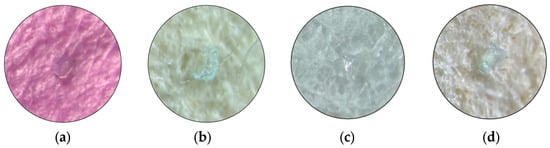
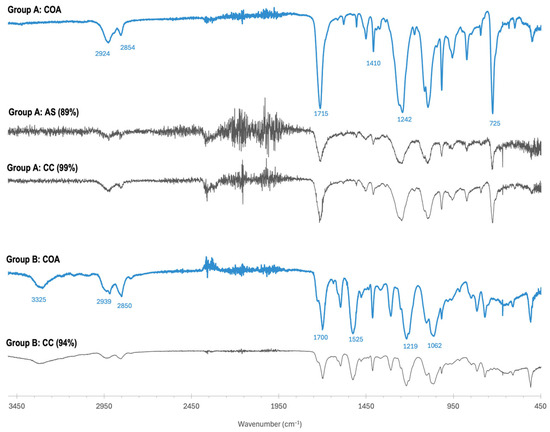
Both aligner brands released microplastic particles under the tested conditions, and the stereomicroscope images of some are shown in Figure 1. The number of particles released was visibly higher following exposure to Coca-Cola® compared to artificial saliva. The FTIR spectra of the as-received aligners (Figure 2, blue lines) showed the characteristic peaks for the presence of polyethylene terephthalate (PET) for the Dentsply Sirona COA, Group A; polyurethane, PU, for the Invisalign COA, Group B. FTIR analysis of the particles collected after filtration (Figure 2, dark lines) and comparison of the spectra obtained with the original COA (by correlation percentages) confirmed the presence of microplastics. No evidence of extraneous contamination was detected. The amount of MP released in the test with Coca-Cola® was always higher than in the control with artificial saliva. These results should be interpreted with caution due to the limited sample size.
Figure 1.
Stereomicroscope images of some particles obtained after filtration: Group A tested with (a) artificial saliva and with (b) Coca-Cola; Group B tested with (c) artificial saliva and with (d) Coca-Cola.
Figure 2.
Comparison between the FTIR spectra of the as-received COA (in blue) with the characteristic molecular bands and the FTIR spectra of the representative collected microparticles detached from the aligners (dark lines). The percentage value in brackets refers to the correlation with the original COA. AS, artificial saliva; CC, Coca-Cola.
4. Discussion
The acidic environment produced by Coca-Cola® appears to accelerate the degradation of thermoplastic polymers used in orthodontic aligners. Repeated acid exposure, combined with mechanical friction, likely increases material fatigue and surface erosion, promoting microplastic release. These findings, although based on a small sample and in vitro simulation, raise concerns considering the growing evidence that microplastics can cross epithelial barriers, accumulate in tissues, and elicit cellular stress responses. Chronic exposure has been linked to endocrine disruption and altered immune responses, which may have systemic implications, particularly for younger patients undergoing prolonged orthodontic treatment. As a pilot study, these results reinforce existing recommendations discouraging the consumption of acidic beverages while wearing aligners and underscore the importance of further research.
5. Conclusions
This pilot study demonstrates that artificial saliva alone can induce microplastic release from orthodontic aligners, with Coca-Cola® exposure significantly increasing this effect. The results highlight the potential influence of patient behaviour on material stability and microplastic exposure. Further comprehensive studies are essential to confirm these findings, determine their clinical relevance, and guide evidence-based recommendations for orthodontic practice.
Author Contributions
Conceptualization, C.A. and D.P.; methodology, C.A. and M.P.; investigation, C.A. and M.P.; writing—original draft preparation, M.P.; writing—review and editing, C.A., D.P., and A.S.D.; supervision, C.A., D.P., and A.S.D. All authors have read and agreed to the published version of the manuscript.
Funding
This research received no external funding.
Institutional Review Board Statement
Not applicable.
Informed Consent Statement
Not applicable.
Data Availability Statement
Data are contained within the article.
Conflicts of Interest
The authors declare no conflicts of interest.
References
- Al-Nadawi, M.; Kravitz, N.D.; Hansa, I.; Makki, L.; Ferguson, D.J.; Vaid, N.R. Effect of clear aligner wear protocol on the efficacy of tooth movement: A randomised clinical trial. Angle Orthod. 2021, 91, 157–163. [Google Scholar] [CrossRef] [Scilit] [PubMed]
- Bernard, G.; Rompré, P.; Tavares, J.R.; Montpetit, A. Colorimetric and spectrophotometric measurements of orthodontic thermoplastic aligners exposed to various staining sources and cleaning methods. Head Face Med. 2020, 16, 2. [Google Scholar] [CrossRef] [Scilit] [PubMed]
- Warnecki, M.; Sarul, M.; Kozakiewicz, M.; Zięty, A.; Babiarczuk, B.; Kawala, B.; Jurzysynk, Z. Surface evaluation of aligners after compulsory teeth immersion in Coca-Cola and orange juice. Materials 2022, 15, 6341. [Google Scholar] [CrossRef] [Scilit] [PubMed]
- Bucci, R.; Rongo, R.; Levaté, C.; Michelotti, A.; Barone, S.; Razionale, A.V.; D’Antò, V. Thickness of orthodontic clear aligners after thermoforming and after 10 days of intraoral exposure: A prospective clinical study. Prog. Orthod. 2019, 20, 36. [Google Scholar] [CrossRef] [Scilit] [PubMed]
- Quinzi, V.; Orilisi, G.; Vitiello, F.; Nofrasterino, V.; Marzo, G.; Orsini, G. A spectroscopic study on orthodontic aligners: First evidence of microplastic dispersion after seven days of clinical use. Sci. Total Environ. 2023, 886, 161356. [Google Scholar] [CrossRef] [Scilit] [PubMed]
- Otorkpa, O.J.; Otorkpa, C.O. Health effects of microplastics and nanoplastics: Review of published case reports. Environ. Anal. Health Toxicol. 2024, 39, e2024020. [Google Scholar] [CrossRef] [Scilit]
- Choi, H.; Kaneko, S.; Suzuki, Y.; Inamura, K.; Nishikawa, M.; Sakai, Y. Size dependent internalization of microplastics and nanoplastics using in vitro model of the human intestine—Contribution of each cell in the tri-culture models. Nanomaterials 2024, 14, 1435. [Google Scholar] [CrossRef] [Scilit] [PubMed]
- Wang, X.; Deng, K.; Zhang, P.; Chen, Q.; Magnuson, J.T.; Qiu, W.; Zhou, Y. Microplastic-mediated new mechanism of liver damage: From the perspective of the gut-liver axis. Sci. Total Environ. 2024, 919, 170962. [Google Scholar] [CrossRef] [Scilit] [PubMed]
- Gal, J.Y.; Fovet, Y.; Adib-Yadzi, M. About a synthetic saliva for in vitro studies. Talanta 2001, 53, 1103–1115. [Google Scholar] [CrossRef] [Scilit]
Disclaimer/Publisher’s Note: The statements, opinions and data contained in all publications are solely those of the individual author(s) and contributor(s) and not of MDPI and/or the editor(s). MDPI and/or the editor(s) disclaim responsibility for any injury to people or property resulting from any ideas, methods, instructions or products referred to in the content. |
© 2025 by the authors. Licensee MDPI, Basel, Switzerland. This article is an open access article distributed under the terms and conditions of the Creative Commons Attribution (CC BY) license (https://creativecommons.org/licenses/by/4.0/).