


Abstract
The observation of lepton flavour violation (LFV) in the charged lepton sector would be an unambiguous sign of physics beyond the Standard Model (BSM), and thus, it is the channel of choice for many BSM searches. LFV searches in muon decays in particular benefit from the fact that muons can be easily produced at high rates. There is a global effort to search for LFV at high-intensity muon sources to which the upcoming Mu3e experiment at the Paul Scherrer Institute (PSI) will contribute. The Mu3e Collaboration aims to perform a background-free search for the LFV decay with an unprecedented sensitivity in the order of 10−15 in the first phase of operation and 10−16 in the final phase—an improvement over the preceding SINDRUM experiment by four orders of magnitude. The high muon stopping rates and low momenta of the decay electrons make high demands on momentum and time resolution and on the data acquisition. The innovative experimental concept is based on a tracking detector built from novel ultra-thin silicon pixel sensors and scintillating fibres and tiles as well as online event reconstruction and filtering in real time.
1. Introduction
In the original formulation of the Standard Model (SM) of particle physics, lepton flavour is a conserved quantity, although, this is only due to an accidental symmetry. With the observation of neutrino mixing, it became evident that lepton flavour is indeed not conserved in nature—at least in the neutrino sector—but so far, lepton flavour violation in the charged lepton sector (cLFV) has eluded observation.
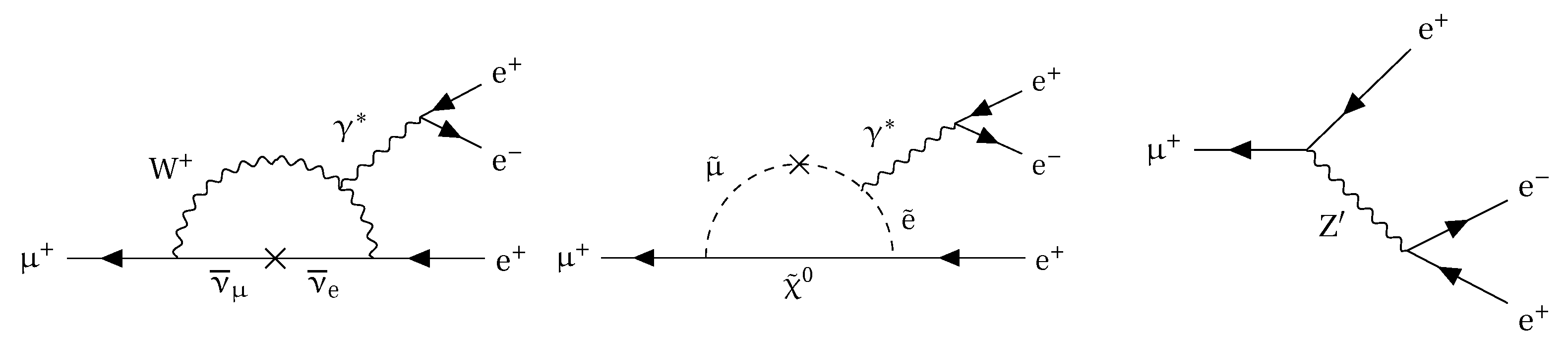
cLFV processes like could be mediated via neutrino mixing (see Figure 1 on the left), but they would be suppressed to branching ratios below and thus far below the reach of current or upcoming cLFV searches. In BSM models which address for example the generation of neutrino masses or the origin of the flavour structure, however, cLFV often occurs at observable levels. Any observation of cLFV would, thus, be an unambiguous sign of BSM physics. Examples for the process are shown in Figure 1 in the centre and on the right.
Figure 1.
Feynman diagrams of the decay mediated via (left) neutrino mixing, (centre) supersymmetric particles, and (right) a in models with an extended electroweak sector.
Searches for cLFV in muon decays are particularly sensitive probes of BSM, since muons can be produced at very high intensities allowing to test also very rare processes. For example, PSI operates regular muon beam lines with rates of muons/. There is a ongoing global effort to search for cLFV with muons in various channels. The Mu3e experiment at PSI is the only experiment planned at the moment which is going to search for .
2. The Mu3e Experiment
The Mu3e Collaboration aims to find or exclude the cLFV decay with a sensitivity to branching ratios in the order of 10−15 in phase I and 10−16 in phase II of the experiment [1]—surpassing the current strongest limit of × 10−12 at a 90% confidence level (CL) set by the SINDRUM experiment [2] by four orders of magnitude.
The search will be conducted free of background. The SM background process is distinguished from signal decays solely by the momentum carried away by the undetectable neutrinos. A further source of background stems from accidental combinations of and from SM muon decays, photon conversion, Bhabha scattering and misreconstructed tracks. This type of background can be suppressed by kinematic selections as well as selections on the reconstructed vertex and the coincidence of the decay products.
In addition to excellent momentum and high vertex and time resolution, operating at high muon decay rates of muons/ (phase I) up to muons/ (phase II) puts further demands on the detector and data acquisition (DAQ).
The phase I detector is under construction and will be operated at the Compact Muon Beamline at PSI. For phase II, the detector will be upgraded and operated at the new High-Intensity Muon Beamline, which is currently being planned at PSI [3]. In the following, the phase I experiment is discussed in further detail.
2.1. Detector Concept
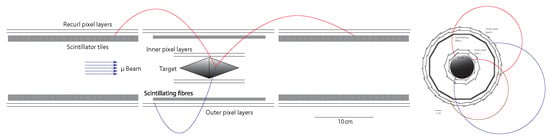
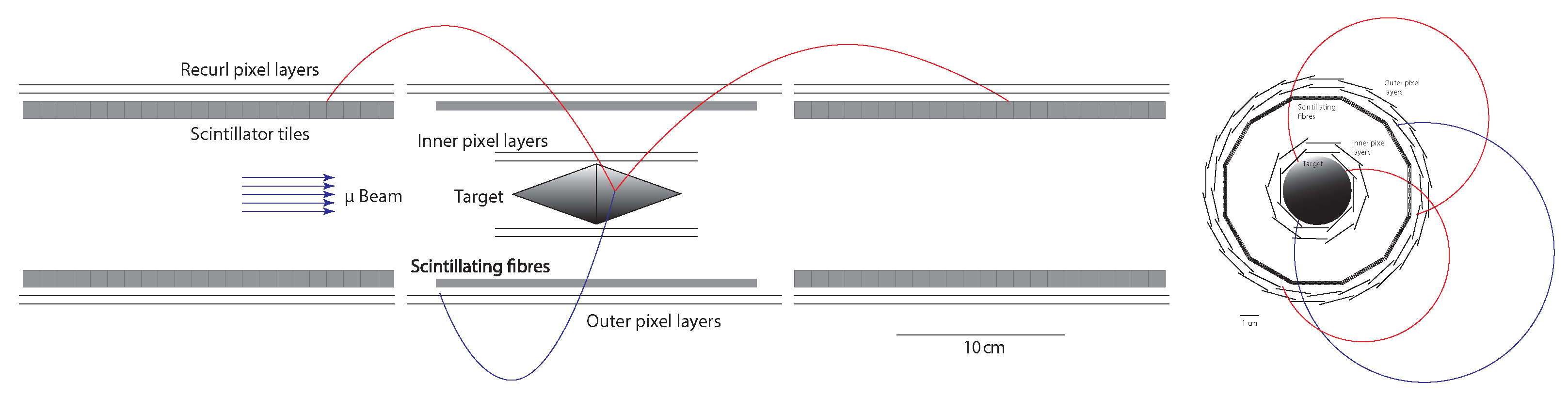
The Mu3e experiment is a spectrometer placed in a 1 solenoidal magnetic field. Multiple Coulomb scattering dominates the momentum resolution of the experiment as the decay particles have momenta of only a few 10 . For this reason, the material in the active detector volume is kept to a minimum. A schematic of the Mu3e experiment is shown in Figure 2.
Figure 2.
Schematic of the Mu3e phase I detector shown (left) along the beam axis and (right) transverse to the beam axis. A potential signal decay is shown with trajectories in red and the trajectory in blue.
The beam is stopped in a thin, hollow, double-cone target built from Mylar in the centre of the detector. The trajectories of the decay and are measured with a barrel-shaped, silicon pixel tracker. Mu3e utilises 50 thin pixel sensors built in the High-Voltage Monolithic Active Pixel Sensor technology [4] leading to a material amount of only % of a radiation length per tracking layer including the flex-print for readout and powering and the mechanical support structures. There are four tracking layers in the central detector part, two of which are located close to the target. The final prototype of pixel sensors for Mu3e—the MuPix11—has been produced in 2022 and is currently passing the last steps of characterisation.
In addition to the pixel tracker, a scintillating fibre detector provides a precise timing measurement. The fibre detector consists of three layers of 250 diameter fibres which are connected to a silicon photomultiplier column array read out by a custom-made ASIC: the MuTRiG chip [5]. The final version of the MuTRiG has been produced in 2022 and is currently being tested.
The momentum resolution of the experiment is significantly improved by the installation of so-called recurl stations upstream and downstream of the central detector station. Due to the bending in the magnetic field, the and produced on the target are forced to return—recurl—to the detector and are measured for a second time either in the central or in the recurl stations. Because of the large lever arm between the measurements of the outgoing and recurling particle, scattering-induced uncertainties cancel to first order. The recurl stations consist of two tracking layers and scintillating tiles for improved timing. The scintillating tiles are read out via silicon photomultipliers and the MuTRiG chip, which is used for the scintillating fibre detectors as well.
Components in the active detector volume are cooled with gaseous helium. Outside the active detector volume, an additional water-cooling system is installed in the support structures.
The streaming data acquisition system of Mu3e continuously processes zero-suppressed data from all detector systems without a hardware trigger. Events of interest, i.e., events containing at least two and one trajectory compatible with a common vertex, are selected on the event filter farm. The filter farm performs fast, simplified track fits and vertex finding in real time on Graphics Processing Units. Raw data of events with signal candidates are stored on disk for offline analysis. In this way, the output data rate is reduced by around a factor of 100 compared to the incoming data rate at the filter farm.
2.2. Sensitivity Studies
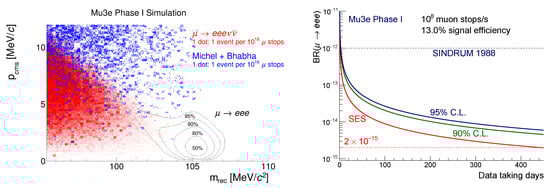
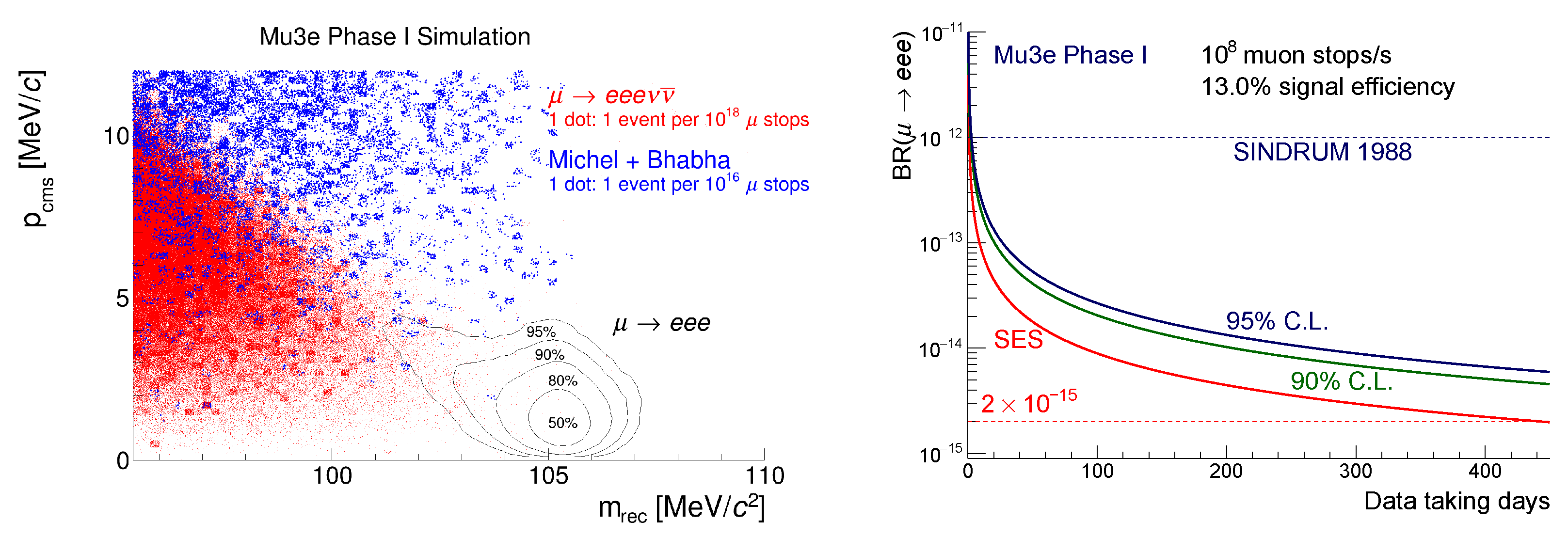
The feasibility of a background-free search for with the phase I Mu3e experiment up to the envisaged sensitivity has been demonstrated with a detailed Geant4-based detector simulation. The distribution of signal and background events in the centre-of-mass momentum () vs. invariant mass () plane of the system after kinematic, vertex and coincidence selections is shown in Figure 3 alongside the expected reach in in dependence of the runtime. Branching ratios of 10−14 to a few 10−15 can be reached with 200 to 300 days of data taking.
Figure 3.
Simulation studies of the phase I Mu3e experiment. (Left) Distribution of simulated signal and background events. (Right) Expected sensitivity of the search in phase I.
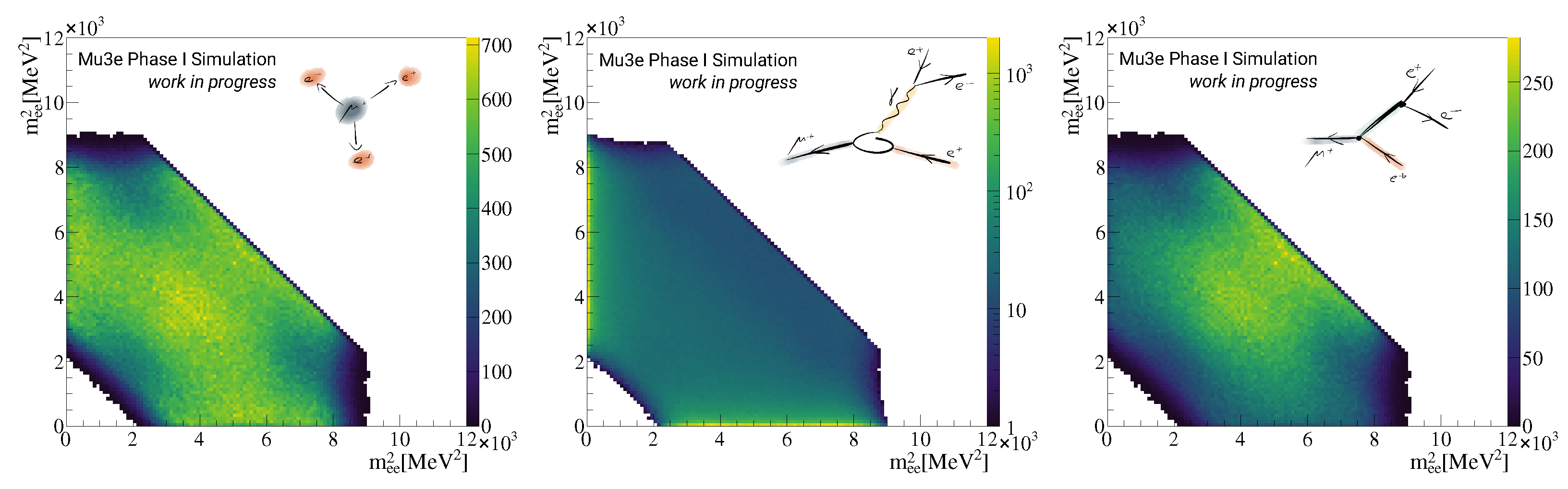
In the case of discovery and given that a sufficient number of events is observed, conclusions on the type of BSM interaction can be drawn from the kinematics of the final state—in addition to the interplay with observation and non-observation in searches for and muon-to-electron conversion on nuclei. In Figure 4, Dalitz plots of the invariant mass of the two possible combinations in are shown assuming selected effective operators.
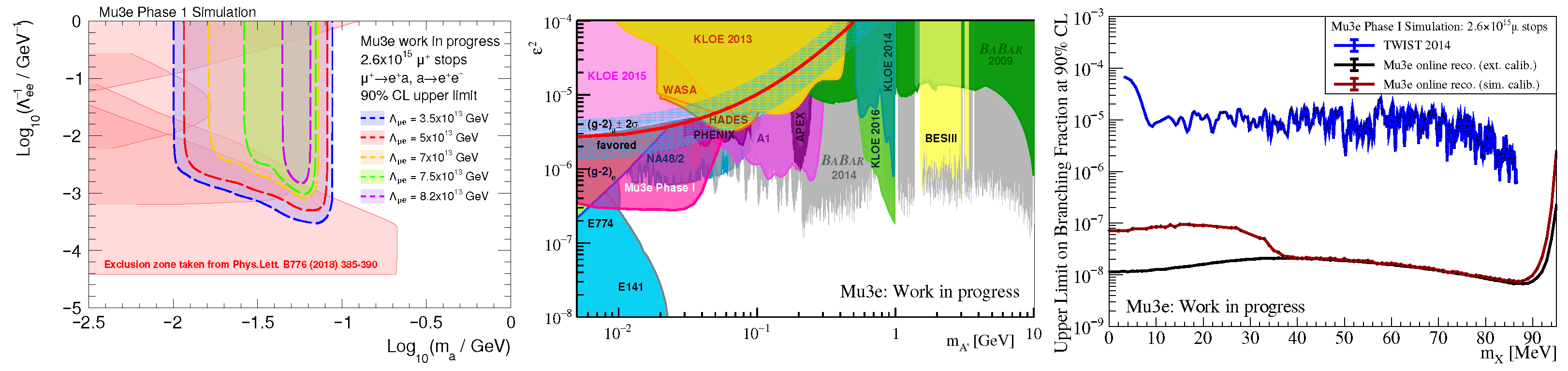
As shown in Figure 5 on the left, the search is also sensitive to decays of the type in which the particle a decays within to an pair. An example are axion-like particles as discussed in [6].
The unprecedented data set of muon decays expected to be recorded with Mu3e can also be exploited for other BSM searches. Dark photons emitted in muon decays, , and promptly decaying to an pair can be identified in a search for a resonance in the invariant spectrum. The sensitivity of the phase I Mu3e experiment to promptly decaying dark photons is shown in Figure 5 in the centre.
Figure 4.
Dalitz plots of the invariant mass of pairs in simulated and reconstructed signal decays in the phase I Mu3e experiment assuming (left) phase-space distributed decays, (centre) an effective dipole interaction, and (right) an effective four-fermion interaction. The effective Lagrangian from [7] has been deployed in this study.
Decays of the type are motivated for example by familon models which try to explain the flavour structure of the SM [8]. If the axion-like particle X exits the detector unseen, the characteristic signature of this decay becomes a mono-energetic in dependence of the mass of X. The Mu3e experiment is planning to implement online histograms filled with results from track fits performed on the filter farm in which decays would show up as an excess on the smooth momentum spectrum from SM muon decays. The sensitivity to decays of the phase I Mu3e experiment is expected to surpass current limits set by the TWIST experiment by two orders of magnitude [9] (see Figure 5 on the right).
Figure 5.
Sensitivity of the Mu3e phase I experiment to certain BSM models. (Left) Reach of a search for with subsequent decay in the parameter space of an axion-like a as presented in [6]. (Centre) Reach of a search for promptly decaying dark photons emitted in muon decays. Lagrangian taken from [10]. Plot adapted from [11]. (Right) Sensitivity of Mu3e phase I to the branching ratio of compared to the current strongest limits set by TWIST [9]. If the calibration of the total momentum scale is performed with the Michel spectrum, the sensitivity deteriorates at low (sim. calib.). Alternative calibrations are currently under investigation (ext. calib.).
3. Summary and Status
The upcoming Mu3e experiment at PSI aims to find or exclude the cLFV decay with an unprecedented sensitivity to branching ratios as low as 10−16. In a first phase, branching ratios of 10−14 to a few 10−15 can be studied. In addition, dark photons emitted in muon decays can be investigated with competitive sensitivity, and current limits on decays can be surpassed by two orders of magnitude already with the phase I Mu3e experiment.
Currently, the design and prototyping phase of the phase I Mu3e experiment is finishing and the experiment is transitioning to the production and construction phase. Demonstrator detector modules have been successfully operated in an integration run in 2021 and a cosmics run in 2022. Commissioning and first physics data taking are expected for 2024.
Funding
The author’s work is funded by the Federal Ministry of Education and Research (BMBF) and the Baden-Württemberg Ministry of Science as part of the Excellence Strategy of the German Federal and State Governments. The author further acknowledges the support by the German Research Foundation (DFG) funded Research Training Group “Particle Physics beyond the Standard Model” (GK 1994) on previous works on this subject.
Institutional Review Board Statement
Not applicable.
Informed Consent Statement
Not applicable.
Data Availability Statement
Data sharing is not applicable.
Conflicts of Interest
The author declares no conflict of interest.
Abbreviations
The following abbreviations are used in this manuscript:
| SM | Standard Model |
| BSM | Beyond the Standard Model |
| (c)LFV | (charged) Lepton Flavour Violation |
| PSI | Paul Scherrer Institute |
| CL | Confidence Level |
| DAQ | Data Acquisition |
| ASIC | Application-Specific Integrated Circuit |
| MuTRiG | Muon Timing Resolver including Gigabit-Link |
| HV-MAPS | High-Voltage Monolithic Active Pixel Sensors |
References
- Arndt, K.; Augustin, H.; Baesso, P.; Berger, N.; Berg, F.; Betancourt, C.; Bortoletto, D.; Bravar, A.; Briggl, K.; vom Bruch, D.; et al. Technical Design of the Phase I Mu3e Experiment. Nucl. Instrum. Methods Phys. Res. Sect. A 2021, 1014, 165679. [Google Scholar] [CrossRef] [Scilit]
- Bellgardt, U.; Otter, G.; Eichler, R.; Felawka, L.; Niebuhr, C.; Walter, H.K.; Bertl, W.; Lordong, N.; Martino, J.; Egli, S.; et al. Search for the Decay μ+→e+e+e−. Nucl. Phys. B 1988, 299, 1–6. [Google Scholar] [CrossRef] [Scilit]
- Aiba, M.; Amato, A.; Antognini, A.; Ban, S.; Berger, N.; Caminada, L.; Chislett, R.; Crivelli, P.; Crivellin, A.; Dal Maso, G.; et al. Science Case for the New High-Intensity Muon Beams HIMB at PSI. arXiv 2021, arXiv:2111.05788. [Google Scholar]
- Perić, I. A Novel Monolithic Pixelated Particle Detector Implemented in High-Voltage CMOS Technology. Nucl. Instrum. Methods Phys. Res. Sect. A 2007, 582, 876–885. [Google Scholar] [CrossRef] [Scilit]
- Chen, H.; Briggl, K.; Eckert, P.; Harion, T.; Munwes, Y.; Shen, W.; Stankova, V.; Schultz-Coulon, H.C. MuTRiG: A Mixed Signal Silicon Photomultiplier Readout ASIC with High Timing Resolution and Gigabit Data Link. J. Instrum. 2017, 12, C01043. [Google Scholar] [CrossRef] [Scilit]
- Heeck, J.; Rodejohann, W. Lepton Flavor Violation with Displaced Vertices. Phys. Lett. B 2018, 776, 385–390. [Google Scholar] [CrossRef] [Scilit]
- Kuno, Y.; Okada, Y. Muon Decay and Physics Beyond the Standard Model. Rev. Mod. Phys. 2001, 73, 151–202. [Google Scholar] [CrossRef] [Scilit]
- Wilczek, F. Axions and Family Symmetry Breaking. Phys. Rev. Lett. 1982, 49, 1549–1552. [Google Scholar] [CrossRef] [Scilit]
- Bayes, R.; Bueno, J.F.; Davydov, Y.I.; Depommier, P.; Faszer, W.; Fujiwara, M.C.; Gagliardi, C.A.; Gaponenko, A.; Gill, D.R.; Grossheim, A.; et al. Search for Two Body Muon Decay Signals. Phys. Rev. D 2015, 91, 052020. [Google Scholar] [CrossRef] [Scilit]
- Echenard, B.; Essig, R.; Zhong, Y.M. Projections for Dark Photon Searches at Mu3e. J. High Energy Phys. 2015, 1, 113. [Google Scholar] [CrossRef] [Scilit]
- Ablikim, M.; Achasov, M.N.; Ai, X.C.; Albayrak, O.; Albrecht, M.; Ambrose, D.J.; Amoroso, A.; An, F.F.; An, Q.; Bai, J.Z.; et al. Dark Photon Search in the Mass Range Between 1.5 and 3.4 GeV/c2. Phys. Lett. B 2017, 774, 252–257. [Google Scholar] [CrossRef] [Scilit]
Disclaimer/Publisher’s Note: The statements, opinions and data contained in all publications are solely those of the individual author(s) and contributor(s) and not of MDPI and/or the editor(s). MDPI and/or the editor(s) disclaim responsibility for any injury to people or property resulting from any ideas, methods, instructions or products referred to in the content. |
© 2023 by the author. Licensee MDPI, Basel, Switzerland. This article is an open access article distributed under the terms and conditions of the Creative Commons Attribution (CC BY) license (https://creativecommons.org/licenses/by/4.0/).