


Abstract
Our research explores the sensitivity of satellite constellations to fluctuations in the quantum gravitational field, with the aim of quantifying their potential impact on critical operations and precision measurement. The main objective is to quantify the potential impact of hypothetical quantum effects on the precise orbital dynamics of satellite constellations. The methods employed will involve the development of a sophisticated computational model using the quantum toolbox QuTIP in Python. Our model will simulate the trajectories of various satellite constellation configurations in two distinct gravitational frameworks: one based on classical general relativity and the other incorporating theoretical models of quantum gravitational fluctuations. The main task is to meticulously analyze and compare the resulting differences in key orbital parameters, including position, velocity, and orbital period, between these two scenarios. This comparative analysis is crucial in determining whether the minute stochastic perturbations resulting from quantum gravity could accumulate over time and measurably affect the performance and objectives of current and future high-precision satellite missions, such as those related to Earth observation, global navigation satellite systems (GNSSs), or space-based gravitational wave detectors. The expected results have provided essential insights into the potential need to integrate quantum gravitational corrections into very high-precision astrodynamics and will contribute significantly to ongoing theoretical and experimental efforts to unify quantum mechanics and general relativity at the macroscopic scale.
1. Introduction
The study of the sensitivity of satellite constellations to quantum gravitational fluctuations represents a crucial frontier of modern astrodynamics, bridging the gap between classical orbital mechanics and the elusive realm of quantum gravity. As described by Swaraj Shekhar Nande in his research entitled “Satellite-based positioning enhanced by quantum synchronization” [1], theoretical physics suggests that at the Planck scale, spacetime could exhibit a stochastics structure characterized by quantum fluctuations. Sensitivity analysis in this approach aims to determine whether these microscopic and stochastic perturbations, most often modeled as deviations from classical geodesics, can accumulate over time to produce macroscopic effects on the satellite’s position, velocity, and orbital period. As explained by Zhara Haghani and Tiberiu Harko in their research entitled “effects of Quantum Metric Fluctuations on the Cosmological Evolution in Friedmann-Lemaitre-Robertson-Walker Geometrics” [2], as global navigation satellite systems (GNSSs) and most space-based gravitational wave detectors achieve unprecedented levels of accuracy, understanding and analyzing corrections becomes essential to maintaining the integrity of high-precession measurements.
Our project aims to evaluate, compare and analyze the performance of satellite constellation missions in two distinct physical scenarios: one governed by classical relativity and the other integrating quantum fluctuations within the gravitational filed. After modeling, when analyzing how these fluctuations influence signal propagation and orbital stability, we seek to quantify the deviations in mission success indicators. As proposed too by Christoph Schirninger in his work entitled “Satellite Measured Ionospheric Magnetic Field Variations over Natural Hazards Sites” [3], this analysis is important for Earth observation and deep space navigation, which often involve quantum communications between satellites, where even minimal and non-classical accelerations could lead to a significant drift in long-term mission objectives. An innovative aspect of our research is to perform a comprehensive sensitivity analysis of satellite constellation configurations to quantum-induced perturbation fields, using Python’s 3.14.0. library QuTIP to simulate these complex interactions.
To analyze the impact of quantum fluctuations in the gravitational field, we used the python QuTIP library and a group of three satellites, including the MICROSCOPE satellite, launched by the French Space Agency. The latter had a mass of approximately and was orbiting in a sun-synchronous orbit at an altitude of approximately .
Ultimately, our research makes a crucial contribution to broader scientific efforts to unify general relativity and quantum mechanics, by testing the limits of our current gravitational models against the realities of a potentially quantized universe.
2. Stochastic Quantum State Trajectory Mapping Analysis
As described by Luis Acedo in his study “Autoparallel vs. Geodesic Trajectories in a Model of Torsion Gravity” [4], in a classical system, the satellite follows a geodesic path expressed by the metric tensor ; the motion is given by the geodesic equation , where represent the Christoffel symbols of the second kind, which are obtained from the metric , and it is expressed as . However, for a group of satellites, the state vector evolves in a deterministic way [4].
By incorporating quantum gravitational field, and as explained by Mohsen Romeshkani in his scientific research entitled “Quantum gravimetry for future satellite gradiometry” [5], the metric is treated as a stochastic field and can be expressed as , where represents the classical background and the quantum fluctuations are represented as . From the stochastic differential equation, in the norm of a Langevin-type equation on a manifold, the stochastic equation is given by the formulas , where represents the covariant derivative, and the stochastic force which represents the quantum gravitational noise is expressed as [4].
From the preceding mathematical formulas, and assuming, for example, that the fluctuations follow a Gaussian white noise process in the local inertial frame of reference, the state trajectory mapping is governed such as , which represents the Ito calculus extension for curved spacetime, where is the geodesic flow, and represents the diffusion matrix, which is derived from the power spectral density of the quantum gravitational fluctuations . To analyze the stochastic quantum state trajectory mapping, the simulation was run for thirteen minutes. Over three minutes, parameters such as state fidelity, diffusion rate, purity, entropy, coherence time, and mapping error were recorded. A stochastic quantum state represents the probabilistic nature of a system influenced by unpredictable environmental noise, while fidelity measures the degree to which the transmitted quantum state corresponds to the original predicted one. The diffusion rate clearly characterizes the speed at which quantum information propagates or degrades under the effect of external disturbances, and this directly impacts the purity of the state. In addition, coherence time defines the duration for which the quantum superposition is maintained before being destroyed by interaction with the environment, and mapping error quantifies the gap introduced during the transfer of quantum data between satellite nodes within a fluctuating gravitational field.
The average values of each parameter in two different scenarios, one based one classical general relativity and the other incorporating quantum gravitational fluctuations, are presented in Table 1 and Table 2.
Table 1.
Parameter results of stochastic quantum state trajectory mapping of each satellite based on classical general relativity.
Table 2.
Parameter results of stochastic quantum state trajectory mapping of each satellite incorporating theoretical models of quantum gravitational fluctuations.
By analyzing the parameter results of stochastic quantum state trajectory mapping of each satellite based on classical general relativity and incorporating theoretical models of quantum gravitational fluctuations, the transition from classical general relativity to a system of quantum gravitational fluctuations results in a coherent and physically interpretable degradation. It reveals a decrease in the accuracy of the orbital position. The coherence windows, and even the predictability of the orbital period, drop by as much as 90%. However, the entropy of the state increases sharply, and the mapping error doubles.
Consequently, the group of satellites exhibits differential sensitivity. Thus, satellite 3 experiences the greatest loss of absolute coherence, satellite 2 the greatest gain in relative entropy, and satellite 1 the most robust according to most indicators, suggesting that its orbital parameters place it in a relatively quieter region of the fluctuation field.
3. Gravitational Decoherence Bloch Manifold Analysis
In principle, from the preceding mathematical formulas, when conserving a quantum system represented on a Bloch manifold, the state is most often defined by the density matrix , where represents the Bloch vector, and the Pauli matrices are represented as . In our simulation, the evolution of the density matrix incorporating the gravitational decoherence is governed by the equation , where the Lindblad operators are obtained from the Hamiltonian interaction between the satellite’s mass and the fluctuating rate tensor.
As developed by the research group of Ping Xu in their research “Satellite testing of gravitationally induced quantum decoherence model” [6], decoherence on the Bloch manifold is manifested by a contradiction of the Bloch vector towards the center of the sphere, representing the transition from a pure state system to a mixed state. In our simulation, the rate of this contraction has been dictated by the power spectrum of fluctuations, which can be defined as follows , where has been calculated using QuTIP’s “mesolve” function, integrating the stochastic gravitational perturbations over the orbital period.
For better comprehension of the gravitational decoherence Bloch manifold parameters, it is crucial to understand that the Bloch vector represents the quantum state of the onboard sensos, while the manifold curvature describes the geometric distortion of the spacetime traversed by the satellites. Ultimately, the stability index determines whether the constellation maintains the integrity of its scientific mission. Despite these perturbations mapping the satellite’s orbital position on the Bloch manifold, we can quantify the phase scattering induced by spacetime fluctuations. This is important for GNSS accuracy, as the accumulation of these stochastic effects over long periods can lead to a measurable drift in the synchronization of the satellite’s clock and its orbital state vector. The parameter results of the gravitational decoherence Bloch manifold of each satellite based on classical general relativity and when incorporating theoretical models of quantum gravitational fluctuations can be seen in Table 3 and Table 4.
Table 3.
Parameter results of gravitational decoherence Bloch manifold of each satellite based on classical general relativity.
Table 4.
Parameter results of gravitational decoherence Bloch manifold of each satellite incorporating theoretical models of quantum gravitational fluctuations.
The results of our simulation show that classical general relativity predicted a uniform and symmetrical decoherence environment for the three satellites. However, quantum gravitational fluctuations break this symmetry. For example, we understand from the Table 4 and Table 5 that satellite 2 exhibits a decrease in the decoherence rate but the greatest increase in phase variance, while satellite 1 displays the opposite behavior, or even an inverse attitude. This differential effect is the predicted signature that would allow us to distinguish a quantum gravitational environment from a purely classical one in real observations.
Table 5.
Parameter results of precision astrodynamics qubit perturbation of each satellite based on classical general relativity.
4. Precision Astrodynamics Qubit Perturbation Analysis
The precision astrodynamics of satellite constellations or the relative navigation of a large group of satellites under the influence of quantum gravitational fluctuations requires a dual framework approach. As developed by Bogdan Dimitrov in his research entitled “New Applications of Elliptic Functions and Integrals in GPS Inter-Satellite Communications with Account of General Relativity Theory” [7], and as explained in the previous sections, in classical general relativity, the motion of any satellite in a constellation is expressed by the following geodesic equation , where represent the Christoffel symbols from the metric tensor . To analyze the precision astrodynamics qubit perturbation, we defined the relative motion via the Hill–Clohessy–Wiltshire equations, and modified for general relativity by incorporating the Schwarzschild perturbation term. In this framework, a qubit represents a discrete quantum state of the gravitational field that deviates from the classical geodesic motion of each satellite. However, the gravitational potential is treated as a deterministic field, and the parameters , represented as the state vector of a qubit onboard the satellite, evolves according to the Schrodinger equation in the following curved spacetime , where is the effective Hamiltonian coupling the qubit to the local gravitational acceleration.
When incorporating quantum gravitational fluctuations, as explained in the previous sections, it is crucial to treat the metric as a stochastic variable which represents quantum fluctuations. Thus, the interaction with fluctuations in the gravitational field leads to a diffusion of the satellite’s positional uncertainly, which is treated or described by the stochastic differential equation , where represents a Wiener process which represents the quantum noise in the gravitational field.
However, in the context of our project, the Bloch sphere representation and the associated quantum gates, especially the Hadamard , Pauli-, and Pauli-gates, are crucial when modeling the interaction between a quantum system and a stochastic gravitational background framework to visualize the evolution of the state under decoherence. The parameter results of the precision astrodynamics qubit perturbation of each satellite based on classical general relativity and when incorporating theoretical models of quantum gravitational fluctuations can be seen in Table 5 and Table 6.
Table 6.
Parameter results of precision astrodynamics qubit perturbation of each satellite incorporating theoretical models of quantum gravitational fluctuations.
5. Results and Discussion
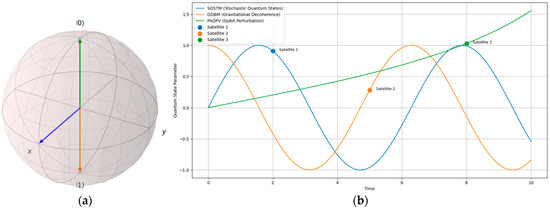
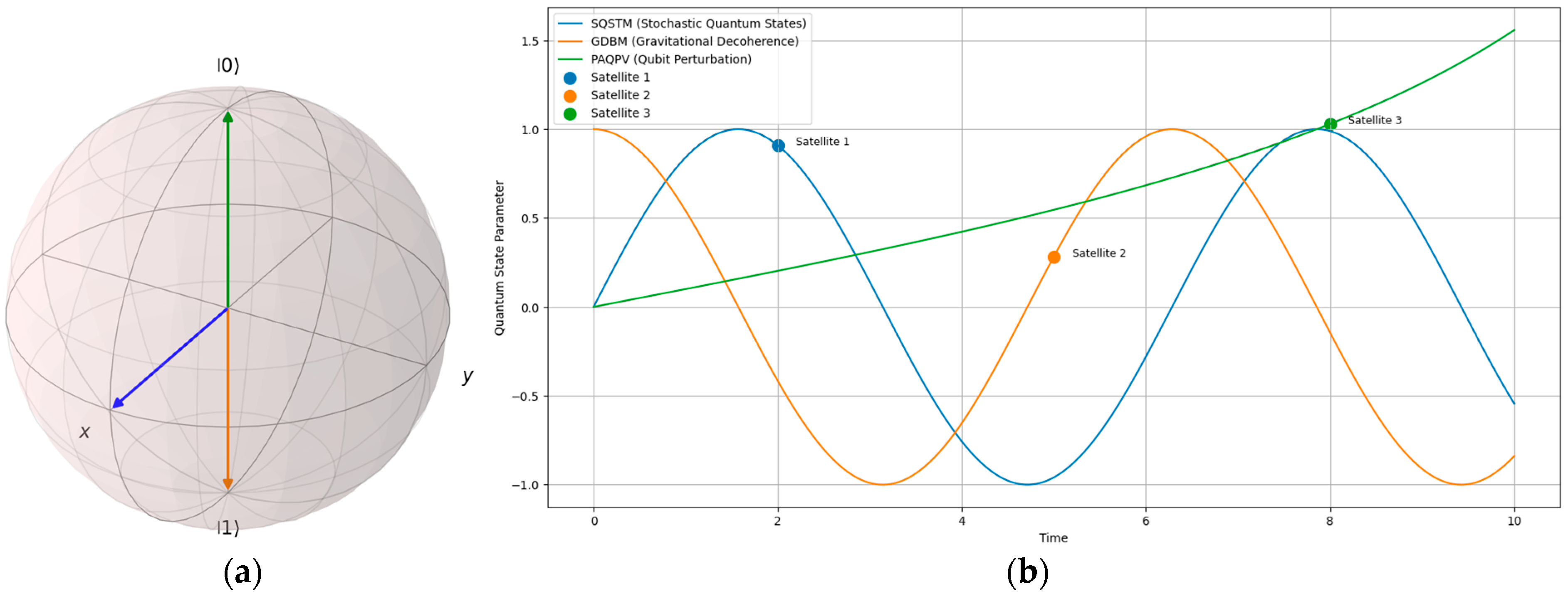
This section provides the results of the sensitivity analysis of satellite constellations to quantum fluctuations in the gravitational field which can be seen in Figure 1. The simulated and observed behaviors in the three analytical models highlight the multifaceted nature of quantum perturbations in orbital dynamics. The stochastic quantum state trajectory mapping plot shows a damped oscillatory behavior with decreasing amplitude over time and it reflects the stochastic perturbations introduced by quantum fluctuations in the gravitational field.
Figure 1.
(a) Illustration of the Block sphere representation and the associated quantum gates using QuTIP python library; (b) sensitivity analysis results of satellite constellations to quantum fluctuations in the gravitational field.
However, the gravitational decoherence Bloch manifold plot provides a larger-amplitude oscillation with no visible decay within the simulation window and it indicates a more persistent decoherence effect driven by gravitational coupling.
Therefore, the precision astrodynamics qubit perturbations plot follows a monotonically increasing trajectory. It suggests a cumulative drift in the qubit state parameter attributed to continuous perturbative forces acting on the satellite orbit.
Thus, by analyzing these results, it suggests that a robust quantum-enabled satellite constellation should take into consideration all three perturbation regimes simultaneously, and that the hybrid correction schemes combining decoherence mitigation, orbital perturbation, and stochastic filtering will be crucial to maintain quantum state integrity across the full mission duration.
6. Conclusions
The study of the sensitivity analysis of satellite constellations to quantum fluctuations in the gravitational field represents a frontier or limit of modern astrodynamics, bridging the gap between classical general relativity and quantum gravity. By simulating orbital trajectories using the QuTIP quantum toolbox in python, via classical frameworks and models incorporating stochastic quantum perturbations, our research aims to determine whether minimal cumulative deviations in position, velocity, and orbital period could compromise the integrity of high-precision missions.
In the precision astrodynamics qubit perturbation analysis, it is crucial to understand that in this framework, a qubit represents a discrete quantum state of the gravitational field that deviates from the classical geodesic motion of each satellite. As satellite technology advances toward subcenter accuracy for Earth observation and global navigation, the traditional use of Einsteinian field equations may require additional corrections to account for the discrete and fluctuating nature of spacetime at the Plank scale.
Our future work will focus on developing quantum communications between satellites for deep space missions.
Author Contributions
Project administration, V.K.O.; Conceptualization, J.B.N.N.A.; writing and editing, J.B.N.N.A. and V.K.O. All authors have read and agreed to the published version of the manuscript.
Funding
This research received no external finding.
Institutional Review Board Statement
Not applicable.
Informed Consent Statement
Not applicable.
Data Availability Statement
The data are contained within the article.
Conflicts of Interest
The authors declare no conflicts of interest.
References
- Nande, S.S.; Rossi, T.; Habibie, M.I.; Barhoumi, M.; Palaparthy, K.; Mansouri, W.; Raju, A.; Bassoli, R.; Cianca, E.; Fitzek, F.H.; et al. Satellite-based positioning enhanced by quantum synchronization. Comput. Netw. 2024, 254, 110734. [Google Scholar] [CrossRef] [Scilit]
- Haghani, Z.; Harko, T. Effects of Quantum Metric Fluctuations on the Cosmological Evolution in Friedmann-Lemaitre-Robertson-Walker Geometries. Physics 2021, 3, 689–714. [Google Scholar] [CrossRef] [Scilit]
- Schirninger, C.; Eichelberger, H.U.; Magnes, W.; Boudjada, M.Y.; Schwingenschuh, K.; Pollinger, A.; Besser, B.P.; Biagi, P.F.; Solovieva, M.; Wang, J.; et al. Satellite Measured Ionospheric Magnetic Field Variations over Natural Hazards Sites. Remote Sens. 2021, 13, 2360. [Google Scholar] [CrossRef] [Scilit]
- Acedo, L. Autoparallel vs. Geodesic trajectories in a Model of Torsion Gravity. Universe 2015, 1, 422–455. [Google Scholar] [CrossRef] [Scilit]
- Romeshkani, M.; Muller, J.; Knabe, A.; Schilling, M. Quantum gravimetry for future satellite gradiometry. Adv. Space Res. 2025, 75, 1653–1664. [Google Scholar] [CrossRef] [Scilit]
- Xu, P.; Ma, Y.; Ren, J.G.; Yong, H.-L.; Ralph, T.C.; Liao, S.-K.; Yin, J.; Liu, W.-Y.; Cai, W.-Q.; Han, X.; et al. Satellite testing of a gravitationally induced quantum decoherence model. Science 2019, 366, 132–135. [Google Scholar] [CrossRef] [Scilit] [PubMed]
- Dimitrov, B. New Applications of Elliptic Functions and Integrals in GPS Inter-Satellite Communications with Account of General Relativity Theory. Mathematics 2025, 13, 1286. [Google Scholar] [CrossRef] [Scilit]

Disclaimer/Publisher’s Note: The statements, opinions and data contained in all publications are solely those of the individual author(s) and contributor(s) and not of MDPI and/or the editor(s). MDPI and/or the editor(s) disclaim responsibility for any injury to people or property resulting from any ideas, methods, instructions or products referred to in the content. |
© 2026 by the authors. Licensee MDPI, Basel, Switzerland. This article is an open access article distributed under the terms and conditions of the Creative Commons Attribution (CC BY) license.