


Abstract
The apsidal motion in close eccentric binaries is a means to unveil the internal structure of stars. We make use of it to test the internal mixing processes in stars with the stellar evolution code GENEC. Apsidal motion is the slow precession of an eccentric orbit with time. Its rate depends on the tidal interactions that occur between the stars through , a measure of the star’s inner density profile. The apsidal motion rate is commonly derived from the eclipses’ times of minima, made possible thanks to high-precision TESS/Kepler observations. We propose an innovative approach: derive the apsidal motion rate from radial velocities obtained over a long timescale combined with light curves to obtain high-accuracy consistent physical and orbital parameters for the binaries. We highlight recent results concerning the most massive binary studied this way. Confronted to observations of massive stars, standard non-rotating single-star models usually predict stars with too low a density contrast; the so-called -discrepancy. We built bespoke GENEC stellar evolution models including tidally induced/suppressed rotational mixing for the twin massive binary HD152248. The models reveal the instabilities that allow us to reproduce the stellar density profiles. A large overshooting is necessary to converge towards the observed in both purely hydrodynamic and magneto-diffusive models. While a change in metallicity or mass-loss rate has no significant impact on , a large initial helium abundance allows us to better reproduce . However, is not observationally supported. These analyses highlight the need for a process in the stars that extends the size of the convective core. It paves the way for the next generation of stellar models.
Keywords:
stars; early-type; evolution; massive; rotation; binaries: close; eclipsing; spectroscopic 1. Introduction
Massive stars are the building blocks of the universe: their radiation-driven winds and supernova explosions enrich their host galaxies in newly formed chemicals and contribute to their reonisation [1]. Massive stars are predominantly found in binaries or higher-multiplicity systems [2,3]. Stars in binaries follow much more complex pathways than their single-star counterparts: their evolution can be affected by tidal interactions and mass transfer between the stars, leading to a diversity of evolutionary sequences [4,5,6]. Current uncertainties in the predictions of post-main sequence evolution [7], pre-supernova structure, and core-collapse outcome [8,9] are mainly caused by the treatment, in stellar models, of convective boundary mixing (through, e.g., overshooting, semi-convection) [10] and internal mixing processes responsible for the transport of angular momentum and chemicals in stars. Over the last few decades, an upward revision of the convective boundary mixing in massive stars has been called for by several independent studies in order to reproduce a variety of stars’ properties [11,12,13,14,15,16,17,18,19,20,21]. In this paper, we present the apsidal motion in a binary system as a powerful tool to probe the interiors of stars and constrain the overshooting parameter.
2. Apsidal Motion
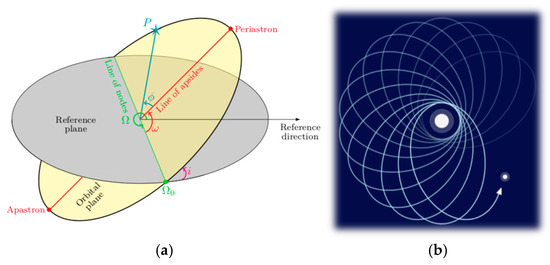
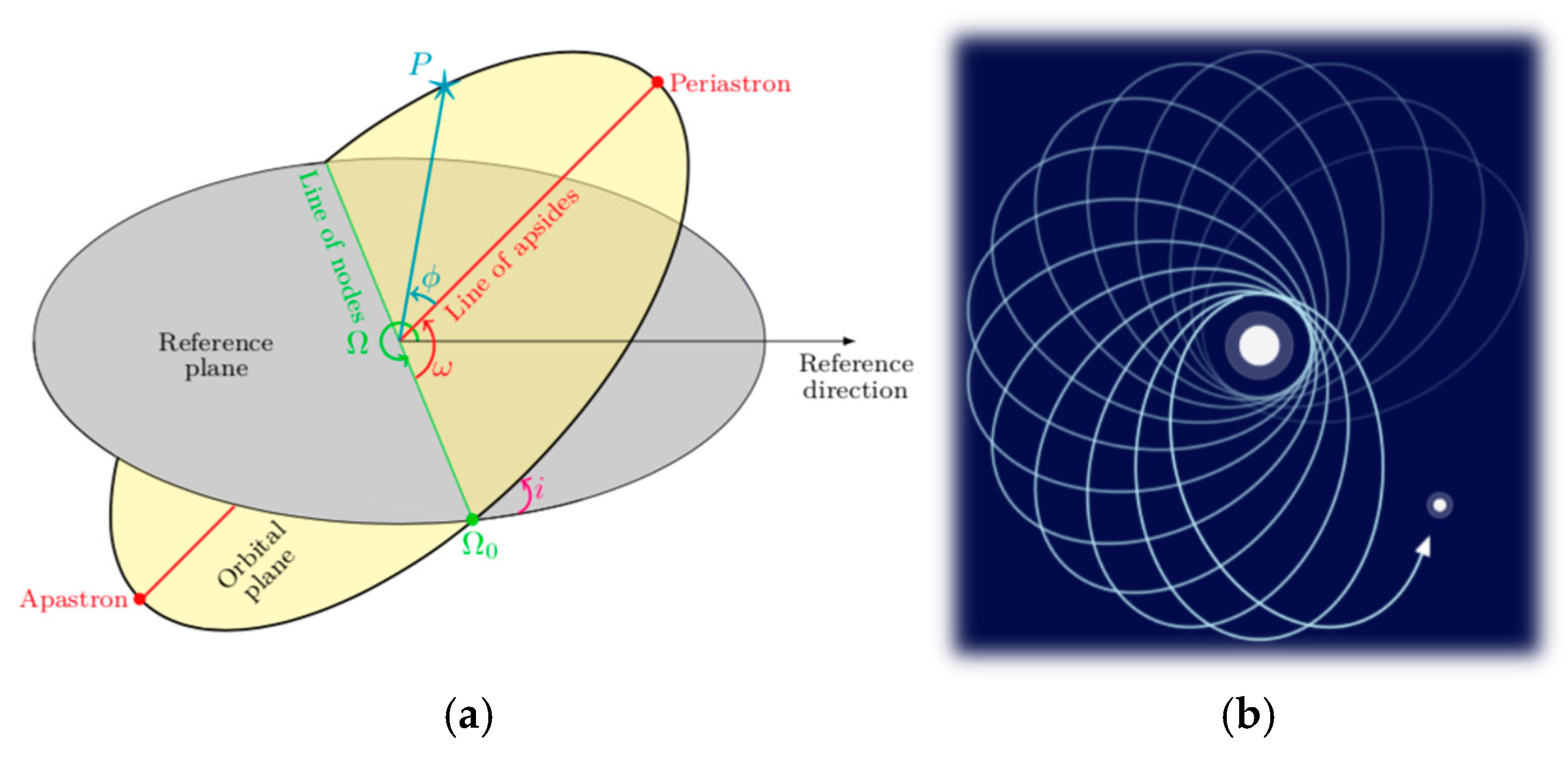
In the purely Keplerian problem of two point-like stars orbiting each other on an eccentric orbit, only the position of the stars on their orbit—measured through the true anomaly ϕ—changes over time (see Figure 1a). In reality, stars have a three-dimensional shape and exert tides on each other. These tidal interactions are responsible for the exchange of angular momentum in the binary system. Due to stellar deformations, the gravitational potential of the stars is not spherically symmetric anymore [22,23]. The most prominent consequence of these tides is the slow precession of the line of apsides with time, measured through the longitude of periastron ω (see Figure 1b) [24]. This motion is purely non-Keplerian and the ensuing rate of apsidal motion is referred to as Newtonian. General relativistic effects also contribute to the total apsidal motion rate [24,25,26]; yet these are, in most systems, of much lower contribution than the Newtonian contribution [27,28,29,30,31,32,33,34].
Figure 1.
(a) Definition of the orbital elements of a binary. Both the argument of periastron ω and the true anomaly ϕ are measures in the orbital plane. (b) Schematic illustration of the apsidal motion.
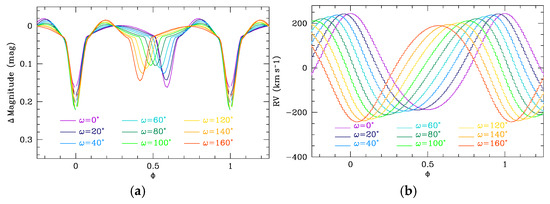
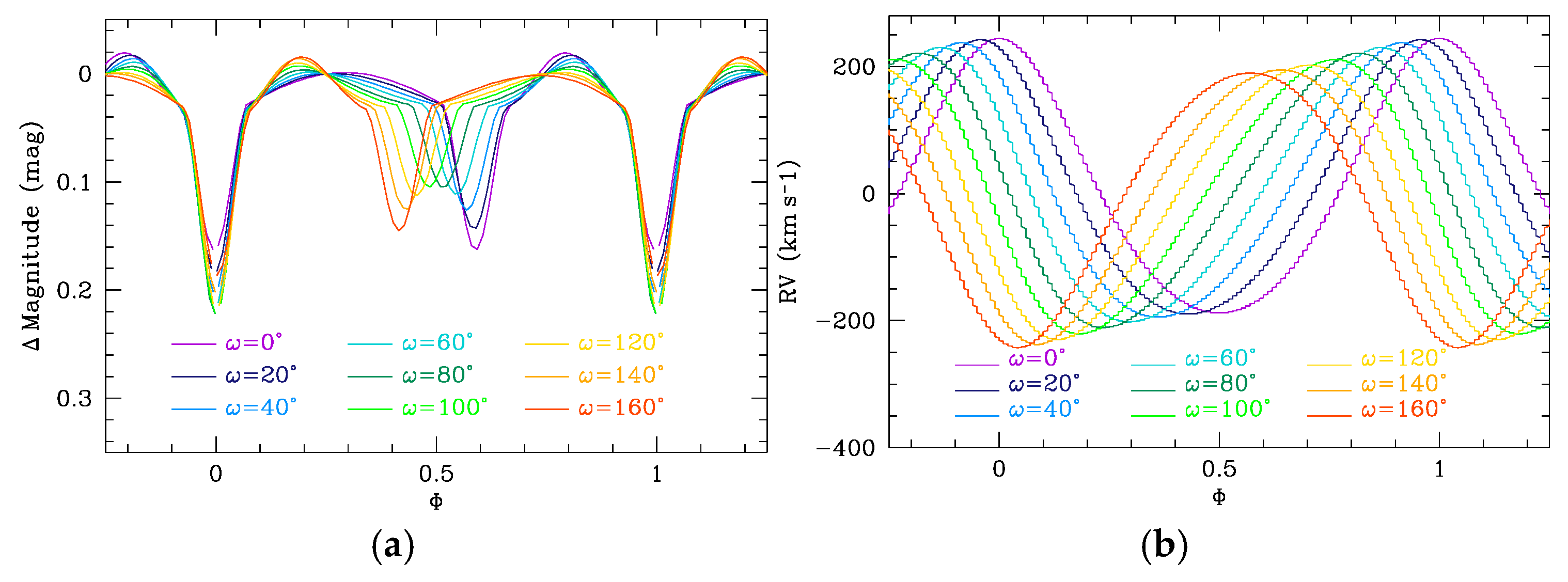
The apsidal motion rate is traditionally determined from the light curves of an eclipsing binary, or equivalently, from the times of minima of the eclipses [34]. Indeed, both the depth and phase of eclipses depend upon the orbital separation at the conjunction phase, which is itself dependent on the orientation of the ellipse with respect to the line of sight; that is to say, ω. Figure 2a illustrates this and shows nine theoretical light curves computed with different values of ω, with all other parameters remaining identical. These light curves were computed assuming a twin system in which both stars share the same exact properties in terms of, e.g., mass, radius, and effective temperature. The difference in depths of the eclipses is thus not attributable to a difference in temperature between the stars. Phase 0 of the eclipses is set at primary eclipse. For the range of ω values shown, the primary eclipse happens close to the periastron passage; hence, the stars are closer and the eclipse is deeper than the secondary eclipse happening closer to the apastron passage.
Figure 2.
(a) Theoretical light curves for different values of ω, with all other parameters identical. Figure from [35]. (b) Theoretical radial velocity curves for the same models as in (a).
Alternatively, the apsidal motion rate can be derived from the stars’ radial velocities provided that the binary is a single- or double-lined spectroscopic system for which spectral lines of the primary or both stars are observed. Figure 2b illustrates the impact of a change in ω on the radial velocity curve for the same parameters as in Figure 2a.
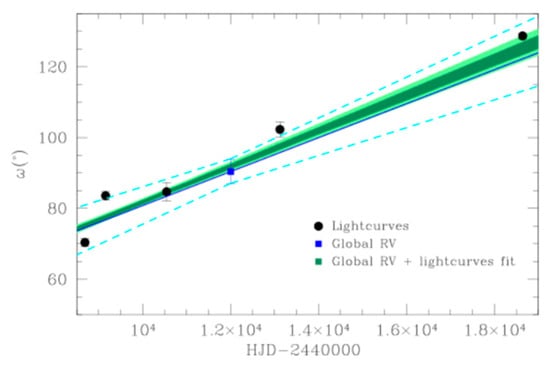
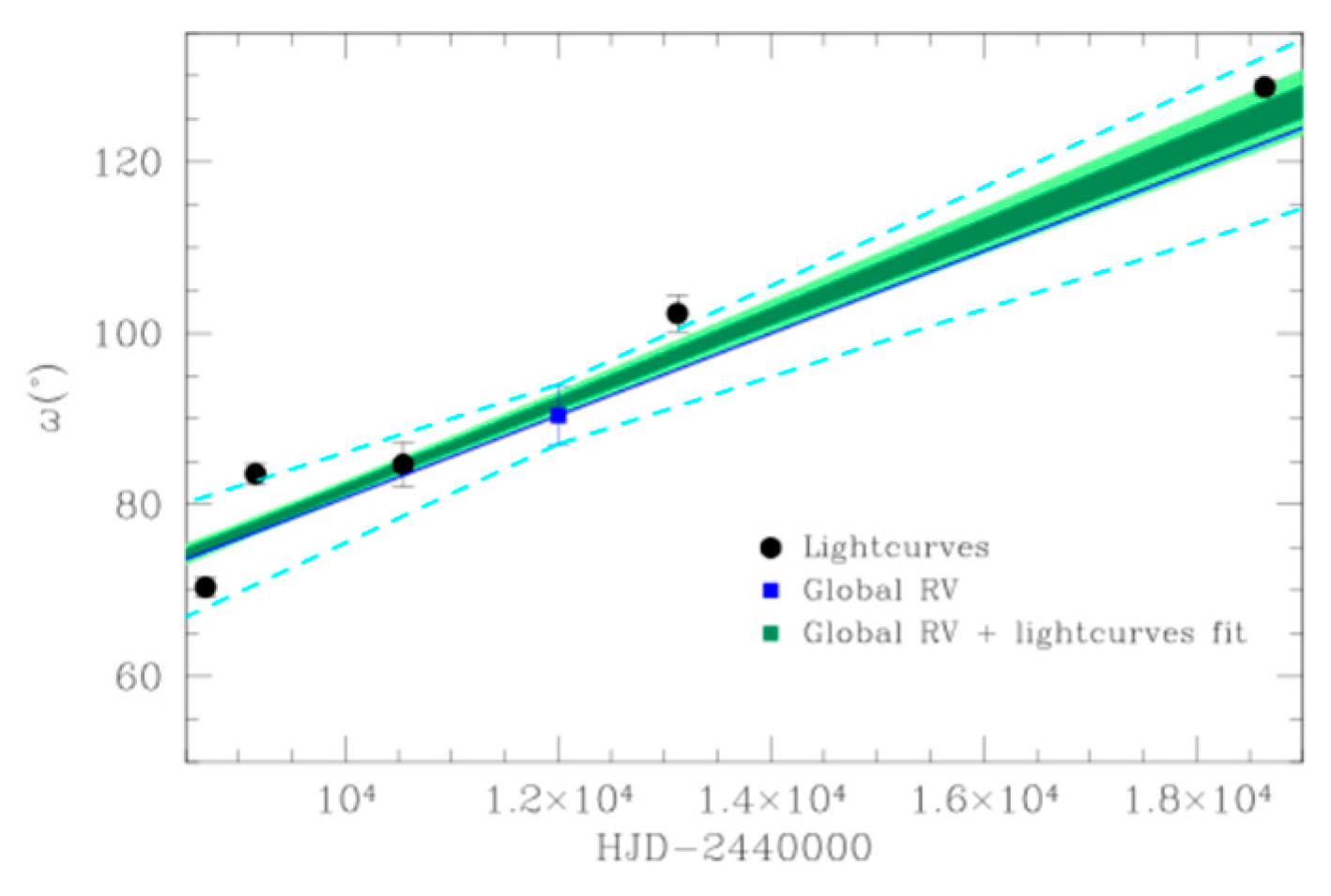
The combination of the two methods allows us to derive consistent apsidal motion rates as well as stellar and orbital properties [36,37,38,39]. This is illustrated for the twin massive binary HD152248 in Figure 3, with all properties summarised in Table 1.
Figure 3.
Longitude of periastron ω as a function of time from radial velocities and light cuves of HD152248. © Adapted from [36].
Table 1.
Observational stellar and orbital parameters of the massive binary HD152248 [36].
3. Internal Stellar Structure Constant
The apsidal motion rate equation reduces, for twin systems, to the following expression:
where and are function of the eccentricity defined in [40], is the gravitational constant, is the speed of light, and other parameters are defined in Table 1. The first and second terms in Equation (1) are the Newtonian and general relativistic contribution, respectively [24]. The internal stellar structure constant
is a function of , the logarithmic derivative of the surface harmonic of the distorted star, function of the ellipticity, and solution of the Clairaut–Radau differential equation
evaluated at the stellar surface with the boundary condition [41]. In Equation (3), is the radial distance from the core to , is the density in a shell at radius , and is the density in a sphere of radius .
The is thus a measure of the density stratification inside the star. It takes its maximum value of 0.75 for a homogenous sphere. As a massive star evolves, its core contracts while its envelope expands; its consequently decreases. The is thus a good indicator of stellar evolution [40,42].
4. The Discrepancy: GENEC Stellar Evolution Models
Over the last decade, several studies have highlighted what we call the -discrepancy between models and observations for massive stars. Models systematically predict larger values than those determined from observations [30,37,40]. This means that models predict stars with a lower density contrast between their core and external layers than what observations suggest. This -discrepancy is observed in massive stars only; their less massive counterparts do not suffer from this problem [30]. We investigated this discrepancy in HD152248 with the GENeva stellar Evolution Code (GENEC) [43].
4.1. GENEC: Input Physics
We computed GENEC stellar evolution models adopting two different prescriptions for the transport of angular momentum in stars: purely hydrodynamic (hydro) [44] and magneto-diffusive (magnetic) models [45]. We computed both single- and binary-star models. The latter include dynamical tides and equilibrium tides of small subsurface convective zones [46,47,48]. We adopted the mass-loss rate of [49] as it is best at reproducing observed stars in this temperature regime [50,51]. We adopted the NACRE II reaction rates [52] and a metallicity as estimated for the NGC 6231 cluster to which HD152248 belongs [53]. The initial helium abundance is not observationally constrained. We adopted the solar value. We varied the overshooting parameter from 0.5 to 1.4. We set the initial mass of the star such that the mass of the model when it reaches the observed radius equals the observed mass. For single-star models, we set the initial velocity of the models such that the surface velocity of the model that reproduces the radius is equal to the observed surface velocity. For binary-star models, we initialised the star synchronised with the orbital motion.
4.2. Single- or Binary-Star Models? The Impact of Tidal Locking
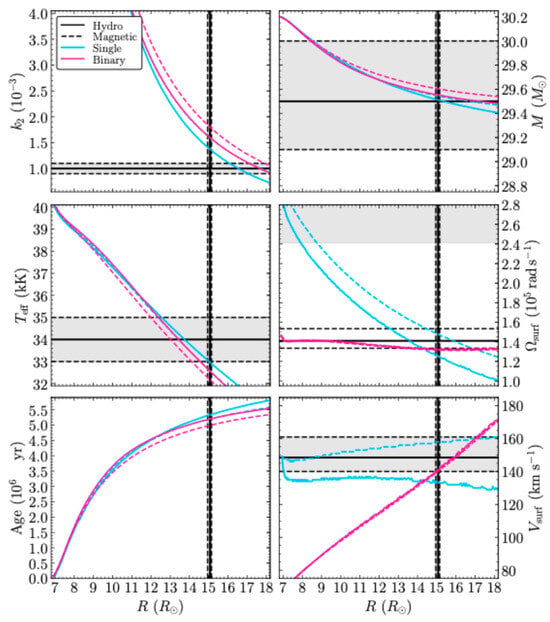
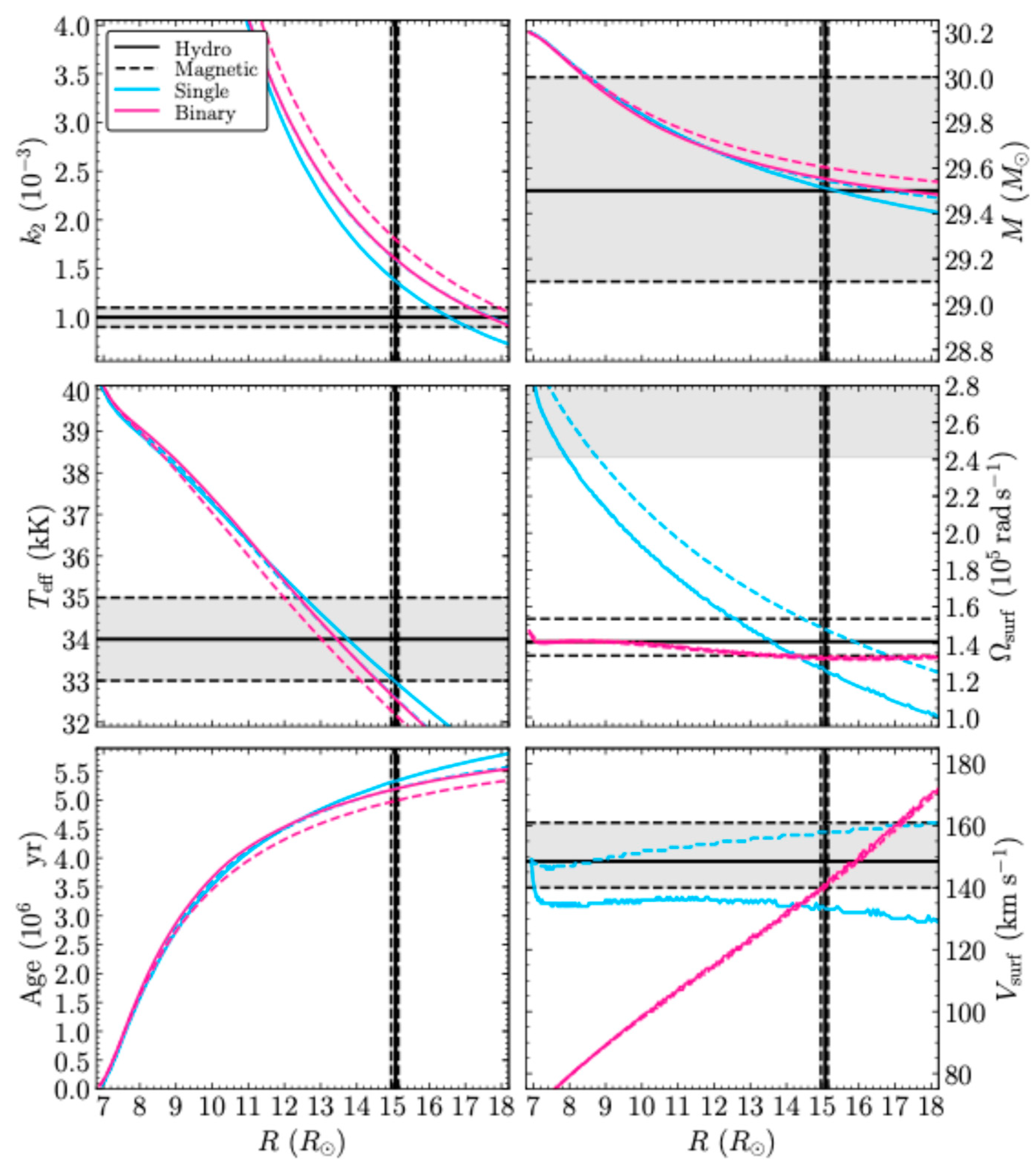
We show in Figure 4 the evolution of the , mass, effective temperature, age, surface velocity, and angular surface velocity as a function of radius for single- and binary-star models with . For a thorough discussion of the interplay between rotation velocity and overshooting, we refer to [54]. If single-star models are apparently better at reproducing the current properties of the stars, it is because we chose their initial velocity such that it is the case; that is to say that . The velocity evolution of a single-star model is driven by stellar evolution: decreases with time while the stellar radius increases with time. is thus roughly constant over time. In reality, in a binary system, the star has a companion and its is fixed by the orbital motion. The binary is pseudo-synchronised, so is roughly constant over time. The angular velocity evolution is driven by tides and increases with time following the increase in the stellar radius. When , both models have and , but the binary-star model saw its and lower during the whole evolution. The binary-star model thus has had less mixing throughout its evolution; hence, its is larger when . In conclusion, single-star models are not better at reproducing the properties of the stars, as they do not properly capture the evolution of the stars. Binary interactions need to be accounted for to correctly predict the evolution of a close binary such as HD152248.
Figure 4.
Evolution of stellar parameters with stellar radius for hydro and magnetic single- and binary-star models. Models have , and from [49]. Observational values and their error bars are shown (plain black lines and shaded grey area).
4.3. Binary-Star Models!
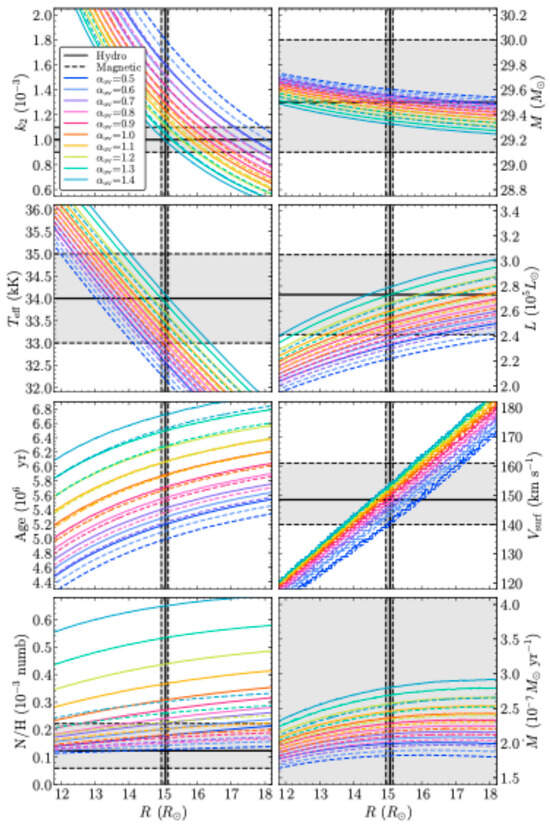
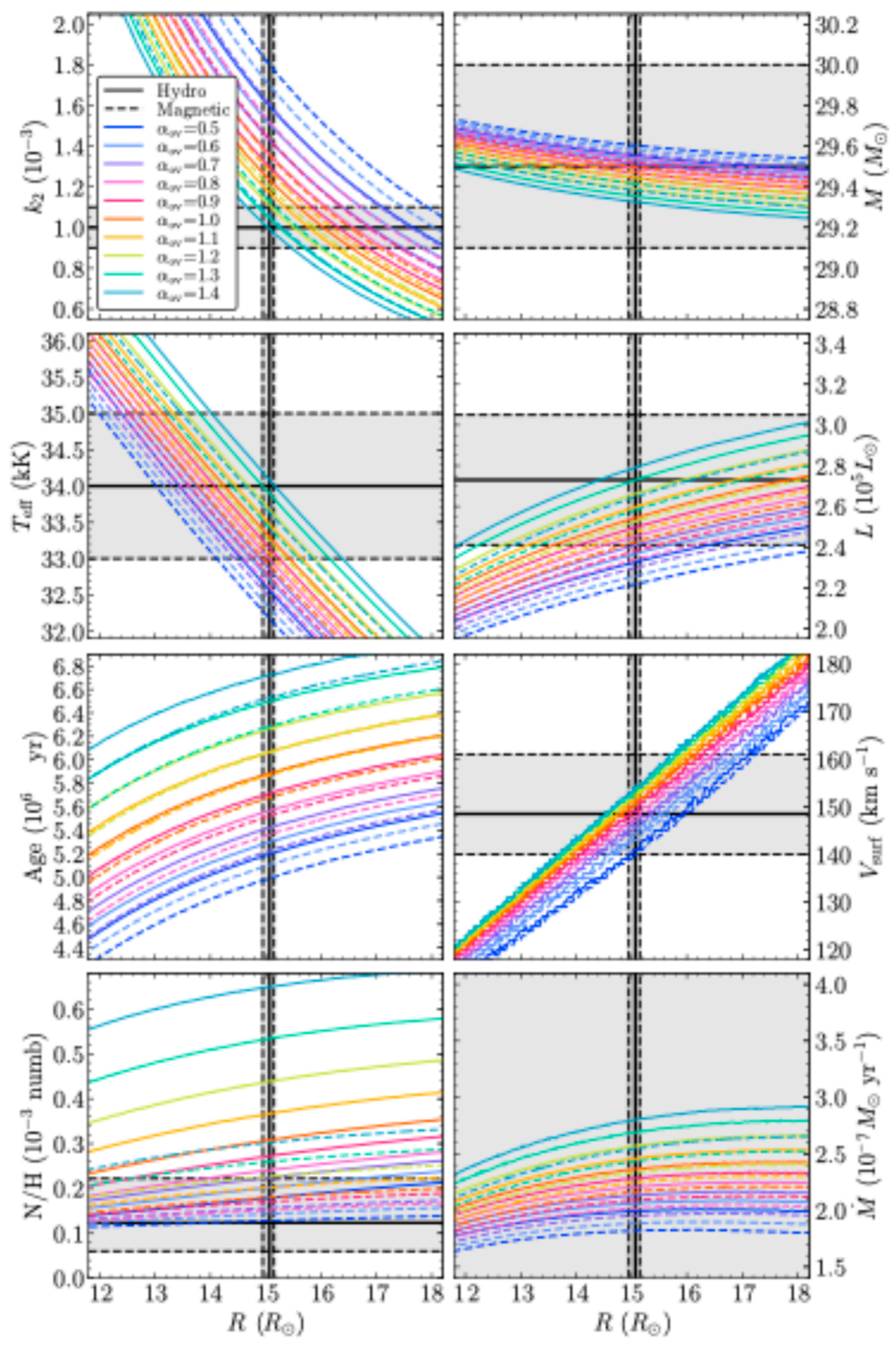
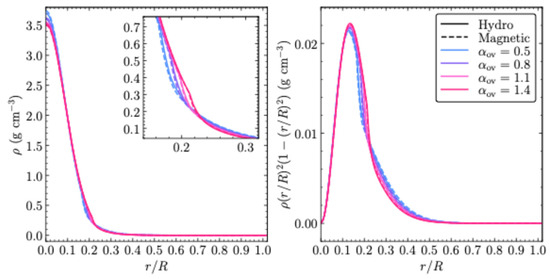
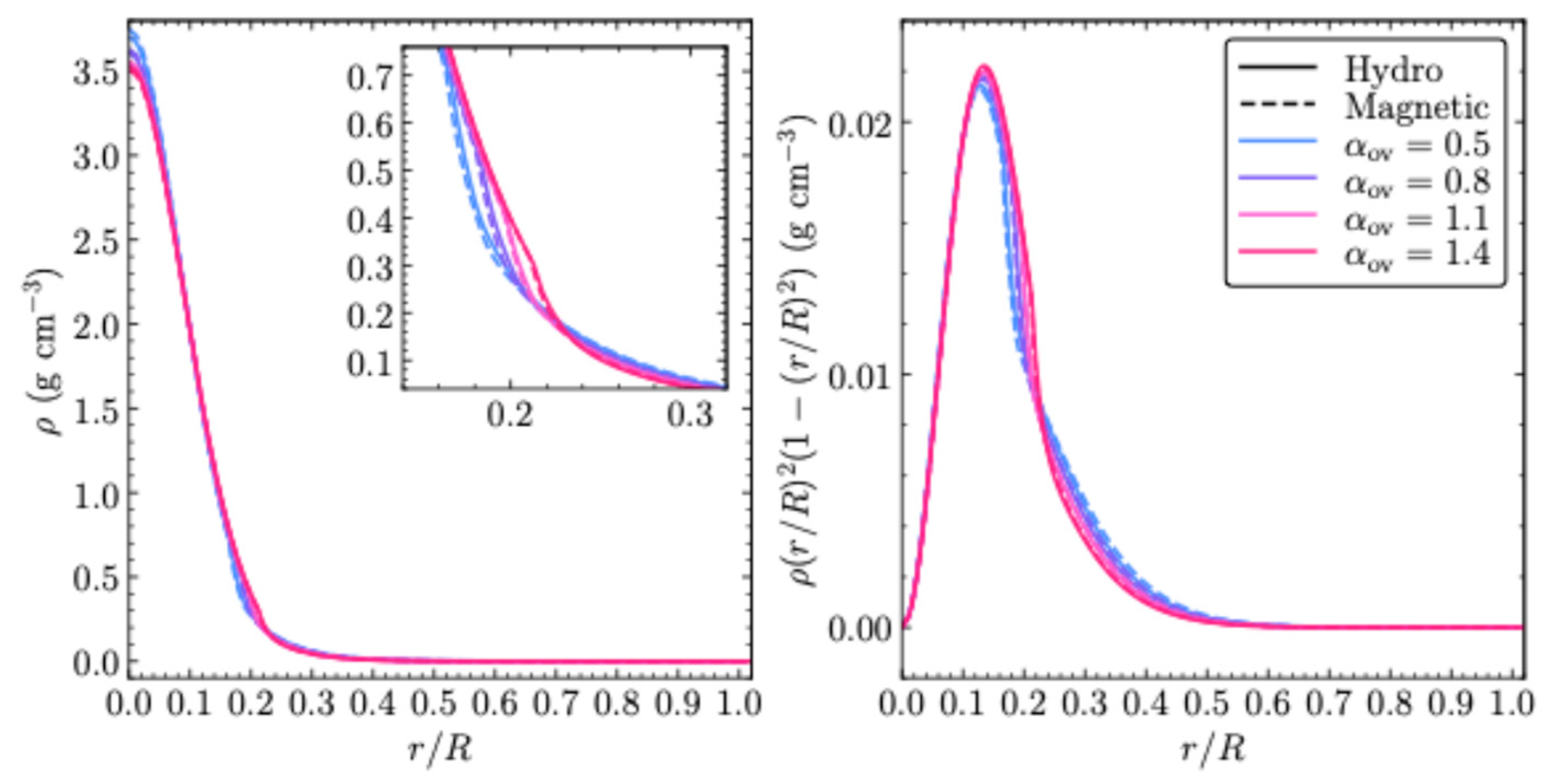
We show in Figure 5 the evolution of stellar parameters for binary-star models with ranging from 0.5 to 1.4. We observe that a larger of at least 1.2–1.3 is necessary to reproduce the properties of the stars, including their . It is justified as follows: a larger implies a larger convective core, and hence more fuel for burning and an extension of the main-sequence lifetime. The model is older when it reaches and thus has had more time to contract its interior and extend its envelope. Consequently, its is smaller. Figure 6 shows the density profile and density function, defined as Equation (5) in [54] inside models with and and 1.4. Models with have a more extended and overall denser core and a more diluted envelope than their counterpart.
Figure 5.
Evolution of stellar parameters with stellar radius for hydro and magnetic binary-star models for different values. Observational values and their error bars are shown (plain black lines and shaded grey area). Adapted from [54].
Figure 6.
Density profiles and density function in binary-star models as a function of the normalised radial distance in the star for different values.
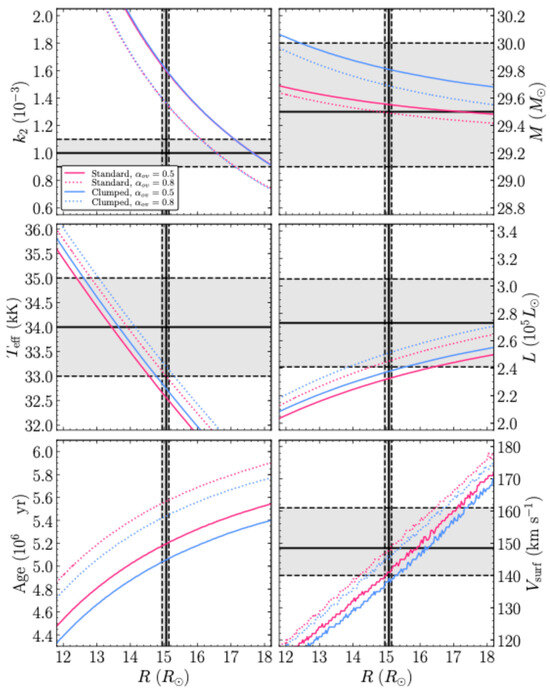
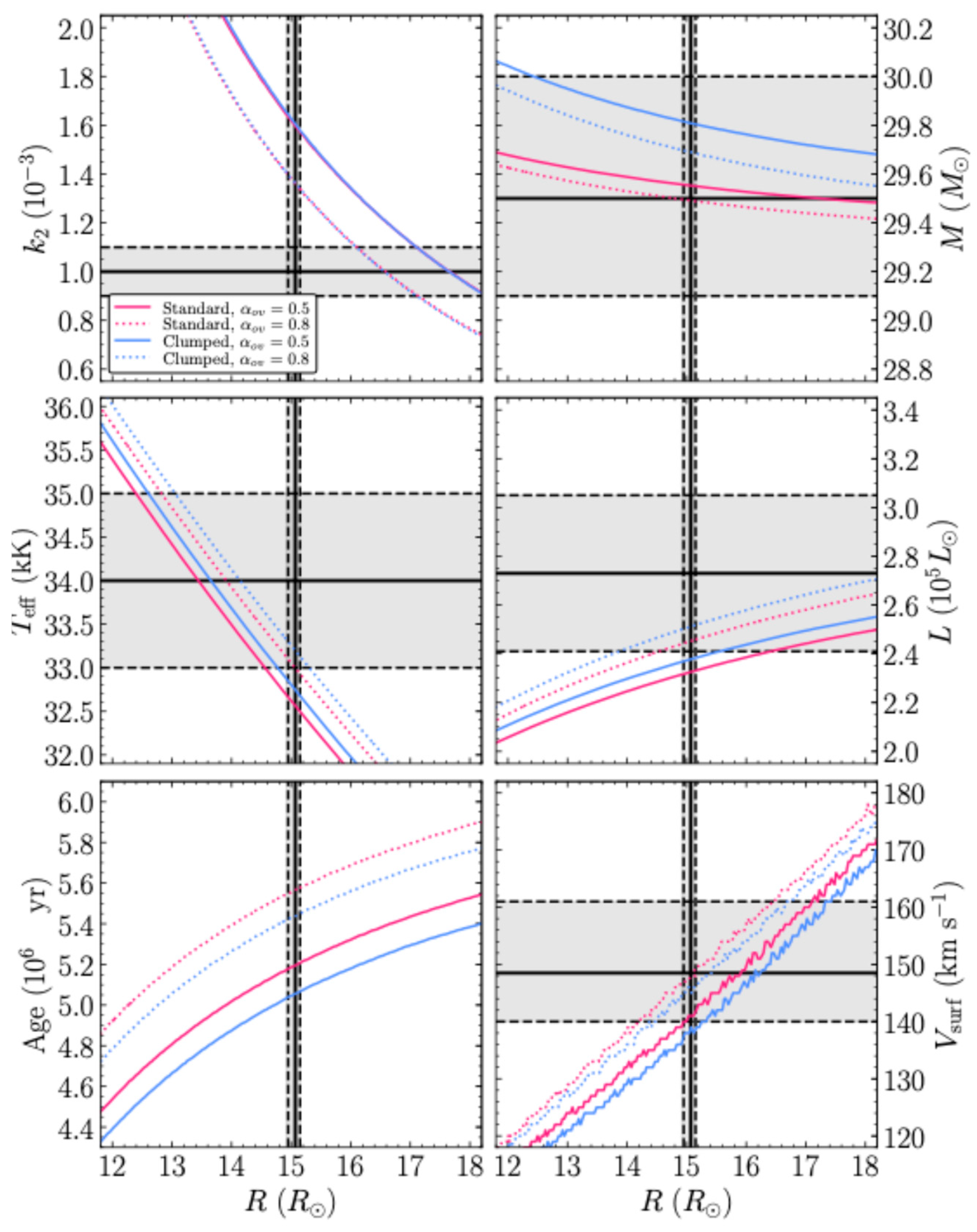
We investigated the impact of the mass-loss rate prescription on the results. The winds of massive stars are clumped. If the clumping starts close to the photosphere, theoretical mass-loss rates are underestimated by a factor with = 8–10. We computed binary-star models adopting the Krticka mass-loss rate multiplied by a factor of 1.8 (clumped models). This mass-loss rate should be an upper limit on possible mass-loss rates [55]. The initial mass of the models was set to a slightly larger value of . The comparison between clumped and standard models is shown in Figure 7. Clumped models, due to their slightly larger initial mass, evolve at a larger effective temperature and luminosity. Yet the evolution of their is identical to that of standard models. Indeed, while the star sees its decreasing faster because it is initially more massive, it reaches earlier, meaning that it does not have time to evolve as much as the standard model, which compensates the faster decrease in . In conclusion, even if the mass-loss rate is underestimated, it has no significant impact on the parameters evolution, and a of at least 1.2–1.3 is still necessary to reproduce the stellar properties, including . It demonstrates that is probing the interiors of stars and is not significantly sensitive to the stars’ atmosphere, making the apsidal motion a powerful technique for probing stellar interiors.
Figure 7.
Evolution of stellar parameters with stellar radius for hydro binary-star models for standard and clumped models. Observational values and their error bars are shown (plain black lines and shaded grey area).
We tested the impact of various input parameters on the evolution of the stars: the initial mass, metallicity, and initial helium abundance. None of the parameters had a significant influence on the evolution of stellar parameters except for the initial helium abundance. However, a very large initial abundance was required to reproduce the observed properties of the stars, which is not observationally supported.
5. Conclusions
The observed apsidal motion in the twin massive binary HD152248 was used to probe the interiors of the stars and constrain convective boundary mixing. We built single- and binary-star evolution models with GENEC adopting two different prescriptions for the transport of angular momentum: purely hydrodynamic and magneto-diffusive models. In addition to the overshooting, measured through , we investigated the impact of initial mass, mass-loss rate, metallicity, initial helium abundance, and mixing-length parameter on the evolution of stellar parameters, including the internal stellar structure constant . We demonstrated that it is crucial to take into account binary interactions through tides in short-period systems as HD152248 as the stellar angular velocity quickly synchronises with the orbital motion. Mixing is thus reduced in binary-star models compared to their single-star counterparts. We showed that standard models computed with a moderate value of systematically overpredict , a result referred to as the -discrepancy. Only models with larger than 1.2–1.3 reproduce all stellar parameters, including . Other parameters have a limited impact on the results. The necessary large overshooting points toward the need for more efficient core boundary mixing in massive stars. Whether it is strictly an extension of the convective core or/and a strong mixing in the radiative envelope close to the core is under investigation.
Author Contributions
Conceptualization, S.R.; data curation, S.R.; formal analysis, S.R.; investigation, S.R.; methodology, S.R.; resources, S.R.; software, S.R. and L.S.; validation, S.R.; writing—original draft preparation, S.R.; writing—review and editing, S.R. and L.S. All authors have read and agreed to the published version of the manuscript.
Funding
This research was funded by the Swiss National Science Foundation SNF project 212143.
Institutional Review Board Statement
Not applicable.
Informed Consent Statement
Not applicable.
Data Availability Statement
The GENEC models supporting the conclusions of this article will be made available by the authors on request.
Acknowledgments
S.R. thanks S. Ekström and P. Eggenberger for the fruitful scientific discussions that led to this paper. The authors thank the anonymous referees for their useful comments which contributed to the improvement of the manuscript.
Conflicts of Interest
The authors declare no conflicts of interest. The funders had no role in the design of the study; in the collection, analyses, or interpretation of data; in the writing of the manuscript; or in the decision to publish the results.
References
- Bresolin, F. Massive Stars in the Nuclei and Arms of Spirals. In Proceedings of the IAU Symposium 250 on Massive Stars as Cosmic Engines, Mānoa, HI, USA, 18 December 2007. [Google Scholar] [CrossRef] [Scilit]
- Sana, H.; de Mink, S.E.; de Koter, A.; Langer, N.; Evans, C.J.; Gieles, M.; Gosset, E.; Izzard, R.G.; Le Bouquin, J.-B.; Schneider, F.R.N. Binary Interaction Dominates the Evolution of Massive Stars. Science 2012, 337, 444. [Google Scholar] [CrossRef] [Scilit] [PubMed]
- Duchêne, G.; Adam, K. Stellar Multiplicity. Annu. Rev. Astron. Astrophys. 2013, 51, 269. [Google Scholar] [CrossRef] [Scilit]
- Wellstein, S.; Langer, N.; Braun, H. Formation of contact in massive close binaries. Astron. Astrophys. 2001, 369, 939. [Google Scholar] [CrossRef] [Scilit]
- Vanbeveren, D.; De Loore, C.; Van Rensbergen, W. Massive stars. Astron. Astrophys. Rev. 1998, 9, 63. [Google Scholar] [CrossRef] [Scilit]
- Marchant, P.; Bodensteiner, J. The Evolution of Massive Binary Stars. Annu. Rev. Astron. Astrophys. 2024, 62, 21. [Google Scholar] [CrossRef] [Scilit]
- Martins, F.; Palacios, A. A comparison of evolutionary tracks for single Galactic massive stars. Astron. Astrophys. 2013, 560, A16. [Google Scholar] [CrossRef] [Scilit]
- Ertl, T.; Janka, H.-T.; Woosley, S.E.; Sukhbold, T.; Ugliano, M. A Two-Parameter Criterion for Classifying the Explodability of Massive Stars by the Neutrino-Driven Mechanism. Astrophys. J. 2016, 818, 124. [Google Scholar] [CrossRef] [Scilit]
- Chieffi, A.; Limongi, M. The Presupernova Core Mass-Radius Relation of Massive Stars: Understanding Its Formation and Evolution. Astrophys. J. 2020, 890, 43. [Google Scholar] [CrossRef] [Scilit]
- Kaiser, E.A.; Hirschi, R.; Arnett, W.D.; Georgy, C.; Scott, L.J.A.; Cristini, A. Relative importance of convective uncertainties in massive stars. Mon. Not. R. Astron. Soc. 2020, 496, 1967. [Google Scholar] [CrossRef] [Scilit]
- Castro, N.; Fossati, L.; Langer, N.; Simón-Díaz, S.; Schneider, F.R.N.; Izzard, R.G. The spectroscopic Hertzsprung-Russell diagram of Galactic massive stars. Astron. Astrophys. 2004, 570, L13. [Google Scholar] [CrossRef] [Scilit]
- Martinet, S.; Meynet, G.; Ekström, S.; Simón-Díaz, S.; Holgado, G.; Castro, N.; Georgy, C.; Eggenberger, P.; Bulgen, G.; Salmon, S.; et al. Convective core sizes in rotating massive stars. I. Constraints from solar metallicity OB field stars. Astron. Astrophys. 2021, 648, A126. [Google Scholar] [CrossRef] [Scilit]
- Baraffe, I.; Clarke, J.; Morison, A.; Vlaykov, D.G.; Constantino, T.; Goffrey, T.; Guillet, T.; Le Saux, A.; Pratt, J. A study of convective core overshooting as a function of stellar mass based on two-dimensional hydrodynamical simulations. Mon. Not. R. Astron. Soc. 2023, 519, 5333. [Google Scholar] [CrossRef] [Scilit]
- Tkachenko, A.; Pavlovski, K.; Johnston, C.; Pedersen, M.G.; Michielsen, M.; Bowman, D.M.; Southworth, J.; Tsymbal, V.; Aerts, C. The mass discrepancy in intermediate- and high-mass eclipsing binaries: The need for higher convective core masses. Astron. Astrophys. 2020, 637, A60. [Google Scholar] [CrossRef] [Scilit]
- Higgins, E.R.; Vink, J.S. Massive star evolution: Rotation, winds, and overshooting vectors in the mass-luminosity plane. I. A calibrated grid of rotating single star models. Astron. Astrophys. 2019, 622, A50. [Google Scholar] [CrossRef] [Scilit]
- Mao, H.; Woodward, P.; Herwig, F.; Denissenkov, P.A.; Blouin, S.; Thompson, W.; McDermott, B. 3D Hydrodynamic Simulations of Massive Main-sequence Stars. III. The Effect of Radiation Pressure and Diffusion Leading to a 1D Equilibrium Model. Astrophys. J. 2024, 975, 271. [Google Scholar] [CrossRef] [Scilit]
- Fellay, L.; Dupret, M.-A.; Rosu, S. Underestimation of the tidal force and apsidal motion in close binary systems by the perturbative approach: Comparisons with non-perturbative models. Astron. Astrophys. 2024, 683, A210. [Google Scholar] [CrossRef] [Scilit]
- Scott, L.J.A.; Hirschi, R.; Georgy, C.; Arnett, W.D.; Meakin, C.; Kaiser, E.A.; Ekström, S.; Yusof, N. Convective core entrainment in 1D main-sequence stellar models. Mon. Not. R. Astron. Soc. 2021, 503, 4208. [Google Scholar] [CrossRef] [Scilit]
- Aerts, C. Probing the interior physics of stars through asteroseismology. Rev. Mod. Phys. 2021, 93, 015001. [Google Scholar] [CrossRef] [Scilit]
- Pedersen, M.G.; Aerts, C.; Pápics, P.I.; Michielsen, M.; Gebruers, S.; Rogers, T.; Molenberghs, G.; Burssens, S.; Garcia, S.; Bowman, D.M. Internal mixing of rotating stars inferred from dipole gravity modes. Nat. Astron. 2021, 5, 715. [Google Scholar] [CrossRef] [Scilit]
- Gilkis, A.; Shenar, T.; Ramachandran, V.; Jermyn, A.S.; Mahy, L.; Oskinova, L.M.; Arcavi, I.; Sana, H. The excess of cool supergiants from contemporary stellar evolution models defies the metallicity-independent Humphreys-Davidson limit. Mon. Not. R. Astron. Soc. 2021, 503, 1884. [Google Scholar] [CrossRef] [Scilit]
- Moreno, E.; Koenigsberger, G.; Harrington, D.M. Eccentric binaries. Tidal flows and periastron events. Astron. Astrophys. 2011, 528, A48. [Google Scholar] [CrossRef] [Scilit]
- Schmitt, J.H.M.M.; Schröder, K.-P.; Rauw, G.; Hempelmann, A.; Mittag, M.; González-Pérez, J.N.; Czesla, S.; Wolter, U.; Jack, D. The alpha CrB binary system: A new radial velocity curve, apsidal motion, and the alignment of rotation and orbit axes. Astron. Astrophys. 2016, 586, A104. [Google Scholar] [CrossRef] [Scilit]
- Shakura, N.I. On the apsidal motion in binary stars. Sov. Astron. Lett. 1985, 11, 224. [Google Scholar]
- Levi-Civita, T. Astronomical Consequences of the Relativistic Two-Body Problem. Am. J. Math. 1937, 59, 225. [Google Scholar] [CrossRef] [Scilit]
- Giménez, A. General-relativistic periastron advances in eclipsing binary systems. Astrophys. J. 1985, 297, 405. [Google Scholar] [CrossRef] [Scilit]
- Wolf, M.; Kotková, L.; Kocián, R.; Dreveny, R.; Hanzl, D. Apsidal Motion in Eccentric Eclipsing Binary WW Camelopardalis. Astrophys. J. 2010, 139, 1028. [Google Scholar] [CrossRef] [Scilit]
- Zasche, P.; Wolf, M. V456 Ophiuchi and V490 Cygni: Systems with the shortest apsidal-motion periods. Astron. Astrophys. 2011, 527, A43. [Google Scholar] [CrossRef] [Scilit]
- Wolf, M.; Zasche, P.; Kucakova, H.; Lehky, M.; Svoboda, P.; Smelcer, L.; Zejda, M. Apsidal motion in five eccentric eclipsing binaries. Astron. Astrophys. 2013, 549, A108. [Google Scholar] [CrossRef] [Scilit]
- Claret, A.; Giménez, A.; Baroch, D.; Ribas, I.; Morales, J.C.; Anglada-Escudé, G. Analysis of apsidal motion in eclipsing binaries using TESS data. II. A test of internal stellar structure. Astron. Astrophys. 2021, 654, A17. [Google Scholar] [CrossRef] [Scilit]
- Schmitt, J.H.M.M.; Czesla, S.; Wichmann, R.; Robrade, J. Apsidal motion in the α CrB binary system revealed through X-ray and optical eclipse timing. Astron. Astrophys. 2023, 676, A86. [Google Scholar] [CrossRef] [Scilit]
- Wolf, M.; Zasche, P.; Kára, J.; Zejda, M.; Janik, J.; Masek, M.; Lehky, M.; Merc, J.; Richterkova, A.; Hanzl, D.; et al. Apsidal motion and TESS light curves of three southern close eccentric eclipsing binaries: GM Nor, V397 Pup, and PT Vel. Astron. Astrophys. 2024, 690, A231. [Google Scholar] [CrossRef] [Scilit]
- Wolf, M.; Zasche, P.; Zejda, M.; Masek, M. Apsidal motion and TESS light curves of two southern eclipsing binaries with high eccentricity: V1647 Sgr and V2283 Sgr. Astron. Astrophys. 2026, 707, A205. [Google Scholar] [CrossRef] [Scilit]
- Rosu, S. Apsidal motion in massive binaries. In Proceedings of the conference Rodolfo Barbá, Madrid, Spain, 18–20 September 2024. [Google Scholar]
- Rosu, S. What apsidal motion reveals about the interior of massive stars. Bull. Société R. Sci. Liège 2021, 90, 1–16. [Google Scholar] [CrossRef] [Scilit]
- Rosu, S.; Rauw, G.; Conroy, K.E.; Gosset, E.; Manfroid, J.; Royer, P. Apsidal motion in the massive binary HD 152248. Astron. Astrophys. 2020, 635, A145. [Google Scholar] [CrossRef] [Scilit]
- Rosu, S.; Rauw, G.; Farnir, M.; Dupret, M.-A.; Noels, A. Apsidal motion in massive eccentric binaries in NGC 6231. The case of HD 152219. Astron. Astrophys. 2022, 660, A120. [Google Scholar] [CrossRef] [Scilit]
- Rosu, S.; Rauw, G.; Nazé, Y.; Gosset, E.; Sterken, C. Apsidal motion in massive eccentric binaries: The case of CPD-41° 7742, and HD 152218 revisited. Astron. Astrophys. 2022, 664, A98. [Google Scholar] [CrossRef] [Scilit]
- Rauw, G.; Rosu, S.; Noels, A.; Mahy, L.; Schmitt, J.H.M.M.; Godart, M.; Dupret, M.-A.; Gosset, E. Aspidal motion in the massive binary HD 152218. Astron. Astrophys. 2016, 594, A33. [Google Scholar] [CrossRef] [Scilit]
- Rosu, S.; Noels, A.; Dupret, M.-A.; Rauw, G.; Farnir, M.; Ekström, S. Apsidal motion in the massive binary HD 152248. Constraining the internal structure of the stars. Astron. Astrophys. 2020, 642, A221. [Google Scholar] [CrossRef] [Scilit]
- Hejlesen, P.M. Studies in stellar evolution. III—The internal structure constants. Astron. Astrophys. Suppl. Ser. 1987, 69, 251. [Google Scholar]
- Claret, A. Theoretical tidal evolution constants for stellar models from the pre-main sequence to the white dwarf stage. Apsidal motion constants, moment of inertia, and gravitational potential energy. Astron. Astrophys. 2023, 674, A67. [Google Scholar] [CrossRef] [Scilit]
- Eggenberger, P.; Meynet, G.; Maeder, A.; Hirschi, R.; Charbonnel, C.; Talon, S.; Ekström, S. The Geneva stellar evolution code. Astrophys. Space Sci. 2008, 316, 43. [Google Scholar] [CrossRef] [Scilit]
- Ekström, S.; Georgy, C.; Eggenberger, P.; Meynet, G.; Mowlavi, N.; Wyttenbach, A.; Granada, A.; Decressin, T.; Hirschi, R.; Frischknecht, U.; et al. Grids of stellar models with rotation. I. Models from 0.8 to 120 M☉ at solar metallicity (Z = 0.014). Astron. Astrophys. 2012, 537, A146. [Google Scholar]
- Eggenberger, P.; Moyano, F.D.; den Hartogh, J.W. Rotation in stellar interiors: General formulation and an asteroseismic-calibrated transport by the Tayler instability. Astron. Astrophys. 2022, 664, L16. [Google Scholar] [CrossRef] [Scilit]
- Song, H.F.; Maeder, A.; Meynet, G.; Huang, R.Q.; Ekström, S.; Granada, A. Close-binary evolution. I. Tidally induced shear mixing in rotating binaries. Astron. Astrophys. 2013, 556, A100. [Google Scholar] [CrossRef] [Scilit]
- Sciarini, L.; Ekström, S.; Eggenberger, P.; Meynet, G.; Fragos, T.; Song, H.F. Dynamical tides in binaries: Inconsistencies in the implementation of Zahn’s prescription. Astron. Astrophys. 2024, 681, L1. [Google Scholar]
- Sciarini, L.; Rosu, S.; Ekström, S.; Marchand, M.; Eggenberger, P.; Meynet, G. Chemical evolution of close massive binaries—Tidally enhanced or tidally suppressed mixing. Astron. Astrophys. 2026, 707, A22. [Google Scholar] [CrossRef] [Scilit]
- Krtička, J.; Kubát, J.; Krtičková, I. New mass-loss rates of Magellanic Cloud B supergiants from global wind models. Astron. Astrophys. 2024, 681, A29. [Google Scholar] [CrossRef] [Scilit]
- Hawcroft, C.; Mahy, L.; Sana, H.; Sundqvist, J.O.; Abdul-Masih, M.; Brands, S.A.; Decin, L.; de Koter, A.; Puls, J. Empirical mass-loss rates and clumping properties of O-type stars in the Large Magellanic Cloud. Astron. Astrophys. 2024, 690, A126. [Google Scholar] [CrossRef] [Scilit]
- Brands, S.A.; de Koter, A.; Bestenlehner, J.M.; Crowther, P.A.; Sundqvist, J.O.; Puls, J.; Caballero-Nieves, S.M.; Abdul-Masih, M.; Driessen, F.A.; García, M.; et al. The R136 star cluster dissected with Hubble Space Telescope/STIS. III. The most massive stars and their clumped winds. Astron. Astrophys. 2022, 663, A36. [Google Scholar] [CrossRef] [Scilit]
- Xu, Y.; Takahashi, K.; Goriely, S.; Arnould, M.; Ohta, M.; Utsunomiya, H. NACRE II: An update of the NACRE compilation of charged-particle-induced thermonuclear reaction rates for nuclei with mass number A<16. Nucl. Phys. A 2013, 918, 61. [Google Scholar] [CrossRef] [Scilit]
- Dias, W.S.; Monteiro, H.; Moitinho, A.; Lépine, J.R.D.; Carraro, G.; Paunzen, E.; Alessi, B.; Villela, L. Updated parameters of 1743 open clusters based on Gaia DR2. Mon. Not. R. Astron. Soc. 2021, 504, 356. [Google Scholar] [CrossRef] [Scilit]
- Rosu, S.; Sciarini, L.; Ekström, S.; Eggenberger, P.; Josiek, J.; Hirschi, R.; Georgy, C. The Beauty of k2: Probing Stellar Interiors Using Apsidal Motion—I. The Benchmark Massive Binary HD 152248. Astron. Astrophys. 2026, accepted. [Google Scholar] [CrossRef] [Scilit]
- Krtička, J. (Department of Theoretical Physics and Astrophysics, Faculty of Science, Masaryk University, Brno, Czech Republic). Personal communication, 2025.

Disclaimer/Publisher’s Note: The statements, opinions and data contained in all publications are solely those of the individual author(s) and contributor(s) and not of MDPI and/or the editor(s). MDPI and/or the editor(s) disclaim responsibility for any injury to people or property resulting from any ideas, methods, instructions or products referred to in the content. |
© 2026 by the authors. Licensee MDPI, Basel, Switzerland. This article is an open access article distributed under the terms and conditions of the Creative Commons Attribution (CC BY) license.