


Abstract
Using Qualitative Behavioural Assessment (QBA) surveys, this study evaluated whether QBA has value as a welfare assessment in two species of zoo-housed non-human primate taxa: saki monkeys (Pithecia pithecia) and ring-tailed lemurs (Lemur catta). Surveys asked participants with varying familiarity with primate behaviour to use a Visual Analogue Scale to describe videos of animals in multiple contextual settings against fixed emotional descriptors. QBA results were then compared with quantitative ethogram data from a professional observer. Principal Component Analysis revealed two dominant QBA dimensions, which were termed Valence and Arousal, with no detectable influence of observer experience on participant rating of either dimension. However, correlations between QBA dimensions and specific observed behaviours were uniformly weak, suggesting that observers may utilise holistic expressive styles when categorising affective state rather than discrete behaviours. These findings have potential in informing evidence-based assessments of psychological wellbeing in animals.
1. Introduction
Evidence-based welfare assessments are essential when evaluating the impact of human-managed care on animals living in zoos and aquariums. Over the years, numerous methodologies have been proposed for evaluating animal welfare, predominantly focusing on either the care inputs provided in the form of housing, nutrition, veterinary care, or meeting of other needs [1]. However, an emphasis on resource provision has been chastised in recent years by authors who call for the incorporation of more science-based practices that assess welfare from not only a physiological needs perspective but also an individual psychological perspective [2,3,4]. Contemporary models of animal welfare increasingly centre the subjective experiences of animals using animal-based indicators [5].
Despite the growing emphasis on animal-based indicators of positive welfare, validated and practical methods for measuring affective states are limited to largely physiological methods such as measuring faecal glucocorticoid levels, or solely behaviour methods such as grimace scales. Despite limitations, it has been proposed that direct evaluation of subjective mental states could overcome many of the challenges faced by currently used animal-based indicators. These challenges can include focusing on behaviours such as stereotypies, which authors such as Mason and Latham [6] suggest are unreliable and can be learned. Mimicking of natural behaviour budgets is further often looked to, which is not necessarily applicable or relevant in a captive context [7]. A promising avenue for the future of animal welfare assessment that presents itself as avoiding many of these pitfalls is Qualitative Behavioural Assessment (QBA). This approach adopts a ‘whole-animal’ approach to assessing animal welfare by describing and quantifying the expressive behaviours exhibited by animals and therefore is not reliant on context-specific event behaviours, such as play. QBA further incorporates behaviour and psychology together, unlike solely quantitative models. Initially developed by Wemelsfelder et al. [8] for assessing the welfare of farm animals, QBA has recently gained attention in the academic study of animal welfare in zoos and aquariums, such as in Skovlund et al.’s study on a group of polar bears and in a study on keeper–animal relationships in giraffes [9,10,11,12].
The aim of the present study was to investigate whether QBA could be applied to welfare assessment of saki monkeys (Pithecia pithecia) and ring-tailed lemurs (Lemur catta) living in zoos. The objectives were to compare and contrast the results of QBA completed by participants with varying levels of familiarity with non-human primate behaviour to quantitative assessments of behaviour conducted by a professional. Furthermore, the study aimed to analyse the extent to which dimensions of possible emotional expressivity in non-human primates correlated with observable behaviours. It is hoped that the results of this study may be used to inform welfare assessment approaches that consider the individual emotional states of animals.
2. Materials and Methods
The present study was conducted at Capel Manor College, a land-based college in Enfield, London, United Kingdom. Two saki monkeys (1.1) and three ring-tailed lemurs (2.1) were filmed and observed for QBA and quantitative behavioural assessment. The animals were filmed during a variety of contexts including feed times, enclosure cleans, and outside of specific management strategies. This allowed a diverse range of behaviours and potential emotional expressivity to be captured. The collected video footage was edited into 15 separate clips of approximately one minute each per species (totaling 15 min per species). These clips were presented individually to participants during the survey. As participants were required to score multiple descriptors across all video clips, total viewing time was kept intentionally limited to maximise response completion rates.
2.1. Qualitative Behaviour Assessment Surveys
A first selection of QBA descriptors was developed using a list of terms identified from QBA literature on other zoo animals [10,11,12]. The list was further discussed between authors to establish whether these terms could be readily described and communicated to participants and represented a range of emotional states without duplicating the same or similar concepts. Ultimately, 10 fixed terms were selected for scoring (Table 1).
Table 1.
List of QBA descriptors and definitions.
Two separate surveys were generated on Microsoft Forms following identical principles, one for each species. Participants were recruited through online posts on a variety of social media platforms including Facebook, Instagram, and Reddit. A total of n = 33 participants responded to the lemur survey and a total of n = 37 participants responded to the saki monkey survey. Participants answered questions regarding their experience with non-human primates in professional contexts and their familiarity with non-human primate behaviour. Then, each of the 15 videos of the species in question would be presented together with QBA descriptors. Participants scored the animal against each descriptor using a Visual Analogue Scale (VAS) ranging from 1 (the animal is not at all, e.g., excited) to 10 (the animal is very intensely, e.g., excited).
2.2. Quantitative Behaviour Observations
Alongside the QBA sessions, quantitative data were collected for the same video clips presented to survey participants. Behaviours were categorised according to a generic ethogram for small primates (Table 2) using a continuous sampling method. Observations were completed by the primary author to prioritise consistency across both species.
Table 2.
Ethogram of non-human primate behavioural states used in the present study.
2.3. Statistical Analysis
All analyses were conducted in RStudio (RStudio 2025.09.1+401). Agreement between observers was calculated using intraclass correlation coefficients (ICCs) to estimate the proportion of total variance attributable to variance from raters and residual error, and a Mixed-Effects Model was then used to examine other causes of variance. Principal Component Analysis (PCA) was used to reduce the dimensionality of the QBA data while preserving the variance. PCA was performed using the prcomp() function with centering and scaling enabled. Eigenvalues and the proportion of variance explained by each component were extracted to determine the number of meaningful components. Components were retained based on reporting eigenvalues greater than 1 and cumulative variance exceeding 60%.
To assess whether particular behaviours were associated with the behaviours observed in each video, Spearman’s rank-order correlations were conducted. Correlations were calculated using the cor() function with pairwise deletion enabled to accommodate behaviours that were infrequently expressed. Spearman’s rank was selected due to its suitability for non-parametric data and its robustness against non-linear relationships common in observational datasets. Correlation coefficients were extracted for each behaviour against both PC1 and PC2 to quantify the extent to which qualitative assessments of emotional style aligned with specific discrete behaviours.
3. Results
Respondents were largely represented by individuals who self-reported basic (44.3%) or moderate (24.3%) experience with primate behaviour. This was followed by respondents with no experience with primate behaviour (20.0%). Fewer respondents possessed advanced (8.6%) or expert (2.9%) levels of experience. ICC values for all videos were low (ICC < 0.20). From Mixed-Effects testing, residual noise was the highest cause of variation (st. dev. = 0.93) followed by observer differences (st. dev. = 0.77). Observer experience showed no clear linear effect on ratings; none of the lower-order contrasts were significant (|t| < 1.41), though the highest-order contrast approached significance (Estimate = 0.46, SE = 0.23, t = 1.99). Tukey-style pairwise contrasts revealed no significant differences between any of the experience groups (p > 0.37).
3.1. Qualitative Behavioural Analysis
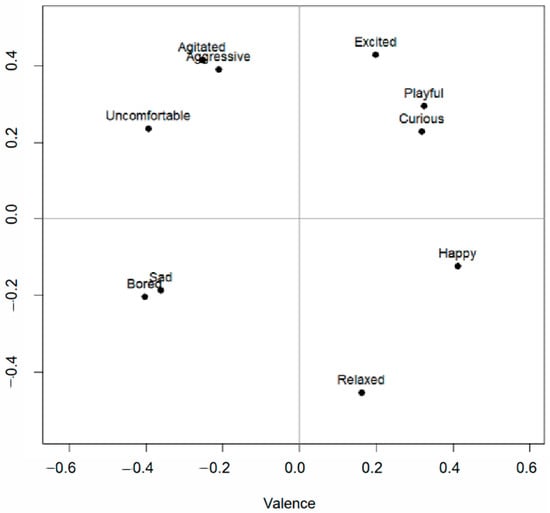
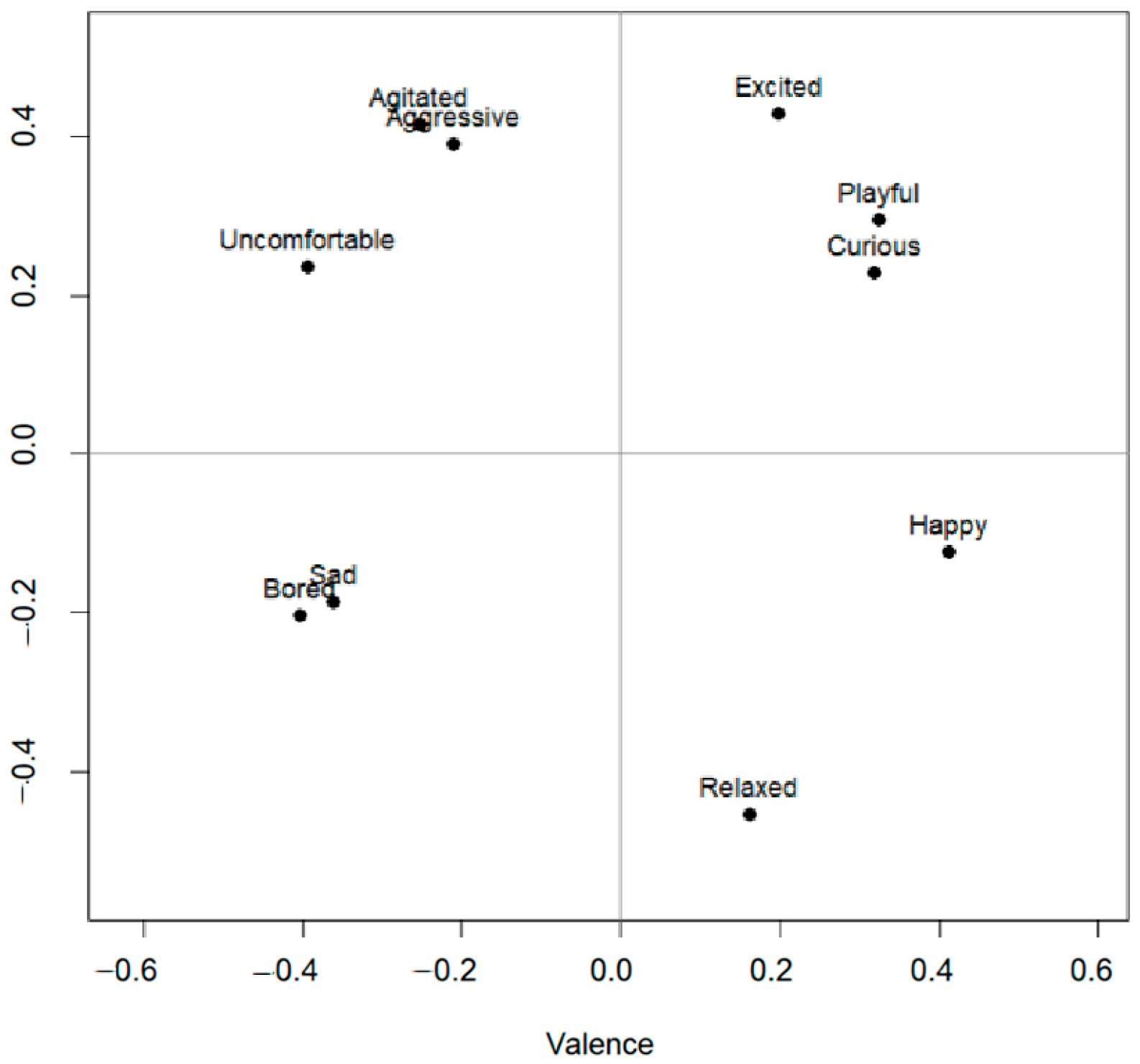
The Principal Component Analysis (PCA) conducted on the 10 QBA descriptors produced a two-dimensional structure that accounted for the majority of variation in observer ratings, accounting for 74.4% of the total variance. PC1 (s.d. = 2.17; 47.1% of variance) was strongly positively loaded by positively valenced descriptors (Relaxed, Playful, Curious, Happy) and strongly negatively loaded by negatively valenced descriptors (Aggressive, Agitated, Uncomfortable, Sad, Bored). This component was termed “Valence”. Conversely, PC2 (s.d. = 1.85; 27.3% of variance) was positively loaded for high-arousal descriptors (Agitated, Excited, Playful) and negatively loaded for low-arousal descriptors (Relaxed, Bored) and was termed “Arousal” (Figure 1).
Figure 1.
Loadings of QBA descriptors according to PC1 (Valence) and PC2 (Arousal).
3.2. Comparisons Between QBA and Quantitative Analysis
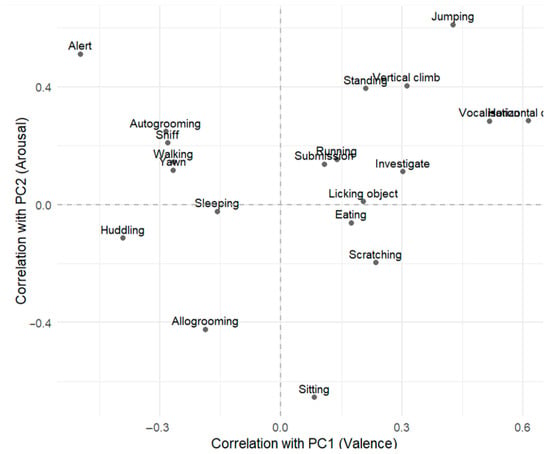
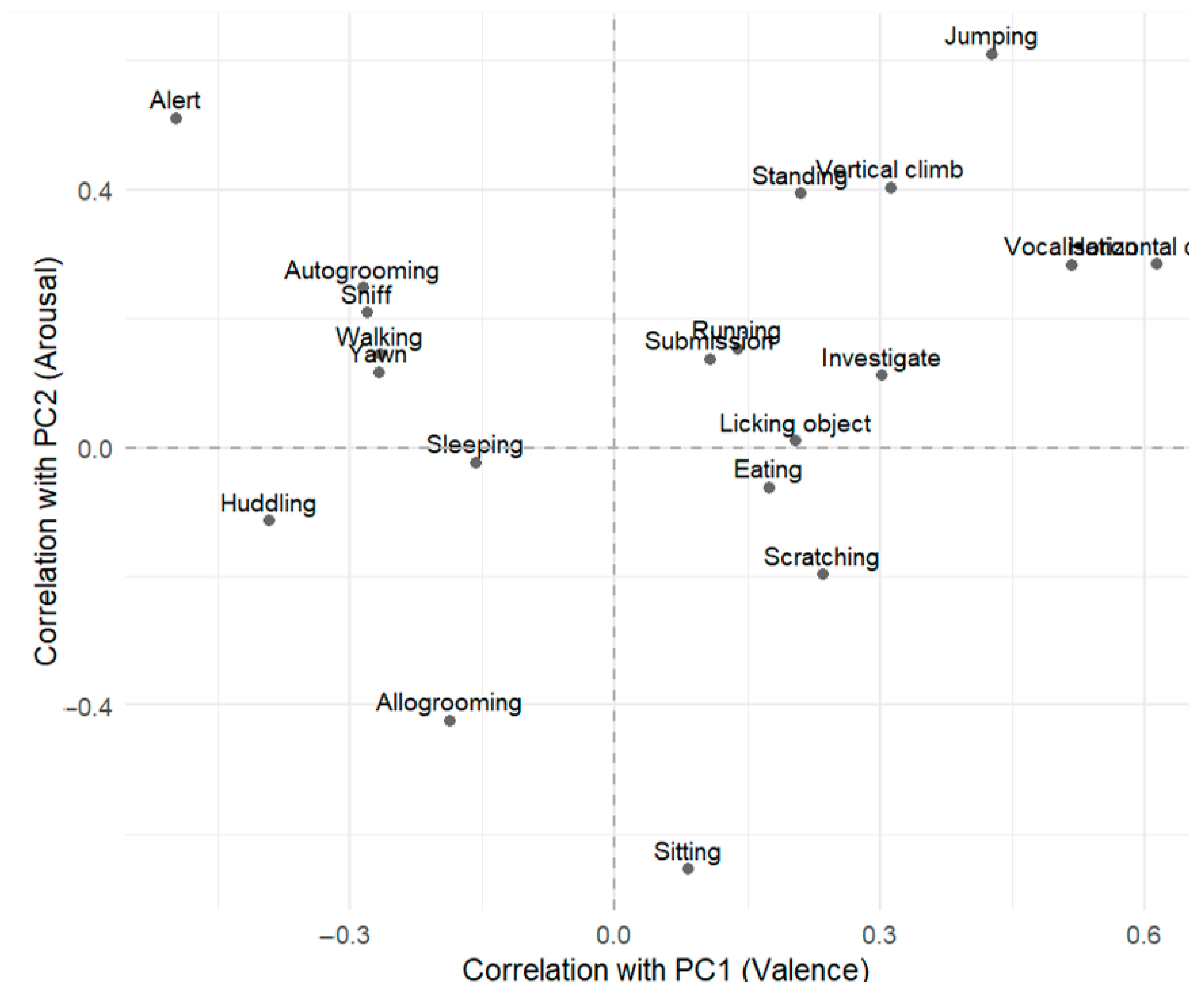
Correlations between the two identified components “Valence” and “Arousal” and the quantitative behavioural measures indicated that neither component showed strong associations with any individual behaviour. Several behaviours showed moderate positive correlations with Valence (e.g., Horizontal climb, r = 0.614; Vocalisation, r = 0.517; Jumping, r = 0.427). For the Arousal component, several behaviours showed weak to moderate positive associations (e.g., Jumping, r = 0.611; Vertical climb, r = 0.504). Although these relationships were directionally meaningful, effect sizes remained weak to moderate across all behaviours (r < 0.70), and many behaviours exhibited near-zero correlations with both components (Figure 2).
Figure 2.
Spearman’s Rank correlations between quantitative behavioural measures and Qualitative Behaviour Assessment Components, Valence (PC1) and Arousal (PC2). Dashed line represents the x and y axes.
4. Discussion
The present study investigated the potential opportunities and limitations of Qualitative Behaviour Assessment (QBA) as a welfare assessment tool for zoo-housed animals. Three central outcomes emerged from this study. The first is that observers demonstrated very low inter-observer agreement when rating the same video clips, with no evidence that individuals with similar experience levels agreed more with each other. Secondly, QBA ratings were nonetheless structured across two clearly defined affective dimensions similar to those identified in other QBA studies [10,11,12], Valence and Arousal. Finally, these qualitative dimensions showed only weak to moderate associations with discrete quantitative behaviours in the videos, suggesting that observers relied on other cues such as posture or facial expression to make their judgements on affective states.
4.1. Intraclass Correlation Coefficient Results
Classic QBA studies often involve a calibration phase wherein the group discusses and agrees upon the meaning of each descriptor before scoring [10,11,12,13]. As the study aimed to examine the relationship between observed behaviours and inferred emotional state, participants worked independently online with short descriptors. Unlike discrete behaviours, emotional descriptors required observers to infer internal states based on their own subjective interpretation of the videos. In the absence of calibration, the participants likely naturally varied widely in which indicators they deemed important.
Low ICC values in the context of QBA research do not necessarily imply that the methodology is not informative. Inherently abstract emotional descriptors will be interpreted idiosyncratically by untrained observers who will be utilising their own unique perceptual framework to interpret the visual information from the video. Although QBA is designed to capture whole-animal expressivity, subtle emotional cues in primates are highly variable and can include posture, facial expression, vocalisations, and so on [14], which may have been too subtle or ambiguous for strong alignment between raters, particularly as the majority of participants reported moderate to no experience with primate behaviour. Training may thus be beneficial in improving agreement between raters; this is reinforced by prior studies of QBA in farm animals [8].
The generalisability of these results across other species, or indeed other individuals of the study species, may be limited due to the small sample size included in the videos. As the goal was primarily to investigate layperson assessments of emotionality rather than quantify or interpret welfare outcomes for the involved animals, the inferences drawn reflect solely the extent of interrater input. It is additionally important to note that the levels of experience indicated by respondents was self-reported, and thus some individuals surveyed may have over- or under-reported their personal level of primate experience. Future research would benefit from a wider scope with a greater variety of individuals across multiple taxa.
4.2. Qualitative and Quantitative Behaviour Assessments
Despite low agreement between observers, QBA ratings demonstrated clear and consistent structure. Valence and Arousal accounted for over 70% of the variance in participants’ ratings. The presence of these clear dimensions even despite poor inter-observer reliability suggests that participants were responding to common affective constructs, even if they differed in their interpretation of individual videos. Of course, it is not straightforward to measure how an animal ‘feels’ due to the reliance on inherently subjective human translations of animal behaviour [15]. The study is further complicated by a reluctance from some researchers to ascribe human definitions of emotionality to the behaviour of animals, and due to the risk of misinterpretation [16].
Indeed, no discrete behaviour showed strong correlations with Valence or Arousal. The findings suggest that observers are likely not basing their emotional judgements solely on specific, isolated behaviours and instead on holistic expressive cues together with these behaviours. This is consistent with QBA’s theoretical foundation and with what would be expected from QBA results [9]. Affective states are often conveyed through a combination of subtle cues that are difficult and often subjective to capture; with a traditional ethogram, a discrete behaviour such as ‘Jumping’—which had a moderate positive relationship with both ‘Valence’ and ‘Arousal’—can be interpreted differently depending on the context. For example, the animal could be jumping as part of play behaviour or in order to escape from an aggressor. The suggestion is not that QBA should replace traditional quantitative measures, but instead that welfare assessments should incorporate multiple methods that integrate behavioural, psychological, physiological, and contextual measures together with human intuition.
5. Conclusions
The findings demonstrate that self-reported observer experience with primates is not important in determining interrater agreement in the QBA. Uniformly, interrater agreement was low regardless of experience, highlighting the need for caution when using subjective methods in the assessment of animal welfare. Correlations between QBA components and quantitative behaviours were weak to moderate, indicating that these qualitative assessments are not driven by specific discrete behaviours but instead reflect broader expressive styles that observers perceive holistically. Together, these results contribute to a growing body of evidence that human intuition has some potential as a tool in animal welfare assessment, but must be interpreted with caution due to differences in rater interpretation. Future research should examine whether similar relationships between QBA and quantitative behaviour observations exist in other taxa and how these methods may be systematically incorporated into welfare assessments in conjunction with other behavioural and physiological methods moving forward.
Author Contributions
Conceptualization, M.N.; methodology, M.N.; software, M.N.; formal analysis, M.N.; investigation, J.K. and J.K.-M.; resources, M.N.; data curation, M.N., J.K. and J.K.-M.; writing—original draft preparation, M.N.; writing—review and editing, M.N., J.K. and J.K.-M.; visualisation, M.N.; supervision, M.N.; project administration, M.N. All authors have read and agreed to the published version of the manuscript.
Funding
This research received no external funding.
Institutional Review Board Statement
The study was conducted in accordance with the Declaration of Helsinki and approved by the Ethics Committee of Capel Manor College.
Informed Consent Statement
Informed consent was obtained from all subjects involved in the study.
Data Availability Statement
The datasets presented in this article are not readily available as the data are part of an ongoing study. Requests to access the datasets should be directed to the corresponding author.
Acknowledgments
The authors would like to thank the animal care staff at Capel Manor College for granting access to the animals to obtain the video materials used for this study. The work reported in this paper includes data collected as part of the second and third authors’ Bachelors degree in Animal Management and Zoology delivered at Capel Manor. Thank you to the teaching staff who supported the students through their projects, Mariam Kachlek and Helena Bonici. Thank you to Ethan Lanser for supplying videos of the saki monkeys for the project.
Conflicts of Interest
The authors declare no conflicts of interest.
References
- Rose, P.; Manteca, X. Re-Assessing the Importance of Evidence-Based Inputs for Positive Zoo and Aquarium Animal Welfare Outputs. J. Zool. Bot. Gard. 2025, 6, 32. [Google Scholar] [CrossRef] [Scilit]
- Wolfensohn, S.; Shotton, J.; Bowley, H.; Davies, S.; Thompson, S.; Justice, W.S. Assessment of welfare in zoo animals: Towards optimum quality of life. Animals 2018, 8, 110. [Google Scholar] [CrossRef] [Scilit] [PubMed]
- Brando, S.; Buchanan-Smith, H.M. The 24/7 approach to promoting optimal welfare for captive wild animals. Behav. Proc. 2018, 156, 83–95. [Google Scholar] [CrossRef] [Scilit] [PubMed]
- Brando, S.; Herrelko, E.S. Wild animals in the city: Considering and connecting with animals in zoos and aquariums. In Animals in Our Midst: The Challenges of Co-Existing with Animals in the Anthropocene; Bovenkerk, B., Keulartz, J., Eds.; Springer: Berlin/Heidelberg, Germany, 2021; pp. 341–360. [Google Scholar]
- Mellor, D.J.; Beausoleil, N.J.; Littlewood, K.E.; McLean, A.N.; McGreevy, P.D.; Jones, B.; Wilkins, C. The 2020 five domains model: Including human–animal interactions in assessments of animal welfare. Animals 2020, 10, 1870. [Google Scholar] [CrossRef] [Scilit] [PubMed]
- Mason, G.J.; Latham, N. Can’t stop, won’t stop: Is stereotypy a reliable animal welfare indicator? Anim. Welf. 2004, 13, 57–69. [Google Scholar] [CrossRef] [Scilit]
- Hemsworth, P.H.; Mellor, D.J.; Cronin, G.M.; Tilbrook, A.J. Scientific assessment of animal welfare. N. Z. Vet. J. 2015, 63, 24–30. [Google Scholar] [CrossRef] [Scilit] [PubMed]
- Wemelsfelder, F.; Millard, F.; De Rosa, G.; Napolitano, F. Qualitative behaviour assessment. In Assessment of Animal Welfare Measures for Dairy Cattle, Beef Bulls, and Veal Calves; Cardiff University: Cardiff, UK, 2009; pp. 215–224. [Google Scholar]
- Rose, P.; Riley, L. The use of Qualitative Behavioural Assessment to zoo welfare measurement and animal husbandry change. J. Zoo. Aquar. Res. 2019, 7, 150–161. [Google Scholar]
- Skovlund, C.R.; Kirchner, M.K.; Contiero, B.; Ellegaard, S.; Manteca, X.; Stelvig, M.; Tallo-Parra, O.; Forkman, B. Qualitative Behaviour Assessment for zoo-housed polar bears (Ursus maritimus): Intra-and inter-day consistency and association to other indicators of welfare. Appl. Anim. Behav. Sci. 2023, 263, 105942. [Google Scholar] [CrossRef] [Scilit]
- Patel, F.; Wemelsfelder, F.; Ward, S.J. Using qualitative behaviour assessment to investigate human-animal relationships in zoo-housed giraffes (Giraffa camelopardalis). Animals 2019, 9, 381. [Google Scholar] [CrossRef] [Scilit] [PubMed]
- Hughes, E.J.; King, T.; Lewis, T.R. Evaluating Qualitative Behavioral Assessment and Ethogram Techniques for Captive Black Rhinoceros (Diceros bicornis). J. Appl. Anim. Welf. Sci. 2025, 28, 673–688. [Google Scholar] [CrossRef] [Scilit]
- Warner, E.; Brando, S.; Wemelsfelder, F. Recognising emotional expressions in captive bottlenose dolphins: Can lay observers agree using qualitative behavioural assessment? J. Zoo. Aquar. Res. 2022, 10, 139–148. [Google Scholar]
- Lameréris, D.W.; Salas, M.; Eens, M.; Gillespie, L.; Staes, N.; Torfs, J.R.; Stevens, J.M. Qualitative Behavioural Assessment of bonobo emotional expressivity across observer groups and zoo housing environments. Anim. Welf. 2024, 33, e28. [Google Scholar] [CrossRef] [Scilit] [PubMed]
- de Vere, A.J.; Kuczaj, S.A. Where are we in the study of animal emotions? Wiley Interdiscip. Rev. Cogn. Sci. 2016, 7, 354–362. [Google Scholar] [CrossRef] [Scilit] [PubMed]
- Beausoleil, N.J.; Mellor, D.J.; Baker, L.; Baker, S.E.; Bellio, M.; Clarke, A.S.; Zito, S. “Feelings and fitness” not “feelings or fitness”–the raison d’être of conservation welfare, which aligns conservation and animal welfare objectives. Front. Vet. Sci. 2018, 5, 296. [Google Scholar] [CrossRef] [Scilit] [PubMed]

Disclaimer/Publisher’s Note: The statements, opinions and data contained in all publications are solely those of the individual author(s) and contributor(s) and not of MDPI and/or the editor(s). MDPI and/or the editor(s) disclaim responsibility for any injury to people or property resulting from any ideas, methods, instructions or products referred to in the content. |
© 2026 by the authors. Licensee MDPI, Basel, Switzerland. This article is an open access article distributed under the terms and conditions of the Creative Commons Attribution (CC BY) license.