1. Introduction
Mushrooms represent one of the fastest-growing segments of high-value horticultural crops due to their nutritional benefits, short production cycles, and efficient conversion of lignocellulosic waste into edible biomass [
1,
2]. Among cultivated species, oyster mushroom (
P. ostreatus) has gained particular prominence because of its adaptability to diverse substrates, relatively wide tolerance to environmental conditions compared to button mushroom (
Agaricus bisporus), and suitability for decentralized, small-scale production systems [
3]. Globally, oyster mushrooms (
P. ostreatus) account for a significant share of total mushroom output, with Asia contributing the majority of production and consumption [
4].
Despite these advantages, oyster mushroom (
P. ostreatus) cultivation remains highly sensitive to microclimatic variability, particularly during the fruiting phase. Temperature fluctuations, relative humidity instability, and carbon dioxide accumulation directly influence mycelial metabolism, primordia initiation, fruit body morphology, and overall yield quality [
5,
6]. In traditional low-cost cultivation systems, environmental control is largely manual, relying on periodic misting and passive ventilation. Such approaches often result in inconsistent growing conditions, leading to yield variability, malformed fruiting bodies, and increased susceptibility to contamination, especially during transitional and warm seasons [
7].
Controlled Environment Agriculture (CEA) has emerged as an effective strategy for mitigating these limitations by enabling precise regulation of key environmental parameters [
8]. In mushroom production, CEA systems range from semi-controlled grow rooms to fully automated industrial facilities employing advanced heating, ventilation, and air-conditioning (HVAC) infrastructure [
9]. While these systems demonstrate high productivity and consistency, their capital and operational costs limit accessibility for smallholder farmers in developing regions, including India (Bharat), where mushroom cultivation is often practiced as a supplementary livelihood activity [
10].
Recent advances in Internet of Things (IoT) technologies have enabled the development of low-cost sensing, monitoring, and automation frameworks for agricultural applications [
11,
12]. In the context of mushroom cultivation, IoT-based systems facilitate continuous monitoring of temperature, relative humidity, carbon dioxide (CO
2) concentration, and substrate moisture, allowing timely and objective control actions [
13]. Several studies have demonstrated that sensor-driven automation can significantly improve environmental stability and resource-use efficiency in mushroom production systems; however, many reported implementations remain either laboratory-scale or insufficiently integrated with biological growth modeling and control logic [
14,
15].
Precision agriculture principles emphasize not only data acquisition but also the intelligent integration of sensing, control algorithms, and biological understanding to optimize crop responses [
16]. For mushrooms, this requires coupling environmental sensing with control strategies that respect physiological thresholds rather than forcing conditions through energy-intensive interventions. In particular, microclimate modeling offers a pathway to link observed environmental variability with growth kinetics and morphological outcomes, supporting more informed and efficient control decisions [
17].
In this context, the present study introduces Mushroom Kothi, an IoT-enabled microclimate control platform designed for precision oyster mushroom (P. ostreatus) cultivation under Indian agro-climatic conditions. In the context of this study, “Mushroom Kothi” refers to a compact IoT-enabled mushroom cultivation chamber integrating environmental sensing, automated microclimate regulation, cloud-connected monitoring, and low-energy actuation mechanisms for decentralized oyster mushroom (P. ostreatus) production. The term “Kothi” is derived from a commonly used vernacular expression in parts of India referring to a small enclosed storage or cultivation structure, reflecting the localized and smallholder-oriented design philosophy of the system.
The system integrates multi-parameter sensing, rule-based and feedback-driven control algorithms, and microclimate modeling to stabilize growing conditions without reliance on active refrigeration. The objectives of this study are to (i) describe the system architecture and control strategies underlying Mushroom Kothi, (ii) evaluate its ability to maintain biologically appropriate microclimate conditions for Pleurotus ostreatus, and (iii) analyze the relationship between environmental stability and cultivation performance. By bridging biosystems engineering and fungal physiology, this work aims to contribute a scalable, context-appropriate framework for precision mushroom cultivation in resource-constrained settings.
2. Biological and Environmental Basis for Oyster Mushroom (P. ostreatus) Cultivation
2.1. Fungal Physiology and Growth Stages
Oyster mushroom (
P. ostreatus) is a saprophytic basidiomycete characterized by rapid mycelial colonization, efficient lignocellulosic substrate utilization, and a relatively flexible environmental tolerance compared to other commercially cultivated mushrooms [
3,
4]. The cultivation cycle of
P. ostreatus consists of three biologically distinct stages: vegetative mycelial growth, primordia initiation, and fruiting body development. Each stage exhibits differential sensitivity to environmental parameters, necessitating dynamic rather than static microclimate management [
3,
9].
During the vegetative phase, mycelial metabolism is primarily driven by substrate moisture, temperature, and oxygen availability, whereas the transition to reproductive growth (primordia formation) is triggered by changes in temperature, relative humidity, and carbon dioxide concentration [
6]. Fruiting body expansion and morphological quality are particularly sensitive to short-term fluctuations in relative humidity and CO
2 concentration, with instability often resulting in elongated stipes, reduced pileus expansion, and compromised texture [
5,
6]. These physiological characteristics provide a strong biological rationale for precision microclimate control in oyster mushroom (
P. ostreatus) cultivation systems.
2.2. Optimal Environmental Parameters for Pleurotus ostreatus
Although oyster mushrooms (
P. ostreatus) exhibit broader tolerance ranges than button mushrooms (
A. bisporus), optimal growth and yield quality are achieved within relatively narrow microclimatic windows. Table-level synthesis of literature indicates that fruiting of
P. ostreatus is favored at temperatures between 20 and 28 °C, relative humidity levels of 80–95%, and CO
2 concentrations below 1200–1500 ppm during the fruiting phase [
3,
5,
9].
Deviation from these ranges, even for short durations, can disrupt primordia differentiation and fruiting body morphology. Excessive CO
2 accumulation suppresses pileus expansion, while insufficient humidity increases desiccation stress and reduces fresh weight yield [
6]. Consequently, biologically informed control strategies must prioritize stability within tolerance bands rather than aggressive optimization beyond physiological limits, particularly in low-energy cultivation systems [
16].
2.3. Temperature-Growth Relationships
Temperature exerts a fundamental influence on fungal metabolic rates, enzymatic activity, and biomass accumulation. Within biologically permissible limits, the relationship between temperature and mycelial growth rate (
μ) of filamentous fungi, including
P. ostreatus, can be approximated using an Arrhenius-type expression [
18]:
where
μ is the specific mycelial growth rate,
μ0 is the pre-exponential factor/growth constant,
e is Euler’s number (approximately 2.71828),
Eₐ is the activation energy,
R is the universal gas constant, and
T is the absolute temperature (K).
While this formulation provides a useful conceptual framework, real-world cultivation environments exhibit fluctuating temperatures rather than steady-state conditions. Therefore, in practical systems, minimizing the variance of temperature around biologically optimal values is often more important than achieving a precise setpoint [
16,
18]. This reinforces the role of feedback-based control strategies in stabilizing microclimate conditions during critical growth transitions.
2.4. Humidity Dynamics and Moisture Regulation
Relative humidity plays a critical role in maintaining turgor pressure, regulating transpiration, and supporting cell expansion during fruit body development. In oyster mushrooms (
P. ostreatus), inadequate humidity leads to surface cracking and reduced fresh weight, whereas excessive humidity promotes condensation and increases the risk of microbial contamination [
6,
7].
Although mushrooms do not transpire in the same manner as higher plants, moisture exchange between the fruiting body, substrate, and surrounding air can be conceptually related to evapotranspiration principles. Adaptations of crop evapotranspiration models, such as those outlined in the Food and Agriculture Organization (FAO) Irrigation and Drainage Paper No. 56 (FAO-56) [
19], a widely adopted framework for estimating crop evapotranspiration and water-use relationships under controlled environmental conditions, have been used as interpretative tools for understanding moisture demand in controlled fungal cultivation systems [
10,
18]. From an engineering perspective, humidity regulation in mushroom chambers is best achieved through fine-grained misting combined with adequate air circulation to avoid localized saturation.
2.5. Carbon Dioxide Accumulation and Ventilation Requirements
Carbon dioxide concentration is a key morphological regulator in
P. ostreatus cultivation. Elevated CO
2 concentration suppresses cap expansion and promotes elongated stipe growth, leading to reduced market acceptability [
5,
6]. In enclosed or semi-enclosed cultivation systems, CO
2 accumulation results from the respiratory metabolism of the mycelium and fruiting bodies and must be mitigated through controlled ventilation.
A simplified mass-balance approach can be used to conceptualize CO
2 dynamics within a cultivation chamber [
17,
18]:
where
V is the required ventilation volume,
n is the number of respiring units,
CO2 is the generation rate,
ΔC is the allowable concentration difference, and
t is time.
While such formulations guide system design, practical implementation relies on sensor-driven feedback to regulate ventilation in response to real-time CO
2 measurements. This approach aligns with precision agriculture principles by maintaining concentrations within biologically acceptable ranges while minimizing unnecessary airflow and energy use [
11,
12,
13,
17].
5. Experimental Design and Data Acquisition
5.1. Experimental Setup and Study Design
The experimental evaluation of the Mushroom Kothi system was conducted across three representative agro-climatic zones of India, covering North, Central, and Eastern regions, to capture spatial variability in temperature, humidity, and ventilation conditions affecting oyster mushroom (P. ostreatus) cultivation.
Each Mushroom Kothi experimental unit consisted of a compact semi-enclosed cultivation chamber with an approximate internal cultivation volume of 0.8–1.0 m3, designed for decentralized smallholder-scale mushroom production. The chambers accommodated vertically arranged substrate bags with a typical loading capacity of 18–24 kg wet substrate per cultivation cycle, depending on substrate density and seasonal ventilation requirements. Conventional comparison units were selected to represent locally prevalent farmer-managed cultivation structures of comparable production scale.
The study was performed over two distinct cultivation seasons, namely monsoon and winter, reflecting periods of contrasting ambient microclimatic stress.
A comparative design was adopted, comprising 30 Mushroom Kothi chambers (treatment) and 30 conventional farmer-managed cultivation setups (control) per season. Each Mushroom Kothi unit consisted of a compact semi-enclosed cultivation chamber designed for decentralized smallholder-scale mushroom production. Each Mushroom Kothi unit consisted of a compact semi-enclosed cultivation chamber with an approximate footprint of 1.2 m × 0.9 m and an internal height of 1.8 m. Conventional farmer-managed units were selected to provide comparable cultivation volume and substrate loading capacity. This design minimized scale-related effects and enabled direct evaluation of the impact of automated microclimate regulation relative to conventional management practices. The chamber structure was fabricated using insulated polymer-composite panels supported by a lightweight metal frame and equipped with environmental sensing, automated ventilation, humidity regulation, and cloud-connected monitoring components. The cultivation layout accommodated vertically arranged substrate bags with a typical loading capacity of 18–24 kg wet substrate per production cycle. Conventional setups followed prevailing local practices, including manual misting and passive ventilation, while Mushroom Kothi chambers employed automated microclimate regulation. Conventional farmer-managed cultivation units were constructed with dimensions and substrate loading capacities comparable to those of the Mushroom Kothi chambers, thereby minimizing scale-related effects on production performance. All cultivation units utilized wheat straw-based substrate prepared according to standard oyster mushroom cultivation practices, with substrate moisture adjusted to approximately 65–70% prior to spawning. Commercial grain spawn of P. ostreatus obtained from a certified regional spawn supplier was used across all treatments at a uniform spawning rate. Hygiene practices included cleaning and disinfection of cultivation areas before each production cycle, use of sanitized cultivation bags and tools, and removal of contaminated substrate units when necessary. These measures were applied uniformly across all experimental units to minimize confounding biological variability.
Environmental monitoring in Mushroom Kothi chambers was carried out using a multi-sensor suite, including temperature and relative humidity sensors (SHT31), CO2 sensors (MH-Z19B), light sensors (BH1750), and substrate moisture probes. Automation strategies combined PID-based regulation for temperature-humidity control, hysteresis logic to prevent actuator cycling, and timed fresh-air exchange for CO2 management. The systems operated without active refrigeration or compressor-based cooling, relying instead on passive thermal buffering and automated environmental regulation strategies. Microclimate data were logged at 2 min intervals and visualized through a cloud-connected ESP32-based dashboard.
5.2. Measured Variables and Data Acquisition
The performance of the Mushroom Kothi system was evaluated using agronomic, microclimatic, and resource-use indicators consistent with precision agriculture assessment frameworks.
Primary production metrics included total fresh yield (g·kg−1 substrate), flush timing, time-to-first harvest, and fruit body uniformity, expressed as the coefficient of variation (CV%) of fruit body size within each unit.
Microclimate stability was quantified using a microclimate deviation index, defined as the standard deviation of temperature and relative humidity over the cultivation period. Resource-use efficiency was assessed through water-use efficiency, calculated as yield per unit water applied. Data reliability was monitored through cloud synchronization success rates to ensure completeness of time-series records.
This focused experimental design enabled direct comparison of microclimate stability, production continuity, and resource efficiency between IoT-controlled and conventional systems under real farm conditions, forming the basis for the results presented in the subsequent section.
5.3. Statistical Analysis
Statistical analyses were performed to compare environmental stability and agronomic performance between Mushroom Kothi and conventional cultivation systems across monsoon and winter production cycles. Mean values and standard deviations were calculated for all measured variables, including temperature, relative humidity, carbon dioxide concentration, yield, fruit body uniformity, time-to-harvest, and water-use efficiency.
Statistical analyses were performed to compare environmental stability and agronomic performance between Mushroom Kothi and conventional cultivation systems across monsoon and winter production cycles. Mean values and standard deviations were calculated for all measured variables, including temperature, relative humidity, carbon dioxide concentration, yield, fruit body uniformity, time-to-first harvest, flush interval, and water-use efficiency. Treatment effects, seasonal effects, and treatment × season interactions were evaluated using two-way analysis of variance (ANOVA). Where significant differences were detected, means were separated using Tukey’s Honest Significant Difference (HSD) test at a significance level of p < 0.05. All statistical analyses were performed using standard scientific computing and spreadsheet-based statistical tools.
6. Results and Analysis
6.1. Microclimate Stability Metrics
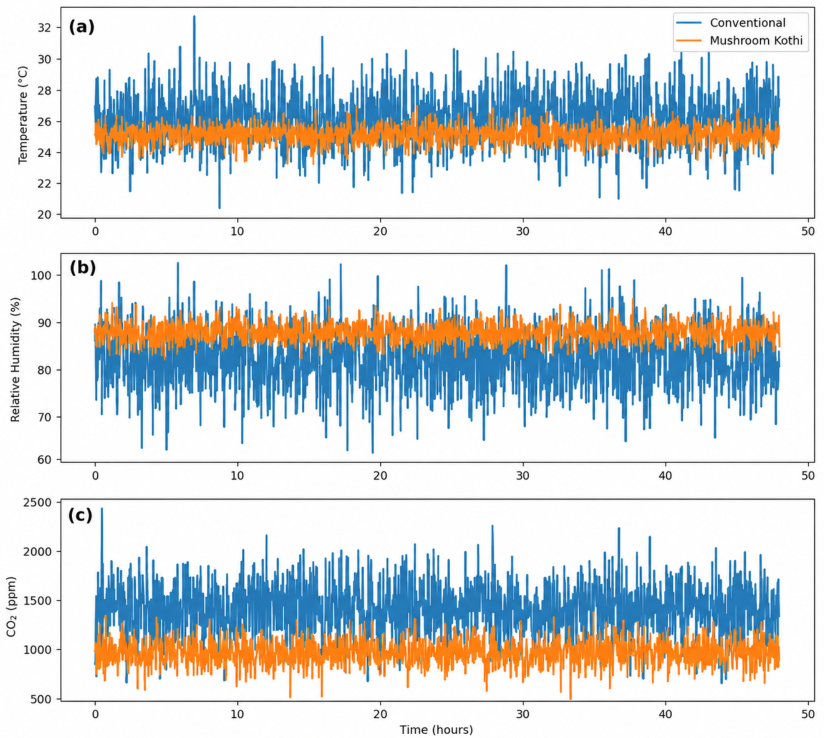
The performance of the Mushroom Kothi system was first evaluated in terms of its ability to stabilize key microclimatic parameters under variable ambient conditions. Representative time-series profiles of temperature, relative humidity, and carbon dioxide concentration recorded over a 48 h monitoring period during the monsoon cultivation cycle are shown in
Figure 1 for both IoT-controlled and conventional cultivation systems. The monsoon period was selected because it exhibited greater ambient environmental variability and therefore provided a more rigorous assessment of microclimate stabilization performance under practical cultivation conditions.
Across all sites and seasons, Mushroom Kothi chambers exhibited visibly smoother temporal trajectories for temperature and relative humidity compared to conventional setups. Short-term fluctuations associated with manual misting and passive ventilation were substantially reduced under automated control, with the standard deviation of temperature decreasing from 1.9 °C in conventional systems to 0.6 °C in Mushroom Kothi chambers, while relative humidity variability declined from 6.4% to 2.1% (
Table 1). This stability was quantitatively captured through the microclimate deviation index, defined as the standard deviation of temperature and relative humidity over the cultivation period (
Table 1). Lower standard deviation values in Mushroom Kothi chambers indicate improved environmental stability and reduced short-term fluctuations compared to conventional systems, reflecting the effectiveness of sensor-driven automation in buffering ambient variability.
Temperature variability was substantially lower in Mushroom Kothi chambers than in conventional cultivation systems, as reflected by the reduced standard deviations of temperature and relative humidity (
Table 1). The monitored environmental parameters remained closer to the recommended cultivation ranges for oyster mushroom (
P. ostreatus) under automated control. Similarly, mean CO
2 concentrations were lower in Mushroom Kothi chambers, indicating improved regulation of air exchange during cultivation. These findings demonstrate the effectiveness of sensor-driven environmental control in reducing microclimate fluctuations under practical cultivation conditions.
These results confirm that microclimate stabilization, rather than strict setpoint control, is the dominant functional advantage of the IoT-controlled system in oyster mushroom (P. ostreatus) cultivation.
6.2. Yield Response and Growth Behavior
Improved microclimate stability was associated with more consistent yield outcomes in Mushroom Kothi chambers. Total fresh yield, expressed as g·kg
−1 substrate, increased from 720 g·kg
−1 substrate in conventional systems to 880 g·kg
−1 substrate in Mushroom Kothi chambers, corresponding to an approximate 22.2% improvement in production performance across cultivation conditions (
Table 2). Yield improvements were primarily attributable to improved continuity of fruiting rather than acceleration of biological growth rates. Improved yield consistency, crop uniformity, and resource-use efficiency observed in Mushroom Kothi chambers highlight the benefits of stabilized microclimate management under real cultivation conditions.
Two-way ANOVA indicated significant effects of cultivation system and season on yield, while the interaction effect was not significant (
Table 3). Two-way analysis of variance (ANOVA) indicated significant effects of cultivation system on yield, time-to-first harvest, flush interval, fruit body uniformity, and water-use efficiency (
p < 0.05). Subsequent Tukey’s HSD mean separation analysis confirmed that Mushroom Kothi chambers consistently formed statistically superior groups for yield and water-use efficiency while exhibiting significantly lower fruit body variability and shorter harvest intervals compared with conventional cultivation systems. The distinct significance groups observed for most variables suggest that automated microclimate regulation contributed substantially to the improved cultivation performance observed in Mushroom Kothi chambers.
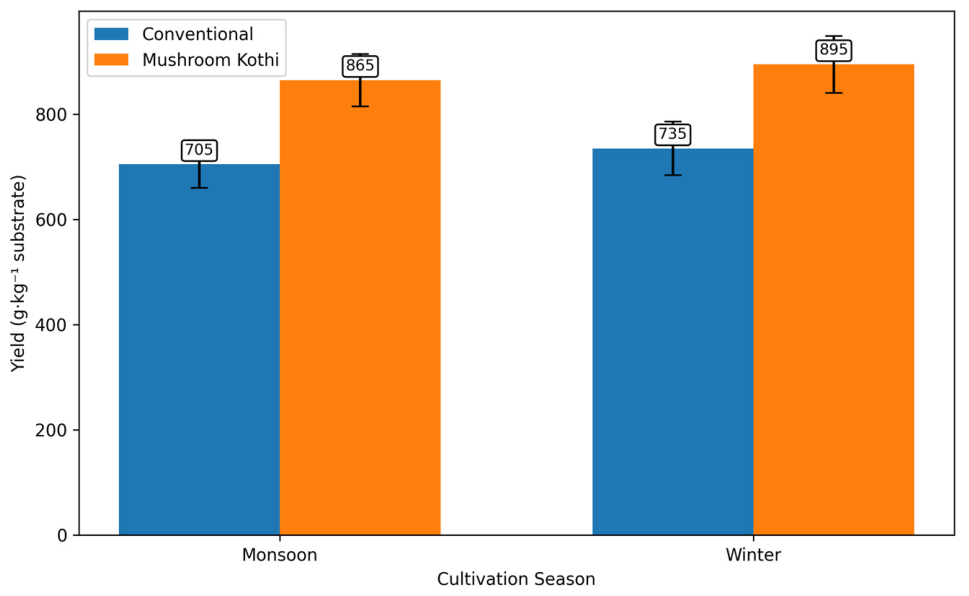
Seasonal comparisons indicated that Mushroom Kothi chambers maintained higher production performance across both monsoon and winter cultivation cycles (
Figure 2 and
Table 2). Although winter cultivation exhibited marginally higher yields overall, the relative treatment advantage remained consistent between seasons, suggesting that microclimate stabilization contributed to improved production continuity under varying environmental conditions.
The yield improvements observed under Mushroom Kothi cultivation conditions are aligned with earlier reports indicating that stable humidity and temperature conditions positively influence oyster mushroom (
P. ostreatus) biomass accumulation and fruit body development [
3,
5]. Previous controlled-environment studies have similarly reported enhanced yield consistency and reduced morphological variability when environmental fluctuations are minimized through automated sensing and regulation systems [
15,
16,
17]. The present study extends these observations to smallholder-oriented cultivation conditions under Indian agro-climatic environments.
Statistical comparisons using two-way ANOVA and Tukey’s HSD test confirmed that Mushroom Kothi chambers produced significantly higher yields than conventional cultivation systems across both cultivation seasons (
Table 2 and
Table 3).
Time-to-first harvest remained comparable between Mushroom Kothi and conventional systems, indicating that automated control did not artificially hasten developmental processes. Instead, the primary differences were observed in flush regularity and harvest predictability. Mushroom Kothi units exhibited more uniform flush timing and reduced delays between successive harvests, particularly under monsoon conditions where conventional systems experienced intermittent stress.
Fruit body morphology was also more consistent in IoT-controlled chambers, with the coefficient of variation (CV%) of fruit body size decreasing from 28% in conventional systems to 15% under automated cultivation conditions (
Table 2). Reduced variability in relative humidity and CO
2 concentration contributed to improved pileus expansion and reduced incidence of elongated stipes, reflected in lower coefficients of variation (CV%) for fruit body size. These observations indicate that the system supports stable growth behavior by maintaining favorable environmental conditions during sensitive developmental stages.
The observed reduction in environmental variability under Mushroom Kothi cultivation conditions is consistent with previous studies demonstrating the importance of automated environmental regulation in controlled mushroom production systems [
11,
12,
13]. Similar improvements in temperature and humidity stability have been reported in IoT-assisted cultivation environments, where continuous sensing and automated ventilation contribute to reduced physiological stress and improved fruiting consistency [
12,
17]. The present findings further support the applicability of low-cost sensor-based environmental control strategies under decentralized smallholder cultivation conditions.
6.3. Association Between Microclimate Variability and Yield
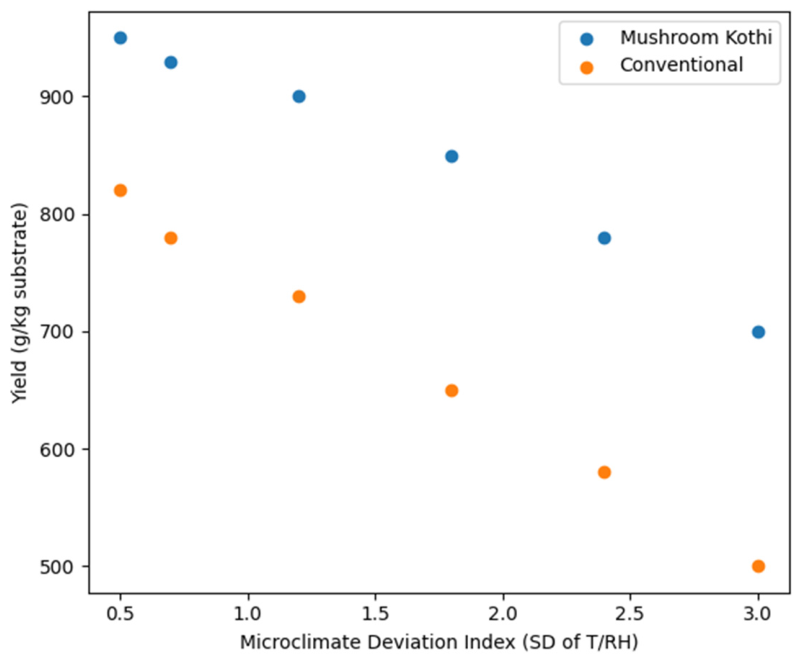
To examine the relationship between environmental stability and production outcomes, yield values were analyzed in relation to the corresponding microclimate deviation index. Pearson correlation analysis revealed a strong negative relationship between microclimate deviation and yield (r = −0.953,
p < 0.001), indicating that cultivation units experiencing lower environmental variability generally achieved higher production performance. Spearman rank correlation analysis produced similar results (ρ = −0.873,
p < 0.001), confirming the robustness of the observed association. The relationship is illustrated in
Figure 3.
Figure 3 demonstrates a strong inverse relationship between microclimate deviation and yield across cultivation units. Mushroom Kothi chambers predominantly occupied the lower variability-higher yield region of the distribution, whereas conventional systems were more frequently associated with higher variability and lower yield outcomes. These findings support the importance of environmental stability as a key factor influencing cultivation performance in oyster mushroom production.
This association supports the conceptual premise that minimizing short-term environmental instability is critical for sustaining productive oyster mushroom (P. ostreatus) cultivation. Importantly, the observed trends are descriptive and intended to illustrate system behavior under real cultivation conditions rather than to establish predictive yield models, which are beyond the scope of the present proceedings study.
6.4. Comparative Performance with Conventional Systems
As shown in
Table 2, Mushroom Kothi chambers consistently outperformed conventional systems across agronomic and resource-use indicators, particularly under conditions of higher ambient variability. The comparative results highlight the stabilizing effect of automated microclimate control on production continuity and resource efficiency.
While conventional systems occasionally achieved comparable yields under favorable ambient conditions, their performance was highly variable and sensitive to short-term microclimatic disturbances. In contrast, the IoT-controlled system delivered more predictable outcomes with reduced manual intervention, supporting its suitability for decentralized and smallholder-oriented mushroom production.
Collectively, these results demonstrate that the integration of sensing, automation, and biologically informed control strategies enables meaningful improvements in cultivation stability and performance without reliance on energy-intensive infrastructure. The findings validate Mushroom Kothi as a precision microclimate management platform rather than a yield-forcing technology, consistent with sustainable controlled environment agriculture principles.
The results also support broader trends observed in controlled-environment agriculture research, where low-energy automation and sensor-assisted environmental management have been identified as practical approaches for improving production resilience under variable climatic conditions [
8,
16]. Unlike large industrial cultivation systems dependent on energy-intensive refrigeration infrastructure, Mushroom Kothi emphasizes passive buffering and decentralized automation strategies better suited to resource-constrained cultivation environments.
7. Conclusions
This study demonstrates the potential of IoT-enabled microclimate control systems to enhance the stability, consistency, and resource efficiency of oyster mushroom (P. ostreatus) cultivation under real farm conditions. The Mushroom Kothi platform, integrating low-cost sensing, automated control strategies, and cloud-based monitoring, was evaluated across multiple agro-climatic zones and seasons, reflecting the variability typically faced by smallholder producers in India (Bharat).
Results indicate that stabilizing key environmental parameters—temperature, relative humidity, and carbon dioxide concentration—plays a more critical role in improving production outcomes than attempting to force biological growth through intensive control. Mushroom Kothi chambers exhibited reduced microclimate variability, improved yield consistency, more regular flush patterns, and enhanced fruit body uniformity compared to conventional farmer-managed systems. Gains in water-use efficiency further highlight the system’s contribution to sustainable intensification without reliance on energy-intensive infrastructure such as active cooling.
Importantly, the system supports seasonal extension of cultivation within biologically permissible limits, offering farmers improved production continuity and income stability rather than off-season forcing. As a proceedings-level contribution, this work establishes a practical and scalable framework for precision microclimate management in mushroom farming. Future research will focus on extended multi-year validation, integration of predictive analytics, and deeper statistical modeling to support decision-making in diverse production contexts.