


Abstract
A new tree fern species, Lophosoria myanmarica sp. nov. (Dicksoniaceae, Cyatheales), is described from mid-Cretaceous Myanmar amber. The fossil preserves a fertile lamina segment with well-defined sori, sporangia, paraphyses, and in situ trilete spores. It is characterized by exindusiate, round sori terminating free veins, abundant pluricellular paraphyses, sporangia with an oblique annulus, and distinctive trilete spores bearing a conspicuous equatorial flange and a pitted distal surface. The combination of flanged spores and exindusiate, paraphysate sori supports assignment to Lophosoria. The new species differs from the extant L. quadripinnata and the Early Cretaceous L. cupulata in its smaller spores and less deeply dissected pinnules. This fossil represents the earliest macrofossil evidence of Lophosoria from Southeast Asia and indicates that the genus had achieved a broader Cretaceous distribution than previously documented.
1. Introduction
Lophosoria, a genus of ferns endemic to the Neotropics and southern South America, is characterized by distinct vegetative and reproductive features [1,2,3,4]. Historically, Lophosoria was regarded as monotypic, primarily represented by L. quadripinnata (J.E. Gmel.) C.Chr., which is widely distributed in the montane regions of southern Mexico, Central America, and South America [1]. Additionally, two species with more limited distributions have been described: L. quesadae A. Rojas, found exclusively in Costa Rica, and L. contracta (Hieron.) A. R. Sm., which is restricted to southern Ecuador and Peru [5].
The distinctive vegetative and reproductive characteristics of Lophosoria include a short, upright stem with an amphiphloic siphonostele, a three-parted petiole, dermal trichomes, and leptosporangia with oblique annuli and characteristic spores [2]. However, the systematic position of the genus remains contentious. It has been classified within several families, including Protocyatheaceae, Cyatheaceae, and Lophosoriaceae [1,3,6]. Molecular phylogenetic studies suggest that Lophosoria is sister to Dicksonia [7,8], and it has been recently classified within the Dicksoniaceae of the Cyatheales [9,10]. The spores produced by Lophosoria are associated with the dispersed spore genus Cyatheacidites Cookson ex Potonié, which is found in strata ranging from the Lower Cretaceous to the Paleogene [2,11]. Fossil evidence indicates that Cyatheacidites had a much broader austral distribution throughout the Cretaceous and Cenozoic compared to its current range, which is limited to tropical and subtropical America [12,13]. Despite the widespread occurrence of this dispersed palynomorph, only a few macrofossils attributable to Lophosoria have been documented. Notably, Lophosoria fertile fern foliage has been reported from the Lower Cretaceous of the Antarctic Peninsula and the Oligocene–early Miocene of Tasmania, regions that were once part of Gondwana [12,13].
In this study, we describe a new species of Lophosoria from the mid-Cretaceous Myanmar amber, a region geographically distant from both fossil and extant distributions of the genus. We also compare this new finding with previously described fossil species of Lophosoria, including Cyatheacidites spores attributed to the Lophosoria lineage. This research provides new insights into the origin and diversification of Lophosoria during the Cretaceous.
2. Materials and Methods
The material studied is a pinnule with reproductive organ preserved in the Cretaceous amber deposits of present-day Myanmar. The age of Myanmar amber was assigned to an earliest Cenomanian age of 98.79 ± 0.62 Ma by a U-Pb zircon dating of the sedimentary matrix of the amber-bearing beds [14]. The amber specimen is housed at the Nanjing Institute of Geology and Palaeontology, Chinese Academy of Sciences. Preparation involved trimming with a water-fed saw and grinding and polishing with a lap to expose the inclusions. Fossil specimen images were captured using a Zeiss Stereo Discovery V16 microscope system (Carl Zeiss AG, Oberkochen, Germany), utilizing both incident and transmitted light in most cases. All images were arranged and labeled in plates using Adobe Photoshop CS4.
3. Results
Systematic paleontology
Classification: Viridiplantae, Streptophyta, Embryophyta, Tracheophyta, Moniliformopses, Polypodiidae, Cyatheales, Dicksoniaceae
Lophosoria C. Presl
Plant Fossil Names Registry Number: PFN003637.
Holotype: Specimen No. PB205825, a pinnule inclusion in Myanmar amber.
Type locality: Amber mines near Tanai, Ledo Road, 105 km northwest of Myitkyina, Kachin State, Myanmar (26°200′ N, 96°360′ E). This site occurs within the Hukawng Basin, which comprises folded sedimentary (volcanic) rocks of the Cretaceous and Cenozoic age.
Type horizon: Myanmar amber, lowest Upper Cretaceous, Lower Cenomanian, absolute age 98.79 ± 0.62 million years ago established by U-Pb dating of zircons from the rind of the unprocessed amber.
Etymology: The specific epithet refers to Myanmar, the country where the species was discovered.
Repository: The holotype is deposited in the Nanjing Institute of Geology and Paleontology, Chinese Academy of Sciences (abbreviation of NIGPAS), Nanjing, China, under accession numbers PB205825.
Diagnosis: Fern fertile lamina segments bearing lobed pinnules with free veins bearing terminal exindusiate sori with abundant paraphyses; sporangia with oblique annulus; spores trilete with a conspicuous equatorial flange and pitted distal surface.
Figure 1.
Pinnule and associated hairs of the holotype of Lophosoria myanmarica sp. nov. (PB205825, A–D) compared with the extant Lophosoria quadripinnata (E). (A) Apex of the pinnule; (B) Base of the pinnule. (C,D) Abaxial surface of L. myanmarica pinnule showing hairs at varying magnifications. (E) Abaxial surface of L. quadripinnata pinnule displaying black hairs (image sourced from https://www.fernsoftheworld.com (accessed on 5 February 2024), posted by H. T. Brent). Scale bars: 1000 μm (A,B), 100 μm (C), and 50 μm (D).
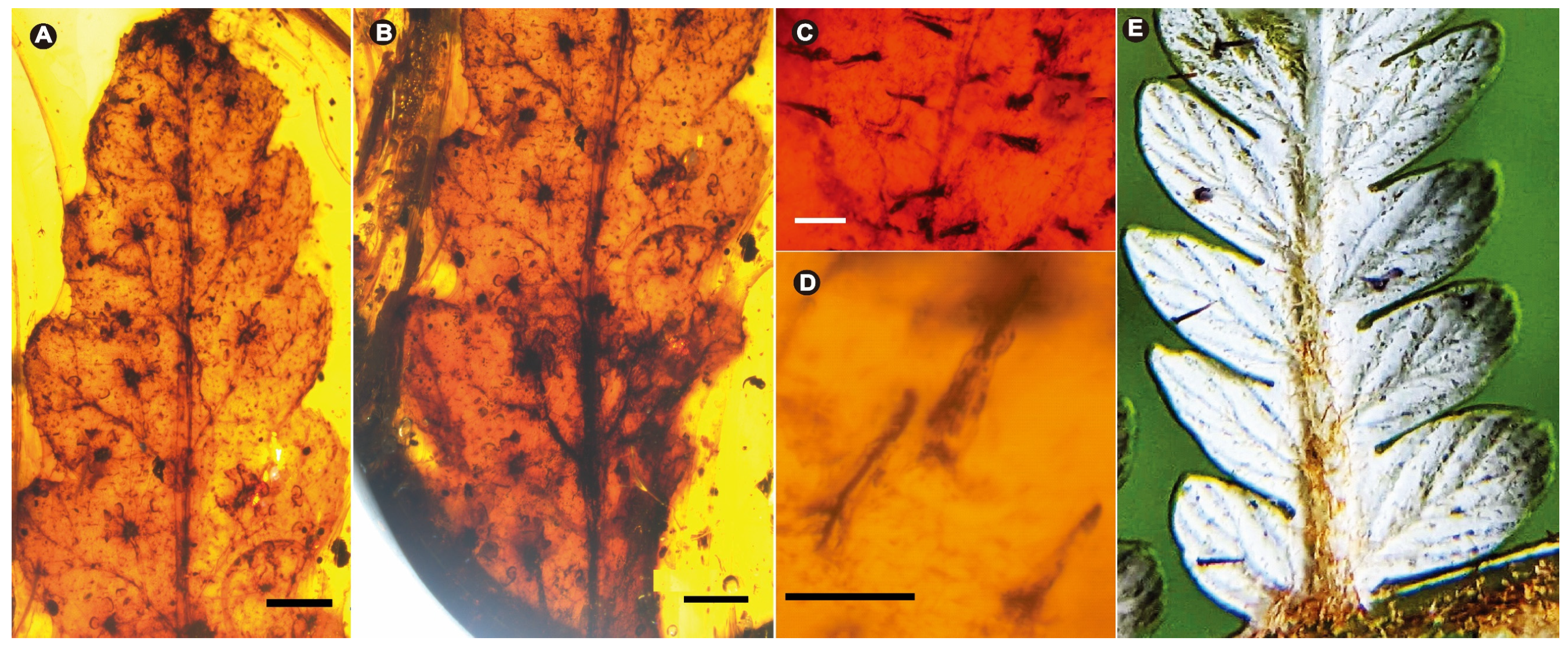
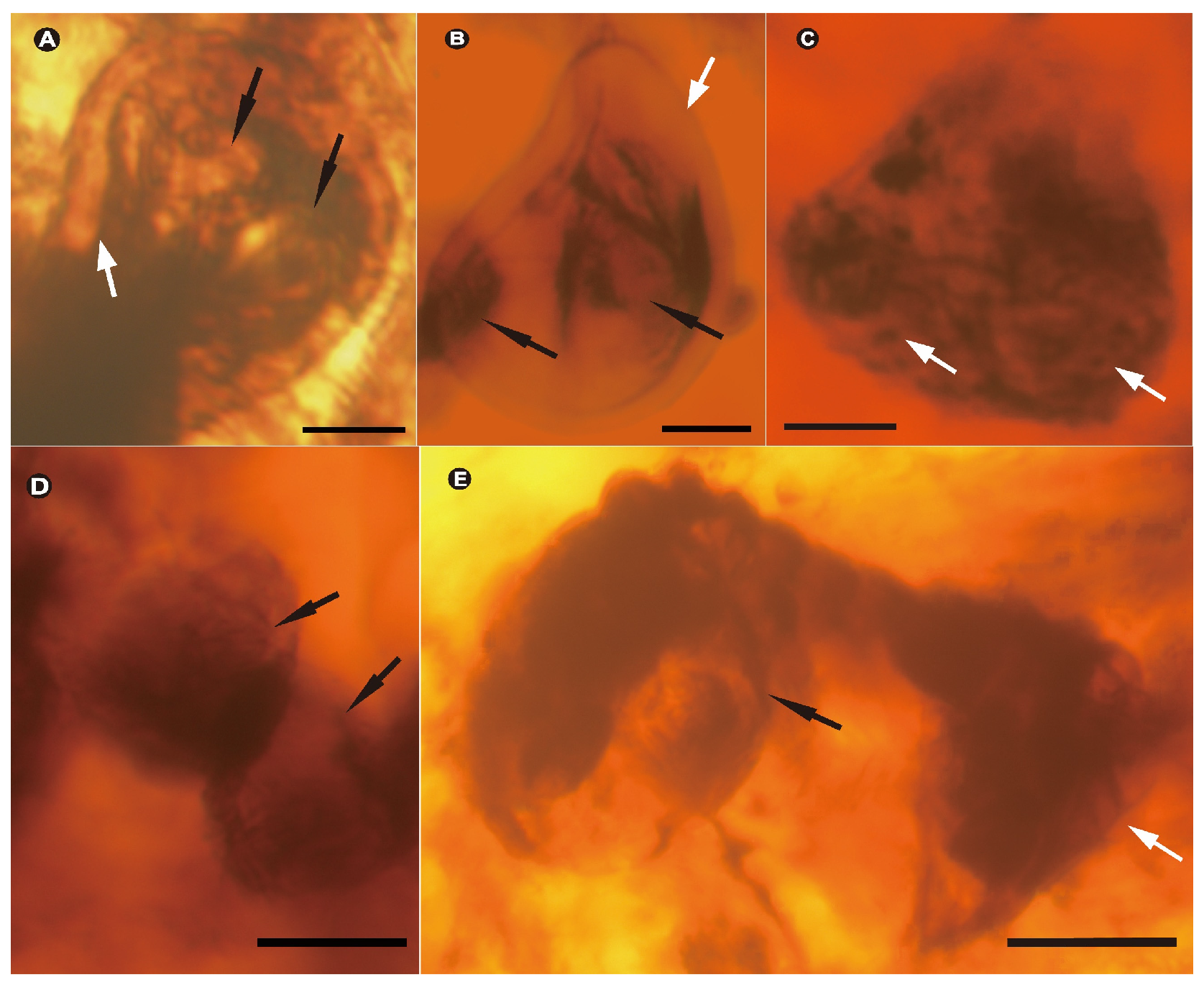
Description: Fertile lamina segment 14.4 mm long and 4.9 mm wide, pinnate with circular to elliptical lobes (Figure 1A,B and Figure 4C,D), slightly concave, margin thickened and a little revolute (Figure 2A), bearing shorter hairs, 113.5 μm long (average of 15 hairs) (Figure 1C,D); axes abaxially grooved entire (Figure 2A); venation free, branching up to 3–4 times on some pinnule lobes; sori abaxial, exindusiate, single, round, one to two per pinnule lobe, more apical pinnule lobes tend to have one sorus, whereas larger more basal pinnule lobes may have up to two sori, sori terminating veins (Figure 1A,B and Figure 4C,D), sori with hardly raised receptacle, nearly round and paraphysate (pluricellular, filiform trichomes present among the sporangia) (Figure 2B); sporangia sessile or with short stalks, 194.5 μm long, 119.5 μm wide (average of 13 sporangia), annulus oblique, with ca. 28 darkened and thickened annulus cells (average of three sporangia) (Figure 2C,D and Figure 3E), sporangia containing invisible trilete spores (Figure 3D,E) with weakly differentiated stomium (Figure 2C,D and Figure 3E); spores oblate, amb oval-triangular, trilete, conspicuous flange 4.5–10.3 μm wide, surface of flange smooth, outer margin entire, proximal surface with large swollen areas (Figure 3A,B), distal face pitted (Figure 3C), approximately 36–43 μm in size.
Figure 2.
Partial pinnule, sori, and sporangia of the holotype of Lophosoria myanmarica sp. nov. (PB 205825). (A) Partial pinnule of L. myanmarica, showing thickened, revolute margins (black arrows) and a groove along the rachis on the adaxial side of the pinnule (white arrows). (B) A fossil sorus, containing numerous pluricellular, filiform paraphyses radiating from the receptacle and interspersed among the sporangia. (C,D) Two dehisced sporangia with oblique annuli. Scale bars: 500 μm (A), 200 μm (B), and 50 μm (C,D).
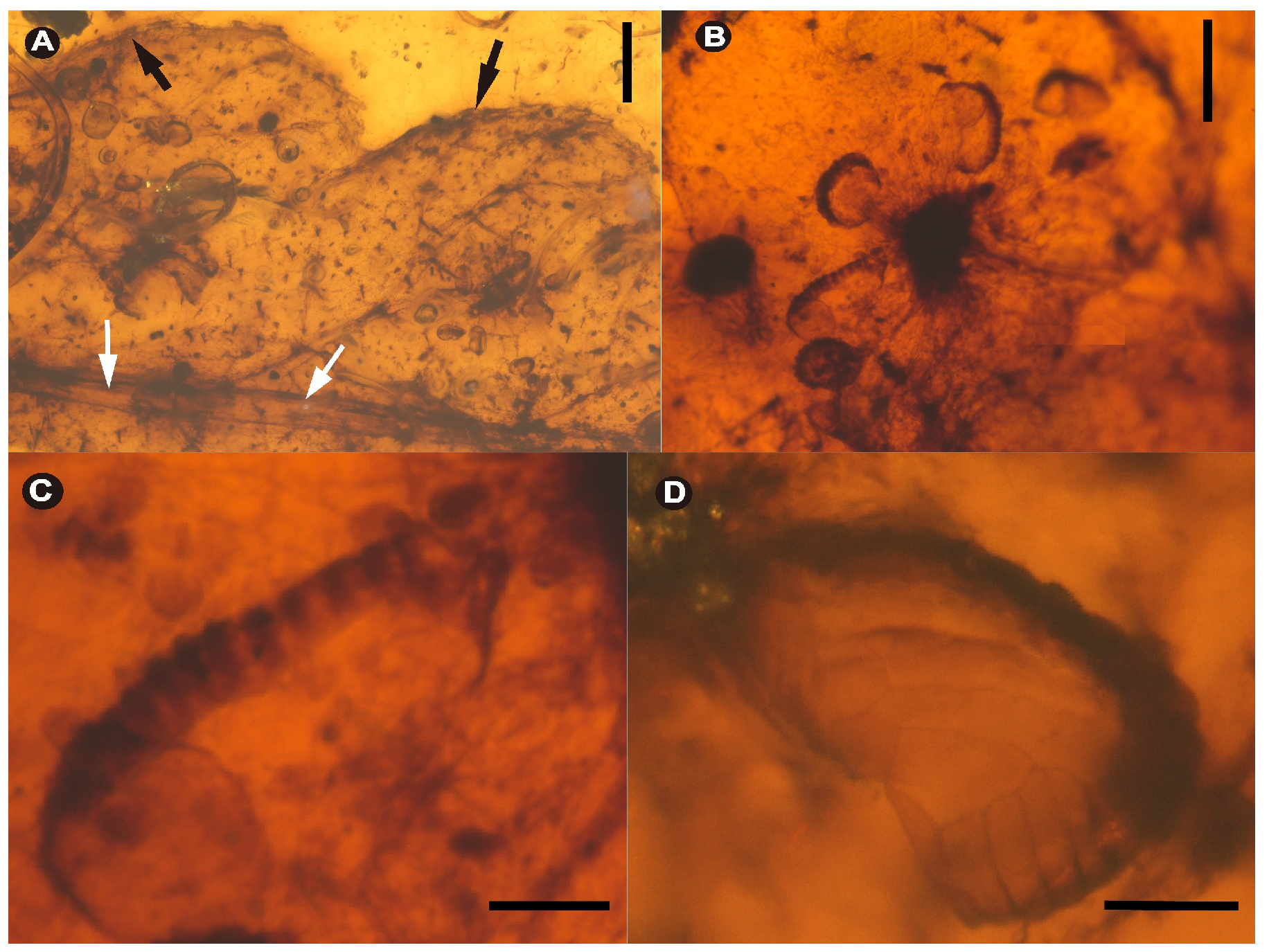
Figure 3.
Spores and sporangia of the holotype of Lophosoria myanmarica sp. nov. (PB205825). (A–C) Isolated trilete spores observed on the abaxial surface of the pinnule: (A,B) Proximal surfaces of the spores showing prominent equatorial flanges (white arrows) and swollen areas (black arrows); (C) Distal face of spore, clearly pitted (white arrows). (D,E) Trilete spores enclosed within sporangia, with visible flanges (black arrows). (E) Sporangia displaying oblique annuli, with sporangial stalks indicated by white arrows. Scale bars: 10 μm (A–C), 20 μm (D), and 50 μm (E).
Remarks: The fossil described in this study is classified within Lophosoria based on spore morphology. Lophosoria produces a distinctive spore type not found in any other extant plants, except for its closest analogues in certain species of Cibotium (e.g., C. arachnoideum and C. curningii) [15]. Lophosoria spores are characterized by cingulate structures with prominent flanges and noticeable contact areas on the proximal surface, while the distal face is pitted. The spores of the fossil L. myanmarica exhibit these unique morphological features, aligning them with other Lophosoria species. Additionally, the classification of this fossil within Lophosoria is supported by its soral features: it is exindusiate, with each sorus containing numerous paraphyses among sporangia that possess an oblique annulus (for details see discussion). The sori of the extant L. quadripinnata and other fossils, such as Lophosoria cupulata [12], also contain numerous paraphyses.
4. Discussion
4.1. Morphological Comparison with Extant Ferns
Although the fossil is preserved only as a segment of a fertile lamina (Figure 1A,B and Figure 4C,D), it retains several diagnostic reproductive characters, including exindusiate sori, abundant paraphyses, obliquely annulate sporangia, and strongly flanged spores. Firstly, the fossil exhibits sporangia with distinctly oblique annuli (Figure 2C,D and Figure 3E), a characteristic strongly associated with the tree fern order Cyatheales [1,3,9,10]. Secondly, the soral characteristics observed on the fossil—superficial, exindusiate, single, round sori, one to two per pinnule lobe (Figure 1A,B, Figure 2A,B and Figure 4C,D)—allow us to further narrow its potential lineage within the Cyatheales to two genera: Lophosoria and Metaxya, as well as some genera of Cyatheaceae, such as certain species of Alsophila, Cyathea, and Gymnosphaera, which also possess exindusiate abaxial sori. However, aside from Lophosoria, the other two groups, Metaxya and Cyatheaceae, do not align with the fossil in terms of spore morphology. The spores of the fossil closely resemble those of Lophosoria, which are characterized by conspicuous flanges on their proximal surfaces (the equatorial cingulums). In contrast, spores from Metaxya and Cyatheaceae lack these distinct flanges and do not share similarities with Lophosoria spores [1,4].
The fossil spores are characterized by an exceptionally prominent equatorial flange, a feature that is also present in spores of Cibotium species, such as C. arachnoideum and C. cumingii [15]. However, the fossil differs from Cibotium in several details of the proximal face. In the fossil spores, the proximal face shows distinct raised or swollen areas between the aperture arms, whereas in Cibotium spores the raised areas are developed only along the aperture arms. In addition, Cibotium can be readily distinguished from the fossil by its marginal sori with clam-shaped indusia, whereas the fossil bears superficial, exindusiate sori. In contrast, the fossil shares a combination of characters consistent with the genus Lophosoria. These include: (1) superficial, exindusiate sori borne near the lamina margin; (2) the presence of paraphyses associated with the sori; (3) a grooved rachis; (4) fertile lamina segments with thickened margins; and (5) hairs on the abaxial surface of the pinnules. Although some of these characters are not individually diagnostic for Lophosoria, their combined occurrence corresponds well with the morphological features observed in extant representatives of the genus. Based on this suite of characters, we interpret the fossil as an extinct member of Lophosoria.
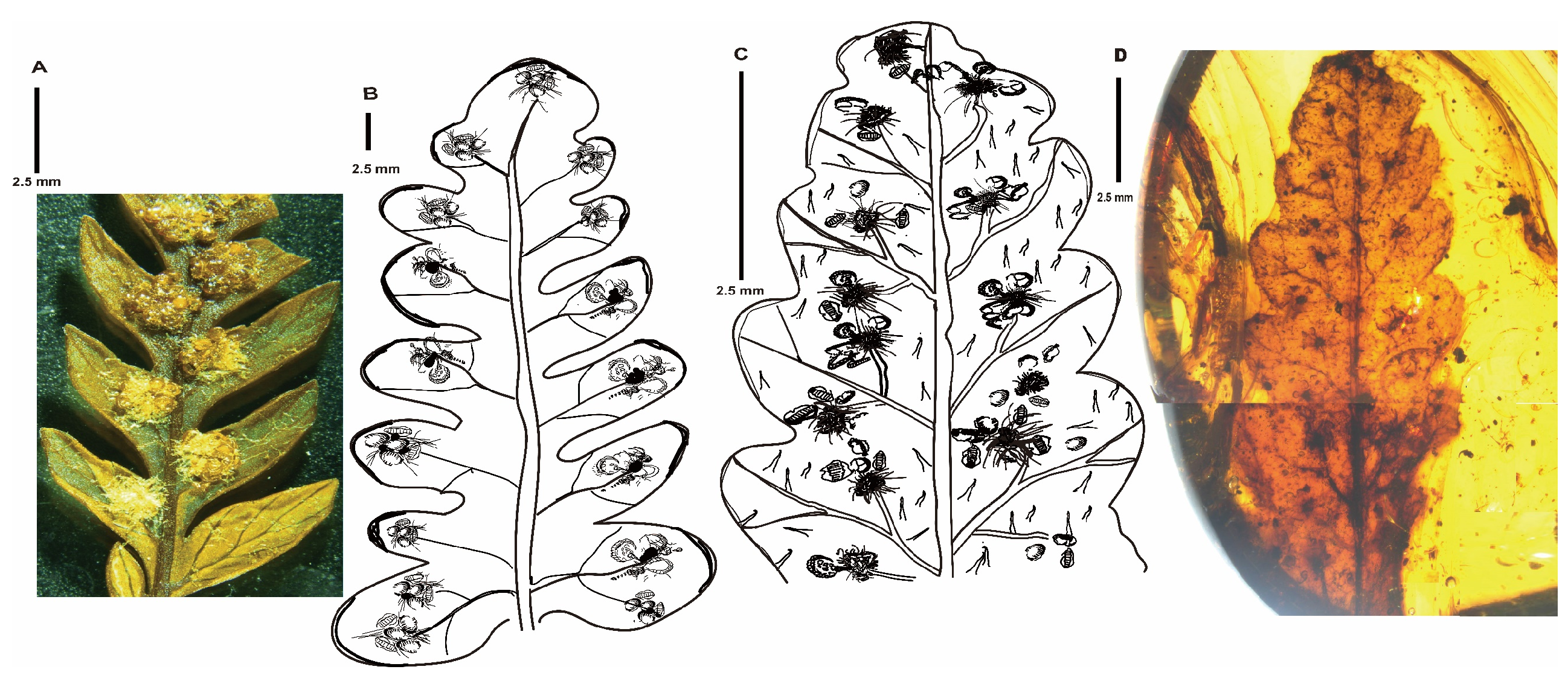
Lophosoria has often been treated as a single species, L. quadripinnata. Therefore, we focus our comparison on the new fossil with only extant L. quadripinnata. The primary distinction between L. myanmarica and L. quadripinnata is spore size; the spores of the fossil measure 36–43 μm, whereas those of extant L. quadripinnata range from 40 to 100 μm [1]. Furthermore, the pinnule margins of the new fossil are slightly pinnatifid with circular lobes, in contrast to the deeply pinnatifid margins and acute lobes of extant L. quadripinnata (Figure 1A,B,E and Figure 4A,C,D). Based on these differences, we propose the designation of L. myanmarica as a new species for the fossil, rather than classifying it under extant L. quadripinnata.
4.2. Comparison with Fossil Records Related to Lophosoria
Fossils associated with Lophosoria include paleopalynological records, the spore genus Cyatheacidites, and several megafossils. Dettmann [11] and Kurmann and Taylor [2] demonstrated that the Cretaceous spore genus Cyatheacidites closely aligns with extant Lophosoria. The distribution of Cyatheacidites has been utilized to infer that Lophosoria existed in southern Gondwana during the Early Cretaceous, with later migrations to Australia and South America during the Cenozoic [11]. More recently, Cantrill [12] described the Early Cretaceous (Aptian) fossil foliage from the Cerro Negro Formation on Snow Island, Antarctica, which contained Cyatheacidites spores. The excellent preservation of this fertile foliage and spores led Cantrill to designate it as L. cupulata, which he proposed was most closely related to extant L. quadripinnata. Lophosoria. cupulata represents the first and earliest confirmed record of Lophosoria macrofossils bearing Cyatheacidites spores.
The newly identified fossil L. myanmarica differs from L. cupulata in its smaller spore sizes (36–43 μm compared to 60–70 μm in L. cupulata [12]), and more circular to elliptical pinnule lobes (Figure 4B–D). Hill et al. [13] also described fertile remains from the Oligocene–early Miocene of Tasmania, which they assigned to the extant L. quadripinnata. The macrofossil is characterized by pinnae morphologically different from the species described here (Figure 4A,C,D). Notably, fossil L. quadripinnata bears the dispersed spores of Cyatheacidites annulatus, measuring approximately 40 μm in diameter (Plate I, e in Hill et al. [13]). This measurement represents the lower size limit of spores for extant L. quadripinnata, as described by Kurmann and Taylor [2], and falls within the size range of the new fossil spores we describe.
Torres and Méon [16] documented the presence of Lophosoria antarctica on the Eocene of King George Island. This species is characterized by sterile pinnae with lobed pinnules and has been associated with the dispersed spores Cyatheacidites annulatus, which are similar to the extant spores of L. quadripinnata. However, our newly discovered fossil preserves only a segment of a fertile lamina (Figure 1A,B), precluding further comparative analysis with the sterile pinnule of L. antarctica.
In addition to the fossils of fertile and sterile pinnules, two Cretaceous permineralized stems show affinities to Lophosoria. Lophosoriorachis japonica, a permineralized tree fern rachis from the Aptian of Chiba, Japan, shares several features with living Lophosoria [17]. The other specimen, Conantiopteris schuchmanii [18], is a distinctive tree fern whose trunk structures display significant similarities to Lophosoria and Dicksonia, C. schuchmanii is also from the Aptian of California, USA. Nishida [17] suggested that L. japonica indicates a distribution of Lophosoria in Japan and the Northern Hemisphere during the early Cretaceous (Aptian). However, this assertion was later questioned by Dettmann [11], who noted the absence of Cyatheacidites spores in the Cretaceous strata of Japan.
Figure 4.
Schematic drawings of fertile pinnules in two fossil species of Lophosoria compared with the extant species. (A) Extant Lophosoria quadripinnata, collected by Li-Bing Zhang (No. MO3526082; Herbarium of the Missouri Botanical Garden, MO). (B) Fossil L. cupulata, adapted from [12]. (C) Fossil L. myanmarica sp. nov. (PB205825) reconstructed based on Figure 1A,D of this study. (D) Composite image of the holotype of L. myanmarica showing the complete specimen, assembled from two overlapping micrographs (Figure 1A,B).
4.3. Paleogeographic Implications
Dettmann [11] mapped the geographic and stratigraphic distribution of Cyatheacidites spores, a study that was later expanded by Torres and Méon [16]. Their findings indicate that the earliest occurrences of Lophosoria date back to the Early Cretaceous in Antarctica, with mid-Cretaceous records also identified in South America, the Falkland Plateau, and both eastern and western Australia. The timing of its northern migration remains uncertain; Dettmann [11] proposed that it may have occurred during the Late Cretaceous or the early Cenozoic, potentially along routes through the Andes and ultimately reaching the islands of Central America [16].
The discovery of two Aptian stem fossils related to Lophosoria—Lophosoriorachis japonica from Japan [17] and Conantiopteris schuchmanii from California, USA [18]—suggests that Lophosoria spread to East Asia and North America during the Early Cretaceous. Our Albian fossil, L. myanmarica, further supports this hypothesis, indicating that Lophosoria was distributed across Eastern Asia and Northern America in the Northern Hemisphere at least from the Early Cretaceous (Aptian). This implies an earlier origin and a broader distribution for Lophosoria. However, the distribution of Lophosoria gradually contracted from the Late Cretaceous, with recent occurrences now limited to southern Mexico, Central America, and South America [3].
Conversely, our new fossil, L. myanmarica, from Myanmar amber suggests an alternative paleobiogeographic scenario. The closest extant relative, L. quadripinnata, with its Gondwanan distribution, appearing in what is now northern Myanmar, is intriguing yet not entirely unexpected. This distribution pattern has been observed in various angiosperms and diverse arthropods found in Myanmar amber [19,20,21]. One explanation for the presence of fossil L. myanmarica outside its current biogeographical range is that the Burmese amber forest is suggested to have a Gondwanan origin. The Burma Terrane, where Myanmar amber is located, was likely an island that was originally part of Gondwana and became separated during the Late Jurassic to Early Cretaceous. Lineages, including Lophosoria, may have migrated into what eventually became the Burmese amber forest prior to the mid-Cretaceous [22,23,24]. Another explanation suggests that Lophosoria and its relatives are likely a relatively ancient lineage that originated before the breakup of Pangaea, indicating that this lineage was once widespread across Pangaea. Consequently, modern populations may be relicts of a previously much broader distribution [21,25,26].
5. Conclusions
The new species Lophosoria myanmarica differs from both extant and previously described fossil species of Lophosoria, displaying distinctive pinnule morphology and expanding the known geographic range of the genus. These features provide new evidence for reconstructing the evolutionary history of Lophosoria and a basis for further interpretations of the paleobiogeographic and paleoecological evolution of Lophosoria.
Author Contributions
Conceptualization, C.L.; methodology, C.L. and J.L.; software, C.L.; validation, C.L.; formal analysis, C.L. and Y.L.; investigation, C.L., Y.L. and J.L.; resources, C.L.; data curation, C.L., J.L., Y.L. and J.M.; writing—original draft preparation, C.L.; writing—review and editing, C.L., Y.L., J.L. and J.M.; visualization, C.L. and J.L.; supervision, C.L.; project administration, C.L.; funding acquisition, C.L. and J.M. All authors have read and agreed to the published version of the manuscript.
Funding
The research was partially funded by the Project of Key Laboratory of Palaeobiology and Petroleum Stratigraphy, NIGPAS (Grant No. Y626040108).
Institutional Review Board Statement
Not applicable.
Informed Consent Statement
Not applicable.
Data Availability Statement
The original contributions presented in this study are included in the article. Further inquiries can be directed to the corresponding author.
Acknowledgments
We are grateful to Bo Wang of NIGPAS for helping with the specimen collections and providing the stratigraphic information, Li-Mei Feng and Jing-Jing Tang for their help in photographing the amber specimens under different models of microscopes.
Conflicts of Interest
The authors declare no conflicts of interest.
References
- Tryon, R.M.; Tryon, A.F. Ferns and Allied Plants with Special Reference to Tropical America; Springer: New York, NY, USA, 1982. [Google Scholar]
- Kurmann, M.H.; Taylor, T.N. Sporoderm ultrastructure of Lophosoria and Cyatheacidites (Filicopsida): Systematic and evolutionary implications. Plant Syst. Evol. 1987, 157, 85–94. [Google Scholar] [CrossRef] [Scilit]
- Kramer, K.U. Lopbosoriaceae. In The Families and Genera of Vascular Plants, Vol. 1 Pteridophytes and Gymnosperms; Kramer, K.U., Green, P.S., Eds.; Springer: Berlin/Heidelberg, Germany, 1990; pp. 170–172. [Google Scholar]
- Tryon, A.F.; Lugardon, B. Spores of the Pteridophyta; Springer: New York, NY, USA, 1991. [Google Scholar]
- Rojas-Alvarado, A.F. Aportes a la flora Pteridophyta Costaricense. II. Taxones nuevos. Brenesia 1996, 45–46, 33–50. [Google Scholar]
- Pichi-Sermolli, R.E.G. Fragmenta Pteriodologiae, II. Webbia 1970, 24, 699–722. [Google Scholar]
- Wolf, P.G.; Sipes, S.D.; White, M.R.; Martines, M.L.; Pryer, K.M.; Smith, A.R.; Ueda, K. Phylogenetic relationships of the enigmatic fern families Hymenophyllopsidaceae and Lophosoriaceae: Evidence from rbcL nucleotide sequences. Plant Syst. Evol. 1999, 219, 263–270. [Google Scholar]
- Sosa, V.; Ornelas, J.F.; Ramírez-Barahona, S.; Gándara, E. Historical reconstruction of climatic and elevation preferences and the evolution of cloud forest-adapted tree ferns in Mesoamerica. PeerJ 2016, 4, e2696. [Google Scholar] [CrossRef] [Scilit]
- Smith, A.R.; Pryer, K.M.; Schuettpelz, E.; Korall, P.; Schneider, H.; Wolf, P.G. A classification for extant ferns. Taxon 2006, 55, 705–731. [Google Scholar] [CrossRef] [Scilit]
- The Pteridophyte Phylogeny Group. A community-derived classification for extant lycophytes and ferns. J. Syst. Evol. 2016, 54, 563–603. [Google Scholar]
- Dettmann, M.E. Significance of the Cretaceous-Tertiary spore genus Cyatheacidites in tracing the origin and migration of Lophosoria (Filicopsida). Spec. Pap. Paleontol 1986, 35, 63–94. [Google Scholar]
- Cantrill, D.J. Early Cretaceous fern foliage referable to Lophosoriaceae from President Head, Snow Island, Antarctica. Alcheringa 1998, 22, 241–258. [Google Scholar]
- Hill, R.S.; Macphail, M.K.; Jordan, G.J. Macrofossils associated with the fossil fern spore Cyatheacidites annulatus and their significance for Southern hemisphere biogeography. Rev. Palaeobot. Palynol. 2001, 116, 195–202. [Google Scholar] [CrossRef] [Scilit]
- Shi, G.-H.; Grimaldi, D.A.; Harlow, G.E.; Wang, J.; Wang, J.; Yang, M.-C.; Lei, W.-Y.; Li, Q.-L.; Li, X.-H. Age constraint on Burmese amber based on U–Pb dating of zircons. Cretac. Res. 2012, 37, 155–163. [Google Scholar] [CrossRef] [Scilit]
- Gastony, G.J. Spore morphology in the Dicksoniaceae. II. The genus Cibotium. Canad. J. Bot. 1982, 60, 955–972. [Google Scholar] [CrossRef] [Scilit]
- Torres, T.G.; Méon, H. Lophosoria from the Tertiary of King George Island and central Chile: Origin and dispersion in the southern hemisphere. Lnstit. Antart. Chil. Ser. Cient. 1993, 43, 18–30. [Google Scholar]
- Nishida, H. Lophosoriorhachis japonica n. gen. et sp., from the lower Cretaceous of Choshi, Chiba Prefecture, Japan. Palaeontographica 1982, 181B, 118–122. [Google Scholar]
- Lantz, T.C.; Rothwell, G.W.; Stockey, R.A. Conantiopteris schuchmanii, gen. et sp. nov., and the role of fossils in resolving the phylogeny of Cyatheaceae sl. J. Plant Res. 1999, 112, 361–381. [Google Scholar] [CrossRef] [Scilit]
- Poinar, G., Jr. Burmese amber: Evidence of Gondwanan origin and Cretaceous dispersion. Hist. Biol. 2018, 31, 1304–1309. [Google Scholar] [CrossRef] [Scilit]
- Licht, A.; Win, Z.; Westerweel, J.; Cogné, N.; Morley, C.; Chantraprasert, S.; Poblete, F.; Ugrai, T.; Nelson, B.; Aung, D.W.; et al. Magmatic history of central Myanmar and implications for the evolution of the Burma Terrane. Gondwana Res. 2020, 87, 303–319. [Google Scholar] [CrossRef] [Scilit]
- De Francesco Magnussen, I.; Müller, S.P.; Hammel, J.U.; Kotthoff, U.; Harms, D. Diversity of schizomids (Arachnida: Schizomida) revealed by new fossil genera and species from mid-Cretaceous Burmese amber with implications for a Gondwanan origin of the Burma Terrane. Zool. J. Linn. Soc. 2022, 196, 792–844. [Google Scholar] [CrossRef] [Scilit]
- Chitimia-Dobler, L.; Dunlop, J.A.; Pfeffer, T.; Würzinger, F.; Handschuh, S.; Mans, B.J. Hard ticks in Burmese amber with Australasian affinities. Parasitology 2023, 150, 157–171. [Google Scholar] [CrossRef] [Scilit]
- Westerweel, J.; Roprech, P.; Licht, A.; Dupont-Nivet, G.; Win, Z.; Poblete, F.; Ruffet, G.; Swe, H.H.; Thi, M.K.; Aung, D.W. Burma Terrane part of the Trans-Tethyan arc during collision with India according to palaeomagnetic data. Natur. Geosci. 2019, 12, 863–868. [Google Scholar] [CrossRef] [Scilit]
- Morley, C.K.; Naing, T.T.; Searle, M.; Robinson, S.A. Structural and tectonic development of the Indo-Burma ranges. Earth Sci. Rev. 2020, 200, 102992. [Google Scholar] [CrossRef] [Scilit]
- Seton, M.; Müller, R.D.; Zahirovic, S.; Gaina, C.; Torsvik, T.; Shephard, G.; Talsma, A.; Gurnis, M.; Turner, M.; Maus, S.; et al. Global continental and ocean basin reconstructions since 200 Ma. Earth Sci. Rev. 2021, 113, 212–270. [Google Scholar] [CrossRef] [Scilit]
- Wood, H.M.; Wunderlich, J. Burma Terrane Amber Fauna Shows Connections to Gondwana and Transported Gondwanan Lineages to the Northern Hemisphere (Araneae: Palpimanoidea). Syst. Biol. 2023, 72, 1233–1246. [Google Scholar] [CrossRef] [Scilit]
Disclaimer/Publisher’s Note: The statements, opinions and data contained in all publications are solely those of the individual author(s) and contributor(s) and not of MDPI and/or the editor(s). MDPI and/or the editor(s) disclaim responsibility for any injury to people or property resulting from any ideas, methods, instructions or products referred to in the content. |
© 2026 by the authors. Licensee MDPI, Basel, Switzerland. This article is an open access article distributed under the terms and conditions of the Creative Commons Attribution (CC BY) license.