Next Article in Journal
Sustainable Recovery of Antioxidant Amphiphilic Bioactives from Avocado By-Products via Green Extraction for Food and Cosmetic Applications
Previous Article in Journal
A Fossil of the Austral Tree Fern Genus Lophosoria (Dicksoniaceae) from Mid-Cretaceous Myanmar Amber
 
 
Due to scheduled maintenance work on our servers, there may be short service disruptions on this website between 11:00 and 12:00 CEST on March 28th.
Proceeding Paper

Nannochloropsis sp. Extract as a Potential Functional Ingredient for Food Applications †

by
Valter F. R. Martins
,
Ana I. Lopes
,
Manuela Machado
,
Manuela E. Pintado
,
Rui M. S. C. Morais
and
Alcina M. M. B. Morais
*
CBQF-Centro de Biotecnologia e Química Fina—Laboratório Associado, Escola Superior de Biotecnologia of Universidade Católica Portuguesa (Porto Campus), Rua Diogo Botelho 1327, 4169-005 Porto, Portugal
*
Author to whom correspondence should be addressed.
Presented at the 6th International Electronic Conference on Foods, 28–30 October 2025; Available online: https://sciforum.net/event/Foods2025.
Biol. Life Sci. Forum 2026, 56(1), 25; https://doi.org/10.3390/blsf2026056025
Published: 25 March 2026
(This article belongs to the Proceedings of The 6th International Electronic Conference on Foods)

Abstract

This present study provides a comprehensive and novel assessment of Nannochloropsis sp. extracts as multifunctional ingredients for food applications, combining lipid profiling, nutritional quality indices, and antimicrobial activity. The extracts were obtained by ultrasound-assisted hydroethanolic extraction (90% EtOH solution; 20 kHz pulses of 30 s during 10 min). Nannochloropsis sp. biomass exhibited a high lipid content (36.6%), and GC-FID analysis of its extract revealed high concentrations of palmitic acid, palmitoleic acid, and eicosapentaenoic acid (EPA). Nutritional quality indices—including the index of atherogenicity (AI), the index of thrombogenicity (TI), and the hypocholesterolemic/hypercholesterolemic ratio (HH)—were favorable, and the health-promoting index (HPI) was high. Although the extract exhibited low antioxidant activity in ABTS, DPPH, and ORAC assays, it demonstrated inhibitory activity against Gram-negative (Yersinia enterocolitica, Escherichia coli, Salmonella enterica Serovar Enteritidis) and Gram-positive (Staphylococcus aureus, and Listeria monocytogenes) foodborne pathogens, with a minimal inhibitory concentration of 6.3–12.5 mg/mL. These findings highlight the novelty of positioning Nannochloropsis sp. extracts as multifunctional ingredients that couple favorable lipid nutrition with antimicrobial functionality, rather than as single-purpose bioactives. The results support their potential for application in healthy food formulations and shelf-life extension strategies.

1. Introduction

Nannochloropsis sp. is a microalga found in both freshwater and marine environments. It has been investigated for various applications, including cosmeceutical applications, food or feed industries, and environmental applications such as carbon dioxide capture. The nutritional composition of this microalga biomass exhibits a characteristic profile in which lipids constitute the major component, followed by carbohydrates and smaller amounts of proteins. This microalga is also recognized for its high content of bioactive compounds, including polyunsaturated fatty acids (PUFAs), particularly eicosapentaenoic acid (EPA), as well as carotenoids (astaxanthin, canthaxanthin, β-carotene, zeaxanthin, violaxanthin), and phenolic compounds. These constituents contribute to potential human health benefits, such as the prevention of coronary heart disease, antimicrobial activity, and free radical scavenging properties [1,2].
Nannochloropsis sp. is beneficial for aquaculture and human nutrition and may be incorporated into clean-label food formulations free from synthetic compounds in the form of pastes, dry powders, or extracts. It can be used as a functional ingredient that promotes health-related properties, including antioxidant and antimicrobial activities, thereby acting as a natural preservative and extending the shelf life of food products. In addition, it may modify the physical and organoleptical properties of foods, functioning as a natural colorant or emulsifier agent [1,2].
The composition of bioactive-rich extracts depends on the extraction methodology, which can be influenced by both the choice of solvent and the extraction technique employed [3]. Ultrasound-assisted extraction enhances cell disruption and mass transfer through acoustic cavitation, thereby increasing the yield of intracellular polar lipids and associated eicosapentaenoic acid (EPA) compared with nonpolar solvent extraction. Consequently, ethanolic extracts are often relatively enriched in EPA compared with simple hexane extracts [4,5]. Aqueous ethanol preferentially solubilizes polar lipids, such as glycolipids and phospholipids, in which EPA is frequently concentrated [6]. Other bioactive compounds, including carotenoids and phenolic compounds, are also present at higher concentrations in hydroethanolic extracts obtained by ultrasound-assisted extraction compared with water-based extracts, whether enzyme-assisted or not [3].
Bioactive compounds can be sensitive to extraction conditions—such as solvent polarity, pH, high temperature, or light exposure—which may affect their stability and bioactivity. Storage conditions, including freezing, drying, and light exposure, can further influence their stability. Careful handling is therefore recommended due to the susceptibility of these compounds to hydrolytic or oxidative degradation, particularly in the case of lipids and polyphenols, and to photodegradation, especially for carotenoids [7]. These stability issues are relevant not only for bioactive extracts intended for use as functional food ingredients but also for their incorporation in manufacturing processes and final products. Packaging plays an important role in preserving the bioactivity of nutraceutical compounds in functional foods or feeds, as well as in cosmeceutical and pharmaceutical products [8].
The novelty of the present work lies in the integration of lipidomic profiling, nutritional quality assessment, and bioactivity evaluation, including antioxidant and antimicrobial properties, to position Nannochloropsis sp. extracts as potential multifunctional food ingredients. This study focuses on an integrated and application-oriented evaluation of a hydroethanolic, ultrasound-assisted extract, combining (i) detailed lipid profiling by GC-FID, (ii) nutritional quality indices (AI, TI, HH, and HPI), which are rarely reported together for this extraction approach, and (iii) antioxidant capacity and antimicrobial activity against a panel of major foodborne pathogens relevant to shelf-life extension.

2. Materials and Methods

2.1. Microalgal Biomass

Nannochloropsis sp. biomass used in this study was from the A4F (Algae for Future, Lisbon, Portugal) culture collection, and it was cultivated by this company, A4F, under non-limiting nutrient conditions. Cultivation was performed using a proprietary artificial saltwater medium developed and optimized by A4F. Although the detailed composition of the medium is confidential for industrial protection reasons, all procedures followed standard microalgal cultivation protocols, ensuring methodological comparability. Cultures were grown under natural solar irradiance in a semi-continuous regime, maintaining pH between 7 and 8 and temperatures below 30 °C. The average photosynthetically active radiation (PAR) was 44.0 ± 4.64 mol m−2 d−1. Biomass production was carried out in a unilateral horizontal tubular photobioreactor (UHT-PBR) [9]. Nannochloropsis sp. biomass was freeze-dried and stored at −20 °C until use for protein and phytochemical compound extraction.

2.2. Determination of the Nutritional Composition of the Biomass

The dry matter, moisture, ash, fat, protein, fiber, and carbohydrate contents, as well as the energetic value, of Nannochloropsis sp. biomass were determined according to Martins et al. [9]. The energetic value was calculated using the following equation:
Energetic value (kcal/100 g DW) = 4 × (massprotein + masscarbohydrates) + 9 × massfat

2.3. Extraction of Phytochemical Compounds

The materials and methods used for the extraction of phytochemical compounds from Nannochloropsis sp. biomass were described by Martins et al. [3,9]. Briefly, the extraction was carried out using a hydroethanolic solution (90% v/v). Freeze-dried microalgal powder (1 g) was added to 30 mL of the solution and incubated at 50 °C with shaking at 120 rpm (Orbital Shaker, MaxQ 6000, Thermo Scientific, Waltham, MA, USA) for 120 min, and this process was repeated twice. The mixture was then homogenized using an ultrasound probe (Sonics, Vibra Cell, Newtown, CT, USA) at 20 kHz for 30 s per pulse, for a total of 10 min. The resulting solution was filtered, and the ethanol was evaporated using a rotary evaporator (Buchi R-210, Buchi Labortechnik AG, Flawil, Switzerland). The final extract was lyophilized to obtain a dried product.

2.4. Identification of Fatty Acid Profile in Nannochloropsis sp. Extracts

The fatty acid composition of Nannochloropsis sp. extracts was determined using gas chromatography coupled with a flame ionization detector (GC–FID), following the methodology described by Machado et al. [1,10], with minor modifications. The same instrumentation and operating conditions were used. Fatty acids were analyzed as fatty acid methyl esters (FAMEs) after transesterification of the lipids in the extracts obtained as described in Section 2.3.
Briefly, 250 mg of the microalgal extract was spiked with 100 µL of tritridecanoin (glyceryl tritridecanoate, 1.5 mg/mL) as an internal standard to ensure accurate quantification of fatty acids during sample preparation and GC analysis. Lipids were extracted using solvents of different polarity, resulting in the formation of two phases: a hexane phase containing predominantly neutral lipids (e.g., triglycerides) and non-polar free fatty acids, and a methanol phase containing more polar lipids and residual free fatty acids. The hexane phase remained as the upper layer. Dimethylformamide (DMF) was added to enhance the solubilization of both lipids and reagents and to facilitate the transesterification reaction. As a polar aprotic solvent, DMF improves reagent accessibility to lipid substrates and promotes efficient conversion by increasing miscibility between phases.
Fatty acids were converted to their methyl esters using a two-step methylation protocol. First, samples underwent base-catalyzed transesterification with sodium methoxide in methanol (80 °C, 10 min), which rapidly converts glycerides to their corresponding methyl esters. After cooling, sulfuric acid in methanol was added to promote acid-catalyzed esterification (60 °C, 30 min), ensuring complete derivatization of free fatty acids and fatty acyl moieties from more complex lipid classes, such as phospholipids and sterol esters. The resulting FAMEs were extracted into the organic phase and analyzed by GC–FID.
Gas chromatography (GC) analyses were conducted using an Agilent 8860 gas chromatograph (Agilent, Santa Clara, CA, USA) equipped with a flame ionisation detector (FID) and a BPX70 capillary column (60 m × 0.25 mm × 0.25 µm; SGE Europe Ltd., Paris, France). The operating conditions were as follows: the injector (split ratio of 25:1, injection volume 1 μL) was set at 250 °C, while the FID temperature was maintained at 275 °C. Hydrogen was used as the carrier gas at a flow rate of 1 mL/min (20.5 psi). The oven temperature program started at 60 °C (held for 5 min), increased at a rate of 15 °C/min to 165 °C (held for 1 min), and then rose at 2 °C/min to reach 225 °C (held for 2 min).
Fatty acid methyl esters were identified by comparing their retention times with those of the Supelco 37-component FAME Mix (Sigma-Aldrich, St. Louis, MO, USA) standard mixture. Each sample was analyzed in triplicate.
Additionally, the nutritional quality of the fatty acid profile was assessed using the Index of Atherogenicity (AI), among other lipid quality indices.
Index of atherogenicity (AI)
A I = [ C 12 : 0 + 4 × ( C 14 : 0 ) + C 16 : 0 ] ( Σ M U F A + Σ P U F A   n 6 + Σ P U F A   n 3 )
Index of thrombogenicity (TI)
T I = ( C 14 : 0 + C 16 : 0 + C 18 : 0 ) [ 0.5 × Σ M U F A + 0.5 × Σ P U F A   n 6 + 3 × Σ P U F A   n 3 + ( Σ P U F A   n 3 Σ P U F A   n 6 ) ]
Hypocholesterolemic-to-Hypercholesterolemic ratio (HH)
H H = ( c i s C 18 : 1 + Σ P U F A ) ( C 12 : 0 + C 14 : 0 + C 16 : 0 )
Health-Promoting Index (HPI)
H P I = Σ U F A [ C 12 : 0 + ( 4 × C 14 : 0 ) + C 16 : 0 ]
MUFA—monounsaturated fatty acids; PUFA—polyunsaturated fatty acids, UFA—unsaturated fatty acids, PUFA n3—ω-3 polyunsaturated fatty acids, PUFA n6—ω-6 polyunsaturated fatty acids. C12:0—lauric acid; C14:0—myristic acid; C16:0—palmitic acid; and C18:0—stearic acid.

2.5. Determination of the Bioactivity of the Extracts

The total phenolic content (TPC) and the antioxidant activity (ABTS, DPPH, and ORAC assays) were determined according to Martins et al. [3].
The antimicrobial activity was determined by using the minimal inhibitory concentration (MIC) and minimal bactericidal concentration (MBC) according to Martins et al. [9]. The determination involved five steps. In the first step, a bacterial suspension was prepared by seeding isolated bacteria onto Mueller–Hinton agar nutrient medium (Biokar Diagnostics, Allonne, France). The Petri dishes are then incubated in an oven at 37 °C for 18–24 h. Three to five morphologically similar colonies were selected and suspended in the same liquid medium with vortex agitation. The bacterial suspension was adjusted to 108 CFU by adding bacterial colonies or liquid medium as necessary, targeting a solution absorbance between 0.08 and 0.13 (excitation wavelength 625 nm, Shimadzu UV mini 1240, Tokyo, Japan). In the second step, the microalgal extract solutions and serial dilutions were prepared in a laminar flow cabinet by dissolving the extracts in the liquid medium. A 96-well microplate was used for the microdilution assay. Each well received 50 µL of microalgal extract solution and 50 µL of bacterial suspension. Two controls were included: a positive control containing 50 µL of bacterial suspension and 50 µL of liquid medium, and a negative control with 100 µL of liquid medium alone. Before addition, the bacterial suspension (108 CFU) was diluted 1:100 in the liquid medium. The microplate is incubated at 37 °C for 16–20 h. The third step involved the confirmation of CFU present in the bacterial suspension. Before incubation of the microplate, 10 µL from the positive control was transferred to an Eppendorf tube, mixed with 990 µL of Mueller–Hinton broth, and serially diluted 1:10. Subsequently, 100 µL of the final dilution was seeded onto a Petri dish and incubated at 37 °C for 16–20 h. The number of colonies was counted, and the assay was considered accurate if approximately 50 colonies were present. The fourth step consisted of reading the results. Bacterial growth alters the color of the liquid medium in the microplate. To facilitate visualization, 40 µL of iodonitrotetrazolium chloride (0.2 mg/mL) was added to each well and incubated at 37 °C for 30 min. The presence of live cells caused a color change from yellow to pink. Pink wells indicated bacterial growth, while yellow wells indicated inhibition of growth. The lowest concentration at which a yellow well appeared corresponded to the MIC. The fifth step involved the determination of the MBC. For this purpose, 50 µL from each yellow well (where no bacterial growth occurred) was seeded onto Mueller–Hinton agar plates. The MBC was defined as the lowest concentration at which no bacterial colonies grew on the agar.
The bacterial strains used, obtained from the CBQF—Centro de Biotecnologia e Química Fina—collection, included both rabbit- and human-derived clinical isolates. The species tested were Gram-negative—Escherichia coli ATCC 25922, Yersinia enterocolitica NCTC 10406, and Salmonella enterica Serovar Enteritidis ATCC 13076—and Gram-positive—Staphylococcus aureus ATCC 6538, Bacillus cereus NCTC 2599, and Listeria monocytogenes NCTC 10357. Among these, only the latter was obtained from rabbit-derived clinical isolates.

2.6. Statistical Analysis

Results were expressed as mean ± standard deviation of three independent replicates (n = 3). For the fatty acid results analysis, a one-way ANOVA model was initially fitted. The assumptions of normality and homogeneity of variances were assessed using the Shapiro–Wilk and Levene tests, respectively, on the model residuals. As the assumption of homogeneity of variances was not met, Welch’s ANOVA was used. Post hoc pairwise comparisons were then performed using the Games–Howell test at a significance level of p < 0.05. Statistical analyses were carried out using IBM SPSS Statistics for Windows version 23.0 (IBM Corp., Armonk, NY, USA).

3. Results and Discussion

3.1. Nutritional Composition of Nannochloropsis sp.

Nannocloropsis sp. biomass has a higher lipid content (36.6%) than other microalgae, such as Limnospira sp., Dunalliela sp., Lobosphaera sp., Odontella sp., Porphyridium sp., and Tetraselmis sp. [9]. It also contains substantial amounts of carbohydrates and protein, 31.4% and 22.9%, respectively, supporting the potential use of this biomass as a nutrient-dense ingredient (Table 1). In fact, the carbohydrate content of Nannocloropsis sp. biomass is higher than that reported for Limnospira sp., Odontella sp., and Porphyridium sp. [9]. Overall, these results indicate that Nannochloropsis sp. provides a balanced composition of lipids, proteins, and carbohydrates, positioning it as a promising candidate for the development of functional foods and nutritional supplements. The relatively high lipid content, coupled with favorable protein and carbohydrate levels, distinguishes it from other commonly studied microalgae and may provide both nutritional and bioactive benefits when incorporated into food formulations.

3.2. Yield of Extraction of Phytochemical Compounds from Freeze-Dried Nannochloropsis sp.

The extraction yield from Nannochloropsis sp. freeze-dried biomass was 27.72 ± 0.76% [9]. Gkioni et al. [11] performed an ethanol (EtOH) extraction assisted by ultrasound and obtained a yield of 12.14% using the same microalga. Georgiopoulou [12] reported an extraction yield of approximately 30% for Chlorella vulgaris. Poojary et al. [13] reported extraction yields ranging from 12 to 20% for ethanol maceration of Spirulina platensis biomass assisted by ultrasounds, while Savvidou et al. [14] reported yields between 15 and 20% for Chlamydomonas sp. biomass.

3.3. Fatty Acids in Nannochloropsis sp. Extract

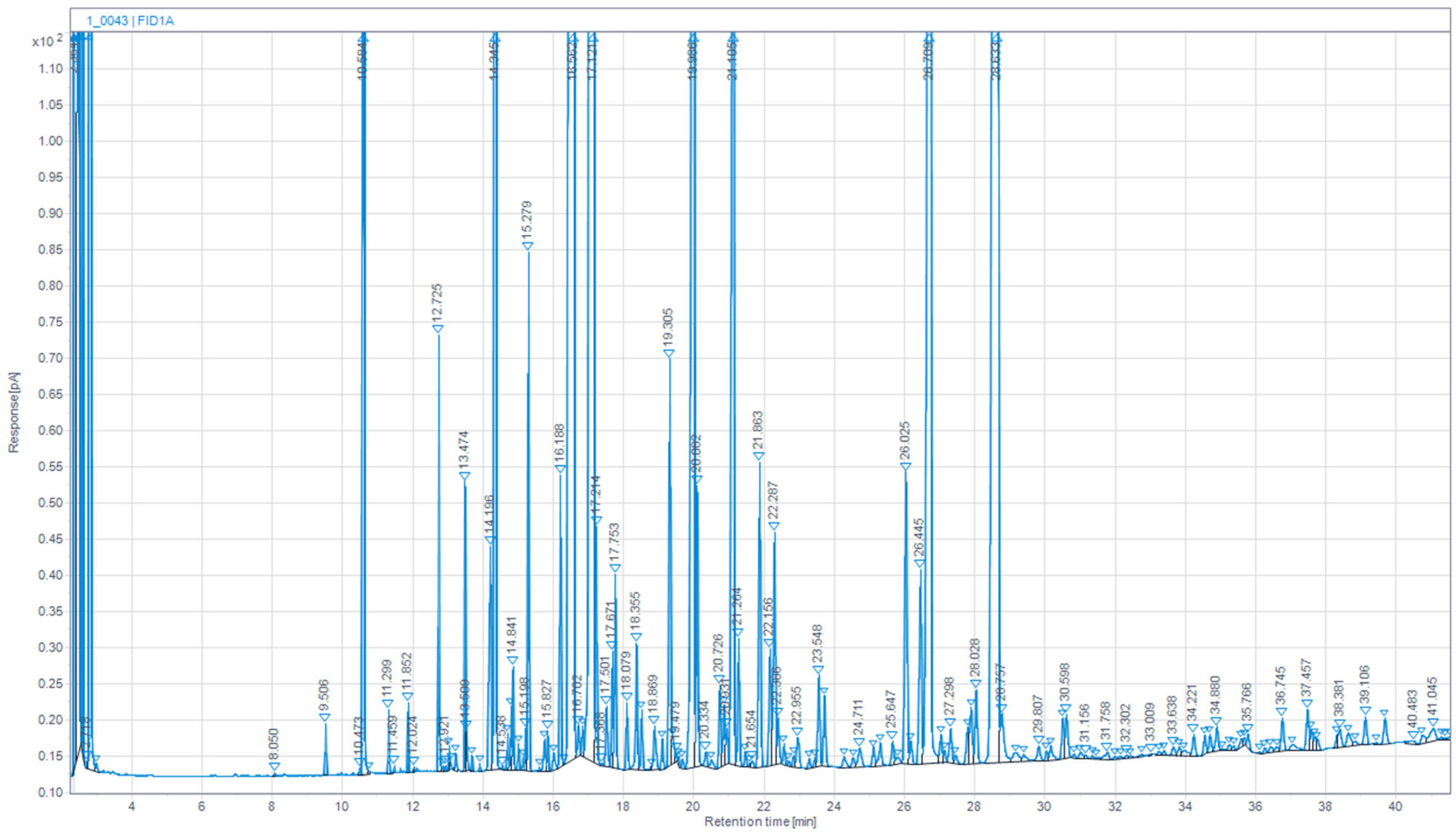
The four fatty acids (FAs) present at the highest concentrations in the hydroalcoholic extract of Nannochloropsis sp. were palmitic acid (C16:0, 310.7 ± 21.03 mg/g), palmitoleic acid (C16:1 c9, 235.03 ± 11.25 mg/g), eicosapentaenoic acid (EPA; ω-3, C20:5, 165.34 ± 5.82 mg/g), and myristic acid (C14:0, 67.45 ± 2.83 mg/g) (Table 2). This fatty acid profile (Figure 1) is consistent with the standardized fatty acid fingerprint reported for Nannochloropsis species.
For example, Nannochloropsis oculata typically contains ~23% C16:0, ~23% C16:1, and ~21% EPA of total fatty acids [14]. Although the absolute values differ in the present extract, the relative profile remains comparable: ~31.76% C16:0, ~24.03% C16:1c9, and ~16.90% EPA (C20:5).
This extract contained a substantial proportion of ω-3 long-chain polyunsaturated fatty acids (LC-PUFAs). In contrast, some other microalgae, such as Lobosphaera sp., primarily accumulate ω-6 LC-PUFAs. For example, the trebouxiophyte Lobosphaera incisa can accumulate up to 60% of total fatty acids as essential ω-6 LC-PUFAs [15,16].
Palmitic acid (C16:0) is a saturated fatty acid commonly consumed in the human diet. The recommended daily intake is 20–30 g/day, corresponding to approximately 8–10% of total caloric intake [17]. Myristic acid (C14:0) is also a saturated fatty acid but is typically present at lower concentrations; the recommended intake ranges from 0.5% to 2% of total caloric intake. Excessive intake can increase LDL cholesterol levels, which is detrimental to cardiovascular health [18].
Palmitoleic acid (C16:1 cis-9) is a monounsaturated fatty acid (MUFA) present in foods and also endogenously synthesized from palmitic acid. Current nutritional guidelines do not specify a recommended daily intake for this fatty acid [19].
Eicosapentaenoic acid (EPA; ω-3, C20:5) and docosahexaenoic acid (DHA; ω-3, C22:6), present in the Nannochloropsis sp. extract (0.505 ± 0.012 mg/g), are polyunsaturated fatty acids (PUFAs) known for their beneficial effects on cardiovascular health and anti-inflammatory activity. The World Health Organization (WHO) recommends 200–500 mg/day of EPA + DHA, while the American Heart Association (AHA) recommends 500 mg/day as a preventive measure. The European Food Safety Authority (EFSA) recommends 250 mg/day of EPA + DHA for adults [20,21,22,23].
Dietary lipids are predominantly present as triglycerides, composed of fatty acids that may exert both beneficial and adverse effects on the prevention and management of various diseases. To evaluate the nutritional quality of fats, several indices are commonly used, including the atherogenicity index (AI), the thrombogenicity index (TI), the hypocholesterolemic/hypercholesterolemic ratio (HH), and the health-promoting index (HPI). These indices provide valuable insight into the potential health effects of lipid extracts.
The AI reflects the ratio between saturated fatty acids (SFAs) and unsaturated fatty acids (UFAs). Because UFAs are considered anti-atherogenic—due to their ability to inhibit plaque formation and reduce plasma levels of phospholipids, cholesterol, and esterified fatty acids—a lower AI is associated with reduced total cholesterol and LDL-C concentrations. In the present study, the AI of the Nannochloropsis sp. extract was 1.004 ± 0.048 (Table 2). For comparison, the AI value of the Lobosphaera sp. hydroalcoholic ultrasound-assisted extract was 0.890 ± 0.123 [6]. The TI represents the thrombogenic potential of fatty acids, reflecting the balance between pro-thrombogenic fatty acids (C12:0, C14:0, and C16:0) and anti-thrombogenic fatty acids (monounsaturated fatty acids and n-3/n-6 polyunsaturated fatty acids). The TI for Nannochloropsis sp. was 0.536 ± 0.035 (Table 2), whereas for Lobosphaera sp. it was 1.65 ± 0.21 [6].
Extracts exhibiting low AI and TI values are considered to possess superior nutritional quality and may contribute to a reduced risk of coronary heart disease.
The HH index expresses the ratio of hypocholesterolemic fatty acids—such as cis-C18:1 and polyunsaturated fatty acids—to hypercholesterolemic fatty acids. In this study, the HH value for Nannochloropsis sp. was 0.887 ± 0.054 (Table 2), while for Lobosphaera sp. it was 3.75 ± 0.003 [6].
Finally, the HPI, which is inversely related to AI, serves as an indicator of the overall health-promoting potential of lipids. Higher HPI values reflect greater nutritional benefit. The HPI of Nannochloropsis sp. was 0.996 ± 0.047 (Table 2), compared with 1.151 ± 0.15 for the Lobosphaera sp. extract [6].

3.4. Bioactivity of the Microalgae Extracts

The total phenolic content (TPC) and antioxidant activity (AA) of Nannochloropsis sp. were previously reported by Martins et al. [9].
The bioactive-rich extracts obtained from Nannochloropsis sp. biomass exhibited substantial TPC and AA values (Table 3). These findings are consistent with those reported in the literature. Wang et al. [24] documented TPC values ranging from 0.4 to 4 mg GAE/g DW and ABTS and DPPH antioxidant activities between 4–25 and 2–15 µmol TE/g DW, respectively, across different Nannochloropsis strains. Similarly, Cunha et al. [25] reported an ORAC value of 361 ± 16.5 µmol TE/g DW for an enzymatic hydrolysis extract derived from Nannochloropsis sp. biomass.
The antimicrobial activity assay of the Nannochloropsis sp. extract showed the same minimal inhibitory concentration (MIC) of 1.25 mg/100 μL for Escherichia coli, Salmonella enterica Serovar Enteritidis, Staphylococcus aureus, and Listeria monocytogenes. The most sensitive strain was the Gram-negative Yersinia enterocolitica, while Bacillus cereus showed the lowest susceptibility (Table 4).
In general, microalgal ethanolic extracts are more effective against Gram-positive than Gram-negative bacteria. This difference is largely due to the outer hydrophilic membrane of Gram-negative bacteria (composed of lipopolysaccharides and proteins), which hinders the penetration of many hydrophobic bioactive compounds, including phenolics, pigments, and fatty acids [26]. Gram-positive bacteria lack this outer membrane, making them more susceptible to antimicrobial agents. However, Nannochloropsis ethanolic extracts are particularly rich in polyunsaturated fatty acids (PUFAs), and moderate inhibition of Gram-negative bacteria can occur when extracts contain sufficient lipophilic fatty acids capable of disrupting bacterial membranes [26]. Ethanolic extraction preferentially isolates lipophilic compounds, such as fatty acids, chlorophylls, and carotenoids, which exhibit membrane-disrupting effects and can enhance activity against Gram-negative bacteria compared with aqueous extracts. Nevertheless, Gram-positive bacteria generally remain more sensitive [26].
Wali et al. [26] reported that ethanolic extracts of Nannochloropsis oculata exhibited MIC values ranging from 15.6 to 500 µg/mL against both Gram-positive and Gram-negative bacteria. Considering that Y. enterocolitica is Gram-negative and possesses an outer membrane barrier, typical expectations for MIC values of ethanolic Nannochloropsis extracts fall within the tens to low hundreds of µg/mL. These reported values are substantially lower than those obtained in the present study (Table 4). For all bacteria tested in this study, the minimal bactericidal concentrations (MBCs) were higher than 5 mg/100 μL.
Comparison with the literature indicates that the extract evaluated in the present work exhibits relatively low antimicrobial activity. Eloff et al. [27] suggested that natural extracts with MIC values higher than 0.625 mg/mL should be considered to have low antimicrobial potential. Roersch et al. [28], using a widely recognized ethnopharmacological scale, classified MIC values above 1.5 mg/mL as indicative of weak antimicrobial activity. Similarly, Rios and Recio [29] stated that MIC values exceeding 1 mg/mL are generally not considered promising for therapeutic applications, although they may serve as a practical threshold for initial screening.
Despite the limited antimicrobial potency for therapeutic purposes, this extract could still be used as a food preservative, with concentrations adjusted to achieve antimicrobial efficacy while also considering potential sensory effects on the food matrix. Nevertheless, future studies should include appropriate reference standards, such as a commonly used food preservative, to allow more robust comparative evaluation.
Nannochloropsis sp. bioactive-rich extract could be used as a functional food ingredient for everyday preventive supplementation. Based on the values in Table 2, a practical intake of 1.2–3 g/day of this extract would provide the recommended 200–500 mg EPA + DHA/day recommended by WHO [21], and 250–500 mg EPA + DHA/day recommended by EFSA and AHA [20,23]. At this dosage, the extract would contribute a maximum of 0.5–1.2 g/day of saturated fatty acids (SFAs). This level of SFA intake is not expected to pose a health risk, as it remains well below the typical limit of 22 g/day recommended for a 2000 kcal diet.
The extract also provides a low level of in vitro antioxidant activity, corresponding to 3/100 on the PAOT scale, which is classified as low. While it contributes to polyphenol intake, it is not expected to confer systemic antioxidant effects. For therapeutic applications requiring high omega-3 intakes, such as 2–4 g/day for hypertriglyceridemia [30], the use of the crude extract would require impractically large quantities, given the concentrations obtained in this study. High intakes of palmitic and myristic acids are associated with elevated LDL cholesterol levels, making such doses unsuitable for cardiovascular risk management. For these purposes, purified EPA preparations are preferable.
Finally, the high MIC values observed indicate that the extract is not suitable or safe for systemic antimicrobial therapy, suggesting that its antimicrobial properties are more appropriate for applications in food preservation rather than therapeutic use.

4. Conclusions

In summary, this study demonstrates for the first time that a bioactive-rich extract from Nannochloropsis sp. obtained via ethanolic ultrasound-assisted extraction can be rationally positioned as a multifunctional ingredient for food applications by combining lipid nutritional quality with antimicrobial activity. The extract exhibited a favorable fatty acid profile, characterized by high levels of EPA and palmitoleic acid, along with advantageous nutritional quality (low AI and TI and a high HPI), supporting its potential contribution to cardiovascular health when incorporated into food formulations. Although its antioxidant capacity was limited, the extract showed inhibitory effects against both Gram-positive and Gram-negative foodborne pathogens, underscoring its potential relevance for food safety and shelf-life extension.
The proposed application of the extract as a food preservative is based on this combination of functional attributes. Rather than serving as a standalone antimicrobial, the extract appears more suitable as a multifunctional ingredient within a hurdle-technology framework. In practical terms, this multifunctionality supports its incorporation into lipid-based food systems (e.g., spreads, dressings, emulsified sauces, bakery fats, and fortified seafood or plant-based products), where it could simultaneously enhance the fatty acid profile and contribute to microbial stability.
However, further studies are required to substantiate its practical application, including challenge tests in real food matrices, assessment of stability during processing and storage, and comprehensive toxicological and sensory analyses. Such investigations are essential to confirm technological feasibility, safety, and regulatory compliance, thereby supporting the development of Nannochloropsis sp. extracts as sustainable, clean-label ingredients for the food industry.

Author Contributions

Conceptualization, A.M.M.B.M. and R.M.S.C.M.; methodology, V.F.R.M., M.M., A.I.L., A.M.M.B.M. and M.E.P.; software, V.F.R.M. and M.M.; validation, A.M.M.B.M.; formal analysis, V.F.R.M. and A.M.M.B.M.; investigation V.F.R.M.; resources, M.E.P., R.M.S.C.M. and A.M.M.B.M.; data curation, V.F.R.M.; writing—original draft preparation, V.F.R.M. and A.M.M.B.M.; writing—review and editing, A.M.M.B.M. and R.M.S.C.M.; visualization, V.F.R.M., and A.M.M.B.M.; supervision, A.M.M.B.M., R.M.S.C.M. and M.E.P.; project administration, A.M.M.B.M., R.M.S.C.M. and M.E.P.; funding acquisition, R.M.S.C.M. and M.E.P. All authors have read and agreed to the published version of the manuscript.

Funding

This work was supported by National Funds from FCT—Fundação para a Ciência e a Tecnologia—through projects UIDB/50016/2025 and LA/P/0076/2020 (https://doi.org/10.54499/LA/P/0076/2020) and by project EXTRATOTECA—COMPETE2020 POCI-01-0247-FEDER-033784. Valter Martins acknowledges FCT for the PhD research grant, reference UI/BD/152825/2022.

Institutional Review Board Statement

Not applicable.

Informed Consent Statement

Not applicable.

Data Availability Statement

Data are contained within the article. Due to the page limitations imposed by the journal, more details on the data are not presented here. Further inquiries can be directed to the corresponding author.

Conflicts of Interest

The authors declare no conflicts of interest. The funders had no role in the design of the study; in the collection, analyses, or interpretation of data; in the writing of the manuscript; or in the decision to publish the results.

References

  1. Machado, M.; Sousa, S.C.; Rodríguez-Alcalá, L.M.; Pintado, M.; Gomes, A.M. Bigels as Delivery Systems of Bioactive Fatty Acids Present in Functional Edible Oils: Coconut, Avocado, and Pomegranate. Gels 2023, 9, 349. [Google Scholar] [CrossRef]
  2. ISO 10993-5:2009; Biological Evaluation of Medical Devices—Part 5: Tests for in Vitro Cytotoxicity. International Organization for Standardization: Geneva, Switzerland, 2009.
  3. Martins, V.F.R.; Ribeiro, T.B.; Lopes, A.I.; Pintado, M.E.; Morais, R.M.S.C.; Morais, A.M.M.B. Comparison among Different Green Extraction Methods of Polyphenolic Compounds from Exhausted Olive Oil Pomace and the Bioactivity of the Extracts. Molecules 2024, 29, 1935. [Google Scholar] [CrossRef]
  4. Melo, T.; Figueiredo, R.P.A.; Costa, E.; Couto, D.; Silva, J.; Domingues, M.R.; Domingues, P. Ethanol Extraction of Polar Lipids from Nannochloropsis oceanica for Food, Feed, and Biotechnology Applications Evaluated Using Lipidomic Approaches. Mar. Drugs 2021, 19, 593. [Google Scholar] [CrossRef]
  5. Liu, Y.; Liu, X.; Cui, Y.; Yuan, W. Ultrasound for microalgal cell disruption and product extraction: A review. Ultrason. Sonochem. 2022, 87, 106054. [Google Scholar] [CrossRef]
  6. Castejón, N.; Marko, D. Fatty Acid Composition and Cytotoxic Activity of Lipid Extracts from Nannochloropsis gaditana Produced by Green Technologies. Molecules 2022, 27, 3710. [Google Scholar] [CrossRef] [PubMed]
  7. Molina, A.K.; Corrêa, R.C.; Prieto, M.A.; Pereira, C.; Barros, L. Bioactive natural pigments’ extraction, isolation, and stability in food applications. Molecules 2023, 28, 1200. [Google Scholar] [CrossRef] [PubMed]
  8. Martins, V.F.R.; Lopes, A.I.; Machado, M.; Costa, E.M.; Ribeiro, T.B.; Poças, F.; Pintado, M.; Morais, R.M.S.C.; Morais, A.M.M.B. Biodegradable Films with Polysaccharides, Proteins, and Bioactive Compounds from Lobosphaera sp.: Antioxidant and Antimicrobial Activities. Foods 2025, 14, 1327. [Google Scholar] [CrossRef] [PubMed]
  9. Martins, V.F.R.; Lopes, A.I.; Gomes, D.; Parreira, C.; Badenes, S.M.; Costa, L.; Pintado, M.; Morais, A.M.M.B.; Morais, R.M.S.C. Unravelling the Potential of Seven Microalgae Species: Nutritional, Antioxidant, and Antimicrobial Properties and Application. Appl. Sci. 2025, 15, 6691. [Google Scholar] [CrossRef]
  10. Machado, M.; Sousa, S.; Morais, P.; Miranda, A.; Rodriguez-Alcalá, L.M.; Gomes, A.M.; Pintado, M. Novel Avocado Oil Functionalized Yogurt with Anti-Obesity Potential: Technological and Nutraceutical Perspectives. Food Biosci. 2022, 50, 101983. [Google Scholar] [CrossRef]
  11. Gkioni, M.D.; Andriopoulo, V.; Koutra, E.; Hatziantoniou, S.; Kornaros, M.; Lamari, F.N. Ultrasound-Assisted Extraction of Nannochloropsis oculata with Ethanol and Betaine: 1,2-Propanediol Eutectic Solvent for Antioxidant Pigment-Rich Extracts Retaining Nutritious the Residual Biomass. Antioxidants 2022, 11, 1103. [Google Scholar] [CrossRef]
  12. Georgiopoulou, I.; Tzima, S.; Pappa, G.D.; Louli, V.; Voutsas, E.; Magoulas, K. Experimental Design and Optimization of Recovering Bioactive Compounds from Chlorella vulgaris through Conventional Extraction. Molecules 2021, 27, 29. [Google Scholar] [CrossRef] [PubMed]
  13. Poojary, M.M.; Barba, F.J.; Aliakbarian, B.; Donsì, F.; Pataro, G.; Dias, D.A.; Juliano, P. Innovative Alternative Technologies to Extract Carotenoids from Microalgae and Seaweeds. Mar. Drugs 2016, 14, 214. [Google Scholar] [CrossRef] [PubMed]
  14. Savvidou, M.G.; Georgiopoulou, I.; Antoniou, N.; Tzima, S.; Kontou, M.; Louli, V.; Fatouros, C.; Magoulas, K.; Kolisis, F.N. Extracts from Chlorella vulgaris Protect Mesenchymal Stromal Cells from Oxidative Stress Induced by Hydrogen Peroxide. Plants 2023, 12, 361. [Google Scholar] [CrossRef]
  15. Iskandarov, U.; Sitnik, S.; Shtaida, N.; Didi-Cohen, S.; Leu, S.; Khozin-Goldberg, I.; Cohen, Z.; Boussiba, S. Cloning and Characterization of a GPAT-like Gene from the Microalga Lobosphaera incisa (Trebouxiophyceae): Overexpression in Chlamydomonas Reinhardtii Enhances TAG Production. J. Appl. Phycol. 2016, 28, 907–919. [Google Scholar] [CrossRef]
  16. Zorin, B.; Grundman, O.; Khozin-Goldberg, I.; Leu, S.; Shapira, M. Development of a Nuclear Transformation System for Oleaginous Green Alga Lobosphaera incisa (Parietochloris) and Genetic Complementation of a Mutant Strain, Deficient in Arachidonic Acid Biosynthesis Development of a Nuclear Transformation System for Oleaginous Green Alga Lobosphaera incisa (Parietochloris) and Genetic Complementation of a Mutant Strain, Deficient in Arachidonic Acid Biosynthesis. PLoS ONE 2014, 9, e105223. [Google Scholar]
  17. Murru, E.; Manca, C.; Carta, G.; Banni, S. Impact of Dietary Palmitic Acid on Lipid Metabolism. Front. Nutr. 2022, 9, 861664. [Google Scholar] [CrossRef]
  18. Dabadie, H.; Peuchant, E.; Bernard, M.; Le Ruyet, P.; Mendy, F. Moderate intake of myristic acid in sn-2 position has beneficial lipidic effects and enhances DHA of cholesteryl esters in an interventional study. J. Nutr. Biochem. 2005, 16, 375–382. [Google Scholar] [CrossRef]
  19. Li, Z.; Lei, H.; Jiang, H.; Fan, Y.; Shi, J.; Li, C.; Chen, F.; Mi, B.; Ma, M.; Lin, J.; et al. Saturated fatty acid biomarkers and risk of cardiometabolic diseases: A meta-analysis of prospective studies. Front. Nutr. 2022, 15, 963471. [Google Scholar] [CrossRef]
  20. De Souza, R.J.; Mente, A.; Maroleanu, A.; Cozma, A.I.; Há, V.; Kishebe, T.; Uleryk, E.; Budylowski, P.; Schünemann, H.; Beyene, J.; et al. Intake of saturated and trans unsaturated fatty acids and risk of all cause mortality, cardiovascular disease, and type 2 diabetes: Systematic review and meta-analysis of observational studies. BMJ 2015, 351, h3978. [Google Scholar] [CrossRef]
  21. Nishida, C.; Uauy, R. WHO scientific update on health consequences of trans fatty acids: Introduction. Eur. J. Clin. Nutr. 2009, 63, S1–S4. [Google Scholar] [CrossRef]
  22. U.S. Department of Agriculture; U.S. Department of Health and Human Services. Dietary Guidelines for Americans, 2020–2025, 9th ed.; U.S. Government Publishing Office: Washington, DC, USA, 2020.
  23. Hooper, L.; Martin, N.; Jimoh, O.F.; Kirk, C.; Foster, E.; Abdelhamid, A.S. Reduction in saturated fat intake for cardiovascular disease. Cochrane Database Syst. Rev. 2020, 8, CD011737. [Google Scholar] [CrossRef] [PubMed]
  24. Wang, N.; Pei, H.; Xiang, W.; Li, T.; Lin, S.; Wu, J.; Chen, Z.; Wu, H.; Li, C.; Wu, H. Rapid Screening of Microalgae as Potential Sources of Natural Antioxidants. Foods 2023, 12, 2652. [Google Scholar] [CrossRef]
  25. Cunha, S.A.; Coscueta, E.R.; Alexandre, A.M.R.C.; Partidário, A.M.C.; Fernández, N.; Paiva, A.; Silva, J.L.; Pintado, M.E. Enzymatic hydrolysis allows an integral valorization of Nannochloropsis oceanica resulting in the production of bioactive peptide extracts and an eicosapentaenoic acid enriched fraction. Biotech. J. 2023, 19, 2300291. [Google Scholar] [CrossRef]
  26. Wali, A.F.; Al Dhaheri, Y.; Pillai, J.R.; Mushtaq, A.; Rao, P.G.M.; Rabbani, S.A.; Firdous, A.; Elshikh, M.S.; Al Farraj, D.A. Lc-Ms Phytochemical Screening, in Vitro Antioxidant, Antimicrobial and Anticancer Activity of Microalgae Nannochloropsis Oculata Extract. Separations 2020, 7, 54. [Google Scholar] [CrossRef]
  27. Eloff, J.N. A proposal Towards a Rational Classification of the Antimicrobial Activity of Acetone Tree Leaf Extracts in a Search for New Antimicrobials. Planta Med. 2021, 87, 836–840. [Google Scholar] [CrossRef]
  28. Roersch, C.M.F.B. Commentary: A classification system for antimicrobial activity based on MIC—Values: Fake or reality? J. Ethnopharmacol. 2012, 139, 678. [Google Scholar] [CrossRef]
  29. Rios, J.L.; Recio, M.C.J. Medicinal Plants and Antimicrobial Activity. J. Ethnopharmacol. 2005, 100, 80–84. [Google Scholar] [CrossRef] [PubMed]
  30. Mach, F.; Baigent, C.; Catapano, A.L.; Koskinas, K.C.; Casula, M.; Badimon, L.; Chapman, M.J.; Backer, G.G.; Delgado, V.; Ference, B.A.; et al. Guidelines for the management of dyslipidaemias:lipid modification to reduce cardiovascular risk: The Task Force for the management of Dyslipidaemia of the European Society of Cardiology ESC) and European Atherosclerose Society (EAS). Eur. Heart J. 2020, 41, 111–188. [Google Scholar] [CrossRef] [PubMed]
Figure 1. Gas chromatography–flame ionization detection (GC–FID) chromatogram of the Nannochloropsis sp. extract. The chromatogram shows detector response (pA) as a function of retention time (min).
Blsf 56 00025 g001
Table 1. Nutritional composition of Nannochloropsis sp. biomass [9].
AshLipidProteinFiberCarbohydrateEnergy Value
(g/100 g DW)(kcal/100 g DW)
7.2 ± 0.036.6 ± 0.022.9 ± 0.125.9 ± 0.031.4 ± 0.1546.3 ± 0.0
Results expressed as the mean ± standard deviation of three independent replicates.
Table 2. Fatty acid profile in Nannochloropsis sp. extract.
Fatty AcidChain LenghthQuantity (mg/g)
Palmitic acid *C16310.7 ± 21.03 a
Palmitoleic acid **C16:1 c9235.03 ± 11.25 b
Eicosapentaenoic acid (ω-3) ***C20:5165.34 ± 5.82 c
Oleic acid **C18:1 c970.175 ± 4.630 d
Myristic acid *C1467.45 ± 2.837 d
Dihomo-γ-linolenic acid (ω-6) ****C20:3 c8 c11 c1464.788 ± 3.21 d
Linoleic acid (ω-6) ****C18:2 c632.105 ±1.914 e
Pentadecylic acid *C155.314 ± 0.229 f
cis-10-Pentadecenoic acid **C15:1 c104.754 ± 1.090 f
Stearic acid *C184.061 ± 3.551 f
Lauric acid *C122.724 ± 0.112 g
Margaric acid *C172.587 ± 0.148 g
Arachidic acid *C201.913 ± 0.457 h
Arachidonic acid (ω-6) ****C20:41.513 ± 0.012 h
α-linolenic acid (ω-3) ***α C18:31.374 ± 0.084 h
cis-10-Heptadecenoic acid **C17:1 c100.953 ± 0.108 i
Myristoleic acid **C14:10.886 ± 0.003 i
Eicosatrienoic acid (ω-3) ***C20:3 c11 c14 c170.852 ± 0.043 i
Eicosadienic acid (ω-6) ****C22:2 c11 c140.626 ± 0.008 i
Palmitoleic acid **C16:1 c70.531 ± 0.098 i
Erucic acid **C22:1 c130.520 ± 0.105 i
Docosahexaenoic acid (ω-3) ***C22:60.505 ± 0.012 i
Tricosylic acid *C230.463 ± 0.052 i
Heneicosylic acid *C210.442 ± 0.029 i
Behenic acid *C220.429 ± 0.057 i
Caprylic acid *C80.409 ± 0.073 i
Capric acid *C100.378 ± 0.049 i
Elaidic acid **C18:1 t90.165 ± 0.008 i
γ-linolenic acid (ω-6) ****γ C18:30.206 ± 0.012 i
Docosadienoic acid (ω-3) ***C22:2 c13 c160.202 ± 0.006 i
Gondoic acid **C20:10.196 ± 0.011 i
Nervoic acid **C24:10.122 ± 0.045 i
Lignoceric acid *C240.078 ± 0.005 i
Σ fatty acids 977.791 ± 25.696
ΣSFA * 396.948 ± 21.523
ΣMUFA ** 313.332 ± 12.216
ΣPUFA 267.511 ± 6.917
ΣMUFA + ΣPUFA 580.843 ± 14.038
ΣPUFA ω-3 *** 168.273 ± 5.821
ΣPUFA ω-6 **** 99.238 ± 3.737
AI 1.004 ± 0.048
TI 0.536 ± 0.035
HH 0.887 ± 0.054
HPI 0.996 ± 0.047
Results in the last column are expressed as the mean ± standard deviation of three independent replicates. Different letters mean differences between different fatty acids (p < 0.05). * SFA; ** MUFA, *** PUFA ω-3; **** PUFA ω-6.
Table 3. TPC and AA (ABTS, DPPH, and ORAC assays) of Nannochloropsis sp. bioactive-rich extract [9].
TPCABTSDPPHORAC
(mg GAE/g DW)(µmol TE/g DW)
5.7 ± 1.013.5 ± 2.72.5 ± 0.675.3 ± 6.8
Results expressed as the mean ± standard deviation of three independent replicates.
Table 4. MIC and MBC (mg/mL) of Nannochloropsis sp. bioactive-rich extract [9].
BacteriaMICMBC
Escherichia coli12.5>50
Yersinia enterocolitica0.63>50
Salmonella enterica Serovar Enteritidis12.5>50
Staphylococcus aureus12.5>50
Bacillus cereus>50>50
Listeria monocytogenes12.5>50
Results expressed as the mean of three independent replicates. The standard deviation was 0 for all values.
Disclaimer/Publisher’s Note: The statements, opinions and data contained in all publications are solely those of the individual author(s) and contributor(s) and not of MDPI and/or the editor(s). MDPI and/or the editor(s) disclaim responsibility for any injury to people or property resulting from any ideas, methods, instructions or products referred to in the content.