


Abstract
This study evaluated the effect of applying tea tree essential oil (TTEO) on the sensory, microbiological, and antioxidant quality of grated anco squash (Cucurbita moschata). To this end, different application methodologies and concentrations of TTEO were applied to the product, and their effect on sensory characteristics, microbiological quality and bioactive compounds was evaluated. The anco squash was washed, disinfected, cut, peeled, grated, and then treated with TTEO at concentrations of 4 and 8 μL/mL using different application methods: spraying (TS), immersion (TI), and absorbent strips impregnated with EO attached to the trays to generate vapors (TV). In addition, an immersion treatment with NaClO (100 ppm, 3 min) (TH) and a water-immersion control (TC) were included. All samples were packaged in PVC trays, sealed with 35 µm polypropylene bags, and stored at 5 °C for 8 days. According to sensory evaluation, TTEO spray treatments (TS) maintained the highest scores until day 4, and were therefore identified as the most effective strategy for application. Antioxidant capacity initially increased for all TTEO treatments compared to the control, while phenolic compound levels remained stable and carotenoid content decreased progressively during storage. Overall, TTEO treatments maintained the quality of grated anco squash for up to 4 days at 5 °C, highlighting their potential to improve nutraceutical properties and extend shelf life when integrated with complementary preservation technologies.
1. Introduction
In the last two decades, significant changes in consumer habits and production systems have driven a shift from traditional squash varieties such as Cucurbita maxima Duch toward cultivars of Cucurbita moschata and hybrids like Tetsukabuto and Hokaido. Current market preferences favor smaller fruits ranging from 1 to 2.5 kg [1], with approximately 70% of the squash traded domestically corresponding to the Anco or “Anquito” type (Butternut) type in Argentina [2].
Cucurbita species are native to tropical regions of the Americas and are well adapted to temperate to warm climates, requiring frost-free periods of 120–150 days for optimal development. Low temperature is the main growth-limiting factor, as these crops are highly sensitive to cold [1]. These species are widely cultivated worldwide and are valued for their carotenoid content, vitamins, dietary fiber, minerals, and phenolic compounds, which contribute to their nutritional and functional properties [3]. The product is generally sold whole and fresh, but another alternative would be minimal processing, a trend that has led to the development of new products such as cut and packaged fruits and vegetables that offer multiple advantages and are classified as ready-to-eat or ready-to-cook [4]. The international market for minimally processed vegetables continues to grow steadily, driven by lifestyle changes that reduce the time available for food preparation. In Argentina, this segment represents a niche market that is still largely untapped, despite growing consumer interest in this type of product [5]. On the other hand, the demand for ready-to-eat and minimally processed foods has also encouraged the emergence of new forms of microbial growth, contributing to the global problem of food waste [6]. This scenario poses a challenge for researchers and producers to find natural and safe alternatives to synthetic preservatives, such as naturally occurring antioxidants and antimicrobial agents [5,7,8].
In this sense, the food industry has increasingly focused on plant-derived extracts and essential oils due to their antimicrobial activity against spoilage and pathogenic microorganisms such as Fusarium spp., Alternaria spp., Aspergillus spp., Penicillium spp., and Rhizopus spp. [9]. Essential oils are complex mixtures of volatile compounds—including esters, aldehydes, ketones, and terpenes—obtained from various plant structures through processes such as steam distillation or solvent extraction—acetate, ethanol, and ethylene chloride. Their antimicrobial, antioxidant, and aromatic characteristics make them relevant in food, pharmaceutical, and cosmetic applications [10,11]. One of them is the tea tree essential oil (TTEO), extracted from Melaleuca alternifolia, a species found in South America, western India and Australia. This essential oil is obtained by steam or hydrodistillation and is notable for its high content of bioactive monoterpenes, particularly terpinen-4-ol, which contributes to its strong antimicrobial properties. Other studies have demonstrated its inhibitory effects on microorganisms such as Escherichia coli, Staphylococcus aureus, Pseudomonas aeruginosa, and Penicillium spp., supporting its potential as a natural preservative in fresh and minimally processed foods [7].
Prior to this work, our research group evaluated the effect of different essential oils of rosemary [8], oregano and tea tree on the sensory quality (appearance, aroma and flavor) of minimally processed grated squash. The studies conducted with tea tree oil were also accepted by the evaluators. Therefore, we decided to continue researching the use of tea tree oil in minimally processed grated squash.
In this context, the use of essential oils in combination with other preservation technologies represents a promising strategy for improving food safety, delaying deterioration and extending shelf life. Therefore, the objective of this study was to evaluate the effect of different application methods and concentrations of tea tree essential oil (TTO) on the sensory attributes, microbiological quality, and bioactive compounds of minimally processed grated Cucurbita moschata from Santiago del Estero, Argentina.
2. Materials and Methods
2.1. Sample Preparation and Treatments
The mature anco squash (Cucurbita moschata) obtained from local producers in Santiago del Estero, Argentina, was used for this study. The plant material was washed and sanitized with chlorinated water (150 ppm, 5 min). After draining, they were manually peeled with a sharp knife, sliced, and then into smaller pieces, removing the seeds and then grated using a food processor under good manufacturing practices.
The grated samples were subjected to the following treatments, shown in Table 1.
Table 1.
Treatments used in grated samples of anco squash.
The TTEO (for human consumption) was obtained from Rivadavia Homeopathic Pharmacy in Córdoba, Argentina. Previous work by the research group determined that concentrations of 4 and 8 μL/mL could be applied to grated butternut squash, as they did not affect the sensory quality of the grated squash. However, other authors [12] applied TTEO concentrations to minimally processed celery (Apium graveolens L.), leek (Allium porrum L.), and butternut squash (Cucurbita moschata D.) and evaluated their effect on microbiological and sensory quality.
Samples were packaged in PVC trays and sealed with 35 μm thick polypropylene film containing normal air (passive MAP). The O2 and CO2 transmission rates at 20 °C and 90% RH were 5000 mL/m2/d/atm and 18,000 mL/m2/d/atm, respectively, and the water vapor transmission rate was 110 g/m2/d/atm (data provided by INTI, Santiago of Estero-Argentina). Packaged samples were stored at 5 °C for up to 8 days. It should be noted that storage and the various evaluations were carried out for up to 8 days, as previous results obtained by the research group on this vegetable treated with essential oils showed that the sensory and microbiological quality of the product decreased significantly after the eighth day, thus limiting its shelf life.
2.2. Sensory Analysis
Sensory evaluation was carried out on days 1 and 8 by a panel of eleven trained judges (21–59 years old). Samples were presented with three-digit random codes for independent evaluation. Six attributes were scored on a 1–9 scale, where 9 indicated optimal quality, 5 the marketability threshold, and 1 the lower score [13,14]. Attributes included overall appearance, color, aroma, presence of exudate, wetness, and flavor, with aroma and flavor considered critical for acceptability [8].
2.3. Methodology Used for Microbiology
Microbiological analyses were performed on all treatments after 1 and 8 days of storage. All procedures were carried out under aseptic conditions in a laminar flow chamber. Mesophilic aerobic bacteria (MA), psychrophilic aerobic bacteria (Psy) and enterobacteria (E) [15] were enumerated following standard microbiological procedures. MA and Psy were cultured on plate count agar (PCA) at 37 °C for 48 h and 5 °C for 7 days, respectively. E were grown on eosin methylene blue agar (EMB) at 37 °C for 48 h. Microbial counts were obtained from three samples per treatment, analyzed in triplicate, across two independent experiments. Results were expressed as log CFU/g.
2.4. Preparation of Extracts for Total Phenols and Antioxidant Activity
The extraction procedure was carried out following the methodology described by Gutiérrez et al. [16] with minor modifications. The extracts were used for the determination of antioxidant capacity and total phenolic content. It is important to note that IT treatments in both concentrations and TV8 were not included in this analysis, as they had been previously excluded based on the results of the sensory evaluation.
2.4.1. Total Phenol Content
The total phenolic content in grated anco squash subjected to different essential oil treatments was determined using the Folin–Ciocalteu method, which is based on a spectrophotometric measurement of a colorimetric redox reaction [17]. Absorbance was measured in triplicate at 750 nm using a UV–visible spectrophotometer (JASCO V-630, JASCO, Tokyo, Japan). Phenolic compounds were calculated using gallic acid as a standard. The results were expressed as mg of gallic acid equivalents (GAE) per g of fresh vegetable (FV).
2.4.2. Antioxidant Capacity
The total antioxidant capacity was determined by evaluating the free radical scavenging capacity according to the methodology described by Ozgen et al. [18], using a 2,2-diphenyl-1-picrylhydrazyl radical (DPPH.) solution with an initial absorbance of approximately 1.1. Absorbance was measured at 515 nm, and antioxidant capacity was calculated:
where
Ao: control absorbance is the absorbance of the radical control (DPPH. solution without the sample).
As: sample absorbance is the absorbance of radical DPPH. in the presence of the sample after the incubation period (10 min).
Results were expressed in relative units as the ratio between %INH at the sampling time and %INH at the initial time.
2.4.3. Carotenoids
Carotenoid content was determined following the procedure described by Gutiérrez et al. [13]. The supernatant obtained after centrifugation was subjected to spectrophotometric measurement at 470 nm using a UV–visible spectrophotometer (JASCO V-630, Tokyo, Japan), corresponding to the maximum absorption peak of carotenoids. Carotenoid concentration was calculated from the absorbance values using previously established calibration equations. Results were expressed as µg of carotenoids per g of sample (µg/g), according to the methodology of Lichtenthaler [19].
2.5. Statistical Analysis
Data were analyzed using Analysis of Variance (ANOVA) in Infostat 2011 software (UNC, Córdoba, Argentina). All assays were performed in triplicate, and mean differences were assessed using the least significant difference (LSD) test at the 0.05 significance level.
3. Results and Discussion
3.1. Sensory Evaluation
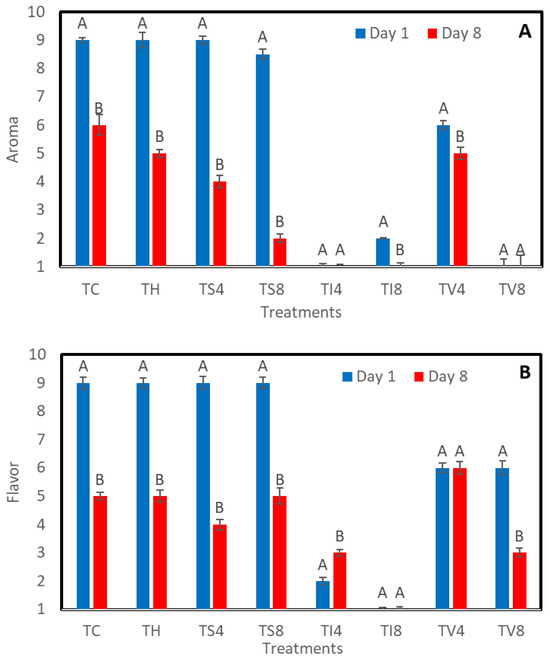
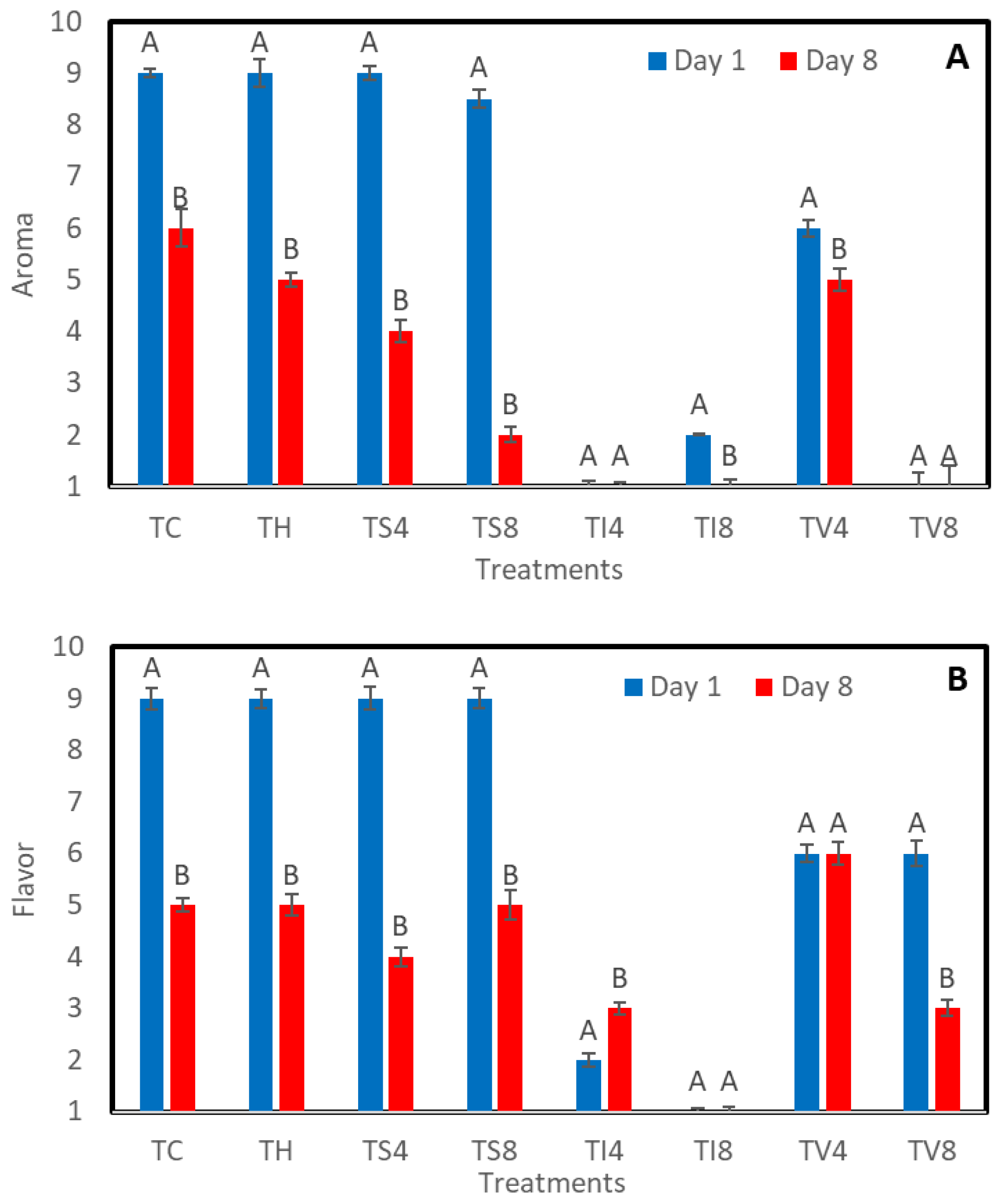
The aroma and flavor attributes for the different treatments are shown in Figure 1. On day 1, the TC, TH, TS4 and S8 treatments showed high aroma scores, close to 9, whereas TV4 exhibited values near the acceptability threshold of 5. In contrast, immersion treatments (TI4 and TI8) and the steam treatment at the highest concentration (TV8) were not sensorially accepted, receiving a score of 1. At 8 days, all samples exhibited a significant decline in aroma (p ˂ 0.05), with only TC, TH and TV4 maintaining values near the acceptability threshold (Figure 1A), which indicated greater acceptability during storage. A similar trend was observed for flavor. TC, TH and TS8 preserved acceptable flavor scores until day 8, remaining close to 5 (Figure 1B). Overall, these results indicate that storage at 5 °C for 8 days results in a marked decrease in sensory quality across treatments. Due to the low acceptability of TI4, TI8 and TV8, these treatments were excluded from further analyses of phenolic compounds, antioxidant capacity and carotenoids.
Figure 1.
Aroma (A) and flavor (B) attributes in grated anco squash subjected to different treatments during 8 storage days at 5 °C. TC: without treatment, TH: immersed in sodium hypochlorite, and different application techniques of tea tree essential oils at 4 and 8 µL/mL, sprayed (TS4, TS8), immersion (TI4, TI8) and absorbent paper strips adhered to the trays and soaked (TV4, TV8). Data are expressed as means ± SE. Different letters in the varieties represent significant differences at p < 0.05 according to the LSD test.
Similarly, Ponce et al. [20] demonstrated that the method of applying TTEO plays a decisive role in shaping sensory quality in fresh lettuce. In their study, spray applications effectively preserved sensory acceptability for up to 7 days, where immersion techniques accelerated deterioration and produced undesirable changes in flavor and aroma. These results suggest that application strategies minimizing direct contact between the essential oil and plant tissue are more effective for maintaining sensory attributes during storage. On the other hand, immersion methods—both in lettuce and pumpkin—tend to induce rapid loss of acceptability, underscoring that not only the concentration but also the delivery method of TTEO is critical for sensory acceptance.
3.2. Effect of TTEO on the Native Microflora of Grated Pumpkin
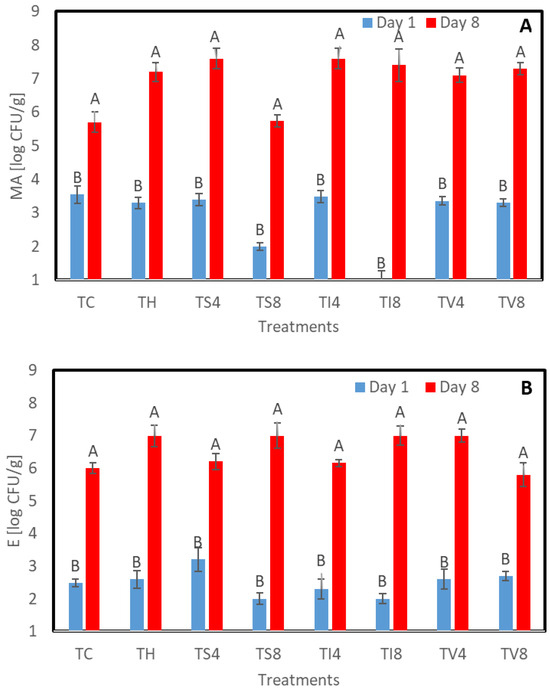
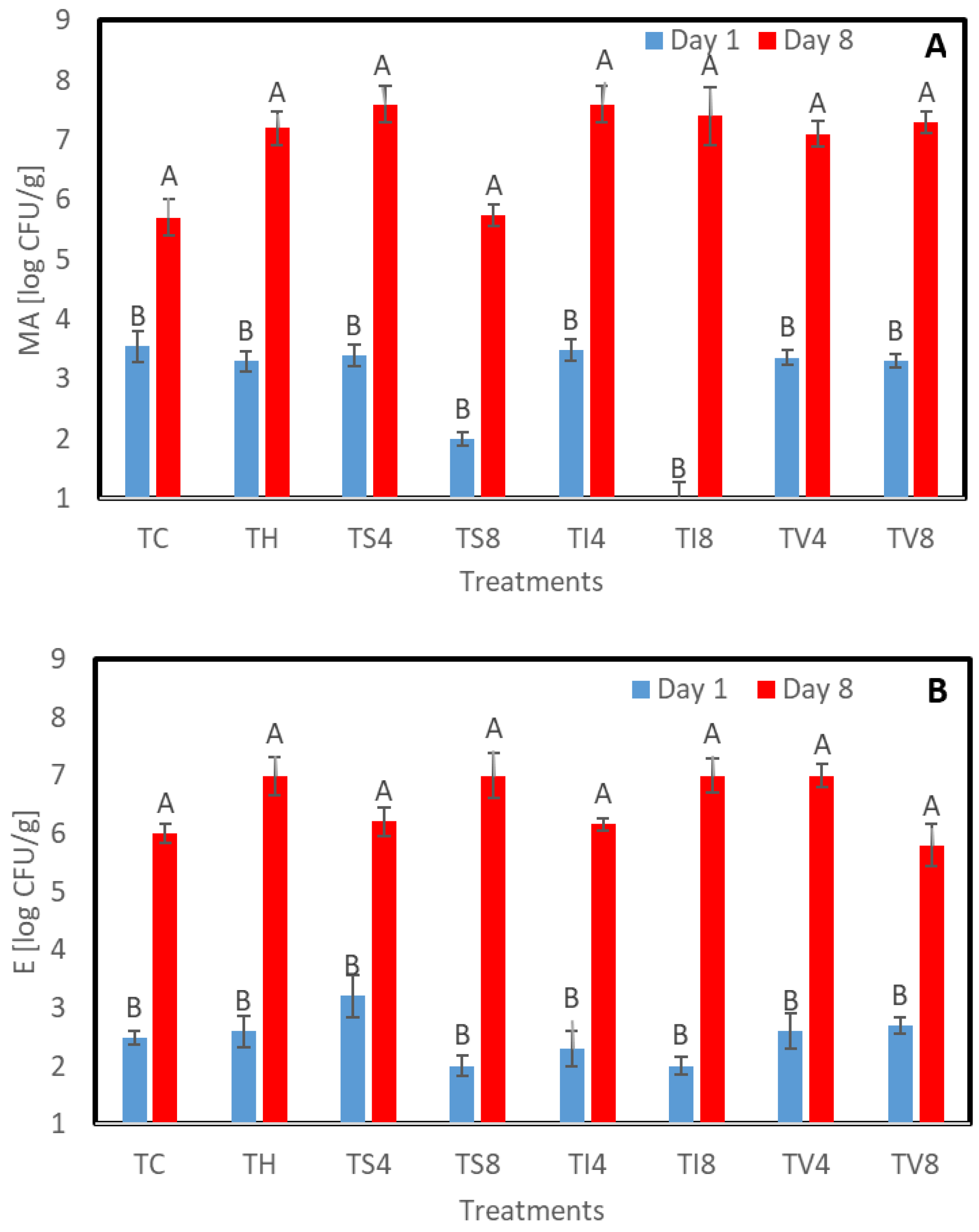
The results for MA and E are presented in Figure 2. On day 1, MA counts ranged from 2.0 to 3.5 log CFU/g, with TS8 producing a reduction greater than 1 log CFU/g and TI8 with a decrease of approximately 3 log CFU/g compared with the control. By day 8, however, TS8 was the only treatment that maintained MA levels below 7 log CFU/g, a microbial threshold commonly associated with acceptable quality in fresh vegetables [19]. These results indicate that, under the tested conditions, the antimicrobial effect of TTEO was not sustained over storage, regardless of application method. Similar behavior was observed for E: although TS8 and TI8 induced an initial reduction of approximately 0.5 log CFU/g relative to TC and TH, counts reached 6.0–7.0 log CFU/g by day 8 across all treatments, suggesting that the inhibitory activity was transient and insufficient to maintain the microbiological hygiene indicator group, which is an indicator of hygiene (Figure 1B).
Figure 2.
Microbial counts on mesophilic aerobes (A) and enterobacteria (B) in grated anco squash subjected to different treatments during 8 storage days at 5 °C. TC: without treatment, TH: immersed in sodium hypochlorite, and different application techniques of tea tree essential oils at 4 and 8 µL/mL, sprayed (TS4, TS8), immersion (TI4, TI8) and absorbent paper strips adhered to the container and soaked (TV4, TV8). Data are expressed as log CFU/g ± SE. Different letters in the varieties represent significant differences at p < 0.05 according to the LSD test.
In the case of Psy, a marked increase was observed only in TS8 and TV8 by day 8, reaching values close to 103 CFU/g further demonstrating that TTEO treatments had limited long-term impact on Psy growth.
When contrasted with other studies, some differences were found. For example, Alvarez et al. [12] reported sustained antimicrobial effects in butternut squash cubes treated with higher concentrations of TTEO (30 μL/mL) by manual spray and greater application volumes (4 mL per 300 g of fresh vegetable. In the present study, although initial reductions were achieved with lower concentrations (4 and 8 μL/mL) and smaller amounts of essential oil (1.05 mL per 200 g of fresh vegetable), the effect was not maintained during storage. These differences underline that the antimicrobial efficacy of TTEO depends strongly on the concentration mode of application, total applied volume, and storage conditions.
3.3. Effect of TTEO on the Bioactive Compounds of Grated Pumpkin
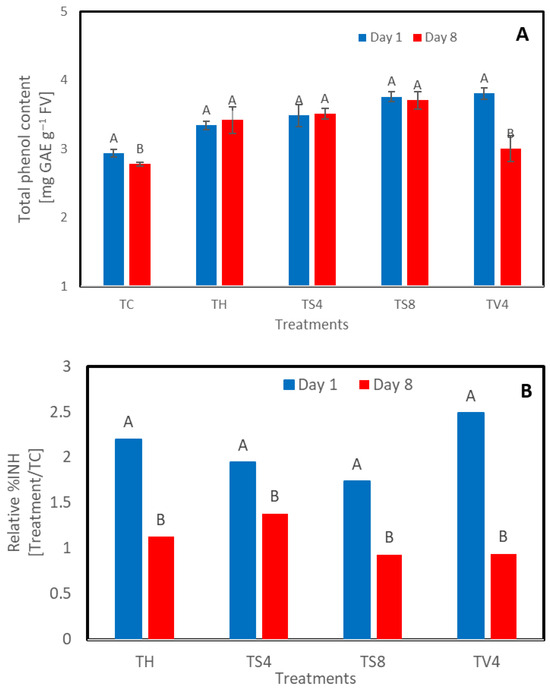
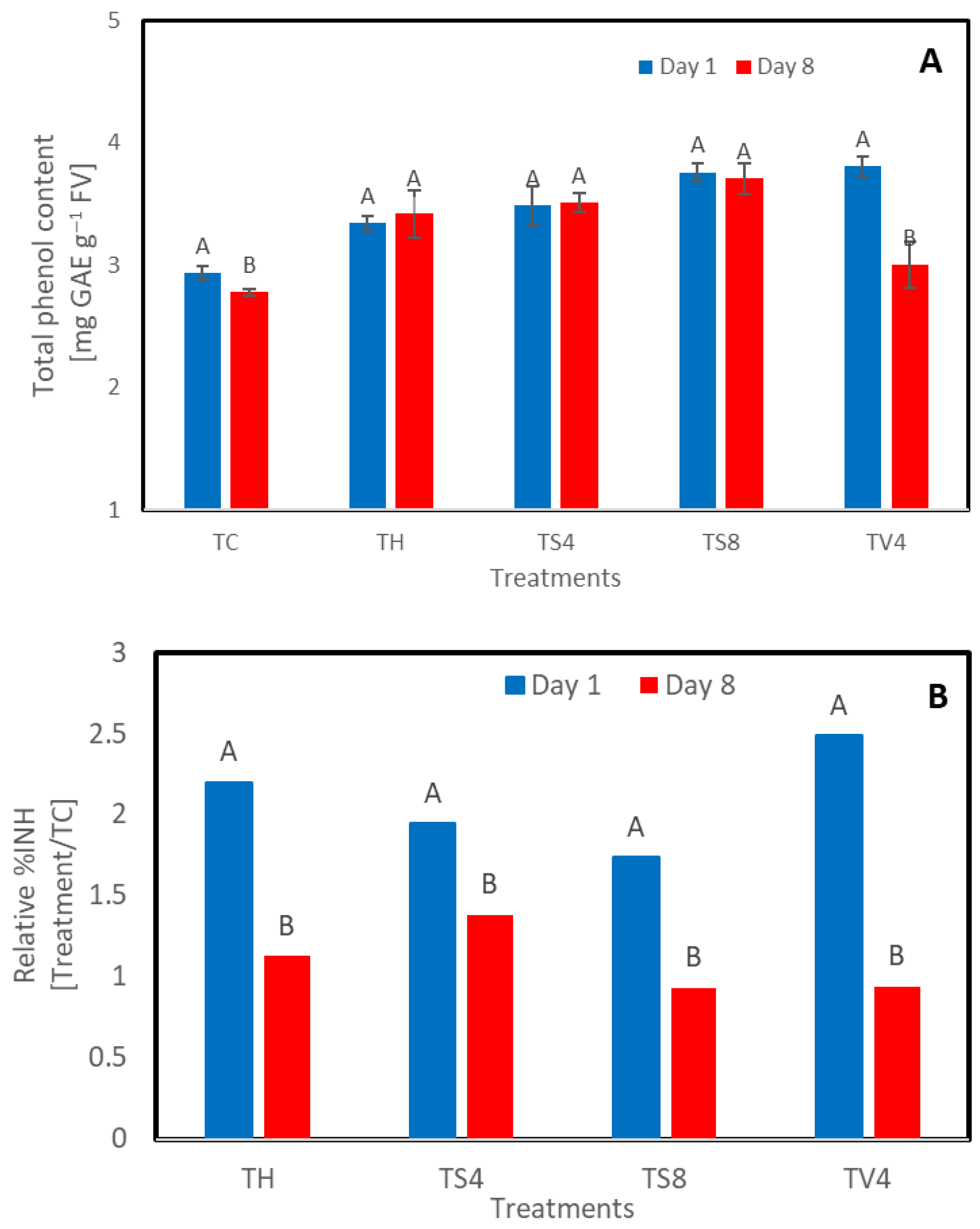
The total phenolic content of grated pumpkin stored at 5 °C is presented in Figure 3A. On day 1, TH, TS4, TS8, and TV4 showed an increase in these compounds compared to TC, with TS8 and TV4 displaying higher phenolic levels than the control, with TS8 and TV4 showing increases of approximately 25%. After 8 days, total phenolic content remained relatively stable in all treatments except TC and TV4, both of which exhibited a decrease of 10% and 20%, respectively. These results suggest that TTEO applications stimulated phenolic accumulation and helped maintain these compounds during early storage.
Figure 3.
Phenolic compounds (A) and relative antioxidant capacity (B) in grated anco squash subjected to different treatments during 8 storage days at 5 °C. TC: without treatment, TH: immersed in sodium hypochlorite, and different application techniques of tea tree essential oils at 4 and 8 µL/mL, sprayed (TS4, TS8), immersion (TI4, TI8) and absorbent paper strips adhered to the container and soaked (TV4, TV8). Data are expressed as mean ± SE. Different letters in the varieties represent significant differences at p < 0.05 according to the LSD test.
In contrast, other plant matrices such as strawberries and lily bulbs showed more pronounced increases in phenolic synthesis when treated with TTEO [21,22], likely due to differences in tissue physiology and metabolic responsiveness.
The relative antioxidant capacity (expressed as %INH) showed a similar behavior in Figure 3B. On day 1, TV4 showed the highest relative inhibition (≈2.5), followed by TH, TS4, and TS8. On day 8, all treatments showed less activity, with TS8 and TV4 showing the lowest values (≈0.9). This decline suggests an initial stimulatory effect on antioxidant activity that decreases with storage time, likely associated with the instability or consumption of antioxidant compounds. In a study conducted in the Slovakian TTEO by Borotová et al. [23], terpinen-4-ol was identified as the dominant compound (40.3%). The antioxidant capacity was mainly attributed to bioactive terpenes such as α-terpinene, γ-terpinene, and terpinolene, all known for their strong radical scavenging activity. Consequently, these results are in line with previous research reporting the antioxidant potential of TTEO.
The increase in total phenols on day 1 could be related to a physiological response of the plant due to the different treatments and the incorporation of oil components (which are concentrated extracts from the aromatic parts of the plant, where these compounds act as defense mechanisms against pathogens, UV radiation and oxidative stress) into the plant tissue. On the other hand, the decrease in phenols in the TC and TV4 samples at the end of storage would indicate that the phenolic compounds were oxidized, which is consistent with what has been reported by other authors who worked, for example, on minimally processed eggplants [24,25].
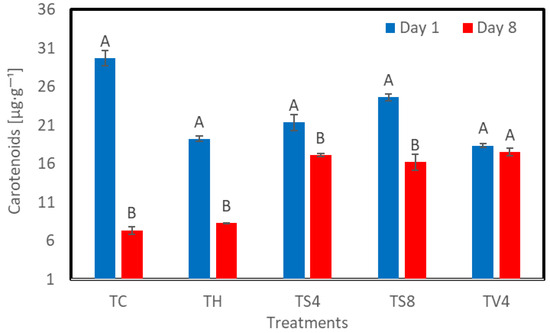
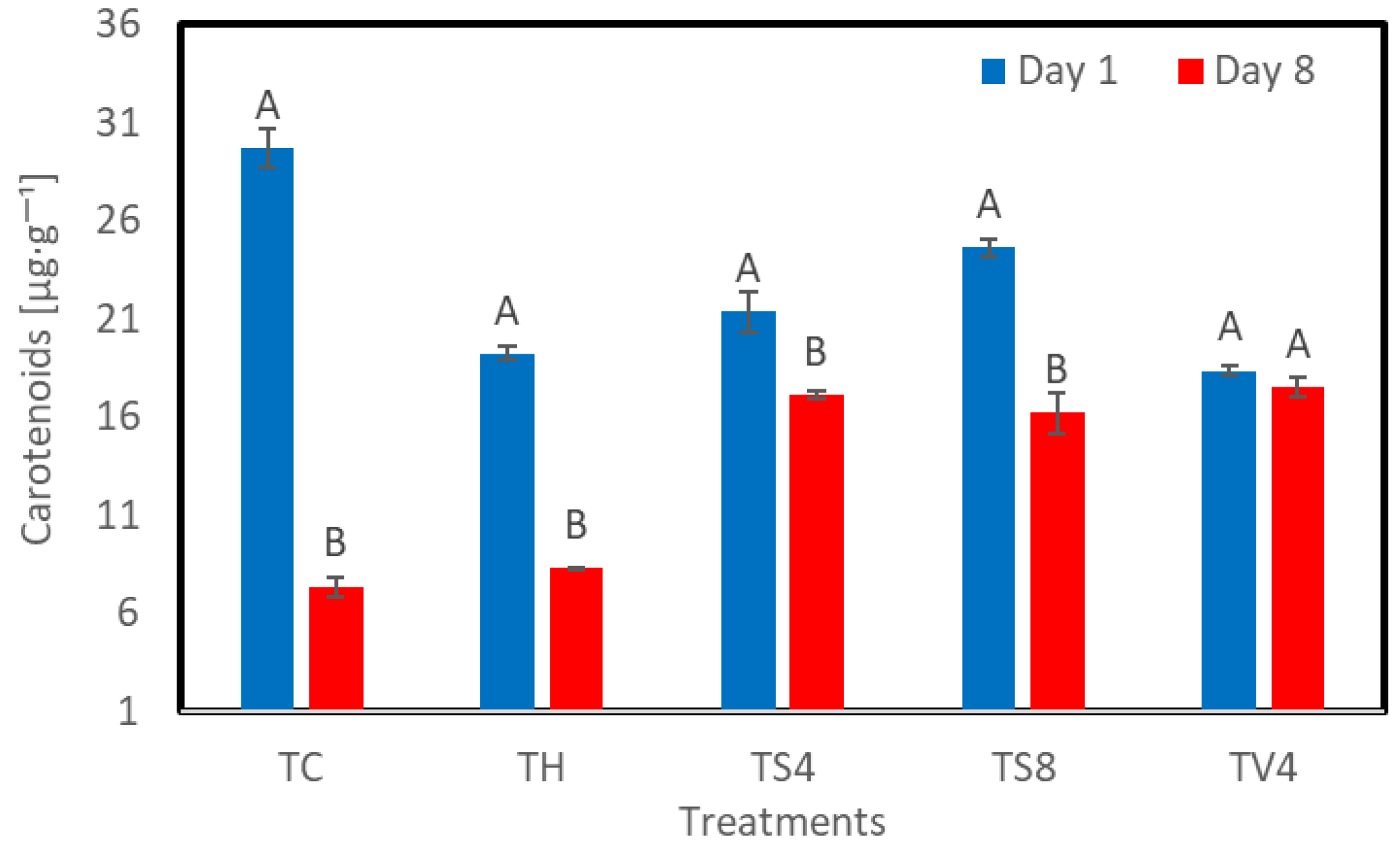
Carotenoid contents are shown in Figure 4. The values obtained decrease significantly in all treatments during storage. TC showed the greatest loss, declining from approximately 30 µg/g−1 on day 1 to almost 6 µg g−1 on day 8. TH also showed a considerable reduction. In contrast, samples treated with TTEO retained higher carotenoid levels, with TV4 showing the most stable profile (18 µg/g at day 1 and 17 µg/g at day 8). These results suggest that TTEO may help reduce carotenoid degradation compared to untreated controls.
Figure 4.
Carotenoid total content in grated anco squash subjected to different treatments during 8 storage days at 5 °C. TC: without treatment, TH: immersed in sodium hypochlorite, and different application techniques of tea tree essential oils at 4 and 8 µL/mL, sprayed (TS4, TS8), immersion (TI4, TI8) and absorbent paper strips adhered to the container and soaked (TV4, TV8). Data are expressed as mean ± SE. Different letters in the varieties represent significant differences at p < 0.05 according to the LSD test.
4. Conclusions
In this study, the effects of TTEO at different concentrations and application methods, combined with passive MAP, on the quality of minimally processed grated anco squash from Santiago del Estero, Argentina, were evaluated. TTEO at 8 μL/mL, particularly when applied by spraying (TS), effectively maintained microbiological quality of MA, although a gradual decline in aroma acceptability was observed throughout storage. Among the evaluated methods, spraying proved to be the most suitable method for preserving sensory attributes, maintaining higher sensory scores up to day 4. Phenolic compounds remained stable over time, carotenoid content decreased progressively across treatments, and antioxidant capacity exhibited an initial increase, suggesting a potential functional benefit of TTEO application. Overall, the combination of TTEO and passive MAP preserved the quality of grated squash for at least 4 days, indicating its potential to enhance nutraceutical properties and extend shelf life. Future research should aim to optimize TTEO concentrations and application strategies—particularly spray- and vapor-based approaches—and explore its integration with emerging preservation technologies such as UV-C radiation, ultrasound, or modified atmosphere conditions to further improve the product with quality and functional characteristics.
Author Contributions
Conceptualization, J.F.B., D.R.G., S.C.R. and S.d.C.R.; methodology, J.F.B., D.R.G., S.C.R. and S.d.C.R.; research and data analysis, J.F.B., S.C.R., D.R.G. and S.d.C.R.; writing: preparation of original draft, D.R.G., S.C.R. and J.F.B.; writing—revising and editing, J.F.B., D.R.G., S.C.R. and S.d.C.R.; supervision, S.d.C.R.; project management, S.d.C.R.; procurement of funds, S.d.C.R. and D.R.G. All authors have read and agreed to the published version of the manuscript.
Funding
This research received funding from project 23/A311-A-2024, awarded by the Scientific and Technological Research Council (CICyT) of the National University of Santiago del Estero, and from Project PUE0051 of the National Council for Scientific and Technical Research, Argentina.
Institutional Review Board Statement
The experimental protocol for the sensory evaluation study does not require formal ethical authorization from the institute, in accordance with ANMAT Provision 5330/97 (art. 5), as this procedure is classified as low risk (no ingestion, non-vulnerable panel), exempting it from formal CEI approval.
Informed Consent Statement
Appropriate protocols were used to protect the rights and privacy of all participants during the study. For example, there was no coercion to participate, and they were not exposed to physical or psychological risks, with no tasting, ingestion, or exposure to risks (allergies, sensory discomfort) in the sensory evaluation. Prior informed verbal consent was obtained and documented, ensuring voluntariness and freedom to withdraw.
Data Availability Statement
The original contributions presented in the study are included in the article, and further inquiries can be directed to the corresponding authors.
Acknowledgments
This work was carried out at the Faculty of Agronomy and Agroindustry of the National University of Santiago del Estero and the Research Center in Applied Biophysics and Food, the National Council for Scientific and Technical Research, Argentina.
Conflicts of Interest
The authors declare no conflicts of interest.
References
- Del Pino, M. Didactic Guide: Cultivation and Management of Cucurbitaceae; FCAyF-UNLP: La Plata, Argentina, 2022. [Google Scholar]
- Instituto Nacional de Tecnología Agropecuaria (INTA). Squash Bulletin; INTA-CMCBA; Instituto Nacional de Tecnología Agropecuaria (INTA): Buenos Aires, Argentina, 2013; Available online: https://mercadocentral.gob.ar/sites/default/files/docs/boletin-INTA-CMCBA-69-zapallo_0.pdf (accessed on 5 September 2025). (In Spanish)
- Men, X.; Choi, S.-I.; Han, X.; Kwon, H.-Y.; Jang, G.-W.; Choi, Y.-E.; Park, S.-M.; Lee, O.-H. Physicochemical, nutritional and functional properties of Cucurbita moschata. Food Sci. Biotechnol. 2020, 30, 171–183. [Google Scholar] [CrossRef] [Scilit]
- Lucera, A.; Costa, C.; Mastromatteo, M.; Conte, A.; del Nobile, M.A. Influence of different packaging systems on fresh-cut zucchini (Cucurbita pepo). Innov. Food Sci. Emerg. Technol. 2010, 11, 361–368. [Google Scholar] [CrossRef] [Scilit]
- Gutiérrez, D.; Chaves, A.; Rodríguez, S. Use of UV-C and gaseous ozone as sanitizing agents for keeping the quality of fresh-cut rocket. J. Food Process. Preserv. 2016, 41, e12968. [Google Scholar] [CrossRef] [Scilit]
- Yang, J.; Goksen, G.; Zhang, W. Rosemary essential oil: Chemical and biological properties, with emphasis on its delivery systems for food preservation. Food Control 2023, 154, 110003. [Google Scholar] [CrossRef] [Scilit]
- Davidson, P.M.; Michael, C.; Faith, J.; Taylor, T.M. Naturally occurring antimicrobials for minimally processed foods. Annu. Rev. Food Sci. Technol. 2013, 4, 163–190. [Google Scholar] [CrossRef] [Scilit] [PubMed]
- Benites, J.F.; Gutiérrez, D.R.; Ruiz, S.C.; Rodriguez, S.d.C. Influence of the Application of Rosemary Essential Oil (Salvia rosmarinus) on the Sensory Characteristics and Microbiological Quality of Minimally Processed Pumpkin (Cucurbita moschata). Biol. Life Sci. Forum 2024, 40, 37. [Google Scholar] [CrossRef] [Scilit]
- Rodríguez Sauceda, E.N. Use of natural antimicrobial agents in the preservation of fruits and vegetables. Ra Ximhai 2011, 7, 153–170. [Google Scholar] [CrossRef] [Scilit]
- Mohammed, D.M.; Salem, M.B.; Elzallat, M.; Alkafaas, S.S.; Salem, H.M.; Alnadari, F.; Ibrahim, E.H.; Elkelish, A.; Negm, S.H.; Saad, A.M.; et al. Essential oils: Antimicrobial, antioxidant properties, and their applications in food preservation—A comprehensive review. Phytochem. Rev. 2026, 25, 2439–2487. [Google Scholar] [CrossRef] [Scilit]
- Martínez, A. Essential Oils. 2001. Available online: http://www.med-informatica.com/OBSERVAMED/Descripciones/AceitesEsencialesUdeA_esencias2001b.pdf (accessed on 6 September 2025). (In Spanish)
- Alvarez, M.V.; Ponce, A.G.; Mazzucotelli, C.A.; Moreira, M.R. The impact of biopreservatives and storage temperature in the quality and safety of minimally processed mixed vegetables for soup. J. Sci. Food Agric. 2015, 95, 962–971. [Google Scholar] [CrossRef] [Scilit] [PubMed]
- Rodríguez, S.C.; Gutiérrez, D.R.; Torales, A.C.; Qüesta, A.G. Vegetales IV Gama: Producción, Comercialización y Aspectos Sanitarios en la Región NOA y Argentina. In Aportes de la FAyA para el Desarrollo Agropecuario y Agroindustrial del NOA; Facultad de Agronomía y Agroindustrias, Universidad Nacional de Santiago del Estero (FAyA–UNSE): Santiago del Estero, Argentina, 2017; Volume 11, pp. 137–147. [Google Scholar]
- Lemos, L.; Gutiérrez, D.; Disalvo, A.; Rodríguez, S. Optimization of treatments as inhibitors of browning in eggplants IV gama, through response surface method. Rev. Iber. Tecnol. Postcosecha 2017, 18, 137–144. [Google Scholar]
- ICMSF (International Commission on Microbiological Specifications for Foods). Microbial Ecology of Foods, 2nd ed.; Food Products; Acribia: Zaragoza, Spain, 1985. [Google Scholar]
- Gutiérrez, D.R.; Char, C.; Escalona, V.H.; Chaves, A.R.; Rodríguez, S.D.C. Application of UV-C radiation in the conservation of minimally processed rocket (Eruca sativa Mill.). J. Food Process. Preserv. 2015, 39, 3117–3127. [Google Scholar] [CrossRef] [Scilit]
- Singleton, V.L.; Orthofer, R.; Lamuela-Raventós, R.M. [14] Analysis of total phenols and other oxidation substrates and antioxidants by means of Folin-Ciocalteu reagent. Method Enzymol. 1999, 299, 152–153. [Google Scholar]
- Ozgen, M.; Reese, R.N.; Tulio, A.Z.; Scheerens, J.C.; Miller, A.R. Modified 2,2-azino-bis-3-ethylbenzothiazoline-6-sulfonic acid (ABTS) method to measure antioxidant capacity of selected small fruits and comparison to ferric reducing antioxidant power (FRAP) and 2,2′-diphenyl-1-picrylhydrazyl (DPPH) methods. J. Agric. Food Chem. 2006, 54, 1151–1157. [Google Scholar] [CrossRef] [Scilit] [PubMed]
- Lichtenthaler, H.K. [34] Chlorophylls and Carotenoids: Pigments of Photosynthetic Biomembranes. Methods Enzymol. 1987, 148, 350–382. [Google Scholar]
- Ponce, A.; Roura, S.I.; Moreira, M.R. Essential oils as biopreservatives: Different methods for the technological application in lettuce leaves. J. Food Sci. 2011, 76, M34–M40. [Google Scholar] [CrossRef] [Scilit] [PubMed]
- Wei, Y.; Shao, X.; Wei, Y.; Xu, F.; Wang, H.F. Effect of preharvest application of tea tree oil on strawberry fruit quality parameters and possible disease resistance mechanisms. Sci. Hortic. 2018, 241, 18–28. [Google Scholar] [CrossRef] [Scilit]
- Guan, Y.; Lu, S.; Sun, Y.; Zhang, R.; Lu, X.; Pang, L.; Wang, L. Effect of Tea Tree Essential Oil on the Quality, Antioxidant Activity, and Microbiological Safety of Lightly Processed Lily (Lilium brownii var. viridulum) during Storage. Foods 2024, 13, 2106. [Google Scholar] [CrossRef] [Scilit] [PubMed]
- Borotová, P.; Galovičová, L.; Vukovic, N.L.; Vukic, M.; Tvrdá, E.; Kačániová, M. Chemical and Biological Characterization of Melaleuca alternifolia Essential Oil. Plants 2022, 11, 558. [Google Scholar] [CrossRef] [Scilit] [PubMed]
- Shi, J.; Zuo, J.; Zhou, F.; Gao, L.; Wang, Q.; Jiang, A. Low-temperature conditioning enhances chilling tolerance and reduces damage in cold-stored eggplant (Solanum melongena L.) fruit. Postharvest Biol. Technol. 2018, 141, 33–38. [Google Scholar] [CrossRef] [Scilit]
- Wu, D.; Zhang, M.; Bhandari, B.; Guo, Z. Combined effects of microporous packaging and nano-chitosan coating on quality and shelf-life of fresh-cut eggplant. Food Biosci. 2021, 43, 101302. [Google Scholar] [CrossRef] [Scilit]

Disclaimer/Publisher’s Note: The statements, opinions and data contained in all publications are solely those of the individual author(s) and contributor(s) and not of MDPI and/or the editor(s). MDPI and/or the editor(s) disclaim responsibility for any injury to people or property resulting from any ideas, methods, instructions or products referred to in the content. |
© 2026 by the authors. Licensee MDPI, Basel, Switzerland. This article is an open access article distributed under the terms and conditions of the Creative Commons Attribution (CC BY) license.