


Abstract
Using agro-industrial by-products as substrates for the growth of probiotic strains is an alternative for increasing their added value. This study aimed to design and optimize the production of a functional ingredient (FI) with L. casei immobilized in oat bran (OB). A Box–Behnken experimental design was applied to study the effects of hydration level (HL), milk whey supplementation, and initial inoculum concentration (IC) on probiotic growth. According to the design, systems containing 1 g of OB, supplemented with 0 to 0.4 g of whey/g OB and HL from 5 to 20 mL of water/g OB, were sterilized and inoculated with an IC in the range of 5.61 to 7.61 log (CFU/g OB). After incubation at 37 °C for 24 h with orbital shaking, the systems were washed, centrifuged, and vacuum-dried. Independent variables were optimized to maximize cell count and growth and minimize cell count after drying. The optimal conditions found were for HL: 15 mL of water/g OB; for whey: 0.3 g/g OB; and for the IC: 5.79 log (CFU/g OB), which were recorded within the studied range. This result demonstrates the feasibility of optimizing the production of a dried FI based on OB as a substrate for L. casei.
1. Introduction
Oat (Avena sativa L.) is a cereal that ranks sixth in global production importance and is primarily cultivated in temperate regions [1]. The oat milling process yields various fractions that differ in their chemical composition and nutritional value. Among these, oat bran is the fraction obtained after milling clean oat grains or rolled oats, followed by the separation of the different fractions by sieving or other physical methods. This fraction is characterized by its enrichment in β-glucans (minimum 5.5%) and dietary fibre and should not exceed 50% of the starting material [2].
Despite its nutritionally and functionally valuable composition, oat bran continues to be considered a by-product of industrial processing, largely destined for low-value-added uses, such as animal feed or the production of flour blends [3,4].
Probiotics are live microorganisms that, when administered in adequate amounts, confer a health benefit on the host [5,6]. Probiotic microorganisms must maintain their viability and functionality during processing, storage, and consumption, as well as have the ability to resist gastric juices and exposure to bile salts. Furthermore, they must be able to proliferate and colonize the digestive tract [6,7]. In particular, Lacticaseibacillus casei, ATCC 393TM (L. casei) and its metabolites can alleviate the inflammatory response in ulcerative colitis models by reducing the production of proinflammatory factors, improving intestinal mucosal integrity, and modulating microbiota composition, suggesting probiotic anti-inflammatory and intestinal barrier-protective mechanisms [8].
Cereals and their fractions, due to their high content of dietary fibre and bioactive compounds, are considered nutritionally attractive substrates for fermentation and interaction with the gut microbiota, showing potential as functional ingredients in the development of prebiotic and probiotic foods [9]. While numerous studies have been conducted on fermented vegetable-based beverages [10], the scientific literature still presents a limited number of works focused on the development of solid or dehydrated probiotic ingredients. Previous work by the group demonstrated that vegetable by-product fermentation with probiotics generally improves the nutritional aspects of plant matrices. These upgrades depend on both the probiotic used and the plant source [11]. To date, there are few developments of solid or dehydrated probiotic products based on oat bran.
Therefore, this work aims to add value to the oat processing chain by studying oat bran as a substrate for L. casei growing and for producing a dehydrated functional ingredient (FI).
2. Methods
2.1. Inoculum Preparation
An inoculum of L. casei was prepared in sterile De Man, Rogosa, and Sharpe (MRS) broth (Biokar Diagnostics, Beauvais, France), using streaks from a mother culture. Cell growth was carried out at 37 °C for 18–20 h in an incubation chamber (Ingelab I-290, Buenos Aires, Argentina).
2.2. Preparation of Oat Bran-Based Systems Containing L. casei
The systems were prepared based on previous experience [12]. Briefly, 1 g of oat bran (OB) was placed in 50 mL conical tubes, supplemented with varying amounts of milk whey (0–4 g/g OB) (Mastellone Hnos. S.A., Buenos Aires, Argentina) and hydrated with different hydration levels (HL) (5–20 mL) according to the experimental design. Immediately, all systems were sterilized at 121 °C for 15 min, cooled, and inoculated with 100 µL of MRS containing a suspension with an L. casei concentration of 4.07 × 10⁷–4.07 × 10⁵ CFU/mL, according to the experimental design. The systems were then incubated for 24 h at 37 °C with orbital shaking with constant agitation of 95 rpm (Vicking S.A., Buenos Aires, Argentina). At the end of the incubation period, an aliquot of each fermented system was resuspended in peptone water (0.1% w/v, Biokar Diagnostics, Beauvais, France) and serially diluted to determine the number of viable L. casei cells. The systems were then washed with sterile water to ensure a uniform final supernatant volume (30 mL) and centrifuged at 5000 rpm (Eppendorf, Hamburg, Germany) for 10 min. The supernatants were separated and stored in a freezer for further characterization, while the OB pellets containing probiotic cells were vacuum-dried (Alpha 1-4 LSD, Martin Christ Gefriertrocknungsanlagen GmbH, Osterode am Harz, Germany) at 25 °C and 4.5 Pa for 24 h, followed by cell counting. Finally, the food ingredients (FIs) obtained from the corresponding system were vacuum-packed and stored at 25 °C for further studies.
2.3. L. casei Cell Count
The number of viable L. casei cells was determined by plate count on MRS agar (Biokar Diagnostics, Beauvais, France). Plates were incubated at 37 °C for 48 h under aerobic conditions. Results were expressed as log (CFU/g FI) (dry weight).
The growth of L. casei (ΔCFU) during the fermentation period was expressed as the logarithm of the ratio between the final (N) and initial counts (N0), Equation (1). Each measurement was performed at least in triplicate.
2.4. FI Yield
The FI yield was calculated as the ratio between the mass of FI obtained from one gram of OB. It was expressed as g FI obtained/g OB.
2.5. Physicochemical Characterization of the Supernatant
In the supernatants obtained after the incubation period, the pH (Basic-Bio-Kit, Sartorius Lab Instruments GmbH, Göttingen, Germany) and titratable acidity, using 0.01 N NaOH (Cicarelli Laboratories, Santa Fe, Argentina) and phenolphthalein (Biopack, Buenos Aires, Argentina) as an indicator, were measured.
2.6. Experimental Design and Statistical Analysis
A Box–Behnken design was applied to study the effect of three factors, or independent variables: whey supplementation, HL, and initial inoculum concentration (IC), with three levels for each factor and the centre point measured in triplicate. The factor levels were selected based on previous trials. The responses analyzed were cell count and ∆CFU, pH, and titratable acidity of the supernatants, FI yield, and cell count after vacuum-drying and after the first 10 days of storage at room temperature.
The results were analyzed using response surface methodology, fitting the experimental data to a second-degree polynomial function. The coefficients of the terms in the polynomial equations were analyzed using analysis of variance (ANOVA) for each response with a significance level of 95%. The model’s adequacy was assessed using the coefficient of determination (R2), adjusted R2, the lack-of-fit test (p ≥ 0.05), and a Durbin–Watson (DW) statistical parameter greater than one. The desirability function was used to simultaneously optimize several responses. Additionally, Pearson’s product-moment correlation coefficient (r) was also evaluated based on the relationships between some response variables.
All measurements were performed at least in triplicate, and the mean ± standard deviation was reported. The experimental design, response surfaces plot, correlation study, and the corresponding statistical analysis were performed using Statgraphics Centurion XV version 6.0 (StatSoft Inc., Tulsa, OK, USA).
3. Results and Discussion
3.1. Effects of the Factors Studied in the Experimental Design
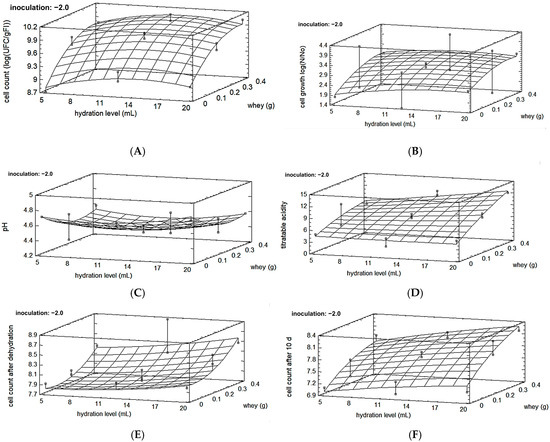
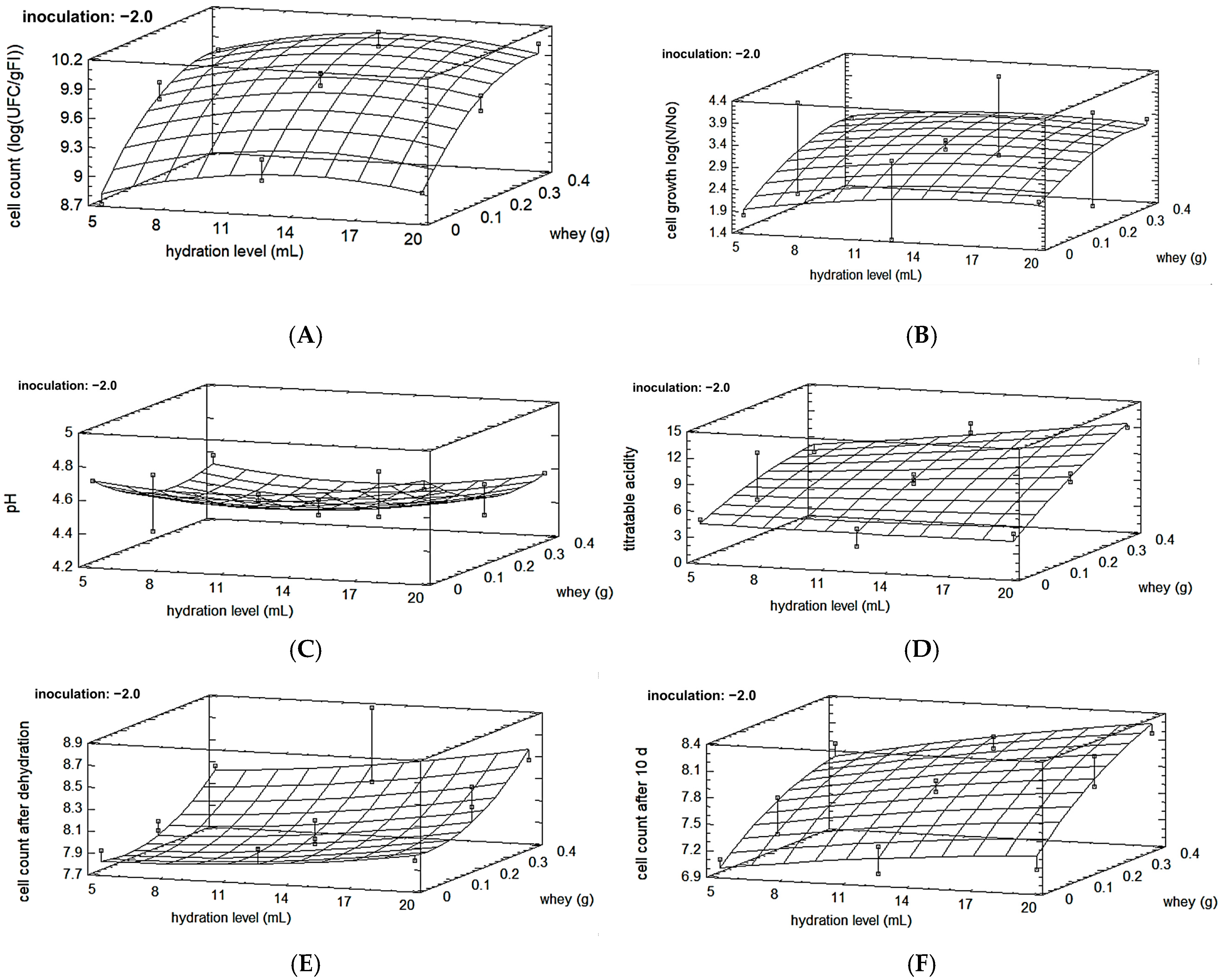
Six of the seven responses showed dependence on the conditions studied. Figure 1 shows the fitted response surfaces with R2 > 87%, and Table 1 shows the estimated regression coefficients of the polynomial equations for the studied response variables.
Figure 1.
Response surface of the cell count (A) and growth of L. casei, ΔCFU, (B) after the fermentation process, pH (C), titratable acidity (D), cell count after dehydration (E), and cell count after 10 days of storage at 25 °C (F), as a function of the hydration level and milk whey content, maintaining the initial inoculum concentration at the centre point. Titratable acidity is expressed in g of lactic acid/L of supernatant; cell count is expressed post-fermentation, post-dehydration, and after 10 days of storage at 25 °C as log (CFU/g FI).
Table 1.
Estimated regression coefficients of the polynomial equations. Values in bold indicate coefficients with a statistically significant effect (p ≤ 0.05) at a 95.0% confidence level.
An increase in the viability of all systems was recorded during the 24 h of fermentation (Figure 1A,B). Furthermore, ∆CFU showed a negative linear relationship with IC (p = 0.0015) and a positive linear relationship with the HL and whey concentration (p = 0.0280 and p = 0.0066, respectively) (Table 1). This suggests that even at the lowest IC tested, the probiotic was able to adapt to this matrix during the studied fermentation period. On the other hand, whey also showed a negative quadratic effect (p = 0.0380), indicating that there is an optimal concentration that maximizes ∆CFU in the range studied. Similarly, cell count was positively influenced with a linear effect by whey, while HL and whey presented a negative quadratic effect (p < 0.05) on cell count, suggesting that within the studied ranges, there is an optimal level of these factors that favours cell count. The IC did not affect the cell count after the fermentation process.
Regarding the supernatant obtained by centrifugation at the end of the fermentation process, the results indicate that both whey and the IC exerted a negative linear effect on pH. In turn, these variables, along with the HL, showed a positive linear effect on titratable acidity (p < 0.05). Additionally, whey showed a positive quadratic effect on pH (p = 0.0463), suggesting the existence of an optimal level within the evaluated range that would minimize this variable (Table 1, Figure 1C,D). Furthermore, a significant negative correlation was observed between the pH of the supernatant and the cell count after fermentation (r = –0.5941; p = 0.0251), and consequently, a positive correlation between titratable acidity and cell count after fermentation (r = 0.7699; p = 0.0013). The r value far from one explains that the correlation is not completely linear, indicating that organic acid production is partially associated with the growth of L. casei under the tested conditions. Previous studies by our research group demonstrated a similar correlation when fermenting L. acidophilus using the same OB as the sole substrate [12].
In all the systems analyzed, the reduction in final pH was accompanied by an increase in the probiotic microorganism count. These results indicate that acidic pH did not negatively affect probiotic viability, possibly due to the intrinsic tolerance of the L. casei strain to acidic conditions and the protective effect of the microenvironment generated by the matrix based on OB. A similar effect was reported by Genevois et al. and Castellanos-Fuentes et al. when fermenting the same strain of L. casei in pumpkin and soy by-products, respectively [13,14].
Regarding cell count after the dehydration process, a positive linear effect of whey was observed (p = 0.0265), while neither the IC nor the HL showed significant effects on this variable (Table 1, Figure 1E). Furthermore, a positive correlation was found between cell count after vacuum-drying and titratable acidity (r = 0.6518; p = 0.0116).
Although no significant effects of the studied variables on the FI yield were observed, a positive correlation was found with the cell count after the fermentation process (r = 0.6202; p = 0.0180). This finding suggests that, while the experimental conditions evaluated did not directly influence the yield, the cell growth achieved during fermentation could be associated with greater process efficiency. In this context, the final yield would seem to depend more on the strain’s physiological state and biomass generated than on external factors alone.
Regarding the cell count after the first 10 days of storage, a positive linear effect of whey was observed (p = 0.0458), while neither the IC nor the HL showed significant effects on this variable (Table 1, Figure 1F). As can be seen in Figure 1F, all systems showed a cell count greater than 7 log CFU/g FI at the time of study, fitting the local and international requirements for probiotic products [15,16].
3.2. Optimization
Based on the analyzed effects, optimization was performed by maximizing cell count and growth after fermentation and cell count after dehydration. A whey level of 0.3 g/g OB and an HL of 15 mL of water/g OB, with an initial L. casei IC of 5 log (CFU/g OB), were the conditions that optimized all responses simultaneously, with a desirability value of 1. Because these levels were not tested in the original design, they were subsequently tested. In this way, the statistically estimated response values could be experimentally corroborated and are shown in Table 2.
Table 2.
Estimated statistical and experimental values for the different response variables of the optimal system.
It should be noted that this optimal formulation would not be suitable for vegans or those with lactose intolerance; however, whey supplementation significantly improves the parameters targeted for optimization in this study.
The fermentation matrix (dairy, plant-based, or hybrid) and the selected strain decisively influence cell viability and the quality of the fermented products [17]. In agreement, Castellanos-Fuentes et al. observed that whey supplementation favoured the growth of L. casei ATCC 393 in soy by-products (okara and expeller) [14], while Genevois et al. demonstrated that the same strain did not require such supplementation in pumpkin by-product matrices [13]. Furthermore, in a previous work, the research group showed that the same OB matrix could be fermented by L. acidophilus. The whey supplementation did not improve the FI characteristics in that opportunity [12]. These background factors, together with the current results, reinforce that the specific interaction between microorganism and substrate determines the need for milk supplementation.
4. Conclusions
It was experimentally confirmed that a whey level of 0.3 g/g OB, an HL of 15 mL water/g OB, and an IC of 5 log (CFU/g OB) are the conditions that allow the production of FIs supporting L. casei cells, based on OB. These results demonstrate the feasibility of upgrading this by-product by converting it into a dehydrated FI. Further studies for scaling up this process should be performed to corroborate these conditions, as well as to establish the shelf life of FI based on probiotic viability. It must be remarked that reducing by-products by means of this proposed fermentation bioprocess represents a contribution to the circular economy.
Author Contributions
N.S. Investigation, Methodology, Data Curation, Formal Analysis, Conceptualization, Writing—Original Draft. S.F.: Conceptualization, Investigation, Funding Acquisition, Writing—Review and Editing. M.d.E.P.: Conceptualization, Investigation, Formal Analysis, Funding Acquisition, Project Administration, Supervision, Writing—Review and Editing. All authors have read and agreed to the published version of the manuscript.
Funding
The authors acknowledge the Universidad de Buenos Aires (UBACyT 20020220200171BA, PIDAE 2024-2025) and CONICET (PIP 11220210100712CO).
Institutional Review Board Statement
Not applicable.
Informed Consent Statement
Not applicable.
Data Availability Statement
The original contributions presented in this study are included in the article. Further inquiries can be directed to the corresponding author.
Conflicts of Interest
The authors declare no conflicts of interest.
Abbreviations
The following abbreviations are used in this manuscript:
| FI | functional ingredient |
| OB | oat bran |
| HL | hydration level |
| IC | initial inoculum concentration |
| CFU | colony-forming units |
| ΔCFU | cell growth after fermentation |
| DW | Durbin–Watson statistical parameter |
| p | p-value |
| r | Pearson’s product-moment correlation coefficient |
References
- Yang, Z.; Xie, C.; Bao, Y.; Liu, F.; Wang, H.; Wang, Y. Oat: Current State and Challenges in Plant-Based Food Applications. Trends Food Sci. Technol. 2023, 134, 56–71. [Google Scholar] [CrossRef] [Scilit]
- American Association of Cereal Chemists (AACC). Oat bran. In Approved Methods of the American Association of Cereal Chemists, 7th ed.; American Association of Cereal Chemists: St. Paul, MN, USA, 1989. [Google Scholar]
- Martín-Diana, A.B.; García-Casas, M.J.; Martínez-Villaluenga, C.; Frías, J.; Peñas, E.; Rico, D. Wheat and Oat Brans as Sources of Polyphenol Compounds for Development of Antioxidant Nutraceutical Ingredients. Foods 2021, 10, 115. [Google Scholar] [CrossRef] [Scilit] [PubMed]
- Tufail, T.; Ain, H.B.U.; Saeed, F.; Nasir, M.; Basharat, S.; Mahwish; Rusu, A.V.; Hussain, M.; Rocha, J.M.; Trif, M.; et al. A Retrospective on the Innovative Sustainable Valorization of Cereal Bran in the Context of Circular Bioeconomy Innovations. Sustainability 2022, 14, 14597. [Google Scholar] [CrossRef] [Scilit]
- Guidelines for the Evaluation of Probiotics in Food. FAO/WHO Working Group Report. Available online: https://www.fao.org/3/a0512e/a0512e.pdf (accessed on 2 January 2026).
- Hill, C.; Guarner, F.; Reid, G.; Gibson, G.R.; Merenstein, D.J.; Pot, B.; Morelli, L.; Canani, R.B.; Flint, H.J.; Salminen, S.; et al. Expert Consensus Document: The International Scientific Association for Probiotics and Prebiotics Consensus Statement on the Scope and Appropriate Use of the Term Probiotic. Nat. Rev. Gastroenterol. Hepatol. 2014, 11, 506–514. [Google Scholar] [CrossRef] [Scilit] [PubMed]
- Marco, M.L.; Sanders, M.E.; Gänzle, M.; Arrieta, M.C.; Cotter, P.D.; De Vuyst, L.; Hill, C.; Holzapfel, W.; Lebeer, S.; Merenstein, D.; et al. The International Scientific Association for Probiotics and Prebiotics (ISAPP) Consensus Statement on Fermented Foods. Nat. Rev. Gastroenterol. Hepatol. 2021, 18, 196–208. [Google Scholar] [CrossRef] [Scilit] [PubMed]
- Dou, X.; Qiao, L.; Chang, J.; Yan, S.; Song, X.; Chen, Y.; Xu, Q.; Xu, C. Lactobacillus casei ATCC 393 and Its Metabolites Alleviate Dextran Sulphate Sodium-Induced Ulcerative Colitis in Mice through the NLRP3-(Caspase-1)/IL-1β Pathway. Food Funct. 2021, 12, 12022–12035. [Google Scholar] [CrossRef] [Scilit] [PubMed]
- Abdi, R.; Joye, I.J. Prebiotic Potential of Cereal Components. Foods 2021, 10, 2338. [Google Scholar] [CrossRef] [Scilit] [PubMed]
- Chen, Y.; Hu, Y.; Xie, Y.; Cui, M.; Jiang, J.; Li, Y.; Guo, J.; Xiang, M.; Tian, Z.; Niu, J.; et al. A Comprehensive Review of Lactic Acid Bacteria-Fermented Plant-Based Beverages: Substrate Types, Nutritional Quality, Probiotic Characteristics, Metabolic Pathways and Future Development Trends. Crit. Rev. Food Sci. Nutr. 2025, 65, 1–29. [Google Scholar] [CrossRef] [Scilit] [PubMed]
- Silva, N.E.; Marchioni, S.; Castellanos-Fuentes, A.P.; Matyayz, A.; Flores, S.K.; de Escalada Pla, M. Sustainability and Economic Aspects of Food Fortification. In Sustainable Food Fortification; Sanghvi, G., Bishoyi, A.K., Joshi, S.J., Enshasy, H.A.E., Eds.; Springer: Singapore, 2025; pp. 53–75. [Google Scholar] [CrossRef] [Scilit]
- Silva, N.E.; Flores, S.K.; de Escalada Pla, M.F. Study of Oat Bran as Substrate for Obtaining Functional Ingredients Containing Lactobacillus acidophilus. Bioprocess Biosyst. Eng. 2025, 48. in press. [Google Scholar] [CrossRef] [Scilit] [PubMed]
- Genevois, C.; Flores, S.; de Escalada Pla, M. Byproduct from Pumpkin (Cucurbita moschata Duchesne ex Poiret) as a Substrate and Vegetable Matrix to Contain Lactobacillus casei. J. Funct. Foods 2016, 23, 210–219. [Google Scholar] [CrossRef] [Scilit]
- Castellanos Fuentes, A.P.; Genevois, C.E.; Flores, S.K.; de Escalada Pla, M.F. Valorisation of Soy By-Products as Substrate for Food Ingredients Containing L. casei through Solid-State Fermentation. LWT 2020, 132, 109779. [Google Scholar] [CrossRef] [Scilit]
- World Health Organization (WHO); Food and Agriculture Organization of the United Nations (FAO). Probiotics in Food: Health and Nutritional Properties and Guidelines for Evaluation; FAO: Rome, Italy, 2006. [Google Scholar]
- National Administration of Drugs; Food and Medical Technology (ANMAT). Joint Resolution 261/2011 and 22/2011; Ministry of Health: Buenos Aires, Argentina, 2011. [Google Scholar]
- Ziarno, M.; Zaręba, D.; Kowalska, E.; Florowski, T. A Study into the Effects of Chosen Lactic Acid Bacteria Cultures on the Quality Characteristics of Fermented Dairy, Dairy–Oat, and Oat Beverages. Appl. Sci. 2025, 15, 3714. [Google Scholar] [CrossRef] [Scilit]

Disclaimer/Publisher’s Note: The statements, opinions and data contained in all publications are solely those of the individual author(s) and contributor(s) and not of MDPI and/or the editor(s). MDPI and/or the editor(s) disclaim responsibility for any injury to people or property resulting from any ideas, methods, instructions or products referred to in the content. |
© 2026 by the authors. Licensee MDPI, Basel, Switzerland. This article is an open access article distributed under the terms and conditions of the Creative Commons Attribution (CC BY) license.