Skip to Content

Biology and Life Sciences Forum, Volume 17, Issue 1

2022 la ValSe-Food 2022 - 27 articles

IV Conference Ia ValSe-Food CYTED and VII Symposium Chia-Link

La Plata and Jujuy, Argentina | 14–18 November 2022

Volume Editors:
Norma Sammán, CIITED-CONICET, Argentina
Mabel Cristina Tomás, CIDCA (CONICET-UNLP-CIC), Argentina
Loreto Muñoz, Universidad Central de Chile, Chile
Claudia Monika Haros, Institute of Agrochemistry and Food Technology (IATA-CSIC), Spain

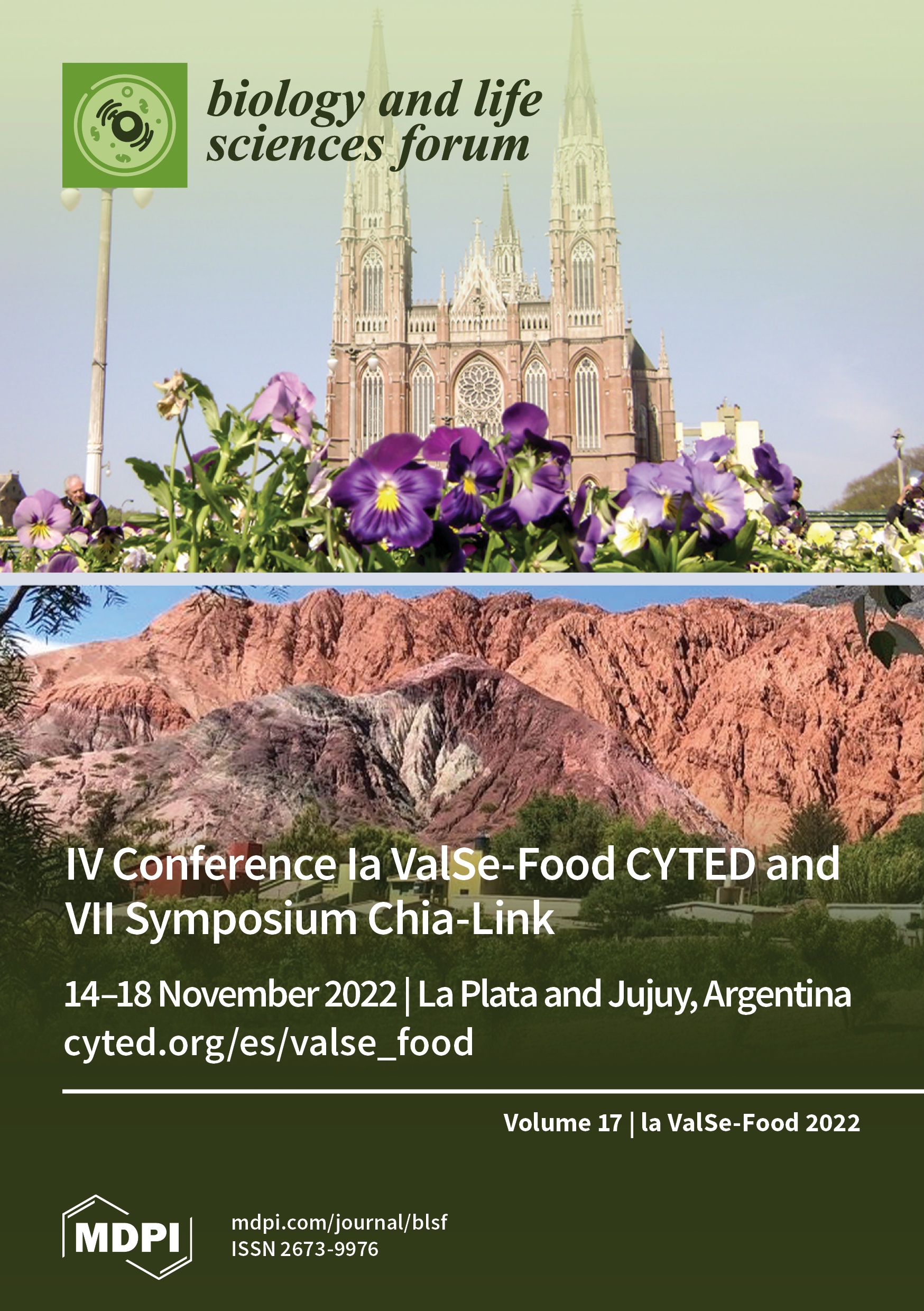
Cover Story: This volume brings together the complete presentations of the IV International Ia-ValSe-Food Conference and VII Symposium of Chia-Link Network, held in the cities of La Plata and Jujuy, Argentina, on November 14 to 18, 2022. The topics are approached from diverse and articulated perspectives, such as agronomic and nutritional properties, the content of bio-functional compounds, technological characteristics, and the development of new products from ancestral Latin American crops, responding to the motto “Promoting research and innovation in food with valuable Ibero-American seeds”.
  • Issues are regarded as officially published after their release is announced to the table of contents alert mailing list .
  • You may sign up for email alerts to receive table of contents of newly released issues.
  • PDF is the official format for papers published in both, html and pdf forms. To view the papers in pdf format, click on the "PDF Full-text" link, and use the free Adobe Reader to open them.

Articles (27)

  • Editorial
  • Open Access
1,262 Views
1 Page

Statement of Peer Review

  • Norma Sammán,
  • Mabel Cristina Tomás,
  • Loreto Muñoz and
  • Claudia Monika Haros

In submitting conference proceedings to Biology and Life Sciences Forum, the volume editors of the proceedings certify that all papers published in this volume have been subjected to peer review administered by the volume editors relative to the publ...

  • Proceeding Paper
  • Open Access
3 Citations
2,691 Views
5 Pages

Variations in the Composition of “Algarrobas” (Prosopis sp.) Flours from Paraguayan Chaco

  • Rocio Villalba,
  • Juan Denis Ibars,
  • Karen Martínez,
  • Eva Coronel,
  • Adeline Friesen and
  • Laura Mereles

Prosopis alba and Prosopis chilensis, popularly called carob trees in the South American Chaco, are arboreal species. Carob fruits are an ancestral food for human consumption, mainly in the form of flour. In recent years, the study of carob trees in...

  • Proceeding Paper
  • Open Access
1 Citations
2,022 Views
5 Pages

Obtaining Integral Kurugua Flour with Antioxidant Potential as Ingredient Foodstuffs

  • Laura Correa,
  • Marcia Gamarra,
  • Kattya Sanabria,
  • Eva Coronel,
  • Marcela L. Martínez,
  • Edgardo Calandri,
  • Silvia Caballero and
  • Laura Mereles

The aim of the present work was to study the effect of the drying process conditions on the antioxidant properties of the integral fruit of kurugua (Sicana odorifera Naud.). The experiments showed that the antioxidant activity of fresh samples of who...

  • Proceeding Paper
  • Open Access
1,764 Views
6 Pages

Chia (Salvia hispanica L.) seed oil is a naturally rich source of α-linolenic (~65%) and linoleic (~20%) essential fatty acids, which are known for their beneficial effects on health. However, they are highly susceptible to oxidative deteriorat...

  • Proceeding Paper
  • Open Access
2 Citations
2,051 Views
5 Pages

Characterization of Three-Layer Microcapsules of Chia Seed Oil Obtained for Electrostatic Deposition Technology

  • Claudia N. Copado,
  • Luciana M. Julio,
  • Bernd W. Diehl,
  • Vanesa Y. Ixtaina and
  • Mabel C. Tomás

Oils with high omega-3 fatty acids are known for their multiple health benefits. For this reason, new strategies have been developed to protect these fatty acids from lipid oxidation to incorporate them into foods. Microencapsulation is an attractive...

  • Proceeding Paper
  • Open Access
2,068 Views
4 Pages

In regions with a majority population of people belonging to indigenous peoples, the solutions to nutritional challenges such as overweight and obesity can go through the implementation of public policies that encourage the use of local and ancestral...

  • Proceeding Paper
  • Open Access
1 Citations
1,875 Views
5 Pages

Immunonutritional Benefits of Chenopodium quinoa’s Ingredients Preventing Obesity-Derived Metabolic Imbalances

  • Helena Marcos Pasero,
  • Adrianna Bojarczuk,
  • Claudia Monika Haros and
  • Jose Moisés Laparra Llopis

Over 1.6 billion people (aged 15 years and above) worldwide are currently either overweight or obese, and this number is predicted to increase to 2.3 billion by 2050 (WHO). Excessive or impaired energy storage in the liver incurs a high risk of liver...

  • Proceeding Paper
  • Open Access
1 Citations
3,823 Views
6 Pages

The World Health Organization recommends the consumption of legumes and considers them good allies to achieve food security and reduce malnutrition worldwide. Bread offers the possibility of incorporating ingredients to improve one’s diet witho...

  • Proceeding Paper
  • Open Access
2 Citations
2,570 Views
6 Pages

Red and Gray Bean (Phaseolus vulgaris L.) Protein Hydrolysates: Food Prototypes with Pota (Dosidicus gigas) by-Product Meal

  • N. Chasquibol,
  • R. Alarcón,
  • B. F. Gonzales,
  • M. Tapia,
  • P. Jara,
  • A. Sotelo,
  • B. García and
  • M. C. Pérez-Camino

The bean (Phaseolus vulgaris L.) known as the ñuña, numia, or Andean popping bean, native to the central Andes of Peru, is often consumed as a snack food after a quick toasting process. The characterization of two of its varieties, red...

  • Proceeding Paper
  • Open Access
3,448 Views
6 Pages

Effect of Cooking on the Content and Bioaccessibility of Minerals in Pseudocereals

  • Carla Motta,
  • Isabel Castanheira,
  • Ana Sofia Matos,
  • Ana Claudia Nascimento,
  • Ricardo Assunção,
  • Carla Martins and
  • Paula Alvito

The cooked Andean cereals can be considered a good source of minerals, contributing to the recommended daily intakes as observed in previous works. This study evaluated quinoa, amaranth, and buckwheat’s chemical and nutritional compositions and...

  • Proceeding Paper
  • Open Access
2 Citations
2,973 Views
5 Pages

In accordance with the current technological advances in the bakery industry, to increase the nutritional value of cookies without affecting their technological and sensorial parameters, critical ingredients of cookie products (flour, sugar, butter)...

  • Proceeding Paper
  • Open Access
3 Citations
2,038 Views
5 Pages

Chia Oil Microencapsulation by Spray Drying Using Modified Soy Protein as Wall Material

  • Paola Alejandra Gimenez,
  • Antonella Estefanía Bergesse,
  • Nahuel Camacho,
  • Pablo Daniel Ribotta,
  • Marcela Lilian Martínez and
  • Agustín González

Chia seed is the richest vegetable source of polyunsaturated fatty acids. A diet rich in these fatty acids decreases the risk of many chronic non-communicable diseases. The incorporation of omega-3-rich oils in processed foods seems to be an efficien...

  • Proceeding Paper
  • Open Access
1,819 Views
6 Pages

Chia Oil-in-Water Nanoemulsions Produced by Microfluidization

  • Nicolás Censi,
  • Luciana M. Julio and
  • Mabel C. Tomás

Oil-in-water (O/W) nanoemulsions (d < 200 nm) are systems with considerable potential for protecting and delivering sensible ingredients such as chia seed oil rich in ω-3 fatty acids (~64% α-linolenic acid). These systems can be formed...

  • Proceeding Paper
  • Open Access
4 Citations
1,932 Views
6 Pages

Despite its high nutritional value, the residue obtained by cold pressing of the chia seeds (expeller) is still undervalued. Expeller is rich in proteins and fibers and contains about 7% omega-3 α-linolenic acid (ALA). Considering that chia see...

  • Proceeding Paper
  • Open Access
2,264 Views
8 Pages

Characterization and Agronomic Evaluation of Chia Germplasm in La Plata, Buenos Aires, Argentina

  • María Emilia Rodríguez,
  • Ramiro Ignacio Lobo-Zavalía,
  • Martín Moisés Acreche,
  • Vanesa Castaldo,
  • Maximiliano Pérez,
  • Aline Schneider-Teixeira,
  • Lorena Deladino and
  • Vanesa Yanet Ixtaina

Chia (Salvia hispanica L.), an ancestral crop currently revalued for its nutritional properties, is one of the main sources of omega-3 fatty acids. It is a short-day plant and sensitive to frost. The objective of this study was to assess the possibil...

  • Proceeding Paper
  • Open Access
1 Citations
2,334 Views
7 Pages

Antioxidant Properties of Chickpea (Cicer arietinum L.) Protein Hydrolysates: The In Vitro Evaluation of SOD Activity in THP-1 Cell Line

  • Noelia María Rodríguez-Martin,
  • José Carlos Marquez,
  • Álvaro Villanueva,
  • Francisco Millán,
  • María del Carmen Millán-Linares and
  • Justo Pedroche

Chickpeas (Cicer arietinum L.) are the third most important grain legume in the world in terms of their area coverage, the volume of production and the amount of trade. The crop is primarily grown in India, being USA, Argentina and Mexico the main pr...

  • Proceeding Paper
  • Open Access
2 Citations
1,877 Views
4 Pages

Gluten-Free Couscous Made from Quinoa Sprouts: Study of Shelf Life

  • Pedro Maldonado-Alvarado and
  • María Trujillo

The aim of this work was to determine the shelf life of a gluten-free couscous made from germinated quinoa. Desaponified quinoa of the Tunkahuan variety from Ecuador was used. Quinoa kernels were germinated, dried, milled, agglomerated, and finally s...

  • Proceeding Paper
  • Open Access
1,879 Views
5 Pages

Obtaining a Functional Food from Andean Grains through Lactic Acid Fermentation

  • Cintya Elizabeth Salinas Alcon,
  • María Dolores Jiménez,
  • Manuel Oscar Lobo and
  • Norma Cristina Sammán

Quinoa and amaranth have excellent nutritional compositions. Lactic fermentation is capable of transforming the functional, structural, organoleptic and nutritional properties of raw materials. The objective of this study was to develop a product ana...

  • Proceeding Paper
  • Open Access
4 Citations
3,279 Views
5 Pages

Nutritional Characterization of Ancestral Organic Wheats: Emmer, Khorasan and Spelt

  • Aikaterini Athinaiou,
  • Silvia Aja and
  • Claudia Monika Haros

Nowadays, consumers show a growing interest in the consumption of foods made with ancestral grains, the main components of the diet of our ancestors. The ancestral grains come from millenary cultivars and have now burst onto the international market...

  • Proceeding Paper
  • Open Access
1 Citations
2,334 Views
6 Pages

Effect of Acid-Extrusion Cooking on Some Properties of Quinoa Starch

  • Julio Rueda,
  • Manuel Oscar Lobo,
  • Norma Sammán and
  • Claudia Monika Haros

According to the FAO, the economic potential of quinoa relies on the extraction and processing of its by-products. Starch in quinoa represents a major component. Although it has a limited application (due to its low solubility, high reactivity to hyd...

  • Proceeding Paper
  • Open Access
1 Citations
2,247 Views
4 Pages

Effect of Quinoa Germination on Its Nutritional Properties

  • Pedro Maldonado-Alvarado,
  • Juan Abarca-Robles,
  • Darío Javier Pavón-Vargas,
  • Silvia Valencia-Chamorro and
  • Claudia Monika Haros

The aim of this study was the evaluation of the effect of desaponification, soaking, germination and refrigerated storage on the phytase activity, phytic acid content, and nutritional properties of three varieties of quinoa: white, red and black. Des...

  • Proceeding Paper
  • Open Access
2 Citations
1,546 Views
6 Pages

Utilization of Hydrothermally Treated Flours in Gluten-Free Doughs

  • Maria A. Gimenez,
  • Cristina N. Segundo,
  • Natalia E. Dominguez,
  • Norma C. Samman and
  • Manuel O. Lobo

Hydrothermal treatments are suitable for modifying the physicochemical properties of flours because they favor the total or partial gelatinization of starch, allowing products with different rheological and water absorption capacities to be obtained....

  • Proceeding Paper
  • Open Access
3,456 Views
9 Pages

Amaranth and Chia: Two Strategic Ancestral Grains for Mexico’s Sustainability

  • Francisco Valenzuela Zamudio and
  • Maira Rubi Segura Campos

The demand for food worldwide due to population growth, rising hunger and malnutrition, the adverse effects of climate change, the overexploitation of natural resources, biodiversity loss, and food loss and waste are severe challenges faced by global...

  • Proceeding Paper
  • Open Access
2,467 Views
5 Pages

Preparation of Fresh Noodles with Chia and Amaranth

  • Jannika Bailey,
  • Silvia Farah,
  • Pablo Mezzatesta and
  • Emilia Raimondo

Current nutritional recommendations lead to reformulate traditional products, such as fresh noodles, in order to improve the nutrients, they provide. The objective of this work was to determine the variation of the nutritional profile of fresh noodle...

  • Proceeding Paper
  • Open Access
3 Citations
1,588 Views
5 Pages

Pasta is traditionally made from durum wheat semolina, but this can be substituted with other flour or semolina types and pasta can contain other ingredients. The nutritional characteristics depend on the ingredients, but, generally, pasta contains a...

  • Proceeding Paper
  • Open Access
1 Citations
2,462 Views
7 Pages

Preparation of Corn Starch Nanoparticles by Wet-Stirred Media Milling for Chia Oil Vehiculization

  • María Gabriela Bordón,
  • Marcela Lilian Martínez,
  • Fabrizio Chiarini,
  • Rodrigo Bruschini,
  • Nahuel Camacho,
  • Hernán Severini,
  • Santiago Daniel Palma and
  • Pablo Daniel Ribotta

An organic-free method was applied to produce corn starch nanoparticles, which were designed to stabilize Pickering emulsions containing chia oil, the richest vegetable source of omega-3 fatty acids. The liquid stream resulting from a laboratory-scal...

Get Alerted

Add your email address to receive forthcoming issues of this journal.

XFacebookLinkedIn
Biol. Life Sci. Forum - ISSN 2673-9976