


Abstract
This research examines Courageous RI Youth Media Contest, a participatory initiative that positioned young people as creative producers, civic voices, and reflective learners. Part of a broader program addressing media literacy, active listening, kindness, and violence prevention, the contest invited middle school, high school, and university students to create original media works and submit accompanying artist statements. Using qualitative content analysis, we coded 70 artist statements across four dimensions of metacognitive engagement and read these codes alongside judges’ evaluations. Students wrote most fully about the dimensions the contest prompt explicitly invited (process awareness and reflective learning) and rarely about those it did not (self-monitoring and in-process problem-solving). Metacognition scores were slightly higher for winning than for non-winning entries, but the difference was small and not statistically significant, and because judges also evaluated the artist statements, this comparison cannot separate students’ reflection from the quality of their creative work. We argue that youth media contests can afford agency, critical reflection, and civic voice, and that the kinds of reflection students make visible depend heavily on how contest prompts and rubrics are designed. Implications highlight the importance of scaffolding metacognitive reflection in the design of youth-centered media literacy programs.
1. Introduction
In summer 2024, a university sophomore won the grand prize in a youth media contest organized by the University of Rhode Island. His award-winning entry—an original song titled “My Child”—is a gentle guitar ballad in which a parent urges a child to open their eyes, recognize the lies circulated by media, and use their voice for good:
See, the box you hold has so much powerSome people use it to get their own waySo, I warn you to use your eyes to find the liesAnd trust me, you’ll be okay…
The student traced the song’s inspiration to another media source: the miniseries The Final Score (2022), set in Colombia during the drug-trafficking and political violence of the 1980s and 1990s, which follows the career and murder of footballer Andrés Escobar. A line of dialogue—“the first thing to go in war is truth”—stayed with him.
This student was not alone in recognizing this war over truth in contemporary culture. Courageous RI (www.courageousri.com) was designed to promote media literacy, active listening, and kindness so communities can challenge disinformation, division, and violent extremism. It is therefore not surprising that the winning entry would reflect its creator’s media literacy competencies. Watching a story set in a historical, geographic, and cultural context far from his own, the student reflected on its themes and connected them to his own experience. In his accompanying artist statement, he writes:
Across his lyrics, his statement, and his account of the song’s inspiration, the student articulates several forms of reflection that bear on metacognition: analyzing the media culture around him, connecting it to his own experience, reflecting on his values, and making deliberate creative choices intended to influence listeners.“Rather than just listen to and take everything they hear, I encourage [the listener] to question what they hear, ask for proof, and always seek the truth through evidence. This is something I truly believe in, and what I hope many people will follow.”
In the pages that follow, we present a case study of the design, implementation, and artifacts of this youth media contest. We focus on how young people articulated their creative decision-making in artist statements—revealing dimensions of metacognitive engagement including process awareness, self-monitoring, problem-solving, and reflective learning. Our central contribution explores how the various dimensions of reflection students expressed were shaped by how the contest’s prompts and judging criteria were designed. This actionable insight may be useful for anyone building youth-centered media literacy programs. Whereas prior work has examined the artist statement as a genre (Damrongmanee, 2016) and as an occasion for metacognition (Desautel, 2009), few studies have examined how the specific prompts and judging criteria of a youth media contest shape which dimensions of metacognition become visible in students’ writing. We present this research as a descriptive case study with design implications rather than as a test of causal claims.
2. Literature Review
2.1. Youth Voice and Critical Reflection
For decades, schools, after-school programs, nonprofits, and media–industry outreach efforts have sought to give young people access to and training in media, arts, and technology as a means of practicing creativity, sharing perspectives, collaborating, and expressing themselves (Fisherkeller, 2011). Scholars and practitioners in youth media commonly frame creative expression and self-actualization as primary goals, aiming to equip young people “with the intellectual, social and technical knowledge and skills they need to use, comprehend and evaluate media, but especially, to create and circulate media in a critical, appreciative and proactive manner” (Fisherkeller, 2011, p. 22).
Research documents a range of benefits from youth media production—for mental health, critical thinking, technical competency, and cultural literacy. Engaging in the expressive arts can support wellbeing by facilitating self-expression and emotional awareness (Malboeuf-Hurtubise et al., 2025), and do-it-yourself media production can boost collaborative, critical, and cultural agency as students navigate digital publics and identity (Kafai et al., 2019). However, young people often need support from teachers, mentors, and collaborators to develop the skills to participate meaningfully as citizens and creators (Hobbs, 2017; Soep, 2014); so, research has often focused on developing more effective pedagogy, while also acknowledging that there is “not a one-size-fits-all approach to youth media curriculum” (Quijada & Collins, 2009, p. 166).
Engaging young people in media making is a labor of love; the creative process activates emotions, cognition, and social practices that reflect and shape personal identity (Jimenez et al., 2024). Scholars such as Mizuko Ito have examined how young people use media participation to understand themselves and connect with others and have sought to create spaces and approaches to facilitate this identity formation and creative collaboration (Ito et al., 2009, 2013, 2019). However, these opportunities are not without challenges. For example, with the rise in social media and the creator economy, some students perceive a “chasm between formal education and the future of work” (Bhatia et al., 2024, p. 1408). Interviews with young urban learners point to a growing need for education to respond to shifting economic and cultural landscapes and to build digital creation skills (Bhatia et al., 2024). Other research clarifies that although the intentions behind youth media initiatives are positive, pedagogical practice needs refinement to minimize common pitfalls; among them are overly optimistic, often hypothetical links between participation and empowerment (Levine, 2008), and the unintended “reproduction of adult discourses in youth-produced media” (Hauge, 2014, p. 473).
Some initiatives give direction and focus to youth expression through themed media contests. Often more topical than a film festival, writing contest, or art exhibit, these contests invite participants to reflect on and share their perspectives on specific challenges facing their communities, using creativity to communicate insights and even propose solutions. For example, in public health, youth-driven models have used creative crowdsourcing to engage key populations in sexual-health initiatives—soliciting short videos from community organizations, or, in one nationwide Chinese contest, gathering visual designs later used in actual interventions (Zhang et al., 2015). A program developed during COVID-19 engaged Arizona students in youth participatory action research on the pandemic, using creative production to amplify young people’s voices on public health (Evans et al., 2023).
These contests also frequently include a written component, often framed as an artist statement that accompanies the creative product. These brief reflective essays let students review their process and articulate the intentions behind their work. In a sense, an artist statement is identity-defining, addressing how creators want their work, and themselves as creators, to be understood by the public (Damrongmanee, 2016). Composing an artist statement can inspire metacognition, positioning the creator not as a passive recipient parroting others’ opinions but as an active manager of their own cognitive processes (Desautel, 2009). To participate meaningfully in media culture—not only as a consumer but as a creator and citizen—this process of thinking about one’s thinking is key.
2.2. Media Literacy and Civic Engagement
Media literacy educators have long used creative expression to promote critical thinking and reflection (Hobbs, 2010, 2017). Defined as the ability to access, analyze, evaluate, create, reflect, and act using all forms of media and communication, media literacy education strengthens critical thinking about texts, institutions, and platforms while advancing habits of mind such as curiosity, creativity, dialogue, ethical reasoning, and civic activism (Hobbs, 2010, 2025). Scholars have long connected young people’s development as media creators to their capacity and confidence to act as citizens. As Masterman (1985) wrote, “Media education is an essential step in the long march towards a truly participatory democracy… Widespread media literacy is essential if all citizens are to wield power, make rational decisions, become effective change-agents, and have an effective involvement with the media” (p. 13). More recent scholarship treats media literacy as a core competency for engaged citizenship in participatory democracy (Mihailidis & Thevenin, 2013; Jolls & Johnsen, 2018).
Work at the intersection of media literacy and civic participation spans how networked technologies redefine citizenship and civic education (Bennett et al., 2009; Middaugh et al., 2017; Mihailidis, 2008; Wunderlich, 2025); youth-led “fan–activist” movements within convergence culture (Jenkins, 2006; Jenkins et al., 2015, 2016); democratic and critical pedagogy in media literacy (Kellner & Share, 2005); social media in activist movements (Allan, 2012; Castells, 2012; Dahlgren, 2013); and critical media literacies addressing identity (Cubbage, 2022; Luke, 1994; van Leent & Mills, 2018; Woolley, 2021), ecological crisis (Lopez, 2020; Share & Beach, 2022), and disinformation and violent extremism (Hobbs et al., 2026). Adults who work with youth have long valued their fresh perspectives on social and political issues (Sefton-Green & Sinker, 2000), and for marginalized youth in particular, media literacy education can illuminate how communication embodies values and ideologies that shape struggles for civil rights and social justice (Celeste, 2019). Because young people are under-represented in democratic life, they have a special need to be heard: “there is need for new strategies by which traditionally under-represented groups can mobilize knowledge resources as part of the broader movement for democratization” (Checkoway & Richards-Schuster, 2003, p. 23). Still, such efforts must be grounded in critical reflection because otherwise, young people risk mere “actionism” rather than meaningful participation (Richter & Adorno, 2002).
2.3. Metacognition and Youth Media
In 1979, John H. Flavell popularized the term metacognition in a foundational American Psychologist article that remains one of the most influential frameworks for how learners think about and regulate their own thinking (Flavell, 1979). Our interest in how youth reflect on their creative production and civic participation draws heavily on Flavell, who provides both a vocabulary and a structural logic that inform our theoretical approach and methodology. Flavell defined metacognition not as passive self-awareness but as the mechanism by which a learner actively monitors and evaluates cognition in real time. After all, a student who recognizes when a strategy isn’t working, identifies why, and shifts approach is often a more effective learner than one who cannot.
Flavell organized metacognition around four interrelated components: (1) Metacognitive knowledge—what a learner knows about their own cognitive processes, including which strategies work and what a task demands—corresponds to what we call process awareness, the degree to which a student can articulate the thinking behind their creative decisions. (2) The subjective sense of how a task is going, whether it feels difficult or right corresponds to self-monitoring: evaluating in real time whether an approach is achieving its purpose. (3) The objectives guiding cognitive activity, what the learner is trying to accomplish and why, correspond to problem-solving: identifying challenges and describing how the work responds to them. (4) Actions, strategies, and behaviors used to reach cognitive goals correspond to reflective learning: synthesizing what the experience of creating taught the student. Flavell himself acknowledged that these components are not cleanly separable; we therefore treat the mapping as a helpful heuristic rather than a rigid taxonomy.
We recognize that this mapping departs from Flavell’s original formulation, in which he posited that metacognitive knowledge concerns person, task, and strategy variables, and in which goals and actions are not themselves reflective outputs. Our adaptation is pragmatic: it translates Flavell’s components into dimensions that can be observed in a brief, retrospective text written about a creative product. Later frameworks inform this translation. Nelson and Narens’ (1990) distinction between monitoring and control underpins our self-monitoring dimension; Schraw and Dennison’s (1994) separation of knowledge of cognition from regulation of cognition parallels our distinction between process awareness and self-monitoring; Zimmerman’s (2002) cyclical model of self-regulated learning, with its forethought, performance, and self-reflection phases, helps explain why a retrospective artist statement favors forethought and self-reflection over monitoring during performance; and Schön’s (1983) distinction between reflection-in-action and reflection-on-action clarifies that artist statements mainly capture the latter. We therefore treat our four dimensions as indicators of metacognition made visible through learners’ creative work, not as direct measures of students’ cognitive processes.
Metacognition has since been applied in media literacy research and practice as monitoring one’s thoughts, evaluating one’s thinking, and revising one’s understanding during creative media production can cultivate habits of reflection that young people carry forward and apply to pressing social issues (Feuerstein, 1999; Lee & Ramazan, 2021; Pourmohades et al., 2023).
Research on the nature of reflection prompts is also directly relevant to our work. In middle school science, Davis (2003) found that generic prompts produced more productive reflection than directed prompts that specified what students should reflect on, suggesting that the wording of a prompt shapes both the amount and the quality of the reflection it elicits. In arts education, reflection is one of the studio habits of mind that teachers deliberately cultivate through questioning, critique, and self-evaluation (Hetland et al., 2013). These lines of work suggest that a contest’s artist statement is not a neutral window onto student thinking but a genre whose prompts make some kinds of reflection more likely than others.
3. Context of Courageous RI
Courageous RI was an educational initiative funded by a U.S. Department of Homeland Security grant to promote active listening, kindness, and media literacy as means of building understanding, challenging disinformation, overcoming political division, and preventing violent extremism. Launched in 2023, Courageous RI included three programs: online scaffolded community conversations, professional development, and a youth media contest. Each component centered on Rhode Island communities but welcomed participants across the U.S. and abroad. The youth media contest invited middle school, high school, and university students to submit creative work, including videos, audio, photography, graphic design, and writing to address the connections between media literacy, active listening, and violence prevention. It aimed both to amplify youth voices and to provide experiential learning that helps young people see themselves as media creators and agents of change.
3.1. Youth Media Contest Design and Launch
Our team began developing the contest by researching similar programs to identify best practices. We held webinars connecting youth media with themes like active listening and political polarization, which introduced us to stakeholders who shared our interest in creative expression and civic participation. We shared our plans, solicited feedback, and made key decisions accordingly.1 We chose to include a variety of formats so students with different interests, skills, and backgrounds could contribute. Table 1 shows the contest format options.
Table 1.
Contest Format Options for Youth Submissions.
Drawing on stakeholder input and our review of best practices, we developed detailed instructions and “how-to” videos to scaffold projects in each format and to guide students in writing artist statements. Statements invited participants to reflect on their work by answering questions such as: “Why did you choose this topic? What creative decisions did you make? What impact do you hope to have?” We told participants that statements would be evaluated alongside their projects, noting that judges would look for “students who demonstrate real effort and are thoughtfully reflecting on how their project might do some good in their community.” The full artist-statement prompt and judging rubric with scales with decision rules are available at Open Science Framework (OSF) repository (https://osf.io/r3d5k/).
3.2. Contest Judging and Showcase
Our team selected twenty judges for their professional experience as working artists as well as their experience working with youth across diverse contexts, disciplines, and skillsets. We invited judges to represent Rhode Island and included individuals from across the United States. Judges were provided an online orientation session to explain the contest rules and practice using the digital platform for accessing student work. As a group, judges discussed the stated evaluation criteria for print, visual, audio and video genres. Judges were assigned to evaluate a subset of the submissions and write brief comments. They rated quality using a 10-point scale that included these themes: (a) relevance and intent; (b) creativity and originality; (c) quality and execution; (d) clarity and effectiveness; and (e) effort and reflection.
A total of 22 judges reviewed student media projects together with its accompanying artist statement, so that each student entry was evaluated by three or more judges. Judges produced a total of 240 responses, with most judges scoring between 8 and 13 entries each. Two additional judges scored 19 and 26 entries. Ratings were aggregated by averaging criterion scores across judges, and the program team used these results to select award winners within the middle school, high school, and university categories. In total, 16 entries received awards, (including three grand prizes) and other prizes by student grade level and submission type (print, visual, audio, video). Four teachers were also given awards for leadership. The number of awards was not fixed in advance but determined after judging had been completed. In June 2024, a showcase and awards ceremony in Providence at Ocean State Media featured on-air interviews with winning students, cash prizes, and celebration by families and community members; the work was later shared through local news, radio, and public billboards.
In this paper, we ask whether the students’ work and artist statements demonstrate evidence of metacognitive practices. We address three research questions:
RQ1: How do participants express creative and civic identity in their projects and artist statements?
RQ2: What evidence of metacognition is present in the artist statements created by youth?
RQ3: How did the youth media contest’s design and judging encourage, express, and reward students’ metacognitive thinking?
4. Research Methodology
4.1. Research Design
This is a single-case study of one youth media contest, with an embedded mixed-methods design. The case is bounded by the 2023–2024 contest cycle. The primary unit of analysis is the artist statement; the creative projects themselves were reviewed descriptively for RQ1 and were not coded for metacognition. Qualitative content analysis is the primary method. Descriptive statistics and a group comparison play a secondary, exploratory role: they summarize patterns across the 70 statements and check whether our qualitative impressions hold across the dataset. Case studies of practice can advance theory and practice by drawing on context-rich evidence from students’ own voices.
4.2. Researcher Positionality and Reflexivity
Because some of our research team helped design and implement the contest, we feel it necessary to acknowledge our positionality: Renee Hobbs wrote the grant and served as the principal investigator for Courageous RI. She brings a long track record of designing, implementing, and assessing media literacy programs in elementary and secondary schools, but had no previous experience in the design of youth media contests before this.
Andrew D’Aiello joined after the contest concluded, approaching the data as a fresh set of eyes; his role was primarily methodological, developing the coding scheme, applying the metacognitive framework, coding, and leading the writing of findings. A recent graduate close in age to many participants, he brought the perspective of a recent collegiate learner. Benjamin Thevenin managed the youth media contest and interacted with contestants and judges. As a tenured professor with a PhD in media studies, he interpreted the coded data against the contest’s objectives to identify findings for future initiatives.
4.3. Artifact Collection
The dataset comprises 70 submissions, including 27 graphics, 21 written works, 20 videos, and 2 audio works, each with an accompanying artist statement averaging approximately 215 words. Participants ranged from middle school to university level, featuring 53 high school submissions, 12 college submissions, and 5 middle school submissions. There were 6 teachers who submitted work on behalf of student authors, but only 6 entries were clearly created by a team. No youth submitted more than one entry. Team entries were not treated differently from individual entries.
Of the 70 entries, three students disclosed the use of generative AI, as the contest rules required. One student explained they Used ChatGPT, Grammarly and Google Translate on the written statement, explaining that their English wasn’t strong enough to make it clear and concise. Another used AI to create the cover image for the poem, including its peace symbol. One student used ChatGPT for research, to learn how a rhythm could fit into a soundtrack.
In December 2023, the contest was announced through the Media Education Lab email list of roughly 10,000 educators, inviting educators and community leaders to encourage young people to participate. A website detailed the contest’s objectives, submission requirements, deadlines, FAQs, and instructions. For each format we provided potential approaches and a “playlist” of examples for inspiration, encouraging students to focus on one or more of the initiative’s central themes.
4.4. Ethical Considerations
The University of Rhode Island IRB reviewed this study and determined that informed consent was unnecessary because the study did not involve interaction with living human subjects. The IRB determination letter is available at the OSF repository. Identifiable private information was removed from student creative work and the creative work was treated as an artifact, not as data about a person. We recognize, however, that a regulatory determination does not settle every ethical question raised by research on young people’s creative work. Participants entered a contest, and agreeing to have one’s work judged and showcased is not the same as agreeing to have it coded, analyzed, and published in a research article. However, the contest clearly stated on the website and submission form that winning works could be published to reach public audiences. The entry form asked students to check a box agreeing that “by entering, you grant the organizers permission (a license) to reproduce, distribute, publicly display, and perform the work without paying royalties. This may include promotional materials, social media, websites, physical galleries, and research reports.” Students who included images of minors in their creative works were required to get written parental permission.
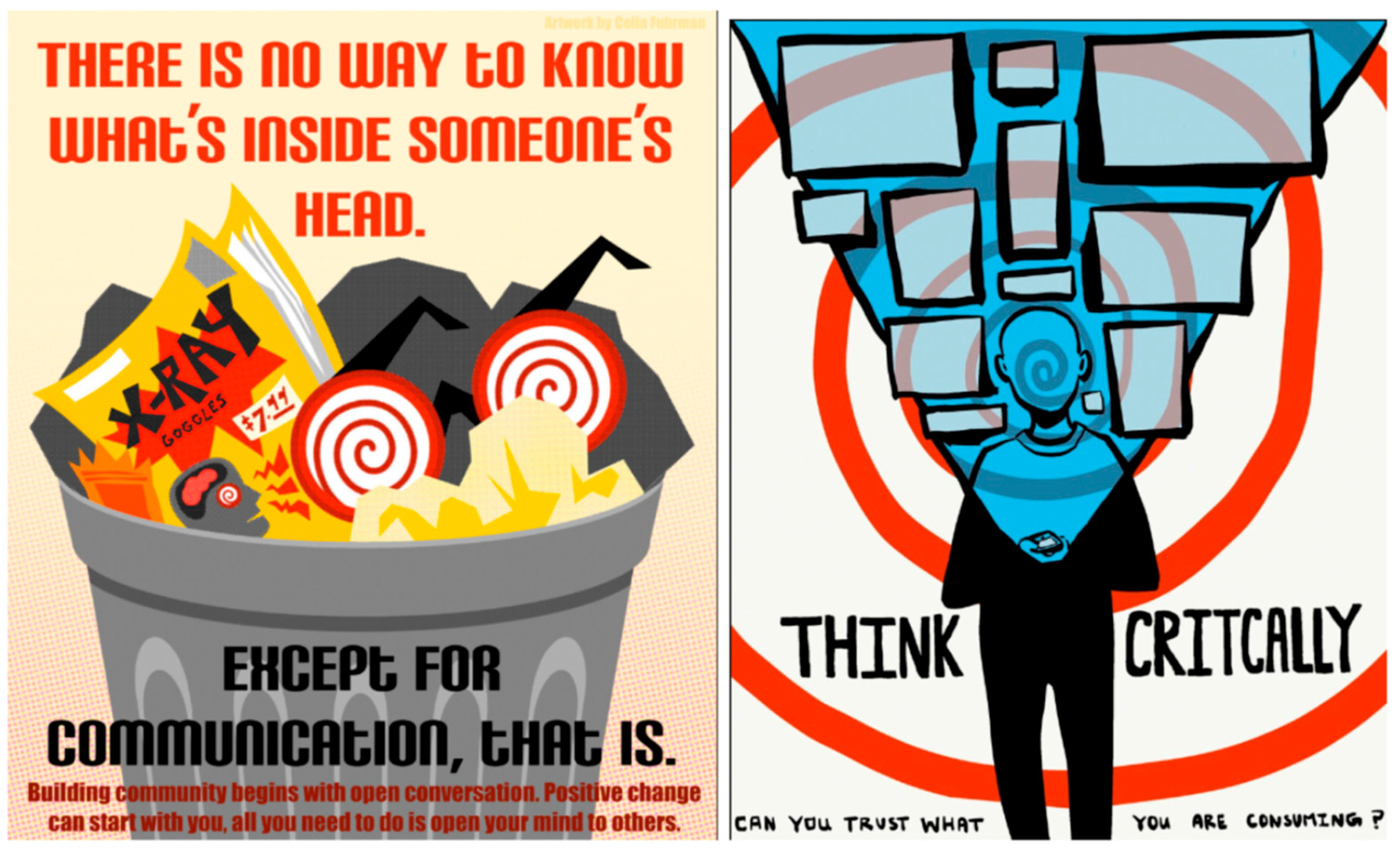
Because students retain intellectual property rights to their work, we sought permission from students to reproduce creative works in Figure 1 and Figure 2 and the song lyrics quoted in the Introduction are included with permission from the creator. To protect participants’ identities, we have removed all participant names from this article; we describe participants by grade level or general age rather than by school, university, or city; and we have omitted identifying details from sensitive personal disclosures, such as experiences of bullying, sexual or gender identity, or residence in a war zone. Because verbatim quotations can be found through web searches, we checked each quoted passage against publicly available versions of the winning entries and paraphrased or omitted passages that could identify a participant.
Figure 1.
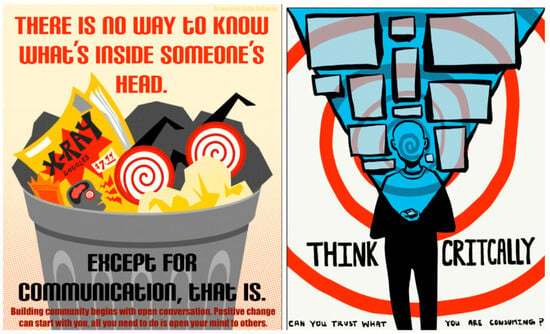
Two examples of student-created poster art on the theme of thinking critically about media and technology.
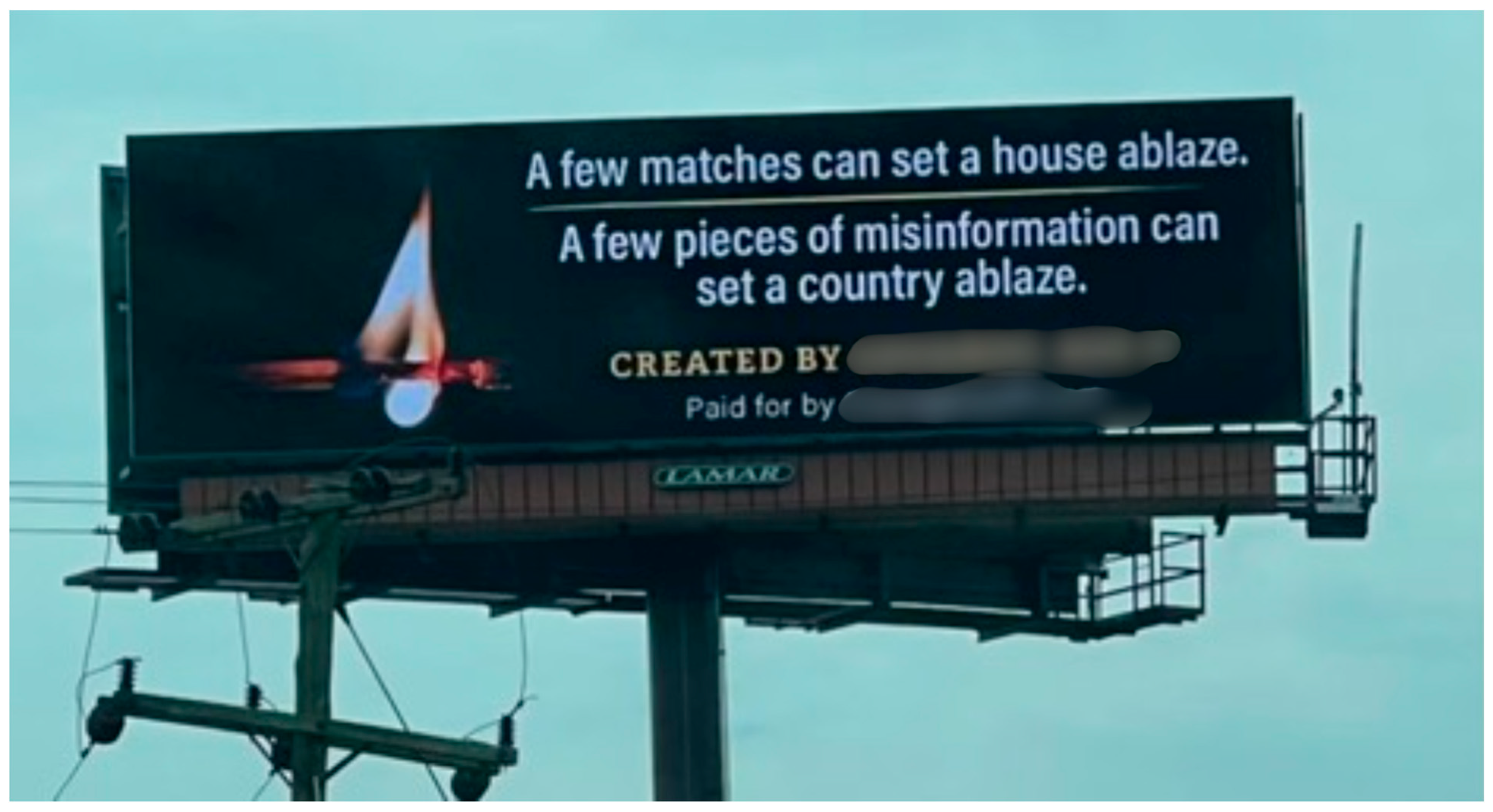
Figure 2.
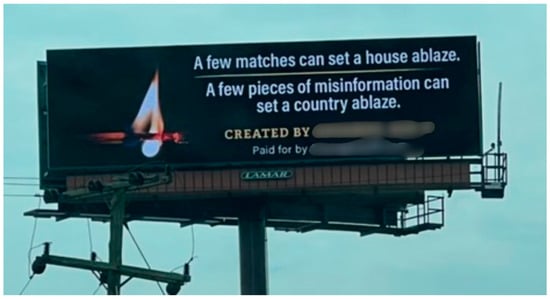
Winning student-created art on the theme of the dangers of disinformation.
4.5. Content Analysis Coding
To examine the relationship between metacognitive awareness and judging scores, we read the 70 statements for evidence of metacognition using the categories in Table 2. Andrew D’Aiello developed the scheme by reviewing each sentence for the presence or absence of each category. Renee Hobbs reviewed all coding processes and independently applied the coding scheme to the corpus of data. Because the artist statements are brief and prompt-driven, our aim was to identify whether, and how substantially, each dimension was evidenced in the statement, rather than to measure the depth of students’ underlying thinking.
Table 2.
Coding Protocol: Evidence of Metacognition in Artist Statements.
Interrater reliability was assessed by having two trained raters independently score 70 artist statements on four metacognition subscales (Process Awareness, Self-Monitoring, Problem-Solving, and Reflective Learning), each rated on a 3-point ordinal scale (0–2), with subscales summed to form a composite metacognition score (range 0–8). One statement with incomplete ratings was excluded, leaving 68–69 statements per analysis. Coders were not aware of which entries had won awards; because winners were publicly showcased, at least some winning entries were likely recognizable, and we treat this as a potential source of bias (see Limitations).
Agreement on the ordinal subscales was estimated with quadratic-weighted Cohen’s kappa (κw), and agreement on the composite was estimated with a two-way random-effects, absolute-agreement, single-rater intraclass correlation coefficient, ICC(2,1). Reliability was substantial for Reflective Learning (κw = 0.82; 88% exact agreement) and Self-Monitoring (κw = 0.79; 81% exact agreement) and moderate to substantial for Process Awareness (κw = 0.69; 77% exact agreement). In contrast, agreement on Problem-Solving was poor (κw = 0.10; 35% exact agreement; Krippendorff’s α = −0.21), reflecting a systematic difference in how the raters applied this criterion (M = 0.14 vs. M = 1.00). As a result, reliability of the four-subscale composite was moderate, ICC(2,1) = 0.66, 95% CI [0.30, 0.82]. When Problem-Solving was removed, the three-subscale composite showed good reliability, ICC(2,1) = 0.85, 95% CI [0.78, 0.91], with 93% of composite scores falling within one point across raters. These findings suggest that the Process Awareness, Self-Monitoring, and Reflective Learning subscales can be coded reliably from artist statements, whereas the Problem-Solving criterion requires a clearer operational definition and rater calibration before it is used in analyses.
Our theoretical approach to data analysis assumes that meaning is perspectival, fluid, and embedded in cultural context; when comparing codes, we observed how our scoring was informed by our interpretations of the four dimensions, and we did not force a single “correct” reading that would erase interpretive nuance. At the same time, we recognize that presenting numeric scores invites quantitative expectations. We therefore report the winner/non-winner comparison below as exploratory rather than confirmatory, with group sizes and an effect size, and we frame the coding as interpretive throughout. We use the scores mainly to describe how often each dimension appeared, and we interpret all statistical comparisons cautiously.
4.6. Strengths and Limitations
A single case study offers rich description of context and choices but has limited generalizability. Metacognition is only partially observable through an artist statement. Students also knew statements would be judged, so they may have written to expectations; a statement is thus a more-or-less accurate depiction of a student’s thinking. Finally, coder bias is possible, reflecting differing understandings of metacognition in relation to students’ written language.
Several further limitations should be noted. First, participants were self-selected: the 70 entries represent a small fraction of the young people reached through the recruitment list, and we collected no demographic data beyond grade level and location, so the sample is not representative of youth in general. Second, the sample is unbalanced across grade levels (53 high school, 12 university, and 5 middle school entries) and formats (only two audio entries). Because awards were made within grade-level categories, award status is confounded with grade level, format, and theme, and older students may write both fuller statements and stronger projects. Third, the winner/non-winner comparison has low statistical power (16 versus 54 entries), so a non-significant difference cannot show whether an association exists. Fourth, because judges evaluated the artist statement within the same rubric, any association between coded metacognition and award status is partly built into the design. Fifth, coders may not have been blind to award status, and two authors were directly involved in running the contest. Sixth, statement length varied considerably and may account for some of the variation in scores. Seventh, the contest permitted generative AI with disclosure, so some statements may not fully reflect students’ own writing.
5. Research Findings
5.1. Civic and Creative Identity in Youth Media Projects
To address RQ1, we reviewed seventy entries and artist statements submitted to the contest, representing a diverse range of geographies, formats, and themes. Participants came from across Rhode Island, the broader United States, Ukraine, Brazil, and Australia and other countries, a range that reflects the reach of the contest’s recruitment networks, as Table 3 shows. Submissions spanned four formats (video, audio, image, writing) and four themes: confronting violence, propaganda, and disinformation; creativity and community engagement; critical thinking about media and technology; and kindness and compassion to heal a broken world, as Table 4 shows.
Table 3.
Distribution of Creative Media Submissions by Country (N = 70).
Table 4.
Distribution of Creative Media Submissions by Format and Theme (N = 70).
The range of approaches shows how students configured their many choices in relation to their identities, interests, and civic commitments. A sixteen-year-old essayist wrote a rigorously researched piece on the alt-right pipeline, moving between creative expression and academic analysis. A team of U.S. college students created a series of one-minute vignettes on disinformation and propaganda. In one, a student investigates a social media post claiming that bacon is worse than smoking, then calls her doctor, who confirms how quickly health misinformation spreads; in another, students show how they discovered that a political statement attributed to a celebrity was a deepfake.
Other students foregrounded the human relationships that reduce the fear and hate leading to violence. A middle school student created a hand-drawn comic on media literacy and kindness for peers navigating social media for the first time; a group of students in wartime Ukraine submitted a video documenting an art project that sustained community amid conflict; and a college student used pop-art imagery to argue that clear communication is the foundation of community. Figure 1 shows examples of student-created graphic art on the theme of thinking critically about media and technology. Taken together, these submissions show participants actively engaging with media culture, choosing content and formats that reflect their positional identities and their sense of what civic action is most needed. Because entrants were self-selected, we do not generalize these patterns beyond the contest.
Submissions were distributed evenly across formats, with the striking exception of audio, which had only two submissions. Format choice let students work in media that interested them or in which they had experience; the scarcity of audio submissions (one song and one podcast) may reflect that songwriting and audio production are less commonly taught than video, photography, design, and writing.
Theme choice was similarly dispersed, allowing students to connect personal experience to the contest’s categories. One student made a short film in Minecraft because friendships formed with players worldwide had “rescued” him from pandemic isolation; the characters represented those friends. Another wrote an essay honoring a queer youth group in their community that had helped them feel more confident in their identity. Inviting students to select from a menu of themes let them personalize their work, grounding it in their creative interests and civic identities. Those who addressed disinformation positioned themselves as informed critics of their media environment; those who made work about self-love or kindness used creative production to locate themselves within their communities.
5.2. Metacognitive Thinking in Students’ Artist Statements
To address RQ2, we took note of how the artist statements varied considerably in length, depth, and tone. Some students wrote with striking clarity about their intentions and process, situating work in personal experience and connecting each decision to a desired effect on the audience; others offered brief, surface-level accounts that named what they made without explaining why. Between these poles, the majority demonstrated genuine engagement with at least some dimensions of metacognitive reflection—evidence that the contest’s invitation to reflect was often meaningfully received. The most consistent pattern was that students wrote best about the decisions they made and what they hoped those decisions would accomplish; the prompt’s explicit invitation to describe creative choices and intended impact created the conditions for this, and students responded consistently.
Table 5 summarizes the distribution of metacognitive thinking scores by award status, grade level, and format, together with mean statement length for each group. These are six entries with no grade level. When we describe a dimension below as common or rare, we are referring to the frequencies below.
Table 5.
Distribution of metacognitive thinking by award status, grade level and format, plus mean statement length for each group (N = 70).
Metacognitive thinking varied modestly by the format of students’ creative work, though none of these differences reached statistical significance. Students who submitted images (n = 27) showed the highest levels of metacognition (M = 4.46, SD = 1.29), followed by those who submitted videos (n = 20; M = 4.18, SD = 1.62). Students who submitted written work (n = 21) had the lowest mean score (M = 3.71, SD = 1.61), but the difference across formats was not significant, F(3, 66) = 1.06, p = .37; a nonparametric test produced the same conclusion, H(3) = 4.62, p = .20. The relatively low scores among writers are noteworthy, since one might expect students working in a verbal medium to articulate their creative process more readily. One possibility is that writers tended to restate the themes of their poems and essays rather than describe the decisions they made in composing them, whereas visual artists more often explained concrete choices about color, imagery, and layout.
Format was also associated with statement length: image creators wrote the longest statements on average (M = 251.2 words), and video creators wrote the shortest (M = 181.6 words), a difference that approached significance, F(3, 66) = 2.36, p = .08. The shorter video statements partly reflect a cluster of submissions from a single classroom, which followed a brief numbered template. Despite writing less, video creators scored close to the sample mean on metacognition, suggesting that statement length alone does not account for differences in metacognitive thinking (overall r = .20, p = .10). Audio submissions (n = 2) were too few to support interpretation. Taken together, these findings suggest that format may shape how young creators reflect on their work, but larger samples would be needed to determine whether these patterns are reliable.
Award winners scored slightly higher on metacognition, but the difference was not significant (Welch’s t(22.5) = 0.87, p = .39). Winners did write longer statements, a difference that approached significance (p = .08). Metacognition did not differ significantly by grade level (F = 1.01, p = .37) or format (F = 1.06, p = .37). Statement length did differ by grade level (F = 3.77, p = .03), as high school statements were shorter than middle school and college statements. The grade-level tests exclude the “not reported” group. Longer statements were only weakly related to higher metacognition scores (r = .20, p = .10).
Artist statements only rarely showed evidence of students actively describing problem-solving or evaluating whether their choices were working mid-process, and few students described moments of difficulty that forced them to adjust. Reflective learning appeared frequently, though its depth varied: many described learning about a subject, while fewer described learning about themselves as creators or thinkers. In its strongest entries, the contest occasionally created the conditions for something deeper where students engaged in a critical analysis of the creative process itself, its challenges and choices, and what it produced in the maker as much as in the artifact. The sections that follow examine each dimension in turn.
Process awareness. Defined as the degree to which a student describes the thinking or planning behind their artifact, process awareness was the most consistently present dimension. This is unsurprising given that the prompt asked students to describe their creative decisions and intended impact. Yet depth varied. Many students named decisions without explaining their reasoning; a sixteen-year-old noted using “dark colors and bold texts” without elaborating on the intended effect. The strongest statements closed that gap. One student explained: “I used things like exclamation marks to emphasize that it is illuminated… as well as big letters to grab people’s attention. I made sure to add a level of detail to the person experiencing the attack by giving them a look of despair and sadness.” Another walked the reader through each element of a kindness-themed piece: “The words on the knot may seem randomly placed, but this was intentional. Random acts of kindness are needed more in our society, and the seemingly random placement… represent this desire.” One grand-prize winner’s statement for a billboard wove personal experience, decision-making, and audience impact together: “That’s why I chose to use a match to represent the dangers of misinformation, and the caption explains how something seemingly small can actually be very dangerous.” What distinguished such statements was not more decisions but fuller explanations of why each decision mattered.
Self-monitoring. Defined as describing evaluation, checking, or adjustment during creation, self-monitoring was the least consistently present dimension. Most entries showed no sign of a student stepping back mid-process to assess whether an approach was working. This should not be read as evidence that students did not self-monitor while creating. After all, constructing anything requires ongoing adjustment. Students were not invited to explain these adjustments because the prompt asked them to describe the decisions they made and the impact they hoped to achieve; it did not ask them to reflect on unsuccessful attempts or explain how their approach evolved over the course of the project.
The rare statements that approach self-monitoring are instructive. A team of students from Ukraine wrote: “It wasn’t easy. We spent a lot of time researching, collaborating with others, and deeply considering how to best represent these stories.” This statement describes effort and deliberation more than real-time evaluation of an approach, and we read it as a borderline case. Clearer evidence came from a student who, acknowledging he had never written a children’s song, noted the result “may still be a bit hard for a kid to digest”—holding his creation to a standard and reflecting on it honestly. The near-absence of this dimension raises questions about prompt design and about whether contest structures that build in revision might better support it.
Problem-solving. Defined as identifying and responding to specific challenges, problem-solving appears to reflect contest design at least as much as student capability. In the traditional metacognitive sense, deliberate in-process problem-solving was largely absent, likely because the instructions never invited students to reflect on obstacles encountered while making their projects. By contrast, sociopolitical problem-solving was pervasive: nearly every project identified a societal problem (primarily bullying or disinformation) and explained its significance. A seventeen-year-old connected the dangers of misinformation to his experience of being bullied, then built a precise visual metaphor; a Brazilian college student framed a video on climate migrants as both advocacy and a demonstration of what students from under-funded public schools can achieve internationally. This sociopolitical problem-solving is real and sophisticated, but it differs from the in-process creative problem-solving that metacognitive theory places at the center of self-regulated learning. We therefore distinguish the two, and read the pattern as evidence that the prompt shaped what students articulated.
Reflective learning. Defined as explaining insights or growth from the experience of creating, reflective learning was the second most present dimension, reflecting the prompt’s explicit invitation to describe what students learned. More telling than its presence was its register. Most statements described learning about a subject as with the Ukrainian student who “learned about examples of the use of disinformation in history”, and an Australian student’s poster which “heightened my awareness for online safety.” These are genuine reflections, but they describe learning about the world rather than about the self as maker or thinker. A smaller subset reached that deeper register. A college student wrote, “What I learned… is how creativity might be hard to work with, [but] you can still be creative in the process of expressing your work, especially when it is your own original idea and not copying off of others.” A high school poet noted: “The production of this poem taught me to better use my voice on issues I’m passionate about… my eyes have been opened to ways I can make a difference that I wouldn’t have even considered before.” Here the learning shifted a student’s sense of what was possible for herself and her world.
5.3. Alignment of Contest Design, Judging, and Metacognition
To address RQ3, we examined the alignment between contest design, judges’ evaluations, and evidence of metacognition. Students demonstrated metacognitive thinking most often where specific instructions overlapped with the dimensions we assessed. Prompts asking “Why did you choose your issue?” and “Why did you make specific creative decisions?” elicited process awareness, and “What impact do you hope to have?” invited problem-solving and reflective learning. The design did not ask students to articulate the challenges they faced, how they solved them, or whether their approach was achieving their goals—so, whether or not students engaged in this thinking, they rarely demonstrated it in writing.
The judging criteria show a similar pattern. Judges were experienced with youth across contexts but were not selected for, or briefed on, metacognition; even so, they received clear assessment criteria focused on students’ achievements in both the creative work and the artist statement:
Relevance and intent: Does the project align with the contest themes, and does the statement explain this connection?
Creativity and originality: How original is the project, and how well does the statement describe the creative process?
Quality and execution: Are the technical aspects well executed?
Clarity and effectiveness: How clear and effective is the project’s message?
Effort and reflection: Do the project and statement demonstrate sincere effort and critical reflection?
These criteria overlap meaningfully with Flavell’s framework: “how well does the artist statement describe the creative process” and “sincere effort and critical reflection” point toward process awareness and reflective learning, and relevance and intent toward sociopolitical problem-solving. As with the instructions, however, the criteria underweighted the dimensions that were underrepresented in statements: self-monitoring and in-process problem-solving. This overlap also means that the comparison below is not independent of the judging. Because judges rated the artist statements themselves, entries with more reflective statements could have received higher scores partly for that reason, regardless of the quality of the creative work. The analysis that follows therefore cannot tell whether metacognitive awareness is associated with stronger creative work, with more favorable evaluations, or with both.
We compared mean metacognition scores for winning and non-winning entries, as Table 6 shows. Winning entries (n = 16, M = 4.44, SD = 1.62) scored higher on average than non-winning entries (n = 54, M = 4.05, SD = 1.44), but the difference was small and not statistically significant, t(68) = 0.93, p = .36. The mean difference was 0.39 points on the 8-point scale, 95% CI [−0.45, 1.23], and the corresponding effect size was small, Cohen’s d = 0.26, 95% CI [−0.30, 0.82]. Because metacognition scores are sums of ordinal ratings, we also conducted a Mann–Whitney U test, which yielded the same conclusion, U = 515.5, z = 1.18, p = .24, rank-biserial r = .19. Winning entries had a median score of 5.0 (IQR = 3.4–5.6), compared with 4.0 (IQR = 3.0–5.0) for non-winning entries.
Table 6.
Mean metacognition scores by award status (0–8 scale, rounded to nearest hundredth).
With 16 and 54 entries, the comparison had low power (roughly 10–15%) to detect a difference of this size. The data are therefore uninformative about whether metacognition scores and award status are associated, and we do not interpret the difference substantively. Both confidence intervals include zero and range from a small negative to a large positive effect, indicating that the present sample cannot rule out either a negligible or a meaningful difference. Larger samples would be needed to determine whether award-winning entries reliably reflect stronger metacognitive thinking.
Criterion-level judge ratings allow a finer-grained, though still imperfect, test of this overlap. For each entry, we averaged each criterion across judges and correlated the result with the entry’s metacognition score (Spearman’s ρ, n = 70). Metacognition scores were positively associated with judges’ overall ratings (the mean of the five criteria), ρ = .34, 95% CI [0.11, 0.54], p = .004. The association was strongest for effort and reflection (ρ = 0.36, 95% CI [0.13, 0.55], p = .002), the criterion that most directly concerns the artist statement, and weakest for relevance and intent (ρ = .18, 95% CI [−0.06, 0.40], p = .13). Metacognition scores were also associated with creativity and originality (ρ = .29, 95% CI [0.05, 0.49], p = .02) and with the two criteria that concern only the project: quality and execution (ρ = 0.32, 95% CI [0.08, 0.52], p = .007) and clarity and effectiveness (ρ = .32, 95% CI [0.08, 0.52], p = .008). These four associations remained significant after Holm correction for five comparisons and after controlling for statement length (partial ρ = .26 to .35). Because judges saw each artist statement while rating every criterion, even ratings of a project’s quality and clarity may partly reflect the statement, so these correlations cannot show that students who wrote more metacognitive statements produced stronger creative work. They do indicate that, across the full range of ratings rather than the binary winner/non-winner split, entries whose statements showed more evidence of metacognition tended to be rated more favorably by judges.
Some of the most highly rated submissions also demonstrated dimensions the instructions and criteria did not ask for. Several grand-prize winners evaluated their own work honestly, named challenges, and described how the creative process changed them. One called the contest “really generative;” another connected his participation to a broader hope for media literacy education; and a third closed the statement for her poem by observing that “art and expression are powerful tools in navigating the complexities of human emotions and societal challenges.” In each case the learning described was not about a topic but about the self and one’s role in civic life. These examples are illustrative only, as a handful of quotations cannot show that winners differed systematically on these dimensions.
6. Discussion
6.1. Balancing Contest Focus and Youth Choice
Our analysis of RQ1 suggests that designing a contest to elicit creative and civic identity requires balancing breadth of formats and themes that invite wide participation and individual choice against focus, which can deepen engagement and ease assessment. The even distribution across three of four formats suggests that medium choice was part of the contest’s appeal. Some students named their creative identity directly, describing a “passion for film” or explaining that when free to choose, they “had no doubt” they wanted to work with poetry. The scarcity of audio may be instructive: the grand-prize songwriter had prior musical experience, and students without such training may have gravitated to more widely taught media. With only two audio entries, however, this is a hypothesis for future contests rather than a finding: contests that wish to include less commonly taught formats may need to scaffold them explicitly.
The even distribution of projects across the four themes similarly suggests that some choice in focus invited wide participation and let students explore personally resonant subjects, connecting personal experience to the categories the contest provided. Regarding civic identity, participants often chose issues because they were personally affected by them, while selecting from a menu the contest defined.
Students addressing “confronting violence” and “kindness” frequently created anti-bullying projects rooted in their own experiences, and all of the Ukrainian participants connected their work to living through war. One wrote: “I live in [a frontline city]… the topic of my work is ‘countering disinformation,’ because enemies have been using disinformation for a long time, and in wartime it is a common thing.” Figure 2 shows a winning project that was posted on a billboard on Route 95, a major highway in Rhode Island, offering a message about the dangers of disinformation to democracy. While we cannot determine how fully any statement represents a participant’s authentic perspective versus catering to the contest, the specificity of these accounts suggests that a structured but open invitation to create leads young people to reveal something of themselves. Thus, the contest offered a space in which participants could express civic and creative identities and in which self-expression for a public audience became an act of authorship; whether participation developed those identities is a question our data cannot answer.
6.2. Inviting Metacognitive Reflection Through Design
In examining RQ2, we find a consistent pattern: students reflected most reliably on the dimensions that the contest prompt invited and rarely on those it did not. We interpret this pattern as reflecting, at least in part, a feature of contest design rather than a lack of student capability. Other explanations are also plausible: the artist statement is a retrospective, summative genre; statements were brief; younger participants may have had less practice describing their thinking; students knew their statements would be judged and may have emphasized what they expected judges to value; and the how-to videos and example playlist may have modeled particular kinds of statements. It is also important to distinguish prompt compliance from metacognition: that students addressed what they were asked to address shows that they followed the prompt, which is not in itself evidence for or against metacognitive thinking. The instructions functioned as an invitation to engage in and demonstrate specific dimensions of metacognition, which the majority of students answered skillfully; what the contest did not ask for (self-monitoring and in-process problem-solving) students seldom volunteered. Given this, we believe the contest design did not invite such reflections, rather than that students were incapable of them.
For this reason, the select statements that demonstrated the underrepresented dimensions are worth noting. The grand-prize winners (and a handful of others across the dataset) evaluated their own work honestly, named the challenges they encountered, and described changes in their thinking and civic voice, in ways the instructions never required. That these dimensions sometimes surfaced without explicit invitation raises the possibility that creative quality and a tendency to articulate metacognition in depth are related. Future studies could test this hypothesis with judging procedures that evaluate projects independently of statements.
For educators and practitioners, implementing this finding could mean designing instructions that create the conditions for authentic reflection. For example, open-ended questions such as “What was something you learned?” or “What was a challenge you faced, and how did you try to solve it?” may elicit evidence of metacognitive processes without coercing students into describing thinking they did not actually do. Because our study examined a single prompt, these questions are hypotheses for future contests rather than tested recommendations.
6.3. Designing Contests to Invite and Recognize Reflection
RQ3 shows that the contest’s prompts and judging criteria rewarded some dimensions of metacognition (process awareness and reflective learning) and left others (self-monitoring and in-process problem-solving) largely unaddressed. Our data do not show that winning entries were more metacognitive than others: the small difference we observed was not statistically significant and is entangled with the judges’ evaluation of the statements themselves. Consistent with a design that invites personal expression while providing helpful constraints, youth media contests should aim to invite, facilitate, and reward students’ authentic demonstration of both creative expression and critical reflection. Four considerations for future design follow.
First, contest designers should account more strategically for how age and education level prepare participants to engage in and articulate metacognition. While our contest recorded age and grade and awarded prizes in categories including middle-school, high school and college, judging criteria could more explicitly acknowledge these factors. Different writing prompts for middle-school students, high schoolers, and college students might reward grade-appropriate metacognition; this recommendation draws on developmental research on metacognition more than on our own data, given the small numbers of middle school and university entries.
Second, we recommend that students be asked to explain the practices of revision and self-assessment in their artist statements, and that documentation of the revision process alongside the final product could allow students to attend more closely to their own metacognitive thinking. Third, and relatedly, we suggest that the artist statement be framed not as a justification of the finished work but as a reflective record of the process. Our instructions implied some acknowledgment of decision-making, but encouraged students to compose definitive explanations of intentions and objectives, rather than an account of the messier and more interesting thinking that led to the final result. Reframing it would give organizers a clearer picture of how participation encouraged metacognition and would signal to students that difficulty, uncertainty, and adjustment are not signs of failure but evidence of authentic creative and civic growth.
Fourth, contests that want to learn whether reflection is associated with creative quality should have judges rate the creative work and the artist statement separately, or have some judges evaluate the work without seeing the statement, so that the two can be distinguished.
7. Conclusions
Our study revealed that students made use of the contest to express both their creative and civic identities; that students made visible the dimensions of metacognition the contest invited and seldom those it did not; and that the design of the instructions provided to participants and the criteria used to evaluate their submissions were key to both facilitating and understanding the students’ demonstration of creative expression and critical reflection. These findings suggest that youth media contests can function not only as platforms for expression but also as spaces that afford agency, metacognition, and civic voice.
For organizations, schools, and funders that run media contests for young people, our case suggests several recommendations for policy and practice. First, write reflection prompts that explicitly invite students to describe challenges, revisions, and moments of uncertainty, not only their intentions and hoped-for impact, and pilot these prompts with young people of different ages. Second, align judging rubrics with the forms of reflection the contest hopes to cultivate, and make the weight given to the artist statement transparent to entrants. Third, evaluate creative work and written reflection separately so that organizers can learn what each contributes. Fourth, provide age-appropriate scaffolds, such as examples of reflective statements and opportunities to share drafts, particularly for younger entrants and for less commonly taught formats. Fifth, treat youth entries with the same ethical care as research data: tell entrants and their parents or guardians at the outset whether and how their work and statements may be used for research, publication, or promotion; obtain consent for those uses; and respect young creators’ ownership of their work. Designed in these ways, contests can function not only as competitions but also as structured opportunities for young people to practice, while making visible the reflective habits that media literacy education seeks to develop.
Author Contributions
Conceptualization, R.H., A.D., and B.T.; methodology, R.H. and A.D.; formal analysis, B.T., A.D.; statistical analysis, R.H.; resources, R.H.; data curation, B.T., R.H.; writing—original draft preparation, A.D.; writing—review and editing, B.T., R.H.; visualization, R.H.; supervision, R.H.; project administration, R.H.; funding acquisition, R.H. All authors have read and agreed to the published version of the manuscript.
Funding
This work was supported by the U.S. Department of Homeland Security’s Center for Prevention Programs and Partnerships, opportunity number DHS-22-TTP-132-00-01. Benjamin Thevenin led the youth media contest as a program manager and Renee Hobbs was principal investigator.
Institutional Review Board Statement
Not applicable.
Informed Consent Statement
Not applicable.
Data Availability Statement
The full contest prompt, judging rubric, and codebook are provided at Open Science Framework (OSF): https://osf.io/r3d5k/ (accessed on 4 November 2026). To protect participants’ privacy, artist statements cannot be shared; de-identified coding sheets are available from the corresponding author on reasonable request.
Conflicts of Interest
The authors declare no conflict of interest.
Note
| 1 | The contest required video and audio submissions to be no longer than four minutes, and written submissions were restricted to 1000 words. Participants were encouraged to make use of copyrighted material (for example: image/video/audio excerpts for documentary/journalistic purposes, memes, remixes, etc.) if they made use of copyrighted material for an educational, creative, or informational purpose and included a list of copyrighted material in the submission (including author, title, date, and hyperlink if applicable). Participants were encouraged to use generative AI to edit, supplement, or enhance their work, but were required to submit a written explanation of their use of AI. For projects that include photographic images or video footage of any children under the age of 18, signed parental permission forms for each child were required. |
References
- Allan, S. (2012). Civic voices: Social media and political protest. In P. Mihailidis (Ed.), News literacy: Global perspectives for the newsroom and the classroom (pp. 23–39). Peter Lang. [Google Scholar]
- Bennett, W. L., Wells, C., & Rank, A. (2009). Young citizens and civic learning: Two paradigms of citizenship in the digital age. Citizenship Studies, 13(2), 105–120. [Google Scholar] [CrossRef] [Scilit]
- Bhatia, K. V., Pathak-Shelat, M., & Arora, P. (2024). DIY education in the digital era: Youth-driven learning strategies and curricula for the future of work opportunities. Education and Information Technologies, 29(2), 1407–1426. [Google Scholar] [CrossRef] [Scilit]
- Castells, M. (2012). Networks of outrage and hope: Social movements in the Internet age. Polity Press. [Google Scholar]
- Celeste, M. (2019). Teach them well: Media literacy as a survival tool for marginalized youth. Spark: Elevating scholarship on social issues. Available online: https://medium.com/national-center-for-institutional-diversity/teach-them-well-media-literacy-as-a-survival-tool-for-marginalized-youth-207322e3cd44 (accessed on 11 August 2025).
- Checkoway, B., & Richards-Schuster, K. (2003). Youth participation in community evaluation research. American Journal of Evaluation, 24(1), 21–33. [Google Scholar] [CrossRef] [Scilit]
- Cubbage, J. (Ed.). (2022). Critical race media literacy: Themes and strategies for media education. Routledge. [Google Scholar]
- Dahlgren, P. (2013). The political web: Media, participation and alternative democracy. Palgrave Macmillan. [Google Scholar]
- Damrongmanee, M. (2016). The artist statement as a genre: Move analysis with pedagogical aims. LEARN Journal: Language Education and Acquisition Research Network, 9(2), 83–104. Available online: https://so04.tci-thaijo.org/index.php/LEARN/article/view/102649 (accessed on 11 August 2025).
- Davis, E. A. (2003). Prompting middle school science students for productive reflection: Generic and directed prompts. Journal of the Learning Sciences, 12(1), 91–142. [Google Scholar] [CrossRef] [Scilit] [PubMed]
- Desautel, D. (2009). Becoming a thinking thinker: Metacognition, self-reflection, and classroom practice. Teachers College Record, 111(8), 1997–2020. [Google Scholar] [CrossRef] [Scilit]
- Evans, L. A., Gomez, O., Jiménez, D. J., Williamson, H. J., Turnlund Carver, A., Parthasarathy, S., & Sabo, S. (2023). Engaging youth and young adults in the COVID-19 pandemic response via the “It’s Our Turn” crowdsourcing contest. International Journal of Environmental Research and Public Health, 20(6), 5112. [Google Scholar] [CrossRef] [Scilit] [PubMed]
- Feuerstein, M. (1999). Media literacy in support of critical thinking. Journal of Educational Media, 24(1), 43–54. [Google Scholar] [CrossRef] [Scilit]
- Fisherkeller, J. (Ed.). (2011). International perspectives on youth media: Cultures of production and education. Peter Lang. [Google Scholar]
- Flavell, J. H. (1979). Metacognition and cognitive monitoring: A new area of cognitive–developmental inquiry. American Psychologist, 34(10), 906–911. [Google Scholar] [CrossRef]
- Hauge, C. (2014). Youth media and agency. Discourse: Studies in the Cultural Politics of Education, 35(4), 471–484. [Google Scholar] [CrossRef] [Scilit]
- Hetland, L., Winner, E., Veenema, S., & Sheridan, K. M. (2013). Studio thinking 2: The real benefits of visual arts education (2nd ed.). Teachers College Press. [Google Scholar]
- Hobbs, R. (2010). Digital and media literacy: A plan of action. The Aspen Institute. [Google Scholar]
- Hobbs, R. (2017). Create to learn: Introduction to digital literacy. John Wiley & Sons. [Google Scholar]
- Hobbs, R. (2025). Media literacy in action: Questioning the media (2nd ed.). Rowman & Littlefield. [Google Scholar]
- Hobbs, R., Lenci, K., Palella, J., & Thevenin, B. (2026). Media literacy education and teacher confidence in addressing violent extremism: A longitudinal professional development study. Journal of Peace Education, 1–26. [Google Scholar] [CrossRef] [Scilit]
- Ito, M., Baumer, S., Bittanti, M., Boyd, D., Cody, R., Herr-Stephenson, B., Horst, H. A., Lange, P. G., Mahendran, D., Martínez, K. Z., Pascoe, C. J., Perkel, D., Robinson, L., Sims, C., & Tripp, L. (2009). Hanging out, messing around, and geeking out: Kids living and learning with new media. MIT Press. [Google Scholar]
- Ito, M., Gutiérrez, K., Livingstone, S., Penuel, W., Rhodes, J., Salen, K., Schor, J., Sefton-Green, J., & Watkins, S. C. (2013). Connected learning: An agenda for research and design. Digital Media and Learning Research Hub. [Google Scholar]
- Ito, M., Martin, C., Pfister, R. C., Rafalow, M. H., Salen, K., & Wortman, A. (2019). Affinity online: How connection and shared interest fuel learning. New York University Press. [Google Scholar]
- Jenkins, H. (2006). Convergence culture: Where old and new media collide. New York University Press. [Google Scholar]
- Jenkins, H., Ito, M., & Boyd, D. (2015). Participatory culture in a networked era. Polity Press. [Google Scholar]
- Jenkins, H., Shresthova, S., Gamber-Thompson, L., Kligler-Vilenchik, N., & Zimmerman, A. M. (2016). By any media necessary: The new youth activism. New York University Press. [Google Scholar]
- Jimenez, C., Schofield Clark, L., & Ramirez, J. (2024). “We know about things too”: Exploring the labors of love involved in cultivating youth voice in online youth civic engagement programs with youth of color. Youth & Society, 56(4), 734–753. [Google Scholar] [CrossRef] [Scilit]
- Jolls, T., & Johnsen, M. (2018). Media literacy: A foundational skill for democracy in the 21st century. Hastings Law Journal, 69(5), 1379–1408. [Google Scholar]
- Kafai, Y. B., Fields, D. A., & Searle, K. A. (2019). Understanding media literacy and DIY creativity in youth digital productions. In R. Hobbs, & P. Mihailidis (Eds.), The international encyclopedia of media literacy (pp. 1–10). Wiley Blackwell and the International Communication Association. [Google Scholar]
- Kellner, D., & Share, J. (2005). Toward critical media literacy: Core concepts, debates, organizations, and policy. Discourse: Studies in the Cultural Politics of Education, 26(3), 369–386. [Google Scholar] [CrossRef] [Scilit]
- Lee, D. K. L., & Ramazan, O. (2021). Fact-checking of health information: The effect of media literacy, metacognition and health information exposure. Journal of Health Communication, 26(7), 491–500. [Google Scholar] [CrossRef] [Scilit] [PubMed]
- Levine, P. (2008). A public voice for youth: The audience problem in digital media and civic education. In W. L. Bennett (Ed.), Civic life online: Learning how digital media can engage youth (pp. 119–138). MIT Press. [Google Scholar]
- Lopez, A. (2020). Ecomedia literacy: Integrating ecology into media education. Routledge. [Google Scholar] [CrossRef] [Scilit]
- Luke, C. (1994). Feminist pedagogy and critical media literacy. Journal of Communication Inquiry, 18(2), 30–47. [Google Scholar] [CrossRef] [Scilit]
- Malboeuf-Hurtubise, C., Lefrançois, D., Éthier, M.-A., Smith, J., Béland, S., & Léger-Goodes, T. (2025). Thinking and creating by and for oneself? In what way traditional assessment practices influence how students perceive and approach philosophical and artistic learning. Learning: Research and Practice, 11(1), 92–104. [Google Scholar] [CrossRef] [Scilit]
- Masterman, L. (1985). Teaching the media. Comedia Publishing Group. [Google Scholar]
- Middaugh, E., Bowyer, B., & Kahne, J. (2017). U Suk! Participatory media and youth experiences with political discourse. Youth & Society, 49(7), 902–922. [Google Scholar] [CrossRef] [Scilit]
- Mihailidis, P. (2008). Beyond cynicism: How media literacy can make students more engaged citizens [Doctoral dissertation, University of Maryland]. [Google Scholar]
- Mihailidis, P., & Thevenin, B. (2013). Media literacy as a core competency for engaged citizenship in participatory democracy. American Behavioral Scientist, 57(11), 1611–1622. [Google Scholar] [CrossRef] [Scilit]
- Nelson, T. O., & Narens, L. (1990). Metamemory: A theoretical framework and new findings. In G. H. Bower (Ed.), The psychology of learning and motivation (Vol. 26, pp. 125–173). Academic Press. [Google Scholar] [CrossRef] [Scilit]
- Pourmohades, G., Khoini, F., & Hosseinalmadani, S. A. (2023). Developing a causal model of literacy based on metacognitive skills, self-regulated learning strategies and self-efficacy with the mediation of creative thinking in students. Journal of Adolescent and Youth Psychological Studies, 4(4), 134–143. [Google Scholar] [CrossRef] [Scilit]
- Quijada, A., & Collins, J. (2009). Youth media curriculum for justice. Youth Media Reporter, 2(5), 165–167. [Google Scholar]
- Richter, G., & Adorno, T. W. (2002). Who’s afraid of the ivory tower? A Conversation with Theodor W. Adorno. Monatshefte, 94(1), 10–23. Available online: http://www.jstor.org/stable/30161947 (accessed on 11 August 2025).
- Schön, D. A. (1983). The reflective practitioner: How professionals think in action. Basic Books. [Google Scholar]
- Schraw, G., & Dennison, R. S. (1994). Assessing metacognitive awareness. Contemporary Educational Psychology, 19(4), 460–475. [Google Scholar] [CrossRef] [Scilit]
- Sefton-Green, J., & Sinker, R. (Eds.). (2000). Evaluating creativity: Making and learning by young people. Routledge. [Google Scholar]
- Share, J., & Beach, R. (2022). Critical media literacy analysis and production for systems thinking about climate change. The Journal of Media Literacy. Available online: https://ic4ml.org/journal-article/critical-media-literacy-analysis-and-production-for-systems-thinking-about-climate-change/ (accessed on 11 August 2025).
- Soep, E. (2014). Participatory politics: Next-generation tactics to remake public spheres. MIT Press. [Google Scholar]
- van Leent, L., & Mills, K. (2018). A queer critical media literacies framework in a digital age. Journal of Adolescent & Adult Literacy, 61(4), 401–411. [Google Scholar] [CrossRef] [Scilit]
- Woolley, S. W. (2021). Queer critical media literacy and possibilities for counterhegemonic pedagogy. The International Journal of Critical Media Literacy, 3(2), 88–104. [Google Scholar] [CrossRef] [Scilit]
- Wunderlich, L. (2025). Disinterested and disillusioned? Information and political engagement practices of young people from disadvantaged backgrounds. Youth & Society, 57(7), 1210–1231. [Google Scholar] [CrossRef] [Scilit]
- Zhang, Y., Kim, J. A., Liu, F., Tso, L. S., Tang, W., Wei, C., Bayus, B. L., & Tucker, J. D. (2015). Creative contributory contests to spur innovation in sexual health: 2 cases and a guide for implementation. Sexually Transmitted Diseases, 42(11), 625–628. [Google Scholar] [CrossRef] [Scilit] [PubMed]
- Zimmerman, B. J. (2002). Becoming a self-regulated learner: An overview. Theory into Practice, 41(2), 64–70. [Google Scholar] [CrossRef] [Scilit] [PubMed]

Disclaimer/Publisher’s Note: The statements, opinions and data contained in all publications are solely those of the individual author(s) and contributor(s) and not of MDPI and/or the editor(s). MDPI and/or the editor(s) disclaim responsibility for any injury to people or property resulting from any ideas, methods, instructions or products referred to in the content. |
© 2026 by the authors. Licensee MDPI, Basel, Switzerland. This article is an open access article distributed under the terms and conditions of the Creative Commons Attribution (CC BY) license.