


Abstract
Artificial intelligence (AI) systems increasingly shape youth’s educational, social, and informational environments. Although numerous ethical frameworks and guidelines have been developed to guide AI governance, including the OECD AI Principles and the UNESCO Recommendation on the Ethics of AI, they rarely address young people’s perspectives when interacting with AI in their everyday lives. At the same time, the United Nations Committee on the Rights of the Child, in General Comment No. 25 published in 2021 on children’s rights in the digital environment, affirms that children should be actively involved in decisions concerning digital technologies that affect them. Objective: This study examines how the scientific literature conceptualizes youth’s right to participate in AI. Methods: An interpretive scoping review was conducted. Database searches and reference list screening were performed between 2010 and 2024 using combinations of keywords related to artificial intelligence, youth, participation, and ethics. Following a systematic selection process, 15 sources were included and analyzed thematically. The corpus comprises peer-reviewed articles, a position paper, legal analyses, policy review reports, and narrative reviews, selected to capture both empirical and normative perspectives on the topic. Results: The literature highlights youth participation in AI as both a children’s rights requirement and a condition for legitimate digital governance. However, a significant gap persists between young people’s widespread exposure to AI systems and their limited influence in decision-making processes. Discussion: Integrating youth participation into AI governance and education may contribute to more inclusive and developmentally informed technological ecosystems.
1. Introduction
Over the past few years, society has undergone significant transformation driven by the digital revolution and the rise of artificial intelligence (AI). This rapidly evolving technology has gained considerable traction across various fields and in everyday life, influencing social, economic, and educational practices as well as political discourse (Henshall, 2023). AI systems are now integrated into most of our devices, such as smartphones and search engines, where they function as digital assistants, offering personalized recommendations.
This digital transformation unfolds in highly connected environments where youth increasingly interact with AI systems, including conversational agents and intelligent interfaces (Druga et al., 2017), as well as algorithmically curated social media platforms such as Instagram and TikTok, where visibility and content distribution are structured through automated recommendation systems (Cotter, 2019). Data compiled by Transforma Insights (2020) and disseminated through Statista indicate that the number of connected devices within the Internet of Things, including smartphones, smartwatches, and voice assistants, is expected to grow from 8.74 billion in 2020 to more than 25.4 billion worldwide by 2030. These figures illustrate the rapid expansion of digital environments and the intensification of their influence on key dimensions of social life, particularly in relation to health, education, and communication, with pronounced effects on younger generations.
Several studies show that AI-enabled digital tools can support personalized learning and foster certain creative practices (Ali et al., 2021; Antle & Kitson, 2021), while also opening spaces for collaboration, social participation, and identity formation (Hasse et al., 2019; Higgs & Stornaiuolo, 2024). However, these same tools raise ethical, social, and legal concerns, such as the reproduction of social inequalities, differentiated hierarchies of content visibility, and the marginalization of certain groups within digital environments (European Commission, 2021; Stypińska, 2023). Such mechanisms may also affect youth mental health and well-being, as youth are already exposed to intense and continuous digital pressures (Karim et al., 2020). Within this context, Livingstone and Stoilova (2021) propose a typology of digital risks organized around four dimensions, commonly referred to as the “4Cs”: content, contact, conduct, and contract. This framework captures the diversity of situations youth encounter in digital environments, including exposure to inappropriate content, unwanted interactions, problematic behaviors, and opaque forms of personal data management. These risks illustrate how AI-mediated environments simultaneously shape youth safety, trust, and socialization processes.
The rise of conversational technologies such as emotional AI systems has further intensified ethical and societal debates regarding youth relationships with digital technologies (McStay & Rosner, 2021). Embedded in interactive toys, educational applications, and voice assistants designed for youth, these technologies aim to create interactions perceived as empathic (Darling, 2017; Druga et al., 2019). However, several studies warn of risks associated with the collection of sensitive emotional data, the blurring of boundaries between human relationships and artificial agents, and the development of affective attachments to AI-powered companions (Devillers & Cowie, 2023; Kim et al., 2025). Despite growing regulatory initiatives, existing governance frameworks remain insufficient to ensure adequate protection for youth and to support their meaningful involvement in discussions about how these technologies are designed and used. In response to these concerns, various frameworks have been developed to promote responsible AI development, such as the Recommendation on the Ethics of Artificial Intelligence (UNESCO, 2021), the IEEE 7010 standard on assessing the impact of autonomous and intelligent systems on human well-being (Schiff et al., 2020), the Artificial Intelligence Act (European Union, 2024), and the International AI Safety Report (Bengio et al., 2025). These tools emphasize transparency, accountability, and human-centered design. Nevertheless, the literature indicates that their implementation remains largely oriented toward technical, economic, and security considerations, leaving limited space for youth rights, experiences, and perspectives as users and future co-designers of AI systems.
Several blind spots persist, particularly with regard to age-related dimensions. While a significant body of research has addressed inequalities linked to gender or ethnicity, age remains relatively underexplored as an analytical category in AI studies (Stypińska, 2023; Akter et al., 2021). Some research highlights the barriers faced by older generations in accessing and appropriating digital technologies, notably due to the digital divide, which encompasses inequalities in access, skills, and confidence in technology use (Goldenthal et al., 2021). However, acknowledging these challenges should not lead to the assumption that current technologies adequately meet the needs, expectations, and lived realities of youth.
This assumption is particularly problematic given the limited research examining the specific effects of AI on youth lives, development, and well-being, as well as the restricted opportunities available for their active participation in the design and governance of these technologies (Hasse et al., 2019). Although user-centered approaches and participatory design practices are increasingly promoted in AI development (Ali et al., 2021; Antle & Kitson, 2021; Arastoopour Irgens et al., 2022; Solyst et al., 2023; Corbett et al., 2023), youth are rarely recognized as heterogeneous groups requiring participatory approaches adapted to their developmental trajectories. Despite their frequent position as early adopters, youth continue to be framed primarily as users rather than as actors capable of contributing to decisions that shape the digital environments they inhabit (Mathiyazhagan & La Fors, 2023; Higgs & Stornaiuolo, 2024). This marginalization contrasts with the principles enshrined in the United Nations Convention on the Rights of the Child (UNCRC, 1989), which explicitly recognizes children’s and adolescents’ right to participate in decisions affecting their lives, a right closely linked to the development of autonomy, agency, and citizenship.
It is within this perspective that the present study is situated. Through a scoping review, our study aims to map and synthesize existing literature addressing youth right to participation across the AI lifecycle, from model conception to deployment. The objective is to highlight how youth’s right to participation in AI is perceived and framed in the literature, including strategies proposed to support their effective participation in the design, governance, and ethical oversight of AI systems. Based on the review findings, we develop the discussion section around three analytical implications derived from the literature.
Given the diversity of age-related terminology across disciplines, it is necessary to clarify the use of the term “youth” in this study. The term is employed as an umbrella concept encompassing individuals aged approximately 12 to 24, corresponding to a developmental period spanning late childhood, adolescence, and early adulthood. This definition draws on sociological and psychological perspectives that conceptualize youth as a phase characterized by identity formation, social participation, and the progressive acquisition of autonomy (UNICEF, 2021; Facer, 2011; Hasse et al., 2019). Where relevant, the original terminology used by authors is retained in order to respect the analytical frameworks specific to each study.
2. Materials and Methods
2.1. Study Design
We conducted a scoping review to examine the existing literature addressing youth’s right to participation in AI. This methodological approach was selected in light of the emerging and interdisciplinary nature of the topic, and its suitability for mapping a broad body of literature, identifying recurring conceptual patterns, and highlighting gaps in current knowledge (Tricco et al., 2018). Scoping reviews are particularly appropriate when a field remains fragmented and conceptually heterogeneous, as is the case for youth’s right to participation in AI. This scoping review was conducted in accordance with the PRISMA 2020 guidelines (Page et al., 2021). This review was not pre-registered.
To synthesize and organize the body of research, we applied a thematic analysis based on the framework proposed by Braun and Clarke (2006). Through this approach, we identified cross-cutting themes across diverse types of publications while remaining attentive to variations in disciplinary perspectives, conceptual frameworks, and empirical approaches.
2.2. Eligibility Criteria
This scoping review was guided by the following research question: How is youth’s right to participation in AI conceptualized and addressed in the existing literature? To address this question, this scoping review focused on literature engaging with AI, youth (including related age-based terminology), participation, and ethics, reflecting the interdisciplinary nature of the topic. Publications from 2010 to 2024 were considered, corresponding to a period of significant transformation in youth digital environments marked by the widespread adoption of social media, smartphones, and algorithmic systems. The scope encompassed literature addressing youth broadly defined, consistent with the terminology outlined in the introduction (approximately 12 to 24 years of age). Given the interdisciplinary and emerging nature of the topic, the corpus intentionally includes heterogeneous English-language source types, including peer-reviewed studies, conceptual and narrative reviews, legal analyses, position papers, and policy-oriented reports. Studies published prior to 2010, not focused on youth, written in other languages, or consisting of full-length books, book chapters, or randomized controlled trials were excluded. These source types were not analyzed separately; rather, they were integrated into the thematic synthesis to capture both empirical evidence and normative analysis. The type of source is further indicated in the data charting table (Table 1).
Table 1.
Data charting of papers from final sample.
2.3. Information Sources and Search Strategy
A keyword-based search strategy was designed using a set of terms aligned with the study’s conceptual focus (Table 2). These selected keywords were used to generate the initial pool of articles from four databases prior to the screening process including PsycInfo, Proquest, Ebsco, and Scopus. PsycInfo, Proquest, and Ebsco were selected for their focus on educational literature, while Scopus was included to broaden the scope of the search by capturing literature from a wide range of disciplines, including the social and medical sciences (Lantz-Andersson et al., 2018; Schwager & Schalk, 2022). Table 2 presents the full list of keywords used in the database search. A total of 16,088 papers were initially retrieved, which was reduced to 12,508 after duplicate removal using Covidence. Reference list screening (citation chasing) of the included articles was also conducted; the small number of additional records identified through this process had already been retrieved through the database search and were therefore not added as a separate source in the PRISMA flow diagram.
Table 2.
Keywords used per theme on Scopus.
2.4. Selection Process
The articles retrieved from the databases were screened in two stages using the Covidence platform (Kellermeyer et al., 2018). In the first stage, two reviewers (B.L. and M.È.L.) independently conducted a title and abstract screening based on predefined inclusion and exclusion criteria, reducing the initial pool from 12,508 to 42 articles. In the second stage, the same reviewers independently conducted a full-text screening to assess eligibility, resulting in a final selection of 15 articles included in the review. Discrepancies between reviewers were resolved through discussion, and when necessary, by consultation with a third reviewer (H.H.). Studies were excluded at the full-text stage for the following reasons: non-pertinent concept of participation (n = 11), non-pertinent concept of AI (n = 8), insufficient detail (n = 5), adult population (n = 2), and wrong type of publication (n = 1). This selection process is illustrated in Figure 1.
Figure 1.
PRISMA flowchart of the selection process. The checkmark □ indicates that the sum of the exclusion reasons (11 + 8 + 5 + 2 + 1 = 27) corresponds to the total number of studies excluded at the eligibility stage.
2.5. Quality Assessment
Consistent with scoping review methodology, a formal quality appraisal of included studies was not conducted (Tricco et al., 2018). Scoping reviews aim to map the breadth of available evidence rather than assess the methodological quality of individual studies. However, analytical rigor was ensured through independent coding by two researchers and systematic thematic analysis using NVivo14.
2.6. Data Analysis and Synthesis
Following the selection process, a thematic analysis was conducted for the included studies. An initial review of the full corpus informed the development of a thematic codebook designed to capture the main analytical dimensions emerging from the literature. All studies were then imported into NVivo14 and systematically coded according to the identified themes and sub-themes. The coding process was conducted independently by two researchers (L.L. and S.B.-G.) to ensure analytical rigor, and coding reliability.
3. Results
Across the fifteen reviewed studies, participation emerges as a cross-cutting issue at the intersection of rights-based considerations, everyday uses of AI, ethical governance, and developmental and well-being–related concerns. Although the studies differ in their disciplinary orientations, empirical scope, and methodological approaches, they converge around a shared concern regarding how youth are positioned in relation to AI systems that increasingly shape educational, social, and digital environments. The thematic synthesis is organized around the four overarching themes that structure this scoping review: (1) youth right to participation in AI, (2) youth uses and interactions with AI, (3) ethical tensions between protection and autonomy, and (4) developmental and psychosocial implications of youth participation in AI. Each theme was further structured into sub-themes reflecting recurrent patterns across the literature illustrated in Table 3.
Table 3.
Identified themes and subthemes.
3.1. Youth Right to Participation in AI
3.1.1. Participation as a Right-Based Approach in AI Contexts
A number of reviewed papers conceptualize participation as a rights-based normative requirement (Djeffal, 2022; Gillett-Swan & Sargeant, 2018; Guarcello & Longo, 2024). In these contributions, participation is directly linked to and discussed through the obligations of states and institutions arising from the Convention on the Rights of the Child. Studies that explicitly adopt a rights-based approach draw directly on Article 12 of the United Nations Convention on the Rights of the Child (UNCRC, 1989), which recognizes children’s right to freely express their views on all matters affecting them and to have those views given due weight in accordance with their age and maturity. This interpretation is developed explicitly in the legal and normative analyses of Djeffal (2022) and Guarcello and Longo (2024), as well as in the study of Gillett-Swan and Sargeant (2018) addressing the effective implementation of the right to participation in digital environments as a requirement stemming from existing legal and normative commitments.
Other studies, drawing on educational research, participatory design, or human–computer interaction, engage with participation in a more implicit manner (Antle & Kitson, 2021; Arastoopour Irgens et al., 2022; Higgs & Stornaiuolo, 2024; Solyst et al., 2023). These studies address participation by linking it to diverse concepts such as agency, expression of viewpoints, or empowerment, without consistently mobilizing the legal language of rights (Arastoopour Irgens et al., 2022; Higgs & Stornaiuolo, 2024; Solyst et al., 2023). This distinction is analytically important, as it reveals differing normative foundations and variable expectations regarding the role of institutions in recognizing youth participation in AI.
Across many of the reviewed sources, authors note a considerable gap between the normative recognition of the right to participation and its effective implementation in public policies, educational arrangements, and AI system design processes (Djeffal, 2022; Guarcello & Longo, 2024; Gillett-Swan & Sargeant, 2018). This gap emerges repeatedly in the selected empirical studies, which show that youth are still predominantly approached as end-users to be supervised or protected, rather than as legitimate actors capable of influencing orientations, design criteria, or governance modalities of AI systems (Costa et al., 2017; López-Ordosgoitia et al., 2023; Mathiyazhagan & La Fors, 2023). Several authors attribute this situation to strongly adult-centered institutional logics, in which decision-making authority remains concentrated in the hands of adults. As Gillet-Swan & Sargeant, and Costa et al. note it, these logics rely primarily on protection-oriented justifications that tend to frame youth as insufficiently capable of participating in decisions deemed complex or sensitive (Gillett-Swan & Sargeant, 2018; Costa et al., 2017). While such protection concerns are presented as legitimate, authors indicate that they frequently lead to the restriction, or even exclusion, of youth participation from spaces where structurally significant decisions are made. As a result, participation often takes the form of punctual or symbolic consultations, without real capacity to influence technological choices (Mathiyazhagan & La Fors, 2023; Guarcello & Longo, 2024).
3.1.2. Legitimacy and Recognition of Youth Perspectives
A convergent theme across the literature concerns the need to recognize youth as contributors in debates related to AI, rather than treating them solely as subjects of protection (O’Brien, 2014; Gillett-Swan & Sargeant, 2018; Mathiyazhagan & La Fors, 2023; Puig et al., 2024). From this perspective, youth participation is explored as a matter of epistemic justice, defined as the recognition that certain groups are unjustly excluded from processes of knowledge production and validation due to their social position or age, rather than a lack of competence (Mathiyazhagan & La Fors, 2023). Several empirical studies show that youth can formulate relevant and situated judgments about AI systems they encounter, without necessarily mastering the full range of technical parameters underlying their functioning (Arastoopour Irgens et al., 2022; Solyst et al., 2023; Higgs & Stornaiuolo, 2024; Durall Gazulla et al., 2024). These studies rely on methodologies that prioritize experimentation, analysis of situated practices, and engagement in educational or creative activities, rather than abstract assessments of technical skills such as programming or in-depth knowledge of algorithmic models (Arastoopour Irgens et al., 2022; Costa et al., 2017; Guarcello & Longo, 2024). In this regard, Arastoopour Irgens et al. (2022) show that children aged between 9 and 13, engaged in participatory design processes, are able to interrogate machine learning systems, question training data and decision criteria, and discuss their normative implications in terms of responsibility and equity, without possessing prior technical knowledge of algorithmic mechanisms. Similarly, Solyst et al. (2023) show that adolescents identify algorithmic bias in AI systems such as facial recognition and image analysis tools. They connect disparities in system performance across skin tones to broader forms of social and racial injustice, even though they lack insight into how these systems select or process data and images. Finally, Higgs and Stornaiuolo (2024) find that the 131 young participants actively interrogate generative AI through their everyday writing, raising questions about authenticity, creativity, and responsibility, despite having no formal training in how these tools operate.
Solyst et al. (2023) and Arastoopour Irgens et al. (2022) found that youth’s agency does not depend on mastering the technical workings of AI systems. Instead, it is grounded in forms of understanding that arise through lived experience, everyday use, and experimentation in contexts that resonate with youth. In that perspective, Mathiyazhagan & La Fors argue that there is a need to reconsider adult-centered frameworks that privilege technical expertise as the sole legitimate form of knowledge (Mathiyazhagan & La Fors, 2023). The authors further suggest that linking legitimacy to formal technical expertise marginalizes youth, whereas recognizing experiential knowledge; whether developed through routine interactions with digital tools or through structured participatory approaches, enables meaningful and effective involvement in the design and governance of AI systems (Gillett-Swan & Sargeant, 2018; Puig et al., 2024). At the same time, Solyst et al. (2023) note that such recognition is often unevenly distributed among young people themselves: youth from racially or socially marginalized backgrounds are particularly vulnerable to having their perspectives filtered, reframed, or constrained by adult-driven institutional frameworks when deliberate measures are not taken to ensure the inclusion of all voices.
3.1.3. Participation as a Collective and Deliberative Practice
Across six of the fifteen reviewed studies, young people’s participation is frequently described as moving away from modalities centered on individual expression toward forms understood as collective, deliberative practice (Arastoopour Irgens et al., 2022; Costa et al., 2017; Gillett-Swan & Sargeant, 2018; Guarcello & Longo, 2024; Higgs & Stornaiuolo, 2024; Solyst et al., 2023). Participation is observed within structured educational and research contexts such as workshops, co-design sessions, or facilitated group discussions, in which youth are invited to reason together on the basis of concrete situations involving digital technologies and AI. Participation formats that rely primarily on personal opinions and individual feedback tend to generate fragmented contributions that are difficult to connect to the complexity of issues associated with AI systems (Gillett-Swan & Sargeant, 2018; Higgs & Stornaiuolo, 2024). From this perspective, Higgs and Stornaiuolo (2024) note that strictly individual forms of feedback struggle to make visible the social and collective dimensions of AI. The arrangements they analyze seek to overcome this limitation by creating spaces for collective dialog in which youth’s experiences can be discussed, related, and connected to broader questions surrounding the uses and impacts of technologies. This orientation toward collective formats is similarly highlighted by Solyst et al. (2023), who explicitly distinguish between solitary and collaborative participation configurations. Solyst et al. (2023) and Arastoopour Irgens et al. (2022) observe that discussions involving participants of different ages and with varying levels of technical knowledge tend to produce more elaborate reflections on ethical issues and the role of AI. Solyst et al. (2023) further note that configurations involving only younger participants with limited exposure to digital technologies constrain discussions about responsibility in the design and deployment of AI systems. Solyst et al. (2023) and Arastoopour Irgens et al. (2022) provide further insight into how these collective forms of participation are embedded within cooperative inquiry approaches associated with intergenerational participatory design and meta-design. In this context, intergenerational participatory design refers to arrangements in which youth and adults collaborate within a shared research setting, with differentiated yet non-hierarchical roles. Arastoopour Irgens et al. (2022) suggest that the use of meta-design practices responds empirically to the limitations of individual interactions with AI systems, which do not allow participants to examine design choices related to data, categorization, and decision rules.
Finally, one study in the corpus describes how collective and deliberative participation can be structured around the production of shared reference points. Guarcello and Longo (2024) analyze a participatory action research project conducted with primary school children in Italy and the United Kingdom, in which participants collectively draft an ethical charter on AI. In this case, participation takes the form of a structured deliberative process built around the proposal, discussion, and formalization of rules concerning acceptable uses of AI, as these emerge through collective dialog among youth.
3.1.4. Conditions and Developmental Aims for a Meaningful Participation
Following the observation that youth participation is frequently enacted through collective and deliberative forms, several sources indicate that its effects are neither automatic nor uniform but vary depending on the conditions under which participation is implemented (Costa et al., 2017; Gillett-Swan & Sargeant, 2018; Solyst et al., 2023; La Fors, 2024). For instance, Costa et al. (2017), Solyst et al. (2023), and La Fors (2024) show that the quality of participation depends on the educational context, the nature of proposed activities, and the forms of support offered to facilitate youth understanding and expression. Costa et al. (2017), Solyst et al. (2023), and La Fors (2024) show that youth participation becomes meaningful when supported by arrangements that foster judgment formation, make lived experiences intelligible, and help youth develop shared reference points. Conversely, simple presence or activity in digital environments (Puig et al., 2024; La Fors, 2024) does not confer decision-making power or influence over governance processes. Gillett-Swan and Sargeant (2018) and Puig et al. (2024) note that frameworks conflating digital engagement with genuine capacity to influence underestimate the gap between participation as presence and participation as power, raising questions about commonly used participation indicators such as attendance, consultation, or opportunities to express opinions without actual influence on decision-making.
Arastoopour Irgens et al. (2022) note that when activities are co-designed with youth, taking into account their interests and engagement practices, higher levels of involvement and more nuanced understandings of algorithmic issues are observed (Arastoopour Irgens et al., 2022). In workshop settings, participation relies on concrete arrangements that allow youth to interact with objects, visual materials, and manipulable situations, making the issues under discussion tangible and supporting the articulation of ethical and social concerns (Solyst et al., 2023). Costa et al. (2017) argue that the quality of youth expression is also shaped by the relational environment, especially the presence of adults who support expression without appropriating or reformulating it in ways that distort meaning (Costa et al., 2017). In this context, scaffolding refers to mediations that make participation effective by helping youth clarify their ideas, understand the situations discussed, and sustain critical reflection, without adults substituting their own voices for youth perspectives (Costa et al., 2017; Solyst et al., 2023). By contrast, top-down, adult-defined implementations, relying primarily on textual materials, fail to generate meaningful participation, while adult involvement becomes a facilitating condition when it consists in creating secure spaces where youth can experiment, discuss, and feel heard and supported in articulating their perspectives (Costa et al., 2017; Arastoopour Irgens et al., 2022; Solyst et al., 2023; La Fors, 2024).
3.2. Youth Uses and Interactions with AI
This section examines how youth interact with AI in everyday life, including educational contexts, focusing on how these interactions are situated, evaluated, and interpreted by youth themselves (Costa et al., 2017; Higgs & Stornaiuolo, 2024; Solyst et al., 2023). AI is not experienced as a neutral or purely technical tool, but as a socio-technical system embedded in daily practices, learning environments, and broader social relations. Its effects are perceived across educational experiences, social interactions, and dynamics of visibility and recognition in digital spaces (Costa et al., 2017; Higgs & Stornaiuolo, 2024).
3.2.1. Situated and Intentional Uses of AI in Everyday Life and Educational Contexts
The reviewed studies consistently show that youth uses of AI vary substantially depending on how these technologies are introduced and framed. When AI is presented in educational settings as an explicit object of inquiry, supported by structured activities and adult guidance, youth are more likely to reflect on how systems operate, how they are used, and what effects they produce (Arastoopour Irgens et al., 2022; Solyst et al., 2023; Higgs & Stornaiuolo, 2024). In such contexts, engagement shifts away from rapid production of outcomes toward processes of understanding, interpretation, and critical discussion of the technologies involved (Higgs & Stornaiuolo, 2024; Puig et al., 2024). Pedagogical arrangements such as guided workshops, co-analysis activities, or organized collective discussions further support reflective engagement. They enable youth to explore concretely how AI systems function, what types of data they rely on, and how their outputs are generated, linking these mechanisms to design choices and contexts of use (Puig et al., 2024; Durall Gazulla et al., 2024). By contrast, Higgs and Stornaiuolo (2024) and Durall Gazulla et al. (2024) show that when AI is introduced primarily as a tool for saving time or optimizing academic performance, observed uses tend to follow a logic of instrumental efficiency. Youth then engage AI to produce results quickly, without sustained attention to data provenance, operational rules of systems, or broader social consequences. Similarly, in everyday informal context, interactions with AI are described as largely opaque. AI systems operate in the background of digital platforms without being explicitly identified or questioned by youth, which limits access to an understanding of how systems work and what effects they generate (Costa et al., 2017; Solyst et al., 2023).
Costa et al. (2017), Solyst et al. (2023), and Higgs and Stornaiuolo (2024) show that youth experience AI-mediated digital environments as fully integrated into their lived realities, rather than as distinct from offline social life. According to these studies, from a youth perspective, online and offline experiences form a single social space, particularly in contexts such as social media interactions, content recommendation systems, and communication platforms where AI shapes visibility, interactions, and peer dynamics. The effects of algorithmic systems, such as content visibility, dynamics of recognition, or experiences of inclusion and exclusion, are lived across online and offline contexts without a clear boundary between them, with AI uses being embedded within youth’s broader social worlds rather than understood independently of their ordinary social experiences.
3.2.2. Youth’s Moral Assessment of AI: Perception of Inequalities and Bias in AI Uses
In educational contexts, the reviewed literature shows that youth develop moral evaluations of their practices when they interact with AI tools. Studies report that they question the legitimacy of certain uses, their effects on learning, and the responsibilities associated with algorithmic assistance, particularly when these uses concern authenticity, creativity, and agency (Higgs & Stornaiuolo, 2024; Durall Gazulla et al., 2024; Solyst et al., 2023). For example, Higgs and Stornaiuolo (2024) and Durall Gazulla et al. (2024) show that situations involving writing or creative tasks make these tensions especially visible. Youth acknowledge the usefulness of generative AI tools in supporting certain stages of the process, such as idea generation, reformulation, or content organization, while simultaneously expressing concerns related to the loss of personal voice, originality, and creative effort (López-Ordosgoitia et al., 2023). Higgs and Stornaiuolo (2024) further report that youth distinguish between uses they consider acceptable, when AI functions as a tool, and practices they view as problematic, when the system substitutes for individual expression. These capacities for ethical judgment are further strengthened when youth are actively involved in participatory approaches (Arastoopour Irgens et al., 2022; Solyst et al., 2023; Guarcello & Longo, 2024). Participatory design, meta-design, and action research frameworks (Arastoopour Irgens et al., 2022; Solyst et al., 2023; Guarcello & Longo, 2024) show that engaging youth in data manipulation, parameter adjustment, or bias identification enables them to develop a more concrete understanding of how machine learning systems operate, refine their moral perceptions, and articulate critical judgments. Durall Gazulla et al. (2024) Guarcello and Longo (2024), Arastoopour Irgens et al. (2022), Solyst et al. (2023) highlight that youth’s reflections on their everyday interactions with AI systems, particularly through social media use, content recommendation, and digital communication, address issues of fairness, responsibility, manipulation, and long-term social effects, and are grounded in lived situations rather than abstract ethical frameworks.
Several studies, including Costa et al. (2017) and Durall Gazulla et al. (2024), report that concerns related to surveillance and data collection recur consistently and do not refer to abstract technical infrastructures. Both authors show that youth describe recommendation, moderation, and algorithmic profiling mechanisms as embedded in their everyday uses of digital platforms, which fosters a sense of being constantly observed, categorized, or evaluated through their online interactions. Antle and Kitson (2021), Solyst et al. (2023), and Puig et al. (2024) further indicate that when these dynamics are made less opaque through adult support, direct links between data collection, automated classification, and risks of exclusion or differential treatment emerge in their reasoning.
Durall Gazulla et al. (2024) and Solyst et al. (2023) found that youth frequently connect algorithmic effects to existing forms of social inequality, highlighting that the functioning of some AI systems varies across groups and explicitly referring to discrimination tied to racialization, gender, or socio-economic status. Youth express discomfort or concern when they recognize that AI systems may reinforce mechanisms of exclusion, invisibilization, or differential treatment (Durall Gazulla et al., 2024; Solyst et al., 2023).
Solyst et al. (2023) further show that youth are capable of recognizing algorithmic harms and express strong reactions to situations perceived as unjust, particularly when these involve systemic forms of discrimination or exclusion. Costa et al. (2017) and Durall Gazulla et al. (2024) note that this sensitivity is accompanied by an awareness of digital inequalities, as youth emphasize that differences in access to technology directly influence who benefits from AI systems and who may experience their positive or negative effects.
3.3. Ethical Tensions Between Protection and Autonomy
A recurrent theme concerns the ethical tensions that arise between protection-oriented approaches to AI and the recognition of youth autonomy, agency, and participatory rights. While AI systems affecting youth are most often designed and governed under the imperative of protecting youth considered as being a vulnerable group, many of the reviewed studies show that these protective logics can simultaneously restrict youth’s opportunities to influence the systems that shape their digital, educational, and social environments (Antle & Kitson, 2021; Costa et al., 2017; Djeffal, 2022; Durall Gazulla et al., 2024; Gillett-Swan & Sargeant, 2018; Guarcello & Longo, 2024; Mathiyazhagan & La Fors, 2023). This section examines how protection-oriented framings of AI, as reported in the reviewed literature, contribute to the emergence of ethical tensions by shaping governance practices and limiting opportunities for youth participation.
3.3.1. Protection-Oriented and Risk-Based Approaches
Durall Gazulla et al. (2024) show that AI systems involving youth participation are predominantly considered through a lens of vulnerability across the reviewed literature. Rooted in minors’ legal status, this presumption applies both to their involvement in research and to their use of technologies (Djeffal, 2022; O’Brien, 2014). Across multiple studies (Costa et al., 2017; Durall Gazulla et al., 2024; Gillett-Swan & Sargeant, 2018), this framing is associated with concerns related to data protection, surveillance, algorithmic bias, exposure to harmful content, as well as potential developmental risks. Djeffal (2022) argues that these concerns structure regulatory and educational responses, making protection the central principle guiding AI governance for youth. However, in the digital context, O’Brien (2014) observes that youth’s right to participate in AI and for their voice to be heard, as enshrined in the Convention on the Rights of the Child (UNCRC, 1989), is often relegated to the background in favor of this predominantly protective logic. As Gillett-Swan and Sargeant (2018) emphasize, measures such as censorship, filtering, or blocking, although introduced for protective purposes, may restrict youth expression and participation and hinder the development of critical digital competencies essential to the exercise of their rights. Gillett-Swan and Sargeant (2018) further caution that such protection-oriented frameworks often rely on a homogenized conception of vulnerability, where youth are treated as a uniform category, with limited differentiation according to age, capacities, or contexts of use. Puig et al. (2024), Mathiyazhagan and La Fors (2023), and Costa et al. (2017) found that vulnerability is unevenly distributed and shaped by structural factors such as gender, racialization, socio-economic status, and migratory background.
Costa et al. (2017), Gillett-Swan and Sargeant (2018), and O’Brien (2014) report that youth are expected to adopt responsible behaviors and are rarely involved in defining what constitutes a risk or an acceptable use in the first place. These authors show that this asymmetry positions them as subjects of protection rather than as rights-bearing individuals capable of contributing to deliberation, despite the normative requirements articulated in children’s rights-based frameworks (Djeffal, 2022). La Fors (2024) argues that approaches grounded exclusively in the principle of “do no harm” risk marginalizing youth’s meaningful participation by prioritizing mitigation and precaution over youth developmental trajectories, while Djeffal (2022) similarly emphasizes that participation constitutes a condition of legitimacy in the digital governance of children. Guarcello and Longo (2024) contend that reducing participation to symbolic consultation is incompatible with a genuinely rights-based approach. Vetrivel et al. (2024) exemplify this pattern of symbolic consultation: their guiding principles for youth-centric AI development center on parental oversight and informed consent, addressing youth involvement in system design only as a secondary consideration. As many authors argue, when youth voices are not structurally integrated into governance processes, protection tends to function as a mechanism of control that consolidates adult authority rather than redistributing it (Costa et al., 2017; Gillett-Swan & Sargeant, 2018; Mathiyazhagan & La Fors, 2023; Guarcello & Longo, 2024). Youth consequently have limited space to develop a critical understanding of AI systems, facing restricted opportunities for meaningful influence (Solyst et al., 2023; Arastoopour Irgens et al., 2022; Durall Gazulla et al., 2024).
3.3.2. Autonomy, Adult Authority, and the Transfer of Ethical Burdens
Costa et al. (2017), Durall Gazulla et al. (2024), and Gillett-Swan and Sargeant (2018) show that ethical and technical responsibilities are frequently transferred to youth without granting them corresponding decision-making power, even as discourses on digital literacy increasingly emphasize youth autonomy and responsible technology use. For instance, youth are often expected to manage their own privacy settings, assess the reliability of AI-generated content, and navigate opaque algorithmic systems despite persistent asymmetries in information and power (Costa et al., 2017; Gillett-Swan & Sargeant, 2018; Mathiyazhagan & La Fors, 2023). Authority over the design, purposes, and governance of these systems, by contrast, remains concentrated in the hands of adults and policymakers, responsibility being individualized without a corresponding redistribution of structural decision-making power (Djeffal, 2022; Durall Gazulla et al., 2024). This asymmetry is further illuminated by what Costa et al. (2017) describe as “age-blind” tendencies in digital environments, where users are implicitly presumed to be adults by default.
Similarly, research on technologies such as biowearables shows that these systems are often calibrated according to adult norms, metrics, and standards of performance and well-being (Antle & Kitson, 2021). Youth are therefore considered as competent users presumed capable of adapting to infrastructures designed around adult assumptions and priorities (Antle & Kitson, 2021). Digital education frameworks further reflect this configuration. Rather than opening spaces for deliberation about the design, governance, or normative purposes of AI systems, they tend to steer youth toward uses deemed appropriate, such as avoiding cheating, within parameters defined by adults (Antle & Kitson, 2021; Costa et al., 2017; Djeffal, 2022). Such arrangements may weaken rather than strengthen autonomy, insofar as responsibility is emphasized without youth having corresponding influence over the values, objectives, and constraints embedded in technological systems (Antle & Kitson, 2021; La Fors, 2024; Durall Gazulla et al., 2024).
3.4. Developmental and Psychosocial Implications of Youth Participation in AI
Diverse studies in this review indicate that the developmental and psychosocial implications of AI cannot be understood independently of the conditions of participation available to youth. In fact, AI systems shape trajectories of agency, identity, and well-being depending on whether youth are positioned as users, as subjects of assessment, or as participants who are able to interpret and question the arrangements that structure their digital environments (Antle & Kitson, 2021; Arastoopour Irgens et al., 2022; Solyst et al., 2023).
3.4.1. Participation as a Developmental Condition: Agency and Identity Formation
Several of the reviewed studies converge on the view that participation constitutes a central condition for the development of youth agency in AI-mediated environments, with agency referring to youth’s capacity to understand, interpret, and influence the sociotechnical systems that structure everyday experiences (Arastoopour Irgens et al., 2022; Solyst et al., 2023; Higgs & Stornaiuolo, 2024). López-Ordosgoitia et al. (2023) show that youth involvement as co-designers or research partners in AI strengthens their sense of competence and legitimacy by transforming their position from mere users to actors capable of questioning and modifying technological structures. Conversely, when participation is absent or reduced to symbolic consultation, authority tends to shift toward technical artefacts. Antle and Kitson (2021) believe that systems based on automated indicators shift authority toward the system itself, encouraging youth to rely on system-generated indicators rather than on their own perceptions. This displacement may limit the development of youth’s critical capacities and reduce the possibility of contesting the normative judgments embedded in AI systems (La Fors, 2024). Antle and Kitson (2021) and La Fors (2024) suggest that these dynamics also concern identity formation, as AI systems structure learning and interaction environments through mechanisms of categorization, quantification, and evaluative feedback. By ranking performances, generating indicators, or offering personalized recommendations, these systems make certain norms of achievement, credibility, or desirability visible when youth interact repeatedly with them. Such evaluative frameworks may influence youth self-representations and their perceptions of others, with these effects being particularly significant during childhood and adolescence, periods marked by heightened cognitive and social plasticity (Antle & Kitson, 2021; La Fors, 2024).
Several studies show that youth tend to perceive AI systems as forms of authority. AI generated responses are often regarded as more reliable or more objective than personal judgment (Higgs & Stornaiuolo, 2024; Durall Gazulla et al., 2024; Arastoopour Irgens et al., 2022; Antle & Kitson, 2021). In writing activities involving generative AI, students frequently describe AI outputs as “more correct” or “more structured” than their own drafts, even when expressing ambivalence about authenticity (Durall Gazulla et al., 2024; Higgs & Stornaiuolo, 2024). Further, Antle and Kitson (2021) explain that systems based on automated indicators shift authority toward the system itself. When algorithmic evaluations are repeated and presented as objective, they may influence youth’s self-esteem, moral judgment, and processes of self-regulation (Higgs & Stornaiuolo, 2024; Arastoopour Irgens et al., 2022; Durall Gazulla et al., 2024). For example, Higgs and Stornaiuolo (2024) note that students sometimes adjust their writing to align with what they believe the system will produce or reward. Arastoopour Irgens et al. (2022) describe similar dynamics in data-driven classroom activities, where students recalibrate their reasoning in response to model outputs. Durall Gazulla et al. (2024) observe that perceived system neutrality can influence how youth interpret correctness and legitimacy.
Arastoopour Irgens et al. (2022) and Solyst et al. (2023) suggest that participation can function as a form of developmental protection: when youth take part in defining categories, evaluation criteria, or system objectives, they come to understand that algorithmic norms are not neutral but humanly constructed, which reduces the tendency to perceive AI-generated outputs as natural or incontestable. La Fors (2024) further argue that by fostering an understanding of how systems are designed and which choices structure them, participation diminishes uncritical dependence on automated responses and strengthens youths’ capacities to question them. In doing so, participation supports more open identity trajectories, in which algorithmic judgments do not replace personal judgment (La Fors, 2024). This normative position is echoed in guidelines for youth-centric AI development, which similarly frame youth involvement in the design process as a way of aligning AI systems with young users’ values and reducing the likelihood of exploitation (Vetrivel et al., 2024).
3.4.2. Participation as a Mediator of Youth’s Well-Being
The reviewed literature shows that youth participation in AI-related contexts functions as a central mediator of well-being and medium- to long-term psychosocial trajectories. López-Ordosgoitia et al. (2023), O’Brien (2014), and Guarcello and Longo (2024) understand well-being in this context as a subjective and relational experience, associated with feeling recognized, competent, safe, and legitimate in interactions with digital environments.
López-Ordosgoitia et al. (2023) found that youth engagement in participatory media settings is predominantly associated with positive psychosocial outcomes, including happiness, a sense of belonging, pride, and responsibility. Drawing on analyses of OECD policy frameworks, Gillett-Swan and Sargeant (2018) similarly show that digital environments are perceived by youth as spaces of opportunity when participation yields tangible benefits, such as the satisfaction of basic social needs, recognition by others, and a sense of belonging to a collective beyond ordinary contexts. The meaning attributed to participation thus appears decisive in shaping youth’s well-being outcomes. However, La Fors (2024) and Solyst et al. (2023) caution that these benefits are not automatic meaning that a significant proportion of youth report anxiety or discomfort when participatory processes occur without adequate support or within contexts marked by persistent power asymmetries, in which case participation may become a source of pressure rather than a lever for well-being.
Mathiyazhagan and La Fors (2023) found that AI governance frameworks largely oriented toward protection and risk management tend to limit the psychosocial benefits of participation by positioning youth primarily as subjects to be protected, the systematic exclusion of youth from design and decision-making processes being associated with increased risks of disengagement, feelings of generational injustice, and heightened vulnerability to the negative effects of AI systems. Co-creative approaches embedded in continuity of use, learning, and lived experience, by contrast, support positive trajectories of recognition and psychological well-being.(Mathiyazhagan & La Fors, 2023; López-Ordosgoitia et al., 2023; La Fors, 2024).
4. Discussion
“Teaching is more than imparting knowledge, it is inspiring change.
Learning is more than absorbing facts, it is acquiring understanding.”William Arthur Ward
Drawing on the identified themes and subthemes from the reviewed literature, our discussion focuses on three key elements related to (1) youth protection through legal exclusion; (2) the framing of protection and autonomy as a misleading opposition; and (3) the shift from protection to participation, with education as a foundation for legitimate AI governance.
4.1. Protection Through Legal Exclusion
Responsibility for safe technology use is frequently placed on youth themselves, even as design and governance authority remains concentrated among adults (Djeffal, 2022; Durall Gazulla et al., 2024). As observed across the reviewed literature, this asymmetry contributes to framing youth primarily as subjects requiring protection rather than as participants in defining that protection (O’Brien, 2014; Costa et al., 2017; Gillett-Swan & Sargeant, 2018; Mathiyazhagan & La Fors, 2023; Guarcello & Longo, 2024). This framing finds its concrete institutional expression in age-based legal exclusion from digital platforms, which has recently gained traction in many countries. For instance, Australia has recently enacted legislation prohibiting access to social media for users under the age of 16, citing psychosocial harms and algorithmic risks. Similar age-based restrictions are under debate in the United Kingdom and France, with parallel discussions underway in Spain, Portugal, and Italy (Australian Government, 2024; Negreiro, 2026; Reuters, 2026; UNESCO, 2023). UNESCO has likewise recommended strict safeguards and age limits for generative AI in educational contexts (UNESCO, 2023). These initiatives are grounded in documented risks, including large-scale personal data collection and profiling practices (European Data Protection Board, 2025), attention-maximizing and persuasive design mechanisms (OECD, 2021), algorithmic bias and discriminatory outcomes (UNESCO, 2023), and growing evidence linking intensive social media use to adverse mental health effects among adolescents (U.S. Surgeon General, 2023; World Health Organization, 2024). Yet this regulatory response reproduces, at the level of public policy, the same asymmetry already observed in the reviewed literature: youth are positioned as the object of protection rather than as participants whose voices inform what protection should look like (O’Brien, 2014; Costa et al., 2017; Djeffal, 2022; Gillett-Swan & Sargeant, 2018).
While such measures reflect legitimate protective concerns, a fundamental question remains: can prohibition constitute a sustainable solution in environments where these technologies are already deeply embedded? The enforcement of age-based restrictions depends on verifiable age-assurance mechanisms which in practice often rely on identity verification techniques such as credential checks, biometric estimation, or third-party verification, thereby expanding the scope of personal data collected and processed (European Data Protection Board, 2025). To remain consistent with fundamental rights, these systems must comply with data protection principles, including data proportionality and minimization (European Data Protection Board, 2025). At the same time, nationally bounded verification requirements are readily circumvented in global digital environments, for example, through the widespread use of virtual private networks (VPNs), which undermine geographic access control and complicate enforcement (Negreiro, 2026). These limitations reveal a broader tension: protective policies risk reinforcing surveillance-oriented data infrastructures without effectively preventing youth access.
There is, thus, a risk that such measures may prove only partially effective, divert use toward less regulated spaces, or entrench intrusive surveillance logics. In this sense, regulation exclusively centered on age may function as a short-term response to a perceived loss of control rather than a durable solution (European Data Protection Board, 2025; Negreiro, 2026). The issue is not the intent to protect, but a model of protection that operates through exclusion rather than participation. The principle of evolving capacities enshrined in the Convention on the Rights of the Child requires that protection and participation advance together (United Nations Committee on the Rights of the Child, 2009). Policies that protect by excluding youth participation may therefore come into tension with this normative framework.
4.2. Protection and Autonomy: A Misleading Opposition
O’Brien (2014) showed that protection and participation are frequently positioned as competing rather than complementary objectives, with protective logics consistently taking precedence over youth’s participatory rights. Policy debates reproduce this opposition, framing protection and autonomy as competing priorities, as though safeguarding youth from digital risks requires limiting their agency. This opposition is normatively fragile. International children’s rights law does not conceptualize protection as an alternative to autonomy, but as a framework that supports the progressive development of capacities (United Nations Committee on the Rights of the Child, 2021). In this context, youth autonomy can be understood not as mere independence or exposure to risk, but as a situated capacity to interpret, navigate, and critically engage with digital environments. From this perspective, autonomy is developed progressively through access to knowledge, participation, and meaningful engagement with digital and AI systems. Protection that fails to incorporate this dimension risks stabilizing dependency rather than fostering informed agency.
Risk-centered regulatory approaches understandably prioritize harm prevention and access restriction (OECD, 2021). However, such measures leave unresolved a core structural issue that is the persistent epistemic asymmetries between system designers and users. Regulating access does not address the opacity of digital systems or the concentration of interpretive power embedded in algorithmic infrastructures. When young users are encouraged to behave responsibly without being equipped to understand the algorithmic logics shaping their online environments, responsibility is individualized while structural opacity remains institutionalized (UNESCO, 2021; Djeffal, 2022).
Research in digital and AI literacy demonstrates that understanding data practices and classification mechanisms reduces the tendency to naturalize automated outputs (UNESCO, 2023; Pangrazio & Sefton-Green, 2021). Such competencies are central to the development of youth autonomy. Therefore, any protective measure that does not invest in capacity development remains normatively insufficient. The reviewed literature thus suggests that a model of protection grounded primarily in restriction, rather than in the development of critical and interpretive competencies, remains structurally incomplete (O’Brien, 2014; Djeffal, 2022; Gillett-Swan & Sargeant, 2018; Mathiyazhagan & La Fors, 2023).
4.3. From Protection to Participation: Education as a Foundation for Legitimate AI Governance
The reviewed literature on participation as a developmental condition (Arastoopour Irgens et al., 2022; Solyst et al., 2023; La Fors, 2024; Gillett-Swan & Sargeant, 2018) suggests that critical capacity is not a precondition for protection but its outcome: when youth are equipped to question the systems that shape their environments, the protective function of regulation gains practical substance. If AI systems structure educational, informational, and social environments, regulation cannot be conceived as self-sufficient. Laws establish boundaries and obligations, but they do not interpret interfaces, contextualize classifications, or make visible the normative choices embedded in technical systems. At the same time, these systems evolve faster than the legal frameworks designed to regulate them. International policy instruments explicitly acknowledge this tension and emphasize that child protection in digital environments requires strengthening critical capacities alongside legal safeguards (United Nations Committee on the Rights of the Child, 2021; OECD, 2021; UNESCO, 2023). In practice, regulatory effectiveness depends on the interpretive capacities of individuals and institutions: education thus becomes central not as a pedagogical supplement, but as a condition of normative durability. Regulation that does not rely on distributed capacities for analysis and critical distance remains structurally vulnerable to technological change. A law may prohibit or constrain, but it cannot by itself ensure that systems are understood, questioned, or contextualized in everyday practice.
When youth are able to identify categorization mechanisms, understand recommendation logics, and interrogate embedded assumptions, protection acquires concrete and operational meaning. Empirical research further supports this position. The effects of digital environments on youth are neither automatic nor uniform; they are mediated by contextual variables, including critical competence and the quality of adult guidance (Valkenburg et al., 2022; Livingstone & Third, 2017). Outcomes are shaped not solely by technical infrastructures, but by how these infrastructures are interpreted, discussed, and socially framed.
This interpretive dimension, however, cannot be placed on youth alone. The asymmetry highlighted throughout this review, whereby ethical and technical responsibilities are frequently transferred to youth while design and governance authority remains concentrated among adults and policymakers (Costa et al., 2017; Djeffal, 2022; Durall Gazulla et al., 2024; Gillett-Swan & Sargeant, 2018), generates institutional incoherence when education systems address only one side of this relation: expecting critical autonomy from young people without equipping the adults who structure their environments is unlikely to be effective (UNESCO, 2021; OECD, 2021).
International guidelines consistently emphasize the need for sustained teacher professional development and broader institutional capacity-building to ensure responsible AI integration in education (European Commission, 2022; UNESCO, 2023; OECD, 2025). Without such preparation, school-based uses of AI risk being guided primarily by tool functionality and platform logics rather than by explicit pedagogical and ethical deliberation. Education, from this perspective, does not merely complement law; it conditions its effectiveness by transforming protection from an external framework of control into a shared capacity for interpretation and deliberation. Participatory spaces, such as youth focus groups, illustrate how this articulation can operate in practice: when conducted in familiar and trusted settings, they can reduce power asymmetries and render visible the collective processes through which ethical judgments are formed. Such spaces should accordingly not be understood solely as research tools, but as potential micro-sites of governance in which youth experiment with deliberative engagement vis-à-vis technical systems. This reading is consistent with General Comment No. 25, which affirms that children’s participation in digital governance is a structural requirement rather than a symbolic gesture (United Nations Committee on the Rights of the Child, 2021), while presupposing adequate educational and institutional resources to understand the systems at stake. “Ethics by design” and “embedded ethics” approaches similarly argue that normative reflection must be integrated throughout the technological development lifecycle rather than appended retrospectively (Grosz et al., 2019; Williams et al., 2023); applied to youth-centered contexts, these approaches call for a rethinking of human-centered design that explicitly incorporates developmental, relational, and educational aims. Understood in this way, education helps shape the structural conditions of technological governance itself.
Beyond educational considerations, youth participation is a condition of legitimacy. Generations Z and Alpha will live long term with AI systems and bear their structural effects; excluding them from processes of design and governance reproduces a generational asymmetry. The central challenge is therefore to cultivate the capacities required to understand and critically engage with these technologies. Protection that is not accompanied by such capacities remains structurally fragile, whereas protection grounded in education and participation supports more sustainable forms of generational justice. As some states respond through restrictions on youth access to digital platforms, the decisive question becomes how governance can mitigate risks without undermining young people’s capacity to learn, interpret, and participate. Education, understood as transformation and comprehension rather than simple knowledge transmission thus emerges as a central political lever.
5. Limitations and Contributions
This review has limitations. The analyzed corpus relies primarily on English publications, which likely excluded scholarships from regions where conceptions of participation, autonomy, and digital justice may differ significantly. The reviewed literature is largely produced and interpreted by adults, a feature that introduces biases. Adults frame research questions, interpret data, and define what counts as valuable input, which risks reinforcing adult-centric assumptions and marginalizing youth agency (Thomas, 2007; Wyness, 2013). This is particularly relevant given the inclusion of gray literature and policy-oriented sources in this review, which are predominantly authored by adult-led institutions and may therefore reflect institutional priorities more than youth perspectives. As a result, much of the existing literature may reflect adult perspectives on youth engagement with AI more than youth’s own priorities, interpretations, and concerns.
In addition, the notion of youth used in this review encompasses highly heterogeneous realities. Although this review adopts a broad definition of youth (approximately 12 to 24 years of age), this category includes highly diverse developmental stages and levels of autonomy, each with distinct capacities and needs. Early adolescents, for instance, differ from older teenagers in their cognitive, emotional, and deliberative abilities, which affects how they can meaningfully engage in decision-making processes and articulate their views. This diversity raises ethical considerations, particularly regarding the provision of age-appropriate information and the conditions under which participation can be considered informed (Alderson & Morrow, 2020). Future research would benefit from greater differentiation across age groups to better account for these variations.
Despite these limitations, this review offers several contributions. It clarifies that youth participation in the field of AI cannot be reduced to technical use or simple consultations. By articulating concepts such as agency, empowerment, and protection, it highlights the importance of placing youth within the sociotechnical dynamics of AI. The review also exposes persistent adult-centric biases and highlights the need for participatory research approaches developed with youth rather than merely for them, emphasizing the importance of recognizing and valuing their lived expertise.
6. Conclusions
This scoping review shows how youth participation in AI is conceptualized, constrained, and enacted. Throughout this review, youth is understood as an umbrella concept encompassing individuals approximately aged 12 to 24, consistent with the definition adopted in the introduction and the eligibility criteria. Although youth are increasingly exposed to AI systems, their perspectives remain insufficiently integrated into the design, governance, and regulation of these technologies. The reviewed literature shows that youth participation should be considered as a structural condition shaping developmental, ethical, and psychosocial outcomes over time. It further suggests that advancing youth-inclusive AI requires coordinated efforts across education, research, and governance. Educational institutions play a critical role in supporting ethical mediation and critical engagement, while participatory research methods such as focus groups offer concrete pathways for integrating youth voices into decision-making processes. Recognizing youth as moral, social, and epistemic actors is not only consistent with children’s rights frameworks (Lundy, 2007; United Nations Committee on the Rights of the Child, 2021), but essential for the development of more just, inclusive, and democratically legitimate AI systems. Future research should continue to explore participatory and co-creative models that place youth perspectives at the center of AI ethics and governance, while remaining attentive to issues of inequality, power, and social justice.
Author Contributions
Conceptualization, H.H.; methodology, L.L., S.B.-G., and H.H.; validation, L.L., S.B.-G., and H.H.; formal analysis, L.L., and S.B.-G.; investigation, L.L., and S.B.-G.; resources, H.H.; data curation, L.L., S.B.-G., and H.H.; writing—original draft preparation, L.L., S.B.-G., and H.H.; writing—review and editing, L.L., S.B.-G., and H.H.; visualization, L.L., and S.B.-G.; supervision, H.H.; project administration, H.H.; funding acquisition, H.H. All authors have read and agreed to the published version of the manuscript.
Funding
This research was funded by Observatoire international sur les impacts sociétaux de l’intelligence artificielle et du numérique (Obvia).
Institutional Review Board Statement
Not applicable.
Informed Consent Statement
Not applicable.
Data Availability Statement
No new data were created or analyzed in this study. Data sharing is not applicable to this article.
Acknowledgments
We would like to thank Observatoire international sur les impacts sociétaux de l’intelligence artificielle et du numérique (Obvia) for funding this study as well as the Fonds de recherche du Québec (FRQ) for their financial support. We would also like to thank Benoit Le Pape and for their contribution.
Conflicts of Interest
The authors declare no conflicts of interest.
Abbreviations
The following abbreviations are used in this manuscript:
| AI | Artificial Intelligence |
| VPN | Virtual Private Network |
| UNESCO | United Nations Educational, Scientific and Cultural Organization |
| OECD | Organisation for Economic Co-operation and Development |
| UNCRC | United Nations Convention on the Rights of the Child |
References
- Akter, S., Dwivedi, Y. K., Biswas, K., Michael, K., Bandara, R. J., & Sajib, S. (2021). Addressing algorithmic bias in AI-driven customer management. Journal of Global Information Management, 29(6), 1–27. [Google Scholar] [CrossRef] [Scilit]
- Alderson, P., & Morrow, V. (2020). The ethics of research with children and young people: A practical handbook (3rd ed.). SAGE. [Google Scholar] [CrossRef] [Scilit]
- Ali, S., DiPaola, D., Lee, I., Sindato, V., Kim, G., Blumofe, R., & Breazeal, C. (2021). Children as creators, thinkers and citizens in an AI-driven future. Computers and Education: Artificial Intelligence, 2, 100040. [Google Scholar] [CrossRef] [Scilit]
- Antle, A. N., & Kitson, A. (2021). 1, 2, 3, 4 tell me how to grow more: A position paper on children, design ethics, and biowearables. International Journal of Child-Computer Interaction, 30, 100328. [Google Scholar] [CrossRef] [Scilit]
- Arastoopour Irgens, G. A., Adisa, I., Bailey, C., & Vega Quesada, H. (2022). Designing with and for youth. Educational Technology & Society, 25(4), 126–141. [Google Scholar]
- Australian Government. (2024). Online safety amendment (social media minimum age) act 2024 (Cth). Parliament of Australia. Available online: https://www.aph.gov.au/Parliamentary_Business/Bills_Legislation/Bills_Search_Results/Result?bId=r7284 (accessed on 5 January 2026).
- Bengio, Y., Mindermann, S., Privitera, D., Besiroglu, T., Bommasani, R., Casper, S., Choi, Y., Fox, P., Garfinkel, B., Goldfarb, D., Heidari, H., Ho, A., Kapoor, S., Khalatbari, L., Longpre, S., Manning, S., Mavroudis, V., Mazeika, M., Michael, J., … Zeng, Y. (2025). International AI safety report 2025: First comprehensive scientific assessment of advanced AI safety. International AI safety report. Available online: https://internationalaisafetyreport.org/sites/default/files/2025-10/international_ai_safety_report_2025_english.pdf (accessed on 10 January 2026).
- Braun, V., & Clarke, V. (2006). Using thematic analysis in psychology. Qualitative Research in Psychology, 3(2), 77–101. [Google Scholar] [CrossRef] [Scilit]
- Corbett, E., Denton, R., & Erete, S. (2023). Power and public participation in AI. In Proceedings of the 3rd ACM conference on equity and access in algorithms, mechanisms, and optimization (EAAMO ’23) (pp. 1–13). Association for Computing Machinery. [Google Scholar] [CrossRef] [Scilit]
- Costa, C., Sousa, C., Rogado, J., & Henriques, S. (2017). Playing digital security: Youth voices on their digital rights. International Journal of Game-Based Learning, 7(3), 11–25. [Google Scholar] [CrossRef] [Scilit]
- Cotter, K. (2019). Playing the visibility game: How digital influencers and algorithms negotiate influence on Instagram. New Media & Society, 21(4), 895–913. [Google Scholar] [CrossRef] [Scilit]
- Darling, K. (2017). “Who’s Johnny?” Anthropomorphic framing in human-robot interaction, integration, and policy. In Robot ethics 2.0: From autonomous cars to artificial intelligence (pp. 173–188). Oxford University Press. [Google Scholar]
- Devillers, L., & Cowie, R. (2023). Ethical considerations on affective computing: An overview. Proceedings of the IEEE, 111(10), 1445–1458. [Google Scholar] [CrossRef] [Scilit]
- Djeffal, C. (2022). Children’s rights by design and internet governance: Revisiting general comment No. 25 (2021) on children’s rights in relation to the digital environment. Laws, 11(6), 84. [Google Scholar] [CrossRef] [Scilit]
- Druga, S., Williams, R., Breazeal, C., & Resnick, M. (2017). Hey Google, is it ok if I eat you?: Initial explorations in child-agent interaction. In Proceedings of the 2017 ACM conference on interaction design and children (IDC ’17) (pp. 595–600). Association for Computing Machinery. [Google Scholar] [CrossRef] [Scilit]
- Druga, S., Williams, R., Park, H. W., & Breazeal, C. (2019). How smart are the smart toys? Children and parents’ agent interaction and intelligence attribution. In Proceedings of the 18th ACM international conference on interaction design and children. Association for Computing Machinery. [Google Scholar]
- Durall Gazulla, E., Hirvonen, N., Sharma, S., Hartikainen, H., Jylhä, V., Iivari, N., Kinnula, M., & Baizhanova, A. (2024). Youth perspectives on technology ethics: Analysis of teens’ ethical reflections on AI in learning activities. Behaviour & Information Technology, 44, 888–911. [Google Scholar] [CrossRef] [Scilit]
- European Commission. (2021). Digital economy and society index (DESI) 2021. Publications Office of the European Union. Available online: https://digital-strategy.ec.europa.eu/en/library/digital-economy-and-society-index-desi-2021 (accessed on 25 July 2025).
- European Commission, Directorate-General for Education, Youth, Sport and Culture. (2022). Ethical guidelines on the use of artificial intelligence (AI) and data in teaching and learning for educators. Publications Office of the European Union. [Google Scholar] [CrossRef] [PubMed]
- European Data Protection Board. (2025). Statement 1/2025 on age assurance. Available online: https://www.edpb.europa.eu/system/files/2025-04/edpb_statement_20250211ageassurance_v1-2_en.pdf (accessed on 25 July 2025).
- European Union. (2024). Regulation (EU) 2024/1689 of the European parliament and of the council of 13 June 2024 laying down harmonised rules on artificial intelligence (Artificial Intelligence Act). Official Journal of the European Union, 64(5), 1–148. [Google Scholar]
- Facer, K. (2011). Learning futures: Education, technology and social change. Routledge. [Google Scholar] [CrossRef] [Scilit]
- Gillett-Swan, J. K., & Sargeant, J. (2018). Voice inclusive practice, digital literacy and children’s participatory rights. Children & Society, 32(1), 38–49. [Google Scholar] [CrossRef] [Scilit]
- Goldenthal, E., Park, J., Liu, S. X., Mieczkowski, H., & Hancock, J. T. (2021). Not all AI are equal: Exploring the accessibility of AI-mediated communication technology. Computers in Human Behavior, 125, 106975. [Google Scholar] [CrossRef] [Scilit]
- Grosz, B. J., Grant, D. G., Vredenburgh, K., Behrends, J., Hu, L., Simmons, A., & Waldo, J. (2019). Embedded EthiCS: Integrating ethics across computer science education. Communications of the ACM, 62(8), 54–61. [Google Scholar] [CrossRef] [Scilit]
- Guarcello, E., & Longo, A. (2024). International call for AI ethics: Children draft their ethical charter on AI. In School children as agents of change: Raising up critical thinking and judgement in the early years. Chapter 17. Routledge. [Google Scholar] [CrossRef] [Scilit]
- Hasse, A., Cortesi, S., Lombana-Bermudez, A., & Gasser, U. (2019). Youth and artificial intelligence: Where we stand. Berkman Klein Center Research Publication No. 2019-3. Available online: https://papers.ssrn.com/sol3/papers.cfm?abstract_id=3385718 (accessed on 10 July 2025).
- Henshall, W. (2023, November 6). 4 charts that show why AI progress is unlikely to slow down. Time. Available online: https://time.com/6300942/ai-progress-charts/ (accessed on 10 July 2025).
- Higgs, J. M., & Stornaiuolo, A. (2024). Being human in the age of generative AI: Youth’s ethical concerns about writing and living with machines. Reading Research Quarterly, 59(4), 632–650. [Google Scholar] [CrossRef] [Scilit]
- Karim, F., Oyewande, A. A., Abdalla, L. F., Ehsanullah, R. C., & Khan, S. (2020). Social media use and its connection to mental health: A systematic review. Cureus, 12(6), e8627. [Google Scholar] [CrossRef] [Scilit] [PubMed]
- Kellermeyer, L., Harnke, B., & Knight, S. (2018). Covidence and Rayyan. Journal of the Medical Library Association, 106(4), 580–583. [Google Scholar] [CrossRef] [Scilit]
- Kim, P., Xie, Y., & Yang, S. (2025). “I am here for you”: How relational conversational AI appeals to adolescents, especially those who are socially and emotionally vulnerable (preprint). arXiv. Available online: https://arxiv.org/abs/2512.15117 (accessed on 25 July 2025).
- La Fors, K. (2024). Toward children-centric AI: A case for a growth model in children—AI interactions. AI & Society, 39(3), 1303–1315. [Google Scholar] [CrossRef] [Scilit]
- Lantz-Andersson, A., Lundin, M., & Selwyn, N. (2018). Twenty years of online teacher communities: A systematic review of formally-organized and informally-developed professional learning groups. Teaching and Teacher Education, 75, 302–315. [Google Scholar] [CrossRef] [Scilit]
- Livingstone, S., & Stoilova, M. (2021). The 4Cs: Classifying online risk to children. Leibniz Institute for the Social Sciences. [Google Scholar] [CrossRef]
- Livingstone, S., & Third, A. (2017). Children and young people’s rights in the digital age: An emerging agenda. New Media & Society, 19(5), 657–670. [Google Scholar] [CrossRef] [Scilit]
- López-Ordosgoitia, R., Giraldo-Cadavid, D. A., Aristizábal-García, D. M., & Lafaurie-Molina, A. (2023). Children’s participation in Colombia: Uses, perceptions, and feelings of the media environment. Jeunesse: Youth, Texts, Cultures, 15(1), 74–103. [Google Scholar] [CrossRef] [Scilit]
- Lundy, L. (2007). ‘Voice’ is not enough: Conceptualising article 12 of the United Nations Convention on the Rights of the Child. British Educational Research Journal, 33(6), 927–942. [Google Scholar] [CrossRef] [Scilit]
- Mathiyazhagan, S., & La Fors, K. (2023). Children’s right to participation in AI: Exploring transnational co-creative approaches to foster child-inclusive AI policy and practice. Information Polity, 28(1), 141–153. [Google Scholar] [CrossRef] [Scilit]
- McStay, A., & Rosner, G. (2021). Emotional artificial intelligence in children’s toys and devices: Ethics, governance and practical remedies. Big Data & Society, 8(1), 1–11. [Google Scholar] [CrossRef] [Scilit]
- Negreiro, M. (2026). Virtual private networks and the protection of children online (PE 782.618). European Parliamentary Research Service. Available online: https://www.europarl.europa.eu/RegData/etudes/ATAG/2026/782618/EPRS_ATA(2026)782618_EN.pdf (accessed on 1 July 2026).
- O’Brien, A. (2014). Australia’s digital policy agenda: Adopting a children’s rights approach. The International Journal of Children’s Rights, 22(4), 748–775. [Google Scholar] [CrossRef] [Scilit]
- Organisation for Economic Co-Operation and Development. (2021). Recommendation of the Council on children in the digital environment (OECD/LEGAL/0389). OECD. Available online: https://legalinstruments.oecd.org/en/instruments/OECD-LEGAL-0389 (accessed on 15 July 2025).
- Organisation for Economic Co-Operation and Development. (2025). How’s life for children in the digital age? OECD Publishing. Available online: https://www.oecd.org/en/publications/how-s-life-for-children-in-the-digital-age_0854b900-en.html (accessed on 5 January 2026).
- Page, M. J., McKenzie, J. E., Bossuyt, P. M., Boutron, I., Hoffmann, T. C., Mulrow, C. D., Shamseer, L., Tetzlaff, J. M., Akl, E. A., Brennan, S. E., Chou, R., Glanville, J., Grimshaw, J. M., Hróbjartsson, A., Lalu, M. M., Li, T., Loder, E. W., Mayo-Wilson, E., McDonald, S., … Moher, D. (2021). The PRISMA 2020 statement: An updated guideline for reporting systematic reviews. BMJ, 372, n71. [Google Scholar] [CrossRef] [Scilit] [PubMed]
- Pangrazio, L., & Sefton-Green, J. (2021). Digital rights, digital citizenship and digital literacy: What’s the difference? Journal of New Approaches in Educational Research, 10(1), 15–27. [Google Scholar] [CrossRef] [Scilit]
- Puig, M. S., Cano-Hila, A. B., & Masanet Jordà, M. J. (2024). The digital environment: Contributions and challenges for children’s participation from a perspective of equity. In Exploring educational equity at the intersection of policy and practice. IGI Global. Available online: https://hdl.handle.net/2445/211942 (accessed on 10 April 2025).
- Reuters. (2026, March 6). From Australia to Europe, countries move to curb children’s social media access. Reuters. Available online: https://www.reuters.com/world/asia-pacific/australia-europe-countries-move-curb-childrens-social-media-access-2026-03-06/ (accessed on 10 January 2026).
- Schiff, D. S., Ayesh, A., Musikanski, L., & Havens, J. C. (2020). IEEE 7010–2020 recommended practice for assessing the impact of autonomous and intelligent systems on human well-being. IEEE. Available online: https://standards.ieee.org/ieee/7010/6781/ (accessed on 10 January 2026).
- Schwager, R., & Schalk, L. (2022). How systematic are systematic literature searches? In Atti Del 5 convegno sulle didattiche disciplinari (pp. 510–516). Dipartimento formazione e apprendimento (DFA), Scuola universitaria professionale della Svizzera italiana (SUPSI). [Google Scholar] [CrossRef] [Scilit]
- Solyst, J., Yang, E., Xie, S., Ogan, A., Hammer, J., & Eslami, M. (2023). The potential of diverse youth as stakeholders in identifying and mitigating algorithmic bias for a future of fairer AI. Proceedings of the ACM on Human-Computer Interaction, 7(CSCW2), 340. [Google Scholar] [CrossRef] [Scilit]
- Stypińska, J. (2023). AI ageism: A critical roadmap for studying age discrimination and exclusion in digitalized societies. AI & Society, 38(2), 665–677. [Google Scholar]
- Thomas, N. (2007). Towards a theory of children’s participation. The International Journal of Children’s Rights, 15(2), 199–218. [Google Scholar] [CrossRef] [Scilit]
- Transforma Insights. (2020). Number of Internet of Things (IoT) connections worldwide from 2022 to 2023, with forecasts from 2024 to 2034 (in billions). Statista. Available online: https://www.statista.com/statistics/1183457/iot-connected-devices-worldwide/ (accessed on 1 August 2025).
- Tricco, A. C., Lillie, E., Zarin, W., O’Brien, K. K., Colquhoun, H., Levac, D., Moher, D., Peters, M. D. J., Horsley, T., Weeks, L., Hempel, S., Akl, E. A., Chang, C., McGowan, J., Stewart, L., Hartling, L., Aldcroft, A., Wilson, M. G., Garritty, C., … Straus, S. E. (2018). PRISMA extension for scoping reviews (PRISMA-ScR): Checklist and explanation. Annals of Internal Medicine, 169(7), 467–473. [Google Scholar] [CrossRef] [Scilit] [PubMed]
- UNESCO. (2021). Recommendation on the ethics of artificial intelligence. Available online: https://unesdoc.unesco.org/ark:/48223/pf0000380455 (accessed on 15 December 2025).
- UNESCO. (2023). Guidance for generative AI in education and research. UNESCO. [Google Scholar] [CrossRef] [Scilit]
- UNICEF. (2021). Policy guidance on AI for children (2nd ed.). United Nations Children’s Fund (UNICEF), Office of Global Insight and Policy. Available online: https://www.unicef.org/innocenti/media/1341/file/UNICEF-Global-Insight-policy-guidance-AI-children-2.0-2021.pdf (accessed on 1 July 2025).
- United Nations Committee on the Rights of the Child. (2009). General comment No. 12 (2009): The right of the child to be heard (CRC/C/GC/12). United Nations. Available online: https://www.refworld.org/docid/4ae562c52.html (accessed on 1 July 2025).
- United Nations Committee on the Rights of the Child. (2021). General comment No. 25 (2021) on children’s rights in relation to the digital environment. United Nations. Available online: https://www.ohchr.org/en/documents/general-comments-and-recommendations/general-comment-no-25-2021-childrens-rights-relation (accessed on 25 July 2025).
- United Nations Convention on the Rights of the Child. (1989). Convention on the rights of the child (Vol. 1577, p. 3). Treaty Serie. United Nations. Available online: https://www.ohchr.org/en/instruments-mechanisms/instruments/convention-rights-child (accessed on 2 July 2025).
- U.S. Surgeon General. (2023). Social media and youth mental health: The U.S. Surgeon General’s advisory. Available online: https://www.hhs.gov/sites/default/files/sg-youth-mental-health-social-media-advisory.pdf (accessed on 25 July 2025).
- Valkenburg, P. M., Meier, A., & Beyens, I. (2022). Social media use and its impact on adolescent mental health: An umbrella review of the evidence. Current Opinion in Psychology, 44, 58–68. [Google Scholar] [CrossRef] [Scilit] [PubMed]
- Vetrivel, S. C., Sowmiya, K. C., Arun, V. P., Saravanan, T. P., & Maheswari, R. (2024). Guiding principles for youth-centric development: Ethical AI. In Exploring youth studies in the age of AI. IGI Global. [Google Scholar] [CrossRef] [Scilit]
- Williams, R., Ali, S., Devasia, N., DiPaola, D., Hong, J., Kaputsos, S. P., Jodan, B., & Breazeal, C. (2023). AI ethics curricula for middle school youth: Lessons learned from three project-based curricula. International Journal of Artificial Intelligence in Education, 33, 325–383. [Google Scholar] [CrossRef] [Scilit] [PubMed]
- World Health Organization. (2024). Adolescent mental health. Available online: https://www.who.int/news-room/fact-sheets/detail/adolescent-mental-health (accessed on 25 July 2025).
- Wyness, M. (2013). Children’s participation and intergenerational dialogue: Bringing adults back into the analysis. Childhood, 20(4), 429–442. [Google Scholar] [CrossRef] [Scilit]
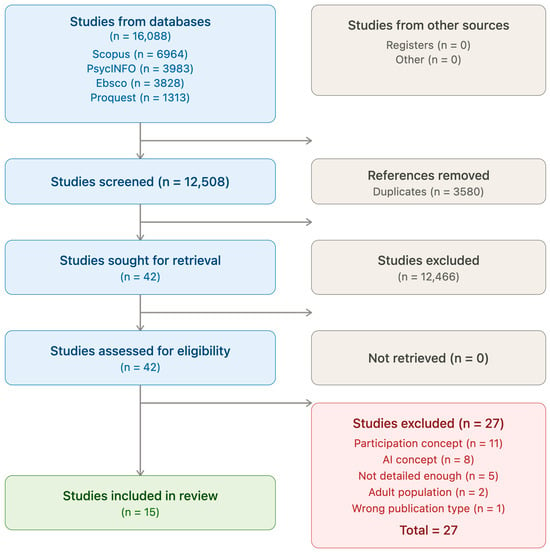
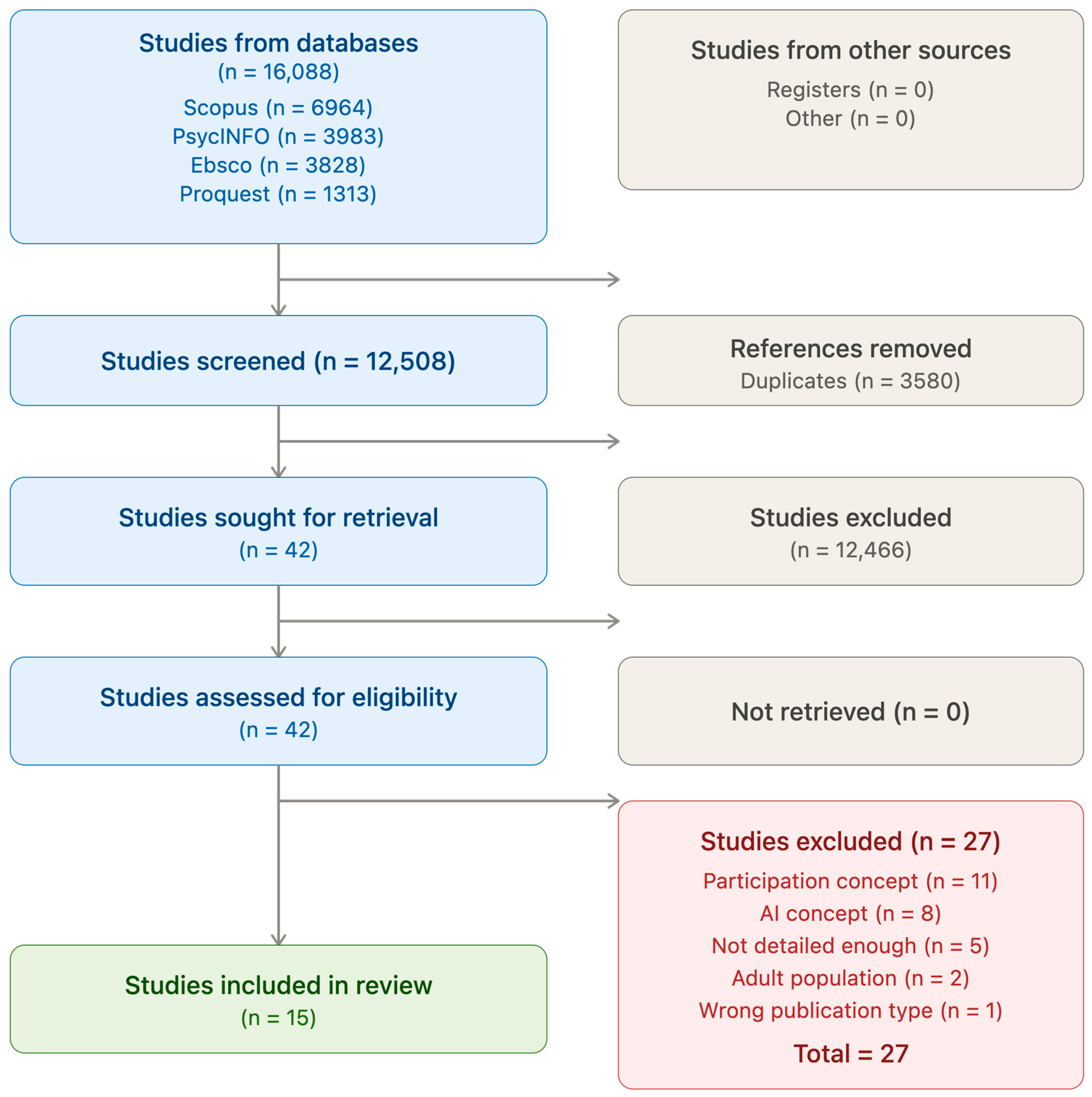

Disclaimer/Publisher’s Note: The statements, opinions and data contained in all publications are solely those of the individual author(s) and contributor(s) and not of MDPI and/or the editor(s). MDPI and/or the editor(s) disclaim responsibility for any injury to people or property resulting from any ideas, methods, instructions or products referred to in the content. |
© 2026 by the authors. Licensee MDPI, Basel, Switzerland. This article is an open access article distributed under the terms and conditions of the Creative Commons Attribution (CC BY) license.