


Abstract
The aim of this study was to examine the impact of mother’s and father’s joint parenting on young adult mental health outcomes, and to explore the impact of sex, personality and family structure in observed relationships. Two hundred and forty-five Northern Irish university students (mean age 21.11 years, SD 2.70, 66% female, 94% white) completed the Measure of Parental Style (MOPS) to measure perception of maternal and paternal indifference, overcontrol and abuse. Mental health was assessed using measures of alcohol misuse, depression and anxiety. Moderators included personality, sex and family structure. Cluster analysis revealed three parenting clusters indicative of positive parenting, negative fathering, and negative mothering. Negative parenting by either parent was associated with higher depression, regardless of sex or family structure. We found some evidence of a buffering effect of negative fathering in the context of good enough parenting from the mother, in that negative parenting from the mother, and not the father, was associated with anxiety symptoms and with earlier drinking in females. The impact of negative parenting by either parent was particularly pronounced in young people who displayed high levels of punishment sensitivity. These results highlight the importance of both parents in the preservation of mental health through to adulthood, regardless of whether they remain together. They also argue for family-focused care in the management of youth mental health.
1. Introduction
Healthy attachment during development is important for adult mental health outcomes and requires the provision of a safe environment as well as a secure base for exploration (Bowlby, 1979). Traditionally, the view is that the mother provides a haven, whilst the father encourages appropriate risk-taking and secure exploration. The more important question to ask is what the combined effect of mother and father parenting styles is, as that is what aligns more closely with real experiences (Kuppens & Ceulemans, 2019). This approach has the advantage of considering additive and potential compensatory effects on child mental health outcomes. Some studies have found evidence of congruence in the parenting styles of mothers and fathers, possibly reflecting assortative mating processes (Larsen & Buss, 2010), or through a process of mutual influence over time (Simons & Conger, 2007). Other studies have found evidence of a buffering effect of positive parenting by one parent on the impact of negative parenting on the part of the other parent (Elder & Caspi, 1988; McKinney & Renk, 2008).
Cluster analysis techniques identify naturally occurring groups or clusters of participants based on similarity of responses to a set of variables, rather than classifying participants based on some cut-off score on a questionnaire (Kuppens & Ceulemans, 2019). Heberle et al. (2015) called this the ‘person-orientated’ approach, because the aim is to discover the naturally occurring divisions within a sample based on the variables, and the patterns they form within groups of individuals. Lee et al. (2006) suggested pattern-based interpretation may increase the utility of parenting measures by capturing potentially interactive effects inherent in the patterns. Several recent studies have used cluster analyses to determine parenting profiles and have largely been successful in identifying parenting types that correspond to theoretical typologies such as Baumrind’s (1991) authoritative (warm and appropriate control), authoritarian (over control and low warmth) and ‘good enough’ (moderate control and warmth) parenting styles, and reported similarities and differences between mothers and fathers (Martin et al., 2007; McKinney & Renk, 2008; Meteyer & Perry-Jenkins, 2009; Kocayörük et al., 2015; Kuppens & Ceulemans, 2019; McKinney et al., 2020).
In terms of the impact on child mental health outcomes, the research is largely consistent with theoretical models in that two supportive parents are better for mental health outcomes for children (Martin et al., 2007; Kuppens & Ceulemans, 2019), adolescents (Kocayörük et al., 2015), and young adults (McKinney & Renk, 2008; McKinney et al., 2020) than unsupportive parents. Where incongruent parent profiles have emerged, e.g., a supportive mother/unsupportive father, the evidence is somewhat inconsistent and may be dependent upon the age of the children and/or the outcomes that are assessed. Kocayörük et al. (2015) reported that a supportive mother/unsupportive father conferred little advantage in terms of well-being and autonomy for adolescents compared to a profile with two unsupportive parents, indicating a key role for the father on adolescent outcomes. In their sample of parents of 2-year-olds, Martin et al. (2007) found that cognitive outcomes for children were similar, regardless of which parent was supportive. Nelson et al. (2011) examined the impact of mothers’ and fathers’ parenting separately and found that regardless of parent gender, positive (authoritative) parenting was linked to positive mental health outcomes, whilst dysfunctional (negative) parenting was associated with negative outcomes in emerging adulthood.
Psychological theory recognizes that healthy human development involves complex and dynamic interactions between the person and his or her environment. Bronfenbrenner and Morris (2007) proposed the Person, Process, Context and Time (PPCT) model of human development and argued that ‘proximal processes’—that is, the interactions with people and objects in one’s environment—are the primary engines of development. The parenting one receives can be understood as a fundamental proximal process that, in turn, interacts with the person characteristics, the context in which one grows up, and time. Person characteristics include things like age, gender, and personality. Despite the availability of data on gender, for example, the number of studies on parenting that examine the differential impact of parenting on males and females separately is limited, but research suggests there may be differential effects. Yang et al. (2023) reported that adolescent boys were more responsive to paternal warmth, whereas girls were more responsive to maternal warmth. Finan et al. (2018) also found that positive communication with fathers in adolescence was shown to be predictive of sons’ but not daughters’ depressive symptoms in young adulthood. Similar to the present study, McKinney et al. (2020) used cluster analysis to identify joint parenting styles, and found that more aggressive parenting was associated with more internalizing and externalizing outcomes. The lack of parenting style by gender interaction suggested the impact of joint parenting, in the context of conflict resolution, was the same for both males and females. Understanding of the differential effects of mother and father’s parenting on young adult outcomes is limited by the lack of studies in this age group. Furthermore, the comparison of studies that examine joint parenting to studies that compare the impact of mother and father separately is necessarily limited given the evidence of potential buffering effects of one positive parent in the context of harsh parenting by the other (Elder & Caspi, 1988; McKinney & Renk, 2008).
That parenting and child temperament interact is now widely accepted (Kochanska et al., 2007), yet most studies on the impact of parenting on youth outcomes fail to include such measures in their examination of parenting influences on child outcomes. We attempted to address this by exploring potential interactive effects between parenting and individual differences in personality on youth outcomes. The measure of personality we employed was conceptualized by Gray and McNaughton’s (2000) Reinforcement Sensitivity Theory which proposes the Behavioral Inhibition System (BIS) and the Behavioral Activation System (BAS) as key components of individual differences in personality. According to this theory, individuals characterized by higher BIS are understood to be sensitive to aversive consequences and punishment, whereas people high in BAS are characterized by responding to cues of reward, escape and avoidance. Greater BIS, or punishment sensitivity, has been suggested as reflecting greater propensity toward anxiety disorders (Carver & White, 1994), and as such, these children would be expected to suffer more from harsh parenting environments. Greater sensitivity to reward has been invoked to explain risk-taking behaviors such as alcohol and drug use (Bijttebier et al., 2009). Again, these traits might be expected to be more pronounced in children who seek out a means of escaping the harsh environment of hostile parenting, in favor of more immediate rewards. In this study, we will examine whether expected associations between higher BIS and internalizing symptoms, and higher BAS and externalizing problems, are indeed moderated by the parenting environment.
Much previous parenting research only includes participants from two-parent families despite increasing numbers of children growing up in single-parent families. In Northern Ireland, 25% of children live with a lone parent, and in most cases (94%), it is the father who is absent (NISRA, 2023). Fathers can continue to be present and supportive after leaving the family home and, in doing so, can benefit the child’s outcomes even in cases of marital conflict (Elam et al., 2016). That children of divorced/separated parents fare less well than children from intact families is well researched (Amato, 2005), and it has been argued that these poor outcomes are more strongly associated with factors such as parental conflict and reduced socioeconomic status (Lucas et al., 2013), rather than parental separation per se. Elder and Caspi (1988) in their classic study on children from the great depression, for example, showed how the cycle from economic hardship to increased interparental conflict can impact parenting practices through increased parental stress and reduced emotional availability for children.
Compared to other developmental periods, there is a paucity of studies examining the impact of joint parenting on the mental health of young adults. Focusing on this period allows us to examine the cumulative effects of parenting, and how a young adult’s perception of their upbringing continues to exert an ongoing influence on their mental health. Arnett et al. (2014) coined the term ‘emerging adulthood’ to represent the period between the end of adolescence, at age 18 years, and stable adulthood at age 29 years. They highlight how in developed countries in particular, the adoption of adult-like responsibilities has extended greatly in recent decades, and this is a period of considerable instability that is conceptually distinct from adolescence. It might be expected therefore, that parental influences that impact mental health during this period would represent a more serious challenge to lifelong mental health, as it could impact their ability to negotiate their way through higher education, early career and securing a romantic partner, hence their ability to build a strong foundation for adult life (Arnett, 2000; Otto et al., 2021).
This research relies on young people’s perceptions of the parenting they received whilst growing up, which is important because research suggests that it is perception of parenting that is important for negative outcomes (Bosco et al., 2003; Young et al., 2011). Furthermore, the consistency between parent self-report and child-report on parenting increases with age of the child (Korelitz & Garber, 2016) and in young adulthood is considered a more accurate predictor of parenting practices than parental reports (Cho et al., 2020).
Given our focus on mental health outcomes, we examined the negative aspects of parenting, as it is high levels of abuse, indifference and overcontrol that have previously been shown to be predictive of such. Our first hypothesis stated that parenting clusters indicative of greater dysfunction would be associated with more internalizing (anxiety and depression) and externalizing (drinking) problems in young adults. Given our sample comprised university students, elevated levels of drinking might be expected. Therefore, we also asked them to report on the age at which they first started drinking, as earlier initiation of drinking is indicative of subsequent problematic substance use (Enstad et al., 2019).
Consistent with the PPCT model of human development, we expected the impact of parenting would vary as a function of the person characteristics of the child, namely their sex and their personality. Thus, hypothesis two states an interaction between parenting and sex, and hypothesis three states an interaction between parenting and personality will be found. The PPCT model also predicts that the impact of parenting on outcomes would vary as a function of the context in which the child grows up. In this study, we examined context in relation to family structure, i.e., whether parents had separated/divorced while they were growing up. As children growing up in families where parents have separated are more likely to be characterized by parental conflict and psychosocial adversity, factors which are independently associated with poor mental health outcomes (Lucas et al., 2013; Deneault et al., 2021), hypothesis four states that an independent effect of parental separation on mental health will be found. We also tested for an interaction between parental separation status and joint parenting style on youth outcomes, but given the limited research in the area, no firm predictions were made.
2. Materials and Methods
2.1. Study Design and Participants
The study employed a cross-sectional design, with a convenience and self-selection sampling method, whereby students voluntarily opted to participate. Participants were university students who accessed a digital questionnaire hosted by Qualtrics using a QR code from advertisements posted throughout the university. Ethical approval was granted for the study by Queen’s University Belfast Research Ethics Committee (REC).
Four hundred and sixty participants accessed the study online, but after data cleaning, 195 cases were excluded due to non-response, lack of informed consent, or failure to complete the measures specific to this study. As the current study sought to examine the unique contributions of both parents, participants who reported on only one parent (n = 8) were also excluded. An additional eighteen students were over the age of thirty, leaving a final sample of 245. The participants were 161 (66%) females and 84 (34%) males, with a mean age of 21.11 (SD = 2.70). Most participants were white (94%). Thirty-eight percent of the sample (n = 100) reported parental separation or divorce whilst growing up.
2.2. Measures
Parenting Style. Participants’ perceived parenting style of the father and mother was assessed using the Measure of Parenting Style (MOPS, Parker et al., 1997). The MOPS was developed as a measure of dysfunctional parenting, and as such, all items are expressed in a negative manner. It contains fifteen items, with each item beginning with the phrase ‘During your first 16 years how “true” are the following statements about your mother/father’s behavior towards you”? The items load onto three subscales: indifference, over-control, and abuse, with higher scores indicative of a higher level of negative parenting. Total scores were computed separately for Mother and Father. Cronbach’s alpha reliability tests suggested acceptable to excellent reliability for each of the subscales (M-OCT α = 0.74, M-ABUSE α = 0.86, M-INDIFF α = 0.93, P-OCT α = 0.70, P-ABUSE α = 0.91, P-INDIFF α = 0.93).
Externalizing Problems. Alcohol misuse was measured using the Alcohol Use Disorder Identification Test (AUDIT, Babor et al., 2001). This is a self-report 10-item questionnaire that measures alcohol use in the last year, and showed acceptable reliability in our sample α = 0.68. A high score indicates more risk of alcohol problems; a score of eight or more suggests hazardous drinking. As the prevalence of substance use in young people in Northern Ireland is high, the survey also asked participants to provide their age when they first started drinking.
Internalizing Problems. The Depression, Anxiety and Stress Scale (DASS, Lovibond & Lovibond, 1995) is a twenty-one item self-report scale and was used to measure levels of depression and anxiety in the preceding week. Each subscale consisted of seven questions and was scored following the recommendation by Tran et al. (2013), by summing the score for each item and then multiplying by two. The subscales showed good and excellent reliability in our sample (Anxiety α = 0.85, Depression α = 0.91).
Reward and punishment sensitivity. The BIS/BAS scales (Carver & White, 1994) were used to assess behavioral inhibition (BIS) and behavioral activation (BAS). Participants were asked to rate twenty items on a 4-point Likert scale ranging from 1 (very false for me) to 4 (very true for me). Two of the BIS items were reversed-scored. Reliability analyses indicated excellent and good reliability, respectively (BIS α = 0.92, BAS α = 0.83). Higher scores indicated greater endorsement of punishment (BIS) and reward sensitivity (BAS). Participants were assigned to a High or Low group depending on whether BIS and BAS scores were above or below the median score for the sample.
2.3. Analysis
The data were analyzed using IBM SPSS Statistics 29, with the Essentials for Python; v23 extension. Cluster analysis was used to identify different clusters of participants’ perceived parenting style, based on their z-transformed scores on the MOPS. Initially, hierarchical cluster analysis was run using the squared Euclidean distance and Ward’s method for combining clusters. Inspection of the dendrogram and the agglomeration schedule suggested a three-cluster solution to be the best fit; therefore, a K-Means Cluster, which specified three clusters, was applied to the dataset. The three-cluster solution yielded a mean silhouette coefficient (M = 0.53), indicating good separation and cohesion among clusters. Four 3 (parenting cluster) by × 2 (sex), (BIS/BAS), and (parental separation) MANOVAs were conducted, with internalizing and externalizing problems as the dependent variables, to test for main and interaction effects. For tests of between-subject effects subsequent to each MANOVA, the Bonferroni correction was applied to p values in an attempt to limit type 1 error. As there were four dependent variables, the adjusted p value for the univariate F test was 0.025, 1-tailed, given the direction of effects, i.e., positive parenting was hypothesized to be better than negative parenting. Fisher’s Least Significant Difference (LSD) tests were conducted to further investigate significant univariate ANOVA effects, and again the Bonferroni correction was applied to the critical p value.
3. Results
3.1. Cluster Analysis
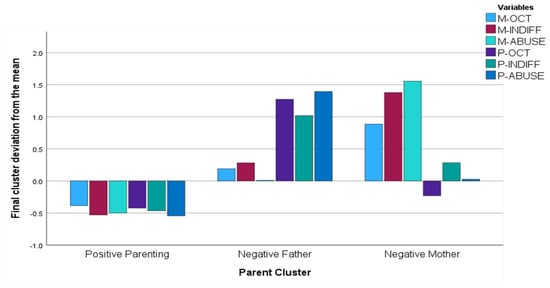
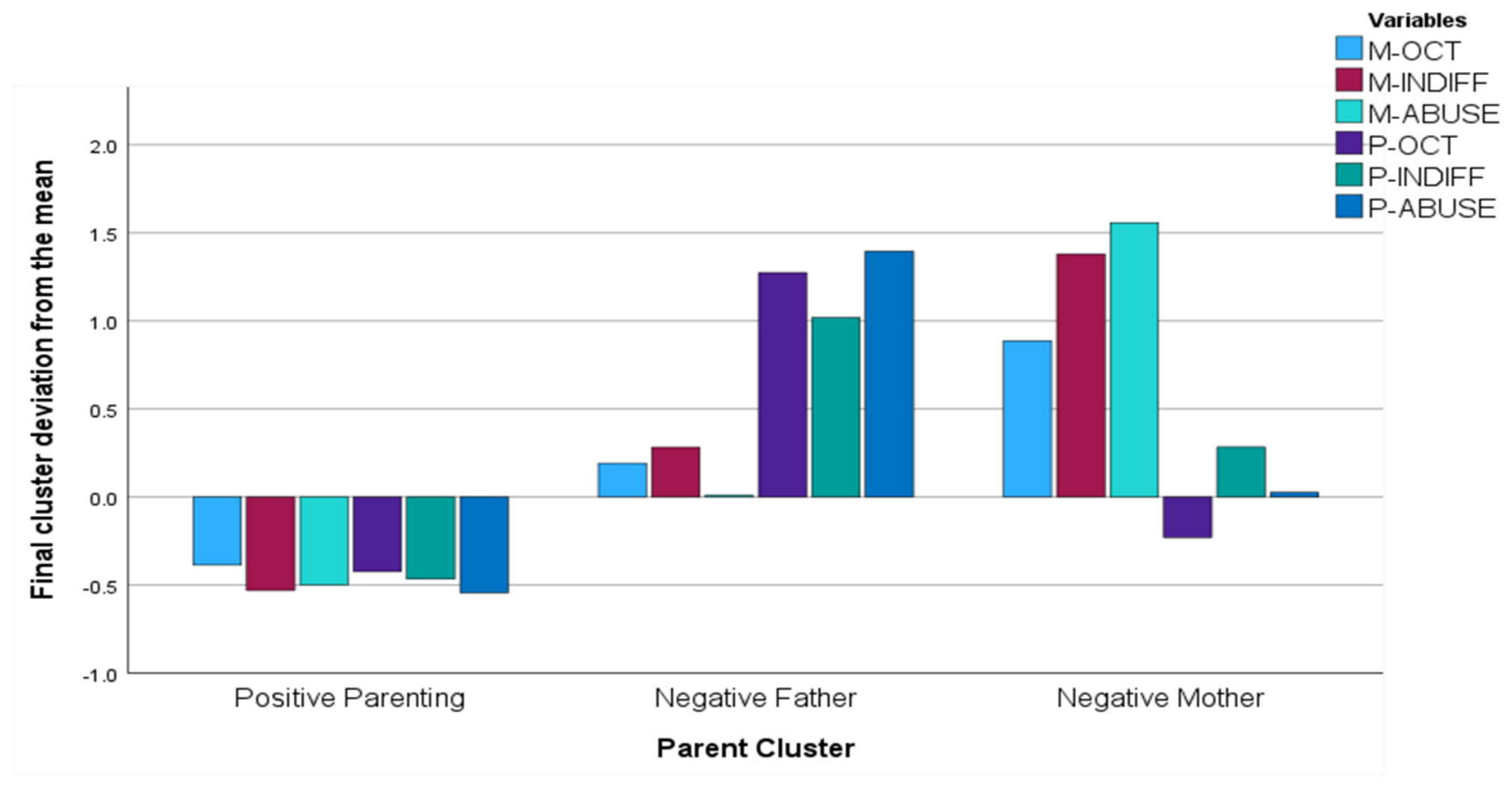
K -means cluster analysis achieved convergence after only six iterations. MANOVA with LSD post-hoc tests confirmed that between-cluster differences were significant (p < 0.001) for 5 of the 6 parenting dimensions (p < 0.001). The exception was paternal overcontrol, where differences between the positive parenting and negative mothering clusters were significant only at the trend level (mean difference= −0.24, p = 0.068).
Parenting clusters are represented graphically in Figure 1. The largest cluster contains 171 (60%) participants and is characterized by those who score both their mothers and fathers lower than average on each of the dysfunctional parenting dimensions of overcontrol, indifference and abuse. This cluster is labeled Positive Parenting (PP). The second largest cluster contains 70 (25%) participants, and they are characterized as scoring their fathers highly on overcontrol, indifference and abuse, but their mothers within the average range (<0.3 standard deviations from the mean). This cluster was labeled Negative Fathering (NF). The final cluster contains 43 (15%) participants and represents those who score their mothers highly on measures of overcontrol, indifference and abuse, but their fathers within the average range. This cluster was labeled Negative Mothering (NM).
Figure 1.
Graph showing the deviation from the mean for each of the parenting dimensions by cluster. M-OCT; Mother Overcontrol, M-INDIFF; Mother Indifference, M-ABUSE; Mother Abuse, P-OCT; Father Overcontrol, F-INDIFF; Father Indifference, P-ABUSE; Father Abuse.
Chi-square analysis showed that sex was not evenly distributed among parenting clusters (χ2 = 8.87, df = 2, p < 0.012). Males and females rated their fathers more negatively than their mothers, and females were less likely than males to rate both parents positively (see Table 1).
Table 1.
Proportion of participants by parent cluster and sex, BIS and BAS category and parental separation.
3.2. Parent Cluster and Sex Effects
Table 2 presents the summary statistics for internalizing and externalizing outcomes for males and females by each of the parenting clusters. Results of a 3 (PP, NF, NM) × 2 (male, female) MANOVA with depression, anxiety, current alcohol use (AUDIT) and age at 1st drink entered as dependent variables, showed a small significant multivariate main effect for parenting cluster (F [8, 448] = 2.194, p = 0.027; Wilks’ Λ = 0.926, η2p = 0.038), a modest sex (F [4, 224] = 6.05, p < 0.001; Wilks’ Λ = 0.902, η2p = 0.098) and a small significant interaction effect (F [8, 448] = 2.697, p = 0.007; Wilks’ Λ = 0.910, η2p = 0.046), indicating a small to moderate parenting cluster effect, a moderate sex effect, and small to moderate parenting cluster by sex interaction on combined health outcomes. The interaction effect suggests the impact of parenting cluster on youth outcomes is not the same for males and females. Inspection of univariate F tests, controlling for multiple comparisons (4 dependent variables yield an adjusted p value of 0.025 (1 tailed) suggests small yet significant main effects of parenting cluster on internalizing outcomes (depression (F [2, 227] = 3.893, p = 0.022; η2p = 0.033, anxiety (F [2, 227] = 4.318, p = 0.014, η2p = 0.037), but not externalizing outcomes. Post-hoc LSD tests showed that for depression, the positive parenting cluster had significantly lower scores than the negative father (mean difference = −2.04, SE = 0.86, p = 0.018, CI [−3.7, −0.35]) and the negative mother (mean difference = −2.44, p = 0.013, CI [−0.4.4, −0.52]) clusters. For Anxiety, the positive parenting cluster showed significantly lower scores than the negative mother cluster (mean difference = −2.22, p = 0.007, CI [−0.3.8, −0.18]), but the difference in scores between the positive parenting and the negative father clusters (mean difference = −1.61, p = 0.027) failed to reach significance at the adjusted critical p value of 0.025. There were no significant differences between the negative father and the negative mother group for anxiety or depression scores.
Table 2.
Summary statistics for youth outcomes by parenting cluster and child sex.
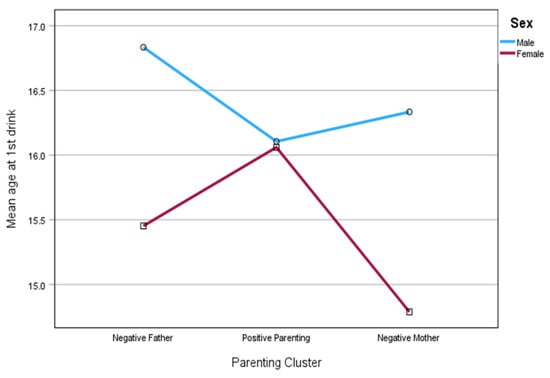
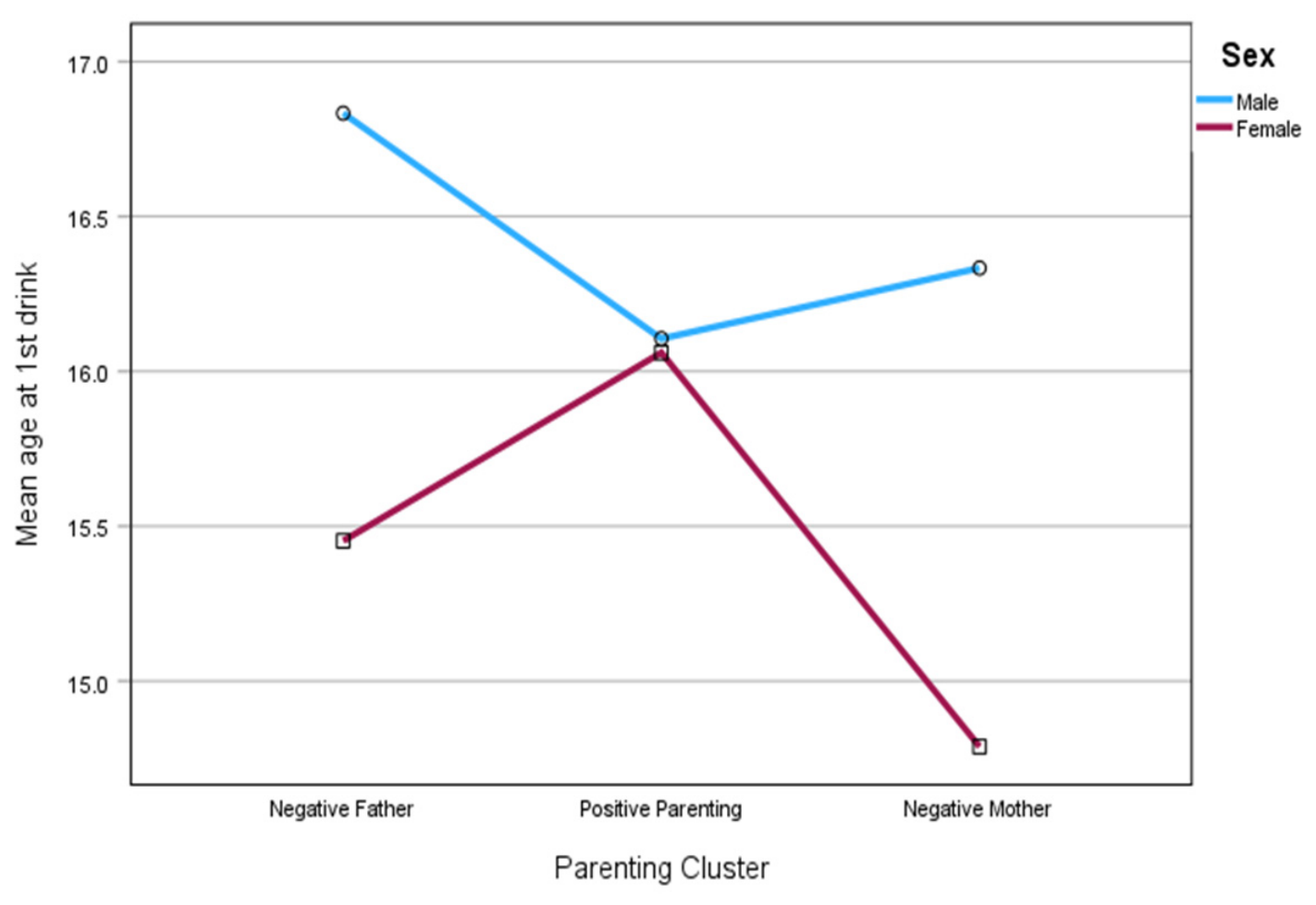
The main effect of sex or the parenting cluster by sex interaction was not significant for either depression or anxiety, suggesting no difference between males’ and females’ scores, and that the impact of dysfunctional parenting on internalizing symptoms was similar for males and females. Results for externalizing problems present a more complicated picture. Results of between-subject effects of sex were small but significant for current alcohol use (F [1, 227] = 7.71, p = 0.006, η2p = 0.033); males had higher scores, and age at 1st drink (F [1, 227] = 11.10, p = 0.001, η2p = 0.047); females started drinking younger. The parenting cluster by sex interaction for Age 1st drink (F [2, 227] = 4.14, p = 0.017, η2p = 0.035) was significant, but for AUDIT score, it failed to meet the threshold of significance at the adjusted critical p value (0.052). To illustrate the interaction between parenting cluster and age at 1st drink more clearly, separate ANOVAs were run for males and females on age at 1st drink. Results showed that the effect of parenting cluster was modest and significant only for females (F [2, 172] = 8.75, p < 0.001, η2p = 0.092). Post-hoc LSD tests show that females in the negative mother cluster began drinking at a significantly younger age than those in the positive parenting cluster (mean difference = −1.25, p < 0.001, CI [−1.86, −0.65]), but the difference in the positive parenting cluster and the negative father cluster (mean difference = −0.73, p = 0.035) failed to reach significance at the corrected critical p value. This is depicted graphically in Figure 2.
Figure 2.
Graph showing the age at 1st drink for males and females by parenting cluster.
3.3. Personality and Personality × Parenting Interactions
Next, we examined the potential moderating role of punishment sensitivity (low/high BIS) or reward sensitivity (low/high BAS) on the relation between joint parenting style and outcomes. Chi-square analysis showed no significant difference in the proportion of high BIS or BAS participants in any of the parenting clusters (Table 3).
Table 3.
Summary statistics for youth outcomes by parenting cluster and Behavioural Inhibition Score (BIS).
Mean scores on outcomes for high and low BIS and BAS by parenting cluster and BIS and BAS are presented in Table 3 and Table 4. Two separate MANOVAs were run to test for main and interactive effects of BIS and BAS separately. Results showed a moderate multivariate effect for BIS (F [4, 224] = 9.34, p < 0.001; Wilks’ Λ = 0.856, η2p = 0.14), and a small yet significant BIS × parenting cluster interaction (F [8, 448] = 2.18, p = 0.028; Wilks’ Λ = 0.926, η2p = 0.038) on combined outcomes. Univariate F tests showed the main effect of BIS was significant only for internalizing problems, with a small effect for depression (F [1, 227] = 10.02, p = 0.002, η2p = 0.04), and a moderate effect on anxiety (F [1, 227] = 24.33, p < 0.001, η2p = 0.10). High-BIS-scoring participants showed higher depression and anxiety scores. The interaction between parenting cluster and BIS and depression or anxiety was not significant. The multivariate main effect of BAS and the BAS x parenting cluster interaction effect was not significant, nor were any of the univariate F tests.
Table 4.
Summary statistics for youth outcomes by parenting cluster and Behavioural Activation Score (BAS).
3.4. Family Structure and Family Structure × Parenting Interactions
Family structure was indicated by the parental separation variable. Those participants whose parents were not separated were more likely to rate both parents positively, and less likely to rate either parent negatively (see Table 1). Chi-square confirmed this difference to be significant (χ2 = 29.12, df = 2, p < 0.001). To test if parental separation had a significant effect on youth mental health outcomes and whether parental separation moderated the relationship between parenting type and youth outcomes, a final 3 (Parent Cluster; PP, NF, NM) × 2 (Parental Separation; Yes/No) MANOVA was run. Results showed a small but significant main effect for parental separation (F [4, 218] = 2.95, p < 0.021; Wilks’ Λ = 0.949, η2p = 0.21), but univariate tests showed this was significant only for age at 1st drink (F [1, 221) = 7.51, p = 0.00 η2p = 0.33). Participants whose parents separated while they were growing up were more likely to start drinking earlier than those whose parents stayed together. The lack of a significant parenting cluster by parental separation interaction suggests that the effect of parenting type on participants’ earlier initiation of alcohol use was the same regardless of whether their parents had separated when they were growing up.
4. Discussion
This study examined the impact of parenting on emerging adult mental health outcomes, and whether this was moderated by their sex, personality, or context, as predicted by the PPCT model of human development (Bronfenbrenner & Morris, 2007). Joint parenting styles were empirically derived using cluster analysis methods on youth-reported perceptions of dysfunctional parenting during childhood and adolescence. Sixty percent of participants rated both parents’ behavior towards them as positive, but significant numbers also perceived either their father (25%) or their mother (15%) as having displayed elevated levels of indifference, overcontrol and abuse while they were growing up. Participants who reported dysfunctional parenting by their mother or father showed increased depression, but for anxiety this difference was only significant when comparing the positive parenting and negative mother group. The impact on depression was more pronounced in those with a personality indicative of high punishment sensitivity, but was the same regardless of whether their parents had separated while they were growing up. For externalizing problems, there was evidence of moderation by child sex in that dysfunctional parenting by either parent was associated with earlier drinking by females only, but this was particularly pronounced where negative mothering was reported.
Cluster analysis was applied to identify the overall pattern or profile of parenting behaviors experienced by our participants. We adopted the k-means method as it minimizes within-cluster variability and maximizes between-cluster variability (Gore, 2000). Like the method used by Heberle et al. (2015), initial cluster centers were pre-specified as those obtained using Ward’s algorithm to avoid order effects from the use of random centers. Convergence was achieved after only six iterations, and average silhouette indices suggest stability of, and good separation between, the clusters. Furthermore, using LSD, we compared cluster center differences on each of the original measures of parental style (MOPS) variables and found that they were all significantly different from each other, except for the variable Parental overcontrol, which was significant only at trend level. We are confident, therefore, that the identified clusters are valid and represent distinct patterns of parenting behaviors as rated by the participants.
Forty percent of participants reported dysfunctional parenting by either their mother or father while they were growing up, and at a magnitude of more than one standard deviation above average levels of abuse, indifference and overcontrol. In the dysfunctional mother group, reported abuse and indifference levels were particularly high. When considering the sample was drawn from a normally developing group of university students, this is unexpected. The MOPS parenting measure asks participants to focus on the negative, rather than the positive aspects of their parenting experiences; therefore, it is possible this inflated the scores. However, in a comparable study where young adults reported on their parents retrospectively, McKinney and Renk (2008) reported similar rates of negative parenting, despite exploring both positive and negative aspects of parenting.
Despite the use of different parenting measures across studies, sufficient research allows us to make comparisons based more on the more broadly defined criteria of positive versus negative parenting. In this study, more fathers (25%) than mothers (15%) were rated negatively in terms of their deployment of dysfunctional parenting whilst growing up. This is consistent with research with similarly aged samples (McKinney & Renk, 2008; Nelson et al., 2011). Nelson et al. (2011) also studied emerging adults and found that mothers were most often rated as positive (authoritative), whereas the fathers were most often rated as average. Like McKinney and Renk (2008), we also found evidence that females were more likely to rate their parents more negatively than males. These findings might be considered as indicating that parents consider that sons are better able to take care of themselves than daughters are (Holmbeck et al., 1995). It is important to caution, however, that comparisons across studies that employ different measurements of parenting that measure differing parenting constructs limit the robustness of such comparisons.
Like most studies, including those using empirically derived joint parenting profiles, we found joint positive parenting to be associated with the most favorable child outcomes, and negative parenting by either parent to be associated with the least favorable outcomes (Kuppens & Ceulemans, 2019; McKinney & Renk, 2008; Meteyer & Perry-Jenkins, 2009; McKinney et al., 2020). We examined the impact of dysfunctional parenting on both internalizing and externalizing behaviors and found that the greatest impact was on internalizing problems in emerging adulthood. Young people who reported heightened abuse, control, and indifference from either their mother or father whilst growing up, displayed significantly more internalizing symptoms in early adulthood. Like McKinney and Renk (2008) and McKinney et al. (2020), we found no evidence that this was moderated by child sex; the impact of dysfunctional parenting on internalizing problems was the same for sons and daughters. Follow-up tests for differences between parenting clusters found no evidence of differential effects for either mother or father on depression scores; participants in either the negative mother or a negative father cluster were detrimental to depression scores. The lack of a significant difference between positive parenting and negative father cluster on anxiety scores, however, suggests that having a negative mother is more detrimental than having a negative father on anxiety symptoms. McKinney and Renk (2008) also reported a buffering effect of a positive mother in the context of a negative father in terms of internalizing symptoms, but comparisons across these studies are limited given the differing approaches to quantifying internalizing problems adopted.
Surprisingly, we found no evidence that negative parenting impacted alcohol misuse in young adulthood; rather, we found an impact on earlier age of drinking, but only in females. Subsequent LSD tests that examined differences between the different parenting clusters suggest that, similar to the impact on depressive symptoms, significant differences between the negative mother cluster and the positive parenting cluster, but not between the negative father and positive parenting cluster. That is, for females only, having a negative mother, in the context of an average father, was associated with an earlier age of drinking. Females in our study started drinking at a significantly younger age than males; therefore, it is possible that for those young girls, their mothers in particular, reacted severely to this, leading subsequently to higher reports of negative parenting by females. This explanation is speculative and would require further substantiation from prospective longitudinal studies that incorporate more contextual data, particularly as the respective role of mothers and fathers continues to evolve.
Consistent with previous research, we found that individuals with high BIS, or punishment sensitivity, had more internalizing problems than low BIS participants, and BAS, or reward sensitivity, participants started drinking at a younger age than low BAS participants (Carver & White, 1994; Bijttebier et al., 2009). The BAS effect on age at drinking was not significant, however, once the critical p value was corrected for multiple comparisons. We found that the impact of punishment sensitivity on depression symptoms was moderated by the perception of how they were parented whilst growing up, but again, this was not significant after controlling for multiple comparisons. Exploratory post-hoc inspection of the data suggests the interaction is driven by the advantage of joint positive parenting for low BIS participants only, but that this personality advantage for depression symptoms is negated by either negative fathering or negative mothering. These findings must be interpreted cautiously, however, and would require replication in larger samples given the non-significance of the findings. That individual differences in personality might moderate the association between parenting and mental health outcomes is consistent with dynamic theories of child development (Bronfenbrenner & Morris, 2007), as well as theories of differential environmental sensitivity (Pluess & Belsky, 2009; Pluess, 2015). As the study was not designed to evaluate differential sensitivity or susceptibility theory, these explanations are offered post-hoc. Our suggestive findings, however, justify more focused studies that use more sensitive measures of environmental sensitivity. Theoretically driven studies that consider relevant family and contextual variables are needed to advance our understanding of how individual characteristics interact to influence associations between parenting and mental health outcomes.
We found no evidence that parental separation moderated associations between dysfunctional parenting and youth outcomes. Consistent with previous research, we found that participants who reported their parents to have separated were more likely to report either parent as exhibiting dysfunctional parenting, and further, that they started drinking at an earlier age than those participants from two-parent homes. Current drinking, or internalizing symptoms of anxiety and depression, were not affected by parental separation, which is at odds with the body of research that suggests parental separation has long-lasting impacts on the child (Amato, 2005; Lucas et al., 2013). Our findings might be interpreted as indicating that parental separation and the consequent changes in family structure impact adolescent behavior because of the proximity of inter-parental difficulties associated with separation (Bastaits & Mortelmans, 2016), but that the impact recedes over time as the families adjust to the new arrangements. Future studies that employ longitudinal designs are needed to investigate whether the impact of parenting changes in response to changes in family structure, and whether this might continue to affect the well-being of children as they grow older.
In contrast to some other studies that have examined the parenting profiles of mothers and fathers in emerging adult populations (Nelson et al., 2011; McKinney & Renk, 2008; McKinney et al., 2020), the young adults in our study were asked to reflect on the parenting they received during their first 16 years of life. As such, our findings relate to the cumulative effects of parenting and are interpreted as indicating that their perception of such exerts an ongoing influence on their mental health in emerging adulthood. Research suggests that it is the perception of parenting that is important for negative outcomes (Bosco et al., 2003; Young et al., 2011), but given the cross-sectional nature of the research, we cannot rule out the possibility that their perceptions are influenced by the parenting they currently receive (Nelson et al., 2011). The cross-sectional design also precludes inference about causation- it is possible that those participants who experience more anxiety and depression symptoms currently are those who review their parenting experiences more negatively. Future studies that adopt a longitudinal design are required to disentangle the complex relationships between the multiple and dynamic processes that impact adult mental health.
We found female sex, parental separation, and high BAS each independently predict early age drinking, and from that we might predict that negative parenting would be particularly detrimental to adolescent girls who display high reward sensitivity and whose parents have separated. However, our sample is limited in terms of sample size, particularly in relation to the interpretation of the sex by parenting cluster interactions. Using a much larger sample of seven hundred college-aged students, McKinney et al. (2020) found that negative parenting (use of harsh discipline) was associated with externalizing problems in both males and females. Larger sample sizes would also permit the testing of 3-way interactions to evaluate whether multiple factors are additive or interactive in their impact on mental health outcomes. A further limitation of our study is that the participants were university students and, as such, the findings may not be generalizable to young people who do not go on to further education. As in many countries, university students from Northern Ireland tend to come from higher socioeconomic groups. Nevertheless, almost half of Northern Irish school leavers enter university (Norther Ireland Executive Statistics, 2022); therefore, they represent a considerable proportion of youth.
Our data indicate high levels of alcohol use in our sample of university students—an AUDIT score above 20 is the National Institute of Health and Care Excellence (NICE, 2023) cut-off score indicative of possible alcohol dependence. The cultural normalization of dangerous alcohol consumption in this population (Heather et al., 2011) may explain the juxtaposing high prevalence of dangerous alcohol consumption, and the non-significant effect of negative parenting. By contrast, evidence suggests that earlier age of drinking is becoming denormalized in Western cultures in recent decades (Caluzzi et al., 2022), and drinking under the age of 15 and 16, in the case of females in the present study, is indicative of problem behavior during adolescence (O’Dwyer et al., 2019). Consistent with studies worldwide, our sample also displayed levels of anxiety and depression symptoms, indicative of moderate levels of anxiety and depression (Ibrahim et al., 2013; McLafferty et al., 2017). In contrast to the findings of the systematic review by Ibrahim et al. (2013), we found no evidence that female students were at higher risk of anxiety or depression. As stated previously, however, our sample size is limited, especially with respect to the number of male participants. Larger, more representative, and longitudinal studies are needed to further elucidate the predictors of mental health in student populations.
Arnett et al. (2014) made a strong argument for young people in this age group- emerging adults to be considered as a distinct group in health care settings. Currently in many countries, adults aged 18 years and older are treated in adult mental health services, and they are considered legally adult, thus independent of parental care, despite the reality for many of these young people who are still heavily dependent on parental input. There is some evidence that this age group refuses mental health treatment at higher rates than adolescents or people in stable adulthood (Stroud et al., 2013). The findings from this study support the argument that the clinical management of young people’s mental health problems would benefit from family-focused care and address family dynamics. This is important even in the case of parental separation, and every effort should be made to support joint parenting after parental separation.
Our conclusions are offered tentatively, however, because of the limitations of our design, sample composition and size, and measures, as discussed above. Additionally, retrospective measures of parenting, which ask adults to recall their parenting experiences up to the age of 16, are subject to recall bias and are influenced by current mental health, such that people with anxiety or depression, for example, may recall more harsh parenting. Conversely, the results could be biased by social desirability and positivity bias, which could lead to more favorable memories being overemphasized (Baldwin et al., 2019). Retrospective measures also fail to capture the more dynamic and fluctuating nature of parenting, which changes with developmental stages. Another important limitation is that the mental health measures were also self-reported, and as such are subject to the same bias and subjectivity as the parenting measures. These reliability and validity concerns necessarily limit the strength of the conclusions to be drawn from the findings. There is a clear need for prospective longitudinal designs to establish causation and rule out the possibility that young adults currently experiencing depression or anxiety do not simply recall their childhoods more negatively. Many birth cohort studies, including the Millennium Cohort Study in the UK, and the only one to include Northern Irish Families, are well underway. Analysis of that data when participants are in the ‘emerging adult’ age range will confirm or refute the present findings. Such large-scale studies of diverse samples are necessary to confidently evaluate how multiple factors like sex, personality and joint parenting profiles interact. Future studies should expand on measures of both family and socioeconomic contextual variables, in order to more fully understand how parenting interacts with these potentially amenable factors. By doing so, tailored evidence-based parenting interventions will help mitigate the risk of mental health problems, and have the potential to help break the cycle of intergenerational effects.
To conclude, we have shown that the combined influence of both mothers and fathers continues to impact a young person’s mental health as they transition into adulthood, and further, that parental separation does not dilute the impact. An important implication of these findings is that clinical treatments for youth mental health should shift toward family-focused care rather than treating young adults solely within adult psychiatric models. Furthermore, societal and legal frameworks should make every effort to support joint positive parenting following family separations.
Author Contributions
T.R., K.M. and T.O. were responsible for the conceptualization, methodology of the study. T.R. was responsible for the data analysis and original draft preparation. C.R.: Methodology Writing—review & editing. All authors contributed to subsequent draft preparations. All authors have read and agreed to the published version of the manuscript.
Funding
This research received no external funding.
Institutional Review Board Statement
The study was conducted in accordance with the Declaration of Helsinki, and approved by the Faculty of Engineering and Physical Sciences Research Ethics Committee, Queen’s University Belfast (8 February 2018).
Informed Consent Statement
Informed consent was obtained from all subjects involved in the study.
Data Availability Statement
The data that support the findings of this study derive from a larger parent study. The data are currently unavailable as analyses within the parent study are ongoing to fulfill its primary objectives.
Conflicts of Interest
The authors have no relevant financial or non-financial interests to disclose.
References
- Amato, P. R. (2005). The impact of family formation change on the cognitive, social, and emotional well-being of the next generation. Future of Children, 15(2), 75–96. [Google Scholar] [CrossRef] [Scilit]
- Arnett, J. J. (2000). Emerging adulthood: A theory of development from the late teens through the twenties. American Psychologist, 55(5), 469–480. [Google Scholar] [CrossRef] [Scilit]
- Arnett, J. J., Zukauskiene, R., & Sugimura, K. (2014). The new life stage of emerging adulthood ate age 18–29 years: Implications for mental health. The Lancet Psychiatry, 1(7), 569–576. [Google Scholar] [CrossRef] [Scilit] [PubMed]
- Babor, T. F., Higgins-Biddle, J. C., Saunders, J. B., & Monteiro, M. G. (2001). The alcohol use disorders identification test. World Health Organization. [Google Scholar]
- Baldwin, J. R., Reuben, A., Newbury, J. B., & Danese, A. (2019). Agreement Between Prospective and Retrospective Measures of Childhood Maltreatment: A Systematic Review and Meta-analysis. JAMA Psychiatry, 76(6), 584–593. [Google Scholar] [CrossRef] [Scilit] [PubMed]
- Bastaits, K., & Mortelmans, D. (2016). Parenting as a mediator between post-divorce family structure and children’s well-being. Journal of Child and Family Studies, 25, 2178–2188. [Google Scholar] [CrossRef] [Scilit]
- Baumrind, D. (1991). The influence of parenting style on adolescent competence and substance abuse. Journal of Early Adolescence, 11, 56–95. [Google Scholar] [CrossRef] [Scilit]
- Bijttebier, P., Beck, I., Claes, L., & Vandereycken, W. (2009). Gray’s reinforcement sensitivity theory as a framework for research on personality–psychopathology associations. Clinical Psychology Review, 29(5), 421–430. [Google Scholar] [CrossRef] [Scilit] [PubMed]
- Bosco, G., Renk, K., Dinger, T., Epstein, M., & Phares, V. (2003). The connections between adolescents’ perceptions of parents, parental psychological symptoms, and adolescent functioning. Journal of Applied Developmental Psychology, 24, 179–200. [Google Scholar] [CrossRef] [Scilit]
- Bowlby, J. (1979). The Bowlby-Ainsworth attachment theory. Behavioral and Brain Sciences, 2(4), 637–638. [Google Scholar] [CrossRef] [Scilit]
- Bronfenbrenner, U., & Morris, P. A. (2007). The bioecological model of human development. In Handbook of child psychology. Wiley. [Google Scholar] [CrossRef] [Scilit]
- Caluzzi, G., Livingston, M., Holmes, J., MacLean, S., Lubman, D., Dietze, P., Vashishtha, R., Herring, R., & Pennay, A. (2022). Declining drinking among adolescents: Are we seeing a denormalization of drinking and a normalization of non-drinking? Addiction, 117(5), 1204–1212. [Google Scholar] [CrossRef] [Scilit] [PubMed]
- Carver, C. S., & White, T. L. (1994). Behavioral inhibition, behavioral activation, and affective responses to impending reward and punishment: The BIS/BAS scales. Journal of Personality and Social Psychology, 67(2), 319–333. [Google Scholar] [CrossRef]
- Cho, J., Ha, J. H., & Jue, J. (2020). Influences of the differences between mothers’ and children’s perceptions of parenting styles. Frontiers in Psychology, 11, 552585. [Google Scholar] [CrossRef] [Scilit] [PubMed]
- Deneault, A. A., Bakermans-Kranenburg, M. J., Groh, A. M., Fearon, P. R., & Madigan, S. (2021). Child-father attachment in early childhood and behavior problems: A meta-analysis. New Directions for Child and Adolescent Development, 2021(180), 43–66. [Google Scholar] [CrossRef] [Scilit] [PubMed]
- Elam, K. K., Sandler, I., Wolchik, S., & Tein, J. Y. (2016). Non-residential father–child involvement, interparental conflict and mental health of children following divorce: A person-focused approach. Journal of Youth and Adolescence, 45, 581–593. [Google Scholar] [CrossRef] [Scilit] [PubMed]
- Elder, G. H., Jr., & Caspi, A. (1988). Economic stress in life: Developmental perspectives. Journal of Social Issues, 44(4), 25–45. [Google Scholar] [CrossRef] [Scilit]
- Enstad, F., Evans-Whipp, T., Kjeldsen, A., Toumbourou, J. W., & von Soest, T. (2019). Predicting hazardous drinking in late adolescence/young adulthood from early and excessive adolescent drinking-a longitudinal cross-national study of Norwegian and Australian adolescents. BMC Public Health, 19, 790. [Google Scholar] [CrossRef] [Scilit] [PubMed]
- Finan, L. J., Ohannessian, C. M., & Gordon, M. S. (2018). Trajectories of depressive symptoms from adolescence to emerging adulthood: The influence of parents, peers, and siblings. Developmental Psychology, 54(8), 1555–1567. [Google Scholar] [CrossRef] [Scilit] [PubMed]
- Gore, P. A. (2000). Cluster analysis. In H. E. Tinsley, & S. D. Brown (Eds.), Handbook of applied multivariate statistics and mathematical modeling. Academic Press. [Google Scholar] [CrossRef] [Scilit]
- Gray, J. A., & McNaughton, N. (2000). The neuropsychology of anxiety: An enquiry into the functions of the septo-hippocampal system. Oxford University Press. [Google Scholar]
- Heather, N., Partington, S., Partington, E., Longstaff, F., Allsop, S., Jankowski, M., Wareham, H., & Gibson, A. S. C. (2011). Alcohol use disorders and hazardous drinking among undergraduates at English universities. Alcohol and Alcoholism, 46(3), 270–277. [Google Scholar] [CrossRef] [Scilit] [PubMed]
- Heberle, A. E., Briggs-Gowan, M. J., & Carter, A. S. (2015). A person-oriented approach to identifying parenting styles in mothers of early school-age children. Infant and Child Development, 24, 130–156. [Google Scholar] [CrossRef] [Scilit]
- Holmbeck, G. N., Paikoff, R. L., & Brooks-Gunn, J. (1995). Parenting adolescents. In M. H. Bornstein (Ed.), Handbook of parenting (Vol. 1., pp. 91–118). Lawrence Erlbaum. [Google Scholar] [CrossRef] [Scilit]
- Ibrahim, A. K., Kelly, S. J., Adams, C. E., & Glazebrook, C. (2013). A systematic review of studies of depression prevalence in university students. Journal of Psychiatric Research, 47(3), 391–400. [Google Scholar] [CrossRef] [Scilit] [PubMed]
- Kocayörük, E., Altıntas, E., & İçbay, M. A. (2015). The perceived parental support, autonomous-self, and well-being of adolescents: A cluster-analysis approach. Journal of Child and Family Studies, 24, 1819–1828. [Google Scholar] [CrossRef] [Scilit]
- Kochanska, G., Aksan, N., & Joy, M. E. (2007). Children’s fearfulness as a moderator of parenting in early socialization: Two longitudinal studies. Developmental Psychology, 43(1), 222–237. [Google Scholar] [CrossRef] [Scilit] [PubMed]
- Korelitz, K. E., & Garber, J. (2016). Congruence of parents’ and children’s perceptions of parenting: A meta-analysis. Journal of Youth and Adolescence, 45, 1973–1995. [Google Scholar] [CrossRef] [Scilit] [PubMed]
- Kuppens, S., & Ceulemans, E. (2019). Parenting styles: A closer look at a well-known concept. Journal of Child and Family Studies, 28(1), 168–181. [Google Scholar] [CrossRef] [Scilit] [PubMed]
- Larsen, R. J., & Buss, D. M. (2010). Personality and social Interaction. In R. J. Larsen, & D. M. Buss (Eds.), Personality psychology. Domains of knowledge about human nature (4th ed., pp. 464–491). McGraw-Hill. [Google Scholar]
- Lee, S. M., Daniels, M. H., & Kissinger, D. B. (2006). Parental influences on adolescent adjustment: Parenting styles versus par-enting practices. The Family Journal, 14, 253–259. [Google Scholar] [CrossRef] [Scilit]
- Lovibond, S. H., & Lovibond, P. F. (1995). Depression anxiety & stress scales (2nd ed.). Psychological Assessment. [Google Scholar] [CrossRef] [Scilit]
- Lucas, N., Nicholson, J. M., & Erbas, B. (2013). Child mental health after parental separation: The impact of resident/non-resident parenting, parental mental health, conflict and socioeconomics. Journal of Family Studies, 19(1), 53–69. [Google Scholar] [CrossRef] [Scilit]
- Martin, A., Ryan, R. M., & Brooks-Gunn, J. (2007). The joint influence of mother and father parenting on child cognitive outcomes at age 5. Early Childhood Research Quarterly, 22, 423–439. [Google Scholar] [CrossRef] [Scilit]
- McKinney, C., & Renk, K. (2008). Differential parenting between mothers and fathers: Implications for late adolescents. Journal of Family Issues, 29(6), 806–827. [Google Scholar] [CrossRef] [Scilit]
- McKinney, C., Walker, C. S., & Kwan, J. W. (2020). Mother–father dyad conflict strategy clusters: Implications for emerging adults. Journal of Interpersonal Violence, 35(1–2), 319–340. [Google Scholar] [CrossRef] [Scilit] [PubMed]
- McLafferty, M., Lapsley, C. R., Ennis, E., Armour, C., Murphy, S., Bunting, B. P., Bjourson, A. J., Murray, E. K., & O’Neill, S. M. (2017). Mental health, behavioral problems, and treatment seeking among students commencing university in Northern Ireland. PLoS ONE, 12(12), e0188785. [Google Scholar] [CrossRef] [Scilit] [PubMed]
- Meteyer, K. B., & Perry-Jenkins, M. (2009). Dyadic parenting and children’s externalizing symptoms. Family Relations, 58, 289–302. [Google Scholar] [CrossRef] [Scilit] [PubMed]
- National Institute for Health and Care Excellence (NICE). (2023). How should I screen for problem drinking—How to screen |diagnosis|alcohol—Problem drinking. CKS|NICE. Available online: https://cks.nice.org.uk/topics/alcohol-problem-drinking/diagnosis/how-to-screen/ (accessed on 28 June 2026).
- Nelson, L. J., Padilla-Walker, L. M., Christensen, K. J., Evans, C. A., & Carroll, J. S. (2011). Parenting in emerging adulthood: An examination of parenting clusters and correlates. Journal of Youth and Adolescence, 40, 730–743. [Google Scholar] [PubMed]
- NISRA. (2023). MS-A25 household composition: Usual residents. Available online: https://www.nisra.gov.uk/publications/census-2021-main-statistics-demography-tableshousehold-relationships (accessed on 28 June 2026).
- Norther Ireland Executive Statistics. (2022). Higher Education statistics published. The Northern Ireland Executive. [Google Scholar]
- O’Dwyer, C., Mongan, D., Millar, S. R., Rackard, M., Galvin, B., Long, J., & Barry, J. (2019). Drinking patterns and the distribution of alcohol-related harms in Ireland: Evidence for the prevention paradox. BMC Public Health, 19, 1323. [Google Scholar] [CrossRef] [Scilit] [PubMed]
- Otto, C., Reiss, F., Voss, C., Wüstner, A., Meyrose, A. K., Hölling, H., & Ravens-Sieberer, U. (2021). Mental health and well-being from childhood to adulthood: Design, methods, and results of the 11-year follow-up of the BELLA study. European Child & Adolescent Psychiatry, 30(10), 1559–1577. [Google Scholar] [CrossRef] [Scilit] [PubMed]
- Parker, G., Roussos, J., Hadzi-Pavlovic, D., Mitchell, P., Wilhelm, K., & Austin, M.-P. (1997). The development of a refined measure of dysfunctional parenting and assessment of its relevance in patients with affective disorders. Psychological Medicine, 27, 1193–1203. [Google Scholar] [CrossRef] [Scilit] [PubMed]
- Pluess, M. (2015). Individual differences in environmental sensitivity. Child Development Perspectives, 9(3), 138–143. [Google Scholar] [CrossRef] [Scilit]
- Pluess, M., & Belsky, J. (2009). Differential susceptibility to rearing experience: The case of childcare. Journal of Child Psychology and Psychiatry, 50(4), 396–404. [Google Scholar] [CrossRef] [Scilit] [PubMed]
- Simons, L. G., & Conger, R. D. (2007). Linking mother-father differences in parenting to a typology of family parenting styles and adolescent outcomes. Journal of Family Issues, 28, 212–241. [Google Scholar] [CrossRef] [Scilit]
- Stroud, C., Mainero, T., & Olson, S. (2013). Improving the health, safety, and well-being of young adults. National Academies Press. [Google Scholar] [CrossRef] [Scilit] [PubMed]
- Tran, T. D., Tran, T., & Fisher, J. (2013). Validation of the depression anxiety stress scales (DASS) 21 as a screening instrument for depression and anxiety in a rural community-based cohort of northern Vietnamese women. BMC Psychiatry, 13(1), 24. [Google Scholar] [CrossRef] [Scilit] [PubMed]
- Yang, P., Schlomer, G. L., & Lippold, M. A. (2023). Mothering versus fathering? Positive parenting versus negative parenting? Their relative importance in predicting adolescent aggressive behavior: A longitudinal comparison. Developmental Psychology, 59(1), 69–83. [Google Scholar] [CrossRef]
- Young, R., Lennie, S., & Minnis, H. (2011). Children’s perceptions of parental emotional neglect and control and psychopathology. Journal of Child Psychology and Psychiatry, 52(8), 889–897. [Google Scholar] [CrossRef] [Scilit] [PubMed]

Disclaimer/Publisher’s Note: The statements, opinions and data contained in all publications are solely those of the individual author(s) and contributor(s) and not of MDPI and/or the editor(s). MDPI and/or the editor(s) disclaim responsibility for any injury to people or property resulting from any ideas, methods, instructions or products referred to in the content. |
© 2026 by the authors. Licensee MDPI, Basel, Switzerland. This article is an open access article distributed under the terms and conditions of the Creative Commons Attribution (CC BY) license.