
Exploring the Intersectional Identities of Youth Mentees and Their Mentors in Shaping the Quality and Duration of Their Relationships

 ,
,  ,
,  ,
, 
Abstract
1. Introduction
1.1. Relationship Quality and Duration in Mentoring Programs
1.2. Mentee and Mentor Identities
1.3. Considering Intersectional Identities of Mentees and Mentors
1.4. The Current Study
- What aspects of mentee identity (i.e., gender, race, class) intersect to predict mentee-reported relationship quality and duration (i.e., mentor support)?
- What aspects of mentor identity intersect to predict mentee-reported relationship quality and duration?
- What aspects of mentor and mentee identity interact to predict mentee-reported relationship quality and duration?
2. Materials and Methods
2.1. Measures
2.1.1. Identity
2.1.2. Mentor Experiences of Poverty
2.1.3. Relationship Quality
2.2. Data Analytic Plan
3. Results
3.1. Primary Analyses
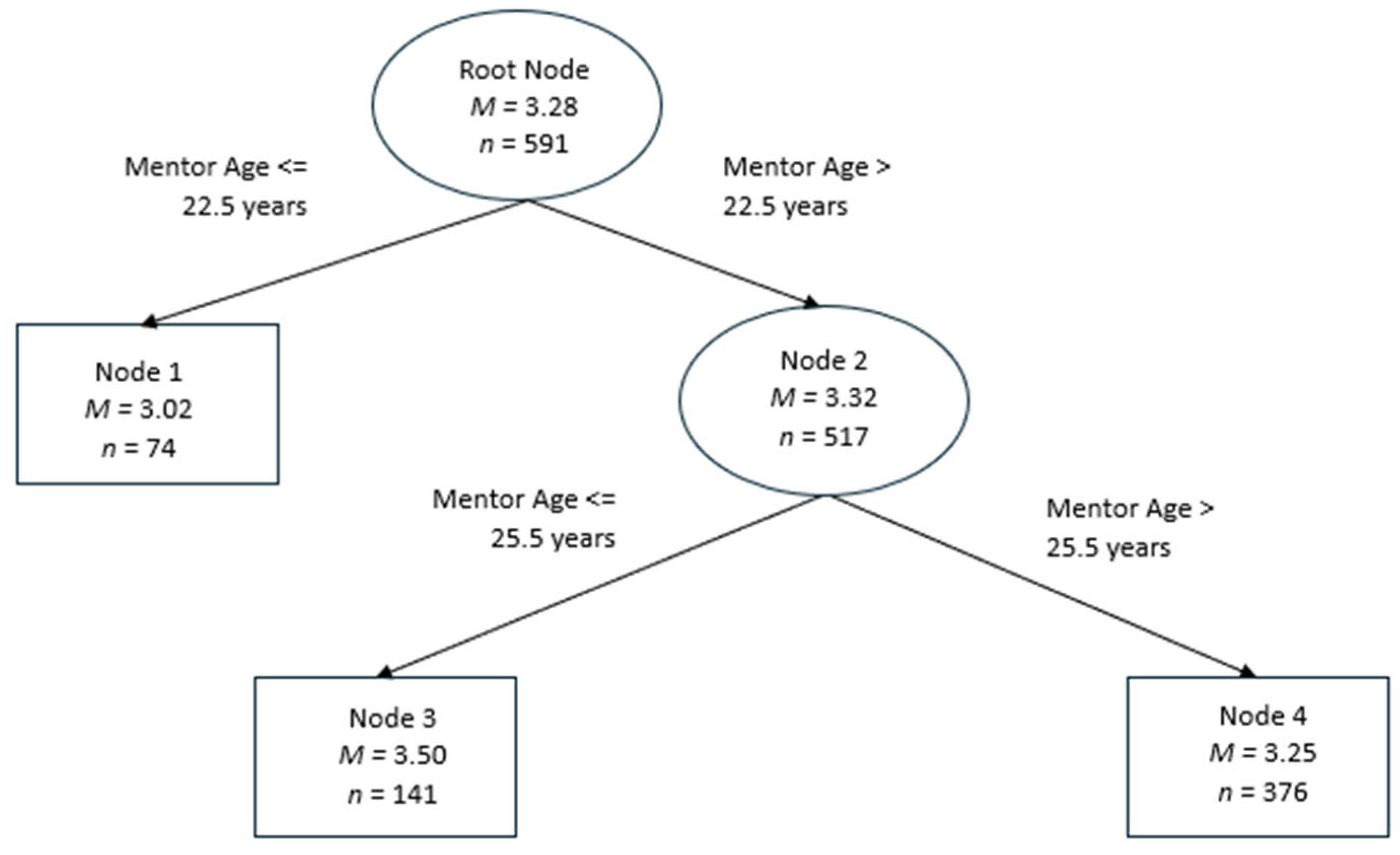
3.2. Mentor Support for Thriving
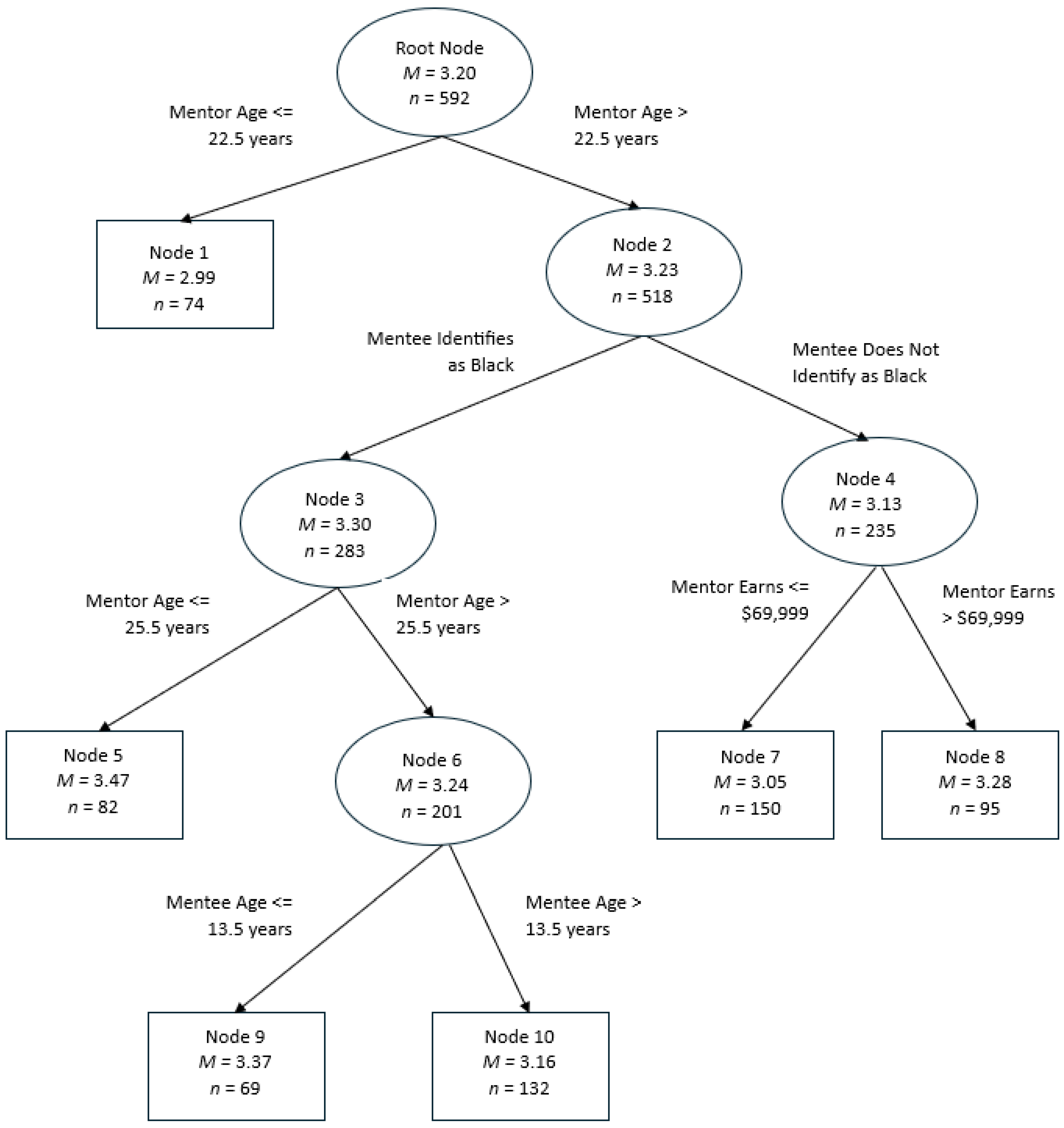
3.3. Growth-Focused Relationship
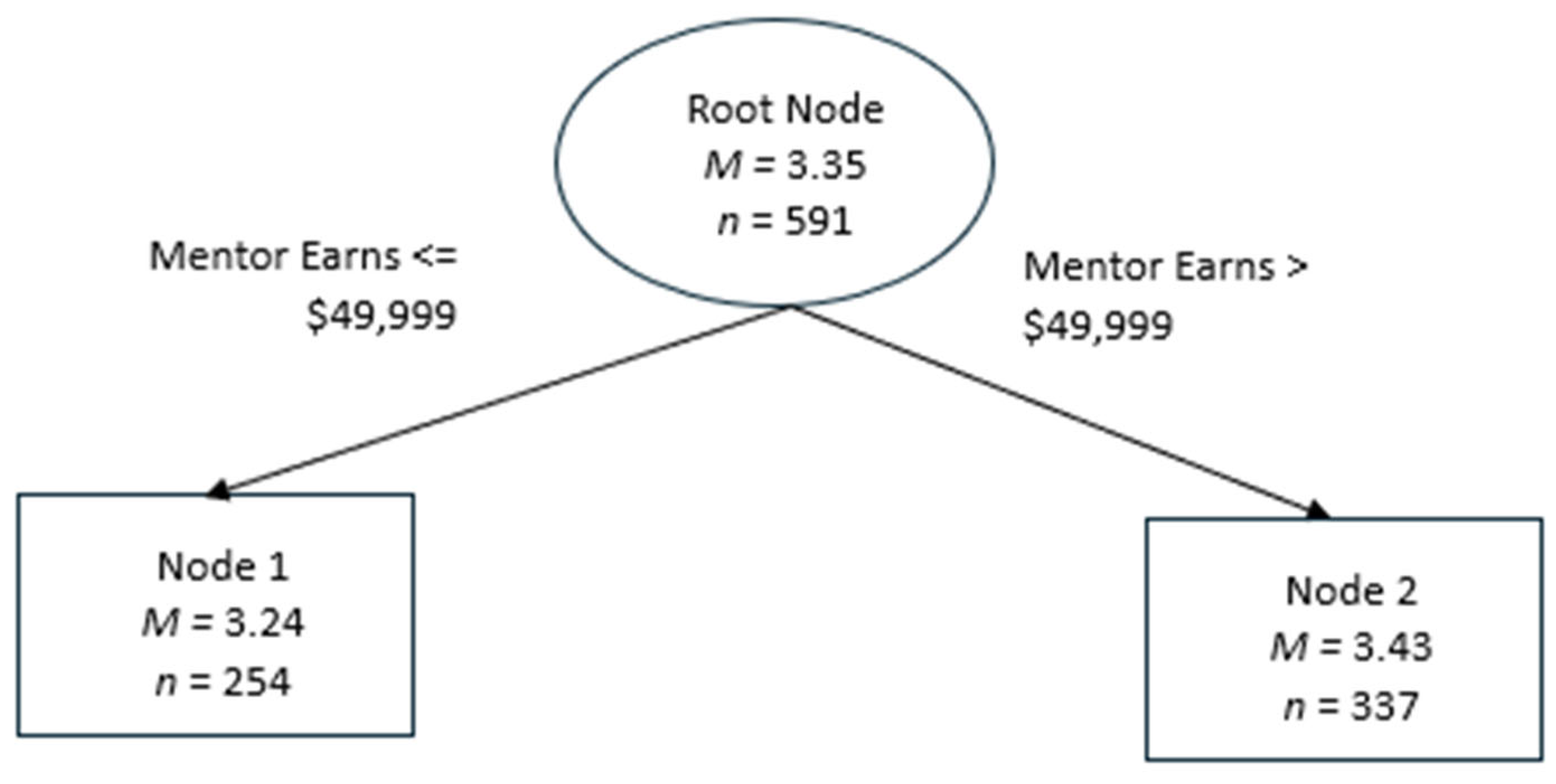
3.4. Safe Haven
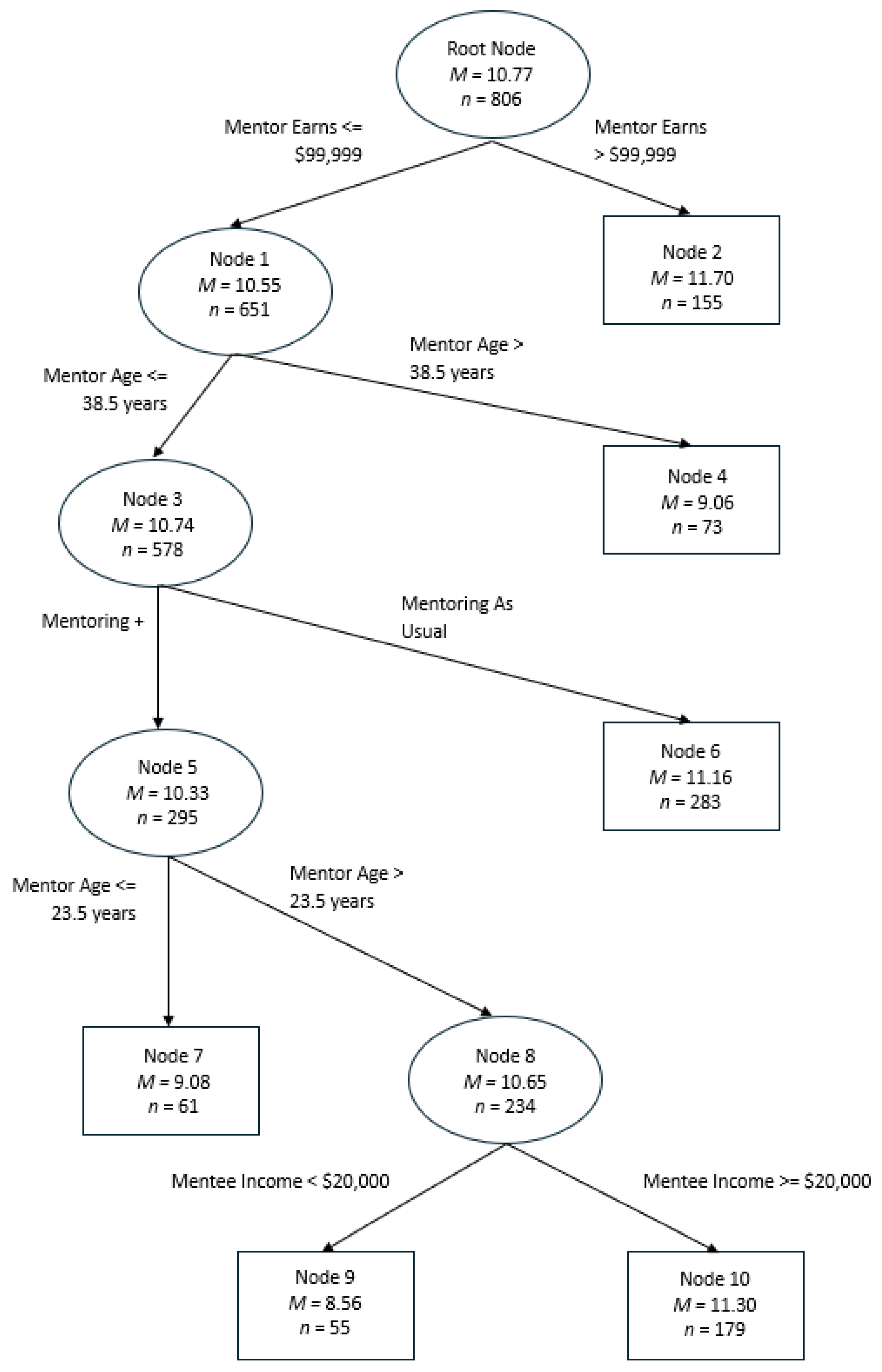
3.5. Match Length
4. Discussion
4.1. Strengths and Limitations
4.2. Future Directions
5. Conclusions
Author Contributions
Funding
Institutional Review Board Statement
Informed Consent Statement
Data Availability Statement
Acknowledgments
Conflicts of Interest
Appendix A

| Mentors | Mentees | |
|---|---|---|
| Gender | ||
| Female | 63.4% | 61.9% |
| Male | 36.6% | 38.0% |
| Race | ||
| Black/African American | 14.5% | 50.5% |
| White | 58.3% | 9.7% |
| Hispanic | 2.9% | 27.9% |
| More than One Race | 19.4% | 9.4% |
| Other Race | 4.1% | 2.5% |
| Income—Mentee * | ||
| Less than $10,000 | 11.3% | |
| $10,000 to $14,999 | 5.0% | |
| $15,000 to $19,999 | 3.6% | |
| $20,000 to $24,999 | 5.8% | |
| $25,000 to $29,999 | 3.5% | |
| $30,000 to $34,999 | 3.6% | |
| $35,000 and over | 5.2% | |
| Income—Mentor * | ||
| Under $20,000 | 11.4% | |
| $20,000 to $49,999 | 31.0% | |
| $50,000 to $69,999 | 22.1% | |
| $70,000 to $99,999 | 14.6% | |
| $100,000 or more | 19.1% | |
| α | M | SD | 1 | 2 | 3 | 4 | 5 | 6 | |
|---|---|---|---|---|---|---|---|---|---|
| 1. Coping | 0.91 | 4.28 | 1.04 | ||||||
| 2. Thriving | 0.96 | 3.28 | 0.83 | 0.74 | |||||
| 3. Growth Focus | 0.89 | 3.20 | 0.72 | 0.70 | 0.80 | ||||
| 4. Youth Center | 0.89 | 3.49 | 0.65 | 0.67 | 0.78 | 0.78 | |||
| 5. Safe Haven | 0.88 | 3.35 | 0.80 | 0.75 | 0.75 | 0.82 | 0.77 | ||
| 6. Match Length * | ---- | 11.68 | 4.51 | 0.27 | 0.32 | 0.30 | 0.31 | 0.29 |
References
- Albright, J. N., Hurd, N. M., & Hussain, S. B. (2017). Applying a social justice lens to youth mentoring: A review of the literature and recommendations for practice. American Journal of Community Psychology, 59(3–4), 363–381. [Google Scholar] [CrossRef] [PubMed]
- Bauer, G. R., Mahendran, M., Walwyn, C., & Shokoohi, M. (2022). Latent variable and clustering methods in intersectionality research: Systematic review of methods applications. Social Psychiatry and Psychiatric Epidemiology, 57(2), 221–237. [Google Scholar] [CrossRef] [PubMed]
- Cassidy, J., & Woodhouse, S. (2003). The secure base scale–revised [Unpublished manuscript]. University of Maryland.
- Chandra, K. (2006). What is ethnic identity and does it matter? Annual Review of Political Science, 9(1), 397–424. [Google Scholar] [CrossRef]
- Crenshaw, K. (1990). Mapping the margins: Intersectionality, identity politics, and violence against women of color. Stanford Law Review, 43, 1241. [Google Scholar]
- Cronk, B. C. (2024). How to use SPSS®: A step-by-step guide to analysis and interpretation (12th ed.). Routledge. [Google Scholar] [CrossRef]
- Cross, W., Seaton, E., Yip, T., Lee, R., Rivas, D., Gee, G., Roth, W., & Ngo, B. (2017). Identity work: Enactment of racial-ethnic identity in everyday life. Identity, 17(1), 1–12. [Google Scholar] [CrossRef]
- Deutsch, N. L., & Spencer, R. (2009). Capturing the magic: Assessing the quality of youth mentoring relationships. New Directions for Youth Development, 2009(121), 47–70. [Google Scholar] [CrossRef] [PubMed]
- DeWit, D. J., DuBois, D., Erdem, G., Larose, S., & Lipman, E. L. (2016). The role of program-supported mentoring relationships in promoting youth mental health, behavioral and developmental outcomes. Prevention Science, 17(5), 646–657. [Google Scholar] [CrossRef] [PubMed]
- DuBois, D. L., & Karcher, M. J. (2014). Handbook of youth mentoring. SAGE Publications, Inc. [Google Scholar] [CrossRef]
- DuBois, D. L., & Keller, T. E. (2017). Investigation of the integration of supports for youth thriving into a community-based mentoring program. Child Development, 88(5), 1480–1491. [Google Scholar] [CrossRef] [PubMed]
- DuBois, D. L., Portillo, N., Rhodes, J. E., Silverthorn, N., & Valentine, J. C. (2011). How effective are mentoring programs for youth? A systematic assessment of the evidence. Psychological Science in the Public Interest, 12, 57–91. [Google Scholar] [CrossRef] [PubMed]
- Garringer, M., McQuillin, S., & McDaniel, H. (2017). Examining youth mentoring services across America: Findings from the 2016 national mentoring program survey. MENTOR. [Google Scholar]
- Gaylord-Harden, N., Barbarin, O., Tolan, P., Murry, V., & Gaylord-Harden, N. (2018). Understanding development of African American boys and young men: Moving from risks to positive youth development. The American Psychologist, 73(6), 753–767. [Google Scholar] [CrossRef] [PubMed]
- Gaylord-Harden, N., Ragsdale, B., Mandara, J., Richards, M., & Petersen, A. (2007). Perceived support and internalizing symptoms in African American adolescents: Self-Esteem and ethnic identity as mediators. Journal of Youth and Adolescence, 36(1), 77–88. [Google Scholar] [CrossRef]
- Goldner, L., & Ben-Eliyahu, A. (2021). Unpacking community-based youth mentoring relationships: An integrative review. International Journal of Environmental Research and Public Health, 18(11), 5666. [Google Scholar] [CrossRef] [PubMed]
- Gowdy, G., Palmer, M. T., Saastamoinen, M., & Rivera, M. (2024). Using a social work perspective to understand contextual factors impacting access to informal mentorship for under-resourced and minoritized youth. Child and Adolescent Social Work Journal, 41(1), 1–14. [Google Scholar]
- Grossman, J. B., Chan, C., Schwartz, S. E. O., & Rhodes, J. E. (2012). The test of time in school-based mentoring: The role of relationship duration and re-matching on academic outcomes. American Journal of Community Psychology, 49, 43–54. [Google Scholar] [CrossRef] [PubMed]
- Grossman, J. B., & Rhodes, J. E. (2002). The test of time: Predictors and effects of duration in youth mentoring programs. American Journal of Community Psychology, 30, 199–206. [Google Scholar] [CrossRef] [PubMed]
- Heath, R. D., Anderson, C., Turner, A. C., & Payne, C. M. (2022). Extracurricular activities and disadvantaged youth: A complicated—But promising—Story. Urban Education, 57(8), 1415–1449. [Google Scholar] [CrossRef]
- Herrera, C., DuBois, D. L., & Grossman, J. B. (2013). The role of risk: Mentoring experiences and outcomes for youth with varying risk profiles. A Public Project Distributed by MDRC. Bill & Melinda Gates Foundation. [Google Scholar]
- Herrera, C., Grossman, J. B., Kauh, T. J., Feldman, A. F., & McMaken, J. (2007). Making a difference in schools: The big brothers big sisters school-based mentoring impact study. Public/Private Ventures. [Google Scholar]
- Herrera, C., Grossman, J. B., Kauh, T. J., & McMaken, J. (2011). Mentoring in schools: An impact study of big brothers big sisters school-based mentoring. Child Development, 82, 346–361. [Google Scholar] [CrossRef] [PubMed]
- Herrera, C., Kauh, T. J., Cooney, S. M., Grossman, J. B., & McMaken, J. (2008). High school students as mentors: Findings from the big brothers big sisters school-based mentoring impact study. Public/Private Ventures. [Google Scholar]
- Holt, L. J., Bry, B. H., & Johnson, V. L. (2008). Enhancing school engagement in at-risk, urban minority adolescents through a school-based, adult mentoring intervention. Child & Family Behavior Therapy, 30(4), 297–318. [Google Scholar] [CrossRef]
- Jones, K., Parra-Cardona, R., Sánchez, B., Vohra-Gupta, S., & Franklin, C. (2023). All things considered: Examining mentoring relationships between white mentors and black youth in community-based youth mentoring programs. Child & Youth Care Forum, 52, 997–1017. [Google Scholar] [CrossRef] [PubMed]
- Keller, T. E., & DuBois, D. L. (2021). Influence of program staff on quality of relationships in a community-based youth mentoring program. Annals of the New York Academy of Sciences, 1483(1), 112–126. [Google Scholar] [CrossRef] [PubMed]
- Keller, T. E., Garringer, M., Karcher, M. J., & Ting, P. (2026). Mentoring program typology: Professional mentoring within the universe of youth mentoring interventions. In Handbook of professional youth mentoring (pp. 25–47). Springer Nature. [Google Scholar]
- Keller, T. E., & Pryce, J. M. (2010). Mutual but unequal: Mentoring as a hybrid of familiar relationship roles. New Directions for Youth Development, 2010(126), 33–50. [Google Scholar] [CrossRef] [PubMed]
- King, M. W., & Resick, P. A. (2014). Data mining in psychological treatment research: A primer on classification and regression trees. Journal of Consulting and Clinical Psychology, 82(5), 895–905. [Google Scholar] [CrossRef] [PubMed]
- Krzywinski, M., & Altman, N. (2017). Classification and regression trees. Nature Methods, 14(8), 757–758. [Google Scholar] [CrossRef]
- Kupersmidt, J. B., Stump, K. N., Stelter, R. L., & Rhodes, J. E. (2017). Predictors of premature match closure in youth mentoring relationships. American Journal of Community Psychology, 59(1–2), 25–35. [Google Scholar] [CrossRef] [PubMed]
- Liang, B. G., Bogat, A., & Duffy, N. (2014). Gender in mentoring relationships. In D. L. DuBois, & M. J. Karcher (Eds.), Handbook of youth mentoring (2nd ed., pp. 159–175). Sage. [Google Scholar] [CrossRef]
- Liang, B. G., Spencer, R., West, J., & Rappaport, N. (2013). Expanding the reach of youth mentoring: Partnering with youth for personal growth and social change. Journal of Adolescence, 36(2), 257–267. [Google Scholar] [CrossRef] [PubMed]
- Liao, C. L., & Sánchez, B. (2019). Mentoring relationship quality profiles and their association with urban, low-income youth’s academic outcomes. Youth & Society, 51(4), 443–462. [Google Scholar] [CrossRef]
- Loh, W. (2011). Classification and regression trees. WIREs Data Mining and Knowledge Discovery, 1(1), 14–23. [Google Scholar] [CrossRef]
- Lyons, M. D., McQuillin, S. D., & Henderson, L. J. (2019). Finding the sweet spot: Investigating the effects of relationship closeness and instrumental activities in school-based mentoring. American Journal of Community Psychology, 63(1–2), 88–98. [Google Scholar] [PubMed]
- Mather, M., Jacobsen, L., Kilduff, L., Lee, A., Pollard, K. M., Scommegna, P., & Vonorman, A. (2019). America’s changing population. Population Bulletin, 74(1), 1–21. [Google Scholar]
- McCormick-Huhn, K., Warner, L. R., Settles, I. H., & Shields, S. A. (2019). What if psychology took intersectionality seriously? Changing how psychologists think about participants. Psychology of Women Quarterly, 43(4), 445–456. [Google Scholar] [CrossRef]
- McQuillin, S. D., & Lyons, M. D. (2021). A national study of mentoring program characteristics and premature match closure: The role of program training and ongoing support. Prevention Science, 22(3), 334–344. [Google Scholar] [CrossRef] [PubMed]
- Miranda-Díaz, M., Clark-Shim, H., Keller, T. E., & Spencer, R. (2020). Determinants of motivation for mentoring among adults volunteering to mentor youth. Journal of Youth Development, 15(4), 174–189. [Google Scholar] [CrossRef]
- Morrow, K. V., & Styles, M. B. (1995). Building relationships with youth in program settings: A study of big brothers/big sisters. Public/Private Ventures. [Google Scholar]
- Nakkula, M. J., & Harris, J. T. (2014). Assessing mentoring relationships. In D. L. DuBois, & M. J. Karcher (Eds.), Handbook of youth mentoring (2nd ed., pp. 45–62). Sage. [Google Scholar]
- Neblett, E. W., Jr., Rivas-Drake, D., & Umaña-Taylor, A. J. (2012). The promise of racial and ethnic protective factors in promoting ethnic minority youth development. Child Development Perspectives, 6(3), 295–303. [Google Scholar] [CrossRef]
- Niebuur, J., van Lente, L., Liefbroer, A. C., Steverink, N., & Smidt, N. (2018). Determinants of participation in voluntary work: A systematic review and meta-analysis of longitudinal cohort studies. BMC Public Health, 18(1), 1213. [Google Scholar] [CrossRef] [PubMed]
- Parra, G. R., DuBois, D. L., Neville, H. A., Pugh-Lilly, A. O., & Povinelli, N. (2002). Mentoring relationships for youth: Investigation of a process-oriented model. Journal of Community Psychology, 30(4), 367–388. [Google Scholar] [CrossRef]
- Raposa, E. B., Ben-Eliyahu, A., Olsho, L. E. W., & Rhodes, J. (2019a). Birds of a feather: Is matching based on shared interests and characteristics associated with longer youth mentoring relationships? Journal of Community Psychology, 47(2), 385–397. [Google Scholar] [CrossRef] [PubMed]
- Raposa, E. B., Rhodes, J., Stams, G. J. J. M., Card, N., Burton, S., Schwartz, S., Sykes, L. A. Y., Kanchewa, S., Kupersmidt, J., & Hussain, S. (2019b). The effects of youth mentoring programs: A meta-analysis of outcome studies. Journal of Youth and Adolescence, 48(3), 423–443. [Google Scholar] [CrossRef] [PubMed]
- Raposa, E. B., Rhodes, J. E., & Herrera, C. (2016). The impact of youth risk on mentoring relationship quality: Do mentor characteristics matter? American Journal of Community Psychology, 57(3–4), 320–329. [Google Scholar] [CrossRef] [PubMed]
- Renick Thomson, N., & Zand, D. H. (2010). Mentees’ perceptions of their interpersonal relationships: The role of the mentor—Youth bond. Youth & Society, 41(3), 434–445. [Google Scholar] [CrossRef]
- Rhodes, J. E., Schwartz, S. E. O., Willis, M. M., & Wu, M. B. (2017). Validating a mentoring relationship quality scale: Does match strength predict match length? Youth & Society, 49(4), 415–437. [Google Scholar] [CrossRef]
- Ruck, M., Hughes, D., & Niwa, E. (2021). Through the looking glass: Ethnic racial socialization among children and adolescents. Journal of Social Issues, 77(4), 943–963. [Google Scholar] [CrossRef]
- Sánchez, B., Anderson, A. J., Weiston-Serdan, T., & Catlett, B. S. (2021). Anti-racism education and training for adult mentors who work with BIPOC adolescents. Journal of Adolescent Research, 36(6), 686–716. [Google Scholar] [CrossRef]
- Sánchez, B., Conón-Torres, Y., Feuer, R., Roundfield, K. E., & Berardi, L. (2014). Race, ethnicity, and culture in mentoring relationships. In D. L. Dubois, & M. J. Karcher (Eds.), Handbook of youth mentoring (pp. 191–204). Sage. [Google Scholar]
- Sánchez, B., Hurd, N. M., Neblett, E. W., & Vaclavik, D. (2018). Mentoring for black male youth: A systematic review of the research. Adolescent Research Review, 3(3), 259–278. [Google Scholar] [CrossRef]
- Schwartz, S. E., Rhodes, J. E., Chan, C. S., & Herrera, C. (2011). The impact of school-based mentoring on youths with different relational profiles. Developmental Psychology, 47, 450–462. [Google Scholar] [CrossRef] [PubMed]
- Spencer, R. (2006). Understanding the mentoring process between adolescents and adults. Youth & Society, 37(3), 287–315. [Google Scholar] [CrossRef]
- Spencer, R. (2007). “I just feel safe with him”: Emotional closeness in male youth mentoring relationships. Psychology of Men & Masculinity, 8(3), 185–198. [Google Scholar] [CrossRef]
- Spencer, R., Drew, A. L., Walsh, J., & Kanchewa, S. S. (2018). Girls (and boys) just want to have fun: A mixed-methods examination of the role of gender in youth mentoring relationship duration and quality. The Journal of Primary Prevention, 39(1), 17–35. [Google Scholar] [CrossRef] [PubMed]
- Spencer, R., Gowdy, G., Drew, A. L., McCormack, M. J., & Keller, T. E. (2020). It takes a village to break up a match: A systemic analysis of formal youth mentoring relationship endings. Child & Youth Care Forum, 49(1), 97–120. [Google Scholar] [CrossRef]
- Spencer, R., McCormack, M., Drew, A. L., Gowdy, G., & Keller, T. E. (2022). (Not) minding the gap: A qualitative interview study of how social class bias can influence youth mentoring relationships. Journal of Community Psychology, 50, 1579–1596. [Google Scholar] [CrossRef] [PubMed]
- Spencer, R., Tugenberg, T., Ocean, M., Schwartz, S. E. O., & Rhodes, J. E. (2016). “Somebody who was on my side”: A qualitative examination of youth initiated mentoring. Youth & Society, 48(3), 402–424. [Google Scholar] [CrossRef]
- Theokas, C., & Bloch, M. (2006). Out-of-school time is critical for children: Who participates in programs. Child Trends. [Google Scholar]
- Travis, R., & Leech, T. (2014). Empowerment-based positive youth development: A new understanding of healthy development for African American youth. Journal of Research on Adolescence, 24(1), 93–116. [Google Scholar] [CrossRef]
- Umaña-Taylor, A., Quintana, S., Lee, R., Cross, W., Rivas-Drake, D., Schwartz, S., Syed, M., Yip, T., & Seaton, E. (2014). Ethnic and racial identity during adolescence and into young adulthood: An integrated conceptualization. Child Development, 85(1), 21–39. [Google Scholar] [CrossRef] [PubMed]
- Velez, G., & Spencer, M. B. (2018). Phenomenology and Intersectionality: Using PVEST as a frame for adolescent identity formation amid intersecting ecological systems of inequality. New Directions for Child and Adolescent Development, 2018(161), 75–90. [Google Scholar] [CrossRef] [PubMed]
- Weiler, L. M., Boat, A. A., & Haddock, S. A. (2019). youth risk and mentoring relationship quality: The moderating effect of program experiences. American Journal of Community Psychology, 63(1–2), 73–87. [Google Scholar] [CrossRef] [PubMed]
- Weiston-Serdan, T. (2017). Critical mentoring: A practical guide (1st ed.). Routledge. [Google Scholar] [CrossRef]
- Werntz, A., Poon, C. Y. S., & Rhodes, J. E. (2023). Striking the balance: The relative benefits of goal- and youth-focused approaches to youth mentoring relationships. Journal of Youth and Adolescence, 52(7), 1448–1458. [Google Scholar] [CrossRef] [PubMed]
- Williams, J. L., & Deutsch, N. L. (2016). Beyond between-group differences: Considering race, ethnicity, and culture in research on positive youth development programs. Applied Developmental Science, 20(3), 203–213. [Google Scholar] [CrossRef]
- Wimer, C., Bouffard, S. M., Caronongan, P., Dearing, E., Simpkins, S., Little, P., & Weiss, H. (2006). What are kids getting into these days? Demographic differences in youth out-of school time participation. Harvard University. [Google Scholar]


Disclaimer/Publisher’s Note: The statements, opinions and data contained in all publications are solely those of the individual author(s) and contributor(s) and not of MDPI and/or the editor(s). MDPI and/or the editor(s) disclaim responsibility for any injury to people or property resulting from any ideas, methods, instructions or products referred to in the content. |
© 2026 by the authors. Licensee MDPI, Basel, Switzerland. This article is an open access article distributed under the terms and conditions of the Creative Commons Attribution (CC BY) license.
Share and Cite
Jones, K.V.; Melton, T.N.; Anderson, A.J.; Keller, T.E.; DuBois, D.L. Exploring the Intersectional Identities of Youth Mentees and Their Mentors in Shaping the Quality and Duration of Their Relationships. Youth 2026, 6, 88. https://doi.org/10.3390/youth6030088
Jones KV, Melton TN, Anderson AJ, Keller TE, DuBois DL. Exploring the Intersectional Identities of Youth Mentees and Their Mentors in Shaping the Quality and Duration of Their Relationships. Youth. 2026; 6(3):88. https://doi.org/10.3390/youth6030088
Chicago/Turabian StyleJones, Kristian V., Theresa N. Melton, Amy J. Anderson, Thomas E. Keller, and David L. DuBois. 2026. "Exploring the Intersectional Identities of Youth Mentees and Their Mentors in Shaping the Quality and Duration of Their Relationships" Youth 6, no. 3: 88. https://doi.org/10.3390/youth6030088
APA StyleJones, K. V., Melton, T. N., Anderson, A. J., Keller, T. E., & DuBois, D. L. (2026). Exploring the Intersectional Identities of Youth Mentees and Their Mentors in Shaping the Quality and Duration of Their Relationships. Youth, 6(3), 88. https://doi.org/10.3390/youth6030088