
Determinants of Career Dynamics of Young Teachers

 ,
,
Abstract
1. Introduction
1.1. The Concept and Characteristics of Young Teachers
1.2. Factors of Young Teachers’ Career Dynamics
2. Materials and Methods
2.1. Data Collection Methods and Instruments
2.2. Data Analysis Method
2.3. Participants
3. Results
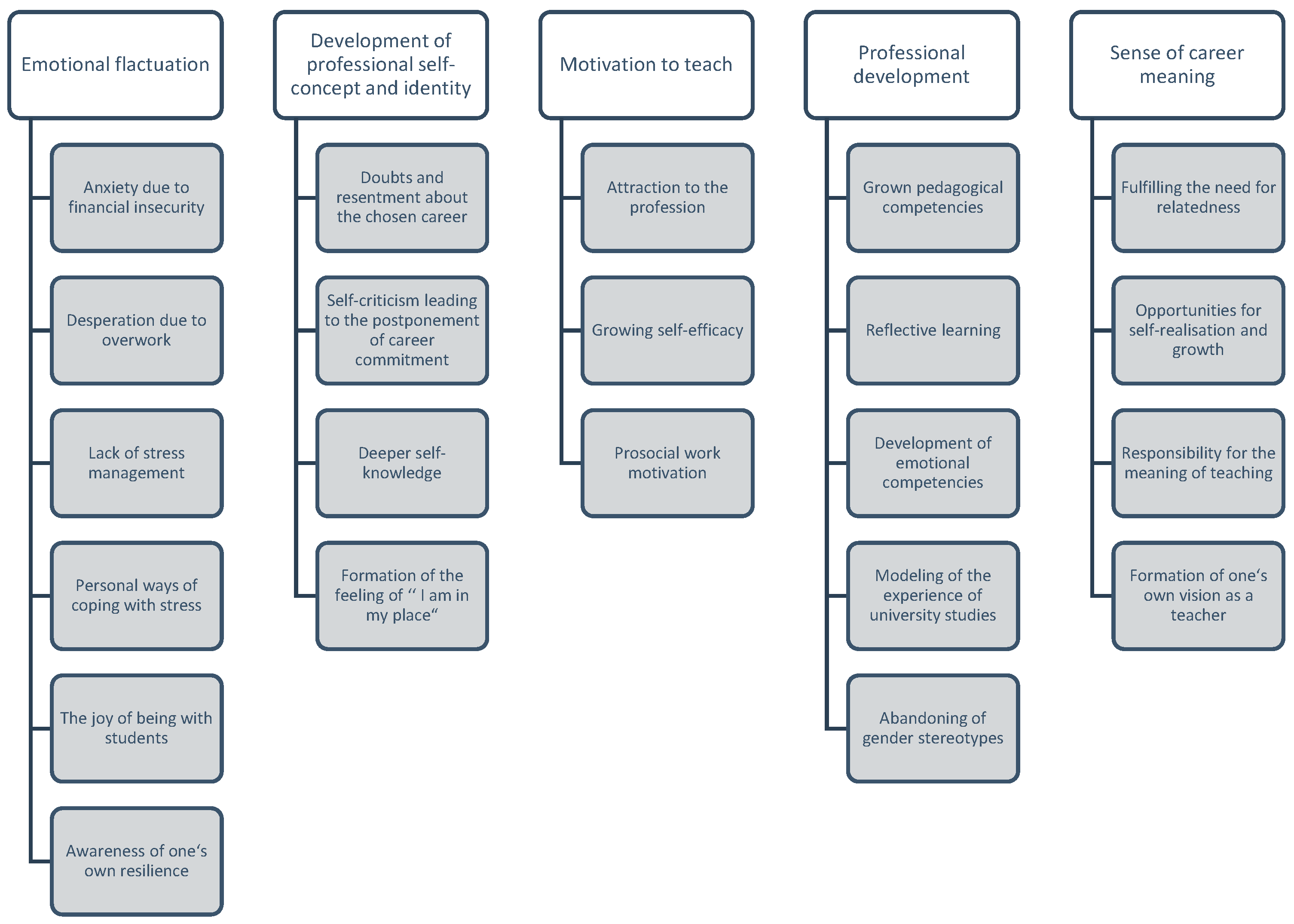
3.1. Personal Factors Determining the Dynamics of Young Teachers’ Careers
3.1.1. Emotional Fluctuation
3.1.2. Development of Professional Self-Concept and Identity
3.1.3. Motivation to Teach
3.1.4. Professional Development
3.1.5. Sense of Career Meaning
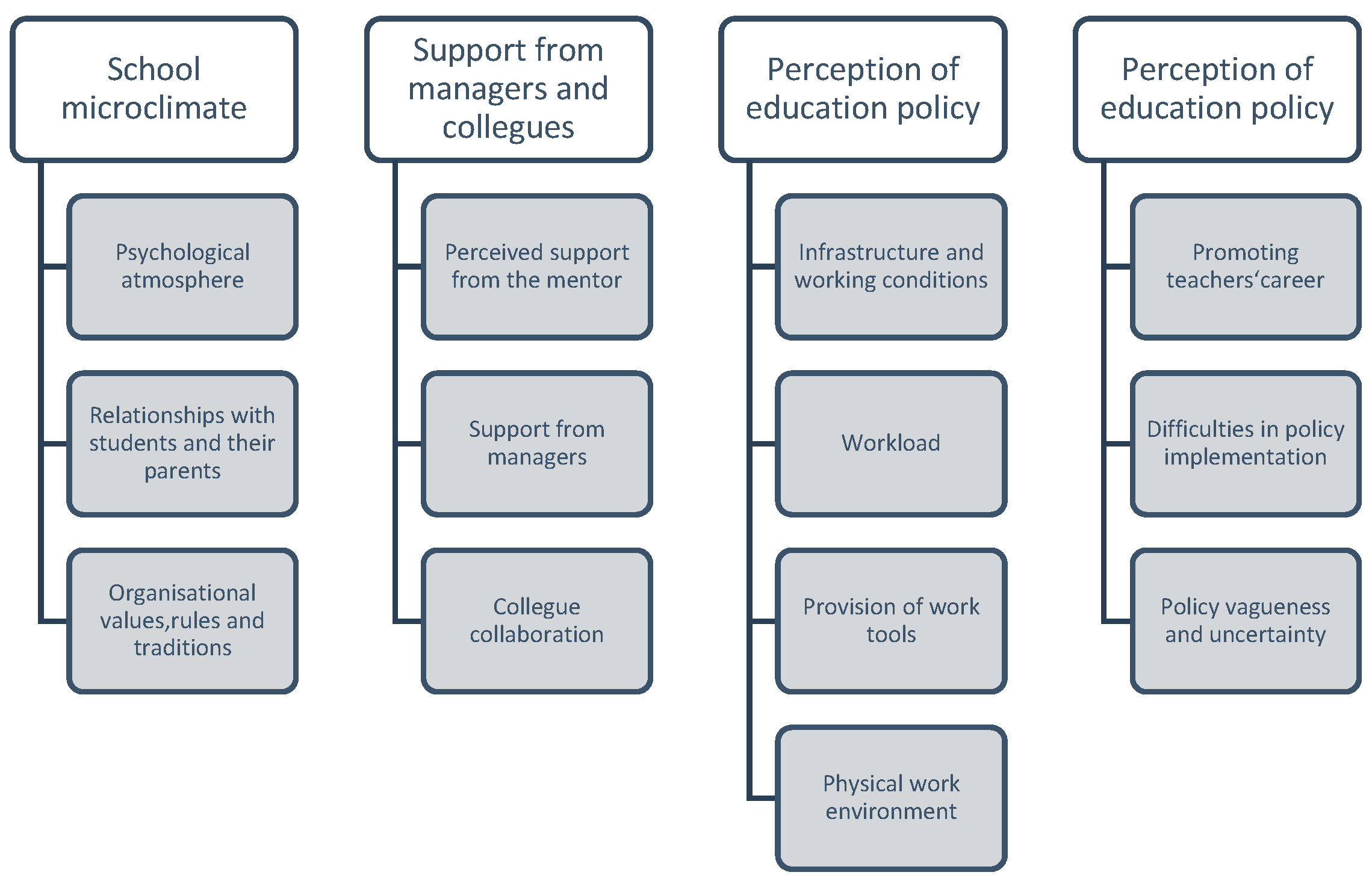
3.2. Environmental Factors Determining the Career Dynamics of Young Teachers
3.2.1. School Microclimate
3.2.2. Support from Managers and Colleagues
3.2.3. Infrastructure and Working Conditions
3.2.4. Perception of Education Policy
4. Discussion and Conclusions
4.1. The Role of Personal Factors: Between Emotional Well-Being, Resilience, and Exhaustion
4.2. Environmental Factors: The Importance of the Micro and Meso Levels
4.3. Limitations and Future Research Directions
Author Contributions
Funding
Institutional Review Board Statement
Informed Consent Statement
Data Availability Statement
Conflicts of Interest
References
- Akkermans, J., da Motta Veiga, S. P., Hirschi, A., & Marciniak, J. (2024). Career transitions across the lifespan: A review and research agenda. Journal of Vocational Behavior, 148, 103957. [Google Scholar] [CrossRef] [Scilit]
- Angelini, G., Mamprin, C., Buonomo, I., Benevene, P., & Fiorilli, C. (2026). Virtues, engagement, and well-being in teachers: Associations with burnout and self-efficacy in a path analysis model. Teaching and Teacher Education, 169, 105284. [Google Scholar] [CrossRef] [Scilit]
- Ballantyne, J., & Retell, J. (2020). Teaching careers: Exploring links between well-being, burnout, self-efficacy and praxis shock. Frontiers in Psychology, 10, 2255. [Google Scholar] [CrossRef] [Scilit]
- Balyer, A., Karataş, H., & Alcı, B. (2015). School principals’ roles in establishing collaborative professional learning communities at schools. Procedia—Social and Behavioral Sciences, 197, 1340–1347. [Google Scholar] [CrossRef] [Scilit]
- Barhate, B., & Dirani, K. M. (2022). Career aspirations of generation Z: A systematic literature review. European Journal of Training and Development, 46(1–2), 139–157. [Google Scholar] [CrossRef] [Scilit]
- Baruch, Y., Guttormsen, D. S. A., Gyoshev, S. B., Pavkov, T., & Plescad, M. (2025). Careers and labor-market stability vs. dynamisms: Using big data to optimize career trajectories. Journal of Vocational Behavior, 163, 104180. [Google Scholar] [CrossRef] [Scilit]
- Beijaard, D., Meijer, P. C., & Verloop, N. (2004). Reconsidering research on teachers’ professional identity. Teaching and Teacher Education, 20(2), 107–128. [Google Scholar] [CrossRef] [Scilit]
- Bellibaş, M. Ş., Gümüş, S., & Chen, J. (2023). The impact of distributed leadership on teacher commitment: The mediation role of teacher workload stress and teacher well-being. British Educational Research Journal, 50(2), 814–836. [Google Scholar] [CrossRef] [Scilit]
- Ben-Amram, M., & Davidovich, N. (2024). Novice teachers and mentor teachers: From a traditional model to a holistic mentoring model in the postmodern era. Education Sciences, 14(2), 143. [Google Scholar] [CrossRef] [Scilit]
- Berliner, D. C. (2004). Describing the behavior and documenting the accomplishments of expert teachers. Bulletin of Science, Technology & Society, 24(3), 200–212. [Google Scholar] [CrossRef] [Scilit]
- Bińczycki, B., Łukasiński, W., & Dorocki, S. (2023). Determinants of motivation to work in terms of industry 4.0—The gen Z perspective. Sustainability, 15(15), 12069. [Google Scholar] [CrossRef] [Scilit]
- Braun, V., & Clarke, V. (2025). Reporting guidelines for qualitative research: A values-based approach. Qualitative Research in Psychology, 22(2), 399–438. [Google Scholar] [CrossRef] [Scilit]
- Bronfenbrenner, U. (Ed.). (2005). Making human beings human: Bioecological perspectives on human development. Sage Publications Ltd. [Google Scholar]
- Burić, I., & Moè, A. (2020). What makes teachers enthusiastic: The interplay of positive affect, self-efficacy and job satisfaction. Teaching and Teacher Education, 89, 103008. [Google Scholar] [CrossRef] [Scilit]
- Carroll, A., York, A., Fynes-Clinton, S., Sanders-O’Connor, E., Flynn, L., Bower, J. M., Forrest, K., & Ziaei, M. (2021). The downstream effects of teacher well-being programs: Improvements in teachers’ stress, cognition and well-being benefit their students. Frontiers in Psychology, 12, 689628. [Google Scholar] [CrossRef] [Scilit]
- Cels, P., Sabina, L. L., Touchton, D., Shankar-Brown, R., & Sabina, K. L. (2023). Addressing teacher retention within the first three to five years of employment. Athens Journal of Education, 10(2), 345–364. [Google Scholar] [CrossRef] [Scilit]
- Cobb, D. J. (2022). Metaphorically drawing the transition into teaching: What early career teachers reveal about identity, resilience and agency. Teaching and Teacher Education, 110, 103598. [Google Scholar] [CrossRef] [Scilit]
- Daly, C., Glegg, P., Stiasny, B., Hardman, M., Taylor, B., Pillinger, C., & Gandolfi, H. (2023). Mentors as instructional coaches for new teachers: Lessons learnt from the early career framework in England. International Journal of Mentoring and Coaching in Education, 12(4), 350–365. [Google Scholar] [CrossRef] [Scilit]
- Davis, T., & Park, E. (2025). A systematic review of early-career teacher wellbeing, stress, burnout and support mechanisms during and post COVID-19 pandemic. Education Sciences, 15(8), 996. [Google Scholar] [CrossRef] [Scilit]
- Day, C., & Gu, Q. (2010). The new lives of teachers. Routledge. [Google Scholar]
- De Vos, A., Van der Heijden, B. I., & Akkermans, J. (2020). Sustainable careers: Towards a conceptual model. Journal of Vocational Behavior, 117, 103196. [Google Scholar] [CrossRef] [Scilit]
- De Witte, K., De Cort, W., & Gambi, L. (Eds.). (2023). Evidence-based solutions to teacher shortages—EENEE-NESET: Analytical report. Publications Office of the European Union. [Google Scholar]
- Diab, A., & Green, E. (2024). Cultivating resilience and success: Support systems for novice teachers in diverse contexts. Education Sciences, 14(7), 711. [Google Scholar] [CrossRef] [Scilit]
- Didžiulienė, R. (2023). Profesinės laimės subjektyvus suvokimas mokytojų bendruomenėje: Lyginimas lyties aspektu [Daktaro disertacija]. Vytauto Didžiojo Universitetas. [Google Scholar]
- Dik, B. J., Eldridge, B. M., Steger, M. F., & Duffy, R. D. (2012). Development and validation of the calling and vocation questionnaire (CVQ) and brief calling scale (BCS). Journal of Career Assessment, 20(3), 242–263. [Google Scholar] [CrossRef] [Scilit]
- Dobrow, S. R., Weisman, H., Heller, D., & Tosti-Kharas, J. (2023). Calling and the good life: A meta-analysis and theoretical extension. Administrative Science Quarterly, 68(2), 508–550. [Google Scholar] [CrossRef] [Scilit]
- Elyashiv, R. A., & Rozenberg, K. (2024). Fostering early career teachers’ preparedness, self-efficacy and professional commitment: The role of teacher education. Teaching and Teacher Education, 148, 104691. [Google Scholar] [CrossRef] [Scilit]
- European Council. (2020, June 9). Council conclusions on European teachers and trainers for the future (2020/C 193/04). Official Journal of the European Union. Available online: https://eur-lex.europa.eu/legal-content/EN/TXT/PDF/?uri=uriserv:OJ.C_.2020.193.01.0011.01.ENG (accessed on 25 February 2026).
- Farrell, T. S. C. (2009). The novice teacher experience. In A. Burns, & J. C. Richards (Eds.), The Cambridge guide to second language teacher education (pp. 182–189). Cambridge University Press. [Google Scholar]
- Fouad, N. A., & Kozlowski, M. B. (2019). Turning around to look ahead: Views of vocational psychology in 2001 and 2019. Journal of Career Assessment, 27(3), 375–390. [Google Scholar] [CrossRef] [Scilit]
- Fratrièová, J., & Kirchmayer, Z. (2018). Barriers to work motivation of generation Z. Journal of Human Resource Management, 21(2), 28–39. [Google Scholar]
- Fullan, M. (Ed.). (2003). The moral imperative of school leadership. Corwin Press. [Google Scholar]
- Geeraerts, K., Tynjälä, P., & Heikkinen, H. L. T. (2018). Inter-generational learning of teachers: What and how do teachers learn from older and younger colleagues? European Journal of Teacher Education, 41(4), 479–495. [Google Scholar] [CrossRef] [Scilit]
- Gore, J., Rosser, B., Jaremus, F., Miller, A., & Harris, J. (2024). Fresh evidence on the relationship between years of experience and teaching quality. The Australian Educational Researcher, 51, 547–570. [Google Scholar] [CrossRef] [Scilit]
- Göregen, M. S., Tanghe, E., & Schelfhout, W. (2024). What works to retain beginning teachers in the profession? A mixed methods approach to detect determining factors. Education Sciences, 14(12), 1319. [Google Scholar] [CrossRef] [Scilit]
- Grant, A. A., & Brantlinger, A. (2023). It’s tough to make predictions, especially about the future: The difference between teachers’ intended and actual retention. Teaching and Teacher Education, 130, 104156. [Google Scholar] [CrossRef] [Scilit]
- Gröschner, A., Schindler, A., Holzberger, D., Alles, M., & Seidel, T. (2018). How systematic video reflection in teacher professional development regarding classroom discourse contributes to teacher and student self- efficacy. International Journal of Educational Research, 90, 223–233. [Google Scholar] [CrossRef] [Scilit]
- Gudžinskienė, V., & Pozdniakovas, A. (2021). Socialinių darbuotojų profesinio perdegimo sindromą nulemiančios organizacinės priežastys. Social Inquiry into Wellbeing, 19(1), 26–47. [Google Scholar] [CrossRef]
- Haberman, M. (2012). The myth of the “fully qualified” bright young teacher. American Behavioral Scientist, 56(7), 926–940. [Google Scholar] [CrossRef] [Scilit]
- Hargreaves, A. (2003). Teaching in the knowledge society: Education in the age of insecurity. Teachers College Press. [Google Scholar]
- Hill, J., Kim, M., Oja, B. D., Kim, H. S., & Lee, H. (2024). Innovation is the key: Identifying factors to increase career satisfaction and psychological well-being in millennial and Generation Z sport employees. Sport, Business and Management: An International Journal, 14(3), 360–379. [Google Scholar] [CrossRef] [Scilit]
- Hobson, A. J., Ashby, P., Malderez, A., & Tomlinson, P. D. (2009). Mentoring beginning teachers: What we know and what we don’t. Teaching and Teacher Education, 25(1), 207–216, (Correction in 2013, Teaching and Teacher Education, 31, 68. https://doi.org/10.1016/j.tate.2012.12.004). [Google Scholar] [CrossRef] [Scilit]
- Hulme, M., & Wood, J. (2022). The importance of starting well: The influence of early career support on job satisfaction and career intentions in teaching. Journal of Further and Higher Education, 46(4), 504–521. [Google Scholar] [CrossRef] [Scilit]
- Ibarra, H., Wittman, S., & Smith, K. (2026). Career transition and professional identity: Dynamic processes, multiple selves, and nonlinear trajectories. Annual Review of Organizational Psychology and Organizational Behavior, 13, 137–163. [Google Scholar] [CrossRef] [Scilit]
- Ingersoll, R., Merrill, L., & May, H. (2014). What are the effects of teacher education and preparation on beginning teacher attrition? (Research Report (#RR-82)). Consortium for Policy Research in Education, University of Pennsylvania. [Google Scholar]
- Ingersoll, R., & Strong, M. (2011). The impact of induction and mentoring programs for beginning teachers: A critical review of the research: A critical review of the research. Review of Educational Research, 81(2), 201–233. [Google Scholar] [CrossRef] [Scilit]
- Kelly, N., Cespedes, M., Clarà, M., & Danaher, P. A. (2019). Early career teachers’ intentions to leave the profession: The complex relationships among preservice education, early career support, and job satisfaction. Australian Journal of Teacher Education, 44(3), 93–113. [Google Scholar] [CrossRef] [Scilit]
- Klassen, R. M., & Chiu, M. M. (2011). The occupational commitment and intention to quit. Contemporary Educational Psychology, 36(2), 114–129. [Google Scholar] [CrossRef] [Scilit]
- Kouhsari, M., Huang, X., & Wang, C. (2024). The impact of school climate on teacher enthusiasm: The mediating effect of collective efficacy and teacher self-efficacy. Cambridge Journal of Education, 54(2), 143–163. [Google Scholar] [CrossRef] [Scilit]
- Król, M. (2020). Generational differences in the evaluation of labor market leaving models: The example of the baby boomer generation and generation Z. Zarzadzanie Zasobami Ludzkimi, 133(2), 89–104. [Google Scholar] [CrossRef] [Scilit]
- Kvale, S., & Brinkmann, S. (2009). Interviews: Learning the craft of qualitative research interviewing. Sage. [Google Scholar]
- Ladd, H. F. (2011). Teachers’ perceptions of their working conditions: How predictive of planned and actual teacher movement? Educational Evaluation and Policy Analysis, 33(2), 235–261. [Google Scholar] [CrossRef] [Scilit]
- Lander, K. A. (2022). Beginning teachers’ perceptions of new teacher mentoring in a suburban Mississippi school district [Ph.D. thesis, Electronic Theses and Dissertations, The University of Mississippi]. Available online: https://egrove.olemiss.edu/etd/2442 (accessed on 24 February 2026).
- Lebedytė-Mečionienė, I. (2022). Beginner teachers’ encounters with the reality of education: Case of the “Teach First Lithuania!” program. Acta Paedagogica Vilnensia, 49, 56–68. [Google Scholar] [CrossRef] [Scilit]
- Li, B., Li, Z., & Fu, M. (2022). Understanding beginning teachers’ professional identity changes through job demands-resources theory. Acta Psychologica, 230, 103760. [Google Scholar] [CrossRef] [Scilit]
- Lindqvist, H., & Kelchtermans, G. (2025). The second year as a teacher: How does it feel? Teachers and Teaching: Theory and Practice. [Google Scholar] [CrossRef] [Scilit]
- Litvinaitė, J. (2024). Deprofessionalization of teachers’ occupation: Sociological analysis. Acta Paedagogica Vilnensia, 51, 146–163. [Google Scholar] [CrossRef] [Scilit]
- Luft, J. A., Navy, S. L., Wong, S. S., & Hill, K. M. (2022). The first 5 years of teaching science: The beliefs, knowledge, practices, and opportunities to learn of secondary science teachers. Journal of Research in Science Teaching, 59(9), 1692–1725. [Google Scholar] [CrossRef] [Scilit]
- Lulewicz-Sas, A., Kinowska, H., Zubek, M., & Danilewicz, D. (2025). Examining the impacts of environmental, social and governance (ESG) on employee engagement: A study of Generation Z. Central European Management Journal, 33(4), 634–649. [Google Scholar] [CrossRef] [Scilit]
- Madigan, D. J., & Kim, L. E. (2021). Towards an understanding of teacher attrition: A meta-analysis of burnout, job satisfaction, and teachers’ intentions to quit. Teaching and Teacher Education, 105, 103425. [Google Scholar] [CrossRef] [Scilit]
- Mansfield, C. F., Ebersöhn, L., Beltman, S., & Loots, T. (2018). Great southern lands: Making space for teacher resilience in South Africa and Australia. In M. Wosnitza, F. Peixoto, S. Beltman, & C. F. Mansfield (Eds.), Resilience in education. Springer. [Google Scholar] [CrossRef] [Scilit]
- Mockler, N. (2022, July 10). No wonder no one wants to be a teacher: World-first study looks at 65,000 news articles about Australian teachers. The Conversation. Available online: https://theconversation.com/no-wonder-no-one-wants-to-be-a-teacher-world-first-study-looks-at-65-000-news-articles-about-australian-teachers-186210 (accessed on 4 March 2026).
- Mokone, M. V., & Setlalentoa, W. N. (2023). Enhancing self-efficacy of beginner teachers in the use of e-portfolio: The role of a mentor teacher. Journal of Curriculum Studies Research, 5(1), 130–140. [Google Scholar] [CrossRef] [Scilit]
- Nabahani, P. R., & Riyanto, S. (2020). Job satisfaction and work motivation in enhancing generation Z’s organizational commitment. Journal of Social Science, 1(5), 234–240. [Google Scholar] [CrossRef] [Scilit]
- OECD. (2020). Education at a glance 2020. OECD Publishing. Available online: https://www.oecd.org/en/publications/education-at-a-glance-2020_69096873-en.html (accessed on 17 April 2026).
- OECD. (2024). Education at a glance 2024. OECD Publishing. [Google Scholar] [CrossRef] [Scilit]
- OECD. (2025). Education at a glance 2025. OECD Publishing. [Google Scholar] [CrossRef] [Scilit]
- Patton, M. Q. (2021). Qualitative research and evaluation methods. SAGE Publications. [Google Scholar]
- Pikić Jugović, I., Marušić, I., & Matić Bojić, J. (2025). Early career teachers’ social and emotional competencies, self-efficacy and burnout: A mediation model. BMC Psychology, 13(1), 9. [Google Scholar] [CrossRef] [Scilit] [PubMed]
- Pillen, M., Beijaard, D., & Brok, P. D. (2013). Tensions in beginning teachers’ professional identity development, accompanying feelings and coping strategies. European Journal of Teacher Education, 36(3), 240–260. [Google Scholar] [CrossRef] [Scilit]
- Procter-Legg, T., Snell, R. J., & Klassen, R. M. (2025). The five-year itch: Motivational factors that influence the career decisions of early career teachers in England. British Educational Research Journal, 51(4), 1623–1647. [Google Scholar] [CrossRef] [Scilit]
- Räsänen, K., Pietarinen, J., Pyhältö, K., Soini, T., & Väisänen, P. (2020). Why leave the teaching profession? A longitudinal approach to the prevalence and persistence of teacher turnover intentions. Social Psychology of Education, 23(4), 837–859. [Google Scholar] [CrossRef] [Scilit]
- Redding, C., & Henry, G. T. (2018). New evidence on the frequency of teacher turnover: Accounting for within-year turnover. Educational Researcher, 47(9), 577–593. [Google Scholar] [CrossRef] [Scilit]
- Rosenberg, R., De Bruin, K., & Ludecke, M. (2024). Beginning teacher preparation and readiness for the profession as inclusive educators. Australian Journal of Education, 68(1), 23–35. [Google Scholar] [CrossRef] [Scilit]
- Savickas, M. L. (2013). Career construction theory and practice. In S. D. Brown, & R. W. Lent (Eds.), Career development and counseling: Putting theory and research to work (2nd ed., pp. 147–183). John Wiley & Sons. [Google Scholar]
- Savina, E., Fulton, C., & Beaton, C. (2025). Teacher emotional competence: A conceptual model. Educational Psychology Review, 37(2), 40. [Google Scholar] [CrossRef] [Scilit]
- Shuls, J. V., & Flores, J. M. (2020). Improving teacher retention through support and development. Journal of Educational Leadership and Policy Studies, 4(1), 1–19. [Google Scholar]
- Sincock, K., Patfield, S., Gore, J., & Miller, D. (2026). Bolstering teacher retention through collaborative professional development. In Professional development in education (pp. 1–22). Taylor & Francis. [Google Scholar] [CrossRef] [Scilit]
- Skaalvik, E. M., & Skaalvik, S. (2010). Teacher self-efficacy and teacher burnout: A study of relations. Teaching and Teacher Education, 26(4), 1059–1069. [Google Scholar] [CrossRef] [Scilit]
- Stenberg, K., & Maaranen, K. (2021). A novice teachers teacher identity construction during the first year of teaching: A case study from a dialogical self perspective. Learning, Culture and Social Interaction, 28, 100479. [Google Scholar] [CrossRef] [Scilit]
- Surugiu, C., Surugiu, M.-R., Grădinaru, C., & Grigore, A.-M. (2025). Factors motivating generation Z in the workplace: Managerial challenges and Insights. Administrative Sciences, 15(1), 29. [Google Scholar] [CrossRef] [Scilit]
- Thomas, L., Tuytens, M., Moolenaar, N., Devos, G., Kelchtermans, G., & Vanderlinde, R. (2019). Teachers’ first year in the profession: The power of high-quality support. Teachers and Teaching, 25(2), 160–188. [Google Scholar] [CrossRef] [Scilit]
- Thompson-Lee, S., See, B. H., & Klassen, R. M. (2025). A systematic review of STEM teacher recruitment and retention interventions. International Journal of STEM Education, 12, 33. [Google Scholar] [CrossRef] [Scilit]
- Toropova, A., Myrberg, E., & Johansson, S. (2021). Teacher job satisfaction: The importance of school working conditions and teacher characteristics. Educational Review, 73, 71–97. [Google Scholar] [CrossRef] [Scilit]
- Van den Borre, L., Spruyt, B., & Van Droogenbroeck, F. (2021). Early career teacher retention intention: Individual, school and country characteristics. Teaching and Teacher Education, 105, 103427, (Correction in 2021, Teaching and Teacher Education, 107, 103481. https://doi.org/10.1016/j.tate.2021.103481). [Google Scholar] [CrossRef] [Scilit]
- Yinon, H., & Orland-Barak, L. (2017). Career stories of Israeli teachers who left teaching: A salutogenic view of teacher attrition. Teachers and Teaching, 23(8), 914–927. [Google Scholar] [CrossRef] [Scilit]



| Questions |
|---|
| How do you feel about working at school? What qualities have you developed while working at school? How does working at school align with your values? How do you assess your teaching competencies? How have they changed while working at school? What is your motivation for a career as a teacher? Do you notice any changes in it? What are your future career goals? How have your first years as a teacher influenced your attitude towards this profession? How does the school microclimate affect your well-being and career plans? What kind of support do you feel from your managers or colleagues? How do you assess your relationships with students and their parents? How does your work environment meet your expectations and needs? What decisions of education policymakers influence your career decisions? What do you think about the prestige of the teaching profession? |
| Research Participant Code | Gender | Age | Years of Schooling | Subject | School Type |
|---|---|---|---|---|---|
| T1 | female | 25 | 1.5 years | Information technology | District lower secondary school |
| T2 | female | 27 | 2.5 years | Primary education | Small rural school |
| T3 | female | 29 | 3 years | Mathematics | City secondary school |
| T4 | female | 24 | 1.5 years | Geography | City secondary school |
| T5 | female | 28 | 1 year | Life skills | Private basic school |
| T6 | female | 29 | 5 years | German | City lower secondary school |
| T7 | female | 24 | 2.5 years | Primary education | District basic school |
| T8 | female | 29 | 4.5 years | Primary education | City basic school |
| T9 | female | 26 | 1.5 years | Lithuanian | City secondary school |
| T10 | male | 27 | 2.5 years | Mathematics | Private lower secondary school |
| T11 | female | 26 | 1.5 years | Physics | City secondary school |
| T12 | female | 28 | 3 years | History | District lower secondary school |
| T13 | female | 27 | 3 years | Preschool education | Private lower secondary school |
| T14 | male | 26 | 2 years | English | City secondary school |
Disclaimer/Publisher’s Note: The statements, opinions and data contained in all publications are solely those of the individual author(s) and contributor(s) and not of MDPI and/or the editor(s). MDPI and/or the editor(s) disclaim responsibility for any injury to people or property resulting from any ideas, methods, instructions or products referred to in the content. |
© 2026 by the authors. Licensee MDPI, Basel, Switzerland. This article is an open access article distributed under the terms and conditions of the Creative Commons Attribution (CC BY) license.
Share and Cite
Stanišauskienė, V.; Augustinienė, A.; Štuopytė, E.; Valuckienė, G.; Kononets, M. Determinants of Career Dynamics of Young Teachers. Youth 2026, 6, 71. https://doi.org/10.3390/youth6020071
Stanišauskienė V, Augustinienė A, Štuopytė E, Valuckienė G, Kononets M. Determinants of Career Dynamics of Young Teachers. Youth. 2026; 6(2):71. https://doi.org/10.3390/youth6020071
Chicago/Turabian StyleStanišauskienė, Vilija, Aldona Augustinienė, Edita Štuopytė, Giedra Valuckienė, and Maria Kononets. 2026. "Determinants of Career Dynamics of Young Teachers" Youth 6, no. 2: 71. https://doi.org/10.3390/youth6020071
APA StyleStanišauskienė, V., Augustinienė, A., Štuopytė, E., Valuckienė, G., & Kononets, M. (2026). Determinants of Career Dynamics of Young Teachers. Youth, 6(2), 71. https://doi.org/10.3390/youth6020071