1. Introduction
Neoliberalism, as the dominant ideological and economic force in the U.S., has significantly shifted the way higher education operates (
Harvey, 2005;
Newfield, 2016;
Schnee, 2022;
Slaughter & Leslie, 1997). The application of neoliberal principles—reduced government spending, market competition, individual responsibility—have shifted the way people think about higher education from a public good to a private commodity. These principles have resulted in neoliberal policies that have decreased public funding for higher education; a shift to students covering the deficit through tuition dollars; massive student loan debt, students being leveraged as consumers with a focus on the Return on Investment (ROI); and a customer service mentality (
Harvey, 2005;
Newfield, 2016;
Schnee, 2022;
Slaughter & Leslie, 1997). This movement in social thought has resulted in universities operating like businesses and prioritizing revenue generation and market competition over the relational aspects of care and concern in educational settings, thereby reframing students as consumers and undermining education as a relational and moral endeavor into a transactional one.
As neoliberal policies reshape higher education into a transactional enterprise, approaches that foreground relational care and institutional responsibility are increasingly diminishing, but they are deeply necessary. One such approach is proactive caring. More than 20 years ago, Woodus, a Towson University administrator, introduced the concept of proactive caring as a strategy to support the retention of underserved students in higher education (
de Vise, 2010). However, to date, there has been no known empirical research that clearly defines, theorizes, or provides evidence for this approach. This paper seeks to address that gap by presenting proactive caring as a meaningful strategy for student support, particularly in the context of growing resistance to diversity, equity, and inclusion (DEI) initiatives. While proactive caring alone cannot dismantle the systemic and structural inequities that contribute to students being underserved, especially within the context of the STEM fields, it may offer a valuable framework to support these students as they transition into, and persist within, higher education.
Moreover, the current paper draws upon a case study of a STEM enrichment program at a large, public research university that examined how higher education professionals operationalized proactive caring in their work with underserved young adults majoring in the STEM disciplines. Within the context of this study, underserved students were primarily Students of Color, some of whom also identified as lower-income or first-generation college students. Of note, these students have been systematically and historically denied educational opportunities, resources, and supports similar to other underserved student populations in higher education (e.g., students with disabilities, foster youth, etc.). Furthermore, in this study, we highlight how higher education professionals anticipated developmental, academic, and socioemotional needs and responded through relational practices. We use this case to illustrate how proactive caring was embedded within program structures and interactions to support students’ sense of belonging and persistence in STEM pathways. Thus, this work extends retention scholarship by demonstrating how caring practices can be enacted within institutional settings to promote access, engagement, and student success.
3. Methods
The current study draws from a larger explanatory case study that investigated how university staff supported the success of underserved students in higher education. The study was conducted in accordance with the Declaration of Helsinki, and the protocol was approved by the Ethics Committee of Michigan State University, MI, USA (IRB x13 553e) on 13 June 2013. Written informed consent for participation was obtained from all subjects involved in the study. Specifically, the unit of analysis was a STEM enrichment program, the Comprehensive STEM Program (CSP, pseudonym) at Jefferson State University (JSU, pseudonym). A qualitative case study approach was selected to provide an in-depth understanding of how program structures, practices, and relational dynamics influenced student experiences and outcomes. The study sought to explain how and why STEM enrichment programs function as mechanisms for persistence, extending prior scholarship that has largely focused on program outcomes rather than supportive institutional practices. The research questions that informed this study were: (1) How do higher education professionals enact care in their engagement with underserved students in the STEM fields at a large, public, research university? (2) What relational practices support students’ transitions into college and their retention in the STEM fields?
Although the data analyzed in this study were collected in a different political and educational context, we reinterpret them in light of contemporary developments. This approach allows us to reinterpret participants’ experiences and institutional dynamics while attending to how similar practices and discourses are being reframed in the current policy environment.
3.1. Context of the Study
JSU is a large, public, land-grant research university located in the Midwest with an approximate enrollment of 50,000 students at the time of the study. Roughly half of incoming students declared majors in STEM fields; however, Students of Color represented only 9% of these entrants. Although about 61% of all STEM students completed their degrees within six years, the completion rate for Students of Color was substantially lower, at 43%.
CSP was established in 2007 through funding from the National Science Foundation’s (NSF) Louis Stokes Alliances for Minority Participation (LSAMP) program. CSP’s mission centers on increasing retention, academic success, and degree completion among students from historically underrepresented, first-generation, and low-income backgrounds in STEM. The program integrates academic support, residential living, advising, and research engagement to facilitate students’ transition into a rigorous STEM curriculum and institutional environment. Further, LSAMP, established by congressional mandate in 1991, was a national initiative aimed at substantially increasing the number of underrepresented students who complete baccalaureate degrees in STEM and pursue graduate education in these fields. LSAMP was discontinued in 2025 following an NSF reorganization.
At the time of the study, CSP enrolled up to 50 students per cohort and typically supported participants during their first two academic years, though some students remained engaged through degree completion. Participants were selected from among admitted STEM majors based on criteria including participation in special admissions programs for first-generation or low-income students, placement below calculus in mathematics, or expressed interest in the program. CSP integrated eight required components: a six-week summer bridge program, a residential living experience during the first year, designated mathematics and science courses, structured recitation sessions, biweekly academic advising, peer mentoring, a first-year seminar, and access to undergraduate research opportunities. Students who successfully completed the first year received a modest scholarship, and there was no cost to participate in the program.
Key program features included an intensive summer bridge experience focused on academic preparation and social integration, biweekly advising sessions that combine academic monitoring with attention to nonacademic concerns, evening recitation sessions staffed by upper-division undergraduate assistants, and a living-learning residential arrangement designed to foster peer support. Selected students also participated in faculty-mentored undergraduate research experiences following their first year. Together, these components are intended to support students academically, socially, and psychosocially as they navigate institutional and disciplinary expectations in STEM.
3.2. Participants
Participants were recruited using purposeful sampling to ensure the inclusion of individuals with direct experience in the program and its implementation (
Miles et al., 2014). This approach allowed us to capture a range of perspectives across students, staff, and instructors who were meaningfully engaged in the phenomenon under investigation. In some cases, snowball sampling was also employed, wherein participants recommended additional individuals who could provide relevant insights (
Miles et al., 2014).
Participants were recruited through both email and in-person outreach. An initial recruitment email was distributed by the CSP director to prospective participants. In addition, the first author regularly visited spaces frequented by prospective participants, such as tutoring sessions and the CSP office, which facilitated in-person recruitment. Selection criteria focused on participants’ level of involvement with the program. This sampling strategy aligns with qualitative case study approaches that prioritize depth, contextual understanding, and the inclusion of information-rich cases.
A total of 50 participants contributed to the study: 42 current and former CSP participants, four recent baccalaureate recipients who had participated in CSP, a program director, an assistant director, and two STEM instructors. Student participants represented a range of STEM majors, including biology, physiology, and multiple engineering disciplines. The average first-year GPA for student participants was 3.01. The participant pool included 40 Black/African American students, four Latine students, and two Southeast Asian American students; approximately 41% identified as women. Nearly half of the student participants identified as first-generation college students and/or from low-income backgrounds. All university staff and instructors identified as African American; of the four participants, three identified as men and one identified as a woman.
3.3. Data Collection
Prior to data collection, Institutional Review Board approval was obtained (IRB #13-553e). Data sources included individual interviews, focus groups, participant observations, and document analysis. Interviews and focus groups ranged from 30 to 80 min in length. In total, 35 individual interviews and five focus groups were conducted. Focus groups included 5–8 participants, with an average of six per group. Fourteen focus group participants were subsequently invited to participate in follow-up interviews to clarify responses and elaborate on topics discussed.
Student interviews focused on participants’ experiences at JSU, perceptions of program support, sense of belonging, STEM identity development, and experiences of care. Interviews with staff and instructors addressed program structure, implementation, and perceived effective practices and served to corroborate student perspectives. Participant observations were conducted across multiple program contexts, including classes, recitation sessions, advising meetings, and informal study spaces, yielding a total of 24 h of observational data. Program documents—including evaluations, recruitment materials, and web content—were reviewed to provide context about the program and support triangulation.
3.4. Data Analysis
All interviews and focus groups were transcribed verbatim and verified for accuracy. Data analysis followed an iterative, constructivist approach consistent with case study methodology. Initial analysis used in vivo coding to privilege participants’ language and meaning-making (
Charmaz, 2006). These initial codes were then organized using axial coding to identify categories and subcategories that explained relationships among program components, participant experiences, and outcomes. The analytic process emphasized explanatory linkages, allowing for the development of a conceptual model illustrating how CSP’s caring practices supported student persistence and degree attainment in STEM. Participant observation and documents were integrated throughout analysis to refine interpretations and enhance analytic rigor.
4. Findings
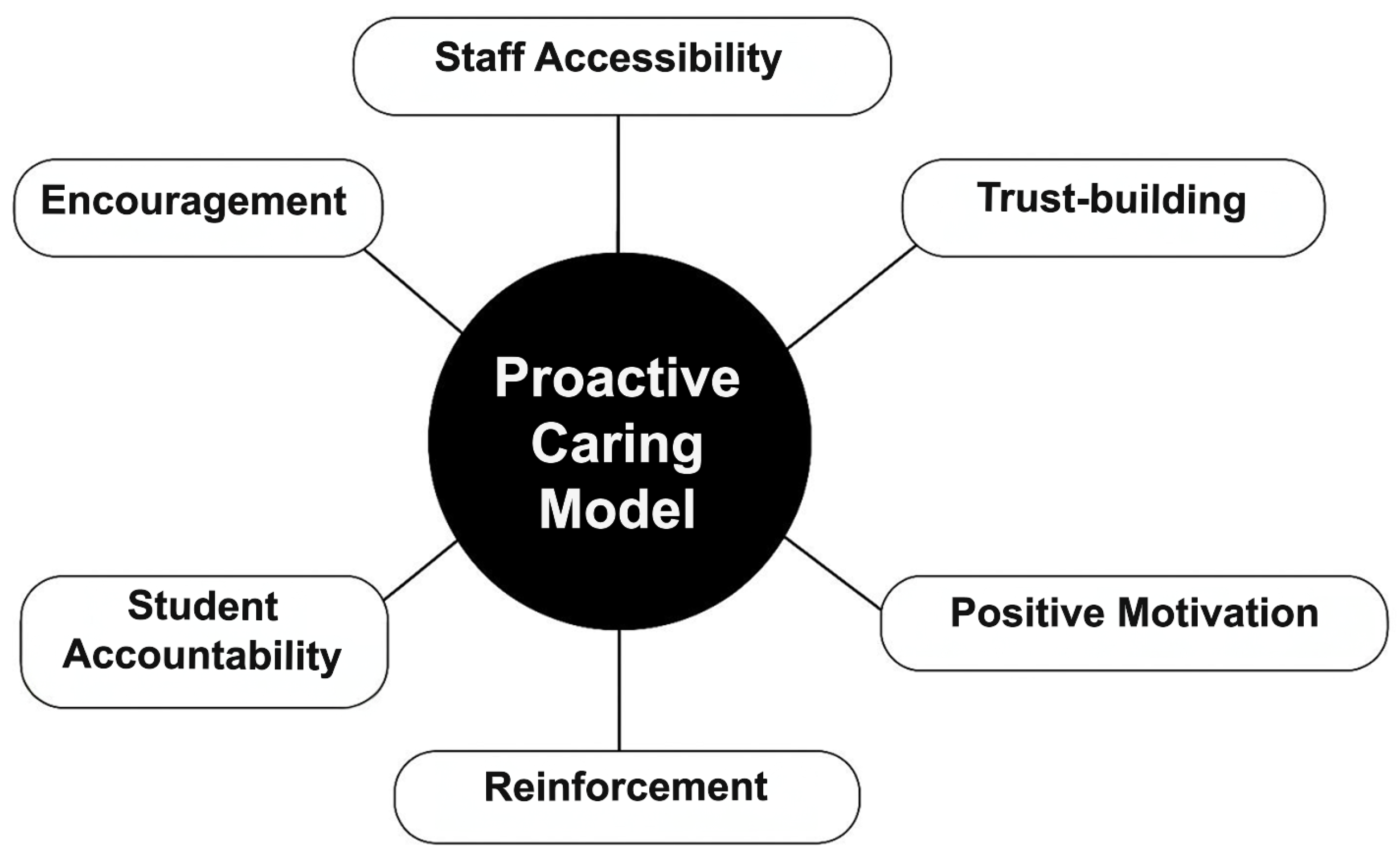
Analysis of the data revealed six elements consistently associated with CSP staff’s enactment of a proactive caring philosophy: (1) staff accessibility, (2) trust-building, (3) positive motivation, (4) reinforcement, (5) encouragement, and (6) student accountability. These themes emerged across administrator and student narratives, highlighting the relational and anticipatory strategies that support college student transitions, retention, and persistence.
Rather than relying on traditional university approaches that respond to students’ needs only after academic difficulties arise (e.g., proactive advising), proactive caring is an anticipatory model aimed at supporting underserved students at the earliest stages of their college trajectories. Program staff systematically review admissions data to identify students who may benefit from a proactive caring approach, and they engage in targeted outreach to enroll them into CSP.
Once students matriculate, they are integrated into an environment that sets high academic expectations with robust socioemotional support. CSP staff remain actively engaged throughout students’ college experiences—from their initial transition into higher education, through their progression toward degree completion, and even as they prepare for job searches and post-baccalaureate pathways. Many staff continue to stay connected with students after graduation as they move into full-time work or further study.
Through this sustained, relationship-centered engagement, CSP fosters the continuous, meaningful interactions that cultivate students’ sense of stability, belonging, and academic confidence. This relational infrastructure is foundational to how students experience care and navigate the complexities of college adjustment and persistence. Collectively, these findings underscore the importance of intentional, humanizing practices in meeting the developmental needs of young adults from historically underserved backgrounds.
The six elements that comprise the proactive caring model are relationally interconnected and mutually reinforcing rather than discrete or sequential practices (see
Figure 1). Although depicted as distinct components, they function as a dynamic system in which each element shapes and strengthens the others. Trust operates as a foundational and generative force within this system. It is cultivated through consistent enactment of practices such as accessibility, responsiveness, and follow-through, and in turn enables deeper engagement with students. For example, staff accessibility increases opportunities for interaction, creating the conditions under which trust can develop, while responsiveness to students’ lived realities strengthens relational depth and sustains engagement. In this way, the elements are co-constitutive, and no single component operates independently. As such, the effectiveness of the model depends on their integration in practice. Moreover, in the sections that follow, we explore each of the six elements that shape the proactive caring model and consider how they support young people’s pathways through college.
4.1. Staff Accessibility
The first year of college demands substantial adjustment and adaptation as students learn the cultural norms of the collegiate environment. Many young people enter college unfamiliar with these expectations and therefore need guidance when making decisions about coursework, navigating roommate dynamics, and responding to the many questions and challenges that emerge during the initial weeks and months. These needs are often intensified for students from underserved backgrounds, who may experience greater difficulty acclimating to campus life. They may be more likely to miss key deadlines, such as course drop/add periods, or struggle to effectively use course management systems and other institutional technology.
The proactive caring model underscores the importance of having consistently accessible staff. Multiple communication channels, including phone calls, emails, walk-in visits, and text messages, were critical for sharing expertise and guiding students through university policies and procedures as they navigated unfamiliar systems. Motivated to succeed, many students proactively engaged with CSP staff to access resources, clarify institutional processes, and stay on track during their first year. This consistent access to responsive, knowledgeable professionals played a key role in helping students feel supported and confident as they adapted to college life. Sandy, a Latina sophomore in mechanical engineering, explained the importance of staff accessibility to her transition into college:
Being able to have people that I already knew coming into college and, you know, people of authority to confide in and ask about different things like scheduling or different conflicts. Just having someone on the phone that I can just without hesitation just dial and help me figure things out. I mean, like I said, I just think having that solid base, always being able to touch back like that, I can’t even stress that enough. Having a phone number in my phone that any circumstance is like something is going wrong, something, like my roommate, I need a new roommate. How do I go about doing this?
Sandy described several transitional challenges she encountered during her first year, including scheduling difficulties and issues with her roommate. She valued having access to “people of authority” whom she trusted with her personal circumstances and from whom she expected credible advice and support. Although academic advisors and residential life staff were also available to help address these concerns, Sandy felt more comfortable turning to CSP staff because she had already developed a meaningful relationship with them. This existing sense of trust made it easier for her to seek guidance during moments of uncertainty.
Regular contact with students is essential for building the relationships and trust that underpin effective support. Phil Smith, the CSP director, described his approach to maintaining consistent communication with CSP participants, emphasizing that frequent check-ins help students feel seen, supported, and connected during critical transition periods:
[We are] engaged with students on an everyday basis, text messages at night, emails in the morning, advising sessions during the day. And then the other thing is because it is intrusive and it does require people on the ground connecting with these students on a daily basis, it costs. You can’t do drop in if you feel like it. We need staff to be here to meet with these students every other week. We need staff to knock on doors, to find out where students are if they’re not in class. We need people at recitation sessions. It requires high man hours.
Phil’s reflections highlight the intensive and relationally demanding work involved in supporting underserved students during their first year of college. These students often benefit from environments characterized by high-touch, high-impact engagement, where staff maintain frequent communication and offer personalized guidance. CSP’s proactive strategies enable staff to stay informed about students’ day-to-day experiences and maintain a visible, trusted presence in their lives. Because of the strong, trust-based relationships cultivated over time, students are typically receptive to impromptu check-ins in residence halls, study spaces, or other campus locations. This ongoing relational engagement serves as a critical foundation for students’ sense of support, belonging, and accountability.
4.2. Trust-Building
The proactive caring model highlights the central role of building trust with students. This trust shapes how they interpret staff guidance and engage with recommendations for navigating college. When students perceive staff as approachable, knowledgeable, and genuinely invested in their success, they are more likely to view guidance as supportive rather than directive. Over time, this trust fosters a sense of accountability and partnership, in which students feel both supported and responsible for their own success. For example, Omari, a first-year Black man majoring in mechanical engineering, described the extent to which he relied on staff guidance as he adjusted to the demands of college life:
Interviewer: How do you know you will earn your mechanical engineering degree from JSU?
Omari: Mr. Smith always says trust the process so I’m trusting the process.
Interviewer: And what exactly does that mean to you, to trust the process?
Omari: Well, what that means is [Collin Davis] already went through school. Mr. Davis, he’s already gotten his engineering degree in mechanical [engineering]. They’ve already done CSP before and they’ve seen how the trends work. So, I figured they know what they’re doing. They’re the experts so I’m just, I’m just along for the ride.
Omari emphasized that the staff’s academic and professional backgrounds contributed significantly to his decision to trust their advice. He noted, for example, that Mr. Collin Davis holds a degree in mechanical engineering and has extensive experience directing the program. These factors increased Omari’s confidence and comfort with “going along for the ride.” He also referenced Phil Smith’s well-known mantra, “Trust the Process.” During the summer bridge program, the first author observed Phil encouraging both students and parents to embrace this mindset. He explained that if students were diligent and flexible in meeting program policies and expectations, they would be well positioned to achieve their academic and professional goals.
Vivek, an Asian American male and graduating senior majoring in Information Technology, offered an additional perspective on why students come to trust program staff. As he shared in his interview, he experienced several years of academic difficulty and often sought guidance on how to move forward. At times, he followed Phil’s recommendations for next steps, and at other times, he chose not to. Eventually, however, Vivek fully committed to Phil’s advice, changed his major to another STEM field, and significantly improved his GPA—progress that ultimately positioned him for a high-paying job upon graduation. Reflecting on this journey, Vivek acknowledged that he was initially hesitant to seek out Phil’s guidance but came to deeply value Phil’s insight over time. He explained:
Phil is [stern], so you’re afraid to talk to him sometimes because of that but you will go to him because you trust him where he’ll be hard on you but it’s for a reason. And I think that needs to be stressed really well. You know, that it works. A lot of us kids coming from these schools, we haven’t had that discipline [in an academic setting]. [Some students come to the program as if] they know everything and that’s a big problem that [the program staff] teaches us. No, you don’t know everything. But you’re here to learn. And that’s what this program really does for us.
Vivek explained that his pre-college experiences had not prepared him for the level of academic rigor and discipline required for success in STEM fields. Over time, however, his growing trust in Phil—and in Phil’s genuine investment in students’ well-being—played a critical role in helping him achieve his goals. As Vivek noted, many CSP participants enter the program believing they already know what it takes to succeed in STEM, yet the program often reveals that the expectations, strategies, and cadence of college learning differ substantially from those in their prior schooling.
During the first author’s observation of advising sessions, it was clear that some students were initially more resistant to acknowledging their need for support or trying strategies recommended by staff. Stories like Vivek’s, however, served as an ongoing reminder of the value of “trusting the process.” His experience also functioned as a persuasive tool—demonstrating to peers the effectiveness of CSP’s evidence-based approaches and encouraging them to engage more fully with the program’s guidance.
4.3. Positive Motivation
Many students described difficulties sustaining motivation throughout their coursework. Much of this diminished motivation stemmed from challenges with academic competencies, the rigorous expectations of STEM disciplines, and declines in self-efficacy. Others struggled to develop effective study skills, establish productive habits, or regulate their own learning processes. In response to these challenges, positive motivation emerged as a key strategy used by CSP staff to support students’ persistence.
As part of the proactive caring model, positive motivation included both direct motivational messaging from staff and intentional approaches that empowered students to cultivate and regulate their own motivation—particularly through building confidence and competence in STEM courses. Students emphasized the range of tactics staff used to encourage them to stay engaged and committed, noting how these strategies often helped them reframe setbacks as opportunities for growth.
During one focus group, participants reflected on the motivational messages consistently shared by CSP’s graduate assistant, Mark:
William: …now that I’m older, I remember Mark used to be talking to us. I never used to take it serious, but I kinda see like, I understand why he did it and the point of it… and like that stuff actually does help you now as far as being motivated. Now that I’m older and stuff, nobody really pushing you but yourself. Self-discipline is big in college, especially when you’re older. All that was initiated from CSP…
Interviewer: What were some of the things Mark told you all that you think is helpful now?
Kari: Who motivates…who motivates the motivator?
Interviewer: So, what does that mean?
William: We were looking at him like what is he talking about? [laughs] But, now like you get older, you’re like, yourself.
Kari: Right, basically. Saying it is you who motivates you.
William: You get older and class gets hard and you don’t feel like doing your homework cuz you don’t know how to do it so you’re like, man, I gotta do it so… Like you don’t wanna do homework if you don’t know what’s going on.
Kari: But you gotta, you know you gotta do it. It’s more of a feeling thing than anything else. That’s what I thought he meant, who motivates the motivator? If you’re not feeling too great, still gotta do the work.
Recounting their interactions with Mark helped students recognize the importance of self-discipline, resilience, and perseverance for achieving academic success. While program staff openly acknowledged that math, science, and engineering coursework can be demanding, they consistently emphasized that students hold the locus of control to shape their success when equipped with the appropriate resources, strategies, and guidance. Amanda, a first-year Black woman majoring in chemical engineering, reflected on the program’s motivational influence from a different angle. She explained:
I think the program like all around has made me a better person because I matured a lot. Before joining the program, I wasn’t as motivated as I am now and I didn’t have people to push me. I didn’t really have people that would [be] on my back to do something. Without the program, I probably wouldn’t have as much passion as I do because I know so many people [believe] that I can do it, and I [want] to make them proud.
Amanda described how her participation in CSP accelerated her maturation and deepened her commitment to earning a STEM degree. When she first entered the program, she did not feel particularly motivated; however, by the end of the summer bridge experience, she noticed a marked shift in her drive and sense of purpose. Many students enter CSP with a general curiosity about STEM, often shaped by preconceived ideas about what success in these fields requires—such as “being good at math and science”—and by perceptions of promising career prospects. The program plays a crucial role in helping them move beyond these surface-level assumptions, fostering a clearer understanding of the discipline-specific expectations and the sustained effort needed to thrive in STEM.
During the summer bridge program, many students begin to question their ability to persist in STEM. The weekly assessments (particularly in mathematics) often make clear the gaps in their academic readiness. Yet, by the end of the program, students typically reported feeling more confident in their competencies and better prepared for the academic demands ahead. Once they transition into their first year of college, however, they encounter a new set of challenges, which can induce renewed feelings of self-doubt.
This combination of successes and setbacks can be especially disconcerting for students from underserved backgrounds, who may interpret academic struggles as signs that they do not belong in STEM. As a result, their motivation may fluctuate across different stages of their college journey. CSP staff intentionally use these moments to foster resilience, helping students reframe challenges as part of the learning process while reinforcing strategies for persistence. The summer bridge program provides a supportive environment for identifying strengths and areas for growth, but motivation remains an ongoing focus beyond the summer bridge experience.
To sustain engagement, the program integrates multiple strategies, including motivational messaging, structured academic feedback, study skills instruction, guided self-reflection, and recognition of achievement. Collectively, these efforts reinforce confidence, accountability, and persistence in the demanding context of STEM education—which are critical for enacting the proactive caring model.
4.4. Reinforcement
Reinforcement, as a component of the proactive caring model, reflects staff’s intentional efforts to promote the attitudes, behaviors, and values that promote students’ engagement in educationally purposeful activities. Program staff use advising sessions, structured program components (such as the summer bridge experience), and their ongoing relationships with students to reinforce success-oriented behaviors. A core aim of this reinforcement is to help students become effective and increasingly independent learners.
During the summer bridge program, participants receive explicit instruction on strategies for maximizing classroom learning, developing strong study habits, and managing their time effectively. Despite this early exposure, some students continue to struggle with maintaining these skills once the academic year begins. The program’s 2009 expansion was a direct response to this need, as staff recognized the importance of creating a sustained structure through which the habits introduced during the summer could be reinforced throughout the year. As Phil explained:
It’s only six weeks so we don’t get to [address every issue] in that time but we’re trying to give them the initial exposure to what it takes [to succeed in college] and that’s why [the] year long piece is so important, because we can’t get it all done in the six week bridge program. We couldn’t get it all done in a 10-week bridge program.
This shift allowed staff to remain closely connected with students throughout their first academic year, extending the developmental work initiated during the summer. Biweekly advising meetings became a key site for reinforcing the behaviors and habits students needed to succeed. As Amanda, a first-year Black woman chemical engineering major, explained:
I have biweekly meetings with Phil and Collin so I talk to them about [my academics] and then it was stuff that I kinda already knew, I just didn’t do it. So just having them like reiterate it was what got me to do it.
Although Amanda entered the program with prior knowledge of many of the strategies discussed in advising, the consistent reinforcement from staff propelled her to follow through and make progress. In a similar way, Vivek shared that he changed his behavior only after recognizing how invested the staff were in his success—and that their continued interventions would persist until his academic performance improved. When asked about his biggest challenge in college, he reflected:
My issue was I was lazy. I didn’t wanta go to class or didn’t wanta do certain things. CSP really, you know always being on us, contacting us, making sure we’re doing things, that really helps us students. You know, it helps the students that just don’t have the motivation, too.
The steady, supportive pressure from program staff motivated Vivek to confront his lack of discipline, act on their advice, and improve his performance. Ultimately, he completed his degree in five years with a 3.0 GPA. While some administrators might feel reluctant to engage with students who display inconsistent behaviors or resistance—like Vivek initially did—the CSP staff recognized his potential and continued to offer care and accountability despite his early hesitation to follow through. This relational persistence exemplifies the program’s commitment to reinforcing success-oriented behaviors in ways that are both humanizing and developmentally attuned.
4.5. Encouragement
The proactive caring model emphasizes the importance of encouragement as a deliberate and ongoing practice to reassure students of their capacity for success and to actively support them in pursuing their educational goals. By consistently affirming students’ abilities, staff help them maintain confidence as they navigate the academic demands of college.
In contrast, students’ experiences with some university personnel outside of CSP were often less supportive. Several participants reported receiving discouraging messages from institutional advisors, who at times questioned their ability to persist in STEM majors. These interactions frequently exacerbated students’ existing struggles with self-efficacy and confidence, underscoring the critical role that intentional, affirming support plays in shaping students’ academic experiences and persistence. Consequently, Roger shared the following experience:
…first, you make it past your advisor who may, who may or may not like have faith in you or, you know, are firm believers in statistics. Well, technically people who fail this class aren’t cut [out] to be an engineer or you know, whatever the case is. So I mean, once you get past the barrier of awful advisors, then you get to the point of like now I’m in.
Roger, a Black male junior in mechanical engineering, had encountered academic difficulties early in his college career. Because of some low course grades, his advisors attempted to steer him away from STEM. In contrast, CSP staff anticipated the academic challenges students might face and continued to support them regardless of setbacks. Their encouragement served not only as emotional reassurance but also as a catalyst for persistence.
Anthony, a Black male senior majoring in information technology, described how CSP’s encouragement helped sustain him through one of his most difficult periods:
Well, I definitely think that the program kept me here. I think without the program I would’ve been recessed. [For instance,] one of my semesters I was put on academic probation. So I had to like, get above a 2.5 to stay here. Phil encouraged me and told me everything I needed to do to [return to good academic standing]. And you know since then my grades haven’t dropped that low.
Unlike the discouraging feedback Roger received from university advisors, Phil’s response to Anthony’s academic struggles was hopeful, supportive, and solutions-oriented. Phil’s encouragement—and the concrete academic guidance that accompanied it—played a meaningful role in Anthony’s improvement and persistence in STEM. These contrasting experiences underscore the importance of affirming, student-centered advising practices, particularly for youth navigating the challenges of being from historically underserved communities in STEM.
4.6. Student Accountability
Setting high scholastic expectations and holding students accountable for their academic progress are core values within CSP. In the proactive caring model, student accountability involves ensuring that students understand program expectations—particularly the attitudes and behaviors that support STEM achievement—and holding them responsible when they fall short. Clear communication and a shared understanding of expectations, their rationale, and accountability processes can reduce anxiety and foster trust. Although staff recognize that many participants enter higher education with variations in their STEM preparation, they do not see them as achievement gaps, but they are perceived as educational debts as a result of the systemic inequities in some K-12 contexts, including disproportionate funding and access to a rigorous STEM curriculum (
Ladson-Billings, 2006). But unlike some stakeholders in postsecondary STEM contexts, the CSP staff does not view these students as having diminished capability. Instead, students receive individualized academic support and advising designed to help them succeed. Acknowledging that each student’s unique context may shape their ability to meet expectations reflects a compassionate, student-centered approach (
McNair et al., 2022). At the same time, staff maintain clear boundaries around accountability, particularly regarding behaviors stemming from a lack of effort or an unwillingness to seek help. CSP staff consistently support students through academic challenges while maintaining clear expectations around accountability and not accepting excuses for underperformance. Cameron, a first-year engineering student, described this balance:
It’s easy to talk to, like, Mr. Smith and the other adults and they help you out, like they make you feel bad for not doing what you’re supposed to do or make you feel like you should be doing this, so just do it. I guess it’s motivational, in a way.
Cameron highlighted the dual nature of staff interactions as both supportive and direct. His account reflects a form of accountability in which staff help students recognize the gap between their actions and their goals while simultaneously affirming their potential. For Cameron, this “tough” yet caring approach served as an important motivational reminder that he could (and should) perform at a higher level. His comments underscore how proactive caring can at times be uncomfortable, yet ultimately productive in supporting underserved students’ academic accountability. Consistent with the program’s design, students enter with self-defined academic goals, including commitments to earning a STEM degree, and student accountability practices are oriented toward helping students remain aligned with those goals.
This theme of accountability also emerged during a focus group in which students discussed unproductive behaviors they observed among peers and the ways CSP addressed such issues. The conversation began with a question about how the program supported their transition to college:
Interviewer: So, in what ways did the program help you to make a smooth transition from high school to college?
Michael: I would say that was big for me, too, cuz you don’t have parents [telling you] what to do or what time you gotta be home. I would be out kinda too late sometimes and do things I probably shouldn’t be doing so. That can also be detrimental, like big time cuz you would think you’re okay. You don’t really think about it cuz you’re so young. Your discipline has not really came into play yet so you’re not really paying attention til those semester grades come. So like wow. Hits you like…that’s not a good feeling.
Antonio: Gotta go talk to Phil [program director]
Interviewer: Why would you go talk to him? What would he do?
Michael: He’s like the enforcer. He put you back into your place.
Interviewer: And how did he go about doing that?
Antonio: He’d remind me of the rules. Just bring them back [to my attention], like I told you. So we talked about it.
Michael recognized his own lack of maturity and discipline as barriers to success, which occasionally required Phil to institute accountability measures. The focus was on finding a solution to empower students to get things back on track. In such circumstances, program staff co-created formal accountability plans with students, reminding them of the practices necessary for STEM degree completion or alternative pathways. Students expressed a range of feelings about Phil’s approach—Michael labeled him “the enforcer,” and others described him as intimidating—but the majority understood that his actions stemmed from genuine care and a desire to see them succeed.
Directness was another tactic program staff used to foster accountability. Staff frequently described their approach as “tough love”—a strategy grounded in preparing students for the demands of STEM and reinforcing that excuses would not move them closer to their goals. From the staff’s perspective, failing to complete program requirements signaled a lack of commitment to earning a STEM degree. This directness is illustrated in Steven’s account of balancing work and academic responsibilities:
Interviewer: Do you find [working and balancing your academic responsibilities] to be a challenge?
Steven: I do just because it seems like I work every time I’m actually motivated to study. So there are times, it’s just like right in, right after I get out of class, I go straight to work and then I come straight to [CSP’s tutoring center]. And after a while, it kinda just builds up to a point where I just like, okay, can I just sit down? But after repetitively doing it, I think I’m okay.
Interviewer: For the challenges you might be dealing with, what kind of information have you discovered that you needed to know to deal with those challenges?
Steven: I was told it was just life and you just gotta deal with it.
Interviewer: Who told you that?
Steven: Probably Collin
Interviewer: Okay. And what was he referring to, do you remember?
Steven: Just the fact that I didn’t feel like I…I didn’t wanna go from work and then come all the way here directly, cuz I was gonna get off from work while CSP, or while study hall is going on. So, I’m already late and I’d just rather go to my room and study, what I was doing before. He was like, no, you just gotta get up and come to CSP. Sorry.
Although Collin’s response was straightforward, it also conveyed empathy for Steven’s demanding schedule. Collin, who earned his engineering degree from the same institution and spent over a decade working in industry before returning to prepare the next generation of STEM professionals, drew on both his lived experiences and the research literature in shaping his approach. His emphasis on collaborative learning (i.e., study hall) reflected evidence that students who study in groups tend to perform better than those who work in isolation (
Garland & Treisman, 1993;
Tsui, 2007).
While Collin and his colleagues held students accountable to the program’s requirements, they paired these expectations with substantial support and resources, which proved instrumental in helping students meet their academic goals. At the same time, they were intentional in avoiding over-accommodation; they recognized that the rigor of earning a STEM degree would only intensify. Consequently, they sought to cultivate in students the discipline, habits, and mindset necessary for sustained academic and professional success. Additionally, staff intentionally worked to preserve students’ sense of self-worth while empowering them to make informed decisions aligned with their goals. Further, the proactive caring model integrates both support and accountability, enabling students to learn from mistakes and continuously improve. By providing constructive feedback, identifying opportunities for growth, and connecting students to relevant resources, the model moves away from surveillance-based approaches (such as shame and punishment) and instead emphasizes growth, remediation, and student development over retribution.
5. Discussion
The purpose of this study was to advance a model that may be leveraged to support students amid anti-DEI policy efforts. Using data from a case study on a STEM enrichment program, we detailed six elements that comprised the proactive caring model. Practitioners demonstrated this orientation by maintaining consistent availability to students, within reasonable boundaries, and by cultivating trust-based relationships that encouraged students to seek support when they encountered academic challenges or personal difficulties. Importantly, students did not experience these efforts as intrusive or paternalistic. Rather, they described staff interactions as affirming and grounded in genuine concern for their overall well-being and success. Additionally, proactive caring is not “hand-holding” or in loco parentis but instead reflects an active and intentional commitment to supporting students’ academic, professional, and personal development (
Manning et al., 2014). CSP staff demonstrated this
active concern through intentional practices, proactively anticipating and addressing student needs, and engaging in sustained relational interactions. Similar to the proactive caring model, practitioners using proactive advising aim to implement early, structured interventions that connect students to resources and help them stay on track (
Rust & Willey, 2025). However, these interventions tend to be episodic, whereas proactive caring extends beyond such practices by emphasizing sustained relationships, an ethic of care, and responsiveness to students’ lived realities. Ultimately, relationships in proactive advising are often instrumental to achieving outcomes, while in proactive caring, relationships are central to and constitutive of the support itself.
Further, the caring practices observed in this study extended beyond initial college transition, as practitioners continued to engage with students throughout their first academic year and, in some cases, across their entire collegiate experience. Additionally, their approaches were distinctly relational, situational, and individualized. This approach stands in stark contrast to the apathy that characterizes current efforts to dismantle DEI policies. Prior scholarship has described intrusive or proactive practices as “gently but firmly prying into every aspect of the student’s life, probing for problems” (
de Vise, 2010, para. 22). However, such probing is only possible—and ethically grounded—when trust has already been established. CSP staff demonstrated this capacity by intentionally investing time to know students as individuals and adapting their interactions based on students’ unique circumstances. At times, this meant offering firm guidance; at others, it required empathy and flexibility. This differentiated responsiveness reflected a deep understanding of students’ backgrounds, aspirations, and challenges and enabled staff to support students holistically rather than solely through an academic lens. Other frameworks similarly emphasize the importance of holistic support for underserved students (
Museus, 2013); however, they often focus on the mere availability of such support rather than the ethic of care and relational foundation that fosters students’ receptivity to that support. For example, in the current study, relational consistency—rather than the simple presence of resources—drove students’ engagement with CSP supports. Additionally, proactive caring is not intended to “fix” students so they conform to institutional norms; rather, practitioners enacting this model provide resources and support that enable students to resist or opt out of institutional practices that may perpetuate harm (
Rendón, 2002).
Furthermore, the depth of these relationships was evident in staff members’ everyday actions. For example, during an informal conversation with the program director, Phil, his phone rang with a call from a local landlord seeking references for two former CSP participants who were applying for housing. Phil readily provided assurance regarding the students’ character and reliability. After the call ended, the first author remarked on how well he seemed to know his students, to which he replied simply, “That’s because I care”. This moment illustrates how proactive caring extended beyond formal program boundaries and into tangible advocacy on behalf of students. Such actions signal to students that they are seen, valued, and supported as whole people. While mentoring models may incorporate some of these elements, often focusing on intense guidance and development through role-based relationships (
Miske & Sogunro, 2024;
Mullen & Klimaitis, 2021), proactive caring is an intentional, practice-based approach embedded in everyday interactions. Mentoring can also vary widely depending on the mentor’s expertise, commitment, and engagement. In contrast, proactive caring foregrounds responsive, relationship-centered engagement grounded in an ethic of care, ensuring that all students (regardless of access to formal mentoring) experience consistent and meaningful support.
6. Implications for Policy and Practice
As DEI initiatives face increasing political and financial constraints, higher education professionals must identify alternative ways to support historically underserved students. In the absence of federal funding streams that once sustained equity-oriented programs, institutions can no longer rely solely on resource-intensive interventions. Instead, they must lean more intentionally into relational practices that center care, accountability, and shared responsibility for student success. This shift requires strategic coordination, coalition-building, and a willingness to reimagine where (and with whom) student support is situated.
This study examined a program supported by a federal grant that was central to establishing the proactive caring model described in this paper. While funding for initiatives of this nature has been substantially reduced or eliminated, the work itself remains imperative. Importantly, the foundational tenets of the proactive caring model do not require substantial financial investment. Rather, they require university professionals who are committed to students’ holistic well-being and who are willing to engage in relational, equity-oriented practices. Furthermore, offices charged with student success and support must develop intentional partnerships with individuals and units that are well-positioned to enact this relational work. In practice, those with the greatest access to institutional resources are not always those best-equipped to build the trust, care, and sustained engagement necessary for this model. This mismatch underscores the need for strategic coalition-building across campus, bringing together professionals with complementary capacities rather than duplicating services within siloed units.
Data usage will continue to play an important role in these efforts; however, data must be interpreted and applied through an equity-minded lens (
Bensimon & Harris, 2007). It is insufficient—and harmful—to attribute student outcomes to deficit-based explanations such as K-12 preparation, study habits, or personal background. As
McNair et al. (
2022) argues in her work on student-ready institutions, the responsibility does not lie in determining whether students are college-ready, but in ensuring that institutions are ready for the students they admit. Admission signals responsibility, obligating institutions to create the conditions necessary for students’ persistence and degree completion. Equity-minded data practices, therefore, must illuminate not only who students are and what they bring with them, but also how institutional structures—including curriculum, policies, advising systems, and campus norms—produce barriers to their success. The proactive caring model demonstrates how practitioners can use data to anticipate these barriers and intervene before inequities are compounded, rather than responding only after students have already been harmed.
Additionally, the findings highlight the importance of holding students accountable
with love.
Hooks (
1994) describes teaching with love as a political act that resists domination and affirms students’ humanity. She conceptualizes love in educational contexts as composed of care, commitment, responsibility, respect, knowledge, and trust, emphasizing that love is not emotional indulgence but a deliberate, justice-oriented practice. Within the current study, students described moments in which they initially resisted guidance or failed to take advantage of available resources, resulting in academic consequences. Importantly, staff did not intervene to “rescue” students from these outcomes. Instead, they allowed students to experience failure while remaining present, accessible, and ready to support them when they chose to reengage. This approach reflects mutual accountability, wherein students assume responsibility for their decisions and actions, and staff are accountable through consistent availability, follow-through, and demonstrated commitment to students’ success. When love is operationalized in this way, as Hooks suggests, it becomes possible to balance high expectations with care, fostering relationships grounded in trust, respect, and shared responsibility.
Finally, to increase the applicability of proactive caring in environments where DEI-specific language may be restricted, institutions can focus on underlying principles that are both legally permissible and educationally effective. One approach is shifting from deficit-oriented frameworks to a strength-based perspective that recognizes and builds upon the assets students bring to college to foster their engagement and belonging. Additionally, proactive caring can be sustained through shared leadership and transparent policy development. Clearly communicating the purpose of policies and their alignment with institutional mission helps humanize the institution and builds trust among students, faculty, and staff, particularly during periods of uncertainty or crisis. This transparency also reinforces that care-oriented practices are central to institutional effectiveness. Importantly, institutions must distinguish between legal requirements and broader political pressures. While compliance with the law is essential, current legal rulings restrict the use of race in specific decision-making contexts but do not prohibit diversity-focused missions or race-neutral efforts to support student success (
Students for Fair Admissions, Inc. v. President and Fellows of Harvard College, 2023).