


Abstract
Lessonia berteroana is a structuring macroalga that houses a high diversity of benthic invertebrates in southeastern Pacific rocky ecosystems. The present study assessed the diversity and structure of the community of polychaetes associated with the holdfast of L. berteroana at two sites on the South Peruvian coastline in order to determine whether higher biodiversity is related to the protected area, Punta Coles National Reserve (PCNR), compared to the exploited site, Tres Hermanas Beach (THP) in Ilo, Peru, during the winter and spring of 2023. In the study period, a total of 72 holdfasts were collected, with a minimum diameter of 20 cm selected for sampling. In PCNR, 19 taxa and 14 families were recorded, whereas in THP, 13 taxa and 11 families were recorded. The ecological indices revealed greater species richness and diversity in PCNR during the spring. Additionally, spatial and seasonal differences in the composition of the community were observed. The results highlight the importance of the holdfasts of L. berteroana as reservoirs of benthic biodiversity on the southern coast of Peru.
1. Introduction
Marine macroalgal forests are highly productive ecosystems that play a fundamental role in the functioning of coastal environments [1,2]. As ecosystem engineers, macroalgae modify the physical environment by providing structurally heterogeneous habitats that offer shelter, food, and breeding sites for numerous marine organisms, thereby promoting biodiversity, nutrient cycling, and carbon sequestration [3,4,5,6,7]. Kelp ecosystems also contribute substantially to blue carbon storage, highlighting their importance in climate change mitigation through carbon capture and export to marine sediments and deeper environments [8,9]. Similarly, L. berteroana contributes to primary productivity and carbon cycling in coastal ecosystems influenced by the Humboldt Current System [10,11].
Currently, these ecosystems are exposed to multiple natural and anthropogenic pressures, including climate change, increases in sea surface temperature, El Niño events, changes in upwelling patterns, and variations in wave intensity [12,13,14,15]. Anthropogenic activities, including intensive kelp extraction and coastal pollution, can alter ecosystem structure and function, while nutrient enrichment associated with urban, agricultural, and industrial activities and contamination by pollutants such as heavy metals may further affect coastal environments [1,16,17]. These disturbances can reduce ecosystem resilience, alter ecological interactions, and increase the risk of biodiversity loss [1,16,17].
In the Humboldt Current System, forests formed by macroalgae of the genus Lessonia, particularly L. berteroana, constitute important habitat-forming ecosystems in rocky intertidal and shallow subtidal environments along the coasts of Peru and Chile. These biogenic structures include fronds, stipes, and holdfasts, which increase habitat heterogeneity and provide suitable conditions for a diverse assemblage of benthic invertebrates, fish, and microorganisms [1,2,5,18,19]. The presence of L. berteroana in southern Peru has also been confirmed as part of its natural distribution at the northern limit of the southeastern Pacific kelp forest system, highlighting its ecological importance as a habitat-forming species that provides three-dimensional structures for associated organisms [20].
Holdfasts may also be referred to as the adhesion disk or fixation disk and are essential morphofunctional components of brown macroalgae of the genus Lessonia. They provide mechanical anchors to rocky substrates and constitute structurally heterogeneous microhabitats because of their interconnected network of rhizoids and cavities. This internal architecture can retain sediments, detritus, organic matter, and suspended particles, generating physical heterogeneity at the microscale [5,21,22,23,24]. Similarly, the holdfasts of L. berteroana play key ecological roles in larval recruitment processes, secondary colonization and the persistence of early life stages of various benthic species. These processes strengthen ecological connectivity and the stability of associated communities [1,5,25,26].
Polychaetes are a diverse and functionally important group of marine benthic macrofauna. Their morphological and functional diversity allows them to perform different feeding roles, such as those of detritivores, filter feeders, and predators, enabling them to actively participate in energy transfer within benthic food webs [27,28,29]. Infaunal polychaetes perform fundamental functions in sediments, including mixing, bioturbation, and oxygenation, thereby contributing to biogeochemical processes and organic matter recycling [29,30]. On the other hand, epifaunal polychaetes are part of the communities associated with brown algal forests, where holdfasts provide refuge and habitat for various benthic invertebrates [31]. Additionally, polychaetes can serve as bioindicators of environmental quality in the face of pollution, hypoxia, and habitat alterations [32].
The conservation of macroalgal ecosystems faces growing challenges because of the convergence of multiple local and global stressors that affect the integrity and structural and functional aspects of forests and their associated communities [1,12,26]. Faced with these challenges, marine protected areas are key tools for the conservation of marine biodiversity and the maintenance of ecological processes. These areas can reduce anthropogenic pressure and contribute to the persistence of species such as Lessonia sp., which, in turn, may favor the recovery of associated communities and benthic invertebrates that depend on microhabitats, such as holdfasts, for survival and recruitment [5,33,34].
In the province of Ilo, Moquegua Region, the Punta Coles National Reserve (PNPC) and Tres Hermanas Beach (PTH) exhibit different levels of protection and anthropogenic pressure. While the PNPC is a protected area within Peru’s national reserve system, the PTH does not have the same level of protection and is exposed to artisanal fishing and other forms of coastal use. According to Miloslavich and Carbonini [35] and Pérez-Araneda et al. [20], the forests of L. berteroana present a high diversity of polychaetes, crustaceans, and other invertebrates, with greater diversity and complexity in the PCNR than in other areas with anthropogenic interventions. These findings highlight the ecological importance of marine protected areas for the conservation of biodiversity and the maintenance of the ecological integrity of macroalgal forests [35].
However, information on how the diversity and community structure of polychaetes associated with the holdfasts of L. berteroana vary across localities with different levels of protection and across seasons on the southern coast of Peru remains limited. This lack of information limits our understanding of the spatial and seasonal variation in polychaete assemblages associated with L. berteroana and restricts the availability of scientific information necessary to support the conservation and management of macroalgal ecosystems in the region.
In this context, the diversity and community structure of polychaetes associated with L. berteroana were evaluated at two coastal localities with differing levels of environmental protection. One of these, the RNPC, is a state-protected area, whereas the other, the THP, lacks official protection status. The analysis focused on spatial and seasonal variations (winter and spring) in polychaete diversity and community structure, as well as their relationships with the measured environmental conditions. This approach provides information on the variation in polychaete assemblages associated with L. berteroana between localities with contrasting levels of protection and across seasons, contributing to the understanding and conservation of macroalgal forests and their associated communities.
We hypothesized that the diversity and structure of the polychaete community would differ between RNPC and PTH and that these differences would be associated with environmental conditions such as temperature, pH, dissolved oxygen, and salinity measured at each site.
2. Materials and Methods
2.1. Study Area
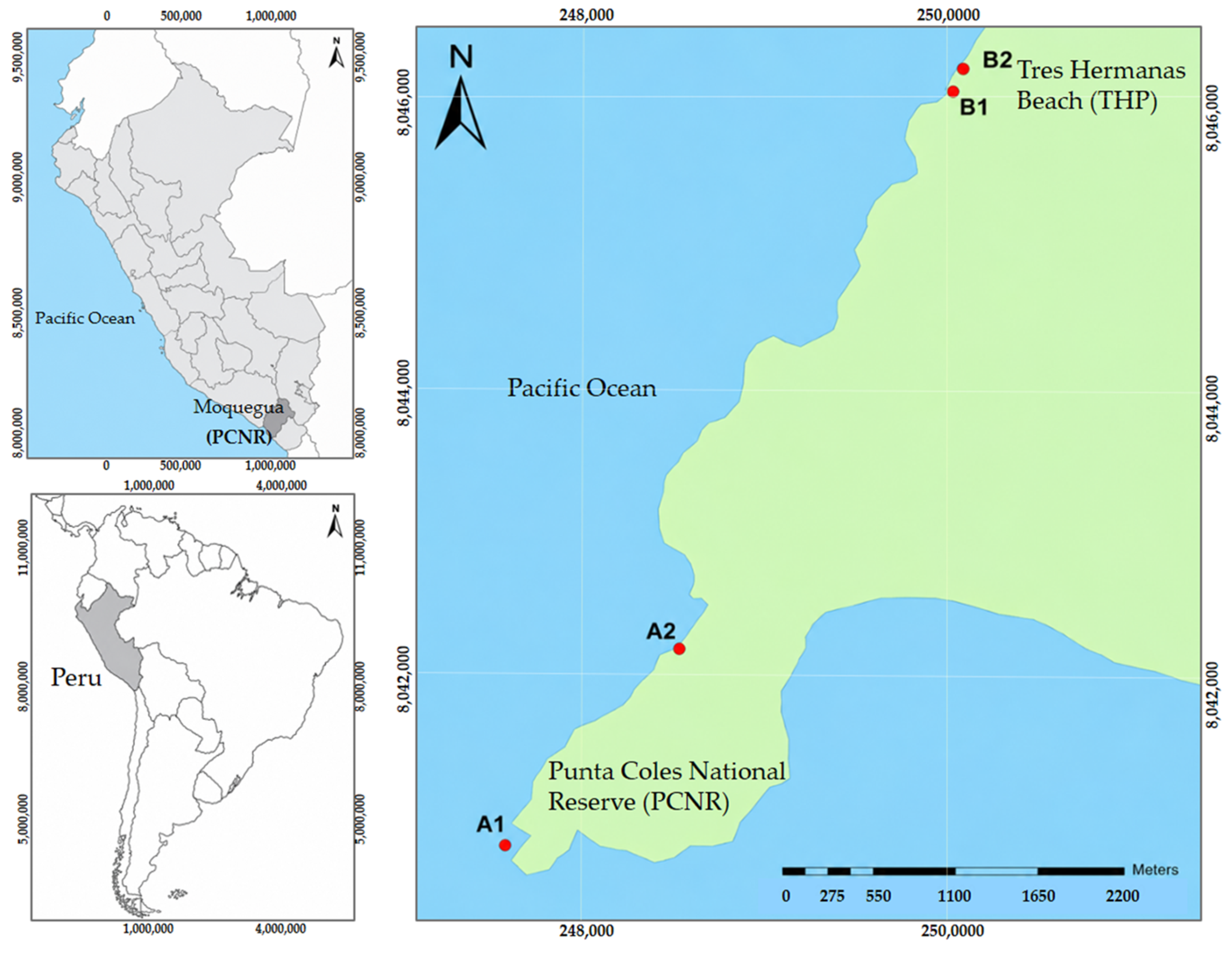
This study was conducted in two coastal zones of the city of Ilo, Moquegua, in southern Peru: the PCNR (zone A), which is located at 17°42′ S and 71°22′ W, and the THP (zone B), which is located at 17°39′30″ S and 71°21′22″ W. The PCNR presents formations of rocky, low cliffs, crags and reefs [36], whereas the THP is influenced by macroalgae extraction activities: these are collected, conditioned and subsequently intended for export. The locations of the study areas, sampling points and campaigns carried out during the winter and spring of 2023 are shown in Figure 1.
Figure 1.
Location of the study areas and sampling points in the province of Ilo, Moquegua, Peru. The Punta Coles National Reserve (PCNR) corresponds to zone A, and Tres Hermanas Beach (THP) corresponds to zone B. The sampling campaigns were carried out during winter (1) and spring (2), corresponding to A1: Punta Coles–Winter (PCNR-W), A2: Punta Coles– Spring (PCNR-S), B1: Tres Hermanas Beach–Winter (THP-W) and B2: Tres Hermanas Beach–Spring (THP-S). The coordinates are presented in the UTM WGS 84 reference system, zone 19S.
The study sites were selected because of their contrasting levels of environmental protection and the variation in environmental conditions observed during the winter and spring of 2023, allowing the assessment of the potential influence of spatial and temporal variability on the structure of the benthic communities associated with L. berteroana.
2.2. Field Sampling
Fieldwork was conducted during the winter and spring of 2023, between June and November, comprising a total of 24 sampling campaigns (two monthly campaigns per area). Distinct sectors within the study areas were evaluated during the winter and spring and were selected on the basis of wave exposure and lower personal risk: Sectors with less wave breaking were considered during the winter, whereas sectors with greater seafloor exposure were selected during the spring. This strategy enabled the assessment of spatial and seasonal variation in polychaetes associated with the holdfasts of L. berteroana.
The holdfasts were collected through sampling points distributed along a line parallel to the coast. At each point, three holdfasts separated by 5 m were collected [37], which were considered independent replicates. Twelve sampling points were evaluated. In each study area, 36 holdfasts were obtained from the PCNR and 36 from the THP, for a total of 72 holdfasts throughout the entire study period. Only L. berteroana holdfasts that had naturally detached from the rocky substrate and exhibited a minimum diameter of 20 cm were considered for sampling. This criterion was applied to standardize the minimum size of the sampling units; individual holdfast size and structural complexity were not quantified as explanatory variables. The samples were placed in plastic bags with airtight closures and preserved with ice packs until they were transferred and processed in the laboratory.
2.3. Sample Processing and Taxonomic Identification
In the laboratory, the holdfasts were oxygenated continuously before processing to maintain adequate oxygen conditions and minimize rapid deterioration of the samples and associated organisms. Each sample was subsequently washed with abundant seawater and filtered through a 0.5 mm mesh to retain the associated fauna. The rhizoids were fragmented manually to facilitate the removal of associated organisms, which were separated with clips and organized in multiwell Petri dishes for subsequent classification and identification.
For preliminary observation and photographic registration, the specimens were maintained alive in a glass observation system with continuous seawater exchange. The photographs were obtained using a Carl Zeiss Stemi 508 stereoscope with a camera incorporated, prioritizing the registration of structures that were externally relevant for identification of the taxonomy.
The specimens were previously relaxed through menthol crystals and magnesium chloride dissolved in seawater to prevent the contraction of structures that were morphologically necessary for their taxonomy ID [38]. The samples were subsequently treated with sodium hypochlorite (% used) to remove soft tissue, after which they were rinsed with distilled water and preserved in 96% ethanol.
Taxonomic identification was performed using a stereoscope at up to 45× magnification and a microscope at 100× optical magnification. The organisms were identified down to the youngest category of taxonomy possible using specialized literature, including the works by Hartmann-Schröder [38,39], Fauchald [40] and Rozbaczylo [41]. Similarly, the identifications were corroborated using the World Register of Marine Species database [42].
Validation of the taxonomic and morphological descriptions was carried out under the supervision of Leslie Harris, Senior Collections Manager of Polychaetes, at the Natural History Museum of Los Angeles County.
2.4. Environmental Variables Evaluated
During each sampling event, in situ water temperature (T, °C), pH, dissolved oxygen concentration (DO, mg L−1), and salinity (psu) were measured using a YSI ProQuatro multiparameter meter. These variables were measured to assess their relationships with the spatial and seasonal variations in polychaete communities associated with L. berteroana.
2.5. Processing of Ecological Data
The data obtained in the field and in the laboratory were organized in Microsoft Excel spreadsheets, and the abundance of polychaetes associated with L. berteroana in both areas of study during the seasons evaluated was recorded. An abundance matrix was subsequently developed for the ecological and statistical correspondence analysis.
2.6. Assessment of Polychaete Diversity and Community Structure
To assess the diversity of the polychaete communities, calculations were performed on the species richness indices of taxonomic diversity (S), Shannon–Wiener diversity (H′), Pielou evenness (J′), and Margalef richness (d). These indices allowed us to characterize the structure and heterogeneity of the communities between the study areas.
The Shannon–Wiener diversity (H′) was calculated through the following expression:
where:
H′ = Shannon–Wiener index
Pi = proportion of individuals of the species
Yo = total number of individuals registered
S = total number of species [43,44].
Pielou’s equity (J′) was estimated as follows:
where:
J′ = H′/ln(S)
J′ = Pielou Equity (J′)
H′ = Shannon–Wiener index
S = total number of species [45].
Species richness specific to Margalef (d) was calculated using the following equation:
where:
d = (S − 1)/ln(N)
d = Margalef species richness index
S = Total number of species
N = The total number of individuals registered in the sample [46].
2.7. Beta Diversity and Community Structure
The variation in the composition of polychaete communities was evaluated using the Bray–Curtis similarity index [47] and abundance data. Additionally, a clustering analysis was performed. Hierarchical clustering was performed for the purpose of identifying similarity patterns between sampling stations. The significance statistics of the groups obtained were evaluated through the similarity profile test (SIMPROF).
2.8. Species Contribution Analysis
A similarity analysis was applied (SIMPER) to determine the taxa that contributed in greater proportion to intragroup similarities and dissimilarities between areas of study.
2.9. Relationships Between Communities and Environmental Variables
The measured environmental variables and Shannon diversity (H′) were explored using principal component analysis (PCA) to assess their overall multivariate structure and spatial variation among the sampling points.
2.10. Statistical Analysis
Statistical analyses, descriptive statistics, and normality tests were performed using SPSS software, version 25. Two-way analysis of variance (ANOVA) was performed to evaluate the effects of area (Punta Coles National Reserve and Tres Hermanas Beach), season (winter and spring), and their interaction on the Shannon–Wiener diversity index (H′, loge). Additional comparisons were performed to assess seasonal differences within each area and differences between areas within each season. Multivariate analyses, including Bray–Curtis similarity, hierarchical cluster analysis, SIMPROF, SIMPER, and PCA, were performed using PRIMER v6 with PERMANOVA+ (Plymouth Marine Laboratory, Plymouth, UK).
3. Results
3.1. Environmental Variables
Temperature, pH, and salinity did not significantly differ between THP and PCNR in either season (Table 1). Dissolved oxygen concentrations also did not significantly differ between sites during the winter; however, in the spring, higher values were recorded at the THP site (5.59 ± 0.35 mg L−1) than at the PCNR site (4.91 ± 0.19 mg L−1) (Table 1).
Table 1.
Physicochemical property parameters of water registered in Tres Hermanas Beach (THP) and the Punta de Coles National Reserve (PCNR) during the winter and spring.
Thus, dissolved oxygen was the only measured environmental variable that differed significantly between the study areas during spring.
3.2. Taxonomic Composition of Polychaetes Associated with Lessonia berteroana
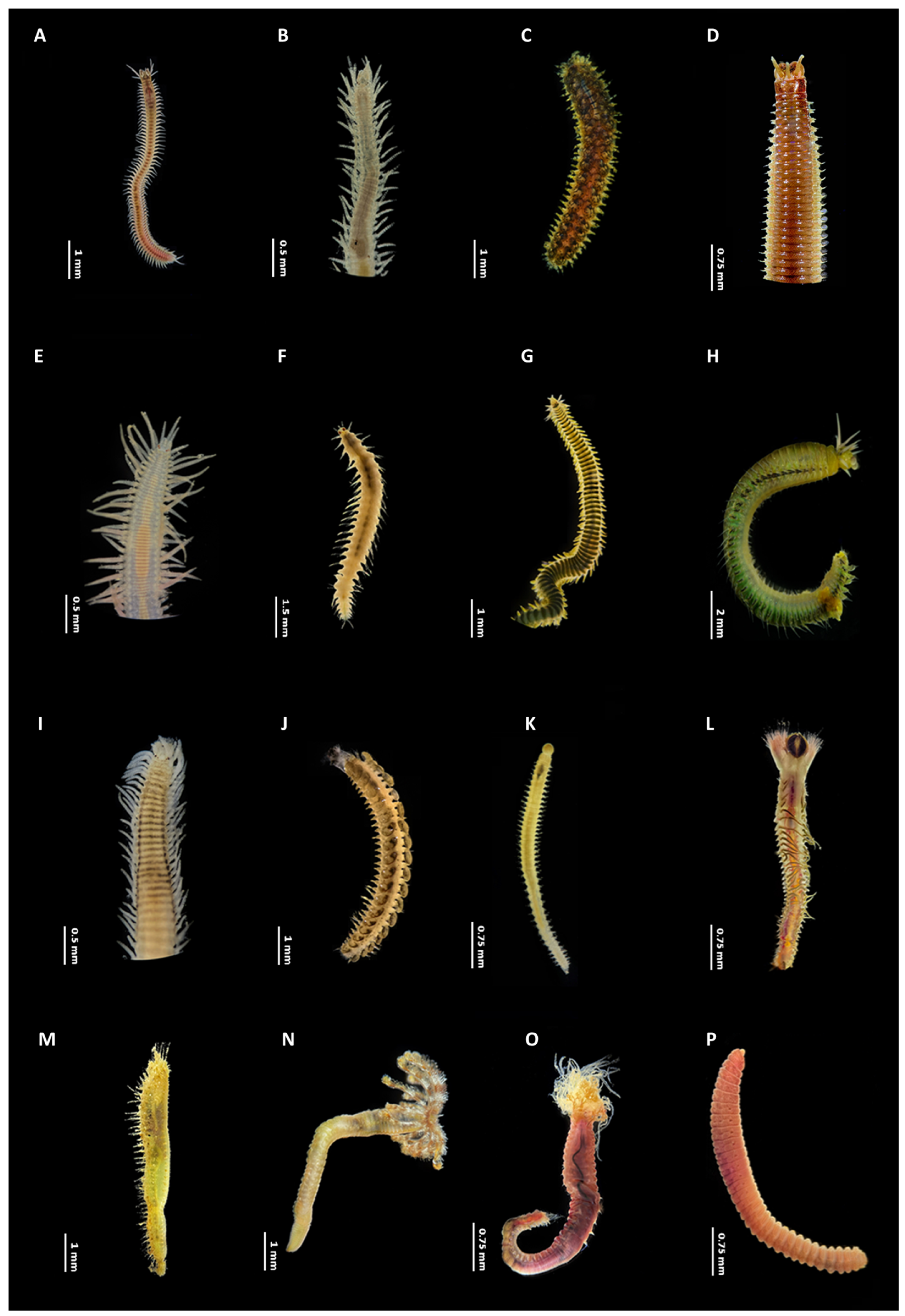
A total of 3674 individuals were identified in PCNR, which were distributed in 19 taxa and 14 families, whereas 4034 individuals were registered in THP, corresponding to 13 taxa and 11 families. The taxa Nereis, Syllis, Halosydna and Phragmatopoma were present in both study areas. Similarly, the following taxa were recorded exclusively in each area (Figure 2). In PCNR, the following were identified: Lysidice, Piromis, Naineris, Notomastus, Trypanosyllis, Perinereis, Parasabella and Terebellinae, while Nephthys was registered only at THP.
Figure 2.
Photographs of polychaetes associated with the Lessonia berteroana complex. The taxa common to both study areas are Errantia: (A) Nereis sp., (B) Syllis sp., (C) Halosydna sp. 1, (G) Eulalia sp., (H) Nereis grubei, (J) Halosydna sp. 2, and (K) Lumbrineris sp.; and Sedentaria: (L) Phragmatopoma sp. The taxa recorded exclusively in the Punta Coles National Reserve are Errantia: (D) Lysidice sp., (E) Trypanosyllis sp. 1, and (I) Trypanosyllis sp. 2; and Sedentaria: (M) Piromis sp., (N) Parasabella sp., (O) Terebellinae, and (P) Notomastus sp. (F) Syllidae (epitoke), an Errantia taxon, was recorded exclusively at Tres Hermanas Beach.
3.3. Diversity and Community Structure of Polychaetes
The diversity of polychaetes associated with L. berteroana varied between seasons and showed a season-dependent pattern across areas (Table 2). The greatest species richness was recorded in PCNR during spring (S = 27), whereas THP maintained the same richness across seasons (S = 17).
Table 2.
Diversity metrics and mean polychaete abundance per sampling point by study area and season.
Total abundance was higher in THP during both winter and spring, with 1946 and 2088 individuals, respectively, compared with 1757 and 1917 individuals in PCNR. The Margalef index reached its highest value in PCNR during spring (d = 3.440), corresponding to the highest species richness recorded. Pielou’s evenness remained relatively high across areas and seasons (J′ = 0.72–0.81), while the Shannon–Wiener diversity index ranged from 2.199 to 2.381, with the highest value recorded in PCNR during spring (H′ = 2.381).
Based on the Shannon–Wiener diversity values presented in Table 2, two-way ANOVA revealed a significant effect of season on diversity (H′, loge) (F1,20 = 29.605, p < 0.001), whereas the effect of area was not significant (F1,20 = 3.055, p = 0.096). However, the area × season interaction was significant (F1,20 = 19.587, p < 0.001), indicating that differences in diversity between areas depended on season.
Seasonal comparisons revealed significant differences in H′ between winter and spring in both PCNR (p < 0.001) and THP (p = 0.039). In contrast, no significant difference between areas was detected during winter (p = 0.283), whereas a significant difference between PCNR and THP was detected during spring (p = 0.045).
3.4. Beta Diversity and Community Similarity
3.4.1. Comparison of Beta Diversity and Similar Communities in Each Study Area
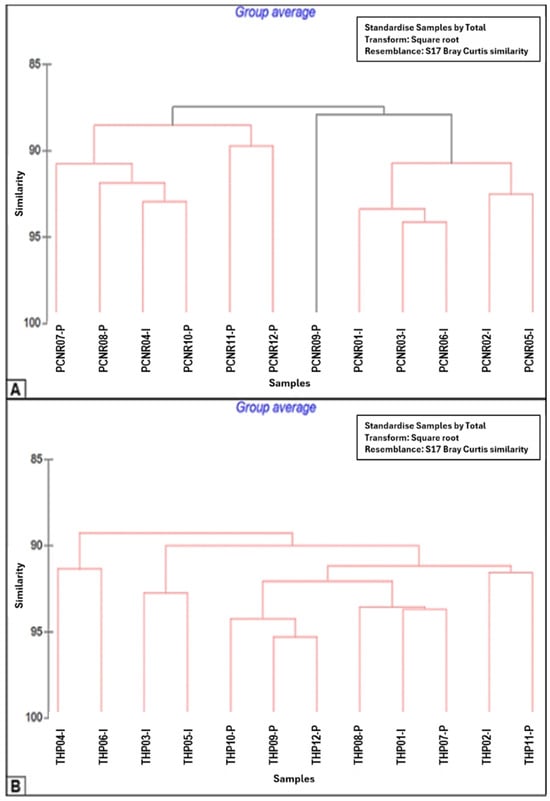
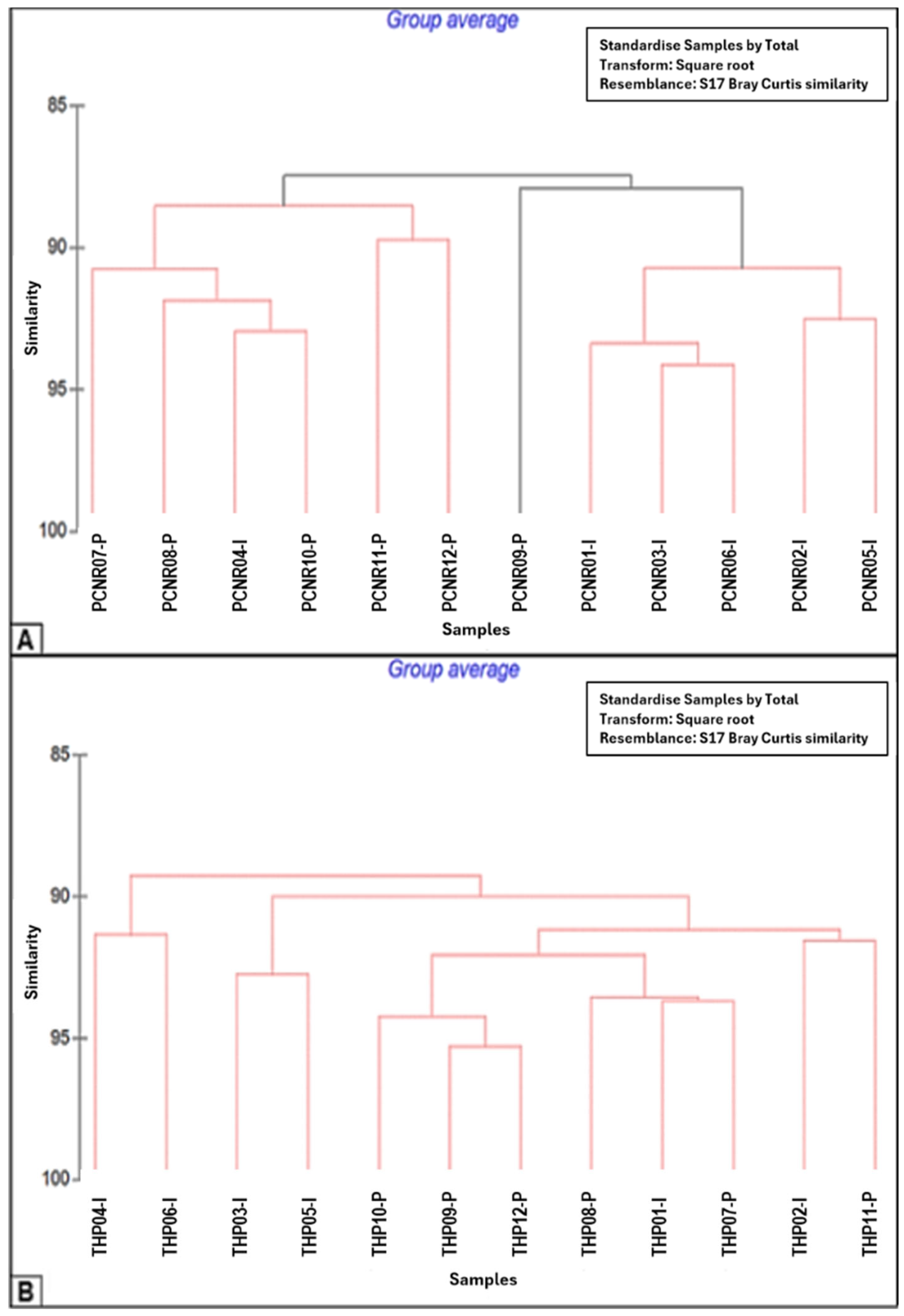
Cluster analysis based on the Bray–Curtis similarity index was used to evaluate patterns of similarity and dissimilarity in polychaete community composition between winter and spring within each study area (Figure 3). The SIMPROF test revealed statistically significant differences (p < 0.05).
Figure 3.
Cluster analysis of polychaete composition between winter and spring within each study area: Punta Coles National Reserve (PCNR) (A) and Tres Hermanas Beach (THP) (B), Ilo, Peru. The letters I and P correspond to the winter and spring seasons, respectively. Branches highlighted in different colors represent groups identified as significantly different by the SIMPROF test (p < 0.05).
In the PCNR (Figure 3A), the winter samples (PCNR01-I to PCNR06-I) tended to cluster separately from the spring samples (PCNR07-P to PCNR12-P), indicating seasonal differentiation in polychaete community composition.
In the THP (Figure 3B), the cluster analysis also revealed patterns related to the sampling season. The THP09-P, THP10-P, and THP12-P samples were highly similar, whereas several winter samples formed separate groups. However, some samples from different seasons were grouped together, indicating less pronounced seasonal differentiation than that observed in PCNR.
3.4.2. Comparison Between Areas by Season
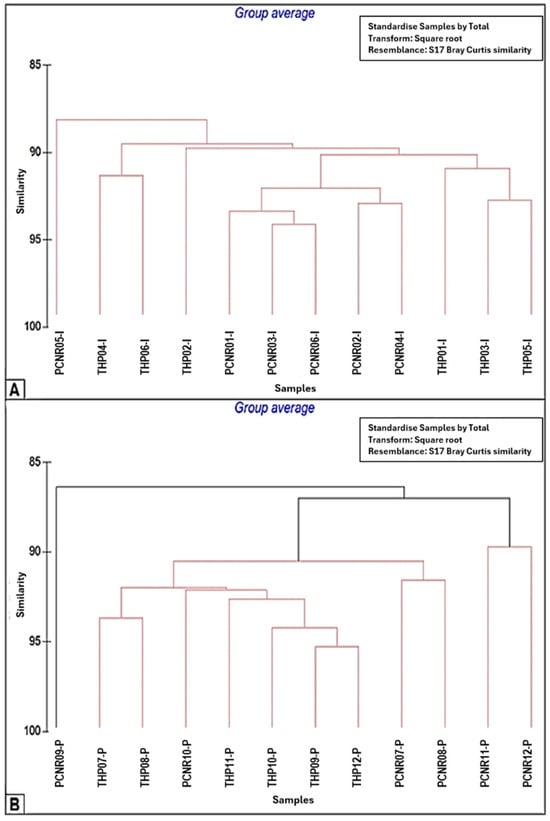
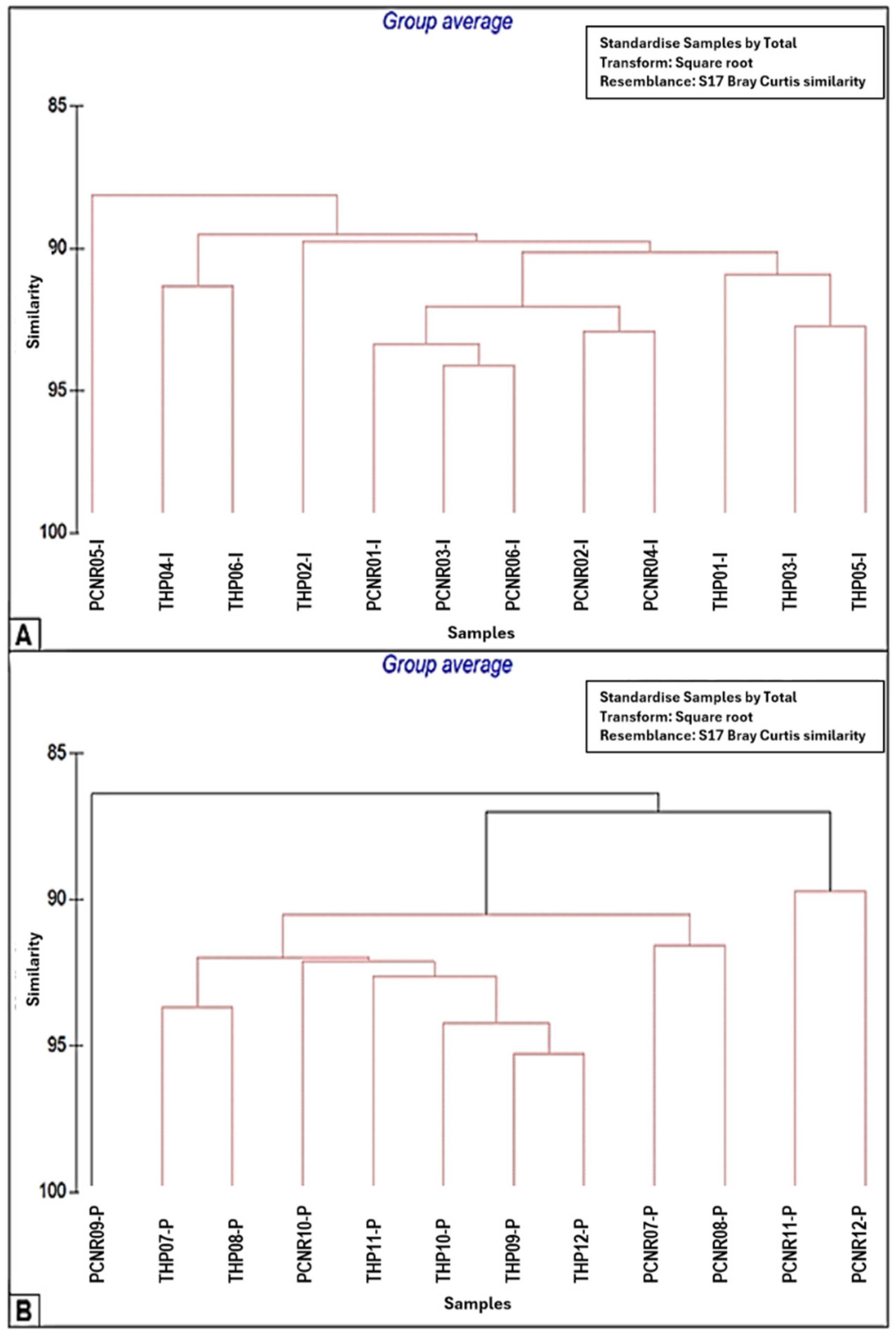
During the winter (Figure 4A), the cluster analysis based on the Bray–Curtis similarity index did not clearly differentiate between the PCNR and THP samples. The twelve stations evaluated formed a single general group, and the SIMPROF test did not detect statistically significant groups (p > 0.05). Samples from both localities were progressively integrated into the dendrogram, indicating high similarity in polychaete community composition during this season.
Figure 4.
Cluster analysis of polychaete composition between Punta Coles National Reserve (PCNR) and Tres Hermanas Beach (THP) in winter (A) and spring (B). The letters I and P correspond to the winter and spring seasons, respectively. Branches highlighted in different colors represent groups identified as significantly different by the SIMPROF test (p < 0.05).
In spring (Figure 4B), the cluster analysis revealed greater differentiation between the two study areas. The SIMPROF test identified statistically significant groups (p < 0.05), with samples tending to organize according to their locality of origin. The THP stations formed groups separate from those registered in PCNR, although some stations showed different levels of similarity within each cluster.
3.5. Contribution of the Taxa to the Community Dissimilarity of the Two Study Areas
As shown in Table 3, in the PCNR, the SIMPER analysis revealed an average dissimilarity of 11.29% between winter and spring. The taxa that contributed most to this difference were Polycirrus sp. 1 (11.43%), Syllis sp. 1 (8.33%), and Eulalia sp. (8.06%). Similarly, some taxa, such as Naineris sp. and Piromis sp., were recorded only during spring.
Table 3.
SIMPER analysis for the Punta Coles Nature Reserve and Tres Hermanas Beach in the winter and spring.
3.5.1. Taxa Contributing to Community Dissimilarity Between Areas by Season
SIMPER Winter Analysis: Punta Coles Nature Reserve vs. Tres Hermanas Beach
As shown in Table 4, the similarity of the internal average was 91.72% for PCNR and 89.80% for THP. The average dissimilarity between areas was 10.61%. The taxa with the greatest contribution to internal similarity were Nereis sp., Syllis sp. 1, Halosydna sp. 1, Phragmatopoma moerchi and Pseudonereis gallapagensis. The main contributions to dissimilarity were associated with differences in the abundance of Syllis sp. 1, Pseudonereis gallapagensis, Nereis sp., Eulalia sp., Cirratulidae sp. and Polycirrus sp. 1.
Table 4.
SIMPER analysis for the winter season: Punta Coles Nature Reserve (PCNR) and Tres Hermanas Beach (THP).
SIMPER Spring Analysis: Punta Coles Nature Reserve vs. Tres Hermanas Beach
During spring, the average internal similarity was 88.41% for PCNR and 92.76% for THP. The average dissimilarity between areas was 10.39%. The taxa with the greatest contributions to dissimilarity were Lumbrineris sp. (9.96%), Syllis sp. 1 (7.57%), Phragmatopoma moerchi (6.80%), Pseudonereis gallapagensis (5.79%), Cirratuidae sp. (5.23%), and Marphysa sp. (4.91%). In addition, Naineris sp., Lysidice sp., Piromis sp., Perinereis sp. 1, Perinereis sp. 2, and Terebellinae sp. were recorded exclusively in PCNR (Table 5).
Table 5.
SIMPER analysis for the spring season: Punta Coles Nature Reserve (PCNR) and Tres Hermanas Beach (THP).
3.6. Relationships Between Polychaete Assemblies and Environmental Variables
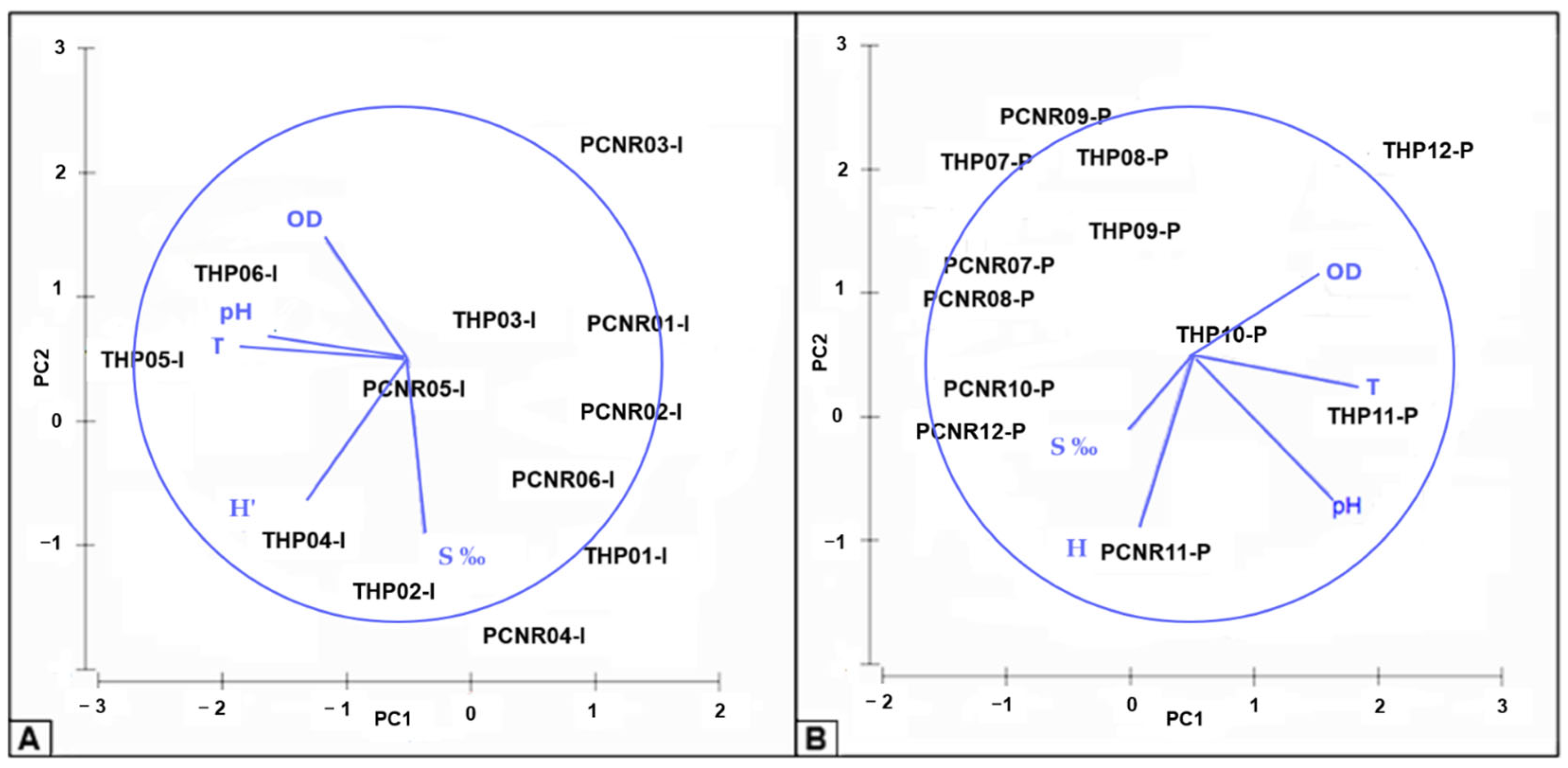
The sampling points in the THP study area were strongly associated with parameters such as OD, T, pH and H′ because of their greater proximity to the vectors of these variables. While PCNR was less strongly associated with these parameters, point PCNR-05 could be further associated with the S ‰ in the winter season (Figure 5A).
Figure 5.
Principal component analysis of the Punta Coles Natural Reserve (PCNR) and Tres Hermanas Beach (THP) associated with the following variables: dissolved oxygen (DO), pH, temperature (T), salinity (S‰) and diversity (H′) in the winter (A) and spring (B) seasons. The letters I and P correspond to the winter and spring seasons, respectively.
For the spring season (Figure 5B) in both study areas, the PCA explained 61.2% of the total variability. PC1 accounts for 38.2%, and PC2 accounts for 23%. Unlike the winter season, the PCA for the spring season revealed a minor differentiation between the study areas, where points THP-10 and THP-11 were influenced by the OD and temperature, respectively, whereas the PCNR zone, at the PCNR-11 point, was influenced by diversity (H′).
4. Discussion
This study revealed that the diversity and community structure of polychaetes associated with the holdfasts of L. berteroana varied between the PCNR and THP zones. Polychaetes were selected as the focal taxonomic group because they constitute a diverse and functionally important component of benthic macrofauna, with different feeding strategies and ecological roles within marine food webs [27,28,29,30]. In addition, their abundance and community composition can respond to environmental conditions and habitat alteration, which has supported their use as indicators of environmental quality [31,32]. Therefore, focusing on polychaetes provides a taxon-specific approach for assessing the spatial and seasonal variation in an important component of the benthic fauna associated with the three-dimensional habitat provided by L. berteroana holdfasts. The present study focused specifically on the diversity and community structure of polychaetes and was not intended to characterize the entire assemblage of organisms associated with the holdfasts.
The PCNR reserve presented greater species richness, particularly in spring, whereas THP had a greater abundance of individuals but lower species richness. The greater species richness observed in PCNR, despite its lower total abundance, indicates that differences in diversity were associated not only with the number of individuals but also with their distribution among taxa. The Margalef and Shannon indices indicated greater diversity in PCNR during spring. In addition, several taxa were recorded exclusively in this locality, including Lysidice, Piromis, Perinereis, Naineris, and Terebellinae. These patterns indicate differences in the composition and relative representation of polychaete taxa between the two localities, particularly during spring (Table 2).
The differences between the areas were further evident during spring. Species richness increased in the PCNR; however, this increase was not proportional to an increase in the abundance of individuals. On the other hand, THP maintained a greater abundance, although it was concentrated in a smaller number of taxa, resulting in relatively lower diversity. Two-way ANOVA indicated that diversity varied significantly across seasons and that the effect of area depended on season, with significant differences detected only between areas during spring. This season-dependent spatial pattern coincided with differences in wave exposure and in the structural condition of the holdfast observed between sampling seasons, suggesting that seasonal changes in habitat conditions may contribute to the observed variation in polychaete diversity.
These results are consistent with previous findings reported by Vega [48], who reported differences in species richness and community composition among communities associated with macroalgal attachment disks from areas differing in habitat characteristics and levels of protection. In the present study, the higher species richness and diversity recorded in the PCNR, particularly during spring, together with the occurrence of several taxa exclusively in this area, indicate differences in community structure between the evaluated areas. These patterns are consistent with the possibility that differences in local habitat conditions and anthropogenic pressure may contribute to the observed variation in polychaete diversity and composition.
The seasonal variation observed within each locality indicates that the polychaete community structure changed between winter and spring, although the magnitude of this variation differed across areas. Within each locality, cluster analysis revealed seasonal differentiation, which was more evident in PCNR than in THP. In PCNR, the samples tended to be organized according to the sampling season, reflecting changes in community structure between winter and spring (Figure 3A). In contrast, although seasonal differences were detected in THPs, the separation between groups was less defined, and some samples from both seasons had similar compositions (Figure 3B). This pattern indicates greater seasonal differentiation in the PCNR assemblage, whereas the THP assemblage showed greater similarity across seasons (Figure 3A,B).
The comparison between localities reinforced this pattern. During the winter, the PCNR and THP samples were highly similar and did not form clearly differentiated groups (Figure 4A), indicating that the community compositions of the two areas were comparable during this season. However, during spring, the separation between localities became more evident (Figure 4B), which coincided with the increase in species richness recorded in PCNR (Table 2) and the occurrence of taxa exclusive to this area. Taken together, these results indicate that spatial differentiation between the two communities was more pronounced during spring and coincided with differences in species richness and taxonomic composition between the localities (Figure 4B; Table 2).
A possible explanation for these patterns is the variation in the physical condition of the L. berteroana holdfasts observed during sampling. Holdfasts constitute three-dimensional microhabitats formed by interconnected rhizoids and cavities that can retain sediments, detritus, organic matter, and suspended particles, providing shelter and potential colonization sites for associated benthic organisms [5,23,24]. Differences in erosion and apparent structural compactness were observed between the localities and sampling seasons, and these characteristics could affect the availability of microhabitats and resources for polychaetes. Nevertheless, holdfast size, volume, and structural complexity were not quantitatively measured in this study. Therefore, the contribution of these characteristics to the observed patterns cannot be directly evaluated and should be considered a hypothesis for future investigations rather than a demonstrated mechanism.
This interpretation is consistent with the findings of previous studies indicating that habitat structure can influence species richness and the organization of benthic communities associated with macroalgal habitats [49,50]. In the present study, the greater species richness recorded in PCNR, particularly during spring, and the occurrence of several taxa exclusively in this locality may be compatible with differences in habitat characteristics. However, the available data do not allow us to determine whether these differences were related specifically to holdfast complexity, erosion, sediment retention, or other unmeasured characteristics of the habitat [51].
The incorporation of taxa recorded exclusively during spring, such as Naineris, Lysidice, Piromis, Perinereis, and Terebellinae, contributed to the increase in species richness in PCNR. Moreover, the persistence of several taxa across seasons indicates that the seasonal variation did not involve complete replacement of the assemblage. Instead, the observed pattern was characterized by changes in the occurrence and relative abundance of taxa, including the addition of taxa with lower abundance. This combination of persistence and incorporation of taxa may explain the increase in diversity without a proportional increase in total abundance (Table 2).
The patterns observed in the diversity analysis were consistent with the beta diversity results. SIMPER analysis indicated that the observed dissimilarities were primarily associated with changes in the relative abundance of taxa shared between communities rather than complete species replacement. Taxa such as Syllis sp. 1, Polycirrus sp. 1, Nereis sp., Pseudonereis gallapagensis, Lumbrineris sp., and Eulalia sp. contributed substantially to the observed dissimilarities (Table 3, Table 4 and Table 5). The recurrence of several taxa in both localities suggests a shared component of the polychaete assemblage associated with L. berteroana holdfasts, whereas the occurrence of additional taxa in PCNR contributed to its higher richness during spring.
The predominance of differences associated with changes in relative abundance rather than complete species replacement suggests that both localities share a common component of polychaete taxa associated with L. berteroana holdfasts. In this context, spatial and seasonal differences may modify the relative abundance of particular taxa without necessarily eliminating the taxa characteristic of this habitat. However, the present study cannot determine whether these patterns resulted from environmental filtering, differences in microhabitat availability, recruitment, competition for space, or other ecological processes because these mechanisms were not directly measured.
This pattern is consistent with what was described previously by Quirós et al. [52], who reported that communities with high internal similarity can maintain a relatively stable composition despite variations in the abundance of particular species. In the present study, the high similarity within localities indicates that the assemblages retained a common compositional structure, whereas the differences detected by SIMPER highlight changes in the relative contribution of particular taxa between seasons and localities. The occurrence of additional taxa in PCNR during spring increased species richness without indicating a complete change in the assemblage.
The presence of recurring genera such as Syllis, Pseudonereis, Nereis, and Halosydna in both areas is also consistent with studies conducted in ecosystems dominated by southeastern Pacific macroalgae. Vega [49] reported a high representation of Syllidae in Lessonia holdfasts on the Chilean coast, whereas Barraza et al. [50] reported the frequent presence of Syllis and Pseudonereis in rocky intertidal substrates. The recurrence of these genera across different algal and rocky habitats suggests that they may be common components of benthic assemblages associated with structurally heterogeneous substrates. Similarly, differences in the representation of Cirratulidae between localities may reflect differences in local conditions, although these associations should be interpreted cautiously because the present study did not directly evaluate the effect of disturbance on community composition.
The relationships between the polychaete assemblages and the measured environmental variables were less consistent than the spatial and seasonal patterns were [53]. The temperature, pH, and salinity did not differ significantly between the study areas in either season, whereas the dissolved oxygen concentration differed between localities only during spring. The PCA did not show a consistent separation between PCNR and THP based on the measured variables. Thus, the physicochemical conditions recorded during the sampling events did not provide a consistent spatial distinction between the two assemblages. These results should be interpreted considering that the environmental variables represent conditions measured at the time of sampling and may not capture environmental variability occurring over longer temporal scales.
The limited spatial differentiation in the measured physicochemical variables suggests that additional factors may contribute to the organization of polychaete assemblages associated with L. berteroana. One possibility is the physical structure of the holdfast itself, since its three-dimensional architecture provides a variety of spaces and surfaces that can be occupied by associated organisms [5,23,24]. However, this study did not quantify holdfast complexity, volume, erosion, sediment retention, or other structural attributes. Therefore, the relative contributions of these characteristics cannot be separated from those of the measured environmental variables. Rather, the present findings highlight habitat structure as a factor that should be considered in future studies of polychaete assemblages associated with Lessonia.
The absence of quantitative measurements of holdfast structure represents an important limitation of the present study. Although a minimum diameter of 20 cm was established to standardize the sampling units, individual holdfast size and structural complexity were not quantified as explanatory variables. Similarly, the biomass or density of L. berteroana per square meter was not measured. Consequently, determining whether differences in the amount of available kelp habitat contributed to the spatial patterns observed in the polychaete assemblages was not possible. Future studies should incorporate quantitative descriptors of holdfast size, volume, structural complexity, erosion, sediment and organic matter retention, as well as kelp density or biomass per unit area. More frequent measurements of environmental variables and direct assessments of recruitment and colonization processes would also help determine the relative contributions of habitat structure, environmental variability, and biological processes to polychaete community organization.
Taken together, the results indicate that polychaete assemblages associated with L. berteroana holdfasts exhibit spatial and seasonal variation in species richness, abundance, and community composition. Season was the most consistent factor detected in the univariate analysis, while the significant area × season interaction demonstrated that spatial differences in diversity depended on season. Multivariate analyses similarly revealed seasonal differences in community composition and greater spatial differentiation during spring. In contrast, the measured physicochemical variables showed relatively limited spatial differentiation, with dissolved oxygen being the only variable that differed significantly between localities during spring.
Overall, this study provides a taxon-specific assessment of the spatial and seasonal variations in polychaete assemblages associated with L. berteroana holdfasts in southern Peru. The results show that these assemblages share several recurrent taxa but differ in species richness, relative abundance, and composition between seasons and, particularly during spring, between localities. The holdfasts of L. berteroana provide structurally heterogeneous habitats for polychaetes, but the extent to which quantitative differences in their structure contribute to community organization remains unresolved. Integrating polychaete diversity with quantitative descriptors of holdfast structure, kelp abundance, and environmental variability in future studies will provide a more comprehensive understanding of the processes shaping the benthic assemblages associated with Lessonia forests.
5. Conclusions
Taken together, the results indicate that the structure of polychaete communities is associated with the holdfast of Lessonia berteroana because of the interaction between habitat heterogeneity, variability, seasonality and the level of environmental protection. The differences in observations between Punta Coles National Reserve and Tres Hermanas Beach reflect consistent differences in the organization of the assemblies of benthic organisms, particularly in terms of species richness, composition and abundance of related species.
Similarly, the holdfasts of L. berteroana act as three-dimensional microhabitats that support various benthic communities whose configurations respond to both the integrity of the substrate structure and the dynamics of the local environment. These results reinforce the importance of the ecological balance of macroalgal forests as key habitat formers in the intertidal zones of southern Peru.
Author Contributions
Conceptualization, H.H.S.G., G.M.C.D.l.C. and A.P.V.Q.; Data curation and formal analysis, G.M.C.D.l.C. and E.L.; Funding acquisition, H.H.S.G. and S.M.-A.; Investigation, G.M.C.D.l.C.; Methodology and Project administration, H.H.S.G. and S.M.-A.; Software, G.M.C.D.l.C., E.L. and A.P.V.Q.; Validation, J.G.A., L.H. and E.L.; Visualization, H.H.S.G., G.M.C.D.l.C., S.M.-A., L.H. and A.P.V.Q.; Writing—original draft, H.H.S.G., G.M.C.D.l.C., S.M.-A., E.L., L.H. and J.G.A.; Writing—review and editing, S.M.-A., E.L., G.M.C.D.l.C., L.H. and J.G.A. All authors have read and agreed to the published version of the manuscript.
Funding
This research was funded by the National University of Moquegua (UNAM) affiliate in Ilo, Peru (Resolutions No. 1279-2019-UNAM and 0102-2020-UNAM).
Institutional Review Board Statement
Not applicable.
Informed Consent Statement
Not applicable.
Data Availability Statement
The dataset supporting the findings of this study is publicly available at the following link: https://drive.google.com/drive/folders/1OlhOBF3BHF4U3L47mMOhreq_5GAivEhY (accessed on 24 April 2026).
Acknowledgments
The authors express their gratitude to the National University of Moquegua (UNAM) for the facilities provided at the Laboratory of Molecular Biology and Biotechnology, UNAM subsidiary Ilo, and for funding.
Conflicts of Interest
The authors declare no conflict of interest.
Abbreviations
The following abbreviations are used in this manuscript:
| PCNR | Punta de Coles Nature Reserve (protected area) by the state) |
| THP | Three Sisters Beach (unprotected area) by the state) |
References
- Steneck, R.S.; Graham, M.H.; Bourque, B.J.; Corbett, D.; Erlandson, J.M.; Estes, J.A.; Tegner, M.J. Kelp forest ecosystems: Biodiversity, stability, resilience and future. Environ. Conserv. 2002, 29, 436–459. [Google Scholar] [CrossRef] [Scilit]
- Teagle, H.; Hawkins, S.J.; Moore, P.J.; Smale, D.A. The role of kelp species as biogenic habitat formers in coastal marine ecosystems. J. Exp. Mar. Biol. Ecol. 2017, 492, 81–98. [Google Scholar] [CrossRef] [Scilit]
- Tano, S.; Eggertsen, M.; Wikstrom, S.A.; Berkstrom, C.; Buriyo, A.S.; Halling, C. Tropical seaweed beds are important habitats for mobile invertebrate epifauna. Estuar. Coast. Shelf Sci. 2016, 183, 1–12. [Google Scholar] [CrossRef] [Scilit]
- Gallardo, D.; Oliva, F.; Ballesteros, M. Marine invertebrate epibionts on photophilic seaweeds: Importance of algal architecture. Mar. Biodivers. 2021, 51, 16. [Google Scholar] [CrossRef] [Scilit]
- Graham, M.H.; Vásquez, J.A.; Buschmann, A.H. Global ecology of the giant kelp Macrocystis: From ecotypes to ecosystems. Oceanogr. Mar. Biol. Annu. Rev. 2007, 45, 39–88. [Google Scholar] [CrossRef] [Scilit]
- Best, R.J.; Chaudoin, A.L.; Bracken, M.E.S.; Graham, M.H.; Stachowicz, J.J. Plant-animal diversity relationships in a rocky intertidal system depend on invertebrate body size and algal cover. Ecology 2014, 95, 1308–1322. [Google Scholar] [CrossRef] [Scilit]
- Byers, J.E.; Cuddington, K.; Jones, C.G.; Talley, T.S.; Hastings, A.; Lambrinos, J.G.; Crooks, J.A.; Wilson, W.G. Using ecosystem engineers to restore ecological systems. Trends Ecol. Evol. 2006, 21, 9. [Google Scholar] [CrossRef] [Scilit]
- Duarte, C.M.; Losada, I.J.; Hendriks, I.E.; Mazarrasa, I.; Marbà, N. The role of coastal plant communities for climate change mitigation and adaptation. Nat. Clim. Change 2013, 3, 961–968. [Google Scholar] [CrossRef] [Scilit]
- IPCC. Special Report on the Ocean and Cryosphere in a Changing Climate. 2019. Available online: https://www.ipcc.ch/srocc/ (accessed on 25 April 2026).
- Buschmann, A.H.; Camus, C.; Infante, J.; Neori, A.; Israel, Á.; Hernández-González, M.C.; Pereda, S.V.; Gomez-Pinchetti, J.L.; Golberg, A.; Tadmor-Shalev, N.; et al. Seaweed production: Overview of the global state of exploitation, farming and emerging research activity. Eur. J. Phycol. 2017, 52, 391–406. [Google Scholar] [CrossRef] [Scilit]
- Filbee -Dexter, K.; Wernberg, T. Rise of Turfs: A New Battlefront for Globally Declining Kelp Forests. BioScience 2018, 68, 64–76. [Google Scholar] [CrossRef] [Scilit]
- Harley, C.D.; Anderson, K.M.; Demes, K.W.; Jorve, J.P.; Kordas, R.L.; Coyle, T.A.; Graham, M.H. Effects of climate change on global seaweed communities. J. Phycol. 2012, 48, 1064–1078. [Google Scholar] [CrossRef] [Scilit]
- Segaran, T.C.; Azra, M.N.; Handayani, K.S.; Lananan, F.; Xu, J. Seaweed and climate change: A mapping review. Mar. Environ. Res. 2023, 192, 106216. [Google Scholar] [CrossRef] [Scilit]
- Smale, D.A.; Wernberg, T.; Oliver, E.C.; Thomsen, M.; Harvey, B.P.; Straub, S.C.; Moore, P.J. Marine heatwaves threaten global biodiversity and the provision of ecosystem services. Nat. Clim. Change 2019, 9, 306–312. [Google Scholar] [CrossRef] [Scilit]
- Wernberg, T.; Bennett, S.; Babcock, R.C.; De Bettignies, T.; Cure, K.; Depczynski, M.; Wilson, S. Climate-driven regime shift of a temperate marine ecosystem. Science 2016, 353, 169–172. [Google Scholar] [CrossRef] [Scilit]
- Strain, E.M.A.; Thomson, R.J.; Micheli, F.; Mancuso, F.P.; Airoldi, L. Identifying the interacting roles of stressors in driving the global loss of canopy-forming to mat-forming algae in marine ecosystems. Glob. Change Biol. 2014, 20, 3300–3312. [Google Scholar] [CrossRef] [Scilit]
- Connell, S.D.; Russell, B.D.; Turner, D.J.; Shepherd, S.A.; Kildea, T.; Miller, D.; Airoldi, L.; Cheshire, A. Recovering a lost baseline: Missing kelp forests from a metropolitan coast. Mar. Ecol. Prog. Ser. 2008, 360, 63–72. [Google Scholar] [CrossRef] [Scilit]
- Vásquez, J.A.; Santelices, B. Ecological effects of harvesting Lessonia (Laminariales, Phaeophyta) in central Chile. Hydrobiologia 1990, 204–205, 41–47. [Google Scholar] [CrossRef] [Scilit]
- Vega, J.M.A.; Broitman, B.R.; Vásquez, J.A. Monitoring the sustainability of Lessonia nigrescens (Laminariales, Phaeophyceae) in northern Chile under strong harvest pressure. J. Appl. Phycol. 2014, 26, 791–801. [Google Scholar] [CrossRef] [Scilit]
- Pérez-Araneda, K.; Zevallos, S.; Arakaki, N.; Gamarra, A.; Carbajal, P.; Tellier, F. Lessonia berteroana en Perú: Comprobación de la identidad de la especie y diversidad genética en el borde norte de distribución. Rev. Biol. Mar. Oceanogr. 2020, 55, 270–276. [Google Scholar] [CrossRef] [Scilit]
- Dayton, P.K. Ecology of kelp communities. Annu. Rev. Ecol. Syst. 1985, 16, 215–245. Available online: https://www.jstor.org/stable/2097048 (accessed on 24 April 2026). [CrossRef]
- Kovalenko, K.E.; Thomaz, S.M.; Warfe, D.M. Habitat complexity: Approaches and future directions. Hydrobiologia 2012, 685, 1–17. [Google Scholar] [CrossRef] [Scilit]
- Christie, H.; Jørgensen, N.M.; Norderhaug, K.M.; Waage-Nielsen, E. Species distribution and habitat exploitation of fauna associated with kelp (Laminaria hyperborea) along the Norwegian coast. J. Mar. Biol. Assoc. UK 2003, 83, 687–699. [Google Scholar] [CrossRef] [Scilit]
- Kelaher, B.P.; Underwood, A.J.; Chapman, M.G. Experimental transplantations of coralline algal turf to demonstrate causes of differences in macrofauna at different tidal heights. J. Exp. Mar. Biol. Ecol. 2003, 282, 23–41. [Google Scholar] [CrossRef] [Scilit]
- Schiel, D.R.; Foster, M.S. The population biology of large brown seaweeds: Ecological consequences of multiphase life histories in dynamic coastal environments. Annu. Rev. Ecol. Evol. Syst. 2006, 37, 343–372. [Google Scholar] [CrossRef] [Scilit]
- Wernberg, T.; Coleman, M.A.; Bennett, S.; Thomsen, M.S.; Tuya, F.; Kelaher, B.P. Genetic diversity and kelp forest vulnerability to climatic stress. Sci. Rep. 2018, 8, 1851. [Google Scholar] [CrossRef] [Scilit]
- Fauchald, K.; Jumars, P.A. The diet of worms: A study of polychaete feeding guilds. Oceanogr. Mar. Biol. Ann. Rev. 1979, 17, 193–284. Available online: https://repository.si.edu/server/api/core/bitstreams/93a7b48e-a7b8-4964-8bae-cd53cae6bac2/content (accessed on 23 January 2026).
- Jumars, P.A.; Mayer, L.M.; Deming, J.W.; Baross, J.A.; Wheatcroft, R.A. Deep-sea deposit-feeding strategies suggested by environmental and feeding constraints. Philos. Trans. R. Soc. London. Ser. A Math. Phys. Sci. 1990, 331, 85–101. [Google Scholar] [CrossRef] [Scilit]
- Rouse, G.W.; Pleijel, F. Polychaetes; Oxford University Press: Oxford, UK, 2001. [Google Scholar]
- Pabis, K.; Sicinski, J. Polychaete fauna associated with holdfasts of the large brown alga Himantothallus grandifolius in Admiralty Bay, King George Island, Antarctic. Polar Biol. 2010, 33, 1277–1288. [Google Scholar] [CrossRef] [Scilit]
- Giangrande, A.; Licciano, M.; Musco, L. Polychaetes as environmental indicators revisited. Mar. Pollut. Bull. 2005, 50, 1153–1162. [Google Scholar] [CrossRef] [Scilit]
- Sala, E.; Giakoumi, S. No-take marine reserves are the most effective protected areas in the ocean. ICES J. Mar. Sci. 2018, 75, 1166–1168. [Google Scholar] [CrossRef] [Scilit]
- Lester, S.E.; Halpern, B.S.; Grorud-Colvert, K.; Lubchenco, J.; Ruttenberg, B.I.; Gaines, S.D.; Warner, R.R. Biological effects within no-take marine reserves: A global synthesis. Mar. Ecol. Prog. Ser. 2009, 384, 33–46. [Google Scholar] [CrossRef] [Scilit]
- Méndez-Ancca, S.; Pepe-Victoriano, R.; Meza, Y.A.; Gonzales, H.H.S.; Aguilar, J.L.C.; Tejada Cáceres, A.; Aguilera, J.G. Subtidal Biodiversity of the Punta de Coles Marine Reserve, Moquegua, Peru. J. Mar. Sci. Eng. 2025, 13, 1400. [Google Scholar] [CrossRef] [Scilit]
- Miloslavich, P.; Carbonini, A. Manual de Muestreo Para Comunidades Costeras. Protocolo Para Litorales Rocosos Y Praderas de Fanerógamas Marinas Universidad Simón Bolívar, Centro de Biodiversidad Marina Caracas, Venezuela; Caracas, Venezuela, 2010. [Google Scholar]
- DHNMGP—Dirección De Hidrografía y Navegación de la Marina de Guerra del Perú. Marina de Guerra del Perú. Lima: Trazando el Rumbo. 2006. Available online: https://www.dhn.mil.pe/Archivos/bitacora/edc_02.pdf (accessed on 19 September 2025).
- León-González, J.; Bastida-Zavala, J.; Carrera-Parra, L.; García-Garza, M.; Salazar-Vallejo, S.; Solís Weiss, V.; Tovar-Hernández, M. Anélidos Marinos de México Y América Tropical; Editorial Universitaria: Nuevo León, México, 2021; pp. 1–1054. [Google Scholar]
- Hartmann-Schrörder, G. Zur Kenntnis des Eulitorals der chilenischen Pazifikküste und der argentinischen Küste Südpatagoniens unter besonderer Berücksichtigung der Polychaeten und Ostracoden (Vol. TI. II). In Mitteilungen aus dem Hamburgischen Zoologischen Museum und Institut; Die Polychaeten des Eulitorals: Hamburgo, Germany, 1962. [Google Scholar]
- Hartmann-Schröder, G. Zur Kenntnis des Sublitorals der chilenischen Küste unter besonderer Berücksichtigung der Polychaeten und Ostracoden. In Mitteilungen aus dem Hamburgischen Zoologischen Museum und Institut; Die Polychaeten des Sublitorals: Hamburgo, Germany, 1965. [Google Scholar]
- Fauchald, K. The Polychaete Worms Definitions and Keys to the Orders, Families and Genera; Science Series; Natural History Museum of Los Angeles County; The Allan Hancock Foundation University of Southern California: Los Ángeles, CA, USA, 1977; p. 28. [Google Scholar]
- Rozbaczylo, N. Clave para el reconocimiento de familias de anélidos. Poliquetos del mar chileno. Stud. Neotrop. Fauna Environ. 1980, 15, 167–196. [Google Scholar] [CrossRef] [Scilit]
- WORMS—World Register of Marine species (WORMS). 2023. Available online: https://www.marinespecies.org/index.php (accessed on 24 April 2026).
- Shannon, C.E. A mathematical theory of communication. Bell Syst. Tech. J. 1948, 27, 623–656. [Google Scholar] [CrossRef] [Scilit]
- Shannon, C.E.; Weaver, W. The Mathematical Theory of Communication; University of Illinois Press: Champaign, IL, USA, 1949. [Google Scholar]
- Pielou, E.C. Measurement of diversity in different types of biological collections. J. Theor. Biol. 1966, 13, 131–144. [Google Scholar] [CrossRef] [Scilit]
- Margalef, R. Information theory in ecology. General. Syst. 1958, 3, 36–71. [Google Scholar] [CrossRef] [Scilit]
- Bray, J.R.; Curtis, J.T. An ordination of the upland forest communities of southern Wisconsin. Ecol. Monogr. 1957, 27, 325–349. [Google Scholar] [CrossRef] [Scilit]
- Vega, A. Fauna asociada a discos de adhesión del complejo Lessonia nigrescens,¿Es un indicador de integridad ecológica en praderas explotadas de huiro negro, en el norte de Chile? Lat. Am. J. Aquat. Res. 2016, 44, 623–637. [Google Scholar]
- Torres-Moye, G.; Edwards, M.; Montaño-Moctezuma, C. Estructura de la comunidad bentónica en los bosques de macroalgas de la cuenca del Sur de California. Cienc. Mar. 2013, 39, 239–252. [Google Scholar] [CrossRef] [Scilit]
- Barraza, J.E.; Melara, V.E.; Picardo, A. Poliquetos y otra fauna macrobentónica asociada de la franja intermareal rocosa de Mizata, La Libertad, El Salvador. Real. Reflex. 2021, 54, 252–265. [Google Scholar] [CrossRef] [Scilit]
- Kraft, N.J.B.; Adler, P.B.; Godoy, O.; James, E.C.; Fuller, S.; Levine, J.M. Community assembly, coexistence and the environmental filtering metaphor. Funct. Ecol. 2015, 29, 592–599. [Google Scholar] [CrossRef] [Scilit]
- Quirós Rodríguez, J.; Dueñas Ramírez, P.; Hernando Campos, N. Poliquetos (Annelida: Polychaeta) asociados a algas rojas intermareales de Córdoba, Caribe Colombiano. Rev. Biol. Mar. Oceanogr. 2013, 8, 87–98. [Google Scholar] [CrossRef] [Scilit]
- Villamar, F. Estudio de los Poliquetos (Gusanos Marinos) en la zona Intermareal y Submareal de la Bahía de Manta (Ecuador), y su Relación con Algunos Factores Ambientales, Durante Marzo y Agosto de 2011. Rev. Acta Ocean. Pac. 2013, 18, 117–130. Available online: http://hdl.handle.net/1834/5756 (accessed on 23 January 2026).

Disclaimer/Publisher’s Note: The statements, opinions and data contained in all publications are solely those of the individual author(s) and contributor(s) and not of MDPI and/or the editor(s). MDPI and/or the editor(s) disclaim responsibility for any injury to people or property resulting from any ideas, methods, instructions or products referred to in the content. |
© 2026 by the authors. Licensee MDPI, Basel, Switzerland. This article is an open access article distributed under the terms and conditions of the Creative Commons Attribution (CC BY) license.