


Abstract
Antifouling coatings are an important source of trace metal contamination in coastal marine environments because they continuously release biocidal compounds from submerged structures. Among the metallic contaminants released from many antifouling coatings, copper (Cu) and zinc (Zn) are of particular environmental concern because of their persistence and bioavailability and may accumulate in filter-feeding organisms inhabiting aquaculture areas. The present study evaluated the effects of the leachable fraction of a commercial antifouling paint on survival and Cu and Zn accumulation in the Pacific cupped oyster Magallana gigas. Oysters were exposed for 21 days to three nominal concentrations of an aqueous antifouling paint extract (0, 0.05, and 0.25 mg/L). Copper and zinc concentrations in the exposure media were analytically verified by inductively coupled plasma mass spectrometry, while tissue metal concentrations were determined at the end of the experiment. Survival was analysed using Kaplan-Meier curves and log-rank tests. Mortality showed an increasing trend with exposure concentration, and overall survival differed significantly among treatments, with mortality concentrated in oysters exposed to the highest concentration tested. Both Cu and Zn accumulated in oyster tissues, although their accumulation patterns differed, reflecting distinct physiological regulation mechanisms. These findings demonstrate that the leachable fraction of antifouling paint represents a bioavailable source of Cu and Zn for marine bivalves under controlled exposure conditions. The study provides new experimental evidence supporting environmental risk assessment of antifouling-derived contamination and contributes to the sustainable management of shellfish farming areas.
1. Introduction
Aquatic ecosystems are increasingly threatened by anthropogenic activities, including urbanization, industrialization, agriculture, and maritime transport, all of which contribute to the continuous release of contaminants into aquatic environments and may compromise ecosystem health [1,2,3]. Among these contaminants, trace metals are of particular environmental concern because of their persistence, toxicity, and capacity to accumulate within aquatic ecosystems [4,5,6]. Once released into the environment, metals can bioaccumulate in the tissues of aquatic organisms and, in some cases, biomagnify through food webs. Their accumulation is influenced by multiple biological and environmental factors, including geographic location, species-specific physiology, body size, feeding behaviour, and the physicochemical characteristics of the contaminants [1,7,8,9].
In coastal marine environments, trace metals originate from a variety of natural and anthropogenic sources, including mining activities, industrial and urban effluents, agricultural runoff, and maritime transport [4,10,11,12]. Among these sources, antifouling coatings represent one of the most direct and continuous inputs of metals into marine ecosystems. These coatings release biocidal compounds from submerged artificial structures such as ships, aquaculture cages, buoys, nets, piers, and abandoned vessels, while additional contamination derives from ship maintenance and repair operations [13,14,15]. Consequently, paint-derived particles and dissolved metals accumulate in the surrounding environment through leaching, runoff, and atmospheric deposition, ultimately becoming incorporated into marine sediments and the water column [16,17].
Marine biofouling, defined as the colonization of submerged artificial surfaces by microorganisms, algae, plants, and invertebrates, represents a major operational challenge for maritime industries because it increases hydrodynamic drag, fuel consumption, and maintenance costs [18,19]. To prevent biological colonization, antifouling paints containing biocidal compounds are widely applied to submerged structures, allowing the gradual release of toxic substances that inhibit the settlement and growth of fouling organisms [20,21,22]. Modern antifouling formulations primarily rely on copper- and zinc-based pigments, frequently combined with booster biocides to enhance their efficacy [21,23]. Their environmental impact is particularly relevant in semi-enclosed coastal systems, including harbours, marinas, estuaries, and aquaculture areas, where limited water exchange and intense boating activity favour the accumulation of contaminants [24].
Experimental studies have demonstrated that copper (Cu) and zinc (Zn) associated with antifouling paint residues may become bioaccessible or bioavailable to marine invertebrates through dissolved and particulate exposure pathways [25,26,27]. Bioaccessibility, defined as the fraction of a contaminant released under digestive conditions and potentially available for absorption, depends on several physiological and chemical factors [28]. Copper bioaccessibility appears to be influenced by digestive parameters such as amino acid concentration, surface tension, and gut residence time, whereas zinc bioavailability is primarily affected by amino acid concentration and surface tension and is less dependent on intestinal transit time [28]. However, bioaccessibility does not necessarily correspond to actual biological uptake. Available evidence suggests that only a fraction of bioaccessible copper is retained in invertebrate tissues, whereas zinc accumulation is partially regulated by physiological homeostatic mechanisms [26,27]. Consequently, a considerable proportion of mobilized metals may ultimately be excreted back into the surrounding environment [28].
Copper and zinc are essential micronutrients involved in several physiological processes; however, elevated environmental concentrations may disrupt metal homeostasis and induce adverse biological effects in aquatic organisms [29,30,31,32]. This is particularly relevant for filter-feeding bivalves, which continuously process large volumes of water and can efficiently accumulate both dissolved and particulate contaminants [4,33]. Although these organisms possess physiological mechanisms regulating metal uptake, storage, detoxification, and elimination [34,35,36], substantial tissue accumulation may occur under contaminated conditions [37,38]. Consequently, bivalves are widely recognized as effective bioindicators of marine pollution and are routinely employed in environmental monitoring programmes [4,33]. Despite the ecological and economic importance of oysters, relatively few experimental studies have directly evaluated their responses to the leachable fraction of antifouling paints under controlled laboratory conditions, particularly considering exposure to complex paint-derived mixtures rather than individual contaminants.
This study was performed using the Pacific cupped oyster (Magallana gigas), a species extensively cultured worldwide [39] and widely employed as a model organism in ecotoxicological studies [40,41]. Oyster farming represents an important economic activity in several Mediterranean coastal regions and is currently expanding in Italy, including Liguria (northwestern Italy) [42,43]. In particular, the Gulf of La Spezia hosts extensive shellfish farming facilities and experiences intense commercial and recreational maritime traffic. Previous investigations in this area have reported elevated concentrations of trace metals, which are thought to be largely associated with antifouling paint emissions [6]. Understanding the biological consequences of this contamination is therefore essential for protecting shellfish production, safeguarding seafood quality, and improving environmental management strategies in coastal aquaculture systems.
Previous experimental studies have investigated the effects and bioavailability of antifouling paint-derived contaminants in marine invertebrates, including the uptake of Cu and Zn associated with paint particles or leachates. In bivalves, the accumulation of paint-derived Cu and Zn has been demonstrated following exposure to antifouling paint particles in Mytilus edulis, with enrichment of both metals detected in the visceral mass following particle ingestion and depuration [44]. Furthermore, exposure to environmentally relevant concentrations of modern and historic biocidal antifouling paint particles added to sediment has been shown to cause pronounced toxicity in Cerastoderma edule, resulting in high levels of metallothioneins and complete mortality within 5 days of exposure [45]. The mobilisation of Cu and Zn from antifouling paint residues has also been characterized directly through batch leaching experiments, which showed that Cu release from spent paint particles is largely independent of particle concentration, consistent with a solubility-controlled process, whereas Zn release increases with particle concentration; salinity affects the two metals in opposite ways, increasing Cu leaching while reducing Zn leaching [46], complementing evidence that a substantial fraction of Cu and Zn in contaminated sediment is bioaccessible under simulated physiological conditions [27]. More recently, attention has extended to next-generation, nanoparticle-based antifouling formulations: exposure of haemocytes from the mussel Mytilus galloprovincialis to bimetallic Ag-TiO2 and ZnTi2O4-TiO2 particles, proposed as potential antifouling coating components, resulted in limited immunotoxic effects without inducing DNA damage or cell death [47]. Collectively, these studies indicate that the toxicity and bioavailability of antifouling-derived Cu and Zn depend strongly on exposure route, paint formulation, and species-specific physiology. However, information remains limited on the effects of the aqueous leachable fraction of contemporary Cu- and Zn-based commercial antifouling paints on M. gigas under controlled exposure conditions. Accordingly, the novelty of the present study lies in the controlled exposure of M. gigas to the aqueous leachable fraction of a commercial antifouling paint, simultaneously assessing organism survival and Cu and Zn accumulation in tissues while analytically verifying their concentrations in the exposure media. This approach provides new insights into the environmental risks associated with antifouling-derived metal contamination under conditions relevant to shellfish farming areas influenced by maritime activities and may contribute to improving ecological risk assessment and the sustainable management of coastal aquaculture.
2. Materials and Methods
2.1. Sampling and Acclimatization
Specimens of Magallana gigas were procured from CRIM (Centro Ricerche Molluschi, Italy). Following a comprehensive external inspection, eligible specimens (n = 60; Table 1) were preserved under refrigerated conditions and transported to the laboratory for subsequent purification and acclimatization.
Table 1.
Main morphometric characteristics of oyster specimens before the experimental trial. Data are expressed as mean ± standard deviation (SD) (n = 60).
Oysters were maintained in 100 L tanks for a period of 15 days using a Recirculating Aquaculture System (RAS) and reconstituted seawater prepared from reverse osmosis water and artificial salt (SalinityTM; Seachem Aquavitro®, Madison, WI, USA). Specimens were maintained under a controlled 12:12 h light-dark photoperiod, with stable physicochemical parameters, to mimic sampling conditions: salinity (28.0 PSU), dissolved oxygen (9.8 ± 1.2 mg/L), temperature (17.0 ± 0.1 °C), pH (8.0 ± 0.08), and hardness (8.2 ± 0.5 dKH). Water was replaced daily and oysters were fed with a multispecific diet of live microalgae belonging to the species Isochrysis galbana (Parke, 1949) and Dunaliella tertiolecta (Butcher, 1959), at approximately 5 × 10⁶ and 12 × 106 cells/mL, respectively (1000 mL/tank per day).
2.2. Preparation of Antifouling Paint
A commercially available antifouling paint, commonly used to prevent biofouling on boat hulls, was used in this study. To simulate the release of soluble paint-derived constituents into the aquatic environment following weathering and leaching, the paint was first dried on a glass plate at 26.0 ± 1.0 °C for 24 h. The dried material was subsequently ground and sieved (mesh No. 18; 1.00 mm). The resulting powder was suspended in reconstituted seawater at a concentration of 0.8 g/L to prepare a stock suspension. This concentration was selected to ensure adequate homogenization and reproducible dilution to the nominal exposure concentrations used in the experiment. The suspension was homogenized using a magnetic stirrer (Heidolph MR 3002, Heidolph Instruments GmbH & Co.KG, Schwabach, Germany) and subsequently filtered through a 0.45 μm membrane to obtain an aqueous extract containing the leachable fraction of the antifouling paint. The concentrations of Cu and Zn in the stock extract were determined by inductively coupled plasma mass spectrometry (ICP-MS) (see Section 2.4), and the extract was stored in the dark at room temperature (20 °C) until use.
2.3. Experimental Trial
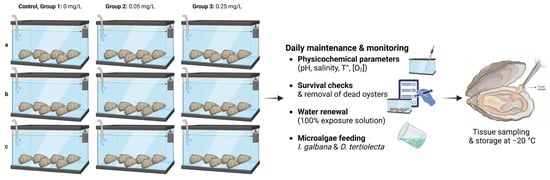
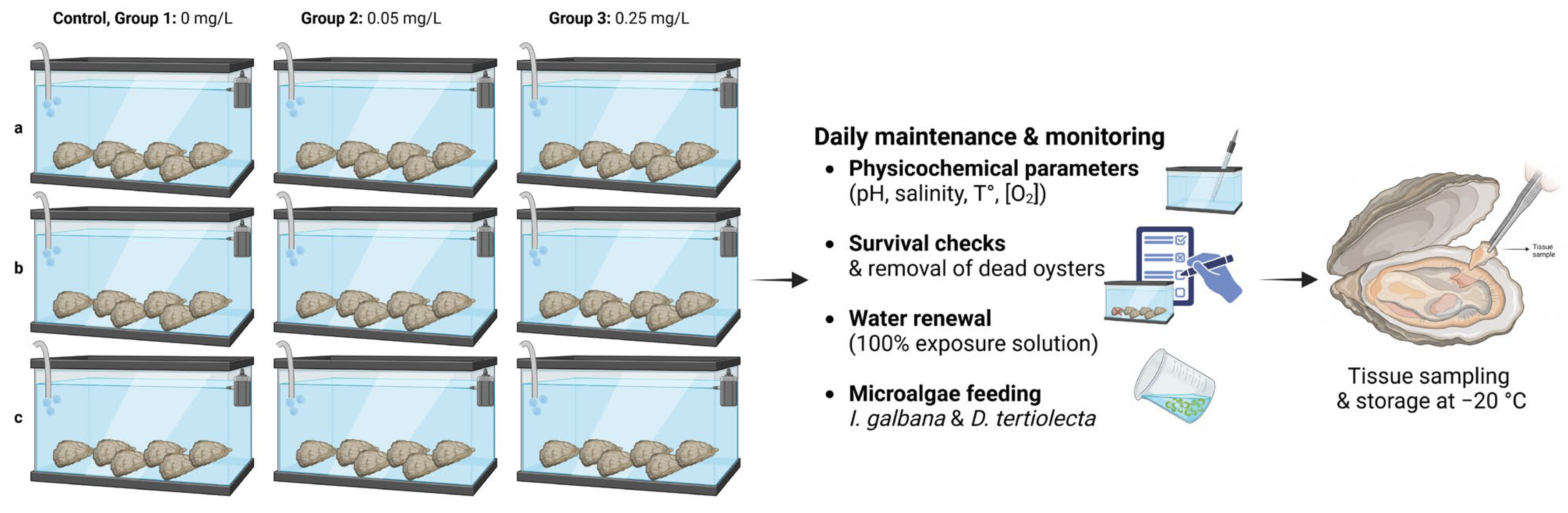
Oysters (n = 54) were exposed to three nominal paint-equivalent concentrations of the aqueous antifouling paint extract: 0 mg/L (control; Group 1), 0.05 mg/L (Group 2), and 0.25 mg/L (Group 3) (Figure 1). In the absence of established reference concentrations for the leachable fraction of antifouling paints in marine environments, the two exposure levels were selected as experimental concentrations representing a low and a higher exposure scenario, with sufficient separation between treatments to allow the assessment of potential concentration-dependent responses. Working exposure media were prepared by dilution of the stock extract with reconstituted seawater. Importantly, the nominal exposure concentrations refer to paint-equivalent concentrations and not to individual metal concentrations. Since the concentrations of individual metals released from the paint could not be predicted from the nominal paint concentrations, Cu and Zn concentrations in each treatment were subsequently verified by ICP-MS (see Section 2.4). This approach was adopted to simulate exposure to the leachable fraction of antifouling paint, representing the dissolved constituents released from antifouling coatings into the surrounding marine environment [14,24].
Figure 1.
Schematic representation of the experimental workflow. Created in BioRender. Merialdi, A et al. (2026) https://BioRender.com.
Each treatment was performed in triplicate (a, b, c), with six oysters per replicate. The experimental setup consisted of nine independent plastic tanks (30.0 × 23.5 × 34.5 cm), each containing 3 L of seawater adjusted to a salinity of 28 PSU. Oxygenation and recirculation were provided by a porous stone and an immersion pump (flow rate = 200 L/h; power = 1 W; dimensions = 4.4 × 4.1 × 3.7 cm). This setup was maintained for 21 days, during which physicochemical parameters remained at constant levels (see Section 2.1). The following procedures were performed daily: monitoring of the water physicochemical parameters, survival checks, complete water changes with renewal of dissolved exposure concentrations. Oysters were fed with approximately 100 mL/tank per day of Isochrysis galbana and Dunaliella tertiolecta (5 × 10⁶ and 12 × 106 cells/mL, respectively). At the conclusion of the experiment, surviving specimens were dissected with a scalpel, and, after being separated from the shell, stored at −20 °C for subsequent chemical analyses.
2.4. Quantification of Cu and Zn in Water and Biological Samples
Concentrations of Cu and Zn were determined in triplicate in the stock aqueous extract (0.8 g/L) and in the exposure media of all experimental treatments (0, 0.05, and 0.25 mg/L). In oyster soft tissues, Cu and Zn concentrations were determined in 12 oysters per treatment (four oysters randomly selected from each replicate tank) using inductively coupled plasma mass spectrometry (ICP-MS XSeries II, Thermo Scientific, Bremen, Germany), according to the protocol previously described by Squadrone et al. [6]. Water samples underwent acidification with HNO3 (70% v/v) before analysis, whereas oyster tissue samples were homogenized prior to analysis. For each 1.0 g of tissue sample, 1.5 mL of H2O2 and 7.0 mL of HNO3 were added, followed by high-pressure microwave digestion (ETHOS 1 by Milestone, Shelton, CT, USA). Each analytical run included a certified reference material (oyster tissue-SRM 1566b from the National Institute of Standards and Technology) and blank samples. The limit of quantification (LOQ) was 0.010 ppm for both elements. Method validation followed ISO/IEC 17025 guidelines [48] (general requirements for the competence of testing and calibration laboratories).
2.5. Statistical Analysis
Statistical analyses were performed to evaluate oyster mortality and Cu and Zn accumulation in tissues following exposure to different treatments. Survival data were analysed using R software (version 4.5.2) [49] and the RStudio interface (version 2026.08.2+200) [50]. Temporal variation in survival probability among treatments (0, 0.05, and 0.25 mg/L) was assessed using Kaplan-Meier survival curves, which estimate survival probability over time. Differences among survival distributions were first evaluated using a global log-rank test, a non-parametric statistical test. Subsequently, pairwise comparisons between treatment groups (0 vs. 0.05 mg/L, 0 vs. 0.25 mg/L, and 0.05 vs. 0.25 mg/L) were performed using separate log-rank tests to identify specific differences between treatments. To account for multiple comparisons, pairwise p-values were adjusted using Holm’s correction. These analyses were conducted using the “survival” (version 3.8.6) and “survminer” (version 0.5.2) packages in R. Cu and Zn concentrations measured in oyster tissues were analysed using STATA® software (version 17.0; StataCorp LLC, College Station, TX, USA). After assessing normality and homoscedasticity, the assumptions required for parametric analysis were not met; therefore, differences among treatments were assessed using the non-parametric Kruskal-Wallis rank test. When significant differences were detected, Dunn’s post-hoc test for multiple comparisons was applied to identify statistically significant pairwise differences between groups. Statistical significance was set at α = 0.05.
3. Results
3.1. Chemical Characterization of the Exposure Media
The aqueous extract prepared from 0.8 g/L of powdered antifouling paint contained 1.00 ± 0.05 mg/L Cu and 8.50 ± 0.70 mg/L Zn. Copper and zinc concentrations in the control group (0 mg/L) were below the LOQ. The 0.05 mg/L treatment contained 0.063 ± 0.004 mg/L Cu and 0.53 ± 0.06 mg/L Zn, whereas the 0.25 mg/L treatment contained 0.313 ± 0.018 mg/L Cu and 2.66 ± 0.19 mg/L Zn.
3.2. Mortality of Oysters Exposed to Antifouling Paint
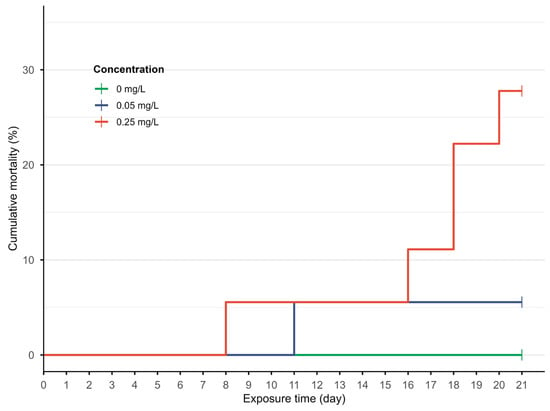
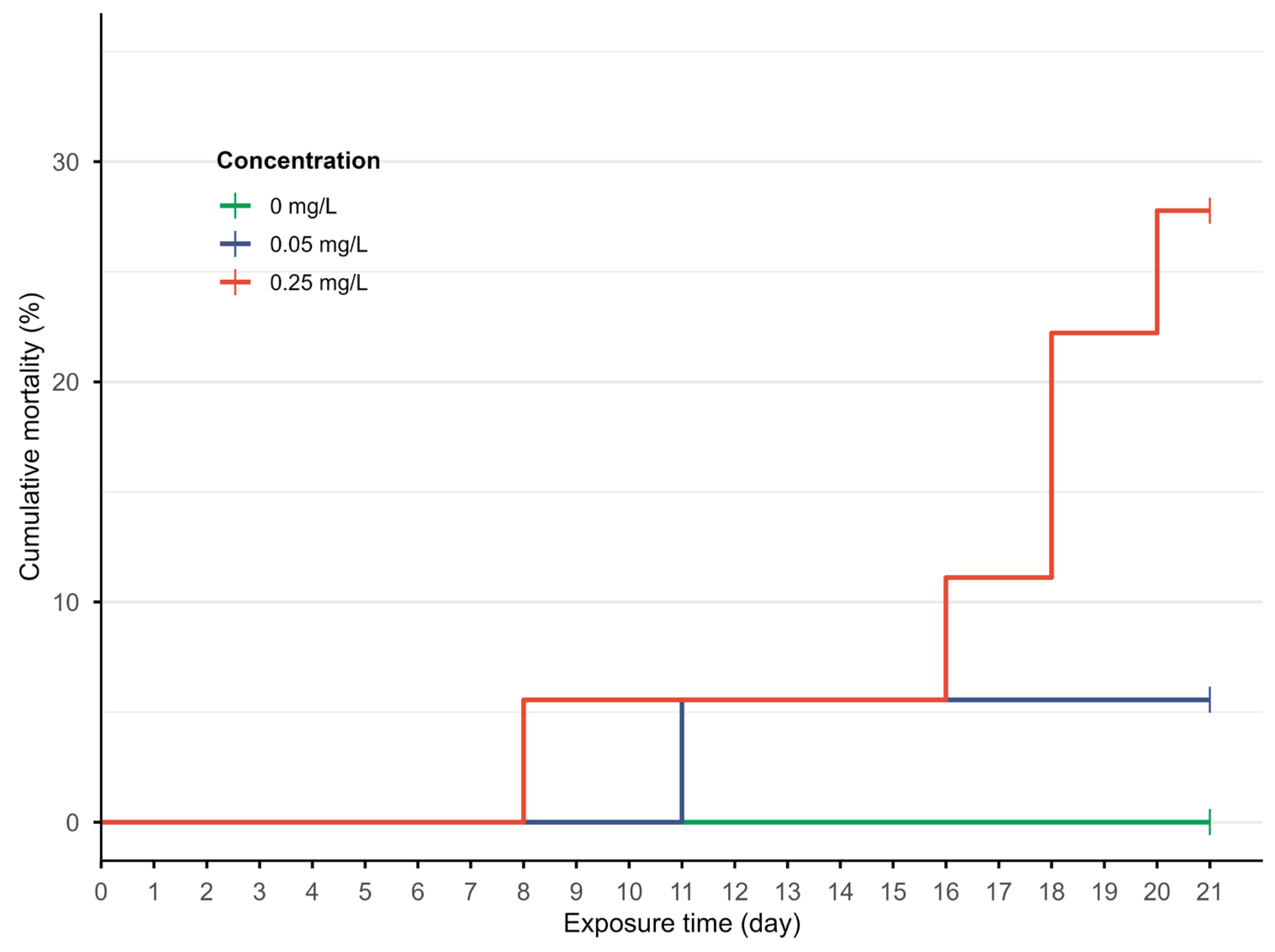
Group 1 (0 mg/L), consisting of oysters maintained under identical experimental conditions but not exposed to the contaminant, showed no mortality throughout the experiment, resulting in 100% survival in all replicates. At the lowest exposure concentration (Group 2; 0.05 mg/L), mortality was limited to a single individual observed on day 11 in replicate “a”, corresponding to a survival rate of 83%, while replicates “b” and “c” showed 100% survival. In Group 3, exposed to the highest concentration (0.25 mg/L), the lowest survival rate (67%) was recorded in replicates “a” and “c”. In replicate “a”, two mortality events occurred on day 8 (n = 1) and day 20 (n = 1), whereas replicate “c” exhibited two mortality events on day 18 (n = 2). Replicate “b” had a single mortality event on day 16 (n = 1), corresponding to a survival rate of 83%. The mortality events and respective survival rates in the replications are shown in Table 2. The cumulative mortality of oysters over time is shown in Figure 2.
Table 2.
Mortality trends of Magallana gigas during exposure to different concentrations of antifouling paint. The number of dead individuals recorded on each day of the experiment is reported, while the final column shows the percentage (%) of surviving oysters at the end of the exposure period.
Figure 2.
Cumulative mortality of Magallana gigas exposed to different antifouling concentrations. Mortality rate is expressed in percentage (%).
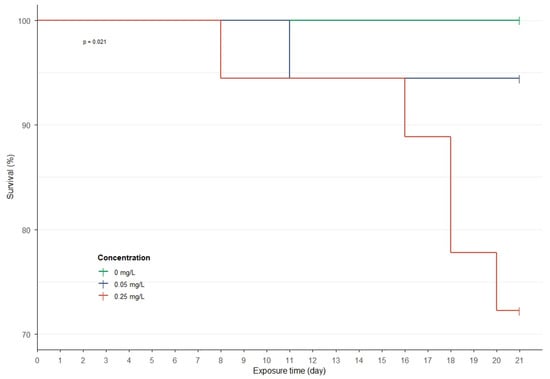
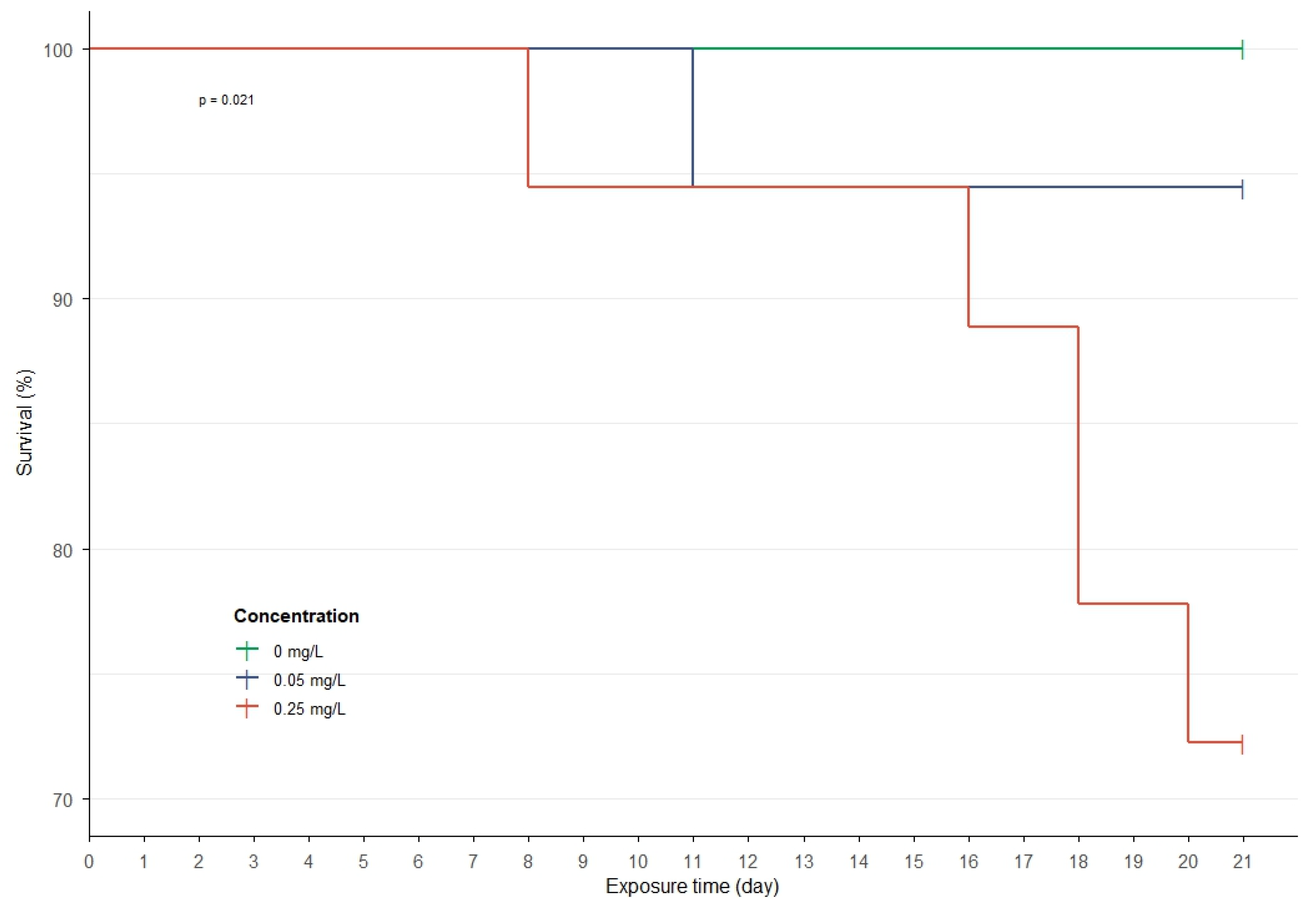
Survival probability over time was further analysed using Kaplan-Meier survival curves (Figure 3), which showed high survival for group 1 (0 mg/L) and group 2 (0.05 mg/L), while the highest exposure group (0.25 mg/L) exhibited an overall survival of 72%.
Figure 3.
Kaplan-Meier survival curves of Magallana gigas exposed to different antifouling concentrations.
Differences among treatments were evaluated using a global log-rank test, which indicated statistically significant differences between survival curves (χ2 = 7.76, df = 2, p = 0.0207). Pairwise log-rank comparisons, corrected for multiple testing using Holm’s method, did not show statistically significant differences between groups: group 1 vs. group 2 (0 mg/L vs. 0.05 mg/L; p = 0.317), group 2 vs. group 3 (0.05 mg/L vs. 0.25 mg/L; p = 0.171), group 1 vs. group 3 (0 mg/L vs. 0.25 mg/L, p = 0.0523) (Table 3).
Table 3.
Results of global and pairwise log-rank tests for survival comparisons among treatment groups. Pairwise p-values were adjusted for multiple comparisons using Holm’s correction. Asterisks indicate statistically significant differences (p < 0.05).
3.3. Accumulation of Copper and Zinc in Oyster Tissues
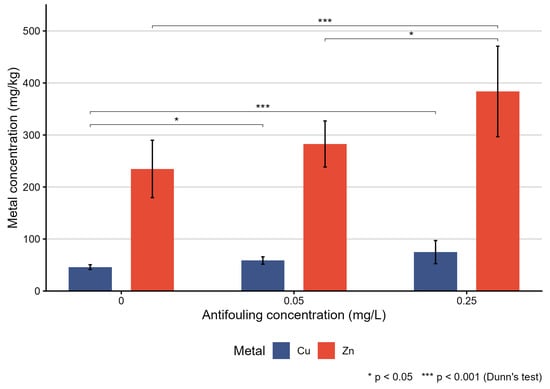
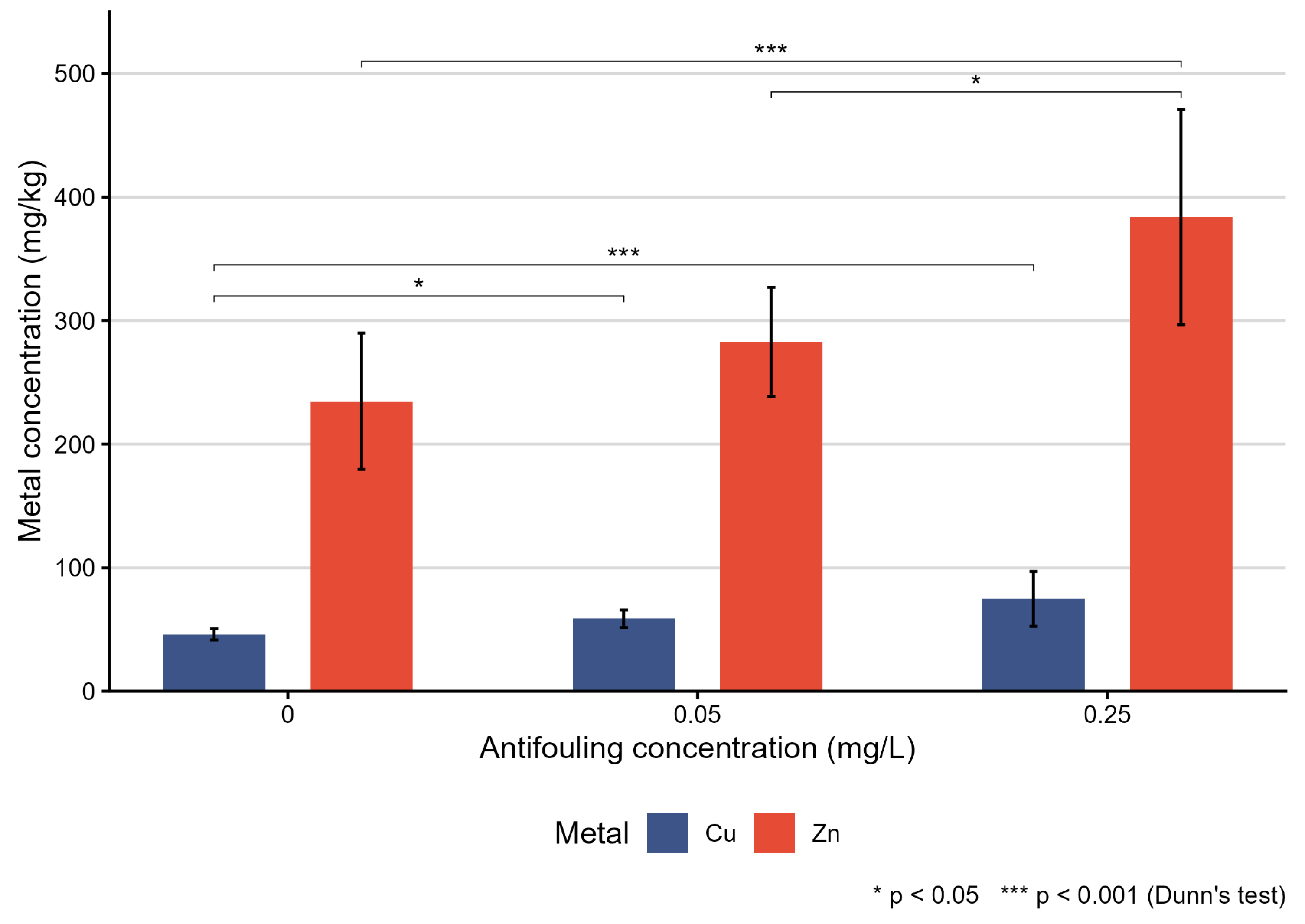
Cu and Zn concentrations are graphically represented in Figure 4. Mean Cu concentrations were 46.0 ± 4.6 mg/kg in Group 1, 58.7 ± 7.1 mg/kg in Group 2, and 74.8 ± 22.2 mg/kg in Group 3. Mean Zn concentrations were 234.7 ± 55.2 mg/kg in Group 1, 282.7 ± 44.3 mg/kg in Group 2, and 383.7 ± 87.0 mg/kg in Group 3.
Figure 4.
Concentrations of copper (Cu) and zinc (Zn) (mg/kg, plotted as mean ± standard deviation) measured in the tissues of Magallana gigas following exposure to increasing concentrations of antifouling paint (0, 0.05, 0.25 mg/L). Asterisks indicate significant pairwise differences.
Statistically significant differences were observed in Cu concentrations among experimental groups. In particular, Cu levels in Group 1 (0 mg/L) differed significantly from those measured in Group 2 (0.05 mg/L) (p < 0.05) and Group 3 (0.25 mg/L) (p < 0.001). No statistically significant difference was detected between Group 2 and Group 3.
For Zn, statistically significant differences were observed between Groups 2 and 3 (p < 0.05) and between Groups 1 and 3 (p < 0.001), while no significant differences were found between Groups 1 and 2.
4. Discussion
The accumulation results clearly demonstrated that both Cu and Zn increased in oyster tissues following exposure to antifouling paint. Copper concentrations increased significantly even at the lowest exposure level, whereas zinc showed a significant increase only in oysters exposed to the highest concentration. These different accumulation patterns probably reflect the distinct physiological regulation of the two metals. Zinc is an essential micronutrient whose uptake and elimination are tightly controlled through homeostatic mechanisms, whereas copper accumulation appears to respond more rapidly to increasing environmental concentrations until detoxification pathways become saturated [30,31,32,36]. This pattern may be explained by the differential induction of metallothioneins, responsible for the detoxification and intracellular sequestration of Cu and other trace metals; MT-like protein levels have been shown to vary with metal exposure, body size, and other natural factors in Pacific oyster populations [38], and more broadly play a central role in metal detoxification in aquatic invertebrates [34]. It is plausible that, under the exposure conditions tested, Cu accumulation exceeded the capacity of MT-mediated detoxification even at the lowest concentration, whereas Zn homeostasis remained within a more tightly regulated range, consistent with the role of Zn in modulating Cu-related metal homeostasis [32]. However, metallothionein induction was not directly measured in this study, and this interpretation should be regarded as a plausible mechanistic hypothesis rather than a demonstrated finding. Similar differences in the regulation of Cu and Zn have been described in marine bivalves exposed to metal-contaminated environments, where Cu generally exhibits greater variability in tissue concentrations than Zn [29,34,51]. Recent spectroscopic analyses further demonstrated that Cu and Zn occur in different chemical forms within oyster tissues, reflecting distinct intracellular detoxification and storage pathways that influence their bioaccumulation patterns [37]. This pattern is also consistent with the differential leaching behaviour of Cu and Zn from antifouling paint residues: Cu release approaches a solubility-controlled, particle concentration independent plateau, whereas Zn release scales more closely with the amount of paint material available, and the two metals respond in opposite directions to salinity [46]. Differences in metal mobilisation from the paint matrix may therefore contribute to the earlier and more pronounced Cu accumulation observed here, in addition to the physiological regulation discussed above. The relatively large standard deviation observed for Cu accumulation in the highest exposure group (74.8 ± 22.2 mg/kg) also points to substantial inter-individual variability. Such variability is common in bioaccumulation studies and may reflect differences among individuals in filtration rate [52], physiological condition, size [38] or detoxification capacity [34,53], rather than measurement inconsistency. Given the relatively small number of oysters analyzed per treatment, this variability should be taken into account when interpreting mean accumulation values, and future studies with larger sample sizes would help to better characterize individual-level variation in metal uptake.
The relatively high concentrations of both elements measured in control oysters are not unexpected. Oysters naturally accumulate considerable amounts of Cu and Zn because these elements are essential for numerous metabolic processes and because filter-feeding bivalves efficiently concentrate dissolved and particulate metals from seawater [9,30,35,36]. Moreover, according to the manufacturer’s specifications, the artificial marine salt used for preparing the reconstituted seawater contains trace amounts of essential metals, including approximately 0.0003 mg/L Cu and 0.010 mg/L Zn at 35‰ salinity. These concentrations are very low, and Cu and Zn were below the analytical LOQ in the control exposure medium. Therefore, the relatively high Cu and Zn concentrations measured in control oysters are unlikely to be primarily attributable to the artificial seawater and most likely reflect physiological metal homeostasis and previous background exposure rather than experimental contamination.
Oysters have been recognized as efficient copper accumulators compared with many other marine bivalves owing to species-specific physiological mechanisms involved in metal uptake and storage [50]. Nevertheless, the significant increases observed after exposure demonstrate that antifouling paint represents an additional source of bioavailable metals capable of further increasing tissue burdens over a relatively short period.
The observed increase in tissue metal concentrations is consistent with previous investigations demonstrating that Cu and Zn associated with antifouling paints can become bioaccessible or bioavailable to marine invertebrates through dissolved and particulate exposure pathways [25,26,27]. However, bioaccessibility should not be confused with bioaccumulation. Experimental evidence indicates that only a proportion of the mobilized metals is ultimately retained within tissues, whereas a substantial fraction may be detoxified, excreted, or incorporated into pseudofaeces [28,44]. The present findings support this interpretation, as tissue concentrations increased without showing a perfectly linear relationship with exposure concentration, suggesting that physiological regulation and detoxification mechanisms were already operating during the experimental period. This observation is consistent with recent evidence indicating that intracellular metal speciation and compartmentalization, rather than total environmental concentrations alone, largely determine tissue accumulation in oysters [37]. A broadly comparable pattern was reported for the mussel Mytilus edulis following ingestion of antifouling paint particles, where Cu was significantly elevated in tissues across all exposure treatments, whereas measurable Zn enrichment was restricted to specific tissue compartments [44]. This similarity, despite the different exposure matrices, suggests that the differential bioavailability of Cu relative to Zn may be a relatively consistent feature of bivalve exposure to antifouling paint-derived metals.
The accumulation of metals observed in this study may have important biological implications beyond mortality. Elevated intracellular copper is known to catalyse the formation of reactive oxygen species through redox cycling, promoting oxidative stress, lipid peroxidation, protein oxidation, and DNA damage [54,55,56]. Although zinc is less redox-active, excessive concentrations may interfere with ion transport, enzyme activity, membrane stability, and energy metabolism [30,57]. Numerous studies have reported that exposure to elevated Cu concentrations induces metallothionein synthesis, lysosomal destabilization, and alterations of antioxidant defence systems in marine bivalves [29,34,53,54]. Accordingly, the increased Cu and Zn concentrations measured in exposed oysters suggest that sublethal physiological responses, including oxidative stress and activation of detoxification pathways, may occur before mortality becomes evident, although these endpoints should be confirmed through biomarker analyses in future studies. It should be emphasized that oxidative stress was not directly measured in the present study; the discussion above therefore reflects mechanistic parallels drawn from the cited literature rather than direct experimental evidence. It must also be noted that the chemical characterization of the exposure medium in this study was restricted to Cu and Zn; therefore, while these were the principal metallic components identified in the antifouling coating tested, other unquantified constituents of the leachable fraction (e.g., organic biocides, additives, or degradation products; see Section 5) cannot be excluded as additional contributors to the observed toxic effects.
From an ecological perspective, filter-feeding bivalves are particularly vulnerable to antifouling-derived contaminants because they continuously filter large volumes of water and efficiently retain suspended particles. Previous studies have demonstrated that oysters and other bivalves generally exhibit limited ability to selectively reject contaminant particles during filtration despite differences in particle morphology and composition [44,52]. Consequently, antifouling paint particles suspended in the water column may be readily ingested and transferred to the digestive tract, increasing the bioavailability of associated metals [26]. In the present study, survival differed significantly among treatment groups according to the global log-rank test, with mortality concentrated among oysters exposed to the highest tested concentration, although none of the pairwise comparisons was statistically significant after Holm correction. This relatively limited mortality effect contrasts with the complete mortality reported for Cerastoderma edule following exposure to environmentally relevant concentrations of biocidal antifouling paint particles [45], suggesting that exposure route and/or species-specific sensitivity may strongly influence the magnitude of the biological effects induced by antifouling-derived contaminants; such a comparison should nonetheless be interpreted with caution given the differences in experimental design. The Cu and Zn concentrations measured in the exposure media were higher than those generally reported in coastal waters, where concentrations are typically in the low µg/L range, although higher values may occur in enclosed and highly impacted areas [58]. Therefore, the tested treatments should be considered controlled experimental exposure scenarios rather than direct simulations of typical environmental concentrations. Considering that shellfish farming is frequently located in sheltered coastal environments characterized by intense boating activity, chronic inputs of antifouling-derived metals may progressively increase contaminant burdens in cultivated oysters, with potential implications for aquaculture sustainability, environmental monitoring programmes, and seafood quality [6,24,43]. However, the present study was based on a short-term laboratory exposure that does not fully replicate the complexity and variability of natural coastal ecosystems or aquaculture settings, and long-term, field-based studies are required to confirm the ecological relevance of these findings.
5. Study Limitations and Future Perspectives
Overall, the present study provides clear evidence that antifouling paint represents a bioavailable source of Cu and Zn for M. gigas under controlled exposure conditions. Nevertheless, some limitations should be considered when interpreting the present findings and should be addressed to achieve a more comprehensive environmental risk assessment. The present work focused on survival and the accumulation of Cu and Zn, while other biological responses potentially associated with exposure were not investigated. Future studies will therefore include biochemical, physiological, and molecular endpoints, with particular attention to biomarkers of oxidative stress, detoxification, and cellular damage, to better elucidate the mechanisms underlying the observed effects. In addition, the chemical characterization of the exposure media was limited to Cu and Zn, as these metals represent the principal metallic components investigated in the antifouling coating tested. However, antifouling formulations are chemically complex mixtures that may also contain organic biocides, booster biocides, resin components, additives, and degradation products capable of contributing to their overall toxicity [21]. Future investigations should therefore characterize the leaching of these organic constituents and assess their potential contribution, individually or in combination with metals, to the biological effects of antifouling paint exposure. The combined effects of these substances and potential interactions among contaminants remain poorly understood and warrant further investigation. Furthermore, the present experimental design, based on only two exposure levels of a complex antifouling-paint leachate, does not allow the reliable derivation of a predicted no-effect concentration (PNEC). Future studies including a broader concentration range and specifically designed for effect-threshold determination would support the derivation of ecotoxicological reference values and improve environmental risk assessment.
Finally, extending future studies to longer exposure periods and environmentally realistic field conditions would improve our understanding of the long-term fate and biological effects of antifouling-derived contaminants in marine bivalves. Such investigations would complement the present findings and contribute to a more comprehensive evaluation of the ecological implications of antifouling paint contamination in coastal environments.
6. Conclusions
The present study demonstrates that short-term exposure to the leachable fraction of antifouling paint can increase the accumulation of Cu and Zn in the tissues of M. gigas and was associated with an overall difference in survival among treatments, with mortality concentrated at the highest exposure level. Although mortality remained relatively low, the observed increase in mortality with exposure concentration and the significant increase in tissue metal concentrations indicate that paint-derived dissolved constituents represent a relevant source of bioavailable trace metals for filter-feeding bivalves. The different accumulation patterns observed for Cu and Zn further suggest that species-specific physiological regulation influences the uptake and retention of these metals.
These findings provide new experimental evidence obtained under controlled exposure conditions by evaluating the effects of the leachable fraction of a commercial antifouling paint rather than individual dissolved metals alone. As oysters are widely used as bioindicators of coastal contamination and represent an economically important aquaculture species, the observed accumulation of Cu and Zn highlights the potential ecological and commercial implications of antifouling-derived contamination, particularly in semi-enclosed coastal environments characterized by intense maritime activity.
Author Contributions
Conceptualization, P.M., G.E. and P.P.; methodology, A.M. (Alessia Merialdi), P.M., A.M. (Alessandra Maganza), G.E., F.B., A.G. (Alice Gabetti), A.G. (Alessandra Griglione), S.S., M.P. and P.P.; investigation, A.M. (Alessia Merialdi), P.M., A.M. (Alessandra Maganza), G.E., F.B., A.G. (Alice Gabetti), A.G. (Alessandra Griglione), S.S., M.P. and P.P.; data curation, A.M. (Alessia Merialdi), G.E. and P.P.; writing—original draft preparation, A.M. (Alessia Merialdi) and P.P.; writing—review and editing, A.M. (Alessia Merialdi), P.M., A.M. (Alessandra Maganza), G.E., F.B., A.G. (Alice Gabetti), S.S., M.P. and P.P.; supervision, P.M. and M.P.; project administration, P.M. All authors have read and agreed to the published version of the manuscript.
Funding
This research was funded by Italian Ministry of Health, grant number IZS PLV 10/18 RC.
Institutional Review Board Statement
Because bivalve mollusks are not covered by the animal categories regulated under European Directive 2010/63/EU and its Italian transposition, Legislative Decree No. 26 of 4 March 2014, no ethical authorization was required for the present study. These regulations apply to the use of live non-human vertebrates and cephalopods for scientific purposes and therefore do not require Ethics Committee approval for experimental procedures involving bivalves.
Informed Consent Statement
Not applicable.
Data Availability Statement
The original contributions presented in this study are included in the article. Further inquiries can be directed to the corresponding authors.
Conflicts of Interest
The authors declare no conflicts of interest.
References
- Esposito, G.; Meloni, D.; Abete, M.C.; Colombero, G.; Mantia, M.; Pastorino, P.; Prearo, M.; Pais, A.; Antuofermo, E.; Squadrone, S. The bivalve Ruditapes decussatus: A biomonitor of trace elements pollution in Sardinian coastal lagoons (Italy). Environ. Pollut. 2018, 242, 1720–1728. [Google Scholar] [CrossRef] [Scilit]
- Food and Agriculture Organisation of the United Nations. Guidelines for Risk-based Fish Inspection; FAO Food and Nutrition Paper; Food and Agriculture Organisation of the United Nations: Rome, Italy, 2009; Volume 90, pp. 1–93. [Google Scholar]
- Lomartire, S.; Marques, J.C.; Gonçalves, A.M. Biomarkers based tools to assess environmental and chemical stressors in aquatic systems. Ecol. Indic. 2021, 122, 107207. [Google Scholar] [CrossRef] [Scilit]
- Fattorini, D. Bioaccumulation of trace elements in mussels as sentinels of environmental pollution in the Mediterranean Sea: A review. Explora Environ. Resour. 2025, 2, 8078. [Google Scholar] [CrossRef] [Scilit]
- Rainbow, P.S. Biomonitoring of heavy metal availability in the marine environment. Mar. Pollut. Bull. 1995, 31, 183–192. [Google Scholar] [CrossRef] [Scilit]
- Squadrone, S.; Brizio, P.; Stella, C.; Prearo, M.; Pastorino, P.; Serracca, L.; Ercolini, C.; Abete, M.C. Presence of trace metals in aquaculture marine ecosystems of the northwestern Mediterranean Sea (Italy). Environ. Pollut. 2016, 215, 77–83. [Google Scholar] [CrossRef] [Scilit]
- Huss, H.H. Assurance of Seafood Quality; Food and Agriculture Organisation: Rome, Italy, 1994; Volume 334. [Google Scholar]
- Institute of Medicine (US) Committee on Evaluation of the Safety of Fishery Products; Ahmed, F.E. (Eds.) Seafood Safety; National Academies Press: Washington, DC, USA, 1991. [Google Scholar]
- Liu, Y.; Xu, J.; Wang, Y.; Yang, S. Trace metal bioaccumulation in oysters (Crassostrea gigas) from Liaodong Bay (Bohai Sea, China). Environ. Sci. Pollut. Res. 2021, 28, 20682–20689. [Google Scholar] [CrossRef] [Scilit]
- El-Sharkawy, M.; Alotaibi, M.O.; Li, J.; Du, D.; Mahmoud, E. Heavy metal pollution in coastal environments: Ecological implications and management strategies: A review. Sustainability 2025, 17, 701. [Google Scholar] [CrossRef] [Scilit]
- Naser, H.A. Assessment and management of heavy metal pollution in the marine environment of the Arabian Gulf: A review. Mar. Pollut. Bull. 2013, 72, 6–13. [Google Scholar] [CrossRef] [Scilit]
- Tanner, P.A.; Leong, L.S.; Pan, S.M. Contamination of heavy metals in marine sediment cores from Victoria Harbour, Hong Kong. Mar. Pollut. Bull. 2000, 40, 769–779. [Google Scholar] [CrossRef] [Scilit]
- Rees, A.B.; Turner, A.; Comber, S. Metal contamination of sediment by paint peeling from abandoned boats, with particular reference to lead. Sci. Total Environ. 2014, 494, 313–319. [Google Scholar] [CrossRef] [Scilit]
- Singh, N.; Turner, A. Trace metals in antifouling paint particles and their heterogeneous contamination of coastal sediments. Mar. Pollut. Bull. 2009, 58, 559–564. [Google Scholar] [CrossRef] [Scilit]
- Soroldoni, S.; Castro, Í.B.; Abreu, F.; Duarte, F.A.; Choueri, R.B.; Möller, O.O., Jr.; Fillmann, G.; Pinho, G.L.L. Antifouling paint particles: Sources, occurrence, composition and dynamics. Water Res. 2018, 137, 47–56. [Google Scholar] [CrossRef] [Scilit]
- Turner, A.; Cheung, H.K. Direct and indirect metal contamination of estuarine sediments by boat paint particles. Mar. Pollut. Bull. 2026, 222, 118719. [Google Scholar] [CrossRef] [Scilit]
- Turner, A. Metal contamination of intertidal sediment and macroalgae in an area impacted by paint from abandoned boats. Mar. Pollut. Bull. 2022, 182, 113958. [Google Scholar] [CrossRef] [Scilit]
- Weber, F.; Esmaeili, N. Marine biofouling and the role of biocidal coatings in balancing environmental impacts. Biofouling 2023, 39, 661–681. [Google Scholar] [CrossRef] [Scilit]
- Yebra, D.M.; Kiil, S.; Dam-Johansen, K. Antifouling technology—Past, present and future steps towards efficient and environmentally friendly antifouling coatings. Prog. Org. Coat. 2004, 50, 75–104. [Google Scholar] [CrossRef] [Scilit]
- Amara, I.; Miled, W.; Slama, R.B.; Ladhari, N. Antifouling processes and toxicity effects of antifouling paints on marine environment. A review. Environ. Toxicol. Pharmacol. 2018, 57, 115–130. [Google Scholar] [CrossRef] [Scilit]
- Paz-Villarraga, C.A.; Castro, Í.B.; Fillmann, G. Biocides in antifouling paint formulations currently registered for use. Environ. Sci. Pollut. Res. 2022, 29, 30090–30101. [Google Scholar] [CrossRef] [Scilit]
- Terlizzi, A.; Fraschetti, S.; Gianguzza, P.; Faimali, M.; Boero, F. Environmental impact of antifouling technologies: State of the art and perspectives. Aquat. Conserv. Mar. Freshw. Ecosyst. 2001, 11, 311–317. [Google Scholar] [CrossRef] [Scilit]
- Dafforn, K.A.; Lewis, J.A.; Johnston, E.L. Antifouling strategies: History and regulation, ecological impacts and mitigation. Mar. Pollut. Bull. 2011, 62, 453–465. [Google Scholar] [CrossRef] [Scilit]
- Lagerström, M.; Ytreberg, E.; Wiklund, A.K.E.; Granhag, L. Antifouling paints leach copper in excess–study of metal release rates and efficacy along a salinity gradient. Water Res. 2020, 186, 116383. [Google Scholar] [CrossRef] [Scilit]
- Chadwick, M.; Bury, N.R. Estuarine copper concentrations following boat-wash down and subsequent accumulation in blue mussels. Toxicol. Environ. Chem. 2023, 105, 111–127. [Google Scholar] [CrossRef] [Scilit]
- Gammon, M.; Turner, A.; Brown, M.T. Accumulation of Cu and Zn in discarded antifouling paint particles by the marine gastropod, Littorina littorea. Estuar. Coast. Shelf Sci. 2009, 84, 447–452. [Google Scholar] [CrossRef] [Scilit]
- Turner, A.; Singh, N.; Millard, L. Bioaccessibility and bioavailability of Cu and Zn in sediment contaminated by antifouling paint residues. Environ. Sci. Technol. 2008, 42, 8740–8746. [Google Scholar] [CrossRef] [Scilit]
- Jones, D.E.; Turner, A. Bioaccessibility and mobilisation of copper and zinc in estuarine sediment contaminated by antifouling paint particles. Estuar. Coast. Shelf Sci. 2010, 87, 399–404. [Google Scholar] [CrossRef] [Scilit]
- Brown, R.J.; Galloway, T.S.; Lowe, D.; Browne, M.A.; Dissanayake, A.; Jones, M.B.; Depledge, M.H. Differential sensitivity of three marine invertebrates to copper assessed using multiple biomarkers. Aquat. Toxicol. 2004, 66, 267–278. [Google Scholar] [CrossRef] [Scilit]
- Rainbow, P.S. Trace metal concentrations in aquatic invertebrates: Why and so what? Environ. Pollut. 2002, 120, 497–507. [Google Scholar] [CrossRef] [Scilit]
- Wang, W.X.; Fisher, N.S. Delineating metal accumulation pathways for marine invertebrates. Sci. Total Environ. 1999, 237, 459–472. [Google Scholar] [CrossRef] [Scilit]
- Zhang, X.; Xu, F.; Hu, X.; Meng, J. Zinc mitigates copper toxicity in Crassostrea gigas by regulating metal homeostasis, oxidative stress, and immune responses. Mar. Environ. Res. 2025, 211, 107393. [Google Scholar] [CrossRef] [Scilit]
- De Rinaldis, G.; Pastorino, P.; Scirocco, T.; Sacchetti, C.; Anselmi, S.; Provenza, F.; Renzi, M.; Specchiulli, A. Navigating a Microplastic Sea: How the Pacific Cupped Oyster (Magallana gigas) Respond to Microplastic Pollution in Lagoons. Toxics 2024, 12, 429. [Google Scholar] [CrossRef] [Scilit]
- Amiard, J.C.; Amiard-Triquet, C.; Barka, S.; Pellerin, J.; Rainbow, P.S. Metallothioneins in aquatic invertebrates: Their role in metal detoxification and their use as biomarkers. Aquat. Toxicol. 2006, 76, 160–202. [Google Scholar] [CrossRef] [Scilit]
- Langston, W.J.; Bebianno, M.J.; Burt, G.R. Metal handling strategies in molluscs. In Metal Metabolism in Aquatic Environments; Springer: Boston, MA, USA, 1998; pp. 219–283. [Google Scholar]
- Wang, W.X.; Rainbow, P.S. Comparative approaches to understand metal bioaccumulation in aquatic animals. Comp. Biochem. Physiol. C Toxicol. Pharmacol. 2008, 148, 315–323. [Google Scholar] [CrossRef] [Scilit]
- Kunene, S.C.; Lin, K.-S.; Mdlovu, N.V.; Shih, W.-C. Bioaccumulation of trace metals and speciation of copper and zinc in Pacific oysters (Crassostrea gigas) using XANES/EXAFS spectroscopies. Chemosphere 2021, 265, 129067. [Google Scholar] [CrossRef] [Scilit]
- Mouneyrac, C.; Amiard, J.C.; Amiard-Triquet, C. Effects of natural factors (salinity and body weight) on cadmium, copper, zinc and metallothionein-like protein levels in resident populations of oysters Crassostrea gigas from a polluted estuary. Mar. Ecol. Prog. Ser. 1998, 162, 125–135. [Google Scholar] [CrossRef] [Scilit]
- Food and Agriculture Organisation of the United Nations. The State of World Fisheries and Aquaculture 2026—Blue Transformation: Turning Vision into Impact; Food and Agriculture Organisation: Rome, Italy, 2026. [Google Scholar]
- Fiori, S.M.; Simonetti, P.; La Colla, N.S.; Giménez, J.; Otegui, M.B.P.; Palacios, P.; Orazi, M.; Arias, A.H.; Ronda, A.C.; Botté, S.E. Assessment of coastal pollutants and health status of Pacific oysters (Magallana gigas) in the Bahía Blanca Estuary and adjacent beaches (Argentina). Mar. Pollut. Bull. 2024, 205, 116652. [Google Scholar] [CrossRef] [Scilit]
- Talley, T.S.; Loflen, C.; Gossett, R.; Pedersen, D.; Venuti, N.; Nguyen, J.; Gersberg, R. Contaminant concentrations and risks associated with the Pacific oyster in the highly urbanized San Diego Bay. Mar. Pollut. Bull. 2022, 174, 113132. [Google Scholar] [CrossRef] [Scilit]
- Graham, P.; Brundu, G.; Scolamacchia, M.; Giglioli, A.; Addis, P.; Artioli, Y.; Telfer, T.; Carboni, S. Improving Pacific oyster (Crassostrea gigas, Thunberg, 1793) production in Mediterranean coastal lagoons: Validation of the growth model “ShellSIM” on traditional and novel farming methods. Aquaculture 2020, 516, 734612. [Google Scholar] [CrossRef] [Scilit]
- Summa, D.; Tamisari, E.; Lanzoni, M.; Castaldelli, G.; Tamburini, E. How Reducing Fossil-Based Plastic Use Can Help the Overall Sustainability of Oyster Farming: The Case of the Gulf of La Spezia. Resources 2025, 14, 10. [Google Scholar] [CrossRef] [Scilit]
- Turner, A.; Barrett, M.; Brown, M.T. Processing of antifouling paint particles by Mytilus edulis. Environ. Pollut. 2009, 157, 215–220. [Google Scholar] [CrossRef] [Scilit]
- Muller-Karanassos, C.; Arundel, W.; Lindeque, P.K.; Vance, T.; Turner, A.; Cole, M. Environmental concentrations of antifouling paint particles are toxic to sediment-dwelling invertebrates. Environ. Pollut. 2021, 268, 115754. [Google Scholar] [CrossRef] [Scilit]
- Singh, N.; Turner, A. Leaching of copper and zinc from spent antifouling paint particles. Environ. Pollut. 2009, 157, 371–376. [Google Scholar] [CrossRef] [Scilit]
- Chelebieva, E.S.; Kladchenko, E.S.; Podolskaya, M.S.; Bogacheva, E.A.; Mosunov, A.A.; Andreyeva, A.Y. Toxic effect of mussel Mytilus galloprovincialis exposed to Ag–TiO2 and ZnTi2O4–TiO2 bicomponent nanoparticles. Chemosphere 2024, 363, 142884. [Google Scholar] [CrossRef] [Scilit]
- ISO/IEC 17025; General Requirements for the Competence of Testing and Calibration Laboratories. International Organization for Standardization/International Electrotechnical Committee: Geneva, Switzerland, 2017.
- R Core Team. R: A Language and Environment for Statistical Computing; R Foundation for Statistical Computing: Vienna, Austria, 2025. [Google Scholar]
- Posit team. RStudio: Integrated Development Environment for R; Posit Software, PBC: Boston, MA, USA, 2025. [Google Scholar]
- Araújo, D.F.; Ponzevera, E.; Briant, N.; Knoery, J.; Bruzac, S.; Sireau, T.; Pellouin-Grouhel, A.; Brach-Papa, C. Differences in copper isotope fractionation between mussels (regulators) and oysters (hyperaccumulators): Insights from a ten-year biomonitoring study. Environ. Sci. Technol. 2021, 55, 324–330. [Google Scholar] [CrossRef] [Scilit]
- Strychar, K.B.; MacDonald, B.A. Impacts of suspended peat particles on feeding and absorption rates in cultured eastern oysters (Crassostrea virginica, Gmelin). J. Shellfish Res. 1999, 18, 437–444. [Google Scholar]
- Zhang, C.; Du, S.; Ma, Q.; Zhang, L. Cytosolic distribution of copper in the gills of field-collected oysters with different copper bioaccumulation. Sci. Total Environ. 2023, 899, 165631. [Google Scholar] [CrossRef] [Scilit]
- Slobodskova, V.V.; Chelomin, V.P.; Kukla, S.P.; Mazur, A.A. Copper induced DNA damage in the gills of the mussel Mytilus trossulus and reversibility after depuration. J. Mar. Sci. Eng. 2022, 10, 1570. [Google Scholar] [CrossRef] [Scilit]
- Stohs, S.J.; Bagchi, D. Oxidative mechanisms in the toxicity of metal ions. Free Radic. Biol. Med. 1995, 18, 321–336. [Google Scholar] [CrossRef] [Scilit]
- Třešňáková, N.; Çağlan Günal, A.; Başaran Kankılıç, G.; Paçal, E.; Nihan Tavşanoğlu, Ü.; Uyar, R.; Erkoç, F. Sub-lethal toxicities of zinc pyrithione, copper pyrithione alone and in combination to the indicator mussel species Unio crassus Philipsson, 1788 (Bivalvia, Unionidae). Chem. Ecol. 2020, 36, 292–308. [Google Scholar] [CrossRef] [Scilit]
- Mandich, M. Ranked effects of heavy metals on marine bivalves in laboratory mesocosms: A meta-analysis. Mar. Pollut. Bull. 2018, 131, 773–781. [Google Scholar] [CrossRef] [Scilit]
- Marras, B.; Montero, N.; Desogus, A.; Todde, D.; Sartori, D.; Macchia, S.; Piccione, M.E.; Schintu, M. Labile concentration of trace metals and organic substances in western Mediterranean ports. Mar. Pollut. Bull. 2026, 222, 118769. [Google Scholar] [CrossRef] [Scilit]

Disclaimer/Publisher’s Note: The statements, opinions and data contained in all publications are solely those of the individual author(s) and contributor(s) and not of MDPI and/or the editor(s). MDPI and/or the editor(s) disclaim responsibility for any injury to people or property resulting from any ideas, methods, instructions or products referred to in the content. |
© 2026 by the authors. Licensee MDPI, Basel, Switzerland. This article is an open access article distributed under the terms and conditions of the Creative Commons Attribution (CC BY) license.