


Abstract
This study examined the morphometric variability and sex-related patterns in three freshwater mollusk species, Pila globosa, Lamellidens marginalis, and Parreysia corrugata from the Hakaluki Haor ecosystem, Bangladesh. All species showed strong linear relationships between shell length and body weight (p < 0.001). The R2 values indicated moderate association in P. globosa (0.57) and L. marginalis (0.59) and a high association in P. corrugata (0.80). Most traits were similar across sexes; however, females of P. corrugata had significantly higher body weight and slightly wider shells, suggesting mild sexual dimorphism. Condition indices were species-specific, with males generally higher, notably in P. corrugata (p < 0.05). Violin box plots showed minor sex differences in P. globosa aperture and spire, with overlap. PCA revealed that size traits were major contributors, explaining 60–75% of the variation. Females of P. globosa scored higher on the size axis, indicating sexual size dimorphism, while L. marginalis and P. corrugata showed significant overlap. Overall, results highlight strong allometric scaling, limited species-specific sexual dimorphism, and body size as the main determinants of morphology.
1. Introduction
Freshwater mollusks are an ecologically significant and evolutionarily diverse group of invertebrates that play critical roles in the structure and functioning of aquatic ecosystems [1,2,3]. Their contributions to nutrient cycling, organic matter decomposition, and trophic dynamics make them essential bioindicators of environmental health in wetlands, rivers, and lakes [4,5,6]. Among freshwater gastropods and bivalves, the apple snail P. globosa and the mussels L. marginalis and P. corrugata are particularly important throughout South and Southeast Asia, largely because of their ecological roles within the trophic web and freshwater biodiversity [7,8]. These species inhabit a wide range of habitats and show morphological variation shaped by ecological gradients, hydrological fluctuations, and anthropogenic pressures. Understanding morphometric attributes and sexual dimorphism in these mollusks is therefore crucial for assessing population structure, adaptive strategies, and environmental responses in dynamic aquatic systems [9,10]. Hakaluki Haor, one of the largest natural wetlands in Bangladesh, is a unique ecological landscape defined by seasonal flooding, diverse microhabitats, and high productivity [11]. This tropical floodplain wetland supports a rich assemblage of aquatic organisms, including numerous molluscan species that are integral to local fisheries and livelihoods [12,13]. Although the three species examined in this study are currently classified as “Least Concern” by the IUCN [14], Hakaluki Haor is facing increasing environmental pressures from agricultural expansion, pollution, overexploitation of aquatic resources, and hydrological changes [15]. These pressures may drive morphological shifts within molluscan populations, reflecting both phenotypic plasticity and potential long-term evolutionary responses.
Morphometric analyses, both traditional and geometric, provide valuable insights into intra- and interspecific variation driven by genetic, developmental, and environmental factors [16]. For gastropods such as P. globosa, shell form is shaped by habitat stability, predation, water chemistry, and reproductive behavior. Similarly, in bivalves such as L. marginalis and P. corrugata, shell dimensions and contour features often reflect ecological stressors, sediment characteristics, and hydrological regimes [17]. Variation in shell morphology affects not only survival and reproductive success but also plays a key role in taxonomic classification, conservation efforts, and stock assessments [18]. Despite their ecological and economic importance, especially as food sources, biofilters, and ecosystem engineers, comprehensive morphometric studies of these mollusks are limited in tropical floodplain wetlands in Bangladesh.
Sexual dimorphism in freshwater mollusks helps explain species biology and population dynamics [19]. Although many gastropods and bivalves show subtle or overlapping sexual traits, differences in shell size, shape, or soft-body features may arise from variations in energy use, reproductive effort, or ecological niche separation [20]. This information aids species identification, reproductive biology, and conservation strategies. Differences in shell shape and soft-tissue characteristics between males and females can affect their growth, habitat preferences, and ability to withstand environmental stress [21,22]. Identifying these dimorphic characteristics is crucial for accurate species assessment and sustainable management, particularly as freshwater mollusks face challenges like habitat destruction and overharvesting [4,9]. Documenting sexual differences in P. globosa, L. marginalis, and P. corrugata enhances conservation efforts by aiding population monitoring, guiding breeding programs, and predicting how species may respond to ecological changes in vulnerable wetlands. This study examines specific morphometric traits and sexually dimorphic features of these species collected from Hakaluki Haor. By analyzing shell measurements, form variation, and sex-related traits, this study aims to enhance understanding of population structure and adaptation in these species. The results provide essential baseline data for future ecological monitoring, conservation, and resource management in tropical floodplain wetlands. Moreover, documenting morphological diversity in this dynamic ecosystem improves our knowledge of molluscan biology and their responses to rapidly changing environmental conditions.
2. Materials and Methods
2.1. Study Sites and Sample Collection
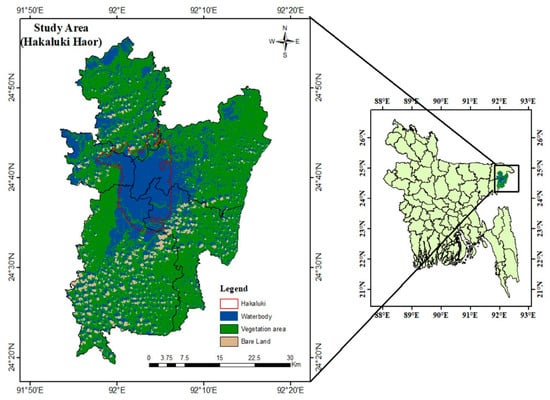
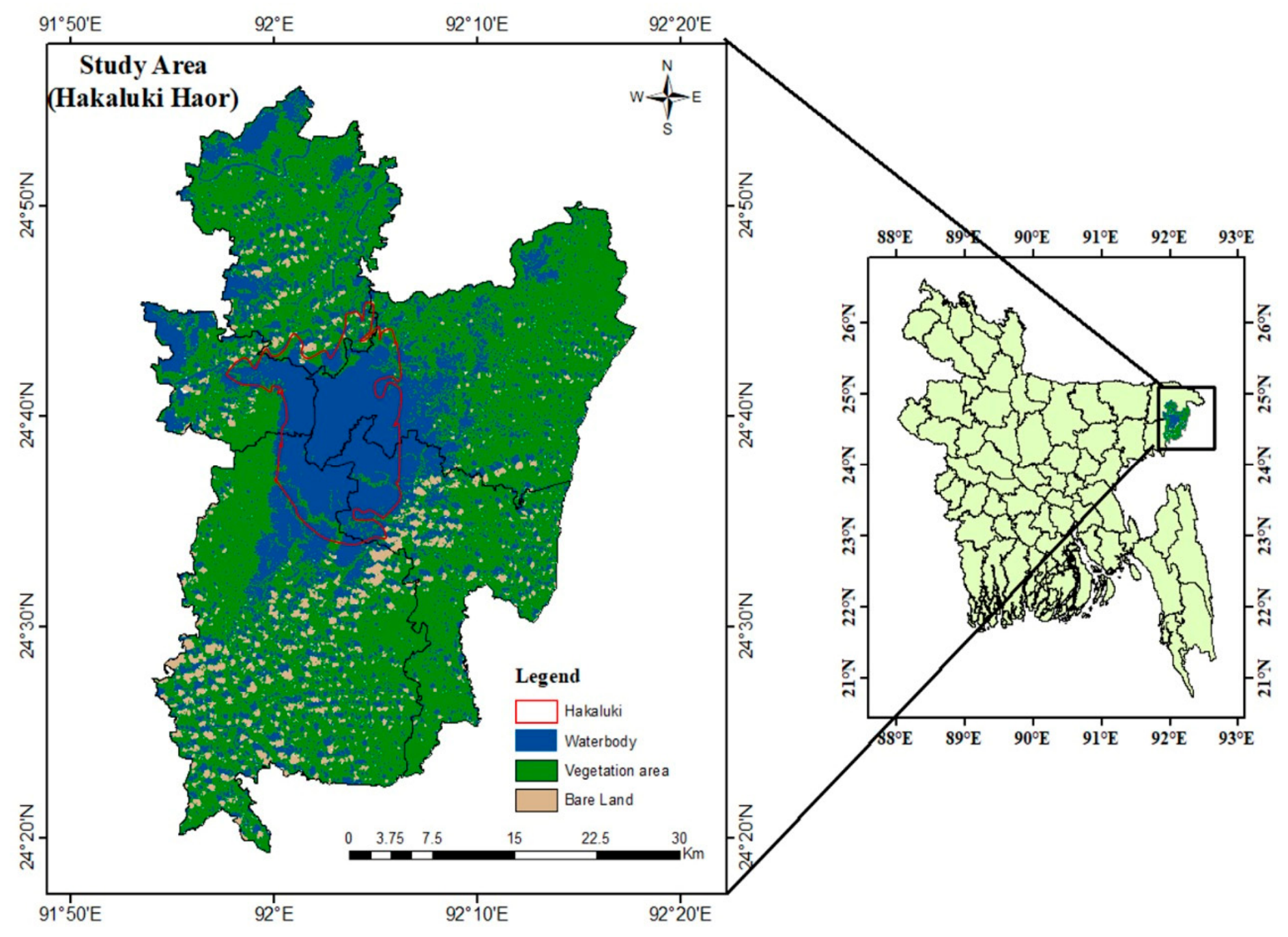
Sampling was conducted in Hakaluki Haor (Figure 1), a vital wetland in Sylhet Division, northeastern Bangladesh. Situated roughly between 24°35′–24°45′ N and 92°00′–92°08′ E, it ranks as one of the country’s most ecologically significant floodplain wetlands [23,24]. The region comprises shallow basins, seasonal floodplains, and interconnected water bodies that fluctuate with the monsoon [15]. Its hydrology is primarily influenced by the Kushiyara River, especially during heavy rains. Between May and July 2025, samples of bycatch from traditional fishermen using a drag net (0.5–1.00 cm mesh) were collected from different locations within the Haor. Sampling took place from the late pre-monsoon through the monsoon, capturing the flood’s onset and the floodplain’s uniform expansion during the monsoon. Hydrological data were collected with a YSI multiparameter meter; water depth was measured with a tape measure; and water transparency was evaluated using a Secchi disk.
Figure 1.
Hakaluki Haor floodplain ecosystem in Bangladesh.
2.2. Measurement Tools for Length-Weight Relationships and Condition Indices
Species were identified and confirmed based on the previous description [25,26,27] and keys mentioned in https://molluscabase.org/. Specimens were carefully placed between the caliper jaws to ensure firm but gentle contact, and their lengths, widths, and heights were measured to 0.01 mm precision. To minimize stress, exposure of live specimens was kept to a minimum. For weighing, individuals were briefly dried, then weighed on a calibrated precision balance, with their mass recorded to 0.001 g. All instruments were calibrated to zero before use, and each measurement was repeated three times to improve accuracy and minimize observer error. Animals were subjected to euthanasia in ice slurry for 1 h to collect and weigh soft tissue. Mussel shells were sundried for at least 4 h before the condition index (CI) measurement [28]. For snails, the condition index is calculated as the percentage ratio of soft tissue wet weight to total weight [25,29], whereas for mussels, it is the percentage ratio of soft tissue wet weight to dried shell weight (oven-dried for 3 h at 50 °C after complete removal of all soft tissue) [30]. Males and females were identified by visual observation of sperm or ova cells in the gonad under the microscope following dissection [28,31]. Only individuals with confirmed sex were included in the present dataset.
2.3. Statistical Analysis
Data were statistically analyzed using IBM SPSS version 26. The significance of regression coefficients was assessed using an ANOVA F-test, and slopes were constructed from log-log regressions on transformed data. However, Shapiro–Wilk tests indicated non-normality (p < 0.05) for most variables, so nonparametric methods were applied. Specifically, differences between groups and between sexes were evaluated using the Mann–Whitney U test at a significance level of p < 0.05. Graphs and principal component analysis (PCA) biplots were generated in OriginPro 2026 (64-bit) SR110.3.0.197 (Learning Edition).
3. Results
3.1. Water Quality Properties
Table 1 summarizes the main water quality parameters, including temperature, DO, conductivity, TDS, pH, transparency, and sampling water depth. The temperature was approximately 25.82 ± 2.88 °C, and the dissolved oxygen level was 4.96 ± 0.24 ppm.
Table 1.
Major water-quality parameters at sampling sites (values are mean ± standard deviation).
3.2. Regression Analysis Between Length and Weight Parameters
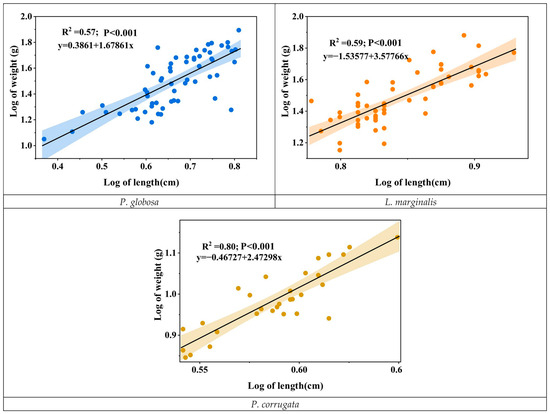
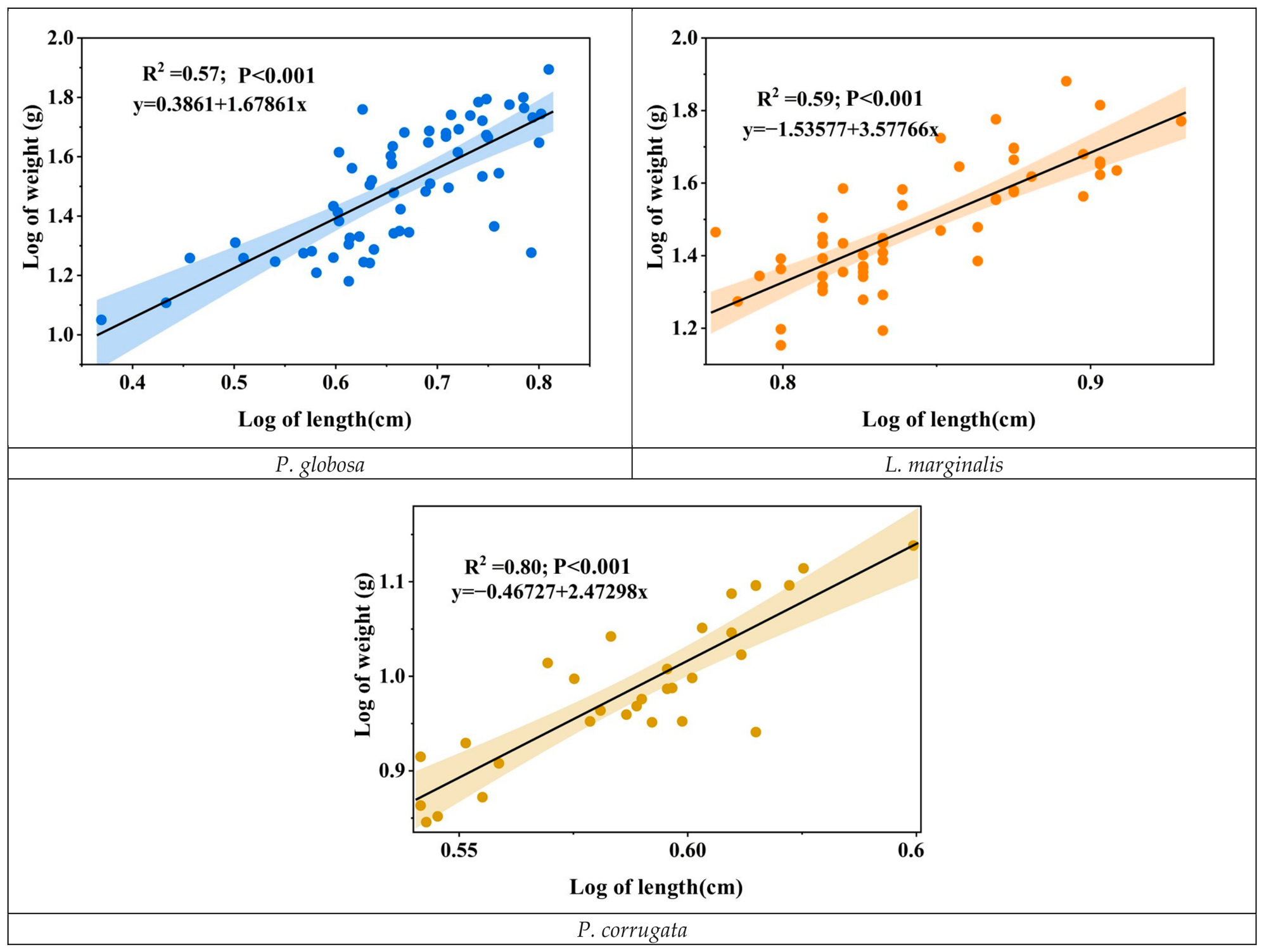
Figure 2 illustrates the regression correlation between length and weight across three mollusks, showing a linear relationship in which weight increases with length, and these correlations are highly significant (p < 0.001). For P. globosa, the model with R2 = 0.57 suggests that length explains about 57% of the variation in weight; a 0.1 cm increase in length corresponds to an approximate 0.168 g increase in weight. L. marginalis exhibits the steepest slope with R2 = 0.59, with weight rising by roughly 0.358 g per 0.1 cm, indicating the fastest mass gain per unit length, although its variability is similar to P. globosa and the measured length range is narrow. P. corrugata offers the best fit, with R2 = 0.80, where weight increases by about 0.247 g per 0.1 cm, and the data points are tightly clustered around the line, ensuring reliable predictions within the sample range. Confidence bands are relatively narrow and parallel, supporting the stability of these estimates within the observed lengths; avoid extrapolating beyond these ranges.
Figure 2.
Correlation plot showing the relationship between length and weight for P. globosa, L. marginalis, and P. corrugata collected from the Hakaluki Haor floodplain ecosystem.
3.3. Sex-Specific Length and Weight Measurements
Most male–female morphometric comparisons across the three mollusk species do not show significant differences, as determined by the Mann–Whitney U test (p = 0.05; Table 2). For shell length, no significant differences were detected between males and females in P. globosa (4.69 ± 0.14 vs. 4.72 ± 0.20 cm; p = 0.93, effect size = 0.01), L. marginalis (6.93 ± 0.10 vs. 7.08 ± 0.11 cm; p = 0.33, effect size = 0.13), or P. corrugata (3.74 ± 0.09 vs. 3.89 ± 0.05 cm; p = 0.20, effect size = 0.03), indicating comparable shell growth in both sexes. Similarly, total body weight did not differ significantly in P. globosa (p = 0.75) and L. marginalis (p = 0.44), although females consistently exhibited slightly higher mean values. However, P. corrugata showed a significant difference in total weight (8.77 ± 0.61 g in males vs. 10.04 ± 0.39 g in females; p = 0.04) with a moderate effect size (0.35), suggesting biologically meaningful dimorphism. Soft tissue wet weight remained statistically similar across sexes in all species (p > 0.05), further supporting the lack of strong dimorphism. In shell width, no significant differences were found for P. globosa and L. marginalis, whereas P. corrugata exhibited a significant difference (2.46 ± 0.16 vs. 2.52 ± 0.16 cm; p = 0.02, effect size = 0.39), indicating wider shells in females. Dried shell weight showed no difference in L. marginalis but was marginal in P. corrugata (3.85 ± 0.29 vs. 4.84 ± 0.20 g; p = 0.05, effect size = 0.48). P. globosa and L. marginalis lack sexual dimorphism, whereas P. corrugata exhibits moderate female-biased size differences.
Table 2.
Sex-specific measurements of length and weight parameters in P. globosa, L. marginalis, and P. corrugata collected from the Hakaluki Haor (values are mean ± standard error).
3.4. Additional Length-Based Parameters Between Male and Female P. globosa
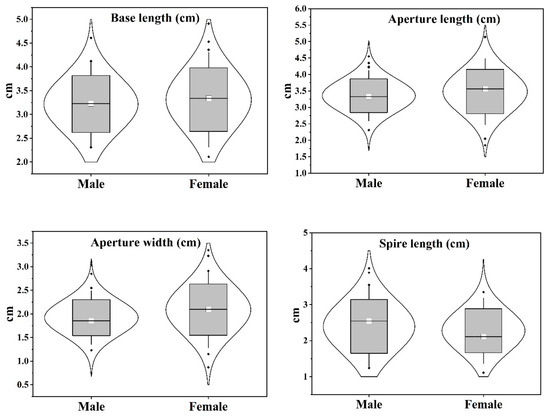
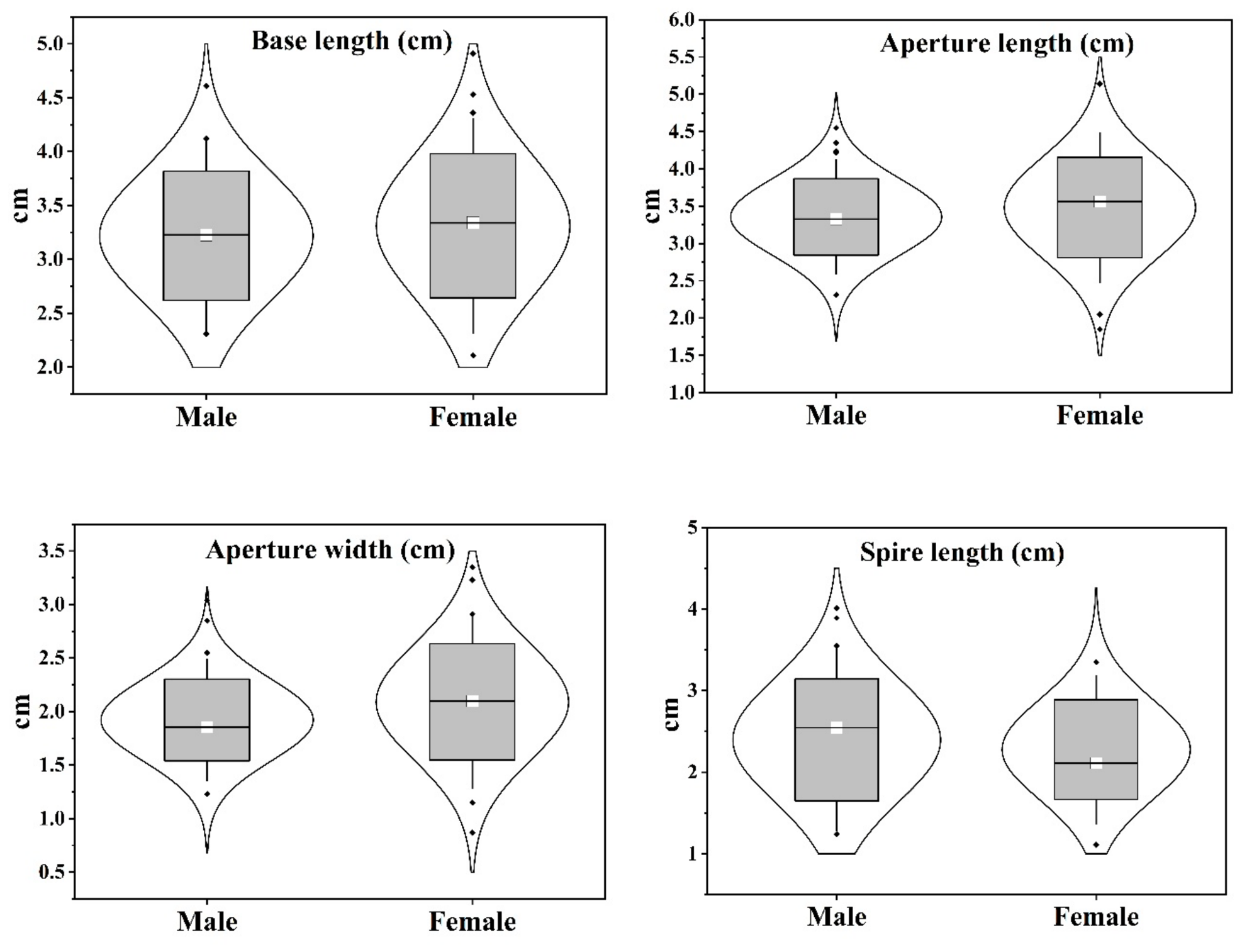
Figure 3 compares base length, aperture length and width, and spire length between male and female P. globosa. The violin shapes indicate unimodal distributions, similarly spread across both sexes, for all traits. None of these parameter differences is statistically significant according to the Mann–Whitney U test (p < 0.05). Males have slightly higher spire lengths (2.40 ± 0.75) compared to females (2.28 ± 0.61), but the high p-value (0.94) indicates no difference. Conversely, females tend to have marginally larger base lengths (3.31 ± 0.67) than males (3.22 ± 0.60), although this is also insignificant (p = 0.49). Similarly, females generally show greater aperture dimensions, with aperture length (3.48 ± 0.67) and width (2.09 ± 0.54) exceeding those of males (3.36 ± 0.51 and 1.92 ± 0.38), but these differences are not statistically meaningful (p = 0.24 and 0.11).
Figure 3.
Comparison of additional length-based morphometric parameters between male and female P. globosa (white rectangular box indicates the mean, and whiskers show standard deviation).
3.5. Condition Index of Males and Females
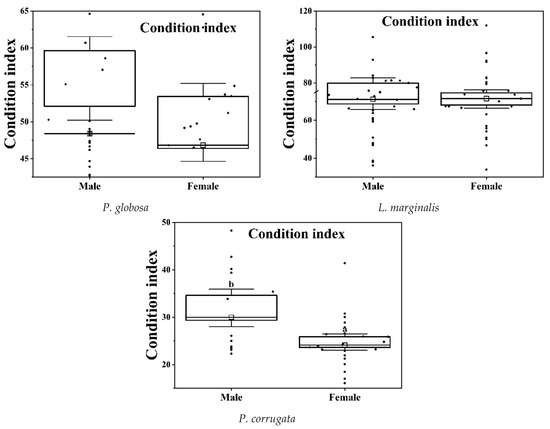
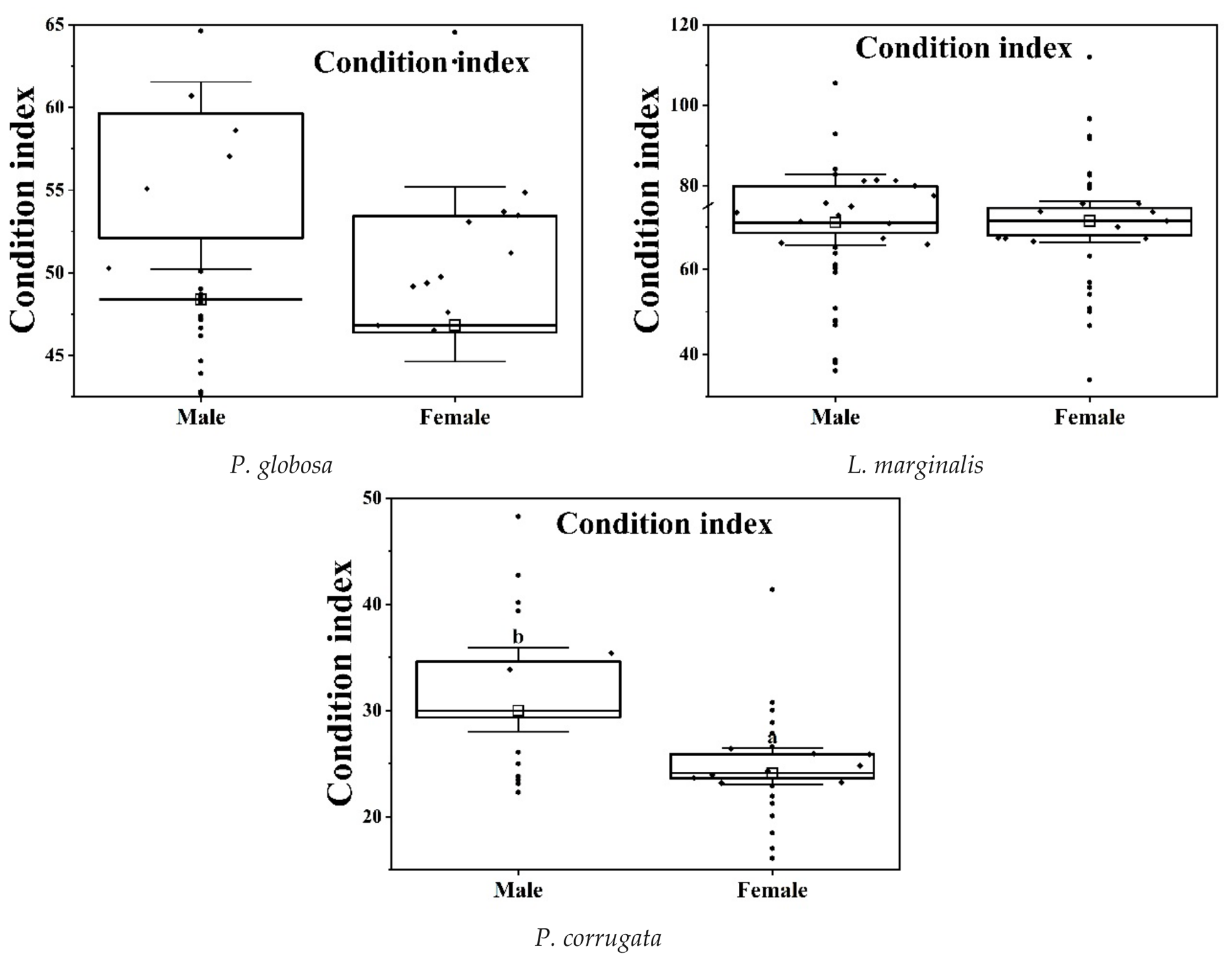
Figure 4 features boxplots comparing the condition indices of males and females across three mollusk species. The data suggest species-specific patterns, with higher condition indices in males, except for L. marginalis, where the sexes are more similar. In P. globosa, males exhibit a wider range and higher median values, with the male boxplot showing greater variability and several upper outliers, suggesting that some individuals are in significantly better condition. Females display a more condensed distribution with moderately lower medians. In L. marginalis, the condition indices of both sexes are more similar, with overlapping interquartile ranges and comparable medians, though males show a slightly broader spread and a few low outliers, suggesting greater variability. For P. corrugata, males again have higher median condition indices, with a distribution that is elevated and more variable, including several high-outlier points. Female indices tend to be lower (p < 0.05), with narrower ranges and medians, indicating a generally lower and more uniform physiological condition than in males.
Figure 4.
Comparison of the condition index between male and female P. globosa, L. marginalis, and P. corrugata collected from the Hakaluki Haor (white rectangular box shows the mean value, and whiskers represent the standard deviation).
3.6. Principal Component Analyses
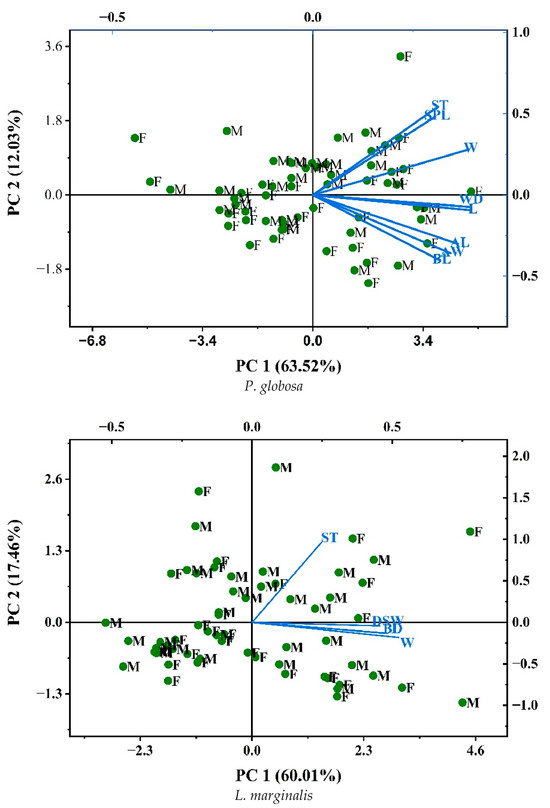
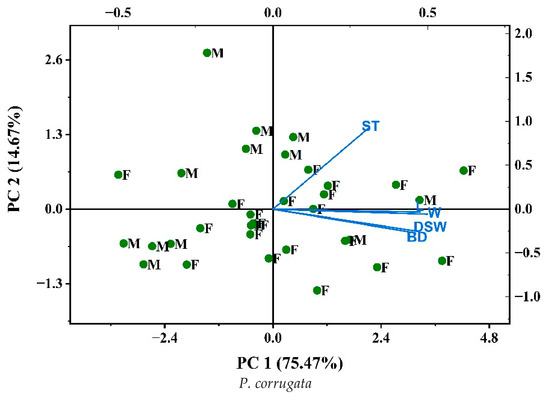
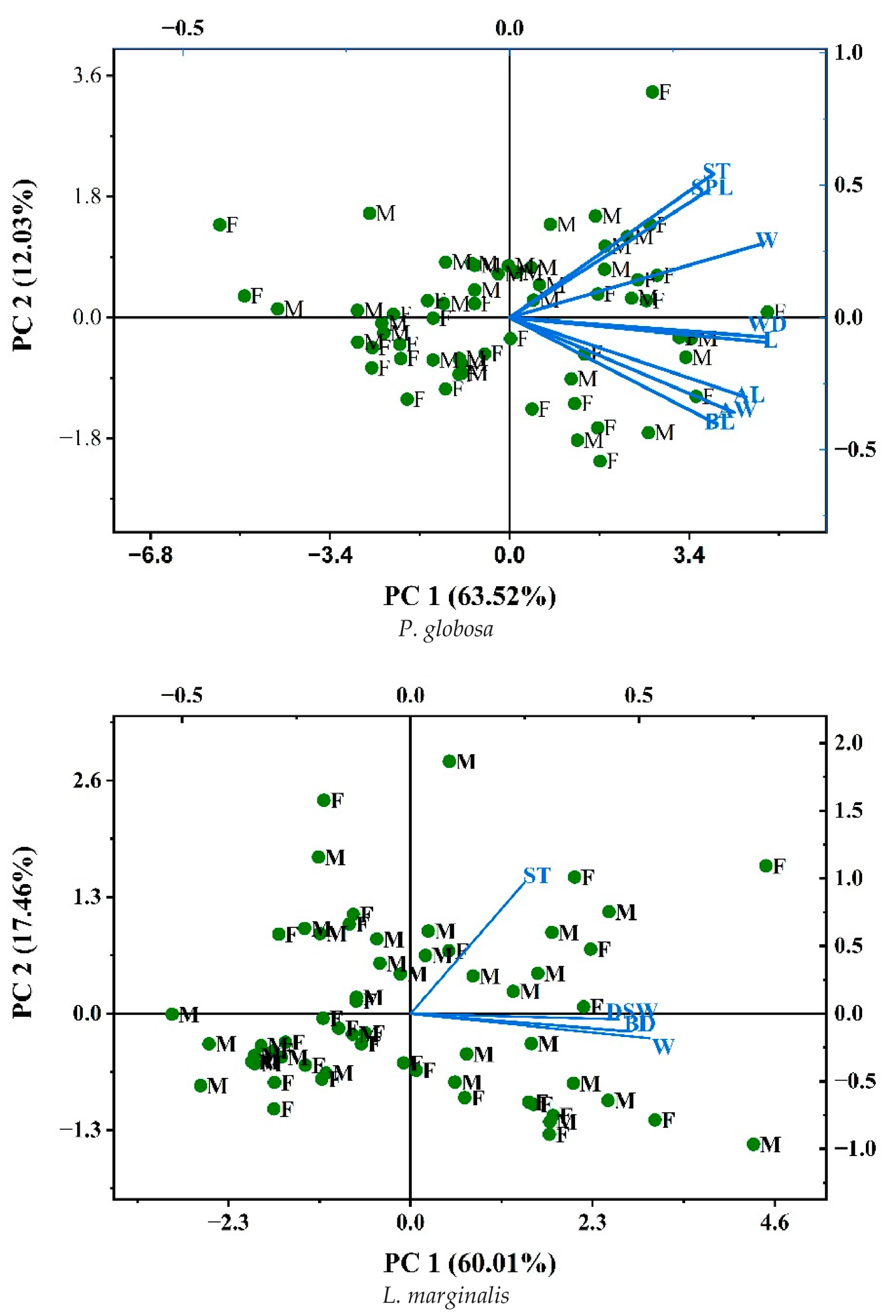
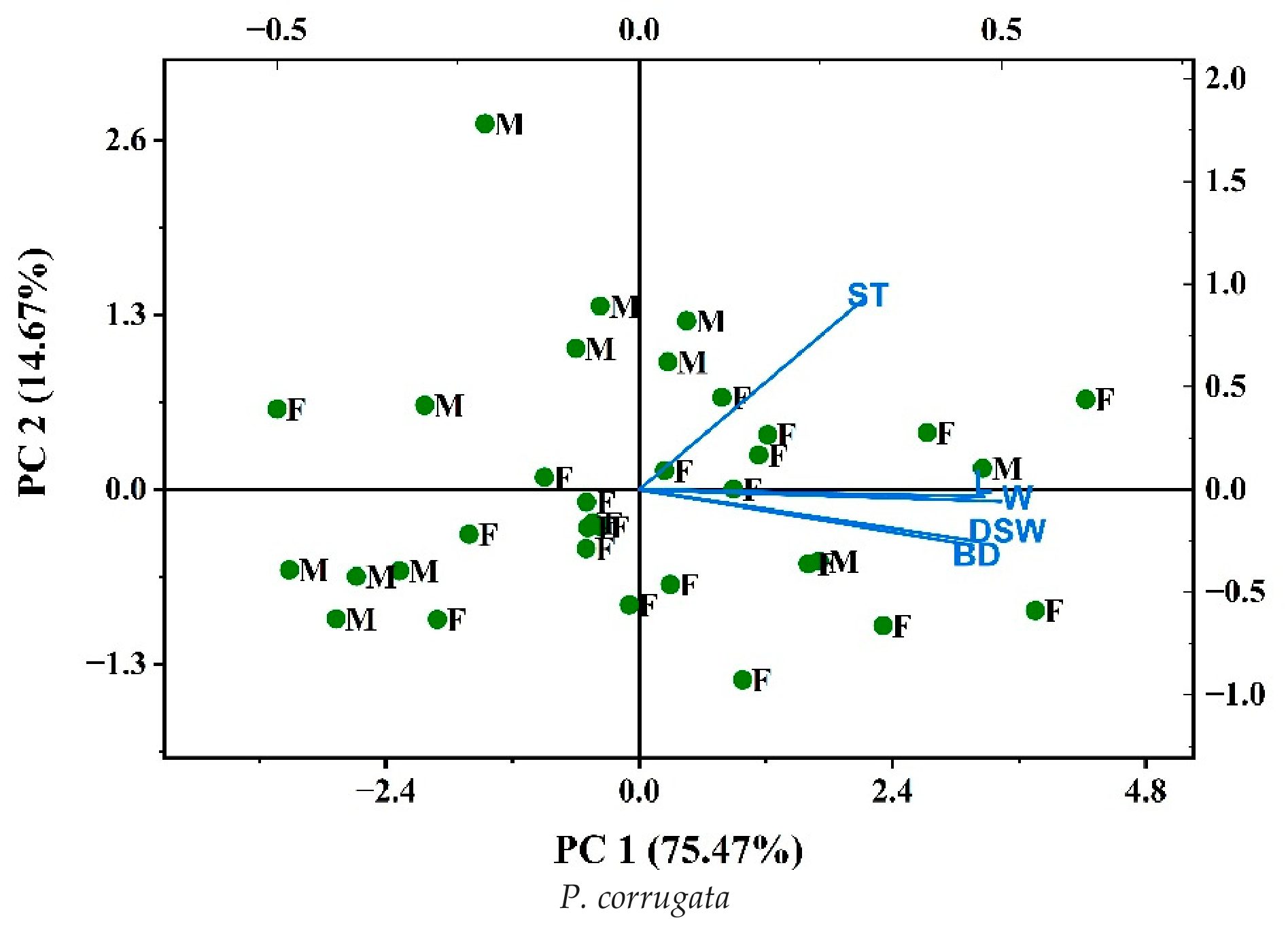
Principal component analyses revealed consistent patterns of morphometric variation among the three freshwater mollusks studied (Figure 5). In P. globosa, PC1 (63.52%) primarily represented overall size, with positive loadings indicating increased shell dimensions, aperture size, and body mass; females scored higher, highlighting clear sexual size dimorphism. PC2 (12.03%) described shape differences between soft-tissue mass and spire length versus aperture and base width, though significant overlap between sexes suggested only minor shape distinctions. In L. marginalis, PC1 (60.01%) similarly reflected shell size and weight, while PC2 (17.46%) captured variation in soft-tissue mass. Male and female distributions overlapped substantially, indicating limited morphological divergence between sexes. For P. corrugata, PC1 (75.47%) explained most of the variation, representing overall size and shell mass, whereas PC2 (14.67%) distinguished individuals by their soft-tissue wet-weight-to-dry-shell-weight ratios. Both sexes showed extensive overlap, with few males exhibiting high PC2 scores. Overall, size accounts for most of the variation, with minor differences in shape between the sexes.
Figure 5.
Principal component analysis of different morphometric traits between male and female of the study mollusk (ST—soft tissue weight (g), SPL—spiral length (cm), W—weight (g), WD—shell width (cm), L—length (cm), AL—aperture length (cm), AW—aperture width (cm), BL—base length (cm), BD—shell depth (cm), L—length (cm), DSW—dry shell weight (g), M—male, F—female).
4. Discussion
Current multi-species analyses reveal a strong allometric relationship between size and mass, with high-quality length–weight regressions (R2 ~ 0.80) and narrow confidence intervals within observed size ranges. These patterns align with classic allometric theory for mollusks and are supported by empirical studies showing excellent fits for bivalve length–weight models across various environments and species [32,33]. Notably, the high R2 for P. corrugata (0.80) reflects findings in Indian unionids that identified tight length–weight relationships and seasonal variations in scaling exponents, highlighting the predictability of biomass from shell metrics across the full ontogenetic range [27,34]. Conversely, the slightly lower but significant R2 values for P. globosa and L. marginalis suggest that, for gastropods and some unionids, variability due to habitat, developmental stage, or tissue-to-shell allocation warrants caution when applying these models beyond the sampled size range [25,35]. The weaker correlations may stem from differences in measurement parameters, reproductive status, and the presence of mixed-size or mixed-age groups. Furthermore, variations in shell shape and growth patterns likely contribute to variability in weight at a given length.
Differences in slopes between species are biologically significant in mollusk morphometrics [36]. The maximum mass gain per unit length in L. marginalis matches aquaculture and field research, where it often shows negative to near-isometric allometry (b ≈ 2.5–3.0), depending on culture phase and conditions [37]. This indicates a flexible distribution of energy between the shell and somatic tissues [38]. The close clustering of P. corrugata supports previous findings that morphometric measures are reliable predictors in this species and related ones, likely because shell and dry-shell weight are closely linked to total mass in stable river environments [39,40]. Our linear models follow the recommended log–log allometric approach, highlighting the importance of bias-aware fitting and inference within specified ranges.
Shell base length, aperture size, and spire length together influence P. globosa’s mobility, protection, and stability [41]. A larger base increases internal space and helps the snail anchor securely, while longer or wider apertures allow greater extension of the foot for movement and feeding, but may slightly reduce defensive closure [42]. Spire length shapes the shell’s internal structure, balancing weight distribution and strength. These morphometric traits determine how effectively the animal moves, feeds, resists predators, and maintains stability in its habitat [43]. Overall, the plots suggest weak sexual dimorphism: small shifts in central tendency without clear, consistent separation.
Sex-specific comparisons show minimal sexual dimorphism in most traits, except for two notable cases in P. corrugata: females tend to have higher body weight and slightly wider shells [27]. This subtle dimorphism aligns with the existing unionid literature, which generally finds sex differences to be weak or context-dependent, often appearing in mass-related traits near reproductive periods [44]. In P. globosa, minimal sex differences in linear dimensions align with regional surveys reporting broadly conserved shell proportions across seasons and locations, despite a wide ecological range [20]. P. corrugata shows significant male–female differences because females invest more in reproduction, including egg production and brooding, which increases body mass and slightly widens the shell [45]. This difference could point to a fecundity advantage, as females generally allocate more energy to reproductive tissues, resulting in higher body mass [46]. However, additional evidence, such as gonad weight or reproductive success, is needed to confirm this. This leads to significant variation in weight and shell dimensions, unlike P. globosa and L. marginalis, which show minimal sexual dimorphism.
Condition index (CI) patterns were species-specific, with males generally higher, significantly so in P. corrugata. CI is a well-established integrator of energy reserves relative to shell or size, and its sensitivity to environmental quality and reproductive cycle is extensively documented in bivalves [47]. Meta-analyses and protocols alike stress that CI responds to food availability and culture intensity, supporting our inference that male-biased CI reflects differential resource allocation or timing relative to gametogenesis [26]. Comparable sex overlap in L. marginalis echoes recent lake and farm studies reporting seasonal CI fluctuations but limited, persistent sex separation, again suggesting that environmental factors and spawning schedules can mask dimorphism outside peak reproductive windows. In Bangladesh, from May to July, the rainy season begins, boosting the food supply for freshwater mollusks and triggering their active reproduction [25,26]. During this period, females devote much of their energy to producing and nurturing gametes [48]. Therefore, reproductive effort reduces energy available for body maintenance, leading to lower body reserves and a lower condition index.
The multivariate structure derived from PCA organizes these univariate patterns. In all three species, PC1 accounts for 60–75% of the variance, representing an overall size–mass axis with consistently positive loadings for linear and mass traits—mirroring the typical “size axis” observed in molluscan morphometrics. The secondary axis (PC2), which contrasts soft tissue with shell dimensions, is biologically meaningful: allometric research indicates that investment in tissue versus shell varies with hydrodynamics, trophic level, and life history, creating orthogonal gradients of shape and allocation relative to size. For P. globosa, females’ higher placement on PC1 (larger size) combined with males’ tendency toward PC2 (longer spires and more soft tissue) aligns with regional studies showing negative allometry and environmental plasticity in subtle, often secondary differences in aperture and base traits. The extensive intersexual overlap in L. marginalis and P. corrugata PCs supports previous findings that sex accounts for little morphometric variation after size is considered, even with modest mass dimorphism.
5. Conclusions
This study establishes consistent allometric relationships and largely overlapping morphometric patterns across P. globosa, L. marginalis, and P. corrugata. Length–weight models proved robust within sampled ranges, particularly for P. corrugata, while sexual dimorphism was generally limited, emerging most clearly in female-biased mass and shell width in P. corrugata. Condition index patterns further highlighted species-specific physiological differences, with males often showing higher condition indices. PCA confirmed body size as the dominant driver of morphological variation, with shape-related differences representing only minor secondary axes. However, there are some limitations to consider. Relying on cross-sectional data limits our ability to infer growth patterns or seasonal reproductive effects. The narrow length ranges in certain species may also affect the applicability of regression slopes. Moreover, environmental factors such as habitat variation, food availability, and hydrological conditions were not directly measured, though they are likely to affect morphometry and condition. Future longitudinal studies that incorporate habitat data would enhance the ecological and conservation relevance of these findings.
Freshwater mussels and snails are threatened by pollution, dams, and exploitation, yet Bangladesh lacks comprehensive conservation programs for them. Monitoring efforts are mainly confined to short-term academic surveys and regional studies, with no standardized national initiatives. Consequently, the absence of long-term monitoring hampers effective conservation planning and impedes understanding of population trends in these species.
Author Contributions
Conceptualization, M.A.H., and R.I., methodology, M.A.H.; software, M.A.H.; validation, M.A.H., R.I., and M.M.I.; formal analysis, M.A.H.; investigation, M.A.H.; resources, M.A.H.; data curation, M.A.H., and R.I.; writing—original draft preparation, M.A.H.; writing—review and editing, M.A.H., R.I., and M.M.I.; visualization, M.A.H. and R.I.; supervision, M.A.H.; project administration, M.A.H., and M.M.I.; funding acquisition, M.A.H. All authors have read and agreed to the published version of the manuscript.
Funding
This research received no external funding.
Institutional Review Board Statement
Current institutional research ethics standards apply only to vertebrates and therefore do not apply to invertebrates, particularly freshwater snails and mussels. In addition, the sample was sourced from the discarded bycatch of commercial and traditional fishermen; no institutional animal ethics approval is required for this purpose.
Data Availability Statement
Data will be made available upon reasonable requests to the corresponding authors.
Acknowledgments
Partial correction and language improvement in this manuscript have been accomplished by using Grammarly V1.2.161.1667 (https://www.grammarly.com) and Microsoft 365 Copilot.
Conflicts of Interest
The authors declare no conflicts of interest.
References
- Böhm, M.; Dewhurst-Richman, N.I.; Seddon, M.; Ledger, S.E.H.; Albrecht, C.; Allen, D.; Bogan, A.E.; Cordeiro, J.; Cummings, K.S.; Cuttelod, A.; et al. The Conservation Status of the World’s Freshwater Molluscs. Hydrobiologia 2021, 848, 3231–3254. [Google Scholar] [CrossRef] [Scilit]
- Hussain, M.; Hossain, M.A.; Begum, M.; Roy, N.C. Freshwater Mussel (Lamelliedens marginalis) to Reduce the Lead (Pb) Bioaccumulation in Aquaculture of Stinging Catfish, Heteropneustes Fossilis. J. Appl. Aquac. 2023, 35, 605–621. [Google Scholar] [CrossRef] [Scilit]
- Lopes-Lima, M.; Burlakova, L.E.; Karatayev, A.Y.; Mehler, K.; Seddon, M.; Sousa, R. Conservation of Freshwater Bivalves at the Global Scale: Diversity, Threats and Research Needs. Hydrobiologia 2018, 810, 1–14. [Google Scholar] [CrossRef] [Scilit]
- Hossain, M.A.; Chowdhury, T.; Chowdhury, G.; Schneider, P.; Hussain, M.; Das, B.; Iqbal, M.M. Impact of Pb Toxicity on the Freshwater Pearl Mussel, Lamellidens marginalis: Growth Metrics, Hemocyto-Immunology, and Histological Alterations in Gill, Kidney, and Muscle Tissue. Toxics 2023, 11, 475. [Google Scholar] [CrossRef] [Scilit] [PubMed]
- Hoellein, T.J.; Zarnoch, C.B.; Bruesewitz, D.A.; DeMartini, J. Contributions of Freshwater Mussels (Unionidae) to Nutrient Cycling in an Urban River: Filtration, Recycling, Storage, and Removal. Biogeochemistry 2017, 135, 307–324. [Google Scholar] [CrossRef] [Scilit]
- Sousa, R.; Zając, T.; Halabowski, D.; Aksenova, O.V.; Bespalaya, Y.V.; Carvalho, F.; Castro, P.; Douda, K.; da Silva, J.P.; Ferreira-Rodríguez, N.; et al. A Roadmap for the Conservation of Freshwater Mussels in Europe. Conserv. Biol. 2023, 37, e13994. [Google Scholar] [CrossRef] [Scilit] [PubMed]
- Hwang, S.; Lee, Y.; Kim, M.; Kim, B.-H. Filter Feeding and Carbon and Nitrogen Assimilation of a Freshwater Bivalve (Unio douglasiae) on a Toxic Cyanobacterium (Microcystis aeruginosa). Appl. Sci. 2021, 11, 9294. [Google Scholar] [CrossRef] [Scilit]
- Nekhaev, I.O.; Ishayeva, A.A.; Vinarski, M.V.; Babushkin, E.S. Freshwater Mollusca of Kazakhstan (Central Asia): Species Composition and Estimation of Taxonomic Richness. Zookeys 2025, 1250, 79–103. [Google Scholar] [CrossRef] [Scilit] [PubMed]
- Akther, S.; Hossain, M.A.; Pandit, D.; Chowdhury, T.R.; Mian, S. Morphometrics and Reproductive Characteristics of the Freshwater Crab Sartoriana spinigera from the Habitat of Ratargul Swamp Forest, Bangladesh: An Approach to Conservation. Scientifica 2024, 2024, 4550875. [Google Scholar] [CrossRef] [Scilit] [PubMed]
- Fassatoui, C.; Shaiek, M.; Romdhane, M.S. Assessing Shell Morphology in Freshwater Mussels (Mollusca: Bivalvia: Unionidae) from the Maâden River, Tunisia: Insights from Geometric Morphometrics and Shape Descriptors. Sci. Afr. 2024, 26, e02427. [Google Scholar] [CrossRef] [Scilit]
- Ahmed, S.; Haque, C.E. Wetland Entitlement and Sustainable Livelihood of Local Users in Bangladesh: A Case Study of Hakaluki Haor Communities. Environ. Manag. 2023, 71, 334–349. [Google Scholar] [CrossRef] [Scilit] [PubMed]
- Ahmed, I.; Deaton, B.J.; Sarker, R.; Virani, T. Wetland Ownership and Management in a Common Property Resource Setting: A Case Study of Hakaluki Haor in Bangladesh. Ecol. Econ. 2008, 68, 429–436. [Google Scholar] [CrossRef] [Scilit]
- Kawsar, M.A.; Hossain, M.A.; Pandit, D.; Kabir, M.A.; Alam, M.T. Evaluation of Well-Being Status of Near-Threatened Gangetic Leaf Fish Nandus nandus (Hamilton, 1822) in the Kawadighi Haor: Implications to Haor Fishery Management in the Northeastern Bangladesh. Conservation 2023, 3, 175–190. [Google Scholar] [CrossRef] [Scilit]
- IUCN 2026. The IUCN Red List of Threatened Species. Version 2025-2. International Union for Conservation of Nature and Natural Resources. Available online: https://www.iucnredlist.org (accessed on 20 June 2026).
- Hossain, M.; Rabby, A. Seasonality of Physicochemical Parameters and Fin Fish Diversity at Hakaluki Haor (Fenchungonj Upazilla), Sylhet, Bangladesh. Mar. Life Sci. 2020, 2, 113–119. [Google Scholar]
- Khan Manon, M.R.; Alam, A.; Ullah, M.R.; Hossen, M.B.; Sufian, M.A.; Hossain, M.A.; Iqbal, M.M.; Rahman, M.A. Intraspecific Phenotypic Differences in Climbing Perch Anabas testudineus (Bloch, 1792) Populations May Be Linked to Habitat Adaptations. Heliyon 2023, 9, e17685. [Google Scholar] [CrossRef] [Scilit] [PubMed]
- Millamena, O.M.; Quinitio, E. The Effects of Diets on Reproductive Performance of Eyestalk Ablated and Intact Mud Crab Scylla Serrata. Aquaculture 2000, 181, 81–90. [Google Scholar] [CrossRef] [Scilit]
- Furuhashi, T.; Schwarzinger, C.; Miksik, I.; Smrz, M.; Beran, A. Molluscan Shell Evolution with Review of Shell Calcification Hypothesis. Comp. Biochem. Physiol. Part B Biochem. Mol. Biol. 2009, 154, 351–371. [Google Scholar] [CrossRef] [Scilit] [PubMed]
- Ramirez-Santana, B.P.; Alvarez-Garcia, I.L.; Avila-Poveda, O.H.; Arellano-Martinez, M.; Ospina-Garcés, S.M. Seasonal Dimorphism as an Expression of Sexual Dimorphism: Influence of Gonad Maturity on the Body Shape of a Rocky Intertidal Polyplacophoran. Zoology 2024, 167, 126224. [Google Scholar] [CrossRef] [Scilit] [PubMed]
- Phung, C.-C.; Choo, M.-H.; Liew, T.-S. Sexual Dimorphism in Shell Size of the Land Snail Leptopoma perlucidum (Caenogastropoda: Cyclophoridae). PeerJ 2022, 10, e13501. [Google Scholar] [CrossRef] [Scilit] [PubMed]
- Lee, J.H. Gonadal Development and Reproductive Cycle of the Top Shell, Omphalius rusticus (Gastropoda: Trochidae). Korean J. Biol. Sci. 2001, 5, 37–44. [Google Scholar] [CrossRef] [Scilit]
- Hossain, M.A.; Sarker, T.R.; Sutradhar, L.; Hussain, M.; Iqbal, M.M. Toxic Effects of Chlorpyrifos on the Growth, Hemocytes Counts, and Vital Organ’s Histopathology of Freshwater Mussel, Lamellidens marginalis. J. King Saud Univ.-Sci. 2023, 35, 102482. [Google Scholar] [CrossRef] [Scilit]
- Hossain, M.A.; Bapary, M.A.J.; Rahman, M.A. A Multi-Model Analysis of Growth and Maturity Biometrics in Common Snakeheads, Channa Striata, and Channa Punctatus Collected from Hakaluki Haor, Northeast Bangladesh. Acta Aquat. Turc. 2021, 17, 429–439. [Google Scholar] [CrossRef] [Scilit]
- Siddique, A.B.; Rayhan, E.; Sobhan, F.; Das, N.; Fazal, M.A.; Riya, S.C.; Sarker, S. Spatio-Temporal Analysis of Land Use and Land Cover Changes in a Wetland Ecosystem of Bangladesh Using a Machine-Learning Approach. Front. Water 2024, 6, 1394863. [Google Scholar] [CrossRef] [Scilit]
- Das, S.; Hossain, M.A.; Chowdhury, G.; Hussain, M.; Pandit, D.; Kunda, M.; Schneider, P.; Iqbal, M.M. Reproductive Ecology of the Freshwater Snail, Pila Globosa, Considering Environmental Factors in a Tropical Freshwater Swamp Forest. Conservation 2025, 5, 43. [Google Scholar] [CrossRef] [Scilit]
- Siddique, M.A.; Khatun, M.A.; Rahman, M.M.; Ahmed, G.U.; Moniruzzaman, M.; Jasim Uddin, M. Annual Gametogenic Cycle of the Freshwater Pearl Mussel, Lamellidens marginalis (Lamarck, 1819) Collected from a Perennial Lentic Habitat of Bangladesh. Molluscan Res. 2020, 40, 36–43. [Google Scholar] [CrossRef] [Scilit]
- Haque, M.A.; Raka, R.A.; Ali, M.R.; Uddin, M.J.; Mondol, M.M.R. Environmental Factors Regulating the Population Dynamics and Reproductive Strategy of Freshwater Mussel Parreysia corrugata in the Padma River, Bangladesh. Heliyon 2024, 10, e39916. [Google Scholar] [CrossRef] [Scilit] [PubMed]
- Uddin, M.J.; Jeung, H.D.; Yang, H.S.; Kim, B.K.; Ju, S.J.; Choi, K.S. Quantitative Assessment of Reproductive Effort of the Manila Clam Ruditapes philippinarum in a Lagoon on Jeju Island (Korea) Using Enzyme-Linked Immunosorbent Assay. Invertebr. Reprod. Dev. 2013, 57, 316–324. [Google Scholar] [CrossRef] [Scilit]
- Hassan, N.H.; Ab Lah, R. Relationship of Condition Index and Reproductive Status of Black Snail, Fannus Ater in Merchang Lagoon. Univ. Malays. Teren. J. Undergrad. Res. 2020, 2, 1–8. [Google Scholar] [CrossRef] [Scilit]
- Hossain, M.A.; Hussain, M.; Sarker, T.R.; Saha, S.; Iqbal, M.M. Reproductive and Morphometric Traits of Freshwater Mussel Lamellidens marginalis and Associated Hydrology in the Ratargul Freshwater Swamp Forest, Bangladesh. Egypt. J. Aquat. Res. 2023, 49, 161–170. [Google Scholar] [CrossRef] [Scilit]
- Mills, S.C.; Côté, I.M. Sex-Related Differences in Growth and Morphology of Blue Mussels. J. Mar. Biol. Assoc. U. K. 2003, 83, 1053–1057. [Google Scholar] [CrossRef] [Scilit]
- Hira, T.T.; Nishat, F.M.; Anika, M.; Semme, S.A.; Uddin, M.J. Length–Weight Relationships, Condition Factor and Relative Condition Factor of Blood Cockle, Tegillarca granosa (L. 1758) Collected from the West Coast of Cox’s Bazar, Bangladesh. Discov. Ocean. 2025, 2, 30. [Google Scholar] [CrossRef] [Scilit]
- Mirzaei, M.R.; Yasin, Z.; Shau Hwai, A.T. Length-Weight Relationship, Growth and Mortality of Anadara granosa in Penang Island, Malaysia: An Approach Using Length-Frequency Data Sets. J. Mar. Biol. Assoc. U. K. 2015, 95, 381–390. [Google Scholar] [CrossRef] [Scilit]
- Atkinson, C.L.; González, I.S.; Bucholz, J.R.; Hopper, G.W.; Garrick, R.C.; Jackson, C.R.; Lozier, J.D. Integration of Genetic, Taxonomic, and Functional Dimensions of Biodiversity Yields Conservation Insights. Biol. Conserv. 2025, 305, 111084. [Google Scholar] [CrossRef] [Scilit]
- Panda, F.; Pati, S.G.; Bal, A.; Mathur, S.; Nirmaladevi, R.; Paital, B. Temporal Morphometric Analyses of Pila Globosa in India for Its Use in Aquaculture and Food Industry. J. Basic Appl. Zool. 2021, 82, 17. [Google Scholar] [CrossRef] [Scilit]
- Gaspar, M.B.; Santos, M.N.; Vasconcelos, P. Weight–Length Relationships of 25 Bivalve Species (Mollusca: Bivalvia) from the Algarve Coast (Southern Portugal). J. Mar. Biol. Assoc. U. K. 2001, 81, 805–807. [Google Scholar] [CrossRef] [Scilit]
- Mondol, M.M.R.; Nahar, D.A.; Ayenuddin Haque, M.; Tisha, S.A.; Ali, M.R.; Jasmine, S.; Md Noor, N.; Das, S.K.; Arai, T.; Paray, B.A.; et al. Growth Dynamics, Reproductive Biology, and Nutritional Profiling of the Freshwater Mussel Lamellidens marginalis (Lamarck, 1819): Implications for Wild Stock Conservation and Sustainable Aquaculture Development. Front. Sustain. Food Syst. 2025, 9, 1562686. [Google Scholar] [CrossRef] [Scilit]
- Bidegain, G.; Sestelo, M.; Luque, P.L.; Powell, E.N.; Irirarte, A.; Uriarte, I.; Munroe, D. Nonparametric Quantile Regression Captures Regional Variability and Scaling Deviations in Atlantic Surfclam Length-Weight Relationships. Sci. Rep. 2025, 16, 6153. [Google Scholar] [CrossRef] [Scilit] [PubMed]
- Gu, Q.H.; Husemann, M.; Wu, H.H.; Dong, J.; Zhou, C.J.; Wang, X.F.; Gao, Y.N.; Zhang, M.; Zhu, G.R.; Nie, G.X. Phylogeography of Bellamya (Mollusca: Gastropoda: Viviparidae) Snails on Different Continents: Contrasting Patterns of Diversification in China and East Africa. BMC Evol. Biol. 2019, 19, 82. [Google Scholar] [CrossRef] [Scilit] [PubMed]
- Zeng, Y.; Yang, H. Review of Molluscan Bivalve Condition Index Calculations and Application in Northern Quahogs Mercenaria Mercenaria. Aquac. Res. 2021, 52, 23–36. [Google Scholar] [CrossRef] [Scilit]
- Panda, F.; Pati, S.G.; Das, K.; Samanta, L.; Sahoo, D.K.; Paital, B. Biochemical and Molecular Responses of the Freshwater Snail Pila sp. to Environmental Pollutants, Abiotic, and Biotic Stressors. Front. Environ. Sci. 2022, 10, 1033049. [Google Scholar] [CrossRef] [Scilit]
- Proćków, M.; Proćków, J.; Błażej, P.; Mackiewicz, P. The Influence of Habitat Preferences on Shell Morphology in Ecophenotypes of Trochulus Hispidus Complex. Sci. Total Environ. 2018, 630, 1036–1043. [Google Scholar] [CrossRef] [Scilit] [PubMed]
- Brönmark, C.; Lakowitz, T.; Hollander, J. Predator-Induced Morphological Plasticity Across Local Populations of a Freshwater Snail. PLoS ONE 2011, 6, e21773. [Google Scholar] [CrossRef] [Scilit] [PubMed]
- Nagel, K.-O.; Schiøtte, T.; Gofarov, M.Y.; Vikhrev, I.V.; Konopleva, E.S.; Bolotov, I.N. Re-Discovery of the Type Series of the Indian Freshwater Mussel Parreysia corrugata (O. F. Müller, 1774) with the Designation of the Lectotype (Bivalvia: Unionidae: Parreysiinae). J. Nat. Hist. 2022, 56, 493–511. [Google Scholar] [CrossRef] [Scilit]
- Uvayeva, O.; Vakaliuk, T.; Shcherbina, G.; Shimkovich, E. Sexual Dimorphism in Shell Morphology of Mollusks of the Genus Viviparus—Important Objects of Water Resources of Ukraine. E3S Web Conf. 2021, 280, 10011. [Google Scholar] [CrossRef] [Scilit]
- Wu, R.-W.; Chen, T.-H.; Zanatta, D.T.; Ouyang, S.; Wu, X.-P. Reproductive Traits of Nine Freshwater Mussel Species (Mollusca: Unionidae) from Poyang Lake, China. J. Molluscan Stud. 2018, 84, 324–332. [Google Scholar] [CrossRef] [Scilit]
- Kurtay, E.; Lök, A. Growth Rate, Meat Yield, Condition Index and Reproduction of Mussels (Mytilus galloprovincialis, Lamarck 1819) Integrated to a Fish Farm. Reg. Stud. Mar. Sci. 2023, 67, 103210. [Google Scholar] [CrossRef] [Scilit]
- McClain, C.R.; Filler, R.; Auld, J.R. Does Energy Availability Predict Gastropod Reproductive Strategies? Proc. R. Soc. B Biol. Sci. 2014, 281, 20140400. [Google Scholar] [CrossRef] [Scilit] [PubMed]

Disclaimer/Publisher’s Note: The statements, opinions and data contained in all publications are solely those of the individual author(s) and contributor(s) and not of MDPI and/or the editor(s). MDPI and/or the editor(s) disclaim responsibility for any injury to people or property resulting from any ideas, methods, instructions or products referred to in the content. |
© 2026 by the authors. Licensee MDPI, Basel, Switzerland. This article is an open access article distributed under the terms and conditions of the Creative Commons Attribution (CC BY) license.