


Abstract
Suppose that T is a normal spanning tree (depth-first search tree) of a graph G. If and are edges of G, satisfying , then they are called secant edges of G with respect to T. Suppose that G has no secant edges with respect to T. If T is a path, Ghazal and Al-Mniny proved that the chromatic number is at most 3. We conjecture that there is a positive constant such that, for any graph G that has no secant edges with respect to a normal spanning tree T, then . We pose the problem of whether suffices. We establish a positive answer in the case where T has at most one node.
1. Introduction
In this paper, graphs are finite and simple, so they have neither loops nor multiple edges. Let G be a graph. and denote the vertex set and the edge set of G, respectively. We write to denote that H is a subgraph of G. Let . Then the subgraph of G induced by A is denoted by . The graph is the subgraph of G induced by , that is . If , then means . H is said to be a spanning subgraph of G, if , that is . A path of G is a subgraph of G with pairwise distinct vertices and edges . The internal vertices of P are . This path is said to be from to or between and . The length of this path is , which is the number of its edges. A cycle of G is a subgraph of G with pairwise distinct vertices and edges and . G is connected if between any two of its vertices there is a path in G. A tree is a connected graph that has no cycles. It is well known that every connected graph contains a spanning tree. A rooted tree is a tree in which one vertex is distinguished and designated as the root. A connected component of G is a maximal set such that is connected. Two vertices x and y are said to be neighbors or adjacent in G, if . The degree of a vertex is the number of its neighbors. The maximum degree of G, denoted by , is the highest degree among all the vertices of G.
Let . S is said to be a clique set if any two of its vertices are adjacent in G. S is said to be a cut-set of a connected graph G if is not connected. In this case, the induced subgraphs , , ⋯, are called the blocks of decomposition of the connected graph G with respect to the cut-set S, where the s are the connected components of . If S is a clique and a cut-set, then it is called a clique cut-set.
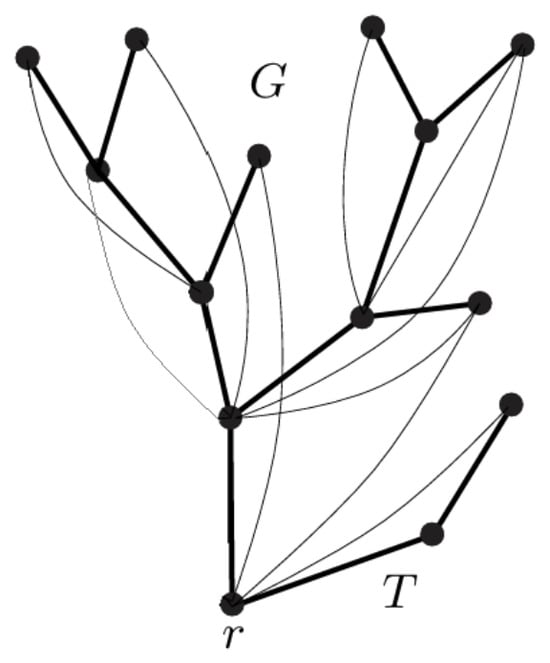
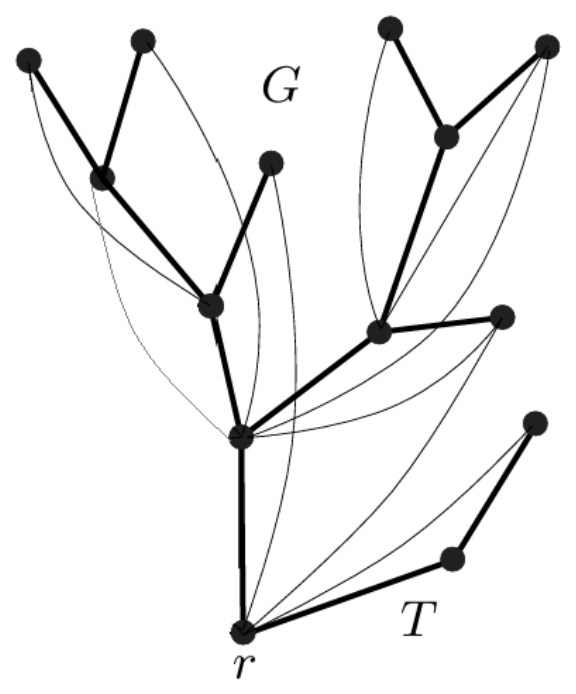
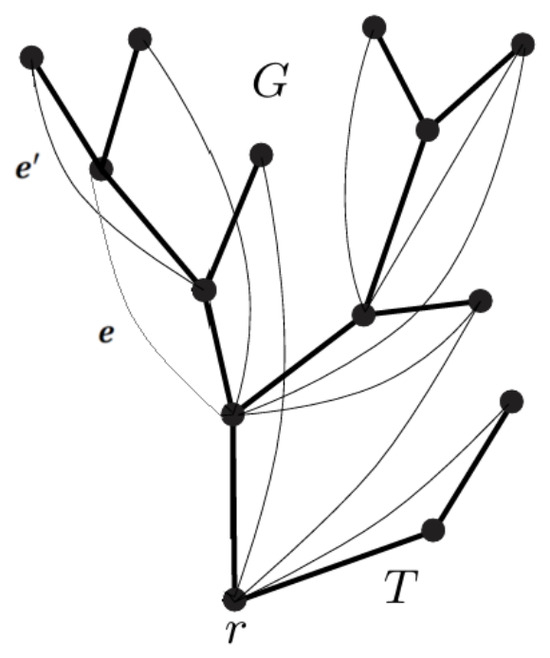
Suppose that T is a spanning tree of G with root r and let a be any vertex of G. Let denote the unique path in T from r to a. The length of the path is called the level of a and it is denoted by . Each vertex in the path is called an ancestor of a. If b is an ancestor of a, then we write and if in addition , then we may write . We denote by , the sub-tree of T rooted at a and induced by the set . A predecessor of a is an ancestor b of a satisfying . If b is a predecessor of a, then a is called a child of b. A node of a tree is a vertex that has at least two children. We say that T is a normal spanning tree in G if for every edge of G either or (see Figure 1). It is well known that every connected graph admits a normal spanning tree rooted at any preassigned vertex [1].
Figure 1.
A normal spanning tree T with root r of a graph G.
A proper k-coloring of G is a function that assigns to each vertex a unique number (called color) from the set such that any two adjacent vertices receive distinct colors. In this case, the graph G is said to be k-colorable. The smallest k such that G is k-colorable is called the chromatic number of G and it is denoted by .
Forbidding some structures in a graph can define some classes of graphs in a simpler way [2] and often proves informative, providing key insights that aid in tackling some specific problems in graph theory [3]. For example, a graph is planar if it can be drawn in the plane in such a way that no edges cross each other. Kuratowski [4] proved that a graph is planar if and only if it does not contain a subgraph that is a subdivision of the complete graph or the complete bipartite graph . It was proved that every planar graph has chromatic number at most 4 and this is famously known as the four-color theorem [5,6]. Another example is the treewidth of a graph, which is an integer that measures, informally, how far a graph is from being a tree. Note that the graphs that have treewidth 1 are precisely the trees and forests. Moreover, a graph has treewidth at most 2 if and only if it has no as a minor (see Diestel [1] [Section 12.4]). Moreover, Robertson and Seymour [7] proved the following cornerstone theorem in structural graph theory: for any graph H, the family of graphs that have no H as a minor has bounded treewidth if and only if H is a planar graph. Furthermore, using some linear ordering the vertices of a graph or digraph proved to be helpful [8,9,10] in tackling other problems such as Seymour’s second neighborhood conjecture [11] and Burr’s conjecture [12,13] restricted to tournaments (which is called Sumner’s conjecture [14]). In addition, it was also useful in proving the directed version [15] of the Erdos–Hajnal [16] conjecture for some families of digraphs [17,18,19]. Chudnovsky et al. [20] proved that if a graph has no and no induced odd cycle of length at least 5, then its chromatic number is at most 4.
In this paper, we will investigate the effect on the chromatic number of the graph when we forbid the so-called secant edges that cannot be defined unless the vertices are tree-ordered according to a normal tree (depth-first search tree).
Normal spanning trees have proven to be a valuable tool for tackling various problems. Bondy [21] employed them to provide simple and direct proofs of the well-known Brooks’ theorem [22] and Gutin’s theorem [23] (see also [24]). Brooks’ theorem asserts that for any connected graph G that is neither an odd cycle nor a complete graph. El-Sahili [25] used these trees to give a concise and direct proof of the Gallai–Roy [26,27] theorem which states that every digraph whose chromatic number is at least n contains a directed path on n vertices. Furthermore, Addario-Berry et al. [28] used them to prove the existence of any path on vertices with two blocks in every digraph whose chromatic number is at least n, thereby confirming El-Sahili’s conjecture [29].
2. Preliminaries and Definitions
In this section, we introduce secant edges necessary to formulate our conjecture and problem.
A graph G is called k-degenerate if any subgraph of G has a vertex of degree at most k. By induction on the number of vertices, we can easily prove the following well-known fact.
Lemma 1 ([30]).
If G is a k-degenerate graph, then it is -colorable.
Let be a linear ordering of the vertices of a graph G. Two edges and of G are called secant edges with respect to L if one of the following cases holds:
- (i)
- ;
- (ii)
- .
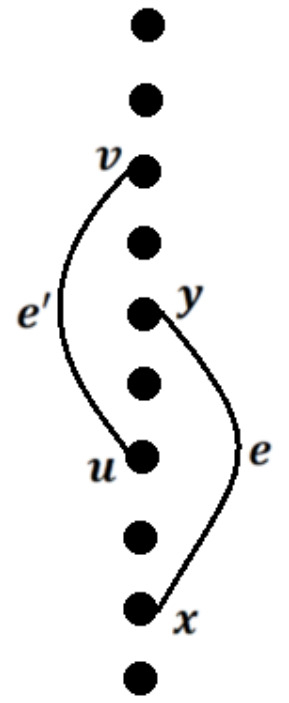
Figure 2 illustrates two secant edges and with respect to a linear order L. Obviously, if G has no secant edges with respect to L and , then H has no secant edges with respect to , where is the restriction of L to the vertices of H. In view of this observation, it is possible to prove that G is 2-degenerate [31], yielding the following result.
Figure 2.
Two secant edges and of with respect to a linear ordering L.
Lemma 2 ([31]).
If G has no secant edges with respect to a linear ordering of its vertices, then .
The concept of secant edges is suggested by Ghazal and Al-Mniny [31] as a tool to tackle a conjecture proposed by Cohen et al. [32]. The conjecture states that, for every oriented cycle C, there is a positive integer such that every strongly connected digraph with chromatic number at least contains a subdivision of C. Indeed, it has been established in [31,33,34,35] that the chromatic number of every graph excluding specific secant edges is bounded above, thereby providing a partial confirmation of this conjecture. For a generalization of the notion of secant edges with respect to a linear ordering of the vertices, together with its implications for the conjecture, we refer the reader to [36,37,38].
We now proceed to extend the concept of secant edges, originally defined with respect to a linear ordering of the vertices of a graph G, to the setting of a tree order on the vertices of G, as follows:
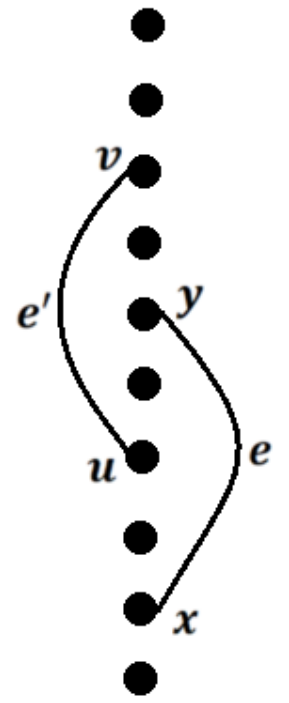
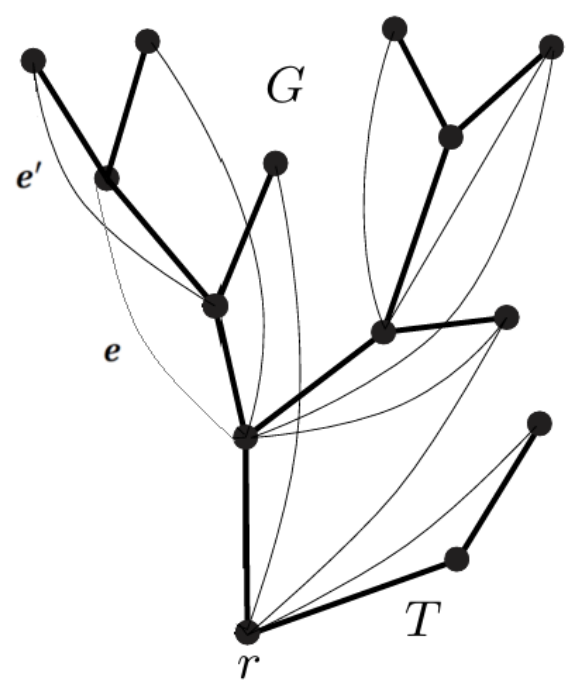
Let T be a normal spanning tree of a given graph G. Two edges and of G are called secant edges with respect to T if one of the following cases holds (see Figure 3):
Figure 3.
Two secant edges e and of G with respect to a normal spanning tree T.
- (i)
- ;
- (ii)
- .
Given that every graph admits a normal spanning tree rooted at any chosen vertex, this motivates the following question: might an analogous statement hold for arbitrary normal spanning trees? We put forward the following conjecture:
Conjecture 1.
There is a positive constant γ such that any graph without secant edges with respect to a normal spanning tree has a chromatic number at most γ.
We also ask the following:
Problem 1.
Is ?
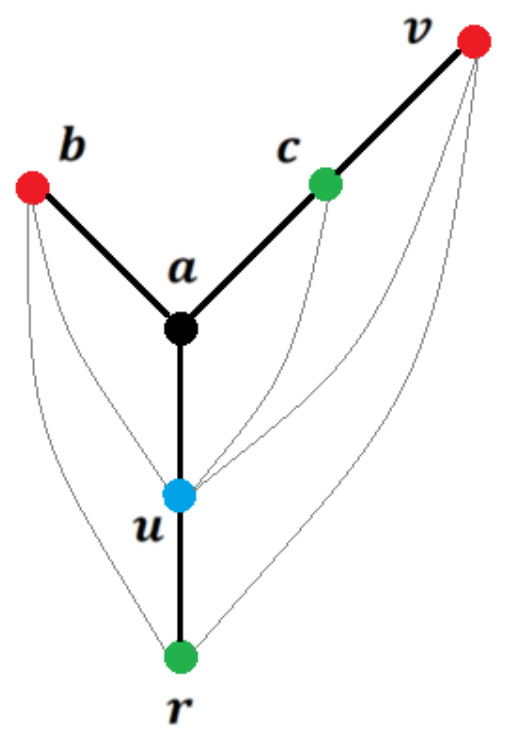
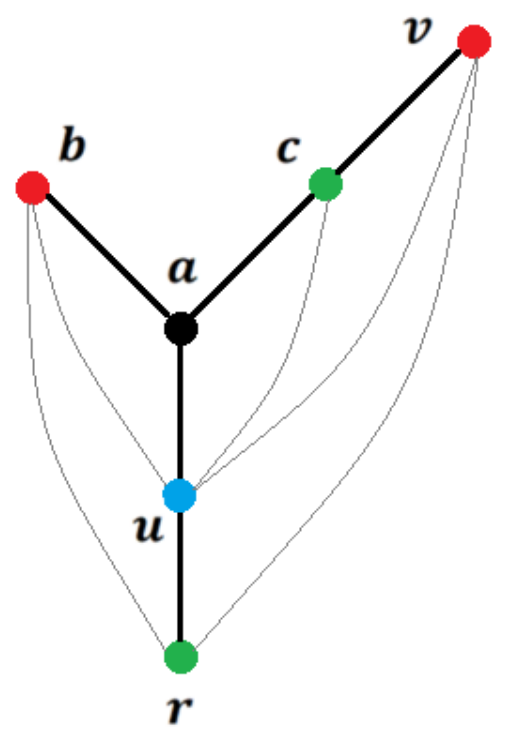
Due to Lemma 2, clearly, the answer is positive to Problem 1 when the tree is a path. The graph H in Figure 4 shows that cannot be less than 4. H has no secant edges with respect to a normal spanning tree T, whose edges are drawn in bold. In fact, assume that H can be colored properly by three colors only: green, blue and red. Since is a clique, then each of these three colors must be used. Without loss of generality, , and . Similarly, since and are cliques, then and . Since the neighbors of a used all of the three colors, it cannot be colored by any of them to obtain a proper coloring of H. Therefore . By assigning to a the block color, we get that .
Figure 4.
Graph H without secant edges with respect to a normal spanning tree, with .
Assume that Conjecture 1 is true, that is, exists. Suppose that H is a normal spanning out-tree of a digraph D. Assume that the underlying tree T of H is a normal spanning tree of the underlying graph G of D. For each , let be the graph defined by and if and only if and . We have two cases: there is , such that has secant edges, or for each , the graph has no such edges. In the first case, the two secant edges can be used to construct in D, a cycle consisting of two blocks—each block is of a length of at least k (see [31] for further details on the construction). In the second case, for each , and hence . This demonstrates that our extension to a tree-order of the notion of secant edges with respect to a tree order is a valuable approach for tackling the problem of Cohen et al. [32].
In the forthcoming section we validate our conjecture by establishing positive answer for the stated problem across specific infinite family of trees.
3. Main Results
This section is devoted to establishing evidence in favor of Conjecture 1. We begin by introducing the necessary definitions, terminology and a lemma needed in our proof.
The following well-known lemma in the literature about chromatic number will be used in our proofs:
Lemma 3 ([39]).
Suppose that are the blocks of decomposition of a graph G with respect to a clique cut-set S. Then
This lemma follows directly from the principle of separation into pieces: since S is a clique, its vertices can be colored consistently across all blocks, and the chromatic number of G is bounded by the maximum chromatic number of its components. The principle is discussed in Berge’s Graphs and Hypergraphs [39], Chapter 15, Section 1, p. 329.
We say has no secant edges, when T is a normal spanning tree of G and G has no secant edges with respect to T. Suppose from now on that G is a graph with no secant edges with respect to a normal spanning tree T, unless otherwise specified. Given an edge of G with . An edge of G is said to be jump with respect to T, if there is a vertex x in G such that .
A whip is a rooted tree that has only one node, and in addition, the children of this node are leaves.
Proposition 1.
If T is a whip and has no secant edges, then G has a proper 3-coloring through which the leaves (except possibly the root) of T are uniquely colored.
Proof.
Let A be the set of all the leaves of T except the root (in case the root is also a leaf). Let H denote the simple graph obtained from G by contracting A into a single new vertex v. Let P denote the path obtained from T by contracting A into v. Then P is a spanning tree of H. Now, we will prove that H has no secant edges with respect to the linear ordering L naturally obtained by the path P, from the root to v. Assume that and are secant edges of and that without loss of generality we have . If , then , and . Hence, and are secant edges of , which is a contradiction. If , then . By definition of contraction, this means that there is a vertex such that . Hence, , and , which is a contradiction. This proves that H has no secant edges with respect to L, and thus, according to Lemma 2, it follows that . Consider a 3-coloring of H and assume without loss of generality that the color of v is 3. By definition of contraction and proper coloring, every vertex in A is not adjacent in the graph G to any vertex of color 3. Since T is a normal spanning tree of G, then the leaves in the set A are pairwise nonadjacent to each other, neither in the tree T nor in the graph G. Thus, this proper 3-coloring of H can be extended to a proper 3-coloring of G by assigning the color 3 to each vertex in A. □
Theorem 1.
If T has exactly one node and has no secant edges, then .
Proof.
We proceed by induction on the number of the vertices of G. The statement is obviously true for small number of vertices. Let r denote the root of the tree T and a its unique node.
Suppose that is a tree. Hence, . Contract the vertices of to a single vertex w. The obtained contracted simple graph has a spanning path P from the root r to w and has no secant edges with respect to P. According to Lemma 2, has a proper 3-coloring. Since any tree is 2-colorable, we can extend the coloring of to a proper 4-coloring of G, by assigning alternately, starting from a, to each vertex in either the color of w or the color 4. Hence, in this case.
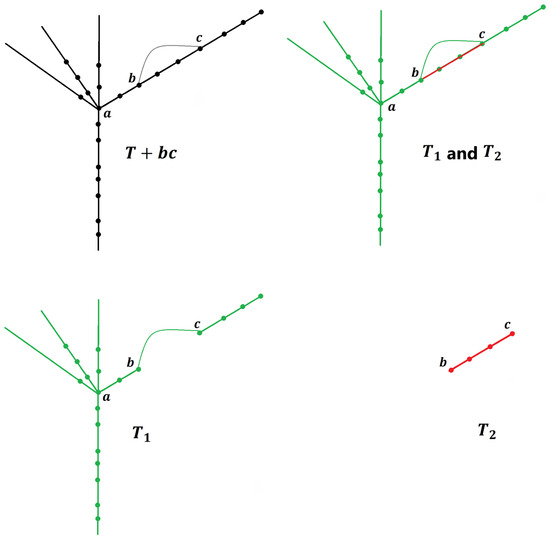
Now suppose that is not a tree. Then has a jump with . Let , , be the tree obtained from T by deleting the internal vertices of and adding the edge , and (see Figure 5).
Figure 5.
Illustration of the trees T, , , and the jump .
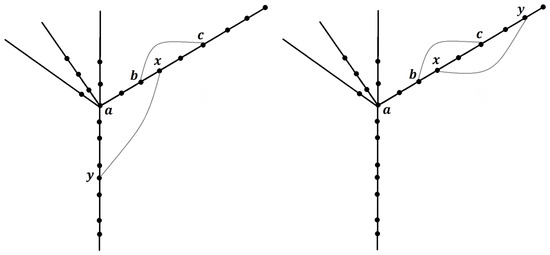
Since , then S is a clique of size 2. Now we will show that S is also a cut set whose blocks of decomposition are and . Let and and assume that . Since T is a normal spanning tree of G and , then either or . In the first case, we get that , while in the second, we get that (see Figure 6). In both cases, we get that and are secant edges of , which is a contradiction. Therefore, S is a clique-cut set of G whose blocks of decomposition are and .
Figure 6.
Secant edges and .
Since any secant edges of would also be secant edges of , it follows that has no secant edges. Since is not a jump in , then it can be an element of any pair of secant edges. Then any secant edges of would also be secant edges of . It follows that has no secant edges as well. Hence, by the induction hypothesis, we get that and . Therefore, by Lemma 3, we get that . □
4. Conclusions
We have seen that graphs that have no secant edges with respect to a linear ordering of their vertices have a bounded chromatic number. This fact was used to prove Cohen et al.’s conjecture in particular cases. Every connected graph has a normal spanning tree with any preassigned root. This suggests that using the tree order instead of the linear order of the vertices could be helpful for proving the aforementioned conjecture. We conjectured that the chromatic number of graphs without secant edges with respect to a normal spanning tree is bounded by an absolute constant and pose the problem of whether suffices. In this work, we were able to show that for any tree T that has exactly one node, if has no secant edges. This highlights the possibility that a proof by induction on the number of nodes of the normal spanning tree could be a promising direction for future research.
Funding
This research received no external funding.
Data Availability Statement
No new data were created or analyzed in this study. Data sharing is not applicable to this article.
Conflicts of Interest
The author declares no conflicts of interest.
References
- Diestel, R. Graph Theory, 5th ed.; Graduate Texts in Mathematics; Springer: Berlin/Heidelberg, Germany, 2017; Volume 173. [Google Scholar] [CrossRef] [Scilit]
- Ghazal, S. The structure of graphs with forbidden induced C4, , C5, S3, chair and co-chair. Electron. J. Graph Theory Appl. 2018, 6, 219–227. [Google Scholar] [CrossRef] [Scilit]
- Al-Mniny, D.; Ghazal, S. The second neighborhood conjecture for oriented graphs missing {C4, , S3, chair and co-chair}-free graph. Australas. J. Comb. 2021, 81, 58–88. [Google Scholar]
- Kuratowski, K. Sur le problème des courbes gauches en topologie. Fundam. Math. 1930, 15, 271–283. [Google Scholar] [CrossRef] [Scilit]
- Appel, K.; Haken, W. Every planar map is four colorable. Part I: Discharging. Ill. J. Math. 1977, 21, 429–490. [Google Scholar] [CrossRef] [Scilit]
- Appel, K.; Haken, W.; Koch, J. Every planar map is four colorable. Part II: Reducibility. Ill. J. Math. 1977, 21, 491–567. [Google Scholar] [CrossRef] [Scilit]
- Robertson, N.; Seymour, P.D. Graph minors. II. Algorithmic aspects of tree-width. J. Algorithms 1986, 7, 309–322. [Google Scholar] [CrossRef] [Scilit]
- Havet, F.; Thomassé, S. Median orders of tournaments: A tool for the second neighborhood problem and Sumner’s conjecture. J. Graph Theory 2000, 35, 244–256. [Google Scholar] [CrossRef]
- El Sahili, A. Trees in Tournaments. J. Comb. Theory Ser. B 2004, 92, 183–187. [Google Scholar] [CrossRef] [Scilit]
- Daamouch, M.; Al-Mniny, D.; Ghazal, S. About the second neighborhood conjecture for tournaments missing two stars or disjoint paths. Contrib. Discret. Math. 2025, 20, 363–383. [Google Scholar] [CrossRef] [Scilit]
- Dean, N.; Latka, B.J. Squaring the tournament: An open problem. Congr. Numer. 1995, 109, 73–80. [Google Scholar]
- Burr, S.A. Subtrees of Directed Graphs and Hypergraphs. Congr. Numer. 1980, 28, 227–239. [Google Scholar]
- El Joubbeh, M.; Ghazal, S. Existence of paths with t-blocks in k(t)-chromatic digraphs. Discret. Appl. Math. 2024, 342, 381–384. [Google Scholar] [CrossRef] [Scilit]
- Osthus, D.; Kühn, D.; Mycroft, R. A Proof of Sumner’s Universal Tournament Conjecture for Large Tournaments. Electron. Notes Discret. Math. 2011, 38, 687–692. [Google Scholar] [CrossRef] [Scilit][Green Version]
- Alon, N.; Pach, J.; Solymosi, J. Ramsey-type theorems with forbidden subgraphs. Combinatorica 2001, 21, 155–170. [Google Scholar] [CrossRef] [Scilit]
- Erdös, P.; Hajnal, A. Ramsey-type theorems. Discret. Appl. Math. 1989, 25, 37–52. [Google Scholar] [CrossRef] [Scilit]
- Berger, E.; Choromanski, K.; Chudnovsky, M. Forcing large transitive subtournaments. J. Comb. Theory Ser. B 2015, 112, 1–17. [Google Scholar] [CrossRef] [Scilit]
- Berger, E.; Choromanski, K.; Chudnovsky, M. On the Erdös–Hajnal conjecture for six-vertex tournaments. Eur. J. Comb. 2019, 75, 113–122. [Google Scholar] [CrossRef] [Scilit]
- Zayat, S.; Ghazal, S. Erdös–Hajnal conjecture for new infinite families of tournaments. J. Graph Theory 2023, 101, 388–417. [Google Scholar] [CrossRef] [Scilit]
- Chudnovsky, M.; Robertson, N.; Seymour, P.; Thomas, R. K4-free graphs with no odd holes. J. Comb. Theory Ser. B 2010, 100, 313–331. [Google Scholar] [CrossRef] [Scilit]
- Bondy, J.A. Short proofs of classical theorems. J. Graph Theory 2003, 44, 159–165. [Google Scholar] [CrossRef] [Scilit]
- Brooks, R.L. On colouring the nodes of a network. Math. Proc. Camb. Philos. Soc. 1941, 37, 194–197. [Google Scholar] [CrossRef] [Scilit]
- Gutin, G. Minimizing and maximizing the diameter in orientations of graphs. Graphs Comb. 1994, 10, 225–230. [Google Scholar] [CrossRef] [Scilit]
- Bang-Jensen, J.; Gutin, G. Digraphs: Theory, Algorithms and Applications, 2nd ed.; Springer: London, UK, 2009. [Google Scholar] [CrossRef] [Scilit]
- Sahili, A.E.; Kouider, M. About paths with two blocks. J. Graph Theory 2007, 55, 221–226. [Google Scholar] [CrossRef] [Scilit]
- Gallai, T. On directed graphs and circuits. In Theory of Graphs (Proceedings of the Colloquium Held at Tihany 1966); Akadémiai Kiadó: Budapest, Hungary, 1968; pp. 115–118. [Google Scholar]
- Roy, B. Nombre chromatique et plus longs chemins d’un graphe. Rev. Française Inform. Rech. Opér. 1967, 1, 129–132. [Google Scholar] [CrossRef] [Scilit][Green Version]
- Addario-Berry, L.; Havet, F.; Thomassé, S. Paths with two blocks in n-chromatic digraphs. J. Comb. Theory Ser. B 2007, 97, 620–626. [Google Scholar] [CrossRef] [Scilit]
- El Sahili, A. Paths with two blocks in k-chromatic digraphs. Discret. Math. 2004, 287, 151–153. [Google Scholar] [CrossRef] [Scilit]
- Szekeres, G.; Wilf, H.S. An inequality for the chromatic number of a graph. J. Comb. Theory 1968, 4, 1–3. [Google Scholar] [CrossRef] [Scilit]
- Al-Mniny, D.; Ghazal, S. Secant edges: A tool for Cohen et al.’s conjectures about subdivisions of oriented cycles and bispindles in Hamiltonian digraphs with large chromatic number. Graphs Comb. 2025, 41, 13. [Google Scholar] [CrossRef] [Scilit]
- Cohen, N.; Havet, F.; Lochet, W.; Nisse, N. Subdivisions of oriented cycles in digraphs with large chromatic number. J. Graph Theory 2018, 89, 439–456. [Google Scholar] [CrossRef] [Scilit]
- Ghazal, S.; Tfaili, S. On subdivisions of oriented cycles in Hamiltonian digraphs with small chromatic number. Commun. Comb. Optim. 2026, 11, 307–314. [Google Scholar] [CrossRef]
- El Joubbeh, M. Subdivisions of oriented cycles in Hamiltonian digraphs with small chromatic number. Discret. Math. 2023, 346, 113209. [Google Scholar] [CrossRef] [Scilit]
- Ghazal, S. Generalized subdivisions in digraphs spanned by subdivision of smaller digraphs and the chromatic number. Commun. Comb. Optim. 2025; in press. [CrossRef]
- Alhakim, A.; El Joubbeh, M. Subdivisions of Oriented Cycles in Digraphs with Hamiltonian directed path. arXiv 2024, arXiv:2409.11421. [Google Scholar] [CrossRef] [Scilit]
- Ghazal, S.; Dirani, N. Long Cycles in Chromatic Digraphs Spanned by Hamiltonian Directed Paths. Mathematics 2026, 14, 1979. [Google Scholar] [CrossRef] [Scilit]
- Ghazal, S.; Karam, S. On Subdivision of Cycles with Two Blocks in Chromatic Digraphs Spanned by Hamiltonian Directed Paths. Mathematics 2026, 14, 1248. [Google Scholar] [CrossRef] [Scilit]
- Berge, C. Graphs and Hypergraphs; North-Holland: Amsterdam, The Netherlands, 1973. [Google Scholar]
Disclaimer/Publisher’s Note: The statements, opinions and data contained in all publications are solely those of the individual author(s) and contributor(s) and not of MDPI and/or the editor(s). MDPI and/or the editor(s) disclaim responsibility for any injury to people or property resulting from any ideas, methods, instructions or products referred to in the content. |
© 2026 by the author. Licensee MDPI, Basel, Switzerland. This article is an open access article distributed under the terms and conditions of the Creative Commons Attribution (CC BY) license.