


Abstract
Background: Due to drug efficacy, adverse reactions, and individual differences, clinicians face significant challenges in drug selection for the treatment of depression. However, the study on predicting antidepressant treatment response based on pharmacogenomics has not yet been determined. Methods: A total of 178 participants were recruited and randomly assigned to either pharmacogenomics-guided antidepressant treatment or regular antidepressant treatment. All participants completed pharmacogenomic sampling at baseline and underwent neuropsychological systemic assessments at baseline and at 4-week, 8-week, 16-week, and 32-week follow-ups. Results: Compared with the control group, the pharmacogenomics-guided group showed significant differences in the effect of DARS scores within 32 weeks (PBonferroni < 0.05), showing a significant time and group effect (p < 0.001; p = 0.007, respectively). In addition, the pharmacogenomic-guided group showed significant differences in ASEC scores within 32 weeks (PBonferroni < 0.05), showing a significant time effect, group effect, and group × time effect (p < 0.001; p = 0.018; p = 0.009, respectively). However, there was no significant difference in HAM-D17, HAM-A, PDQ-D, and PSQI between the two groups within 32 weeks (PBonferroni > 0.05). Conclusions: Pharmacogenomics-guided antidepressant prescribing effectively alleviates anhedonia and reduces adverse effects in patients with first-episode depression, but there is no significant improvement in major psychopathological symptoms. These findings carry important implications for the early application of pharmacogenomic testing in primary care settings for depression.
1. Background
Depression is an affective disorder whose core features include loss of pleasure, low mood, and severe suicidal behaviour and ideation [1]. It carries a substantial prevalence, a high rate of recurrence, and a considerable disease burden. Current therapeutic strategies for depression encompass pharmacotherapy, psychological interventions, and neuromodulation techniques; at least half of patients receive antidepressant medication [2]. Data from the UK’s National Health Service indicate that more than 70 million antidepressant prescriptions are issued annually, and global expenditure on these agents is projected to reach $17.6 billion by 2030 [3]. Moreover, the US Centers for Disease Control and Prevention revealed that antidepressants have become the most frequently prescribed drug category, with prescription volumes rising by 18.6% in the first quarter of 2020 [4].
Globally, antidepressants are currently classified into six major categories, encompassing nearly 70 individual agents, with a further 240 compounds at the phase I clinical trial or New Drug Application stage [5]. However, clinicians often encounter substantial difficulties when selecting among these options, owing to variations in drug efficacy, differing side effect profiles, and marked inter-individual heterogeneity [6]. Previous research indicates that only 30–45% of depressed patients achieve clinical remission with a single antidepressant treatment, and approximately 10% of patients fail to respond to any class of antidepressant [7]. A study on primary healthcare reported that patients with depression switch drugs an average of three times during the course of their treatment [8,9].
The application of pharmacogenomics in treatment for depression is attracting growing attention [10]. By directly sequencing genes, researchers can establish links between genetic variants and individual responses to antidepressant agents [11,12]. Aldrich [13] reported that depressed patients who are CYP2C19 rapid metabolisers are more prone to adverse events, such as agitation and weight gain, after using citalopram. Polymorphisms in the HTR1B gene and methylation levels in its promoter TFBS region were associated with clinical improvement in depressed adolescents treated with fluoxetine [14]. Pharmacogenomic testing may facilitate more rational drug selection and dosing in patients with genetic variations that affect pharmacokinetics or pharmacodynamics, thereby enhancing both efficacy and safety and supporting evidence-based prescribing.
To date, research investigating the utility of pharmacogenomics for predicting antidepressant outcomes remains scarce. According to Greden et al. [15], pharmacogenetic testing could offer particular advantages for major depressive disorder, given that 28–33% of patients show diminished therapeutic response and lower adherence to treatment. However, an 8-week short-term randomised trial reported that genotyping for a panel of pharmacokinetic and pharmacodynamic markers did not yield a statistically significant improvement in the primary efficacy endpoints [16]. The American Psychological Association (APA) acknowledges that pharmacogenetic methods have potential in guiding antidepressant treatment, but evidence of the ability of these methods to predict antidepressant treatment response is lacking owing to study limitations such as a short duration, single dimensionality, and nonrandomisation [17].
The Precision Medicine in Mental Health Care study aims to evaluate multidimensional, long-term evidence in pharmacogenomic testing of medications and routine clinical practice. Using a prospective randomised controlled design, we tested two main hypotheses: (i) treatment under pharmacogenomic guidance would lead to greater improvement in depressive symptoms and sustained benefits for accompanying symptoms; and (ii) early pharmacogenomic intervention may reduce the risk of adverse reactions to antidepressants.
2. Methods
2.1. Study Design
We conducted a randomised controlled trial at the Clinical Research Center of Shanghai Pudong Mental Health Center (affiliated with Tongji University School of Medicine) to assess the clinical value of pharmacogenomic-guided therapy. Eligible participants were allocated in a 1:1 ratio to either the pharmacogenetics group or the control group, with a target sample size of 80 per arm (allowing for an estimated 10% attrition). This trial was prospectively registered with ClinicalTrials.gov (NCT05669391).
2.2. Participants
Between 1 January 2023 and 31 January 2024, we systematically screened consecutive patients presenting with a first episode of major depressive disorder in order to reduce confounding factors caused by past use of antidepressants; diagnoses were confirmed using the DSM-5 criteria. Inclusion criteria: 18–65 years old; never used antidepressants before; primary school education or above; intact sensory and cognitive abilities. Exclusion criteria: comorbid schizophrenia spectrum, bipolar disorder, neurocognitive disorders, substance use disorders; complications of severe endocrine, cardiovascular, or neurological disorders; contraindications for antidepressants such as narrow-angle glaucoma and epilepsy; pregnancy or lactation; serious suicide risk; abnormal hepatic and renal function; and have previously received neuromodulation therapy.
2.3. Randomisation
An independent researcher, who had no involvement in patient assessments, used SPSS 26.0 to generate the randomisation sequence. The allocation sequence was subsequently placed in opaque envelopes that were numbered sequentially so as to maintain allocation concealment. Participants were enrolled in chronological order and allocated in a 1:1 ratio to either the pharmacogenetics group or the control group according to the next number in the sequence. Throughout the trial, participants were kept unaware of their group assignment.
2.4. Pharmacogenomics (PGx)
This study adopted a pharmacogenomic strategy that genotyped 55 target loci across 12 genes involved in drug metabolism, efficacy, and toxicity, covering 23 commonly prescribed antidepressants (see Supplementary Material Table S1). Genomic DNA was extracted using Tris-EDTA as an anticoagulant in conjunction with salt precipitation; the resultant samples exhibited OD 260/280 absorbance ratios between 1.6 and 1.8 and concentrations above 50 ng/μL. We performed genotyping using a PCR-based chip assay in conjunction with the Illumina Asian Screening Array. This array is the first genome-wide SNP chip designed from whole-genome sequencing data of over 9000 East Asian individuals, and it encompasses 750,000 markers with an effective locus coverage of 85%. This process generated genetic data relevant to inter-individual differences in therapeutic responses. Locus selection drew upon the ClinPGx resource, clinical guidelines for antidepressants, package inserts, allele frequencies in the Chinese population, and extensive real-world trial data, all of which were integrated to tailor a specialised testing panel. The algorithm was based on data from three pharmacogenomic dimensions-drug metabolism genes, drug efficacy genes, and drug toxicity genes-to select antidepressants with appropriate pharmacokinetic, pharmacodynamic, and safety profiles for each participant. With respect to drug metabolism genes, each tested genetic variant in CYP2D6 and CYP2C19 was translated into a predicted metaboliser phenotype, classified as poor metaboliser (PM), intermediate metaboliser (IM), normal metaboliser (NM), rapid metaboliser (RM), or ultra-rapid metaboliser (UM). For drug efficacy genes, polymorphisms in genes encoding drug targets and signalling pathways, including SLC6A4 and HTR2A, were assessed. For drug toxicity genes, genetic variants associated with an increased risk of adverse drug reactions were screened. The algorithm platform utilises an allele conversion tool to convert raw genotyping data into standardised star alleles. In accordance with CPIC guidelines, each allele is assigned an activity score: normal-function alleles are scored as 1.0, decreased-function alleles as 0.5 or 0.25, and no-function alleles as 0. A weighted calculation is then performed on the activity scores of all relevant genes affecting metabolism to generate a composite metabolic prediction. Finally, this composite metabolic score is integrated with polymorphic information from drug efficacy genes and drug toxicity genes. Based on authoritative evidence from CPIC/DPWG guidelines, FDA labels, East Asian population data, and Chinese real-world evidence, a prioritised prescribing recommendation is generated. Blood specimens were collected by fingertip puncture; roughly 50 μL blood was spotted onto sterile filter-paper rings and air-dried at ambient temperature for a minimum of 4 h. During collection, care was taken neither to stack the spots nor to allow them to contact any other surfaces. After complete desiccation, the dried spots were placed in sterile sachets together with desiccants and humidity indicator cards; the sealed packages were then dispatched to the laboratory within 8 h for analysis.
3. Assessments
Evaluate psychopathological results using validated instruments. Depressive symptom severity was evaluated with the 17-item Hamilton Depression Rating Scale (HAM-D17). The Chinese localised version has a Cronbach’s α coefficient of 0.77 and a remeasuring coefficient of 0.95. In terms of severity cut-offs, scores between 8 and 16 indicate mild depression, 17 and 23 moderate depression, and ≥24 severe depression or more severe [18]. Anxiety symptom severity was measured using the Hamilton Anxiety Scale (HAM-A). The Cronbach’s α coefficient of the Chinese version was 0.83; remeasuring reliability was 0.93 [19]. A score of 8–14 indicates confirmed anxiety; a score of 15–23 indicates obvious anxiety; and a score of ≥24 indicates severe anxiety. Anhedonia was assessed with the Dimensional Anhedonia Rating Scale (DARS), a 17-item covering four domains [20]. The Chinese version was created by Jia et al. (Cronbach’s α coefficient was 0.97; remeasuring reliability was 0.89) [21]. Higher scores indicate a lower degree of happiness deficiency. The Perceived Deficits Questionnaire-Depression (PDQ-D) assesses subjective cognitive dysfunction in depression, including four subscale scores: attention/concentration, retrospective memory, prospective memory, and planning/organisation [22]. Chuan et al. created a localised Chinese version (Cronbach’s α coefficient was 0.95; remeasuring reliability was 0.84), with higher scores indicating worse subjective cognitive impairment [23]. The Pittsburgh Sleep Quality Index (PSQI) assessed sleep quality and disturbances over a 1-month interval, including a total of 18 items and 7 dimensions to evaluate sleep effects and duration [24]. Liu et al. created a Chinese version (Cronbach’s α coefficient was 0.74; remeasuring reliability was 0.53), and higher scores denote worse sleep quality [25]. The side effects associated with antidepressants were documented using the 21-item Antidepressant Side Effect Checklist (ASEC). The scale assesses a range of symptoms, including physical fatigue, headache, dizziness, sleep disturbances, palpitations, tremors, orthostatic collapse, dry mouth, sweating, constipation, drowsiness, urinary complaints, and sexual dysfunction. It had a Cronbach’s α coefficient of 0.78 and a remeasuring reliability of 0.64 [26], with elevated total scores reflecting greater side-effect severity.
3.1. Procedure
After randomisation, each participant underwent pharmacogenomic sample collection at baseline, alongside psychopathological evaluations performed at baseline and at weeks 4, 8, 16 and 32 based on a long-term study design of antidepressant pharmacokinetics. Neuropsychological testing was administered in a separate room under the guidance of a trained evaluator who held a registered clinical qualification in psychological scale administration. For those allocated to the pharmacogenomics-guided arm, clinicians selected antidepressants with a genetically predicted lower likelihood of adverse drug-gene interactions, drawing directly on the individual’s genomic profile. Conversely, participants in the control group received treatment as standard clinical practice. All costs attributable to the pharmacogenomic testing were covered by the project.
3.2. Blinding Strategy
All participants provided pharmacogenomic sampling; however, pharmacogenomic testing was performed exclusively for those in the intervention group. In order to ensure standardised interpretation, a single clinically practising psychopharmacology pharmacist reviewed all pharmacogenomic results, focusing on genes related to drug metabolism genes, drug efficacy genes, and drug toxicity genes. Likewise, a trained assessor conducted all neuropsychological assessments. Masking was maintained for the subjects and the psychological assessor with respect to group allocation. Furthermore, the interpreting pharmacist only had access to deidentified sample codes and did not know the specific identities of the participants corresponding to the genetic results, thereby minimising potential bias in genotype interpretation. Participants in the intervention group received antidepressant regimens chosen according to their genomic profiles, while control participants were managed with conventional treatment, with medication selection based on the clinician’s clinical judgement. Disclosure of study grouping and individual pharmacogenomic findings was deferred until the research had been completed.
3.3. Data Analysis
The sample size estimation was performed through a priori power analysis software (PASS 21.0.3). The significance level of the two-sided test was set to 0.05, the effect size was 0.6, and the power value was 0.8. We used SAS version 9.4 (SAS Institute, Inc., Cary, NC, USA) for all statistical analysis. Normality of the data was checked with the one-sample Kolmogorov-Smirnov test. Categorical variables are shown as percentages, whereas continuous variables are presented as mean ± standard deviation (SD). The chi-square test and analysis of variance (ANOVA) were used to compare the baseline demographic and clinical characteristics. We performed an intention-to-treat analysis as part of the sensitivity analysis, and we replaced missing values using the last observation carried forward (LOCF) method. Between-group factors and within-group factors (baseline, 4, 8, 16 and 32 weeks) were evaluated with adjustment for clinical confounding covariates. Between-group comparisons were carried out using independent samples t-tests. A repeated-measures multivariate analysis of variance (RM MANOVA) was performed on the six scale scores (HAM-D17, HAM-A, DARS, PDQ-D, PSQI, and ASEC) to derive their overall p values, with intergroup and intragroup factors set and confounding covariates adjusted. Given the observed baseline imbalances in DARS and HAM-D17 scores, a sensitivity analysis was conducted using analysis of covariance with baseline scores as covariates. After adjustment for baseline values and relevant covariates (BMI, age, gender, illness duration, way of living, and health status), follow-up scores were compared between the two arms. If the group × time interaction was significant, an ANCOVA was used to analyse the inter-group differences of factors within the group. Bonferroni corrections were applied to guard against multiplicity. To assess the potential bias introduced by the unblinding of clinicians, we evaluated the risk of bias for the primary and secondary outcomes using the Cochrane Risk of Bias 2 (RoB 2) tool. Sample size and power calculations assumed a two-tail significance level of 5%. Effect sizes are reported as Cohen’s d, and statistical significance was set at p < 0.05.
4. Results
4.1. Participants
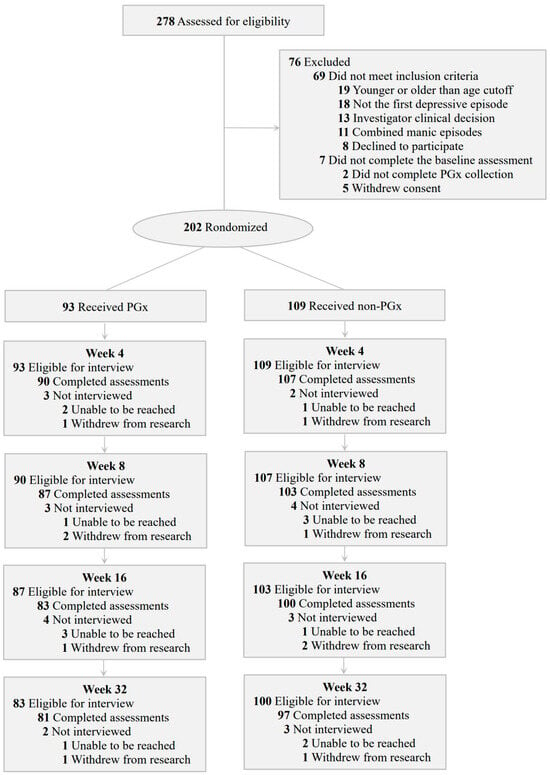
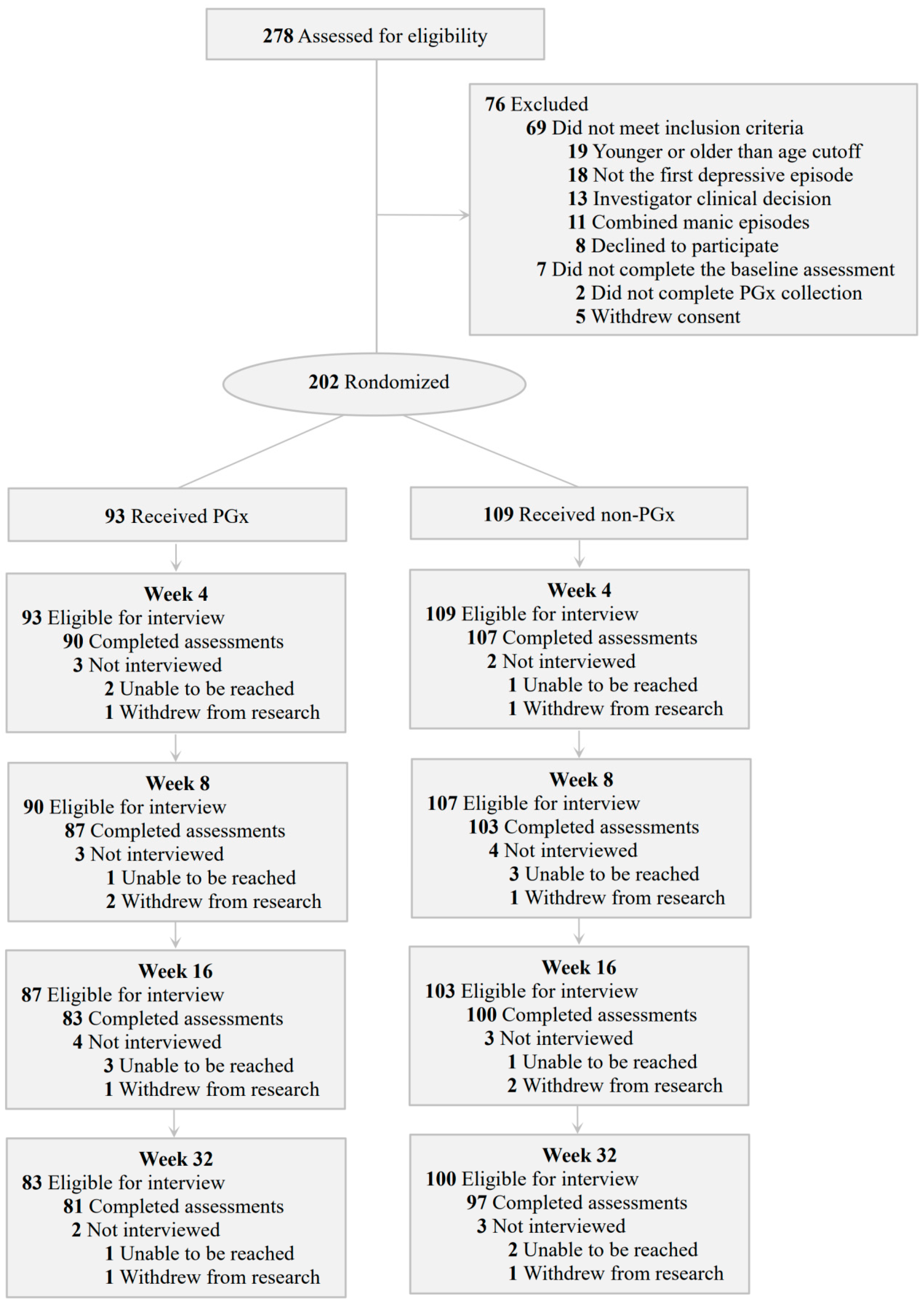
A total of 31 clinicians consented to participate in the study, with each allowed a maximum of 10 randomised patients. A total of 278 participants consented to participate, of whom 178 completed the study endpoint (see Figure 1). Table 1 shows the baseline demographics for the pharmacogenomic-guided, control, and total sample groups. The overall mean age was 34.34 ± 15.53 years, whilst females constituted 68.54% of the cohort.
Figure 1.
Screening, enrolment, randomisation, and outcomes among individuals in the study. PGx: Pharmacogenomics.
Table 1.
Participant demographics and social characteristics.
There were no significant differences in the demographics between two groups (p > 0.05), except for way of living and health status. Table 2 shows that in the pharmacogenomics-guided group, the prescription frequency of Fluvoxamine (14.81% vs. 5.15%, p = 0.030), Venlafaxine (13.58% vs. 3.09%, p = 0.010), and Citalopram (7.41% vs. 0.00%, p = 0.007) was significantly higher than that of the control group. On the contrary, Fluoxetine (0.00% vs. 7.22%, p = 0.017) and Agomelatine (0.00% vs. 12.37%, p < 0.001) were used more frequently in the control group, with significant differences.
Table 2.
Antidepressant selection between pharmacogenomic-guided groups vs. control groups.
4.2. Primary Outcomes
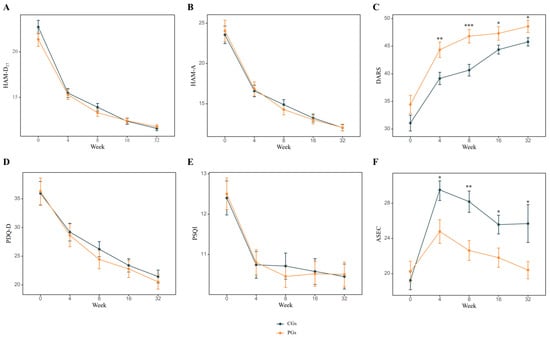
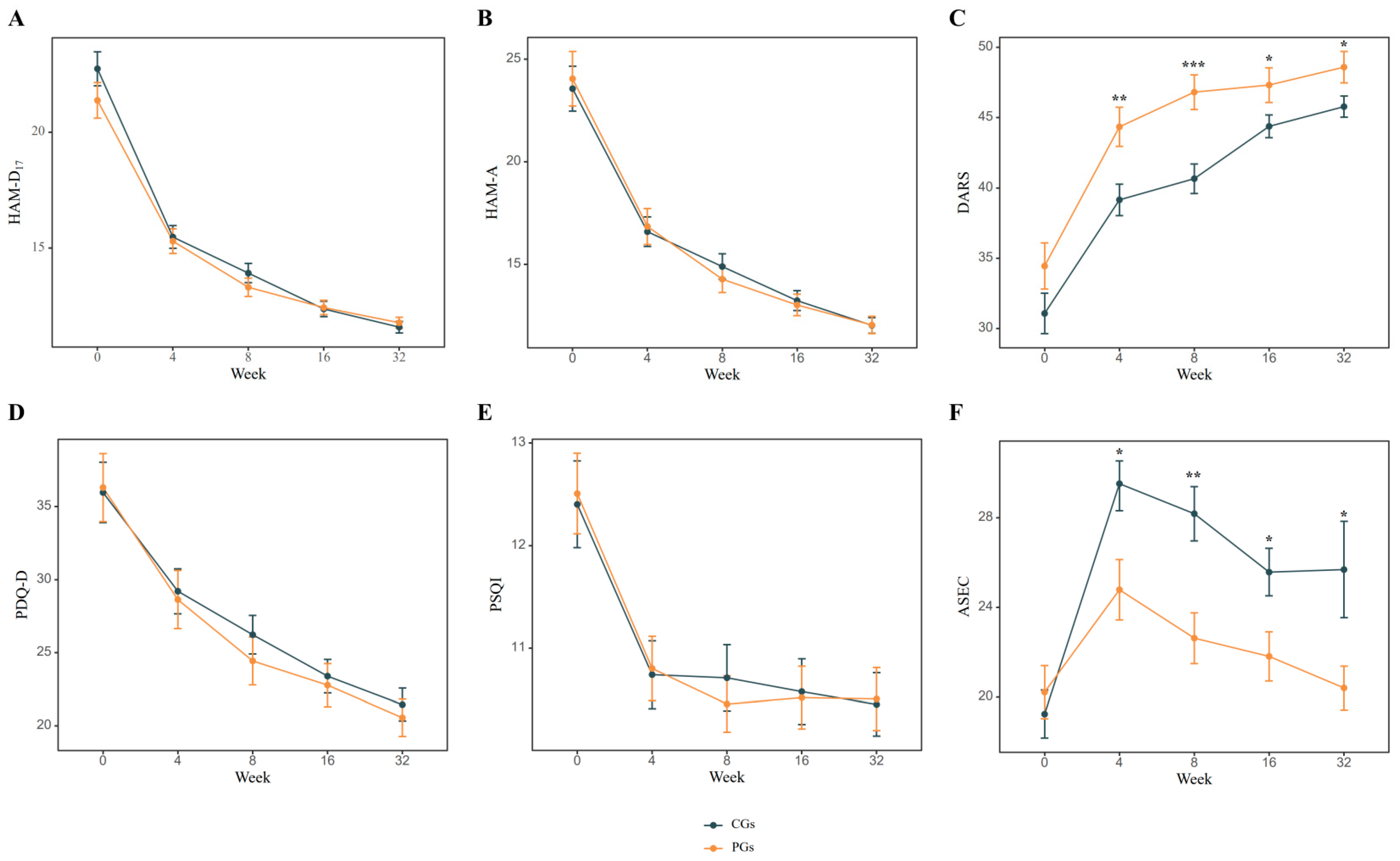
As shown in Table 3 and Figure 2, HAM-D17 and DARS scores were used as indicators of the alleviation of depressive symptoms in patients receiving antidepressant prescriptions. Sensitivity analyses using ANCOVA with baseline HAM-D17 scores as a covariate confirmed the absence of a significant group effect at any follow-up time point (p > 0.05). There was no significant difference in HAM-D17 scores between two groups at all time points (p > 0.05). RM MANOVA using HAM-D17 scores as the outcome measurement and BMI as the covariate revealed a significant time effect (Wilks’ λ F(4, 704) = 387.61, p < 0.001, η2 = 0.69), whereas the group effect and group × time interaction were not significant (Wilks’ λ F(1, 176) = 0.45, p = 0.504, η2 = 0.01; Wilks’ λ F(4, 704) = 2.20, p = 0.127, η2 = 0.12; respectively). For DARS, after controlling for BMI, age, gender, illness duration, way of living, health status, and baseline DARS scores, the pharmacogenomic-guided group showed significantly higher scores at weeks 4, 8, 16 and 32 compared with the control group (PBonferroni < 0.05, Cohen’s d = 0.23 to 0.58). The observed baseline imbalance was compared based on Analysis of Covariance as a sensitivity analysis, and the robustness of the treatment effect was confirmed. RM MANOVA using DARS score as the outcome measure and BMI as the covariate showed significant time and group effect (Wilks’ λ F(4, 704) = 165.25, p < 0.001, η2 = 0.48; Wilks’ λ F(1, 176) = 7.59, p = 0.007, η2 = 0.41); the group × time interaction was not significant (Wilks’ λ F(4, 704) = 2.85, p = 0.070, η2 = 0.16).
Table 3.
Effect of pharmacogenomic-guided groups vs. usual care control groups on depressive symptoms, accompanying symptoms, and adverse reactions.
Figure 2.
Impact of pharmacogenomics guidance on various symptoms of first-episode patients with depression at different time points between two groups. (A) No significant difference in HAM-D17 score; (B) No significant difference in HAM-A score; (C) DARS—a statistically significant difference was noted at weeks 4, 8, 16, and 32; (D) No significant difference in PDQ-D score; (E) No significant difference in PSQI score; (F) ASEC—a statistically significant difference was noted at weeks 4, 8, 16, and 32. Abbreviations: HAM-D17: 17-items Hamilton Depression Scale; HAM-A: Hamilton Anxiety Scale; DARS: Dimensional Anhedonia Rating Scale; PDQ-D: Perceived Deficits Questionnaire-Depression; PSQI: Pittsburgh Sleep Quality Index; ASEC: Antidepressant Side Effect Checklist; PGs, pharmacogenomic-guided groups; CGs, control groups; * p < 0.05, ** p < 0.01, *** p < 0.001.
4.3. Secondary Outcomes
The secondary outcomes (HAM-A, PDQ, and PSQI) showed a progressive decrease from baseline to week 32; however, the mean differences between the pharmacogenomic-guided and control groups at any time point up to 32 weeks were not statistically significant after adjustment (PBonferroni > 0.05). RM MANOVA using HAM-A, PDQ-D, and PSQI scores as the outcome measurement and BMI as the covariate showed a significant time effect (Wilks’ λ F(4, 704) = 270.48, p < 0.001, η2 = 0.66; Wilks’ λ F(4, 704) = 188.61, p < 0.001, η2 = 0.52; Wilks’ λ F(4, 704) = 61.03, p < 0.001, η2 = 0.26). No significant group or group × time interaction effects were observed (p > 0.05) (See Table 3).
4.4. Side Effects and Safety
Table 3 showed the ASEC scores after adjusting for BMI, age, gender, disease course, way of living, and health status. Compared with the control group, the pharmacogenomic-guided group showed a significant decrease in ASEC scores at weeks 4, 8, 16 and 32, mainly characterised by dry mouth, constipation, and nausea (PBonferroni < 0.05, Cohen’s d = 0.32 to 0.50). Furthermore, RM MANOVA revealed significant main effects of time and group, as well as a group × time interaction, on ASEC scores after adjusting for BMI as a covariate (Wilks’ λ F(4, 704) = 21.61, p < 0.001, η2 = 0.11; Wilks’ λ F(1, 176) = 5.71, p = 0.018, η2 = 0.03; Wilks’ λ F(4, 704) = 5.04, p = 0.009, η2 = 0.03). In addition, no adverse events attributable to the intervention were recorded throughout the study.
5. Discussion
To our knowledge, this prospective, long-term randomised controlled trial is the first systematic comparison of multidimensional neuropsychological assessments between pharmacogenomics and non-pharmacogenomics guidance treatment for first-episode depression patients. The main findings were as follows: (i) antidepressant drug therapy based on pharmacogenomics showed within-group differences in the improvement of major psychopathological symptoms within 32 weeks, with no difference compared to non-pharmacogenomics-guided group; (ii) antidepressant treatment based on pharmacogenomics improves the anhedonia in patients both within and between groups, with statistically significant differences; and (iii) in terms of drug side effects, there were significant differences in the time, group, and time × group of antidepressant drugs between pharmacogenomics and non-pharmacogenomics, indicating that treatment guided by pharmacogenomics can more effectively reduce the occurrence of drug side effects.
Owing to method limitations, previous research have yielded conflicting evidence regarding the value of pharmacogenomics as a clinical support tool for improving depression outcomes [16]. McCarthy et al. [27] observed a marginally faster improvement in the pharmacogenomic arm, but the difference was not significant statistically. In contrast, a real-world randomised controlled study reported that the response rate of HAM-D17 in MDD patients was significantly greater than that of those on usual care and that this approach also curtailed prescribing of drugs with predicted drug-gene interaction risks [28]. To date, studies have concentrated almost exclusively on depressive severity, with no examination of pharmacogenomic effects on the accompanying symptoms. We found that pharmacogenomic-guided antidepressant therapy showed no significant long-term difference across depression, anxiety, cognition, and sleep-related symptoms. This outcome is consistent with the majority of published findings on depressive symptoms and further confirms the effects of the accompanying symptoms.
It is well recognised that anhedonia constitutes an early cardinal feature of depression and serves as a prognostic indicator of suboptimal therapeutic response to antidepressant medication. Interestingly, our study revealed that pharmacogenomics-guided antidepressant treatment conferred a significant advantage in reducing anhedonia in first-episode depression. This may be related to the selection of drugs with higher dopamine or noradrenergic activity [29]. Anhedonia has a distinct neurobiological basis involving dysfunction of dopaminergic and reward-circuitry pathways. By contrast, the HAM-D17 aggregates multiple symptom domains; improvements in a single domain may be obscured by the heterogeneity inherent in the scale’s multidimensional structure. This study is also the first to use indicators of early depressive symptoms as a measure of the effectiveness of clinical decision-making in pharmacogenomics [30,31,32]. Our findings suggest that the improvement in anhedonia may be attributed to pharmacogenomic testing, which can identify patients with genetic variations that can predict better responses to drugs that enhance dopamine delivery. A glutamatergic hypothesis for anhedonia has been advanced by several studies, drawing on the rapid antidepressant action of ketamine (an NMDA receptor antagonist) in MDD patients [33,34]. Huang et al. [35] reported that the polymorphic interaction of glutamate pathway genes could influence hedonic capacity and might serve as predictive markers for anhedonia.
Furthermore, optimising drug and dose selection guided by pharmacogenomics may ensure sufficient inhibition of norepinephrine reuptake, which could indirectly modulate dopamine levels in the prefrontal cortex. However, it should be noted that the proportion of patients receiving potent serotonin transporter (SERT) inhibitors was higher in the pharmacogenomics-guided group than in the control group, suggesting that pharmacogenomics guidance may have encouraged clinicians to preferentially select SERT inhibitors. Given that SERT inhibitors can indirectly modulate dopaminergic activity in the mesolimbic pathway by enhancing serotonergic transmission, which may also contribute to the improvement of anhedonia, the observed advantage in anhedonia improvement in the pharmacogenomics group might be partially attributable to the increased use of SERT inhibitors.
Adverse drug reactions have consistently been a concern in antidepressant prescribing, representing the greatest worry for patients and potentially a decisive factor in treatment success [36]. In a large cohort study involving 251,745 depressed individuals, 54% of respondents discontinued their antidepressant within one month of initiation; side effects were the most frequently cited reason for non-adherence, with reports ranging from 20% to 40% [37]. Notably, our study observed a significant reduction in the ASEC score of the pharmacogenomics-guided group, mainly characterised by anticholinergic symptoms (such as dry mouth and constipation) and gastrointestinal distress (such as nausea). The reduction in nausea can be attributed to dose reduction or avoidance of SSRIs in patients with the CYP2D6 poor metaboliser phenotype. Screening for toxicity-related genetic markers via pharmacogenomics can flag susceptibility to adverse reactions [38]. For example, patients with the CC genotype of the HTR2A 102T/C polymorphism (rs6313) have been shown to face a significantly elevated risk of nausea and vomiting after four weeks of citalopram therapy compared with those carrying the CT or TT genotype [39]. However, only one evidence-based pharmacogenomic trial has used adverse events as its primary endpoint; that study also found a numerically lower early drop-out rate due to adverse events in the pharmacogenomically guided arm relative to the control group [40].
For DARS, Cohen’s d values ranged from 0.23 to 0.58, corresponding to between-group differences in raw scores of 2.81 to 6.16 points. For ASEC, Cohen’s d ranged from 0.32 to 0.50, with corresponding raw score differences of 3.76 to 5.56 points. Although the minimal clinically important difference has not yet been established for either DARS or ASEC, a previous meta-analysis study proposed that a standardised mean difference of 0.24 could serve as a tentative threshold for clinical relevance in depression research [41]. The effect sizes observed in our study for both DARS and ASEC consistently exceeded this threshold, suggesting that the improvements are likely to be clinically meaningful. The moderate effect size for DARS is of particular note, given that the conventional antidepressant effect on core depressive symptoms (HAM-D17) is an SMD of approximately 0.30, whereas anhedonia is generally considered more refractory to treatment. Furthermore, the reduction in adverse effects, even with small-to-medium effect sizes, has direct clinical utility for first-episode patients, as it may enhance early treatment adherence and lower the risk of premature discontinuation.
Overall, pharmacogenomics tools have not yet been proven to improve the speed or magnitude of antidepressant efficacy, but they can be used in the clinic for the prediction of early drug selection or to estimate the likelihood of adverse drug reactions, with potential uses in epigenetic research.
Limitations
This study has several strengths, among them a prospective design, a long-term observation period, an acceptable sample size, and multidimensional symptoms. Nevertheless, several limitations should be acknowledged. First, our findings would benefit from validation in a larger, multicentre sample, which would help to minimise regional population stratification and enhance generalisability across diverse ethnic groups. Second, LOCF may introduce bias in effect estimation; perhaps mixed models for repeated measures or multiple imputation could be used to compensate for the static trajectory that emerges after dropout. Third, the trials are seldom able to obtain fully double-blind statistically significant outcomes in clinical settings. Clinicians may experience implementation bias when selecting antidepressants in an unblinded setting. Finally, we did not consider phenoconversion caused by drug-drug interactions, which may constitute potential confounding bias. Although we have provided a detailed description of the core logic of the algorithm, the specific weighting parameters of the commercial platform have not been fully disclosed. In future studies, we will endeavour to promote greater transparency regarding the algorithmic details.
6. Conclusions
Our findings indicate that pharmacogenomics-guided antidepressant prescribing effectively alleviates anhedonia and reduces adverse effects in patients with first-episode depression, but there is no significant improvement in major psychopathological symptoms. These findings carry important implications for the early application of pharmacogenomic testing in primary care settings for depression.
Supplementary Materials
The following supporting information can be downloaded at: https://www.mdpi.com/article/10.3390/futurepharmacol6030047/s1, Table S1. The 12 genes and 55 loci included in the pharmacogenomic testing panel.
Author Contributions
J.T. and J.Z. contributed to formal analysis, visualization, writing—original draft, and methodology. X.S. and J.Y. conceived the study, funding acquisition, and writing—review and editing. J.T. and N.Z. performed the project administration, neuropsychological assessments, and writing—original draft. X.L., X.Z., Y.X. and M.L. were responsible for sample collection, resources, validation, and writing—original draft. All authors have read and agreed to the published version of the manuscript.
Funding
This study was funded by the Key Discipline Construction Fund of Shanghai Pudong New Area Municipal Commission of Health and Family Planning (PWZxk2022-18) and the National TCM Heritage and Innovation Pilot Zone of Shanghai Pudong New Area (PDZY-2026-1303).
Institutional Review Board Statement
The Research Ethics Committee of Tongji University School of Medicine granted ethical approval for this study (PDJWLL2022033, approval date: 10 July 2022). All experimental procedures were performed in strict compliance with the ethical principles of the relevant human research committees and the 2024 revision of the Helsinki Declaration. Written informed consent was obtained from each participant prior to study enrollment.
Data Availability Statement
All data supporting the findings of this study are accessible via the corresponding author.
Conflicts of Interest
The authors declare no conflicts of interest.
References
- Mangione, C.M.; Barry, M.J.; Nicholson, W.K.; Cabana, M.; Chelmow, D.; Coker, T.R.; Davidson, K.W.; Davis, E.M.; Donahue, K.E.; Jaén, C.R. Screening for Depression and Suicide Risk in Children and Adolescents: US Preventive Services Task Force Recommendation Statement. JAMA 2022, 328, 1534–1542. [Google Scholar] [PubMed]
- Zaidi, A.; Shami, R.; Sewell, I.J.; Cao, X.; Giacobbe, P.; Rabin, J.S.; Goubran, M.; Hamani, C.; Swardfager, W.; Davidson, B. Antidepressant class and concurrent rTMS outcomes in major depressive disorder: A systematic review and meta-analysis. EClinicalMedicine 2024, 75, 102760. [Google Scholar] [CrossRef] [Scilit] [PubMed]
- Iacobucci, G. NHS prescribed record number of antidepressants last year. BMJ 2019, 364, l1508. [Google Scholar] [CrossRef] [Scilit] [PubMed]
- Haddad, Y.K.; Luo, F.; Bergen, G.; Legha, J.K.; Atherly, A. Special Report from the CDC Antidepressant subclass use and fall risk in community-dwelling older Americans. J. Saf. Res. 2021, 76, 332–340. [Google Scholar] [CrossRef] [Scilit] [PubMed]
- Skovlund, C.W.; Mørch, L.S.; Kessing, L.V.; Lidegaard, Ø. Association of Hormonal Contraception With Depression. JAMA Psychiatry 2016, 73, 1154–1162, Correction in JAMA Psychiatry 2017, 74, 764. [Google Scholar] [CrossRef] [Scilit] [PubMed]
- Read, J.; Moncrieff, J.; Horowitz, M.A. Designing withdrawal support services for antidepressant users: Patients’ views on existing services and what they really need. J. Psychiatr. Res. 2023, 161, 298–306. [Google Scholar] [CrossRef] [Scilit] [PubMed]
- Mekonen, T.; Chan, G.C.K.; Connor, J.P.; Hides, L.; Leung, J. Estimating the global treatment rates for depression: A systematic review and meta-analysis. J. Affect Disord. 2021, 295, 1234–1242. [Google Scholar] [CrossRef] [Scilit] [PubMed]
- Phelps, J.R.; James, J., 3rd. Psychiatric consultation in the collaborative care model: The “bipolar sieve” effect. Med. Hypotheses 2017, 105, 10–16. [Google Scholar] [CrossRef] [Scilit] [PubMed]
- Sinyor, M.; Schaffer, A.; Levitt, A. The sequenced treatment alternatives to relieve depression (STAR*D) trial: A review. Can. J. Psychiatry 2010, 55, 126–135. [Google Scholar] [CrossRef] [Scilit] [PubMed]
- Kalin, N.H. Affective Disorders, Pharmacogenomics, and Psychiatric Illness-Related Cardiometabolic Problems. Am. J. Psychiatry 2024, 181, 565–568. [Google Scholar] [CrossRef] [Scilit] [PubMed]
- Winner, J.G.; Carhart, J.M.; Altar, C.A.; Allen, J.D.; DeChairo, B.M. A prospective, randomized, double-blind study assessing the clinical impact of integrated pharmacogenomic testing for major depressive disorder. Discov. Med. 2013, 16, 219–227. [Google Scholar] [PubMed]
- Qin, J.; Zhuang, L.; Zhang, T. Bibliometrics analysis of antidepressant pharmacogenomics based on Web of Science. Med. J. Air Force 2020, 5, 36. [Google Scholar] [CrossRef] [Scilit]
- Aldrich, S.L.; Poweleit, E.A.; Prows, C.A.; Martin, L.J.; Strawn, J.R.; Ramsey, L.B. Influence of CYP2C19 Metabolizer Status on Escitalopram/Citalopram Tolerability and Response in Youth with Anxiety and Depressive Disorders. Front. Pharmacol. 2019, 10, 99. [Google Scholar] [CrossRef] [Scilit] [PubMed]
- Gassó, P.; Rodríguez, N.; Blázquez, A.; Monteagudo, A.; Boloc, D.; Plana, M.T.; Lafuente, A.; Lázaro, L.; Arnaiz, J.A.; Mas, S. Epigenetic and genetic variants in the HTR1B gene and clinical improvement in children and adolescents treated with fluoxetine. Prog. Neuropsychopharmacol. Biol. Psychiatry 2017, 75, 28–34. [Google Scholar] [CrossRef] [Scilit] [PubMed]
- Greden, J.F.; Parikh, S.V.; Rothschild, A.J.; Thase, M.E.; Dunlop, B.W.; DeBattista, C.; Conway, C.R.; Forester, B.P.; Mondimore, F.M.; Shelton, R.C. Impact of pharmacogenomics on clinical outcomes in major depressive disorder in the GUIDED trial: A large, patient- and rater-blinded, randomized, controlled study. J. Psychiatr. Res. 2019, 111, 59–67. [Google Scholar] [CrossRef] [Scilit] [PubMed]
- Perlis, R.H.; Dowd, D.; Fava, M.; Lencz, T.; Krause, D.S. Randomized, controlled, participant- and rater-blind trial of pharmacogenomic test-guided treatment versus treatment as usual for major depressive disorder. Depress. Anxiety 2020, 37, 834–841. [Google Scholar] [CrossRef] [Scilit] [PubMed]
- Zeier, Z.; Carpenter, L.L.; Kalin, N.H.; Rodriguez, C.I.; McDonald, W.M.; Widge, A.S.; Nemeroff, C.B. Clinical Implementation of Pharmacogenetic Decision Support Tools for Antidepressant Drug Prescribing. Am. J. Psychiatry 2018, 175, 873–886. [Google Scholar] [CrossRef] [Scilit] [PubMed]
- Zimmerman, M.; Martinez, J.H.; Young, D.; Chelminski, I.; Dalrymple, K. Severity classification on the Hamilton Depression Rating Scale. J. Affect Disord. 2013, 150, 384–388. [Google Scholar] [CrossRef] [Scilit] [PubMed]
- Maier, W.; Buller, R.; Philipp, M.; Heuser, I. The Hamilton Anxiety Scale: Reliability, validity and sensitivity to change in anxiety and depressive disorders. J. Affect Disord. 1988, 14, 61–68. [Google Scholar] [CrossRef] [Scilit] [PubMed]
- Rizvi, S.J.; Quilty, L.C.; Sproule, B.A.; Cyriac, A.; Bagby, R.M.; Kennedy, S.H. Development and validation of the Dimensional Anhedonia Rating Scale (DARS) in a community sample and individuals with major depression. Psychiatry Res. 2015, 229, 109–119. [Google Scholar] [CrossRef] [Scilit] [PubMed]
- Jia, H.; Wang, L.; An, J.; Kong, Q.; Qiao, H.; Pan, C.; Si, T. Reliability and validity of the Chinese Version of Dimensional Anhedonia Rating Scale of depression in China. Chin. J. Psychiatry 2020, 53, 5. [Google Scholar]
- Sullivan, M.J.; Edgley, K.; Dehoux, E. A survey of multiple sclerosis: I. Perceived cognitive problems and compensatory strategy use. Chirurgia 1990, 44, 99–105. [Google Scholar]
- Shi, C.; Wang, G.; Tian, F.; Han, X.; Sha, S.; Xing, X.; Yu, X. Reliability and validity of Chinese version of perceived deficits questionnaire for depression in patients with MDD. Psychiatry Res. 2017, 252, 319–324. [Google Scholar] [CrossRef] [Scilit] [PubMed]
- Buysse, D.J.; Reynolds, C.F.; Monk, T.H.; Berman, S.R.; Kupfer, D.J. The Pittsburgh Sleep Quality Index: A new instrument for psychiatric practice and research. Psychiatry Res. 1989, 28, 193–213. [Google Scholar] [CrossRef] [Scilit] [PubMed]
- Zheng, B.; Li, M.; Wang, K.L.; Lv, J. Analysis of the reliability and validity of the Chinese version of Pittsburgh sleep quality index among medical college students. Beijing Da Xue Xue Bao Yi Xue Ban 2016, 48, 424–428. [Google Scholar] [PubMed]
- Uher, R.; Farmer, A.; Henigsberg, N.; Rietschel, M.; Mors, O.; Maier, W.; Kozel, D.; Hauser, J.; Souery, D.; Placentino, A.; et al. Adverse reactions to antidepressants. Br. J. Psychiatry 2009, 195, 202–210. [Google Scholar] [CrossRef] [Scilit] [PubMed]
- McCarthy, M.J.; Chen, Y.; Demodena, A.; Leckband, S.G.; Fischer, E.; Golshan, S.; Suppes, T.; Kelsoe, J.R. A prospective study to determine the clinical utility of pharmacogenetic testing of veterans with treatment-resistant depression. J. Psychopharmacol. 2021, 35, 992–1002. [Google Scholar] [CrossRef] [Scilit] [PubMed]
- Oslin, D.W.; Lynch, K.G.; Shih, M.C.; Ingram, E.P.; Wray, L.O.; Chapman, S.R.; Kranzler, H.R.; Gelernter, J.; Pyne, J.M.; Stone, A.; et al. Effect of Pharmacogenomic Testing for Drug-Gene Interactions on Medication Selection and Remission of Symptoms in Major Depressive Disorder: The PRIME Care Randomized Clinical Trial. JAMA 2022, 328, 151–161. [Google Scholar] [PubMed]
- Bekhbat, M.; Li, Z.; Mehta, N.; Treadway, M.T.; Lucido, M.J.; Woolwine, B.J.; Haroon, E.; Miller, A.H.; Felger, J.C. Functional connectivity in reward circuitry and symptoms of anhedonia as therapeutic targets in depression with high inflammation: Evidence from a dopamine challenge study. Mol. Psychiatry 2022, 27, 4113–4121, Correction in Mol. Psychiatry 2022, 27, 4122. [Google Scholar] [CrossRef] [Scilit] [PubMed]
- Sullivan, P.F.; Neale, M.C.; Kendler, K.S. Genetic Epidemiology of Major Depression: Review and Meta-Analysis. Am. J. Psychiatry 2000, 157, 1552–1562. [Google Scholar] [CrossRef] [Scilit] [PubMed]
- Krach, S.R.; Jansen, A.; Krug, A.; Markov, V.; Thimm, M.; Sheldrick, A.J.; Eggermann, T.; Zerres, K.; Stöcker, T.; Shah, N.J.; et al. COMT genotype and its role on hippocampal-prefrontal regions in declarative memory. Neuroimage 2010, 53, 978–984. [Google Scholar] [CrossRef] [Scilit] [PubMed]
- Mier, D.; Kirsch, P.; Meyer-Lindenberg, A. Neural substrates of pleiotropic action of genetic variation in COMT: A meta-analysis. Mol. Psychiatry 2010, 15, 918–927. [Google Scholar] [CrossRef] [Scilit] [PubMed]
- Son, H.; Baek, J.H.; Go, B.S.; Jung, D.H.; Sontakke, S.B.; Chung, H.J.; Lee, D.H.; Roh, G.S.; Kang, S.S.; Cho, G.J.; et al. Glutamine Has Antidepressive Effects through Increments of Glutamate and Glutamine Levels and Glutamatergic Activity in the Medial Prefrontal Cortex. Neuropharmacology 2018, 143, 143–152. [Google Scholar] [CrossRef] [Scilit] [PubMed]
- Lee, Y.; Son, H.; Kim, G.; Kim, S.; Lee, D.H.; Roh, G.S.; Kang, S.S.; Cho, G.J.; Choi, W.S.; Kim, H.J. Glutamine deficiency in the prefrontal cortex increases depressive-like behaviours in male mice. J. Psychiatry Neurosci. Jpn. 2013, 38, 183–191. [Google Scholar] [CrossRef] [Scilit] [PubMed]
- Huang, X.; Liu, C.; Lü, Q.; Hu, G.; Bao, C.; Zhang, Y.; Yi, Z. Relationship between polymorphic interaction of glutamate pathway genes and anhedonia. J. Shanghai Jiao Tong Univ. 2024, 44, 576–583. [Google Scholar]
- Milosavljević, F.; Molden, E.; Ingelman-Sundberg, M.; Jukić, M.M. Current level of evidence for improvement of antidepressant efficacy and tolerability by pharmacogenomic-guided treatment: A Systematic review and meta-analysis of randomized controlled clinical trials. Eur. Neuropsychopharmacol. 2024, 81, 43–52. [Google Scholar] [CrossRef] [Scilit] [PubMed]
- Hung, C.I. Factors predicting adherence to antidepressant treatment. Curr. Opin. Psychiatry 2014, 27, 344–349. [Google Scholar] [CrossRef] [Scilit] [PubMed]
- Zhou, Z.; Chen, X.; Sneed, K.; Yang, Y.X.; Zhang, X.; He, Z.X.; Chow, K.; Yang, T.; Duan, W.; Zhou, S.F. Clinical association between pharmacogenomics and adverse drug reactions. Drugs 2015, 75, 589–631. [Google Scholar] [CrossRef] [Scilit] [PubMed]
- Demirbugen Oz, M.; Uckun, Z.; Yuce-Artun, N.; Baskak, B.; Ozdemir, H.; Ozel, T.K.; Ozguven, H.D.; Suzen, H.S. The relationship between the serotonin 2A receptor gene -1438A/G and 102T/C polymorphisms and citalopram/sertraline-induced nausea in major depressed patients. Hum. Psychopharmacol. 2018, 33, e2673. [Google Scholar] [CrossRef] [Scilit] [PubMed]
- Han, C.; Wang, S.; Bahk, W.; Lee, S.J.; Patkar, A.A.; Masand, P.S.; Mandelli, L.; Pae, C.U.; Serretti, A. A Pharmacogenomic-based Antidepressant Treatment for Patients with Major Depressive Disorder: Results from an 8-week, Randomized, Single-blinded Clinical Trial. Clin. Psychopharmacol. Neurosci. Off. Sci. J. Korean Coll. Neuropsychopharmacol. 2018, 16, 469–480. [Google Scholar] [CrossRef] [Scilit]
- Hengartner, M.P.; Plöderl, M. What is the threshold for a clinically relevant effect? The case of major depressive disorders. Acta Psychiatr. Scand. 2014, 130, 162–163. [Google Scholar]

Disclaimer/Publisher’s Note: The statements, opinions and data contained in all publications are solely those of the individual author(s) and contributor(s) and not of MDPI and/or the editor(s). MDPI and/or the editor(s) disclaim responsibility for any injury to people or property resulting from any ideas, methods, instructions or products referred to in the content. |
© 2026 by the authors. Licensee MDPI, Basel, Switzerland. This article is an open access article distributed under the terms and conditions of the Creative Commons Attribution (CC BY) license.