


Abstract
Introduction: Hereditary hemochromatosis is a genetic disorder characterized by dysregulation of iron homeostasis, resulting in excessive intestinal iron absorption and progressive iron deposition in vital organs. The hepcidin–ferroportin axis plays a central role in the pathophysiology of the disease, particularly in cases associated with mutations in the HFE gene. Persistent iron overload may lead to progressive injury in target organs and functional impairment. Methods: A brief description of the pathological basis of hereditary hemochromatosis was conducted together with a systematic review of interventional clinical trials registered on ClinicalTrials.gov. Studies with available results were included regardless of clinical phase or recruitment status. Relevant data regarding therapeutic interventions and iron metabolism parameters were extracted and descriptively analyzed. Results: Three studies met the inclusion criteria: one evaluating the hepcidin mimetic Rusfertide (PTG-300), another assessing synthetic hepcidin LJPC-401, and a third investigating the iron chelator Deferasirox. Discussion: These therapies demonstrated biological activity in modulating iron metabolism parameters; however, none proved superior to therapeutic phlebotomy, which remains the standard treatment, in terms of efficacy. Conclusions: Although emerging pharmacological therapies targeting iron metabolism show promising biological effects, current clinical evidence remains limited. Therapeutic phlebotomy continues to represent the first-line treatment for hereditary hemochromatosis, and further clinical trials are necessary to determine the potential role of these novel therapeutic approaches.
1. Introduction
Hereditary hemochromatosis is a genetic disorder of iron metabolism characterized by inappropriate intestinal iron absorption and progressive deposition in parenchymal tissues, primarily affecting the liver, heart, and pancreas. Mutations in key regulatory genes—particularly HFE, HJV, and HAMP—impair the hepcidin–ferroportin axis and constitute the molecular basis of the disease [1,2].
Diagnosis is based on biochemical markers such as serum ferritin and transferrin saturation; however, these parameters reflect already established iron overload rather than early pathogenic dysregulation. Delayed recognition favors irreversible complications, including cirrhosis, diabetes mellitus, and cardiomyopathy. Although advances in molecular genetics and personalized medicine have expanded the understanding of iron homeostasis and stimulated the development of targeted therapies, the translation of these advances into truly disease-modifying interventions remains limited [3,4].
In this context, the present study addresses the pathophysiological foundations of hereditary hemochromatosis and reviews interventional clinical trials registered on the ClinicalTrials.gov platform in order to identify emerging pharmacological strategies that may provide clinically significant benefits in the future.
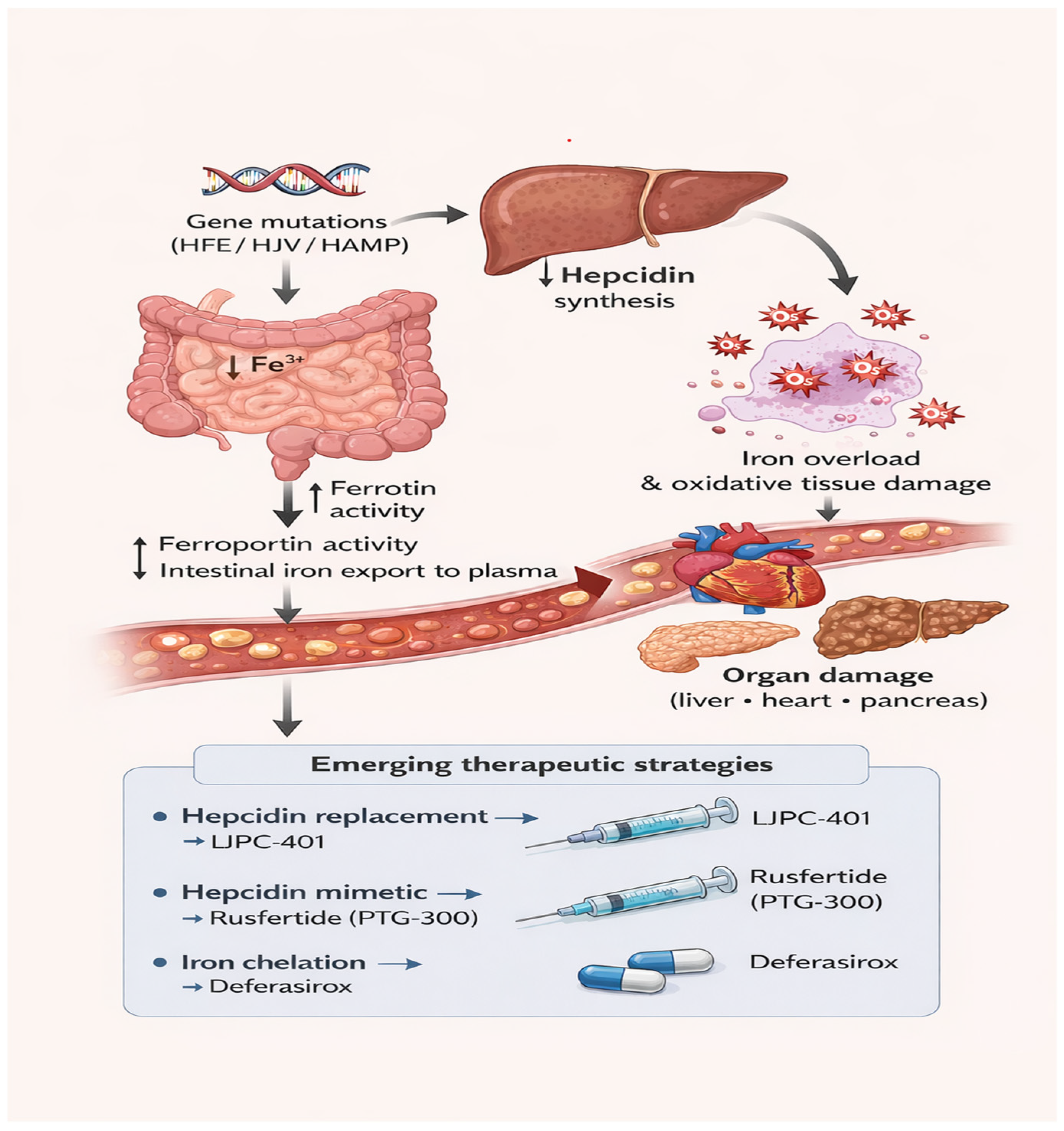
The pathophysiological mechanisms underlying hereditary hemochromatosis, along with emerging therapeutic strategies, are illustrated in Figure 1.
Figure 1.
Pathophysiology and emerging pharmacological strategies in hereditary hemochromatosis.
Illustration created by the authors with the assistance of an AI-based image generation (ChatGPT (OpenAI, version GPT-5.3)) tool to summarize the mechanisms of iron overload and emerging therapeutic approaches.
1.1. Metabolic Regulation of Iron in Hemochromatosis
Iron homeostasis is tightly regulated to prevent the toxic effects of iron excess while ensuring its bioavailability for essential physiological functions [5,6]. In hereditary hemochromatosis associated with the HFE C282Y mutation, dysfunction of this regulatory system represents the central pathogenic event.
Under physiological conditions, iron absorption occurs in the duodenum and proximal jejunum, where iron is absorbed and either stored as ferritin or exported via ferroportin to bind to transferrin and be distributed systemically [1,5]. Hepcidin, synthesized by hepatocytes, is the main regulator of systemic iron balance, promoting the degradation of ferroportin and limiting both intestinal iron absorption and iron release from macrophages [7,8,9].
In C282Y homozygotes, mutation of the HFE gene impairs its interaction with transferrin receptors 1 and 2, interfering with the activation of the BMP/SMAD pathway and resulting in inappropriately low hepcidin expression [10,11]. This deficiency allows persistent ferroportin activity, increased intestinal iron absorption, and progressive iron accumulation in parenchymal tissues [12,13,14,15].
Although erythroferrone physiologically suppresses hepcidin during erythropoiesis [12,16], in C282Y hemochromatosis, this suppression becomes pathologically sustained due to a regulatory failure. Iron excess promotes the formation of reactive oxygen species, oxidative stress, and organ damage, particularly in the liver, heart, and endocrine tissues [13,17].
Understanding this specific molecular defect has supported the development of therapies aimed at modulating hepcidin and has reinforced the translational relevance of iron regulatory pathways [18,19].
1.2. Genetics of HFE C282Y Hemochromatosis
Hereditary hemochromatosis associated with the HFE gene, particularly the C282Y mutation located on chromosome 6, represents the predominant genetic form of iron overload in adults. Homozygosity for C282Y accounts for approximately 80–85% of clinically significant cases in populations of European ancestry [3,20].
The disease follows an autosomal recessive inheritance pattern. However, clinical penetrance is incomplete, and phenotypic expression is influenced by sex, environmental factors, and metabolic cofactors. Men and postmenopausal women show greater clinical expression due to reduced physiological iron loss [21,22].
The association of hemochromatosis with the HLA system was initially described by Marcel Simon [23], establishing its hereditary basis. Although mutations in HJV, HAMP, TFR2, and SLC40A1 explain the non-HFE forms [11,12], these variants are less frequent and present distinct clinical patterns. In contrast, C282Y hemochromatosis shows slow progression with onset typically occurring in adulthood.
Advances in next-generation genomic sequencing have expanded the detection of gene mutations in HFE and enabled the early identification of individuals at risk [24].
1.3. Iron Overload in C282Y Hemochromatosis
In C282Y homozygotes, iron overload results primarily from chronic hepcidin deficiency and increased intestinal iron absorption, differing from the mechanisms observed in secondary forms of iron overload [25,26,27].
The main laboratory findings include elevated transferrin saturation—commonly the earliest abnormality—and progressive increases in serum ferritin levels. Early identification is essential to prevent irreversible organ damage [5].
Although secondary iron overload occurs in conditions such as transfusion-dependent anemias and chronic liver disease, C282Y hemochromatosis represents the classical model of primary genetic iron overload. Therapeutic phlebotomy remains the first-line treatment, while iron chelation therapy is reserved for specific situations [2,20].
1.4. Consequences of Iron Overload in C282Y Homozygotes
In C282Y hemochromatosis, iron accumulates predominantly in hepatocytes, promoting oxidative stress through the generation of reactive oxygen species [2,5,19]. Lipid peroxidation, DNA damage, and mitochondrial dysfunction contribute to progressive fibrosis and an increased risk of cirrhosis and hepatocellular carcinoma [28,29].
At the cellular level, iron accumulation destabilizes lysosomal and cytosolic compartments, activating autophagic and apoptotic pathways depending on the oxidative burden [28,29]. Clinically, advanced iron overload is associated with hepatic fibrosis, cardiomyopathy, diabetes mellitus, and endocrine dysfunction [13].
Because organ damage correlates with cumulative iron burden, early diagnosis and therapeutic intervention are essential in C282Y homozygotes [5].
1.5. Diagnosis of Hereditary Hemochromatosis
Early diagnosis of hereditary hemochromatosis is essential to prevent complications resulting from iron overload, particularly in target organs. Initial evaluation is based on accessible laboratory tests. Serum ferritin is widely used as an initial marker, although it has limited specificity; levels > 1000 μg/L are strongly associated with significant hepatic fibrosis [30,31].
Transferrin saturation, calculated from serum iron and total iron-binding capacity (TIBC), represents the most sensitive biochemical marker for screening. Values ≥ 45% are suggestive of iron overload, even in asymptomatic individuals [28,32].
Increased circulating iron availability favors greater erythropoietic incorporation, often reflected by elevated mean corpuscular volume (MCV) and other hematimetric alterations, including in non-classical forms, highlighting the systemic impact of iron overload on bone marrow physiology [33].
Diagnostic confirmation requires molecular genetic analysis to identify variants in the HFE gene (C282Y, H63D). Mutations in HJV, HAMP, TFR2, and SLC40A1 should be investigated in atypical cases [34].
Genetic testing also plays a central role in the screening of asymptomatic relatives and in risk stratification, contributing to clinical management, prevention of complications, and reproductive counseling [35,36]. In this context, genetic counseling is an indispensable tool, providing clarification regarding inheritance patterns, indications and interpretation of tests, and psychosocial support for families at risk [37].
Hepatic magnetic resonance imaging is a non-invasive and accurate method for quantifying iron overload and assessing fibrosis, proving useful both in diagnosis and therapeutic monitoring [38]. Liver biopsy remains reserved for specific situations due to its invasive nature.
The integration of laboratory, genetic, imaging, and clinical data—including detailed medical and family history—is fundamental for diagnostic planning and the implementation of a specific therapeutic approach [39].
1.6. Therapeutic Approaches in Hemochromatosis
Hereditary hemochromatosis (HH) requires effective control of iron overload to prevent organ complications. Phlebotomy remains the first-line therapy and is performed during the induction phase (until ferritin < 50 μg/L and transferrin saturation < 30%) and the maintenance phase (ferritin < 100 μg/L), with proven efficacy in preventing hepatic and systemic damage [40,41].
Erythrocytapheresis represents a more efficient alternative for iron removal; however, it is associated with higher costs. In cases where phlebotomy is contraindicated, iron chelators such as deferoxamine, deferiprone, and deferasirox are used, the latter being approved by international regulatory agencies, although it is associated with adverse effects [40,41,42].
Adjuvant measures include proton pump inhibitors to reduce iron absorption and dietary recommendations involving restriction of alcohol consumption and avoidance of iron or vitamin C supplementation [43].
Non-classical genetic forms, such as juvenile hemochromatosis and ferroportin disease, require individualized management and may demand more intensive therapy or complementary [44].
2. Methods
A systematic search was conducted in the ClinicalTrials.gov database to identify interventional clinical trials investigating emerging therapeutic strategies for hereditary hemochromatosis.
2.1. Inclusion Criteria
Interventional clinical trials registered in the ClinicalTrials.gov database that investigated emerging therapeutic strategies for the treatment of hereditary hemochromatosis were included.
Studies registered up to 30 May 2024 were considered, regardless of the clinical trial phase. No restrictions were applied regarding publication language or recruitment status.
2.2. Exclusion Criteria
Observational studies, narrative reviews, editorials, letters to the editor, and case reports were excluded. Studies that did not address hereditary hemochromatosis, did not investigate emerging therapeutic interventions related to iron metabolism, or were not registered in the ClinicalTrials.gov database were also excluded, as well as duplicate or repeated records.
The research question was formulated according to the PICO framework, which can be observed in Table 1 below.
Table 1.
PICO framework used to evaluate studies on emerging pharmacological therapies in adults with hereditary hemochromatosis, detailing the population of interest, the investigated intervention, the comparison with standard treatments, and the key outcomes of interest.
Study selection followed the stages of title screening, abstract review, and full-text assessment in accordance with PRISMA guidelines. For each eligible study, data were extracted regarding methodological design, investigated drug, eligibility criteria, primary and secondary outcomes, adverse events, and the main clinical and laboratory results.
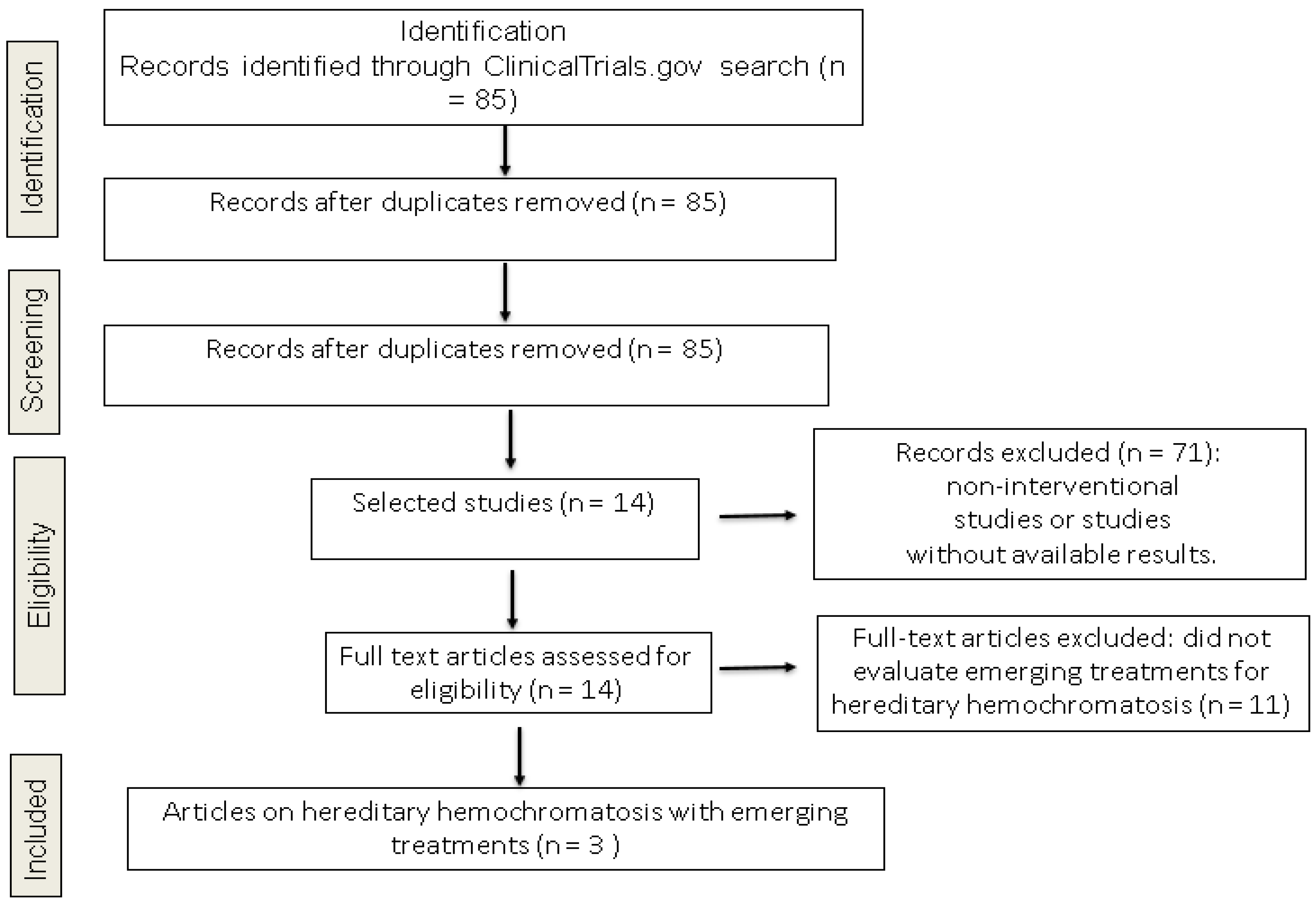
The study selection process is detailed in the flowchart presented in Figure 2.
Figure 2.
PRISMA flowchart of the selection process for studies on emerging treatments for hereditary hemochromatosis.
The study was conducted in accordance with PRISMA 2020 guidelines (see Supplementary Materials: PRISMA Checklist).
2.3. PROSPERO Registration
The protocol for this systematic review was registered in the International Prospective Register of Systematic Reviews (PROSPERO) under registration number CRD4201333214. The registered title is “Hereditary Hemochromatosis: Pathophysiological Basis and Emerging Therapeutic Approaches—A Systematic Review of Clinical Evidence.” The record was created on 5 March 2026 and last updated on 5 March 2026.
2.4. Guideline Statement
For the development of this study, a systematic review was conducted following the methodological principles recommended by the JBI Manual for Evidence Synthesis. The research question and eligibility criteria were structured according to the PICO framework (Population, Intervention, Comparison, Outcomes). The review was reported in accordance with the PRISMA 2020 (Preferred Reporting Items for Systematic Reviews and Meta-Analyses) guidelines.
3. Results
Open-label Study with PTG-300 in Individuals with Hereditary Hemochromatosis (Protagonist Therapeutics, Inc., Newark, CA, USA).
A phase 2, multicenter, open-label, single-arm clinical trial conducted between March 2020 and February 2022 in the United States and Canada evaluated the safety and efficacy of the mimetic peptide PTG-300 (Rusfertide) in individuals with hereditary hemochromatosis due to the HFE mutation [19,45,46].
PTG-300 is a hepcidin analog that inhibits ferroportin—the only known cellular pathway for iron export—thereby blocking intestinal iron absorption and the release of iron from hepatic stores and macrophages. This hepcidin-mimetic action provides therapeutic potential in iron overload disorders such as hereditary hemochromatosis [45].
Sixteen patients (10 men and 6 women) were included, with a mean age of 62.5 years. A sub-study involving approximately six participants was also conducted [45].
The primary endpoint was the change in transferrin saturation and serum iron levels up to week 24. Secondary endpoints included the frequency of phlebotomy and quality-of-life indicators assessed by the Short Form Health Survey (SF-36) and the Patient Global Impression of Change (PGI-C) [46,47].
Table 1 presents further details and the results of the study.
Open-Label Phase I/II Dose-Escalation Study with Six-Month Extension Evaluating Deferasirox (ICL670) in Patients with Iron Overload Due to Hereditary Hemochromatosis—Novartis Pharmaceuticals, Basel, Switzerland.
Between August 2006 and March 2009, a phase I/II clinical trial was conducted in patients with hereditary hemochromatosis who were homozygous for the Cys282Tyr (C282Y) mutation in the HFE gene, presenting serum ferritin levels between 300 and 2000 ng/mL, transferrin saturation ≥ 45%, and no history of cirrhosis. Conducted in the United States, Australia, Canada, France, Germany, and Italy, the study evaluated the safety and efficacy of deferasirox] [48].
Table 2 presents the detailed characteristics and results of this study.
Table 2.
Comparative Analytical Overview of Emerging Pharmacological Therapies in Hereditary Hemochromatosis.
Phase II, Multicenter, Randomized, Placebo-Controlled, Single-Blind Study with LJPC-401 for the Treatment of Iron Overload in Adult Patients with Hereditary Hemochromatosis—La Jolla Pharmaceutical Company, Waltham, MA, USA.
The primary objective of the study was to compare the effect of weekly administration of LJPC-401 [49], a synthetic human hepcidin, versus placebo on transferrin saturation (TSAT) in adults with hereditary hemochromatosis.
The study was initiated in November 2017 and completed in October 2019, enrolling 70 participants. It was conducted in the United States, Australia, France, and the United Kingdom [49].
The results are presented in Table 2 below.
4. Discussion
The comparative evaluation of currently available interventional clinical trials reveals that pharmacological innovation in hereditary hemochromatosis remains at an early stage of development. All identified studies were limited to phase 1/2 or phase 2 designs, with small sample sizes (n = 16–70) and relatively short follow-up periods (16–48 weeks) [45,46,48,49]. The absence of confirmatory phase 3 trials reinforces the preliminary nature of these therapeutic strategies and limits extrapolation to long-term clinical outcomes.
Importantly, none of the investigated agents demonstrated superiority over therapeutic phlebotomy, which remains the standard treatment due to its proven efficacy in reducing iron overload, preventing complications, and improving morbidity and survival.
Furthermore, the evaluated interventions focused predominantly on biochemical endpoints such as transferrin saturation (TSAT) and serum ferritin rather than robust and clinically meaningful outcomes, including regression of hepatic fibrosis, reduction in the risk of hepatocellular carcinoma, prevention of cardiomyopathy, or sustained reduction in phlebotomy requirements.
From a pharmacodynamic perspective, substantial heterogeneity was observed in the magnitude of the therapeutic effect. LJPC-401 (synthetic hepcidin) produced the most pronounced reduction in transferrin saturation (up to −79.7%), suggesting substantial suppression of ferroportin-mediated iron export and a more effective correction of the hepcidin–ferroportin axis [49]. By acting upstream in the pathophysiological cascade, this strategy more directly targets the central molecular defect in HFE-associated disease.
In contrast, PTG-300 (rusfertide), despite functioning as a hepcidin mimetic, demonstrated only a modest reduction in transferrin saturation (−6.1%) [45]. This difference may reflect dose limitations, pharmacokinetic properties, variability in receptor activation, or insufficient treatment duration. Moreover, PTG-300 did not significantly reduce the need for phlebotomy, limiting its immediate clinical relevance as monotherapy.
The trial evaluating deferasirox (ICL670) demonstrated progressive reductions in serum ferritin levels, consistent with its established iron-chelating mechanism [46,48]. However, as a downstream intervention, deferasirox does not restore hepcidin regulation nor correct ferroportin hyperactivity, functioning only to remove accumulated iron. Thus, its clinical role appears complementary rather than disease-modifying, particularly in patients with contraindications to phlebotomy, intolerance to the procedure, or poor venous access.
When interpreting these findings, the mechanistic hierarchy of the interventions should be considered. Therapies acting upstream to restore physiological regulatory pathways theoretically present greater disease-modifying potential. However, this theoretical advantage still requires validation through long-term clinical outcomes.
From a safety perspective, serious adverse events were limited in the publicly available data, with no emphasis on irreversible complications directly attributable to the investigational drugs. Nevertheless, small sample sizes and short study durations prevent an adequate evaluation of long-term safety.
Collectively, current evidence suggests that emerging pharmacological agents may represent alternative or adjunctive therapies in specific clinical scenarios but do not yet support replacing phlebotomy as the standard therapy. Progress in this field requires multicenter, randomized, placebo-controlled trials with larger samples and adequate statistical power to evaluate clinically meaningful outcomes such as fibrosis regression, sustained reduction of TSAT, reduction of organ complications, and improvement in quality of life.
Until such data become available, phlebotomy remains the cornerstone of treatment for hereditary hemochromatosis, and emerging approaches should be considered investigational strategies within a precision medicine framework.
5. Conclusions
Current evidence indicates that none of the investigated pharmacological therapies demonstrated a clinically significant impact on reducing the frequency of therapeutic phlebotomies. This finding reinforces that emerging agents do not yet represent substitute alternatives to the standard treatment for iron overload. Furthermore, the reduction in phlebotomy requirements was not established as a primary endpoint in the analyzed trials, indicating that these interventions were designed as adjunctive strategies rather than replacements for conventional therapy.
Although variable biochemical modulation was observed across the studies—particularly regarding transferrin saturation and serum ferritin—these improvements in surrogate markers did not translate into long-term clinical benefits. In the absence of robust data demonstrating regression of hepatic fibrosis, reduction in the risk of hepatocellular carcinoma, impact on cardiomyopathy, or sustained normalization of iron parameters without phlebotomy, the therapeutic paradigm remains based on periodic iron removal through established methods.
The effective advancement of these therapies will depend on the development of multicenter, randomized trials with adequate statistical power and clinically meaningful endpoints beyond biochemical correction. Further investigations into the pathophysiological mechanisms of iron metabolism may facilitate the identification of new therapeutic targets with greater efficacy, safety, and long-term applicability.
In summary, although pharmacological innovation in hereditary hemochromatosis represents an important translational milestone, therapeutic phlebotomy remains the cornerstone of treatment. Emerging strategies should currently be considered investigational or adjunctive approaches, pending robust clinical validation before any redefinition of the therapeutic paradigm.
Supplementary Materials
The following supporting information can be downloaded at: https://www.mdpi.com/article/10.3390/futurepharmacol6020022/s1, Prisma Checklist. Reference [50] is cited in Supplementary Materials.
Author Contributions
Conceptualization: V.C.J.d.S., J.P.D.T. and F.L.A.F.; Methodology: V.C.J.d.S., E.C.P. and A.A.H.; Formal Analysis: F.L.A.F., B.A., T.G., G.R.L.d.V. and S.S.d.C.; Investigation (clinical assessment, imaging evaluation, data collection): V.C.J.d.S., J.P.D.T. and E.C.P.; Resources: F.L.A.F., E.C.P., G.R.L.d.V., and B.A.; Data Curation: E.C.P., A.A.H., B.A., T.G., G.R.L.d.V., S.S.d.C. and F.L.A.F.; Writing—Original Draft Preparation: J.P.D.T., G.R.L.d.V. and V.C.J.d.S.; Writing—Review and Editing: J.P.D.T., V.C.J.d.S. and F.L.A.F.; Supervision: F.L.A.F., E.C.P., G.R.L.d.V. and B.A.; Project Administration: F.L.A.F. All authors have read and agreed to the published version of the manuscript.
Funding
This research received no external funding.
Institutional Review Board Statement
This study did not involve direct participation of human subjects or the use of identifiable personal data. The analysis was conducted exclusively using publicly available information and/or fully anonymized secondary data. Therefore, in accordance with applicable ethical guidelines and regulations, approval by an Institutional Review Board (IRB) or Ethics Committee was not required.
Informed Consent Statement
Not applicable.
Data Availability Statement
The original contributions of this study are included in the article and its references. For further information, please contact the corresponding author.
Acknowledgments
During the preparation of the manuscript, the authors used the artificial intelligence tool ChatGPT (OpenAI, version GPT-5.3) for scientific language editing, for illustration creation, and to improve the level of English. The generated content was reviewed and edited by the authors, who take full responsibility for the content of this scientific publication.
Conflicts of Interest
The authors declare no conflicts of interest.
References
- Ono, L.A.R. Revisão Sistemática Sobre a Prevalência de Hemocromatose Hereditária no BRASIL e o Debate Sobre sua Inclusão na Doação de Sangue; UNICAMP: Campinas, Brazil, 2022. [Google Scholar]
- Girelli, D.; Busti, F.; Brissot, P.; Cabantchik, I.; Muckenthaler, M.U.; Porto, G. Hemochromatosis classification: Update and recommendations by the BIOIRON Society. Blood 2022, 139, 3018–3029. [Google Scholar] [CrossRef] [Scilit] [PubMed]
- Singh, P.; Millson, C.; Driver, R. Hereditary haemochromatosis: A review. J. R. Coll. Physicians Edinb. 2024, 4, 340–347. [Google Scholar] [CrossRef] [Scilit] [PubMed]
- Fonseca, P.F.d.S. Avaliação da Qualidade de Vida e da Percepção de Saúde em Pacientes Com Hemocromatose Hereditária. Ph.D. Thesis, Universidade de São Paulo (USP), São Paulo, Brazil, 2017. [Google Scholar]
- Ru, Q.; Li, Y.; Chen, L.; Wu, Y.; Min, J.; Wang, F. Homeostase do ferro e ferroptose em doenças humanas: Mecanismos e perspectivas terapêuticas. Signal Transduct. Target. Ther. 2024, 9, 271. [Google Scholar] [CrossRef] [Scilit] [PubMed]
- Nemeth, E.; Ganz, T. Hepcidin and iron in health and disease. Annu. Rev. Med. 2023, 74, 261–277. [Google Scholar] [CrossRef] [Scilit]
- Daniłowicz-Szymanowicz, L.; Świątczak, M.; Sikorska, K.; Starzyński, R.R.; Raczak, A.; Lipiński, P. Pathogenesis, diagnosis, and clinical implications of hereditary hemochromatosis—The cardiological point of view. Diagnostics 2021, 11, 1279. [Google Scholar] [CrossRef] [Scilit]
- Mura, C.; Raguenes, O.; Ferec, C. HFE mutations analysis in 711 hemochromatosis probands: Evidence for S65C implication in mild form of hemochromatosis. Blood 1999, 93, 2502–2505. [Google Scholar] [CrossRef] [Scilit]
- Ganz, T. Hepcidin and iron regulation, 10 years later. Blood 2011, 117, 4425–4433. [Google Scholar] [CrossRef] [Scilit]
- Kowdley, K.V.; Brown, K.E.; Ahn, J.; Sundaram, V. ACG clinical guideline: Hereditary hemochromatosis. Am. J. Gastroenterol. 2019, 114, 1202–1218. [Google Scholar] [CrossRef] [Scilit]
- D’alessio, F.; Hentze, M.; Muckenthaler, M. The hemochromatosis proteins HFE, TfR2, and HJV form a membrane-associated protein complex for hepcidin regulation. J. Hepatol. 2012, 57, 1052–1060. [Google Scholar] [CrossRef] [Scilit]
- Mleczko-Sanecka, K.; Silvestri, L. Cell-type-specific insights into iron regulatory processes. Am. J. Hematol. 2021, 96, 110–127. [Google Scholar] [CrossRef] [Scilit]
- Bacon, B.R.; Adams, P.C.; Kowdley, K.V.; Powell, L.W.; Tavill, A.S.; American Association for the Study of Liver Diseases. Diagnosis and management of hemochromatosis: 2011 Practice Guideline by the American Association for the Study of Liver Diseases. Hepatology 2011, 54, 328–343. [Google Scholar] [CrossRef] [Scilit] [PubMed]
- Brissot, P.; Pietrangelo, A.; Adams, P.C.; de Graaff, B.; McLaren, C.E.; Loréal, O. Haemochromatosis. Nat. Rev. Dis. Primers 2018, 4, 18016. [Google Scholar] [CrossRef] [Scilit] [PubMed]
- Vujić, M. Molecular basis of HFE-hemochromatosis. Front. Pharmacol. 2014, 5, 42. [Google Scholar] [CrossRef] [Scilit] [PubMed]
- Ganz, T. Erythropoietic regulators of iron metabolism. Free Radic. Biol. Med. 2019, 133, 69–74. [Google Scholar] [CrossRef] [Scilit]
- Murphree, C.R.; Nguyen, N.N.; Raghunathan, V.; Olson, S.R.; DeLoughery, T.; Shatzel, J.J. Diagnosis and management of hereditary haemochromatosis. Vox Sang. 2020, 115, 255–262. [Google Scholar] [CrossRef] [Scilit] [PubMed]
- Wallace, D.F.; Subramaniam, V.N. The global prevalence of HFE and non-HFE hemochromatosis estimated from analysis of next-generation sequencing data. Genet. Med. 2016, 18, 618–626. [Google Scholar] [CrossRef] [Scilit]
- Kowdley, K.V.; Modi, N.B.; Peltekian, K.; Vierling, J.M.; Ferris, C.; Valone, F.H.; Gupta, S. Rusfertide for the treatment of iron overload in HFE-related haemochromatosis: An open-label, multicentre, proof-of-concept phase 2 trial. Lancet Gastroenterol. Hepatol. 2023, 8, 1118–1128. [Google Scholar] [CrossRef] [Scilit]
- Fitzsimons, E.J.; Cullis, J.O.; Thomas, D.W.; Tsochatzis, E.; Griffiths, W.J.H.; Haematology, T.B.S.F. Diagnosis and therapy of genetic haemochromatosis (review and 2017 update). Br. J. Haematol. 2018, 181, 293–303. [Google Scholar] [CrossRef] [Scilit]
- Ganz, T.; Nemeth, E. Iron homeostasis in host defence and inflammation. Nat. Rev. Immunol. 2015, 15, 500–510. [Google Scholar] [CrossRef] [Scilit] [PubMed] [PubMed Central]
- Pietrangelo, A. Hereditary Hemochromatosis—A New Look at an Old Disease. N. Engl. J. Med. 2004, 350, 2383–2397. [Google Scholar] [CrossRef] [Scilit]
- Simon, M.; Bourel, M.; Fauchet, R.; Genetet, B. Association of HLA-A3 and HLA-B14 antigens with idiopathic haemochromatosis. Gut 1976, 17, 332–334. [Google Scholar] [CrossRef] [Scilit] [PubMed] [PubMed Central]
- Faria, R.; Silva, B.; Silva, C.; Loureiro, P.; Queiroz, A.; Fraga, S.; Esteves, J.; Mendes, D.; Fleming, R.; Vieira, L.; et al. Next-generation sequencing of hereditary hemochromatosis-related genes: Novel likely pathogenic variants found in the Portuguese population. Blood Cells Mol. Dis. 2016, 61, 10–15. [Google Scholar] [CrossRef] [Scilit] [PubMed]
- Baas, F.S.; Rishi, G.; Swinkels, D.W.; Subramaniam, V.N. Genetic diagnosis in hereditary hemochromatosis: Discovering and understanding the biological relevance of variants. Clin. Chem. 2021, 67, 1324–1341. [Google Scholar] [CrossRef] [Scilit] [PubMed]
- Tyler, T.; Wiggins-McDaniel, A.; McBroom, S.; Parry, C.; Tyler, R.; White, R.A. Diagnosis and Current Treatment Strategies for Adult and Juvenile Hereditary Hemochromatosis. Biotechnol. J. Int. 2024, 28, 46–58. [Google Scholar] [CrossRef] [Scilit]
- Fowler, C. Hereditary hemochromatosis: Pathophysiology, diagnosis, and management. Crit. Care Nurs. Clin. N. Am. 2008, 20, 191–201. [Google Scholar] [CrossRef] [Scilit]
- Dixon, S.; Stockwell, B. The role of iron and reactive oxygen species in cell death. Nat. Chem. Biol. 2014, 10, 9–17. [Google Scholar] [CrossRef] [Scilit]
- Eaton, J.W.; Qian, M. Molecular bases of cellular iron toxicity. Free Radic. Biol. Med. 2002, 32, 833–840. [Google Scholar] [CrossRef] [Scilit] [PubMed]
- Adams, P.C.; Ryan, J.D. Diagnosis and Treatment of Hemochromatosis. Clin. Gastroenterol. Hepatol. 2025, 23, 1477–1485. [Google Scholar] [CrossRef] [Scilit]
- Adams, P.C.; Jeffrey, G.; Ryan, J. Haemochromatosis. Lancet 2023, 401, 1811–1821. [Google Scholar] [CrossRef] [Scilit]
- Teles, J.M.; Reis, A.; Calcagno, A.B.; Lima, A.A.; Muniz, L.R.; de Mendonça, M.F.M.; Ramos, B.V.; de Ávila, I. Cardiomiopatia na Hemocromatose Hereditária: Revisão de literatura. Braz. J. Health Rev. 2021, 4, 1918–1928. [Google Scholar] [CrossRef] [Scilit]
- Barton, J.C.; Bertoli, L.F.; Rothenberg, B.E. Peripheral blood erythrocyte parameters in hemochromatosis: Evidence for increased erythrocyte hemoglobin content. J. Lab. Clin. Med. 2000, 135, 96–104. [Google Scholar] [CrossRef] [Scilit] [PubMed]
- Barton, J.C.; Parker, C.J. HFE-Related Hemochromatosis. In GeneReviews®; Adam, M.P., Bick, S., Mirzaa, G.M., Pagon, R.A., Wallace, S.E., Amemiya, A., Eds.; University of Washington: Seattle, WA, USA, 1993–2026. [Google Scholar]
- Porto, G.; Brissot, P.; Swinkels, D.W.; Zoller, H.; Kamarainen, O.; Patton, S.; Alonso, I.; Morris, M.; Keeney, S. EMQN best practice guidelines for the molecular genetic diagnosis of hereditary hemochromatosis (HH). Eur. J. Hum. Genet. 2016, 24, 479–495. [Google Scholar] [CrossRef] [Scilit] [PubMed]
- Yassine, A.A.; MacDougall, K.; Sasso, R.; Shammaa, Y.; Alsheikh, M.; Abureesh, M.; Dahabra, L.; Alshami, M.; Mulrooney, S. The Evolution of Iron-Related Comorbidities and Hospitalization in Patients with Hemochromatosis: An Analysis of the Nationwide Inpatient Sample. Blood Sci. 2023, 5, 131–135. [Google Scholar] [CrossRef] [Scilit] [PubMed]
- Cancado, R.D.; Alvarenga, A.M.; Santos, P.C.J. HFE hemochromatosis: An overview about therapeutic recommendations. Hematol. Transfus. Cell Ther. 2022, 44, 95–99. [Google Scholar] [CrossRef] [Scilit]
- Wood, J.C. Impact of iron assessment by MRI. Hematol. Am. Soc. Hematol. Educ. Program. 2011, 2011, 443–450. [Google Scholar] [CrossRef] [Scilit]
- Sonagra, A.D.; Zubair, M. Laboratory Evaluation of Hereditary Hemochromatosis; StatPearls Publishing: Treasure Island, FL, USA, 2026. Available online: https://www.ncbi.nlm.nih.gov/books/NBK594250/ (accessed on 17 July 2023).
- Yin, J.L.; Cussen, C.; Harrington, C.; Foskett, P.; Raja, K.; Ala, A. Guideline Review: European Association for the Study of Liver (EASL) Clinical Practice Guidelines on Haemochromatosis. J. Clin. Exp. Hepatol. 2023, 13, 649–655. [Google Scholar] [CrossRef] [Scilit] [PubMed] [PubMed Central]
- Ministério Da Saúde Secretaria De Atenção À Saúde Secretaria De Ciência, Tecnologia E Insumos Estratégicos Portaria Conjunta No 7, de 23 de Fevereiro de 2018. [s.l.: S.n., s.d.]. Available online: https://www.gov.br/conitec/pt-br/midias/protocolos/pcdt_sobrecarga_ferro.pdf (accessed on 1 June 2024).
- Franchini, M. Hereditary iron overload: Update on pathophysiology, diagnosis, and treatment. Am. J. Hematol. 2006, 81, 202–209. [Google Scholar] [CrossRef] [Scilit]
- Vanclooster, A.; van Deursen, C.; Jaspers, R.; Cassiman, D.; Koek, G. Proton Pump Inhibitors Decrease Phlebotomy Need in HFE Hemochromatosis: Double-Blind Randomized Placebo-Controlled Trial. Gastroenterology 2017, 153, 678–680.e2. [Google Scholar] [CrossRef] [Scilit]
- Szczerbinska, A.; Kasztelan-Szczerbinska, B.; Rycyk-Bojarzynska, A.; Kocki, J.; Cichoz-Lach, H. Hemochromatosis—How Not to Overlook and Properly Manage “Iron People”—A Review. J. Clin. Med. 2024, 13, 3660. [Google Scholar] [CrossRef] [Scilit]
- Clinicaltrials.gov. Available online: https://clinicaltrials.gov/study/NCT04202965?cond=hereditary%20hemochromatosis&start=2017-01-01_2024-04-01&rank=1&tab=results (accessed on 23 May 2024).
- Cançado, R.; Melo, M.R.; Bastos, R.d.M.; Santos, P.C.J.L.; Guerra-Shinohara, E.M.; Chiattone, C.; Ballas, S.K. Deferasirox in patients with iron overload secondary to hereditary hemochromatosis: Results of a 1-yr Phase 2 study. Eur. J. Haematol. 2015, 95, 545–550. [Google Scholar] [CrossRef] [Scilit] [PubMed]
- Ware, J.E.; Sherbourne, C.D. The MOS 36-Item Short-Form Health Survey (SF-36). I. Conceptual Framework and Item Selection. Med. Care 1992, 30, 473–483. Available online: https://pubmed.ncbi.nlm.nih.gov/1593914/ (accessed on 23 May 2024). [CrossRef] [Scilit]
- Phatak, P.; Brissot, P.; Wurster, M.; Adams, P.C.; Bonkovsky, H.L.; Gross, J.; Malfertheiner, P.; McLaren, G.D.; Niederau, C.; Piperno, A.; et al. A phase 1/2, dose-escalation trial of deferasirox for the treatment of iron overload in HFE-related hereditary hemochromatosis. Hepatology 2010, 52, 1671–1779. [Google Scholar] [CrossRef] [Scilit]
- ClinicalTrials.gov. A Phase 2, Multicenter, Randomized, Placebo-Controlled, Single-Blind Study with LJPC-401 for the Treatment of Iron Overload in Adult Patients with Hereditary Hemochromatosis. ClinicalTrials.gov Identifier: NCT03395704. Available online: https://clinicaltrials.gov/study/NCT03395704?cond=hereditary%20hemochromatosis&rank=1 (accessed on 23 May 2024).
- Page, M.J.; McKenzie, J.E.; Bossuyt, P.M.; Boutron, I.; Hoffmann, T.C.; Mulrow, C.D.; Shamseer, L.; Tetzlaff, J.M.; Akl, E.A.; Brennan, S.E.; et al. The PRISMA 2020 statement: An updated guideline for reporting systematic reviews. BMJ 2021, 372, n71. [Google Scholar] [CrossRef] [Scilit]

Disclaimer/Publisher’s Note: The statements, opinions and data contained in all publications are solely those of the individual author(s) and contributor(s) and not of MDPI and/or the editor(s). MDPI and/or the editor(s) disclaim responsibility for any injury to people or property resulting from any ideas, methods, instructions or products referred to in the content. |
© 2026 by the authors. Licensee MDPI, Basel, Switzerland. This article is an open access article distributed under the terms and conditions of the Creative Commons Attribution (CC BY) license.