


Abstract
This study evaluated seasonal variations in mesozooplankton carbon biomass in Laguna de Terminos, a tropical coastal lagoon of the Southern Gulf of Mexico and a designated Ramsar site. We compared data from two contrasting 2022 sampling periods, the dry season (April) and the rainy season (October), coinciding with a strong La Niña event. Through systematic expeditions, we collected hydrographic and biological data to estimate zooplankton carbon biomass and assess its relationship with prevailing climatic conditions. Our results revealed distinct seasonal shifts. While surface water temperatures were higher in October (30 °C) than in April (28 °C), salinity and total dissolved solids exhibited the inverse trend. Chlorophyll-a peaked in April (>5 mg m−3) near river discharges and the lagoon’s connection to the Gulf of Mexico. Consistent with this, zooplankton carbon biomass was higher in April (up to 77.2 mg C m−3) than in October (up to 48.4 mg C m−3), with maximum concentrations observed in the eastern section of the lagoon. Given the scarcity of published reports for this system, these findings establish a critical baseline for future environmental monitoring. Furthermore, this data is essential for evaluating the lagoon’s primary and secondary productivity potential and for estimating the carbon pool held within lower-trophic-level organisms that support higher-level consumer groups.
1. Introduction
Zooplankton are a highly diverse group of aquatic organisms found worldwide that play a critical role in global ecosystems. First, as primary consumers occupying the base of pelagic food chains, they serve as a food source for numerous other species [1]. Second, these organisms sequester significant amounts of carbon, which is subsequently transferred to higher trophic levels or exported to the deep ocean [2]. In fact, research suggests that zooplankton can store more than 6 million metric tons of carbon annually, an amount comparable to the carbon dioxide emissions of major metropolitan areas [3].
Given these ecological functions, quantifying zooplankton biomass is a vital indicator of secondary production [4]. Furthermore, assessing this biomass is essential in the context of global climate change, as it enables precise determination of carbon distribution across various food-web compartments [5]. To date, it is well-established that zooplankton biomass levels respond dynamically to environmental fluctuations, most notably to variations in temperature, salinity, dissolved oxygen, total dissolved solids concentration, and chlorophyll-a (Chl-a) levels [6,7].
Coastal environments exhibit distinct seasonal fluctuations in zooplankton biomass, fundamentally driven by environmental variability. For instance, along the coast of Malaysia, biomass peaks in spring and summer, when rising temperatures facilitate phytoplankton proliferation, particularly among diatoms [8]. Similarly, in the Kariega Estuary, South Africa, seasonal biomass is characterized by a winter minimum and a summer maximum, a pattern regulated by water-column hydrography (primarily temperature) and corresponding fluctuations in Chl-a levels [9]. In the Japan Sea, zooplankton biomass displays pronounced seasonal and interannual variability with spring and autumn peaks, both linked to the intrusion of distinct water masses [10]. Likewise, in the Bay of Biscay, strong seasonality is observed, with spring biomass peaks driven by thermal fluctuations [11].
Collectively, these studies underscore the critical importance of monitoring seasonal dynamics in zooplankton biomass. However, such research remains unsystematized within Mexican coastal environments. Consequently, there is a significant data gap regarding the carbon content of zooplankton biomass in these regions, obscuring our understanding of the energy availability transferred to higher trophic levels within these ecosystems.
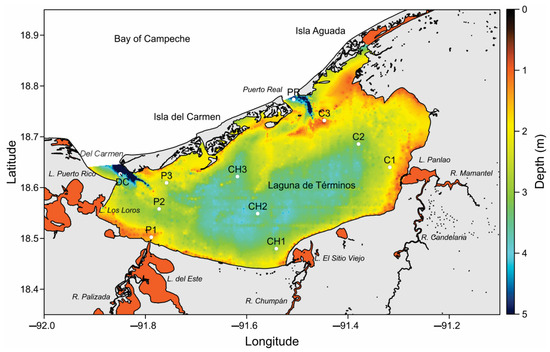
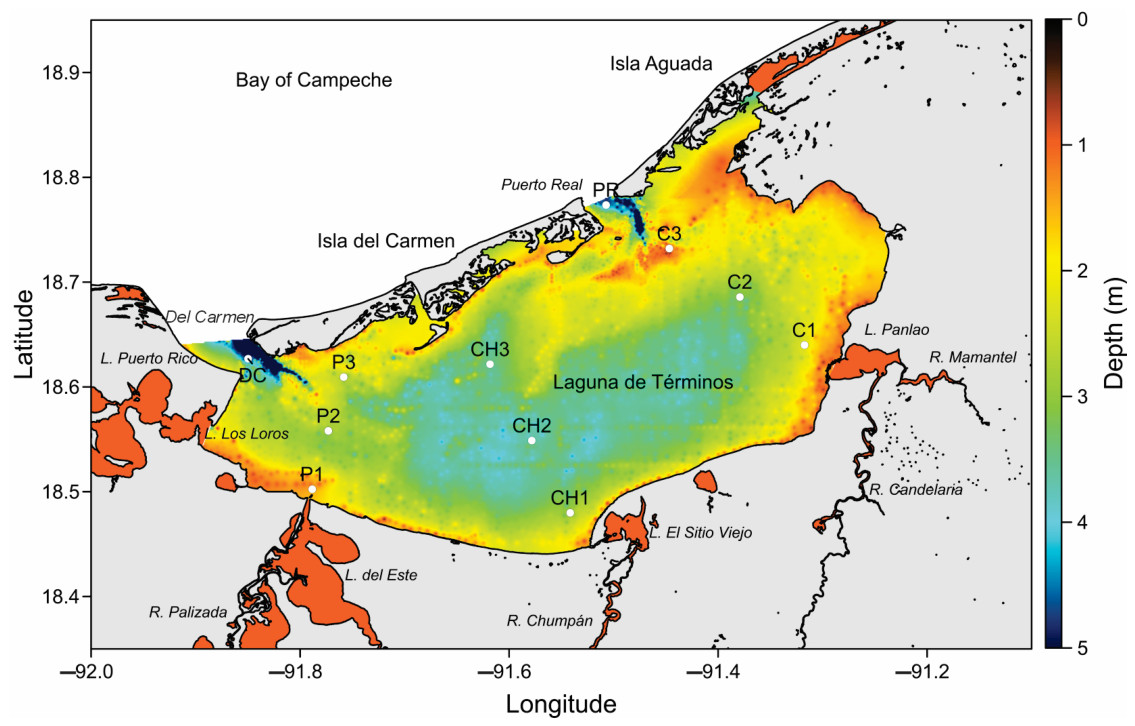
Among these coastal environments, Laguna de Terminos (LT) in the southern Gulf of Mexico is particularly significant; as the second-largest coastal lagoon in Mexico, it covers an area exceeding 7000 km2 (Figure 1). LT is a complex system defined by marked seasonal climatic variability consisting of three distinct periods: the rainy season (June to October), characterized by precipitation levels exceeding 2000 mm; the dry season (February to May), with precipitation below 500 mm; and the “Nortes” season (November to January). This final period is characterized by intense northerly winds exceeding 100 km/h, which induce strong water-column mixing and significantly lower surface temperatures to below 26 °C [12].
Figure 1.
Location of Laguna de Terminos in the Southern Gulf of Mexico. White dots indicate the stations where hydrographic data and zooplankton samples were collected. The bathymetry is represented in meters.
Historical research on zooplankton communities in LT has revealed significant taxonomic diversity. Early investigations characterized the prevalence of copepods, tintinnids, and gastropods [12], while subsequent studies focused on the ecology, distribution, and taxonomy of ostracods, particularly in benthic habitats near river mouths [13]. Furthermore, analyses of isotopic data in LT zooplankton have identified spatial gradients between the western and eastern sectors, reflecting migration patterns of species entering from the Gulf of Mexico [14]. Data on zooplankton biomass in the LT remain limited, which hinders robust large-scale comparisons. However, existing reports on the carbon-13 isotopic composition of specific decapod and amphipod species reveal significant spatial variability, identifying two distinct trophic areas: one in the northeast and one in the southwest [14]. This divergence suggests that these species exploit different resources across the lagoon, reflecting the system’s heterogeneous environmental conditions.
In recent years, studies have emphasized the influence of hydrography on specific groups, such as shrimp larvae, demonstrating that variations in temperature, salinity, and currents (driven by Gulf water intrusion) significantly affect their abundance and distribution [15,16].
Despite these studies’ insights into specific taxonomic groups, research exploring the response of total zooplankton biomass to seasonal environmental variability remains limited. To address this knowledge gap, this study quantifies mesozooplankton biomass (expressed as carbon concentration) in the LT and examines its relationship with key hydrographic variables. We hypothesize that the seasonal climatic transition between the dry and rainy seasons drives notable fluctuations in zooplankton biomass. Furthermore, given the substantial influence of freshwater discharge from the lagoon’s three major rivers, we anticipate that variations in salinity, total dissolved solids, and temperature will serve as primary environmental drivers of zooplankton carbon content.
This study contributes to local marine ecology by integrating functional biomass assessment with the primary environmental drivers within LT. While previous regional research has centered on the taxonomy and spatial distribution of specific zooplankton groups, the seasonal dynamics of total mesozooplankton biomass (specifically its carbon content) have remained largely undocumented. By quantifying these parameters relative to the lagoon’s complex hydrographic regime, this research provides critical insights into the energy available for transfer across trophic levels within one of Mexico’s most significant coastal ecosystems. Furthermore, this study advances our understanding of how climatic seasonality regulates carbon sequestration at the base of the pelagic food web. Ultimately, these findings provide a baseline dataset essential for modeling ecosystem responses to ongoing environmental shifts, thereby supporting more informed management and conservation strategies for the Southern Gulf of Mexico.
2. Materials and Methods
2.1. Study Area
LT is a complex and highly productive coastal ecosystem located in the Southern Gulf of Mexico. It is renowned for its habitats, particularly its extensive seagrass beds and mangrove forests, which serve as essential nurseries and nesting grounds sustaining regional biodiversity [17,18].
Hydrodynamically, the lagoon is defined by the interaction between marine and freshwater inputs. Seawater from the Gulf of Mexico enters the eastern region through the Puerto Real inlet, circulating within the lagoon where it mixes with substantial freshwater discharge from three primary river systems: the Palizada, Chumpan, and Candelaria. As this water mass traverses the lagoon, it acquires unique thermohaline characteristics before exiting into the Gulf of Mexico through the western inlet, El Carmen [19].
The LT’s climatic regime is governed by three distinct seasonal periods: the dry season (February to May), the rainy season (June to October), and the “Nortes” storm season (November to January) [12,16]. This environmental variability fundamentally shapes the lagoon’s biological productivity. The LT supports high biodiversity, providing critical feeding grounds for numerous species of both economic and ecological significance. Central to this productivity are the organisms at the base of the food web, most notably the zooplankton communities, which serve as the primary link between primary producers and higher trophic levels [15].
2.2. Sampling
Two sampling expeditions were conducted, one in April and the other in October 2022. During each expedition, hydrographic data were collected at the surface layer using a YSI EXO 1 multiparameter sonde (YSI Inc., Yellow Springs, OH, USA), and zooplankton samples were collected from 11 sampling sites throughout the lagoon (Figure 1). Hydrographic data acquisition was restricted to the surface layer for two primary reasons. First, as this study focuses on zooplankton samples collected specifically from the surface, we aimed to align the hydrographic data with that vertical range. Second, the lagoon’s complex bathymetry—characterized by a deep central basin (see Figure 1) and extensive, highly dynamic shallow zones near the shoreline—posed a significant risk to the monitoring equipment. Consequently, surface-level sampling was maintained to ensure both data consistency and operational safety.
Zooplankton were collected using a 200 μm conical net equipped with a flowmeter (General Oceanics 2030R, Miami, FL, USA). Horizontal surface tows were conducted for 10 min at a speed of 2 knots. Immediately following collection, samples were fixed on board using a formaldehyde solution buffered with sodium borate. After 24 h, the samples were transferred to a 70% ethanol solution for final preservation and transported to the laboratory.
2.3. Laboratory and Data Analyses
Upon arrival at the laboratory, samples were processed immediately. Zooplankton biomass was calculated using the following expression: ,
ZB is the zooplankton biomass expressed in g 100 m−3 of filtered water; NW is the net weight of the sample (after removing all excess ethanol) expressed in g. FW is the volume of filtered water during the haul (obtained from the flowmeter placed in the net) expressed in m3 [20]. To ensure accuracy, non-zooplankton material—specifically, large organisms such as fish and jellyfish, as well as anthropogenic litter—was removed before weighing. This methodology is well established in similar studies, such as those conducted in the Gulf of California [21,22] and the Southern Gulf of Mexico [23], thereby ensuring the reliability of the results.
Following the determination of biomass wet weight, results were converted to carbon units using the following equation: ; with WW (g m−3) and C (mg m−3) [24]. Consequently, final zooplankton biomass values are reported in mg C m−3.
Hydrographic data were used to generate horizontal distribution maps for all measured variables. These were then compared across sampling periods and correlated with the zooplankton biomass values obtained. The mapping process involved two primary steps. First, we applied the Data-Interpolating Variational Analysis (DIVA) method, a technique widely used in oceanography to interpolate spatial distributions from in situ measurements. Second, we generated the final visualizations from the resulting interpolation grids using Golden Software Surfer v28.1.248.
To determine the statistical significance of our dataset, we employed Student’s t-test. Because we are comparing two groups with identical stations and variables—both hydrographic and biological (specifically, Chl-a and zooplankton carbon biomass)—the t-test is appropriate for identifying significant differences between the means of these two independent sets of measurements (April versus October).
Finally, to examine the relationships between hydrographic variables and zooplankton biomass, we performed a Principal Component Analysis (PCA), a robust statistical approach for analyzing environmental datasets and identifying underlying patterns [25]. Before performing the PCA, all hydrographic and biological variables—Temperature, Salinity, Dissolved Oxygen, Chl-a, Total Dissolved Solids, and Zooplankton Biomass—were standardized using a Z-score scaling procedure, ensuring that variables with larger numerical ranges or units do not disproportionately skew the ordination results. The multidimensional feature space comprising these six variables was then transformed into orthogonal principal components ( through ), allowing the complex variance of the lagoon ecosystem to be effectively captured and visualized across primary axes (such as and ). PCA analysis was run in R-4.0.3 with the “factoextra” package [26,27].
3. Results
Both the hydrographic variables and zooplankton biomass recorded during this study exhibited notable variability (Table S1 in the Supplementary Materials).
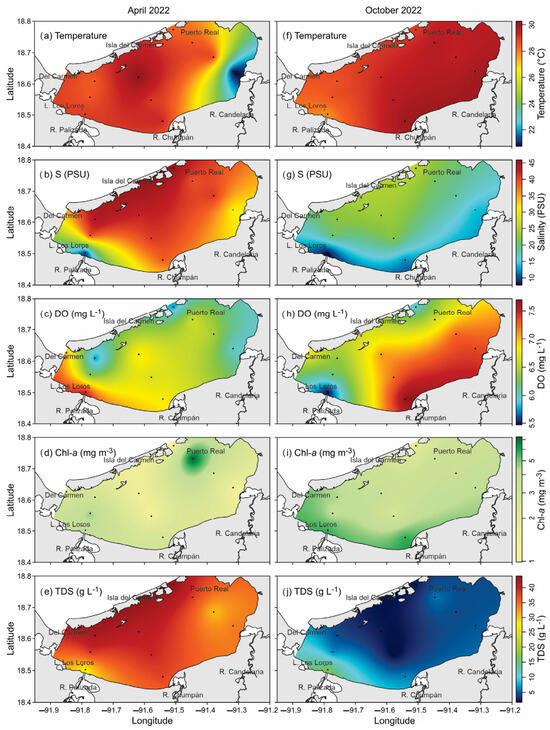
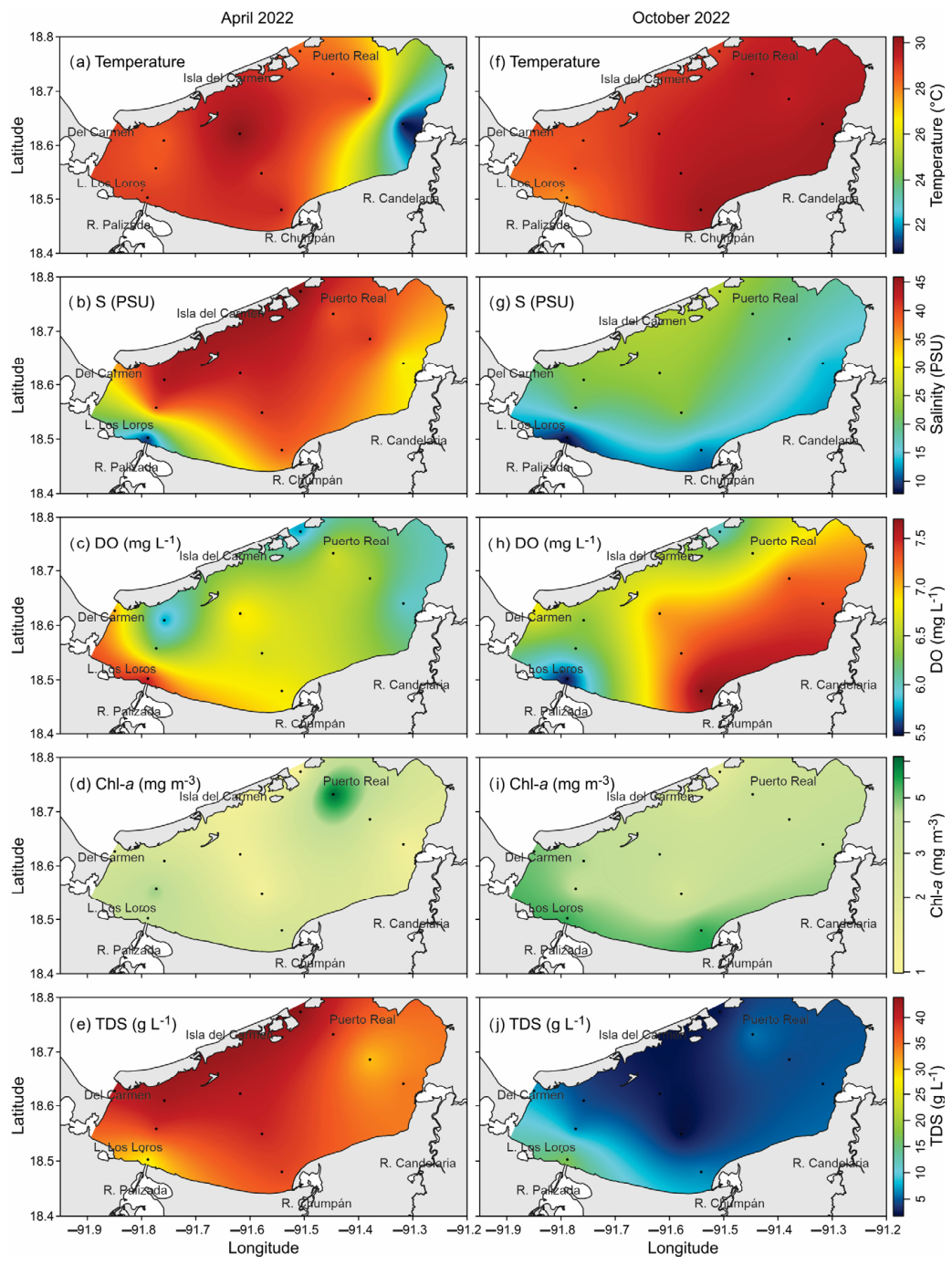
The horizontal distribution of hydrographic parameters differed markedly between the two sampling periods. In April, the temperature ranged from 21 to 28 °C (Figure 2a), while in October it increased to 27 to 30 °C (Figure 2f). In April, lower temperatures were recorded in the eastern part, near the mouth of the Candelaria River (Figure 2a). Salinity also showed significant variation. In April, salinity levels ranged from 10 to 43 PSU (Figure 2b), but in October, they decreased considerably, falling between 10 and 30 PSU (Figure 2g). In both months, lower salinity was observed at the surface waters in the southwestern region, specifically at the mouth of the Palizada River. The distribution of dissolved oxygen was notable in both months. The maximum values (>7 mg L−1) were found in the southern section of the lagoon (Figure 2c,h). In April, the highest dissolved oxygen was measured at the mouth of the Palizada River (7 mg L−1) (Figure 2c), whereas in October, that area showed the lowest levels, measuring 5.5 mg L−1 (Figure 2h).
Figure 2.
Horizontal distribution of hydrographic parameters in Laguna de Terminos. In April 2022: (a) Temperature (°C), (b) Salinity (S, PSU), (c) Dissolved Oxygen (DO, mg L−1), (d) Chlorophyll-a (Chl-a, mg m−3), and (e) Total Dissolved Solids (TDS, g L−1). In October 2022: (f) Temperature (°C), (g) Salinity (S, PSU), (h) Dissolved Oxygen (DO, mg L−1), (i) Chlorophyll-a (Chl-a, mg m−3), and (j) Total Dissolved Solids (TDS, g L−1).
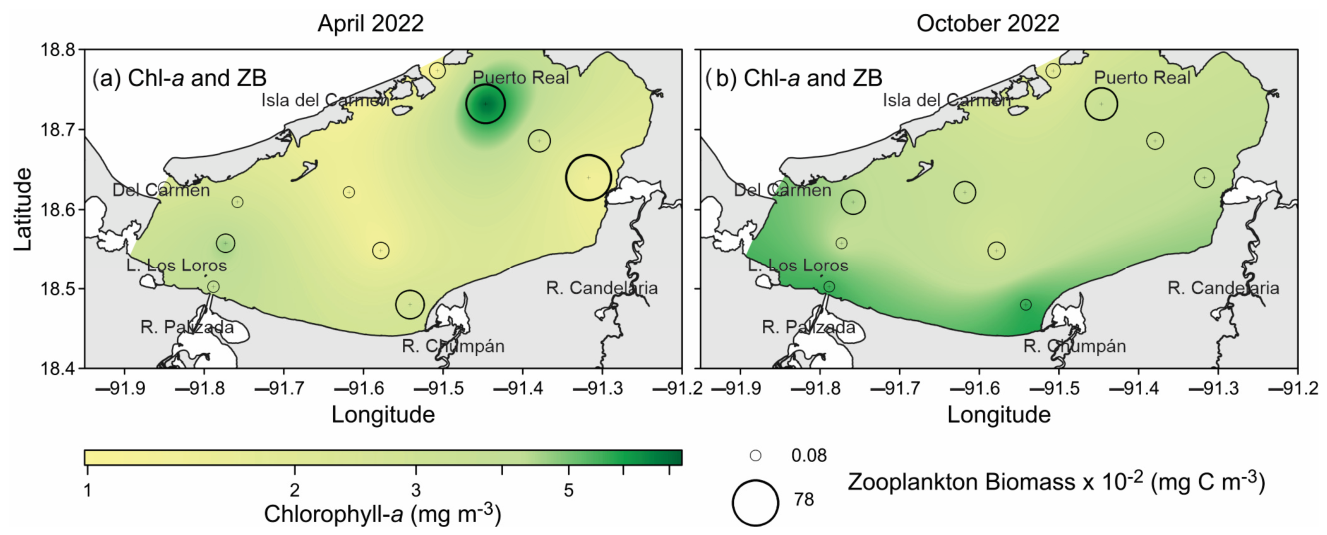
The concentration of Chl-a also differed between the two months. In April, the highest levels (>5 mg m−3) were recorded in the core area near the mouth of Puerto Real. In October, however, the highest values were observed in the southern section, particularly near the mouths of rivers flowing into the lagoon. Lastly, total dissolved solids showed contrasting values between the two samplings. In April, maximum values reached 40 g L−1, distributed almost uniformly across the lagoon (Figure 2e). However, in October, values dropped below 15 g L−1, showing a similar distribution throughout the lagoon (Figure 2j).
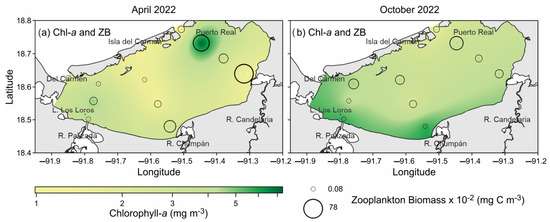
Zooplankton carbon biomass values in April ranged from 0.8 to 77.2 mg C m−3, while in October, the values were generally lower, ranging from 0.07 to 48.4 mg C m−3. Analyzing the horizontal distribution, it was noted that in April, high biomass values coincided with a region of elevated Chl-a concentrations (Figure 3a). The maximum biomass value was found in the eastern part of the lagoon, particularly at the mouth of the Candelaria River. In October, however, a contrasting pattern emerged: the lowest zooplankton carbon biomass values were observed near the river mouths, whereas the highest were located closer to Isla del Carmen (Figure 3b).
Figure 3.
Horizontal distribution of zooplankton carbon biomass (mg C m−3) in Laguna de Terminos. (a) Values calculated for April 2022; (b) values calculated for October 2022. The zooplankton carbon biomass values are overlaid on chlorophyll-a maps.
The results of our statistical analyses are summarized in Table 1. In this context, a higher absolute t-statistic value, paired with a low p-value, indicates a more pronounced difference between the two sampling months. For Salinity and Total Dissolved Solids, the t-statistics of 5.28 and 16.15, respectively, were notably high, with p-values well below the 0.05 threshold. This indicates that seasonal variability significantly impacts these parameters within the study area. Conversely, for Temperature and Dissolved Oxygen, the t-statistics were relatively small, and their p-values exceeded 0.05. Consequently, there was insufficient statistical evidence to conclude that the means of these parameters differ significantly between April and October.
Table 1.
Seasonal Comparison of Hydrographic and Biological Parameters (April vs. October).
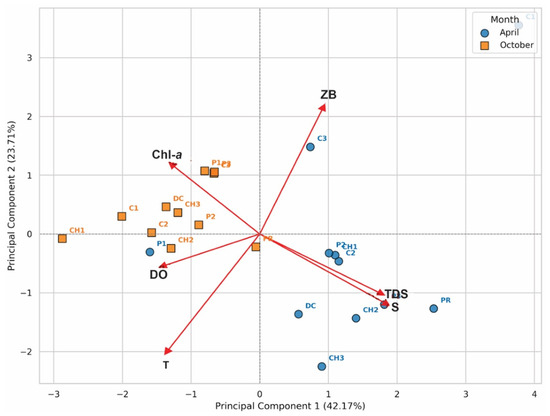
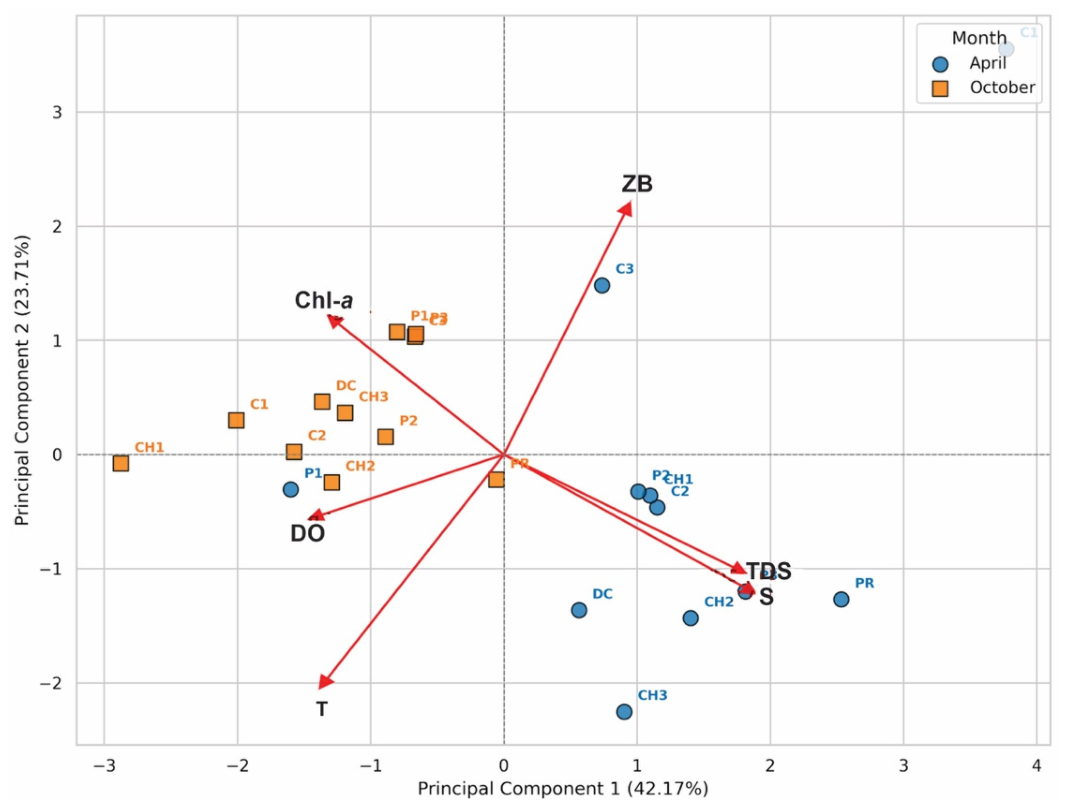
The PCA applied to our dataset showed that the first two principal components accounted for 65.88% of the total variance, with PC1 and PC2 explaining 42.17% and 23.71%, respectively. The first four components (PC1 through PC4) explain over 92% of the variance (Table 2), suggesting that the complexity of the six environmental variables considered in this study can be effectively reduced to these four main components.
Table 2.
Summary of Explained Variance by Principal Components for Environmental Data Collected in April and October 2022.
The PCA biplot (Figure 4) reveals a distinct seasonal differentiation, with April and October samples occupying the positive and negative domains of PC1, respectively, confirming two contrasting environmental regimes. Analysis of the variable vectors identifies the primary drivers of this separation. Salinity and Total Dissolved Solids exhibit a strong positive correlation and are the defining characteristics of the April dataset. Conversely, Chlorophyll-a (Chl-a) is closely associated with the October regime; its vector orientation, nearly opposite to salinity’s, suggests a robust inverse relationship. Collectively, these patterns illustrate the interplay between physicochemical gradients and biological responses, particularly the modulation of biomass due to salinity.
Figure 4.
Principal Component Analysis (PCA) of hydrographic and biological parameters from April and October 2022. The biplot illustrates the distribution of sampling stations and the contribution of environmental variables, with the first two components (PC1 and PC2) explaining 65.88% of the total variance. Vectors represent environmental variables: salinity (S), total dissolved solids (TDS), chlorophyll-a (Chl-a), zooplankton biomass (ZB), temperature (T), and dissolved oxygen (DO). April and October sampling stations are indicated by blue circles and orange squares, respectively.
4. Discussion
Seasonal and interannual changes significantly influence species abundance in both oceanic and coastal environments. In shallow coastal systems, fluctuations in light and temperature are widely regarded as the primary drivers of this variability [28].
In this study, the recorded hydrographic parameters exhibited a clear seasonal trend, characterized by significant variability between the two months. Temperatures were consistently higher in October than in April, with a difference exceeding 2 °C; this shift is attributable to increased solar irradiance in the Northern Hemisphere, which drives elevated surface temperatures following the summer months.
Salinity also showed notable differences between sampling periods, with values decreasing by more than 10 PSU in October compared to April, a trend likely driven by high summer precipitation in the region. Furthermore, the observed fluctuations in dissolved oxygen levels can be linked to temperature variations; the higher temperatures recorded in October correlate with reduced oxygen solubility, explaining the shift in dissolved oxygen concentrations observed during that period.
Chl-a concentrations peaked in April, potentially driven by cooler water temperatures. During this month, persistent northerly winds continue to influence the water column, facilitating vertical mixing and the resuspension of nutrients [16]. Although direct nutrient data were unavailable for this study, the elevated phytoplankton and zooplankton biomass values suggest a nutrient-rich environment.
We observed significant variations in zooplankton biomass, with values notably higher in April than in October. These peaks in zooplankton biomass coincided with maximum Chl-a concentrations, suggesting that herbivorous, filter-feeding zooplankton aggregate in response to abundant food resources [29].
Furthermore, the highest zooplankton biomass in April was localized in the eastern section of the lagoon, extending in a strip from the Candelaria River mouth along an axis perpendicular to the Puerto Real inlet (Figure 3). This distribution suggests that the influx of seawater from the Gulf of Mexico during this month concentrates organisms in that area. This finding is supported by documented accounts of strong currents flowing into the lagoon from the Gulf through the Puerto Real connection during this period [16].
Data on zooplankton biomass in the LT remained limited, hindering robust large-scale comparisons. However, existing reports on the carbon-13 isotopic composition of specific decapod and amphipod species reveal significant variability, identifying two distinct areas: one in the northeast and one in the southwest [14]. This divergence suggests that these species exploit different resources across the lagoon, reflecting the system’s heterogeneous environmental conditions.
Notably, our study period coincided with a prolonged and intense La Niña event. The Multivariate ENSO Index recorded values of −1.6 in April and −1.7 in October, both indicative of a significant La Niña.
Fluctuations in zooplankton biomass are often linked to ENSO-driven environmental shifts [30]. While El Niño phases are typically characterized by the intrusion of warm, nutrient-poor waters that depress biological production, La Niña conditions generally facilitate the transport of nutrient-rich, cooler water masses, often leading to enhanced productivity [31]. Previous studies have consistently documented lower zooplankton biomass during El Niño [32], whereas La Niña events have been associated with increased biomass in both the open-ocean [33] and coastal ecosystems [34].
This trend has been observed globally. In the Pacific Ocean, La Niña events in 1999 and 2008 were associated with higher zooplankton biomass [35], a pattern also observed in regions influenced by the California Current [36]. Research in the Mexican Central Pacific during the 2010 La Niña event similarly found that lower temperatures correlated with increased zooplankton biomass [37]. Furthermore, observations in Australian waters during the 2010/2011 La Niña event showed that lower temperatures and higher Chl-a levels led to significant shifts in zooplankton biomass relative to normal years [38]. Despite these global precedents, the specific implications of La Niña events for zooplankton populations in Mexican coastal environments, such as LT, remain relatively underexplored. This highlights a critical need for further research to better understand the ecological responses of these systems to large-scale climatic forcing.
5. Conclusions
This study demonstrates significant seasonal and spatial variability in the hydrographic parameters, Chl-a concentration, and zooplankton biomass of the lagoon between the April and October sampling periods. Statistical and principal component analyses confirm a clear differentiation between two contrasting environmental regimes, driven primarily by marked seasonal fluctuations in salinity and total dissolved solids, which heavily characterize the April dataset. Conversely, parameters such as temperature and dissolved oxygen showed no statistically significant differences between the two months.
Furthermore, the interaction between physicochemical gradients and biological responses is evident in both the spatial distribution of Chl-a and zooplankton carbon biomass. A robust inverse relationship emerged between salinity and Chl-a, guiding shifts in the ecological regime from April to October. Consequently, zooplankton biomass varied notably across seasons—reaching higher levels in April compared to generally lower values in October—with its distribution strongly modulated by freshwater inputs and regional food availability.
Supplementary Materials
The following supporting information can be downloaded at: https://www.mdpi.com/article/10.3390/coasts6030037/s1, Table S1. Hydrographic data and zooplankton biomass values recorded in April and October 2022 in Laguna de Terminos. St = Station, Lat = Latitude, Lon = Longitude, T = Temperature, S = Salinity, DO = Dissolved Oxygen, Chl-a = Chlorophyll-a, TDS = Total Dissolved Solids, ZB = zooplankton biomass.
Author Contributions
Conceptualization, E.C.-M., E.D.-C., M.A.M.-G., and D.A.S.-d.-L.; methodology, E.C.-M., E.D.-C., M.A.M.-G., D.A.S.-d.-L., and B.Q.-M.; software, E.C.-M., E.D.-C., M.A.M.-G., D.A.S.-d.-L., and B.Q.-M.; validation, E.C.-M., E.D.-C., M.A.M.-G., D.A.S.-d.-L., and B.Q.-M.; formal analysis, E.C.-M., E.D.-C., M.A.M.-G., D.A.S.-d.-L., and B.Q.-M.; investigation, E.C.-M., E.D.-C., M.A.M.-G., D.A.S.-d.-L., and B.Q.-M.; resources, E.C.-M.; data curation, E.C.-M., E.D.-C., M.A.M.-G., D.A.S.-d.-L., and B.Q.-M.; writing—original draft preparation, E.C.-M., E.D.-C., M.A.M.-G., D.A.S.-d.-L., and B.Q.-M.; writing—review and editing, E.C.-M., E.D.-C., M.A.M.-G., D.A.S.-d.-L., and B.Q.-M.; supervision, E.C.-M., E.D.-C., M.A.M.-G., D.A.S.-d.-L., and B.Q.-M.; funding acquisition, E.C.-M. All authors have read and agreed to the published version of the manuscript.
Funding
This study was primarily funded by the DGAPA-PAPIIT-UNAM project #IA200123 “Evaluación de la ingesta de microplásticos por microcrustáceos (Copepoda) en la Laguna de Terminos, sur del Golfo de México”. Additional funding was provided by the Instituto de Ciencias del Mar y Limnología, UNAM (projects 144, 145, 627, and 628).
Data Availability Statement
The datasets generated during this study are available from the corresponding author on request.
Acknowledgments
The authors appreciate the support provided by Alejandro Gómez Ponce, Andrés Reda Deara, Hernán Álvarez Guillen, Francisco Ponce-Núñez, and Sergio Castillo Sandoval. Jorge Castro improved the figures. Constructive feedback from three anonymous reviewers significantly improved our manuscript.
Conflicts of Interest
The authors declare no conflicts of interest.
References
- Lomartire, S.; Marquez, J.C.; Goncalves, A.M.M. The key role of zooplankton in ecosystem services: A perspective of interaction between zooplankton and fish recruitment. Ecol. Indic. 2021, 129, 107867. [Google Scholar] [CrossRef] [Scilit]
- Jaspers, C.; Hopcroft, R.R.; Kiorboe, T.; Lombard, F.; López-Urrutia, A.; Everett, J.D.; Richardson, A.J. Gelatinous larvacean zooplankton can enhance trophic transfer and carbon sequestration. Trends Ecol. Evol. 2023, 38, 980–993. [Google Scholar] [CrossRef] [Scilit] [PubMed]
- Luo, J.Y.; Condon, R.H.; Stock, C.A.; Duarte, C.M.; Lucas, C.H.; Pitt, K.A.; Cowen, R.K. Gelatinous Zooplankton-Mediated Carbon Flows in the Global Oceans: A Data-Driven Modeling Study. Glob. Biogeochem. Cy. 2020, 34, e2020GB006704. [Google Scholar] [CrossRef] [Scilit]
- Deo Dias, J.; Ressye Simoes, N.; Miracle, M.R.; de Melo, T.X.; Costa Bonecker, C. Community attributes reflecting the zooplankton secondary production: Using field and experimental approaches. Acta Limnol. Bras. 2024, 36, e102. [Google Scholar] [CrossRef] [Scilit]
- Ratnarajah, L.; Abu-Alhaija, R.; Atkinson, A.; Batten, S.; Bax, N.J.; Bernard, K.S.; Canonico, G.; Cornils, A.; Everett, J.D.; Grigoratou, M.; et al. Monitoring and modelling marine zooplankton in a changing climate. Nat. Comm. 2023, 14, 564. [Google Scholar] [CrossRef] [Scilit] [PubMed]
- Dalpadado, P.; Ingvaldsen, R.; Hassel, A. Zooplankton biomass variation in relation to climatic conditions in the Barents Sea. Polar Biol. 2003, 26, 233–241. [Google Scholar] [CrossRef] [Scilit]
- Lewandowska, A.M.; Hillebrand, H.; Lengfellner, K.; Sommer, U. Temperature effects on phytoplankton diversity—The zooplankton link. J. Sea Res. 2014, 85, 359–364. [Google Scholar] [CrossRef] [Scilit]
- Balquis, A.R.S.; Yusoff, F.M.; Arshad, A.; Nishikawa, J. Seasonal variations of zooplankton biomass and size-fractioned abundance in relation to environmental changes in a tropical mangrove estuary in the Straits of Malacca. J. Environ. Biol. 2016, 37, 685–695. [Google Scholar]
- Froneman, P.W. Seasonal Changes in Zooplankton Biomass and Grazing in a Temperate Estuary, South Africa. Estuar. Coast. Shelf Sci. 2001, 52, 543–553. [Google Scholar] [CrossRef] [Scilit]
- Iguchi, N. Spatial/temporal variations in zooplankton biomass and ecological characteristics of major species in the southern part of the Japan Sea: A review. Progr. Oceanogr. 2004, 61, 213–225. [Google Scholar] [CrossRef] [Scilit]
- Ibáñez-Tejero, L.; Somavilla, R.; Valdés, L.; Marcos, E.; Viloria, A.; Lavín, A. Acoustic observations unveil seasonal fluctuations and regulation of zooplankton biomass and its vertical distribution at a mid-latitude long-term ocean observatory. J. Geophys. Res. Ocean. 2026, 131, e2024JC021987. [Google Scholar] [CrossRef] [Scilit]
- Paz-Ríos, C.E.; Sosa-López, A.; Torres-Rojas, Y.E. Spatiotemporal Configuration of Hydrographic Variability in Terminos. Estuar. Coast. 2024, 47, 2554–2572. [Google Scholar] [CrossRef] [Scilit]
- Suárez-Caabro, J.A.; Gómez-Aguirre, S. Observaciones sobre el plancton de la Laguna de Términos, Campeche, México. Bull. Mar. Sci. 1965, 15, 1072–1120. [Google Scholar]
- Morales-Frías, G.A. Ecology, Distribution and Taxonomy of Recent Ostracoda of Laguna de Términos, Campeche, México; Universidad Nacional Autónoma de México, Instituto de Geología, Boletín 81: Ciudad de México, México, 1965; p. 69. [Google Scholar]
- Raz-Guzmán, A.R.; De La Lanza, G. δ13C del zooplancton, crustáceos decápodos y anfípodos de laguna de Términos, Campeche (México), con referencias a fuentes de alimentación y posición trófica. Cienc. Mar. 1993, 19, 245–264. [Google Scholar]
- Gómez-Ponce, M.A.; Coria-Monter, E.; Flores-Coto, C.; Canales-Delgadillo, J.C.; Cardoso-Mohedano, J.G.; Durán-Campos, E. Seasonal and interannual variability in the density of the postlarvae of Litopenaeus setiferus and Farfantepenaeus duorarum in Términos Lagoon, Gulf of Mexico. Crustaceana 2021, 94, 1263–1281. [Google Scholar] [CrossRef] [Scilit]
- Gómez-Ponce, M.A.; Coria-Monter, E.; Flores-Coto, C.; Canales-Delgadillo, J.C.; Cardoso-Mohedano, J.G.; Durán-Campos, E. Impact of some environmental factors on the temporal variability of pink and white shrimps postlarvae in Terminos Lagoon, Southern Gulf of Mexico. Rev. Biol. Mar. Oceanogr. 2024, 59, 13–28. [Google Scholar] [CrossRef] [Scilit]
- Coria-Monter, E.; Durán-Campos, E. Proximal analysis of seagrass species from Laguna de Términos, Mexico. Hidrobiológica 2015, 25, 249–255. [Google Scholar]
- Celis-Hernandez, O.; Canales-Delgadillo, J.C.; Girón-García, M.P.; Ontiveros-Cuadras, J.F.; Ward, R.D.; Pérez-Ceballos, R.Y.; Gómez-Ponce, M.A.; Capparelli, M.V.; Merino-Ibarra, M. Land use effects in trace element concentrations and bird biodiversity in mangrove environments within a Natural Protected Area. Chemosphere 2025, 378, 144396. [Google Scholar] [CrossRef] [Scilit] [PubMed]
- Montoya-Melgoza, A.; Coria-Monter, E.; Monreal-Gómez, M.A.; Durán-Campos, E.; Salas-de-León, D.A.; Armstrong-Altrin, J.S.; Quiroz-Martínez, B.; Cházaro-Olvera, S. Microplastic ingestion by copepods in two contrasting seasons: A case study from the Terminos Lagoon, southern Gulf of Mexico. Microplastics 2024, 3, 405–418. [Google Scholar] [CrossRef] [Scilit]
- Durán-Campos, E.; Salas-de-León, D.A.; Monreal-Gómez, M.A.; Aldeco-Ramírez, J.; Coria-Monter, E. Differential zooplankton aggregation due to relative vorticity in a semi-enclosed bay. Estuar. Coast. Shelf Sci. 2015, 164, 10–18. [Google Scholar] [CrossRef] [Scilit]
- Durán-Campos, E.; Monreal-Gómez, M.A.; Salas de León, D.A.; Coria-Monter, E. Zooplankton functional groups in a dipole eddy in a coastal region of the southern gulf of California. Reg. Stud. Mar. Sci. 2019, 28, 100588. [Google Scholar] [CrossRef] [Scilit]
- Rocha-Díaz, F.A.; Monreal-Gómez, M.A.; Coria-Monter, E.; Salas-de-León, D.A.; Durán-Campos, E. Seasonal variability in copepod biomass in a cyclonic eddy in the Bay of La Paz, southern Gulf of California, Mexico. Cienc. Mar. 2022, 48, e3167. [Google Scholar] [CrossRef] [Scilit]
- Fuentes-Martínez, R.; Coria-Monter, E.; Monreal-Gómez, M.; Durán-Campos, E.; Salas-de-León, D.A. An assessment of the zooplankton biomass in Campeche Canyon (southern Gulf of Mexico) during the “Nortes” storm season of 2011. Lat. Am. J. Aquat. Res. 2023, 51, 435–442. [Google Scholar] [CrossRef] [Scilit]
- Wiebe, P.H. Functional regression equations for zooplankton displacement volume, wet weight, dry weight, and carbon: A correction. Fish. Bull. 1988, 86, 833–835. [Google Scholar]
- R Development Core Team. R: A Language and Environment for Statistical Computing; R Foundation for Statistical Computing: Vienna, Austria, 2025; Available online: https://www.R-project.org/ (accessed on 11 August 2026).
- Kassambara, A.; Mundt, F. Factoextra: Extract and Visualize the Results of Multivariate Data Analyses, R package version 2.2.0; With Contributions from Laszlo Erdey (Faculty of Economics and Business, University of Debrecen, Hungary). 2026. Available online: https://CRAN.R-project.org/package=factoextra (accessed on 11 August 2026).
- Clarke, K.R.; Ainsworth, M. A method of linking multivariate community structure to environmental variables. Mar. Ecol. Prog. Ser. 1993, 92, 205–219. [Google Scholar] [CrossRef] [Scilit]
- Gray, J.S.; Elliot, M. Ecology of Marine Sediments; Oxford University Press: Oxford, UK, 2009; p. 240. [Google Scholar]
- Kornijów, R.; Karpowicz, M.; Ejsmont-Karabin, J.; Nawrocka, L.; De Eyto, E.; Grzonkowski, K.; Magnuszewski, A.; Jakubowska, A.; Wodzinowski, T.; Woźniczka, A. Patchy distribution of phyto and zooplankton in large and shallow lagoon under ice cover and resulting trophic interactions. Mar. Freshw. Res. 2020, 71, 1327–1341. [Google Scholar] [CrossRef] [Scilit]
- Gomez, F.A.; Lee, S.K.; Hernandez, F.J., Jr.; Chiaverano, L.M.; Muller-Karger, F.E.; Liu, Y.; Lamkin, J.T. ENSO-induced covariability of Salinity, Plankton Biomass and Coastal Currents in the Northern Gulf of Mexico. Sci. Rep. 2019, 9, 178. [Google Scholar] [CrossRef] [Scilit] [PubMed]
- McPhaden, M.J.; Santoso, S.; Cai, W. Introduction to El Niño Southern Oscillation in a Changing Climate. In El Niño Southern Oscillation in a Changing Climate; McPhaden, M.J., Santoso, A., Cai, W., Eds.; Geophysical Monograph Series; American Geophysical Union: Washington, DC, USA, 2020; pp. 1–19. [Google Scholar]
- Lavaniegos, B.E.; Gaxiola-Castro, G.; Jiménez-Pérez, L.C.; González-Esparza, M.R.; Baumgartner, T.; García-Córdova, J. 1997-98 El Niño effects on the pelagic ecosystem of the California current off Baja California, Mexico. Geofis. Int. 2003, 42, 483–494. [Google Scholar] [CrossRef] [Scilit]
- Marinovic, B.B.; Croll, D.A.; Gong, N.; Benson, S.R.; Chavez, F.P. Effects of the 1997–1999 El Niño and La Niña events on zooplankton abundance and euphausiid community composition within the Monterey Bay coastal upwelling system. Progr. Oceanogr. 2002, 54, 265–277. [Google Scholar] [CrossRef] [Scilit]
- Andrade, M.P.; Magalhaes, A.; Pereira, L.C.C.; Flores-Montes, M.J.; Pardal, E.C.; Andrade, T.P.; Costa, R.M. Effects of a La Niña event on hydrological patterns and copepod community structure in a shallow tropical estuary (Taperaçu, Northern Brazil). J. Mar. Syst. 2016, 164, 128–143. [Google Scholar] [CrossRef] [Scilit]
- Parés-Escobar, F.; Lavaniegos, B.E.; Ambriz-Arreola, I. Interannual summer variability in oceanic euphausiid communities off the Baja California western coast during 1998–2008. Progr. Oceanogr. 2018, 160, 53–67. [Google Scholar] [CrossRef] [Scilit]
- Brinton, E.; Townsend, A. Decadal variability in abundances of the dominant euphausiid species in southern sectors of the California Current. Deep. Sea Res. Part II Top. Stud. Oceanogr. 2003, 50, 2449–2472. [Google Scholar] [CrossRef] [Scilit]
- Pelayo-Martínez, G.; Olivos-Ortiz, A.; Franco-Gordo, C.; Quijano-Scheggia, S.; Gaviño-Rodríguez, J.; Kono-Martínez, T.; Castro-Ochoa, F. Physical, chemical and zooplankton biomass variability (inshore-offshore) of Mexican Central Pacific during El Niño-La Niña 2010. Lat. Am. J. Aquat. Res. 2017, 45, 67–78. [Google Scholar] [CrossRef] [Scilit]

Disclaimer/Publisher’s Note: The statements, opinions and data contained in all publications are solely those of the individual author(s) and contributor(s) and not of MDPI and/or the editor(s). MDPI and/or the editor(s) disclaim responsibility for any injury to people or property resulting from any ideas, methods, instructions or products referred to in the content. |
© 2026 by the authors. Licensee MDPI, Basel, Switzerland. This article is an open access article distributed under the terms and conditions of the Creative Commons Attribution (CC BY) license.