


Abstract
There is growing demand for biosourced functional polymers, particularly in organic electronics, which continue to rely heavily on petroleum-derived materials. In this regard, platform chemicals obtained from biomass offer sustainable alternatives. However, the development of biosourced polymers prepared by metal-free methods remains limited. In this context, lignin-derived divanillin is an attractive renewable unit that can be incorporated into polymer backbones. This work discusses the synthesis and characterization of a new family of biosourced divanillin-based polymers prepared through metal-free aldol polycondensation. Divanillin was obtained from biosourced vanillin and converted into two dialdehyde monomers bearing either methyl or decyl substituents. These monomers were polymerized via aldol polycondensation, affording the following polymers: PDVMeCP, PDVMeCH, PDVMeIND, and PDVC10IND. The influence of the cyclic ketone unit and side-chain structure on their thermal and optical properties was investigated. The polymers were soluble in common organic solvents and also showed solubility in greener solvents such as ethyl L-lactate and p-cymene. Optical and electrochemical analyses showed absorption maxima between 357 and 391 nm and electronic bandgaps from 1.84 to 2.14 eV. Overall, the results demonstrate that divanillin is a promising renewable building block for the metal-free synthesis of sustainable polymers.
1. Introduction
The growth of the petrochemical industry over the past 50 years has allowed the development and production of a variety of synthetic polymers. These polymers have come to occupy a prominent place in our lives because of their versatility and physicochemical properties. These modern materials are now considered indispensable and irreplaceable in a variety of applications, especially in the field of electronics. Indeed, electronic products have become essential tools in our daily lives. However, they have a limited lifespan, and the resources used to manufacture them are environmentally demanding. The ever-increasing demand for petroleum compounds has recently raised concerns about the impact of petrochemicals on humans and the environment [1].
Biosourced polymers represent an interesting alternative because they are derived from biomass, such as algae, wood, and agricultural waste [2]. In this regard, lignin, the most abundant biopolymer on Earth, has been proposed as a renewable alternative feedstock to replace petroleum-based chemicals [3]. However, for lignin to be used as a versatile building block, it needs to be depolymerized into aromatic molecular fragments. One interesting platform molecule obtained from this process is vanillin. Vanillin possesses three functional groups, namely aldehyde, hydroxyl, and methoxy groups, and can therefore be chemically modified into more complex structures [4,5]. Of the 18,600 tons produced annually, only a small fraction, approximately 2500 tons/year, is produced from biomass by the company Borregaard [6].
In the last decade, vanillin has been used for the preparation of several biosourced polymers [7]. More specifically, Amarasekara and coworkers reported the preparation of symmetrical divanillin Schiff base polymers for metal-ion chelation purposes [8]. Vanillin has also been used for the preparation of epoxy thermoset resins. Savonnet et al. reported the synthesis of divanillin precursors for the preparation of DGEBA substitutes [9]. However, only a few reports have described the preparation of biosourced vanillin-based conjugated polymers [10]. For instance, Kayser and coworkers reported conjugated vanillin–pyrrole-based polymers using a catechyl-substituted phosphonite-mediated polymerization [11]. Recently, our group reported the preparation of several vanillin-derived conjugated polymers by direct heteroarylation polymerization (DHAP) [12,13].
In this regard, aldol condensation is an efficient method to prepare substituted benzylidene–cycloalkanone derivatives from an aromatic dialdehyde and a cyclic ketone without the use of a metal catalyst [14,15,16]. Several conjugated polymers have been synthesized using this approach [17,18,19,20,21,22]. For example, Guo et al. described the preparation of naphthalene bisoxindole-based polymers incorporating various alkyl side chains by aldol condensation, leading to high number-average molecular weights (Mn = 44 to 256 kDa), good solution processability, and interesting hole mobility (10−1 cm2/V.s) in thin-film transistors [23]. Likewise, Huang and coworkers investigated the conformation and configuration of fused and non-fused isoindigo–thiophene copolymers prepared by aldol polycondensation [24]. The number-average molecular weight (Mn) of the polymers varied from 26 to 32 kDa using this method of preparation. It is noteworthy that all polymers possessed long branched alkyl side chains (C8C10) to increase the solubility of the resulting polymers. Similarly, Chen et al. reported a naphthalene polymer bearing ethylene glycol side chains prepared by aldol condensation for use in electrochemical transistors [25]. Aldol condensation polymerization is a potent method for the preparation of conjugated polymers without the need for a metallic catalyst, such as Pd, which can affect the performance of these polymeric materials in optoelectronic devices [26,27].
Despite these notable advances, previously reported conjugated polymers obtained through aldol poly(condensation) reactions mostly utilize petrochemical-derived or specially engineered electron-deficient motifs [17,18,19,20,21,22]. In contrast, the use of bio-based aromatic dialdehydes as monomers in such polycondensation processes has received only limited attention. Divanillin is an attractive starting material, as it can be produced from natural vanillin via biorefinery processes, providing two reactive aldehyde groups for aldol polycondensation and a rigid biobased aromatic core that can be introduced into the resulting polymer backbone. Therefore, the key point of this study is that besides demonstrating the possibility of using biosourced monomers in aldol poly(condensation) reactions, the choice of cyclic ketone and the length of the alkyl chain on the divanillin unit can be utilized to fine-tune the solubility, thermal, optoelectronic, and packing properties of the resulting polymers.
Herein, we report a series of novel divanillin-based copolymers prepared by Aldol condensation polymerization (PDVMeCP, PDVMeCH, PDVMeIND and PDVC10IND). It is important to point out that these polymers were synthesized from biosourced vanillin. The polymerization method does not employ any metal catalyst and leads to polymers soluble in common organic solvents. First, we evaluated the effect of the cyclic ketone moieties on the resulting polymers (PDVMeCP, PDVMeCH, PDVMeIND) and their physicochemical, thermal, and optical properties. Second, we investigated the influence of the alkyl side chain (methyl and C10H21, for polymers PDVMeIND and PDVC10IND, respectively) on the polymer’s solubility and molecular weight. Finally, the polymers were characterized by cyclic voltammetry and X-ray diffraction in order to obtain information about their energy levels and their solid-state organization. Our results show that the divanillin moiety can be used for the preparation of polymers through Aldol condensation polymerization. These results open the way to explore the incorporation of the other biosourced moieties into conjugated polymer structures, thus enabling the preparation of more sustainable high-value materials.
2. Materials and Methods
All chemicals were used as supplied from Sigma-Aldrich, TCI America and Oakwood Chemicals. The biosourced vanillin was provided by Borregaard. 6,6′-dihydroxy-5,5′-dimethoxy-[1,1′-biphenyl]-3,3′-dicarbaldehyde 1 and 5,5′,6,6′-tetramethoxy-[1,1′-biphenyl]-3,3′-dicarbaldehyde M1 were prepared as described in the literature (Supporting Information, Figures S1, S2, S5 and S11) [28,29]. 1H and 13C NMR spectra were recorded using a 300 MHz Bruker spectrometer in appropriate deuterated solvents at 293 K. Chemical shifts were reported as δ values (ppm) relative to the residual solvent signals (CDCl3: 7.26 ppm for the 1H NMR; CDCl3 = 77.16 ppm for the 13C NMR) and coupling constants are given to the nearest 0.5 Hz. Column chromatography was performed with SiliaFlash P60, 40–63 µm mesh silica purchased from SiliCycle (Québec, Canada). Thin-layer chromatography (TLC) was performed on glass plates (SiliaPlate) coated with silica gel 60 F254. UV–visible spectroscopy was performed using a Agilent Technologies Cary 60 UV-Vis spectrophotometer with the sample as either a thin film on quartz or as a solution in spectroscopic-grade solvent (CHCl3 = chloroform). FT-IR spectroscopy was performed on solid samples using an Agilent Technologies Cary 630 FT-IR Spectrometer with an ATR attachment. Electrospray ionization (ESI) high-resolution mass spectrometry were carried out using an Agilent 6210 LC time-of-flight mass spectrometer. Size-exclusion chromatography was carried out on an Agilent Technologies 1260 Infinity II in chloroform at 30 °C using polystyrene standards in a mixed-D column. Cyclic voltammetry measurements were performed using a Solartron SI 1287 potentiostat with platinum electrodes at a scan rate of 50 mV s−1 and an Ag/Ag+ reference electrode (0.01 M AgNO3 in 0.1 M Bu4NBF4 in acetonitrile) with a supporting electrolyte of tetrabutylammonium tetrafluoroborate in acetonitrile (0.1 M). The measurements were performed under an argon-saturated solution. The acetonitrile was dried using a VAC system, and the Bu4NBF4 (98% Sigma-Aldrich, Canada) was recrystallized in a mixture of MeOH/H2O (1:1) and subsequently dried at 100 °C under reduced pressure in an oven before use. The oxidation and reduction onset potentials were determined from the intersection of the baseline with a tangent drawn at the beginning of the corresponding redox wave. The HOMO and LUMO energy levels were obtained from the oxidation and reduction onset potentials of a film of material deposited on a platinum electrode and were estimated according to EHOMO = −(4.80 + Eox onset) eV and ELUMO = −(4.80 +Ered onset) eV, in which Eox onset and Ered onset represent the oxidation and reduction onset potentials of the polymers versus the half-wave potential of the Fc/Fc+ redox couple, respectively. Thermogravimetric analysis (TGA) was carried out using a TA Instruments Q500 apparatus at a heating rate of 10 °C min−1 under a nitrogen atmosphere. Thermal decomposition values were reported as the temperature corresponding to a 5% reduction in weight (Td). Differential scanning calorimetry (DSC) was carried out using a TA instrument Q200 differential scanning calorimeter at a heating/cooling rate of 10 °C min−1. Calibration was done using an indium standard. All curves presented were performed as a successive three-step process with initial heating from −90 °C to 200 °C, a cooling step from 200 °C to −90 °C, and heating from −90 °C to 200 °C. This cycle was repeated three times. Data reported in this article were chosen from the second cycle. The small-angle X-ray diffraction (SAXD) spectra were obtained by a Rigaku Miniflex 6G diffractometer using a graphite-monochromatized copper radiation (Ka = 1.540598 Å). The operating power was 40 kV, 15 mA at 600 W.
- Synthesis of 6,6′-bis(decyloxy)-5,5′-dimethoxy-[1,1′-biphenyl]-3,3′-dicarbaldehyde (M2)
Divanillin 1 (13.4 g, 44.2 mmol), potassium carbonate (25.7 g, 186 mmol) and N,N-dimethylformamide (286 mL) were added in a three-neck flask equipped with a condenser and a thermometer under a nitrogen atmosphere. The mixture was stirred vigorously (until the color changed to dark brown) and 1-bromodecane (58.7 g, 265 mmol) was added dropwise. The mixture was then heated to 80 °C for 16 h. The reaction was cooled down to room temperature and 190 mL of water was added. The aqueous phase was extracted with ethyl acetate (3 × 200 mL), and the organic phase was washed with water (200 mL) and concentrated under reduced pressure. The crude was purified by column chromatography (silica gel) using ethyl acetate/heptane (1:3) as an eluent. A light-yellow viscous oil was obtained (22.4 g, Y = 87%). 1H NMR (300 MHz, CDCl3) 9.89 (s, 2H), 7.45 (dd, 2H, J1 = 11.6 Hz, J2 = 1.6 Hz), 3.95 (s, 6H), 3.90 (t, 4H, J = 6.4 Hz), 1.46 (m, 4H), 1.08–1.28 (m, 28H), 0.87 (t, 6H, J = 7.3 Hz);13C NMR (75 MHz, CDCl3), 191.10, 153.56, 151.88, 132.05, 131.69, 128.31, 109.67, 73.58, 55.97, 31.59, 30.03, 29.55 (2C), 29.32, 29.25, 25.68, 22.69, 14.14. FTIR (cm−1) ATR, 2910, 2850, 1692, 1580, 1134 UV-vis λ lambda max (in chloroform) 242.7 nm, 280.2 nm, 316.7 nm. HRMS Calc. for C36H54O6 583.3993 found 583.4160 [M + H+]. (Supporting Information, Figures S3, S4, S6 and S12).
- Synthesis of PDVMeCH
Divanillin monomer M1 (2.0 g, 6.06 mmol), cyclohexanone (0.59 g, 6.06 mmol) and p-toluenesulfonic acid (0.015 g, 0.078 mmol) were added under a nitrogen atmosphere in a Schlenk tube. Toluene (degassed) was added (40 mL) to the solids, and the stirred mixture was heated at 110 °C for 48 h in an oil bath. After 48 h, the polymerization was cooled down to room temperature and poured into 800 mL of cold methanol. The precipitate was filtered through a 0.45 µm PTFE membrane and dried. The polymer was purified by Soxhlet extraction using methanol, acetone, heptane and chloroform successively. The chloroform fraction was concentrated to 5–10 mL under reduced pressure, and the solution was precipitated dropwise in methanol (500 mL). The purified polymer was recuperated by filtration (0.45 µm PTFE membrane) and dried under vacuum. A yellow solid was obtained (281 mg). 1H NMR (300 MHz, CDCl3) 7.70–8.08 (br, 5H), 4.19–4.48 (br, 12H), 2.94 (br, 2H), 2.85 (m, 1H), 2.53 (br, 1H), 2.13 (br, 1H), 1.81 (br, 1H), 1.39 (br, 1H). (Supporting Information, Figures S7 and S14).
- Synthesis of PDVMeCP
Divanillin monomer M1 (0.5 g, 1.5 mmol), cyclopentanone (0.12 g, 1.5 mmol) and p-toluenesulfonic acid (0.005 g, 2.9 × 10⁻⁵ mmol) were added under a nitrogen atmosphere in a microwave vial. Toluene (degassed) (2.5 mL) was added to the solids. The vial was capped, and the stirred mixture was heated at 100 °C for 48 h in an oil bath. After 48 h, the polymerization was cooled down to room temperature and poured into 400 mL of cold methanol. The precipitate was filtered through a 0.45 µm PTFE membrane and dried. The polymer was purified by Soxhlet extraction using methanol, acetone, heptane and chloroform successively. The chloroform fraction was concentrated to 5–10 mL under reduced pressure and the solution was precipitated dropwise in methanol (300 mL). The purified polymer was recuperated by filtration (0.45 µm PTFE membrane) and dried under vacuum. A yellow solid was obtained (101 mg). 1H NMR (300 MHz, CDCl3) 7.78 (s, 1H), 7.50 (s, 1H), 7.42 (s, 1H), 7.03–7.06 (br, 3H), 3.71–3.99 (br, 12H), 2.94 (br, 2H), 1.61–1.80 (br, 2H). (Supporting Information, Figures S8 and S13).
- Synthesis of PDVMeIND
Divanillin monomer M1 (0.5 g, 1.5 mmol), 2-indanone (0.198 g, 1.5 mmol) and p-toluenesulfonic acid (0.005 g, 2.9 × 10⁻⁵ mmol) were added under a nitrogen atmosphere in a microwave vial. Toluene (degassed) was added (3.0 mL) to the solids. The vial was capped, and the stirred mixture was heated at 100 °C for 48 h in an oil bath. After 48 h, the polymerization was cooled down to room temperature and poured into 400 mL of cold methanol. The precipitate was filtered through a 0.45 µm PTFE membrane and dried. The polymer was purified by Soxhlet extraction using methanol, acetone, heptane and chloroform successively. The chloroform fraction was concentrated to 5–10 mL under reduced pressure and the solution was precipitated dropwise in methanol (300 mL). The purified polymer was recuperated by filtration (0.45 µm PTFE membrane) and dried under vacuum. A yellow solid was obtained (411 mg). 1H NMR (300 MHz, CDCl3) 7.87 (br, 1H), 7.13–7.85 (br, 8H), 3.66–4.00 (br, 12H). (Supporting Information, Figures S9 and S15).
- Synthesis of PDVC10IND
Divanillin monomer M2 (0.4 g, 0.6 mmol), 2-indanone (0.09 g, 0.6 mmol) and p-toluenesulfonic acid (0.005 g, 2.9 × 10⁻⁵ mmol) were added under a nitrogen atmosphere in a microwave vial. Toluene (degassed) was added (3.0 mL) to the solids. The vial was capped, and the stirred mixture was heated at 100 °C for 48 h in an oil bath. After 48 h, the polymerization was cooled down to room temperature and poured into 400 mL of cold methanol. The precipitate was filtered through a 0.45 µm PTFE membrane and dried. The polymer was purified by Soxhlet extraction using methanol and acetone successively. The latter fraction was concentrated to 5–10 mL under reduced pressure and the solution was precipitated dropwise in methanol (300 mL). The purified polymer was recuperated by filtration (0.45 µm PTFE membrane) and dried under vacuum. A yellow solid was obtained (178 mg). 1H NMR (300 MHz, CDCl3) 8.24 (br, 1H), 7.42–7.93 (br, 8H), 4.17 (s, 6H), 1.12–1.80 (br, 42H). (Supporting Information, Figures S10 and S16).
3. Results and Discussion
3.1. Monomer and Polymer Synthesis
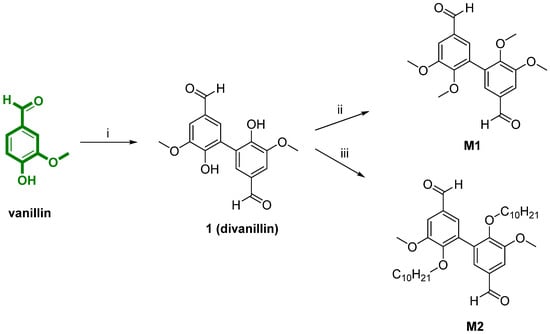
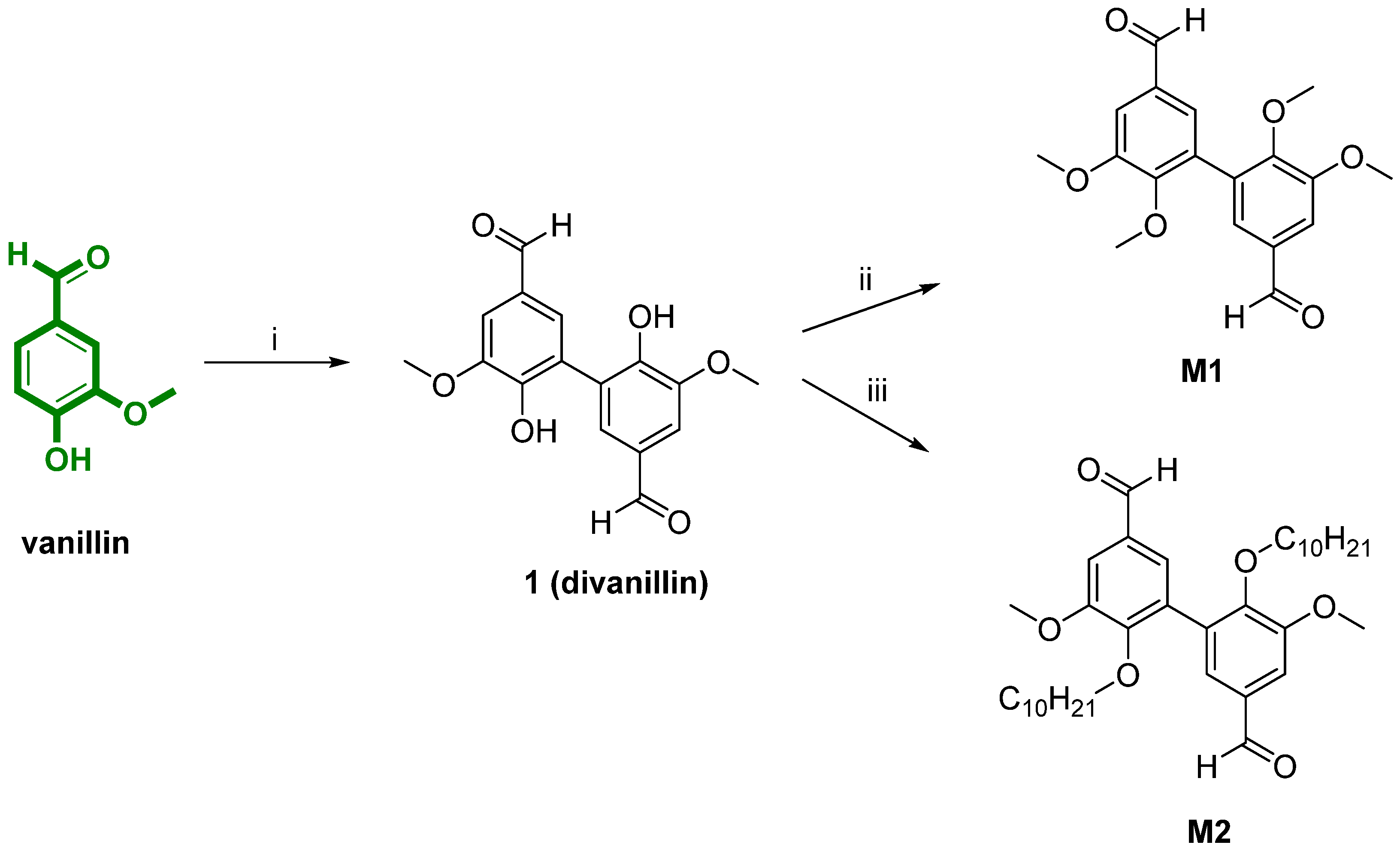
The synthesis of biosourced monomers M1 and M2 is shown in Figure 1. First, biosourced vanillin was converted to divanillin 1 using iron sulfate and sodium persulfate in water, as previously reported [28]. 5,5′,6,6′-Tetramethoxy-[1,1′-biphenyl]-3,3′-dicarbaldehyde monomer M1 was prepared by reacting divanillin 1 with iodomethane and potassium carbonate in N,N-dimethylformamide (DMF) [29]. Similarly, the 6,6′-bis(decyloxy)-5,5′-dimethoxy-[1,1′-biphenyl]-3,3′-dicarbaldehyde monomer M2 was prepared by reacting divanillin 1 with 1-bromodecane and potassium carbonate in DMF. The alkylation reactions proceeded with high yields: 85% for M1 and 87% for M2.
Figure 1.
Synthetic scheme for the preparation of monomers M1 and M2 from biosourced vanillin. (i) Na2S2O8, FeSO4.7H2O, H2O, 80 °C, 30 min, Y = 84%; (ii) K2CO3, MeI, DMF, 80 °C, 15 h, Y = 85%; (iii) K2CO3, BrC10H21, DMF, 80 °C, 16 h, Y = 87%.
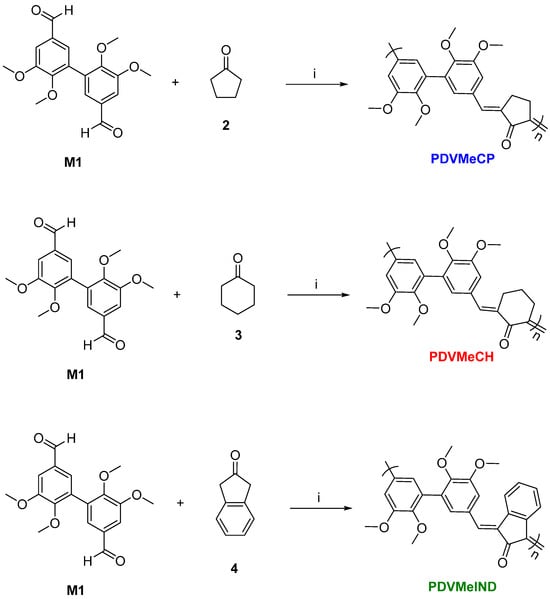
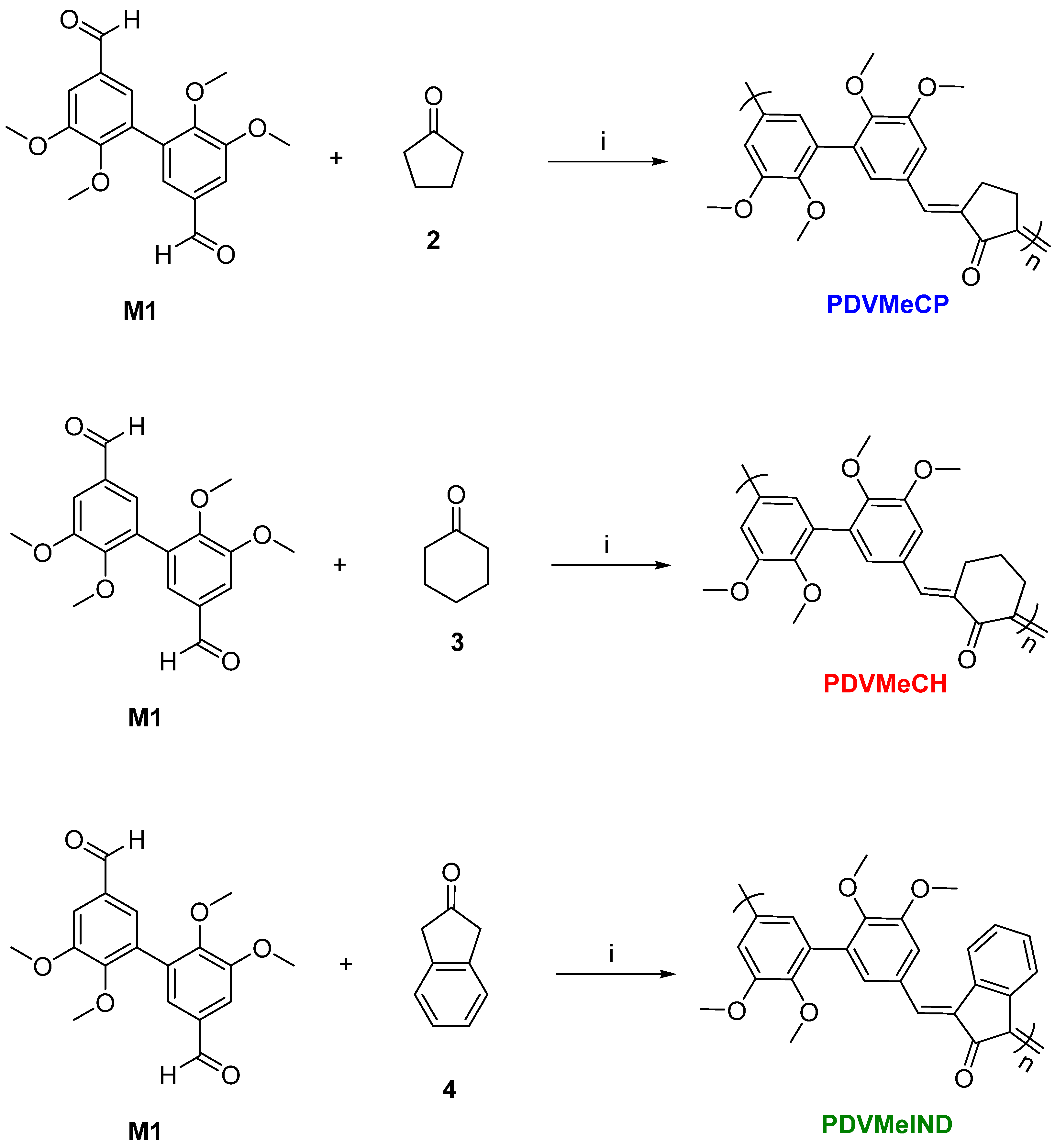
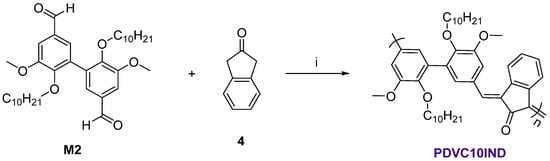
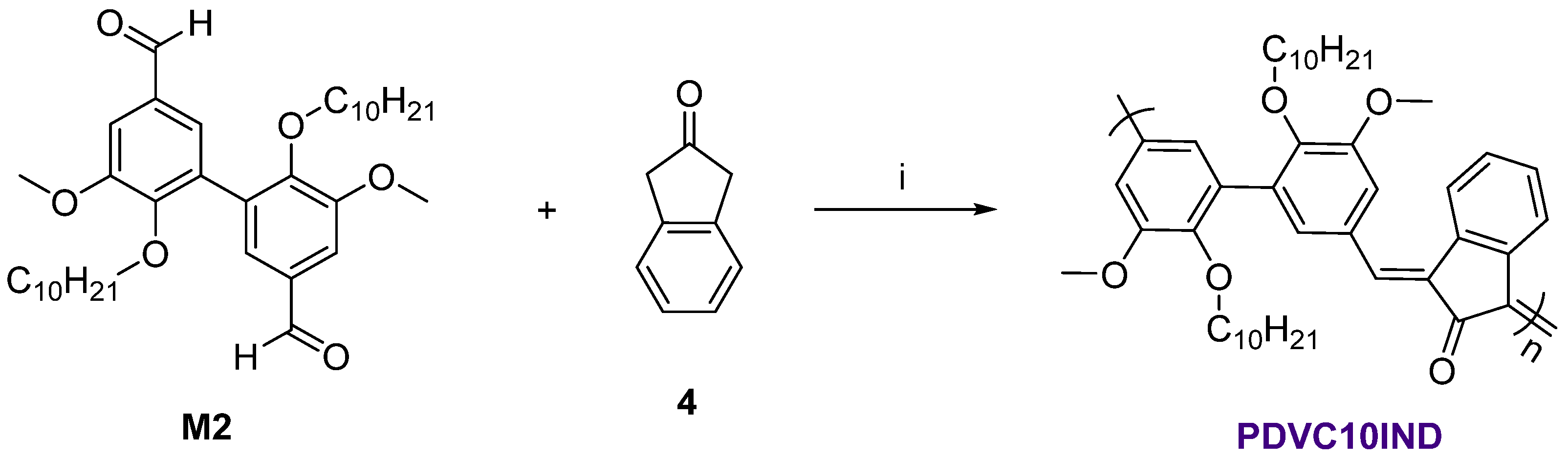
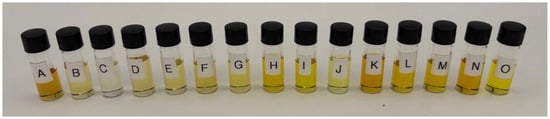
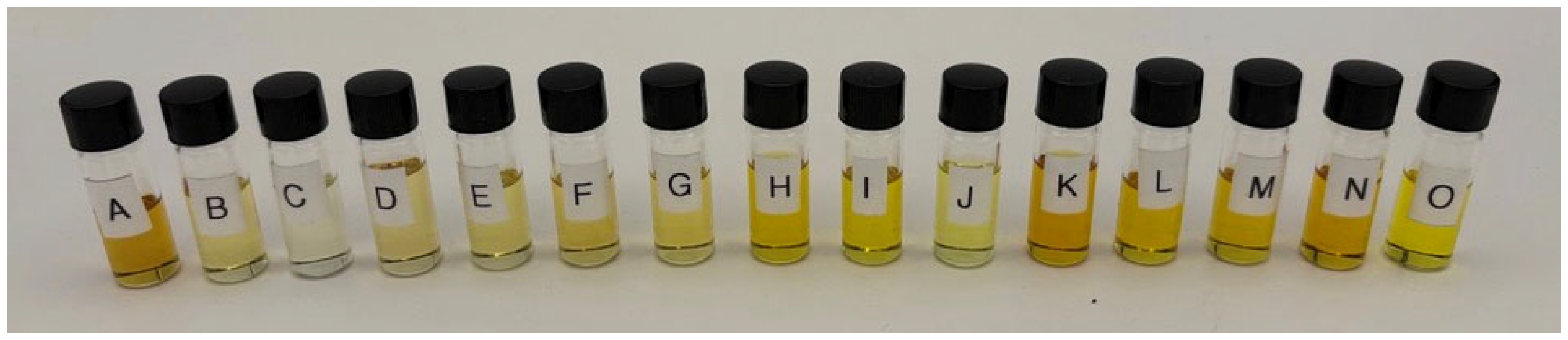
The polymers were prepared using aldol polycondensation conditions [24]. In particular, monomer M1 was polymerized with three different ketone derivatives, namely, cyclopentanone 2, cyclohexanone 3 or 2-indanone 4, leading to the corresponding polymers PDVMeCP, PDVMeCH and PDVMeIND respectively (Figure 2). Similarly, monomer M2 was polymerized with 2-indanone 4, resulting in the polymer PDVC10IND (Figure 3). Interestingly, 2-indanone is a natural product found in Apis cerana, whereas cyclopentanone and cyclohexanone can be obtained from the lignocellulosic biomass [30,31,32]. The polymerizations were carried out in toluene at 100 °C for 48 h using p-toluenesulfonic acid as a catalyst (p-TSA). Increasing the polymerization time and/or polymerization temperature did not lead to an increase in the polymers’ molecular weights. Moreover, polymerizations were also carried out using microwave irradiation with the aim of increasing the molecular weights but did not result in higher molecular weights. Thus, the resulting yellow polymers PDVMeCP, PDVMeCH, PDVMeIND and PDVC10IND were found to be soluble in organic solvents such as toluene and chloroform (Figure 4). Moreover, the solubility of the polymer was tested in green solvents such as 2-methyltetrahydrofuran (2-MeTHF), p-cymene and ethyl-L-lactate [33,34]. All polymers were soluble in 2-MeTHF except PDVMeCH. Polymers PDVMeCH and PDVC10IND were found to be soluble in ethyl-L-lactate at 150 °C. On the other hand, only polymer PDVC10IND was soluble in p-cymene at room temperature.
Figure 2.
Synthetic scheme for the preparation of polymers PDVMeCH, PDVMeCP, and PDVMeIND: (i) p-toluenesulfonic acid (p-TSA), toluene, 100–110 °C, 48 h.
Figure 3.
Synthetic scheme for the preparation of polymer PDVC10IND: (i) p-toluenesulfonic acid (p-TSA), toluene, 100 °C, 48 h.
Figure 4.
Solubility of polymers PDVMeCH, PDVMeCP, PDVMeIND and PDVC10IND in various solvents: A = PDVMeCP in CHCl3; B = PDVMeCH in toluene, C = PDVMeCH in 2-MeTHF; D = PDVMeCH in CHCl3; E = PDVMeCH in toluene; F = PDVMeCH in 2-MeTHF; G = PDVMeCH in ethyl-L-lactate; H = PDVMeIND in CHCl3; I = PDVMeIND in toluene; J = PDVMeIND in 2-MeTHF; K = PDVC10IND in CHCl3; L = PDVC10IND in toluene; M = PDVC10IND in 2-MeTHF; N = PDVC10IND in cymene; O = PDVC10IND in ethyl-L-lactate. Concentration ≈ 5–10 mg/mL.
It should be noted that monomer M2 was polymerized only with 2-indanone because PDVMeIND, the corresponding M1-derived polymer incorporating a 2-indanone unit, exhibited the highest molecular weight and thermal stability among the other M1-derived polymers. Thus, the comparison between PDVMeIND and PDVC10IND should be considered as an early evaluation of the influence of decyloxy substitution on an indanone-based divanillin polymer, rather than as a general conclusion applicable to all cyclic ketone comonomers.
1H NMR spectra of all polymers (Supporting Information, Figures S7–S10) show a small residual signal at approximately 9.8–10.4 ppm, which can be attributed to aldehyde protons from terminal divanillin units and indicates the presence of unreacted aldehyde end groups. This observation is consistent with the limited molecular weights reported in Table 1. Broad resonances are observed for all polymers, reflecting restricted chain mobility, increased molecular weight, and a distribution of slightly different chemical environments within the polymer backbones, as expected for macromolecular systems. More specifically, the 1H NMR spectrum of PDVMeCH shows peaks between 1.39 and 2.93 ppm associated with the cyclohexanone ring, whereas the spectrum of PDVMeCP shows peaks between 1.61 and 3.61 ppm associated with the cyclopentanone ring. For all polymers, signals between approximately 3.68 and 4.47 ppm correspond to the methoxy protons, and signals between approximately 7.03 and 8.08 ppm are attributed to protons of the divanillin aromatic rings. In addition, the 1H NMR spectra of PDVMeIND and PDVC10IND display additional resonances from the 2-indanone moiety. Overall, the 1H NMR spectra are consistent with the expected polymer structures. Attempts to acquire 13C NMR spectra were unsuccessful, even with extended acquisition times, because the resulting spectra exhibited very broad and low-intensity resonances that could not be interpreted reliably. This behavior is most likely due to the limited solubility and rigid backbones of the polymers, which significantly affect 13C NMR resolution.
Table 1.
Thermal and physical properties of polymers PDVMeCH, PDVMeCP, PDVMeIND and PDVC10IND.
3.2. Thermal, Optical and Physical Properties of the Polymers
The stability of the polymers was investigated using thermogravimetric analysis (TGA) (Table 1). Polymers PDVMeCP, PDVMeIND and PDVC10IND showed that 5% weight loss (Td) occurred at temperatures higher than 350 °C, whereas polymer PDVMeCH demonstrated a Td of 258 °C (see Supporting Information, Figure S18).
Polymers were characterized by size-exclusion chromatography (SEC) using chloroform as the eluent and polystyrene calibration standards (Table 1). PDVMeCH and PDVC10IND showed similar weight-average molecular weights (Mw) of approximately 6.5 kDa, whereas PDVMeCP and PDVMeIND exhibited higher Mw values of 13.7 and 15.9 kDa, respectively. The dispersity values ranged from 1.7 to 3.2, which is consistent with step-growth polycondensation processes and should not be interpreted as a direct measure of chemical purity. Increasing the polymerization time to 72 h, changing the heating method to microwave irradiation, increasing the temperature to 110–120 °C, or modifying the pressure did not lead to higher molecular weights. Indeed, introducing decyl side chains on the divanillin unit did not improve the molecular weight of the resulting indanone-based polymer. The limited molecular weights may arise from a combination of factors including: (1) the reduced electrophilicity of the aldehyde groups due to electron-donating methoxy and alkoxy substituents; (2) the steric hindrance introduced by the non-planar divanillin core; and (3) the progressive decrease in solubility as the rigid conjugated backbone grows. These factors can limit monomer conversion and promote premature precipitation of oligomeric species, thereby restricting chain growth.
Differential scanning calorimetry (DSC) analysis was performed on the polymers to obtain information about their thermal transitions. DSC thermograms are shown in Figure S17. The polymer PDVMeCH showed a glass transition (Tg) at −60 °C as well as fusion (Tc1) at −2 °C and crystallization (Tf1) at −3 °C (Table 1). Similarly, PDVMeCP’s thermogram showed a Tg at −60 °C, a Tc1 at −3 °C and a Tf1 at −1 °C. Interestingly, the polymer PDVMeIND thermogram demonstrated two fusion (−1 °C and 124 °C respectively) and two crystallization (−13 °C and 121 °C respectively) transitions. These transitions could be related to a higher organization of the polymer chains. Lastly, the polymer PDVC10IND thermogram showed a thermal transition at −67 °C, which could be attributed to a Tg.
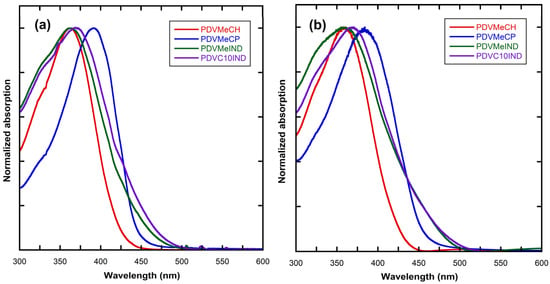
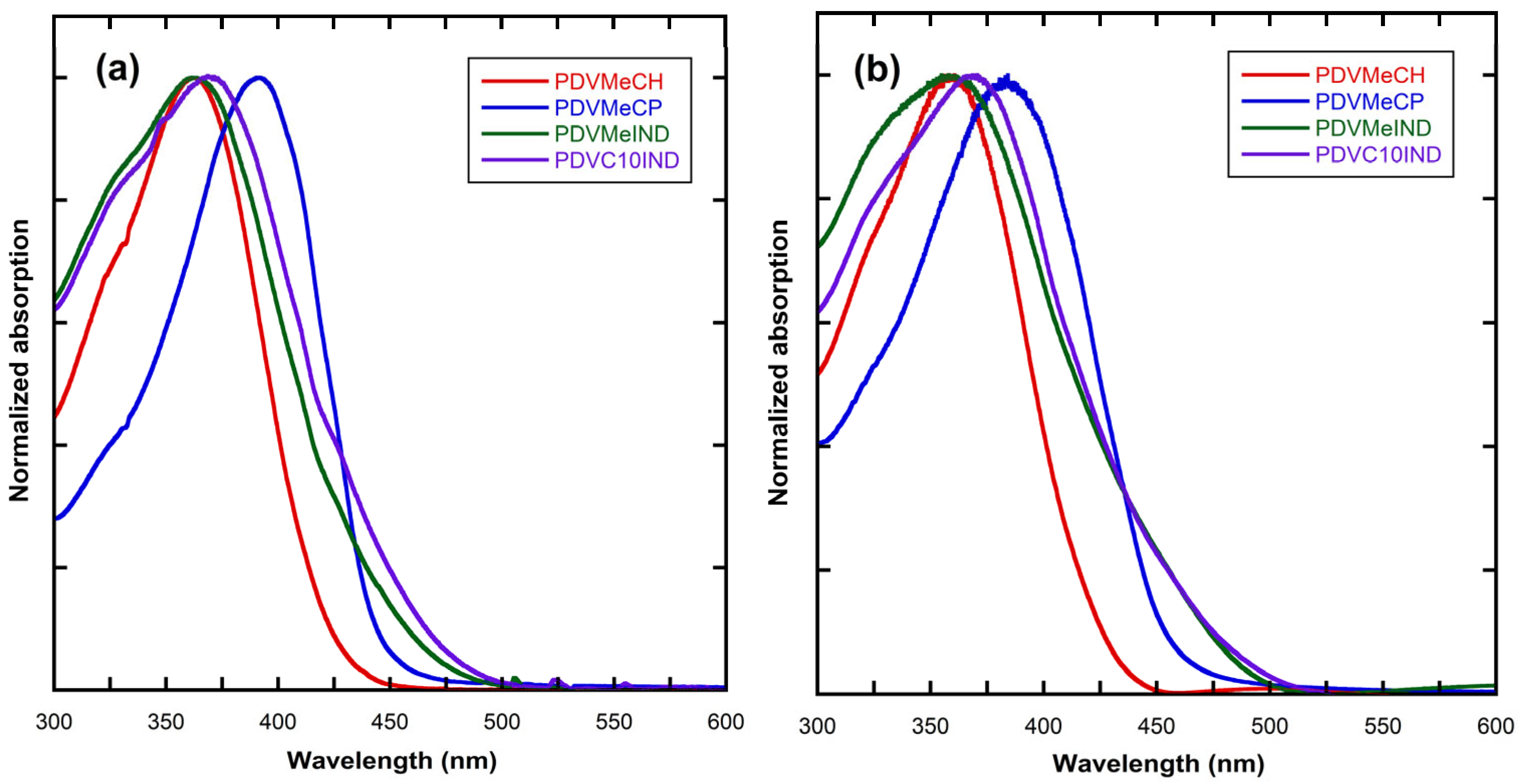
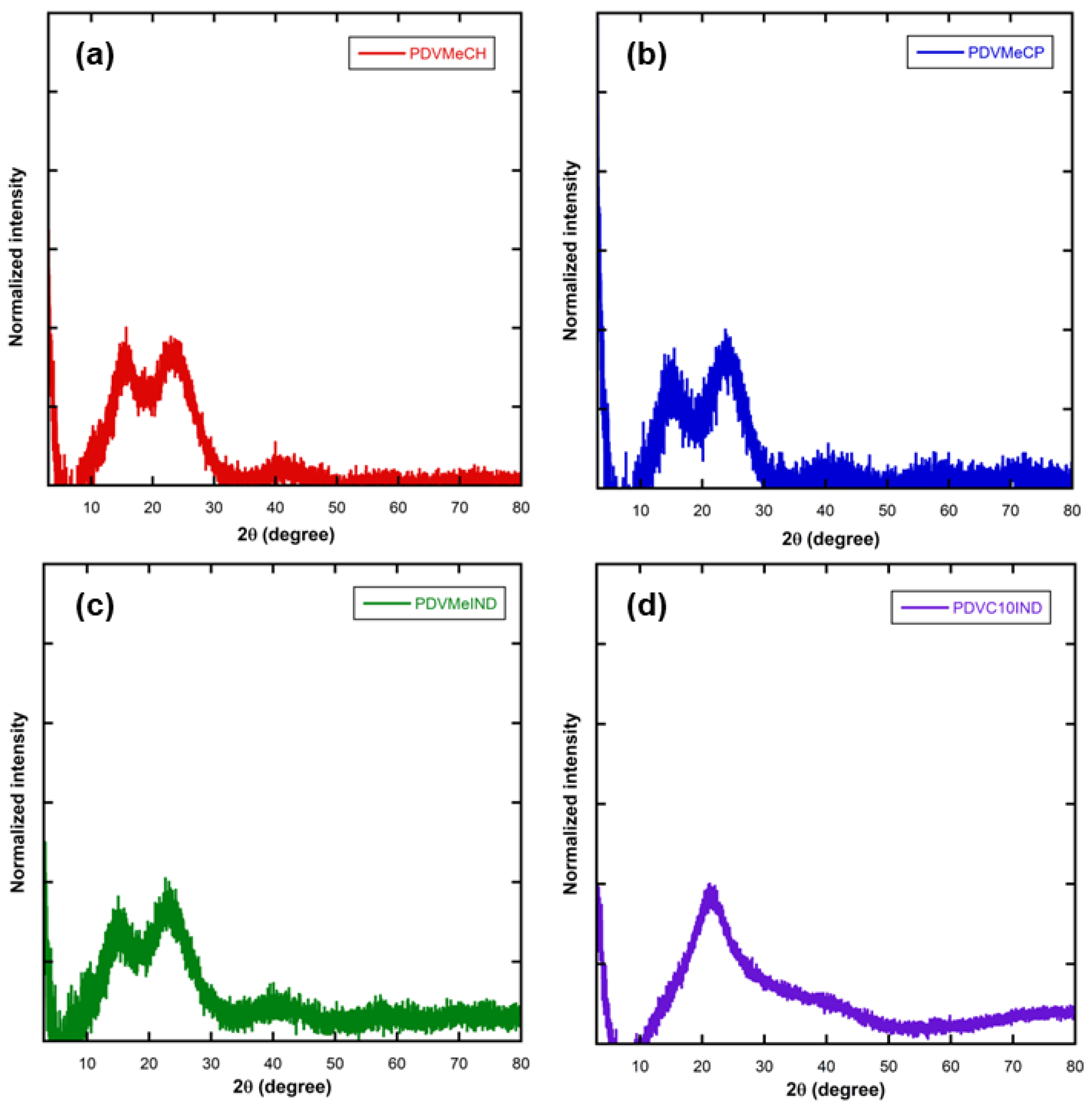
The UV–visible spectra of the polymers in solution (chloroform) and in solid state are shown in Figure 5. First, in chloroform, polymer PDVMeCP showed a maximum absorption (λmaxSol) at 391 nm, whereas polymers PDVMeCH, PDVMeIND and PDVC10IND demonstrated maximum absorption (λmaxSol) at around 360 nm. Interestingly, the solid-state absorption maximum showed a light blue shift when compared to the spectra obtained in solution. This slight blue shift observed in the solid-state spectra compared with solution suggests that the polymers do not undergo strong aggregation upon film formation. Indeed, the limited interchain π–π interactions do not significantly enhance electronic delocalization. These results are consistent with the X-ray diffractograms, which showed broad diffraction peaks characteristic of predominantly amorphous materials.
Figure 5.
UV–visible spectra of polymers PDVMeCP, PDVMeCH, PDVMeIND and PDVC10IND (a) in chloroform and (b) in solid state.
As seen in Table 2, the polymers’ solid-state absorption peak maxima (λmaxSS) were found to be 1–7 nm lower than the corresponding absorption peak maxima in solution (Supporting Information, Figure S19). Interestingly, the polymers did not show any emission.
Table 2.
Optical and electrochemical properties of polymers PDVMeCH, PDVMeCP, PDVMeIND and PDVC10IND.
Finally, the optical bandgaps of the polymers were determined from the solid-state absorption onset and are reported in Table 2. Polymers PDVMeCH and PDVMeCP possessed optical bandgaps of 2.87 eV and 2.72 eV respectively. On the other hand, polymers PDVMeIND and PDVC10IND, incorporating a 2-indanone unit, possessed a similar optical bandgap (2.48 eV and 2.54 eV respectively).
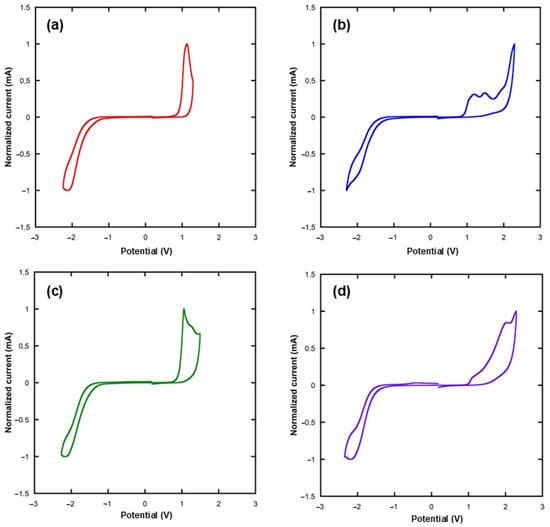
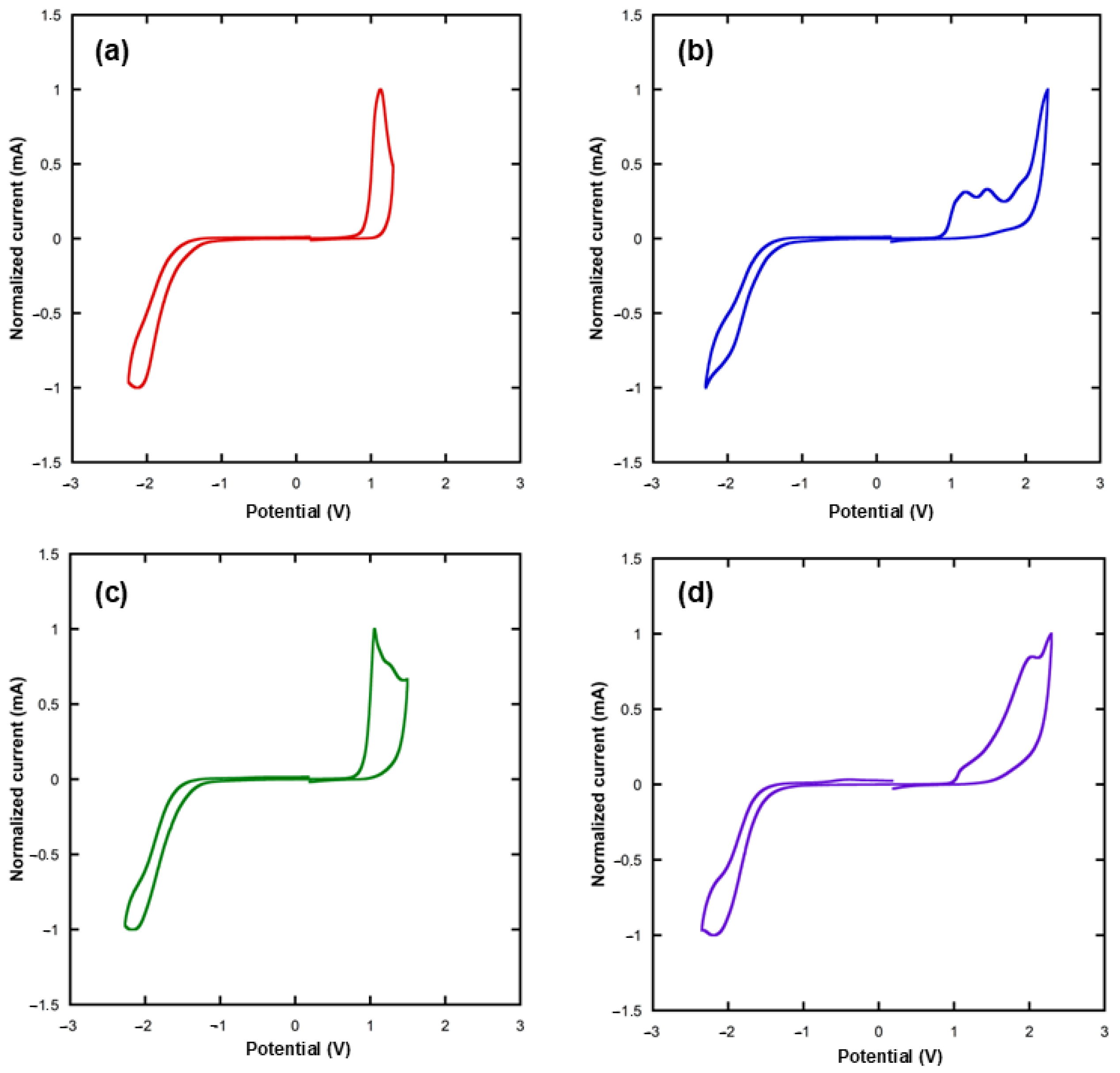
The electronic properties of the polymers were evaluated by cyclic voltammetry using polymer films deposited on a platinum electrode. The cyclic voltammograms of PDVMeCH, PDVMeCP, PDVMeIND, and PDVC10IND are reported in Figure 6. None of the polymers showed fully reversible oxidation or reduction processes; therefore, the HOMO and LUMO values reported in Table 2 should be considered estimated energy levels derived from onset potentials rather than absolute values. The irreversibility may indicate limited electrochemical stability under the measurement conditions or at the investigated potentials. PDVMeCH and PDVMeIND showed similar HOMO energy levels of −5.5 eV, whereas PDVMeCP and PDVC10IND showed HOMO energy levels of −5.6 and −5.7 eV, respectively. The LUMO energy levels were also similar across the series, ranging from −3.7 to −3.6 eV. These results suggest that the cyclic ketone unit has only a limited influence on the reduction process, whereas oxidation may be slightly more sensitive to backbone conformation and side-chain substitution. The electronic bandgaps (Eg-elec) of PDVMeCH, PDVMeCP, and PDVMeIND were similar, ranging from 1.8 to 1.9 eV, while PDVC10IND showed a larger value of 2.1 eV. This difference may be related to the decyl side chains on the divanillin moiety, which affect solid-state conformation and packing, as suggested by the XRD diffractograms in Figure 7. The electrochemical bandgaps are lower than the optical bandgaps, which is commonly observed because the two methods probe different processes and are influenced by film morphology, interfacial effects, and onset determination.
Figure 6.
Cyclic voltammograms of polymers (a) PDVMeCH, (b) PDVMeCP, (c) PDVMeIND, and (d) PDVC10IND in solid state.
Figure 7.
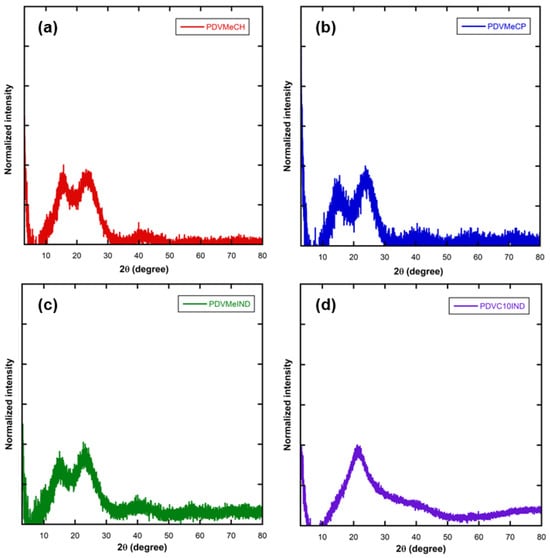
X-ray diffraction (XRD) of (a) PDVMeCH, (b) PDVMeCP, (c) PDVMeIND, and (d) PDVC10IND films.
The polymer films were analyzed by X-ray diffraction to obtain information about their relative solid-state organization. The XRD diffractograms are reported in Figure 7. PDVMeCH, PDVMeCP, and PDVMeIND showed two broad diffraction features near 15° and 23°. In contrast, PDVC10IND displayed one main broad peak centered near 21°, which could be attributed to a change in packing induced by the decyl side chains. The broad nature of the diffraction features indicates that the polymers are predominantly amorphous or weakly ordered, consistent with the non-planar divanillin backbone. The signal near 23° corresponds to a short-range intermolecular distance of approximately 3.9 Å, which may be associated with π–π stacking, whereas the signal near 15° corresponds to a larger spacing of approximately 5.9 Å arising from interchain packing. For PDVC10IND, the disappearance of the 15° feature and the shift to a broad peak near 21° (approximately 4.2 Å) suggest that decyl substitution modifies the packing mode of the polymer chains. The long alkyl substituents likely increase steric hindrance and disrupt backbone packing, leading to a different solid-state organization. Therefore, the broad diffraction peaks should not be interpreted as evidence of impurities, but rather as a consequence of the predominantly amorphous and weakly ordered nature of these polymers.
4. Conclusions
We designed and synthesized a series of divanillin-based copolymers using aldol condensation polymerization. Starting from biosourced vanillin, we prepared two vanillin-derived dialdehydes and their corresponding polymers incorporating different cyclic ketones: PDVMeCH, PDVMeCP, PDVMeIND, and PDVC10IND. This approach demonstrated that divanillin can serve as a renewable aromatic building block for the preparation of polymers without the need for transition metal catalysts.
We investigated the influence of the cyclic ketone and alkyl side chain on the physicochemical, thermal, optical and electrochemical properties of the polymers. The polymers showed solubility in greener solvents such as ethyl lactate and p-cymene. The results demonstrate that the polymers possess excellent thermal stability (258 to 397 °C). In terms of optical and electrochemical properties, we found that absorption spectra in solid-state Eg-opt ranged from 2.54 to 2.87 eV and solid-state absorption maxima were between 359 and 383 nm. The X-ray diffraction further indicates that the addition of a decyl side chain affects the solid-state ordering organization of the polymers.
In summary, this study highlights the potential of divanillin as a sustainable, biosourced moiety for the preparation of polymers. Nevertheless, although the use of biosourced vanillin and employing a metal-free polymerization strategy represents a promising step toward more sustainable polymer synthesis, it is worth pointing out that a full evaluation of the environmental benefits of these materials would require a dedicated life-cycle assessment (LCA). Indeed, such an analysis should consider feedstock origin, chemical use (reagents, catalysts, and solvents), energy consumption, purification steps, process scale-up, a comparison with relevant petroleum-based polymers, and end-of-life scenarios. Future work will therefore focus on the exploration of other divanillin units, the evaluation of the resulting polymers’ physicochemical properties, and, if appropriate, a dedicated LCA study to better quantify their environmental impact.
Supplementary Materials
The following supporting information can be downloaded at https://www.mdpi.com/article/10.3390/appliedchem6030056/s1. Figure S1: 1H NMR spectra (DMSO-d6) of monomer M1; Figure S2: 13C NMR spectra (DMSO-d6) of monomer M1; Figure S3: 1H NMR spectra (CDCl3) of monomer M2; Figure S4: 13C NMR spectra (CDCl3) of monomer M2; Figure S5: HRMS (ESI) spectra of monomer M1; Figure S6: HRMS (ESI) spectra of monomer M2; Figure S7: 1H NMR spectra (CDCl3) of polymer PDVMeCH; Figure S8: 1H NMR spectra (CDCl3) of polymer PDVMeCP; Figure S9: 1H NMR spectra (CDCl3) of polymer PDVMeIND; Figure S10: 1H NMR spectra (CDCl3) of polymer PDVC10IND; Figure S11: FTIR spectra of monomer M1; Figure S12: FTIR spectra of monomer M2; Figure S13: FTIR spectra of polymer PDVMeCP; Figure S14: FTIR spectra of polymer PDVMeCH; Figure S15: FTIR spectra of polymer PDVMeIND; Figure S16: FTIR spectra of polymer PDVC10IND; Figure S17: DSC thermograms of (a) PDVMeCH, (b) PDVMeCP, (c) PDVMeIND, and (d) PDVC10IND; Figure S18: TGA thermograms of polymers PDVMeCH, PDVMeCP, PDVMeIND, and PDVC10IND; Figure S19: Picture of the polymer’s thin films spin-coated from chloroform (2000 rpm, 30s).
Author Contributions
Conceptualization, D.G.; synthesis and characterization, D.G., J.L. and W.D.; writing—review and editing, D.G.; funding acquisition, D.G. All authors have read and agreed to the published version of the manuscript.
Funding
This research was funded by Fonds de Recherche du Québec—Nature et Technologie, grant number 293062.
Institutional Review Board Statement
Not applicable.
Informed Consent Statement
Not applicable.
Data Availability Statement
The data presented in this study are available in this article and in the Supplementary Information.
Acknowledgments
The authors thank Jérémie Abran for his assistance with the synthesis of monomers. The authors have reviewed and edited the output and take full responsibility for the content of this publication.
Conflicts of Interest
D.G. and J.L. were employed by the company Kemitek. W.D. is a doctoral researcher at Université Laval. The authors declare that the research was conducted in the absence of any commercial or financial relationships that could be construed as potential conflicts of interest. The funders had no role in the design of the study; in the collection, analyses, or interpretation of the data; in the writing of the manuscript; or in the decision to publish the results.
Abbreviations
The following abbreviations are used in this manuscript:
| DMF | N,N-dimethylformamide |
| XRD | X-ray diffraction |
| HOMO | Highest occupied molecular orbital |
| LUMO | Lowest occupied molecular orbital |
| Eg | Bandgap |
| TGA | Thermogravimetric analysis |
| DSC | Differential scanning calorimetry |
| SEC | Size exclusion chromatography |
References
- Andrady, A.L. Plastics and the Environment; John Wiley & Sons, Inc.: Hoboken, NJ, USA, 2003. [Google Scholar]
- Wang, Z.; Ganewatta, M.S.; Tang, C. Sustainable polymers from biomass: Bridging chemistry with materials and processing. Prog. Polym. Sci. 2020, 101, 101197. [Google Scholar] [CrossRef] [Scilit]
- Bhaskar, T.; Pandey, A. (Eds.) Biomass, Biofuels, Biochemicals: Lignin Biorefinery; Elsevier: Amsterdam, The Netherlands, 2021. [Google Scholar]
- Gendron, D. Vanillin: A promising biosourced building block for the preparation of various heterocycles. Front. Chem. 2022, 10, 949355. [Google Scholar] [CrossRef] [Scilit] [PubMed]
- Boivin, L.-P.; Dupont, W.; Leclerc, M.; Gendron, D. Biosourced vanillin-based building blocks for organic electronic materials. J. Org. Chem. 2021, 86, 16548–16557. [Google Scholar] [CrossRef] [Scilit] [PubMed]
- Martău, G.A.; Călinoiu, L.-F.; Vodnar, D.C. Bio-vanillin: Towards a sustainable industrial production. Trends Food Sci. Technol. 2021, 109, 579–592. [Google Scholar] [CrossRef] [Scilit]
- Kunkel, R.; Schmidt, V.M.; Cremers, C.; Müller, D.; Schmiedl, D.; Tübke, J. Electrochemical synthesis of biobased polymers and polymer building blocks from vanillin. RSC Adv. 2021, 11, 8970–8985. [Google Scholar] [CrossRef] [Scilit] [PubMed]
- Amarasekara, A.S.; Razzaq, A. Vanillin-based polymers—Part II: Synthesis of Schiff base polymers of divanillin and their chelation with metal ions. ISRN Polym. Sci. 2012, 2012, 532171. [Google Scholar] [CrossRef] [Scilit]
- Savonnet, E.; Grau, E.; Grelier, S.; Defoort, B.; Cramail, H. Divanillin-based epoxy precursors as DGEBA substitutes for biobased epoxy thermosets. ACS Sustain. Chem. Eng. 2018, 6, 11008–11017. [Google Scholar] [CrossRef] [Scilit]
- Boivin, L.-P.; Dupont, W.; Gendron, D.; Leclerc, M. Biosourced monomers: Toward sustainable conjugated polymers for organic electronics. Macromol. Chem. Phys. 2022, 223, 2200378. [Google Scholar] [CrossRef] [Scilit]
- Kayser, L.V.; Hartigan, E.M.; Arndtsen, B.A. Multicomponent coupling approach to cross-conjugated polymers from vanillin-based monomers. ACS Sustain. Chem. Eng. 2016, 4, 6263–6267. [Google Scholar] [CrossRef] [Scilit]
- Dupont, W.; Marcoux St-Pierre, T.; Boivin, L.-P.; Mainville, M.; Leclerc, M.; Johnson, P.A.; Gendron, D. Synthesis of fluorinated phenylene-alkoxybenzothiadiazole polymer (PDTBTBz-2Fanti) by DHAP. Polym. Chem. 2025, 16, 4996–5008. [Google Scholar] [CrossRef] [Scilit]
- Dupont, W.; Boivin, L.-P.; Mainville, M.; Yuan, Y.; Li, Y.; Leclerc, M.; Gendron, D. Vanillin-based diketopyrrolopyrrole conjugated polymers prepared by direct heteroarylation polymerization (DHAP). ACS Appl. Polym. Mater. 2024, 7, 29–41. [Google Scholar] [CrossRef] [Scilit]
- Moli, J.A.; Vasanthi, S.; Prakash, N.; Singh, D.R. Synthesis and characterization of certain photocrosslinkable thermotropic liquid crystalline random copolyesters containing arylidene moiety. High Perform. Polym. 2012, 24, 507–520. [Google Scholar] [CrossRef] [Scilit]
- Sidharthan, J.; Amaladhas, T.P. Synthesis and characterization of photo-crosslinkable liquid crystalline copolyesters containing arylidene-keto and chalcone moieties. J. Polym. Res. 2017, 24, 53. [Google Scholar] [CrossRef] [Scilit]
- Das, B.; Thirupathi, P.; Mahender, I.; Reddy, K.R. Convenient and facile cross-aldol condensation catalyzed by molecular iodine: An efficient synthesis of α,α′-bis(substituted-benzylidene)cycloalkanones. J. Mol. Catal. A Chem. 2006, 247, 182–185. [Google Scholar] [CrossRef] [Scilit]
- Risse, W.; Grubbs, R.H. A novel route to block copolymers by changing the mechanism from living ring-opening metathesis polymerization of cyclic olefins to aldol condensation polymerization of silyl vinyl ethers. Macromolecules 1989, 22, 1558–1562. [Google Scholar] [CrossRef] [Scilit]
- Shih, Y.-H.; Wu, G.-L.; Chueh, P.-H.; Chen, J.-C.; Tsai, C.-Y.; Wang, T.-Y.; Yu, M.-H.; Li, Y.-P.; Chen, W.-C.; Chueh, C.-C. The influence of interlocking effects in conjugated polymers synthesized by aldol polycondensation on field-effect transistor properties and morphology. JACS Au 2025, 5, 1382–1391. [Google Scholar] [CrossRef] [Scilit] [PubMed]
- Ganguly, A.; He, K.; Hendsbee, A.D.; Abdelsamie, M.; Bennett, R.N.; Li, Y.; Toney, M.F.; Kelly, T.L. Synthesis of poly(bisindigo) using a metal-free aldol polymerization for thin film transistor applications. ACS Appl. Mater. Interfaces 2020, 12, 14265–14271. [Google Scholar] [CrossRef] [Scilit] [PubMed]
- Patel, P.R.; Patel, M.J.; Iyer, P.K.; Zade, S.S.; Patel, A.L. Synthesis and study of donor–acceptor conjugated polymers based on the dithienopyrrolobenzothiadiazole unit via a metal-free aldol condensation polymerization strategy and their SCLC hole mobilities. New J. Chem. 2024, 48, 19536–19548. [Google Scholar] [CrossRef] [Scilit]
- Sato, S.; Lin, P.-S.; Liu, C.-L.; Higashibara, T. Atom-economical synthesis and characterization of poly(oxindolidene thienylene vinylene) based on aldol polycondensation reaction. Catalysts 2020, 10, 364. [Google Scholar] [CrossRef] [Scilit]
- Shi, H.; Huang, X.; Tian, D.; Pan, H.; Hu, A. Narrowly distributed conjugated polymers synthesized through acid-catalyzed aldol polycondensations in nanoreactors. Macromol. Chem. Phys. 2024, 225, 2400203. [Google Scholar] [CrossRef] [Scilit]
- Guo, Y.; Yang, X.; Wang, L.; Duan, J.; Zhou, Y.; Nielsen, C.B.; Yu, Y.; Yang, J.; Guo, Y.; Li, Z.; et al. Aldol polymerization to construct half-fused semiconducting polymers. Macromolecules 2021, 54, 10312–10320. [Google Scholar] [CrossRef] [Scilit]
- Huang, Y.-W.; Lin, Y.-C.; Li, J.-S.; Chen, W.-C.; Chueh, C.-C. Investigating the backbone conformation and configuration effects for donor–acceptor conjugated polymers with ladder-type structures synthesized through aldol polycondensation. J. Mater. Chem. C 2021, 9, 9473–9483. [Google Scholar] [CrossRef] [Scilit]
- Chen, X.; Marks, A.; Paulsen, B.D.; Wu, R.; Rashid, R.B.; Chen, H.; Alsufyani, M.; Rivnay, J.; McCulloch, I. n-Type rigid semiconducting polymers bearing oligo(ethylene glycol) side chains for high-performance organic electrochemical transistors. Angew. Chem. Int. Ed. 2021, 60, 9368–9373. [Google Scholar] [CrossRef] [Scilit] [PubMed]
- Kosco, J.; Sachs, M.; Godin, R.; Kirkus, M.; Francàs, L.; Bidwell, M.; Qureshi, M.; Anjum, D.; Durrant, J.R.; McCulloch, I. The effect of residual palladium catalyst contamination on the photocatalytic hydrogen evolution activity of conjugated polymers. Adv. Energy Mater. 2018, 8, 1802181. [Google Scholar] [CrossRef] [Scilit]
- Griggs, S.; Marks, A.; Meli, D.; Rebetez, G.; Bardagot, O.; Paulsen, B.D.; Chen, H.; Weaver, K.; Nugraha, M.I.; Schafer, E.A.; et al. The effect of residual palladium on the performances of organic electrochemical transistors. Nat. Commun. 2022, 13, 7964. [Google Scholar] [CrossRef] [Scilit] [PubMed]
- Fang, Z.; Nikafshar, S.; Hegg, E.L.; Nejad, M. Biobased divanillin as a precursor for formulating biobased epoxy resin. ACS Sustain. Chem. Eng. 2020, 8, 9095–9103. [Google Scholar] [CrossRef] [Scilit]
- Llevot, A.; Grau, E.; Carlotti, S.; Grelier, S.; Cramail, H. Renewable (semi)aromatic polyesters from symmetrical vanillin-based dimers. Polym. Chem. 2015, 6, 6058–6066. [Google Scholar] [CrossRef] [Scilit]
- Servé, M.S.; Ferry, M.J.; Yu, K.O.; Olson, C.T.; Hobson, D.W. Metabolism and nephrotoxicity of Indian in male Fischer 344 rats. J. Toxicol. Environ. Health 1990, 29, 409–416. [Google Scholar] [CrossRef] [Scilit] [PubMed]
- Meng, Q.; Hou, M.; Liu, H.; Song, J.; Han, B. Synthesis of ketones from biomass-derived feedstock. Nat. Commun. 2017, 8, 14190. [Google Scholar] [CrossRef] [Scilit] [PubMed]
- Hronec, M.; Fulajtárová, K.; Soták, T. Highly selective rearrangement of furfuryl alcohol to cyclopentanone. Appl. Catal. B Environ. 2014, 154–155, 294–300. [Google Scholar] [CrossRef] [Scilit]
- Pereira, C.S.M.; Silva, V.M.T.M.; Rodrigues, A.E. Ethyl lactate as a solvent: Properties, applications and production processes—A review. Green Chem. 2011, 13, 2658–2671. [Google Scholar] [CrossRef] [Scilit]
- Satira, A.; Espro, C.; Paone, E.; Calabrò, P.S.; Pagliaro, M.; Ciriminna, R.; Mauriello, F. The limonene biorefinery: From extractive technologies to its catalytic upgrading into p-cymene. Catalysts 2021, 11, 387. [Google Scholar] [CrossRef] [Scilit]

Disclaimer/Publisher’s Note: The statements, opinions and data contained in all publications are solely those of the individual author(s) and contributor(s) and not of MDPI and/or the editor(s). MDPI and/or the editor(s) disclaim responsibility for any injury to people or property resulting from any ideas, methods, instructions or products referred to in the content. |
© 2026 by the authors. Licensee MDPI, Basel, Switzerland. This article is an open access article distributed under the terms and conditions of the Creative Commons Attribution (CC BY) license.