


Abstract
This investigation assessed the phenolic composition, and the in vitro and in silico antioxidant potential of peels from six potato varieties (Arizona, Spunta, Fabula, Manito, Argos, and Touareg) cultivated in Algeria. 80% ethanol was applied to macerate potato peels, and standard procedures were followed for phytochemical analyses. The in vitro antioxidant capacity was evaluated by the scavenging methods of DPPH (1,1-diphenyl-2-picrylhydrazil) and ABTS ((2,2′-azino-bis (3-ethylbenzothiazoline-6-sulfonic acid)) radicals. AutoDock Vina was employed to perform molecular docking analyses. LC–MS/MS analyses revealed significant variability in phenolic compounds among the varieties, with chlorogenic acid being the predominant compound, reaching the highest concentration in Touareg peels (51.28 µg/g). The Manito variety exhibited the highest total phenolic and flavonoids contents of 643.53 ± 2.59 mg GAE/100 g DW and 144.42 ± 2.40 mg QE/100 g DW, respectively and the strongest ABTS radical scavenging activity (IC50 = 473.81 ± 1.35 µg/mL). Molecular docking analysis suggested potential interactions of catechin and chlorogenic acid with oxidative stress-related enzymes namely myeloperoxidase, xanthine oxidase, and 5-lipoxygenase, providing complementary insights into their possible biological relevance. The integration of in vitro and in silico results demonstrates that the Manito variety is the most promising candidate for the sustainable valorization of potato peels as a natural source of antioxidants.
1. Introduction
Potato (Solanum tuberosum L.) is one of the most important staple crops globally, and its production represents a critical component of the Algerian agricultural sector. According to [1], potato production in Algeria reached approximately 4.63 million tons in 2023, supplying domestic demand and generating substantial by-products, particularly peels, which are a rich source of bioactive compounds.
Potato peels contain significant amounts of dietary fiber, resistant starch, proteins, and minerals, making them valuable nutritional sources [2,3]. In addition, they are abundant in phenolic compounds such as chlorogenic, caffeic, and gallic acids, which exhibit potent antioxidant activity and potential anti-inflammatory, antimicrobial, and cardioprotective effects [4]. Valorization of these by-products aligns with circular economy principles, supporting waste reduction, resource efficiency, and the development of functional food ingredients [2,5].
Advanced analytical techniques such as liquid chromatography–mass spectrometry (LC–MS) provide precise and sensitive profiling of complex plant metabolites [6]. Molecular docking approaches further complement experimental investigations by predicting interactions between bioactive compounds and biological targets, providing mechanistic understanding of their activity [7,8].
Despite the importance of potato cultivation in Algeria, limited studies have compared the phenolic content and antioxidant activity of peels from locally grown varieties, although these characteristics are known to vary between cultivars. Therefore, this study aimed to compare the phenolic composition and antioxidant potential of peels from six Algerian potato varieties. In addition, molecular docking is employed to explore the potential interactions of identified phenolic compounds with oxidative stress-related enzymes. While molecular docking is a widely used computational approach, its integration with LC–MS/MS profiling of Algerian potato varieties provides complementary insights into their potential bioactivity. Overall, the combined experimental and in silico approach contributes to a better valorization of these agricultural by-products within a sustainable development framework.
2. Materials and Methods
2.1. Reagents
The solvents, standards, and reagents employed in this study were of analytical grade. They were supplied by Sigma-Aldrich (Merck, St. Louis, MO, USA; Madrid, Spain) and Biochem Chemopharma (Montreal, QC, Canada).
2.2. Preparation of Plant-Based Matrix and Extraction
Six potato varieties, namely Arizona (Ari), Spunta (Spu), Fabula (Fab), Manito (Man), Argos (Arg), and Touareg (Tou), were selected based on their commercial importance and phenotypic diversity. According to varietal descriptions available in potato cultivar databases, Ari, Spu, Fab, Arg, and Tou are generally characterized by yellow to cream-colored peels, whereas Man presents a red peel pigmentation. Potato tubers were obtained from local producers and markets in Bejaia and Bouira (Algeria). The potato tubers were thoroughly washed to remove adhering soil and impurities, and the peels were manually removed using a stainless-steel peeler. The moisture content of the fresh samples was determined and found to be as follows: Spu: 86.38%, Ari: 87.98%, Man: 92.88%, Fab: 97.90%, Arg: 84.02%, and Tou: 85.12%. The collected peels were then oven-dried at 40 °C for 24 h, finely ground, and sieved (≤250 µm). The resulting powders were stored in sealed containers at 4 °C until further use.
This sample preparation was carried out to ensure efficient drying, stabilization, and preservation of phenolic compounds, as well as to obtain a homogeneous powder suitable for subsequent extraction and LC–MS/MS analysis.
The extraction procedure was carried out under the optimal conditions reported by [9]. Briefly, the plant material was extracted using 80% (v/v) ethanol at a solid-to-solvent ratio of 1 g per 30 mL. The mixture was maintained under continuous agitation for 150 min, followed by centrifugation at 1765× g for 10 min to remove solid residues. The supernatant was then collected and stored in opaque bottles at 4 °C for subsequent tests and analyses.
2.3. Analysis of Phenolic Compounds
The total phenolic (TP) and total flavonoid (TF) content of the extracts were determined using the Folin–Ciocalteu and the aluminum chloride colorimetric methods, respectively, as described by [9]. The results were expressed as milligrams of gallic acid equivalents (GAE) for TP or quercetin equivalents (QE) for TF per 100 g of dry weight (DW) of potato peels.
The characterization of phenolic compounds was performed using LC–MS/MS (Agilent Technologies 1260 Infinity II system coupled to a 6460 Triple Quadrupole mass spectrometer (Agilent Technologies, Santa Clara, CA, USA)). Separation was achieved on a Poroshell 120 SB-C18 column (50 mm × 4.6 mm, 2.7 µm particle size) as described by [10], which corresponds to a validated analytical method. For sample preparation, hexane was added to the ethanolic extract (80% v/v) of potato peels (50 mg/mL) and the mixture was centrifuged at 9000 rpm for 10 min. An aliquot of 100 µL from the ethanolic phase was diluted with 450 µL of water and 450 µL of methanol, followed by filtration through a 0.22 µm membrane prior to injection. The injection volume was set at 5.12 µL with a flow rate of 0.40 mL/min. The mobile phases consisted of (A) 0.1% formic acid with 5.0 mM ammonium formate in water and (B) 0.1% formic acid with 5.0 mM ammonium formate in methanol. The gradient elution was programmed as follows: 25% B (1–3 min), 50% B (4–12 min), 90% B (13–21 min), and 3% B (22–25 min). The column oven was maintained at 40 °C. Mass spectrometric detection was performed using an Agilent 6460 Triple Quadrupole LC–ESI–MS/MS (Agilent Technologies, Santa Clara, CA, USA) system operating in both positive and negative ionization modes. Data acquisition was carried out in multiple reaction monitoring (MRM) mode using Agilent (Agilent Technologies, Santa Clara, CA, USA) Mass Hunter software version 18.2. Collision energies were optimized for each compound. The operating conditions were as follows: gas temperature 350 °C, capillary voltage 4000 V, drying gas (N2) flow rate 15 L/min, and nebulizer gas flow rate 11 L/min. Compound identification was achieved by comparison of retention times, precursor ions, and characteristic MS/MS fragmentation patterns with those of authentic standards. Phenolic compounds were quantified using external calibration curves constructed from authentic standards. The compounds reported in this study represent the phenolics that were identified with high confidence based on authentic standards and MS/MS fragmentation patterns.
2.4. Assessment of the In Vitro Antioxidant Potential
Serial dilutions were prepared from the crude extract obtained under optimized extraction conditions (80% ethanol, solid-to-liquid ratio of 1 g/30 mL, extraction time of 150 min). The scavenging capacity for DPPH of the potato peels extract was assessed using the method outlined by [9]. The ABTS (2,2′-azino-bis (3-ethylbenzothiazoline-6-sulfonic acid)) radical scavenging activity of samples was determined following the method reported by [11].
The percentage inhibition of the DPPH and ABTS radicals was calculated using the following formula:
Free radicals’ inhibition (%) = [(Absorbance control − Absorbance sample)/Absorbance control] × 100
The results were expressed as IC50 (µg/mL).
2.5. Molecular Docking Study
To investigate the antioxidant potential and to clarify the probable mechanisms of action of the phenolic compounds identified in potato peel extracts from six varieties, a molecular docking study was performed. Catechin, trans-ferulic acid, chlorogenic acid, vanillin, vanillic acid, and gentisic acid were selected based on their relative abundance in the extracts, as determined by LC–MS/MS analysis. This approach allowed focusing on the most biologically relevant phenolic compounds potentially contributing to the observed antioxidant effects. These phenolics were investigated for their potential interactions with oxidative stress-related enzymes associated with oxidative pathways. All ligands were acquired from the PubChem database (https://pubchem.ncbi.nlm.nih.gov/, accessed on 5 March 2026) using their canonical SMILES, and CORINA (https://demos.mn-am.com/corina.html, accessed on 5 March 2026) was utilized to convert them into PDB format. The resulting PDB files were then imported into PMV for further preparation, including hydrogen addition, assignment of atom types and charges, and conversion into the Protein Data Bank, Partial Charge (Q), & Atom Type (T) (PDBQT) format required for AutoDock Vina version 1.2.0. The 3D ligand structures were visually inspected using Discovery Studio Visualizer to confirm stereochemical correctness and structural integrity before docking analysis. Docking calculations were performed using an exhaustiveness value of 16 to ensure adequate conformational sampling and reliable ligand–receptor interaction prediction. The docking grid boxes were centered on the active sites of the selected receptor proteins using the following coordinates: human myeloperoxidase (MPO, PDB ID: 1D2V) (X = 22.606, Y = −4.871, Z = 2.158), xanthine oxidase (XO, PDB ID: 3NVY) (X = 39.973, Y = 30.787, Z = 22.379), and 5-lipoxygenase (PDB ID: 3O8Y) (X = 4.945, Y = 34.531, Z = −5.127). The grid box dimensions were set to 112 Å × 110 Å × 90 Å for MPO, 100 Å × 114 Å × 94 Å for XO, and 104 Å × 104 Å × 102 Å for 5-lipoxygenase to ensure complete coverage of the catalytic binding regions and adequate accommodation of all studied ligands during docking simulations performed with AutoDock Vina.
The crystallographic structures of 1D2V, 3O8Y, and 3NVY as protein receptors, were acquired from the RCSB Protein Data Bank (https://www.rcsb.org/, accessed on 3 March 2026). Co-crystallized ligands and water molecules were eliminated from all protein structures before polar hydrogen atoms and Kollman charges were added. Based on the location of the co-crystallized ligand and important active site residues, a grid box was created around each receptor’s active site. and the ligands’ most stable conformations were chosen according to their lowest binding energy values. Key interactions, such as hydrogen bonds and hydrophobic contacts, that may account for the antioxidant activity perceived in vitro were identified by analyzing the resultant ligand–protein complexes. The optimized structures were stored in format PDBQT. For each receptor, the docking protocol was validated by re-docking the co-crystallized ligand into the active site of the corresponding receptor structures. The root mean square deviation (RMSD) between the experimental and predicted binding poses was found to be below 2.0 Å, indicating good agreement and confirming the reliability of the docking procedure.
AutoDock Vina software version 1.2.0 (Scripps Research, La Jolla, CA, USA) was used to perform molecular docking calculations. The poses with the lowest binding energies and maximal affinities were selected for further investigation using BIOVIA Discovery Studio2021Visualizer version 21.1.0.2098 (Dassault Systems BIOVIA Corp, San Diego, CA, USA).
2.6. Statistical Analysis
The measurements were carried out in triplicate, and the experimental results were reported as means ± standard deviation (SD) based on three measurements except for LC-MS analysis (performed only once). Tukey HSD test with a significance level (α) of 0.05 was used to analyze the statistical differences between results.
3. Results
3.1. Total Phenolics and Flavonoids Contents
The results of TPC determination (Table 1) using a calibration curve prepared with gallic acid (y = 0.011x − 0.0637; R2 = 0.9911) revealed significant (p < 0.05) variability among peels of different potato varieties. The Tou variety exhibited the highest concentration (711.59 ± 2.74 mg GAE/100 g DW), followed by Spu (680.42 ± 2.25 mg GAE/100 g DW) and Man (643.53 ± 2.59 mg GAE/100 g DW). Intermediate values were observed for Arg (584.14 ± 2.31 mg GAE/100 g DW) and Ari (460.74 ± 2.35 mg GAE/100 g DW), while Fab showed the lowest content (379.68 ± 1.95 mg GAE/100 g DW).
Table 1.
Phenolic contents and antioxidant activity of potato peel extracts of six Algerian varieties.
TFC values calculated by referring to a calibration curve prepared with quercetin (y = 0.0344x + 0.0235; R2 = 0.9911) also varied significantly among the studied varieties. The highest value was recorded in Man (144.42 ± 2.40 mg QE/100 g DW), followed by Arg (87.27 ± 0.98 mg QE/100 g DW), Fab (73.44 ± 2.05 mg QE/100 g DW), and Tou (72.82 ± 0.15 mg QE/100 g DW). The lowest values were observed in Ari (32.55 ± 0.56 mg QE/100 g DW) and Spu (42.53 ± 0.23 mg QE/100 g DW).
3.2. LC–MS/MS Profiling of Individual Phenolics
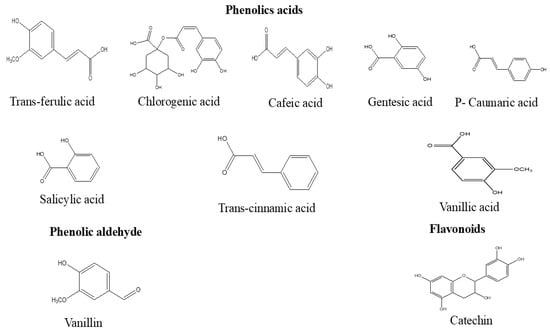
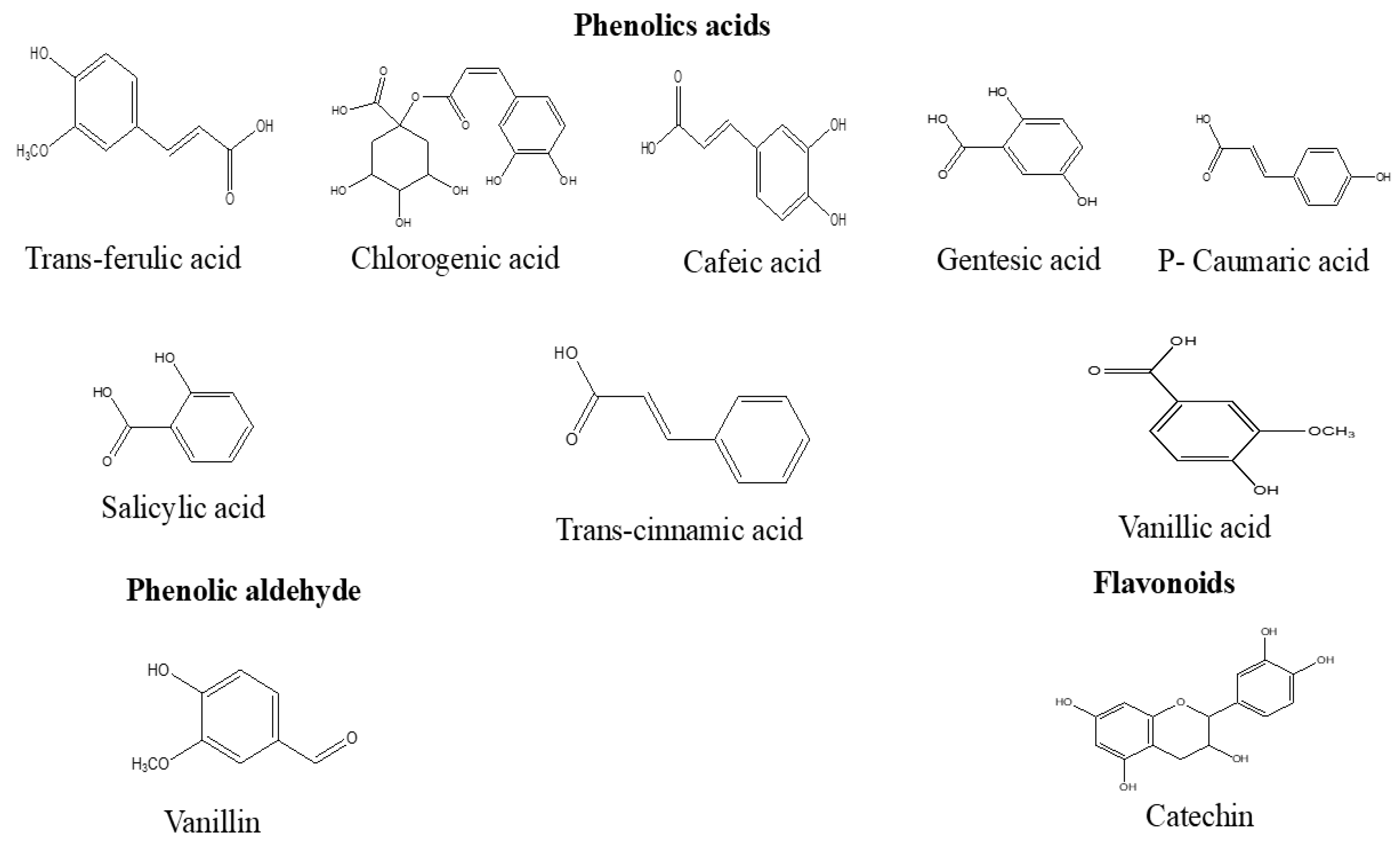
The LC–MS/MS analysis of phenolic compounds in the peels of six potato varieties revealed quantitative differences among cultivars (Table 2 and Figure 1).
Table 2.
The LC-MS/MS characterization of phenolic compounds in six Algerian potato varieties peel.
Figure 1.
Chemical structures of the main phenolic compounds identified in PP.
Chlorogenic acid was identified as the predominant phenolic compound in all varieties, with the highest concentration observed in Tou (51.28 µg/g), followed by Spu, Man, Ari, and Arg, while Fab exhibited the lowest level (11.56 µg/g).
Caffeic acid also varied among varieties, with higher levels detected in Tou (24.83 µg/g), followed by Ari, Arg, Spu, and Man, while Fab showed the lowest content (9.70 µg/g).
Vanillin was present at the highest concentration in Ari (55.57 µg/g), followed by Spu, Fab, Man, and Arg, while Tou showed the lowest level (20.15 µg/g).
Trans-ferulic acid was detected at relatively low and consistent levels across all six samples, with the highest concentration observed in Man (7.74 µg/g).
Salicylic acid was detected at low and relatively similar levels across all six varieties, ranging from 1.93 to 2.53 µg/g. The highest concentration was observed in Tou (2.53 µg/g), while the lowest was found in Man (1.93 µg/g).
Overall, LC–MS/MS profiling revealed marked differences in the concentration of individual phenolic compounds among the peels of six potato varieties.
3.3. Antioxidant Properties of Potato Peel Extracts
The peels of the Tou variety showed the strongest antioxidant activity against the DPPH radical, with an IC50 value of 23.92 ± 0.04 µg/mL (Table 1). This high scavenging capacity is consistent with its elevated TPC and particularly high chlorogenic acid concentration revealed by LC–MS/MS analysis.
The Spu variety also exhibited strong antioxidant activity in the DPPH assay, which may similarly be associated with its high TPC. The Man variety presented the highest antioxidant activity against the ABTS radical, with an IC50 value of 473.81 ± 1.35 µg/mL. The Arg variety showed intermediate antioxidant activity, whereas the Ari variety exhibited moderate to low activity. In contrast, the Fab variety showed the lowest antioxidant activity in both DPPH and ABTS assays.
3.4. Molecular Docking Investigation
3.4.1. Structural Validation of Target Receptors
The chosen receptor structures were appropriate for molecular docking investigations because of their high to moderate crystallographic resolution (1.75–2.39 Å) and good stereochemical quality (Table 3). Human myeloperoxidase (MPO), xanthine oxidase (XO), and stable-5-lipoxygenase (5-LOX) exhibited satisfactory structural quality for docking simulations.
Table 3.
The oxidant targets models selected for molecular docking simulation.
The selected receptor structures displayed good stereochemical quality and high to intermediate crystallographic resolution (1.75–2.39 Å), indicating their suitability for molecular docking studies (Table 3). When multiple crystal structures were available for given target, the structures with the best resolution, complete binding sites, and biologically relevant ligand-bound conformations were preferred. Human myeloperoxidase (MPO), xanthine oxidase (XO), and 5-lipoxygenase showed reliable structural integrity and possessed biologically relevant active sites. These targets were selected because of their well-established involvement in oxidative stress and inflammatory pathways. MPO contributes to the formation of reactive oxygen species (ROS), XO contributes to xanthine oxidation with concomitant ROS generation, and 5-lipoxygenase is involved in leukotriene biosynthesis and pro-inflammatory processes. In addition, proteins with distinct but complementary biological functions were intentionally selected to explore potential multi-target interactions with the identified phenolic compounds.
Therefore, the docking analysis was conducted as a complementary and exploratory in silico approach rather than a direct mechanistic explanation of the radical scavenging activity observed in DPPH and ABTS assays.
3.4.2. Molecular Docking Results for Identified Phenolics
The in vitro antioxidant assays (DPPH and ABTS) reflect the direct radical scavenging capacity of the phenolic compounds, whereas the molecular docking analysis provides complementary insight into their potential to interact with key pro-oxidant enzymes involved in oxidative stress pathways. These enzymes, including MPO, XO, and 5-LOX, contribute to reactive oxygen species (ROS) generation and inflammatory processes. Therefore, both approaches should be considered as interconnected but mechanistically distinct levels of antioxidant action, providing a more comprehensive overview of the antioxidant potential of the studied compounds.
Although polyphenolic compounds contain multiple hydroxyl groups capable of forming hydrogen bonds, differences in binding affinities and interaction profiles observed among the tested ligands suggest that docking outcomes are also influenced by molecular geometry and target-site complementarity, rather than solely by non-specific interactions.
Stronger ligand-receptor affinity is indicated by lower binding energy values. The three targets (3NVY, 3O8Y, and 1D2V) showed varying interactions with the investigated phenolic compounds (Table 4). Most favorable binding affinities were displayed by catechin and chlorogenic acid, with values as high as −9.2 kcal/mol for catechin versus 1D2V and −9.3 kcal/mol for chlorogenic acid against 3O8Y.
Table 4.
Binding affinities, interacting amino acids and hydrogen bonds of identified bioactive molecules on receptor human myeloperoxidase (PDB ID: 1D2V), xanthine oxidase (PDB ID: 3NVY), and stable-5-lipoxygenase (PDB ID: 3O8Y).
These substances consistently exhibited strong interactions with all receptors, suggesting their potential as multitarget antioxidants. Gentisic acid, together with vanillic acid, vanillin, and p-coumaric acid, exhibited weaker binding affinities (ranging between −6.2 and −6.9 kcal/mol), indicating a relatively lower contribution to the overall activity compared to chlorogenic acid and catechin. In particular, the reduced affinity of p-coumaric acid may be attributed to the absence of hydrogen bond interactions with key active site residues, as observed in the docking results (Table 4), which likely decreases the stability of the ligand–receptor complex. The remaining compounds exhibited moderate interactions with the selected targets, as reflected by their intermediate binding energies.
Likewise, trans-cinnamic acid and salicylic acid exhibited relatively low binding affinities (>−6.0 kcal/mol) against MPO (1D2V), xanthine oxidase (3NVY), and stable 5-lipoxygenase (3O8Y), and were therefore excluded from the final docking table.
3.4.3. Ligand Interactions Towards MPO (PDB ID: 1D2V)
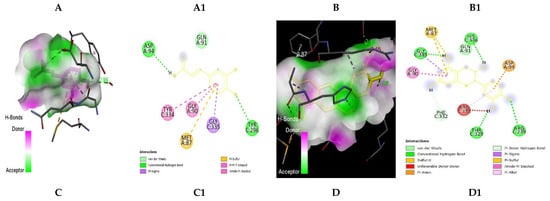
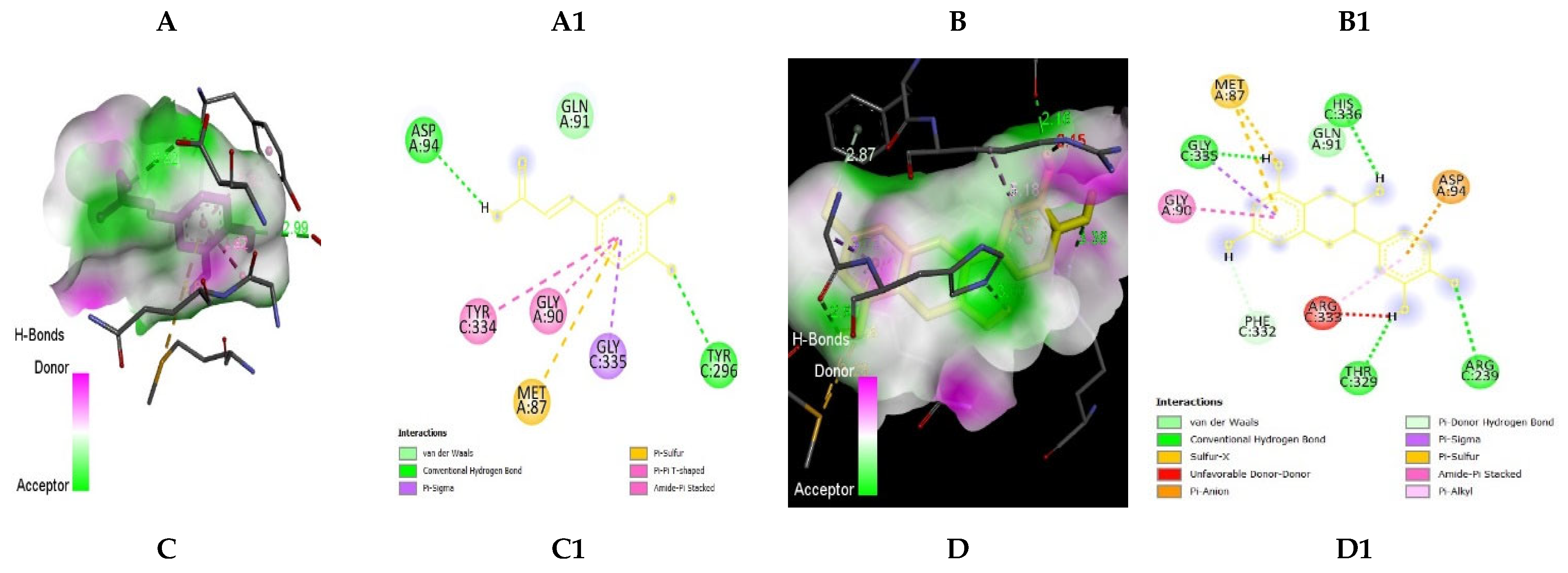
Catechin formed four hydrogen bonds with the highest binding affinity (−9.2 kcal/mol) and numerous interactions with important residues like ARG C239, ARG C333, GLN A91, and ASP A94 (Figure 2B,B1), establishing robust attachment in the MPO active site. In the same way, chlorogenic acid exhibited the maximum number of hydrogen bonds (five) and a high binding affinity (−9.0 kcal/mol) (Table 4), binding to residues such as GLY A90, HIS C336, GLN A91, and ARG C333, implying a stable and well-established interaction network.
Figure 2.
Visualization of binding poses of caffeic acid (A), catechin (B), chlorogenic acid (C), gentisic acid (D), p-coumaric acid (E), trans-ferulic acid (F), vanillic acid (G), and vanillin (H) in the binding site of human myeloperoxidase (PDB ID: 1D2V) using Discovery Studio 2021, docking interaction of caffeic acid (A1), catechin (B1), chlorogenic acid (C1), gentisic acid (D1), p-coumaric acid (E1), rans-ferulic acid (F1), vanillic acid (G1), and vanillin (H1).
Nevertheless, caffeic and trans-ferulic acids exhibited limited interaction networks and fewer hydrogen bonds, as well as moderate binding affinities (−6.9 and −7.0 kcal/mol). The remaining substances, such as gentisic acid, p-coumaric acid, vanillic acid, and vanillin, showed comparatively lower affinities (−6.2 to −6.6 kcal/mol), primarily stabilized by weak Van der Waals interactions, which may lessen their inhibitory effectiveness.
3.4.4. Ligand Interactions Towards XO (PDB ID: 3NVY)
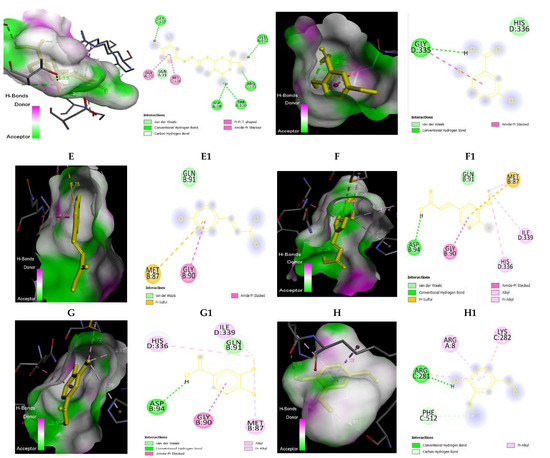
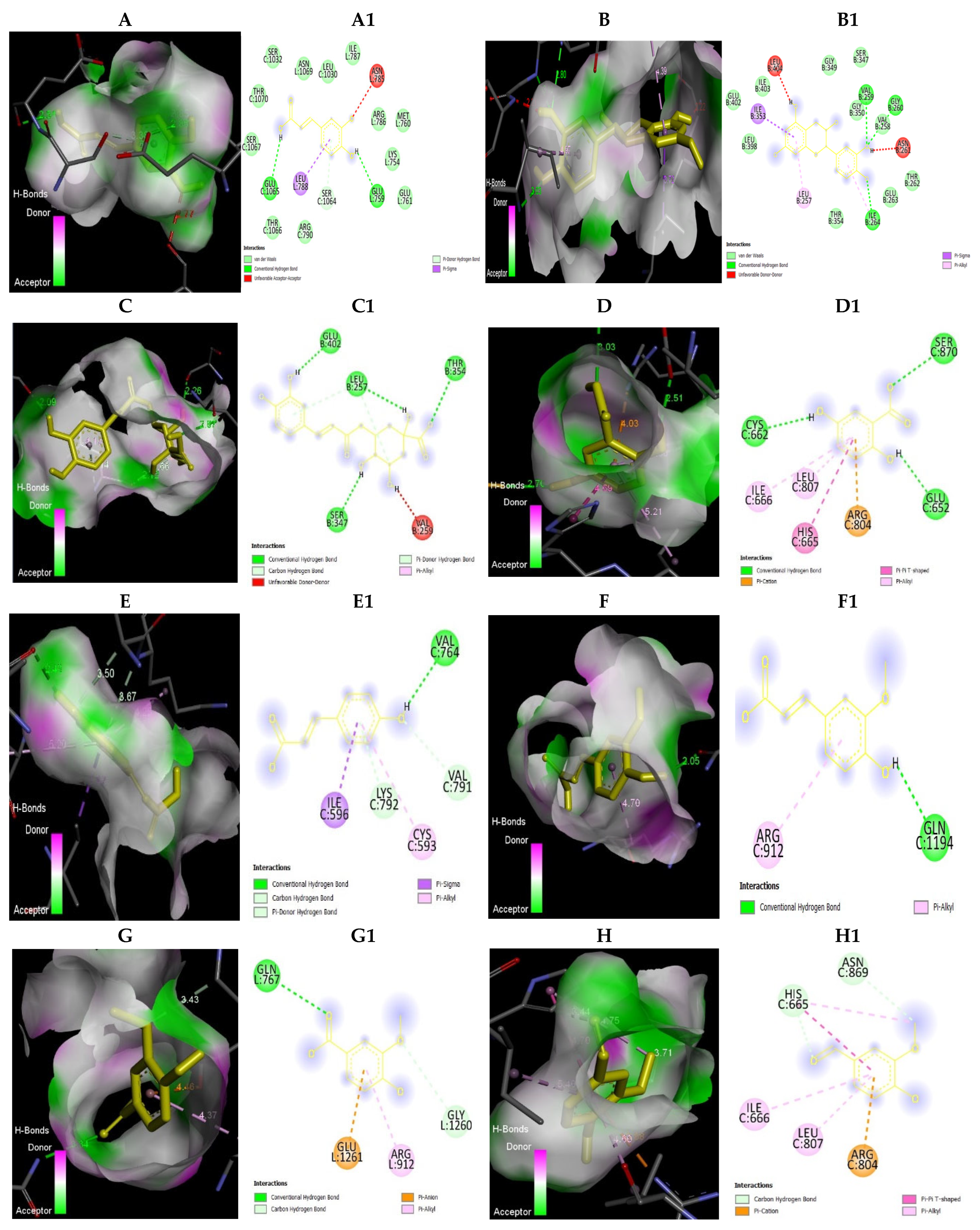
Catechin exhibited the strongest binding affinity (−9.1 kcal/mol) toward XO, followed by chlorogenic acid (−8.3 kcal/mol), indicating greater stability of the ligand–target complex (Figure 3B, Figure 3B1, Figure 3C, and Figure 3C1, respectively).
Figure 3.
Visualization of binding poses of caffeic acid (A), catechin (B), chlorogenic acid (C), gentisic acid (D), p-coumaric acid (E), trans-ferulic acid (F), vanillic acid (G), and vanillin (H) in the binding site of xanthine oxidase (PDB ID: 3NVY) using Discovery Studio 2021, docking interaction of caffeic acid (A1), catechin (B1), chlorogenic acid (C1), gentisic acid (D1), p-coumaric acid (E1), trans-ferulic acid (F1), vanillic acid (G1), and vanillin (H1).
In contrast, vanillin and vanillic acid showed the weakest interactions (−6.0 and −6.2 kcal/mol, respectively). Simple phenolic acids, including trans-ferulic acid, caffeic acid, and p-coumaric acid, displayed moderate binding affinities (−6.7 to −6.9 kcal/mol).
Interaction analysis revealed that high-affinity ligands formed multiple hydrogen bonds and were stabilized by hydrophobic interactions with residues in the catalytic pocket, including GLU, LEU, VAL, and ASN. Chlorogenic acid notably formed up to five hydrogen bonds, reinforcing its binding stability.
3.4.5. Ligand Interactions Towards Stable-5-LOX (PDB ID: 3O8Y)
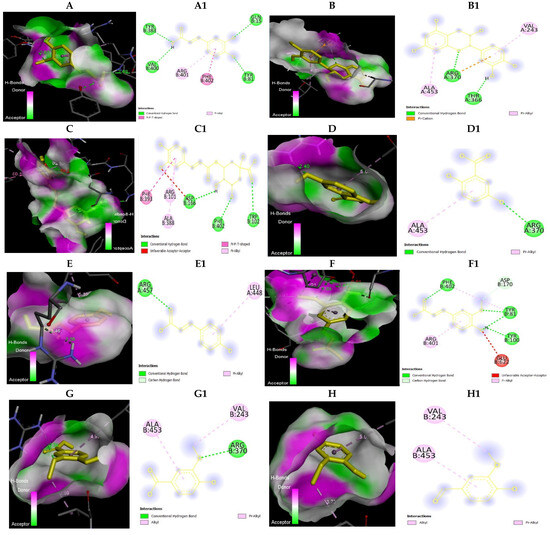
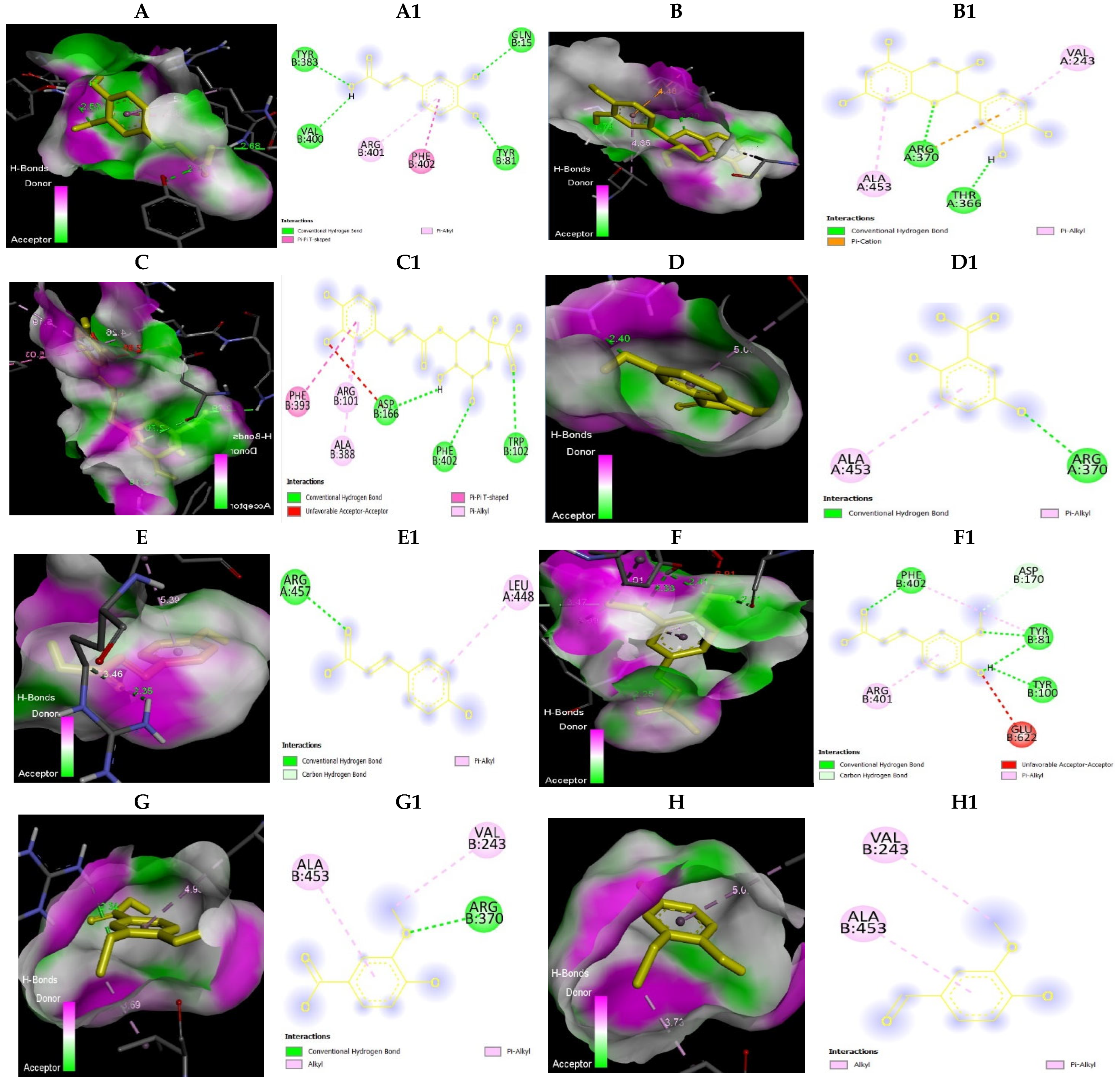
Chlorogenic acid exhibited the strongest binding affinity (−9.3 kcal/mol), forming three hydrogen bonds with key residues, namely PHE B393, ARG B101, ASP B166, ALA B388, PHE B402, and TRP B102 (Figure 4C,C1), indicating the formation of a highly stable complex.
Figure 4.
Visualization of binding poses of caffeic acid (A), catechin (B), chlorogenic acid (C), gentisic acid (D), p-coumaric acid (E), trans-ferulic acid (F), vanillic acid (G), and vanillin (H) in the binding site of stable-5-lipoxygenase (PDB ID: 3O8Y) using Discovery Studio 2021, docking interaction of caffeic acid (A1), catechin (B1), chlorogenic acid (C1), gentisic acid (D1), p-coumaric acid (E1), trans-ferulic acid (F1), vanillic acid (G1), and vanillin (H1).
Catechin also showed strong binding affinity (−8.2 kcal/mol), despite forming fewer hydrogen bonds.
In contrast, simple phenolic compounds such as gentisic acid, vanillin, vanillic acid, and p-coumaric acid displayed lower binding affinities (−6.1 to −6.8 kcal/mol) and formed fewer hydrogen bonds.
Additionally, trans-ferulic acid (−6.9 kcal/mol) and other moderately active compounds established several hydrogen bonds, contributing to the stabilization of the ligand–enzyme complex.
4. Discussion
4.1. Variation in Total Phenolics and Flavonoids
The significant variability observed in TPC among potato peel varieties suggests a potential influence of genotype on phenolic compound accumulation. The higher levels recorded in the Tou, Spu, and Man varieties suggest an enhanced capacity for secondary metabolite production, which may be associated with enhanced activation of the phenylpropanoid biosynthetic pathway. In contrast, the lower content observed in the Fab and Ari varieties may reflect genetic differences in metabolic regulation governing phenolic biosynthesis [12,13].
These findings are consistent with previous studies reporting important cultivar-dependent variation in potato phenolic composition. Comparable phenolic levels in potato peels have been reported in earlier studies [14], while significant differences among potato genotypes were also demonstrated by [15]. For example, in four Chinese varieties, a similar trend was observed: the HeiJingang variety exhibited the highest total phenolic content (360.61 mg GAE/100 g DW), whereas the Shepody variety showed the lowest level (157.20 mg GAE/100 g DW), confirming that genetic background is a major determinant of phenolic accumulation.
Regarding TFC, the higher accumulation observed in the Man variety suggests a greater metabolic capacity for flavonoid biosynthesis, which may contribute to enhanced antioxidant defense mechanisms. The relatively lower levels observed in Ari and Spu varieties further support the hypothesis of strong genotype-dependent regulation of flavonoid metabolism.
Overall, these results are in agreement with previous reports [16,17], which showed that colored potato peels generally contain higher flavonoid levels compared to lighter-colored varieties. This observation suggests that pigmentation-related metabolic pathways may be closely linked to flavonoid accumulation in PP.
4.2. Characterization of Individual Phenolic Compounds by LC–MS/MS
The differences observed in the phenolic profiles of the peels of the six potato varieties highlight the strong influence of genotype on the qualitative and quantitative distribution of individual phenolic compounds [18]. These findings confirm that chlorogenic acid is the major hydroxycinnamic acid in potato, particularly concentrated in the peel [19,20]. Its high accumulation particularly in the Tou variety suggests a greater capacity for hydroxycinnamate biosynthesis in this genotype, which may enhance its biochemical functionality.
Overall, the phenolic profile suggests that Tou, Spu, and Man varieties tend to exhibit relatively higher concentrations of major hydroxycinnamic acids, particularly chlorogenic and caffeic acids, compared to Fab and Ari varieties. However, in the absence of standard deviations for some data, these differences should be interpreted with caution. The LC–MS/MS results presented in Table 2 show that Tou exhibited the highest chlorogenic acid concentration, while Spu, Man, Arg, and Ari displayed comparable levels of key phenolic acids. This observation aligns with prior reports showing that phenolic composition varies with genotype, with potato peels and by-products being particularly rich in hydroxycinnamic acids such as chlorogenic, caffeic, and p-coumaric acids Such variability is generally attributed to genotypic differences influencing hydroxycinnamic acid biosynthesis [21,22]. Indeed, genetic variability is recognized as a key factor affecting phenolic accumulation in potato cultivars [16], which may explain the differences in phenolic composition observed among the studied varieties.
Although potato peels represent a promising source of bioactive compounds, their potential application in food or nutraceutical products requires supplementary investigation. Future studies should include safety assessments, particularly regarding the presence of naturally occurring compounds and possible contaminants, to ensure their suitability for human consumption.
4.3. Antioxidant Activity of Potato Peel Extracts
The observed antioxidant activity of potato peel extracts may be related to their phenolic content and the qualitative composition of individual phenolic compounds. Notably, chlorogenic acid plays a key role in free radical neutralization by enhancing DPPH scavenging capacity and limiting the accumulation of reactive oxygen species [4,23]. This activity is mainly attributed to the overall contribution of phenolic compounds, which are well known for their strong hydrogen-donating ability and their capacity to stabilize free radicals.
The Man variety exhibited the highest antioxidant activity against the ABTS radical, which is consistent with its high TPC and its rich and balanced phenolic profile. In addition to chlorogenic acid and caffeic acid, this variety is distinguished by the highest trans-ferulic acid content, a compound recognized for its efficiency in ABTS systems due to its electron-transfer capability [24]. An experimental study conducted by [25] directly applied the ABTS assay to demonstrate the antioxidant activity of trans-ferulic acid derivatives, confirming its role as a radical scavenger in such systems. Catechin was detected only in the Man variety and may contribute to its antioxidant profile; however, its specific contribution was not experimentally evaluated in the present study.
The Arg variety showed intermediate antioxidant activity, corresponding to its moderate total phenolic content and the presence of key phenolic acids, including chlorogenic acid, caffeic acid, and vanillin. This moderate activity suggests a synergistic effect that is less pronounced than in the Tou and Man varieties [26]. The Ari variety showed moderate to low antioxidant activity, which aligns with its low total phenolic content.
In contrast, the Fab variety exhibited the lowest antioxidant activity in both DPPH and ABTS assays, consistent with its low TPC. Its LC-MS/MS profile showed relatively low concentrations of chlorogenic and caffeic acids, thereby limiting its radical-scavenging efficiency despite the presence of vanillin.
These findings are consistent with recent reports indicating that potato peels constitute a concentrated source of natural antioxidants and that their effectiveness depends on their phenolic composition [27]. Across 65 cultivars, variations in total antioxidant capacity were shown to be strongly correlated with polyphenol content [28].
The differences between DPPH and ABTS IC50 values with ABTS showing markedly lower IC50 values than DPPH in all extracts can be explained by their distinct reaction mechanisms and solvent systems. DPPH is more selective toward lipophilic antioxidants, whereas ABTS reacts with both hydrophilic and lipophilic compounds, leading to broader reactivity. Therefore, the higher discrepancies observed in this study may be related to the phytochemical composition of the extracts and their different affinities toward each radical system [29,30,31].
4.4. Molecular Docking Analysis
4.4.1. Structural Validation of Targets Receptor
These enzymes (MPO, XO, and 5-LOX) play key roles in oxidative stress. MPO is known for its oxidative and halogenative activity, it catalyzes the conversion of halides and pseudohalides to the equivalent hypohalous acids by hydrogen peroxide [32], XO produces superoxides and hydrogen peroxide through the use of molecular oxygen as the electron acceptor [33], and 5-LOX catalyzes the oxidation of linoleic acid producing aldehydes that caused oxidative stress [34].
4.4.2. Molecular Docking Study of Identified Phenolic Compounds
The binding interactions observed in the molecular docking study are complementary to the in vitro antioxidant assays by providing exploratory information on potential interactions between phenolic compounds and oxidative stress-related enzymes. These observations are consistent with the in vitro results and with data reported in the literature, which indicate that the antioxidant activity of hydroxycinnamic acids is mainly associated with their ortho-dihydroxylated structure, facilitating electron transfer and the stabilization of free radicals [35].
It should be noted that molecular docking provides a theoretical prediction of ligand–target interactions. Therefore, the observed binding affinities should not be interpreted as direct evidence of biological activity. These findings are intended to complement the experimental antioxidant results and require confirmation through appropriate in vitro and in vivo studies.
4.4.3. Ligand–MPO Interactions (PDB ID: 1D2V)
As a whole, hydrogen bonds, Van der Waals forces, and π-type interactions which are known to be essential for the stability of ligand-enzyme complexes, contributed to the stabilization of ligand–receptor interactions [36]. As shown in Table 4, catechin and chlorogenic acid exhibited the most favorable binding energies toward MPO, confirming their strong interaction potential.
These outcomes are in alignment with earlier research showing that since catechin and chlorogenic acid may establish numerous hydrogen bonds and hydrophobic interactions, they have substantial binding affinities toward oxidative stress-related enzymes, such as MPO [37].
According to [38] phenolic acids with simpler structures exhibit more restricted interactions compared to flavonoids, which possess a broader interaction profile due to their structural complexity.
4.4.4. Ligand–XO Interactions (PDB ID: 3NVY)
The high binding affinity of catechin and chlorogenic acid can be attributed to the presence of multiple hydroxyl groups and aromatic rings, facilitating hydrogen bonding and hydrophobic interactions within the active site. These observations are consistent with the docking results reported in Table 4, where catechin and chlorogenic acid showed the lowest binding energies toward XO.
The number and position of hydroxyl groups, as well as molecular size and planarity, significantly influence the binding capacity of phenolic compounds toward oxidative enzymes [39].
Moreover, flavonoids generally exhibit higher binding affinity and inhibitory activity against xanthine oxidase than simpler phenolic acids, due to their more complex polycyclic structures and greater ability to establish multiple stabilizing interactions [40].
Finally, hydrophobic interactions and hydrogen bonding play a crucial role in enzyme inhibition and in stabilizing ligand–XO complexes [41].
4.4.5. Ligand–5-LOX Interactions (PDB ID: 3O8Y)
The high binding affinity of chlorogenic acid can be explained by its ability to establish multiple interactions with active site residues, leading to the formation of a stable complex. As indicated in Table 4, chlorogenic acid exhibited one of the most favorable binding energies toward 5-LOX.
In the case of catechin, complex stability appears to be largely supported by hydrophobic and π–π interactions, in addition to hydrogen bonding. These results are consistent with those of [36], showing that phenolics can interact with 5-LOX through a mixture of hydrophobic contacts, hydrogen bonding, and aromatic stacking interactions.
Conversely, smaller and structurally simpler phenolic compounds exhibit limited interaction potential, which explains their lower binding affinities. These findings confirm that molecular size, the number of hydroxyl groups, and the ability to form multiple stabilizing interactions are key factors influencing the inhibitory effectiveness of phenolic compounds toward 5-LOX [42].
Finally, the results suggest that hydrogen bonding can partially compensate for reduced hydrophobic interactions in stabilizing ligand–enzyme complexes, particularly for compounds with moderate binding affinities.
5. Conclusions
Algerian potato peels have been shown to possess substantial potential as a natural source of bioactive phenolic compounds with pronounced antioxidant effect, highlighting their value beyond conventional food waste. The phenolic profiles varied among the potato varieties and were associated with differences in in vitro antioxidant capacity, as measured by DPPH and ABTS assays, while molecular docking provided complementary predictive insights into possible interactions with oxidative stress-related enzymes, including MPO, XO, and 5-LOX, as demonstrated by in silico molecular docking study. Among the six varieties analyzed, the Man variety stands out due to its particularly high TPC, the presence of catechin together with a diversified phenolic profile, which may contribute to the observed antioxidant properties. This suggests that Man peels may serve as one of the most promising candidates for the valorization of potato by-products. Although the Tou variety exhibited the highest concentration of chlorogenic acid among the studied potato peels, the Man variety was identified as particularly promising due to its higher overall phenolic content and more balanced phenolic profile, including a notable contribution of flavonoids, especially catechin. This indicates that, beyond the accumulation of a single dominant compound, the combined richness of both phenolic acids and flavonoids in the Man variety may enhance its bioactive potential. Such a diversified phenolic composition could contribute to greater antioxidant activity, supporting its potential application in the development of functional food ingredients, nutraceuticals, or natural antioxidant additives.
These findings also highlight the importance of considering both the general phenolic content and the diversity of individual compounds. Overall, the study demonstrates that potato peels, particularly from select varieties, represent a sustainable and bioactive resource, supporting waste reduction, circular economy initiatives, and the design of value-added functional products.
Nevertheless, the molecular docking results should be considered as preliminary and predictive observations that require further experimental validation. Future studies should focus on safety evaluation, including glycoalkaloid determination and toxicological assessment, as well as in vitro and in vivo validation of the predicted biological activities before practical applications can be recommended.
Author Contributions
Conceptualization, T.S. and F.B.; methodology, T.S., R.A.-A., F.D. and Y.A.; software, R.A.-A. and I.Y.; validation, F.B., L.B.-M. and I.M.-A.; formal analysis, T.S.; investigation, T.S.; resources, T.S.; data curation, T.S.; writing—original draft preparation, T.S. and F.B.; writing—review and editing, F.B. and I.M.-A.; visualization, T.S. and R.A.-A.; supervision, F.B. and L.B.-M.; project administration, F.B. and L.B.-M. All authors have read and agreed to the published version of the manuscript.
Funding
This research received no external funding.
Institutional Review Board Statement
Not applicable.
Informed Consent Statement
Not applicable.
Data Availability Statement
The original contributions presented in this study are included in the article.
Acknowledgments
This work was supported by the Spanish–Algerian Bilateral Program for Technological Cooperation (ALGESIP). We also thank everyone who contributed to this work.
Conflicts of Interest
The authors declare no conflicts of interest.
Abbreviations
The following abbreviations are used in this manuscript:
| ABTS | 2,2′-azino-bis (3-ethylbenzothiazoline-6-sulfonic acid) |
| Arg | Argos (potato variety) |
| Ari | Arizona (potato variety) |
| DPPH | 1,1-diphenyl-2-picrylhydrazyl |
| Fab | Fabula (potato variety) |
| LC-MS(/MS) | Liquid chromatography–mass spectrometry |
| 5-LOX | 5-lipoxygenase |
| Man | Manito (potato variety) |
| MPO | Myeloperoxidase |
| PDB | Protein Data Bank |
| SMILES | Simplified Molecular Input Line Entry System |
| Spu | Spunta (potato variety) |
| TFC | Total flavonoids content |
| Tou | Touareg (potato variety) |
| TP | Total phenolic |
| TPC | Total phenolics content |
| XO | Xanthine oxidase |
References
- FAO. FAOSTAT. Available online: https://www.fao.org/faostat/en/#data/QCL (accessed on 9 August 2025).
- Singh, L.; Kaur, S.; Aggarwal, P.; Kaur, N. Characterisation of Industrial Potato Waste for Suitability in Food Applications. Int. J. Food Sci. Technol. 2023, 58, 2686–2694. [Google Scholar] [CrossRef] [Scilit]
- Çağlar, N.; Seçilmiş, Ş.S.; Demirci, B. Comparison of Functional and Nutritional Properties of Potato Peel Waste as Alternative for Potato Flour. Potato Res. 2025, 68, 3211–3225. [Google Scholar] [CrossRef] [Scilit]
- Vescovo, D.; Manetti, C.; Ruggieri, R.; Spizzirri, U.G.; Aiello, F.; Martuscelli, M.; Restuccia, D. The Valorization of Potato Peels as a Functional Ingredient in the Food Industry: A Comprehensive Review. Foods 2025, 14, 1333. [Google Scholar] [CrossRef] [Scilit] [PubMed]
- Mia, S.; Ahmed, M.; Zzaman, W. Valorization of Food Waste into Functional Ingredients Supports a Sustainable Strategy for the Food Industry. Discov. Food 2025, 5, 275. [Google Scholar] [CrossRef] [Scilit]
- D’Urso, G.; Capuano, A.; Fantasma, F.; Chini, M.G.; De Felice, V.; Saviano, G.; Lauro, G.; Casapullo, A.; Bifulco, G.; Iorizzi, M. The Role of LC-MS in Profiling Bioactive Compounds from Plant Waste for Cosmetic Applications: A General Overview. Plants 2025, 14, 2284. [Google Scholar] [CrossRef] [Scilit] [PubMed]
- Kiani, H.S.; Ahmad, W.; Nawaz, S.; Farah, M.A.; Ali, A. Optimized Extraction of Polyphenols from Unconventional Edible Plants: LC-MS/MS Profiling of Polyphenols, Biological Functions, Molecular Docking, and Pharmacokinetics Study. Molecules 2023, 28, 6703. [Google Scholar] [CrossRef] [Scilit] [PubMed]
- Lei, M.; Wang, L.; Olatunde, O.O.; Singh, S.; Ovatlarnporn, C.; Basit, A.; Olatunji, O.J. UPLC–ESI–QTOF–MS Profiling, Antioxidant, Antidiabetic, Antibacterial, Anti-Inflammatory, Antiproliferative Activities and in Silico Molecular Docking Analysis of Barleria strigosa. Chem. Biol. Technol. Agric. 2023, 10, 73. [Google Scholar] [CrossRef] [Scilit]
- Brahmi, F.; Mateos-Aparicio, I.; Garcia-Alonso, A.; Abaci, N.; Saoudi, S.; Smail-Benazzouz, L.; Guemghar-Haddadi, H.; Madani, K.; Boulekbache-Makhlouf, L. Optimization of Conventional Extraction Parameters for Recovering Phenolic Compounds from Potato (Solanum tuberosum L.) Peels and Their Application as an Antioxidant in Yogurt Formulation. Antioxidants 2022, 11, 1401. [Google Scholar] [CrossRef] [Scilit] [PubMed]
- Erenler, R.; Yaman, C.; Demirtas, L.; Alma, M.H. Phytochemical Investigation of Hypericum heterophyllum Flowers: LC-ESI-MS/MS Analysis, Total Phenolic and Flavonoid Contents, Antioxidant Activity. Nat. Prod. J. 2023, 13, 37–45. [Google Scholar] [CrossRef] [Scilit]
- Brahmi, F.; Ramasamy, L.K.; Kunjiappan, S.; Guemghar-Haddadi, H.; Djaoud, K.; Haddad, T.; Lamri, H.; Boulekbache-Makhlouf, L.; Blando, F. NADES-Based Extraction of Olive Leaf Phenolics Using RSM, ANFIS and Machine Learning Techniques. Sustain. Food Technol. 2026, 4, 1967–1978. [Google Scholar] [CrossRef] [Scilit]
- Ijaz, N.; Bashir, S.; Ikram, A.; Zafar, A.; Ul Ain, H.B.; Ambreen, S.; Ahmad, M.; Almalki, R.S.; Khalid, M.Z.; Khalid, W.; et al. Valorization of Potato Peel: A Sustainable Eco-Friendly Approach. CyTA J. Food 2024, 22, 2306951. [Google Scholar] [CrossRef] [Scilit]
- Kag, S.; Kumar, P.; Kataria, R. Potato Peel Waste as an Economic Feedstock for PHA Production by Bacillus circulans. Appl. Biochem. Biotechnol. 2024, 196, 2451–2465. [Google Scholar] [CrossRef] [Scilit] [PubMed]
- Deo, S.K.; Sakhale, B.K. Phytochemical Analysis and in Vitro Antioxidant Activity of Solanum tuberosum Peel Using High-Resolution Liquid Chromatography Mass Spectrometry (HR-LCMS) and FTIR. Sustain. Agri Food Environ. Res. Discontin. 2024, 12. [Google Scholar] [CrossRef] [Scilit]
- Makori, S.I.; Mu, T.-H.; Sun, H.-N. Profiling of Polyphenols, Flavonoids and Anthocyanins in Potato Peel and Flesh from Four Potato Varieties. Potato Res. 2022, 65, 193–208. [Google Scholar] [CrossRef] [Scilit]
- Rasheed, H.; Ahmad, D.; Bao, J. Genetic Diversity and Health Properties of Polyphenols in Potato. Antioxidants 2022, 11, 603. [Google Scholar] [CrossRef] [Scilit] [PubMed]
- Jimenez-Champi, D.; Romero-Orejon, F.L.; Moran-Reyes, A.; Muñoz, A.M.; Ramos-Escudero, F. Bioactive Compounds in Potato Peels, Extraction Methods, and Their Applications in the Food Industry: A Review. CyTA J. Food 2023, 21, 418–432. [Google Scholar] [CrossRef] [Scilit]
- Dramićanin, A.; Horvacki, N.; Gašić, U.; Milojković-Opsenica, D. Optimization of Extraction Conditions for Phenolic Compounds from Potato Tubers: LC-MS Phenolic Profile as a Powerful Tool to Assess the Genotypes, Vegetation Period, and Production Systems of Potato. Processes 2025, 13, 396. [Google Scholar] [CrossRef] [Scilit]
- Joly, N.; Souidi, K.; Depraetere, D.; Wils, D.; Martin, P. Potato By-Products as a Source of Natural Chlorogenic Acids and Phenolic Compounds: Extraction, Characterization, and Antioxidant Capacity. Molecules 2021, 26, 177. [Google Scholar] [CrossRef] [Scilit] [PubMed]
- Polivanova, O.B.; Goryunova, S.V.; Simakov, E.A.; Sivolapova, A.B.; Zhevora, S.V.; Gins, E.M.; Mityushkin, A.V. Total Phenolic, Flavonoid, and Anthocyanin Content in Russian Potato. SABRAO J. Breed. Genet. 2024, 56, 728–738. [Google Scholar] [CrossRef] [Scilit]
- He, Y.; Mao, S.; Zhao, Y.; Yang, J. Research Advances in the Synthesis, Metabolism, and Function of Chlorogenic Acid. Foods 2025, 14, 1914. [Google Scholar] [CrossRef] [Scilit] [PubMed]
- Morales-García, B.C.; Pérez-González, A.; Álvarez-Idaboy, J.R.; Galano, A. Computer-Aided Design of Caffeic Acid Derivatives: Free Radical Scavenging Activity and Reaction Force. J. Mol. Model. 2025, 31, 30. [Google Scholar] [CrossRef] [Scilit] [PubMed]
- Dessì, D.; Fais, G.; Sarais, G. Nutritional and Chemical Characterization of Red and Purple Potatoes Peels: A Polyphenol-Rich by-Product. Foods 2025, 14, 1740. [Google Scholar] [CrossRef] [Scilit] [PubMed]
- Kowalska-Baron, A. Theoretical Insight into Antioxidant Mechanisms of Trans-Isoferulic Acid in Aqueous Medium at Different pH. Int. J. Mol. Sci. 2025, 26, 5615. [Google Scholar] [CrossRef] [Scilit] [PubMed]
- Donoso-Bustamante, V.; Osorio, E.; Arias-Santé, M.F.; De Camargo, A.C.; Rincón-Cervera, M.Á.; Amalraj, J.; Carrasco, B.; Palomo, I.; Araya-Maturana, R. Antioxidant Activity of Sinapic Acid Anilides: DPPH, ABTS, FRAP, Electrochemical and Theoretical Analysis. LWT 2025, 222, 117656. [Google Scholar] [CrossRef] [Scilit]
- Franková, H.; Musilová, J.; Árvay, J.; Harangozo, Ľ.; Šnirc, M.; Vollmannová, A.; Lidiková, J.; Hegedűsová, A.; Jaško, E. Variability of Bioactive Substances in Potatoes (Solanum tuberosum L.) Depending on Variety and Maturity. Agronomy 2022, 12, 1454. [Google Scholar] [CrossRef] [Scilit]
- Almeida, P.V.; Costa, J.C.; Gando-Ferreira, L.M.; Quina, M.J. Effect of Drying and Milling Industrial Potato Peel for Recovering Phenolic and Antioxidant Compounds: Optimization Process and Economic Evaluation. J. Ind. Eng. Chem. 2024, 140, 385–397. [Google Scholar] [CrossRef] [Scilit]
- Tatarowska, B.; Milczarek, D.; Plich, J. The Content of Total Carotenoids, Vitamin C and Antioxidant Properties of 65 Potato Cultivars Characterised under the European Project ECOBREED. Int. J. Mol. Sci. 2023, 24, 11716. [Google Scholar] [CrossRef] [Scilit] [PubMed]
- Platzer, M.; Kiese, S.; Herfellner, T.; Schweiggert-Weisz, U.; Miesbauer, O.; Eisner, P. Common Trends and Differences in Antioxidant Activity Analysis of Phenolic Substances Using Single Electron Transfer Based Assays. Molecules 2021, 26, 1244. [Google Scholar] [CrossRef] [Scilit] [PubMed]
- Rumpf, J.; Burger, R.; Schulze, M. Statistical Evaluation of DPPH, ABTS, FRAP, and Folin-Ciocalteu Assays to Assess the Antioxidant Capacity of Lignins. Int. J. Biol. Macromol. 2023, 233, 123470. [Google Scholar] [CrossRef] [Scilit] [PubMed]
- Adamczuk, N.; Krauze-Baranowska, M.; Ośko, J.; Grembecka, M.; Migas, P. Comparison of Antioxidant Properties of Fruit from Some Cultivated Varieties and Hybrids of Rubus idaeus and Rubus occidentalis. Antioxidants 2025, 14, 86. [Google Scholar] [CrossRef] [Scilit] [PubMed]
- Gorudko, I.V.; Grigorieva, D.V.; Reut, V.E.; Martinovich, G.G.; Sokolov, A.V.; Panasenko, O.M. Myeloperoxidase as a Regulator of Cell Signaling under Oxidative/Halogenative Stress. Biochem. Mosc. 2026, 91, S51–S83. [Google Scholar] [CrossRef] [Scilit] [PubMed]
- Nelson, K.L.; Voruganti, V.S. Implication of Xanthine Oxidoreductase in Oxidative Stress-Related Chronic Diseases. Front. Endocrinol. 2026, 16, 1662037. [Google Scholar] [CrossRef] [Scilit]
- Cao, X.; Guo, H.; Dai, Y.; Jiang, G.; Liu, W.; Li, X.; Zhang, D.; Huang, Y.; Wang, X.; Hua, H. Excessive Linoleic Acid Induces Muscle Oxidative Stress through 5-Lipoxygenase-Dependent Peroxidation. Redox Biol. 2024, 71, 103096. [Google Scholar] [CrossRef] [Scilit] [PubMed]
- Hassan, N.M.; Elsawy, B.S.; Helal, M.A.; Mahmoud, M.H.; El-Ezz, N.M.A.; Shalaby, H.A. Green Tea Catechins as Sustainable Treatment to Albendazole Resistant Hamonchus contortus Isolates: Determination of Phytochemicals, Antioxidants, Cytotoxic Effects and Anthelmintic Potency in Natural Infected Sheep. Res. Sq. 2025. [Google Scholar] [CrossRef] [Scilit] [PubMed]
- Sun, J.; Gao, R.; Yang, Z.; Deng, Z.; Qin, L.; Jia, H.; Li, C. Construction of Artificial Organelles via Protein Self-Assembly and Their Applications. Chem. Sci. 2025, 16, 22231–22249. [Google Scholar] [CrossRef] [Scilit] [PubMed]
- De Almeida, V.M.; Dias, Ê.R.; De Souza, B.C.; Leite, F.H.A.; Biondi, I.; Vieira, I.J.C.; Filho, R.B.; Queiroz, R.F.; Branco, A. Myeloperoxidase Inhibition and In Silico Evaluation of Phenolics from Vellozia dasypus. Rev. Bras. Farmacogn. 2023, 33, 344–352. [Google Scholar] [CrossRef] [Scilit]
- Vidal de Barros Rêgo, C.M.; Rahman, Z.M.; Aguiar, A.P.; Ferreira dos Santos, T.F.; Senar, S.; Campos, L.A.; Baltatu, O.C. Cross-Database Characterization of Flavonoids and Phenolic Acids: Integrating Drug-Likeness Metrics, Molecular Interactions, and Dietary Sources. Molecules 2026, 31, 728. [Google Scholar] [PubMed]
- Mehmood, A.; Rehman, A.U.; Ishaq, M.; Zhao, L.; Li, J.; Usman, M.; Zhao, L.; Rehman, A.; Zad, O.D.; Wang, C. In Vitro and in Silico Xanthine Oxidase Inhibitory Activity of Selected Phytochemicals Widely Present in Various Edible Plants. CCHTS 2020, 23, 917–930. [Google Scholar] [CrossRef] [Scilit] [PubMed]
- Li, K.; Wang, Y.; Liu, W.; Zhang, C.; Xi, Y.; Zhou, Y.; Li, H.; Liu, X. Structure–Activity Relationships and Changes in the Inhibition of Xanthine Oxidase by Polyphenols: A Review. Foods 2024, 13, 2365. [Google Scholar] [CrossRef] [Scilit] [PubMed]
- Liu, M.; Wu, X.; Chen, H.; Pan, F.; Wang, W.; Fang, X.; Peng, W.; Li, X.; Tian, W. Exploring the Mechanism and Inhibitory Effect of Robinin on Xanthine Oxidase Using Multi-Spectroscopy and Molecular Dynamics Simulation Methods. J. Mol. Liq. 2024, 408, 125373. [Google Scholar] [CrossRef] [Scilit]
- Figueroa, A.; Mutis, A.; Hormazabal, E.; Rubilar, O.; Hermosilla, E.; Lago, J.H.G.; Quiroz, A.; Espinoza, J. First Insights into the Anti-Inflammatory Potential of Colliguaja odorifera Molina Leaf Extracts and Their Isolated Phenolic Compounds. Plants 2025, 14, 3839. [Google Scholar] [CrossRef] [Scilit] [PubMed]

Disclaimer/Publisher’s Note: The statements, opinions and data contained in all publications are solely those of the individual author(s) and contributor(s) and not of MDPI and/or the editor(s). MDPI and/or the editor(s) disclaim responsibility for any injury to people or property resulting from any ideas, methods, instructions or products referred to in the content. |
© 2026 by the authors. Licensee MDPI, Basel, Switzerland. This article is an open access article distributed under the terms and conditions of the Creative Commons Attribution (CC BY) license.