1. Introduction
Sports performance and recovery are typically assessed using physiological variables such as oxygen consumption, workload, lactate, heart rate, perceived exertion, substrate use, muscle damage, and fatigue tolerance. From an applied chemistry perspective, however, these macroscopic endpoints are emergent readouts of a high-dimensional molecular response involving small polar metabolites, lipids, nucleosides, amino acid derivatives, organic acids, cofactors, hormones, and redox-related compounds. Early plasma metabolomics established that exercise produces reproducible small-molecule signatures rather than isolated changes in one or two biomarkers, and later multi-omic and exercise-mode studies showed that energy metabolism, lipid mobilization, oxidative stress, inflammatory mediators, and tissue-repair pathways can be temporally organized after acute exercise [
1,
2,
3]. The practical question for sports chemistry is therefore not only whether exercise changes the metabolome, but whether the post-exercise return toward baseline is chemically structured, measurable with reproducible LC-MS data, and interpretable at the level of molecular class and recovery burden.
Metabolomics is well suited to this problem because metabolites provide a downstream chemical readout of the biological state. Reviews of exercise metabolomics and the broader metabolomics literature have emphasized that the human metabolome responds to physical activity in ways that depend on protocol, intensity, fitness, sample timing, biospecimen, sex, analytical platform, and the position of metabolites as downstream chemical readouts of phenotype [
4,
5,
6,
7,
8,
9]. Public metabolomics repositories now enable reanalysis of exercise datasets without additional participant recruitment, improving reproducibility and enabling cross-study validation. This is especially relevant for sports science, where high-quality time-series sampling is expensive and where many studies are underpowered for discovery. The Metabolomics Workbench race-walking dataset ST003348/PR002083 is particularly valuable because it includes serum LC-MS profiles from 19 athletes at rest, immediately after exercise, and after 3 h and 22 h of recovery [
10,
11]. This temporal structure allows a distinction between acute perturbation, delayed response, and residual post-exercise displacement.
Most exercise metabolomics studies emphasize pathway interpretation, biomarker discovery, or exercise-mode comparison. Less attention has been paid to the chemical-class recovery landscape: for example, whether lipids, amino acid derivatives, nucleosides, organic acids, carbohydrates, cofactor-related compounds, and steroid-like or signaling molecules differ in acute amplitude, early recovery, or residual recovery burden. A class-level chemical view is useful for applied sports chemistry because it connects analytical measurement to formulation science, nutrition chemistry, recovery monitoring, and targeted biomarker development. It also helps avoid the common limitation of single-metabolite interpretation, in which a statistically significant feature is discussed as a biological marker without asking whether its behavior is representative of its chemical family or whether its post-exercise persistence is analytically transferable across studies [
4,
5,
8].
Chemical framing also helps to interpret why exercise metabolomics should not be reduced to a list of significant p-values. A metabolite can be important because it is a high-amplitude acute responder, changes late in recovery, marks a class-level process, or is reproducible across platforms. These properties are not equivalent. For example, a lipid-derived molecule may rise rapidly because exercise induces lipolysis and fatty-acid oxidation, yet it may return toward the baseline quickly; a purine-related metabolite may reflect ATP turnover and nucleotide degradation; an organic acid may serve as a short-lived energy-metabolism marker; and a steroid-like or signaling molecule may have a low feature count but high residual displacement. Class-level recovery analysis therefore creates a chemistry-aware layer between feature-level statistics and biological interpretation.
The emphasis on public data is also strategic. Applied sports chemistry is moving toward personalized monitoring, but most laboratories cannot generate large, time-resolved LC-MS datasets for every sport, intervention, or population. Public datasets allow researchers to test hypotheses, benchmark analytical strategies, and identify candidate chemical classes before expensive prospective studies. The cost is that public matrices are heterogeneous: they may differ in sample preparation, extraction solvent, chromatographic separation, ionization mode, internal standard strategy, and annotation depth. For this reason, external validation in the present manuscript was deliberately framed as direction-of-change reproducibility rather than identical quantitative replication. A related public-data and data-driven sports analytics study used unsupervised learning to classify 439 professional cycling stages and connect an objective technical load with variability in collective performance [
12].
Because acute exercise-induced changes in lipids, purines, organic acids, and related metabolites are already well established, the objective here was not to claim discovery of new exercise metabolites or pathways. In this study, we reanalyzed three public LC-MS exercise metabolomics datasets. The primary aim was to quantify exercise-induced perturbation and recovery in ST003348 using paired statistics, rule-based chemical-class annotation, kinetic classification, and a class-level 22 h residual-displacement summary. Because the public datasets do not include external recovery endpoints, this residual-displacement summary is not presented as a validated recovery index or as a predictor of performance, soreness, neuromuscular status, or return-to-training readiness. The second aim was to test whether the acute direction of change was reproducible in two external public datasets: ST003662/PR002271, a targeted DBS/VAMS before/after exercise dataset associated with a large mixed-sex athlete cohort, and ST001789/PR001133, a plasma LC-MS dataset collected before, immediately after, and 60 min after a monitored 90 min run [
13,
14,
15,
16]. We framed the analysis as an applied analytical and computational chemistry study of human exercise recovery, with emphasis on chemical classes, LC-MS data reuse, transparent statistics, and external validation rather than on a purely physiological narrative.
2. Materials and Methods
2.1. Public Datasets
The primary analysis used Metabolomics Workbench study ST003348, project PR002083, an LC-MS dataset of race-walking athletes with samples collected before exercise, immediately after exercise, after 3 h of recovery, and after 22 h of recovery. The public study summary and associated Scientific Data descriptor report a cohort of 19 athletes, four time points, 859 metabolites identified through the untargeted method, 465 metabolites in targeted metabolite panels, and 411 lipids in targeted lipid panels [
10,
11]. The present analysis used the named metabolite matrices available from the positive- and negative-ion reversed-phase untargeted LC-MS data because these files allowed direct feature-level reanalysis without reconstructing raw peak picking. This choice made the workflow transparent and reproducible, while also imposing a deliberate limitation: the analysis evaluates named features as deposited, not the full raw-data search space.
External validation used two independent public studies. ST003662/PR002271 is a DBS/VAMS-targeted LC-MS exercise physiology dataset with before/after sampling in more than 130 participants and quantitative measurements of over 100 metabolites; the associated article highlights the value of minimally invasive microsampling for athlete-friendly metabolomics [
13,
14]. ST001789/PR001133 is a plasma LC-MS dataset from young adult volunteers sampled before, immediately after, and 60 min after a monitored 90 min run; it is linked to work on acute endurance exercise metabolomics in plasma and cerebrospinal fluid [
15,
16]. The datasets, retained matrices, sampling structures, and analytical roles are summarized in
Table 1. All three datasets are deposited in the open Metabolomics Workbench repository with study/project accession numbers ST003348/PR002083, ST003662/PR002271, and ST001789/PR001133, corresponding to DOIs
https://doi.org/10.21228/M8C802, https://doi.org/10.21228/M82V6D, and
https://doi.org/10.21228/M87X24, respectively. The analysis used only public, de-identified data matrices and did not involve new human subject recruitment.
Dataset selection was based on a repository-level screen for public human exercise metabolomics studies with LC-MS-derived named metabolite matrices, interpretable baseline/post-exercise sample labels, and a design suitable for paired direction-of-change analysis. ST003348 was selected as the primary dataset because it provided the most informative recovery structure, with serum LC-MS profiles collected at rest, immediately after exercise, and after 3 h and 22 h of recovery. ST003662 was retained because it provided the largest available external before/after exercise cohort, but it was used only for direction-of-change validation because it was a targeted DBS/VAMS dataset rather than a serum/plasma time-course dataset. ST001789 was retained despite its smaller sample size because it provided plasma LC-MS profiles before, immediately after, and 60 min after a monitored 90 min run, making it more comparable to the primary serum/plasma recovery framework than a larger single-post-time DBS/VAMS panel. Therefore, dataset inclusion prioritized matrix comparability, availability of named metabolites, paired sampling, and interpretable post-exercise timing over participant number alone.
2.2. Matrix Parsing, Deduplication, and Paired Contrasts
Named metabolite matrices were parsed from Metabolomics Workbench text files, a repository designed to support metabolomics data and metadata sharing [
17]. The factors row was used to recover time labels and sample descriptors. For ST003348, sample IDs encoded the subject and time point; collection labels were mapped to rest, stat, rec3, and rec22. For ST003662, only sample IDs matching paired before/after athlete samples were retained. For ST001789, sample IDs were mapped to subject IDs and group labels Pre, Time 0, and Time 60. When a RefMet feature appeared in more than one ionization or chromatography mode, the mode with the largest number of observed values was retained; ties were resolved by higher median signal. This deduplication step was intentionally simple because the deposited named matrices did not provide uniform raw-spectra-level evidence across all studies.
Missing or non-numeric entries in the deposited matrices were treated as missing values. No global missing-value imputation was performed before paired testing. Instead, each subject-level contrast was calculated only when both the baseline value and the corresponding comparison time value were observed for the same subject and feature. The pseudo count described below was used only to stabilize log-ratio calculations in the presence of zero or near-zero intensities and was not used to impute missing observations. Within each dataset, paired log2 fold-change was calculated at the subject level using these pairwise complete baseline-comparison observations. For ST003348, the paired contrasts were STAT versus REST, REC3 versus REST, and REC22 versus REST; for ST003662, the paired contrast was After versus Before; and for ST001789, the paired contrasts were Time 0 versus Pre and Time 60 versus Pre. For feature
, subject
, and comparison time
, the paired contrast was defined as
, where
was one-half of the smallest positive value observed for that feature (
). The feature-level log2FC reported for each comparison was the median across the available subject-level paired contrasts. Log transformation, centering, and scaling decisions are central to metabolomics because they strongly influence biological interpretation and comparability [
18,
19]. After calculating the paired log2 ratios, no additional between-sample centering, scaling, or missing-value imputation was applied before statistical testing. For each feature and comparison time, Wilcoxon signed-rank tests were applied to the non-missing subject-level paired log2FC values using a two-sided alternative because the design was paired and the feature distributions were not assumed to be Gaussian [
20]. Benjamini–Hochberg false-discovery-rate correction was applied within each comparison time point [
21]. At each comparison time point, a feature was considered significantly perturbed when q ≤ 0.05 and
≥ 0.30.
2.3. Rule-Based Chemical Class Annotation
Named features were assigned to broad chemical classes using transparent rule-based annotation from RefMet or metabolite names. RefMet was used as a practical nomenclature anchor because metabolite names are often inconsistent across studies and platforms [
22]. Classes included lipids and lipid mediators, amino acids and derivatives, nucleotides/nucleosides/cofactors, organic acids and energy metabolites, carbohydrates and polyols, vitamins/steroids/signaling molecules, peptides and protein-derived fragments, and other or weakly annotated compounds. Public chemical resources such as HMDB, PubChem, and KEGG provide more comprehensive structural, identifier, and pathway information [
23,
24,
25], but the present analysis did not require a complete structure lookup for every feature, as the primary goal was class-level recovery stratification. The annotation was intentionally conservative and was used for class-level recovery analysis rather than definitive structural assignment.
2.4. Kinetic Classification and 22 h Residual-Displacement Summary
Primary ST003348 features were classified into kinetic categories. Acute-and-recovered features were significant immediately after exercise but not significantly displaced at 22 h. Delayed/3 h-dominant features were significant at 3 h and either not significant immediately or had a 3 h absolute response at least 0.15 log2 units larger than the immediate response. The 0.15 log2-unit margin was used as a pragmatic effect-size separation threshold, equal to one-half of the primary 0.30 log2-unit cutoff used to define significant perturbation. On the original abundance scale, this corresponds to an approximately 11% difference between the 3 h and immediate responses. This margin was used only to avoid classifying features as 3 h-dominant when immediate and 3 h responses differed by a trivial amount; it was not an additional statistical significance threshold. Persistent features were significant at 22 h. Features that did not meet these rules were classified as non-responders.
For each feature, residual displacement was quantified as the absolute paired log2 fold-change at 22 h relative to baseline. At the chemical-class level, residual displacement was summarized as the median of these feature-level values within each class. We also calculated a persistence ratio, defined as the class-level median 22 h residual displacement divided by the maximum median absolute response observed immediately or at 3 h. This statistic is, mathematically, a robust aggregation of the observed 22 h paired contrasts and is not presented as an independent index, biomarker, or validated recovery score. No performance, soreness, neuromuscular, return-to-training, or other recovery endpoint was available in the public matrices; therefore, no outcome validation was attempted or claimed. The summary is interpreted only alongside feature count, acute amplitude, statistical significance at individual time points, and cross-dataset direction-of-change reproducibility.
Two additional design choices were made to keep the summary interpretable. First, the class-level summary used the median rather than the mean to reduce the influence of single extreme features. Second, the summary was computed after paired within-subject contrasts, so each participant served as their own baseline. This is important in exercise datasets because basal metabolite concentrations can vary between athletes due to sex, diet, training status, recent activity, circadian timing, and sample handling. The residual-displacement summary therefore reports class-level distance from the individual’s baseline in the simplest possible way.
No attempt was made to infer dense kinetic curves from the four primary time points. Instead, the analysis separated the observed post-exercise windows: immediate perturbation, 3 h recovery, and 22 h residual displacement. This decision was conservative. With only four observed times, a fully mechanistic kinetic model would require assumptions about production, clearance, distribution volume, and pathway coupling that are not identifiable from the public matrices alone. The present index is intentionally descriptive but chemically interpretable.
2.5. Cross-Dataset Direction-of-Change Reproducibility
The cross-dataset comparison focused on direction-of-change reproducibility rather than exact effect-size replication or outcome validation. For each feature shared between ST003348 and an external dataset, we compared the sign of the primary immediate log2 fold-change with the external acute log2 fold-change. ST003662 was compared using After versus Before; ST001789 was compared using Time 0 versus Pre and Time 60 versus Pre [
13,
14,
15,
16]. Concordance was summarized for all shared features and the subset of primary acute responders. Binomial tests against a null 50% concordance rate and Spearman correlations of log2 fold-changes were computed. This validation strategy was conservative because it acknowledges that biospecimen, platform, matrix preparation, and exercise protocol can change the measured magnitude even when the dominant chemical direction is shared.
Metabolite matching across datasets was performed after RefMet-based deduplication. For a validation set containing n shared features, sign concordance was calculated as k/n, where k was the number of features with the same sign of median log2FC in the primary and external contrasts. Exact binomial tests used a null concordance probability of 0.50. Spearman’s rho was calculated on paired vectors of the feature-level median log2FC values.
Because ST003662 was a targeted DBS/VAMS panel rather than an untargeted serum or plasma time-course dataset, its external validation result was interpreted as a test of direction-of-change transportability rather than an unbiased class-level representation of the exercise metabolome. Chemical-class comparisons in ST003662 may be affected by the metabolites selected for the original targeted panel, by the limited number of shared primary acute responders, and by dried whole-blood microsampling effects. Therefore, class-specific conclusions from ST003662 were treated descriptively and were not used to infer that any chemical class was universally concordant or discordant across matrices.
3. Results
3.1. Public LC-MS Matrices Support a Chemically Resolved Exercise Recovery Analysis
After mode-level deduplication, the primary ST003348 race-walking analysis retained 561 named features from 19 subjects with a complete time point structure. The external validation matrices retained 137 paired before/after sample ID pairs from ST003662 and 19 paired plasma profiles from ST001789. The three datasets differed in biospecimen, platform design, and exercise protocol, which made them suitable for testing whether the primary chemical-direction signal generalized beyond the original race-walking matrix. Because the ST003662 public matrix is organized by sample IDs, the validation denominator was described as paired sample ID pairs rather than as a new estimate of the number of independent participants.
3.2. Immediate Post-Exercise Perturbation Was Broad, but Residual Displacement at 22 h Was Sparse
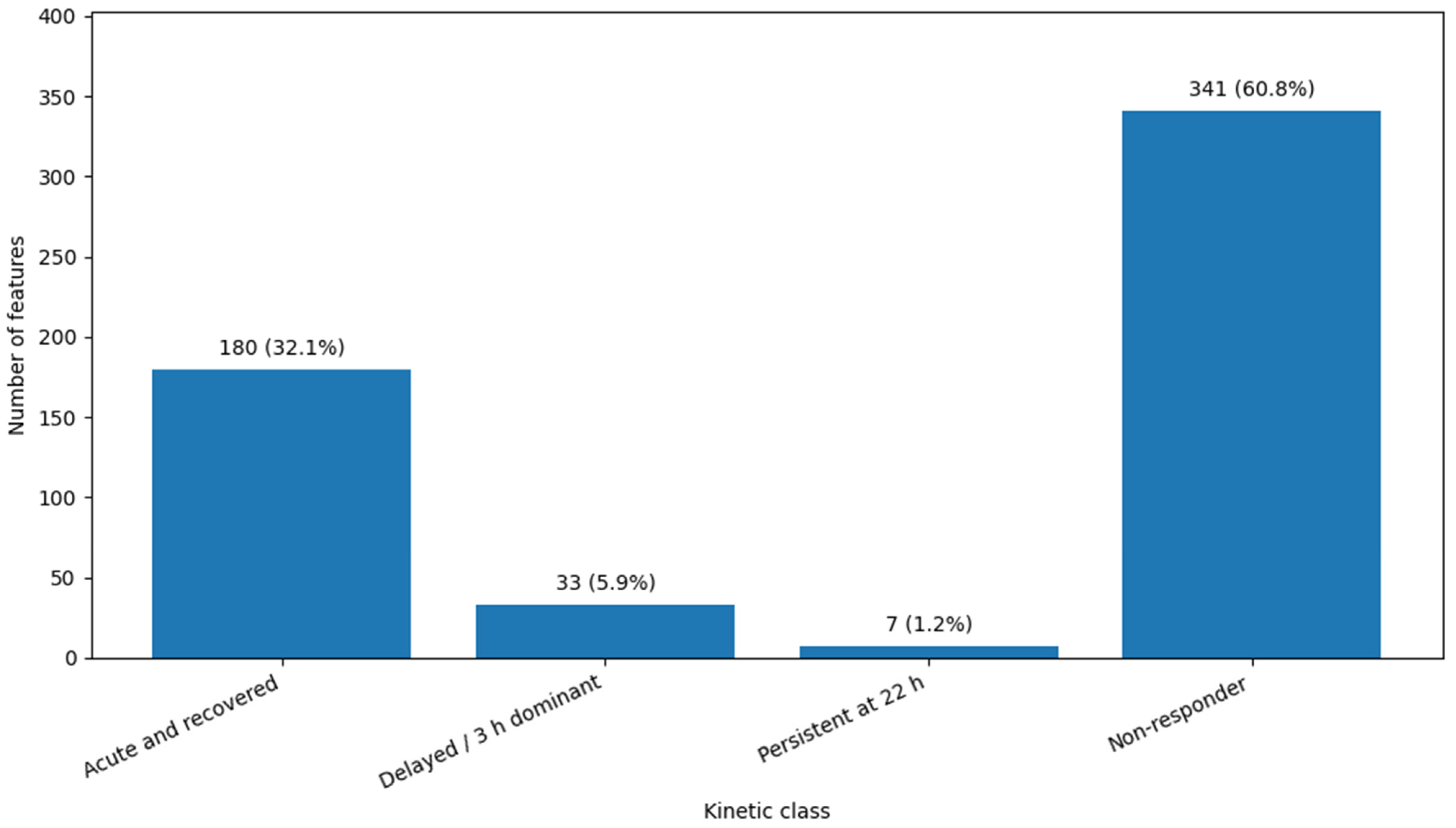
In ST003348, 188 features met the significance threshold immediately after exercise, 65 remained or became significant at 3 h, and only seven remained significantly displaced at 22 h. Thus, the dominant pattern was acute chemical perturbation followed by a substantial return toward baseline. Kinetic classification identified 180 acute-and-recovered features, 33 delayed/3 h-dominant features, and seven persistent features, while 341 features were classified as non-responders under the predefined threshold (
Figure 1).
At the chemical-class level, the significant feature counts already showed that this temporal contraction was not uniform across classes. Lipids and lipid mediators contributed the largest share of immediate signals, with 66 significant features among 103 lipid-related features. Other or weakly annotated compounds contributed 61 immediate features; amino acid derivatives, 28; peptides/protein-derived fragments, 14; nucleotides/cofactors, eight; organic acids/energy metabolites, seven; vitamins/steroids/signaling molecules, three; and carbohydrates/polyols, one. At 3 h, the lipid/lipid-mediator signal decreased from 66 to 4 significant features, whereas other or weakly annotated compounds and peptides/protein-derived fragments contributed 33 and 12 significant features, respectively. At 22 h, only seven significant residual features remained: three other or weakly annotated compounds, three peptides/protein-derived fragments, and one lipid/lipid-mediator feature. Thus, the observed 188-to-65-to-7 pattern was consistent with a large acute lipid-dominant perturbation followed by broad recovery and selective residual displacement in a small number of chemically heterogeneous features.
The present class-level summary is based on absolute median log2 fold-changes and significance status. Therefore, it should not be interpreted as a signed upregulated/downregulated inventory.
A signed Venn-style overlap among the 188 immediate, 65 3 h, and 7 22 h feature sets required an additional feature-level directionality table and was therefore considered beyond the scope of the present descriptive analysis.
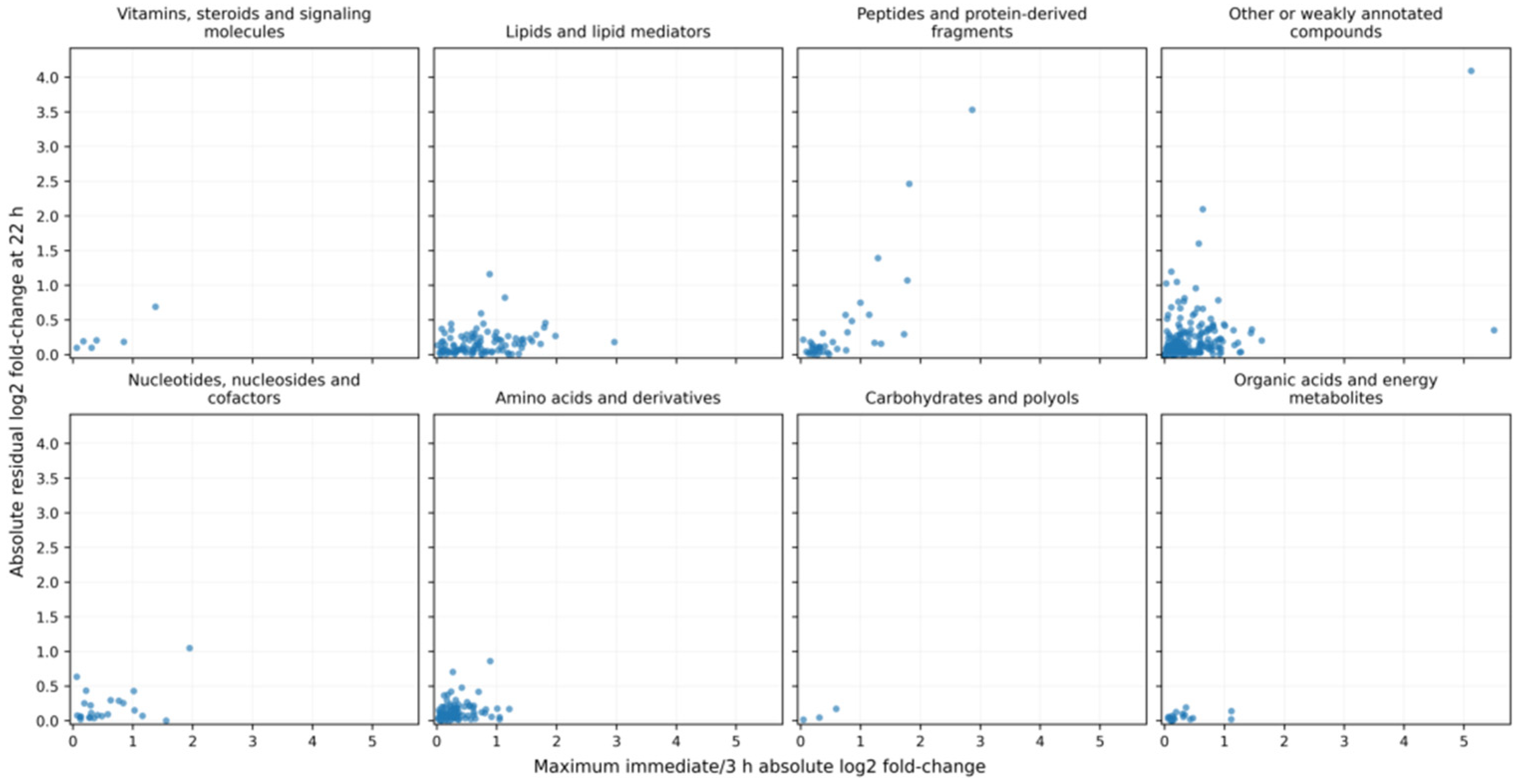
The decrease from 188 immediate responders to seven persistent 22 h responders is the key empirical basis for treating recovery as a selective chemical process rather than as a uniform decay of the whole metabolome. If all classes recovered at the same rate, class-level residual displacement would mainly reflect an immediate fold-change magnitude. Instead, the feature-level scatter and MCRI ranking showed that acute amplitude and residual displacement were related but not interchangeable. This distinction supports reporting a descriptive 22 h residual-displacement summary, but does not, by itself, validate that summary as a performance recovery biomarker.
The 33 delayed or 3 h-dominant features are also chemically meaningful. They indicate that some molecules do not reach their strongest observed perturbation immediately after exercise. This can arise from delayed mobilization, downstream metabolism, redistribution between compartments, or analytical detection of secondary products. Although the present dataset cannot assign causal mechanisms, the kinetic classification helps flag features that may be missed by simple pre/post designs.
3.3. Chemical-Class Profiles Revealed a Lipid-Dominant Immediate Response
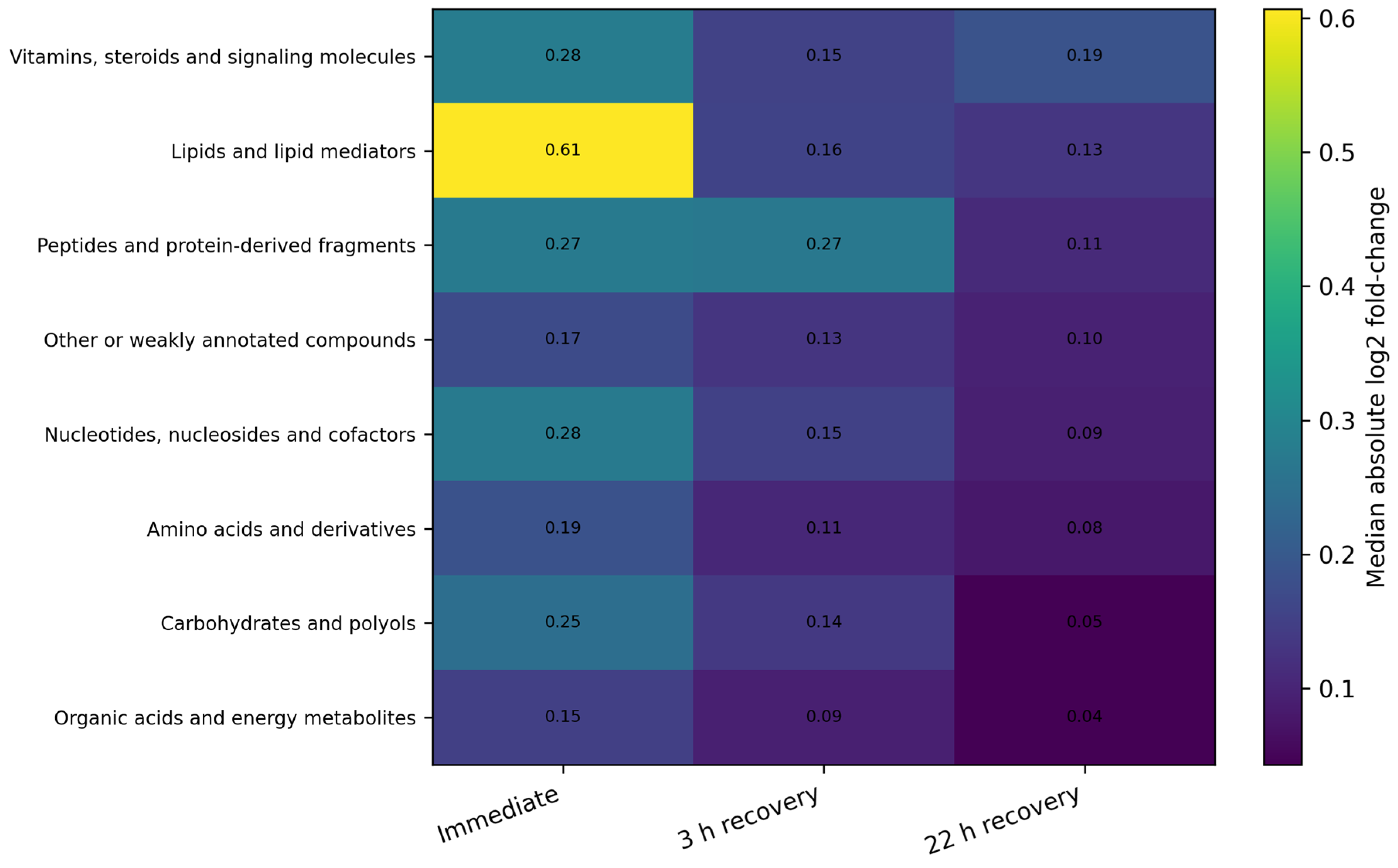
Chemical-class aggregation showed that lipids and lipid mediators had the largest median immediate absolute response, consistent with rapid exercise-induced mobilization of lipid-related metabolism (
Figure 2,
Table 2). Examples among significant lipid or lipid-mediated acute responders included CAR 16:2, stearidonic acid, oleic acid, and linoleic acid. Nucleotide/nucleoside/cofactor-related features also showed immediate perturbation, including xanthine, adenosine, and hypoxanthine. Organic acid and energy-related features such as 2-hydroxybutyric acid+3-hydroxybutyric acid, 3-hydroxyhippuric acid, succinic acid, and fumaric acid showed smaller but interpretable acute responses. This pattern is consistent with previous reports that endurance-type exercise perturbs fatty acids, acylcarnitines, oxylipins, purines, and tricarboxylic-acid-related metabolites [
1,
3,
16,
26,
27,
28,
29]. The chemical-class heatmap showed that class-level perturbation generally decreased by 22 h, supporting a recovery-dominant profile (
Figure 2).
3.4. The 22 h Residual-Displacement Summary Ranked Chemical Classes
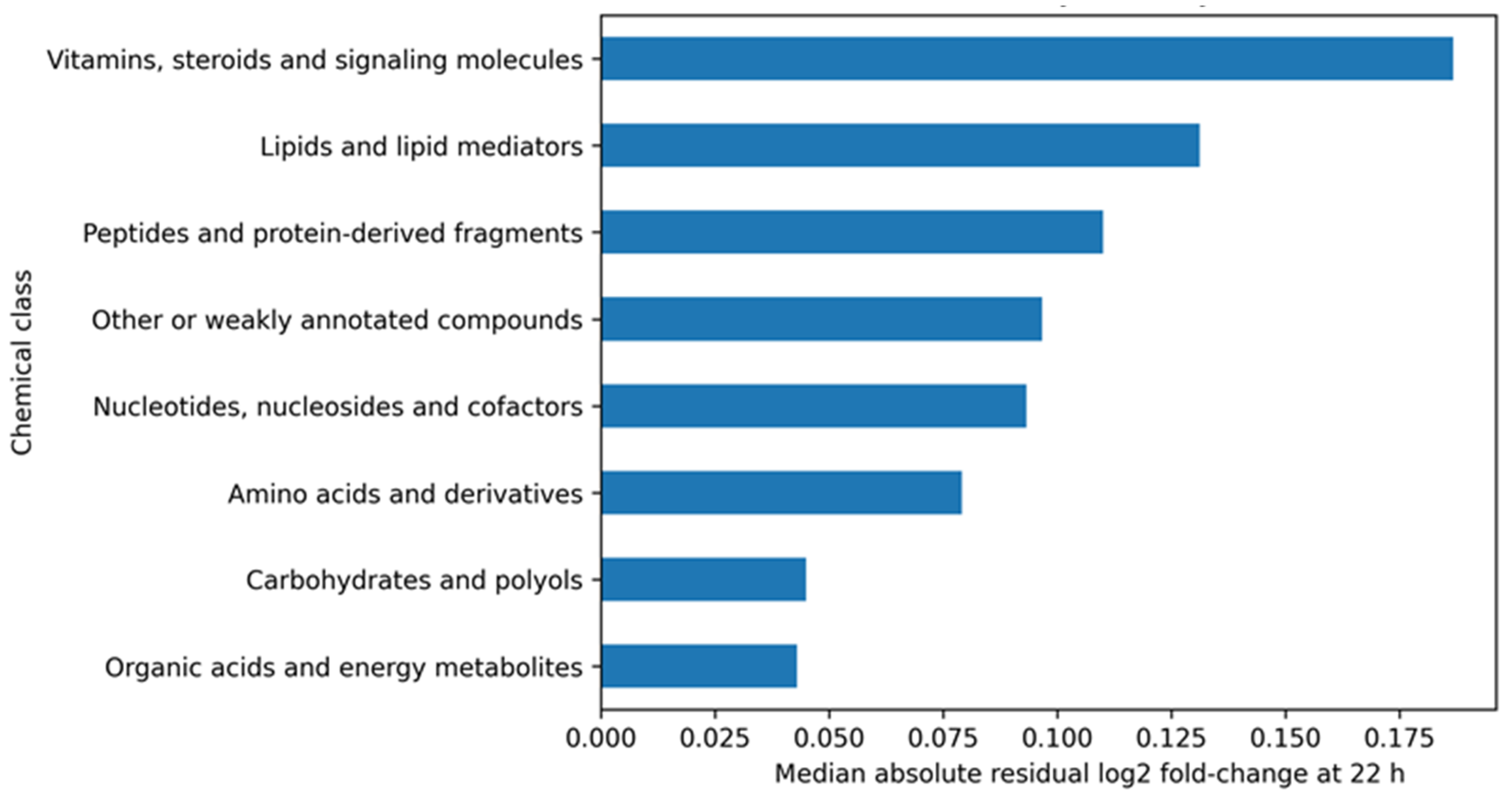
The 22 h residual-displacement summary provided a compact class-level visualization of the observed paired contrasts. Vitamins/steroids/signaling molecules had the highest residual 22 h displacement, although this class contained only six features and should therefore be interpreted cautiously. Lipids and lipid mediators had the highest combination of feature count, immediate response, and residual 22 h displacement among well-represented classes. Organic acids and energy metabolites had the lowest residual 22 h displacement, suggesting a comparatively rapid return toward baseline in this dataset (
Figure 3).
This summary should be interpreted strictly as descriptive data reduction rather than as a validated biomarker or recovery index. Its limited role is to rank chemical classes for targeted follow-up: for example, classes with a higher residual 22 h displacement and adequate feature count can be prioritized for authentic standard confirmation, whereas classes with a high acute amplitude but low residual displacement can be treated primarily as exertion markers. This descriptive use does not imply that the summary predicts performance recovery; such validation would require that prospective outcome data are unavailable in the public datasets.
The low MCRI for organic acids and energy metabolites should not be read as biological irrelevance. These features may be highly informative immediately after exercise but may return quickly toward baseline. In practical terms, this means that sample timing can determine whether an energy metabolism marker is detected as significant. The same metabolite can be a good marker for acute exertion and a poor marker for next-day recovery.
3.5. Acute Amplitude and Residual Displacement Were Not Equivalent
A feature-level comparison of acute amplitude against 22 h residual displacement, displayed by chemical class in
Figure 4, showed that a large immediate response did not necessarily imply persistent displacement. Many lipid features showed strong immediate perturbation but returned substantially toward baseline by 22 h. Conversely, the small group of persistent features was enriched for weakly annotated compounds, peptide- or protein-derived fragments, and one lipid-related feature. This distinction is important because recovery chemistry cannot be inferred from acute amplitude alone.
3.6. Cross-Dataset Direction-of-Change Reproducibility Was Strongest in the Independent Plasma Running Dataset
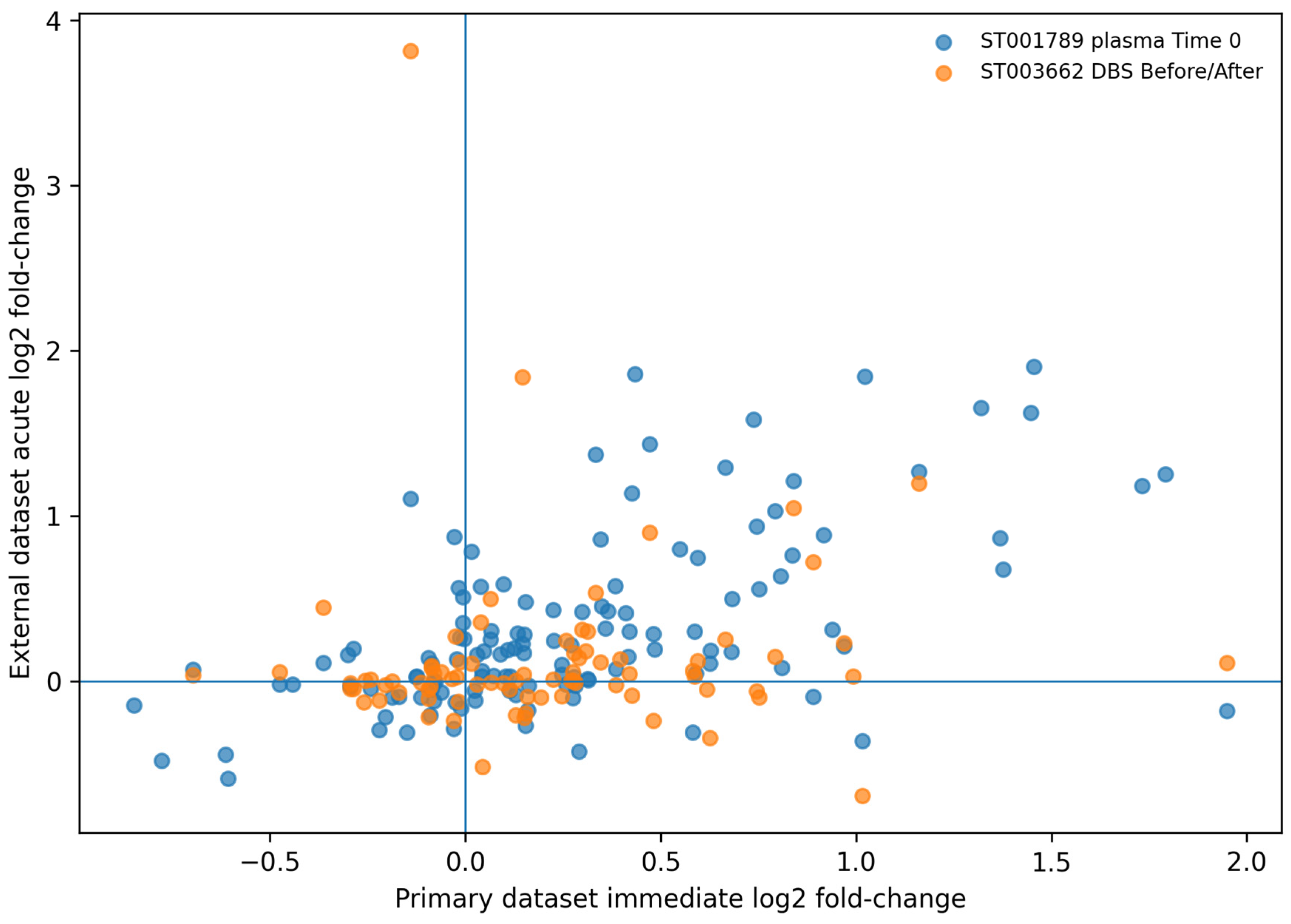
The cross-dataset direction-of-change comparison showed protocol-dependent reproducibility (
Figure 5). In ST001789, primary acute responders shared with the external plasma dataset showed 90.7% sign concordance at Time 0, with a binomial
p-value of 1.95 × 10
−10 and a Spearman’s rho of 0.543. At 60 min, concordance remained at 75.9%, indicating persistence of the primary direction-of-change signal into early recovery. In ST003662, the DBS/VAMS before/after comparison showed weaker concordance among primary acute responders (60.0%), with a non-significant binomial test (
p = 0.212) and near-zero Spearman correlation (rho = −0.006,
p = 0.977), indicating poor transportability of the primary acute signal to this matrix/protocol (
Table 3). Therefore, the external analysis supports reproducibility primarily in the plasma dataset ST001789 and does not support broad generalizability across all biospecimens and protocols [
13,
14,
15,
16].
The weak ST003662 result was not interpreted as evidence that a single chemical class failed systematically. Because only 25 primary acute responders were shared with ST003662 and because the ST003662 matrix was targeted, any class-level concordance estimate would be highly sensitive to which metabolites were included in the panel. Therefore, the available data do not support a claim that all lipid mediators, or any other chemical class, were systematically discordant in DBS/VAMS. The more conservative interpretation is that the primary serum/plasma acute signal showed limited transportability to a targeted dried blood microsampling matrix.
4. Discussion
This public-data reanalysis shows that exercise recovery can be described as a chemically structured process. The primary race-walking dataset revealed broad immediate perturbation, especially among lipid-related features, but only sparse significant residual displacement at 22 h. This finding is consistent with a recovery-dominant chemical trajectory rather than a prolonged global metabolomic disturbance. The class-level 22 h residual-displacement summary visualized this distinction, but it should not be interpreted as an outcome-validated recovery metric. In relation to the broader exercise metabolomics literature, the contribution is not the rediscovery that exercise changes metabolites; this is well established across plasma, serum, urine, dried blood spots, and multi-omic studies [
1,
2,
3,
4,
5,
6,
7,
8,
26,
27,
28,
29,
30,
31,
32,
33,
34]. The contribution is the organization of an open time-series LC-MS dataset into a recovery landscape that separates acute amplitude, delayed behavior, and residual chemical displacement without claiming that the residual summary is a validated performance recovery index.
The lipid-dominant immediate response is chemically plausible because endurance exercise rapidly mobilizes fatty acids and lipid mediators. Prior studies of cycling, running, resistance exercise, and multi-omic acute exercise have repeatedly found changes in fatty acids, acylcarnitines, ketone-related compounds, and oxylipin-like molecules [
1,
2,
3,
26,
27,
32]. However, the present analysis also shows that acute amplitude alone is an incomplete metric for recovery. Several lipid features had a high immediate response but low residual displacement, whereas some persistent features belonged to weakly annotated or peptide-related classes. For sports chemistry, this means that a useful recovery panel should include both high-amplitude acute markers and slower residual markers. A panel selected solely from the largest immediate fold changes may be analytically attractive but chemically incomplete if it does not capture residual return toward baseline.
The strongest external validation was obtained in ST001789, an independent plasma dataset collected around a 90 min run. The high sign concordance for primary acute responders suggests that a core set of exercise-induced chemical changes is reproducible across endurance-type protocols when the biospecimen is plasma or serum and sampling occurs immediately after exercise [
15,
16]. The ST003662 result should be interpreted as a weak external transportability result for DBS/VAMS-targeted measurements: 60.0% concordance did not differ statistically from chance, and the correlation was essentially zero. This does not invalidate the ST001789 plasma concordance, but it narrows the claim: the present workflow currently generalizes better across serum/plasma endurance datasets than across DBS/VAMS-targeted matrices [
13,
14].
This DBS/VAMS result has practical implications for recovery monitoring. Dried whole-blood microsampling is attractive for athlete-friendly field collection, but it is not analytically interchangeable with LC-MS of serum or plasma. Whole-blood sampling can introduce hematocrit effects, contributions from cell-associated metabolites, drying and storage effects, and differences in extraction. These factors may be especially relevant for labile or matrix-sensitive metabolites, including some lipid mediators. Consequently, future DBS/VAMS recovery panels should not assume direct transferability from serum/plasma discovery datasets. Instead, candidate recovery markers should be validated class-by-class, with particular attention given to lipids/lipid mediators, purine metabolites, amino acid derivatives, and weakly annotated persistent features.
The main methodological contribution is the combination of paired public-data reanalysis, rule-based chemical-class annotation, kinetic classification, class-level residual-displacement summarization, and cross-dataset direction-of-change reproducibility. The approach is intentionally transparent and reproducible. It avoids black-box biomarker discovery and instead asks which chemical classes perturb rapidly, which features return toward baseline, and which acute direction-of-change signals are reproducible across datasets. This is aligned with minimum reporting and data analysis principles in metabolomics, which emphasize clear sample descriptions, preprocessing, metabolite identification confidence, and statistical transparency [
18,
19,
35]. The use of shared resources such as Metabolomics Workbench, RefMet, HMDB, PubChem, KEGG, and MetaboAnalyst-like analytical concepts also positions the work within a broader reproducible chemical informatics ecosystem [
17,
22,
23,
24,
25,
36,
37].
4.1. Implications for Applied Sports Chemistry
The most direct application is the rational design of targeted LC-MS panels for recovery monitoring. Based on the present results, an illustrative—not clinically validated—panel would deliberately include: (i) lipid mobilization markers with strong acute responses, such as CAR 16:2, stearidonic acid, oleic acid, and linoleic acid; (ii) purine turnover markers, such as xanthine, adenosine, and hypoxanthine; (iii) short-lived organic-acid/energy markers, such as 2-hydroxybutyric acid+3-hydroxybutyric acid, 3-hydroxyhippuric acid, succinic acid, and fumaric acid; and (iv) a small residual-displacement module selected from persistent or higher 22 h displacement features after structural confirmation. The purpose of this panel would be analytical triage: acute markers indicate recent exertion, whereas persistent or higher 22 h displacement markers identify classes requiring next-day verification.
A second application is formulation science. Hydration products, carbohydrate electrolyte solutions, protein supplements, polyphenol-rich recovery products, and lipid-related interventions are often evaluated with performance endpoints or a small number of clinical chemistry markers. The public-data framework developed here can generate hypotheses about which chemical classes to measure when evaluating such interventions. For example, if an intervention claims to improve recovery after endurance exercise, the appropriate analytical question is not only whether it changes lactate or glucose, but also whether it modifies lipid-mediator recovery, purine turnover, amino acid handling, and residual 22 h chemical displacement at a defined time point. Concrete use case: in a controlled carbohydrate–electrolyte or protein recovery trial, investigators would sample pre-exercise, immediately post-exercise, 3 h, and 22 h. The intervention would not be considered chemically supported merely because lactate or glucose changes acutely; instead, it would be considered to reduce residual chemical displacement only if pre-specified class(es) with higher residual 22 h displacement—for example, a well-represented class such as lipids/lipid mediators in this dataset—show a lower 22 h absolute log2 fold-change than the control condition without suppressing the expected acute exertion markers. This is a research workflow, not a current recommendation for athlete-level decision-making.
A third application is the study design. The present findings show why at least three post-exercise windows are informative: immediate sampling captures acute exertion chemistry, a short recovery window captures delayed or secondary responses, and a next-day window captures residual displacement. Public datasets with only pre/post sampling can still be useful, but they cannot distinguish acute-and-recovered features from persistent features. Future sports chemistry studies should therefore treat the sampling time as an analytical variable of equal importance to instrument type or normalization strategy.
The framework could support sports chemistry in several ways. First, it offers a quantitative basis for selecting recovery biomarkers beyond lactate or glucose alone. Second, it can guide targeted analytical panels by ranking chemical classes with a high acute response or residual recovery burden. Third, it provides a public-data strategy for comparing training modalities, nutrition interventions, hydration products, and recovery protocols without requiring a new wet-lab study at the discovery stage. Fourth, it may help distinguish markers of acute exertion from markers of incomplete recovery, which is relevant for athlete monitoring, return-to-training decisions, and formulation of recovery products. Finally, by emphasizing the chemical class rather than a single named feature, the method can be adapted when different LC-MS platforms measure partially overlapping metabolite panels [
7,
8,
30,
31,
32,
33,
34].
4.2. Limitations
Several limitations are important. The analysis used named metabolite matrices rather than raw LC-MS feature extraction, so conclusions depend on the original preprocessing, peak integration, metabolite annotation, and quality control. The chemical-class annotation was rule-based and broad; it should be treated as a transparent stratification tool, not as a substitute for structural curation or MS/MS-level confirmation. Some features remained weakly annotated, and this dominated the persistent signal, meaning that follow-up studies should prioritize structural clarification. ST003662 used DBS/VAMS and targeted quantification, while ST001789 used plasma and a different endurance protocol; therefore, external validation was intentionally interpreted at the level of direction of change rather than exact effect-size equality. A further limitation is that the present analysis did not include a powered class-stratified ST003662 concordance analysis or a signed feature-level overlap table across the immediate, 3 h, and 22 h sets. Such analyses would require additional feature-level calculations. Therefore, this manuscript avoids unsupported claims about the lowest concordance chemical class in ST003662, systematic lipid-mediator disagreement, or exact overlap in upregulated/downregulated features among the 188, 65, and 7 significant feature sets. Because the public datasets do not include performance recovery or intervention endpoints, the 22 h residual-displacement summary cannot be interpreted as a validated recovery index or decision-making metric. It is, mathematically, a class-level median of the same observed paired contrasts reported in the results and is included only for transparent data reduction and visualization. The candidate panel proposed in the Discussion should therefore be viewed as illustrative until it is confirmed against authentic standards and prospective outcome data. Finally, the residual-displacement summary does not prove mechanistic causality. It should be used as a hypothesis-generating chemical index to be tested in controlled exercise protocols with standardized sampling, internal standards, and targeted verification [
18,
19,
32,
35].
4.3. Future Directions
Future work should extend the present framework in three directions. First, chemical annotation should be strengthened by linking each feature to harmonized identifiers, exact mass, formula, retention-time evidence, and, when available, MS/MS confidence. This would permit more formal testing of whether molecular descriptors such as hydrophobicity, polarity, hydrogen-bonding capacity, or lipid class predict recovery burden. Second, prospective studies should test whether class-level 22 h residual displacement predicts external recovery endpoints under controlled conditions, including a standardized diet, hydration, sleep, training load, sex-stratified sampling, and internal-standard-based quantification. Third, integration with proteomics, transcriptomics, wearable physiology, and nutrition data could determine whether a class-level residual chemical burden predicts perceived recovery, performance restoration, or adaptive training response. Future descriptor-aware models of residual chemical displacement could also draw on hybrid chemical modeling strategies that combine classical kinetic descriptors with machine-learning regressors, as recently demonstrated for controlled-release polymer membranes [
38].
The public-data strategy can also be expanded beyond endurance exercise. Resistance exercise, repeated-sprint exercise, team sports, heat stress, altitude exposure, and combined nutrition–exercise interventions may each have distinct metabolochemical recovery maps. A useful long-term goal would be an open atlas of exercise recovery chemistry in which each protocol is described by feature-level responses, class-level MCRI values, sampling windows, biospecimen types, analytical platforms, and validation status.
5. Conclusions
This study provides a reproducible applied chemistry framework for analyzing human exercise recovery from public LC-MS metabolomics data. In the primary race-walking dataset, exercise produced broad immediate chemical perturbation but limited significant residual displacement at 22 h. Lipids and lipid mediators showed the strongest immediate class-level response, while the 22 h residual-displacement summary visualized residual chemical displacement across chemical classes. External validation supported statistically significant direction-of-change concordance only in the independent plasma 90 min running dataset, while the DBS/VAMS dataset showed weak, non-significant concordance, limiting claims of generalizability across biospecimens and protocols. The kinetic classification and residual-displacement summary may help convert public sports metabolomics datasets into chemically interpretable recovery maps, but prospective validation is required before using any residual-displacement metric for athlete monitoring, recovery-product evaluation, or return-to-training decisions.
The broader message is that exercise recovery can be treated as a chemically organized analytical problem. Public LC-MS datasets, when combined with careful identifier harmonization, paired statistics, conservative recovery metrics, and external validation, can generate testable hypotheses for sports nutrition, recovery-product formulation, athlete monitoring, and targeted analytical panel design. The 22 h residual-displacement summary should therefore be viewed as a data-reduction visualization of observed paired contrasts, not as a validated recovery index, a predictor of performance recovery, or a standalone intervention guidance tool.