


Abstract
Industrial wastewater containing heavy metals such as iron (Fe) and copper (Cu) remains a major environmental concern in Malaysia, since industrial effluents significantly contribute to national water pollution loads. Without proper treatment, these contaminants can accumulate in the ecosystem and pose long term risks to human health and aquatic life. This study evaluates the performance, sludge characteristics, and cost implications of alkaline precipitation using sodium hydroxide (NaOH) and calcium oxide (CaO) in the presence and absence of a polymeric flocculant (SW204) for heavy metal removal. Experimental findings reveal that both NaOH and CaO effectively removed heavy metals, where NaOH achieved removal efficiencies of 91.6% for Fe and 93.5% for Cu, while CaO removed 98.9% of Fe and 99.17% of Cu. The addition of polymer improved the treatment efficiency where removal up to 99.73% Fe and 99.80% Cu was achieved with the CaO and polymer system. Settling time improved drastically from 30 min when using NaOH to 2 min when using CaO and the polymer system, indicating the formation of denser and more compact flocs. The specific gravity and sludge weight also increased by approximately 4% with polymer addition, which may influence the disposal costs. Economic analysis revealed that CaO treatment is substantially more cost-effective than NaOH, yielding savings of approximately RM 15.77 per m−3 of effluent treated. Therefore, the combination of CaO and polymers provided the best balance of removal efficiency, settling performance, and cost reduction. The findings support the use of CaO-based systems as sustainable, high-efficiency alternatives for industrial wastewater treatment, all of which aligns with UN Sustainable Development Goals 6 (Clean Water and Sanitation) and 12 (Responsible Consumption and Production).
1. Introduction
The presence of heavy metals such as iron (Fe) and copper (Cu) in industrial wastewater poses significant environmental and public health issues worldwide [1,2]. Today, rapid industrialization and urban growth have increased the discharge of metal-laden effluents, particularly from electronic industries, electroplating operations and metal finishing cable manufacturing. The United Nations World Water Development Report 2025 reported that more than 80% of global industrial wastewater has been discharged without treatment or with partial treatment. This has led to an increased accumulation of metal particles in aquatic ecosystems [3,4]. In Malaysia, industrial wastewater accounts for approximately one third of the total pollution load in 2024, with increased concentrations of Fe and Cu exceeding permissible limits under the Environmental Quality (Industrial Effluent) Regulations 2009 [5,6]. In electroplating and metal finishing treatments, wastewater streams often carry dissolved iron and copper compounds resulting from cleaning actions and pickling treatments. The stated concentrations of influent streams often vary from tens to hundreds of milligrams per litre, depending on specific process conditions. According to the Environmental Quality (Industrial Effluent) Regulations 2009, the permissible discharge limits of Standard B effluents are 1.0 mg/L for Cu and 5.0 mg/L for Fe. Therefore, the treatment systems require high removal efficiency and stability to ensure satisfactory operation and to meet the regulatory standards. This signifies the ongoing challenges faced by industrial sectors in order to achieve compliance with national effluent standards and highlights the urgent need for cost-effective, high-efficiency treatment technologies to mitigate heavy metal contamination in industrial wastewater.
Alkaline reagents such as sodium hydroxide (NaOH) have been commonly used as the traditional precipitation method owing to factors such as simplicity and high removal potential; however, this technique has several limitations such as high chemical cost, poor sludge settling characteristics and challenges in sludge management [7,8,9]. These limitations have prompted the use of alternative coagulants and hybrid systems which offer higher removal efficiency, reduced cost and better sludge management. To this end, calcium oxide (CaO)—or, lime—has emerged as a promising alternative to NaOH due to its lower cost, strong alkalinity and its ability to generate denser, more easily settled precipitates [10,11]. When used in combination with polymeric flocculants, such as anionic polymers (e.g., SW204), the treatment can be enhanced further through charge neutralization and bridging mechanisms which promote the aggregation of fine metal hydroxide particles into larger and faster-settling flocs.
In polymer-assisted precipitation, metal hydroxide particles formed after alkaline dosing initially exhibited surface charges that prevent aggregation. Anionic polymer chains adsorb onto these positively charged hydroxide surfaces to partially neutralize electrostatic repulsion (charge neutralization), while extended polymer chains simultaneously attach to neighbour particles to form inter-particle bridges [12]. The bridging action increases the size, density, and settling rate of the flocs, enabling the formation of compact sludge. The combined action of the lime precipitation and polymer bridging is expected to enhance the performance of the clarification process in comparison to the use of hydroxide precipitation alone [13]. Several studies have successfully demonstrated the potential of lime-based precipitation for heavy metal removal to achieve a 99% efficiency removal of Cu(II), Zn(II), and Fe(III) from various industrial wastewaters [14,15].
Although studies on alkaline precipitation have been widely reported, these studies mostly report on the removal efficiency under laboratory conditions and do not consider the operational and economic feasibility for Malaysian wastewater industries. While factors such as chemical pricing, sludge disposal cost, and settling behaviour can affect technology adoption, integrated techno-economic assessments among NaOH and CaO systems remain scarce in the literature. Therefore, the present study aims to investigate NaOH and CaO treatment systems, with and without polymer SW204, using actual electroplating wastewater to determine the removal efficiency, sludge characteristics, settling performance, and practical cost assessment to determine which is the most feasible for Malaysian industries. Findings obtained from the current study will be useful to develop cost-effective and environmentally responsible wastewater treatment practices that are aligned with the United Nations Sustainable Development Goals (SDGs) such as SDG 6 (Clean Water and Sanitation), which promotes access to safe and sustainable water resources, and SDG 12 (Responsible Consumption and Production), which emphasizes efficient resource use and waste reduction.
By providing empirical data and cost analyses relevant to the current industrial operating conditions in Malaysia, this work aims to assist industry practitioners and policymakers in optimizing treatment strategies that can reduce environmental impact and maintain economic viability. The outcomes also provide insights into integrating polymer-assisted chemical precipitation as part of circular economy approaches for wastewater management in developing regions.
2. Methodology
2.1. Materials and Reagents
Sodium hydroxide (NaOH) and calcium oxide (CaO) powder obtained from SigmaAldrich were selected as pH adjusters for the comparative evaluation. NaOH was included as an adjuster due to the strong alkalinity and rapid pH adjustment capability, while CaO was chosen as a representative lime-based reagent that raises pH and promotes the precipitation of metal hydroxides. It offers a cost-effective and widely used alternative suitable for industrial-scale application. 0.2% polymeric flocculant SW204 which is an anionic polyacrylamide-based coagulant was supplied by a local wastewater chemical distributor, characterized as a high-molecular-weight polymer (>5 × 10⁶ g·mol−1) with moderate anionic charge density suitable for the bridging and charge neutralization of metal hydroxide particles.
The wastewater samples were collected from a copper wire electroplating facility located in the southern region of Malaysia. Grab samples were collected in pre-cleaned HDPE containers from the equalization tank, stored at 4 °C during transport, and processed within 6 h in accordance with APHA 1060B guidelines to prevent changes in metal speciation. Sampling was performed at 10:00 a.m. on the same production day to minimize temporal variability.
2.2. Electrolyte pH Adjustment
Four beakers were prepared and labelled as Test 1, Test 2, Test 3, and Test 4. For Test 1 and 3, the pH was adjusted to pH 9 using NaOH, whereas for Test 2 and 4, CaO was used to achieve the same target pH, corresponding to the optimum pH range for metal hydroxide precipitation. The NaOH solution and CaO slurry were prepared as working reagents and added incrementally under continuous mixing until the target pH range was achieved. The reagents were added incrementally to avoid overshooting the desired pH. All beakers were then placed in a flocculator and subjected to continuous stirring at 140 rpm for 5 min to ensure the uniform dispersion of chemicals. The effluent pH was measured after the initial reaction period. The pH was measured using a calibrated digital pH metre with ±0.01 accuracy. If the pH deviated from the target value of 9.0 ± 0.1, additional NaOH or CaO was added dropwise under continuous stirring until stabilization within the desired pH range. The final pH for all tests was confirmed at 9.0 ± 0.1 prior to settling analysis.
2.3. Polymer Assisted Treatment
Test 1 and Test 2 beakers were set as controls. The beakers were left to settle under quiescent conditions to evaluate the natural gravity of the effluents. The total settling time was recorded and the settling interface was visually monitored. The recorded results served as the basis for baseline settling characteristics for the effluents. A total of 4 mL of 0.2% anionic polymer was added to Test 3 and Test 4 beakers each, to promote floc formation and accelerate settling. The beakers were placed in stirring condition at 100 rpm for 2 min upon the polymer dosing. The rate of floc formation was evaluated by recording the settling rate and the supernatant clarity. The clarified supernatants from Test 3 and Test 4 were then collected and analyzed for copper (Cu) and iron (Fe) concentrations using Inductively Coupled Plasma–Optical Emission Spectroscopy (ICP-OES). The results were analyzed to assess the removal efficiency achieved using different pH-adjusting chemicals and polymer dosing. Calibration curves were constructed by analyzing multi-element standards for the expected concentration range to produce correlation coefficients of R2 ≥ 0.999. Instrument and method blanks were analyzed to ensure that there was no sample contamination. Quality control samples were analyzed every ten samples to ensure the stability of the calibration curves, with an acceptable drift of 5% or less. Method detection limits (MDL) and limits of quantification (LOQ) were determined based on blank signal variability (MDL = 3σ, LOQ = 10σ). Duplicate measurements and matrix spike recovery tests (acceptable recovery 90–110%) were performed to ensure analytical precision and accuracy. Samples exceeding calibration range were diluted and reanalysed.
2.4. Settling Rate and Sludge Gravity Determination
Zone settling characteristics were evaluated by transferring the treated samples into a graduated cylinder at a fixed height using gravity flow. The solid–liquid interface was recorded at 1 min intervals for 30 min to capture the progression toward a constant settling velocity. The recorded interface heights were plotted against the time. The zone settling rate was determined from the slope of the linear of the settling curve. Sludge specific gravity was determined using APHA 2710F as described in Equation (1) below:
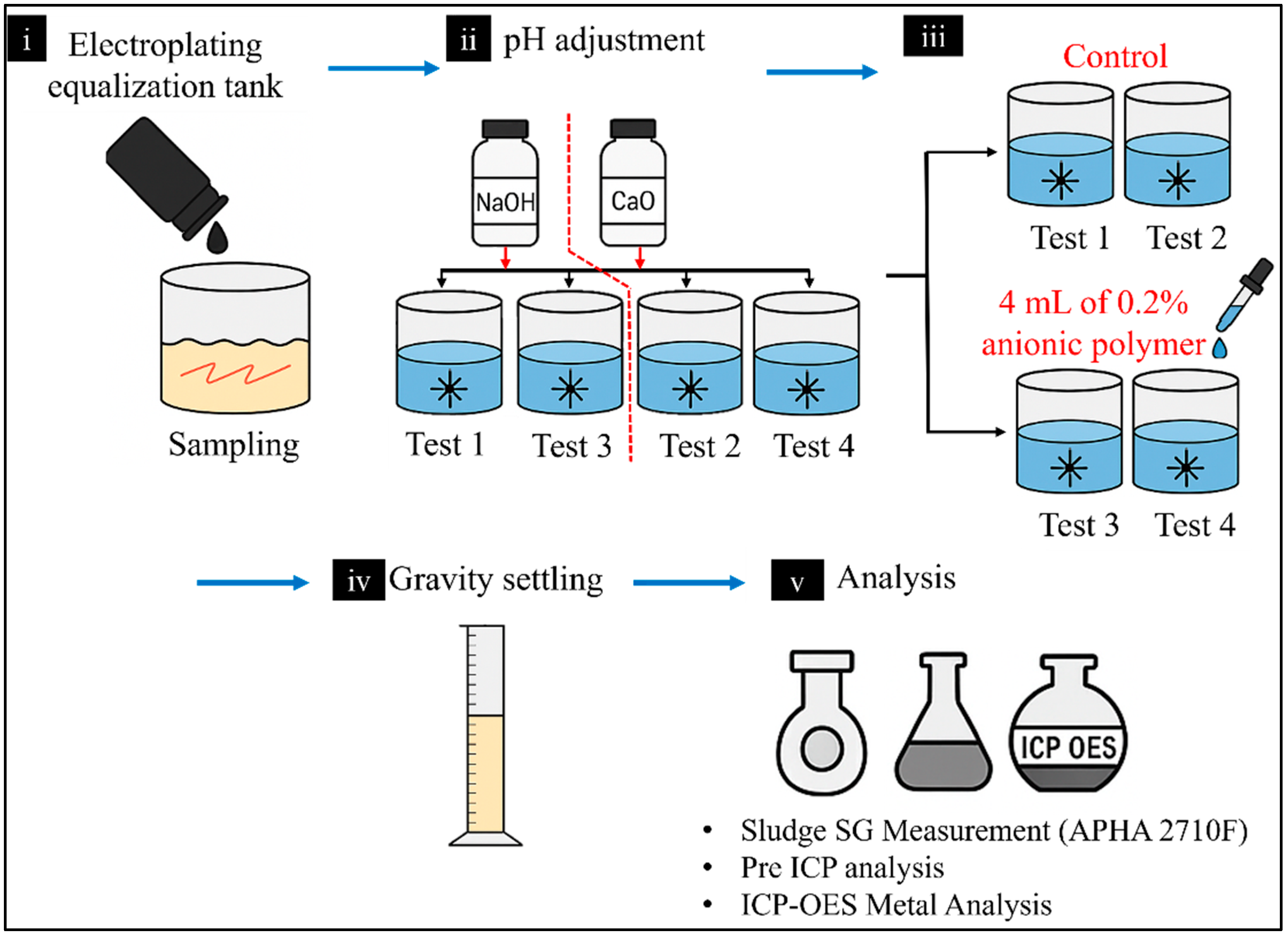
where W is the weight of empty beaker, is the weight of beaker with sludge and is the weight of the beaker with water. A pre-marked beaker was weighted empty (W), filled to the marked volume with sludge (s), and finally filled with water (R). The weight measurements were taken at all conditions and recorded to the nearest 10 mg. It is important to note that the sludge mass obtained from this procedure represents wet sludge weight, which includes both solid particles and the substantial amount of water entrapped within the hydroxide floc structure. Metal hydroxide sludges typically retain 95–99% water; therefore, wet sludge weights are significantly higher than dry solid mass values commonly reported in the literature. The specific gravity was calculated using the standard APHA formula, providing a measure of sludge density and allowing comparison of sludge characteristics produced by the different pH adjustments and polymer treatments. All experiments were performed in triplicate (n = 3), and the values are reported in the present study. Figure 1 shows the schematic illustration of experimental procedure in the current study.
Figure 1.
Schematic illustration of the experimental procedure: (i) wastewater sampling from equalization tank of copper wire electroplating facility; (ii) pH adjustment using NaOH (Test 1 and 3) or CaO (Test 2 and 4); (iii) polymer-assisted treatment (Tests 3 and 4); (iv) gravity settling; and (v) analysis stage (e.g., ICP-OES, sludge specific gravity and settling behaviour).
3. Results and Discussion
3.1. Removal Efficiency
The removal efficiencies of Fe and Cu under different treatment conditions in the current study are summarized in Table 1 and Figure 2A. The initial concentrations of Cu and Fe were 1297.1 mg/L and 7130.87 mg/L, respectively. After NaOH treatment, concentrations decreased to 84.167 mg/L (Cu) and 597.631 mg/L (Fe) respectively while CaO treatment reduced them to 10.758 mg/L and 78.776 mg/L respectively. Polymer-assisted CaO further reduced concentrations of Cu and Fe to 2.585 mg/L and 19.064 mg/L respectively. It can be seen that both NaOH and CaO treatments achieved high metal removal efficiencies, particularly with the addition of polymer coagulant. Fe and Cu removal reached 91.62% and 93.51%, respectively, for the NaOH treatment, while the use of CaO significantly improved Fe and Cu removal by 98.9% and 99.17%, respectively. This corresponds to an approximate 8% improvement in Fe removal and a 6% improvement in Cu removal compared to the use of NaOH. The addition of polymer coagulant further enhanced metal removal for both alkaline systems. The NaOH with the anionic polymer reported a Fe and Cu removal of 99.42% and 99.49%, respectively, while CaO with the anionic polymer reported the highest removal efficiency for Fe and Cu, i.e., 99.73% and 99.8%, respectively. This represents a marginal improvement of less than 1% compared to treatment with CaO alone, suggesting that while the addition of an anionic polymer enhances floc formation, CaO by itself is already highly effective in achieving near-complete removal.
Table 1.
Concentration trends of Cu and Fe before and after treatment.
The mechanism which represents the metal ion removal process in the current study is shown in Figure 2B. The addition of sodium hydroxide (NaOH) or calcium oxide (CaO) as the coagulant to the contaminated water increased the pH of the solution and promoted the formation of insoluble metal hydroxides. Unlike NaOH, CaO will first hydrate to Ca(OH)2, i.e., CaO + H2O → Ca(OH)2 to release OH− ions. This reaction, which is slightly exothermic and temperature-dependent, will improve dissolution and floc formation, which leads to faster settling in turn. These coagulants destabilize the surface charge of dissolved and colloidal metal ions such as Fe2+ and Cu2+ to allow for the aggregation of particles and formation of larger flocs. The process involves three main stages: (i) the destabilization of charged metal ions, (ii) the entrapment of the metal ions within the coagulant matrix, and (iii) the precipitation of flocs through sedimentation. The addition of the anionic polymer (SW204) promotes this mechanism by bridging adjacent particles and neutralizing the residual surface charge to accelerate floc growth and improve overall solid–liquid separation [16].
Figure 2.
(A) Removal efficiencies of Fe and Cu under different chemical treatment conditions. (B) Schematic illustration of the coagulation–flocculation mechanism showing the metal hydroxide precipitation and floc formation, reproduced from [17] with permission from Springer.
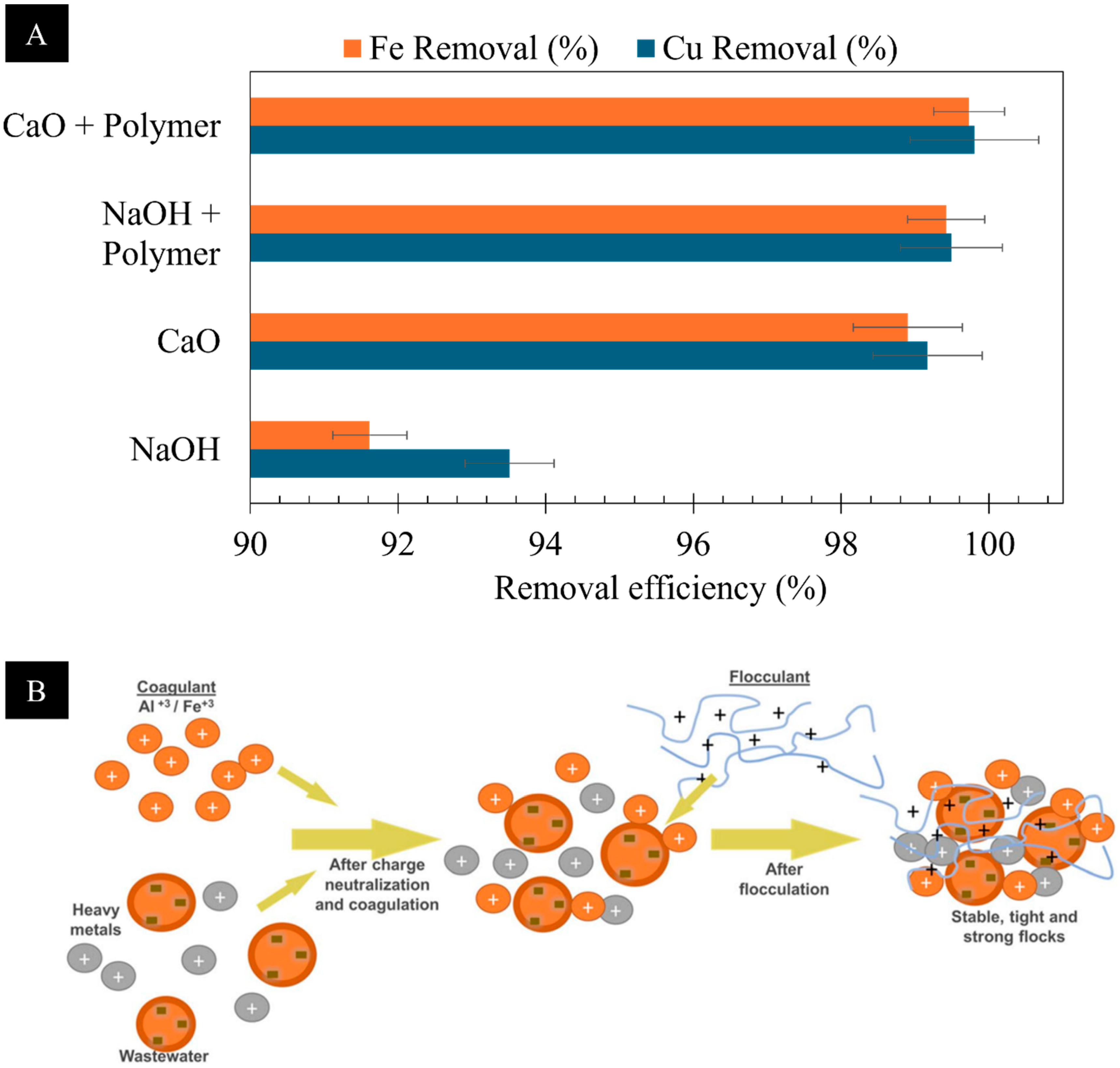
It is worth noting that the removal efficiencies of Fe and Cu showed only minor variations across the treatments, indicating that both metals exhibit similar precipitation behaviour under alkaline conditions. The consistently high removal efficiencies (>99%) for polymer-assisted treatments highlight the synergistic effect of coagulation and precipitation mechanisms in achieving near-complete removal of dissolved metals. In summary, the findings indicate that, when combined with an anionic polymer, CaO is the most effective treatment in achieving more than 99% Fe and Cu removal, whereas NaOH delivers good but noticeably lower removal performance. Although there is only a moderate difference in removal efficiency, the practical advantage of CaO becomes significant when combined with its faster settling behaviour and improved sludge characteristics, as discussed in Section 3.2.
The findings obtained in this study are consistent with those reported in previous studies on heavy metal removal via hydroxide precipitation. Lejwoda et al. reported that precipitation with CaO in the 8–11 pH range achieved removal efficiencies of approximately 99% for various metals including Fe and Cu [11]. Benalia et al. showed that chemical precipitation using lime (Ca(OH)2), caustic soda (NaOH), and soda ash (Na2CO3) at doses ranging from 10 to 400 mg/L achieved more than 90% removal efficiency for Cu(II) and Zn(II) from cable industry wastewater, where optimal performance was observed at pH 8–10. The resulting sludge, which consisted mainly of Cu(OH)2 and Zn(OH)2, showed higher copper content in comparison to zinc, while treatment with soda ash produced larger and denser sludge particles with the sludge volume reduced by 20–30% to provide a more cost-effective alternative in comparison to other reagents [18].
3.2. Zone Settling Time
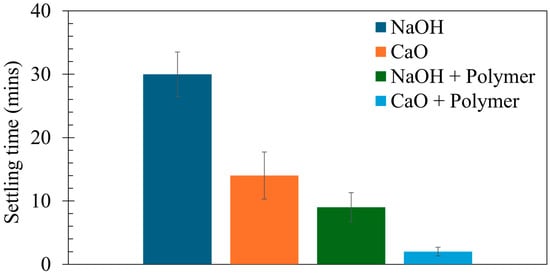
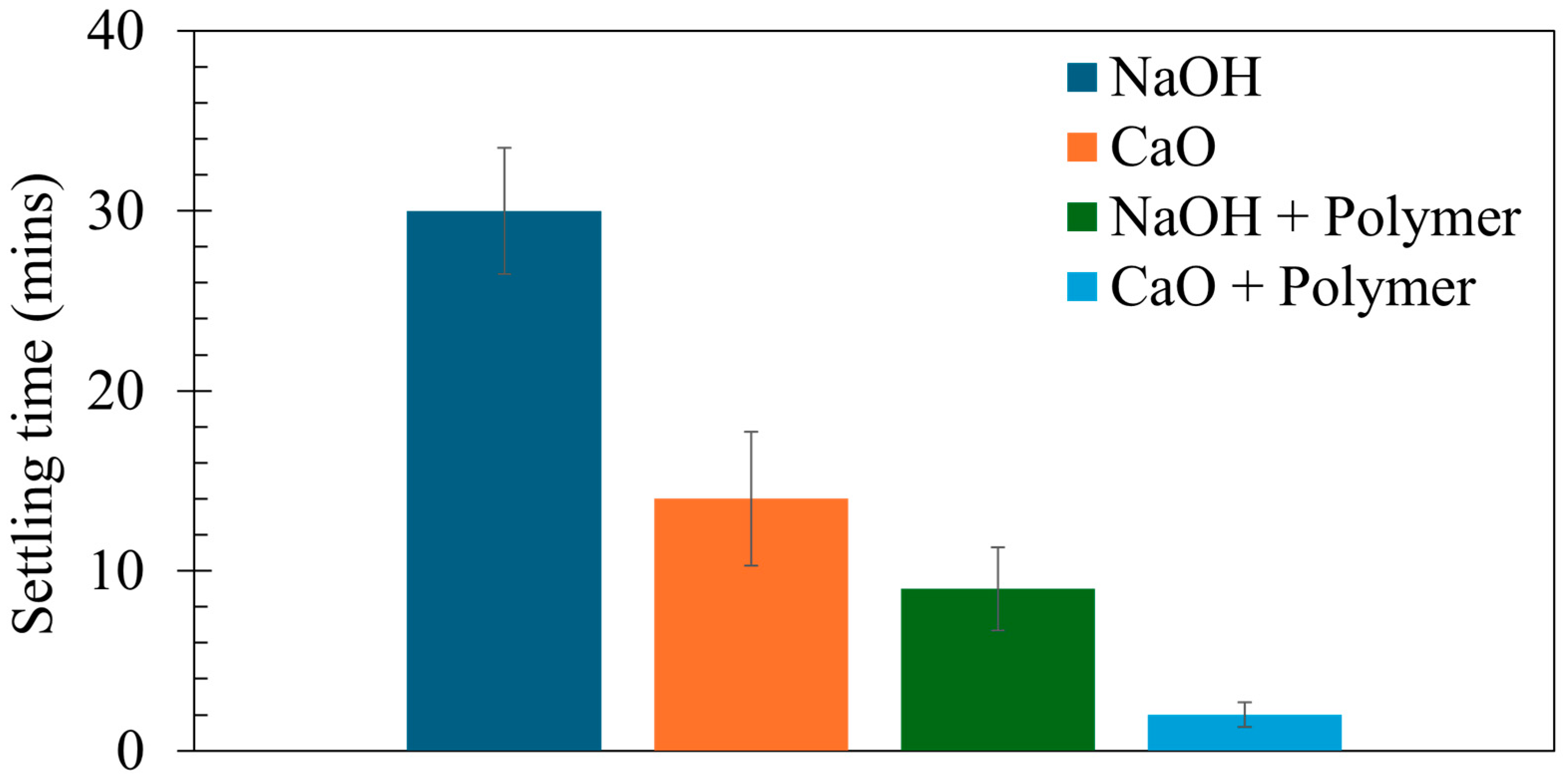
The effect of the treatment reagents on sludge settling time is shown in Figure 3. The settling time decreased substantially with the addition of a polymer and when CaO was used instead of NaOH as the alkaline precipitant. The NaOH system exhibited the longest settling time of 30 min, which indicates slower floc formation and lower settling velocity of the precipitated metal hydroxides. In contrast, replacing NaOH with CaO reduced the settling time to 14 min, which suggests that CaO generated denser and more compact flocs that settled more readily.
Figure 3.
Effect of various chemical treatments on sludge settling time.
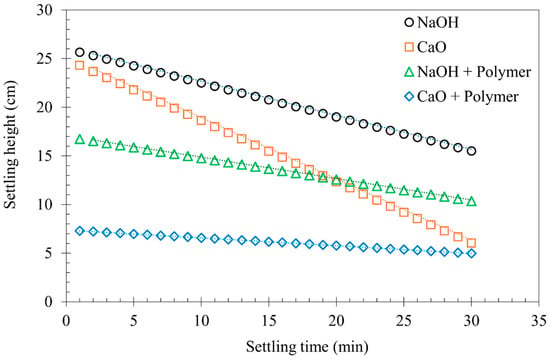
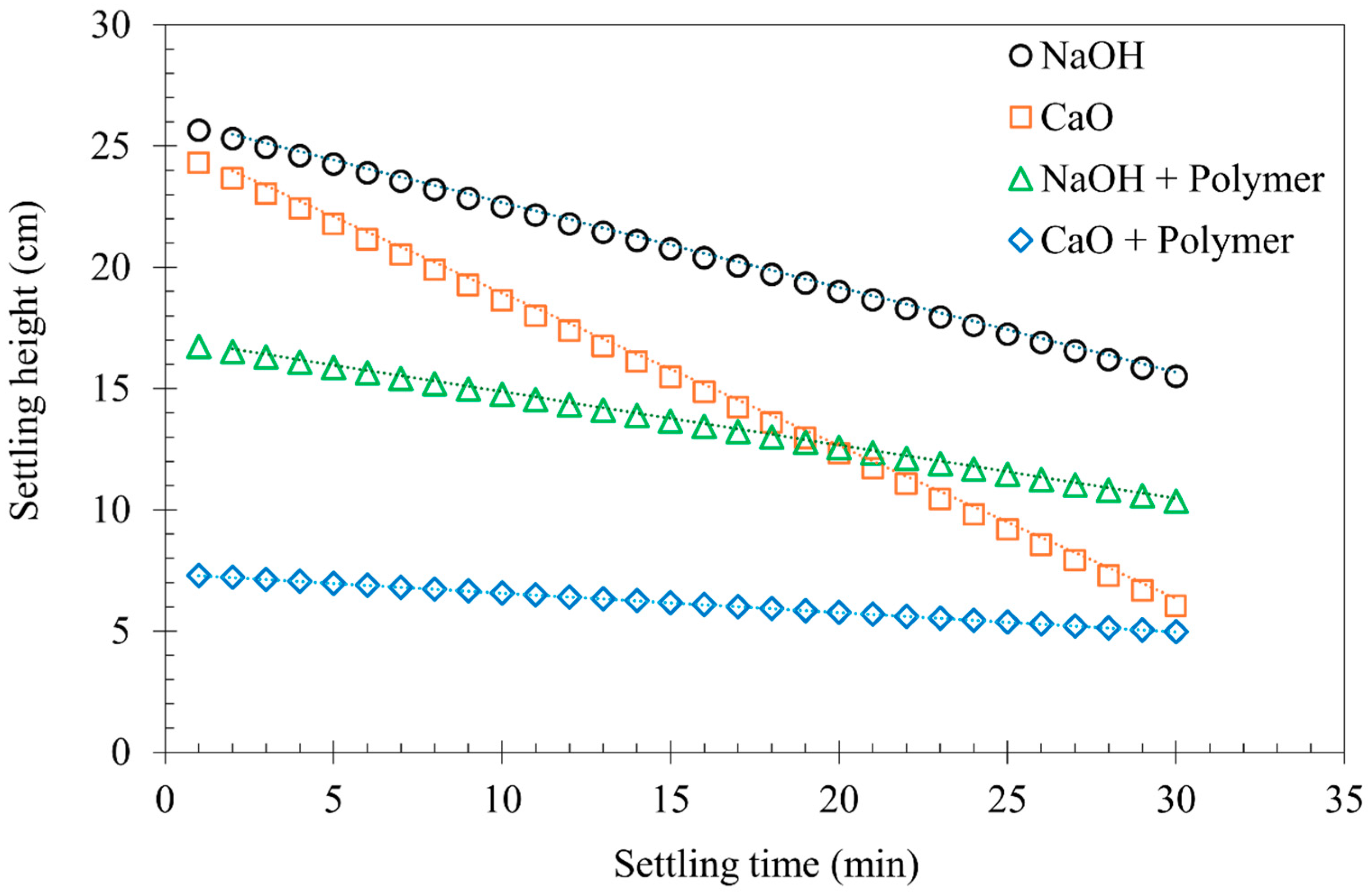
The effects of different treatment reagents on sludge settling time and height were examined and are shown in Figure 4. The results indicate a significant improvement in both parameters with the addition of a polymer coagulant and the substitution of NaOH with CaO as the alkaline precipitant. The NaOH with polymer treatment shortened the settling time to 9 min, while the CaO and polymer combination achieved the fastest settling of only 2 min. This represents an overall reduction of approximately 93% in settling time compared to NaOH alone. The polymer likely promoted aggregation through bridging and charge-neutralization mechanisms, resulting in larger and heavier flocs that settled more efficiently [16].
Figure 4.
Settling height versus time, showing the effect of different coagulants and coagulant–polymer combinations on sludge settling behaviour.
These results are consistent with findings from the literature, where polymer addition is reported to significantly accelerate sedimentation in chemically precipitated sludges. Yang et al. systematically evaluated the effects of sludge properties, such as the solid concentration, soluble extracellular polymeric substances (SEPSs), and alkalinity, on sludge dewatering using polyaluminum chloride (PACl). Results showed that higher solids concentration improved dewaterability and reduced PACl demand, while excessive SEPS and alkalinity hindered conditioning efficiency by promoting complexation and converting active hydroxy-aluminum species into less effective amorphous hydroxides [19]. These observations align with studies on chemical precipitation of heavy metals, where sludge properties and particle interactions similarly influence sedimentation and dewaterability.
Chen et al. compared the use of lime (Ca(OH)2), soda ash (Na2CO3), and sodium sulfide (Na2S) for the removal of Zn(II), Cu(II), and Pb(II) from aqueous solutions, achieving over 99.99% removal of copper and zinc and up to 99.75% for lead using Na2S. The particle size distribution (55 nm–45 μm) and zeta potential of the precipitates were found to control the sludge settling performance, with ultra-fine CuS particles (~55 nm) exhibiting poor sedimentation due to electrostatic repulsion [20]. In the present study, the combination of CaO and polymer yielded the most favourable settling characteristics, drastically reducing sedimentation time while maintaining high metal removal efficiencies.
In addition to the improvements in settling time and metal removal efficiencies, the impact of different pH adjusters on the specific gravity (SG) and weight of the generated sludge were also examined. As shown in Table 2, the sludge exhibited a higher SG when CaO was used as the pH adjuster compared to NaOH, showing an increase of 3.84%. The increase in SG directly affects the weight of the sludge, potentially leading to higher disposal costs. In the current study, the volume of sludge generated was 200 mL per 1000 mL of the sample, which corresponds to a sludge generation rate of 20%. Based on the SG values obtained, the weight of the sludge to be disposed was calculated to be 202 g for Test 1 (NaOH only), 210 g for Test 2 (CaO only), 204 g for Test 3 (NaOH with the anionic polymer) and 212 g for Test 4 (CaO with the anionic polymer).
Table 2.
Specific gravity of sludge after treatment with NaOH, CaO, and their combinations with polymer.
It should be noted that the sludge weights reported above are indicative of wet sludge mass, which contains large amounts of water that are usually entrapped within metal hydroxide flocs. The wet sludge commonly contains 95–99% moisture, which results in higher sludge weights in terms of the cubic metres of wastewater treated. The wet sludge mass and specific gravity provide practical indicators of sludge moisture retention and dewaterability relevant to industrial sludge handling and disposal operations. Hydroxide sludges produced from Fe and Cu precipitation are known to retain large volumes of interstitial water which often results in wet sludge densities of 1.0–1.1 g/mL. Thus, an apparent wet sludge volume of 200 mL per 1000 mL of the sample, which corresponds to ≈200 kg/m3 wet sludge, is consistent with values reported in industrial lime treatment systems. The corresponding dry solid content of the sludge is therefore much lower and falls within ranges reported in the chemical precipitation literature [21].
Hence, the combination of CaO and the polymer yielded the most efficient solid–liquid separation to significantly reduce the settling time while maintaining high metal removal efficiencies. These results highlight the synergistic benefits of using CaO as the primary precipitant, in combination with a polymeric flocculant, to optimize both metal removal and the sludge settling characteristics in heavy-metal treatment systems.
The findings from the current study show a 3.84% increase in sludge weight when CaO was used as the pH adjuster compared to NaOH. The sludge weight increased by 4.72% when the anionic polymer was added to the CaO treatment. The increase in sludge weight highlights the importance to consider both metal removal efficiency as well as the practical aspects of sludge disposal while selecting the appropriate treatment system. While CaO, results in higher metal removal efficiencies and faster settling times, in particular when combined with a polymer, the additional weight of the sludge produced can affect the disposal costs incurred. Thus, the choice of the pH adjuster and use of polymeric coagulants should be carefully considered against the costs involved for sludge handling and disposal.
3.3. Cost Comparison and Economic Assessment
The cost analysis was conducted to evaluate the economic feasibility of using different coagulants such as sodium hydroxide (NaOH) and calcium oxide (CaO) with and without the addition of polymer (SW204) in the treatment of industrial effluent. Based on the comparison between treatment performance and cost breakdown as shown in Table 2, it was estimated that the unit cost-saving of RM 15.77/m3 could be achieved when CaO was used as the coagulant instead of NaOH under the same operating conditions. The unit cost-saving was calculated based on the difference in total treatment cost per m3 between baseline coagulant (NaOH) and optimized coagulant (CaO). Hence, based on values reported in Table 2, if the total treatment cost without the polymer for NaOH and CaO was RM 399.37 and RM 383.60, respectively, the cost-saving of RM 15.77/m3 can be achieved. Similar unit cost-saving was achieved for polymer-assisted treatments.
To estimate the practical financial impact, an average discharge rate of 3.0 m3/h was assumed [22]. The estimated flow rate is common among small- to medium-scale industrial facilities in Malaysia such as food-processing, chemical blending and metal finishing plants. Industrial effluent generation in these facilities generally falls within range of few m3/h, depending on production capacity and onsite water reuse systems which is consistent with reported monitoring practices in Malaysian industries [23]. The 8 h per day of operation indicates a single-shift operation, to align with the standard Malaysian industrial working hours, and accounts for non-continuous discharge periods such as during maintenance or non-production hours. In addition, the 26 days per month of the operation period represents the average working days in a month, which excludes the weekends and public holidays.
Based on the unit cost-saving of RM 15.77/m3, the estimated monthly cost-saving is:
For a single-shift operation, this in turn corresponds to an annual saving of approximately RM 118,or 085.76/year. The following considerations were used to clarify the values presented in Table 3.
Table 3.
Cost comparison between coagulants.
- i.
- Sludge disposal cost is based on an assumed rate of RM 1.80/kg, representing typical industrial waste disposal fees in Malaysia.
- ii.
- Sludge mass (202–212 kg/m3) is determined from pilot-scale treatment studies for the respective coagulants, with slightly higher mass when polymer SW204 is added.
- iii.
- Chemical prices are based on the latest available data: NaOH at RM 3.05/kg (import price in Asia, US$653/tonne, 2024) and CaO at RM 0.56/kg (Malaysia, US$119/tonne, September 2025). Polymer SW204 is priced at RM 1.80/kg.
- iv.
- Cost savings (RM 15.77/m3) reflect the difference between baseline treatment costs and optimized chemical treatment costs.
Findings from the current study show that calcium oxide (CaO) is a more cost-effective coagulant compared to sodium hydroxide (NaOH). This is due to its substantially lower market price. The treatment produced approximately 202–212 kg of wet sludge per m3 of wastewater treated, which directly influences sludge transport and disposal requirements. Although CaO generates slightly more sludge per cubic metre of treated effluent (210 kg/m3 for CaO and 202 kg/m3 for NaOH), the increase in disposal cost is marginal compared to the difference in chemical expenditure. It should also be noted that the additional amount of sludge that is generated might offset the cost savings due to the higher handling costs. In actual applications, plants with large sludge disposal costs or limited dewatering capacity might experience a reduction in cost savings compared to the estimated cost of treatment per unit. As such, the selection of the optimal treatment process should consider the sludge handling capacity of the plants.
The addition of anionic polymer SW204 resulted in a modest increase in sludge production (212 kg/m3 for CaO + polymer, 204 kg/m3 for NaOH + polymer) due to enhanced flocculation and higher solid capture. Nevertheless, the increase is beneficial since it improves clarification, reduces turbidity in the treated effluent, and can decrease downstream filtration or polishing requirements. From an operational perspective, the combination of CaO with polymer provided an optimal balance between the cost of chemicals involved, sludge generation, and treatment efficiency. The rapid settling rate reported in the current study will reduce retention time in clarifiers, which can improve throughput and potentially lower the energy consumption in continuous operations in turn. Moreover, the improved sludge compaction can decrease the volume of dewatered sludge which can reduce transport and disposal costs over time.
From the industrial scalability perspective, minor unit cost differences can accumulate into significant annual savings. For instance, larger facilities with continuous discharge of 10 m3/h over 24 h per day will treat:
which can achieve estimated total annual savings of:
Similarly, plants operating at 15 m3/h can exceed total savings of RM 200,000. It should be added that the values are obtained directly from the unit cost-saving reported in the present study and hence, external economic assumptions were not made. The findings in the current study highlight the economic advantage of choosing an appropriate coagulant–polymer system, especially in sectors with high water usage and stringent effluent quality requirements. From a scale-up aspect, reduced settling time can reduce the clarifier volume requirements (capex), while the reduced chemical consumption can lessen the operating cost (opex). However, it should be noted that the increased sludge production may require larger sludge handling or dewatering capacity.
Other than the economic considerations, the use of CaO also has several environmental benefits. For instance, calcium-based coagulants produce fewer chemically reactive residues and can help to neutralize acidic effluents to enhance pH stability in treated water [15]. In addition, CaO residues can be repurposed or stabilized for safe disposal, while NaOH residues tend to produce higher alkalinity in sludge, which may require further neutralization prior to landfill disposal. The adoption of the polymer-assisted CaO system does not only improve treatment efficiency but also aligns well with national objectives for sustainable wastewater management, all of which supports Malaysia’s Sustainable Development Goals such as SDG 6 (Clean Water and Sanitation) and SDG 12 (Responsible Consumption and Production). A complete life-cycle assessment (LCA) is recommended in future work to quantify the environmental trade-offs between CaO (calcination-related emissions) and NaOH (electricity-intensive chlor–alkali production).
4. Conclusions
In conclusion, calcium oxide (CaO) combined with an anionic polymeric flocculant (SW204) effectively removed Fe and Cu from industrial wastewater. Treatment with CaO alone achieved high removal efficiencies of 98.9% for Fe and 99.17% for Cu, which were further improved with the addition of an anionic polymer, reaching 99.73% Fe and 99.80% Cu removal (final concentrations of 19.064 mg/L Fe and 2.585 mg/L Cu). In addition, sludge settling time and compaction were enhanced with the CaO treatment combined with an anionic polymer, where sedimentation time was reduced by over 90% compared to NaOH alone. The treatment produced heavier sludge with higher specific gravity, with significant implication on disposal management. Economic assessment indicated that CaO is more cost-effective compared to NaOH due to the lower chemical price, while polymer-assisted treatments offer additional operational advantages such as faster clarifier throughput, improved effluent clarity, and reduced downstream treatment requirements. Hence, the combination of CaO and anionic polymer provided an ideal performance of high metal removal efficiency, rapid sludge settling and economic feasibility, all of which supports their application in industrial wastewater treatment and promotes sustainable water management practices. Future studies can investigate pilot-scale validation under continuous flow conditions, assessment of sludge dewatering or valorization options and LCA to determine the environmental trade-offs such as the carbon footprint between CaO- and NaOH-based treatment systems.
Author Contributions
Conceptualization, S.S.; methodology, S.S. and T.R.; formal analysis, S.S., T.R. and K.M.; investigation, T.R.; resources, S.S.; data curation, K.M., S.R., T.R. and S.S.; writing—original draft preparation, K.M., S.R. and T.R.; writing—review and editing, S.S.; visualization, supervision and funding acquisition, S.S. All authors have read and agreed to the published version of the manuscript.
Funding
This research was carried out at Universiti Putra Malaysia.
Institutional Review Board Statement
Not applicable.
Informed Consent Statement
Not applicable.
Data Availability Statement
The data supporting findings of this study will be provided upon request from the corresponding authors.
Conflicts of Interest
The authors declare no conflicts of interest.
Abbreviations
| APHA | American Public Health Association |
| CaO | Calcium Oxide |
| Cu | Copper |
| Fe | Iron |
| HDPE | High-Density Polyethylene |
| ICP-OES | Inductively Coupled Plasma–Optical Emission Spectroscopy |
| NaOH | Sodium Hydroxide |
| PACl | Polyaluminum Chloride |
| RM | Ringgit Malaysia |
| SDGs | Sustainable Development Goals |
| SEPS | Soluble Extracellular Polymeric Substances |
| SG | Specific Gravity |
| SW204 | Anionic Polymeric Flocculant |
| UN | United Nations |
References
- Tsoutsa, E.K.; Tolkou, A.K.; Kyzas, G.Z.; Katsoyiannis, I.A. New Trends in Composite Coagulants for Water and Wastewater Treatment. Macromol 2024, 4, 509–532. [Google Scholar] [CrossRef] [Scilit]
- Liu, W.; Li, M.; Zhang, T.; Li, G.; He, Y. Preparation and Application of Magnetic Flocculant (MPCF) Derived from Ac-id-Immersion Industrial Waste Slag. Water Air Soil Pollut. 2025, 236, 514. [Google Scholar] [CrossRef] [Scilit]
- Bijekar, S.; Padariya, H.D.; Yadav, V.K.; Gacem, A.; Hasan, M.A.; Awwad, N.S.; Yadav, K.K.; Islam, S.; Park, S.; Jeon, B.-H. The State of the Art and Emerging Trends in the Wastewater Treatment in Developing Nations. Water 2022, 14, 2537. [Google Scholar] [CrossRef] [Scilit]
- Khan, S.H.; Yadav, V.K. Advanced Oxidation Processes for Wastewater Remediation: An Overview. In Removal of Emerging Contaminants Through Microbial Processes; Springer: Singapore, 2020; pp. 71–93. [Google Scholar] [CrossRef] [Scilit]
- Mokhtar, Z. Review of Malaysia’s environmental waterway compliances with industrial effluent discharge. Int. J. Bus. Econ. Law 2023, 30, 151–165. [Google Scholar]
- Mansor, M.; Fatehah, M.O.; Aziz, H.A.; Wang, L.K. Occurrence, Behaviour and Transport of Heavy Metals from Industries in River Catchments. In Industrial Waste Engineering; Springer International Publishing: Cham, Switzerland, 2023; pp. 205–277. [Google Scholar] [CrossRef] [Scilit]
- Fu, F.; Wang, Q. Removal of heavy metal ions from wastewaters: A review. J. Environ. Manag. 2011, 92, 407–418. [Google Scholar] [CrossRef] [Scilit] [PubMed]
- Li, H.; Jin, Y.; Mahar, R.; Wang, Z.; Nie, Y. Effects and model of alkaline waste activated sludge treatment. Bioresour. Technol. 2008, 99, 5140–5144. [Google Scholar] [CrossRef] [Scilit]
- Pohl, A. Removal of Heavy Metal Ions from Water and Wastewaters by Sulfur-Containing Precipitation Agents. Water Air Soil Pollut. 2020, 231, 503. [Google Scholar] [CrossRef] [Scilit]
- Kavitha, J.; Rajalakshmi, M.; Phani, A.; Padaki, M. Pretreatment processes for seawater reverse osmosis desalination systems—A review. J. Water Process. Eng. 2019, 32, 100926. [Google Scholar] [CrossRef] [Scilit]
- Lejwoda, P.; Świnder, H.; Thomas, M. Evaluation of the stability of heavy metal-containing sediments obtained in the wastewater treatment processes with the use of various precipitating agents. Environ. Environ. Monit. Assess. 2023, 195, 442. [Google Scholar] [CrossRef] [Scilit] [PubMed]
- Bian, Y.; Li, C.; Zhang, S.; Xu, J.; Xia, X.; Liu, T.; Liu, B.; Zhang, K.; Su, J. Enhanced coagulation performance of chlorine-free pol-yaluminum ferric silicate in low-temperature water: Mechanism insights and floc characteristics. Sep. Purif. Technol. 2025, 380, 135379. [Google Scholar] [CrossRef] [Scilit]
- Wulandari, M.; Saha, S.; Adachi, Y. Initial Stage Flocculation of Positively Charged Colloidal Particles in the Presence of Ultrafine Bubbles. Appl. Nano 2025, 6, 27. [Google Scholar] [CrossRef] [Scilit]
- Loughlaimi, I.; Bakher, Z.; Zouhri, A. Enhanced Heavy Metal Removal from Wastewater Produced by Chemical Analysis La-boratory Using Calcium Oxide Precipitation: pH Improvement and Characterization of Precipitated Phases. J. Turk. Chem. Soc. Sect. A Chem. 2024, 11, 83–92. [Google Scholar] [CrossRef] [Scilit]
- Madeira, L.; Carvalho, F.; Almeida, A.; Ribau Teixeira, M. Integrated Process of Immediate One-Step Lime Precipitation, Atmospheric Carbonation, Constructed Wetlands, or Adsorption for Industrial Wastewater Treatment: A Review. Water 2023, 15, 3929. [Google Scholar] [CrossRef] [Scilit]
- Maćczak, P.; Kaczmarek, H.; Ziegler-Borowska, M. Recent achievements in polymer bio-based flocculants for water treatment. Materials 2020, 13, 3951. [Google Scholar] [CrossRef] [Scilit] [PubMed]
- Solmaz, A.; Bölükbaşi, Ö.S.; Sari, Z.A. Green industry work: Production of FeCl3 from iron and steel industry waste (mill scale) and its use in wastewater treatment. Environ. Sci. Pollut. Res. 2024, 31, 19795–19814. [Google Scholar] [CrossRef] [Scilit] [PubMed]
- Benalia, M.C.; Youcef, L.; Bouaziz, M.G.; Achour, S.; Menasra, H. Removal of Heavy Metals from Industrial Wastewater by Chemical Precipitation: Mechanisms and Sludge Characterization. Arab. J. Sci. Eng. 2021, 47, 5587–5599. [Google Scholar] [CrossRef] [Scilit]
- Yang, P.; Li, D.; Zhang, W.; Wang, N.; Yang, Z.; Wang, D.; Ma, T. Flocculation-dewatering behavior of waste activated sludge particles under chemical conditioning with inorganic polymer flocculant: Effects of typical sludge properties. Chemosphere 2019, 218, 930–940. [Google Scholar] [CrossRef] [Scilit]
- Chen, Q.; Yao, Y.; Li, X.; Lu, J.; Zhou, J.; Huang, Z. Comparison of heavy metal removals from aqueous solutions by chemical precipitation and characteristics of precipitates. J. Water Process. Eng. 2018, 26, 289–300. [Google Scholar] [CrossRef] [Scilit]
- Ayoub, G.; Merhebi, F. Characteristics and quantities of sludge produced by coagulating wastewater with seawater bittern, lime and caustic. Adv. Environ. Res. 2002, 6, 277–284. [Google Scholar] [CrossRef] [Scilit]
- Ma, R.; Chong, C.H.; Foo, D.C.Y. Design and Optimisation of Wastewater Treatment Plant for the Poultry Industry. MATEC Web Conf. 2021, 333, 12003. [Google Scholar] [CrossRef] [Scilit]
- Mokhtar, Z.; Kenway, S.; Nashir, I.M. Challenges for Compliance with Industrial Effluent Regulations—An Industry Perspective. Challenges 2024, 16, 1. [Google Scholar] [CrossRef] [Scilit]

Disclaimer/Publisher’s Note: The statements, opinions and data contained in all publications are solely those of the individual author(s) and contributor(s) and not of MDPI and/or the editor(s). MDPI and/or the editor(s) disclaim responsibility for any injury to people or property resulting from any ideas, methods, instructions or products referred to in the content. |
© 2026 by the authors. Licensee MDPI, Basel, Switzerland. This article is an open access article distributed under the terms and conditions of the Creative Commons Attribution (CC BY) license.