


Abstract
This study examined how human resource management (HRM) training and development practices contribute to strengthening knowledge absorptive and protective capacities within South African state-owned enterprises (SOEs). Using an exploratory mixed-methods approach, this research was conducted in two phases. Firstly, 20 HR managers were interviewed, and annual reports from nine SOEs were reviewed. Thematic analysis, supported by Atlas.ti, revealed key insights that informed the design of a survey used in the second phase. In the second phase, the survey was administered to 585 randomly selected employees across three SOEs, achieving a 25% response rate. Data analysis carried out with Statistical Analysis Software (SAS) version 8.4 showed strong reliability, with a Cronbach’s alpha of 0.94. Findings indicate that training and development initiatives play a significant role in building absorptive capacity as they enhance knowledge acquisition and the ability to integrate new skills. These practices also reinforced employees’ tacit knowledge base, particularly through job-specific training and skills development. However, whilst HRM practices were effective in knowledge absorption, they were less successful in safeguarding and protecting critical tacit knowledge against potential loss. This study highlights the dual challenge facing SOEs: advancing employees’ capacity to absorb knowledge whilst also developing stronger mechanisms to protect valuable expertise.
1. Introduction
Organisational knowledge assets are drivers of the competitive edge, production, innovation capacity and sustainability for knowledge-intensive businesses and learning enterprises such as state-owned enterprises (SOEs). SOEs are critical pillars of economic activity in developed and developing economies worldwide [1,2]. Ref. [3] asserts that the management challenge in a contemporary knowledge-based economy and competition is the management of knowledge, knowledgeable workers and their productivity. Knowledge assets are the most valued asset of any 21st-century enterprise, including SOEs [4]. It is now well acknowledged that gaining a competitive edge in the developing knowledge economy requires the efficient management of knowledge assets to minimise their potential loss and the negative impact thereof [5]. These assets require development, safeguarding or protection to ensure a sustainable competitive edge; they could be lost to rival companies, resulting in the loss of organisational competitiveness and sustainability [6].
Training and development as knowledge acquisition and transfer strategies enable organisations to replace lost knowledge with new or modified knowledge and integrate the new or modified knowledge into organisational knowledge [7]. It is indisputable that training and development approaches are crucial for fostering a learning environment and nurturing knowledge in developed economies. However, their impact on absorptive and protective capacities in state-owned enterprises in emerging and developing economies is unclear due to potential knowledge loss risks from increased human resource turnover [8]. Moreover, there is limited literature on how training and development practices build and impact absorptive and protective capacities in SOEs, especially in developing countries like South Africa.
SOEs, like any company, rely heavily on human resources for both tangible and intangible assets like knowledge, competencies and abilities. Moreover, SOEs as learning and knowledge-intensive enterprises are known to invest heavily in developing their human capital and employees [1]. Nevertheless, the extent to which they ensure that a return on investment (ROI) is derived from their staff training and development initiatives is unclear, as is whether such investments enhance their absorptive and protective capacities in mitigating potential implicit knowledge loss risks.
Ref. [9] advances the thesis for the development of organisational intangible and tangible resources in order for enterprises to remain competitive in the knowledge economy. Strategic human resource management greatly emphasises workers as sources of a competitive edge and sustainable advantage [10]. Similarly, knowledge workers use their knowledge, expertise and skills to produce goods and services which generate profits for employers (companies). It is in this regard that knowledge-intensive enterprises such as SOEs are expected to invest in developing knowledge absorptive and protective capacities to secure their knowledge assets. Nevertheless, extant research is silent on how training and development practices facilitate the development and protection of such knowledge assets in SOEs. Therefore, this study attempts to address such a gap in research and practice, interdependently from knowledge management and human resource development perspectives, by qualitatively and quantitatively exploring training and development practices in developing absorptive and retentive capacities to mitigate against potential implicit knowledge loss in public enterprises.
Ref. [11] makes a clarion proposal for enterprises operating in the current knowledge-based economy to invest in organisational intangible assets such as knowledge, skills and attributes in order to stay relevant, competitive and sustainable. The extant literature points to the significant role of human resource management (HRM) practices in the development of knowledge management capacity [12,13]. However, the literature also indicates that such investments in developing human resources and their much-needed knowledge, skills and abilities in SOEs could go to waste and equally poses serious knowledge loss risks whenever such workers decide to resign or retire [14,15,16]. SOEs are defined by [17] as public enterprises created in accordance with the nation’s statutes. Moreover, they may be fully or partially owned, with the government owning a substantial portion of the shares and ownership. These are companies that the government owns to fulfil the mandates or socio-economic goals of their home nations. Globally, SOEs propel economies in both rich and developing nations [8]. According to [18,19], knowledge-intensive and learning organisations such as state-owned entities are in a perpetual struggle to build knowledge management capacities (especially absorptive and protective capacities). This is largely because they face multiple problems in relation to increased worker mobility and knowledge loss induced by resignations and involuntary turnover [8,20]. Training and development are human resource management (HRM) functions that directly enhance the transfer and retention of knowledge between and amongst employees. Ref. [21] points out that it is viewed as being central to any knowledge development, sharing and management effort. Training and development practices are effective in sourcing and developing enterprise-specific human and knowledge resources in higher education institutions [22]. However, their effectiveness in knowledge-intensive organisations like state-owned enterprises in South Africa remains unclear.
The current study strives to explore the role of training and development practices in enhancing both knowledge absorptive capacity and knowledge protective capacity within South African state-owned enterprises. More specifically, it examines the extent to which these practices contribute to effective knowledge management within selected public entities. The research objectives are fivefold, namely (i) to identify training and development practices that mitigate the risks associated with knowledge loss; (ii) to evaluate how such practices facilitate knowledge transfer and retention; (iii) to assess the effectiveness of human resource management (HRM) training and development initiatives; (iv) to determine the extent to which these initiatives generate a measurable return on investment; and (v) to establish whether these investments strengthen the absorptive and protective capacities of SOEs. The originality of this study lies in its empirical and interdependent examination of the relationship between training and development practices and the dual dimensions of knowledge absorptive and protective capacity within the context of South African state-owned enterprises.
2. Theories and Literature Review
2.1. Knowledge Absorptive Capacity
Theories such as knowledge absorptive capacity and knowledge protective capacity are theories of the firm that emerged in the knowledge economy and are closely related to the knowledge-based theory of the firm. Absorptive capacity, according to [23], refers to the collective abilities of the firm’s employees to acquire, absorb, assimilate and use external knowledge to achieve or sustain innovation performance. Consequently, a crucial aspect of absorptive capacities is the capacity to utilise outside knowledge. Ref. [23] adds that one’s level of past-related knowledge has a major role in one’s capacity to assess and use outside knowledge. At the most fundamental level, this previous knowledge comprises fundamental abilities or even a specific language, but it can also involve an awareness of the most recent advancements in science or technology within a certain subject. The ability to recognise the value of new information, digest it and use it for commercial purposes is thereby conferred by earlier relevant expertise. All these skills together make up a company’s absorptive capacity.
State-owned enterprises are known to invest heavily in the absorption of external knowledge and assimilate such knowledge through training and development initiatives [1]. Therefore, in an organisational sense or context, if firm-specific knowledge workers decide to leave, resign or retire, the implications are that the firm would lose all such prior accumulated knowledge, which will threaten their viability, innovation capabilities and SOE performance [18,24]. Extant research professes that HRM practices, including recruitment, are crucial in sourcing and replenishing organisational intangible knowledge assets amidst high employee mobility attrition [25,26,27]. Furthermore, it is also evident that talent retention strategies such as compensation, succession management and reward systems in the short and long term facilitate human resource retention and related knowledge protective capacities [19]. However, there is a lack of clarity on how training/learning and development can develop and facilitate knowledge absorptive and protective capacities in state-owned enterprises to mitigate the adverse consequences of implicit knowledge loss induced by enterprise human resource turnover.
2.2. Knowledge Protective Capacity
The knowledge protective capacity theory is a theory on the knowledge economy that makes a clarion call for firms to invest and build capacities and capabilities for the protection of their firm-specific knowledge assets. Businesses are urged by [28] to appropriately manage the trade-off between knowledge-based resource generation and retention. The ability to “maintain or reduce the speed of depreciation of intangible knowledge-based assets by preventing knowledge from being identified, imitated and/or acquired by direct or indirect competitors” is the definition of protective capacity [28]. Additionally, Ref. [28] claims that absorptive capacity and protective capacity are negatively correlated. One important aspect of KM that is also central to HRM training and development in South African SOEs is acquiring outside knowledge [19]. It is commonly assumed that a corporation must be open to the environment in order for it to absorb outside information [28]. However, the Resource-Based Theory contends that for businesses to maintain their competitive advantages, they must protect their knowledge by, for instance, maintaining an exclusive organisation, which increases the ambiguity surrounding tacit knowledge, to avoid it being imitated or poached by rivals [6]. Whilst the ability to acquire knowledge has been the subject of many studies, the ability to safeguard knowledge through HRM practices has received less attention in the extant literature. In an ideal business situation, state-owned enterprises should strike a balance between knowledge acquisition via their learning and development programmes and knowledge protection through knowledge-driven retention practices [18]. Nevertheless, research suggests that SOEs are struggling in developing the requisite knowledge absorption and retentive capacities due to high employee attrition [8,14]. Training and development could thus play an important moderating role in countering the negative effects of tacit knowledge losses induced by firm-specific employee turnover.
2.3. Training and Development and Its Role in Knowledge Management
Most corporate operations depend on the application of knowledge, making knowledge management a broad and diverse topic of study [29]. To improve the influence of knowledge on the firm’s goal attainment cost-effectively, knowledge management (KM) may be described as carrying out the actions involved in finding, assimilating, capturing, sharing and using knowledge in terms of resources, documents and human resource skills [30]. One HRM procedure that directly improves knowledge retention and transfer amongst employees is training, which is therefore regarded as the centrepiece of any knowledge-management endeavour [21]. Ref. [31] contends that building crucial relationships for enabling knowledge exchange across various corporate divisions is facilitated by team-based and cross-training initiatives. Whatever the format, the goal of any training is to spread information. It must thus be viewed as a fundamental facilitator of KM procedures within organisations. Both refs. [25,32] assert that staff training is central to the growth of organisational knowledge, competencies and skills. Employees are completely developed and have the appropriate knowledge, skills, abilities and other characteristics because of this approach. However, whether the company can keep such skill characteristics from departing personnel is another matter entirely. Ref. [33] suggests that companies providing substantial training and development opportunities for their staff have a higher retention rate of human capital resources. This is likely because training and development foster employee motivation and commitment. Therefore, HRM provides the appropriate environment for workers to use and share knowledge through processes like training and development. These knowledge-oriented HRM techniques only assist businesses to innovate, foster a knowledge-oriented culture, and improve knowledge management procedures [34,35].
After discussing knowledge-centred HRM activities above, it is important to remember that in order to guarantee improved KM processes and results, these practices should be handled and applied in an interdependent manner. Based on the research reviewed thus far, it appears that knowledge management (KM) in knowledge-intensive organisations is facilitated by thoughtful and creative HRM best-practices [16]. The extant literature has established a paradigm that offers a comprehensive examination of the intersection between knowledge management and human resource management [36,37]. Knowledge workers are different from other types of workers in that they have unique, dynamic knowledge, skills and expertise that distinguishes them from industrial workers. As a result, ref. [38] concurs that managing these abilities calls for unique HRM procedures that are relevant to the company and whose main goal is to draw in, inspire and keep knowledge workers. This is specifically due to the fact that retaining knowledge workers requires integrating and retaining their expertise within the company.
According to the literature, such HRM-driven knowledge capacity-building initiatives could include coaching and mentoring systems, job shadowing, job rotation and communities of practice [7,39]. Organisations that offer employees opportunities for training and development are more likely to increase employee commitment and retention [19,40], thus enhancing their knowledge absorptive and retention capacities in the process. Therefore, the role of training and development in building knowledge management capacities is inescapable for SOEs. Hence, SOEs must provide need-based and on-the-job training to overcome high employee turnover rates and related knowledge risks [19]. SOEs invest significant funds in capacity development programmes aimed at acquiring and developing job-specific knowledge. However, such investments could dissipate if SOEs cannot account for and measure the degree/extent to which such interventions develop firm-specific knowledge bases, assets and capacities. Furthermore, it is equally important that capacity development investments directly and positively contribute towards job-specific knowledge acquisition, application, sharing and retention.
3. Materials and Methods
Using Pragmatism theory, this study deployed an exploratory sequential design and mixed-methods research (MMR) methodology to collect primary data from human resource (HR) managers and employees. In order to assure ethical concerns, the researchers used the interview method in carefully chosen SOEs and obtained authorisation, kept anonymity and secrecy, and obtained informed consent. Producing thorough, reliable, balanced and diverse research findings made it essential to use data and research techniques from both qualitative and quantitative methodologies [41]. MMR is appropriate for examining complex scientific social research problems from a variety of angles [42]. The qualitative phase involved interviewing twenty HR managers from nine selected SOEs to understand their opinions on learning and development practices and their influence in developing knowledge absorptive and protective capacities. To answer specific study questions, data were also gathered from the SOEs’ 2018 annual reports in addition to the qualitative interview data. Atlas.ti (owned by Lumivero, Denver, CO, USA) was utilised for the thematic analysis, and the qualitative results were utilised to develop a survey questionnaire. The quantitative phase tested the findings with 585 randomly chosen employees of the SOEs, which yielded a 25% response rate. The survey instrument was analysed using SAS version 8.4 (developed by SAS Institute, NC, USA) and a reliability test yielded a Cronbach’s alpha of 0.94. The water utility sector, development finance companies, research and development sector, service sector, and compliance and regulatory industries were amongst the nine industry sectors of SOEs sampled for the qualitative study. Only three SOEs participated in the survey phase because of coronavirus limitations and other associated issues.
3.1. Presentation of the Interview Findings
This section’s goal is to answer the study aim, which is to determine how particular HRM training and development practices enhance the development of KM behaviours and activities, knowledge absorptive and protective capacities within the targeted SOEs. The researchers addressed this particular research goal by delving into the research questions regarding job boarding and job shadowing, the effectiveness of the practices, returns on investment from the practices, and the role of staff training and development practices in place (as part of a KM strategy driven by HR) to support KM activities.
3.1.1. Training and Development Support for KM Processes
This sub-section aims to highlight knowledge-driven staff training and development approaches and initiatives that supported knowledge management processes in certain SOEs. The research question is as follows: What knowledge-driven staff training and development practices do SOEs have in place to support knowledge management processes such as knowledge creation, transfer, retention and use? The following tactics were recognised by the human resource managers as beneficial to knowledge production, usage, sharing and retention processes in knowledge management: workplace skills plans that include skills audit and skills matrix tools; coaching and mentorship programmes; talent management strategies; leadership development; technical development; chartered accountant training programmes; academic training and development; research programmes like master’s and PhD internships; investment in bursaries and training; internal training courses; experiential learning programmes; job shadowing; on-the-job training; on-the-job onboarding (induction programmes); train the trainer; knowledge transfer sessions; graduate programmes; and job rotation. Numerous SOEs reported that their organisational training rules restricted the number of training sessions that staff members may take each year. This view was recorded by the SOE1 HR manager as follows:
In terms of staff training, right now every employee of the organisation is given at least a minimum of four courses per year to attend, and that would include conferences that would include their own personal development, get through our performance management so, so there is a whole lot. We have a training menu (HR Manager#2, SOE1).
The results of the reviewed annual reports also revealed and affirmed that the aforementioned practices were used by SOEs to capacitate their personnel with relevant knowledge, competencies and abilities. For example, the reviewed yearly reports reveal that SOE1, a development finance company, invested 30.6 million (in South African currency) in 2018 in employee development plans. SOE2 also focused on human capital development, aiming to build the knowledge transfer, retention and protection of intellectual capital. SOE3, another state-owned company, invested 3.3 million in training and development. SOE9 spent 2.7 million on staff training and development in the period under review, emphasising the growth of technical and functional expertise in core competency areas. The researchers noted that training and development opportunities varied from company to company and were key performance indicators. Some companies reported on the actual costs spent on training and development opportunities, whilst others did not report the financial costs. However, the findings revealed that training and development opportunities, both internal and external, assisted employees in acquiring and developing new knowledge, thereby enhancing their knowledge capacity to act and perform. It is clear from the aforementioned tactics that SOEs make significant investments in the skills of their knowledge personnel. Employers spend heavily on training and development or capacity building efforts because they view knowledge acquisition and development as a very purposeful endeavour. Although staff training and capacitation strategies may have the best of intentions, human resource managers at those SOEs continued to have concerns about knowledge sharing. Furthermore, retaining and exchanging knowledge were critical issues.
3.1.2. Design and Implementation of Training and Development Practices
It is crucial to explore the practices’ conception and execution after identifying several training and development initiatives targeted at strengthening knowledge management in SOEs. The following research question addresses this: How are staff training and development practices designed and implemented to fit the current and future required knowledge and skills needs of the SOEs?
The participants stated that personal development plans and the annual performance review process are the sources of the design. The organisational workplace skills plan for training and development interventions then includes a skills gap analysis. Since having a workplace skills plan is a regulatory compliance requirement for state enterprises in South Africa, all participants responded that they have one. An SOE3 participant described the situation as follows:
Regarding workplace skills plans, we make a list of all training requirements for that particular skills plan, which is the requirement for SETA where we submit a report that says that particular year. This is the training that we going to embark on and as much as possible we try to align to annual performance plan (APP), which is the annual performance plan. Therefore, what we do is at the beginning of the financial year we prioritise those areas also drawing from the employee’s individual development plan (IDP) then we consolidate a plan (HR Manager#4, SOE3).
In summary, a variety of elements, including a workplace skills plan, competence models, a skills audit and skills matrix, individual development plans, yearly performance goals and evaluations, influenced the design and execution of training and development processes. When an employee declares a need to attend an internal or external training intervention, that is where the design originates. A few organisations mentioned that they had competency frameworks that specify the kinds of skills needed, and that in order to meet their objectives, those SOEs occasionally need to plan a significant number of training interventions. The corporate strategy and performance evaluation procedure, in addition to the skills audit, influence the design of employee training and development. Performance evaluations also function as a means of enforcement to guarantee that staff members participate in interventions for training and development. One participant described the procedure as follows:
As part of our performance management process, we do have annual performance, which includes a development plan to say; in the next financial year, what part of your skills do we need to develop. Therefore, there is a focus, as I said up front on technical training and by virtue of that, it is geared towards making us ready for the future. Fortunately, it has not been by design, it has been more by default, out of necessity. The other training generally happens because people have a need and so it is very difficult for us to study forward for the year to say what training we are going to do. We have gotten a lot better at it this year. We have asked for all IDPs to come in so that we can rather identify training needs (HR Manager#16, SOE5).
The design and implementation process in participating state entities aligns with the corporate strategy for the next five years, aiming to address current and future knowledge and skills needs. However, some implementations faced budgetary constraints as most relied on state funding. It is also important to remember that the ten human resource managers of the SOEs whose knowledge management was institutionalised were able to demonstrate with clarity and precision how closely their training and development initiatives complemented their knowledge management strategies. The level of alignment was described by an SOE3 respondent as follows:
Therefore, that is one of our strategic pillars. So, our human capital strategy, which encompasses knowledge management strategy, which encompasses learning and development strategy, it’s geared toward, it’s aligned to say: okay guys if the organisation wants to make sure that we are sustainable from a financial perspective, we are a high performing organisation, we increase our footprint in terms of the rest of Africa. What sort of training do we need to, what sort of capabilities and training do we need to capacitate our staff on? Therefore, it is aligned. It is a fit with our long-term strategy; let me say; long term strategy, yeah. We have a three-year strategy (HR Manager #6, SOE3).
For almost twenty years, South Africa has been a proponent of the knowledge-based economy. However, the fact that knowledge management has not yet been institutionalised or even conceptualised in six of the nine participating SOEs is concerning, as it continues to pose challenges for those organisations’ human resource managers. Just three state-owned enterprises (SOEs) had completely conceptualised, implemented and institutionalised knowledge management in terms of organisational structure, resource allocation and procedures, accounting for ten out of twenty HR managers. The other ten HR managers bemoaned the lack of a knowledge management unit or strategy in their organisations, which implies that their training and development interventions did not complement knowledge management operations.
3.1.3. On-the-Job On-Boarding and Shadowing as KM Strategies Directed by HRM
This segment addresses whether HR departments in the participating SOEs oversee or support on-the-job on-boarding and shadowing programmes as components of knowledge management strategies. The data shows that sixteen human resource managers took on-the-job boarding seriously, whereas four managers gave different answers to the research question. Additionally, many companies have different on-the-job boarding procedures. It is a probationary term that can extend to up to six months in some firms. In other firms, the process finishes after two days of rigorous knowledge exchange. There is undoubtedly still space for development.
On-the-job shadowing, however, painted a very distinct and opposing image. Numerous HR managers indicated that while they are extremely careful throughout the onboarding process, they are extremely careless during the on-the-job shadowing process. In SOEs, job shadowing is a concern. Interestingly, of the twenty HR managers from the three participating organisations (SOE1, SOE6 and SOE7), only five had job shadowing activities as part of their department-supported knowledge transfer and management plan. For this crucial information transfer method, most of the remaining participants were absent from the scene. A human resources manager stated:
Job shadowing, not as much in our environment. The only time we look at job shadowing opportunities is when school children from schools visits us, matriculants come into the organisation just to job shadow what it’s like to be a lawyer for a day (HR Manager#14, SOE2).
In many of the state-owned companies that participated in the study, job shadowing appears to be unusual. According to two HR managers, their organisations had just recently begun to discuss job shadowing, but they were not taking it seriously enough. Job shadowing was conducted in isolation in certain parts of the organisation. One respondent’s viewpoint is as follows:
It is not as rife; these programmes have started but they are not as robust as I would like them to be. Personally, I think we could do more on these, especially job shadowing. We are talking about job shadowing; it is done in dribs and drabs, you know. It is done in isolation, sometimes there is no focus and intent (HR Manager#16, SOE9).
Clearly, job shadowing was a failure for many SOEs. Undoubtedly, on-the-job shadowing continues to be a challenging area for development in public enterprises. Job shadowing should be carefully considered as a purposeful technique for knowledge transfer, as well as to reduce the loss of organisational knowledge for those SOEs that have just recently begun operations. It is also concerning that at one firm, on-the-job shadowing is limited to graduates who take part in experiential learning programmes for a set amount of time, rather than the organisation’s regular staff. This change undoubtedly made things more difficult, especially considering how frequently this specific SOE had employees leaving. Employees may choose to search elsewhere for growth opportunities if they believe that they are being passed over for training and career advancement options. Consequently, there was voluntary turnover that resulted in the loss of organisational expertise, particularly when personnel in mission-critical sectors felt this way. The fact that it took longer for new hires to get oriented in those organisations further compounded issues. In response to the research question, how long does it take to get a new hire up to speed in open positions? four participants indicated that it could take a new hire one to two years to become familiar with high-level or specialised roles, depending on the nature of the work. Six participants reported that it would take them three to six months to bring a new hire up to date in a vacant job, compared to eight who indicated that it takes one to three months.
3.1.4. Training and Development Practices That Focus on Job-Specific Knowledge Acquisition, Application, Sharing and Retention
All twenty participants agreed that the learning and application of job-specific knowledge is the main emphasis of their training and development initiatives. Many claimed that because their SOEs lack adequate funding, they mainly concentrate on acquiring expertise related to their jobs. Some reported that their training and development includes interventions for personal growth in addition to job-specific information. Specific training interventions exist, but there are also general, strategic, technical, regulatory or compliance and generic training interventions. One of SOE2’s participants described the type of training interventions they conducted as follows:
We vary; some training interventions are quite specific, job-related. Some are of strategic nature, which are quite broad to ensure the bigger picture. We have to put puzzles together. So, it varies according to the levels within your employment. The most senior, of course, are your strategic, key-kind of programmes (HR Manager#9, SOE2).
Employees with training have better knowledge and abilities; hence, every manager interviewed felt that applying and acquiring job-specific expertise is essential. Ten respondents believed that sharing and retention are part of their training and development procedures. The fact that these respondents work for the three organisations that institutionalise knowledge management through policies, procedures, systems and structures is not a coincidence. On the second portion of the question, which focused on the acquisition and exchange of job-specific information, ten participants disagreed. They clarified that at their SOEs, knowledge retention and sharing related to specific jobs do not occur. One participant in SOE4 explained this problem area as follows:
Yes, it does. It is very good, but the sharing part I am not sure. The sharing part might need better development, but in terms of … we make sure that for that specific job people are trained (HR Manager#11, SOE4).
State-owned businesses that prioritised job-specific training made it clear that they were more concerned with the technical aspects of skillsets than with the combination of technical and personal development interventions. Three of the businesses whose HR managers were questioned took great satisfaction in becoming learning organisations. According to their HR managers, companies are free to send employees for any type of training, be it personal or technical, or conducted locally or abroad. Their strong retention rates are consistent with this policy. The SOEs were even over-developing their knowledge workers, as several HR managers bemoaned:
We are a developmental and learning organisation, so we develop our people and we make sure that they remain relevant. However, we overdevelop them; because where they want to study whatever, they will fund you. The company does not care, whether the training intervention cost you millions or whatever, they will fund you. Whatever training you identify you will be funded to enhance your knowledge and skills, they will be there to support you (HR Manager#10, SOE2).
The significance of the aforementioned assertion stems from the high retention rate of the personnel complement of the relevant SOE. Additionally, this data demonstrates the effectiveness of their retention tactics.
3.1.5. Returns on Investment from Training and Development Practices
The purpose of this section was to answer the following research question: To what extent do SOEs ensure that a return on investment (ROI) is derived from their staff training and development initiatives?
This was identified as an area of concern from the data. Seventeen participants emphasised how inefficient their SOEs are in this area, whereas three participants from an SOE that operates in the developmental finance market sector indicated that their SOE does an excellent job of ensuring and guaranteeing a return on investment for the training interventions they offer. Most participants indicated that their SOEs invested a significant sum of money in efforts aimed at developing capacity. However, they struggle to quantify the return on investment of those programmes.
The section on the efficacy of staff training and development provides a detailed explanation of the one state-owned enterprise that has established a mechanism to guarantee a return on investment. Eight state-owned businesses were struggling and were unable to track their ROI or guarantee it. They contend that asking workers to commit to staying at the SOE for a predetermined period of time after providing them with training and development opportunities is the only way they can guarantee a return on investment. One participant articulated the situation as follows:
We do that badly, we do it terribly. Nevertheless, the only way we protect the organisation is that if I spend a certain amount of money on your learning and development, I tie you in in terms of payback or a work back. Therefore, if I give you a bursary or if I send you on a course, financially I make sure that I can recoup my money. Nevertheless, the actual value of either the conference or the course that you have gone on, we do not create space for it (HR Manager#16, SOE9).
The perspective expressed above is in line with what a participant from SOE7 mentioned when she raised the fact that their company has contracts that mandate years of service from its workers. They compel workers to remain at the SOE longer than they would want via this method. However, according to other participants, they gauge returns on investment by looking at how people behave, or how well they carry out their jobs. In state-owned businesses, an assessment form is a frequently utilised instrument for assessing the effectiveness of training and development initiatives. However, their annual reports did not provide reflections on the return on investment of such capacity development initiatives.
3.1.6. Effectiveness of Training and Development Practices
Regarding the research question, how effective are these HRM training and development practices in developing current and future knowledge and skillsets?, the data revealed that 15 out of 20 participants found their training and development initiatives effective. On the contrary, five deemed them ineffective in developing current and future knowledge and skillsets. In the previous sub-section, it was noteworthy to observe that 17 of the participants indicated that they do not have a measurement to assess return on investment. However, fifteen claimed that their staff training and development practice is effective. The method of measuring the effectiveness of their training and development interventions remains a mystery and a significant issue. Twelve of fifteen participants who acclaimed the effectiveness of their training and development interventions cited several factors as indicators of success. Workers appreciate the capacity development opportunities, for instance. One participant expressed success as follows:
Employees have appreciated the opportunities so I would say they are very effective (HR Manager#1, SOE1).
Last year, Learning and Development won an award for helping employees to be developed, so they are highly appreciated (HR Manager#2, SOE1).
In certain SOEs, organisational members are forced to stay in the organisation for a period as part of a retention strategy. There are also obligations imposed. For instance, if one is at a certain post level, particular timeframes are imposed that one may not be able to leave until one has spent a certain period in the organisation. In a way, this is part of the retention policy. Some SOEs had in-house training centres and academies that focussed on technical training:
On the technical side, I think it is effective because we have an in-house training centre that focuses on the technical training. Therefore, it is effective, the problem there is the scheduling because the training centre is the profit centre and as a result, they do not run certain training courses if the volumes are not right (HR Manager#16, SOE9).
When asked about the tool they used to assess the impact or success of their training and development programmes, most interviewees stated that there were no metrics in place to determine the efficacy of their methods. A participant in SOE4 demonstrated the point as follows:
We do not have a tool that measures return on investment; we have not implemented anything. It is only manifested in the performance where we are able to see, but there is no framework or tool to measure that (HR Manager#4, SOE3).
Others indicated that it is difficult to determine the success of their programmes, in large part because line management monitors the impact of training or on-the-job training. To ensure and track the effectiveness of their training and development processes, only SOE1 offered an example of a best-practice measurement:
There is specific return on investment measurement that we look at. Therefore, in that return on investment we look at matrix to calculate the return on investment. I would say, because we have a model on how to measure the return on investments, I would comfortably say it is effective because it is measured through of model. Yes, we have a return on investment measurement. Return on investment measurement is based on Brinkerhoff model (HR Manager#2, SOE1).
Eight of the nine organisations have an issue with the absence of measurement tools for impact or to measure the effectiveness of training and development activities. State-owned businesses must train with the intention of making an impact, not only for the sake of training.
3.2. Presentation of Survey Findings
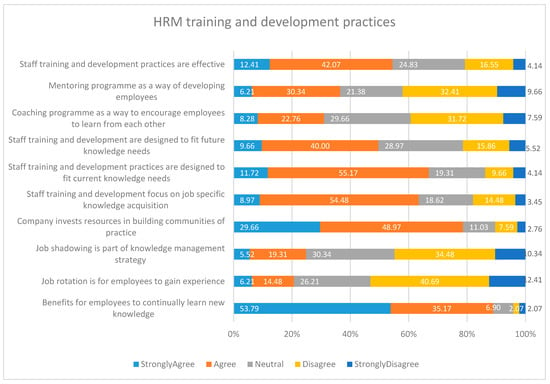
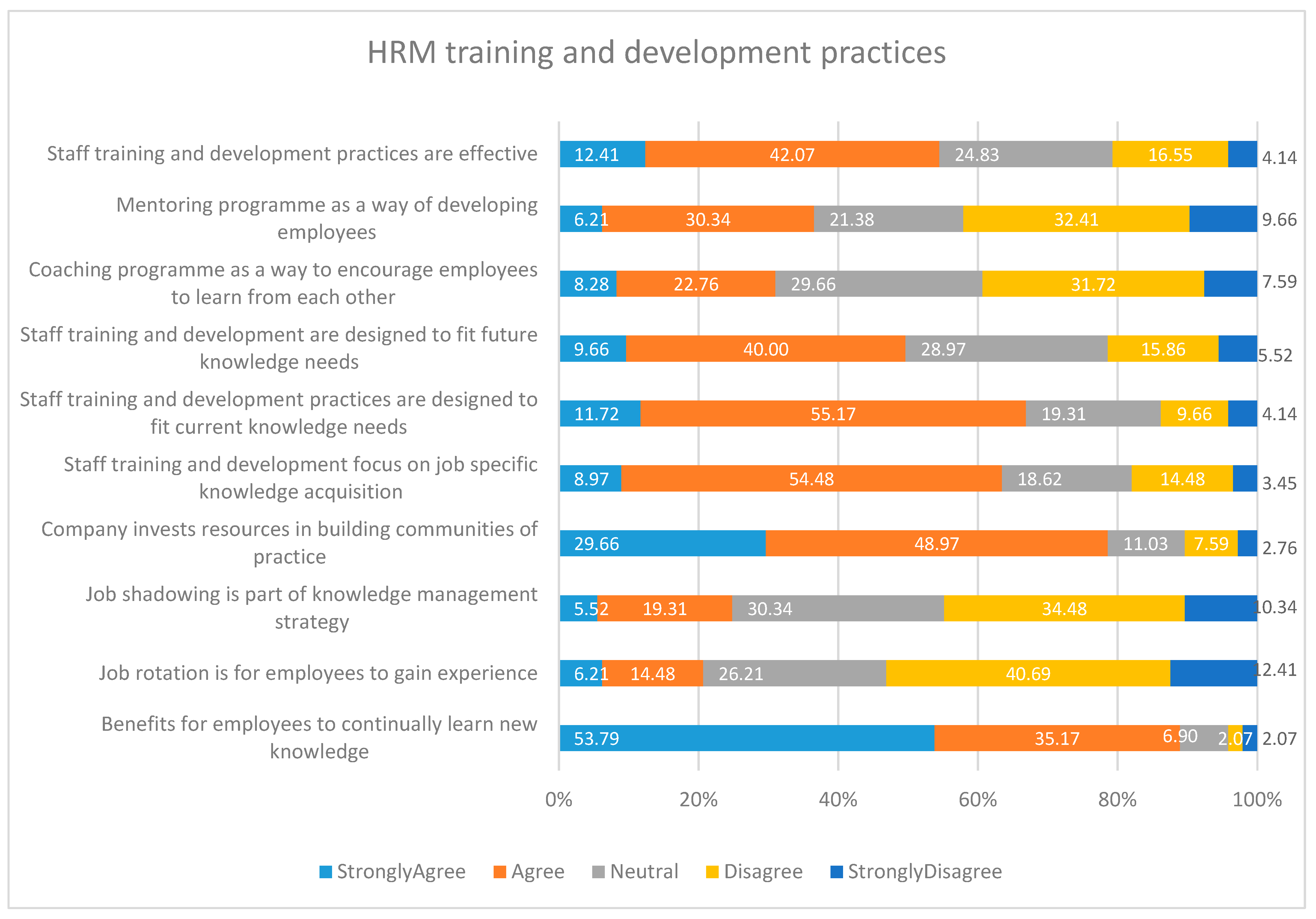
Data presented in Figure 1 below depicts survey responses on opportunities for staff training and development (by offering benefits for workers to continuously learn and gain new knowledge and skills).
Figure 1.
Training and development practices.
Over 80 percent of the participants confirmed that their SOEs offer a plethora of advantages to their staff members in terms of ongoing education and knowledge acquisition. These benefits may include covering the cost of tuition, subsidising conference participation, or offering additional avenues for professional growth. Conversely, a negligible portion of participants (4%) reported that benefits were not furnished, whilst 7% expressed ignorance or a lack of information on this aspect.
The utilisation of job rotation as a means for employees to acquire experience presents a challenge since most respondents (53%) stated that they did not apply it, whilst 21% claimed that their organisations do utilise job rotation. A minor but significant portion of respondents (26%) stated that they knew little about job rotation.
The majority of respondents (45%) had never heard of job shadowing as a knowledge management method, whereas a small but significant portion (25%) indicated that the practice was used in their organisations. A sizeable portion of respondents (30%) lacked knowledge on the application of job shadowing as a knowledge management tactic.
Most respondents (79%) indicated that their organisations devote a large number of resources (such as funding, rewards and technical assistance) to creating communities of practice. Ten percent stated the contrary, and eleven percent knew less about the topic.
Many respondents (63%) mentioned that human resource training and development initiatives concentrated on acquiring knowledge appropriate to their jobs, whereas 18% stated that this was irrelevant and 19% knew less about it.
Almost two-thirds (67%) indicated that capacity development procedures were created to meet the company’s current knowledge demands, while 14% disagreed and 19% knew less about the practice.
Regarding the topic of whether training and development practices were created to meet the knowledge requirements of the companies in the future, most respondents (50%) confirmed that this was the case, whilst a small but significant portion (21%) disagreed. It is interesting to note that a small but significant portion (29%) lacked understanding regarding whether staff training and development was intended to meet future knowledge requirements.
Most respondents (39%) claimed that their organisations used coaching programmes as a means of encouraging staff members to exchange knowledge with one another, while a lesser percentage (31%) answered that this was not the case. A significant portion of the respondents (30%) were not aware that there was a coaching programme in place. Similarly, the majority of respondents (42%) indicated that their organisations did not use mentoring programmes as a means of human resource training and development (capacity development), while 37% stated that their organisations did. A smaller portion of respondents (21%) expressed uncertainty regarding the use of mentoring, suggesting a lack of knowledge about the variable.
Regarding how well staff training and development methods create knowledge and skills for the future, most respondents (54%) thought that their organisation’s approach was beneficial in this regard, while 21% disagreed. A small but significant portion of respondents (25%) lacked awareness regarding the efficacy of staff training procedures in advancing their knowledge and abilities, both now and in the future.
4. Discussion of the Research Results
The interview and survey data affirmed the extant literature in that the state-owned enterprises of the study are viewed as learning and knowledge-intensive organisations, albeit with some serious challenges [1,16]. The provision of learning and development opportunities to human resources serves to augment their domain-specific knowledge, experience and abilities, as well as streamline the learning of new knowledge and skillsets [43,44]. The human resource training and development approach was recognised as a crucial intervention in enhancing both the absorptive and protective capacities of knowledge, as indicated by the findings from the Exploratory Factor Analysis conducted for this investigation.
These results corroborate the conclusions of the qualitative research. State-owned businesses may greatly improve and expand their knowledge-based capabilities by using knowledge-driven training and development strategies. According to this study, training and development methods are knowledge-driven and encourage knowledge management behaviour. Nearly 90% of respondents agreed with the HR managers’ qualitative assessment that SOEs provided several advantages to guarantee that employees were always learning and gaining new knowledge.
Examining the annual reports also showed that state-owned businesses had made significant investments in interventions related to training and development. The state-owned enterprises’ training and development programmes are knowledge-driven, as inferred from both the quantitative (survey) and qualitative data (interviews and annual reports). Human resource capacitation was highly valued by state-owned firms, according to the survey data, interview transcripts and annual report findings. Put differently, significant investments in training and development or capacity building programmes attest to the fact that knowledge acquisition, application and development are highly intentional processes. According to [40], training and development show an investment in organisational employees. Another perspective is that state-owned enterprises’ training and development policies encourage employees to learn from outside sources by sending them to conferences and other training events. The ability of businesses to identify, absorb and utilise outside knowledge is known as their “knowledge absorptive capacity” [23]. The majority of SOEs do not use job rotation and job shadowing for employees to gain, absorb, share and apply knowledge as knowledge management methods. It was interesting that most HR managers lacked knowledge about job rotation as a knowledge management tactic. Studies show that job rotation and job shadowing are important capacity development strategies that enhance tacit knowledge sharing, absorption and retention, thus helping to mitigate against potential risks in the process [19].
The interviews revealed that the design and execution of training and development strategies or practices were impacted by workplace skills plans, personal development plans, competency-based modelling, and skills audit matrices. According to [43], training and development facilitate the acquisition and growth of knowledge by guaranteeing ongoing learning within organisations. The quantitative research findings (65% of the respondents) and qualitative research findings (all human resource managers) indicate a convergence of the perspectives that training and development in state-owned companies primarily focus on the acquisition and utilisation and, to a lesser extent, on the sharing and retention of job-specific knowledge. This kind of attention is mostly technical. Technical training therefore acts to solidify an implicit organisational knowledge base. Ninety-five percent of the knowledge in an organisation is tacit [45]. Opportunities for training and development help to fortify the tacit knowledge base of SOEs, which is based on work activities and behaviours or business processes.
Protecting tacit knowledge is one of the main obstacles. Large sums of money are invested in capacity development programmes targeted at the acquisition and development of job-specific knowledge, as demonstrated by both qualitative and statistical evidence. However, a large portion of the learned organisational tacit knowledge base is still at risk due to a lack of retention techniques to cope with both voluntary and involuntary turnover. Several of the South African SOEs involved in the current research study experienced challenges because of exposing employees to outside knowledge sources through learning and development interventions and conference attendance but being unable to retain their workers.
Opportunities for learning and development offer workers and businesses the ability to learn new things. As helpful as staff capacity building may seem, in principle, to relate to knowledge acquisition and development, this study clarified that a significant issue for many state-owned businesses was the lack of knowledge sharing and retention. As a result, this study’s conclusions showed that capacity development practices were knowledge-driven but not highly knowledge-driven in relation to the sharing and retention of business tacit knowledge. In contrast, this study concluded that SOEs experienced protective capacity problems in the areas of tacit knowledge sharing and retention, which can be linked to a lack of retention strategy, knowledge loss, and turnover. Stated differently, SOEs neglected to safeguard their valuable, company-specific people and knowledge resources. According to [28], a company’s protective capacity is its ability to maintain or slow the rate at which its intangible knowledge-based assets or resources depreciate. Therefore, this study contends that investments in interventions related to training and development have a detrimental effect on SOEs’ ability to retain knowledge if employees depart after being exposed to them.
5. Research Limitations
The findings of this study should be used cautiously as it was undertaken in a limited number of state-owned enterprises in a particular country-specific context (South Africa). The water utility sector, development finance companies, research and development sector, services sector, and compliance and regulatory industries were amongst the nine industry sectors of SOEs sampled for the qualitative study. Only three SOEs took part in the survey phase because of the coronavirus and other associated issues. However, it is plausible to generalise the enquiry findings to other state companies in similar market industries. Similar studies could be undertaken in SOEs that operate in the transportation sector, such as civil aviation and rail, defence; mining, manufacturing; and power generation and distribution companies. Moreover, it is possible that the findings would not apply to SOEs in other developing and developed nations due to different contextual realities. However, further similar research could be undertaken in other countries and other sectors of their economies to establish whether there is a direct link between learning and development practices, knowledge acquisition, and absorptive and protection capacities. Such studies could also be extended to include other HRM practices.
6. Conclusions and Recommendations
According to the research findings, SOEs made significant investments in training and development programmes to improve the acquisition of domain-specific intangible knowledge assets. Therefore, it can be deduced that they are learning and knowledge-intensive business enterprises. It follows that knowledge-driven training and development procedures were used in SOEs. The statistical results demonstrated these behaviours as critical intervention components in the development and facilitation of both the absorptive and protective capacities of knowledge, corroborated by the findings of the qualitative study. Mechanisms such as competency-based modelling, personal development plans, skills audit matrices and workplace skills planning were put in place to ensure that staff members gained domain-specific knowledge and abilities. As a result, the researchers draw the conclusion that SOE training and development procedures increased knowledge absorption ability. Offering their staff training and development opportunities strengthened the tacit knowledge base since the emphasis was on acquiring and developing job-specific skillsets. However, the difficulty was in maintaining and safeguarding very important job-specific knowledge and abilities. Therefore, if SOEs do not have plans in place to keep skilled and capacitated workers, then a significant investment in job-specific training and development opportunities is wasted. The researchers also conclude that departing personnel have an impact on the organisation’s ability to safeguard intangible knowledge assets such as skills, competencies and abilities. “What is the point of capacitating if you cannot retain?” asks the study’s researchers, underscoring the necessity of funding protective capacities. The absence of job rotation and job shadowing driven by the HRM establishment is a serious problem area that warrants attention.
Knowledge-oriented learning and development practices should enable staff members to continuously update their skills and knowledge base, thereby contributing to knowledge creation and building and increasing knowledge absorptive capacity in SOEs by continuously updating their skills. As a result, this study suggests that the HR departments of state-owned businesses create policies to guarantee a return on investment for possibilities for training and development. If not, it will be quite challenging to defend the impact or efficacy of these training and development programmes. Eight of the nine state-owned enterprises lacked a training and development ROI mechanism, whilst only one in the developmental finance sector was using a mechanism called the Brinkerhoff model. Benchmarking best practices can help other companies learn from them. The use of such a return on investment model will assist the SOEs to justify their investments in the development of intangible knowledge assets, as well as predict, measure and mitigate the potential risks relating to the potential loss of such assets due to human resource attrition factors. Moreover, a return on investment mechanism can help HRM practitioners to demonstrate the value of their learning and development investments, thereby enhancing the knowledge base for their organisations. SOEs should not just train for the sake of training but train to have an impact on their organisational knowledge base and knowledge management capacity.
Author Contributions
Conceptualization, M.P.P.; methodology, M.P.P. and S.P.M.; validation, M.P.P. and S.P.M.; formal analysis, M.P.P.; investigation, M.P.P.; writing—original draft preparation, S.P.M.; writing—review and editing, M.P.P. and S.P.M.; project administration, S.P.M.; funding acquisition, M.P.P. All authors have read and agreed to the published version of the manuscript.
Funding
The Article Processing Charge (APC) was funded by both the Durban University of Technology and the University of South Africa.
Institutional Review Board Statement
This research project adhered to the ethical guidelines established by the University of South Africa’s Department of Information Science Ethics Committee and obtained ethical clearance approval (References #: 2020-DIS-0018 and approved on 15 July 2020) prior to data collection, ensuring conformity with both institutional and international research ethics standards.
Informed Consent Statement
Informed consent was obtained from all subjects involved in the study. The study involved participants who were informed about the research objectives, procedures, risks and rights, and their right to withdraw without consequence, and their written informed consent was obtained in accordance with the University of South Africa’s ethical policies.
Data Availability Statement
This study’s data is accessible upon reasonable request but may be restricted due to ethical and confidentiality agreements to protect participant privacy.
Acknowledgments
During the preparation of this manuscript/study, the author(s) used Atlas.ti version 24 for the purposes of analysis of interview data and SAS version 8.4 for the purpose of analysing survey data. The authors have reviewed and edited the output and take full responsibility for the content of this publication.
Conflicts of Interest
The authors declare no conflicts of interest.
Abbreviations
The following abbreviations are used in this manuscript:
| SOEs | State-Owned Enterprises |
| ROI | Return on Investment |
| HRM | Human Resource Management |
| MMR | Mixed-Method Research |
References
- Benassi, M.; Landoni, M. State-owned enterprises as knowledge-explorer agents. Ind. Innov. 2019, 26, 218–241. [Google Scholar] [CrossRef] [Scilit]
- Alexopoulos, G.; Garefalakis, A.; Stavropoulou, E.; Spinthiropoulos, K. Ownership and Governance of State-Owned Enterprises: A Compendium of National Practices. In Governance and Financial Performance: Current Trends and Perspectives; World Scientific Publishing: Singapore, 2023; pp. 43–69. [Google Scholar]
- Drucker, P.F. Knowledge-Worker Productivity: The Biggest Challenge. Calif. Manag. Rev. 1999, 41, CMR143. [Google Scholar] [CrossRef] [Scilit]
- Saxena, N.K.; Das, S. Competitive pressure and the moderating role of the knowledge network on internationalization intent of Indian state-owned enterprises. IIM Kozhikode Soc. Manag. Rev. 2022, 11, 47–61. [Google Scholar] [CrossRef] [Scilit]
- Mamorobela, S.P. Understanding the Affordances of Expert Systems in Improving the Competitiveness of South African Insurance SMEs. In Business Models and Innovative Technologies for SMEs; Bentham Science: Soest, The Netherlands, 2023; p. 85. [Google Scholar]
- Boisot, M.H. Knowledge Assets: Securing Competitive Advantage in the Information Economy; Oxford University Press: Oxford, UK, 1998. [Google Scholar]
- Galan, N. Knowledge loss induced by organizational member turnover: A review of empirical literature, synthesis and future research directions (Part II). Learn. Organ. 2023, 30, 137–161. [Google Scholar] [CrossRef] [Scilit]
- Kumar, S. Knowledge risk management for state-owned enterprises-Indian scenario. In Knowledge Risk Management: From Theory to Praxis; Springer International Publishing: Cham, Switzerland, 2020; pp. 89–106. [Google Scholar]
- Barney, J.B. Is the resource-based “view” a useful perspective for strategic management research? Yes. Acad. Manag. Rev. 2001, 26, 41–56. [Google Scholar]
- Wright, P.M.; Dunford, B.B.; Snell, S.A. Human resources and the resource based view of the firm. J. Manag. 2001, 27, 701–721. [Google Scholar] [CrossRef]
- Grant, R.M. Toward a knowledge-based theory of the firm. Strateg. Manag. J. 1996, 17, 109–122. [Google Scholar] [CrossRef] [Scilit]
- Hussinki, H.; Kianto, A.; Vanhala, M.; Ritala, P. Assessing the universality of knowledge management practices. J. Knowl. Manag. 2017, 21, 1596–1621. [Google Scholar] [CrossRef] [Scilit]
- Phaladi, M.P.; Omarsaib, M.; Mhlongo, P.M.; Mpungose, B. Integrating Strategic Human Resource Management Practices for Effective Knowledge Risk Management in Public Enterprises: A Systematic Review and Future Research Directions. In Trends, Challenges, and Practices in Contemporary Strategic Management; IGI Global: Hershey, PS, USA, 2024; pp. 213–235. [Google Scholar]
- Azaki, J.I.; Rivett, U. Organisational factors affecting knowledge retention in a public organisation. In European Conference on Knowledge Management; Academic Conferences International Limited: Reading, UK, 2022; Volume 2, pp. 1304–1322. [Google Scholar]
- Okharedia, A.A. A conceptual framework in promoting knowledge management in electricity industry in South Africa: The case of ESKOM. J. Bus. Retail. Manag. Res. 2019, 13, ART-24. [Google Scholar] [CrossRef] [Scilit]
- Phaladi, M.P. Mitigating tacit knowledge loss in South African state-owned companies: HRM approach. Electron. J. Knowl. Manag. 2023, 21, 211–223. [Google Scholar] [CrossRef] [Scilit]
- Balbuena, S.S. State-Owned Enterprises in Southern Africa: A Stocktaking of Reforms and Challenges; OECD: Paris, France, 2014. [Google Scholar]
- Phaladi, M.P. Developing knowledge protective capacity through retention practices in South African state-owned companies. South Afr. J. Inf. Manag. 2023, 25, a1727. [Google Scholar] [CrossRef] [Scilit]
- Phaladi, M.P. Framework for tacit knowledge loss mitigation in South African public sector enterprises. Adm. Sci. 2025, 15, 218. [Google Scholar] [CrossRef] [Scilit]
- Phaladi, M.P.; Ngulube, P. Understanding tacit knowledge loss in public enterprises of South Africa. SA J. Hum. Resour. Manag. 2024, 22, 2229. [Google Scholar] [CrossRef] [Scilit]
- Alshanbri, N.; Khalfan, M.; Noor, M.A.; Dutta, D.; Zhang, K.; Maqsood, T. Employees’ turnover, knowledge management and human recourse management: A case of Nitaqat program. Int. J. Soc. Sci. Humanit. 2015, 5, 701–706. [Google Scholar] [CrossRef] [Scilit]
- Roache, D.A. Educational Leaders’ Success, Motivation, and Performance in Higher Educational Institutions: Serving, Striving, and Surviving (3S) Phenomena. In Transformational Leadership Styles for Global Leaders: Management and Communication Strategies; IGI Global Scientific Publishing: Hershey, PS, USA, 2023; pp. 1–19. [Google Scholar]
- Cohen, W.M.; Levinthal, D.A. Absorptive capacity: A new perspective on learning and innovation. Adm. Sci. Q. 1990, 35, 128–152. [Google Scholar] [CrossRef] [Scilit]
- Durst, S.; Zieba, M. Knowledge risks inherent in business sustainability. J. Clean. Prod. 2020, 251, 119670. [Google Scholar] [CrossRef] [Scilit]
- Dalkir, K. The role of human resources (hr) in tacit knowledge sharing. In Handbook of Research on Tacit Knowledge Management for Organizational Success; IGI Global Scientific Publishing: Hershey, PS, USA, 2017; pp. 364–386. [Google Scholar]
- Mwangi, M.W.; Oluoch, M.F. Recruitment practices, knowledge management, human capital and organisational performance: A critical literature review. Expert J. Bus. Manag. 2022, 10, 140–146. [Google Scholar]
- Jøranli, I. Managing organisational knowledge through recruitment: Searching and selecting embodied competencies. J. Knowl. Manag. 2018, 22, 183–200. [Google Scholar] [CrossRef] [Scilit]
- Andersén, J. Protective capacity and absorptive capacity: Managing the balance between retention and creation of knowledge-based resources. Learn. Organ. 2012, 19, 440–452. [Google Scholar] [CrossRef] [Scilit]
- Dalkir, K. Knowledge Management in Theory and Practice, 4th ed.; MIT Press: London, UK, 2023. [Google Scholar]
- Becerra-Fernandez, I.; Sabherwal, R. Knowledge Management: Systems and Processes, 2nd ed.; Taylor & Francis: London, UK, 2014. [Google Scholar]
- Cabrera, E.F.; Cabrera, A. Fostering knowledge sharing through people management practices. Int. J. Hum. Resour. Manag. 2005, 16, 720–735. [Google Scholar] [CrossRef] [Scilit]
- Narasimha, S. Organizational knowledge, human resource management, and sustained competitive advantage: Toward a framework. Compet. Rev. Int. Bus. J. 2000, 10, 123–135. [Google Scholar]
- Delery, J.E.; Roumpi, D. Strategic human resource management, human capital and competitive advantage: Is the field going in circles? Hum. Resour. Manag. J. 2017, 27, 1–21. [Google Scholar] [CrossRef] [Scilit]
- Chaita, M.V.; Sibanda, W. The role of knowledge in enhancing SME innovation: The case of Knowsley–Northwest Region of England. Int. J. Knowl. Manag. 2021, 17, 93–112. [Google Scholar] [CrossRef] [Scilit]
- Donate, M.J.; Guadamillas, F. Organizational factors to support knowledge management and innovation. J. Knowl. Manag. 2011, 15, 890–914. [Google Scholar] [CrossRef] [Scilit]
- Gürlek, M. Tech Development Through HRM: Driving Innovation with Knowledge-Based Cultures; Emerald Publishing Limited: Leeds, UK, 2020. [Google Scholar]
- Scarborough, H.; Carter, C. Investigating Knowledge Management; CIPD: London, UK, 2000. [Google Scholar]
- Hislop, D. Linking human resource management and knowledge management via commitment: A review and research agenda. Empl. Relat. 2003, 25, 182–202. [Google Scholar] [CrossRef] [Scilit]
- Ensslin, L.; Carneiro, M.C.; Rolim, E.S.; Dutra, A.; Pereira, B.F.L. Organizational knowledge retention management using a constructivist multi-criteria model. J. Knowl. Manag. 2020, 24, 985–1004. [Google Scholar] [CrossRef] [Scilit]
- Matoškova, J.; Směšná, P. Human resources management practices stimulating knowledge sharing. Manag. Mark. Chall. Knowl. Soc. 2020, 12, 614–632. [Google Scholar]
- Ngulube, P. Mixed methods research in knowledge management studies (2009–2014): A content analysis of journal articles. J. Inf. Knowl. Manag. 2020, 19, 2050016. [Google Scholar] [CrossRef] [Scilit]
- Creswell, J.W.; Creswell, J.D. Research Design: Qualitative, Quantitative, and Mixed Methods Approaches, 5th ed.; Sage Publications: Thousand Oaks, CA, USA, 2017. [Google Scholar]
- Papa, A.; Dezi, L.; Gregori, G.L.; Mueller, J.; Miglietta, N. Improving innovation performance through knowledge acquisition: The moderating role of employee retention and human resource management practices. J. Knowl. Manag. 2020, 24, 589–605. [Google Scholar] [CrossRef] [Scilit]
- Kianto, A.; Sáenz, J.; Aramburu, N. Knowledge-based human resource management practices, intellectual capital and innovation. J. Bus. Res. 2017, 81, 11–20. [Google Scholar] [CrossRef] [Scilit]
- Sandelin, S.K.; Hukka, J.J.; Katko, T.S. Importance of knowledge management at water utilities. Public Work. Manag. Policy 2021, 26, 164–179. [Google Scholar] [CrossRef] [Scilit]
Disclaimer/Publisher’s Note: The statements, opinions and data contained in all publications are solely those of the individual author(s) and contributor(s) and not of MDPI and/or the editor(s). MDPI and/or the editor(s) disclaim responsibility for any injury to people or property resulting from any ideas, methods, instructions or products referred to in the content. |
© 2026 by the authors. Licensee MDPI, Basel, Switzerland. This article is an open access article distributed under the terms and conditions of the Creative Commons Attribution (CC BY) license.