


Abstract
Pacific white shrimp (Litopenaeus vannamei) production faces increasing economic, environmental, and health-related challenges, particularly due to acute hepatopancreatic necrosis disease (AHPND), caused by pathogenic strains of Vibrio spp., including Vibrio parahaemolyticus. This study independently evaluated the effect of two different phytogenic supplements, one based on flavonoids and organic acids and the other on alkaloids, on performance, immune parameters, and the response to V. parahaemolyticus challenge. The trial was conducted in two phases: In Phase 1 (culture of 70 days), shrimp were fed supplemented diets, and growth, feed efficiency, survival, and immune status variables were evaluated. Subsequently, the animals were challenged with a pathogenic strain of V. parahaemolyticus, causing AHPND to determine their health response after 48 h (Phase 2). Both phytogenic strategies improved performance, promoting growth trajectory during the final weeks of culture without compromising survival. However, these improvements did not translate into increased survival following the bacterial challenge. The results demonstrate the potential of these supplements to improve production efficiency but indicate that their application for the prevention of AHPND requires further research.
1. Introduction
Litopenaeus vannamei is one of the main aquaculture species cultured worldwide [1], reaching approximately 6.8 million tons of global production in 2022 [2]. Its cultivation is widespread across Asia and Latin America, particularly in countries such as China, India, Vietnam, Indonesia, and Ecuador, and encompasses different production systems, ranging from extensive and semi-intensive to intensive and super-intensive farming [3].
Despite the continued expansion of shrimp production, the sector faces increasing economic and environmental challenges. Fluctuations in international shrimp prices, particularly affecting major exporters such as Ecuador, together with rising production costs, have increased pressure on farm profitability [4,5]. These challenges encourage producers to improve growth and feed efficiency while maintaining shrimp health. However, increasing production must go hand in hand with sustainable farming practices to minimize environmental impacts [6].
Another challenge to shrimp production is the high incidence of bacterial diseases caused by members of the family Vibrionaceae, which are responsible for significant economic losses in global shrimp farming [7,8]. Among these, Early Mortality Syndrome or Acute Hepatopancreatic Necrosis Disease (EMS/AHPND), initially associated with pathogenic strains of Vibrio parahaemolyticus but subsequently linked to other Vibrio species, constitutes one of the major health and economic challenges. AHPND-causing strains carry a virulence plasmid encoding the binary toxin PirAB, which is responsible for the characteristic damage to the shrimp hepatopancreas [9]. In addition to production losses, V. parahaemolyticus represents a major food safety concern, as it is a foodborne pathogen whose ability to form biofilms promotes its persistence in seafood products and increases the risk to public health [10]. In Ecuador, this issue is particularly relevant. A high prevalence of Vibrio spp., especially V. parahaemolyticus, has been documented in both shrimp farms and final shrimp products intended for human consumption, with a high frequency of multidrug-resistant strains being observed [11,12,13].
Historically, the control of these infections has relied heavily on the use of antibiotics; however, increasing restrictions resulting from the development of antimicrobial resistance have driven the search for more sustainable alternatives [14,15].
In this context, various strategies are being investigated to reduce dependence on antibiotic treatments without compromising performance or shrimp health [14], including the use of organic acids [16,17,18], plant extracts [1,12,19,20,21], mannan oligosaccharides [22], algae [23], and bacteriophages [7]. Plant-derived compounds represent a promising alternative due to the wide diversity of bioactive metabolites they contain, including flavonoids, alkaloids, polyphenols, terpenoids, and polysaccharides, which possess antimicrobial, antioxidant, and immunomodulatory properties [24,25]. Nevertheless, comparisons among studies should be made with caution, as the composition of these extracts may vary considerably depending on the origin of the raw material, cultivation conditions, and extraction process, all of which determine their biological activity [26,27]. In-feed supplements represent one of the most promising approaches. Their use seeks to improve shrimp growth, feed efficiency, and immune response, thereby contributing to more sustainable production [6,25].
Resistance to AHPND exhibits low heritability, which may limit the effectiveness of genetic selection for this trait. However, recent studies have reported a strong positive genetic correlation between growth traits and survival or tolerance to the disease [28,29]. In this context, nutritional strategies aimed at improving growth and physiological status could represent a complementary approach to supporting shrimp health and potentially enhancing their resilience to AHPND.
The present study aimed to evaluate the individual effects of two nutritional supplements formulated with different groups of phytogenic compounds: one based on flavonoids and organic acids and the other on alkaloids. Although these components have attracted increasing interest in aquaculture, the available information regarding the effects of different phytochemical profiles and their inclusion levels remains limited [16,19,30]. A two-phase experimental design, similar to that described by Mathew et al. (2026) [25], was proposed: the first phase evaluated the effects of the nutritional strategies on the performance and immune parameters of L. vannamei reared under experimental conditions; subsequently, the shrimp were challenged with a pathogenic strain of V. parahaemolyticus, causing AHPND to determine the effect of both supplements on health status and the response to infection.
2. Materials and Methods
2.1. First Phase: Experimental Culture
2.1.1. Experimental Facilities
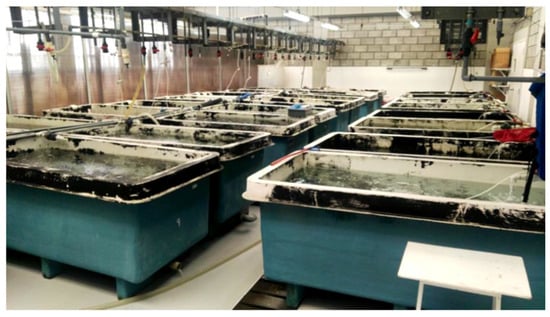
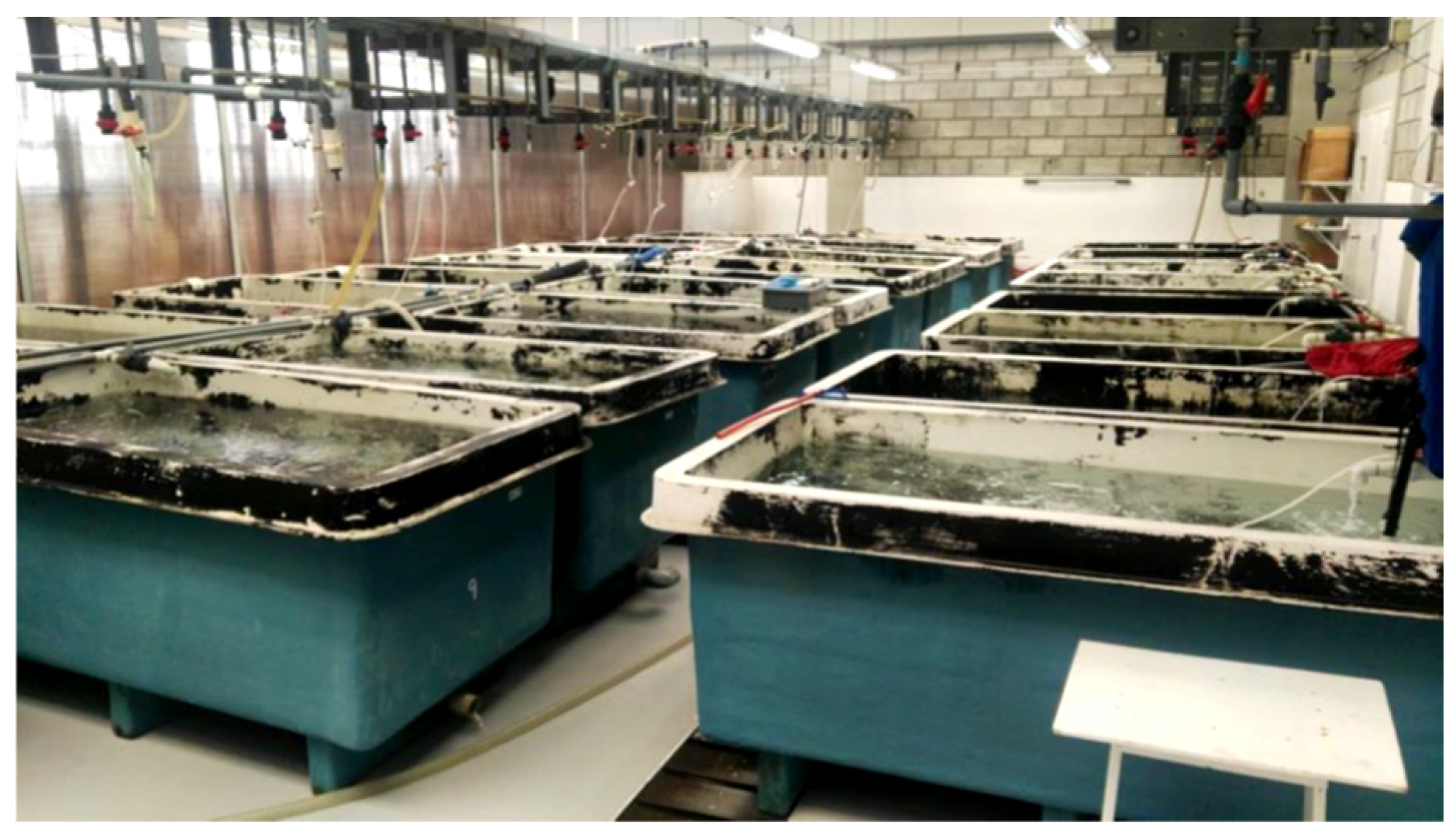
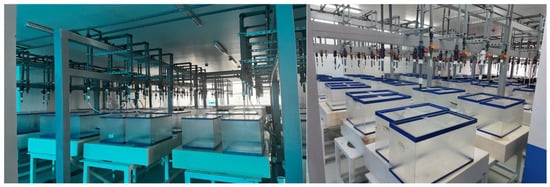
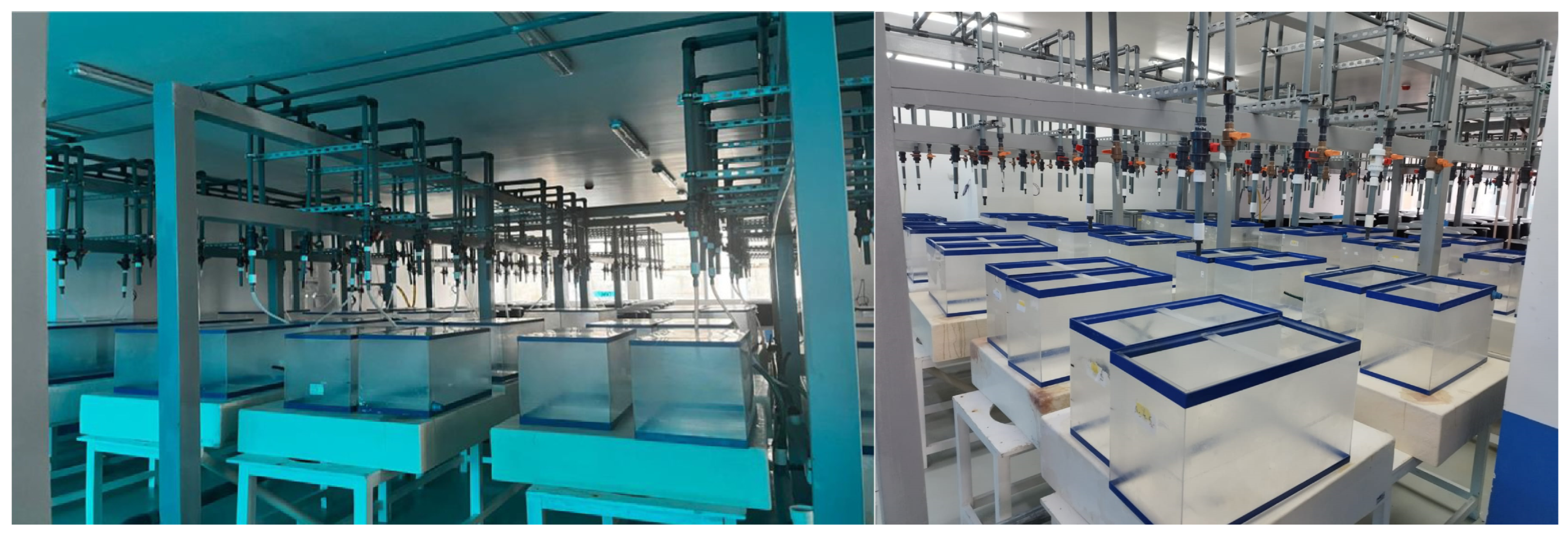
The experimental culture was conducted in experimental room 3 of the National Center for Aquaculture and Marine Research (CENAIM), located in San Pedro de Manglaralto, Santa Elena Province, Ecuador. The experimental units consisted of rectangular fiberglass tanks with a capacity of 1 m3 (Figure 1), equipped with continuous aeration provided by air stones connected to a central air supply system. The water used for filling and water exchange in the tanks was supplied by CENAIM’s central seawater distribution system, which consists of direct seawater intake through a submerged pipeline located offshore beyond the surf zone, followed by a gravel and sand filtration system and storage reservoirs for seawater holding.
Figure 1.
General view of experimental room at CENAIM and the experimental units used during the trial. Photograph courtesy of CENAIM.
2.1.2. Animals and Husbandry
Shrimp were obtained from a commercial production pond located in Palmar, Santa Elena, Ecuador. The animals were not specific pathogen-free (SPF) and were not screened for relevant pathogens by qPCR prior to the trial. They were transported to CENAIM and maintained in the quarantine area for a five-day acclimation period, during which they were fed a standard commercial diet and closely monitored for signs of disease. Health monitoring was maintained throughout the experimental period.
At the end of the acclimation period, each shrimp was individually weighed and assigned to its corresponding experimental unit. Each tank was stocked with 40 shrimp. The average initial body weight was 3.6 ± 0.4 g. The experimental period lasted a total of 70 days.
2.1.3. Water Quality Management
Throughout the experimental period, a daily water exchange equivalent to 100% of the volume of each tank was maintained through continuous water flow. In addition, the bottom of each tank was siphoned daily to remove feces and uneaten feed to preserve water quality and minimize the accumulation of organic matter. The main water quality parameters, including dissolved oxygen concentration, temperature, salinity, and pH, were measured daily in each experimental tank throughout the experimental period. Water temperature was controlled using a water bath system equipped with a heat exchanger to maintain stable thermal conditions throughout the experiment. Ammonia, nitrite, and nitrate concentrations were not directly measured. Dissolved oxygen concentration and temperature were measured using a YSI EcoSense® ODO200 m (YSI Inc., Yellow Springs, OH, USA). Salinity was determined using a field refractometer, and pH was measured with a pHTestr® 30 pH meter (Oakton Instruments, Vernon Hills, IL, USA). All experimental units were managed under the same husbandry protocol throughout the trial.
2.1.4. Experimental Groups
The experiment aimed to evaluate the effect of two phytogenic-based supplements incorporated into a commercial diet. Each supplement was evaluated at two inclusion levels (3 and 6 g/kg of feed), resulting in a total of four experimental diets. In addition, a control treatment was included, consisting of the commercial diet without supplementation. The treatments were designated as T1, T2, T3, T4, and T5 (control) (Table 1).
Table 1.
Dietary treatments and random allocation of the experimental units during the experimental culture phase.
A completely randomized design was used. A total of 24 tanks were randomly assigned to the five experimental groups. Treatments T1, T2, T3, and T4 each had five replicates, whereas the control treatment (T5) had four replicates. The distribution of the treatments and the random allocation of the experimental units are presented in Table 1.
Both supplements were supplied by MPA Veterinary Medicines and Additives–PH-Albio Group (Barcelona, Spain). BacterActive Dry, used in groups T1 and T2, consists of a blend containing more than 3% flavonoids and more than 40% organic acids (formic, propionic, and lactic acids). The feed supplement used in groups T3 and T4 was Eimex® Active, which contains 10% isoquinoline alkaloids as active ingredients.
2.1.5. Feeding
The shrimp were fed daily in two rations, provided at 09:00 h and 14:00 h. Feed was manually supplied in each tank (experimental unit). The amount of feed offered corresponded to 5% of the estimated biomass in each tank, following the standard experimental husbandry practices established by CENAIM-ESPOL for L. vannamei. Uneaten feed was collected two hours after each feeding event (11:00 h and 16:00 h). Daily feed consumption was determined from the wet weight of the remaining feed in each experimental unit.
The basal diet used during the trial consisted of a commercial shrimp feed (Feedpac® Premium 28%, AGRIPAC), supplemented with a fish peptide concentrate and antioxidants (CPP Plus Vit C1®, PROINTEMARE) and the respective nutritional supplements, according to the assigned experimental group (refer to Section 2.1.4).
The supplements were incorporated into the feed using the top-dressing technique. For this purpose, the required amount of formulated feed was weighed, and the corresponding supplement was added at the established experimental dose (3 or 6 g/kg of feed). Subsequently, vegetable oil was added in a proportion equivalent to 5% of the feed weight. The supplement was previously mixed with the oil until a homogeneous mixture was obtained. This mixture was gradually incorporated into the formulated feed, with continuous mixing until a uniform coating of the pellets was achieved. The process was considered complete when the feed obtained a darker coloration due to oil absorption. The control feed was also top-coated using the same amount of vegetable oil and the same procedure as the treatment feeds, but without the nutritional supplements.
Once prepared, the feed was allowed to rest for one hour before use. To preserve the stability of the incorporated ingredients, the diets were prepared in small quantities and stored under refrigeration until use, as suggested by Liu et al. (2011) [1]. Before being provided to the animals, the diets were allowed to reach ambient temperature for a few minutes.
2.1.6. Evaluated Parameters
During this first phase of the experimental culture, performance parameters and indicators of the immune response were assessed in the shrimp.
Performance
Shrimp growth was monitored through weekly body weight sampling using 10 shrimp per replicate. Weighing was performed with a Scout Pro® SP601 balance (OHAUS Corp., Parsippany, NJ, USA), with a resolution of ±0.1 g.
At the end of the 70-day experimental period, all shrimp from each experimental unit were harvested and weighed. Based on these records, the following productive parameters were determined: survival (%), final biomass (g), final mean body weight (g), weekly weight gain, and the feed conversion ratio (FCR). The FCR was calculated for each experimental unit as the ratio between the total amount of feed consumed and the biomass gain recorded during the trial period.
Additionally, an exploratory economic analysis was performed based on the performance results obtained during the culture period. Feeding costs were estimated considering the prices of commercial feed, fish oil, and dietary supplements at their respective inclusion levels. The actual feeding cost was calculated according to feed intake and expressed relative to the biomass produced. The prices used were approximate and intended for illustrative purposes only. Detailed calculations are presented in Table A1.
Immune Analysis
The immune response of the shrimp was evaluated by determining the activity of the phenoloxidase (PO) system and the superoxide anion (O2−) generation capacity.
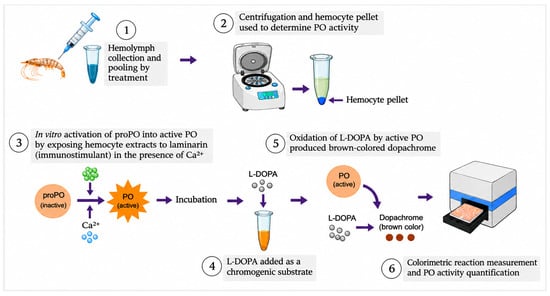
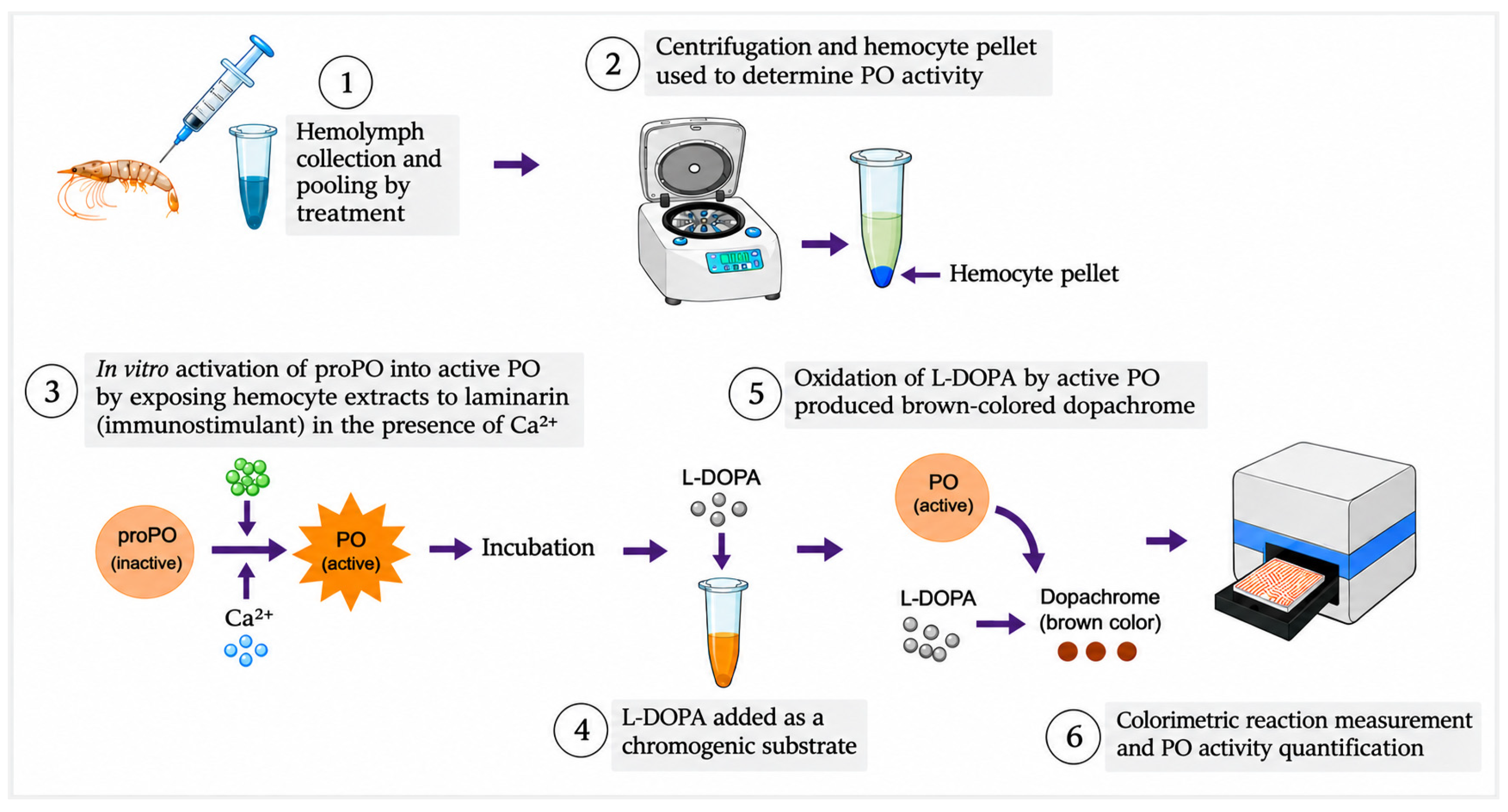
At days 31 and 57, ten shrimp were randomly selected from each treatment for hemolymph collection. For the supplemented treatments, two shrimp were collected from each of the five replicates. In the control group, two shrimp were collected from two replicates and three shrimp from the remaining two replicates. A total of 100 μL of hemolymph was withdrawn from each shrimp using 10% sodium citrate as an anticoagulant. Subsequently, the samples were adjusted to a 1:1 volume-to-volume (v/v) ratio with the same anticoagulant. The hemolymph obtained from shrimp belonging to the same treatment was pooled to produce a composite sample for immunological analyses. The samples were then centrifuged, and the hemocyte pellet was used to determine PO activity according to the methodology described by Gullian et al. (2004) [31]. Hemocytes contain granules with enzymatic complexes involved in the immune response, which are released in the presence of pathogens. Among these is the prophenoloxidase (proPO) system, responsible for melanization processes in crustaceans. The assay is based on the in vitro activation of proPO into active PO by exposing hemocyte extracts to an immunostimulant in the presence of Ca2+. In this study, laminarin (soluble β-glucans from Laminaria digitata) was used as the immunostimulant. After 70 min of incubation, during which the inactive proenzyme was converted into active PO, L−3,4-dihydroxyphenylalanine (L-DOPA) was added as a chromogenic substrate. The oxidation of L-DOPA by active PO produced brown-colored dopachrome, the intensity of which was quantified using a microplate reader after 10 min of reaction. The intensity of the colorimetric reaction was used as an indicator of activated PO activity, which was reported in the results (Figure 2).
Figure 2.
In vitro determination of phenoloxidase (PO) activity.
Superoxide anion (O2−) production was quantified using the Nitro Blue Tetrazolium (NBT) reduction assay according to the methodology described by Muñoz et al. (2000) [32]. The analysis was performed in ELISA plates using fresh primary hemocyte cultures. Hemocytes were incubated in the absence and presence of phorbol 12-myristate 13-acetate (PMA) to determine basal and stimulated activity, respectively. The assay is based on the reduction of yellow NBT to blue formazan by the action of O2− generated by the hemocytes. After the dissolution of the formazan crystals, absorbance was measured at 620 nm using a microplate reader. The O2− generation rate was calculated as the ratio between stimulated and basal activity. Measurements were performed on days 31 and 57 of the experimental period.
The immune response results were expressed as basal and stimulated O2− radical production, and as basal and total PO activity, both expressed as optical density (OD). The NBT ratio was calculated as the ratio of stimulated to basal O2− activity (stimulated O2−/basal O2−). The PO ratio was calculated as the ratio of total PO activity to basal PO activity (total PO/basal PO), whereas PO activation was calculated as the difference between total and basal PO activity (total PO − basal PO).
2.2. Second Phase: Challenge with Vibrio parahaemolyticus (AHPND)
2.2.1. Facilities and Biosecurity Measures
For the second phase of the experiment, consisting of a challenge trial with V. parahaemolyticus associated with AHPND, the shrimp were randomly assigned to 40 acrylic aquaria with an operational capacity of 40 L, located in the CENAIM quarantine experimental room (Figure 3). The experimental challenge was conducted four days after transfer to the aquaria, following an acclimation period during which the temperature was gradually increased to 30 °C. No mortality was recorded during this period, and the shrimp continued to receive the diets corresponding to their respective treatments.
Figure 3.
CENAIM quarantine experimental facility used for conducting experimental pathogen challenge trials. Photographs courtesy of CENAIM.
During the challenge, each aquarium received continuous aeration through a plastic hose fitted with an air stone. A daily water exchange equivalent to 50% of the aquarium volume was performed, together with the siphoning of the bottom of each aquarium to remove feces and uneaten feed. The water used for filling and water exchange in the aquaria was previously sterilized by ultraviolet (UV) irradiation. Wastewater generated during siphoning and water exchange was collected and disinfected with chlorine at a concentration of 500 ppm for two days before disposal.
To prevent cross-contamination among treatments, separate siphoning hoses were used for each experimental group. Once the bioassay was completed, the surviving shrimp were euthanized by chlorination and subsequently discarded.
Finally, the experimental room, including the aquaria, pipelines, water hoses, and walls, was disinfected with chlorine at a concentration of 100 ppm for 24 h. In addition, the personnel involved in the challenge did not enter other laboratory areas or culture rooms during the experiment.
2.2.2. Experimental Design of the Vibrio parahaemolyticus Challenge
At the end of the 70-day experimental culture period, the shrimp were harvested and randomly redistributed within their respective experimental groups into 40 aquaria, with eight replicates per treatment. For each treatment (T1–T5), six aquaria were allocated to the challenge with the pathogenic V. parahaemolyticus strain BA94C2, while the remaining two aquaria were maintained without inoculation as negative controls. The shrimp used in the challenge had a mean body weight of 14.0 g, with 12 individuals stocked per aquarium. Infection was performed by administering feed inoculated with the bacterial suspension, as described in Section 2.2.3.
2.2.3. Infection Procedure
Before the start of the experimental challenge, V. parahaemolyticus, preserved at −80 °C, was reactivated by streaking onto Tryptic Soy Agar (TSA) plates and incubating for 24 h at 30 °C. Subsequently, ten bacterial colonies were selected to confirm the presence of the pirA and pirB genes associated with AHPND by PCR analysis using the AP4 primers described by Dangtip et al. (2015) [33].
PCR analysis yielded positive results for all colonies tested, confirming the presence of AHPND-associated genes in the selected strain. The positive and negative controls showed the expected results.
Once the presence of these genes had been confirmed, the bacterium was inoculated into liquid Tryptic Soy Broth (TSB) supplemented with 2% NaCl and cultured for 5 h at 30 ± 0.5 °C under constant agitation (120 rpm). When the culture reached a concentration of 2 × 10⁸ CFU/mL, corresponding to an OD of 0.3 at 620 nm, the bacterial cells were harvested by centrifugation at 5060 rpm for 10 min. The supernatant was then discarded, and the bacterial pellet was resuspended in 2% NaCl saline solution.
The experimental feed was inoculated with the bacterial suspension to achieve a target final concentration of 2 × 10⁸ CFU/g of feed. To verify the successful inoculation of the feed used during the challenge, a microbiological analysis was performed to quantify total aerobic bacteria using 3M Petrifilm™ plates (Neogen Corporation, Lansing, MI, USA). For this purpose, a representative sample of the experimental diet inoculated with strain BA94C2 was subjected to serial dilutions followed by plating. After 48 h of incubation, the analysis confirmed a total bacterial concentration of 1.08 × 10⁹ CFU/g of feed, confirming that the feed used in the challenge contained the intended bacterial load for the experimental infection.
The shrimp were infected orally by administering a single dose of infected pellets equivalent to 2.5% of the biomass present in each aquarium of the challenged groups. The negative control aquaria received the same amount of feed (2.5% of the biomass) without bacterial inoculation.
During the 20 h following infection, shrimp from all treatments, including the negative controls, received no additional feed. After this period, the animals were fed every 12 h with their respective non-infected experimental diets at a feeding rate equivalent to 2.5% of their biomass.
2.2.4. Mortality Monitoring
Mortality recording started 12 h after infection. The aquaria were monitored several times daily throughout the challenge period, and moribund shrimp were removed whenever detected to minimize the risk of reinfection. The bioassay was terminated 48 h after inoculation due to the high mortality observed across all experimental groups, as extending the challenge period was considered unlikely to provide substantial additional information.
2.3. Statistical Analysis
In both experimental moments, each tank or aquarium was considered an independent experimental unit.
The productive variables obtained at harvest were analyzed using a one-way analysis of variance (ANOVA), with a 95% confidence level, to determine differences among treatments. Prior to the analysis, the assumptions of normality and homogeneity of variances were evaluated using the Shapiro–Wilk and Bartlett tests. When the ANOVA indicated significant differences (p < 0.05), Tukey’s multiple comparison test was applied to identify differences among treatment means. Variables that did not meet the assumption of homogeneity of variances were analyzed using the non-parametric Kruskal–Wallis test.
Additionally, to evaluate growth dynamics throughout the experimental period, body weight data collected over time were analyzed using a repeated-measures mixed-effects ANOVA, considering treatment, sampling time, and the treatment × time interaction as fixed effects. This analysis allowed the evaluation of both overall growth differences among treatments and temporal changes within each treatment. When significant effects were detected, multiple comparisons were performed using Bonferroni’s adjustment to control the type I error associated with repeated comparisons.
Immune parameters (PO activity, basal and stimulated O2− activity, and O2− generation rate) were obtained from pooled hemolymph samples prepared for each treatment. These analyses were conducted as an exploratory assessment to identify potential effects of the nutritional supplements on shrimp immune responses. As individual samples were not analyzed separately, biological replication was not available. Therefore, no statistical analysis was performed on these immune parameters, and the results are presented exclusively as descriptive observations.
Following the experimental challenge, Kaplan–Meier survival analysis was performed to estimate differences in the survival distributions of the five infected treatments during the post-infection period. In addition, each treatment was compared with the control group using Dunnett’s test.
For all statistical analyses, the level of significance was set at α = 0.05. Analyses of immune parameters and survival were performed using R version 4.3.2 (R Foundation for Statistical Computing, Vienna, Austria), whereas complementary analysis of the growth curve by two-way repeated-measures ANOVA and Bonferroni’s multiple comparisons were conducted using GraphPad Prism version 5.01 (GraphPad Software, San Diego, CA, USA).
3. Results
3.1. Water Quality Parameters
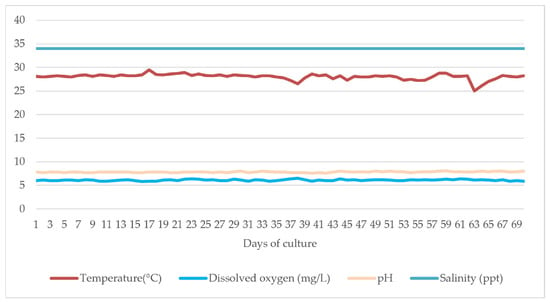
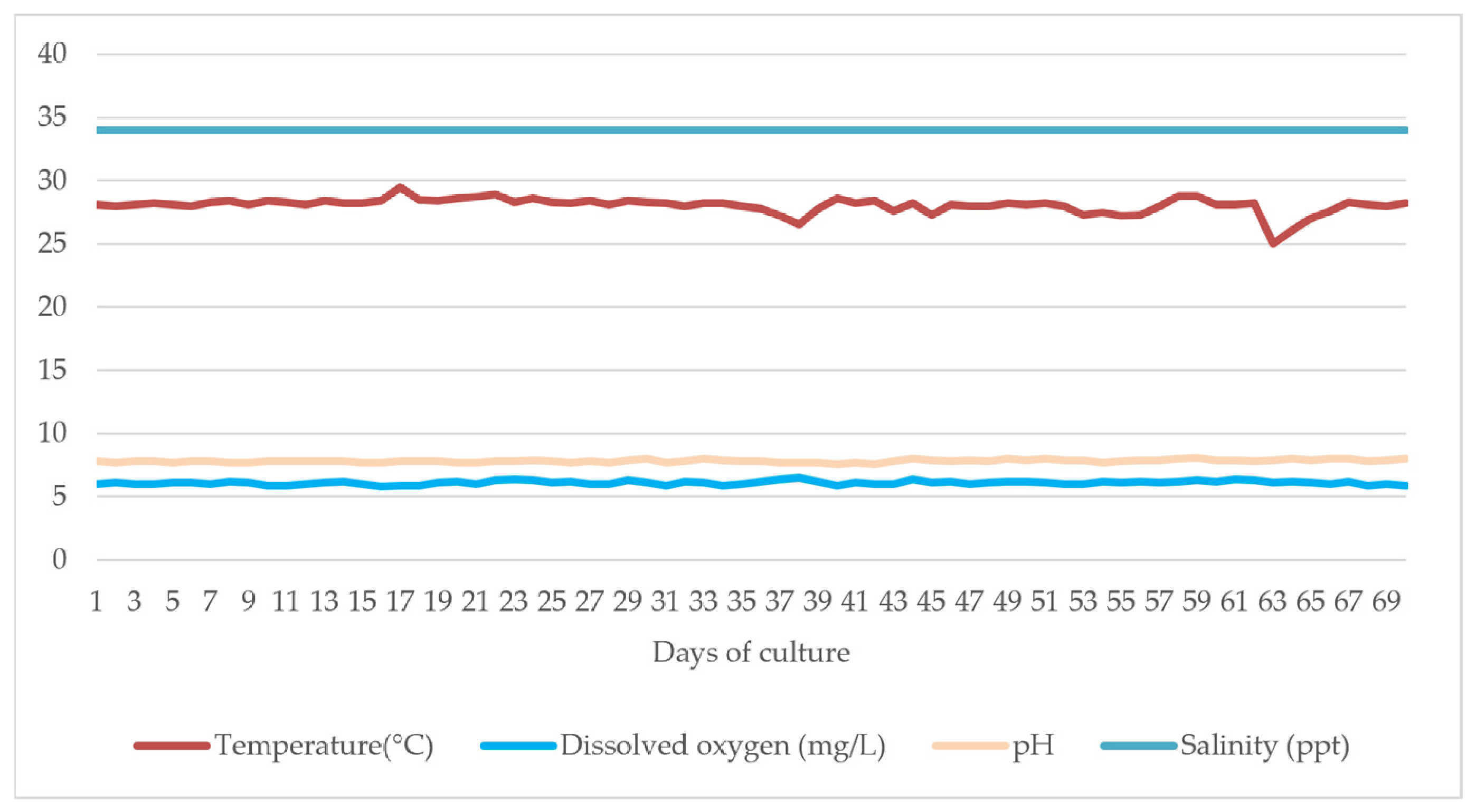
Water quality parameters remained stable throughout the 70-day experimental culture period. The mean water temperature was 28.0 ± 0.6 °C, ranging from 25.0 to 29.5 °C. The dissolved oxygen concentration averaged 6.1 ± 0.1 mg/L, with values ranging from 5.8 to 6.5 mg L−1. The mean pH was 7.8 ± 0.1, ranging from 7.6 to 8.1. Salinity remained constant throughout the experimental period at 34.0 g/L (Figure 4).
Figure 4.
Water quality parameters recorded during the 70-day experimental culture period.
3.2. Performance
The results of the productive parameters evaluated during the first phase of the experimental culture are presented in Table 2. At the end of the 70-day culture period, survival, final biomass, final mean body weight, feed conversion ratio (FCR), and weekly weight gain were determined. No significant differences were observed among the experimental groups for any of the parameters evaluated (p > 0.05). The weekly absolute growth of shrimp in treatments T1, T2, T3, T4, and T5 was 1.0, 1.0, 1.0, 1.0, and 0.9 g/week, respectively (Table 2).
Table 2.
Survival, final biomass, final mean body weight, feed conversion ratio (FCR), and weekly weight gain of shrimp fed the different experimental diets for 70 days. Values are presented as mean ± standard error. Identical letters within the same column indicate no significant differences among treatments (one-way ANOVA, p > 0.05).
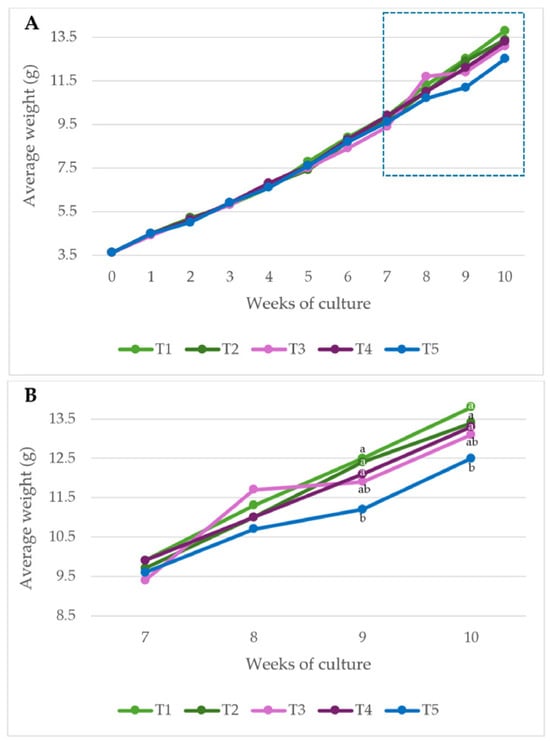
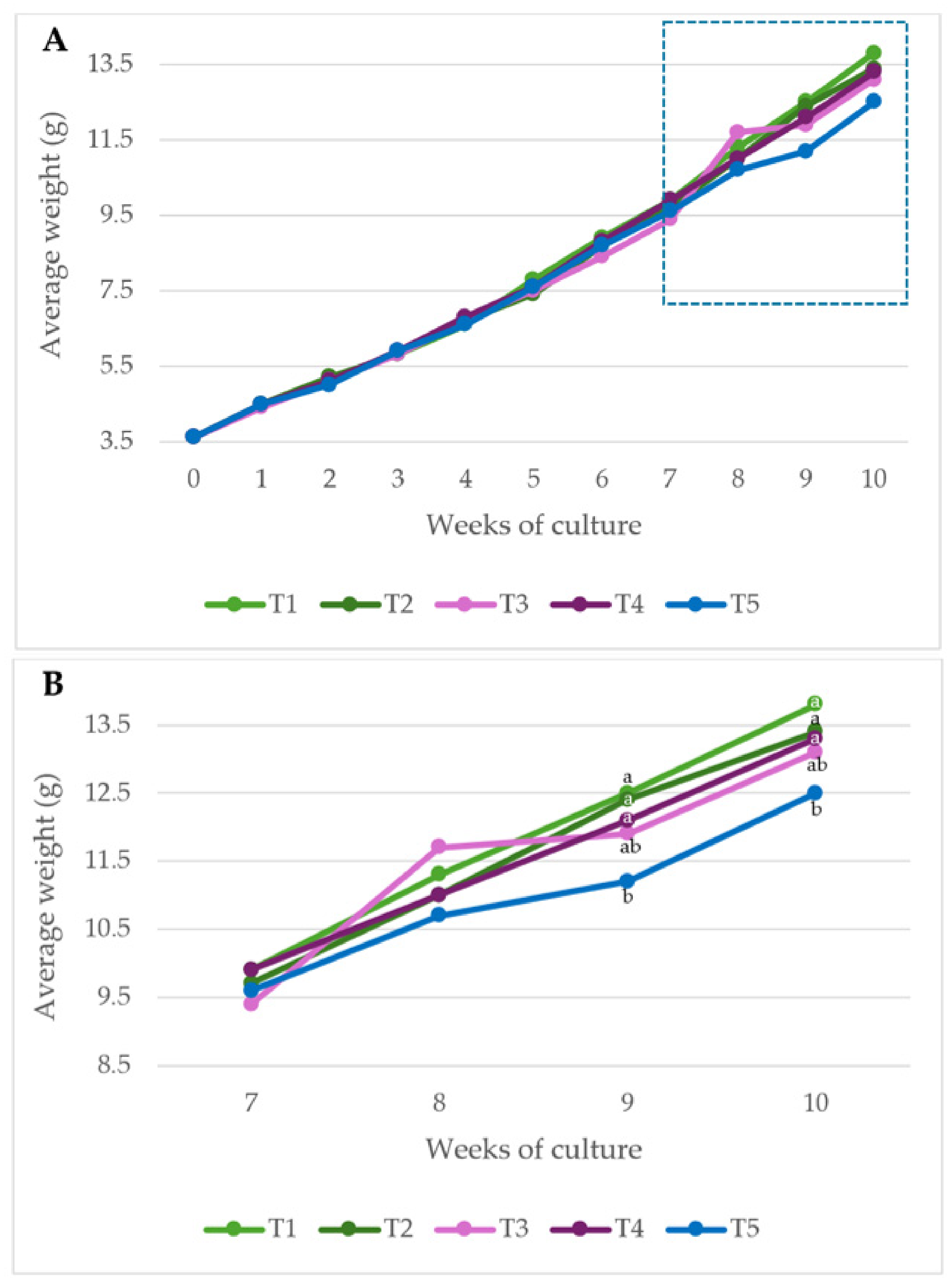
Analysis of growth trajectories over time using a two-way repeated-measures ANOVA revealed a significant interaction between time and treatment, indicating that growth patterns differed among treatments throughout the experimental period. Specifically, at weeks 9 and 10 of culture, treatments T1, T2, and T4 differed significantly from the control (T5) (p = 0.0251). T3 did not differ significantly from T1, T2, T4, or T5, suggesting intermediate growth (p > 0.05). As shown in Figure 5A,B, the growth curves were similar during the first weeks of culture. Differences among the experimental groups became more evident from week 5 onward, reaching their maximum at the end of the culture period (Figure 5A).
Figure 5.
Growth trajectories. (A) shows the complete growth curve, whereas (B) presents an enlarged view of weeks 7–10 of culture to highlight the progressive divergence among treatments and the differences detected by two-way repeated-measures ANOVA with Bonferroni’s multiple comparison correction. Different letters indicate statistically significant differences (p < 0.05).
Additionally, the economic analysis indicated a reduction in feed cost per unit of biomass produced in treatments T1, T2, T3 and T4 (−8.0%, −5.2%, −4.2% and −1.3%, respectively) (Appendix A). The cost savings were more pronounced in T1.
3.3. Immune Response
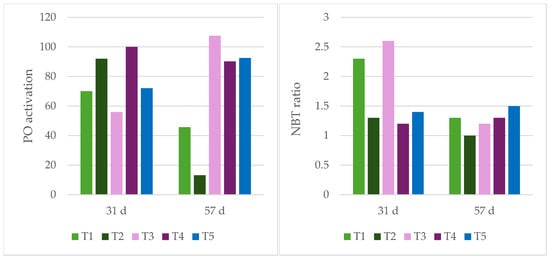
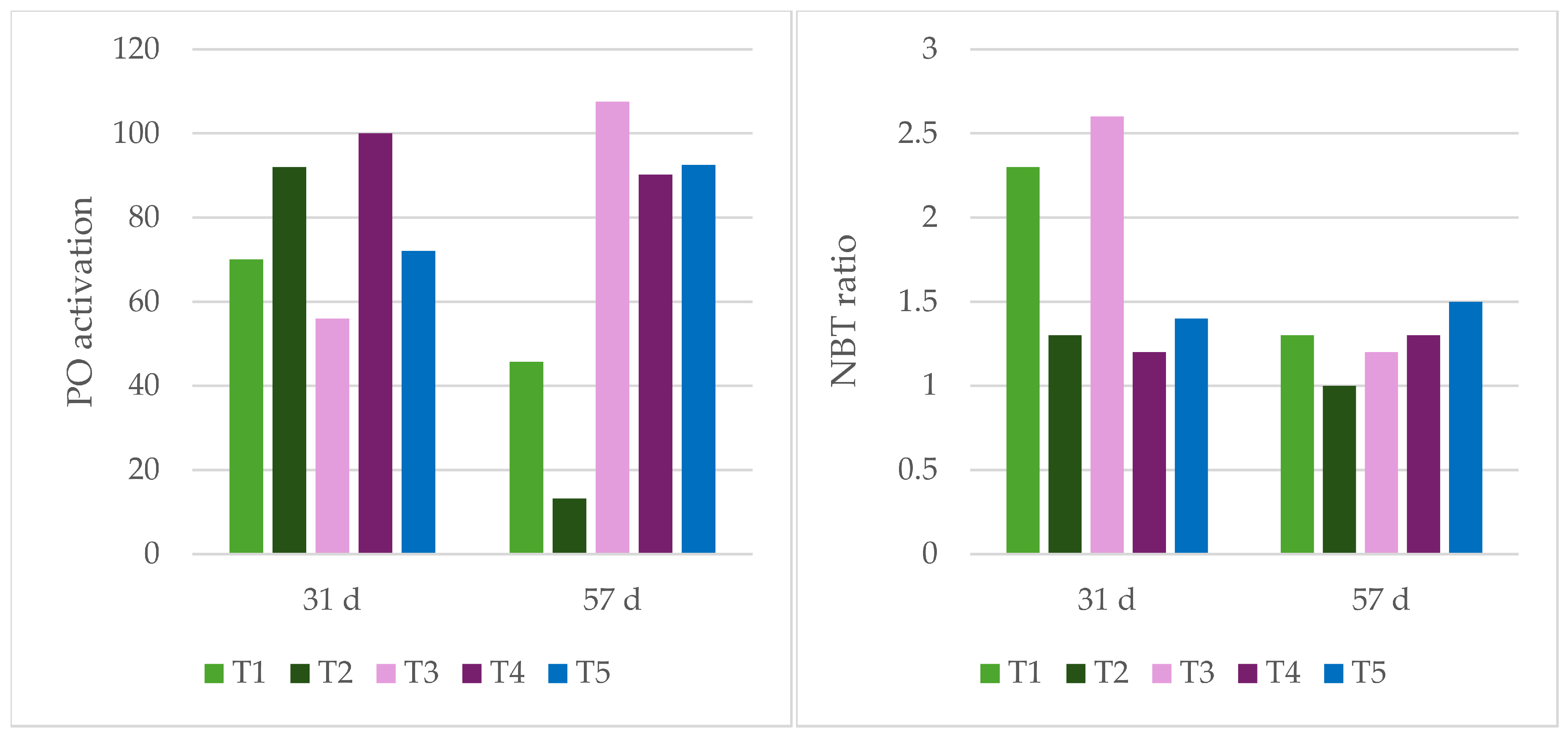
Immune response markers showed temporal variation among treatments. No consistent pattern was observed in either the respiratory burst (NBT) or the proPO system throughout the experimental period (Figure 6 and Appendix B).
Figure 6.
Graphical representation of the NBT ratio and prophenoloxidase (PO) system activation, indicators of the respiratory burst response and the proPO system response capacity, respectively.
3.4. Second Stage: Challenge with the Pathogenic Bacterium (AHPND)
Survival analysis at 48 h post-infection showed no statistically significant differences in either survival percentage or mean survival time among the treatments and the control group (T5) (p = 0.081), as presented in Table 3. Overall, the results indicate that the supplementation strategies evaluated neither improved nor adversely affected the ability of shrimp to withstand the experimental challenge with V. parahaemolyticus, the causative agent of AHPND, as all treatments exhibited a response comparable to that of the control group.
Table 3.
Final survival and approximate survival time of shrimp subjected to the experimental challenge with Vibrio parahaemolyticus, the causative agent of AHPND. Values are presented as mean ± standard deviation. Identical letters within the same column indicate no significant differences among the experimental groups (p > 0.05).
The non-infected control aquaria showed no mortality during the 48-h bioassay, maintaining 100% survival across all treatments. In contrast, high mortality was observed in the infected groups, supporting the effectiveness of the bacterial challenge. However, histopathological examination of hepatopancreatic lesions was not performed.
4. Discussion
The identification of nutritional supplements capable of improving performance, modulating immune responses, and enhancing disease resistance represents one of the main research areas in shrimp aquaculture [14]. This interest arises from the need to reduce the use of antimicrobials and their contribution to the emergence of antimicrobial resistance, in line with the One Health approach [34,35,36].
To the best of our knowledge, the present study is the first to evaluate, in L. vannamei, two supplementation strategies with distinct profiles: a combination of flavonoids and organic acids (T1 and T2) and another based on isoquinoline alkaloids (T3 and T4), each administered at two inclusion levels (3 and 6 kg/t of feed).
As a starting point, culture conditions remained stable throughout the experimental period, with temperature, salinity, dissolved oxygen, and the remaining physicochemical parameters within the recommended ranges for the culture of L. vannamei. This stability reduces the likelihood that environmental factors influenced the observed results and provides a solid basis for attributing the detected differences to the nutritional supplements. Furthermore, the experimental conditions were comparable to those reported in other studies conducted under controlled culture systems [16,17,18].
Regarding performance (first phase of the trial), both supplements significantly improved the growth curve, particularly during weeks 9 and 10 of culture (p < 0.05). The variability observed in the intermediate growth measurements, particularly in T3, may be partly attributed to the sampling strategy, as only 25% of the shrimp were weighed at each intermediate time point to minimize handling-related stress. These findings are consistent with numerous studies reporting enhanced growth following supplementation with various compounds, including flavonoids [37], such as luteolin [25], polysaccharides [38,39], algae with a high content of polysaccharides and polyphenols [23], and blends of organic acids [17]. However, other phenolic extracts or combinations of organic acids and essential oils (thymol and vanillin) have not demonstrated benefits on productive performance [16,40], highlighting that their efficacy depends on the nature of the extract, its composition, and the dose administered. It should be noted that some variability in the intermediate growth measurements, particularly in T3, may be associated with the sampling strategy, as only 25% of the shrimp were weighed at each intermediate time point to minimize handling-related stress.
A particularly interesting finding of the present study is that the differences in growth became more pronounced during the final weeks of the culture period. One possible explanation lies in the development of the shrimp intestinal microbiota throughout the production cycle. Gainza et al. (2018) demonstrated that microbial diversity progressively increases in L. vannamei cultured under intensive farming systems, which could enhance the modulatory effects of certain bioactive compounds as a more complex microbial community becomes established [41]. Although this hypothesis requires experimental validation, it is consistent with the growth pattern observed in the present study.
Another relevant finding was the absence of a clear dose-dependent response. Increasing the inclusion level of either supplement did not consistently improve performance. In fact, T1 (lower dosage, 3 kg/t of feed) showed the best overall performance. This pattern is consistent with the existing literature and confirms that determining the optimal dose remains one of the main challenges in the development of functional supplements for aquaculture. Jin et al. (2024) reported that quercetin improved survival against V. parahaemolyticus only at an intermediate dose [37], whereas Pu & Wu (2022) found that high doses of Astragalus membranaceus polysaccharides did not provide additional growth benefits [38]. Similarly, a microencapsulated blend of organic acids improved the growth and survival of L. vannamei at inclusion levels of 1–2%, whereas a 4% inclusion level provided no additional advantages, despite reducing the Vibrio load in the hepatopancreas [17].
Regarding the immune response, PO activity and superoxide anion production were evaluated during the culture period (days 31 and 57), in the absence of a specific health challenge. Under these conditions, no consistent pattern was observed among the experimental groups. However, as these analyses were performed on pooled hemolymph samples without biological replication, the results are descriptive and do not allow definitive conclusions regarding the immunomodulatory effects of the supplements.
These biomarkers are highly dynamic, and their activation depends on the type of stimulus, the intensity of the challenge, and the timing of sampling [42,43]. Previous studies have shown that PO activity and the respiratory burst may decrease during the first hours following a bacterial challenge and subsequently recover [21]. Furthermore, published studies have reported heterogeneous results regarding the immunostimulatory effects of dietary supplements. While some compounds have been shown to improve immune and antioxidant parameters [1,25,38,39], others have produced no detectable changes in PO activity or O2− production [17,40]. These findings highlight the complexity of immune responses and the importance of considering the type of supplement, dose, and biomarkers evaluated. Further studies with appropriate biological replication are needed to better characterize the potential immunomodulatory effects of these supplements.
In the experimental challenge with V. parahaemolyticus (second phase of the trial), no significant differences in survival were observed among the experimental groups (T1–T5) (p > 0.05). The available scientific evidence shows inconsistent results depending on the type of compound evaluated, the dose used, and the experimental conditions. Several studies have demonstrated improved survival following supplementation with plant-derived compounds, including extracts from guava, moringa, and pomegranate [14], “lechuguilla” [8], Mitragyna speciosa (purik) leaf extract [20], neem (Azadirachta indica) [12]. Similarly, Ng & Koh (2016) reported beneficial effects of organic acid salts [15], while He et al., (2017) observed increased resistance to V. parahaemolyticus following supplementation with a combination of organic acids and essential oils, despite the absence of significant changes in PO activity [16].
However, these beneficial effects are not consistently observed across studies. Chowdhury et al. (2021) reported no significant improvement in survival following supplementation with organic acid blends, despite previously described nutritional benefits [18]. Likewise, Aguirre Chanta et al. (2021) found that oregano extract did not improve survival following a Vibrio challenge [12]. These findings are consistent with the absence of significant differences observed in the present study and suggest that the protective effects of dietary supplements may vary according to their composition, dose, and experimental conditions. Furthermore, the high mortality observed within the 48-h challenge period may have limited the ability to detect potential differences in survival among treatments.
In experimental studies, infection with V. parahaemolyticus is performed primarily by immersion [7,19,44,45] or by injection [16,21,37]. In the present study, the challenge was conducted using feed contaminated with V. parahaemolyticus, a strategy that reproduces infection via the oral route and is consistent with the findings of Tran et al. (2013) [46], who demonstrated that AHPND transmission occurred through oral exposure but not following intramuscular inoculation. This methodology may generate infection dynamics that differ from those observed following injection or immersion and should therefore be taken into consideration when comparing results across studies.
Finally, one methodological aspect that should be considered is that the supplement was applied on top, using fish oil as a carrier after feed extrusion. In shrimp, this strategy may present both advantages and limitations. On the one hand, because shrimp are slow feeders and may take between 1 and 2 h to consume the pellets completely, there is a risk of leaching of water-soluble compounds, such as organic acids or their salts, thereby reducing the amount that reaches the hepatopancreas and intestine in their undissociated form [18]. Although substantial leaching is considered unlikely under our experimental conditions, it was not directly evaluated, and its potential influence on the results cannot be completely excluded.
As a future line of research, it would be of interest to evaluate the combination of plant extracts with other control strategies, such as probiotics. In particular, the potential synergy with Lactobacillus plantarum warrants further investigation, as this probiotic has been shown to enhance shrimp growth and disease resistance through modulation of intestinal immunity and microbiota [47]. Considering these reported benefits, investigating its combination with plant-derived compounds could provide valuable insights into potential synergistic effects on shrimp health and performance.
5. Conclusions
The present study suggests that dietary supplementation with two phytogenic strategies of different composition may contribute to improved growth in L. vannamei during the final weeks of culture, without negatively affecting survival under the experimental rearing conditions.
However, these improvements did not translate into increased survival following challenge with an AHPND-causing strain of V. parahaemolyticus. These findings highlight the need for further research to better understand the factors influencing the efficacy of phytogenic compounds against this disease.
Although the experimental conditions remained stable throughout the trial, further studies under commercial farming conditions are needed to confirm these findings. A more comprehensive characterization of the intestinal microbiota and immune response would also help clarify the mechanisms involved and optimize the use of these compounds in shrimp feeding programs.
Author Contributions
Conceptualization, A.-S.H. and N.D.; methodology, A.-S.H., N.D. and R.R.; validation, S.S.; formal analysis, A.-S.H., F.F.B., N.D. and S.S.; writing—original draft preparation, A.-S.H., F.F.B., N.D. and R.R.; writing—review and editing, A.-S.H., F.F.B., N.D., R.R. and S.S.; supervision, S.S.; project administration, A.-S.H., N.D., F.F.B. and S.S.; funding acquisition, A.-S.H. and F.F.B. All authors have read and agreed to the published version of the manuscript.
Funding
This research was funded by companies of the PH-Albio Group.
Institutional Review Board Statement
Ethical review and approval were not required for this study, as the experimental organism, the Pacific white shrimp (Litopenaeus vannamei), is an invertebrate crustacean. Nevertheless, all experimental procedures were conducted in accordance with established practices for the appropriate handling and welfare of the experimental organisms.
Informed Consent Statement
Not applicable.
Data Availability Statement
The original data supporting the findings of this study are available to the journal during the peer-review process and are available from the corresponding author upon reasonable request.
Acknowledgments
The authors would like to thank Núria Fàbregas and Gustavo Espelleta for their participation in the design of the experimental protocol and the monitoring of the trial.
Conflicts of Interest
Anne-Sophie Hascoët and Fellipe Freitas Barbosa are employees of the companies of PH-Albio Group, the company that funded this study, and therefore declare a potential conflict of interest. Their contribution was limited to a complementary analysis of the growth data and manuscript preparation. All experimental work, laboratory analyses, and interpretation of the results were conducted independently by the remaining authors. The other authors declare no conflicts of interest.
Abbreviations
The following abbreviations are used in this manuscript:
| α | Alpha |
| AHPND | Acute hepatopancreatic necrosis disease |
| ANOVA | Analysis of variance |
| Ca2+ | Calcium ion |
| CENAIM | National Center for Aquaculture and Marine Research (Centro Nacional de Acuicultura e Investigaciones Marinas) |
| CFU | Colony-forming units |
| ELISA | Enzyme-linked immunosorbent assay |
| EMS | Early mortality syndrome |
| FAO | Food and Agriculture Organization of the United Nations |
| FCR | Feed conversion ratio |
| h | Hours |
| L-DOPA | L−3,4-dihydroxyphenylalanine |
| min | Minutes |
| NaCl | Sodium chloride |
| NBT | Nitro blue tetrazolium |
| nm | Nanometer |
| O2− | Superoxide anion |
| OD | Optical density |
| p | p-value |
| PCR | Polymerase chain reaction |
| pH | Potential of hydrogen |
| PL | Postlarvae |
| PMA | Phorbol 12-myristate 13-acetate |
| PO | Phenoloxidase |
| ppm | Parts per million |
| proPO | Prophenoloxidase |
| rpm | Revolutions per minute |
| TSA | Tryptic soy agar |
| TSB | Tryptic soy broth |
| USD | United States dollar |
| v/v | Volume/volume |
Appendix A
Table A1.
Economic analysis based on feed cost per unit of biomass produced in the different experimental groups. The prices used in the economic analysis are approximate and provided for illustrative purposes only.
Appendix B
Table A2.
Value of each immune variable.
References
- Liu, X.L.; Xi, Q.Y.; Yang, L.; Li, H.Y.; Jiang, Q.Y.; Shu, G.; Wang, S.B.; Gao, P.; Zhu, X.T.; Zhang, Y.L. The Effect of Dietary Panax ginseng Polysaccharide Extract on the Immune Responses in White Shrimp, Litopenaeus vannamei. Fish Shellfish Immunol. 2011, 30, 495–500. [Google Scholar] [CrossRef] [Scilit]
- FAO. The State of World Fisheries and Aquaculture 2024—Blue Transformation in Action; FAO: Rome, Italy, 2024. [Google Scholar] [CrossRef] [Scilit]
- Emerenciano, M.G.C.; Rombenso, A.N.; Vieira, F.D.N.; Martins, M.A.; Coman, G.J.; Truong, H.H.; Noble, T.H.; Simon, C.J. Intensification of Penaeid Shrimp Culture: An Applied Review of Advances in Production Systems, Nutrition and Breeding. Animals 2022, 12, 236. [Google Scholar] [CrossRef] [Scilit]
- Cedeño Quinto, J.; Ulloa Noboa, L.; Salazar Freire, J.; Claro Pérez, P. Economic Impact of Shrimp Sector Exports in Ecuador. Rev. Int. Estud. Cienc. Adm. 2025, 5, 10–21. [Google Scholar] [CrossRef] [Scilit]
- van der Pijl, W. Shrimp Trade Statistics. Status and Future Prospects; Global Shrimp Forum 2025, Utrecht, The Netherlands, 3 September 2025. Available online: https://www.seafoodalliance.org/messages/global-shrimp-forum-2025-shrimp-trade-statistics-2025 (accessed on 14 October 2026).
- Viera-Romero, A.M.; Diemont, S.A.W.; Selfa, T.L.; Luzadis, V.A. The Sustainainability of Shrimp Aquaculture: An Emergy-Based Case Study in the Gulf of Guayaquil Thirty Years Later. Renew. Sustain. Energy Rev. 2024, 194, 114326. [Google Scholar] [CrossRef] [Scilit]
- Lomelí-Ortega, C.O.; Martínez-Díaz, S.F. Phage Therapy Against Vibrio parahaemolyticus Infection in the Whiteleg Shrimp (Litopenaeus vannamei) Larvae. Aquaculture 2014, 434, 208–211. [Google Scholar] [CrossRef] [Scilit]
- Quiroz-Guzmán, E.; Morreeuw, Z.P.; Peña-Rodríguez, A.; Barajas-Sandoval, D.R.; Magallón-Servín, P.; Mejía, A.; Reyes, A.G. Flavonoid-Enriched Extract of Agave lechuguilla Bagasse as a Feed Supplement to Prevent Vibriosis in Pacific White Shrimp Penaeus vannamei. Aquaculture 2023, 562, 738867. [Google Scholar] [CrossRef] [Scilit]
- Lai, H.C.; Ng, T.H.; Ando, M.; Lee, C.T.; Chen, I.T.; Chuang, J.C.; Mavichak, R.; Chang, S.H.; Yeh, M.D.; Chiang, Y.A.; et al. Pathogenesis of Acute Hepatopancreatic Necrosis Disease (AHPND) in Shrimp. Fish Shellfish Immunol. 2015, 47, 1006–1014. [Google Scholar] [CrossRef] [Scilit]
- Faleye, O.S.; Lee, J.H.; Lee, J. Selected Flavonoids Exhibit Antibiofilm and Antibacterial Effects against Vibrio by Disrupting Membrane Integrity, Virulence and Metabolic Activities. Biofilm 2023, 6, 100165. [Google Scholar] [CrossRef] [Scilit]
- Sperling, L.; Alter, T.; Huehn, S. Prevalence and Antimicrobial Resistance of Vibrio spp. in Retail Farm Shrimps Ecuador. J. Food Prot. 2015, 78, 2089–2092. [Google Scholar] [CrossRef] [Scilit]
- Aguirre Chanta, L.E.; Sánchez-Suárez, H.A.; Ordinola-Zapata, A. Antibiotic Resistance in Vibrio spp. Isolated from Shrimp Litopenaeus vannamei. Treatment alternatives with extracts of neem (Azadirachta indica) and oregano (Origanum vulgare). Rev. Investig. Vet. Perú 2021, 32, e19386. [Google Scholar] [CrossRef] [Scilit]
- Mitchell, T.M.; Ho, T.; Salinas, L.; VanderYacht, T.; Walas, N.; Trueba, G.; Graham, J.P. Analysis of Antibiotic Resistance Genes (ARGs) Across Diverse Bacterial Species in Shrimp Aquaculture. Antibiotics 2024, 13, 825. [Google Scholar] [CrossRef] [Scilit]
- Jara-Medina, N.R.; Cedeño-Pinargote, A.C.; Beltrán-Noboa, A.; Tejera, E.; Machado, A. Managing Vibrio parahaemolyticus and Vibrio alginolyticus Infections in the Whiteleg Shrimp (Penaeus vannamei): A Systematic Review. Molecules 2025, 30, 3620. [Google Scholar] [CrossRef] [Scilit]
- Ng, W.K.; Koh, C.B. The Utilization and Mode of Action of Organic Acids in the Feeds of Cultured Aquatic Animals. Rev. Aquac. 2016, 9, 342–368. [Google Scholar] [CrossRef] [Scilit]
- He, W.; Rahimnejad, S.; Wang, L.; Song, K.; Lu, K.; Zhang, C. Effects of Organic Acids and Essential Oils Blend on Growth, Gut Microbiota, Immune Response and Disease Resistance of Pacific White Shrimp (Litopenaeus vannamei) against Vibrio parahaemolyticus. Fish Shellfish Immunol. 2017, 70, 164–173. [Google Scholar] [CrossRef] [Scilit]
- Romano, N.; Koh, C.B.; Ng, W.K. Dietary Microencapsulated Organic Acids Blend Enhances Growth, Phosphorus Utilization, Immune Response, Hepatopancreatic Integrity and Resistance against Vibrio harveyi in White Shrimp, Litopenaeus vannamei. Aquaculture 2015, 435, 228–236. [Google Scholar] [CrossRef] [Scilit]
- Chowdhury, M.A.K.; Song, H.; Liu, Y.; Bunod, J.D.; Dong, X.H. Effects of Microencapsulated Organic Acid and Their Salts on Growth Performance, Immunity, and Disease Resistance of Pacific White Shrimp Litopenaeus vannamei. Sustainability 2021, 13, 7791. [Google Scholar] [CrossRef] [Scilit]
- Bussabong, P.; Rairat, T.; Chuchird, N.; Keetanon, A.; Phansawat, P.; Cherdkeattipol, K.; Pichitkul, P.; Kraitavin, W. Effects of Isoquinoline Alkaloids from Macleaya cordata on Growth Performance, Survival, Immune Response, and Resistance to Vibrio parahaemolyticus Infection of Pacific White Shrimp (Litopenaeus vannamei). PLoS ONE 2021, 16, e0251343. [Google Scholar] [CrossRef] [Scilit]
- Sugiharta, A.; Fadjar, M.; Hardoko, H. The Use of Purik Leaf Extract (Mitragyna speciosa) on Hematological and Histopathological Profile of Vannamei Shrimp (Litopenaeus vannamei) on Vibrio parahaemolyticus Infection. J. Penelit. Pendidik. IPA 2023, 9, 1262–1270. [Google Scholar] [CrossRef] [Scilit]
- Yeh, S.T.; Chen, J.C. White Shrimp Litopenaeus vannamei That Received The Hot-Water Extract of Gracilaria tenuistipitata Showed Earlier Recovery in Immunity After A Vibrio alginolyticus Injection. Fish Shellfish Immunol. 2009, 26, 724–730. [Google Scholar] [CrossRef] [Scilit]
- Gainza, O.; Romero, J. Effect of Mannan Oligosaccharides on the Microbiota and Productivity Parameters of Litopenaeus vannamei Shrimp under Intensive Cultivation in Ecuador. Sci. Rep. 2020, 10, 2719. [Google Scholar] [CrossRef] [Scilit]
- Ashour, M.; Al-Souti, A.S.; Mabrouk, M.M.; Naiel, M.A.E.; Younis, E.M.; Abdelwarith, A.A.; AbdEl-Kader, M.F.; Abu Husein, M.S.; El Saharty, A.; Elokaby, M.A.; et al. A Commercial Seaweed Extract Increases Growth Performance, Immune Responses, and Related Gene Expressions in Whiteleg Shrimp (Litopenaeus vannamei). Aquac. Rep. 2024, 36, 102154. [Google Scholar] [CrossRef] [Scilit]
- Cowan, M.M. Plant Products as Antimicrobial Agents. Clin. Microbiol. Rev. 1999, 12, 564–582. [Google Scholar] [CrossRef] [Scilit]
- Mathew, R.T.; Ashour, M.; Alkhamis, Y.A.; Mansour, A.T.; Haroun, M.; Almohaimeed, H.M.; Bushnaq, A.; Abdul Kari, Z.; Eissa, M.E.H.; Eissa, E.S.H. Dietary Luteolin Supplementation Enhances Growth Performance, Digestive Capacity, and Immune-Antioxidant Status of Whiteleg Shrimp (Litopenaeus vannamei) against Vibrio parahaemolyticus Infection. Dev. Comp. Immunol. 2026, 178, 105589. [Google Scholar] [CrossRef] [Scilit]
- Monagas, M.; Brendler, T.; Brinckmann, J.; Dentali, S.; Gafner, S.; Giancaspro, G.; Johnson, H.; Kababick, J.; Ma, C.; Oketch-Rabah, H.; et al. Understanding Plant to Extract Ratios in Botanical Extracts. Front. Pharmacol. 2022, 13, 981978. [Google Scholar] [CrossRef] [Scilit]
- Sun, S.; Yu, Y.; Jo, Y.; Han, J.H.; Xue, Y.; Cho, M.; Bae, S.J.; Ryu, D.; Park, W.; Ha, K.T.; et al. Impact of Extraction Techniques on Phytochemical Composition and Bioactivity of Natural Product Mixtures. Front. Pharmacol. 2025, 16, 1615338. [Google Scholar] [CrossRef] [Scilit]
- Martínez Soler, M.; Shin, H.S.; Lorenzo-Felipe, Á.; Zamorano Serrano, M.J.; Castro, P.L.; Pachón Mesa, L.C.; Rodríguez, J.A.; Tomalá, C.; Sonnenholzner, S.; Carvalheiro, R.; et al. Genetic Parameters of Resistance to Acute Hepatopancreatic Necrosis Disease (AHPND) Caused By Vibrio parahaemolyticus and Their genetic Correlations with Growth Traits in an Ecuadorian Penaeus vannamei Population. Aquaculture 2025, 604, 742458. [Google Scholar] [CrossRef] [Scilit]
- Martínez Soler, M. Advancing Sustainable Shrimp Aquaculture Production in Ecuador through Selective Breeding and Hatchery Management. PhD’s Thesis, Universidad de Las Palmas de Gran Canaria, Las Palmas de Gran Canaria, Spain, 2026. [Google Scholar]
- Molina León, D.C.; Wasiliesky Junior, W.; Monserrat, J.M. Quercetin Influence in Water Quality and Biochemical Responses of Shrimp Litopenaeus vannamei Reared in Biofloc Technology System. Aquac. Res. 2018, 49, 3569–3576. [Google Scholar] [CrossRef] [Scilit]
- Gullian, M.; Thompson, F.; Rodriguez, J. Selection of Probiotic Bacteria and Study of Their Immunostimulatory Effect in Penaeus vannamei. Aquaculture 2004, 233, 1–14. [Google Scholar] [CrossRef] [Scilit]
- Muñoz, M.; Cedeño, R.; Rodríguez, J.; Van Der Knaap, W.P.W.; Mialhe, E.; Bachère, E. Measurement of Reactive Oxygen Intermediate Production in Haemocytes of the Penaeid Shrimp, Penaeus vannamei. Aquaculture 2000, 191, 89–107. [Google Scholar] [CrossRef] [Scilit]
- Dangtip, S.; Sirikharin, R.; Sanguanrut, P.; Thitamadee, S.; Sritunyalucksana, K.; Taengchaiyaphum, S.; Mavichak, R.; Proespraiwong, P.; Flegel, T.W. AP4 Method for Two-Tube Nested PCR Detection of AHPND Isolates of Vibrio parahaemolyticus. Aquac. Rep. 2015, 2, 158–162. [Google Scholar] [CrossRef] [Scilit]
- Natrah, I.; Muthukrishnan, S.; Mohd-Padil, H.; Mohamad, N.; Alipiah, N.M.; Shariff, M.; Yusoff, F.M.; Yasin, I.S.M.; Devadas, S.D.; Omar, W.H.H.W.; et al. Antimicrobial Resistance in Malaysian Shrimp Aquaculture and Strategies to Reduce Its Occurrence. Rev. Aquac. 2025, 17, e70020. [Google Scholar] [CrossRef] [Scilit]
- Milijasevic, M.; Veskovic-Moracanin, S.; Babic Milijasevic, J.; Petrovic, J.; Nastasijevic, I. Antimicrobial Resistance in Aquaculture: Risk Mitigation within the One Health Context. Foods 2024, 13, 2448. [Google Scholar] [CrossRef] [Scilit]
- Nadimpalli, M.; Delarocque-Astagneau, E.; Love, D.C.; Price, L.B.; Huynh, B.T.; Collard, J.M.; Lay, K.S.; Borand, L.; Ndir, A.; Walsh, T.R.; et al. Combating Global Antibiotic Resistance: Emerging One Health Concerns in Lower- and Middle-Income Countries. Clin. Infect. Dis. 2018, 66, 963–969. [Google Scholar] [CrossRef] [Scilit]
- Jin, J.; Chen, N.; Hu, Y.; Chen, Y.; Yin, B.; Wang, X.; Shen, Y.; Li, S. Transcriptome and Metabolome for Identifying Key Metabolites Impacting the Vibrio parahaemolyticus in Litopenaeus vannamei. Front. Mar. Sci. 2024, 11, 1400082. [Google Scholar] [CrossRef] [Scilit]
- Pu, Y.; Wu, S. The Growth Performance, Body Composition and Nonspecific Immunity of White Shrimps (Litopenaeus vannamei) Affected by Dietary Astragalus membranaceus Polysaccharide. Int. J. Biol. Macromol. 2022, 209, 162–165. [Google Scholar] [CrossRef] [Scilit]
- Eissa, E.S.H.; Ahmed, R.A.; Abd Elghany, N.A.; Elfeky, A.; Saadony, S.; Ahmed, N.H.; Sakr, S.E.S.; Dayrit, G.B.; Tolenada, C.P.S.; Atienza, A.A.C.; et al. Potential Symbiotic Effects of β−1,3 Glucan, and Fructooligosaccharides on the Growth Performance, Immune Response, Redox Status, and Resistance of Pacific White Shrimp, Litopenaeus vannamei to Fusarium solani Infection. Fishes 2023, 8, 105. [Google Scholar] [CrossRef] [Scilit]
- Diaz, J.S.; Flores-Miranda, M.C.; Almaraz-Abarca, N.; Fierro-Coronado, A.; Luna-Gonzalez, A.; Garcia-Ulloa, M.; Gonzalez-Ocampo, H.A. Effect of Microencapsulated Phenolic Compound Extracts of Maclura tinctoria (L.) Steud on Growth Performance and Humoral Immunity Markers of White Leg Shrimp (Litopenaeus vannamei, Boone, 1931) Juveniles. Span. J. Agric. Res. 2021, 19, e0604. [Google Scholar] [CrossRef] [Scilit]
- Gainza, O.; Ramírez, C.; Ramos, A.S.; Romero, J. Intestinal Microbiota of White Shrimp Penaeus vannamei under Intensive Cultivation Conditions in Ecuador. Microb. Ecol. 2018, 75, 562–568. [Google Scholar] [CrossRef] [Scilit]
- Amparyup, P.; Charoensapsri, W.; Tassanakajon, A. Prophenoloxidase System and Its Role in Shrimp Immune Responses against Major Pathogens. Fish Shellfish Immunol. 2013, 34, 990–1001. [Google Scholar] [CrossRef] [Scilit]
- Ji, P.-F.; Yao, C.-L.; Wang, Z.-Y. Immune Response and Gene Expression in Shrimp (Litopenaeus vannamei) Hemocytes and Hepatopancreas against Some Pathogen-Associated Molecular Patterns. Fish Shellfish Immunol. 2009, 27, 563–570. [Google Scholar] [CrossRef] [Scilit]
- Aguirre-Guzmán, G.; Sánchez-Martínez, J.G.; Pérez-Castañeda, R.; Palacios-Monzón, A.; Trujillo-Rodríguez, T.; de la Cruz-Hernández, N.I. Pathogenicity and Infection Route of Vibrio parahaemolyticus in American White Shrimp, Litopenaeus vannamei. J. World Aquac. Soc. 2010, 4, 464–470. [Google Scholar] [CrossRef] [Scilit]
- Hernández-Cabanyero, C.; Carrascosa, E.; Jiménez, S.; Fouz, B. Exploring the Effect of Functional Diets Containing Phytobiotic Compounds in Whiteleg Shrimp Health: Resistance to Acute Hepatopancreatic Necrotic Disease Caused by Vibrio parahaemolyticus. Animals 2023, 13, 1354. [Google Scholar] [CrossRef] [Scilit]
- Tran, L.; Nunan, L.; Redman, R.M.; Mohney, L.L.; Pantoja, C.R.; Fitzsimmons, K.; Lightner, D.V. Determination of the Infectious Nature of the Agent of Acute Hepatopancreatic Necrosis Syndrome Affecting Penaeid Shrimp. Dis. Aquat. Organ. 2013, 105, 45–55. [Google Scholar] [CrossRef] [Scilit]
- Du, Y.; Xu, W.; Wu, T.; Li, H.; Hu, X.; Chen, J. Enhancement of Growth, Survival, Immunity and Disease Resistance in Litopenaeus vannamei, by the Probiotic, Lactobacillus plantarum Ep-M17. Fish Shellfish Immunol. 2022, 129, 36–51. [Google Scholar] [CrossRef] [Scilit]

Disclaimer/Publisher’s Note: The statements, opinions and data contained in all publications are solely those of the individual author(s) and contributor(s) and not of MDPI and/or the editor(s). MDPI and/or the editor(s) disclaim responsibility for any injury to people or property resulting from any ideas, methods, instructions or products referred to in the content. |
© 2026 by the authors. Licensee MDPI, Basel, Switzerland. This article is an open access article distributed under the terms and conditions of the Creative Commons Attribution (CC BY) license.