


Abstract
Background: Youth with type 1 diabetes (T1D) often show low physical activity levels and a long time spent in sedentary and poor sleep, which may worsen their health. This study aimed to describe baseline movement and sleep patterns in children and adolescents with T1D and compare them with behaviors recorded during a structured summer camp. Methods: Twenty-three participants (13.33 ± 2.13 years) completed physical fitness tests, self-report questionnaires, and 7–8 days of wearable monitoring before camp. During a 10-day diabetes summer camp, participants continued wearing the devices to track physical activity, sedentary time, and sleep. Comparisons between pre- and during-camp periods were performed using paired statistics, and linear regressions examined associations between activity and sleep awakenings. Results: At baseline, device-based monitoring showed low physical activity levels, long sedentary time and poor sleep. Self-reported data confirmed low activity levels and long time spent in sedentary activities, especially screen time. During camp, daily steps increased significantly (p < 0.001), as well as all the physical activity intensities (p < 0.01). Sedentary time decreased significantly (p < 0.001), and sleep duration declined (p < 0.001), but awakenings were shorter (p = 0.005). Baseline sedentary time predicted longer nocturnal awakenings, while greater increases in steps during camp correlated with longer awakenings. Conclusions: Children and adolescents with T1D showed low baseline activity, high sedentary time, and poor sleep. Participation in the structured summer camp appears to be associated with changes in physical activity, sedentary behavior, and sleep patterns.
1. Introduction
Type 1 diabetes (T1D) is a chronic autoimmune disease in which the immune system destroys pancreatic β-cells, leading to loss of endogenous insulin production, responsible for transporting glucose from the bloodstream into cells. Its absence causes a condition named hyperglycemia, which in turn can lead to multiple complications [1]. T1D usually begins in childhood or adolescence, and its management typically includes exogenous insulin injections, continuous glucose monitoring, appropriate nutrition, and education, involving both patients and families [2]. Physical activity also plays a key role. The American Diabetes Association recommends regular exercise for improving cardiovascular fitness, bone health, insulin sensitivity, and enhancing psychological well-being in patients with T1D [3]. Physical activity may also reduce insulin requirements because muscle contractions promote insulin-independent glucose uptake [4]. The World Health Organization (WHO) recommends that children and adolescents accumulate at least 60 min/day of moderate-to-vigorous physical activity (MVPA) and engage in muscle-strengthening activities three times per week. These recommendations apply to youth with T1D as well [5]. According to the International Society for Pediatric and Adolescent Diabetes (ISPAD), a minority of young patients with T1D manage to meet these activity targets, as patients tend to be less active and more sedentary compared to their peers without diabetes [6]. A study involving 201 children with T1D revealed significant barriers hindering physical activity among this population. The highest barrier scores included loss of diabetes control, fear of hypoglycemia, and concerns related to external temperature [7]. The literature indicates that insufficient physical activity among children and adolescents with T1D is often accompanied by lower physical fitness, particularly strength, coordination and speed [8,9]. Moreover, studies in youth with T1D consistently report increased arterial stiffness compared with healthy peers [10], indicating early vascular alterations. While pediatric data on trunk flexibility in T1D are limited, evidence from adults shows that lower trunk flexibility is associated with a greater age-related increase in aortic stiffness [11]. Sleep is another relevant health and lifestyle behavior. The American Academy of Sleep Medicine suggests 9–12 h of sleep per night for children and 8–10 h for adolescents, with night awakenings lasting a maximum of 20 min [12]. A recent systematic review indicates that youth with T1D often experience shorter sleep, greater fragmentation, and more sleep disturbances, which may adversely affect glycemic management [13]. Greater physical activity levels are generally associated with better sleep quality. In particular, moderate physical activity (MPA) may be more effective than light activity (LIPA) or vigorous activity (VPA) in improving sleep. Conversely, prolonged sedentary behavior, especially long periods of screen time, is linked to poorer sleep [14]. Beyond total volume of activity, the context may matter. Conducting physical activity in natural environments has been associated with sleep and mood benefits, potentially influenced by environmental characteristics such as air quality, temperature, and visual features like colors [15]. Furthermore, structured settings can also help in improving physical activity. In youth with chronic conditions, participation in organized physical exercise programs tends to reduce barriers and increase participation [16]. Summer camps with structured activities have been shown to promote higher levels of MVPA compared with less organized camps [17,18]. Previous research in youth with T1D has widely investigated physical activity and, separately, sleep-related problems [19]. In addition, available studies conducted in diabetes camp settings have mainly focused on physical activity, glycemic control, or psychosocial outcomes rather than on the integrated assessment of physical activity, sedentary behavior, and sleep [20,21]. Therefore, this study addresses this gap by providing a simultaneous objective assessment of physical activity, sedentary behavior, and sleep before and during participation in a structured summer camp in youth with type 1 diabetes, enabling the evaluation of behavioral changes in a real-life structured environment. Moreover, there is a lack of studies investigating how engaging in physical activity in natural and structured settings affects sleep quality, specifically in youth with T1D. A recent project on the determinants of physical activity showed that, although the evidence in the literature remains inconclusive [22,23,24], settings play a crucial role [25,26]. Based on this background, we hypothesized that participation in a 10-day summer camp would improve physical activity levels, reduce sedentary time, and enhance sleep patterns in children and adolescents with T1D. Accordingly, our aims were: (i) to describe motor behavior and sleep patterns in daily life conditions, using both objective and subjective tools, and (ii) to compare these variables with those recorded during participation in a summer camp, characterized by structured activities.
2. Results
2.1. Basal Assessment—Fitness Tests
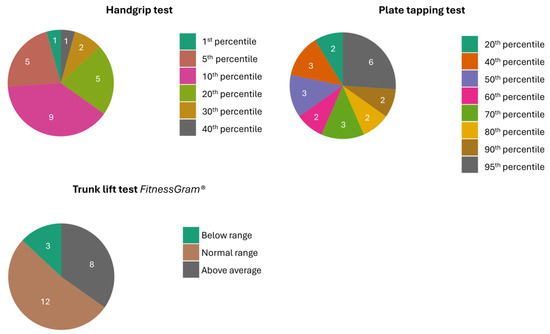
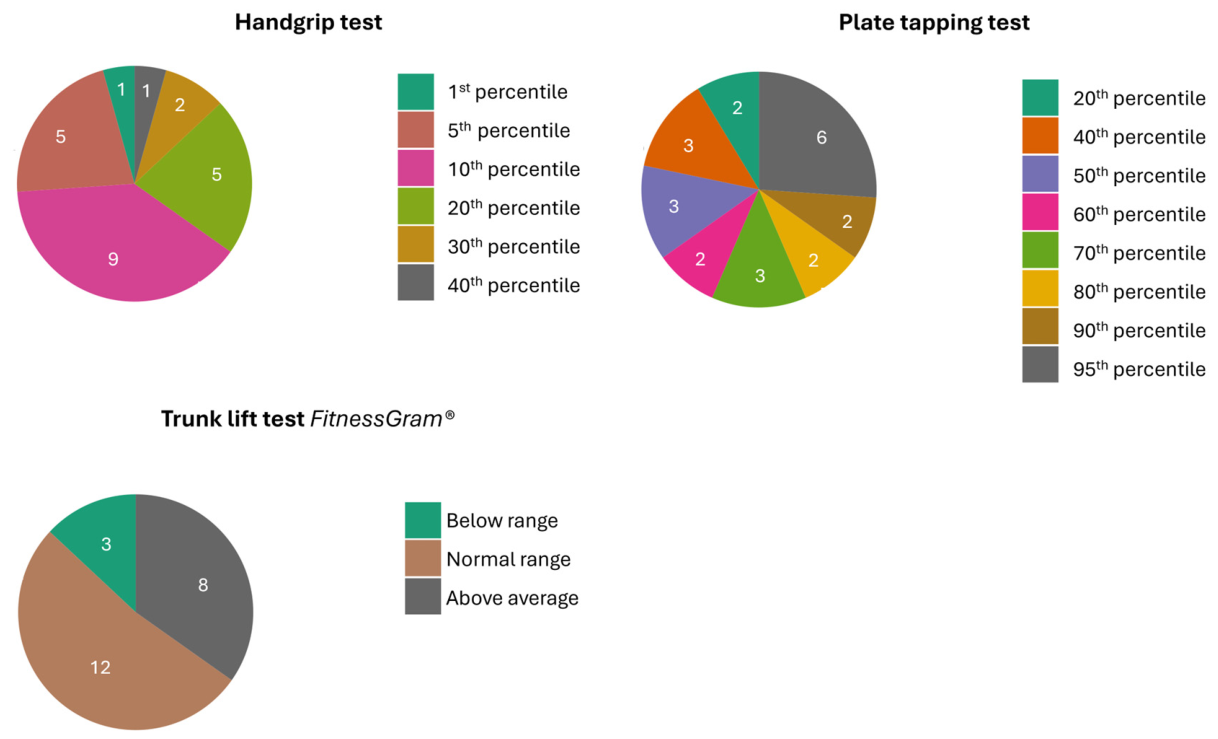
Upper limb strength was below average; indeed, the results of the Handgrip test showed that most participants were below the age- and sex-specific 10th percentile (Figure 1). In contrast, the results related to the Plate Tapping test showed that the upper-limb speed and coordination were above average, with most participants scoring above the 50th percentile (Figure 1). For the Trunk Lift test, the sample was, on average, within the Healthy Fitness Zone according to the FitnessGram® Healthy Fitness Zone reference tables. Specifically, twelve participants fell within the Healthy Fitness Zone normal range, three below it, and eight above the upper threshold (Figure 1).
Figure 1.
Distribution of participants across normative percentiles in the Handgrip test and Plate Tapping test, and distribution of participants across the Healthy Fitness Zone according to the FitnessGram® in the Trunk Lift test. Numbers inside the pie chart segments indicate the number of participants in each percentile or range category.
2.2. Basal Assessment—Self-Reported Physical Activity and Sedentary Behavior
The PAQ- Cindicated a low activity level. Conversely, the ASAQ corroborated these findings by showing prolonged sedentary time on both weekdays and weekends. Further details for the ASAQ subsections are reported in Table 1.
Table 1.
Results related to the Physical Activity Questionnaire for Older Children and Adolescents Sedentary Activities Questionnaire.
2.3. Basal Assessment—Device-Based Physical Activity, Sedentary Behavior and Sleep
The participants accumulated an average of 8772.13 ± 2823.75 steps/day and spent 258.34 ± 52.69 min/day in LIPA, 28.48 ± 16.40 min/day in MPA, and 24.66 ± 18.11 min/day in VPA. On the other hand, the time spent in sedentary activities was long, with an average of 717 ± 80.61 min/day. Regarding sleep, they slept 408.89 ± 61.32 min/night with 46.10 ± 16.95 min/night of awake time (wake after sleep onset). Finally, sleep efficiency averaged 93.56 ± 2.26%.
2.4. Pre-Camp vs. During-Camp
Physical activity improved during the camp compared to the pre-camp period. The number of steps increased significantly (p < 0.001, d = −2.85), as well as the time spent in different physical activity intensities, LIPA (p < 0.001, rrb = −1), MPA (p < 0.001, d = −1.07), and VPA (p = 0.008, rrb = −0.56). Conversely, the time spent in sedentary significantly decreased (p < 0.001, d = 1.77). Regarding sleep, the time spent asleep decreased significantly (p < 0.001, d = 0.96), as well as the duration of the awakenings (p = 0.005, d = 0.65). Table 2 shows the details.
Table 2.
Mean differences (Δ), test statistics, and effect sizes for physical activity, sedentary behavior, and sleep variables between the pre-camp and during-camp periods.
2.5. Regression Analyses on Movement and Sleep Quality
A linear regression analysis examined the association between pre-camp sedentary time and the average duration of nocturnal awakenings. The model was significant (F(1, 21) = 5.44, B = 0.095, p = 0.030) explaining 20.6% of the variance (R2 = 0.206; Adj. R2 = 0.168). Sedentary minutes showed a positive association with awakening duration. A second linear regression analysis assessed the association between the change in daily steps (delta steps) and awakening duration during the camp. This model was significant as well (F(1, 21) = 13.61, B = 0.002, p = 0.001) accounting for 39.3% of the variance (R2 = 0.393; Adj. R2 = 0.364). Delta daily steps were positively associated with awakening duration.
3. Discussion
The present study provides a descriptive-behavioral characterization of motor behavior and sleep patterns in children and adolescents with T1D in daily life conditions and during participation in a structured summer camp, providing evidence that settings may contribute to determining physical activity levels. The baseline assessment revealed a specific physical activity and sedentary pattern in children and adolescents with T1D: the levels of physical activity were lower than the recommended levels, while the time spent in sedentary activities was very long. In particular, screen time was longer than the recommendations of international guidelines. Indeed, from the data recorded by accelerometry and questionnaires, the participants did not reach the minimum amount of physical activity recommended by the WHO, corresponding to at least 60 min per day of MVPA and reduced sedentary time [5]. These results are consistent with recent literature [6], which shows that young people with T1D tend to be less active and more sedentary compared to their healthy peers, also because of psychological barriers such as fear of hypoglycemia, losing glycemic control and external temperature [7]. With regard to physical fitness, most of the participants showed handgrip strength values below the average compared to their healthy peers, in line with what has been reported in the literature, which describes significantly reduced muscle strength in youth with T1D, likely due to chronic metabolic alterations, reduced insulin availability, and decreased participation in resistance activities [8,27]. The results herein regarding trunk flexibility are not directly comparable with the existing studies. In one study, for example, the side-bending test was used, highlighting lower flexibility values in youth with T1D compared to their peers without T1D [27]. However, in the present study, the Trunk Lift test was employed [28], which assesses a related but not identical domain. Despite this methodological difference, the discrepancy between the results suggests that certain components of flexibility may be preserved in youth with T1D and deserve further investigation. In the present study, more than half of the participants achieved above-average results in the Plate Tapping test, suggesting that upper-limb speed and coordination are relatively preserved in this population. This finding partially contrasts with what was reported by Lukács et al. (2012) [8], who observed lower performance compared to healthy controls, probably because of differences in sample characteristics (e.g., age, disease duration), or different levels of habitual physical activity, and we could hypothesize that some neuromotor abilities may be less vulnerable to the effects of T1D. Regarding sleep, the baseline data confirmed the presence of suboptimal parameters, with a duration shorter than the international recommendations [29] and the presence of sleep fragmentation. The literature shows that young people with T1D tend to present shorter sleep duration and higher sleep fragmentation, elements that can negatively influence glycemic management and quality of life [13]. Furthermore, a bidirectional association has been suggested in youth, where sedentary behavior is linked to more fragmented sleep, and poor sleep quality predicts greater sedentary time [30,31]. The regression analysis offered additional insight into this relationship, highlighting a positive association between the time spent in sedentary behavior and the duration of nocturnal awakenings. In particular, longer sedentary time was associated with more nocturnal awakenings, suggesting that lower daytime activity may contribute to less consolidated sleep, in line with previous evidence [30,31].
Participation in a structured summer camp showed different motor behavior and sleep patterns compared with daily life conditions, characterized by higher physical activity levels, shorter sedentary time, and less nocturnal awakenings, despite reduced total sleep time. This finding is consistent with studies showing structured camps can significantly increase MVPA in youth [16,17]. Regarding sleep, a significant qualitative difference emerged, highlighted by a lower duration of awakenings, even though total sleep time also appeared lower. To complement these findings, we examined whether individual temporal differences in physical activity were associated with differences in sleep continuity. Using the delta score for steps, which captures how much each participant increased or decreased their daily steps relative to baseline, we observed a positive association with awakening duration. This means that participants who increased their daily steps more markedly compared with their own pre-camp levels tended to experience slightly longer nighttime awakenings. Although this result may appear inconsistent with the overall difference in sleep quality during the camp compared with baseline, it likely reflects the specific context of the camp. The camp was located at an altitude and extended across a large area, requiring participants to walk considerable distances between the sleeping quarters, the dining hall, the areas dedicated to glycemic monitoring, and the spaces used for daily activities. In addition, all participants took part in several scheduled physical activity sessions. This descriptive finding may suggest that, in the camp context, a considerable amount of daily movement appears to be associated with greater sleep fragmentation among some participants, particularly when activity levels were higher compared with their daily life conditions [32]. Consequently, even though physical activity is generally associated with better sleep quality, the substantial amount of movement required by the camp setting may have contributed, at an individual level, to more fragmented sleep and slightly longer nocturnal awakenings among those who changed their daily routine.
The camp context may have further influenced sleep quality through environmental features. Natural environment could have a positive effect on sleep through environmental variables such as temperature, sounds, air quality, and visual characteristics [15,33]. The structured camp context may also be considered in relation to the regularity of daily routines and behavioral rhythms. The circadian system influences metabolic processes, glucose homeostasis, and hormonal secretion, and circadian disruption has been associated with insulin resistance and glycemic variability [34]. In addition, physical activity has been described as a zeitgeber, acting as an external synchronizer of the biological clock and contributing to circadian regulation [35]. In the present study, although circadian phase markers and metabolic outcomes were not directly assessed, the structured organization of the camp day, including scheduled physical activity, regular meal timing, outdoor exposure, and sleep routines, may provide a useful behavioral framework for interpreting the observed movement and sleep patterns. This interpretation may be considered in light of previous evidence suggesting that more irregular sleep patterns are associated with less stable glycemic management in youth with T1D [34]. Therefore, future studies including specific chronobiological and metabolic assessments are needed to better clarify how structured daily routines may relate to circadian regulation, sleep regularity, and metabolic outcomes in this population. On the other hand, motor behavior during childhood and adolescence is influenced by a number of key determinants, which may act differently depending on the setting [26]. As previously highlighted, settings such as school, family, and sociocultural environments are critical for behavioral interventions [25]. Unfortunately, the literature on physical activity determinants across settings remains limited for both children and adolescents, as well as heterogeneous, especially with regard to the instruments used, including subjective and objective tools [22,23,24]. The present study provides a description of physical activity patterns in a peculiar setting, namely a summer camp for children and adolescents with T1D, thereby adding an important piece of knowledge regarding motor behavior in specific settings.
4. Materials and Methods
4.1. Participants
Participants included children and adolescents with T1D, regularly followed by the medical staff of the Pediatric Endocrinology Unit, 3rd Department of Pediatrics, situated at Hippokration General Hospital (Thessaloniki, Greece). In the absence of directly comparable studies, a priori power analysis was conducted in G*Power (version 3.1.9.4) comparing pre-camp and during-camp for a moderate-to-large effect size (d = 0.70), consistent with expected changes in physical activity/sedentary time and sleep during structured residential programs. Using a two-tailed paired t-test (α = 0.05; power 0.85), results indicated that the total sample size should be n = 21 participants. A total of twenty-three children and adolescents (mean age: 13.33 ± 2.13 years; 10 boys and 13 girls) were enrolled in the study. Inclusion criteria were: (i) a confirmed diagnosis of T1D; (ii) age between 6 and 17 years; (iii) medical eligibility to safely perform the fitness tests, with no contraindications. Exclusion criteria included: (i) presence of diabetes-related comorbidities or complications; (ii) musculoskeletal injury before or during the monitoring period that could compromise participation in the study activities; (iii) medical contraindications to physical activity. The sample was routinely monitored using continuous glucose monitoring (CGM) systems as part of their standard clinical management. After obtaining informed consent from the families, participants underwent a baseline assessment at the clinic, conducted two weeks prior to their participation in a Diabetes Summer Camp. Participants’ characteristics are presented in Table 3. The protocol was approved by the Scientific Committee of the Ippokratio General Hospital (33475/19-7-2024).
Table 3.
Study participants’ characteristics at baseline.
4.2. Study Design
This study employed a longitudinal observational design with two data collection phases. Data were collected under two different conditions: school holidays, during participants’ usual routines, and subsequently during a structured summer camp.
4.3. Procedure
- Phase 1: Baseline assessment at the end of the school year
During the last two weeks of July, participants and their families visited the Pediatric Unit of the Ippokratio General Hospital in Thessaloniki, where routine medical evaluations were performed. After that evaluation, a baseline assessment was conducted. Each participant completed three physical fitness tests and, additionally, each child received a wearable device and its charger to objectively measure daily physical activity and sleep patterns over a 7–8 day period, continuously day and night. Families were instructed on device use, account setup, and synchronization procedures. At the end of the 7–8 days of recording, participants received two standardized questionnaires assessing subjective physical and sedentary activities and completed them before the participation at the camp.
- Phase 2: Monitoring during the summer camp
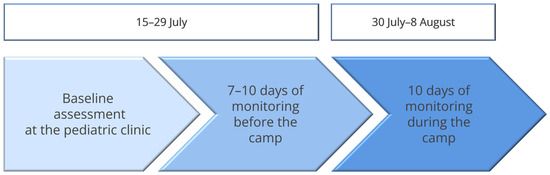
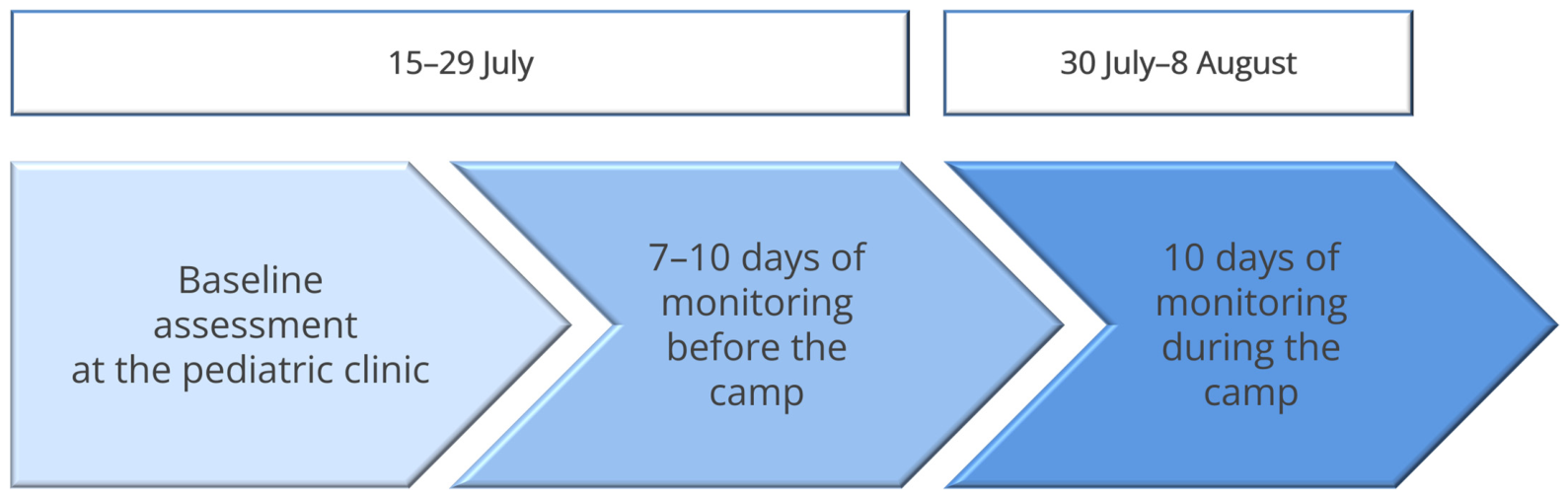
From the last two days of July, participants attended a 10-day Diabetes Summer Camp organized by the YMCA (Young Men’s Christian Association) in Chalkidiki, Greece. The participating children and adolescents were still wearing the electronic devices that were provided to them during their clinic visit in the previous week and participated in three physical and recreational activities each day, two in the morning and one in the afternoon. Figure 2 details the procedure timeline.
Figure 2.
Procedure timeline.
4.4. Camp Structure and Daily Schedule
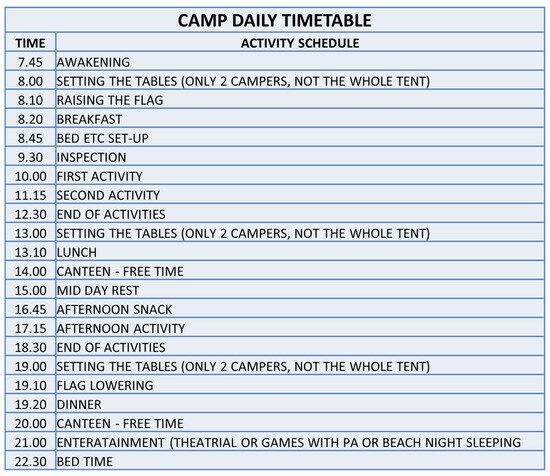
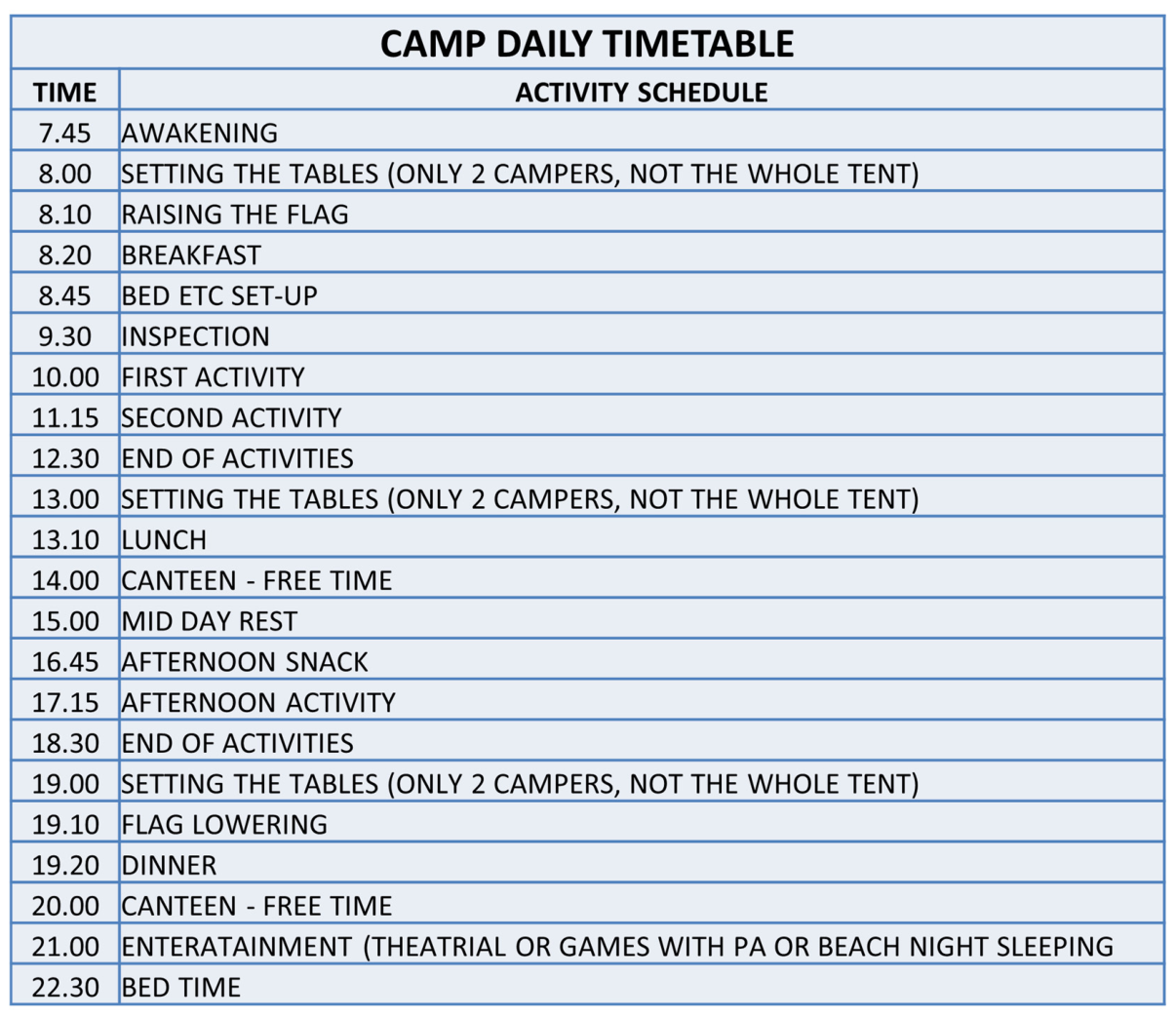
The summer camp was held in a large natural environment located at high altitude, with direct access to the sea, situated at the Chalkidiki peninsula in Greece. The camp’s structure encouraged continuous movement throughout the day, as participants had to walk between the different areas where activities, meals, and sleep accommodations were located. The daily program was organized into three main physical activity sessions, two in the morning and one in the afternoon, which included swimming, basketball, volleyball, climbing, and other recreational and educational games. In addition, campers participated in collective routines and leisure moments that further contributed to overall daily movement. A typical daily schedule of the camp is presented in Figure 3, showing the structured alternation of physical activities, meals, rest, and recreational periods.
Figure 3.
Camp daily timetable showing the structured organization of activities, meals, and rest periods throughout the day.
4.5. Physical Fitness Tests
Participants underwent a brief set of physical fitness assessment tests to evaluate motor abilities, including strength, coordination, and flexibility. The Handgrip Strength Test was used to evaluate upper-body muscular strength, using a hand dynamometer (Gima S.p.A., Gessate, Italy). Participants were seated on a chair with their shoulders adducted and in a neutral position, elbows flexed at 90°, and forearms and wrists in a neutral position. They were instructed to hold the hand dynamometer and squeeze it with maximal effort for five seconds, alternating between hands. The highest attained value, corresponding to peak force, was recorded in kilograms [36]. The Plate Tapping test, designed to assess hand-eye coordination and speed, involved two sets of 50 alternating touches on two target circles placed on either side of a central rectangle. The dominant hand performed the task, while the non-dominant hand remained stationary over the rectangle. Two attempts were performed, and the best result, corresponding to the shorter time spent, was recorded [37]. Finally, the Trunk Lift test was used to measure trunk extensor strength and flexibility. The participant lay prone on a mat with hands behind the neck and slowly lifted the upper body off the examination table, keeping the head aligned with the spine. The height from the floor to the chin was measured, and the best of two attempts was recorded. The test required a second operator to stabilize the lower body. Handgrip Strength and Plate Tapping test results were standardized by matching each participant’s best attempt to age and sex specific reference percentiles [38]. Regarding the Trunk lift test, in accordance with FitnessGram® performance standards [28], results were classified into three categories: below the Healthy Fitness Zone (HFZ), within the HFZ, and above the HFZ. The HFZ is defined as 6–12 inches for ages 6–9 and 9–12 inches for ages 10–17+. The selected tests were chosen to evaluate neuromuscular fitness components that have been reported to be altered in youth with type 1 diabetes. Previous studies have described reduced muscular strength, impaired coordination, and reduced flexibility in this population compared to healthy peers [8,27]. These tests were intended as descriptive baseline measures rather than primary outcome variables and were included to contextualize the functional characteristics of the sample.
4.6. Questionnaires
To collect subjective data on physical activity and sedentary behaviors, two validated questionnaires were administered to participants, each referring to the previous seven days spent wearing the electronic devices, in order to allow comparison between subjective and objective measures. Both questionnaires were not administered during the summer camp, as daily activities were fully structured and movement-oriented, and restricted use of electronic devices. The first tool was the Greek version of the Adolescent Sedentary Activity Questionnaire (ASAQ) [39,40], designed to assess time spent in a wide range of sedentary activities across five domains: recreational screentime, educational, cultural, social, and transportation. Participants reported the time spent on each behavior during both a typical weekday and a weekend day. The questionnaire is divided into two sections, one for weekdays and one for weekends, and the total sedentary time is calculated by summing the minutes reported across all items for both time periods. The second instrument was the Greek version of the Physical Activity Questionnaire for Children (PAQ-C) [41,42], a self-administered, 7-day recall questionnaire developed to evaluate general levels of physical activity in children between 8 and 14 years of age. The questionnaire was adapted by removing items related to time spent at school, as data collection took place during the summer holiday period. The final score is derived from nine items, each rated on a 5-point scale, where higher scores indicate greater physical activity levels. Specifically, a score of 1 corresponds to a very low activity level, 2 to low, 3 to moderate, 4 to high, and 5 to very high physical activity levels.
4.7. Wearable Device
To objectively assess daily physical activity, sedentary behavior, and sleep parameters, participants were equipped with two types of Fitbit devices (Fitbit Inc., San Francisco, CA, USA): the Fitbit Ace 3 and the Fitbit Inspire HR, assigned according to the participant’s age [43,44]. A one-week baseline monitoring period was selected to align with the recall period of the administered questionnaires and to minimize participant burden prior to camp participation. Previous research has shown that a seven-day monitoring period provides a reliable estimate of habitual physical activity and sleep patterns in pediatric populations [45]. These devices record step counts at one-minute intervals, heart rate every five seconds, and the number of minutes spent each day at different intensities of physical activity (light, moderate, and vigorous). Additionally, sleep-related variables were collected, including time asleep, duration of awakenings, and sleep efficiency [46]. Participants were instructed to wear the device continuously, both day and night, on their non-dominant wrist to minimize overestimation of movement. Families received detailed guidance on how to install the Fitbit mobile application, create individual accounts, and synchronize the devices to ensure consistent and complete data collection. Informed consent also included authorization to access and retrieve the data recorded by the devices. After the investigation period, families were instructed to access their child’s Fitbit account and download the data recorded throughout the entire period. They then provided the downloaded data to the research team. The collected data included the daily time spent in light, moderate, vigorous, and sedentary activity, expressed in minutes per day. Regarding sleep, the downloaded data reported the number of daily minutes spent asleep and awake, as well as the daily percentage of sleep efficiency, which indicates sleep quality. For each investigation phase, the minutes recorded for each variable were summed and divided by the number of days in that phase to obtain the average daily values.
4.8. Anthropometric Measurements
Body weight and height of participants were measured during early morning hours, with the subjects barefoot, wearing the minimum amount of clothes possible. One experienced dietitian (E.G.P.) performed all body measurements during morning hours. A standardized procedure was followed for weighing and measuring body height, in order to minimize measurement error, and frequent calibration of the scale was performed with portable fixed weights, to ensure measurement accuracy. A mechanical scale (Seca 700, Seca, Hamburg, Germany) and a wall-mounted stadiometer (Harpenden, Holtain, Crymych, UK) were employed, both situated at the Pediatric Endocrinology Unit. The body mass index (BMI) of each participant was calculated as the ratio of body weight (kg) divided by stature (m2). The World Health Organization’s (WHO) Anthro software v.3.2 (WHO, Geneva, Switzerland) was used for the calculation of BMI z-score (BMIz) in each participant. The WHO Anthro software is based on the WHO child growth standards and growth curves [47,48].
4.9. Statistical Analysis
Statistical analyses were conducted using JASP software (version 0.19.1, University of Amsterdam, Amsterdam, Netherlands). The Shapiro–Wilk test was used to assess the normality of data distribution across both phases of the study. Descriptive statistics were performed to explore participants’ basal conditions and conditions during the camp, examining variables related to fitness, physical activity, sedentary behavior, and sleep. To evaluate changes between the periods, paired-sample t-tests were performed on physical activity and sleep variables: Student’s paired t-test when the distribution of pre- and during-camp differences met normality, and the Wilcoxon signed-rank test otherwise. Effect sizes were reported as Cohen’s d for t-tests and the matched rank-biserial correlation (rrb) for Wilcoxon tests. To assess the influence of movement on sleep quality, linear regression models were performed for both periods, before the camp and during the camp. Assumptions of linear regression were examined for both models. Multicollinearity was assessed through the Variance Inflation Factor (VIF) and tolerance values, with all VIFs equal to 1.00, indicating the absence of collinearity. Residual plots and standardized residuals confirmed homoscedasticity and normal distribution of errors, with no influential outliers detected. A p-value < 0.05 was considered significant.
5. Limitations
This study had some limitations. First, the short observation period might not have been long enough to capture the long-term effects of physical activity and behavioral changes on sleep patterns. Second, the absence of details on sleep architecture limited the possibility of exploring the mechanisms underlying the observed variations. Third, the relatively small sample size reduces statistical power and may limit the generalizability of the findings, particularly regarding regression analyses. Future studies with larger samples are needed to confirm the observed associations. In addition, the limited number of participants within each sex group (10 boys and 13 girls) did not allow reliable sex-specific analyses, and potential sex-related differences should therefore be interpreted with caution. Fourth, no assessments of aerobic capacity or metabolic-related fitness were included, which limits the interpretation of the findings in relation to the metabolic nature of type 1 diabetes. This was mainly due to logistical and organizational constraints within the clinical setting. Additionally, although participants routinely used CGM systems, glycemic data were not included in the present analyses because recordings were available only for a limited period and contained substantial missing values and incomplete data across participants. Considering that an adequate characterization of glycemic patterns generally requires more complete CGM recordings, these data were deemed insufficiently robust for formal analysis. Therefore, metabolic parameters could not be integrated into the study analyses. Finally, the study was conducted in a summer camp setting characterized by fixed routines, scheduled activities, and mandatory nocturnal glycemic checks. These organizational constraints may have influenced both physical activity levels and sleep continuity, representing an inherent limitation in interpreting causal relationships. Despite these limitations, the results obtained provide interesting insights into future research. Future studies should include follow-up periods to evaluate chronic adaptations in physical activity and sleep patterns. Furthermore, precise strategies to reduce sleep fragmentation and enhance sleep hygiene could further potentiate the observed benefits.
6. Conclusions
This study provides a descriptive characterization of physical activity, sedentary behavior, and sleep patterns in children and adolescents with T1D, showing low physical activity levels, long sedentary time, and shorter sleep duration compared with international recommendations. Participation in the structured summer camp appears to be associated with different physical activity, sedentary behavior, and sleep patterns than habitual daily routine. These results highlight the importance of a structured and enjoyable environment for promoting healthy behaviors in youth with T1D. In particular, programs in structured settings, including regular physical activity, planned daily routines, and natural environments, may provide a useful framework for encouraging more active and less sedentary behaviors in youth with T1D. Moreover, the study suggests that individual variations in physical activity may differentially influence sleep continuity, highlighting the need to further explore how movement behaviors interact with sleep regulation in youth with T1D. Future studies should further investigate the role of settings in determining motor behaviors, such as physical activity, sedentary behavior, and sleep, as well as the long-term effects of structured camp-based programs. They should also include psychosocial, behavioral, clinical, metabolic, and chronobiological assessments to better understand their broader implications.
Author Contributions
Conceptualization, A.V., K.T. and P.I.; methodology, A.V. and P.I.; software, I.P.; validation, P.I.; formal analysis, I.P. and P.I.; investigation, I.P., I.T., P.S., A.T., E.G.P., A.B., and K.T.; resources, K.T., P.I.; data curation, I.P. and P.I.; writing—original draft preparation, I.P. and P.I.; writing—review and editing, I.P., P.I., M.G.G., D.G.G., and K.T.; visualization, I.P.; supervision, P.I.; project administration, K.T.; funding acquisition, Not applicable. All authors have read and agreed to the published version of the manuscript.
Funding
This research received no external funding.
Institutional Review Board Statement
The study was conducted in accordance with the Declaration of Helsinki and approved by the Institutional Review Board (Administration/Scientific Committee) of Hippokration General Hospital of Thessaloniki (Protocol Number 33475/19-7-2024, Study Number 24-E-55, Approval Date 16 January 2025).
Informed Consent Statement
After being given an analytical information sheet concerning participation in the study, informed consent was obtained from all subjects involved in the study.
Data Availability Statement
The data presented in this study are not publicly available due to privacy and ethical restrictions. Data may be made available from the corresponding author upon reasonable request.
Acknowledgments
The authors would like to express their gratitude to YMCA Thessaloniki, and particularly to the diabetes camp personnel, namely to Efthymios Arsenidis, Danai Efstathiou, Christiana Kanari, Konstantina Kosta, Kyriaki Pappa, Eleni C. Pardali, Ioannis Taiganidis, Kyriaki Taiganidou, and Panagiota Zisiadou.
Conflicts of Interest
The authors declare that the research was conducted without any commercial or financial relationships that could be construed as a potential conflict of interest.
Abbreviations
The following abbreviations are used in this manuscript:
| ASAQ | Adolescents Sedentary Activities Questionnaire |
| BMI | Body mass index |
| BMIz | BMI z-score |
| H | Glycated hemoglobin |
| HFZ | Healthy Fitness Zone |
| ISPAD | International Society for Pediatric and Adolescent Diabetes |
| KG | Kilograms |
| LIPA | Light physical activity |
| M | Meters |
| MPA | Moderate physical activity |
| MVPA | Moderate-to-vigorous physical activity |
| PAQ-C | Physical Activity Questionnaire for Older Children |
| T1D | Type 1 diabetes |
| VIF | Variance Inflation Factor |
| VPA | Vigorous physical activity |
| WHO | World Health Organization |
| YMCA | Young Men’s Christian Association |
References
- Greeley, S.A.W.; Polak, M.; Njølstad, P.R.; Barbetti, F.; Williams, R.; Castano, L.; Raile, K.; Chi, D.V.; Habeb, A.; Hattersley, A.T.; et al. ISPAD Clinical Practice Consensus Guidelines 2022: The Diagnosis and Management of Monogenic Diabetes in Children and Adolescents. Pediatr. Diabetes 2022, 23, 1188–1211. [Google Scholar] [CrossRef] [Scilit]
- Libman, I.; Haynes, A.; Lyons, S.; Pradeep, P.; Rwagasor, E.; Tung, J.Y.L.; Jefferies, C.A.; Oram, R.A.; Dabelea, D.; Craig, M.E. ISPAD Clinical Practice Consensus Guidelines 2022: Definition, Epidemiology, and Classification of Diabetes in Children and Adolescents. Pediatr. Diabetes 2022, 23, 1160–1174. [Google Scholar] [CrossRef] [Scilit] [PubMed]
- Colberg, S.R.; Sigal, R.J.; Yardley, J.E.; Riddell, M.C.; Dunstan, D.W.; Dempsey, P.C.; Horton, E.S.; Castorino, K.; Tate, D.F. Physical Activity/Exercise and Diabetes: A Position Statement of the American Diabetes Association. Diabetes Care 2016, 39, 2065–2079. [Google Scholar] [CrossRef] [Scilit]
- Bird, S.R.; Hawley, J.A. Update on the Effects of Physical Activity on Insulin Sensitivity in Humans. BMJ Open Sport Exerc. Med. 2017, 2, 143. [Google Scholar] [CrossRef] [Scilit]
- Chaput, J.P.; Willumsen, J.; Bull, F.; Chou, R.; Ekelund, U.; Firth, J.; Jago, R.; Ortega, F.B.; Katzmarzyk, P.T. 2020 WHO Guidelines on Physical Activity and Sedentary Behaviour for Children and Adolescents Aged 5–17 Years: Summary of the Evidence. Int. J. Behav. Nutr. Phys. Act. 2020, 17, 141. [Google Scholar] [CrossRef] [Scilit] [PubMed]
- Huerta-Uribe, N.; Hormazábal-Aguayo, I.A.; Izquierdo, M.; García-Hermoso, A. Youth with Type 1 Diabetes Mellitus Are More Inactive and Sedentary than Apparently Healthy Peers: A Systematic Review and Meta-Analysis. Diabetes Res. Clin. Pract. 2023, 200, 110697. [Google Scholar] [CrossRef] [Scilit]
- Jabbour, G.; Henderson, M.; Mathieu, M.E. Barriers to Active Lifestyles in Children with Type 1 Diabetes. Can. J. Diabetes 2016, 40, 170–172. [Google Scholar] [CrossRef] [Scilit]
- Lukács, A.; Mayer, K.; Juhász, E.; Varga, B.; Fodor, B.; Barkai, L. Reduced Physical Fitness in Children and Adolescents with Type 1 Diabetes. Pediatr. Diabetes 2012, 13, 432–437. [Google Scholar] [CrossRef] [Scilit]
- Calella, P.; Vitucci, D.; Zanfardino, A.; Cozzolino, F.; Terracciano, A.; Zanfardino, F.; Rollato, S.; Piscopo, A.; Gallè, F.; Mancini, A.; et al. Lifestyle and Physical Fitness in Adolescents with Type 1 Diabetes and Obesity. Heliyon 2023, 9, e13109. [Google Scholar] [CrossRef] [Scilit]
- Urbina, E.M.; Wadwa, R.P.; Davis, C.; Snively, B.M.; Dolan, L.M.; Daniels, S.R.; Hamman, R.F.; Dabelea, D. Prevalence of Increased Arterial Stiffness in Children with Type 1 Diabetes Mellitus Differs by Measurement Site and Sex: The SEARCH for Diabetes in Youth Study. J. Pediatr. 2010, 156, 731–737. [Google Scholar] [CrossRef] [Scilit] [PubMed]
- Gando, Y.; Murakami, H.; Yamamoto, K.; Kawakami, R.; Ohno, H.; Sawada, S.S.; Miyatake, N.; Miyachi, M. Greater Progression of Age-Related Aortic Stiffening in Adults with Poor Trunk Flexibility: A 5-Year Longitudinal Study. Front. Physiol. 2017, 8, 454. [Google Scholar] [CrossRef] [Scilit]
- Paruthi, S.; Brooks, L.J.; D’Ambrosio, C.; Hall, W.A.; Kotagal, S.; Lloyd, R.M.; Malow, B.A.; Maski, K.; Nichols, C.; Quan, S.F.; et al. Recommended Amount of Sleep for Pediatric Populations: A Consensus Statement of the American Academy of Sleep Medicine. J. Clin. Sleep Med. 2016, 12, 785–786. [Google Scholar] [CrossRef] [Scilit] [PubMed]
- Ji, X.; Wang, Y.; Saylor, J. Sleep and Type 1 Diabetes Mellitus Management among Children, Adolescents, and Emerging Young Adults: A Systematic Review. J. Pediatr. Nurs. 2021, 61, 245–253. [Google Scholar] [CrossRef] [Scilit]
- Kakinami, L.; O’Loughlin, E.K.; Brunet, J.; Dugas, E.N.; Constantin, E.; Sabiston, C.M.; O’Loughlin, J. Associations between Physical Activity and Sedentary Behavior with Sleep Quality and Quantity in Young Adults. Sleep Health 2017, 3, 56–61. [Google Scholar] [CrossRef] [Scilit]
- Zapalac, K.; Miller, M.; Champagne, F.A.; Schnyer, D.M.; Baird, B. The Effects of Physical Activity on Sleep Architecture and Mood in Naturalistic Environments. Sci. Rep. 2024, 14, 5647. [Google Scholar] [CrossRef] [Scilit]
- Izzicupo, P.; Di Blasio, A.; Di Credico, A.; Ghinassi, B.; Capranica, L.; Napolitano, G.; Di Baldassarre, A.; Modestini, E.; Di Pietro, M. Objectively Measured Physical Activity Increases Only in Males During a Summer Camp for Obese Children. Front. Sports Act. Living 2021, 3, 624449. [Google Scholar] [CrossRef] [Scilit] [PubMed]
- Barnett, E.Y.; Ridker, P.M.; Okechukwu, C.A.; Barrett, J.L.; Gortmaker, S.L. Children’s Physical Activity Levels in a Sports-Oriented Summer Day Camp. J. Hum. Sport Exerc. 2018, 13, 430–442. [Google Scholar] [CrossRef] [Scilit]
- Tumini, S.; Chiarelli, F. Camps for Children with T1DM. Acta BioMed. 2003, 74, 32–34. [Google Scholar]
- Jaser, S.S.; Ellis, D. Sleep in Adolescents and Young Adults with Type 1 Diabetes: Associations with Diabetes Management and Glycemic Control. Health Psychol. Behav. Med. 2016, 4, 49–55. [Google Scholar] [CrossRef] [Scilit]
- Sikora, M.; Zwierzchowska, A.; Jaworska, M.; Solich-Talanda, M.; Mikolajczyk, R.; Zebrowska, A. The Effects of Physical Activity on Glycaemic Control in Children and Adolescents with Type 1 Diabetes Mellitus Participating in Diabetes Camp. Balt. J. Health Phys. Act. 2018, 10, 151–161. [Google Scholar] [CrossRef] [Scilit]
- Skoufa, L.; Makri, E.; Barkoukis, V.; Papagianni, M.; Triantafyllou, P.; Kouidi, E. Effects of a Diabetes Sports Summer Camp on the Levels of Physical Activity and Dimensions of Health-Related Quality of Life in Young Patients with Diabetes Mellitus Type 1: A Randomized Controlled Trial. Children 2023, 10, 456. [Google Scholar] [CrossRef] [Scilit]
- Ling, F.C.M.; Khudair, M.; Ng, K.; Tempest, G.D.; Peric, R.; Bartoš, F.; Maier, M.; Brandes, M.; Carlin, A.; Ciaccioni, S.; et al. DE-PASS Best Evidence Statement (BESt): Determinants of Self-Report Physical Activity and Sedentary Behaviours in Children in Settings: A Systematic Review and Meta-Analyses. PLoS ONE 2024, 19, e0309890. [Google Scholar] [CrossRef] [Scilit] [PubMed]
- Khudair, M.; Marcuzzi, A.; Tempest, G.D.; Ng, K.; Peric, R.; Bartoš, F.; Maier, M.; Brandes, M.; Carlin, A.; Ciaccioni, S.; et al. DE-PASS Best Evidence Statement (BESt): A Systematic Review and Meta-Analysis on the Effectiveness of Trials on Device-Measured Physical Activity and Sedentary Behaviour and Their Determinants in Children Aged 5–12 Years. Sports Med. 2025, 55, 419–458. [Google Scholar] [CrossRef] [Scilit]
- Kolovelonis, A.; Syrmpas, I.; Marcuzzi, A.; Khudair, M.; Ng, K.; Tempest, G.D.; Peric, R.; Bartoš, F.; Maier, M.; Brandes, M.; et al. DE-PASS Best Evidence Statement (BESt): Determinants of Adolescents’ Device-Based Physical Activity and Sedentary Behaviour in Settings: A Systematic Review and Meta-Analysis. BMC Public Health 2024, 24, 1706. [Google Scholar] [CrossRef] [Scilit] [PubMed]
- Fusco, A.; Cortis, C.; Mork, P.J.; Conte, D.; Di Rocco, F.; Festino, E.; Izzicupo, P.; Orrù, S.; Nordstoga, A.L.; Papale, O.; et al. The Development of the EUropean Physical Activity Determinants Framework for Adolescents (EU-PAD-A): A Mixed-Methods Concept Mapping Study within the DE-PASS COST Action. Int. J. Behav. Nutr. Phys. Act. 2026, 23, 22. [Google Scholar] [CrossRef] [Scilit]
- Khudair, M.; Marcuzzi, A.; Ng, K.; Tempest, G.D.; Bartoš, F.; Peric, R.; Maier, M.; Beccia, F.; Boccia, S.; Brandes, M.; et al. DE-PASS Best Evidence Statement (BESt): Modifiable Determinants of Physical Activity and Sedentary Behaviour in Children and Adolescents Aged 5-19 Years-a Protocol for Systematic Review and Meta-Analysis. BMJ Open 2022, 12, e059202. [Google Scholar] [CrossRef] [Scilit]
- Hagag, A.A.; Seyam, M.K.; Zaky, N.A.; Salem, E.Y. Evaluation of Physical Fitness in Children with Type 1 Diabetes. Orig. Res. Artic. 2017, 5, 2332–2336. [Google Scholar] [CrossRef] [Scilit]
- The Cooper Institute. Fitnessgram®—Standards for Healthy Fitness Zone; The Cooper Institute: Dallas, TX, USA, 2006. [Google Scholar]
- Ohayon, M.; Wickwire, E.M.; Hirshkowitz, M.; Albert, S.M.; Avidan, A.; Daly, F.J.; Dauvilliers, Y.; Ferri, R.; Fung, C.; Gozal, D.; et al. National Sleep Foundation’s Sleep Quality Recommendations: First Report. Sleep Health 2017, 3, 6–19. [Google Scholar] [CrossRef] [Scilit]
- Chaput, J.P.; Gray, C.E.; Poitras, V.J.; Carson, V.; Gruber, R.; Olds, T.; Weiss, S.K.; Connor Gorber, S.; Kho, M.E.; Sampson, M.; et al. Systematic Review of the Relationships between Sleep Duration and Health Indicators in School-Aged Children and Youth. Appl. Physiol. Nutr. Metab. 2016, 41, 266–282. [Google Scholar] [CrossRef] [Scilit]
- Farabi, S.S. Type 1 Diabetes and Sleep. Diabetes Spectr. 2016, 29, 10–13. [Google Scholar] [CrossRef] [Scilit]
- Korkutata, A.; Korkutata, M.; Lazarus, M. The Impact of Exercise on Sleep and Sleep Disorders. npj Biol. Timing Sleep 2025, 2, 5. [Google Scholar] [CrossRef] [Scilit] [PubMed]
- Di Blasio, A.; Morano, T.; Lancia, F.; Viscioni, G.; Bucci, I.; Grossi, S.; Cimini, A.; Cianchetti, E.; Verrocchio, S.; Izzicupo, P.; et al. The Role of the Environment and Type of Exercise on Acute Adrenal Modulation and Perceived Distress of Breast Cancer Survivors Practising Light-Intensity Physical Exercise. Arch. Breast Cancer 2022, 9, 152–161. [Google Scholar] [CrossRef] [Scilit]
- Rutters, F.; Nefs, G. Sleep and Circadian Rhythm Disturbances in Diabetes: A Narrative Review. Diabetes Metab. Syndr. Obes. 2022, 15, 3627–3637. [Google Scholar] [CrossRef] [Scilit] [PubMed]
- Lewis, P.; Korf, H.W.; Kuffer, L.; Groß, J.V.; Erren, T.C. Exercise Time Cues (Zeitgebers) for Human Circadian Systems Can Foster Health and Improve Performance: A Systematic Review. BMJ Open Sport Exerc. Med. 2018, 4, e000443. [Google Scholar] [CrossRef] [Scilit]
- Ewing Fess, E.; Moran, C.A. American Society of Hand Therapists Clinical Assessment Recommendations; Hershman, G., Mackin, E., Laseter, G., Holdeman, V., Eds.; American Society of Hand Therapists: Mount Laurel, NJ, USA, 1981. [Google Scholar]
- Adam, C.; Klissouras, V.; Ravazzolo, M.; Renson, R.; Tuxworth, W. EUROFIT Handbook for the EUROFIT Tests of Physical Fitness; Committee of Experts od Sports Research: Strasbourg, France, 1987. [Google Scholar]
- Ortega, F.B.; Artero, E.G.; Ruiz, J.R.; España-Romero, V.; Jiménez-Pavón, D.; Vicente-Rodriguez, G.; Moreno, L.A.; Manios, Y.; Béghin, L.; Ottevaere, C.; et al. Physical Fitness Levels among European Adolescents: The HELENA Study. Br. J. Sports Med. 2011, 45, 20–29. [Google Scholar] [CrossRef] [Scilit] [PubMed]
- Hardy, L.L.; Booth, M.L.; Okely, A.D. The Reliability of the Adolescent Sedentary Activity Questionnaire (ASAQ). Prev. Med. 2007, 45, 71–74. [Google Scholar] [CrossRef] [Scilit]
- Trigonis, C. Validity and Reliability Assessment of a Questionnaire Recording Sedentary Behavior in Junior High School Students [Έλεγχος Εγκυρότητας Και Aξιοπιστίας Ερωτηματολογίου Καταγραφής Καθιστικής Συμπεριφοράς Μαθητών Γυμνασίου]. Master’s Thesis, Democritus University of Thrace, Komotini, Greece, University of Thessaly, Volos, Greece, 2014. [Google Scholar] [CrossRef]
- Kowalski, K.C.; Crocker, P.R.E.; Donen, R.M.; Honours, B. The Physical Activity Questionnaire for Older Children (PAQ-C) and Adolescents (PAQ-A) Manual; University of Saskatchewan: Saskatoon, SK, Canada, 2004. [Google Scholar]
- Venetsanou, F.; Emmanouilidou, K.; Soutos, K.; Sotiriou, S.A.; Bastida, L.; Moya, A.; Kambas, A. Towards a Functional Approach to the Assessment of Daily Life Physical Activity in Children: Are the Paq-c and Fitbit Flex-2 Technically Adequate? Int. J. Environ. Res. Public Health 2020, 17, 8503. [Google Scholar] [CrossRef] [Scilit]
- Evenson, K.R.; Goto, M.M.; Furberg, R.D. Systematic Review of the Validity and Reliability of Consumer-Wearable Activity Trackers. Int. J. Behav. Nutr. Phys. Act. 2015, 12, 159. [Google Scholar] [CrossRef] [Scilit]
- Feehan, L.M.; Geldman, J.; Sayre, E.C.; Park, C.; Ezzat, A.M.; Young Yoo, J.; Hamilton, C.B.; Li, L.C. Accuracy of Fitbit Devices: Systematic Review and Narrative Syntheses of Quantitative Data. JMIR Mhealth Uhealth 2018, 6, e10527. [Google Scholar] [CrossRef] [Scilit]
- Trost, S.G.; Pate, R.R.; Freedson, P.S.; Sallis, J.F.; Taylor, W.C. Using Objective Physical Activity Measures with Youth: How Many Days of Monitoring Are Needed? Med. Sci. Sports Exerc. 2000, 32, 426. [Google Scholar] [CrossRef] [Scilit]
- Meltzer, L.J.; Hiruma, L.S.; Avis, K.; Montgomery-Downs, H.; Valentin, J. Comparison of a Commercial Accelerometer with Polysomnography and Actigraphy in Children and Adolescents. Sleep 2015, 38, 1323–1330. [Google Scholar] [CrossRef] [Scilit] [PubMed]
- De Onis, M.; Garza, C.; Onyango, A.W.; Rolland-Cachera, M.F. WHO Growth Standards for Infants and Young Children. Arch. Pediatr. 2009, 16, 47–53. [Google Scholar] [CrossRef] [Scilit]
- De Onis, M.; Onyango, A.W.; Borghi, E.; Siyam, A.; Nishida, C.; Siekmann, J. Development of a WHO Growth Reference for School-Aged Children and Adolescents. Bull. World Health Organ. 2007, 85, 660–667. [Google Scholar] [CrossRef] [Scilit]

Disclaimer/Publisher’s Note: The statements, opinions and data contained in all publications are solely those of the individual author(s) and contributor(s) and not of MDPI and/or the editor(s). MDPI and/or the editor(s) disclaim responsibility for any injury to people or property resulting from any ideas, methods, instructions or products referred to in the content. |
© 2026 by the authors. Licensee MDPI, Basel, Switzerland. This article is an open access article distributed under the terms and conditions of the Creative Commons Attribution (CC BY) license.