


Abstract
Safety of enteral nutrition (EN) and parenteral nutrition (PN) products depends on manufacturing quality and changes during storage, preparation, and administration. This critical narrative review examines microbiological, chemical, and physicochemical hazards, distinguishing finished-product measurements, experimental models, and patient outcomes. The evidence documents secondary microbial contamination, material-derived plasticizer exposure, and oxidative changes in selected formulations, while also identifying conditions in which administration introduces no measurable additional contamination. Mechanistic susceptibility of eicosapentaenoic acid and docosahexaenoic acid to oxidation does not establish harmful exposure from contemporary commercial products. We propose Patient-Exposure-Oriented Nutritional Product Safety (PEONPS), a framework linking release quality, post-release change, terminal-line quality, and delivered exposure. Its proposed contribution is to integrate hazard-specific measurements with time-resolved administered dose and a prespecified test of whether the additional information changes a safety decision. Existing exposure studies provide precedents; PEONPS does not claim to introduce exposure assessment itself. Validation should compare its incremental value with established manufacturing, compounding, and administration controls. The framework offers a testable research agenda for targeted safety assessment, rather than a validated clinical score or a requirement for routine bedside testing. Supplementary targeted checks of official standards and selected safety-event and workflow studies were used to contextualize mechanical integrity and human factors; these searches were not intended to constitute exhaustive systematic retrieval.
1. Introduction
Enteral nutrition (EN) and parenteral nutrition (PN) sustain patients whose nutritional requirements cannot be met adequately by ordinary oral intake, but their delivery routes impose different safety requirements. Commercial liquid EN formulas are administered through the gastrointestinal tract, whereas PN bypasses gastrointestinal barriers and requires stringent sterility, compatibility, and administration controls. ESPEN guidance and ASPEN safety recommendations consequently address product selection, preparation, storage, handling, and delivery as connected clinical processes [1,2,3,4]. Recent analyses of PN quality also emphasize standardization and implementation across the care pathway [5].
The released product and the preparation actually delivered to a patient are different sampling states. Handling can introduce microbial contamination into EN, contact with administration materials can generate chemical exposure, and storage or light exposure can alter susceptible lipid-containing formulations [6,7,8,9,10,11]. These observations are conditional on product composition and workflow. They do not establish that sealed commercial formulas are generally contaminated or that every analytical change causes harm. Photoprotection evidence in premature infants illustrates a clinically relevant precaution whose population and outcome boundaries must remain explicit [12,13].
Existing systems already address substantial parts of this lifecycle. ASPEN recommendations govern PN ordering, compounding, filtration, and lipid-emulsion use; contemporary compatibility guidance incorporates physicochemical assessment throughout the PN process [3,14,15,16,17]. ICH Q9(R1) provides a broader framework for pharmaceutical quality risk management [18]. The unresolved question considered here is therefore how to connect these controls with measurements of the identity and amount of a specific hazard actually delivered, and when that information changes a safety decision.
Exposure-oriented measurements also have precedents. Investigations have compared aluminum in PN components and admixtures and sampled through both bag ports and infusion sets [19,20]. Neonatal PN research has estimated plasticizer exposure under simulated administration conditions [21]. These studies prevent a defensible claim that terminal-line sampling or dose reconstruction is intrinsically new. Instead, they motivate an integrated approach that retains differences between hazards, products, administration routes, and patient vulnerability while making incremental value testable.
We propose Patient-Exposure-Oriented Nutritional Product Safety (PEONPS) as that integrative research framework. Its proposed contribution combines paired lifecycle measurements, hazard-specific reconstruction of administered exposure, and a prespecified comparison with decisions based on existing controls. The framework asks whether added measurements would lead to a justified change in material selection, handling, or protection—not simply whether a concentration differs. This review synthesizes product-related microbiological, chemical, and physical evidence to define the framework and a staged validation strategy. It does not address the full spectrum of metabolic complications, catheter infections, or feeding intolerance except where they inform product quality or exposure; nor does it claim clinical validation of PEONPS.
2. Review Approach
The organizing question was whether the attributes of a nutritional product at the point of release adequately represent the material delivered to a patient after clinically realistic storage, handling, and administration. The synthesis therefore prioritizes the transferability of findings across product classes and use conditions. Regulatory standards and professional guidance are considered normative sources; analytical experiments are treated as evidence of measured changes under their reported conditions; and observational or interventional clinical studies are required to support patient-outcome claims. These categories are not a numerical grading system and should not be interpreted as a formal risk-of-bias assessment.
This article is a critical narrative review addressing microbiological, chemical and physical or physicochemical hazards of EN and PN products. Relevant literature studies were identified through targeted exploration of published studies, reference-list examination and supplementary bibliographic checks using PubMed, Crossref, publisher pages and professional or regulatory sources. Priority was given to clinical guidance, standards, original analytical studies, systematic reviews and research on storage, handling and administration. This was not a prospectively registered systematic search; no exhaustive retrieval or PRISMA-based selection process is claimed. A targeted revision search and source check was completed on 29 October 2026; this date does not reconstruct the undocumented period of the original search. Principal topics were EN microbial contamination and feeding systems; PN plasticizer migration and aluminum; lipid oxidation and photoprotection; and emulsion stability and calcium–phosphate compatibility. Searches combined these topics with enteral or parenteral nutrition and followed relevant reference lists. Publication dates in the cited literature span 1994–2026, which describes the included sources rather than a predefined eligibility window.
Sources were selected for relevance to the review questions, clarity of product class, analytical specificity, study design and applicability to actual clinical use. Original commercial products, compounded formulations, simplified laboratory models, administration systems and patient-level studies were evaluated as distinct evidence types. Negative results and methodological limitations were retained where informative. Because a dated complete search log and formal screening counts were not maintained, the selection process cannot be independently reproduced as a systematic review; this limits completeness and creates potential selection bias. Representative original investigations were prioritized when they identified the formulation or contact material, reported interpretable experimental conditions and directly informed a product-to-administration comparison. Contrasting results were retained, including formulation-dependent versus nonsignificant lipid-type effects on migration [7,8] and the absence of a significant administration-related aluminum increment [19]. Selection was purposive rather than exhaustive; neither comprehensive descriptive breadth nor balanced retrieval of every positive and negative study can be assumed.
Interpretation is therefore qualitative and explicitly conditioned on formulation, administration route, sampling matrix, assay validity and the distinction between measured product change, administered exposure and demonstrated clinical effect.
The review distinguishes evidence according to the proximity of its experimental system to actual clinical exposure. Tier A comprises measurements of complete, commercially relevant EN or PN formulations under defined handling or administration conditions. Tier B comprises studies of infusion or feeding systems and representative admixtures. Tier C comprises simplified emulsions, mechanistic chemistry and other laboratory models. Tier D comprises patient-level investigations that explicitly connect measured product attributes or exposure with clinical endpoints. These tiers are not an automatic ranking of study quality; they describe directness and transferability. A rigorous model study may establish mechanism more convincingly than a poorly controlled product study, while remaining insufficient to estimate the patient dose.
For each reported hazard, the critical appraisal considers formulation identity, sample size and replication, analytical specificity, controls for artefactual contamination or oxidation, relevance of tested temperature and illumination, contact time, administration route, and whether clinical outcomes were actually measured. Negative findings are interpreted in relation to assay sensitivity and study conditions. Narrative synthesis is used because the product types, exposure matrices and outcomes are too heterogeneous for a single pooled estimate. Table 1 summarizes the principal evidence categories and their inference boundaries.
Table 1.
Evidence categories and limitations.
3. Product Classes and Safety Boundaries
Ready-to-use liquid enteral formulas are manufactured for administration through an appropriate feeding system, including nasogastric and gastrostomy tubes. They should not be conflated with powdered oral nutritional supplements requiring reconstitution, although certain specifically labeled powdered products may be used via a feeding tube. Blenderized feeds constitute a separate category. PN includes commercially prepared multichamber products, individualized admixtures and intravenous lipid emulsions, each with different compounding, compatibility and stability considerations [1,2,3].
For EN, an unopened industrial liquid formula, a formula poured into an open feeding reservoir and a formula sampled at the distal end of the tube represent different exposure states. Microbiological findings from blended foods, home-prepared feeds or powdered products cannot be generalized to unopened ready-to-hang formulas. In addition, contamination of a formula sample is a process-quality finding, not by itself proof of infection or causation of clinical deterioration.
For PN, original commercial lipid emulsions and compounded total nutrient admixtures are not analytically interchangeable. Adding amino acids, glucose, electrolytes, vitamins or trace elements can alter pH, ionic strength, light absorption, oxygen-dependent reactions and emulsion stability. The distinction between physical instability (including enlarged lipid droplets or precipitates) and chemical degradation (including oxidation products) must be maintained throughout the safety assessment.
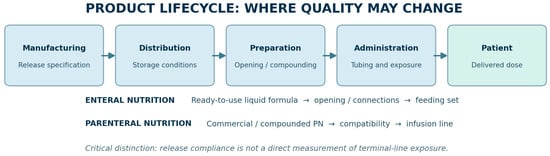
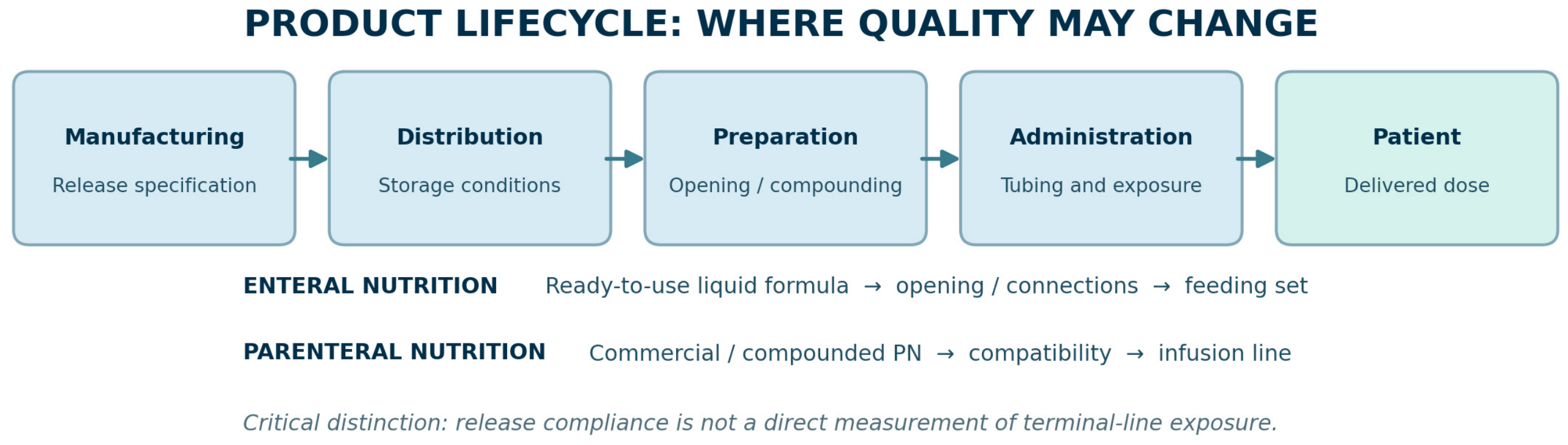
The sequence of product transitions is illustrated in Figure 1.
Figure 1.
Product lifecycle and potential quality transitions for enteral and parenteral nutrition. Conceptual illustration; pathways differ by product class.
Comparative evidence from historical open-versus-closed feeding system studies [24,25] and systematic reviews of blenderized or home-handled preparations [26,27] must be interpreted by product category and sampling context. These sources cannot estimate the intrinsic contamination rate of sealed ready-to-use liquid EN. The broader ESPEN enteral nutrition guidance [1,28] supports an implementation-centered approach in which hygienic handling and validated administration procedures complement manufacturing quality.
4. Microbiological Safety
A particularly instructive comparison is provided by Kozow and colleagues, whose systematic review included 23 studies and 1099 enteral formulations prepared or manipulated in hospitals and homes. The review reported that 44.67% of tested formulations exceeded the bacterial-count threshold used in the included investigations. The figure is a heterogeneous sample-level observation, not a prevalence estimate for unopened industrially manufactured liquid formulas and not an infection rate. The highest proportions were observed among homemade preparations, with lower proportions among commercial preparations after handling. Differences in sampling, preparation, storage, microbiological criteria and study setting limit causal interpretation [6].
The relevant contrast is therefore not simply commercial versus noncommercial nutrition but the entire preparation and administration pathway. Commercial liquid ready-to-use EN minimizes some handling steps; an open system may reintroduce opportunities for environmental contamination when the product is transferred into a reservoir. A closed ready-to-hang system may reduce such manipulations but can still be compromised by connection practices and administration duration. These findings support process-specific prevention rather than a universal assumption that every commercial formula remains uncontaminated after opening [4].
Microbiological studies should be read with attention to the sampling denominator. Samples may represent unopened containers, freshly prepared feeds, administration reservoirs or distal-line effluent, and these matrices cannot be combined without qualification. Reported colony counts, detection rates and organisms are also sensitive to culture methods, sampling time and whether handling was standardized. The review by Kozow and colleagues is therefore informative about the existence and diversity of contamination routes, but it does not provide a universal rate for factory-produced, ready-to-use liquid EN [6].
PN contamination poses a different hazard because of the intravenous route. Aseptic compounding and infusion-system access are distinct risk stages, and clinical bloodstream infection may originate from a catheter or hub rather than from a contaminated nutrition bag. Demonstrating product-attributable infection would require microbiological source attribution and appropriate epidemiological assessment. The PEONPS approach should therefore treat microbial contamination as a measurable process outcome and clinical infection as a separate, downstream endpoint.
For comparative evidence from enteral delivery systems, Wagner et al. directly compared open and closed delivery configurations for peptide-based enteral diets, examining handling, waste and contamination [24]. Vanek subsequently evaluated system compliance and microbial findings in a quality-improvement setting [25]. In that study, the small number of cultured bags and the local workflow preclude treating the results as a universal contamination rate; nevertheless, the comparison is informative because the intervention changed the number of manipulation opportunities. Such studies should be interpreted together with the heterogeneous product classes and sampling approaches synthesized in the systematic review [6].
The relevant clinical context is not limited to a single nutrition setting: home PN and home EN guidance address different administration environments [2,28,29], whereas hospital nutrition guidance addresses institutional processes [30]. These documents establish practice context, not quantitative estimates of contaminants transferred from product to patient.
A controlled investigation of enteral feeding-system reuse compared a closed, ready-to-hang liquid feeding system with open systems using reconstituted powdered feeds. Under repeated inoculation challenge, no significant bacterial growth was observed in the tested closed system over 24.5 h, whereas significant growth occurred in some open configurations. This is evidence about the tested systems and hygiene conditions, not proof that all closed systems are sterile throughout use or that extended reuse is universally appropriate. The study was funded by an enteral-nutrition manufacturer and should be interpreted alongside independent evidence [31].
5. Chemical Contaminants and Material Migration
The aluminum and DEHP examples illustrate two different exposure pathways. Aluminum can be present as an impurity in parenteral components and is of particular concern in patients with limited renal elimination or prolonged intravenous exposure. In contrast, DEHP migration depends on contact between a formulation and a plasticized material. Consequently, a manufacturing certificate for the original formulation does not necessarily characterize exposure generated in the administration line [7,8,32,33].
For a constant contaminant concentration, the administered dose normalized to body weight can be estimated as:
where Dadm is the administered contaminant dose per kilogram of body weight, Cadm is the contaminant concentration at the point of administration, Vadm is the volume delivered, and BW is the patient’s body weight. When contaminant concentration and administration flow rate vary over time, the cumulative administered dose can be more accurately estimated as:
where Cout(t) is the contaminant concentration measured at the terminal end of the administration system at time t, Q(t) is the corresponding administration flow rate, and T is the total administration duration.
Dadm = (Cadm × Vadm)/BW
Dadm = (1/BW) × integral from 0 to T of [Cout(t) × Q(t)] dt
This approach accounts for time-dependent contaminant migration and provides a more representative estimate of actual contaminant delivery than a single measurement in the original container. However, the calculated dose represents administered exposure rather than systemic absorption or biological effect. Its toxicological significance depends on the administration route, exposure duration, contaminant-specific kinetics, and patient susceptibility.
Product contamination and migration from contact materials should be evaluated separately from the administered dose and any demonstrated clinical effect. Aluminum exposure from PN is an established concern, particularly in premature infants; clinical evidence and specific regulatory provisions support this distinction [32,33]. DEHP migration from PVC infusion sets has been demonstrated in experimental investigations of lipid emulsions. Differences between study designs show that formulation, material, contact time and flow conditions jointly influence migration, rather than lipid source alone [7,8]. Emerging concerns such as microplastics require product-specific analytical confirmation, validated blanks and route-sensitive exposure assessment before health implications can be inferred.
Bagel et al. tested six lipid emulsions in static contact with 150 cm PVC/polyethylene coextruded extension sets at 22 ± 2 °C, with six tubing replicates per emulsion at each of 1 and 24 h; lipid-type differences emerged after prolonged contact [7]. Faessler et al. instead perfused seven 150 cm PVC line types, representing three internal diameters, with three emulsions and found no significant lipid-emulsion effect under their conditions [8]. These designs do not establish a universal ranking of lipid sources. Flow determines residence time and the volume delivered: lower flow can prolong contact, but concentration alone cannot predict cumulative dose, which depends on concentration multiplied by flow and integrated over time. Tubing polymer, plasticizer identity, inner diameter, length, temperature and duration must therefore accompany any migration estimate. A coextruded barrier or a different plasticizer changes the exposure system and cannot be treated as equivalent to DEHP-plasticized PVC. Comparisons should match the circuit and administration conditions before attributing differences to lipid composition [7,8].
A more recent neonatal ex vivo study distinguished plasticizers already present in lipid emulsions from those contributed by infusion circuits. Panneel et al. estimated daily DEHP and acetyl tributyl citrate exposure under their simulated administration conditions; these estimates were below the reference doses used by the investigators, but did not establish neonatal clinical safety [21]. This demonstrates that exposure reconstruction is already feasible and provides a direct methodological precedent for PEONPS.
Claims regarding microplastics and nanoplastics require especially stringent contamination control. Background particles from laboratory air, vessels, tubing, sample preparation and analytical equipment can compromise interpretation. Without validated particle identification, size distribution, field blanks and quantitative patient exposure, environmental evidence should not be promoted into a clinical EN/PN risk estimate.
Microplastics are no longer solely a theoretical PN concern: Vercauteren et al. examined particles larger than 25 μm in an ex vivo neonatal PN circuit with pre-infusion and subsequent samples [34]. The pilot design and analytical size window do not establish the total particle burden, nanoplastic exposure, or patient harm. It supports product- and circuit-specific investigation with contamination controls, rather than extrapolation to all EN/PN products.
Schönenberger et al. measured elemental contamination in adult all-in-one PN admixtures and compared bag-port with infusion-set samples over 48 h. They found no significant difference in aluminum concentration between those sampling routes, and measured concentrations agreed with estimates based on components [19]. Such findings are a necessary counterexample to an assumption that administration always increases contamination. Aljohar et al. separately examined aluminum in neonatal PN ingredients and solutions using mass spectrometry [20]; differences in products and populations preclude treating the studies as a common exposure estimate.
Expert recommendations on intravenous lipid emulsions [15,35] and pediatric lipid guidance [36] provide clinically relevant formulation context, but they do not replace analytical characterization of oxidation in individual products. Review-level discussions of lipid-emulsion functionality [37] likewise require separation from direct measurements of patient exposure.
6. Lipid Oxidation and Nutrient Degradation
Interpretation should distinguish oxidation initiation, propagation, and secondary degradation. Hydroperoxide concentrations may peak and subsequently decline as decomposition progresses; thus a low peroxide value at a single time point does not necessarily exclude earlier oxidative reactions. Secondary indices such as malondialdehyde are useful in defined experimental settings but are neither specific to EPA/DHA nor comprehensive measures of all oxidized lipid species. Ideally, targeted mass-spectrometric measurements should complement global indices, with appropriate internal standards, extraction controls and avoidance of artefactual oxidation. These markers demonstrate chemical reactions under the tested conditions; their possible toxicological consequences remain mechanistic hypotheses unless delivered dose and relevant clinical outcomes are established. An increased MDA or peroxide measurement alone does not establish toxicity during current clinical use of an EN or PN product.
Lipid oxidation may change fatty acid composition and generate primary hydroperoxides and secondary products. EPA and DHA are susceptible to oxidation because of their multiple double bonds, but the behavior of finished formulations depends on antioxidant content, oxygen, temperature, light, packaging and other ingredients. Autoxidation and photosensitized reactions are mechanistically distinct [38,39]. Rufián-Henares et al. identified oxidative changes during storage of two enteral formulas, without specifically quantifying EPA- and DHA-derived oxidation products [9]. Silvers et al. demonstrated light-induced peroxidation and vitamin degradation in PN-related experimental systems, including complex effects of vitamin mixtures [10].
Setoguchi et al. studied fish-oil and mixed-oil intravenous emulsions dispensed into polypropylene syringes and observed effects of storage conditions on malondialdehyde and pH [11]. The relevance to handling of omega-3-containing PN is direct, but the formulation and dispensing context were specific. It is not evidence for unrestricted extension of beyond-use dates, and it does not establish the full spectrum of oxidized EPA/DHA molecular species. Studies should distinguish products stored in their original manufacturer containers from emulsions transferred into syringes or incorporated into complete PN admixtures.
6.1. Photosensitized Oxidation
Riboflavin-mediated photochemistry is especially informative as a mechanistic example rather than proof of harm from finished products. The balance between Type I electron-transfer reactions, Type II singlet-oxygen generation, antioxidant quenching and oxygen availability varies by matrix. Droplet size and optical transparency can affect oxidation in model fish-oil emulsions [22,38,39], but the presence of emulsifiers, other vitamins, trace elements, packaging and light-protective materials can change the net response of a commercial formulation. The protective effects of certain vitamin preparations in the experiments by Silvers et al. caution against a simple claim that vitamins uniformly increase lipid peroxidation [10]. Pediatric PN vitamin guidance also recommends, when feasible, adding vitamins to lipid-containing preparations to improve vitamin stability [40]; this formulation guidance does not establish a patient toxicity threshold for lipid oxidation products.
Photoprotection guidance for premature infants is clinically important, yet the population, outcome and mechanistic specificity must remain explicit. The ASPEN position paper addresses PN photoprotection in premature infants, who may be particularly vulnerable to oxidative stress; it should not be read as direct evidence of an EPA/DHA-specific adverse outcome in adult recipients of PN [12].
A meta-analysis by Chessex et al. included four trials involving 800 premature infants and reported lower mortality with light-protected PN [13]. This patient-level evidence supports the relevance of photoprotection in that population, while leaving the contribution of individual EPA/DHA oxidation products unresolved.
Type I photochemistry involves electron or hydrogen transfer with potential initiation of radical reactions; Type II processes involve energy transfer to molecular oxygen and generation of singlet oxygen [38]. Riboflavin can participate in photosensitization [39], but whether it produces net lipid oxidation in a finished formula depends on light spectrum and intensity, oxygen, matrix optical properties and protective constituents. Model fish-oil emulsion findings [22] establish a plausible pathway, not its prevalence in clinical use.
The proposed omega-3 research question is therefore narrowly formulated: under defined clinical storage and administration conditions, do complete commercial EN and PN formulations exhibit measurable EPA/DHA depletion or formation of analytically specific oxidation products beyond validated baseline variability? Only if that question is answered affirmatively does the next question arise: what dose of those products is delivered and is that dose biologically relevant?
6.2. Analytical Implications
Chemical and physical stability must be assessed independently. Measurements of residual EPA and DHA, selected primary and secondary oxidation markers and targeted oxidation products, where validated, should be combined with appropriate sample-handling controls. A single peroxide or malondialdehyde measurement cannot fully describe oxidation pathways or delivered toxicological exposure. Terminal-line sampling under realistic conditions is a priority for future studies.
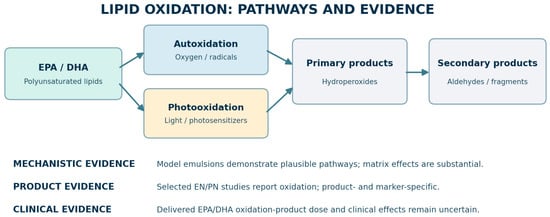
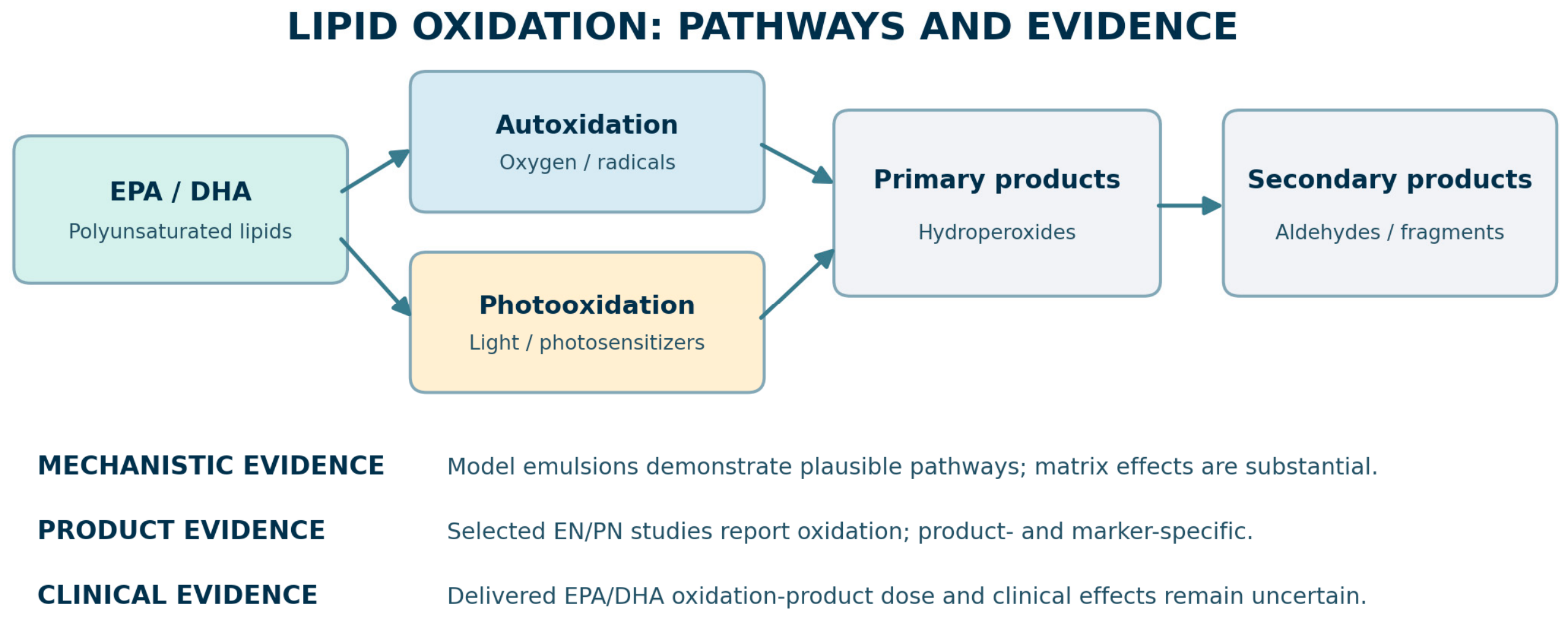
A robust protocol should specify collection vessels, oxygen exclusion where appropriate, immediate sample stabilization, light shielding, validated storage until analysis, internal standards and procedural blanks. Paired samples should be obtained from the original container and the distal end of a feeding or infusion set, with the exact elapsed time and delivered volume recorded. Orthogonal analytical approaches can distinguish residual fatty acids, primary oxidation, secondary oxidation and emulsion particle-size distributions. This prevents the mistaken inference that physical stability proves chemical stability or vice versa. Figure 2 distinguishes plausible oxidation pathways from product-level and clinical evidence.
Figure 2.
Simplified pathways of omega-3 lipid oxidation and the distinction between mechanistic, product-level, and clinical evidence. Mechanistic plausibility does not establish patient harm.
Guidance on photoprotection is similarly population-specific. The ASPEN position paper addresses premature infants [12], while an international perspective places photoprotection within a broader discussion of PN practice [41]. Neither source establishes a universal adult threshold for oxidized omega-3 species. ASPEN lipid injectable emulsion recommendations also emphasize physical stability, product-specific formulation and administration safeguards, providing an important comparator for chemical oxidation claims [15].
The general principles of sterile preparation and quality risk management are described in USP <797> [42] and ICH Q9(R1) [18], while USP <729> [43] addresses droplet-size distribution in specified injectable lipid emulsions. These documents have different scopes and should not be presented as interchangeable or as proof of clinical harm. ASPEN ordering and compounding guidance [16] complements the infusion filter recommendations [14].
7. Physicochemical Stability and Compatibility
Physical instability and chemical oxidation must be treated as parallel safety dimensions. Mean droplet diameter and PFAT5 address the size distribution of lipid globules under applicable injectable-emulsion specifications; they do not measure peroxide formation or loss of individual fatty acids. Conversely, chemically oxidized lipid species may be present in an emulsion that still meets physical droplet-size criteria. Applying a limit derived for a particular injectable emulsion to a compounded admixture requires attention to the applicable test method and product context [23].
Calcium–phosphate precipitation is mechanistically distinct from lipid coalescence. Its risk depends on the chemical forms and concentrations of calcium and phosphate, amino acid composition, pH, temperature and compounding sequence. Filtration can reduce certain particulate hazards but cannot correct an incompatible formulation or replace validated preparation and administration procedures [3,14].
Original formulation studies illustrate these boundaries. Watrobska-Swietlikowska examined 12 neonatal PN base solutions in triplicate with different calcium and phosphate salts, including 24 h incubation at 37 °C and subsequent storage assessments. Organic salt combinations permitted higher concentrations than inorganic combinations in the tested matrices, but precipitation still occurred at sufficiently high concentrations; compatibility therefore remained composition-specific [44]. Forchielli et al. [45] studied six pediatric admixture compositions with five lipid emulsions at 4 °C over 0–96 h, with triplicate testing (450 analyses). Most preparations retained the reported droplet-size range, whereas selected fish-oil-containing admixtures with 4.5 mmol/L calcium showed enlarged droplets immediately after compounding [45]. The first investigation concerns salt precipitation, whereas the second concerns emulsion droplet distributions; neither establishes clinical outcomes, chemical oxidative stability or universal compatibility limits. The PEONPS model should include both pre-infusion and post-contact assessments where a material or handling step could plausibly alter physical quality.
The 2024 practical compatibility and stability guidance similarly embeds physicochemical assessment in prescribing, review, preparation, and administration [17]. PEONPS should therefore be tested against this active process of care, with additional measurements justified by a specific unresolved exposure question.
Beyond-use dating and storage decisions depend on the product and preparation process [46]. Photoprotection recommendations and international discussion of implementation [12,41] should be distinguished from stability measurements for specific containers and tubing. The ESPEN micronutrient guideline [47] addresses provision and monitoring of micronutrients, rather than establishing rates of chemical degradation in EN or PN.
8. Packaging, Storage and Distribution
Oxygen and light transmission, container integrity, material composition and interactions with the product may influence stability. Storage instructions must be product-specific and based on validated manufacturer specifications. Receipt checks, traceability, expiry management, temperature excursion procedures and packaging inspection may limit avoidable post-release deterioration. Formal critical-control-point designation requires process-specific hazard analysis and validation. Mechanical integrity is an additional product safety dimension: punctures, compromised seals, cracks, leakage and damage during transport or handling may invalidate the assumed container–closure barrier and warrant product-specific inspection and rejection procedures. A visible defect is not proof of contamination, but it should not be interpreted as merely cosmetic. Packaging qualification, receipt inspection, traceability and documented responses to damage or temperature excursions should be distinguished from microbiological release testing and physicochemical stability assessment [4,42].
9. Preparation and Administration
The clinically relevant safety transition is the movement from a released product to a material actually delivered to the patient. For ready-to-use EN, this includes opening, hygienic connection, avoidance of unnecessary transfers, and adherence to validated administration periods. Powder reconstitution is not a standard assumption for feeding through PEG or nasogastric tubes [1,4]. For PN, relevant steps include aseptic compounding when applicable, compatibility review, filtration, inspection and photoprotection when indicated [2,3,12,14]. Measurements should distinguish concentration in the original container from concentration and total dose at the terminal delivery point.
The administration stage should be investigated as a sequence rather than a single event: package opening or bag preparation, connection, contact with tubing, flow through the set and delivery to the patient. Sampling only the original container risks missing time-dependent migration or contamination, whereas sampling only the terminal line may obscure whether a change originated during manufacturing or administration. Paired, time-stamped samples and process documentation are therefore necessary.
For EN, commercial ready-to-use formulas and closed systems should be the primary clinical reference, with separate study strata for open-system decanting and reconstituted products. For PN, original lipid emulsions, compounded admixtures and neonatal photoprotected systems should be investigated as distinct strata. The resulting data should be linked to the volume actually administered rather than the nominal volume prescribed.
Recent microbiological comparisons of feeding systems [48] may inform workflow-related contamination hypotheses, but study design, commercial involvement, sample collection and clinical endpoints must be assessed before extrapolating findings to all products. Risk-management analogies to ISO 14971 [49] are conceptual only: that standard concerns medical devices and does not establish a dedicated nutritional product safety framework. Human factors and device-related errors are relevant determinants of delivered exposure, but they are not themselves a fourth class of physical contaminants. Incorrect product selection, labeling, dilution, compounding, tubing connections, route, flow rate or duration may result in unintended delivery even when the original product meets release specifications. ASPEN safe practices and device-specific connector standards already address important parts of this risk; PEONPS should complement rather than replace these safeguards [4,49,50,51,52,53]. Reported EN safety events and prospective workflow audits document the practical importance of administration and labeling errors, while evidence on enteral misconnections supports route-specific connection safeguards [50,51,52]. Safe PN compounding similarly requires control of automated-compounding workflows and verification steps [53].
10. Emerging Risks and Research Gaps
Microbial contamination after handling, aluminum exposure, calcium–phosphate precipitation and DEHP migration from specified materials are established safety concerns [3,6,7,8,32,33]. The emerging component is the incomplete characterization of exposure in contemporary products and circuits, including alternative plasticizers, microplastics, specific oxidized EPA/DHA species and combined post-release stresses [21,34]. Here, emerging denotes an unresolved exposure or evidence question, not proof of a newly demonstrated clinical hazard.
A recurring weakness of the literature is the use of noncomparable endpoints. A microbiological colony count, a DEHP concentration, a peroxide value, PFAT5 and a clinical infection endpoint measure fundamentally different phenomena. Combining them into a single unvalidated safety score would obscure rather than resolve this heterogeneity. A future integrated framework should retain hazard-specific endpoints and only aggregate them when an empirically defensible exposure–response relationship exists.
Another limitation is external validity. Experimental transfer to polypropylene syringes, illumination beyond routine practice, and deliberately stressed storage may identify vulnerabilities but do not necessarily represent standard administration. Future protocols should predefine a clinically representative primary condition and separately include stress-testing conditions. Reporting should include the commercial product class, lot, packaging, tubing composition, temperature, illuminance or spectral exposure, dissolved or headspace oxygen where relevant, time and administered volume.
Available studies often examine isolated factors, while actual administration may combine temperature changes, oxygen, light, material contact and elapsed time. Such combined exposure is a plausible research question, not evidence of proven synergy. Major gaps include validated EPA/DHA-specific oxidation assays in complete commercial formulations, clinically representative terminal-line measurements, comparative material-migration data, and studies linking measured exposure with meaningful patient outcomes. Digital traceability may assist process documentation, but its clinical benefits remain to be demonstrated.
A research priority is the interaction between oxidative degradation and contact-material migration in lipid-rich products. Such an interaction is chemically conceivable but should not be asserted without controlled evidence. Factorial designs can distinguish independent main effects from statistically supported interactions. Similarly, concurrent physical and chemical measurements can determine whether changes in droplet distribution and oxidation markers co-occur, without assuming a causal relationship.
Research gaps should be ranked by decision relevance: (i) measurement reliability, (ii) reproducibility under clinical conditions, (iii) delivered dose, (iv) toxicological interpretation and (v) evidence of patient benefit from mitigation. This sequence avoids prematurely recommending costly monitoring measures on the basis of isolated laboratory findings. Table 2 compares representative original investigations, including studies that support and studies that limit an assumption of additional exposure during administration.
Table 2.
Comparison of selected original studies: evidence tier, design, matrix, endpoint, and inference boundary.
Tiers describe evidence directness, not methodological quality (Section 2). No study in this table links measured exposure to patient outcomes sufficiently to qualify as Tier D. Counts refer to formulations, line types or analytical replicates, not patients; repeated analyses are not independent clinical observations.
11. Patient-Exposure-Oriented Nutritional Product Safety (PEONPS)
The Patient-Exposure-Oriented Nutritional Product Safety (PEONPS) framework is a proposed, unvalidated research architecture for testing whether post-release product measurements provide actionable information beyond existing manufacturing, compounding and administration controls. Its proposed innovation is not terminal-line sampling, exposure estimation or quality risk management in isolation: all have established precedents [3,18,19,20,21]. Rather, PEONPS prespecifies the hazard, baseline measurement, downstream measurement, administered-exposure estimate, existing-control comparator and safety decision before data collection. It is therefore an incremental-value hypothesis, not a claim that existing controls are inadequate.
The primary PEONPS hypothesis is that, for at least some defined hazards and workflows, terminal-line measurements combined with actual delivered volume and flow will change an exposure estimate sufficiently to alter a prespecified quality or risk-management decision compared with current controls. The null hypothesis is that established release, storage, compounding and administration controls already provide adequate information for that decision. A statistically significant concentration difference alone does not demonstrate added value; analytical uncertainty, clinical or toxicological relevance, feasibility and the consequences of an altered decision must all be evaluated.
PEONPS therefore proposes a falsifiable, decision-focused comparator rather than a new universal testing obligation. Existing controls already address many of the same hazards: ICH Q9(R1) provides a lifecycle approach to pharmaceutical quality risk management [18]; USP <797> governs sterile compounding [42]; USP <729> addresses injectable lipid-emulsion globule-size distribution [43]; and ASPEN recommendations address PN preparation, filtration, compatibility, and lipid-emulsion administration [3,14,15,16]. Prior investigations have also measured aluminum in PN preparations and administration systems and estimated plasticizer exposure in simulated neonatal infusion circuits [19,20,21]. The potential increment is consequently not any individual test, but a prospectively specified comparison of standard decisions with decisions informed by paired lifecycle measurements and administered-exposure reconstruction. Table 3 distinguishes established functions from this unvalidated proposition.
Table 3.
PEONPS in relation to existing safety approaches.
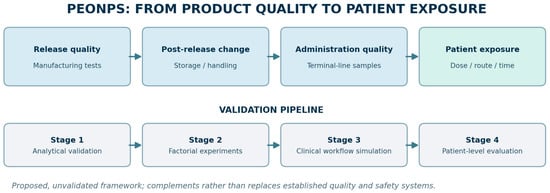
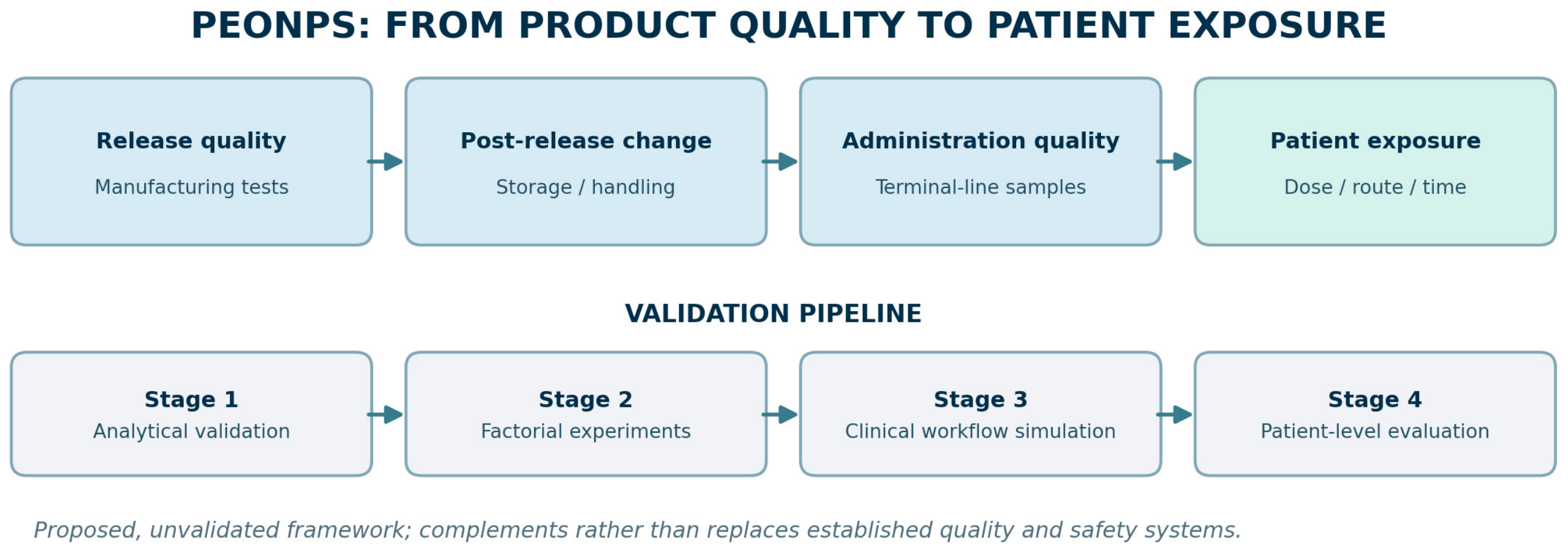
Operationally, four linked sampling and inference domains are defined: Q0, manufacturing-release quality; Q1, quality after storage and handling; Q2, quality at the terminal administration point; and E, hazard-specific administered exposure reconstructed from Q2 and documented delivery parameters. The framework does not assume that Q2 differs from Q0 or that a measured difference is clinically meaningful. A pre-administration sample must not be mislabeled as an authentic manufacturing-release sample. For microbial, chemical, and physical hazards, analytical endpoints and decision thresholds must be specified separately. PEONPS should be judged by whether it reproducibly changes a prespecified safety decision beyond existing controls, not by the mere detection of a difference.
As for an illustrative DEHP decision scenario (hypothetical values, not study results), consider a 1 kg infant receiving 48 mL of a lipid-containing preparation over 24 h at 2 mL/h. An original-container pre-administration concentration of 0.10 µg/mL would predict 4.8 µg/kg over 24 h; this sample represents Q1, not a verified Q0 release measurement. Suppose terminal-line sampling establishes mean concentrations of 0.20 µg/mL during the first 12 h and 0.40 µg/mL during the next 12 h. The reconstructed exposure is [(0.20 × 24) + (0.40 × 24)] / 1 = 14.4 µg/kg, an increment of 9.6 µg/kg relative to the container-based estimate. A matched alternative circuit yielding 0.10 µg/mL throughout would give 4.8 µg/kg. The prespecified decision would be whether the reproducible increment, after analytical uncertainty is considered, justifies selecting an equally functional, validated lower-migration circuit beyond existing material-selection and handling controls. The decision must also consider alternative leachables, compatibility, procurement and route-appropriate toxicological assessment. No numerical clinical safety threshold is assumed here, and the example demonstrates calculation and decision logic rather than clinical benefit. Existing migration studies provide the experimental precedent [7,8,21].
Hypotheses and Validation Strategy
Initial validation should examine ready-to-use liquid EN and lipid-containing PN as separate product strata. A controlled factorial design would compare original-container and terminal-line samples while varying clinically relevant contact materials, time and light exposure, with temperature and oxygen controlled or measured as appropriate. Each study should prespecify a single primary hazard-specific endpoint, a comparator decision based on current controls and the minimum difference considered practically relevant. Exploratory endpoints must be identified as such.
Analytical qualification should precede comparative testing. Independent product lots, randomized condition order where feasible, repeated measurements, negative handling blanks, recovery controls and validated sample stabilization are needed. Models should account for product and batch heterogeneity and report effect estimates with confidence intervals, measurement uncertainty and absolute exposure differences. An apparent change that falls within assay uncertainty or does not alter the prespecified decision would not support incremental value.
Validation should proceed from assay feasibility and contamination controls through simulated administration workflows to terminal-line sampling and, only where justified, patient-level investigations. Studies must be able to report a negative result: if PEONPS adds no reproducible, decision-relevant information beyond established safeguards, routine implementation is not warranted.
Implementation should begin as a focused pharmacy-led research pilot with analytical-laboratory support, not routine bedside screening. Stage 1 requires matrix-specific assay validation, standards, blanks and recovery checks; access to suitable chromatography or mass spectrometry may require a shared laboratory. Stage 2 can restrict factorial testing to plausible material and handling combinations to contain sample numbers. Stage 3 should first use simulated circuits, recording staff time, sample volume, cold-chain needs and turnaround; any patient-connected sampling must preserve asepsis and avoid compromising prescribed delivery. Stage 4 requires justified endpoints, governance and recruitment resources only after a reproducible, actionable exposure difference is found. Costs include method development, consumables, quality-control samples, instrument time, personnel, transport and data interpretation, rather than the assay price alone. These costs have not been quantified for PEONPS and no cost-effectiveness claim is made. Each stage should have a stop/go criterion based on analytical performance, decision relevance and local resources; an inconclusive or non-actionable result should not trigger routine monitoring.
The primary comparative outcome should be the difference between terminal-line delivered exposure and the estimate obtainable from standard product or pre-administration measurements, interpreted against an a priori decision threshold. Where concentration changes with time, administered mass should be reconstructed using measured flow and time rather than a single-container concentration. The comparison should test whether PEONPS identifies a relevant hazard, supports a safer material or handling choice, or improves a defined safety decision without disproportionate analytical burden.
Clinical outcomes should not be inferred directly from laboratory measurements. Patient-level work is justified only after reproducible exposure differences, plausible dose–response relevance and feasible mitigation are established. Depending on the hazard, endpoints might include independently verified contamination events, validated biomarkers or patient outcomes. Figure 3 and Table 4 outline this staged research agenda; neither represents clinical validation of PEONPS.
Figure 3.
Proposed Patient-Exposure-Oriented Nutritional Product Safety (PEONPS) framework and staged validation strategy. The framework has not been clinically validated.
Table 4.
Proposed PEONPS research program.
12. Conclusions
Safety assessment of EN and PN should distinguish manufacturing-release quality from conditions at the point of administration, without conflating analytical changes with patient harm. The reviewed evidence supports secondary microbial contamination, contact-material migration, selected oxidative changes and physically relevant emulsion or particulate hazards under defined conditions. Evidence for EPA/DHA-specific oxidation-product doses and clinical effects in routine contemporary products remains incomplete. PEONPS proposes a falsifiable comparison: do paired lifecycle measurements and delivered-exposure reconstruction improve a prespecified safety decision beyond established controls? Its added value remains to be demonstrated prospectively.
Future research should prioritize validated assays, representative commercial products, matched original-container and terminal-line sampling, recorded delivered volumes and independent replication. Negative comparisons are valuable: additional testing should not be recommended when current safeguards already answer the relevant safety question.
Author Contributions
Conceptualization, W.K. and J.T.; methodology, W.K. and J.T.; writing—original draft preparation, W.K. and J.T.; writing—review and editing, W.K. and J.T. Both authors have read and agreed to the submitted version of the manuscript. All authors have read and agreed to the published version of the manuscript.
Funding
This research received no external funding.
Institutional Review Board Statement
Not applicable.
Informed Consent Statement
Not applicable.
Data Availability Statement
No new data were created or analyzed in this study. Data sharing is not applicable.
Acknowledgments
During the preparation of this manuscript, the authors used ChatGPT (o-3 mini OpenAI) to assist with manuscript organization, language editing, and bibliographic verification. The authors have reviewed and edited the AI-assisted content and take full responsibility for the content of this publication.
Conflicts of Interest
The authors declare no conflicts of interest.
Abbreviations
The following abbreviations are used in this manuscript:
| Abbreviation | Definition |
| ASPEN | American Society for Parenteral and Enteral Nutrition |
| DEHP | Di(2-ethylhexyl) phthalate |
| DHA | Docosahexaenoic acid |
| EN | Enteral nutrition |
| EPA | Eicosapentaenoic acid |
| ESPEN | European Society for Clinical Nutrition and Metabolism |
| ICH | International Council for Harmonization |
| ILE | Injectable lipid emulsion |
| MDA | Malondialdehyde |
| MDD | Mean droplet diameter |
| PEONPS | Patient-Exposure-Oriented Nutritional Product Safety |
| PFAT5 | Volume-weighted percentage of fat in globules larger than 5 micrometers |
| PN | Parenteral nutrition |
| PVC | Polyvinyl chloride |
| QRM | Quantitative Risk Management |
| USP | United States Pharmacopeia |
References
- Bischoff, S.C.; Austin, P.; Boeykens, K.; Chourdakis, M.; Cuerda, C.; Jonkers-Schuitema, C.; Lichota, M.; Nyulasi, I.; Schneider, S.M.; Stanga, Z.; et al. ESPEN practical guideline: Home enteral nutrition. Clin. Nutr. 2022, 41, 468–488. [Google Scholar] [CrossRef] [Scilit] [PubMed]
- Pironi, L.; Boeykens, K.; Bozzetti, F.; Joly, F.; Klek, S.; Lal, S.; Lichota, M.; Mühlebach, S.; Van Gossum, A.; Wanten, G.; et al. ESPEN practical guideline: Home parenteral nutrition. Clin. Nutr. 2023, 42, 411–430. [Google Scholar] [CrossRef] [Scilit] [PubMed]
- Ayers, P.; Adams, S.; Boullata, J.; Gervasio, J.; Holcombe, B.; Kraft, M.D.; Marshall, N.; Neal, A.; Sacks, G.; Seres, D.S.; et al. A.S.P.E.N. Parenteral Nutrition Safety Consensus Recommendations. JPEN J. Parenter. Enter. Nutr. 2014, 38, 296–333. [Google Scholar] [CrossRef] [Scilit] [PubMed]
- Boullata, J.I.; Carrera, A.L.; Harvey, L.; Escuro, A.A.; Hudson, L.; Mays, A.; McGinnis, C.; Wessel, J.J.; Bajpai, S.; Beebe, M.L.; et al. ASPEN Safe Practices for Enteral Nutrition Therapy. JPEN J. Parenter. Enter. Nutr. 2017, 41, 15–103, Corrigendum in JPEN J. Parenter. Enter. Nutr. 2017, 41, 15–103. [Google Scholar] [CrossRef] [Scilit] [PubMed]
- Monczka, J.; Ayers, P.; Berger, M.M.; Wischmeyer, P.E. Safety and quality of parenteral nutrition: Areas for improvement and future perspectives. Am. J. Health Syst. Pharm. 2024, 81, S121–S136. [Google Scholar] [CrossRef] [Scilit] [PubMed]
- Kozow, J.F.C.; Rabito, E.I.; Kruger, J.F.; Medeiros, C.O.; da Costa, R.L.; Beux, M.R.; Stangarlin-Fiori, L. Microbiological contamination present in enteral tube feeding prepared in hospitals and/or at home: A systematic review. Nutr. Rev. 2024, 82, 1226–1238. [Google Scholar] [CrossRef] [Scilit] [PubMed]
- Bagel, S.; Dessaigne, B.; Bourdeaux, D.; Boyer, A.; Bouteloup, C.; Bazin, J.E.; Chopineau, J.; Sautou, V. Influence of Lipid Type on Bis (2-ethylhexyl)phthalate (DEHP) Leaching From Infusion Line Sets in Parenteral Nutrition. JPEN J. Parenter. Enter. Nutr. 2011, 35, 770–775. [Google Scholar] [CrossRef] [Scilit] [PubMed]
- Faessler, D.; McCombie, G.; Biedermann, M.; Felder, F.; Subotic, U. Leaching of plasticizers from polyvinylchloride perfusion lines by different lipid emulsions for premature infants under clinical conditions. Int. J. Pharm. 2017, 520, 119–125. [Google Scholar] [CrossRef] [Scilit] [PubMed]
- Rufián-Henares, J.Á.; Guerra-Hernández, E.; García-Villanova, B. Evolution of Fatty Acid Profile and Lipid Oxidation During Enteral Formula Storage. JPEN J. Parenter. Enter. Nutr. 2005, 29, 204–211. [Google Scholar] [CrossRef] [Scilit] [PubMed]
- Silvers, K.; Sluis, K.; Darlow, B.; McGill, F.; Stocker, R.; Winterbourn, C. Limiting light-induced lipid peroxidation and vitamin loss in infant parenteral nutrition by adding multivitamin preparations to Intralipid. Acta Paediatr. 2001, 90, 242–249. [Google Scholar] [CrossRef] [PubMed]
- Setoguchi, M.; Muto, M.; Ohata, T.; Fukuoka, R.; Ikeda, H.; Aki, H.; Haraguchi, M.; Hanjo, S.; Arima, J.; Ibara, S. Syringe-dispensed omega-3 lipid injectable emulsions should be stored under airtight refrigeration: A proposal for the efficient supply of unapproved precious lipid resources. JPEN J. Parenter. Enter. Nutr. 2022, 46, 1923–1931. [Google Scholar] [CrossRef] [Scilit] [PubMed]
- Robinson, D.T.; Ayers, P.; Fleming, B.; Gura, K.M.; Gutsul, L.; Michalski, A.; Holcombe, B.; Sacks, G.S. Recommendations for photoprotection of parenteral nutrition for premature infants: An ASPEN position paper. Nutr. Clin. Pract. 2021, 36, 927–941. [Google Scholar] [CrossRef] [Scilit] [PubMed]
- Chessex, P.; Laborie, S.; Nasef, N.; Masse, B.; Lavoie, J.C. Shielding Parenteral Nutrition From Light Improves Survival Rate in Premature Infants: A Meta-Analysis. JPEN J. Parenter. Enter. Nutr. 2017, 41, 378–383. [Google Scholar] [CrossRef] [Scilit] [PubMed]
- Worthington, P.; Gura, K.M.; Kraft, M.D.; Nishikawa, R.; Guenter, P.; Sacks, G.S. Update on the Use of Filters for Parenteral Nutrition: An ASPEN Position Paper. Nutr. Clin. Pract. 2021, 36, 29–39. [Google Scholar] [CrossRef] [Scilit] [PubMed]
- Mirtallo, J.M.; Ayers, P.; Boullata, J.; Gura, K.M.; Plogsted, S.; Anderson, C.R.; Worthington, P.; Seres, D.S.; Nicolai, E.; Alsharhan, M.; et al. ASPEN Lipid Injectable Emulsion Safety Recommendations, Part 1: Background and Adult Considerations. Nutr. Clin. Pract. 2020, 35, 769–782, Erratum in Nutr. Clin. Pract. 2022, 37, 482. [Google Scholar] [CrossRef] [Scilit] [PubMed]
- Boullata, J.I.; Gilbert, K.; Sacks, G.; Labossiere, R.J.; Crill, C.; Goday, P.; Kumpf, V.J.; Mattox, T.W.; Plogsted, S.; Holcombe, B.; et al. A.S.P.E.N. Clinical Guidelines: Parenteral Nutrition Ordering, Order Review, Compounding, Labeling, and Dispensing. JPEN J. Parenter. Enter. Nutr. 2014, 38, 334–377. [Google Scholar] [CrossRef] [Scilit] [PubMed]
- Boullata, J.I.; Salman, G.; Mirtallo, J.M.; Canada, T.W.; Monczka, J.; Gura, K.M.; Kiritsy, P. Parenteral nutrition compatibility and stability: Practical considerations. Nutr. Clin. Pract. 2024, 39, 1150–1163. [Google Scholar] [CrossRef] [Scilit] [PubMed]
- International Council for Harmonisation. ICH Q9(R1): Quality Risk Management. 2023. Available online: https://database.ich.org/sites/default/files/ICH_Q9%28R1%29_Guideline_Step4_2023_0126.pdf (accessed on 16 October 2026).
- Schönenberger, K.A.; Saxer, C.; Neyer, P.J.; Huwiler, V.V.; Reber, E.; Hammerer-Lercher, A.; Stanga, Z.; Mühlebach, S. Aluminum and other chemical elements in parenteral nutrition components and all-in-one admixtures. Clin. Nutr. 2023, 42, 2475–2483. [Google Scholar] [CrossRef] [Scilit] [PubMed]
- Aljohar, H.I.; Nawawi, R.A.; Albanyan, N.S.; Aljarboa, S.; Orfali, R.S. An Assessment of aluminum contamination in neonatal parenteral nutrition solutions based on measured versus labeled content. Saudi Pharm. J. 2024, 32, 101941. [Google Scholar] [CrossRef] [Scilit] [PubMed]
- Panneel, L.; Cleys, P.; Breugelmans, C.; Christia, C.; Malarvannan, G.; Poma, G.; Jorens, P.G.; Mulder, A.; Covaci, A. Neonatal exposure to phthalate and alternative plasticizers via parenteral nutrition. Int. J. Pharm. 2023, 631, 122472. [Google Scholar] [CrossRef] [Scilit] [PubMed]
- Uluata, S.; McClements, D.J.; Decker, E.A. Riboflavin-induced oxidation in fish oil-in-water emulsions: Impact of particle size and optical transparency. Food Chem. 2016, 213, 457–461. [Google Scholar] [CrossRef] [Scilit] [PubMed]
- Driscoll, D.F. The pharmacopeial evolution of intralipid injectable emulsion in plastic containers: From a coarse to a fine dispersion. Int. J. Pharm. 2009, 368, 193–198. [Google Scholar] [CrossRef] [Scilit] [PubMed]
- Wagner, D.R.; Elmore, M.F.; Knoll, D.M. Evaluation of “Closed” vs “Open” Systems for the Delivery of Peptide-Based Enteral Diets. JPEN J. Parenter. Enter. Nutr. 1994, 18, 453–457. [Google Scholar] [CrossRef] [Scilit] [PubMed]
- Vanek, V.W. Closed versus Open Enteral Delivery Systems: A Quality Improvement Study. Nutr. Clin. Pract. 2000, 15, 234–243. [Google Scholar] [CrossRef] [Scilit]
- Ojo, O.; Adegboye, A.R.A.; Ojo, O.O.; Wang, X.; Brooke, J. The Microbial Quality and Safety of Blenderised Enteral Nutrition Formula: A Systematic Review. Int. J. Environ. Res. Public Health 2020, 17, 9563. [Google Scholar] [CrossRef] [Scilit] [PubMed]
- Uniat, K.C.; Stangarlin-Fiori, L.; Krüger, J.F.; Schieferdecker, M.E.M.; Rabito, E.I. Microbiological quality of enteral formulations handled at home: A systematic review. JPEN J. Parenter. Enter. Nutr. 2022, 46, 1787–1796. [Google Scholar] [CrossRef] [Scilit] [PubMed]
- Bischoff, S.C.; Austin, P.; Boeykens, K.; Chourdakis, M.; Cuerda, C.; Jonkers-Schuitema, C.; Lichota, M.; Nyulasi, I.; Schneider, S.M.; Stanga, Z.; et al. ESPEN guideline on home enteral nutrition. Clin. Nutr. 2020, 39, 5–22. [Google Scholar] [CrossRef] [Scilit] [PubMed]
- Pironi, L.; Boeykens, K.; Bozzetti, F.; Joly, F.; Klek, S.; Lal, S.; Lichota, M.; Mühlebach, S.; Van Gossum, A.; Wanten, G.; et al. ESPEN guideline on home parenteral nutrition. Clin. Nutr. 2020, 39, 1645–1666. [Google Scholar] [CrossRef] [Scilit] [PubMed]
- Thibault, R.; Abbasoglu, O.; Ioannou, E.; Meija, L.; Ottens-Oussoren, K.; Pichard, C.; Rothenberg, E.; Rubin, D.; Siljamäki-Ojansuu, U.; Vaillant, M.F.; et al. ESPEN guideline on hospital nutrition. Clin. Nutr. 2021, 40, 5684–5709. [Google Scholar] [CrossRef] [Scilit] [PubMed]
- Hubbard, G.P.; Van Wyk, J.; Grinyer, L.; Onley, R.; White, S.; Fleming, C.A.; Baxter, J.; Forwood, L.; Stratton, R.J. Appropriate handling and storage reduce the risk of bacterial growth in enteral feeding systems reused within 24 hours. Nutr. Clin. Pract. 2024, 39, 437–449. [Google Scholar] [CrossRef] [Scilit] [PubMed]
- Bishop, N.J.; Morley, R.; Day, J.P.; Lucas, A. Aluminum Neurotoxicity in Preterm Infants Receiving Intravenous-Feeding Solutions. N. Engl. J. Med. 1997, 336, 1557–1562. [Google Scholar] [CrossRef] [Scilit] [PubMed]
- U.S. Food and Drug Administration. Aluminum in Large and Small Volume Parenterals Used in Total Parenteral Nutrition. 21 CFR §201. Available online: https://www.ecfr.gov/current/title-21/section-201.323 (accessed on 16 October 2026).
- Vercauteren, M.; Panneel, L.; Jorens, P.G.; Covaci, A.; Cleys, P.; Mulder, A.; Janssen, C.R.; Asselman, J. An Ex Vivo Study Examining Migration of Microplastics from an Infused Neonatal Parenteral Nutrition Circuit. Environ. Health Perspect. 2024, 132, 037703. [Google Scholar] [CrossRef] [Scilit] [PubMed]
- Mundi, M.S.; Martindale, R.G.; Calder, P.C.; Klek, S. Long-term/home parenteral nutrition: Expert consensus statements regarding intravenous lipid emulsions. Front. Nutr. 2025, 12, 1718116. [Google Scholar] [CrossRef] [Scilit] [PubMed]
- Lapillonne, A.; Fidler Mis, N.; Goulet, O.; van den Akker, C.H.P.; Wu, J.; Koletzko, B.; ESPGHAN/ESPEN/ESPR/CSPEN Working Group on Pediatric Parenteral Nutrition. ESPGHAN/ESPEN/ESPR/CSPEN guidelines on pediatric parenteral nutrition: Lipids. Clin. Nutr. 2018, 37, 2324–2336. [Google Scholar] [CrossRef] [Scilit] [PubMed]
- Sadu Singh, B.K.; Narayanan, S.S.; Khor, B.H.; Sahathevan, S.; Abdul Gafor, A.H.; Fiaccadori, E.; Sundram, K.; Karupaiah, T. Composition and Functionality of Lipid Emulsions in Parenteral Nutrition: Examining Evidence in Clinical Applications. Front. Pharmacol. 2020, 11, 506, Erratum in Front. Pharmacol. 2021, 12, 663960. [Google Scholar] [CrossRef] [Scilit] [PubMed]
- Bacellar, I.O.L.; Baptista, M.S. Mechanisms of Photosensitized Lipid Oxidation and Membrane Permeabilization. ACS Omega 2019, 4, 21636–21646. [Google Scholar] [CrossRef] [Scilit] [PubMed]
- Cardoso, D.R.; Libardi, S.H.; Skibsted, L.H. Riboflavin as a photosensitizer. Effects on human health and food quality. Food Funct. 2012, 3, 487–502. [Google Scholar] [CrossRef] [Scilit] [PubMed]
- Bronsky, J.; Campoy, C.; Braegger, C.; ESPGHAN/ESPEN/ESPR/CSPEN Working Group on Pediatric Parenteral Nutrition. ESPGHAN/ESPEN/ESPR/CSPEN guidelines on pediatric parenteral nutrition: Vitamins. Clin. Nutr. 2018, 37, 2366–2378. [Google Scholar] [CrossRef] [Scilit] [PubMed]
- Hardy, G.; Austin, P.D.; Davis, M.R.; Manzanares, W.; Mühlebach, S.F.; Pietka, M.; Allwood, M.C. Photoprotection of parenteral nutrition: An international perspective. Nutr. Clin. Pract. 2021, 36, 921–925. [Google Scholar] [CrossRef] [Scilit] [PubMed]
- United States Pharmacopeia Convention. General Chapter <797>: Pharmaceutical Compounding—Sterile Preparations. In USP–NF; United States Pharmacopeia Convention: Rockville, MD, USA, 2023. [Google Scholar] [CrossRef] [Scilit]
- United States Pharmacopeia Convention. General Chapter <729>: Globule Size Distribution in Lipid Injectable Emulsions. In USP–NF; United States Pharmacopeial Convention: Rockville, MD, USA, 2019. [Google Scholar] [CrossRef] [Scilit]
- Watrobska-Swietlikowska, D. Compatibility of Maximum Inorganic and Organic Calcium and Phosphate Content in Neonatal Parenteral Solutions. Sci. Rep. 2019, 9, 10525. [Google Scholar] [CrossRef] [Scilit] [PubMed]
- Forchielli, M.L.; Bonoli, A.; Stancari, A.; Bruno, L.L.; Piro, F.; Piazza, G.; Albertini, C.; Pession, A.; Puggioli, C.; Bersani, G. Do carnitine and extra trace elements change stability of paediatric parenteral nutrition admixtures? Clin. Nutr. 2019, 38, 2369–2374. [Google Scholar] [CrossRef] [Scilit] [PubMed]
- Engel, J.; Lazar, N. Guidelines for the Establishment of Appropriate beyond Use Dating of Sterile Compounded Admixtures. Hosp. Pharm. 2016, 51, 654–655. [Google Scholar] [CrossRef] [Scilit] [PubMed]
- Berger, M.M.; Shenkin, A.; Schweinlin, A.; Amrein, K.; Augsburger, M.; Biesalski, H.K.; Bischoff, S.C.; Casaer, M.P.; Gundogan, K.; Lepp, H.L.; et al. ESPEN micronutrient guideline. Clin. Nutr. 2022, 41, 1357–1424, Erratum in Clin. Nutr. 2024, 43, 1024. [Google Scholar] [CrossRef] [Scilit] [PubMed]
- Bellotti, R.L.; Ferreira, D.B.; Biz, A.P.; Zanini, A.C.; Lorini, R.P.; Pereira, C.M.; dos Santos, H.; Celes, A.P. Microbiological safety of nutrition formulas with different feeding systems. Nutr. Clin. Pract. 2026, 41, 198–206. [Google Scholar] [CrossRef] [Scilit] [PubMed]
- ISO 14971:2019; Medical Devices—Application of Risk Management to Medical Devices. International Organization for Standardization (ISO): Geneva, Switzerland, 2019.
- Citty, S.W.; Chew, M.; Hiller, L.D.; Maria, L.A. Enteral nutrition: An underappreciated source of patient safety events. Nutr. Clin. Pract. 2024, 39, 784–799. [Google Scholar] [CrossRef] [Scilit] [PubMed]
- Schwarz, E.; Nass, O.; Giocondo, V.; Kozeniecki Schneider, M.L. Identification of enteral nutrition errors in a single-center quality-improvement audit. Nutr. Clin. Pract. 2024, 39, 470–474. [Google Scholar] [CrossRef] [Scilit] [PubMed]
- Ethington, S.; Volpe, A.; Guenter, P.; Simmons, D. The lingering safety menace: A 10-year review of enteral misconnection adverse events and narrative review. Nutr. Clin. Pract. 2024, 39, 1251–1258. [Google Scholar] [CrossRef] [Scilit] [PubMed]
- Iredell, B.; Mourad, H.; Nickman, N.A.; Dieu, H.; Austin, G.; Goradia, R.; Wade, J.S.; Goette, J.; Ezekiel, T.O.; Begnoche, B.R.; et al. ASHP Guidelines on the Safe Use of Automated Compounding Devices for the Preparation of Parenteral Nutrition Admixtures. Am. J. Health-Syst. Pharm. 2022, 79, 730–735. [Google Scholar] [CrossRef] [Scilit] [PubMed]

Disclaimer/Publisher’s Note: The statements, opinions and data contained in all publications are solely those of the individual author(s) and contributor(s) and not of MDPI and/or the editor(s). MDPI and/or the editor(s) disclaim responsibility for any injury to people or property resulting from any ideas, methods, instructions or products referred to in the content. |
© 2026 by the authors. Licensee MDPI, Basel, Switzerland. This article is an open access article distributed under the terms and conditions of the Creative Commons Attribution (CC BY) license.