


Abstract
Edible packaging is commonly assessed through good manufacturing practice (GMP), hazard analysis and critical control point (HACCP) systems, food-contact-material (FCM) compliance, and microbial risk assessment (MRA). These approaches respectively control production hygiene, process hazards, constituent migration, and pathogen exposure, but none routinely requires an integrated demonstration that an externally handled package remains suitable for intentional ingestion at the end of its lifecycle. This critical narrative review therefore proposes Edible Packaging Hygiene (EPH) as a conceptual, not yet validated, framework that adds a point-of-consumption endpoint and links the surface history of the edible article with microbial, chemical, allergenic, and physical exposure. Direct evidence on commercially relevant edible-package surfaces is limited; consequently, the review distinguishes direct edible-packaging evidence from indirect low-moisture-food, conventional-packaging, and hand-transfer evidence, regulatory requirements, and author-proposed controls. EPH combines process stabilisation, prevention of post-process contamination, moisture and package-integrity control, realistic handling verification, and chemical assessment of both migration and ingestion of the residual package. It also frames the need for secondary protection as a product-specific, testable design hypothesis rather than a universal disadvantage. Priority research comprises finished-surface challenge and transfer studies, gastrointestinal transformation of nanoforms, realistic retail and consumer simulations, and integrated safety-lifecycle assessment. The principal contribution is the operational integration of established food-safety principles around hygienic integrity of an intentionally consumed surface at the point of consumption.
1. Introduction
Conventional food packaging is designed to contain and protect food while remaining outside the diet. Edible films, coatings, pouches, wraps, capsules, and formed containers deliberately weaken that boundary because all or part of the packaging is intended to be consumed. They are produced from polysaccharides, proteins, lipids, or composite systems and may incorporate plasticisers, emulsifiers, antioxidants, antimicrobials, flavours, colours, or nutritionally active ingredients [1,2,3,4,5,6]. The field has expanded in response to interest in food-waste reduction, renewable feedstocks, circular use of by-products, and alternatives to persistent single-use packaging [2,3,4,5,6,7]. Yet technological edibility is not equivalent to hygienic suitability at the moment of ingestion.
Most edible-packaging research asks whether a material forms a continuous film, provides acceptable mechanical and barrier properties, preserves the underlying food, or inhibits selected microorganisms [1,2,3,4,5,6,8]. These are necessary questions, but they treat the edible material mainly as a packaging technology. Intended consumption adds another exposure pathway. Environmental contamination can be transferred through the packaging to food, as with conventional food-contact materials, but contamination or chemical constituents can also be ingested with the packaging itself. Therefore, an edible surface can simultaneously be a barrier, a food-contact material, an ingredient, and a directly consumed environmental interface.
Evidence for the magnitude of hygiene risk is uneven. Direct evidence from commercially marketed edible-package surfaces is scarce, and no surveillance dataset currently supports a general prevalence estimate. Direct edible-packaging evidence shows that experimental green-banana-flour films can retain low water activity (aw) and remain free of selected indicators over storage, but that study did not simulate repeated retail touching or deliberate post-process inoculation [9]. Indirect but commercially relevant evidence from conventional food-packaging supply chains found total viable counts on 95% (19/20) and yeasts/moulds on 65% (13/20) of retail packaging samples, with higher occurrence than at factory collection; because those articles were not edible, the data demonstrate a plausible post-process contamination route rather than the magnitude of risk for edible packaging [10]. Recent low-moisture experiments likewise confirm long persistence and matrix-dependent resistance of Salmonella enterica and other organisms [11,12,13]. These studies support the need for product-specific validation without establishing that every edible package is hazardous.
Chemical assessment also changes when the material is eaten. Migration testing estimates transfer from a contact material into food, whereas an edible package may expose the consumer to both the migrated fraction and constituents retained in the consumed article. Proteins may introduce regulated allergens; botanical extracts and essential oils may create dose, purity, interaction, and sensory concerns; agricultural or marine by-products may carry contaminants; and nanoscale structures require case-specific oral-exposure characterization [14,15,16,17,18]. Physical hazards, misidentification of edible and non-edible components, and damaged protective layers add distinct but product-dependent risks.
This review defines Edible Packaging Hygiene (EPH) as the set of lifecycle conditions, controls, measurements, decision rules, and corrective actions required to demonstrate that packaging intended or reasonably expected to be eaten remains microbiologically, chemically, allergenically, and physically suitable at the expected point of consumption. EPH complements rather than replaces HACCP, GMP, FCM safety assessment, and MRA. Its operational difference is the explicit integration of (i) the post-process history of an externally exposed surface, (ii) ingestion of the residual article in addition to migration, and (iii) verification at the consumption endpoint. The novelty claimed is therefore an integrative point-of-consumption framework, not a validated new risk-assessment method. The aim of this review is to map the strength and transferability of available evidence, propose a transparent implementation logic, and prioritise experiments needed for product-specific validation.
Review Approach
This article is a critical narrative review intended for conceptual integration rather than pooled effect estimation or systematic-review completeness. The original searches were iterative and were conducted in Scopus, Web of Science, PubMed, Google Scholar, Crossref, and official regulatory sources, principally for 2000-11 September 2026; earlier seminal studies were retained where newer work did not replace their mechanistic contribution. Major Boolean concepts were: “edible packaging” or “edible film” or “edible coating”) and “hygiene” or “microbiology” or “pathogen” or “contamination” or “transfer” or “handling”; “low-moisture food” or “desiccation” and “survival” or “persistence” or “inactivation” and “Salmonella” or “Listeria” or “Escherichia”; “edible film” or “edible coating” and “antimicrobial” or “challenge” or “storage”; “food packaging” and “microbial” and “transfer”; “edible packaging” and “migration” or “ingestion” or “exposure” or “allergen” or “nanomaterial”; and “edible packaging” and “regulation” or “legislation” combined with European Union, United States/FDA, India/FSSAI, China, or Japan.
Eligible records were English-language primary studies, authoritative reviews, standards, guidance, and legal texts that informed at least one EPH hazard, exposure route, lifecycle stage, measurement, or decision. Primary experimental studies were prioritised when they examined finished edible materials, low-moisture persistence, transfer, realistic storage/handling, oral nano-transformation, or whole-system environmental performance. Records confined to mechanical optimisation, antimicrobial screening without interpretable relevance to the consumed surface, non-food biomedical films, promotional claims, or unverifiable bibliographic records were excluded unless they supplied a clearly identified analogue mechanism. Titles and abstracts were screened for relevance, full texts were checked for substantive claims where accessible, reference lists and forward citations were used iteratively, and DOI or official-source metadata were verified before inclusion.
A retrospective PRISMA-style count cannot be reported reliably because the original concept-driven searches did not preserve a single deduplicated export or exclusion log. Inventing identified or retained numbers would create false reproducibility. Instead, this revision provides an auditable update protocol: rerun the stated strings in each named database; export date, exact query, database, and results; deduplicate by DOI/title; apply the eligibility criteria; record one exclusion reason per full text; and classify every retained source by hazard, lifecycle stage, product format, and evidence category. The final targeted update was completed on 11 September 2026. This transparent limitation is inherent to the narrative design and means the framework should be read as a critical synthesis and research agenda, not as an estimate of incidence or effect size.
Evidence is classified throughout as: direct, when generated on the finished edible film, coating, container, or intentionally consumed surface; indirect/analogue, when extrapolated from low-moisture foods, hands, conventional FCMs, equipment, or environments; regulatory, when derived from binding legislation or authoritative guidance; and proposed, when it is an EPH recommendation formulated by the authors. Direct evidence can still be laboratory-scale and therefore does not automatically establish commercial performance. Recommendations in Figure 1 and Table 1 and Table 2 are explicitly labelled as proposed performance criteria or research priorities unless a cited legal requirement applies.
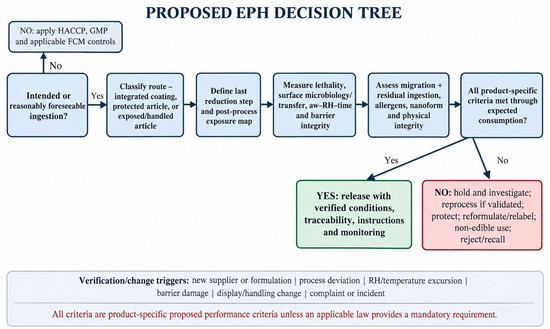
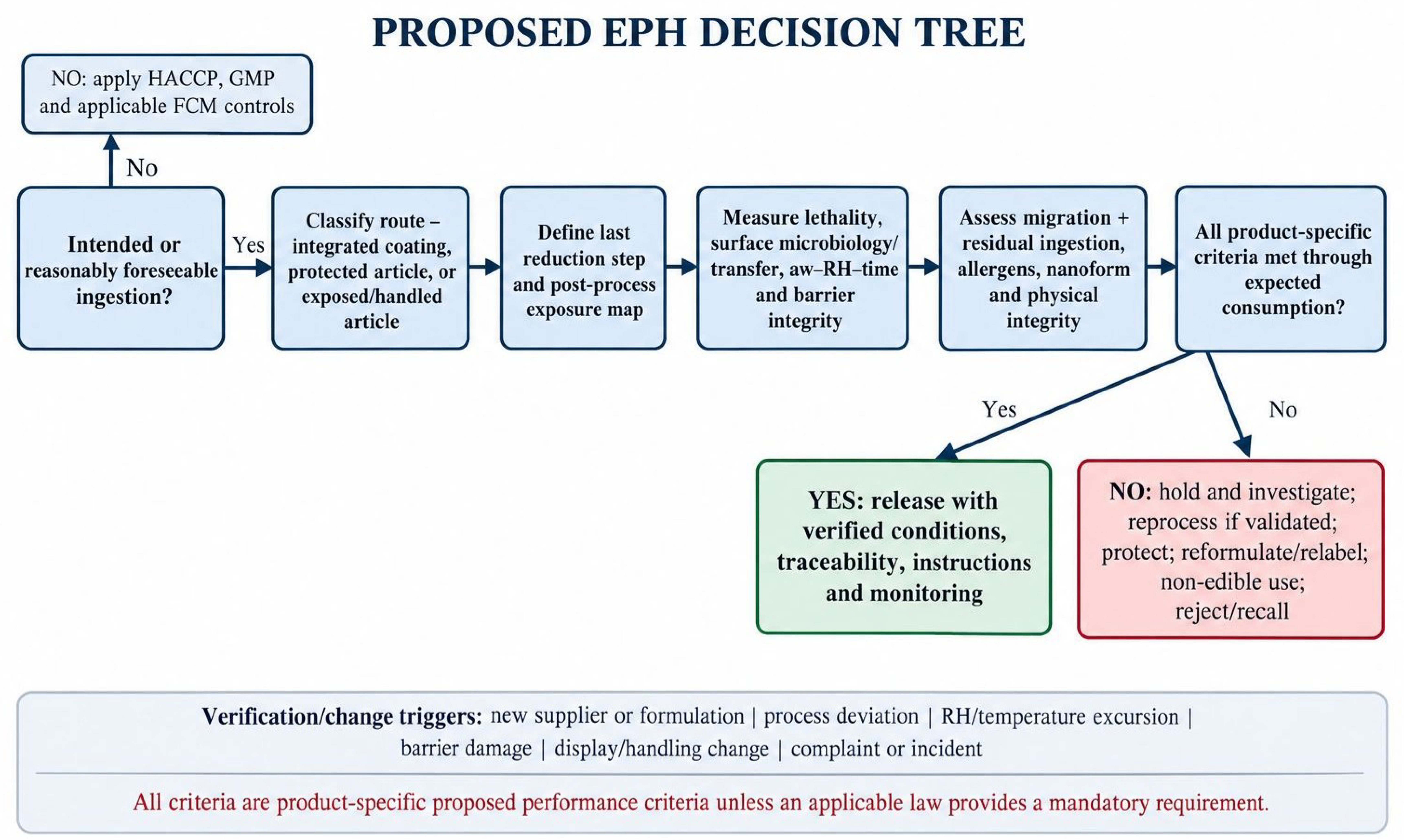
Figure 1.
Proposed EPH decision tree for practical implementation. EPH is triggered by intended or reasonably foreseeable ingestion. Product classification determines measurable parameters, verification, decision points and corrective actions. All performance criteria shown are author-proposed and require product-specific justification; applicable legal requirements prevail.
Table 1.
Proposed EPH lifecycle framework: control domains, questions and evidence requirements.
Table 2.
Risk-prioritised EPH research agenda. The priorities and endpoints are author-proposed; regulatory relevance describes their intended decision use, not an existing approval requirement.
2. Edible Packaging as a Distinct Hygienic Category
EPH classification is determined by intended ingestion and exposure, not by material chemistry alone. The first decision is whether the article or layer is intended, instructed, marketed, or reasonably foreseeable to be eaten. If not, conventional food and FCM controls apply without an EPH consumption endpoint. If yes, assessment proceeds according to exposure route: a coating consumed inseparably with food; a discrete edible article protected until opening; or an exposed/repeatedly handled edible service item. Processing, the last validated microbial reduction step, duration and conditions of post-process exposure, expected consumption fraction, and foreseeable misuse then determine the evidence burden [1,2,3,4]. Figure 1 formalises this decision tree.
Three features justify this distinct operational category. First, the external surface can become food without final washing or cooking. Second, migration-only assessment omits the constituent mass retained in the article and then swallowed. Third, damage, moisture uptake, abrasion, touching, or confusion between edible and non-edible parts can alter exposure before consumption [1,2,3,4,19,20,21,22]. These features identify assessment questions; they do not imply that edible packaging is intrinsically riskier than conventional packaging.
EPH is complementary to HACCP and GMP, which remain the primary systems for controlling process hazards and hygienic production; to FCM rules, which address composition and migration under specified uses; and to MRA, which can quantify organism-specific exposure and risk when suitable data exist [23,24,25,26,27]. EPH adds a lifecycle dossier and a final decision point for the consumed article. A food-grade ingredient, an authorized FCM constituent, or antimicrobial performance against the packaged food is relevant evidence but is not, by itself, verification of the exposed surface at ingestion.
The proposed verification burden escalates from an integrated coating with minimal post-process contact, through a protected freestanding wrapper, to an exposed or repeatedly handled cup, straw, utensil, or dispenser item. Measurable inputs include packaging mass consumed per serving, surface area and contact history, target population, storage time/temperature/RH, water activity (aw), terminal-process lethality, barrier integrity, microbial recovery and transfer, constituent concentration, allergen status, and physical integrity. Products intended for vulnerable populations require conservative exposure assumptions and more stringent product-specific justification [14,17,23,24,28].
3. Microbiological Hazards and Hygienic Stability
Microorganisms may enter edible packaging through biological raw materials, water, equipment, air, personnel, rework, or post-process contact [1,2,3,4,5,6,29,30,31,32]. Indirect evidence from packaging plants documents measurable contamination on equipment, handlers, factory packaging, and retail packaging, including higher occurrence after distribution, but it does not quantify edible-package risk [10]. Author-proposed EPH control: identify the last meaningful microbial reduction step, validate its performance for the actual matrix, and map every subsequent exposure opportunity. Supplier criteria, hygienic zoning, air and personnel controls, protected transfer, and environmental monitoring should be selected from that map [24].
Water activity (aw) is a central but easily misinterpreted property. Direct material studies show that hydrophilic edible films change moisture and barrier behaviour with RH [9,19,20,21]. Indirect experimental evidence shows that growth inhibition is not inactivation: Salmonella enterica, Escherichia coli, and Enterococcus faecium can survive desiccation, resistance varies with cell level and matrix, and S. enterica serovars have persisted for years in ground black pepper [11,12,13]. Those quantitative observations cannot be imported as survival rates for an edible film. Author-proposed EPH verification therefore requires finished-surface challenge data across the product’s dynamic RH/temperature profile.
Transfer efficiency remains a critical uncertainty. Indirect studies on hands, foods, stainless steel, and conventional FCMs show dependence on organism, moisture, pressure, time, surface topography, applied weight, and transfer direction [33,34,35,36]. Direct coefficients for mouth contact with commercially relevant edible films are not available. Because biopolymer surfaces can be rough, porous, hygroscopic, oily, charged, tacky, or antimicrobial [1,2,3,4,5,6,9,18], EPH proposes product-specific hand-to-surface and surface-to-mouth tests with defined inoculum, contact area, pressure, duration, RH, recovery efficiency, and limit of detection.
Antimicrobial ingredients are hurdles, not proof of hygienic safety. Direct edible-film/coating experiments report condition-specific effects: sodium-alginate coating with cinnamon-oil nanocapsules and nisin was tested on refrigerated beef [37]; a phenolic coating reduced aerobic counts on apples by about 2 log CFU/g after 15 days but showed no microbial inhibition on baroa potatoes under the same protocol [38]; and a chitosan-flavonoid film inhibited target organisms in packed beef burgers [39]. These studies strengthen evidence for food-preservation performance but do not simulate contamination of the package’s outward-facing surface followed by touching and ingestion. Matrix, target organism, dose, release, humidity, volatilisation, binding, and storage duration can change efficacy. Accordingly, agar inhibition or reduced food counts must not be used as a surrogate acceptance test for a consumed surface.
Direct edible-material studies demonstrate the feasibility of measuring water activity, total aerobic counts, Enterobacteriaceae, Staphylococcus aureus, yeasts, and moulds over storage [9]. However, direct commercially representative prevalence and pathogen-challenge datasets remain insufficient. Proposed EPH specifications should select indicators and pathogens through product-specific hazard analysis; validate sampling, neutralization, recovery, and detection limits; and combine lot release with shelf-life challenge, environmental monitoring, barrier integrity, and post-process surface inoculation. No universal microbiological limit is proposed here.
Mould control deserves separate, risk-based attention because nutrient-rich matrices can become supportive after moisture uptake. Evidence category: the moisture response of edible films is direct [9,19,20,21], whereas persistence/toxin concerns are partly analogue [29,30,31]. Proposed controls include validated RH limits, moisture-barrier integrity, maximum open time, damage criteria, and targeted testing when raw-material history or product conditions make toxigenic moulds plausible. Absence of visible growth is not an analytical safety criterion.
A proposed microbiological validation plan begins with intended use and a reasoned organism panel. Vegetative pathogens, spore-formers, yeasts, moulds, and hygienic indicators have different relevance for dry wraps, moist coatings, and formed cups. Challenge organisms or surrogates should reflect feedstocks, the processing environment, associated food, post-process exposure, and target population. Recovery efficiency and antimicrobial neutralisation must be validated to prevent false reassurance [9,11,29,30,31,32,40,41,42,43].
Sampling must address heterogeneous contamination at edges, seams, printed zones, folds, porous regions, and opening-contact areas. Proposed decision metrics include log CFU per defined area/article, prevalence with confidence intervals, transfer fraction, survival/growth/inactivation kinetics, recovery efficiency, and analytical detection limit. Replicate lots and worst-case RH/time conditions are required. Where MRA is feasible, variability and uncertainty should be reported separately [33,34,35,36].
Attachment should not automatically be called biofilm formation. Indirect evidence supports persistent niches on equipment, drains, cutters, rollers, and reusable holders; mature biofilm on a specific edible surface requires direct demonstration. Regulatory/GMP-aligned environmental monitoring should connect positives to predefined root-cause investigation, product disposition, intensified sanitation, and effectiveness verification [24].
4. Chemical, Allergenic and Physical Hazards
Edible-package exposure includes every intentional and incidental constituent. Plasticisers, cross-linkers, surfactants, release agents, colours, flavours, antimicrobials, inks, adhesives, impurities, reaction products, and non-intentionally added substances require identity, purity, authorisation, stability, and exposure assessment [1,2,3,4,5,6,18,23,25,26,27,44,45]. This review defines the following equation as a proposed conceptual exposure model within the EPH framework, not an established independent regulatory model: total dietary exposure = exposure from migration into food + exposure from the consumed residual package + relevant background dietary exposure. Each term should be calculated for average and high consumers and divided by body weight where the health-based guidance value is body-weight-based [14,17,23,28,45].
Worked example (hypothetical, for method illustration only): a 2.0 g edible wrapper contains an additive at 500 mg/kg. If 70% of the wrapper is consumed, residual-package exposure is 2.0 g × 0.70 × 0.500 mg/g = 0.70 mg/serving. If separately measured migration into the food is 0.10 mg/serving and background intake is 0.20 mg/day, total exposure is 1.00 mg/day or 0.0167 mg/kg body weight/day for a 60 kg adult. A migration-only calculation would report 0.10 mg and understate package-related intake by omitting 0.70 mg retained in the eaten material. This example is not an acceptance limit; the result must be compared with an applicable substance-specific health-based value and repeated for high consumption, children, uncertainty, and incomplete/foreseeable consumption scenarios.
Agricultural, marine, and upcycled feedstocks require prioritised rather than indiscriminate testing. Documented or directly plausible hazards include contaminants known to occur in the specified crop, geography, process, or supplier lot; concentration during extraction and batch variability should be measured [5,6,7,45]. Generic lists of pesticides, mycotoxins, metals, marine biotoxins, pathogens, and process contaminants are theoretical until linked to that history. Proposed priority is high when occurrence is supported and exposure/toxicity is consequential, medium when a plausible route exists but occurrence data are incomplete, and low when neither route nor meaningful exposure is demonstrated. Supplier evidence, traceability, targeted analytics, and change triggers should follow that ranking.
Nano-safety requires oral-exposure evidence rather than a particle label alone. Regulatory guidance calls for characterisation of size distribution, agglomeration, surface chemistry, dissolution and small-particle presence [14,17]. Primary studies show that food matrix and gastrointestinal fluids can form coronas and alter aggregation/disaggregation of silver nanoparticles [46], that oro-gastrointestinal transformation changes particle descriptors and cellular uptake relative to pristine particles or ions [47], and that CuO and TiO2 E171 exhibit different dissolution and intestinal-uptake behaviour after simulated digestion and oral exposure [48]. Persistence of a particulate form, conversion to ionic species, reprecipitation, bioavailability, and local/systemic toxicology are material-specific; mass concentration alone cannot establish equivalence between particulate and ionic forms.
Allergenic and physical hazards should also be ranked by evidence. Documented allergens arise when milk, wheat, soy, egg, fish, crustacean, or other allergenic proteins are ingredients or credible cross-contact residues; regulatory labelling and hygiene controls then apply [24,28]. Physical hazards are documented when brittle fragments, hard particles, foreign matter, damaged closures, or confusing non-edible supports occur in testing, complaints, or process history. Other scenarios remain proposed until demonstrated. Mechanical integrity, opening simulations, and visual/tactile differentiation should focus on reasonably foreseeable use rather than an undifferentiated catalogue of possibilities [1,2,3,4,28].
Risk prioritisation should combine severity, occurrence/route plausibility, exposure magnitude, detectability, and vulnerability of the intended population. Highest priority is assigned to a hazard with direct product evidence or a credible source-route-exposure chain and potentially serious outcome; lower priority does not mean zero risk but justifies proportionate evidence. Proposed EPH decisions should record the evidence category, uncertainty, test trigger, responsible operator, acceptance rationale, and corrective action. Ingredient compliance remains necessary but does not replace finished-product assessment [14,17,18,23,24,25,26,27,28,44,45].
Exposure scenarios should include complete and partial consumption, repeated daily use, high consumers, children on a body-weight basis, vulnerable groups, and reasonably foreseeable misuse. Packaging mass per serving and constituent concentration must be measured rather than assumed. When a health-based guidance value or legal limit exists, it controls; otherwise, a toxicologically justified margin-of-exposure or threshold approach should be documented by a qualified assessor. The proposed EPH calculation does not create a new legal limit [14,17,23,28].
Chemical stability studies should follow oxidation, hydrolysis, volatile loss, polymer interactions, light/oxygen effects, and formation of reaction products when relevant to the formulation. Printing requires special attention because the printed surface may be swallowed; conventional low-migration/set-off controls are useful analogue evidence, but intentional ingestion requires confirmation that inks, carriers, and foreseeable degradation products are suitable at the consumed dose [18,25,26].
Allergen management must cover intentional ingredients and cross-contact from shared tanks, dryers, cutters, and packing lines. Regulatory evidence supports declaration and non-misleading information [28], while proposed EPH controls include validated cleaning, segregation, scheduling, changeover inspection, and verification testing where risk assessment indicates value. Precautionary statements should not replace feasible controls.
5. Hygiene Along the Edible Packaging Lifecycle
EPH begins with product definition. Developers should state which components are intended to be eaten, the expected portion, whether consumption is optional, the target population, storage conditions, and the route by which the consumer accesses the edible surface. Ambiguity at this stage propagates into inappropriate specifications and testing. A hazard analysis should then follow the material from source to ingestion rather than ending at factory release [23,24].
Raw-material controls include approved suppliers, traceability, microbiological and chemical specifications, allergen status, authenticity, storage, and water quality. For agricultural and upcycled inputs, seasonality and batch variation may require intensified verification. Formulation should select hurdles that remain effective under expected pH, aw, and temperature while staying within acceptable sensory and dietary exposure [24,28,29,30,31,45].
Manufacturing controls should identify validated time–temperature, drying, irradiation, fermentation, or other stabilisation steps. The post-lethality area deserves special protection because cutting, shaping, printing, filling, and packing can expose a large surface area. Environmental monitoring should target relevant niches and indicators; sanitation methods must be compatible with edible materials and should not introduce residues. Rework policies must prevent uncontrolled accumulation of microorganisms, allergens, or active compounds [1,2,3,4,5,6,24,26].
Storage and distribution can alter both material functionality and microbial fate. Barrier properties, seal integrity, water activity, texture, and active-agent concentration should be monitored across realistic temperature and humidity profiles. Transport abrasion or puncture can expose edible surfaces even when the food remains physically contained. Shelf-life claims should incorporate worst reasonably foreseeable conditions and should define actions after damaged or opened secondary protection [19,20,21,24,29,30,31,49].
Retail is a distinctive stage for exposed products. Open display, shared dispensers, self-service handling, dust, droplets, utensils, and repeated temperature changes can convert an attractive sustainability concept into an uncontrolled surface-exposure experiment. Formats intended for open retail should be supported by direct contamination and handling evidence. Otherwise, individually protected presentation or controlled dispensing may be necessary [22,24,33,34,35,36].
Consumer behaviour is the final variable. Consumers may touch the package, place it on tables, share it, store it after opening, separate layers incorrectly, or decide not to eat it. Studies of acceptance show that use context and perceived hygiene affect willingness to consume edible packaging [22,50]. Instructions should explain edibility, storage after opening, damaged-package decisions, allergens, and any non-edible components. Communication should be tested for comprehension and behaviour, not merely noticed in a questionnaire.
Within the proposed EPH framework, verification at the point of consumption should integrate evidence generated across the lifecycle. No single test establishes EPH. A defensible dossier links formulation safety, process validation, environmental control, packaging protection, distribution simulation, challenge testing, consumer-use assumptions, and traceability. Deviations should be evaluated against the final endpoint rather than only against mechanical appearance.
Corrective-action logic should be defined before commercialisation. A seal failure, humidity excursion, environmental positive, labelling error, or supplier deviation can affect edible packaging differently from conventional packaging because disposal of an outer layer is not an available consumer control. Decision trees should specify when product can be released, reworked, relabelled, downgraded to a non-edible use, or destroyed. Traceability should link packaging lots to ingredient lots and the packaged food so that withdrawal and recall can be proportionate [23,24].
Food-service and refill applications need additional controls. Reusable dispensers or holders may reduce material consumption but introduce cleaning, drying, and cross-contamination requirements. Operators should be able to load products without touching consumed surfaces, protect them between service periods, and discard units exposed beyond validated limits. Training should distinguish edible packages from garnishes or conventional service ware and should address allergen communication at the point of sale [24,28,33,34,35,36].
The lifecycle approach also supports verification of claims. Terms such as edible, compostable, biodegradable, natural, antimicrobial, and plastic-free communicate different properties and should not be treated as interchangeable. A material can be edible without being nutritionally desirable, hygienically robust, home-compostable, or environmentally preferable. Claims should be specific to tested conditions and should not encourage consumption when the protective barrier has been compromised [3,7,22,49,50].
6. The Secondary-Packaging Paradox as a Testable Design Hypothesis
Edible packaging is often intended to reduce conventional packaging, yet some consumed surfaces may require protection from humidity, mechanical damage, or contamination [1,2,22]. This review calls that possible trade-off the secondary-packaging paradox. It is an author-proposed, testable design hypothesis, not a universal characteristic of edible packaging. The hypothesis applies only when a specified edible format requires additional protection that materially changes whole-system burden or use.
Available quantitative evidence is product-specific. In a lifecycle assessment of edible coffee cups, environmental results depended strongly on formulation and whether eating the cup displaced another snack [49]. Consumer studies report hygiene concerns and preference for external protection [22,50], but perception is not a microbial measurement. No general dataset compares otherwise equivalent protected and unprotected edible packages across contamination, food waste, consumption rate, and environmental endpoints. Therefore, neither environmental benefit nor hygienic necessity should be generalised beyond the tested product and scenario.
The proposed test is comparative: define candidate protective configurations; measure barrier integrity, RH/temperature exposure, damage, surface contamination/transfer, product rejection and consumption; then couple those results with food loss, material mass, energy, water, transport, and end-of-life indicators [7,49]. A secondary layer is justified only when the product-specific risk–benefit analysis supports it; grouped protection, dispensers, peelable layers, reusable holders, or point-of-service formation may achieve the endpoint with less burden.
7. Regulatory Considerations
Regulatory evidence indicates that edible packaging may fall simultaneously or alternatively within food, hygiene, FCM, additive, flavouring, novel-food, labelling, and packaging regimes. Classification is product-specific because an inseparable coating, freestanding wrapper, active layer, and edible service cup differ in function and intended consumption. EPH is not a legal category and does not replace jurisdiction-specific assessment.
European Union. Regulation (EC) No 178/2002 supplies general food-law, safety, traceability, and responsibility principles [23]; Regulation (EC) No 852/2004 requires hygiene procedures based on HACCP principles [24]. Regulation (EC) No 1935/2004 and Regulation (EC) No 2023/2006 govern FCM safety and GMP [25,26], with material-specific, active/intelligent, additive, flavouring, allergen-information, novel-food, contaminant, and bisphenol provisions potentially applyied [14,17,27,28,44,45,51,52,53,54]. Migration requirements remain necessary when applicable, but they do not quantify constituents retained in a swallowed article.
United States. FDA determines the status of each FCM component through applicable Title 21 CFR authorisations, an effective Food Contact Substance Notification, prior sanction, GRAS status, or a Threshold of Regulation exemption, depending on substance and intended use [55]. FDA chemistry guidance estimates dietary exposure from migration under defined food types and conditions of use [56]. If the article or a constituent is intended to be consumed or to have a technical effect in food, direct-food-additive, GRAS, colour-additive, labelling, and other food requirements may be relevant rather than, or in addition to, the FCS route. Thus, FCM clearance must not be represented as authorisation to ingest the complete article.
India. The FSSAI Food Safety and Standards (Packaging) Regulations, 2018 require food-grade, suitable, clean, hygienic and tamper-proof packaging; include migration-related provisions; and state that printed surfaces should not directly contact food [57]. The Food Safety and Standards (Labelling and Display) Regulations, 2020 address instructions and allergen declarations for pre-packaged foods [58]. An edible wrapper or coating may also engage standards for food ingredients, additives, contaminants, licensing, and novel foods. Because the packaging regulations were written primarily for FCMs, intentional ingestion of the complete article requires case-specific consultation rather than inference from migration compliance alone.
China and Japan. China’s GB 4806.1-2016 establishes general safety requirements for FCMs and articles within a broader national-standard system [59]. Japan operates specifications and a positive-list system for synthetic-resin utensils, containers, and packaging, with the revised list applying from 1 June 2025 [60]. In both jurisdictions, an intentionally consumed component may also be regulated as food or an additive according to composition and function. These sources are regulatory evidence for conventional classifications; neither provides a dedicated validated EPH method.
Across jurisdictions, a technical file should define intended and foreseeable ingestion, edible/non-edible components, composition and suppliers, terminal process, post-process exposure, hazard analysis, migration and residual-ingestion calculations, allergens, nanoform characterisation where relevant, microbiological validation, protection and stability, instructions, traceability, recall, and claim substantiation. Change control should trigger reassessment when formulation, supplier, geometry, printing, associated food, process, distribution, display, or intended population changes [23,24,25,26,27,28,44,55,57].
Supply-chain responsibilities should be explicit. The film manufacturer, food packer, retailer, and food-service operator can each change moisture, handling, exposure, and information. Specifications and evidence must travel with the product, but contractual allocation does not remove each operator’s legal responsibility. International commercialisation requires a jurisdiction-by-jurisdiction classification matrix because definitions and authorisation routes are not harmonised.
Author-proposed EPH recommendation: future guidance should remain performance-based. It should define reporting and validation expectations for the point-of-consumption endpoint, while deferring legal limits to the competent jurisdiction and substance/product-specific assessment. Table 1 therefore labels its numerical or qualitative acceptance statements as proposed performance criteria unless a cited regulation explicitly supplies a mandatory limit.
8. The Edible Packaging Hygiene Framework
The proposed EPH framework organises six connected domains: raw-material safety; process stabilisation; post-process exposure control; storage and distribution stability; retail and consumer-stage hygiene; and final point-of-consumption verification. Figure 1 begins with intended or foreseeable ingestion and uses exposure route, processing, handling, and final consumption to select evidence. Table 1 specifies proposed minimum parameters, justified acceptance logic, testing triggers, decisions, verification, and corrective actions. Direct, indirect, regulatory, and proposed evidence are kept distinct; only direct product-relevant validation can establish performance for a specific consumed surface.
The framework is outcome-oriented but not technology-prescriptive. A coating consumed immediately with food, a protected wrapper stored for months, and an exposed service cup require different evidence. The measurable endpoint is justified hygienic suitability of the actual article immediately before expected consumption, supported by defined methods, limits of detection, uncertainty, and documented decisions.
EPH also separates intrinsic stability from external hygiene. Low aw, low pH, or an antimicrobial may limit growth or reduce a selected target but cannot demonstrate absence of deposited toxins, allergens, foreign matter, or resistant organisms [11,19,20,21,29,30,31,40,41,42]. Secondary protection is a control whose integrity and removal must be verified, not proof of safety. HACCP/GMP control how the system is produced; MRA may quantify a microbial pathway; FCM assessment addresses authorised use and migration; EPH connects those outputs to the consumed surface history and final ingestion decision.
EPH is not a pass–fail regulatory standard or a validated risk-assessment methodology. Before testing, developers should define target organisms and recovery limits; growth/survival/inactivation endpoints; aw and RH profiles; barrier and physical-integrity criteria; packaging mass consumed; migration plus residual-ingestion exposure; allergen/contaminant requirements; instruction-comprehension endpoints; sampling frequency; change triggers; and corrective actions. Criteria must be derived from law where applicable or justified by product-specific risk assessment, never borrowed as universal regulatory limits.
9. Prioritised Research Gaps
Priority 1—direct finished-surface microbial evidence. The most consequential gap is product-specific challenge and transfer testing after the last reduction step. Studies should inoculate relevant external zones, reproduce realistic RH/temperature and handling, validate neutralisation and recovery, and report survival, growth or inactivation, transfer fraction, detection limit, variability, and uncertainty. This would allow MRA and performance criteria to replace analogy [9,11,12,13,29,30,31,33,34,35,36].
Priority 2—total oral chemical, allergen, and nanoform exposure. Migration, residual-package ingestion, and background intake should be integrated with measured package mass and high-consumer scenarios. Nano studies should follow dissolution, aggregation, corona formation, particulate/ionic speciation, bioaccessibility, uptake, and toxicological endpoints after realistic digestion [14,17,46,47,48].
Priority 3—realistic lifecycle and protection validation. Dynamic humidity, abrasion, opening, retail display, repeated touching, domestic storage, and damage should be linked to microbiological, chemical, allergen, and physical endpoints. Comparative configurations should test the secondary-protection hypothesis at product level [19,20,21,22,33,34,35,36,49,50].
Priority 4—consumer behaviour and communication. Observed touching, layer separation, sharing, storage, consumption, and disposal should replace intention-only outcomes. Instructions and edible/non-edible cues require comprehension and behavioural testing in relevant populations [22,50].
Priority 5—integration and regulatory translation. Standardised reporting should enable combined MRA, chemical exposure assessment, allergen/physical-hazard evaluation, and lifecycle assessment. Table 2 links each priority to methodology, measurable endpoint, and the regulatory decision it could support [7,49].
10. Conclusions
Edible packaging converts part of a package into an intentional exposure route. Its assessment should therefore extend beyond food protection and conventional migration to the condition, composition, and surface history of the article at the expected point of consumption.
EPH is a proposed conceptual framework, not a validated risk-assessment methodology, certification scheme, or regulatory category. Its contribution is the structured integration of established HACCP, GMP, FCM-safety, allergen-control, exposure-assessment, and MRA principles with a point-of-consumption endpoint for an intentionally consumed surface. Direct commercial evidence remains limited, so analogue evidence and author-proposed recommendations must not be presented as product validation.
Validation should prioritise finished-surface challenge and transfer studies, dynamic moisture and handling, migration plus residual-package ingestion, gastrointestinal transformation of nanoforms, consumer behaviour, and product-specific assessment of protective systems. EPH will be useful only if measurable criteria, uncertainty, verification, and corrective actions are justified for the actual product and jurisdiction.
Author Contributions
Conceptualization, W.K. and J.T.; methodology, W.K. and J.T.; software, W.K. and J.T.; writing—original draft preparation, W.K.; writing—review and editing, W.K.; visualization, J.T.; supervision, W.K. and J.T. All authors have read and agreed to the published version of the manuscript.
Funding
This research received no external funding.
Institutional Review Board Statement
Not applicable.
Informed Consent Statement
Not applicable.
Data Availability Statement
No new data were created or analysed in this study. Data sharing is not applicable to this article.
Conflicts of Interest
The authors declare no conflicts of interest.
Abbreviations
The following abbreviations are used in this manuscript:
| aw | Water activity |
| EPH | Edible Packaging Hygiene |
| EFSA | European Food Safety Authority |
| FCM | Food Contact Material |
| GMP | Good Manufacturing Practice |
| HACCP | Hazard Analysis and Critical Control Points |
| MRA | Microbial Risk Assessment |
References
- Janjarasskul, T.; Krochta, J.M. Edible Packaging Materials. Annu. Rev. Food Sci. Technol. 2010, 1, 415–448. [Google Scholar] [CrossRef] [Scilit] [PubMed]
- Falguera, V.; Quintero, J.P.; Jimenez, A.; Munoz, J.A.; Ibarz, A. Edible films and coatings: Structures, active functions and trends in their use. Trends Food Sci. Technol. 2011, 22, 292–303. [Google Scholar] [CrossRef] [Scilit]
- Trajkovska Petkoska, A.; Daniloski, D.; D’Cunha, N.M.; Naumovski, N.; Broach, A.T. Edible packaging: Sustainable solutions and novel trends in food packaging. Food Res. Int. 2021, 140, 109981. [Google Scholar] [CrossRef] [Scilit] [PubMed]
- Hassan, B.; Chatha, S.A.S.; Hussain, A.I.; Zia, K.M.; Akhtar, N. Recent advances on polysaccharides, lipids and protein based edible films and coatings: A review. Int. J. Biol. Macromol. 2018, 109, 1095–1107. [Google Scholar] [CrossRef] [Scilit] [PubMed]
- Galus, S.; Kadzinska, J. Food applications of emulsion-based edible films and coatings. Trends Food Sci. Technol. 2015, 45, 273–283. [Google Scholar] [CrossRef] [Scilit]
- Suhag, R.; Kumar, N.; Petkoska, A.T.; Upadhyay, A. Film formation and deposition methods of edible coating on food products: A review. Food Res. Int. 2020, 136, 109582. [Google Scholar] [CrossRef] [Scilit] [PubMed]
- Dilkes-Hoffman, L.S.; Lane, J.L.; Grant, T.; Pratt, S.; Lant, P.A.; Laycock, B. Environmental impact of biodegradable food packaging when considering food waste. J. Clean. Prod. 2018, 180, 325–334. [Google Scholar] [CrossRef] [Scilit]
- Karnwal, A.; Kumar, G.; Singh, R.; Selvaraj, M.; Malik, T.; Al Tawaha, A.R.M. Natural biopolymers in edible coatings: Applications in food preservation. Food Chem. X 2025, 25, 102171. [Google Scholar] [CrossRef] [Scilit] [PubMed]
- Salazar, D.; Arancibia, M.; Casado, S.; Viteri, A.; Lopez-Caballero, M.E.; Montero, M.P. Green banana (Musa acuminata AAA) wastes to develop an edible film for food applications. Polymers 2021, 13, 3183. [Google Scholar] [CrossRef] [Scilit] [PubMed]
- Abdessater, M.; Fayyad, F.; Matta, J.; Karam, L. Assessment of prerequisite programs implementation at food packaging manufacturing companies and hygiene status of food packaging in a developing country: Cross-sectional study. Heliyon 2023, 9, e19824. [Google Scholar] [CrossRef] [Scilit] [PubMed]
- Salazar, J.K.; Tesfaldet, B.; Zamperlini, M.; Streufert, R.; Fay, M.; Keller, S.E. Desiccation survival of Salmonella enterica, Escherichia coli, and Enterococcus faecium related to initial cell level and cellular components. J. Food Prot. 2022, 85, 398–405. [Google Scholar] [CrossRef] [Scilit] [PubMed]
- Xu, J.; Zhang, M.; Cao, P.; Adhikari, B.; Yang, C. Influence of drying conditions, food composition, and water activity on the thermal resistance of Salmonella enterica. Food Res. Int. 2021, 148, 110548. [Google Scholar] [CrossRef] [Scilit] [PubMed]
- Davies, C.P.; Jurkiw, T.; Haendiges, J.; Reed, E.; Anderson, N.; Grasso-Kelley, E.; Hoffmann, M.; Zheng, J. Changes in the genomes and methylomes of three Salmonella enterica serovars after long-term storage in ground black pepper. Front. Microbiol. 2022, 13, 970135. [Google Scholar] [CrossRef] [Scilit] [PubMed]
- European Food Safety Authority Scientific Committee. Guidance on risk assessment of nanomaterials to be applied in the food and feed chain: Human and animal health. EFSA J. 2021, 19, 6768. [Google Scholar] [CrossRef] [Scilit] [PubMed]
- Rhim, J.W.; Park, H.M.; Ha, C.S. Bio-nanocomposites for food packaging applications. Prog. Polym. Sci. 2013, 38, 1629–1652. [Google Scholar] [CrossRef] [Scilit]
- Dehghani, S.; Hosseini, S.V.; Regenstein, J.M. Edible films and coatings in seafood preservation: A review. Food Chem. 2018, 240, 505–513. [Google Scholar] [CrossRef] [Scilit] [PubMed]
- European Food Safety Authority Scientific Committee. Guidance on technical requirements for regulated food and feed product applications to establish the presence of small particles including nanoparticles. EFSA J. 2021, 19, 6769. [Google Scholar] [CrossRef] [Scilit] [PubMed]
- Mellinas, C.; Valdes, A.; Ramos, M.; Burgos, N.; Garrigos, M.C.; Jimenez, A. Active edible films: Current state and future trends. J. Appl. Polym. Sci. 2016, 133, 42631. [Google Scholar] [CrossRef] [Scilit]
- Gontard, N.; Guilbert, S.; Cuq, J.L. Water and glycerol as plasticizers affect mechanical and water vapor barrier properties of an edible wheat gluten film. J. Food Sci. 1993, 58, 206–211. [Google Scholar] [CrossRef] [Scilit]
- Debeaufort, F.; Quezada-Gallo, J.A.; Voilley, A. Edible films and coatings: Tomorrow’s packagings: A review. Crit. Rev. Food Sci. Nutr. 1998, 38, 299–313. [Google Scholar] [CrossRef] [Scilit] [PubMed]
- McHugh, T.H.; Avena-Bustillos, R.; Krochta, J.M. Hydrophilic edible films: Modified procedure for water vapor permeability and explanation of thickness effects. J. Food Sci. 1993, 58, 899–903. [Google Scholar] [CrossRef] [Scilit]
- Koukoumaki, D.I.; Gkatzionis, K.; Panagiotou, M.; Sarris, D. Consumer perception of novel edible films produced by single cell protein derived from cheese whey bio-valorization. J. Sens. Stud. 2024, 39, e70004. [Google Scholar] [CrossRef] [Scilit]
- European Parliament and Council. Regulation (EC) No 178/2002 laying down the general principles and requirements of food law. Off. J. Eur. Communities 2002, L31, 1–24. [Google Scholar]
- European Parliament and Council. Regulation (EC) No 852/2004 on the hygiene of foodstuffs. Off. J. Eur. Union 2004, L139, 1–54. [Google Scholar]
- European Parliament and Council. Regulation (EC) No 1935/2004 on materials and articles intended to come into contact with food. Off. J. Eur. Union 2004, L338, 4–17. [Google Scholar]
- European Commission. Commission Regulation (EC) No 2023/2006 on good manufacturing practice for materials and articles intended to come into contact with food. Off. J. Eur. Union 2006, L384, 75–78. [Google Scholar]
- European Commission. Commission Regulation (EU) No 10/2011 on plastic materials and articles intended to come into contact with food. Off. J. Eur. Union 2011, L12, 1–89. [Google Scholar]
- European Parliament and Council. Regulation (EU) No 1169/2011 on the provision of food information to consumers. Off. J. Eur. Union 2011, L304, 18–63. [Google Scholar]
- Podolak, R.; Enache, E.; Stone, W.; Black, D.G.; Elliott, P.H. Sources and risk factors for contamination, survival, persistence, and heat resistance of Salmonella in low-moisture foods. J. Food Prot. 2010, 73, 1919–1936. [Google Scholar] [CrossRef] [Scilit] [PubMed]
- Beuchat, L.R.; Komitopoulou, E.; Beckers, H.; Betts, R.P.; Bourdichon, F.; Fanning, S.; Joosten, H.M.; Ter Kuile, B.H. Low-water activity foods: Increased concern as vehicles of foodborne pathogens. J. Food Prot. 2013, 76, 150–172. [Google Scholar] [CrossRef] [Scilit] [PubMed]
- Finn, S.; Condell, O.; McClure, P.; Amezquita, A.; Fanning, S. Mechanisms of survival, responses and sources of Salmonella in low-moisture environments. Front. Microbiol. 2013, 4, 331. [Google Scholar] [CrossRef] [Scilit] [PubMed]
- Gheorghita Puscaselu, R.; Besliu, I.; Gutt, G. Edible biopolymers-based materials for food applications-the eco alternative to conventional synthetic packaging. Polymers 2021, 13, 3779. [Google Scholar] [CrossRef] [Scilit] [PubMed]
- Chen, Y.; Jackson, K.M.; Chea, F.P.; Schaffner, D.W. Quantification and variability analysis of bacterial cross-contamination rates in common food service tasks. J. Food Prot. 2001, 64, 72–80. [Google Scholar] [CrossRef] [Scilit] [PubMed]
- Kusumaningrum, H.D.; Riboldi, G.; Hazeleger, W.C.; Beumer, R.R. Survival of foodborne pathogens on stainless steel surfaces and cross-contamination to foods. Int. J. Food Microbiol. 2003, 85, 227–236. [Google Scholar] [CrossRef] [Scilit] [PubMed]
- Perez-Rodriguez, F.; Valero, A.; Carrasco, E.; Garcia, R.M.; Zurera, G. Understanding and modelling bacterial transfer to foods: A review. Trends Food Sci. Technol. 2008, 19, 131–144. [Google Scholar] [CrossRef] [Scilit]
- Maitz, S.; Schmid, P.J.; Kittinger, C. Modelling and determination of parameters influencing the transfer of microorganisms from food contact materials. Int. J. Environ. Res. Public Health 2022, 19, 2996. [Google Scholar] [CrossRef] [Scilit] [PubMed]
- Zhang, M.; Luo, W.; Yang, K.; Li, C. Effects of sodium alginate edible coating with cinnamon essential oil nanocapsules and nisin on quality and shelf life of beef slices during refrigeration. J. Food Prot. 2022, 85, 896–905. [Google Scholar] [CrossRef] [Scilit] [PubMed]
- Lima, E.M.F.; Matsumura, C.H.S.; da Silva, G.L.; Patrocinio, I.C.S.; Santos, C.A.; Pereira, P.A.P.; Hassimotto, N.M.A.; Pinto, U.M.; da Cunha, L.R. Antimicrobial and antioxidant activity of apricot phenolic-rich extract and its application as an edible coating for fresh-cut vegetable preservation. J. Food Qual. 2022, 2022, 8440304. [Google Scholar] [CrossRef] [Scilit] [PubMed]
- Hamed, Y.S.; Hassan, K.R.; Ahsan, H.M.; Hussain, M.; Abdullah; Wang, J.; Zou, X.G.; Bu, T.; Rayan, A.M.; Yang, K. Development of chitosan-based edible film incorporated with purified flavonoids from Moringa oleifera: Structural, thermal, antibacterial activity and application. Food Chem. 2024, 457, 140059. [Google Scholar] [CrossRef] [Scilit] [PubMed]
- Flores, S.; Haedo, A.S.; Campos, C.; Gerschenson, L. Antimicrobial performance of potassium sorbate supported in tapioca starch edible films. Eur. Food Res. Technol. 2007, 225, 375–384. [Google Scholar] [CrossRef] [Scilit]
- Rojas-Grau, M.A.; Avena-Bustillos, R.J.; Friedman, M.; Henika, P.R.; Martin-Belloso, O.; McHugh, T.H. Mechanical, barrier, and antimicrobial properties of apple puree edible films containing plant essential oils. J. Agric. Food Chem. 2006, 54, 9262–9267. [Google Scholar] [CrossRef] [Scilit] [PubMed]
- Seydim, A.C.; Sarikus, G. Antimicrobial activity of whey protein based edible films incorporated with oregano, rosemary and garlic essential oils. Food Res. Int. 2006, 39, 639–644. [Google Scholar] [CrossRef] [Scilit]
- Campos, C.A.; Gerschenson, L.N.; Flores, S.K. Development of edible films and coatings with antimicrobial activity. Food Bioprocess Technol. 2011, 4, 849–875. [Google Scholar] [CrossRef] [Scilit]
- European Parliament and Council. Regulation (EU) 2015/2283 on novel foods. Off. J. Eur. Union 2015, L327, 1–22. [Google Scholar]
- European Commission. Commission Regulation (EU) 2023/915 on maximum levels for certain contaminants in food. Off. J. Eur. Union 2023, L119, 103–157. [Google Scholar]
- Laloux, L.; Kastrati, D.; Cambier, S.; Gutleb, A.C.; Schneider, Y.J. The food matrix and the gastrointestinal fluids alter the features of silver nanoparticles. Small 2020, 16, 1907687. [Google Scholar] [CrossRef] [Scilit] [PubMed]
- Carnovale, C.; Guarnieri, D.; Di Cristo, L.; De Angelis, I.; Veronesi, G.; Scarpellini, A.; Malvindi, M.A.; Barone, F.; Pompa, P.P.; Sabella, S. Biotransformation of silver nanoparticles in the oro-gastrointestinal tract by an integrated in vitro testing assay: Generation of exposure-dependent physical descriptors for nanomaterial grouping. Nanomaterials 2021, 11, 1587. [Google Scholar] [CrossRef] [Scilit] [PubMed]
- Mortensen, N.P.; Moreno Caffaro, M.; Aravamudhan, S.; Beeravalli, L.; Prattipati, S.; Snyder, R.W.; Watson, S.L.; Patel, P.R.; Weber, F.X.; Montgomery, S.A.; et al. Simulated gastric digestion and in vivo intestinal uptake of orally administered CuO nanoparticles and TiO2 E171 in male and female rat pups. Nanomaterials 2021, 11, 1487. [Google Scholar] [CrossRef] [Scilit] [PubMed]
- Anand, K.; Martinez Arce, A.; Bishop, G.; Styles, D.; Fitzpatrick, C. A tasty solution to packaging waste? Life cycle assessment of edible coffee cups. Resour. Conserv. Recycl. 2024, 201, 107320. [Google Scholar] [CrossRef] [Scilit]
- Taylor, S.; Colonna, A.; Jung, J.; Gutierrez, J.; Zhao, Y. Consumer perception and acceptance of edible packaging for various food products. J. Food Sci. 2024, 89, 2423–2437. [Google Scholar] [CrossRef] [Scilit] [PubMed]
- European Commission. Commission Regulation (EC) No 450/2009 on active and intelligent materials and articles intended to come into contact with food. Off. J. Eur. Union 2009, L135, 3–11. [Google Scholar]
- European Commission. Commission Regulation (EU) 2024/3190 on the use of bisphenol A and other bisphenols and bisphenol derivatives in certain food-contact materials and articles. Off. J. Eur. Union 2024, L410, 1–14. [Google Scholar]
- European Parliament and Council. Regulation (EC) No 1333/2008 on food additives. Off. J. Eur. Union 2008, L354, 16–33. [Google Scholar]
- European Parliament and Council. Regulation (EC) No 1334/2008 on flavourings and certain food ingredients with flavouring properties. Off. J. Eur. Union 2008, L354, 34–50. [Google Scholar]
- U.S. Food and Drug Administration. Determining the Regulatory Status of Components of a Food Contact Material. Available online: https://www.fda.gov/food/packaging-food-contact-substances-fcs/determining-regulatory-status-components-food-contact-material (accessed on 11 September 2026).
- U.S. Food and Drug Administration. Guidance for Industry: Preparation of Premarket Submissions for Food Contact Substances: Chemistry Recommendations. Available online: https://www.fda.gov/regulatory-information/search-fda-guidance-documents/guidance-industry-preparation-premarket-submissions-food-contact-substances-chemistry (accessed on 11 September 2026).
- Food Safety and Standards Authority of India. Food Safety and Standards (Packaging) Regulations, 2018, as Amended. Available online: https://www.fssai.gov.in/upload/uploadfiles/files/CompendiumPackagingLabellingRegulations28012022.pdf (accessed on 11 September 2026).
- Food Safety and Standards Authority of India. Food Safety and Standards (Labelling and Display) Regulations, 2020, Consolidated Version. Available online: https://fssai.gov.in/upload/uploadfiles/files/comp_Labelling%20Display_Version%20VIII_09_09_2025.pdf (accessed on 11 September 2026).
- GB 4806.1-2016; National Food Safety Standard: General Safety Requirements for Food-Contact Materials and Articles. National Health Commission of the People’s Republic of China: Beijing, China, 2016. Available online: https://www.nhc.gov.cn/wjw/c100175/201611/f2cf66762b054f7b87b26da7a620533c.shtml (accessed on 11 September 2026).
- Ministry of Health, Labour and Welfare of Japan. Positive List System for Food Utensils, Containers and Packaging. Available online: https://www.mhlw.go.jp/stf/newpage36419.html (accessed on 11 September 2026).

Disclaimer/Publisher’s Note: The statements, opinions and data contained in all publications are solely those of the individual author(s) and contributor(s) and not of MDPI and/or the editor(s). MDPI and/or the editor(s) disclaim responsibility for any injury to people or property resulting from any ideas, methods, instructions or products referred to in the content. |
© 2026 by the authors. Licensee MDPI, Basel, Switzerland. This article is an open access article distributed under the terms and conditions of the Creative Commons Attribution (CC BY) license.