


Abstract
Airborne fungal contamination poses an occupational health risk in environments where engineering-controls are essential for maintaining indoor air quality. However, evidence integrating assessments of engineering-control readiness and airborne fungal contamination in forensic pathology facilities remains limited, particularly in low- and middle-income countries. This study assessed engineering-control readiness, indoor environmental conditions, and airborne fungal contamination in three public forensic pathology facilities in Gauteng Province, South Africa, and explored factors associated with airborne fungal contamination. A cross-sectional occupational hygiene study was conducted in three public forensic pathology facilities. Engineering-control readiness was assessed using structured walkthroughs and summarised using a study-specific Engineering Control Readiness Index (ECRI). Indoor temperature, relative humidity, carbon dioxide (CO2), and airborne fungal concentrations were measured concurrently. Duplicate fungal air samples were collected at predefined locations over three consecutive sampling days. For the primary regression analysis, duplicate fungal measurements were averaged within each physical sampling location and sampling day, yielding 54 indoor location-day observations from 18 physical indoor sampling locations. Multivariable log-linear regression included facility, functional work area, area-specific ventilation and environmental-control deficiency, temperature, relative humidity and CO2, with cluster-robust inference accounting for repeated measurements within physical sampling locations. Overall ECRI scores ranged from 50.1% to 53.9%, with ventilation and environmental control representing the weakest domain. Airborne fungal concentrations differed significantly between facilities, with FPF G recording the highest indoor median concentration (740 CFU/m3). Cladosporium spp. and Penicillium spp. predominated. After adjustment for facility, functional work area and environmental conditions and accounting for repeated sampling, engineering-control deficiency was not independently associated with fungal concentration (adjusted change per 10-percentage-point increase: −16.3%; 95% CI: −70.9% to 140.9%; p = 0.727). Substantial engineering-control deficiencies and airborne fungal contamination were identified; however, the independent contribution of engineering-control deficiency could not be estimated with adequate precision in this three-facility study. Larger longitudinal studies incorporating objective ventilation-performance measurements are required to clarify the contribution of specific engineering controls to occupational bioaerosol exposure.
1. Introduction
Workers in healthcare, laboratories, healthcare risk waste management, and mortuary settings are routinely exposed to biological hazards through contact with human tissues, contaminated materials, and bioaerosols. Among these hazards, fungal bioaerosols have received increasing attention due to their association with respiratory disease, allergic sensitisation, hypersensitivity pneumonitis, and opportunistic infections, particularly among susceptible individuals [1,2]. Airborne fungi are ubiquitous in indoor and outdoor environments, originating from soil, vegetation, dust, building materials, ventilation systems, and human occupants [3,4]. Once aerosolised, fungal spores may remain airborne for prolonged periods, increasing opportunities for inhalation exposure and indoor dispersal [2].
Indoor fungal contamination is strongly influenced by environmental conditions. Moisture availability, water damage, relative humidity, temperature, ventilation performance, building maintenance, and occupant activities affect fungal growth, sporulation, and aerosolisation [3]. Within the occupational hygiene hierarchy of controls, engineering controls represent the highest practical means of controlling airborne biological hazards because they reduce exposure at its source. Mechanical ventilation, airflow management, humidity control, environmental monitoring, and routine maintenance are fundamental measures for reducing occupational exposure to airborne biological contaminants [2,5,6]. Conversely, inadequate ventilation, poor maintenance, and ineffective environmental controls may promote fungal growth, increase airborne spore concentrations, and compromise indoor air quality [7,8].
Forensic pathology facilities (FPFs) are distinctive occupational environments where workers are repeatedly exposed to biological hazards during the handling, examination, and storage of human remains. Activities such as autopsy procedures, bone sawing, body preparation, specimen handling, cleaning, and cadaver movement generate respirable bioaerosols capable of exposing workers to airborne microorganisms [9,10,11]. Unlike many healthcare environments, FPFs combine continuous sources of biological contamination with environmental conditions that favour microbial persistence, including decomposing organic material, elevated moisture, fluctuating temperatures, and variable ventilation performance [5,12]. Cadavers and contaminated environmental surfaces may also act as reservoirs for fungi, bacteria, and other microorganisms, creating opportunities for repeated occupational exposure during routine forensic activities.
Several fungal genera of occupational health importance have been identified in cadavers and forensic environments, including Aspergillus, Penicillium, Candida, Fusarium, Cladosporium, Alternaria, Cryptococcus, members of the order Mucorales, and the Trichophyton species [13,14]. Many produce environmentally resilient spores that remain viable long after death, increasing opportunities for occupational exposure through inhalation, direct inoculation, or contact with contaminated mucous membranes [12,15,16]. Although exposure does not always result in infection, repeated inhalation of fungal bioaerosols has been associated with adverse respiratory and allergic health outcomes [3,16,17]. Fungal and other indoor environmental exposures have also been implicated in building-related symptom complexes historically described as sick building syndrome (SBS). SBS encompasses nonspecific symptoms, including irritation of the eyes and upper respiratory tract, respiratory complaints, headache, fatigue, and skin symptoms, that are temporally associated with occupancy of a particular indoor environment. Fungal contamination represents one of several biological and environmental factors that may contribute to such symptom patterns and should not be interpreted as a singular cause of SBS [1]. From an occupational hygiene perspective, evaluating engineering controls’ performance alongside measured airborne fungal contamination is important for identifying potentially modifiable workplace conditions and informing preventive interventions.
These challenges are particularly relevant in low- and middle-income countries (LMICs), where ageing infrastructure, inadequate maintenance, limited environmental monitoring, and unreliable utility services can compromise environmental controls within healthcare facilities (HCFs) [1,17,18]. In South Africa, recurrent electricity supply interruptions have highlighted the vulnerability of HCFs that rely on continuous operation of ventilation, refrigeration, sterilisation, and other environmental-control systems. Power interruptions may reduce air exchange rates, disrupt temperature and humidity control, impair ventilation performance, and create conditions that favour microbial growth [18]. Despite this biological plausibility, empirical evidence examining the relationship between engineering-control deficiencies and airborne fungal contamination in FPFs remains limited.
From a prevention perspective, engineering controls are important because they operate upstream of individual worker behaviour and personal protective equipment. Ventilation performance, airflow direction and pressure relationships, humidity control, filtration, preventive maintenance, and continuity of critical systems during power interruptions represent potentially modifiable characteristics of the work environment [2,5,6]. Systematic assessment of these controls can identify infrastructure and maintenance deficiencies requiring corrective action and provide measurable targets for occupational-hygiene interventions. Examining whether poorer engineering-control conditions coincide with increased airborne fungal contamination may therefore assist in prioritising limited maintenance and infrastructure resources, identifying facilities or work areas requiring more detailed investigation, and evaluating subsequent control interventions [3,7,8]. This is particularly relevant in resource-constrained forensic settings, where comprehensive infrastructure replacement may not be immediately feasible and targeted engineering improvements must be prioritised.
Existing evidence on airborne fungal contamination has been derived primarily from residential buildings, offices, hospitals, agricultural environments, waste management facilities, and, to a lesser extent, mortuary settings [3,4]. Comparatively little attention has been given to FPFs, particularly in Africa [14,17]. Few studies have quantitatively examined the relationship between engineering-control deficiencies and measured fungal contamination. Furthermore, the available literature has largely characterised fungal occurrence or concentration rather than integrating concurrent engineering-control assessment, indoor environmental measurements, and fungal air sampling within the same occupational setting. Consequently, evidence to inform engineering controls, environmental monitoring, and occupational health policies for African FPFs remains limited.
This study provides a comprehensive baseline assessment of engineering-control readiness, indoor environmental conditions, and airborne fungal contamination in three FPFs in Gauteng Province, South Africa. To our knowledge, it is among the first occupational hygiene studies in Africa to integrate structured engineering-control assessment, concurrent indoor environmental measurements, and airborne fungal sampling in forensic pathology facilities. Specifically, the study aimed to: (1) characterise engineering-control readiness at facility and functional-work-area level; (2) quantify and compare airborne fungal concentrations across facilities and functional work areas; (3) characterise the fungal genera recovered from airborne samples; and (4) explore associations between area-specific engineering-control deficiency, indoor environmental conditions, and airborne fungal concentration while accounting for facility-level differences and repeated sampling.
2. Materials and Methods
2.1. Study Design
A cross-sectional occupational hygiene study was conducted between August and November 2024 in three FPFs in Gauteng Province, South Africa. The investigation aimed to provide a baseline evaluation under routine operating conditions. Three complementary data streams were collected: (i) structured walkthrough assessments of engineering and environmental control, (ii) measurement of indoor temperature, relative humidity, and carbon dioxide (CO2), and (iii) active airborne fungal sampling. Measurements were linked by facility and functional work area for descriptive and inferential analyses.
2.2. Study Setting
The study was conducted at three public FPFs located in Gauteng Province (FPF J, FPF G, and FPF D), South Africa. The facilities provide routine medicolegal autopsy and body storage services for the provincial forensic pathology system. Facilities were purposively selected based on operational comparability, vulnerability to electricity interruptions, and proximity (approximately 50 km) to the National Institute for Occupational Health (NIOH) laboratory to minimise sample transport time and preserve sample integrity.
2.3. Engineering-Control Assessment and Engineering Control Readiness Index (ECRI)
Engineering-control readiness was assessed using a structured facility walkthrough in collaboration with facility managers and maintenance personnel. From the walkthrough engineering and environmental-control characteristics relevant to the management of airborne biological hazards were observed. Indicators recorded in the study instrument were organised into three operational domains: power resilience (PR), ventilation and environmental control (VEC), and biosecurity and surveillance readiness (BSR). The indicators reflected engineering-, environmental-control-, power-resilience-, biosecurity-, and surveillance-related characteristics assessed during the structured walkthrough and considered operationally relevant to the participating FPFs. The complete indicator framework, including domain allocation, level of assessment, and scoring criteria, is provided in Table S1.
2.4. ECRI Calculation
Each applicable indicator was coded as present/functional (1) or absent/non-functional (0). Indicators that were not applicable to a particular assessment were excluded from the corresponding denominator. Domain readiness was calculated as:
Domain readiness (%) = (number of applicable indicators present/functional ÷ total number of applicable indicators assessed) × 100.
Indicators within each domain were assigned equal weight. Equal weighting was used because no empirically validated weighting scheme was available to justify assigning different numerical weights to individual indicators. Differential weighting would therefore have introduced unsupported assumptions regarding the relative contribution of individual control measures to overall readiness.
The facility-level ECRI was calculated as the unweighted arithmetic mean of the three domain scores:
ECRI (%) = [PR (%) + VEC (%) + BSR (%)] ÷ 3.
The three domains were equally weighted because no validated evidence-based weighting system was available for estimating their relative contribution to overall engineering-control readiness. Higher ECRI values therefore indicate greater observed control readiness but should not be interpreted as externally validated thresholds of engineering performance.
2.5. Validation and Reliability of the ECRI
The ECRI was developed specifically for this study and was not derived from a previously validated ECRI instrument. No inter-rater reliability assessment, or criterion validation against objective engineering-performance measurements was undertaken before implementation. The ECRI was conceptualised as a formative index in which distinct engineering-control components collectively define readiness, rather than as a reflective psychometric scale in which individual items are expected to measure the same latent construct. Accordingly, internal-consistency statistics such as Cronbach’s alpha were not considered an appropriate primary measure of reliability. The absence of formal content validation, inter-rater reproducibility testing, and criterion validation is acknowledged as a limitation of the study.
2.6. Area-Specific Ventilation and Environmental-Control Deficiency
Because ventilation and environmental-control conditions varied among functional work areas within facilities, area-specific VEC readiness was calculated separately for each assessed work area. Area-specific engineering-control deficiency was defined as the complement of the corresponding VEC readiness score:
Engineering-control deficiency (%) = 100 − area-specific VEC readiness (%).
The area-specific VEC deficiency score, rather than the overall facility-level ECRI, was used as the principal engineering-control exposure variable in the regression analyses. The overall ECRI was retained for descriptive characterisation of facility-level engineering-control readiness. For descriptive purposes, engineering-control deficiency was classified as no deficiency (0%), low deficiency (1–24%), moderate deficiency (25–49%), high deficiency (50–74%), or very high deficiency (75–100%). These categories were defined for descriptive interpretation within this study and do not represent externally validated engineering-performance thresholds.
2.7. Environmental Measurements
Indoor temperature (°C), relative humidity (%RH), and carbon dioxide (CO2; ppm) were measured using a calibrated TSI IAQ-Calc Indoor Air Quality Meter (Model 7575, TSI Incorporated, Shoreview, MN, USA). Temperature and relative humidity measurements were conducted with reference to ANSI/ASHRAE Standard 55-2023, Thermal Environmental Conditions for Human Occupancy [2]. Measurements were obtained at the fungal air-sampling locations over approximately two hours so that environmental conditions and fungal measurements represented the same monitoring period. Instrument calibration and operation were undertaken in accordance with the manufacturer’s requirements. CO2 concentrations were measured concurrently using the same instrument and were included in the analysis as an environmental and ventilation-related covariate. CO2 was not interpreted as a direct measure of fungal exposure or as a standalone measure of overall indoor air quality.
2.8. Airborne Fungal Sampling
Airborne fungal contamination was assessed concurrently with environmental measurements using a calibrated MAS-100 microbial air sampler (Merck, Darmstadt, Germany) operating at a flow rate of 100 L/min. Sampling was conducted over three consecutive days at each facility. At each predefined physical sampling location, two fungal replicate samples were collected on each sampling day, producing paired replicate observations under the same concurrent temperature, relative humidity, and CO2 conditions. Indoor sampling locations included office/administrative areas, reception areas, cold room passages, and autopsy rooms. Outdoor reference samples were also collected. The duplicate fungal samples represented replicate measurements obtained from the same physical sampling location and sampling occasion and were therefore not treated as independent location-level observations in the primary inferential analysis.
2.9. Laboratory Analysis and Fungal Identification
Following collection, samples were transported at 2–8 °C to the National Institute for Occupational Health (NIOH) microbiology laboratory for analysis. Culture plates were incubated at 25 °C for a minimum of seven days, with extended incubation for slow-growing fungi where required. Fungal isolates were identified using standard microbiological methods based on macroscopic colony morphology and microscopic (Olympus BX34F, Tokyo, Japan) examination following lactophenol cotton blue staining (Clinical Science Diagnostics, Johannesburg, South Africa) [19]. Total fungal concentration (TFC) was determined independently of genus-level classification. Genus-specific results therefore represent recorded taxonomic detections among cultured fungi and were analysed descriptively; genus-level counts were not assumed to constitute a complete partition of TFC for every sample.
2.10. Quality Assurance and Quality Control
All environmental monitoring instruments were calibrated before field measurements in accordance with the manufacturers’ specifications. Standardised sampling protocols were used throughout the study, including duplicate air sampling at predefined locations over three consecutive days at each facility to improve measurement consistency. Sabouraud dextrose agar supplemented with chloramphenicol (Media Mage, Johannesburg, South Africa) was used to minimise bacterial contamination, and all fungal colony counts were independently verified by two laboratory analysts before data analysis.
2.11. Study Variables
The primary outcome variable was airborne fungal concentration, expressed as colony-forming units per cubic meter (CFU/m3). Because fungal concentrations were positively skewed, TFC was natural-log transformed for multivariable regression analysis. The principal engineering-control exposure was the area-specific VEC deficiency score, expressed as a percentage. Facility and functional work area were included as contextual covariates, while temperature, relative humidity, and CO2 were included as measured indoor environmental covariates. The facility-level ECRI and its component domain scores were used for descriptive characterisation of engineering-control readiness and were not entered as the principal engineering-control exposure in the regression model.
2.12. Statistical Analysis
Data were entered into Microsoft Excel and imported into Stata version 19 (StataCorp, College Station, TX, USA) for analysis. Data cleaning included verification of completeness, identification of duplicate records, and consistency checks.
Continuous variables were assessed for distribution and summarised using medians, interquartile ranges (IQRs), and ranges where appropriate. Airborne fungal concentrations were positively skewed and were therefore summarised using non-parametric descriptive statistics. All valid samples were included in overall and taxonomic summaries, whereas analyses of indoor environmental conditions and engineering-control deficiency were restricted to indoor observations.
Duplicate fungal measurements collected at each physical location on each sampling day were averaged for the primary analysis, yielding 54 indoor location-day observations from 18 physical locations sampled over three consecutive days. Fungal concentrations were natural-log transformed and analysed using multivariable linear regression. Area-specific engineering-control deficiency was the principal exposure, with facility, functional work area, temperature, relative humidity, and CO2 included as covariates. Facility was included to account for potential facility-level confounding, and cluster-robust standard errors with small-sample-adjusted inference were calculated at the physical-location level to account for repeated measurements.
Engineering-control deficiency was scaled per 10-percentage-point increase and CO2 per 100 ppm increase. Regression coefficients were exponentiated and expressed as adjusted percentage differences in fungal concentration, calculated as [exp(β) − 1] × 100, with 95% confidence intervals (CIs). Statistical significance was assessed at p < 0.05, with interpretation emphasising effect estimates and CIs.
Sensitivity analyses examined models excluding environmental covariates, additionally adjusting for sampling day, and retaining all 108 individual indoor fungal replicates with clustered inference (Table S2). Unadjusted differences in fungal concentrations across facilities and functional work areas were described using medians, IQRs, ranges, and graphical distributions. Kruskal–Wallis tests were considered descriptive because sample-level observations did not fully account for the duplicate and repeated measure structure.
3. Results
3.1. Characteristics of Participating FPFs
Three public FPFs in Gauteng Province, South Africa, were included in the study. All were standalone medicolegal mortuary services providing routine forensic pathology and postmortem examination services (Table 1). Standby generators were available at all facilities; however, none had uninterruptible power supply (UPS) systems or alternative energy sources such as solar power. Mechanical ventilation systems were present throughout, although only two facilities had partial ventilation support during the backup power operation. None of the facilities routinely monitored air changes per hour (ACH); airflow direction and ventilation performance records were unavailable. Routine environmental monitoring of temperature, relative humidity, and CO2 was also limited across all facilities.
Table 1.
Characteristics of participating FPFs and engineering control infrastructure.
3.2. Engineering-Control Readiness Across Participating FPFs
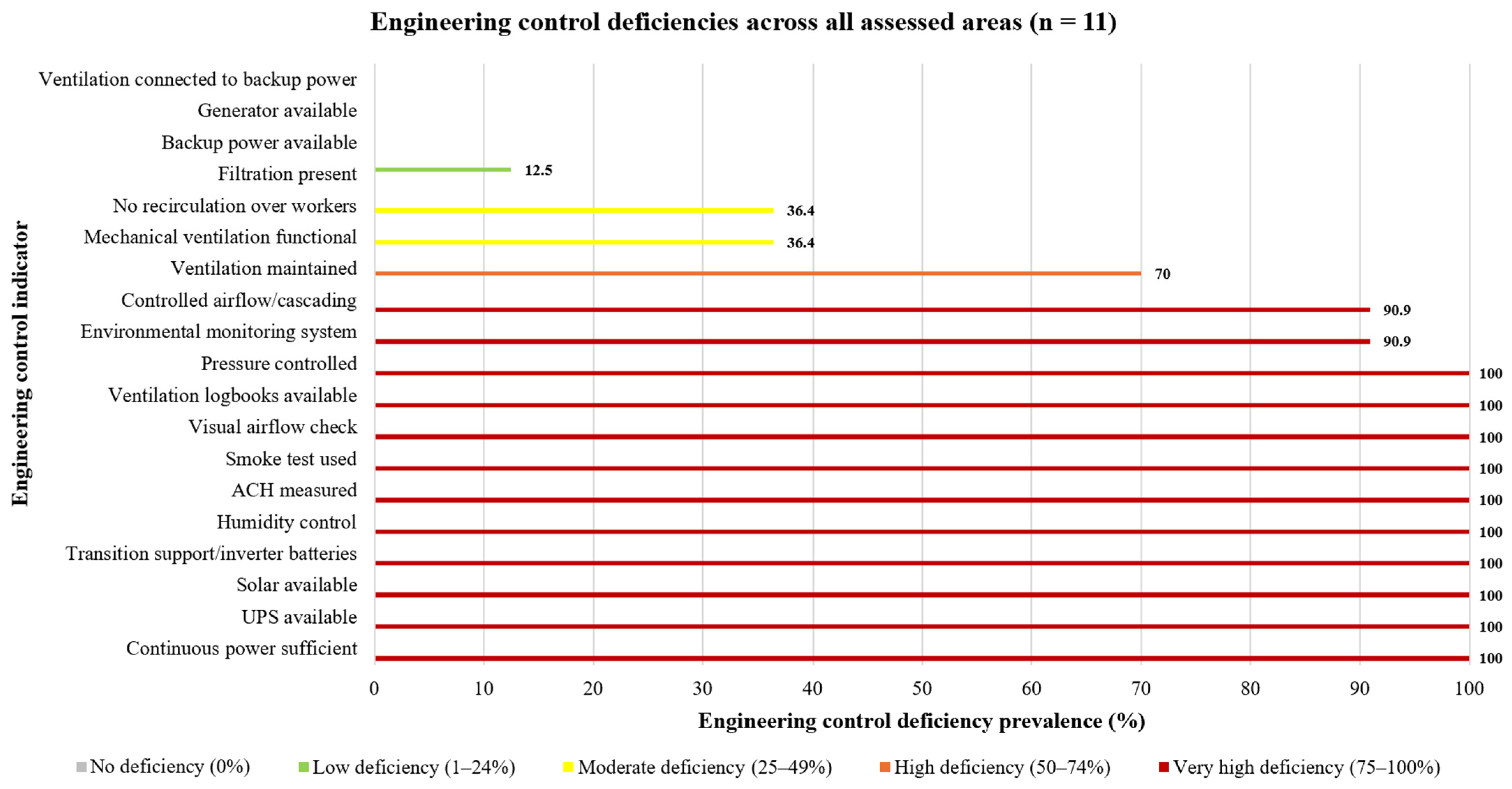
Overall ECRI values were similar across the three facilities, ranging from 50.1% in FPF G to 53.9% in FPF J, with a 3.8-percentage-point difference between the highest and lowest overall scores. Power resilience was identical across facilities (50.0%), reflecting the availability of standby generators but the absence of UPS systems and alternative energy sources. VEC represented the weakest domain, with readiness ranging from 21.9% in FPF G to 37.5% in FPF D, reflecting deficiencies in environmental monitoring, humidity control, ACH monitoring, airflow verification, ventilation documentation, and pressure control. In contrast, BSR values ranged from 73.9% to 80.4%, and were higher than the corresponding PR and VEC scores at all three facilities (Table 2).
Table 2.
Engineering Control Readiness Index (ECRI) scores for participating FPFs.
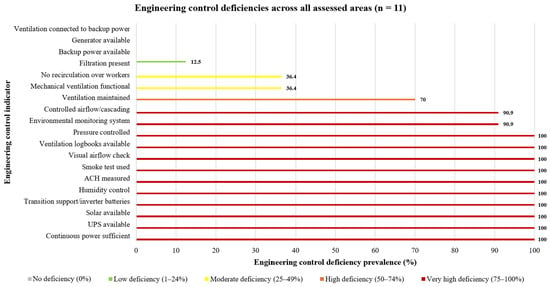
The prevalence of individual engineering-control deficiencies identified during facility walkthrough assessments is presented in Figure 1.
Figure 1.
Prevalence of engineering-control deficiencies identified during facility walkthrough assessments.
3.2.1. Area-Specific Ventilation and Environmental-Control Deficiencies
Because VEC varied between functional work areas, area-specific VEC readiness was evaluated separately (Table 3). Area-specific VEC deficiency ranged from 61.5% to 84.6% across functional work areas. FPF G had the highest deficiency scores (76.9–84.6%), whereas FPF D had the lowest (61.5–66.7%). FPF J recorded a VEC deficiency of 69.2% across all assessed work areas. These area-specific VEC deficiency scores were used as the engineering-control exposure variable in the regression analyses.
Table 3.
Area-specific ventilation and environmental control (VEC) readiness and deficiency across participating FPFs.
3.2.2. Indoor Environmental Conditions
Indoor environmental conditions measured during airborne fungal sampling are summarised in Table 4. Analyses were restricted to 108 indoor observations (36 per facility), excluding the 18 outdoor reference observations. Median temperature, relative humidity, and CO2 concentrations differed across facilities in descriptive sample-level comparisons (all Kruskal–Wallis p < 0.001). FPF G recorded the lowest median indoor temperature (21.6 °C) and the highest median relative humidity (55.0%RH) and CO2 concentration (531 ppm), whereas FPF D recorded the highest median temperature (24.2 °C) and the lowest median relative humidity (31.8%RH).
Table 4.
Indoor environmental conditions measured during airborne fungal sampling.
3.2.3. Airborne Fungal Contamination
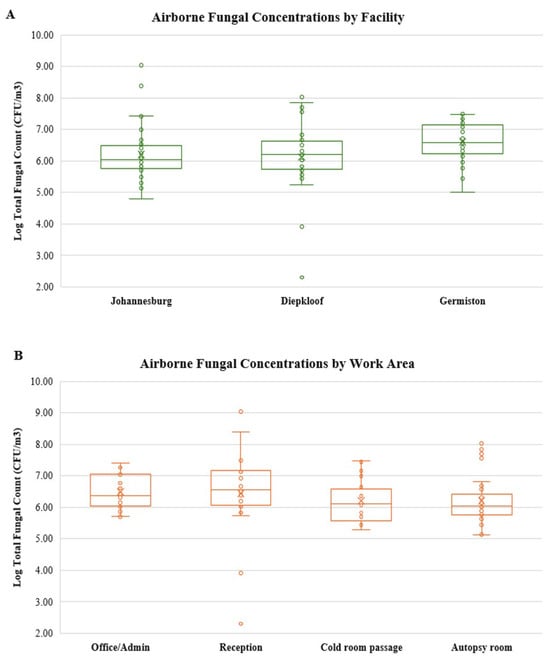
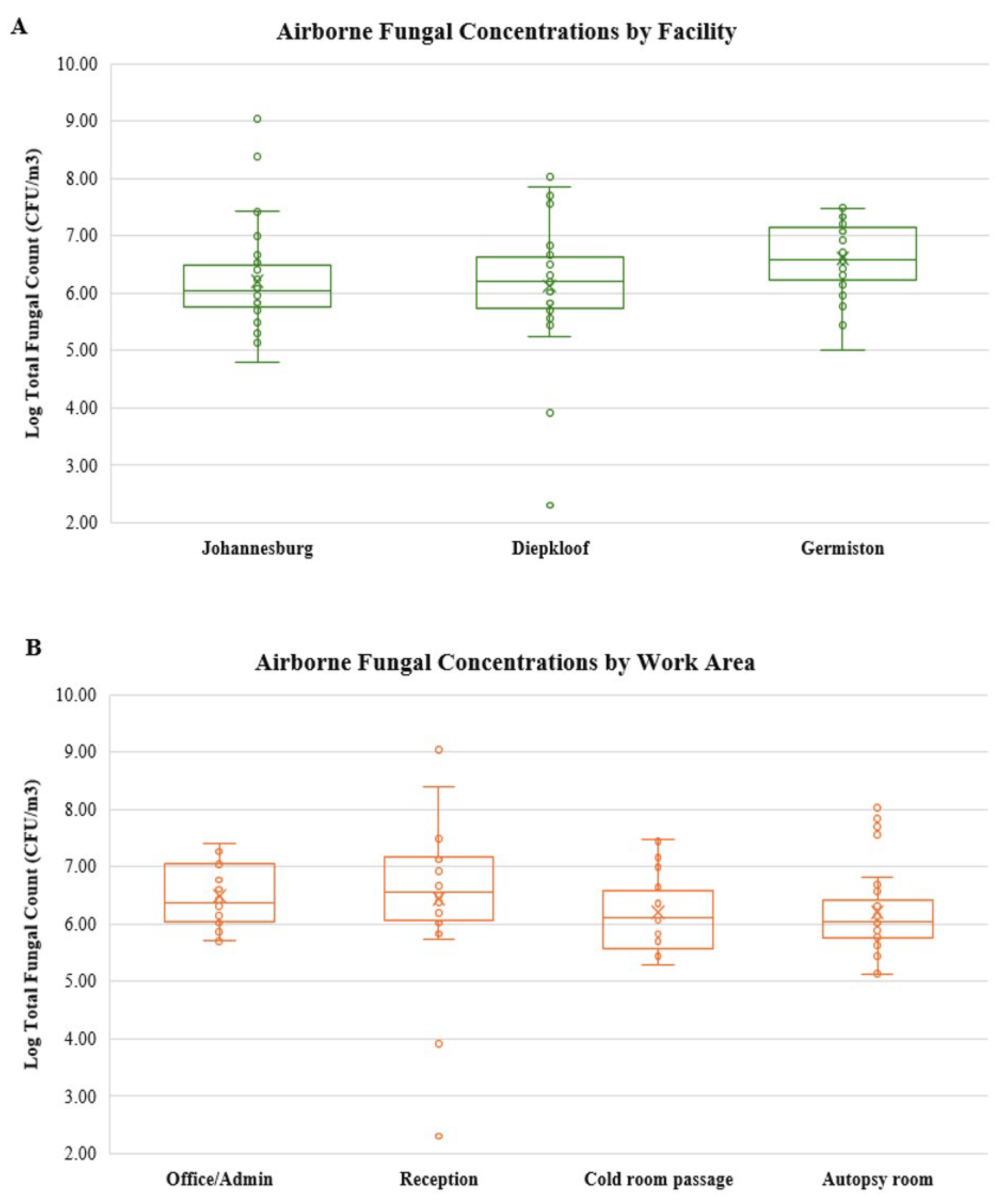
Airborne fungal contamination was detected at all three participating FPFs, with indoor concentrations ranging from 10 to 8360 CFU/m3 (Table 5). Median indoor fungal concentrations were highest in FPF (740 CFU/m3), followed by FPF D (470 CFU/m3) and FPF J (410 CFU/m3). The exploratory sample-level comparison differed across facilities (Kruskal–Wallis p = 0.0014); however, this comparison did not fully account for duplicate samples and repeated sampling days. FPF J recorded the highest individual indoor concentration (8360 CFU/m3) (Table 5; Figure 2A). Across indoor functional work areas, median fungal concentrations ranged from 420 CFU/m3 in autopsy rooms to 705 CFU/m3 in reception areas (Table 5; Figure 2B). The exploratory sample-level omnibus comparison across functional work areas was not statistically significant (Kruskal–Wallis p = 0.117).
Table 5.
Airborne fungal concentrations by facility and functional work area.
Figure 2.
Distribution of airborne fungal log concentrations by (A) facility and (B) functional work area. Fungal concentrations are displayed on a logarithmic scale. Boxes represent the interquartile range (IQR), the horizontal line indicates the median, whiskers extend to 1.5 times the IQR, and points beyond the whiskers represent outlying observations. Fungal concentrations are displayed on a logarithmic scale.
3.2.4. Distribution of Airborne Fungal Genera
Six fungal genera or groups were recovered from airborne samples (Table 6). Cladosporium spp. and Penicillium spp. predominated, being detected in 94.4% and 92.9% of samples, respectively, and exhibited the highest median concentrations among positive samples. Unidentified fungal isolates were also common (97.6%) but generally occurred at lower concentrations. Aspergillus niger, Mucor spp., and Aspergillus flavus were detected less frequently, with median concentrations of 10 CFU/m3 among positive samples. Specifically, A. niger was detected in 35/126 (27.8%) samples, Mucor spp. in 14/126 (11.1%), and Aspergillus flavus in 7/126 (5.6%). No Alternaria, Chrysosporium, Curvularia, Fusarium, Microsporum, Trichophyton, or non-sporulating fungi were detected.
Table 6.
Distribution of airborne fungal genera recovered from participating FPFs.
3.2.5. Factors Associated with Airborne Fungal Concentration
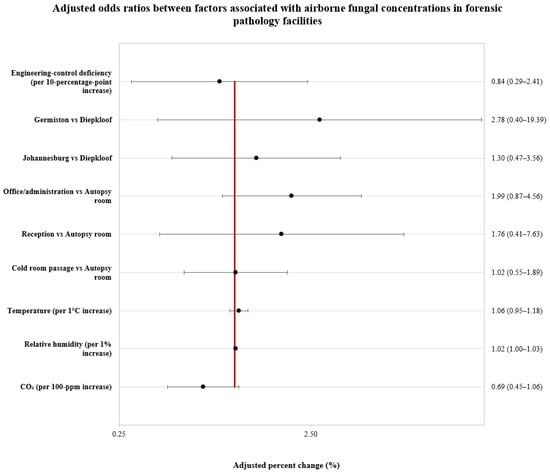
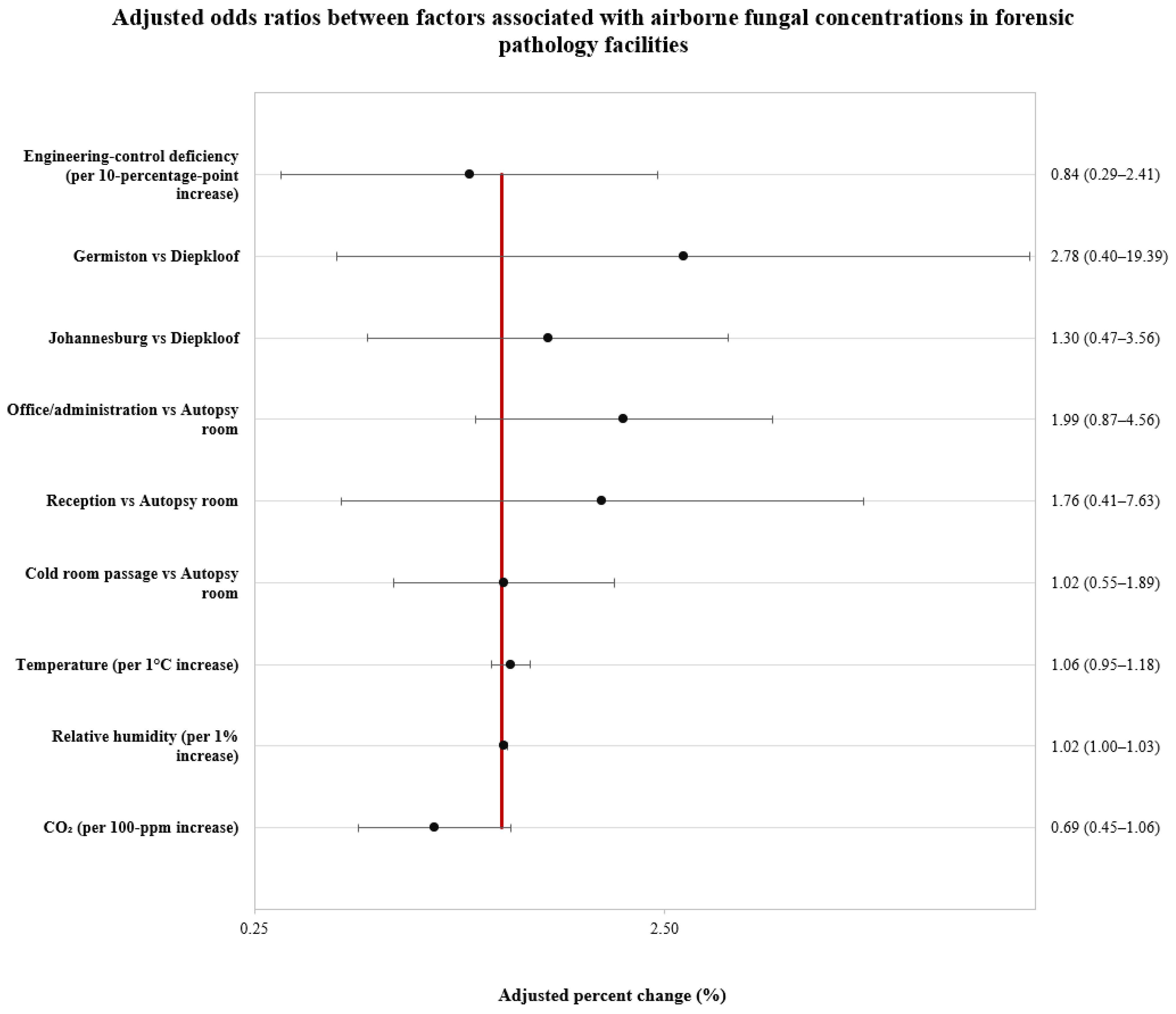
The primary multivariable analysis included 54 indoor location-day observations from 18 physical sampling locations. After adjustment for facility, functional work area, temperature, relative humidity, and CO2 and accounting for repeated measurements within physical sampling locations, engineering-control deficiency was not statistically associated with airborne fungal concentration (Table 7; Figure 3). A 10-percentage-point increase in engineering-control deficiency corresponded to an adjusted −16.3% difference in fungal concentration (95% CI: −70.9% to 140.9%; p = 0.727). No individual facility or functional work-area contrast reached statistical significance in the adjusted model. The overall tests for facility (p = 0.515) and functional work area (p = 0.260) were also not statistically significant. Temperature was not associated with fungal concentration (+5.6% per 1 °C; 95% CI: −5.3% to 17.8%; p = 0.304). The estimated associations for relative humidity (+1.7% per 1% increase; 95% CI: −0.1% to 3.5%; p = 0.059) and CO2 (−31.1% per 100 ppm increase; 95% CI: −55.1% to 5.8%; p = 0.084) did not meet the prespecified threshold for statistical significance.
Table 7.
Primary multivariable analysis of factors associated with airborne fungal concentrations.
Figure 3.
Adjusted associations between engineering-control, facility, functional work-area, and environmental variables and airborne fungal concentration in the primary multivariable model. Points represent adjusted percentage differences and horizontal lines represent 95% confidence intervals. The vertical reference line at 0% represents no difference. Estimates account for repeated observations within physical sampling locations.
3.3. Sensitivity Analyses
Sensitivity analyses yielded results consistent with the primary analysis (Table S2). When environmental covariates were excluded, a 10-percentage-point increase in engineering-control deficiency corresponded to a 9.7% difference in fungal concentration (95% CI: −58.1% to 187.6%; p = 0.841). Additional adjustment for sampling day yielded an estimate of −17.8% (95% CI: −70.7% to 130.9%; p = 0.694). In the replicate-level sensitivity analysis retaining all 108 indoor fungal measurements with clustered inference, the corresponding estimate was −13.7% (95% CI: −69.2% to 141.5%; p = 0.766). No statistically significant association between engineering-control deficiency and fungal concentration was observed across these revised analytical specifications.
4. Discussion
4.1. Principal Findings
This study provides one of the first integrated occupational hygiene assessments of engineering-control readiness, indoor environmental conditions, and airborne fungal contamination in South African FPFs. Unlike previous studies that have primarily described microbial contamination, it quantitatively examined the relationship between engineering-control performance and airborne fungal contamination.
Four principal findings emerged. First, all facilities demonstrated substantial deficiencies in engineering controls, particularly ventilation performance monitoring, humidity control, airflow verification, and environmental surveillance, identifying common gaps in engineering-control monitoring and performance verification across the participating facilities. Second, airborne fungal contamination varied between facilities and functional work areas, with FPF G recording the highest median indoor concentration and FPF J the highest individual concentration, demonstrating substantial variation in measured airborne fungal concentrations. Third, after adjustment for facility, functional work area, temperature, relative humidity, and CO2, and accounting for repeated measurements within physical sampling locations, engineering-control deficiency was not independently associated with airborne fungal concentration. Finally, Cladosporium spp. and Penicillium spp. predominated, consistent with their recognised importance as common indoor fungal bioaerosols in healthcare environments [3]. Less frequently detected genera included Aspergillus niger, Mucor spp., and Aspergillus flavus, which remain relevant from an occupational hygiene perspective because some species within these genera can cause opportunistic disease in susceptible individuals. However, their environmental detection does not establish worker infection or disease. Collectively, these findings demonstrate the coexistence of measurable airborne fungal contamination and substantial engineering-control deficiencies within the participating FPFs, but do not establish engineering-control deficiency as an independent determinant of fungal concentration.
4.2. Engineering-Control Readiness and Occupational Bioaerosol Exposure
Engineering controls are an important upstream means of preventing occupational exposure to airborne biological hazards because they reduce exposure at its source. Mechanical ventilation, airflow management, humidity regulation, environmental monitoring, and preventive maintenance are therefore central to occupational hygiene programmes for controlling airborne biological contaminants [4,5,6].
All participating FPFs demonstrated substantial deficiencies in these controls, particularly in ventilation performance monitoring, airflow verification, humidity regulation, and environmental surveillance. Similar deficiencies have been reported internationally, where inadequate ventilation, poor pressure control, limited airflow verification, and insufficient environmental monitoring contribute to airborne contamination in autopsy and mortuary facilities [7]. In resource-constrained settings, ageing infrastructure, inadequate maintenance, and unreliable utility services may further compromise the performance and resilience of environmental-control systems [8,9].
This absence of an independent statistical association should not, however, be interpreted as evidence that engineering-controls are unimportant for controlling airborne biological hazards. Ventilation, airflow direction, pressure relationships, filtration, moisture control, and contaminant-removal are established components of environmental control [4,5,6,7]. Importantly, the area-specific VEC deficiency score used in this study characterised the presence or absence of selected control attributes but did not directly quantify air changes per hour (ACH), airflow direction, pressure differentials, filtration efficiency, or contaminant removal effectiveness. The composite score may therefore not fully represent the specific engineering mechanisms influencing airborne fungal transport and removal. The findings demonstrate engineering-control deficiencies that warrant objective performance assessment. In particular, direct measurement of ACH, airflow direction and pressure relationships, together with verification of filtration and ventilation performance, would provide a stronger basis for examining relationships between engineering performance and bioaerosol concentrations in future studies.
4.3. Environmental Conditions and Fungal Contamination
Airborne fungal contamination is influenced by the interaction between environmental conditions, engineering controls, building characteristics, and workplace activities [11]. Temperature, relative humidity, ventilation, and airflow affect fungal growth, aerosolisation, transport, and persistence, while activities such as autopsy procedures, body handling, cleaning, and cadaver movement may contribute to the generation or resuspension of bioaerosols [7,12,13].
FPF G recorded the highest median indoor fungal concentration and also had the lowest overall engineering-control readiness and comparatively high area-specific VEC deficiencies. However, although these characteristics occurred concurrently, the adjusted analysis did not demonstrate an independent association between engineering-control deficiency and fungal concentration; the descriptive correspondence should therefore not be interpreted as evidence that poorer engineering-control readiness caused the higher fungal concentrations. In contrast, FPF J recorded the highest individual fungal concentration, indicating substantial within-facility variability and the occurrence of an unusually elevated measurement. Potential explanations include localised environmental conditions, disturbance of contaminated materials, variation in ventilation performance, or episodic aerosolisation; however, these mechanisms were not directly measured and cannot be established from the present data. These findings highlight the importance of considering both central tendency and the full distribution of measured concentrations when assessing occupational bioaerosol hazards.
Across functional work areas, median fungal concentrations ranged from 420 CFU/m3 in autopsy rooms to 705 CFU/m3 in reception areas. However, the exploratory sample-level comparison across functional work areas was not statistically significant (p = 0.117), and the overall functional-work-area effect was also not significant in the adjusted analysis. Consequently, the observed spatial variation should be interpreted descriptively rather than as evidence that particular work areas independently produced higher fungal concentrations.
The predominance of Cladosporium spp. and Penicillium spp. is consistent with studies from autopsy facilities in Turkey and Germany, referral autopsy units in Ghana, mortuary facilities in Yemen, and healthcare environments more broadly, where these genera are commonly reported airborne fungi [10,14,15,16,17]. Their ability to produce abundant airborne spores and colonise damp indoor environments likely explains their predominance. Although generally regarded as environmental fungi, prolonged exposure has been associated with allergic sensitisation, respiratory irritation, asthma exacerbation, and hypersensitivity pneumonitis [3]. Their widespread recovery in the present study therefore indicates the potential for recurrent environmental inhalation exposure, but the culture-based area measurements cannot establish individual worker dose or attributable health effects.
The less frequent detection of A. niger, A. flavus, and Mucor spp. is also relevant to the interpretation of potential occupational exposure. Species belonging to Aspergillus and Mucorales include opportunistic pathogens capable of causing clinically important disease, particularly in susceptible or immunocompromised individuals. Nevertheless, environmental detection should not be equated with clinical infection, and no worker health outcomes were assessed in this study. The findings therefore demonstrate environmental presence and potential exposure rather than occupationally acquired fungal disease. In the revised multivariable analysis, temperature was not associated with fungal concentration (+5.6% per 1 °C; 95% CI: −5.3% to 17.8%; p = 0.304). Relative humidity showed a positive but statistically non-significant estimate (+1.7% per 1% increase; 95% CI: −0.1% to 3.5%; p = 0.059), while CO2 showed an inverse but statistically non-significant estimate (−31.1% per 100 ppm increase; 95% CI: −55.1% to 5.8%; p = 0.084). These estimates should be interpreted cautiously and do not establish independent environmental effects. In particular, the inverse CO2 estimate should not be interpreted as a protective effect because CO2 is an indirect indicator influenced by occupancy and ventilation conditions rather than a biological mechanism for suppressing fungal contamination.
More broadly, these findings illustrate the multifactorial nature of airborne fungal contamination. Fungal concentrations may reflect interacting influences from outdoor-air entry, indoor fungal reservoirs, moisture, building condition, human activity, cleaning, ventilation, filtration, deposition and resuspension. The absence of statistically significant independent associations in the present model therefore does not establish that these environmental or engineering factors are biologically unimportant; rather, their individual contributions could not be distinguished with sufficient precision within the present study design and sample structure.
4.4. Implications for Occupational Hygiene Practice
The findings have several important implications for occupational hygiene practice. First, routine engineering assessments should be incorporated into occupational hygiene programmes to assess ventilation performance, airflow management, humidity control, backup power integration, and preventive maintenance. The ECRI developed in this study provides a structured, study-specific framework for characterising engineering-control readiness across relevant control domains. However, because the ECRI has not yet undergone formal external validation, it should not currently be interpreted as a validated performance benchmark or used to define acceptable or unacceptable facility performance. Further evaluation of its reliability, validity, weighting, and responsiveness to engineering improvements is required.
Second, ventilation systems should undergo routine commissioning and performance verification, including measurement of ACH, airflow verification, pressure relationship testing, and filtration performance. These engineering performance indicators provide objective evidence that ventilation systems are functioning effectively and should form part of routine occupational hygiene surveillance [18,19]. This is particularly important because the present study identified deficiencies in ventilation monitoring and verification but did not directly measure these performance parameters. Objective measurements would allow future assessments to distinguish between the documented presence of ventilation infrastructure and its actual effectiveness in controlling airborne contaminants.
Third, environmental surveillance should be risk-based and linked to clearly defined occupational-hygiene objectives and corrective actions. Periodic monitoring of temperature, relative humidity, and CO2 may assist in identifying changes in indoor environmental conditions and evaluating engineering performance. Where fungal air sampling is undertaken, results should be interpreted together with building conditions, moisture indicators, ventilation performance, work activities, and temporal trends rather than against a single concentration in isolation [7,14].
This distinction is particularly important because no universally accepted health-based occupational exposure limit exists for total airborne fungal concentrations in FPFs. Measured CFU/m3 values therefore cannot be translated directly into a probability of worker infection or disease. Microbiological monitoring is likely to be most informative when used to investigate suspected contamination, compare temporal or spatial patterns, identify potential sources, or evaluate specific control interventions.
Finally, where comprehensive engineering upgrades are not immediately feasible, priority should be given to strengthening ventilation performance, implementing local exhaust ventilation for aerosol-generating procedures where appropriate, improving preventive maintenance, and enhancing environmental monitoring while longer-term infrastructure improvements are planned [7]. Such interventions are consistent with the hierarchy-of-controls principle of managing hazards upstream of individual worker behaviour and PPE. However, the magnitude of any reduction in fungal exposure resulting from these interventions was not evaluated in the present study and should therefore be established through prospective intervention studies.
For resource-constrained FPFs, the findings also suggest a pragmatic prioritisation strategy. Initial efforts could focus on verifying whether existing ventilation systems achieve their intended airflow, pressure, and filtration performance; correcting identified maintenance deficiencies; ensuring continuity of critical ventilation functions during power interruptions; and establishing documented preventive maintenance and performance-verification programmes. These measures may allow existing infrastructure to be optimised before major capital replacement is considered.
4.5. Strengths and Limitations
4.5.1. Strengths
This study has several important strengths. To our knowledge, it is among the first African occupational hygiene studies to integrate engineering-control readiness, indoor environmental conditions, and airborne fungal contamination in FPFs. The ECRI provided a quantitative framework for assessing engineering performance alongside measured airborne fungal contamination. The multi-site design, objective environmental measurements, direct airborne fungal sampling, and multivariable regression strengthened the analysis by allowing the association between area-specific engineering-control deficiency and fungal concentration to be examined while accounting for facility, functional work area, temperature, relative humidity, CO2, and the repeated measure structure of the data.
An additional strength was the statistical re-evaluation of the sampling structure. Duplicate fungal measurements collected within each physical sampling location and sampling day were averaged for the primary analysis, preventing technical/within-location replicates from being treated as independent environmental observations. Cluster-robust inference at the physical sampling-location level further accounted for repeated measurements over the three sampling days. Sensitivity analyses using alternative model specifications provided an additional assessment of the robustness of the engineering-control estimate.
The study also integrated three complementary components, engineering-control assessment, contemporaneous indoor environmental measurements, and culture-based fungal air sampling, within the same occupational settings. This enabled engineering and environmental conditions to be considered alongside measured fungal contamination rather than as separate descriptive assessments.
4.5.2. Limitations
Several limitations should be considered. Only three purposively selected FPFs were included, which may limit the generalisability of the findings. Although the revised analysis accounted for repeated observations within physical sampling locations, only 18 indoor physical locations contributed to the primary model. The limited number of facilities and clusters reduced statistical precision, as reflected in the wide confidence intervals around several adjusted estimates, and limited the ability to distinguish facility-level characteristics from engineering-control performance. Sampling was conducted during three consecutive days at each facility within a single study period and may not reflect seasonal variation in airborne fungal contamination or longer-term variation in indoor environmental conditions. Culture-based methods and conventional fungal identification may have underestimated fungal diversity by failing to detect non-culturable organisms. Culture-dependent enumeration may also be influenced by growth conditions and competition between organisms and therefore should not be regarded as a complete characterisation of the airborne fungal community.
The ECRI and area-specific VEC deficiency measures were developed for this study and have not undergone formal external validation. Although they provided a structured approach to characterising engineering-control readiness, the indices do not directly measure ventilation effectiveness. In particular, ACH, airflow direction, pressure differentials, filtration efficiency, and contaminant-removal effectiveness were not objectively quantified. Misclassification or limited sensitivity of the composite engineering-control measure may therefore have attenuated an association with fungal concentration.
In addition, the cross-sectional design precludes causal inference, and residual confounding from unmeasured factors, including building characteristics, occupancy patterns, cadaver-related factors (e.g., decomposition stage and postmortem workload), and operational activities, cannot be excluded. Outdoor fungal concentrations were measured as reference observations, but the study was not designed to quantify indoor–outdoor source relationships or determine the contribution of outdoor fungal infiltration to individual indoor measurements.
The environmental measurements also represent area measurements rather than personal exposure monitoring. Consequently, the fungal concentrations cannot be interpreted as individual worker inhalation doses, and variation in workers’ location, duration of tasks, use of respiratory protection, and proximity to emission sources was not reported in this study.
Finally, the absence of occupational exposure limits for airborne fungal concentrations in FPFs limits interpretation of the measured concentrations against health-based benchmarks. No worker clinical outcomes, respiratory symptoms, sensitisation markers, or infection data were collected. The study therefore cannot establish whether the measured environmental fungal concentrations caused adverse health effects or quantify the clinical risk to individual workers.
Furthermore, because scheduled electricity interruptions did not occur during the sampling period, the study could not directly evaluate whether loss of mains power or transition to backup power altered ventilation performance or fungal concentrations. Findings relating to power resilience therefore reflect engineering readiness rather than measured bioaerosol consequences of active power interruptions.
5. Conclusions
This study identified substantial gaps in engineering-control readiness alongside widespread and variable airborne fungal contamination across three South African FPFs. Ventilation and environmental control represented the weakest engineering-readiness domain, while Cladosporium spp. and Penicillium spp. predominated among the airborne fungi detected. However, after accounting for facility, functional work area, measured environmental conditions, and repeated measurements within physical sampling locations, area-specific engineering-control deficiency was not independently associated with airborne fungal concentration. The wide confidence intervals around the adjusted estimates indicate considerable statistical uncertainty and preclude conclusions regarding the direction or magnitude of an independent association.
6. Recommendations
FPFs should strengthen engineering-control management through routine ventilation-performance verification, environmental monitoring, and documented preventive maintenance. Ventilation assessments should include, where applicable, ACH, airflow direction, pressure relationships, and filtration performance, with particular attention to maintaining critical systems during power interruptions.
Risk-based monitoring of temperature, relative humidity, and CO2 should be used to identify changes in indoor environmental conditions and inform the investigation of ventilation performance. Fungal air sampling should be undertaken for defined occupational-hygiene purposes, such as investigating suspected contamination, characterising spatial or temporal patterns, or evaluating control interventions, rather than interpreted against an assumed universal health-based CFU/m3 threshold.
Where infrastructure replacement is constrained, priority should be given to verifying and optimising existing ventilation systems, correcting identified maintenance deficiencies, and strengthening airflow, pressure, and environmental-control performance. These actions are supported by established occupational-hygiene principles and the engineering-control deficiencies identified in this study, rather than by an independently demonstrated association between the composite deficiency score and fungal concentration.
Future longitudinal and intervention studies should include larger numbers of FPFs, seasonal sampling, direct measures of ventilation performance, and personal bioaerosol exposure and worker health assessments to determine whether improvements in engineering controls reduce fungal exposure and associated occupational health risks. Complementary assessment of workers’ knowledge, attitudes, and practices may inform administrative and behavioural components of integrated exposure prevention.
Supplementary Materials
The following supporting information can be downloaded at https://www.mdpi.com/article/10.3390/hygiene6030063/s1, Table S1: Complete indicator framework used to construct the study-specific ECRI; Table S2: Sensitivity analyses of the association between engineering-control deficiency and airborne fungal concentration.
Author Contributions
Conceptualization, T.S.; methodology, T.S., D.M., L.V.M.; software, T.S., L.V.M.; validation, T.S., D.M., L.M.; formal analysis, T.S. and L.V.M.; investigation, T.S., D.M., L.M., Z.K.; resources, T.S. and D.M.; data curation, L.M., Z.K., L.V.M.; writing—original draft preparation, T.S. and D.M.; writing—review and editing, T.S.; visualisation, T.S.; supervision, T.S. and D.M.; project administration, Z.K. and L.M.; funding acquisition, T.S. and D.M. All authors have read and agreed to the published version of the manuscript.
Funding
This research was funded by the National Health Laboratory Services (PR2448750). The APC was supported by the University of Johannesburg.
Institutional Review Board Statement
The study was conducted in accordance with the Declaration of Helsinki and approved by the University of Johannesburg Research Ethics Committee (REC-2652-2024, date of approval: 11 April 2024 and renewal: 27 March 2026) and the Gauteng Department of Health. Permission to conduct the study was granted by the relevant provincial health authorities and participating FPFs. All study procedures were conducted in accordance with approved ethical protocols and institutional requirements. Facility managers and maintenance personnel provided operational information during the walkthrough assessments.
Informed Consent Statement
Not applicable.
Data Availability Statement
The data supporting the findings of this study are not publicly available due to privacy and ethical restrictions. Data may be available from the corresponding author upon request.
Acknowledgments
The authors would like to thank the Gauteng Department of Health and participating Forensic Pathology Facilities for granting permission to conduct the study. The authors also acknowledge the support of the University of Johannesburg, the National Institute for Occupational Health, a division of the National Health Laboratory Service for providing academic supervision and institutional support during the research process. The research team also acknowledges the efforts by Adaho Bilankulu for conducting the facility walkthrough inspections and Palesa Setlhodi who assisted with data collection. All individuals included in this section have consented to the acknowledgement.
Conflicts of Interest
The authors declare no conflicts of interest.
Abbreviations
The following abbreviations are used in this manuscript:
| ACH | Air changes per hour |
| BSR | Biosecurity and surveillance readiness |
| CFU/m3 | Colony-forming units per cubic metre |
| CI | Confidence interval |
| CO2 | Carbon dioxide |
| ECRI | Engineering Control Readiness Index |
| FPF | Forensic pathology facility |
| IQR | Interquartile range |
| LMICs | Low- and middle-income countries |
| NIOH | National Institute for Occupational Health |
| PPE | Personal protective equipment |
| PR | Power resilience |
| QA/QC | Quality assurance and quality control |
| RH | Relative humidity |
| SD | Standard deviation |
| Spp | Multiple species within a genus |
| UPS | Uninterruptible power supply |
| VEC | Ventilation and environmental control |
| %RH | Percentage relative humidity |
References
- Rai, R.; El-Zaemey, S.; Dorji, N.; Rai, B.D.; Fritschi, L. Exposure to Occupational Hazards among Health Care Workers in Low- and Middle-Income Countries: A Scoping Review. Int. J. Environ. Res. Public Health 2021, 18, 2603. [Google Scholar] [CrossRef] [Scilit] [PubMed]
- Boyd, D.C.; Steadman, D.W.; Marzani, G.R.; Andersen, V. Recognizing and mitigating the effects of occupational exposure to traumatic death in forensic anthropology. J. Forensic Sci. 2026, 71, 105–119. [Google Scholar] [CrossRef] [Scilit] [PubMed]
- Hicks, J.; Lewis, R. Health Risks of Fungi in the Built Environment. In Human and Ecological Risk Assessment: Theory and Practice, 3rd ed.; Wiley: Hoboken, NJ, USA, 2024; Chapter 12; pp. 525–539. [Google Scholar] [CrossRef] [Scilit]
- Pimenta, R.; Gomes, B.; Dias, M.; Viegas, C. Fungal Contamination Assessment in Healthcare Environments—A Bibliographic Review. In Viruses, Bacteria and Fungi in the Built Environment; Pacheco-Torgal, F., Ivanov, V., Falkinham, J.O., Eds.; Woodhead Publishing: Cambridge, UK, 2022; pp. 181–229. [Google Scholar] [CrossRef] [Scilit]
- Kadam, S.S.; Akhade, S.; Desouza, K. Autopsy Practice, Potential Sources of Occupational Hazards: A Review for Safety and Prevention. J. Indian Acad. Forensic Med. 2015, 37, 196–201. [Google Scholar] [CrossRef] [Scilit]
- Ghosh, B.; Lal, H.; Srivastava, A. Review of bioaerosols in indoor environment with special reference to sampling, analysis and control mechanisms. Environ. Int. 2015, 85, 254–272. [Google Scholar] [CrossRef] [Scilit] [PubMed]
- Langroudi, M.F.; Farzanegan, A. Decrease of microbial contamination by application of routinely glycerol and phenol solution on human cadavers. J. Curr. Biomed. Rep. 2021, 2, 74–78. [Google Scholar] [CrossRef] [Scilit]
- Emmanuel, N.O.; Police, U.I. Health Hazards, Perceived Health Problems and Safety Compliances among Mortuary Workers in Ikwerre Local Government Area of Rivers State. Asian J. Adv. Res. Rep. 2021, 15, 67–74. [Google Scholar] [CrossRef] [Scilit]
- Pluim, J.M.E.; Jimenez-Bou, L.; Gerretsen, R.R.R.; Loeve, A.J. Aerosol production during autopsies: The risk of sawing in bone. Forensic Sci. Int. 2018, 289, 260–267. [Google Scholar] [CrossRef] [Scilit] [PubMed]
- Sonmez, E.; Ozdemir, H.M.; Cem, E.M.; Sonmez, Y.; Salacin, S.; Ismail, O.C.; Sen, F. Microbiological detection of bacteria and fungi in the autopsy room. Rom. J. Leg. Med. 2011, 19, 33–44. [Google Scholar] [CrossRef] [Scilit]
- Kato, H.; Kanno, S.; Fukuta, M.; Yaguchi, T.; Aoki, Y. Cadavers found outdoor in whom fungal growth was observed on the body surface: Consideration of the role of mycology in forensic medicine. Leg. Med. 2023, 65, 102301. [Google Scholar] [CrossRef] [Scilit] [PubMed]
- Wingert, L.; Debia, M.; Hallé, S.; Marchand, G. Occupational Microbial Risk among Embalmers. Atmosphere 2022, 13, 1281. [Google Scholar] [CrossRef] [Scilit]
- Al-Jobory, H.J.; Al-Amoodi, S.A.; Al-Shamerie, S.A.; Al-Samawi, K.K. Mortuary: The Inevitable Evil: Mortuary Staff is a Victim of the Sudden Death Caused by the Invisible Mycoburden of Human Cadavers. PSM Microbiol. 2018, 3, 70–81. [Google Scholar]
- Piepenbring, M.; Baschien, C.; Hoffmann, L.; Olesiuk, M.; Gehrels, D.; Amendt, J. Exploring the diversity of culturable fungi on corpses for forensic applications. Mycol. Prog. 2025, 24, 8. [Google Scholar] [CrossRef] [Scilit]
- Dufayet, L.; Langrand, J.; Ludes, B. Risk of occupational infection in forensic workers: A review. Forensic Sci. Res. 2023, 8, 1–4. [Google Scholar] [CrossRef] [Scilit] [PubMed]
- Tomao, P.; La Russa, R.; Oliva, A.; De Angelis, M.; Mansi, A.; Paba, E.; Marcelloni, A.M.; Chiominto, A.; Padovano, M.; Maiese, A.; et al. Mapping Biological Risks Related to Necropsy Activities: Old Concerns and Novel Issues for the Safety of Health Professionals. Int. J. Environ. Res. Public Health 2021, 18, 11947. [Google Scholar] [CrossRef] [Scilit] [PubMed]
- Oforiwaa, M.E.; Gyapong, F.; Afrifah, K.A.; Isawumi, A.; Mosi, L. Case Report of Indoor Air Antimicrobial Resistant Fungi Circulating in a Ghanaian Referral Autopsy Unit. Preprints 2023. [Google Scholar] [CrossRef] [Scilit]
- Ringane, A.; Milovanovic, M.; Maphakula, D.; Omar, T.; Martinson, N.; Ringane, A.; Milovanovic, M. An observational study of safe and risky practices in funeral homes in South Africa. S. Afr. Med. J. 2019, 109, 587–591. [Google Scholar] [CrossRef] [Scilit] [PubMed]
- Kidd, S.; Halliday, C.L.; Alexiou, H.; Handke, R.; Bartley, R. Descriptions of Medical Fungi; CutCut Digital: Misgav, Israel, 2016. [Google Scholar]

Disclaimer/Publisher’s Note: The statements, opinions and data contained in all publications are solely those of the individual author(s) and contributor(s) and not of MDPI and/or the editor(s). MDPI and/or the editor(s) disclaim responsibility for any injury to people or property resulting from any ideas, methods, instructions or products referred to in the content. |
© 2026 by the authors. Licensee MDPI, Basel, Switzerland. This article is an open access article distributed under the terms and conditions of the Creative Commons Attribution (CC BY) license.