


Abstract
Nicotine pouches have expanded rapidly across the Gulf region, yet population-based evidence on gingival health remains scarce and users differ widely in intensity of consumption. We examined the association between nicotine pouch use and self-reported gingival symptom burden among 655 adults in Saudi Arabia using a bilingual self-administered online questionnaire. All data, including the outcome, were self-reported; no clinical periodontal examination was performed, so the study does not provide a clinical diagnosis of periodontal disease. Self-reported gingival symptom burden was assessed with a ten-item screening scale validated in Saudi adults, analysed as a continuous score and dichotomised at the sample median, and dependence among users was quantified with a six-item index adapted from the Fagerström Test for oral nicotine products. Tobacco exposure was modelled as a single four-level mutually exclusive variable. An above-median self-reported gingival symptom score was present in 277 participants (42.3%), and 180 (27.5%) reported pouch use. Pouch use status was not associated with the outcome (adjusted odds ratio 1.06, 95% CI 0.67–1.69). Among 179 users, the screening score rose by 1.63 points per dependence stratum (95% CI 0.88–2.37), and prevalence rose from 28.2% at low dependence to 38.9% and 58.3% at moderate and high dependence (Kendall τ-b = 0.186, p = 0.002), with adjusted odds of 5.86 (95% CI 2.30–14.96) for high dependence and a per-stratum trend of 2.43 (95% CI 1.52–3.87). The gradient persisted after additional adjustment for smoking status, former smoking and use of other tobacco products (trend odds ratio 2.53–2.65), and across ten sensitivity analyses. Self-reported gingival recession showed the steepest gradient across dependence strata, whereas gingival bleeding showed none. Self-reported gingival symptom burden among pouch users was associated with intensity of consumption rather than with use status; these findings are hypothesis-generating rather than evidence of a clinical effect, and require confirmation by studies with clinical periodontal assessment and longitudinal follow-up.
1. Introduction
Tobacco-free nicotine pouches deliver nicotine across the oral mucosa without combustion or tobacco leaf. Placed between the upper lip and the gingiva, they remain in sustained and direct contact with gingival tissue throughout each use episode. Marketed as reduced-risk alternatives to cigarettes and to traditional smokeless tobacco, they have achieved rapid uptake among young adults and among smokers seeking cessation [1,2,3].
The absence of tobacco leaf does not imply biological inertness. Pouches contain pharmacologically active nicotine together with flavourings, sweeteners and alkaline buffering agents that raise oral pH and enhance mucosal absorption [4,5,6,7]. Nicotine constricts the gingival microvasculature and reduces gingival blood flow, impairs fibroblast attachment and proliferation, and attenuates neutrophil chemotaxis and phagocytosis. This combination plausibly increases susceptibility to plaque-induced inflammation while simultaneously suppressing its most visible clinical sign, bleeding on probing [8,9,10].
Gingival inflammation is the earliest and only fully reversible stage of periodontal disease; if unresolved it may progress to periodontitis, with irreversible destruction of the supporting apparatus and eventual tooth loss [11]. Severe periodontal disease affects an estimated 19% of the global adult population, and oral diseases rank among the most prevalent non-communicable conditions worldwide [12]. The relationship between cigarette smoking and periodontal destruction is firmly established through impaired host response, reduced vascularisation and altered subgingival microbial ecology [13,14,15]. Traditional smokeless products have been linked to localised gingival recession and mucosal lesions at the site of placement, with severity related more closely to the daily amount used and hours of daily use than to the number of years of the habit [16]; population-level studies of Swedish snus have nonetheless not consistently demonstrated associations with gingivitis or periodontitis [17].
Evidence concerning nicotine pouches remains preliminary. Case series and short-term clinical observations describe localised mucosal irritation, epithelial alteration and inflammatory infiltration at habitual placement sites [18,19], and a systematic review concluded that the available literature is insufficient to characterise population-level periodontal risk, being constrained by small clinic-based samples and short follow-up [20]. A further consideration has received little attention: users are markedly heterogeneous in intensity of consumption. Daily use ranges from a single low-strength pouch to more than fifteen high-strength pouches, implying order-of-magnitude differences in the nicotine load delivered to the oral mucosa. If gingival effects are dose-dependent, as the mechanistic literature on nicotine implies, then intensity rather than use status should determine risk.
Saudi Arabia provides an informative setting. Nicotine pouch consumption has grown substantially in the Kingdom, driven largely by a domestic brand, while epidemiological data on oral health consequences are effectively absent. The present study therefore addressed two questions: whether nicotine pouch use status is associated with self-reported gingival symptom burden in a general adult sample, and whether, among users, dependence severity and cumulative daily nicotine load are associated with that risk in a graded manner. Because the outcome was ascertained by questionnaire rather than by clinical examination, it is referred to throughout as self-reported gingival symptom burden.
2. Materials and Methods
2.1. Study Design and Setting
This analytical cross-sectional study was conducted in July 2026 across the Kingdom of Saudi Arabia. Reporting follows the STROBE statement for cross-sectional studies [21].
2.2. Participants
Eligible participants were adults aged 18 years or older residing in Saudi Arabia who provided informed consent. Current and former smokers were eligible, since combustible tobacco use is a central confounder of the exposure of interest and was addressed analytically through mutually exclusive exposure categorisation, covariate adjustment and stratification.
Participants were recruited by convenience sampling through a self-administered questionnaire distributed electronically via social media platforms and community networks. The survey instrument was configured to accept a single response per user account. An external pilot study of ten participants preceded the main survey to assess clarity and completion time; pilot responses were not included in the analysis.
The minimum required sample size was calculated using the standard formula for estimating a single proportion, n = Z2p(1 − p)/d2. Assuming an anticipated prevalence of nicotine pouch use of 35%, an absolute precision of 5% and a 95% confidence level, the minimum required sample was 350 participants. The realised sample of 655 participants exceeded this threshold, improving the precision of the prevalence estimates. Among the 180 pouch users, the study had 80% power at α = 0.05 to detect a per-stratum trend odds ratio of 1.8 or greater in the dependence sub-analysis.
The questionnaire was distributed through open web links embedded in a recruitment campaign that reached an estimated 2850 potential respondents, this denominator being the estimated reach of the recruitment message across the platforms and community networks used. A total of 655 questionnaires were submitted between 9 and 28 July 2026, so that approximately 23% of the estimated recruitment-message reach (655/2850) resulted in a completed questionnaire. This proportion is not a formal response rate, because the denominator is an estimate of campaign reach rather than a verified count of eligible individuals who received and opened an invitation, and because the platform did not retain partial submissions. Duplicate submissions were prevented by configuring the platform to accept a single submission per user account. No records were excluded on eligibility grounds, and all 655 submissions were analysed. Age was missing for seven participants (1.1%); adjusted models were fitted on 648 complete cases.
2.3. Measures
2.3.1. Sociodemographic and Clinical Characteristics
Age, sex, nationality, marital status, educational attainment, occupation, monthly income, self-reported height and weight, physician-diagnosed chronic conditions and regular physical exercise were recorded. Body mass index was computed from reported height and weight and categorised according to World Health Organization criteria. Chronic disease was analysed both as a binary indicator and as a count of conditions (respiratory disease, diabetes mellitus, hypertension, arthritis, heart disease, cancer, kidney disease); obesity was analysed separately to avoid duplicating information captured by body mass index.
2.3.2. Tobacco Use and Nicotine Pouch Use
Smoking status was recorded in four categories (never smoked; current smoker; former smoker who quit more than six months ago; former smoker who quit within the preceding six months), together with the type(s) of product ever used (conventional cigarettes, electronic hookah or vaping devices, shisha, heated tobacco; multiple responses permitted). Ever-use status of nicotine pouches, duration of use, daily sachet consumption, nicotine strength, brand, and perceived contribution of pouches to smoking cessation were recorded. Nicotine pouch use was ascertained by a single screening question on ever-use (“Have you ever used nicotine pouches?”). The 180 participants who answered affirmatively were then routed to items on their current pattern of use, phrased in the present tense: duration of use to date, daily sachet consumption, nicotine strength, brand, and the six dependence items. All 180 completed these items with no missing values, so the group analysed consists of ever-users who reported an ongoing pattern of consumption at the time of the survey. Participants who had used pouches in the past and stopped before the survey could not be distinguished from current users and, had any been present, would have been classified as users, which would bias the exposure contrast towards the null. Throughout this article “pouch user” therefore denotes ever-use with reported current consumption, and non-users are participants who reported never having used pouches. Habitual placement site within the mouth and whether users rotated the site between applications were not surveyed; the exposure metrics therefore capture the quantity and intensity of use but not its anatomical distribution, which is relevant to localised recession. Cumulative daily nicotine load was derived as nicotine strength in milligrams multiplied by the midpoint of the reported daily sachet category, expressed as mg/day. The two open-ended response options have no defined midpoint and were assigned the nearest plausible values: 17 sachets per day for the category “more than 15 sachets” (reported by 9 users) and 12 mg for the category “more than 10 mg” (reported by 10 users). Because these assignments are arbitrary, the analysis of daily nicotine load was repeated with alternative values (11 mg and 16 sachets; 15 mg and 20 sachets), and the estimates were materially unchanged (adjusted odds ratio per 10 mg/day 1.06 to 1.08; Kendall τ-b 0.101 to 0.107), so the borderline association reported for this metric does not depend on the values chosen.
2.3.3. Self-Reported Gingival Symptom Burden
Self-reported gingival symptom burden was assessed with the Self-Reported Periodontal Disease Screening Scale, a ten-item unidimensional instrument developed and validated in Saudi adults by confirmatory factor analysis, with acceptable internal consistency (Cronbach α = 0.75) and excellent test–retest reliability (r = 0.93) [22]. Five items use a binary response format and five use five-point frequency or rating formats, giving a summed score of 0 to 25. Internal consistency in the present sample was good (α = 0.788). The score also behaved as expected of a measure of periodontal risk, rising with age (Spearman ρ = 0.113, p = 0.004) and with the number of chronic conditions (ρ = 0.156, p < 0.001) and falling with regular physical exercise (ρ = −0.134, p < 0.001). The instrument captures self-perceived signs and symptoms of gingival and periodontal disease; no clinical periodontal examination was performed.
The score was analysed primarily as a continuous variable, consistent with its use in the validation study. It was additionally dichotomised to define an above-median self-reported gingival symptom score, and the sample median was adopted as the cut-point on distributional grounds. The score departed substantially from normality: it was bounded at zero, right-skewed (skewness 1.11; 10.2% of participants scored zero) and leptokurtic relative to a normal curve, and both the Shapiro–Wilk and Kolmogorov–Smirnov tests rejected normality (both p < 0.001). The mean therefore exceeded the median (4.80 versus 4.00) and was displaced by the upper tail, so a mean-based or standard-deviation-based cut-point would have been determined by the most extreme responses rather than by the centre of the distribution. No externally validated clinical threshold exists for this instrument, and in the absence of such a threshold the median is the location statistic that is robust to skew and that divides the sample closest to evenly (42.3% versus 57.7%), maximising the precision of the resulting odds-ratio estimates and minimising the risk of sparse-cell bias in the multivariable models. A stricter threshold (≥7, corresponding to the 70th centile, which classified 29.5% of participants above the threshold) was examined in sensitivity analysis; the full distribution of the score is given in Table S4, and the continuous-score analyses, which require no cut-point at all, were given precedence throughout. For ordinal analysis the score was classified as low (0–4), moderate (5–11) or high (≥12). Participants at or above the median are described as having an above-median gingival symptom score; the instrument has no clinically validated diagnostic threshold, and no diagnosis is implied by this term. The questionnaire administered here carried an eleven-item version of the scale, comprising the ten validated items together with one further item on loss of permanent teeth. Because tooth loss is not specific to gingival inflammation and may follow caries, trauma, orthodontic extraction or ageing, the validated ten-item version was used for the primary analysis and the eleven-item version was retained as a sensitivity analysis (Table 5 and Table S4). The Arabic version published with the original validation study was used.
2.3.4. Nicotine Dependence
Among pouch users, dependence was assessed with a six-item index adapted from the Fagerström Test for Nicotine Dependence for smokeless and oral nicotine products [23,24]: time to first pouch after waking; swallowing saliva during use; use exceeding intention; difficulty abstaining where use is prohibited; continued use during illness; and daily consumption, dichotomised. Items were scored 0 or 1 and summed to give a score of 0 to 6, classified as low (0–2), moderate (3–4) or high (5–6) dependence. Internal consistency was modest (α = 0.580). Corrected item–total correlation ranged from 0.255 to 0.471 for five items and was 0.076 for the saliva-swallowing item; this item was therefore examined additionally as an independent exposure, and a five-item index excluding it was examined in sensitivity analysis (α = 0.625). Considered without the item on daily consumption, the five behavioural items alone correlated with the independently reported consumption measures (Spearman ρ = 0.423 with daily sachet count and ρ = 0.437 with derived daily nicotine load, both p < 0.001), supporting the index as a measure of intensity of use. The index is a behavioural measure of intensity of use.
The Arabic version of the index was produced by forward–backward translation. Bilingual members of the study team translated the items from English into Arabic and reconciled the translation by consensus; a bilingual translator blind to the source text then back-translated it into English, and discrepancies between the back-translation and the source were resolved item-by-item by consensus. The reconciled version was reviewed for content and cultural relevance by team members with expertise in preventive medicine and dentistry and was cognitively debriefed with the ten pilot participants, who explained each item in their own words to confirm that it was understood as intended.
2.3.5. Systemic Symptoms and Product Perceptions
Pouch users were asked whether they had experienced any of six symptoms commonly attributed to nicotine—palpitations, sleep disturbance, mouth ulcers, anxiety symptoms, headache and weight gain—each recorded as a binary response. These items do not form part of the gingival screening scale and were analysed separately, as an exploratory check on whether the dependence index tracks recognised pharmacological effects of nicotine. All participants, whether or not they used pouches, were additionally asked whether they regarded nicotine replacement products as healthy.
2.4. Statistical Analysis
Analyses were performed in IBM SPSS Statistics version 22.0 (IBM Corp., Armonk, NY, USA).
Normality was assessed with the Shapiro–Wilk test. Because age and the gingival score departed markedly from normality (both p < 0.001), continuous variables are summarised as median [interquartile range] and compared with the Mann–Whitney U or Kruskal–Wallis test. Categorical variables are presented as n (%) and compared with the Pearson χ2 test, or the Fisher–Freeman–Halton exact test where more than 20% of expected cell counts were below five. Prevalence estimates are presented with 95% confidence intervals.
Analyses were organised in three tiers. The two primary analyses addressed the two research questions: (i) the association between the four-level tobacco and pouch exposure variable and the outcome in the full sample, and (ii) the association between dependence severity and the outcome among pouch users. Secondary analyses examined the individual consumption metrics, the individual gingival signs and the sensitivity analyses. All remaining analyses—systemic symptoms, chronic conditions, cessation outcomes and product perceptions—were exploratory, are reported briefly in the main text and in full in the Supplementary Materials, and are not adjusted for multiplicity.
Primary analysis I. Tobacco and pouch exposures in the full sample were represented by a single four-level mutually exclusive variable—never-smoker non-user (reference), ever-smoker non-user, never-smoker pouch user, ever-smoker pouch user—because pouch use and combustible tobacco use overlapped substantially in this population (167 of 180 users, 92.8%, had smoked), and separate binary indicators would be collinear. These models were adjusted for age, sex, body mass index, regular exercise, chronic disease count and educational attainment. The contrast of primary interest, pouch use versus non-use, was additionally estimated within smoking strata, comparing users with non-users separately among never-smokers and among ever-smokers, with a multiplicative interaction term and a likelihood-ratio test used to assess whether the association of pouch use with the outcome differed by smoking history.
Primary analysis II. The exposure of principal interest among users was intensity of nicotine pouch use, operationalised as dependence severity and as cumulative daily nicotine load. Dependence was analysed in four forms: on the continuous gingival score, by linear regression; as the continuous 0–6 index; as a linear trend across categories; and as a three-level categorical variable with the low-dependence stratum as reference. The ordinal association was quantified with Kendall τ-b, and a proportional-odds model was fitted to the three-level gingival classification, with formal testing of the parallel-line assumption. Models were adjusted for age and current cigarette smoking. Sex was not entered into user-level models because 175 of 180 users (97.2%) were male.
Where residuals from linear regression departed from normality, confidence intervals were additionally derived by bootstrap resampling with 5000 replicates. In the analysis of individual gingival signs, a Bonferroni-corrected threshold was applied to account for the ten comparisons made. Crude and adjusted odds ratios are reported with 95% confidence intervals. Calibration was assessed with the Hosmer–Lemeshow test and discrimination with the area under the receiver operating characteristic curve. Seven sensitivity analyses were planned (S1–S7), and three further analyses examined whether the dependence gradient could be explained by tobacco history beyond current cigarette smoking: S8 replaced the binary current-smoking covariate with the four-level smoking status variable; S9 additionally entered ever-use of each tobacco product type as separate indicators; and S10 restricted the analysis to the 167 users who had ever smoked, adjusting for smoking status. E-values were computed [25] to quantify the strength of unmeasured confounding that would be required to explain away the principal association. Covariates were selected a priori on causal grounds, and no stepwise selection procedures were used. All tests were two-sided with α = 0.05. No adjustment for multiplicity was applied to the two primary analyses; secondary and exploratory analyses are reported as such.
2.5. Ethical Considerations
The study protocol was approved by the Research Ethics Committee of the Armed Forces Hospital Southern Region, Saudi Arabia (approval number H-06-KM-001, approved 6 June 2026). All procedures accorded with the Declaration of Helsinki. Informed consent was obtained electronically from all participants, who read a study information page and recorded their agreement to take part before any data were collected; participation was voluntary and anonymous.
3. Results
3.1. Participant Characteristics
Of 655 participants, 277 (42.3%, 95% CI 38.5–46.1) scored at or above the median on the screening scale and were classified as having an above-median self-reported gingival symptom score. Participants were predominantly Saudi nationals (97.6%), male (64.6%) and married (73.7%), with a median age of 40 years (IQR 31–50).
Two characteristics differed significantly between risk groups (Table 1). Participants with an above-median self-reported gingival symptom score were less likely to exercise regularly (22.4% versus 35.4%; p < 0.001) and more likely to report at least one chronic condition (33.6% versus 22.5%; p = 0.002). Educational attainment also differed (p = 0.031), with secondary education or below over-represented among those above the median (19.5% versus 14.0%) and postgraduate education under-represented (22.4% versus 30.4%). Age showed a non-significant tendency towards higher values in the above-median group (median 42 [IQR 32–50] versus 38 [IQR 31–50] years; p = 0.067). Sex, nationality, marital status, occupation, monthly income, body mass index, smoking history and nicotine pouch use did not differ significantly.
Table 1.
Participant characteristics by self-reported gingival symptom burden (n = 655).
3.2. Tobacco Use and Nicotine Pouch Consumption
Never-smokers comprised 394 participants (60.2%); 121 (18.5%) were current smokers, 110 (16.8%) had ceased smoking more than six months previously, and 30 (4.6%) within the preceding six months. Among 261 ever-smokers, conventional cigarettes were the most frequently reported product (168, 64.4%), followed by electronic hookah or vaping devices (72, 27.6%), shisha (67, 25.7%) and heated tobacco (17, 6.5%).
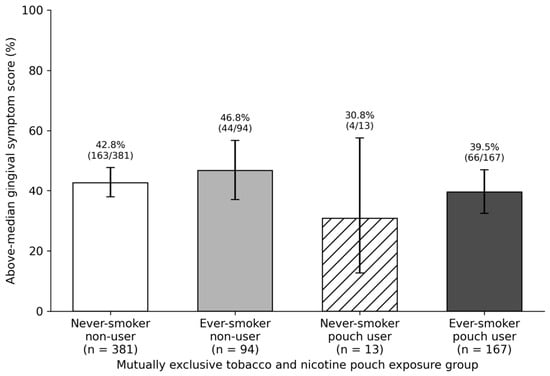
Nicotine pouch use was reported by 180 participants (27.5%). A single domestic brand accounted for 96.7% of use, and 134 users (74.4%) used 10 mg pouches. Daily consumption was one to five sachets in 63 users (35.0%), six to ten in 75 (41.7%), eleven to fifteen in 33 (18.3%) and more than fifteen in 9 (5.0%). The median derived daily nicotine load was 80 mg/day (IQR 30–80); the median and upper quartiles coincide because 74.4% of users used 10 mg pouches and 41.7% consumed 6–10 sachets daily, so a single combination (10 mg × 8 sachets) accounts for the largest share of the distribution. Duration of use exceeded six months in 131 users (72.8%). Self-reported changes in smoking behaviour after pouch initiation are summarised in Table 2 and examined only as an exploratory outcome (Section 3.7). The distribution of the sample across the four mutually exclusive exposure groups is shown in Figure 1.
Table 2.
Tobacco use and nicotine pouch consumption patterns.
Figure 1.
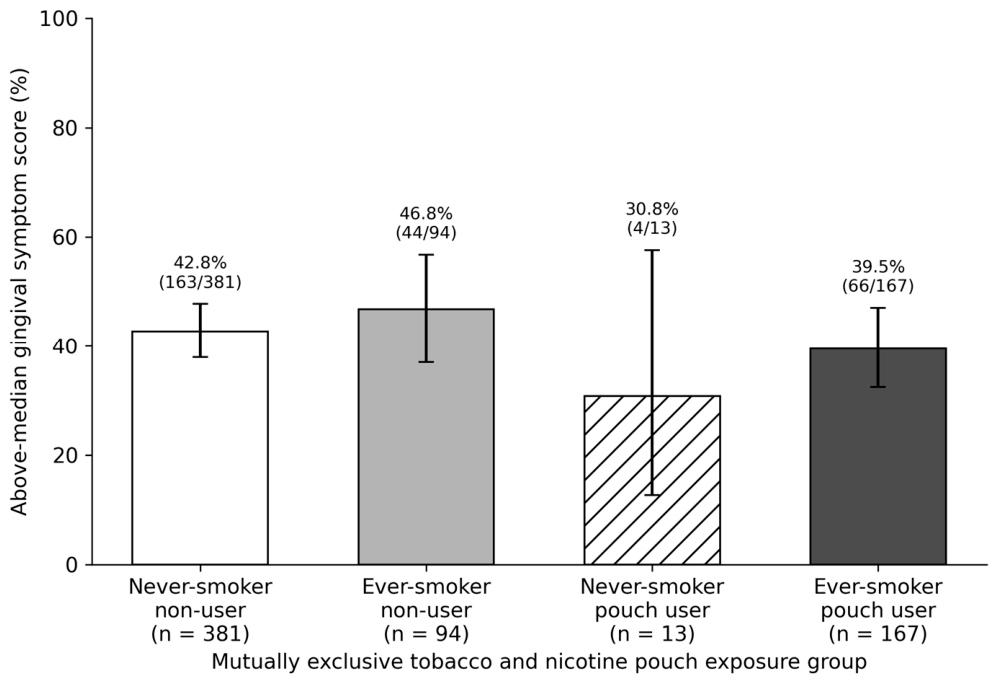
Prevalence of an above-median self-reported gingival symptom score across the four mutually exclusive tobacco and nicotine pouch exposure groups (n = 655). Bars show the proportion scoring at or above the sample median on the screening scale; error bars are Wilson 95% confidence intervals; counts are events/participants. Ever-smokers include current and former smokers of any tobacco product.
3.3. Primary Analysis I: Nicotine Pouch Use Status and Self-Reported Gingival Symptom Burden in the Full Sample
An above-median self-reported gingival symptom score was present in 42.8% of never-smoking non-users, 46.8% of ever-smoking non-users, 30.8% of never-smoking pouch users and 39.5% of ever-smoking pouch users (Figure 1). In the adjusted model (n = 648), no exposure category differed significantly from the reference category; ever-smoking pouch users had an adjusted odds ratio of 1.06 (95% CI 0.67–1.69; p = 0.806). The independent predictors of the outcome in this model were regular exercise (aOR 0.51, 95% CI 0.35–0.74; p < 0.001) and chronic disease count (aOR 1.57 per additional condition, 95% CI 1.20–2.05; p = 0.001). The estimate for never-smoking pouch users rests on 13 participants with four events and is correspondingly imprecise. Model calibration was adequate (Hosmer–Lemeshow p = 0.453) and discrimination modest (AUC 0.637) (Table 3).
Table 3.
Multivariable model for an above-median self-reported gingival symptom score in the full sample (n = 648).
The contrast of direct interest, pouch use versus non-use, was also estimated within smoking strata. Among never-smokers it gave an adjusted odds ratio of 0.47 (95% CI 0.12–1.90; p = 0.290; 4 of 13 users versus 163 of 381 non-users), and among ever-smokers 1.17 (95% CI 0.60–2.25; p = 0.646; 66 of 167 versus 44 of 94). The two estimates did not differ significantly (interaction odds ratio 1.58, 95% CI 0.37–6.74; likelihood-ratio χ2 = 0.40 on one degree of freedom, p = 0.528), so there was no evidence that the association of pouch use with the outcome depends on smoking history, although the never-smoking stratum contains only four events and the interaction test has correspondingly low power.
3.4. Primary Analysis II: Dependence Severity and Self-Reported Gingival Symptom Burden Among Pouch Users
On the continuous screening score, linear regression adjusted for age and current cigarette smoking gave 1.63 additional points per dependence stratum (95% CI 0.88–2.37; p < 0.001); because the residuals departed from normality, this estimate was confirmed by bootstrap resampling (5000 replicates; 95% CI 0.85–2.45). The proportional-odds model applied to the three-level gingival classification gave an odds ratio of 2.33 (95% CI 1.55–3.49; p < 0.001); the parallel-line assumption was not rejected (stratum-specific coefficients 0.89 and 0.85; p = 0.94).
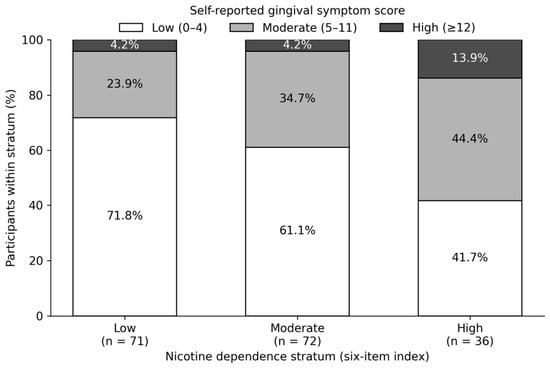
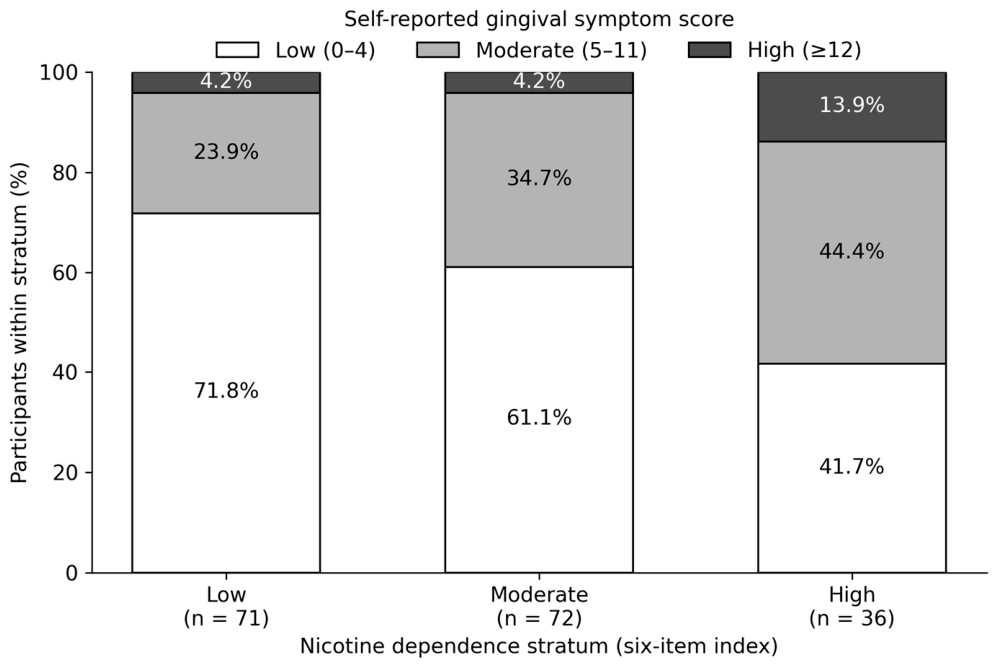
Among 179 users with complete data, the prevalence of an above-median self-reported gingival symptom score increased monotonically across dependence strata: 28.2% (95% CI 17.7–38.6) at low dependence (n = 71), 38.9% (95% CI 27.6–50.1) at moderate dependence (n = 72) and 58.3% (95% CI 42.2–74.4) at high dependence (n = 36). The ordinal association was significant (Kendall τ-b = 0.186, p = 0.002) (Figure 2). Analyses requiring adjustment for age were restricted to the 179 users with complete age data; unadjusted correlations and descriptive comparisons (Section 3.6) use all 180 users, so the high-dependence stratum comprises 36 users in Table 4 and 37 in the descriptive comparisons of Section 3.6.
Figure 2.
Distribution of self-reported gingival symptom burden within nicotine dependence strata among pouch users (n = 179). Self-reported gingival symptom burden was classified from the screening scale as low (0–4), moderate (5–11) or high (≥12). As dependence increases, the low-risk segment contracts and the moderate- and high-risk segments expand (Kendall τ-b = 0.186, p = 0.002). Percentages may not sum to 100% because of rounding.
Table 4.
Nicotine dependence severity and an above-median self-reported gingival symptom score among pouch users (n = 179).
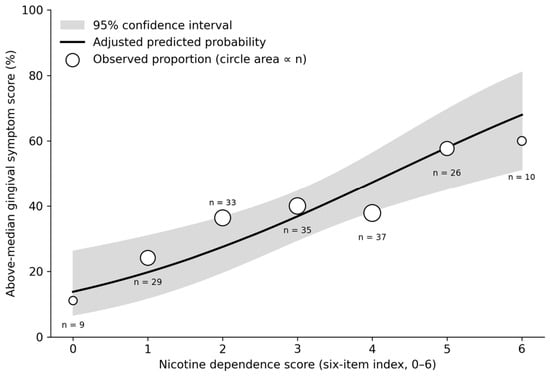
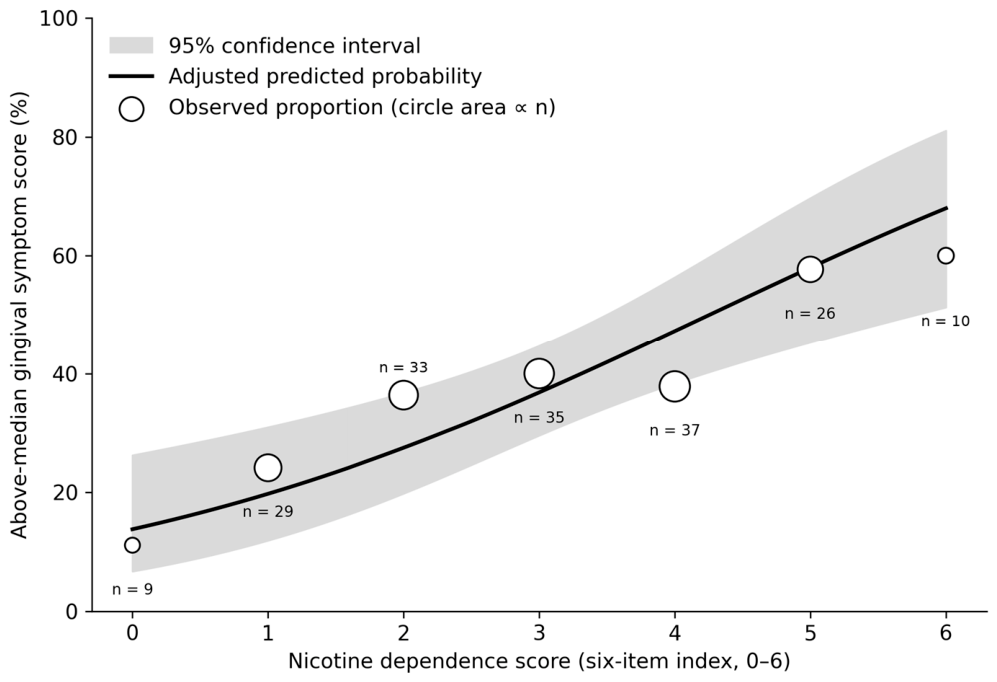
After adjustment for age and current cigarette smoking, the odds of an above-median self-reported gingival symptom score were 2.51 times higher at moderate dependence (95% CI 1.14–5.53; p = 0.022) and 5.86 times higher at high dependence (95% CI 2.30–14.96; p < 0.001) relative to low dependence. The per-category trend estimate was 2.43 (95% CI 1.52–3.87; p < 0.001), and the continuous index yielded 1.54 per point (95% CI 1.23–1.93; p < 0.001). Calibration was excellent (Hosmer–Lemeshow p = 0.736), discrimination was 0.696, and the events-per-variable ratio was 23.0 (69 events, three covariates); the study had 96% power at α = 0.05 for the observed trend estimate (Table 4, Figure 3).
Figure 3.
Predicted probability of an above-median self-reported gingival symptom score across the continuous nicotine dependence score (n = 179). The solid line shows probabilities predicted by a logistic model adjusted for age and current cigarette smoking, evaluated at sample mean covariate values; the shaded band is the 95% confidence interval. Circles show observed proportions at each score, sized in proportion to the number of participants.
Measured confounders in this subsample were distributed against the observed association: users in the high-dependence stratum were less frequently current smokers than those in the low-dependence stratum (27.8% versus 46.5%) and were younger (median 31 versus 35 years). Users in the high-dependence stratum were, however, slightly more likely to have ever used conventional cigarettes (67.6% versus 56.3%) or vaping devices (40.5% versus 26.8%), and this was examined in the additional sensitivity analyses (Section 3.5).
3.5. Sensitivity Analyses
The dependence gradient was consistent across all seven planned sensitivity analyses and the three additional analyses of tobacco history (Table 5). Trend estimates ranged from 2.10 (95% CI 1.33–3.33) to 2.65 (95% CI 1.62–4.34), and no analysis reduced the lower confidence bound below 1.22. Applying a stricter outcome threshold (score ≥ 7) gave 2.50 (95% CI 1.52–4.13; p < 0.001). The eleven-item version of the screening scale, which additionally counts loss of permanent teeth, classified 629 of 655 participants (96.0%) identically to the validated ten-item version and gave a trend estimate of 2.10 (95% CI 1.33–3.33; p = 0.002); the slightly attenuated estimate is consistent with the addition of a sign that is not specific to gingival inflammation. Excluding the saliva-swallowing item, which had the lowest corrected item–total correlation, raised the internal consistency of the dependence index from α = 0.580 to α = 0.625 and left the gradient essentially unchanged (S5: 1.54 per point, 95% CI 1.22–1.95; p < 0.001), indicating that the association does not depend on the weakest component of the index. Replacing the binary current-smoking covariate with four-level smoking status (S8) gave a trend estimate of 2.53 (95% CI 1.57–4.07); further adding ever-use of each tobacco product type as separate indicators (S9) gave 2.54 (95% CI 1.57–4.10), with no product type independently associated with the outcome (adjusted odds ratios 0.74–1.85, all p > 0.29); and restricting the analysis to ever-smoking users (S10, n = 167) gave 2.65 (95% CI 1.62–4.34). On the continuous score, the S9 covariate set gave 1.72 points per stratum (95% CI 0.98–2.47). Fuller adjustment for tobacco history therefore did not attenuate the gradient. The gradient was also positive in every subgroup examined, with trend estimates from 1.95 to 3.35 across twelve specifications (Table S5), and the Mantel–Haenszel test for linear trend gave a χ2 of 8.85 on one degree of freedom (p = 0.003).
Table 5.
Sensitivity analyses for the association between dependence severity and self-reported gingival symptom burden.
Because the outcome was common rather than rare, the E-value was computed on the risk-ratio scale for the high- versus low-dependence comparison following conversion of the odds ratio to an approximate risk ratio using the reference-group prevalence (28.2%); this gave an E-value of 4.38 for the point estimate and 2.76 for the limit of the confidence interval closest to the null.
3.6. Secondary Analyses: Intensity of Consumption and Individual Gingival Signs
Among the consumption metrics examined (Table 6), product nicotine strength was associated with the gingival score (Kendall τ-b = 0.148, p = 0.016) and cumulative daily nicotine load showed a borderline association (aOR 1.07 per 10 mg/day, 95% CI 1.00–1.16; p = 0.057; τ-b = 0.106, p = 0.062). Daily sachet count considered alone was not associated (τ-b = 0.065, p = 0.279), nor was duration of use (τ-b = −0.011, p = 0.848). Swallowing saliva during use was associated with an above-median self-reported gingival symptom score (42.2% versus 28.9%; τ-b = 0.144, p = 0.025).
Table 6.
Consumption metrics and individual self-reported gingival signs across dependence strata among pouch users (n = 180; low dependence n = 71, moderate n = 72, high n = 37).
Examined individually (Table 6), self-reported gingival recession showed the steepest gradient across dependence strata (12.7%, 23.6% and 45.9%; τ-b = 0.259, p < 0.001), followed by change in the appearance of a tooth (5.6%, 13.9% and 27.0%; τ-b = 0.214, p = 0.003) and spontaneous tooth mobility (15.5%, 30.6% and 32.4%; τ-b = 0.159, p = 0.025). Self-reported gingival bleeding did not increase significantly across strata (35.2%, 36.1% and 48.6%; τ-b = 0.082, p = 0.247), nor did the global self-rating of oral health (τ-b = 0.061, p = 0.389). Ten signs were examined; the gradients for recession and for change in tooth appearance remained significant after Bonferroni correction (α = 0.005), whereas those for tooth mobility did not.
3.7. Exploratory Analyses
Full results of the exploratory analyses are provided in the Supplementary Materials (Tables S1–S3) and are summarised here. Recognised systemic effects of nicotine increased across dependence strata: palpitations (15.5%, 20.8% and 45.9%; τ-b = 0.223, p = 0.002), sleep disturbance (12.7%, 34.7% and 29.7%; τ-b = 0.181, p = 0.010) and mouth ulcers (11.3%, 12.5% and 29.7%; τ-b = 0.151, p = 0.033) (Table S1). Among users, mouth ulcers were associated with an above-median self-reported gingival symptom score (60.7% versus 28.3%; p = 0.002).
In the full sample, respiratory disease was independently associated with the outcome (aOR 2.23, 95% CI 1.14–4.35; p = 0.019), with borderline associations for hypertension (aOR 1.65, 95% CI 0.98–2.77; p = 0.057) and arthritis (aOR 2.21, 95% CI 0.92–5.29; p = 0.075); diabetes mellitus was not associated (aOR 1.15, 95% CI 0.67–1.96; p = 0.612) (Table S2). The prevalence of an above-median self-reported gingival symptom score increased with the number of chronic conditions (Kendall τ-b = 0.129, p < 0.001; aOR 1.56 per additional condition, 95% CI 1.20–2.04). Neither self-reported obesity nor obesity defined by body mass index was associated with the outcome, and chronic disease did not modify the dependence gradient (interaction p = 0.489).
Among the 167 users who had ever smoked, the proportion self-reporting complete cessation of smoking after pouch initiation was 44.1%, 60.0% and 67.6% in the low, moderate and high dependence strata respectively (τ-b = 0.180, p = 0.014) (Table S3); these self-reports were not biochemically verified. Pouch users were considerably more likely than non-users to regard nicotine replacement products as healthy (37.8% versus 5.3%; χ2 = 110.6, p < 0.001).
4. Discussion
In this cross-sectional study of 655 adults in Saudi Arabia, nicotine pouch use status was not associated with self-reported gingival symptom burden in the full sample, whereas among users dependence severity showed a graded association with the outcome. Self-reported gingival symptom burden among pouch users was therefore related to the intensity of consumption rather than to use status. Because the outcome was ascertained by questionnaire, the findings describe an association with self-perceived gingival signs and symptoms and are interpreted in those terms throughout.
The dependence gradient was reproduced across five analytic specifications and remained consistent across ten sensitivity analyses, including three that adjusted for smoking status, former smoking and use of other tobacco products. Because 93% of users had ever smoked, cumulative tobacco exposure was the most important measured alternative explanation; fuller adjustment for it did not attenuate the estimate. Because the outcome was common rather than rare in this sample, the odds ratio for the high- versus low-dependence comparison was converted to an approximate risk ratio before computing the E-value, giving a value of 4.38. This indicates that an unmeasured confounder would need to be associated with both dependence severity and the outcome at risk ratios of approximately 4.4 to account for the finding. Oral hygiene practices and dental attendance, which were not measured, are the most plausible candidates, and their influence cannot be quantified from these data. The measured confounders were distributed in the direction of the null, since users in the high-dependence stratum were younger and less frequently current smokers than those in the low-dependence stratum. These features do not establish causality in a cross-sectional design, but they narrow the range of alternative explanations. This caution is shared by a recent critical review of oral health outcomes across non-combustible nicotine products, which identified 52 human studies but concluded that risks remain poorly established, citing heterogeneity of design and the confounding inherent in cross-sectional data as the principal barriers to inference [26].
A graded association in cross-sectional data does not establish temporality. Reverse causation, whereby users who notice gingival symptoms modify their pattern of use or their reporting, and differential reporting by more dependent users are alternative explanations, and the consistency of the gradient across specifications does not discriminate between them and a causal effect; clinical measurement and longitudinal follow-up are required to do so.
The distribution of self-reported gingival signs across dependence strata is nonetheless informative. Self-reported gingival recession showed the steepest gradient, and recession is the lesion most consistently documented in the emerging clinical literature on nicotine pouches. In two recently reported cases, localised buccal recession—accompanied in one instance by leukoplakia—corresponded precisely to the sites of habitual pouch placement in young men using pouches daily for 11 and 18 months, with generalised periodontal disease, occlusal trauma and aggressive brushing excluded on clinical and radiographic assessment [27]. Similar site-specific mucosal changes have been described in a case series of pouch users [18] and in the older literature on smokeless tobacco [16]. The mechanism proposed in those reports is repeated localised mechanical and chemical insult at the placement site rather than a systemic effect of nicotine; in vitro work supports a local chemical contribution, since pouch extracts and their flavouring constituents are cytotoxic to human gingival fibroblasts and oral epithelial cells [7,28]. Our finding is compatible with that interpretation: participants with higher dependence scores consume more pouches for longer periods each day, and therefore sustain more prolonged contact between the pouch and a limited area of gingiva. We did not record placement site or whether users rotated placement, and this is an important gap, since the case literature suggests that rotation may be protective. Nicotine may also act systemically on gingival vasculature and host response; self-reported data cannot distinguish local from systemic effects, and the recession signal is compatible with either. A counterweight to this interpretation should be noted: in a six-week study in which 60 regular snus users substituted tobacco-free nicotine pouches for snus, pre-existing oral mucosal lesions regressed rather than worsened [29]. Displacement of a tobacco-based product may therefore improve mucosal outcomes even where sustained single-site exposure to a tobacco-free product carries its own local risk, and these two observations are not contradictory.
Self-reported gingival bleeding, by contrast, showed no gradient across dependence strata. This warrants cautious interpretation. Reduced bleeding on probing among tobacco users, despite equal or greater underlying tissue destruction, is a well-described clinical observation, and it is recognised that this may mask the sign most commonly relied upon to detect gingival inflammation [8,9,30]. The mechanism has traditionally been attributed to nicotine-mediated vasoconstriction of the gingival microvasculature, although the human evidence for that specific mechanism remains inconclusive, and alternative explanations, including increased epithelial thickness and altered vascular density, have been proposed. Our data cannot distinguish between these possibilities, and the absence of a bleeding gradient may equally reflect limited sensitivity of a single self-reported item. What the pattern suggests, and what merits testing with clinical measurement, is that bleeding alone may be an insufficient screening sign in this population.
The pattern across consumption metrics is compatible with a dose-related process. Product nicotine strength was associated with the gingival score and cumulative daily nicotine load showed a borderline association, whereas daily sachet count considered alone was not. Concentration at the site of mucosal contact, rather than the number of exposure episodes, may therefore be the more relevant dimension, although the load metric is derived from category midpoints and these comparisons were secondary. Controlled pharmacological data support the plausibility of a strength gradient: in a crossover study a 30 mg pouch delivered higher peak plasma nicotine than a cigarette and produced the strongest side-effect profile, and every pouch tested induced mouth irritation [31]. Almost three-quarters of users in the present sample used 10 mg pouches, so the range of strengths available for comparison was narrow and the corresponding estimate imprecise. The association between swallowing saliva during use and the outcome is consistent with prolonged mucosal contact, but this item performed poorly within the dependence index and the finding should be regarded as hypothesis-generating.
Duration of use showed no association. One interpretation is a healthy-user effect, whereby individuals who experience early oral symptoms discontinue, leaving long-duration users enriched for tolerance. An alternative and equally plausible interpretation is that self-reported duration is a poor proxy for cumulative exposure when daily intensity varies widely. The older smokeless tobacco literature points the same way: severity of mucosal change was governed more by the daily amount consumed and hours of daily exposure than by years of the habit [16]. Longitudinal data are required to distinguish these interpretations.
The graded increases in palpitations, sleep disturbance and mouth ulcers across dependence strata are consistent with the index capturing variation in nicotine exposure, since these are recognised pharmacological effects of nicotine measured independently of the gingival outcome, and this is relevant given the modest internal consistency of the index. Because symptoms and gingival signs were both self-reported, this support is indirect. The parallel gradient in mouth ulcers offers an additional line of evidence, being an oral outcome assessed outside the gingival instrument.
Beyond exposure-specific findings, chronic morbidity burden was independently associated with the outcome, with each additional condition raising the odds by 56%. Respiratory disease was independently associated, with borderline associations for hypertension and arthritis. Diabetes mellitus was not associated, despite the well-documented bidirectional relationship between diabetes and periodontal disease [32,33]. Two explanations are plausible. Diabetes was ascertained by self-report, and undiagnosed diabetes is common in this population, so non-differential misclassification would attenuate the association towards the null. In addition, the outcome instrument captures self-perceived gingival signs and symptoms rather than established periodontitis, for which the association with diabetes is strongest. The inverse association of regular exercise, which approximately halved the odds of the outcome, is consistent with existing evidence and is plausibly mediated through reductions in circulating pro-inflammatory cytokines and improved glycaemic control [34,35], although reverse causation and residual confounding by general health behaviour cannot be excluded in this design.
More than half of users reported having stopped smoking after initiating pouches, and the proportion reporting cessation was higher at greater dependence. These are unverified self-reports from a study not designed to assess cessation, and they do not constitute evidence of effectiveness. A Cochrane review identified only four small randomised trials and concluded that it remains uncertain whether oral nicotine pouches help people stop smoking, with low-certainty evidence that they may be slightly less effective than nicotine e-cigarettes [36,37]. The relevance of the cessation data here is narrower: the users who reported having stopped smoking were also those in whom self-reported gingival symptom burden was highest, which suggests that counselling about pouches should address intensity of use rather than offering undifferentiated reassurance about product safety. The observation that pouch users were considerably more likely than non-users to regard nicotine replacement products as healthy is consistent with that concern.
Limitations
Five limitations bear on the interpretation of these findings, each with a corresponding safeguard in the design or analysis. First, gingival status was assessed by a self-report screening instrument rather than by clinical examination, so no data on bleeding on probing, probing depth, clinical attachment level, plaque or radiographic bone loss are available, and the findings relating to recession and bleeding in particular require clinical confirmation. The instrument was, however, developed and validated in the same population and showed good internal consistency in the present sample. The instrument has no clinically validated diagnostic threshold, so the dichotomous outcome is defined by the sample median and is described as an above-median symptom score rather than as disease or as elevated risk; the median was chosen because the score was bounded, right-skewed and non-normal (Shapiro–Wilk and Kolmogorov–Smirnov p < 0.001), which makes the median the appropriate location statistic, and the analyses on the continuous score, which require no threshold, were given precedence and yielded the same conclusion, as did the stricter threshold examined in sensitivity analysis. Second, the cross-sectional design precludes causal inference: temporality cannot be established, reverse causation and differential reporting cannot be excluded, and because the dependence analysis is restricted to a subgroup defined by the exposure itself, conditioning on use status can in principle induce selection (collider) bias; the gradient therefore requires confirmation in longitudinal designs with clinical assessment. One form of bias cannot be bounded by these data: because the exposure and the outcome were reported by the same participant in the same questionnaire, participants who use pouches more heavily may also be more attentive to, or more willing to disclose, oral symptoms. Unlike measurement error in the dependence index, differential reporting of this kind would inflate rather than attenuate the gradient, and nothing in the present design distinguishes it from a true association. Two considerations bear on the direction of other potential biases. The modest internal consistency of the dependence index (α = 0.580) implies non-differential measurement error in the exposure, which attenuates rather than generates a gradient; the magnitude of any selection (collider) bias arising from restriction to users is bounded by the association between pouch use and the outcome, which was null both crudely (38.9% versus 43.6%; χ2 p = 0.319) and after adjustment (adjusted odds ratio 0.94, 95% CI 0.61–1.44). Against this, the gradient was monotonic, was reproduced across ten sensitivity analyses, and was observed although the measured confounders were distributed towards the null. Third, pouch use overlapped almost completely with ever-smoking, and only 13 never-smoking users were included, so the full-sample analysis cannot separate the contribution of pouches from that of tobacco; within users, adjustment for smoking status, former smoking and other tobacco products did not attenuate the dependence gradient, although pack-years and lifetime cigarette consumption were not recorded. Residual confounding by oral hygiene practices, frequency of dental attendance and dietary patterns, none of which were measured, cannot be excluded; the E-value of 4.38 indicates the strength such confounding would need to reach. For comparison, the strongest measured confounders in this dataset reached 1.56 per additional chronic condition and 1.96 for absence of regular exercise, so an unmeasured confounder would have to be roughly twice as strong as any observed here. Fourth, the dependence index was adapted from instruments developed for smokeless tobacco, has not been validated in nicotine pouch users and showed modest internal consistency; its graded relationship with recognised pharmacological effects of nicotine, measured independently of the gingival outcome, nonetheless supports its use as an indicator of intensity. The nicotine-load metric relies on category midpoints and is therefore approximate, and placement site and rotation of placement were not recorded. Fifth, convenience sampling through online platforms, from which approximately 23% of the estimated recruitment-message reach resulted in a completed questionnaire, introduces selection bias, and the user subsample was 97.2% male and the sample overall 97.6% Saudi, so findings should not be generalised to women, older adults or non-Saudi residents. The sample nonetheless exceeded the calculated size requirement and reflects the dominant pattern of pouch use in the Kingdom, where a single domestic brand and a single nicotine strength predominate.
5. Conclusions
Among adults in Saudi Arabia, nicotine pouch use status was not associated with self-reported gingival symptom burden in the full sample. Among users, dependence severity showed a consistent graded association with self-reported gingival symptom burden, with users in the high-dependence stratum exhibiting nearly six times the adjusted odds of those in the low-dependence stratum, a gradient that persisted after adjustment for tobacco history, and with self-reported gingival recession the predominant sign. Higher self-reported gingival symptom burden was associated with greater dependence and intensity of use, whereas no association with pouch-use status was detected. These findings describe an association with self-reported gingival signs and symptoms rather than with clinically diagnosed periodontal disease; they are hypothesis-generating rather than established clinical facts, and confirmation of a causal effect requires clinical and longitudinal study.
If confirmed in studies with clinical periodontal assessment, these findings would imply that clinicians evaluating nicotine pouch users with gingival complaints should consider nicotine strength and dependence severity, and should examine specifically for recession rather than relying on bleeding, which nicotine may suppress; and that regulatory appraisal of these products should consider dependence potential as a risk dimension in its own right. Both implications are hypotheses arising from these data rather than established recommendations. Prospective studies incorporating clinical periodontal assessment, measurement of oral hygiene and dental attendance, detailed quantification of exposure and tobacco history, and adequate representation of never-smoking and female users are required to establish temporality and confirm causality.
Supplementary Materials
The following supporting information can be downloaded at https://www.mdpi.com/article/10.3390/hygiene6040075/s1: Table S1: Self-reported systemic symptoms across nicotine dependence strata among pouch users (n = 180; low dependence n = 71, moderate n = 72, high n = 37); Table S2: Chronic conditions and an above-median self-reported gingival symptom score (descriptive columns n = 655; adjusted models n = 648); Table S3: Self-reported change in smoking after nicotine pouch initiation, by dependence stratum (ever-smoking users, n = 167), and perceptions of nicotine replacement products (n = 655); Table S4: Distribution of the ten-item self-reported gingival disease screening score and the thresholds derived from it (n = 655); Table S5: Consistency of the dependence–gingival gradient across subgroups of pouch users (trend odds ratio per dependence stratum).
Author Contributions
Conceptualisation, N.A.A.A. and O.S.A.K.; methodology, N.A.A.A., N.S.H. and H.A.A.K.; software, N.A.A.A.; validation, A.A., A.M.A. and A.A.A.; formal analysis, N.A.A.A. and M.A.A.; investigation, S.A.A., M.Y.A. and A.E.M.A.; resources, A.M.A.A. and M.A.A.Y.; data curation, N.A.A.A. and S.A.A.; writing—original draft preparation, N.A.A.A.; writing—review and editing, all authors; visualisation, N.A.A.A.; supervision, F.A., N.S.H., H.A.A.K. and A.A.; project administration, N.A.A.A. and F.A. All authors have read and agreed to the published version of the manuscript.
Funding
This research received no external funding.
Institutional Review Board Statement
The study was conducted in accordance with the Declaration of Helsinki and approved by the Research Ethics Committee of the Armed Forces Hospital Southern Region, Saudi Arabia (approval number H-06-KM-001, 6 June 2026).
Informed Consent Statement
Informed consent was obtained electronically from all subjects involved in the study, who recorded their agreement on the opening page of the questionnaire before any data were collected. Participation was voluntary and anonymous.
Data Availability Statement
The de-identified dataset is available from the corresponding author (F.A.) on reasonable request, subject to a data-sharing agreement and, where required, approval from the institutional Research Ethics Committee. Requests should specify the intended analysis and the requesting institution.
Acknowledgments
The authors thank all participants who completed the questionnaire. During the preparation of this manuscript, the authors used ChatGPT (GPT-6, OpenAI) for the purposes of English language drafting and editing. The authors have reviewed and edited the output and take full responsibility for the content of this publication.
Conflicts of Interest
The authors declare no conflicts of interest.
Abbreviations
The following abbreviations are used in this manuscript:
| aOR | Adjusted odds ratio |
| AUC | Area under the receiver operating characteristic curve |
| BMI | Body mass index |
| CI | Confidence interval |
| IQR | Interquartile range |
| OR | Odds ratio |
| SAR | Saudi Riyal |
| STROBE | Strengthening the Reporting of Observational Studies in Epidemiology |
| WHO | World Health Organization |
References
- World Health Organization. WHO Report on the Global Tobacco Epidemic 2021: Addressing New and Emerging Products; World Health Organization: Geneva, Switzerland, 2021. [Google Scholar]
- Robichaud, M.O.; Seidenberg, A.B.; Byron, M.J. Tobacco companies introduce “tobacco-free” nicotine pouches. Tob. Control 2020, 29, e145–e146. [Google Scholar] [CrossRef] [Scilit] [PubMed]
- Tattan-Birch, H.; Jackson, S.E.; Dockrell, M.; Brown, J. Tobacco-free nicotine pouch use in Great Britain: A representative population survey 2020–2021. Nicotine Tob. Res. 2022, 24, 1509–1512. [Google Scholar] [CrossRef] [Scilit] [PubMed]
- Lunell, E.; Fagerström, K.; Hughes, J.; Pendrill, R. Pharmacokinetic comparison of a novel non-tobacco-based nicotine pouch (ZYN) with conventional, tobacco-based Swedish snus and American moist snuff. Nicotine Tob. Res. 2020, 22, 1757–1763. [Google Scholar] [CrossRef] [Scilit] [PubMed]
- Mallock, N.; Schulz, T.; Malke, S.; Dreiack, N.; Laux, P.; Luch, A. Levels of nicotine and tobacco-specific nitrosamines in oral nicotine pouches. Tob. Control 2024, 33, 193–199. [Google Scholar] [CrossRef] [Scilit] [PubMed]
- Azzopardi, D.; Liu, C.; Murphy, J. Chemical characterization of tobacco-free “modern” oral nicotine pouches and their position on the toxicant and risk continuums. Drug Chem. Toxicol. 2022, 45, 2246–2254. [Google Scholar] [CrossRef] [Scilit] [PubMed]
- Rinaldi, S.; Pieper, E.; Schulz, T.; Zimmermann, R.; Luch, A.; Laux, P.; Mallock-Ohnesorg, N. Oral nicotine pouches with an aftertaste? Part 2: In vitro toxicity in human gingival fibroblasts. Arch. Toxicol. 2023, 97, 2343–2356. [Google Scholar] [CrossRef] [Scilit] [PubMed]
- Johnson, G.K.; Guthmiller, J.M. The impact of cigarette smoking on periodontal disease and treatment. Periodontology 2000 2007, 44, 178–194. [Google Scholar] [CrossRef] [Scilit] [PubMed]
- Palmer, R.M.; Wilson, R.F.; Hasan, A.S.; Scott, D.A. Mechanisms of action of environmental factors—Tobacco smoking. J. Clin. Periodontol. 2005, 32, 180–195. [Google Scholar] [CrossRef] [Scilit] [PubMed]
- Nociti, F.H., Jr.; Casati, M.Z.; Duarte, P.M. Current perspective of the impact of smoking on the progression and treatment of periodontitis. Periodontology 2000 2015, 67, 187–210. [Google Scholar] [CrossRef] [Scilit] [PubMed]
- Trombelli, L.; Farina, R.; Silva, C.O.; Tatakis, D.N. Plaque-induced gingivitis: Case definition and diagnostic considerations. J. Clin. Periodontol. 2018, 45, S44–S67. [Google Scholar] [CrossRef] [Scilit] [PubMed]
- World Health Organization. Global Oral Health Status Report: Towards Universal Health Coverage for Oral Health by 2030; World Health Organization: Geneva, Switzerland, 2022. [Google Scholar]
- Tomar, S.L.; Asma, S. Smoking-attributable periodontitis in the United States: Findings from NHANES III. J. Periodontol. 2000, 71, 743–751. [Google Scholar] [CrossRef] [Scilit] [PubMed]
- Bergström, J. Tobacco smoking and chronic destructive periodontal disease. Odontology 2004, 92, 1–8. [Google Scholar] [CrossRef] [Scilit] [PubMed]
- Warnakulasuriya, S.; Dietrich, T.; Bornstein, M.M.; Casals Peidró, E.; Preshaw, P.M.; Walter, C.; Wennström, J.L.; Bergström, J. Oral health risks of tobacco use and effects of cessation. Int. Dent. J. 2010, 60, 7–30. [Google Scholar] [CrossRef] [Scilit]
- Axéll, T.E. Oral mucosal changes related to smokeless tobacco usage: Research findings in Scandinavia. Eur. J. Cancer B Oral Oncol. 1993, 29B, 299–302. [Google Scholar] [CrossRef] [Scilit] [PubMed]
- Rolandsson, M.; Hellqvist, L.; Lindqvist, L.; Hugoson, A. Effects of snuff on the oral health status of adolescent males: A comparative study. Oral Health Prev. Dent. 2005, 3, 77–85. [Google Scholar] [CrossRef]
- Miluna-Meldere, S.; Vanka, S.A.; Skadins, I.; Kroica, J.; Sperga, M.; Rostoka, D. Oral mucosal changes caused by nicotine pouches: Case series. Diagn. Pathol. 2024, 19, 127, Correction in Diagn. Pathol. 2025, 20, 12. [Google Scholar] [CrossRef] [Scilit] [PubMed]
- Ye, D.; Rahman, I. Emerging oral nicotine products and periodontal diseases. Int. J. Dent. 2023, 2023, 9437475. [Google Scholar] [CrossRef] [Scilit] [PubMed]
- Rungraungrayabkul, D.; Gaewkhiew, P.; Vichayanrat, T.; Shrestha, B.; Buajeeb, W. What is the impact of nicotine pouches on oral health: A systematic review. BMC Oral Health 2024, 24, 889. [Google Scholar] [CrossRef] [Scilit] [PubMed]
- von Elm, E.; Altman, D.G.; Egger, M.; Pocock, S.J.; Gøtzsche, P.C.; Vandenbroucke, J.P. The Strengthening the Reporting of Observational Studies in Epidemiology (STROBE) statement: Guidelines for reporting observational studies. Lancet 2007, 370, 1453–1457. [Google Scholar] [CrossRef] [Scilit] [PubMed]
- Alawaji, Y.N.; Alqasoumi, M.H.; Alwatban, S.N.; Halwani, A.M.; Aljnoubi, L.A.; Alshehri, B.K.; Alenezi, M.K. Development and validation of a single latent variable self-reported periodontal disease scale based on the disease’s common signs and symptoms in Saudi adults. BMC Oral Health 2025, 25, 424, Erratum in BMC Oral Health 2025, 25, 787. [Google Scholar] [CrossRef] [Scilit] [PubMed]
- Boyle, R.G.; Jensen, J.; Hatsukami, D.K.; Severson, H.H. Measuring dependence in smokeless tobacco users. Addctv. Behav. 1995, 20, 443–450. [Google Scholar] [CrossRef] [Scilit] [PubMed]
- Hatsukami, D.K.; Lemmonds, C.; Zhang, Y.; Murphy, S.E.; Le, C.; Carmella, S.G.; Hecht, S.S. Evaluation of carcinogen exposure in people who used “reduced exposure” tobacco products. J. Natl. Cancer Inst. 2004, 96, 844–852. [Google Scholar] [CrossRef] [Scilit] [PubMed]
- VanderWeele, T.J.; Ding, P. Sensitivity analysis in observational research: Introducing the E-value. Ann. Intern. Med. 2017, 167, 268–274. [Google Scholar] [CrossRef] [Scilit] [PubMed]
- Scherer, G.; Pluym, N.; Scherer, M. Oral health risks in adults who use electronic nicotine delivery systems and oral nicotine pouches: A critical review of the literature and qualitative synthesis of the available evidence. Harm Reduct. J. 2024, 21, 229. [Google Scholar] [CrossRef] [Scilit] [PubMed]
- Alkhatib, O.A. Localized gingival recession and leukoplakia associated with nicotine pouch use: Two clinical case reports. BMC Oral Health 2025, 25, 2004. [Google Scholar] [CrossRef] [Scilit] [PubMed]
- Shaikh, S.B.; Tung, W.C.; Pang, C.; Lucas, J.; Li, D.; Rahman, I. Flavor classification/categorization and differential toxicity of oral nicotine pouches (ONPs) in oral gingival epithelial cells and bronchial epithelial cells. Toxics 2022, 10, 660. [Google Scholar] [CrossRef] [Scilit] [PubMed]
- Alizadehgharib, S.; Lehrkinder, A.; Alshabeeb, A.; Östberg, A.-K.; Lingström, P. The effect of a non-tobacco-based nicotine pouch on mucosal lesions caused by Swedish smokeless tobacco (snus). Eur. J. Oral Sci. 2022, 130, e12885. [Google Scholar] [CrossRef] [Scilit] [PubMed]
- Al-Bayaty, F.H.; Baharuddin, N.; Abdulla, M.A.; Ali, H.M.; Arkilla, M.B.; ALBayaty, M.F. The influence of cigarette smoking on gingival bleeding and serum concentrations of haptoglobin and alpha 1-antitrypsin. BioMed Res. Int. 2013, 2013, 684154. [Google Scholar] [CrossRef] [Scilit] [PubMed]
- Mallock-Ohnesorg, N.; Rabenstein, A.; Stoll, Y.; Gertzen, M.; Rieder, B.; Malke, S.; Burgmann, N.; Laux, P.; Pieper, E.; Schulz, T.; et al. Small pouches, but high nicotine doses—Nicotine delivery and acute effects after use of tobacco-free nicotine pouches. Front. Pharmacol. 2024, 15, 1392027. [Google Scholar] [CrossRef] [Scilit] [PubMed]
- Stöhr, J.; Barbaresko, J.; Neuenschwander, M.; Schlesinger, S. Bidirectional association between periodontal disease and diabetes mellitus: A systematic review and meta-analysis of cohort studies. Sci. Rep. 2021, 11, 13686. [Google Scholar] [CrossRef] [Scilit] [PubMed]
- Sanz, M.; Ceriello, A.; Buysschaert, M.; Chapple, I.; Demmer, R.T.; Graziani, F.; Herrera, D.; Jepsen, S.; Lione, L.; Madianos, P.; et al. Scientific evidence on the links between periodontal diseases and diabetes: Consensus report and guidelines of the joint workshop on periodontal diseases and diabetes. J. Clin. Periodontol. 2018, 45, 138–149. [Google Scholar] [CrossRef] [PubMed]
- Merchant, A.T.; Pitiphat, W.; Rimm, E.B.; Joshipura, K. Increased physical activity decreases periodontitis risk in men. Eur. J. Epidemiol. 2003, 18, 891–898. [Google Scholar] [CrossRef] [Scilit] [PubMed]
- Petersen, A.M.; Pedersen, B.K. The anti-inflammatory effect of exercise. J. Appl. Physiol. 2005, 98, 1154–1162. [Google Scholar] [CrossRef] [Scilit] [PubMed]
- Hartmann-Boyce, J.; Tattan-Birch, H.; Brown, J.; Shahab, L.; Goniewicz, M.L.; Ma, C.L.; Wu, A.D.; Travis, N.; Jarman, H.; Livingstone-Banks, J.; et al. Oral nicotine pouches for cessation or reduction of use of other tobacco or nicotine products. Cochrane Database Syst. Rev. 2025, 10, CD016220. [Google Scholar] [CrossRef] [Scilit] [PubMed]
- Patwardhan, S.; Fagerström, K. The new nicotine pouch category: A tobacco harm reduction tool? Nicotine Tob. Res. 2022, 24, 623–625. [Google Scholar] [CrossRef] [Scilit] [PubMed]

Disclaimer/Publisher’s Note: The statements, opinions and data contained in all publications are solely those of the individual author(s) and contributor(s) and not of MDPI and/or the editor(s). MDPI and/or the editor(s) disclaim responsibility for any injury to people or property resulting from any ideas, methods, instructions or products referred to in the content. |
© 2026 by the authors. Licensee MDPI, Basel, Switzerland. This article is an open access article distributed under the terms and conditions of the Creative Commons Attribution (CC BY) license.