


Abstract
Hand hygiene is a cornerstone of infection prevention, yet adherence often declines once public health emergencies subside. This study examines post-pandemic hand hygiene practices and knowledge among public health trainees. We conducted a cross-sectional study of graduate students (N = 93) at a U.S. School of Public Health between May and October 2025. Participants completed a self-administered questionnaire assessing knowledge, self-reported practices, and demographics, with associations analyzed using chi-square tests. Results indicated that while 65.6% of participants possessed good knowledge (mean score 6.92 ± 1.92), only 23.7% met the criteria for good hand hygiene practice. Knowledge level was not associated with practice (p = 0.631). In contrast, sex was strongly associated with behavior: 34.4% of females reported good practice compared with 3.1% of males (p = 0.0016). Furthermore, adherence in high-risk situations was low, with only 7% reporting handwashing after coughing or sneezing. In conclusion, hand hygiene knowledge did not translate into consistent preventive behavior among these trainees. The observed differences by sex suggest that post-pandemic interventions should prioritize behavioral and social determinants rather than relying on information-based strategies alone.
1. Introduction
Hand hygiene remains one of the most effective and low-cost interventions for preventing the transmission of infectious diseases across community and institutional settings. International guidelines consistently advocate for handwashing with soap and running water for at least 20 s, complemented by alcohol-based hand rubs (ABHR) when necessary [1]. Despite decades of public health messaging and renewed emphasis during the COVID-19 pandemic, adherence to recommended handwashing practices remains inconsistent, particularly outside clinical environments [2].
A well-documented phenomenon in behavioral science is the intention–behavior gap, wherein individuals possess accurate knowledge about health-promoting behaviors but fail to translate that awareness into consistent action [3,4]. This gap is especially salient in educational contexts, where formal training in disease prevention does not always result in the internalization of preventive behaviors as personal habits. Behavioral frameworks increasingly suggest that hygiene practices are shaped less by conscious knowledge than by habit, social norms, environmental cues, and motivation [5,6].
Traditional behavioral theories, such as the Theory of Planned Behavior, conceptualize intention as the most proximal determinant of behavior. However, this assumption often proves insufficient in explaining real-world behavior in contexts where individuals hold strong intentions yet demonstrate low behavioral adherence [7,8]. This limitation is particularly relevant among public health trainees, who are likely to possess high preventive intentions. In response to such gaps, more nuanced models have emerged, including Schwarzer’s Health Action Process Approach, which distinguishes between pre-intentional motivational processes and post-intentional volitional processes [9]. HAPA emphasizes constructs such as action self-efficacy, coping planning, and recovery self-efficacy, offering a useful framework for understanding how preventive behaviors such as hand hygiene are initiated, maintained, or abandoned over time [9].
Public health trainees represent a critical yet understudied population for examining this intention–behavior disconnect. As future practitioners, researchers, and policymakers, they are trained to advocate for evidence-based prevention strategies, including hand hygiene. Persistent gaps between professional knowledge and personal practice among public health trainees may influence the modeling of public health norms [10].
Existing studies among medical and nursing students consistently report high levels of hand hygiene knowledge alongside suboptimal compliance [11]. However, comparable research among public health trainees, who are less frequently embedded in clinical hygiene protocols but deeply engaged in population-level prevention, is scarce. Emerging evidence further suggests that demographic factors, particularly sex, may be stronger predictors of hygiene behavior than knowledge alone [12], yet these patterns remain underexplored in public health academic settings.
This study addresses these gaps by examining hand hygiene knowledge, self-reported practices, and their association with sex among graduate students at a U.S. School of Public Health in the early post-pandemic period (May–October 2025). While the knowledge–behavior gap has been documented among healthcare students, less is known about its persistence among public health trainees as acute crisis messaging recedes. Our study addresses this gap by examining behavioral sustainability in a population trained to design and evaluate public health interventions, offering insights for curriculum development and behavioral reinforcement strategies. We tested two hypotheses: (1) Hand hygiene knowledge is not significantly associated with self-reported practice, and (2) Female respondents report higher compliance than male respondents. By centering behavioral patterns rather than institutional compliance alone, this work contributes to the growing literature on the limitations of information-based public health education. It underscores the conclusion that gender-sensitive, habit-based interventions are needed even among those trained to promote preventive behaviors.
2. Materials and Methods
2.1. Study Design and Setting
We conducted a cross-sectional survey between May and October 2025 among graduate students at a U.S. School of Public Health in the Midwest. The study aimed to assess hand hygiene knowledge, self-reported practices, and demographic predictors in the post-pandemic period.
2.2. Sampling and Recruitment
Participants were recruited using convenience sampling via QR codes posted on high-traffic notice boards across campus. The anonymous online survey was administered through Qualtrics. During the six-month data collection period, an estimated 200–300 individuals passed these locations daily. Of 102 individuals who initiated the survey, 93 provided complete responses (completion rate: 91%) and were included in the final analysis. All participants were aged ≥ 18 years and affiliated with the school as graduate students. Differences between respondents and non-respondents could not be assessed due to the anonymous study design.
2.3. Survey Instrument
The questionnaire was adapted from a previously validated hand hygiene survey instrument [13]. It comprised four sections:
- Demographics: Age, sex, and prior COVID-19 infection.
- Hand hygiene knowledge: Eleven multiple-choice questions assessing knowledge of hand hygiene principles (score range: 0–11; one point per correct response).
- Self-reported hand hygiene practice: Frequency (times per day) and duration (seconds) of handwashing.
- Post-pandemic behavioral changes: Five items assessing perceived changes in hygiene practices since the COVID-19 pandemic.
2.4. Scoring and Categorization
Hand hygiene knowledge scores were categorized as “good” (≥7) or “not good” (<7), based on score distribution. Hand hygiene practice was classified as “good” if respondents reported washing their hands at least three times per day for ≥20 s; all other responses were categorized as “poor.” Hand hygiene practice was classified as “good” if respondents reported washing their hands at least three times per day for ≥20 s per episode; all other responses were categorized as “poor.” We recognize that WHO guidelines specify a total duration of 40–60 s for the complete handwashing procedure with soap and water, and 20–30 s for alcohol-based hand rub [6]. Our ≥20 s threshold was adopted as a pragmatic, conservative minimum aligned with widely disseminated public health messaging and to facilitate reliable self-reporting in a survey context. We acknowledge that this operational definition may not fully capture adherence to the complete WHO technique, and we note this as a limitation and a study-specific definition. Future studies should consider moment-specific, procedure-complete assessments aligned with the WHO’s full framework.
2.5. Data Analysis
Statistical analyses were conducted using RStudio (version 2024.12.1+563). Descriptive statistics, including frequencies and means with standard deviations, were used to summarize participant characteristics and outcome measures. Associations between categorical variables were evaluated using chi-square tests. Where expected cell frequencies were <5, Fisher’s exact test was applied instead. Effect sizes were estimated using Cramer’s V and interpreted as small (≥0.1), medium (≥0.3), or large (≥0.5). Differences in knowledge scores across participant roles were assessed using the Kruskal–Wallis test. Effect sizes were estimated using Cramer’s V and interpreted as small (≥0.1), medium (≥0.3), or large (≥0.5).
2.6. Ethical Considerations
The study was approved by the Washington University in St. Louis Institutional Review Board (IRB ID: 202504112). Electronic informed consent was obtained from all participants, with survey submission constituting consent. No external funding was received for this study.
2.7. Data Availability Statement
The data presented in this study are available on request from the corresponding author. The data are not publicly available due to privacy and ethical restrictions regarding human subject data.
2.8. Generative AI Statement
No generative artificial intelligence was used in the study design, data collection, analysis, or interpretation of the results.
3. Results
3.1. Participant Characteristics
A total of 93 participants completed the survey as shown in Table 1. and were included in the final analysis. The sample was predominantly female (65.6%, n = 61), with males comprising 34.4% (n = 32). Most participants were aged 25–35 years (66.7%, n = 62), followed by 18–24 years (28.0%, n = 26) and ≥36 years (5.4%, n = 5). All respondents were graduate students (and 55.9% (n = 52) reported a prior COVID-19 infection.
Table 1.
Participant characteristics (N = 93).
3.2. Hand Hygiene Knowledge and Practice
Participants demonstrated moderate-to-good knowledge of hand hygiene principles, with a mean knowledge score of 6.92 ± 1.92. Overall, 65.6% of respondents were classified as having good knowledge. Despite this, only 23.7% met criteria for good hand hygiene practice.
There was no statistically significant association between knowledge level and hand hygiene practice (χ2 = 1.73, p = 0.631), indicating that higher knowledge did not correspond to improved adherence.
3.3. Sex Differences in Hand Hygiene Practice
Hand hygiene practice differed substantially by sex. Good practice was reported by 34.4% of female participants compared with only 3.1% of male participants. This difference was statistically significant (χ2 = 9.97, p = 0.0016) and represented a moderate-to-large effect size (Cramer’s V = 0.36). In multivariable logistic regression adjusting for knowledge score, female sex remained strongly associated with good hand hygiene practice (aOR = 17.9 for Female vs. Male, 95% CI: 3.3–331, p = 0.007), while knowledge score was not significantly associated (aOR = 0.77 per 1-point increase, 95% CI: 0.56–1.04, p = 0.097) (Table 2).
Table 2.
Hand Hygiene Knowledge, Practice, and Association with Sex (N = 93).
3.4. Compliance in High-Risk Daily Activities
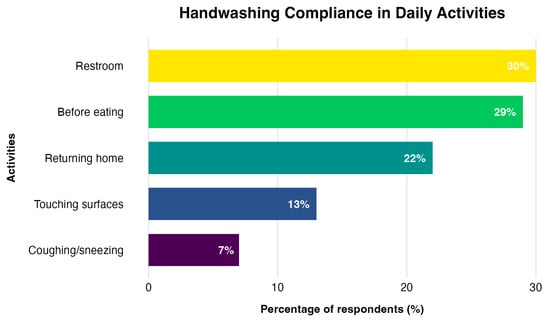
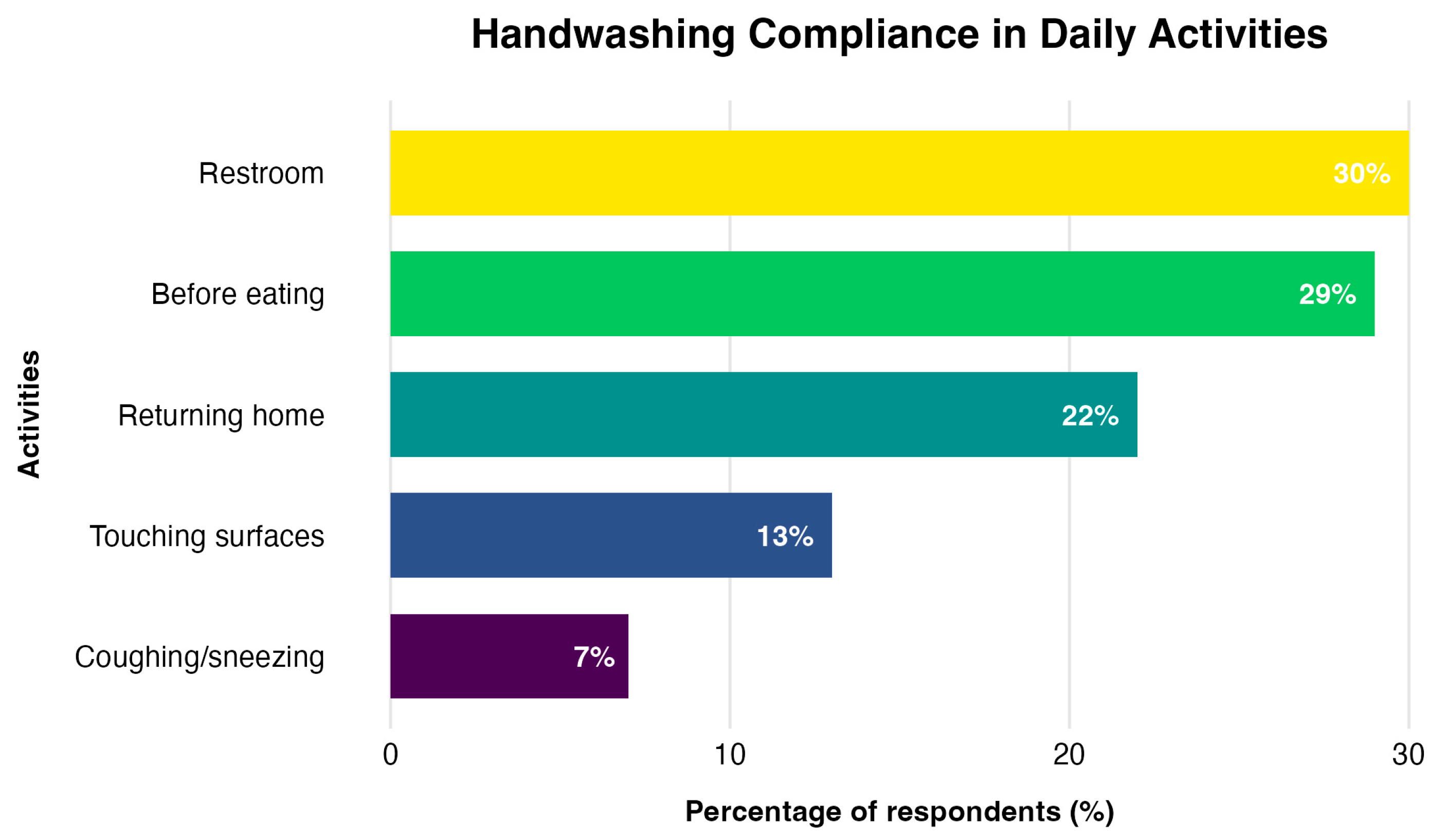
Self-reported compliance with hand hygiene in high-risk situations as shown in Figure 1 below was low across multiple scenarios. Only 7% of participants reported washing their hands after coughing or sneezing. Handwashing before eating was reported by 29% of respondents, while 30% reported washing their hands after using the restroom.
Figure 1.
Self-reported handwashing compliance in high-risk daily activities.
3.5. Post-Pandemic Behavioral Changes
Most participants reported changes in hygiene behavior following the COVID-19 pandemic shown in Table 3. Approximately 66.7% indicated increased handwashing frequency, while 62.4% reported being more cautious about hygiene practices. Additionally, 79.5% of respondents reported sometimes or frequently encouraging others to practice good hand hygiene.
Table 3.
Post-Pandemic Behavioral Changes (N = 93).
4. Discussion
This study demonstrates a substantial gap between hand hygiene knowledge and self-reported practice among public health trainees in the post-pandemic period. Although most participants demonstrated good theoretical understanding of hand hygiene principles, fewer than one-quarter met criteria for consistent handwashing behavior. The absence of a significant association between knowledge and practice reinforces a well-established finding in health behavior research: awareness alone is insufficient to produce sustained behavioral change [14,15,16]. These findings provide empirical support for the intention–behavior gap, which has been documented across a range of preventive health behaviors, including vaccination uptake, diet, and physical activity. While this gap is well-documented in clinical training settings, our findings extend the literature by demonstrating its persistence among public health trainees in the post-pandemic period. Unlike healthcare workers bound by institutional compliance protocols, this population relies on self-directed habit formation, making their behavioral trajectories particularly informative for post-crisis public health strategy. By centering on individuals formally educated in prevention yet demonstrating low adherence, our study underscores the need to integrate behavioral reinforcement and habit-building techniques directly into public health curricula.
Sex emerged as a key factor associated with behavioral differences in hand hygiene in this sample, with markedly higher compliance among female participants compared with males [17,18]. This difference was both statistically significant and substantial in magnitude. Similar patterns have been reported across diverse settings, with women consistently demonstrating higher engagement in preventive hygiene behaviors [19,20,21]. Proposed explanations include gendered socialization, differences in perceived susceptibility and severity of infection risk, and social norms related to caregiving and cleanliness. However, it remains unclear whether these differences reflect true behavioral variation or differential reporting influenced by social desirability bias [22]. Further research using objective measures of behavior is needed to clarify these mechanisms.
Notably, compliance dropped sharply in high-transmission contexts: only 7% of participants reported hand hygiene after coughing or sneezing. This may reflect pandemic fatigue, the decay of threat-driven motivation, and contextual barriers (e.g., limited immediate access to handwashing facilities in social or classroom settings). Even among individuals trained in infectious disease prevention, routine hygiene behaviors may not be fully internalized as automatic responses [23,24]. These results challenge the assumption that formal public health training translates directly into consistent personal preventive practices and underscore the need for context-specific behavioral nudges such as environmental cues or just-in-time reminders to sustain protective behaviors beyond acute crisis periods. Instead, they align with behavioral models that emphasize habit formation and automaticity over deliberate, knowledge-based decision-making [25,26,27].
The findings have important implications for public health education and training. Current curricula often emphasize cognitive mastery of prevention principles while placing less emphasis on strategies that promote durable behavior change. Approaches such as implementation intentions, contextual cueing, and repeated behavioral rehearsal may be necessary to bridge the gap between knowledge and routine practice [28,29]. Integrating behavioral science frameworks into public health training may enhance the translation of knowledge into sustained action. Additionally, the observed differences by sex suggest that hygiene promotion strategies should be tailored to account for demographic variation, rather than relying on uniform messaging [30,31].
Several limitations should be considered. First, hand hygiene practices were self-reported and may be subject to recall bias or social desirability bias, potentially leading to overestimation of adherence [32,33,34,35]. Second, the study was conducted at a single U.S. institution with a predominantly graduate student population, which may limit generalizability. The use of convenience sampling from a single academic institution limits the generalizability of findings to broader populations of public health trainees globally. While this design was appropriate for an initial exploratory assessment of post-pandemic behavioral sustainability, future multi-center, longitudinal studies are needed to validate these patterns across diverse educational, cultural, and resource contexts. Third, the cross-sectional design precludes causal inference regarding the relationships observed. Finally, objective measures of hand hygiene behavior, such as direct observation or electronic monitoring, were not available.
Despite these limitations, this study contributes to a growing body of evidence demonstrating that information-based approaches alone are insufficient to sustain preventive behaviors, even among individuals formally trained to promote them. By focusing on public health trainees, a population positioned to influence future professional norms, this work highlights the importance of behaviorally informed, habit-centered interventions. Strengthening the integration of behavioral science within public health education may be essential for embedding infection prevention practices as routine behavior rather than aspirational knowledge.
5. Conclusions
This study demonstrates a persistent gap between hand hygiene knowledge and consistent practice among public health trainees in the post-pandemic period. Although most participants possessed adequate theoretical understanding, adherence to recommended handwashing behaviors remained low, indicating that knowledge alone is insufficient to drive sustained preventive action. Notably, sex emerged as a key factor associated with behavioral differences, with female participants demonstrating significantly higher compliance than males, while knowledge showed no meaningful association with practice.
These findings highlight the limitations of traditional information-based approaches to infection prevention, even within populations formally trained in public health. To address this gap, public health education and institutional strategies should move beyond cognitive instruction and incorporate behaviorally informed approaches. Specifically, integrating habit formation techniques, implementation intentions, environmental cueing (e.g., strategic placement of hand hygiene facilities), and social norm reinforcement may improve adherence. Additionally, interventions should be tailored to account for demographic differences, including gender-related variations in risk perception and behavioral engagement.
At the policy level, embedding behavioral competence as a core component of public health training and accreditation may strengthen the translation of knowledge into routine practice. Future research should evaluate the effectiveness of such behaviorally informed interventions using longitudinal and experimental designs, as well as incorporate objective measures of hygiene behavior to better understand adherence patterns.
By focusing on a population poised to shape future public health practice, this study underscores the importance of aligning professional training with the behavioral realities of prevention. Promoting hand hygiene as a habitual and socially reinforced behavior, rather than a purely conceptual ideal, may be essential for sustaining infection prevention efforts beyond periods of public health crisis.
Author Contributions
Conceptualization, P.K.M. and N.T.; methodology, P.K.M.; formal analysis, P.K.M., G.Y.A.; investigation, P.K.M.; data curation, P.K.M.; writing—original draft preparation, P.K.M.; writing—review and editing, N.T., D.T., E.T., G.Y.A. and B.B.Y.; visualization, P.K.M.; supervision, N.T.; project administration, P.K.M. All authors have read and agreed to the published version of the manuscript.
Funding
This research received no external funding.
Institutional Review Board Statement
The study was conducted in accordance with the Declaration of Helsinki and approved by the Institutional Review Board of Washington University in St. Louis (protocol code 202504112 and date of approval: 24 April 2025).
Informed Consent Statement
Informed consent was obtained from all subjects involved in the study.
Data Availability Statement
The data that support the findings of this study are available from the corresponding author upon reasonable request. The data are not publicly available due to privacy and ethical restrictions.
Acknowledgments
The authors would like to thank the students and staff of the Bursky School of Public Health who participated in this study. We also acknowledge the support of the Washington University in St. Louis Institutional Review Board for their guidance and oversight.
Conflicts of Interest
The authors declare no conflicts of interest.
Abbreviations
The following abbreviations are used in this manuscript:
| Abbreviation | Meaning |
| ABHR | Alcohol-Based Hand Rub |
| COVID-19 | Coronavirus Disease 2019 |
| HAPA | Health Action Process Approach |
| IRB | Institutional Review Board |
References
- MacLeod, C.; Braun, L.; Caruso, B.A.; Chase, C.; Chidziwisano, K.; Chipungu, J.; Dreibelbis, R.; Ejemot-Nwadiaro, R.; Gordon, B.; Mills, J.E.; et al. Recommendations for hand hygiene in community settings: A scoping review of current international guidelines. BMJ Open 2023, 13, e068887. [Google Scholar] [CrossRef] [Scilit]
- Alzyood, M.; Jackson, D.; Aveyard, H.; Brooke, J. COVID-19 reinforces the importance of handwashing. J. Clin. Nurs. 2020, 29, 2760–2761. [Google Scholar] [CrossRef] [Scilit]
- Conner, M.; Norman, P. Understanding the intention–behavior gap: The role of intention strength. Front. Psychol. 2022, 13, 923464. [Google Scholar] [CrossRef] [Scilit]
- Rhodes, R.E.; Yao, C.A. Models accounting for intention–behavior discordance in the physical activity domain: A user’s guide and review. Int. J. Behav. Nutr. Phys. Act. 2015, 12, 9. [Google Scholar] [CrossRef] [Scilit]
- Curtis, V.A.; Danquah, L.O.; Aunger, R.V. Planned, motivated and habitual hygiene behaviour: An eleven country review. Health Educ. Res. 2009, 24, 655–673. [Google Scholar] [CrossRef] [Scilit] [PubMed]
- World Health Organization. Behavioural considerations. In WHO Guidelines on Hand Hygiene in Health Care; WHO: Geneva, Switzerland, 2009. [Google Scholar]
- Epton, T.; Norman, P.; Sheeran, P.; Harris, P.R.; Webb, T.L.; Ciravegna, F.; Brennan, A.; Meier, P.; Julious, S.A.; Naughton, D.; et al. A theory-based online health behavior intervention for new university students: Study protocol. BMC Public Health 2013, 13, 107. [Google Scholar] [CrossRef] [Scilit] [PubMed]
- Godin, G.; Bélanger-Gravel, A.; Eccles, M.; Grimshaw, J. Healthcare professionals’ intentions and behaviours: A systematic review. Implement. Sci. 2008, 3, 36. [Google Scholar] [CrossRef] [Scilit]
- Liao, Y.K.; Liu, Y.-Y.; Wu, W.-Y.; Chi, H.-K.; Huang, K.-C.; Vuong, B.-H. Synthesizing comprehensive models for health behavior studies: Connecting dots and revealing links on health enhancement through a meta-analysis approach. Front. Psychol. 2025, 16, 1518834. [Google Scholar] [CrossRef] [Scilit]
- Bashkin, O.; Otok, R.; Kapra, O.; Czabanowska, K.; Barach, P.; Baron-Epel, O.; Dopelt, K.; Duplaga, M.; Leighton, L.; Levine, H.; et al. Identifying gaps between public health training and practice. Int. J. Public Health 2022, 67, 1605303. [Google Scholar] [CrossRef] [Scilit]
- Nawab, T.; Mehnaz, S.; Abedi, A.J.; Safwi, S.R.; Khalique, N.; Ansari, M.A.; Khan, Z. Knowledge, attitude and practices of hand hygiene among medical and nursing students in a tertiary teaching hospital. Int. J. Sci. Appl. Res. 2015, 2, 29–39. [Google Scholar]
- Dwipayanti, N.M.U.; Lubis, D.S.; Harjana, N.P.A. Public perception and hand hygiene behavior during COVID-19. Front. Public Health 2021, 9, 621800. [Google Scholar] [CrossRef] [Scilit] [PubMed]
- Mahdi, H.A.; Assaggaf, H.M.; Alfelali, M.; Ahmed, O.B.; Alsafi, R.; Shaban, R.Z.; Booy, R.; Rashid, H. Hand hygiene knowledge, perception, and practices. Int. J. Environ. Res. Public Health 2021, 18, 673. [Google Scholar] [CrossRef] [Scilit]
- Alves, R.F. The relationship between health knowledge and risk behaviours. Glob. Health Promot. 2024, 31, 36–44. [Google Scholar] [CrossRef] [Scilit]
- Hendel, K.R.; Vaughan, E.; Kirschmann, J.M.; Johnston, C.A. Moving beyond raising awareness: Addressing barriers. Am. J. Lifestyle Med. 2024, 18, 740–743. [Google Scholar] [CrossRef] [Scilit]
- Carrillo-González, A. The gap between health knowledge and action. In Health Promotion—From Knowledge to Action; IntechOpen: London, UK, 2025. [Google Scholar] [CrossRef] [Scilit]
- Judah, G.; Aunger, R.; Schmidt, W.P.; Michie, S.; Granger, S.; Curtis, V. Experimental pretesting of handwashing interventions. Am. J. Public Health 2009, 99, S405–S411. [Google Scholar] [CrossRef] [Scilit]
- Lhakhang, P.; Lippke, S.; Knoll, N.; Schwarzer, R. Evaluating motivational hand hygiene interventions. BMC Public Health 2015, 15, 79. [Google Scholar] [CrossRef] [Scilit]
- Kuandyk, U.; Omarova, A.; Delellis, N. Hygiene practices among schoolchildren. Front. Public Health 2025, 13, 1595672. [Google Scholar] [CrossRef] [Scilit]
- Singh, P.; Faisal, A.R.; Alam, M.M.; Saeed, A.; Haider, T.; Asif, H.M.A.; Rauniyar, J.; Rai, N.; Janjua, M.A.K.; Pasha, A.R. Personal hygiene practices among young adults. Cureus 2023, 15, e44308. [Google Scholar] [CrossRef] [Scilit]
- Eriksson, K.; Dickins, T.E.; Strimling, P. Global sex differences in hygiene norms. PLoS Glob. Public Health 2022, 2, e0000591. [Google Scholar] [CrossRef] [Scilit]
- Sjöström, O.; Holst, D. Validity of questionnaire surveys and social desirability bias. Acta Odontol. Scand. 2002, 60, 136–140. [Google Scholar] [CrossRef] [Scilit] [PubMed]
- Asare, A.; Enweronu-Laryea, C.C.; Newman, M.J. Hand hygiene practices in neonatal units. J. Infect. Dev. Ctries. 2009, 3, 352–356. [Google Scholar] [PubMed]
- Lam, B.C.C.; Lee, J.; Lau, Y.L. Hand hygiene in neonatal intensive care. Pediatrics 2004, 114, e565–e571. [Google Scholar] [CrossRef] [Scilit]
- Alyafei, A.; Easton-Carr, R. Health Belief Model of Behavior Change; StatPearls: Treasure Island, FL, USA, 2025. [Google Scholar]
- Schlaff, A.L. Behavior change in public health. AMA J. Eth. 2013, 15, 353–361. [Google Scholar]
- Lumen Learning. Changing Health Habits—Behavioral Change Models. Available online: https://courses.lumenlearning.com (accessed on 22 January 2026).
- Domitrovich, C.E.; Bradshaw, C.P.; Greenberg, M.T.; Embry, D.; Poduska, J.M.; Ialongo, N.S. Integrated models of school-based prevention. Psychol. Sch. 2010, 47, 71–88. [Google Scholar] [CrossRef] [Scilit]
- Domitrovich, C.E.; Bradshaw, C.P.; Poduska, J.M.; Hoagwood, K.; Buckley, J.A.; Olin, S.; Romanelli, L.H.; Leaf, P.J.; Greenberg, M.T.; Ialongo, N.S. Maximizing the Implementation Quality of Evidence-Based Preventive Interventions in Schools: A Conceptual Framework. Adv. Sch. Ment. Health Promot. 2008, 1, 6–28. [Google Scholar] [CrossRef] [Scilit] [PubMed]
- Cislaghi, B.; Heise, L. Gender norms and prevention science. Sociol. Health Illn. 2020, 42, 407–422. [Google Scholar] [CrossRef] [Scilit]
- Stewart, R.; Wright, B.; Smith, L.; Roberts, S.; Russell, N. Gendered stereotypes and norms: A systematic review of interventions designed to shift attitudes and behaviour. Heliyon 2021, 7, e06660. [Google Scholar] [CrossRef] [Scilit]
- Contzen, N.; Mosler, H.J. Over-reporting in handwashing self-reports. PLoS ONE 2015, 10, e0136445. [Google Scholar] [CrossRef] [Scilit]
- Vikke, H.S.; Vittinghus, S.; Betzer, M.; Giebner, M.; Kolmos, H.J.; Smith, K.; Castrén, M.; Lindström, V.; Mäkinen, M.; Harve, H.; et al. Self-reported hand hygiene compliance. Scand. J. Trauma Resusc. Emerg. Med. 2019, 27, 10. [Google Scholar] [CrossRef] [Scilit] [PubMed]
- Wolde, M.; Abate, M.; Mandefro, G.; Beru, E.; Kassahun, A.; Tesema, G.A. Determinants of handwashing practice. BMJ Open 2022, 12, e058960. [Google Scholar] [CrossRef] [Scilit]
- Kulkarni, P.A.; Greene, M.T.; Saint, S.; Fowler, K.E.; Jacob, S.; Dillon, L.; Espiritu, M.; Houchens, N.; Cozart, H.T.; Trautner, B.W. Comparing observed with self-reported hand hygiene adherence among bedside nurses and physicians at two hospitals in the United States. Am. J. Infect. Control 2026, 54, 241–246. [Google Scholar] [CrossRef] [Scilit] [PubMed]

Disclaimer/Publisher’s Note: The statements, opinions and data contained in all publications are solely those of the individual author(s) and contributor(s) and not of MDPI and/or the editor(s). MDPI and/or the editor(s) disclaim responsibility for any injury to people or property resulting from any ideas, methods, instructions or products referred to in the content. |
© 2026 by the authors. Licensee MDPI, Basel, Switzerland. This article is an open access article distributed under the terms and conditions of the Creative Commons Attribution (CC BY) license.