
The Evolution of Brain and Body Size in Genus Homo

Abstract
1. Introduction


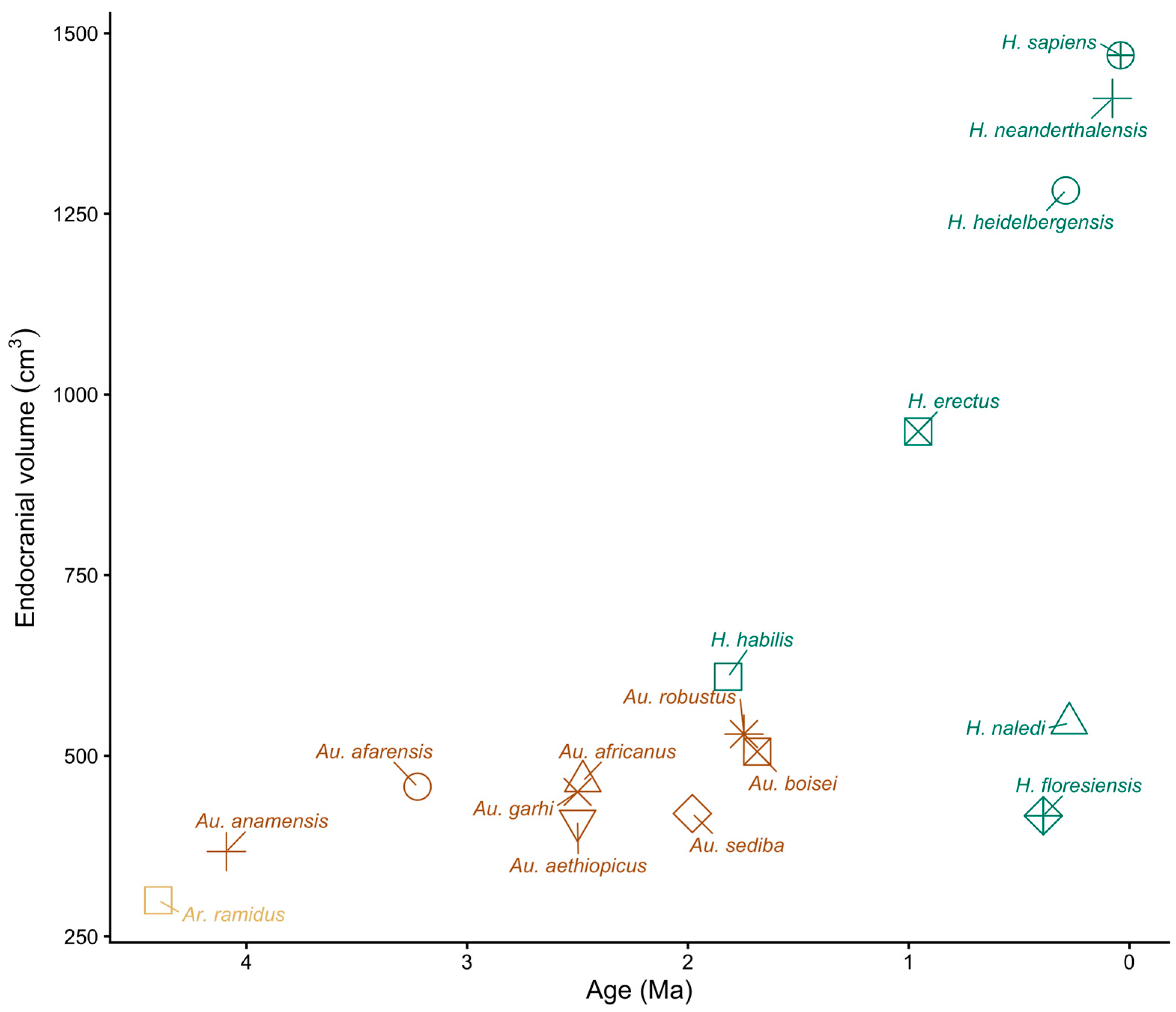
| Taxa | Avg 1 ECV (cm3) | SE ECV (cm3) | Avg Body Mass (g) | SE Body Mass (g) | Avg Age (Ma) | n = (ECV; Body Mass) |
|---|---|---|---|---|---|---|
| Ardipithecus ramidus | 300.00 | NA | 46,466.67 | 733.33 | 4.40 | (1; 4) |
| Australopithecus aethiopicus | 410.00 | NA | 37,666.00 | NA | 2.50 | (1; 1) |
| Australopithecus afarensis | 457.25 | 38.75 | 43,718.33 | 2041.85 | 3.23 | (4; 38) |
| Australopithecus africanus | 464.86 | 21.15 | 36,124.29 | 1444.88 | 2.48 | (7; 41) |
| Australopithecus anamensis | 367.50 | NA | 56,983.33 | 4169.17 | 4.09 | (1; 4) |
| Australopithecus boisei | 505.71 | 8.48 | 52,425.00 | 3936.37 | 1.69 | (7; 9) |
| Australopithecus garhi | 450.00 | NA | 36,500.00 | NA | 2.50 | (1; 1) |
| Australopithecus robustus | 530.00 | NA | 35,326.39 | 2007.57 | 1.75 | (1; 21) |
| Australopithecus sediba | 420.00 | NA | 32,372.22 | 4964.34 | 1.98 | (1; 6) |
| Homo erectus | 948.69 | 32.57 | 61,574.85 | 1949.65 | 0.96 | (29; 38) |
| Homo floresiensis | 417.00 | NA | 29,750.00 | 1650.00 | 0.39 | (1; 3) |
| Homo habilis | 609.33 | 25.62 | 36,803.17 | 2422.60 | 1.82 | (6; 8) |
| Homo heidelbergensis | 1282.33 | 39.87 | 60,513.00 | NA | 0.29 | (9; 1) |
| Homo naledi | 545.00 | 42.52 | 42,421.38 | 983.26 | 0.27 | (3; 39) |
| Homo neanderthalensis | 1409.81 | 38.65 | 87,570.00 | 5254.93 | 0.08 | (21; 6) |
| Homo sapiens (fossil) | 1469.44 | 14.82 | 65,398.33 | 5093.81 | 0.04 | (71; 9) |
2. Materials and Methods
2.1. Fossil Materials
2.2. Extant Materials
2.3. Statistical Analyses
3. Results
3.1. Brain:Body Size Scaling in Fossil Hominids
3.2. Specimen-Based Assessment of Morphological Overlap
4. Discussion
4.1. Brain and Body Size Are Correlated in Genus Homo
4.2. Evolution of Encephalization
4.3. Brain Anatomy and Cognition
4.4. Brain Size Diversification and Cognition
5. Conclusions
Supplementary Materials
Author Contributions
Funding
Institutional Review Board Statement
Informed Consent Statement
Data Availability Statement
Conflicts of Interest
Abbreviations
| ECV | Endocranial volume |
References
- Aiello, L. (2010). Five years of Homo floresiensis. American Journal of Physical Anthropology, 142(2), 167–179. [Google Scholar] [CrossRef]
- Aiello, L., & Dean, C. (1990). An introduction to human evolutionary anatomy. Academic Press. [Google Scholar]
- Alba, D. M. (2010). Cognitive inferences in fossil apes (Primates, Hominoidea): Does encephalization reflect intelligence. Journal of Anthropological Sciences, 88(11–48), 20834049. [Google Scholar]
- Antón, S. C., Potts, R., & Aiello, L. C. (2014). Evolution of early Homo: An integrated biological perspective. Science, 345(6192), 1236828. [Google Scholar] [CrossRef]
- Argue, D., Donlon, D., Groves, C., & Wright, R. (2006). Homo floresiensis: Microcephalic, pygmoid, Australopithecus, or Homo? Journal of Human Evolution, 51(4), 360–374. [Google Scholar] [CrossRef]
- Arsuaga, J. L., Martınez, I., Gracia, A., Carretero, J. M., Lorenzo, C., Garcıa, N., & Ortega, A. I. (1997). Sima de los huesos (Sierra de Atapuerca, Spain). The site. Journal of Human Evolution, 33(2–3), 109–127. [Google Scholar] [CrossRef]
- Balzeau, A., Holloway, R. L., & Grimaud-Hervé, D. (2012). Variations and asymmetries in regional brain surface in the genus Homo. Journal of Human Evolution, 62(6), 696–706. [Google Scholar] [CrossRef]
- Barrickman, N. L., & Lin, M. J. (2010). Encephalization, expensive tissues, and energetics: An examination of the relative costs of brain size in strepsirrhines. American Journal of Physical Anthropology, 143(4), 579–590. [Google Scholar] [CrossRef]
- Barton, R. A., & Capellini, I. (2011). Maternal investment, life histories, and the costs of brain growth in mammals. Proceedings of the National Academy of Sciences, 108(15), 6169–6174. [Google Scholar] [CrossRef] [PubMed]
- Berger, L. R., De Ruiter, D. J., Churchill, S. E., Schmid, P., Carlson, K. J., Dirks, P. H., & Kibii, J. M. (2010). Australopithecus sediba: A new species of Homo-like australopith from South Africa. Science, 328(5975), 195–204. [Google Scholar] [CrossRef] [PubMed]
- Berger, L. R., Hawks, J., de Ruiter, D. J., Churchill, S. E., Schmid, P., Delezene, L. K., Kivell, T. L., Garvin, H. M., Williams, S. A., DeSilva, J. M., Skinner, M. M., Musiba, C. M., Cameron, N., Holliday, T. W., Harcourt-Smith, W., Ackermann, R. R., Bastir, M., Bogin, B., Bolter, D., … Zipfel, B. (2015). Homo naledi, a new species of the genus Homo from the Dinaledi Chamber, South Africa. eLife, 4, e09560. [Google Scholar] [CrossRef] [PubMed]
- Boddy, A. M., McGowen, M. R., Sherwood, C. C., Grossman, L. I., Goodman, M., & Wildman, D. E. (2012). Comparative analysis of encephalization in mammals reveals relaxed constraints on anthropoid primate and cetacean brain scaling. Journal of Evolutionary Biology, 25(5), 981–994. [Google Scholar] [CrossRef]
- Bozzola, M., Travaglino, P., Marziliano, N., Meazza, C., Pagani, S., Grasso, M., Tauber, M., Diegoli, M., Pilotto, A., Disabella, E., Tarantino, P., Brega, A., & Arbustini, E. (2009). The shortness of Pygmies is associated with severe under-expression of the growth hormone receptor. Molecular Genetics and Metabolism, 98(3), 310–313. [Google Scholar] [CrossRef] [PubMed]
- Brown, P., Sutikna, T., Morwood, M. J., Soejono, R. P., Jatmiko, Wayhu Saptomo, E., & Awe Due, R. (2004). A new small-bodied hominin from the Late Pleistocene of Flores, Indonesia. Nature, 431(7012), 1055–1061. [Google Scholar] [CrossRef] [PubMed]
- Brumm, A., Oktaviana, A. A., Burhan, B., Hakim, B., Lebe, R., Zhao, J. X., Sulistyarto, P. H., Ririmasse, M., Adhityatama, S., Sumantri, I., & Aubert, M. (2021). Oldest cave art found in Sulawesi. Science Advances, 7(3), eabd4648. [Google Scholar] [CrossRef]
- Bruner, E., & Beaudet, A. (2023). The brain of Homo habilis: Three decades of paleoneurology. Journal of Human Evolution, 174, 103281. [Google Scholar] [CrossRef]
- Buckner, R. L., & Krienen, F. M. (2013). The evolution of distributed association networks in the human brain. Trends in Cognitive Sciences, 17(12), 648–665. [Google Scholar] [CrossRef] [PubMed]
- Carlson, K. J., Stout, D., Jashashvili, T., De Ruiter, D. J., Tafforeau, P., Carlson, K., & Berger, L. R. (2011). The endocast of MH1, Australopithecus sediba. Science, 333(6048), 1402–1407. [Google Scholar] [CrossRef]
- Churchill, S. E., & Vansickle, C. (2017). Pelvic morphology in Homo erectus and early Homo. The Anatomical Record, 300(5), 964–977. [Google Scholar] [CrossRef]
- Clutton-Brock, T. H., & Harvey, P. H. (1980). Primates, brains and ecology. Journal of Zoology, 190(3), 309–323. [Google Scholar] [CrossRef]
- DeCasien, A. R., Williams, S. A., & Higham, J. P. (2017). Primate brain size is predicted by diet but not sociality. Nature Ecology & Evolution, 1(5), 112. [Google Scholar] [CrossRef]
- DeSilva, J. M. (2011). A shift toward birthing relatively large infants early in human evolution. Proceedings of the National Academy of Sciences, 108(3), 1022–1027. [Google Scholar] [CrossRef] [PubMed]
- DeSilva, J. M., Fannin, L., Cheney, I., Claxton, A., Ilieş, I., Kittelberger, J., Stibel, J., & Traniello, J. (2023). Human brains have shrunk: The questions are when and why. Frontiers in Ecology and Evolution, 11, 1191274. [Google Scholar] [CrossRef]
- DeSilva, J. M., & Lesnik, J. J. (2008). Brain size at birth throughout human evolution: A new method for estimating neonatal brain size in hominins. Journal of Human Evolution, 55(6), 1064–1074. [Google Scholar] [CrossRef]
- de Sousa, A. A., Beaudet, A., Calvey, T., Bardo, A., Benoit, J., Charvet, C. J., Dehay, C., Gómez-Robles, A., Gunz, P., Heuer, K., van den Heuvel, M. P., Hurst, S., Lauters, P., Reed, D., Salagnon, M., Sherwood, C. C., Ströckens, F., Tawane, M., Todorov, O. S., … Wei, Y. (2023). From fossils to mind. Communications Biology, 6(1), 636. [Google Scholar] [CrossRef]
- Dominguez-Rodrigo, M., Pickering, T. R., Baquedano, E., Mabulla, A., Mark, D. F., Musiba, C., Bunn, H. T., Uribelarrea, D., Smith, V., Diez-Martin, F., Pérez-González, A., Sánchez, P., Santonja, M., Barboni, D., Gidna, A., Ashley, G., Yravedra, J., Heaton, J. L., & Arriaza, M. C. (2013). First partial skeleton of a 1.34-million-year-old Paranthropus boisei from Bed II, Olduvai Gorge, Tanzania. PLoS ONE, 8(12), e80347. [Google Scholar] [CrossRef]
- Du, A., Zipkin, A. M., Hatala, K. G., Renner, E., Baker, J. L., Bianchi, S., Bernal, K. H., & Wood, B. A. (2018). Pattern and process in hominin brain size evolution are scale-dependent. Proceedings of the Royal Society B: Biological Sciences, 285(1873), 20172738. [Google Scholar] [CrossRef]
- Dumas, L. J., O’Bleness, M. S., Davis, J. M., Dickens, C. M., Anderson, N., Keeney, J. G., Jackson, J., Sikela, M., Raznahan, A., Giedd, J., Rapoport, J., Nagamani, S. S. C., Erez, A., Brunetti-Pierri, N., Sugalski, R., Lupski, J. R., Fingerlin, T., Cheung, S. W., & Sikela, J. M. (2012). DUF1220-domain copy number implicated in human brain-size pathology and evolution. The American Journal of Human Genetics, 91(3), 444–454. [Google Scholar] [CrossRef]
- Dunbar, R. I., & Shultz, S. (2017). Why are there so many explanations for primate brain evolution? Philosophical Transactions of the Royal Society B: Biological Sciences, 372(1727), 20160244. [Google Scholar] [CrossRef]
- Falk, D., Hildebolt, C., Smith, K., Morwood, M. J., Sutikna, T., Brown, P., Jatmiko, Saptomo, E. W., Brunsden, B., & Prior, F. (2005). The brain of LB1, Homo floresiensis. Science, 308(5719), 242–245. [Google Scholar] [CrossRef]
- Foster, J. B. (1964). Evolution of mammals on islands. Nature, 202(4929), 234–235. [Google Scholar] [CrossRef]
- Fox, J., & Weisberg, S. (2019). Nonlinear regression, nonlinear least squares, and nonlinear mixed models in R. Population, 150, 200. [Google Scholar]
- Frémondière, P., Thollon, L., Marchal, F., Fornai, C., Webb, N. M., & Haeusler, M. (2022). Dynamic finite-element simulations reveal early origin of complex human birth pattern. Communications Biology, 5(1), 377. [Google Scholar] [CrossRef]
- Garvin, H. M., Elliott, M. C., Delezene, L. K., Hawks, J., Churchill, S. E., Berger, L. R., & Holliday, T. W. (2017). Body size, brain size, and sexual dimorphism in Homo naledi from the Dinaledi Chamber. Journal of Human Evolution, 111, 119–138. [Google Scholar] [CrossRef]
- Gilbert, S. L., Dobyns, W. B., & Lahn, B. T. (2005). Genetic links between brain development and brain evolution. Nature Reviews Genetics, 6(7), 581–590. [Google Scholar] [CrossRef] [PubMed]
- Gingerich, P. D. (2022). Pattern and rate in the Plio-Pleistocene evolution of modern human brain size. Scientific Reports, 12(1), 11216. [Google Scholar] [CrossRef]
- González-Forero, M. (2023). How development affects evolution. Evolution, 77(2), 562–579. [Google Scholar] [CrossRef] [PubMed]
- Gómez-Robles, A., Nicolaou, C., Smaers, J. B., & Sherwood, C. C. (2024). The evolution of human altriciality and brain development in comparative context. Nature Ecology & Evolution, 8, 133–146. [Google Scholar]
- Grabowski, M. (2016). Bigger brains led to bigger bodies?: The correlated evolution of human brain and body size. Current Anthropology, 57(2), 174–196. [Google Scholar] [CrossRef]
- Grabowski, M., Hatala, K. G., Jungers, W. L., & Richmond, B. G. (2015). Body mass estimates of hominin fossils and the evolution of human body size. Journal of Human Evolution, 85, 75–93. [Google Scholar] [CrossRef]
- Grabowski, M., Voje, K. L., & Hansen, T. F. (2016). Evolutionary modeling and correcting for observation error support a 3/5 brain-body allometry for primates. Journal of Human Evolution, 94, 106–116. [Google Scholar] [CrossRef]
- Haile-Selassie, Y., Melillo, S. M., & Su, D. F. (2016). The Pliocene hominin diversity conundrum: Do more fossils mean less clarity? Proceedings of the National Academy of Sciences, 113(23), 6364–6371. [Google Scholar] [CrossRef]
- Haile-Selassie, Y., Melillo, S. M., Vazzana, A., Benazzi, S., & Ryan, T. M. (2019). A 3.8-million-year-old hominin cranium from Woranso-Mille, Ethiopia. Nature, 573(7773), 214–219. [Google Scholar]
- Harmand, S., Lewis, J. E., Feibel, C. S., Lepre, C. J., Prat, S., Lenoble, A., Boës, X., Quinn, R. L., Brenet, M., Arroyo, A., Taylor, N., Clément, S., Daver, G., Brugal, J.-P., Leakey, L., Mortlock, R. A., Wright, J. D., Lokorodi, S., Kirwa, C., … Roche, H. (2015). 3.3-million-year-old stone tools from Lomekwi 3, West Turkana, Kenya. Nature, 521(7552), 310–315. [Google Scholar] [CrossRef]
- Hawks, J., Elliott, M., Schmid, P., Churchill, S. E., Ruiter, D. J. D., Roberts, E. M., Hilbert-Wolf, H., Garvin, H. M., Williams, S. A., Delezene, L. K., & Feuerriegel, E. M. (2017). New fossil remains of Homo naledi from the Lesedi Chamber, South Africa. Elife, 6, e24232. [Google Scholar] [CrossRef]
- Heldstab, S. A., Isler, K., Burkart, J. M., & van Schaik, C. P. (2019). Allomaternal care, brains and fertility in mammals: Who cares matters. Behavioral Ecology and Sociobiology, 73, 71. [Google Scholar] [CrossRef]
- Heldstab, S. A., Kosonen, Z. K., Koski, S. E., Burkart, J. M., van Schaik, C. P., & Isler, K. (2016). Manipulation complexity in primates coevolved with brain size and terrestriality. Scientific Reports, 6(1), 24528. [Google Scholar] [CrossRef]
- Henneberg, M. (1998). Evolution of the human brain: Is bigger better? Clinical and Experimental Pharmacology and Physiology, 25(9), 745–749. [Google Scholar] [CrossRef]
- Holloway, R. L. (1983). Cerebral brain endocast pattern of Australopithecus afarensis hominid. Nature, 303(5916), 420–422. [Google Scholar] [CrossRef] [PubMed]
- Holloway, R. L., Broadfield, D., Yuan, M., Schwartz, J. H., & Tattersall, I. (2004). The human fossil record, brain endocasts: The paleoneurological evidence (Volume 3). Wiley. [Google Scholar]
- Hublin, J. J., Ben-Ncer, A., Bailey, S. E., Freidline, S. E., Neubauer, S., Skinner, Bergmann, I., Le Cabec, A., Benazzi, S., Harvati, K., & Gunz, P. (2017). New fossils from Jebel Irhoud, Morocco and the pan-African origin of Homo sapiens. Nature, 546(7657), 289–292. [Google Scholar] [CrossRef] [PubMed]
- Hublin, J. J., Neubauer, S., & Gunz, P. (2015). Brain ontogeny and life history in Pleistocene hominins. Philosophical Transactions of the Royal Society B: Biological Sciences, 370(1663), 20140062. [Google Scholar] [CrossRef] [PubMed]
- Isler, K., Kirk, E. C., Miller, J. M., Albrecht, G. A., Gelvin, B. R., & Martin, R. D. (2008). Endocranial volumes of primate species: Scaling analyses using a comprehensive and reliable data set. Journal of Human Evolution, 55(6), 967–978. [Google Scholar] [CrossRef]
- Isler, K., & van Schaik, C. P. (2012). Allomaternal care, life history and brain size evolution in mammals. Journal of Human Evolution, 63(1), 52–63. [Google Scholar] [CrossRef] [PubMed]
- Kaifu, Y., Kurniawan, I., Mizushima, S., Sawada, J., Lague, M., Setiawan, R., Sutisna, I., Wibowo, U. P., Suwa, G., Kono, R. T., Sasaki, T., Brumm, A., & van den Bergh, G. D. (2024). Early evolution of small body size in Homo floresiensis. Nature Communications, 15(1), 6381. [Google Scholar] [CrossRef]
- Kappelman, J. (1996). The evolution of body mass and relative brain size in fossil hominids. Journal of Human Evolution, 30(3), 243–276. [Google Scholar] [CrossRef]
- Kimbel, W. H., & Delezene, L. K. (2009). “Lucy” redux: A review of research on Australopithecus afarensis. American Journal of Physical Anthropology, 140(S49), 2–48. [Google Scholar] [CrossRef]
- Kochiyama, T., Ogihara, N., Tanabe, H. C., Kondo, O., Amano, H., Hasegawa, K., Suzuki, H., Ponce de León, M. S., Zollikofer, C. P., Bastir, M., Stringer, C., Sadato, T., & Akazawa, T. (2018). Reconstructing the Neanderthal brain using computational anatomy. Scientific Reports, 8(1), 6296. [Google Scholar] [CrossRef]
- Kubo, D., Kono, R. T., & Kaifu, Y. (2013). Brain size of Homo floresiensis and its evolutionary implications. Proceedings of the Royal Society B: Biological Sciences, 280(1760), 20130338. [Google Scholar] [CrossRef] [PubMed]
- Leakey, M. G., Feibel, C. S., McDougall, I., & Walker, A. (1995). New four-million-year-old hominid species from Kanapoi and Allia Bay, Kenya. Nature, 376(6541), 565–571. [Google Scholar] [CrossRef]
- Lefebvre, L. (2012). Primate encephalization. Progress in Brain Research, 195, 393–412. [Google Scholar]
- Liu, W., Athreya, S., Xing, S., & Wu, X. (2022). Hominin evolution and diversity: A comparison of earlier-Middle and later-Middle Pleistocene hominin fossil variation in China. Philosophical Transactions of the Royal Society B, 377(1847), 20210040. [Google Scholar] [CrossRef]
- Lordkipanidze, D., Jashashvili, T., Vekua, A., De León, M. S. P., Zollikofer, C. P., Rightmire, G. P., Pontzer, H., Ferring, R., Oms, O., Tappen, M., Bukhsianidze, M., Agusti, J., Kahlke, R., Kiladze, G., Martinez-Navarro, B., Mouskhelishvili, A., Nioradze, M., & Rook, L. (2007). Postcranial evidence from early Homo from Dmanisi, Georgia. Nature, 449(7160), 305–310. [Google Scholar] [CrossRef]
- Martin, R. D. (1981). Relative brain size and basal metabolic rate in terrestrial vertebrates. Nature, 293(5827), 57–60. [Google Scholar] [CrossRef]
- Martin, R. D. (1982). Allometric approaches to the evolution of the primate nervous system. In Primate brain evolution: Methods and concepts (pp. 39–56). Springer. [Google Scholar]
- Martin, R. D., & Harvey, P. H. (1985). Brain size allometry ontogeny and phylogeny. In Size and scaling in primate biology (pp. 147–173). Springer. [Google Scholar]
- Martinón-Torres, M., Garate, D., Herries, A. I., & Petraglia, M. D. (2024). No scientific evidence that Homo naledi buried their dead and produced rock art. Journal of Human Evolution, 195, 103464. [Google Scholar]
- Mayr, E. (1963). The taxonomic evaluation of fossil hominids. In Classification and human evolution (pp. 332–346). Routledge. [Google Scholar]
- McHenry, H. M. (1992). Body size and proportions in early hominids. American Journal of Physical Anthropology, 87(4), 407–431. [Google Scholar] [CrossRef]
- Miller, I. F., Barton, R. A., & Nunn, C. L. (2019). Quantitative uniqueness of human brain evolution revealed through phylogenetic comparative analysis. eLife, 8, e41250. [Google Scholar] [CrossRef]
- Mitani, J. C., & Watts, D. (1997). The evolution of non-maternal caretaking among anthropoid primates: Do helpers help? Behavioral Ecology and Sociobiology, 40, 213–220. [Google Scholar] [CrossRef]
- Monson, T. A., Weitz, A. P., & Brasil, M. F. (2025). Molar proportions, endocranial volume, and insular nanism in fossil Homo. Annals of Human Biology 52, 2512027. [Google Scholar] [CrossRef] [PubMed]
- Monson, T. A., Weitz, A. P., Brasil, M. F., & Hlusko, L. J. (2022). Teeth, prenatal growth rates, and the evolution of human-like pregnancy in later Homo. Proceedings of the National Academy of Sciences, 119(41), e2200689119. [Google Scholar] [CrossRef]
- Montgomery, S. H., Capellini, I., Barton, R. A., & Mundy, N. I. (2010). Reconstructing the ups and downs of primate brain evolution: Implications for adaptive hypotheses and Homo floresiensis. BMC Biology, 8(1), 9. [Google Scholar] [CrossRef]
- Montgomery, S. H., & Mundy, N. I. (2012). Evolution of ASPM is associated with both increases and decreases in brain size in primates. Evolution, 66(3), 927–932. [Google Scholar] [CrossRef] [PubMed]
- Moore, M. W., & Brumm, A. (2009). Homo floresiensis and the African Oldowan. In Interdisciplinary approaches to the oldowan (pp. 61–69). Springer. [Google Scholar]
- Morwood, M. J., Brown, P., Jatmiko, Sutikna, T., Wahyu Saptomo, E., Westaway, K. E., Awe Due, R., Roberts, R. G., Maeda, T., Wasisto, S., & Djubiantono, T. (2005). Further evidence for small-bodied hominins from the Late Pleistocene of Flores, Indonesia. Nature, 437, 1012–1017. [Google Scholar] [CrossRef] [PubMed]
- Nakahashi, W., Horiuchi, S., & Ihara, Y. (2018). Estimating hominid life history: The critical interbirth interval. Population Ecology, 60, 127–142. [Google Scholar] [CrossRef]
- Ni, X., Ji, Q., Wu, W., Shao, Q., Ji, Y., Zhang, C., Liang, L., Ge, J., Guo, Z., Li, J., Li, Q., Grün, R., & Stringer, C. (2021). Massive cranium from Harbin in northeastern China establishes a new Middle Pleistocene human lineage. The Innovation, 2(3), 100130. [Google Scholar] [CrossRef] [PubMed]
- Pablos, A. (2015). The foot in the Homo fossil record. Mitteilungen der Gesellschaft für Urgeschichte, 24(11). Available online: https://www.academia.edu/21777925/The_foot_in_the_Homo_fossil_record (accessed on 17 March 2026).
- Pickering, T. R., Cazenave, M., Clarke, R. J., Heile, A. J., Caruana, M. V., Kuman, K., Stratford, D., Brain, C. K., & Heaton, J. L. (2025). First articulating os coxae, femur, and tibia of a small adult Paranthropus robustus from Member 1 (Hanging Remnant) of the Swartkrans Formation, South Africa. Journal of Human Evolution, 201, 103647. [Google Scholar] [CrossRef] [PubMed]
- Pilbeam, D., & Gould, S. J. (1974). Size and scaling in human evolution: Homo sapiens is a peculiar large primate; however, all australopithecines are versions of the “same” animal. Science, 186(4167), 892–901. [Google Scholar]
- Pontzer, H. (2012). Ecological energetics in early Homo. Current Anthropology, 53(S6), S346–S358. [Google Scholar] [CrossRef]
- Posit Team. (2023). RStudio: Integrated development environment for R [Posit Software]. PBC.
- Potts, R. (1998). Environmental hypotheses of hominin evolution. American Journal of Physical Anthropology, 107(S27), 93–136. [Google Scholar] [CrossRef]
- Powell, L. E., Isler, K., & Barton, R. A. (2017). Re-evaluating the link between brain size and behavioural ecology in primates. Proceedings of the Royal Society B: Biological Sciences, 284(1865), 20171765. [Google Scholar] [CrossRef]
- Profico, A., Buzi, C., Di Vincenzo, F., Boggioni, M., Borsato, A., Boschian, G., Marchi, D., Micheli, M., Cecchi, J. M., Samadelli, M., Tafuri, M. A., Arsuaga, J. L., & Manzi, G. (2023). Virtual excavation and analysis of the early Neanderthal cranium from Altamura (Italy). Communications Biology, 6(1), 316. [Google Scholar] [CrossRef]
- Püschel, H. P., Bertrand, O. C., O’reilly, J. E., Bobe, R., & Püschel, T. A. (2021). Divergence-time estimates for hominins provide insight into encephalization and body mass trends in human evolution. Nature Ecology & Evolution, 5(6), 808–819. [Google Scholar] [CrossRef]
- Püschel, T. A., Nicholson, S. L., Baker, J., Barton, R. A., & Venditti, C. (2024). Hominin brain size increase has emerged from within-species encephalization. Proceedings of the National Academy of Sciences, 121(49), e2409542121. [Google Scholar] [CrossRef]
- R Core Team. (2023). R Core Team R: A language and environment for statistical computing. R Foundation for Statistical Computing. [Google Scholar]
- Reed, D. (2025). Nomenclature and taxonomy of Chibanian hominins. Special issue: What’s in a name? Late Middle and early Late Pleistocene hominin systematics. PaleoAnthropology, 2025(2), 288–301. [Google Scholar]
- Rightmire, G. P. (2004). Brain size and encephalization in early to Mid-Pleistocene Homo. American Journal of Physical Anthropology, 124(2), 109–123. [Google Scholar] [CrossRef] [PubMed]
- Robbins, J. L., Dirks, P. H., Roberts, E. M., Kramers, J. D., Makhubela, T. V., Hilbert-Wolf, H. L., Elliott, M., Wiersma, J. P., Placzek, C. J., Evans, M., & Berger, L. R. (2021). Providing context to the Homo naledi fossils: Constraints from flowstones on the age of sediment deposits in Rising Star Cave, South Africa. Chemical Geology, 567, 120108. [Google Scholar] [CrossRef]
- Robson, S. L., Hawkes, K., & van Schaik, C. P. (2006). The derived features of human life history. In K. Hawkes, & R. L. Paine (Eds.), The evolution of human life history (pp. 17–44). School of American Research Press. [Google Scholar]
- Ross, C. (2003). Chapter 11: Life history, infant care strategies, and brain size in primates. In P. M. Kappeler, & M. E. Pereira (Eds.), Primate life histories and socioecology (pp. 266–284). University of Chicago Press. [Google Scholar]
- Ruff, C. B. (2010). Body size and body shape in early hominins–implications of the Gona pelvis. Journal of Human Evolution, 58(2), 166–178. [Google Scholar] [CrossRef]
- Ruff, C. B., & Burgess, M. L. (2015). How much more would KNM-WT 15000 have grown? Journal of Human Evolution, 80, 74–82. [Google Scholar] [CrossRef]
- Ruff, C. B., Trinkaus, E., & Holliday, T. W. (1997). Body mass and encephalization in Pleistocene Homo. Nature, 387(6629), 173–176. [Google Scholar] [CrossRef]
- Ruff, C. B., & Wood, B. A. (2023). The estimation and evolution of hominin body mass. Evolutionary Anthropology, 32(4), 223–237. [Google Scholar] [CrossRef]
- Sansalone, G., Allen, K., Ledogar, J. A., Ledogar, S., Mitchell, D. R., Profico, A., Castiglione, S., Melchionna, M., Serio, C., Mondanaro, A., Raia, P., & Wroe, S. (2020). Variation in the strength of allometry drives rates of evolution in primate brain shape. Proceedings of the Royal Society B, 287(1930), 20200807. [Google Scholar] [CrossRef] [PubMed]
- Schillaci, M. A. (2006). Sexual selection and the evolution of brain size in primates. PLoS ONE, 1(1), e62. [Google Scholar] [CrossRef] [PubMed]
- Schoenemann, P. T., Budinger, T. F., Sarich, V. M., & Wang, W. S. Y. (2000). Brain size does not predict general cognitive ability within families. Proceedings of the National Academy of Sciences, 97(9), 4932–4937. [Google Scholar] [CrossRef] [PubMed]
- Schroeder, L., Madison, P., & Ackermann, R. R. (2025). Why heads matter in palaeoanthropology: The impacts and consequences of collecting skulls. South African Journal of Science, 121(1/2), 1–8. [Google Scholar] [CrossRef]
- Semaw, S., Renne, P., Harris, J. W., Feibel, C. S., Bernor, R. L., Fesseha, N., & Mowbray, K. (1997). 2.5-million-year-old stone tools from Gona, Ethiopia. Nature, 385(6614), 333–336. [Google Scholar] [CrossRef] [PubMed]
- Shea, J. J. (2003). Neandertals, competition, and the origin of modern human behavior in the levant. Evolutionary Anthropology, 12(4), 173–187. [Google Scholar] [CrossRef]
- Smaers, J. B., Rothman, R. S., Hudson, D. R., Balanoff, A. M., Beatty, B., Dechmann, D. K., de Vries, D., Dunn, J. C., Fleagle, J. G., Gilbert, C. C., Goswami, A., Iwaniuk, A. N., Jungers, W. L., Kerney, M., Ksepka, D. T., Manger, P. R., Mongle, C. S., Rohlf, F. J., Smith, N. A., … Safi, K. (2021). The evolution of mammalian brain size. Science Advances, 7(18), eabe2101. [Google Scholar] [CrossRef]
- Steudel-Numbers, K. L., & Tilkens, M. J. (2004). The effect of lower limb length on the energetic cost of locomotion: Implications for fossil hominins. Journal of Human Evolution, 47(1–2), 95–109. [Google Scholar] [CrossRef]
- Stibel, J. M. (2021). Decreases in brain size and encephalization in anatomically modern humans. Brain, Behavior and Evolution, 96(2), 64–77. [Google Scholar] [CrossRef]
- Stibel, J. M. (2023). Climate change predictive of body size and proportionality in humans. Evolutionary Biology, 50(4), 461–475. [Google Scholar] [CrossRef]
- Stibel, J. M. (2025). Did increasing brain size place early humans at risk of extinction? Brain and Cognition, 188, 106336. [Google Scholar] [CrossRef]
- Street, S. E., Navarrete, A. F., Reader, S. M., & Laland, K. N. (2017). Coevolution of cultural intelligence, extended life history, sociality, and brain size in primates. Proceedings of the National Academy of Sciences, 114(30), 7908–7914. [Google Scholar] [CrossRef]
- Striedter, G. F. (2005). Principles of brain evolution. Sinauer Associates. [Google Scholar]
- Suwa, G., Asfaw, B., Kono, R. T., Kubo, D., Lovejoy, C. O., & White, T. D. (2009). The Ardipithecus ramidus skull and its implications for hominid origins. Science, 326(5949), 68–68e7. [Google Scholar] [CrossRef]
- Tartarelli, G., & Bisconti, M. (2006). Trajectories and constraints in brain evolution in primates and cetaceans. Human Evolution, 21, 275–287. [Google Scholar] [CrossRef]
- Tattersall, I. (2023). Endocranial volumes and human evolution. F1000Research, 12, 565. [Google Scholar] [CrossRef]
- Tattersall, I., & Schwartz, J. H. (2009). Evolution of the genus Homo. Annual Review of Earth and Planetary Sciences, 37, 67–92. [Google Scholar] [CrossRef]
- Tylén, K., Fusaroli, R., Rojo, S., Heimann, K., Fay, N., Johannsen, N. N., Riede, F., & Lombard, M. (2020). The evolution of early symbolic behavior in Homo sapiens. Proceedings of the National Academy of Sciences, 117(9), 4578–4584. [Google Scholar] [CrossRef] [PubMed]
- van den Bergh, G. D., Kaifu, Y., Kurniawan, I., Kono, R. T., Brumm, A., Setiyabudi, E., Aziz, F., & Morwood, M. J. (2016). Homo floresiensis-like fossils from the early Middle Pleistocene of Flores. Nature, 534(7606), 245–248. [Google Scholar] [CrossRef]
- Venditti, C., Baker, J., & Barton, R. A. (2024). Co-evolutionary dynamics of mammalian brain and body size. Nature Ecology & Evolution, 8(8), 1534–1542. [Google Scholar]
- Vinicius, L. (2005). Human encephalization and developmental timing. Journal of Human Evolution, 49(6), 762–776. [Google Scholar] [CrossRef]
- Walpole, S. C., Prieto-Merino, D., Edwards, P., Cleland, J., Stevens, G., & Roberts, I. (2012). The weight of nations: An estimation of adult human biomass. BMC Public Health, 12(1), 439. [Google Scholar] [CrossRef] [PubMed]
- White, T. D., Asfaw, B., Beyene, Y., Haile-Selassie, Y., Lovejoy, C. O., Suwa, G., & WoldeGabriel, G. (2009). Ardipithecus ramidus and the paleobiology of early hominids. Science, 326(5949), 64–86. [Google Scholar] [CrossRef]
- Wickham, H. (2016). ggplot2: Elegant graphics for data analysis. Springer. [Google Scholar]
- Wickham, H., François, R., Henry, L., Müller, K., & Vaughan, D. (2023). dplyr: A grammar of data manipulation (Rpackage version 1.1.2). Available online: https://dplyr.tidyverse.org (accessed on 17 March 2026).
- Will, M., Krapp, M., Stock, J. T., & Manica, A. (2021). Different environmental variables predict body and brain size evolution in Homo. Nature Communications, 12(1), 4116. [Google Scholar] [CrossRef]
- Xu, L., Kun, E., Pandey, D., Wang, J. Y., Brasil, M. F., Singh, T., & Narasimhan, V. M. (2025). The genetic architecture of and evolutionary constraints on the human pelvic form. Science, 388(6743), eadq1521. [Google Scholar] [CrossRef]
- Zhang, J. (2003). Evolution of the human ASPM gene, a major determinant of brain size. Genetics, 165(4), 2063–2070. [Google Scholar] [CrossRef] [PubMed]


Disclaimer/Publisher’s Note: The statements, opinions and data contained in all publications are solely those of the individual author(s) and contributor(s) and not of MDPI and/or the editor(s). MDPI and/or the editor(s) disclaim responsibility for any injury to people or property resulting from any ideas, methods, instructions or products referred to in the content. |
© 2026 by the authors. Licensee MDPI, Basel, Switzerland. This article is an open access article distributed under the terms and conditions of the Creative Commons Attribution (CC BY) license.
Share and Cite
Monson, T.A.; Weitz, A.P.; Brasil, M.F. The Evolution of Brain and Body Size in Genus Homo. Humans 2026, 6, 12. https://doi.org/10.3390/humans6020012
Monson TA, Weitz AP, Brasil MF. The Evolution of Brain and Body Size in Genus Homo. Humans. 2026; 6(2):12. https://doi.org/10.3390/humans6020012
Chicago/Turabian StyleMonson, Tesla A., Andrew P. Weitz, and Marianne F. Brasil. 2026. "The Evolution of Brain and Body Size in Genus Homo" Humans 6, no. 2: 12. https://doi.org/10.3390/humans6020012
APA StyleMonson, T. A., Weitz, A. P., & Brasil, M. F. (2026). The Evolution of Brain and Body Size in Genus Homo. Humans, 6(2), 12. https://doi.org/10.3390/humans6020012