


Abstract
Growing pressure to make aquaculture more sustainable has renewed attention on bioactive feed ingredients obtained from natural sources. In the present work, juvenile FFRC-strain common carp (Cyprinus carpio L.) were used to examine how graded dietary inclusion of Euglena gracilis powder (EP) influences growth, redox status, immune responsiveness and the underlying molecular regulation. Four hundred and fifty fish (2.23 ± 0.01 g) were distributed at random among five isonitrogenous and isolipidic diets supplying 0 (control), 0.25, 0.5, 1 or 2% EP, and were reared for eight weeks. Survival, growth and feed use were all improved by EP, most evidently at 0.25% and 0.5%. Within this window, both antioxidant capacity and the activity of nonspecific immune enzymes increased, and hepatic transcription of genes governing antioxidant defence and cytokine signalling was correspondingly altered, notably through genes linked to the Nrf2/Keap1 axis. Inclusion at 2%, by contrast, conferred no further advantage and was accompanied by poorer feed conversion, so that the overall response was clearly dose-dependent and non-linear. Taken together, EP acts in a biphasic manner in common carp: 0.25–0.5% improves growth and physiological regulation, whereas higher levels are counterproductive. The results underline the promise of Euglena biomass as a renewable, algae-derived functional ingredient for aquafeed formulation. Future work should validate their effects in larger-scale and longer-term feeding trials, assess the consistency of raw material quality and feed processing, and evaluate production costs and economic returns to determine their feasibility for commercial application.
1. Introduction
Among food-producing sectors, aquaculture currently expands faster than most and now underpins both global food security and the provision of high-quality animal protein [1]. Because China produces more farmed aquatic products than any other country, its production decisions shape world supply and resource demand [2,3]. Intensification, however, has amplified a set of persistent problems—rising feed expenditure, competition for finite resources and heightened food-safety risk—so that identifying feed additives that are at once safe, effective and sustainable has become an urgent priority.
Common carp (Cyprinus carpio L.) ranks among the most extensively farmed freshwater fishes, and China simultaneously leads in both production and consumption [4,5]. Economic value notwithstanding, intensified carp culture has brought more frequent disease episodes and, with them, a heavy dependence on antibiotics used preventively and therapeutically [6]. Such reliance accelerates antimicrobial resistance while eroding the long-term sustainability of the sector; hence, environmentally benign alternatives, functional feed additives in particular, are increasingly viewed as a route to lower antibiotic use and improve fish health [7].
Conventional aquafeeds are typically formulated using protein sources (e.g., fishmeal and soybean meal), lipid sources (e.g., fish oil and plant oils), carbohydrates, vitamins and minerals to satisfy the nutritional demands of farmed fish. However, conventional nutrient formulations do not necessarily provide sufficient functional support for intestinal health, antioxidant defence, and immune regulation under intensive aquaculture conditions. In addition, plant-derived ingredients, although widely used as cost-effective alternatives to fishmeal, may contain antinutritional factors or have imbalanced essential amino acid profiles, which can limit nutrient utilisation and compromise intestinal health when included at inappropriate levels. Therefore, functional feed additives containing bioactive compounds have attracted increasing attention as a complementary strategy to support the physiological health of aquatic animals, with microalgae representing one such group of additives [7].
Photosynthetic microorganisms collectively termed microalgae—spanning chlorophytes, cyanobacteria, diatoms, dinoflagellates and euglenoids—combine rapid proliferation, wide environmental tolerance and nutritionally dense biomass [8,9]. Euglena gracilis stands out within this group because it merges plant-like and animal-like features, possesses remarkably flexible metabolism, and can be cultivated photoautotrophically, mixotrophically or heterotrophically [10,11]. Protein, polyunsaturated fatty acids, vitamins, functional polysaccharides, and, above all, the β-1,3-glucan paramylon are abundant in this species, and its immunostimulatory, antioxidant and gut-protective activities have led to increasing use as an aquafeed additive, with better survival, growth and physiological condition documented in finfish and shrimp [12,13]. In teleosts, β-1,3-glucan is known to trigger innate defences, raise enzyme activities and strengthen resistance to infection, as reported for Nile tilapia, red drum and rainbow trout [14,15,16,17,18].
Whereas the immunomodulation exerted by purified β-1,3-glucan is well documented, far less is known about how the intact algal powder behaves in practical diets, where β-1,3-glucan is delivered together with numerous other nutrients that may act synergistically. The present experiment was therefore undertaken to establish a suitable dietary inclusion level of E. gracilis powder for juvenile common carp. Graded amounts of EP were added to a basal formulation, and the consequences for growth, feed utilisation, redox balance, immune function and gut architecture were assessed systematically; hepatic transcription of antioxidant (Nrf2/Keap1) and immune-related genes was additionally profiled to probe the mechanism. Specifically, the study aimed (1) to identify the dietary EP level best suited to juvenile common carp; (2) to characterise its influence on growth, feed efficiency, antioxidant capacity, innate immunity and intestinal morphology; and (3) to clarify the underlying mechanisms by reference to hepatic Nrf2/Keap1 signalling and immune gene expression. In so doing, it seeks to supply both a conceptual and an empirical basis for E. gracilis-based functional additives and for aquaculture systems that rely less on antibiotics.
2. Methods and Materials
2.1. Diet Formulation and Preparation
Experimental feeds were designed to be isonitrogenous and isolipidic and to differ only in the amount of E. gracilis powder incorporated: 0 (EP0, the unsupplemented control), 0.25 (EP025), 0.5 (EP05), 1 (EP1) and 2% (EP2). Ingredient inclusion rates and the analysed proximate composition are given in Table 1. Apart from EP, all raw materials were sourced from Xinhui Xinjian Feed Co., Ltd. (Jiangmen, Guangdong, China). Ingredients were milled to a fine powder, blended in the proportions specified by each formulation and moistened with water to obtain a workable mash. Pellets of 2 mm diameter were produced by extrusion and then dried at 60 °C in a forced-air oven and held in a cool, ventilated store until required.
Table 1.
Dietary formulation and proximate composition.
2.2. Chemical Characterisation of Euglena gracilis Powder
EP was obtained from the laboratory of Jiangxin Wang (Shenzhen University), where it had been produced by heterotrophic culture, and contained roughly 70.1% β-1,3-glucan (paramylon). Before the diets were prepared, its proximate composition was measured, giving 22.51% crude protein and 3.05% crude lipid on a dry-weight basis. These figures agree closely with those reported by Dai et al. [19] for E. gracilis biomass grown heterotrophically in the same laboratory.
2.3. Experimental Trial and Rearing Conditions
All procedures involving fish were carried out in compliance with the Guiding Principles for the Care and Use of Animals (China) and had been cleared beforehand by the Animal Welfare Committee of South China Agricultural University, Guangzhou (permit No. 2025G015). Juvenile carp were obtained from Foshan Yudeli Aquatic Development Co., Ltd. (Foshan, China) and, before the trial proper began, were held for one week in the recirculating system and offered the control feed (EP0). Four hundred and fifty apparently healthy fish (initial body weight: 2.23 ± 0.01 g) were randomly assigned to five dietary treatments, with three replicate 150 L glass tanks per treatment and 30 fish per tank. Fish were manually fed twice daily, at 09:30 and 16:00, at a daily ration equivalent to 4% of the total weight of the fish in each tank, following the feeding regime described by Reidel et al. [20]. The total fish weight in each tank was measured every two weeks, and the daily feed ration was adjusted accordingly. Daily feed intake was recorded for each tank. The recirculating aquaculture system, equipped with water treatment facilities (Figure S1), operates continuously at room temperature and with 24 h aeration, ensuring a stable aquatic environment. A ProQuatro-C multiparametre water quality meter (YSI, Yellow Springs, OH, USA) is used to measure water quality parameters daily, including dissolved oxygen, pH, ammonium/ammonia, nitrate, and water temperature. The 8-week feeding trial was conducted under the following water conditions: temperature, 25.0 ± 3 °C; dissolved oxygen (mg/L), >7.50; nitrite nitrogen and ammonia nitrogen (mg/L), both <0.1; and pH, neutral.
2.4. Sample Collection
Sampling took place after eight weeks of feeding, following a 24 h fast. For every tank, the number of survivors and their individual lengths and weights were recorded. Three fish were randomly selected from each aquarium and stored at −20 °C for subsequent whole-fish approximate composition analysis. A further six fish per tank were netted at random, anaesthetised, measured and weighed individually, as well as bled from the caudal vein with 1 mL syringes. Whole blood was transferred to 1.5 mL Eppendorf tubes, left to clot for 4 h at 4 °C, and spun at 4000 rpm for 10 min at 4 °C in a refrigerated high-speed centrifuge; serum was then transferred to clean tubes and kept at −80 °C until biochemical analysis. The same six fish were dissected on ice to remove liver and intestinal tissue. Livers and viscera were weighed so that hepatosomatic and viscerosomatic indices could be derived. Mid-intestine segments from three of the fish were fixed in 4% paraformaldehyde at room temperature for histology, whereas liver and intestinal samples from the remaining three were placed in cryovials, snap-frozen in liquid nitrogen and stored at −80 °C for enzyme and gene-expression work.
2.5. Growth Performance and Biometric Parameters
The parameters were calculated using standard formulas, as described by Yang et al. [21]. The specific calculation methods are presented below:
Here, (F): total feed intake during the experiment (dry weight, g); (Wi): initial total fish body weight (g); (Wf): final total fish body weight (g); (Wd): total body weight of fish that died during the experiment (g); (Ni): number of fish at the start of the experiment; (Nf): number of surviving fish at the end of the experiment; (W): fish body weight (g); (L): fish length (cm); (Wl): liver weight (g); (Wv): viscera weight (g); (P): crude protein content of the feed; (ln): natural logarithm; (56): experiment duration (days); (2): coefficient used to calculate average fish weight; and (100): conversion factor for percentages.
2.6. Proximate Composition Analysis
Using methods in accordance with Chinese national standards (GB/T), the moisture content (6435-2014), crude protein (6432-2018), crude fat (6433-2025), and ash (6438-2007) of the feed and whole fish were analysed and determined on a wet-weight basis. Before analysing the samples, they were dried at 105 °C until they reached a constant weight and were then ground and homogenised. The following equipment was used in the experiment: a semi-automatic Kjeldahl nitrogen determinator (Buchi, Flawil, Switzerland), a Soxhlet extractor (VELP Scientific, Milano, Italy), and a muffle furnace (Thermo Fisher Scientific, Pittsburg, PA, USA). Determinations were run in triplicate for each of the three biological replicates per treatment, and mean values are reported.
2.7. Biochemical and Enzymatic Activity Assays
All enzyme activity assays were performed using kits manufactured by the Nanjing Jiancheng Biotechnology Research Institute (Nanjing, China). For specific measurement parameters, please refer to Table S1 in the Supplementary Materials. For tissue assays, liver and intestine were homogenised at 1:9 (w/v) in ice-cold sterile saline using a Xinyi-48 high-throughput tissue homogeniser (Xinyi, Ningbo, China) with stainless-steel beads. Homogenates were centrifuged at 4 °C at the speed prescribed in each kit manual (TG16-Ws; Hunan Xiangyi Laboratory Instrument Development Co., Ltd., Changsha, China) and the supernatants were retained as 10% tissue homogenates. Serum was diluted with ice-cold saline as required. Reactions were run in 96-well microplates following the manufacturers’ protocols, and absorbance was read on a Synergy multimode microplate reader (Winooski, VT, USA). Concentrations and enzyme activities were obtained from standard curves or absorbance readings in accordance with the relevant kit instructions.
2.8. Intestinal Histology
The collected intestinal tissues were fixed in the fixative, processed by routine dehydration and paraffin embedding, sectioned at approximately 5 μm and stained with haematoxylin and eosin (Wuhan Servicebio Technology Co., Ltd., Wuhan, China). Photographs of the sections were taken under an optical microscope equipped with a display. Following the method described by Su et al. [22], ImageJ 1.51j8 was used to measure villus height, villus width, villus count, and muscular layer thickness.
2.9. qPCR Analysis
Hepatic RNA was isolated with a total RNA extraction kit (Model AB0225, Cinotohi, Changsha, China) and reverse-transcribed using the ALFA Fast King RT Kit (Product Code Q201-02, Findrop, Guangzhou, China). Primer sequences are compiled in Table 2. Amplification was carried out with PerfectStart® Green qPCR SuperMix (Product No. AQ601-02-V2, TransGen, Beijing, China) on a real-time PCR system (Bio-Rad Laboratories, Hercules, CA, USA); the assay protocol is as follows: 3 min at 95 °C, followed by 40 cycles, each consisting of 10 s at 95 °C and 30 s at 60 °C. Specificity of the amplicons was verified by melting-curve analysis. β-actin served as the reference gene, and relative transcript abundance was obtained by the 2−ΔΔCT method following Yang et al. [23].
Table 2.
Gene names and primer sequences.
2.10. Statistical Analysis
Normality (Shapiro–Wilk) and homogeneity of variance (Levene’s test) were verified before any comparison was made. Treatment means were compared by one-way ANOVA in SPSS 26.0 (IBM Corp., Armonk, NY, USA), with Duncan’s multiple range test applied for pairwise comparisons. Differences were regarded as significant at p < 0.05. Results are given as means ± SD, and graphs were prepared in GraphPad Prism 8.0 (GraphPad Software, San Diego, CA, USA).
3. Results
3.1. Growth Status, Biometric Parameters, and Whole-Fish Composition
Table 3 brings together the growth data, somatic indices and whole-body composition. Comparable initial body weight (IBW) across treatments (p > 0.05) indicated that randomisation had been effective. Survival rose from 86.67% under the control diet to between 93.33% and 97.78% wherever EP was included (p < 0.05). Final body weight (FBW), WGR and SGR each traced an inverted-U trajectory: EP025 ranked first on all three, with EP05 and EP1 close behind and statistically indistinguishable from one another (p > 0.05), while every EP group outperformed EP0 (p < 0.05).
Table 3.
Growth, somatic indices and whole-body proximate composition of juvenile common carp (Cyprinus carpio L.) after eight weeks on the experimental diets.
Feed conversion tracked the growth response. The two lowest FCR values, 1.09 in both cases, belonged to EP025 and EP05 and were superior to the control figure of 1.35 (p < 0.05); at 2% EP, the ratio deteriorated again to 1.27 and no longer differed from the control (p > 0.05). Voluntary intake was greatest in EP2 (3.16%/day) and least in EP05 (2.76%/day), so the poorer growth at the top dose cannot be ascribed to reduced appetite. PER was likewise raised by EP and was maximal in EP025 (p < 0.05).
Among somatic indices, HSI was greater in EP1 and EP2 than in the control (p < 0.05), and VSI exceeded the control value in every EP treatment (p < 0.05). The condition factor behaved less consistently: it was minimal in EP05 (1.78), yet significantly above the control in both EP1 and EP2 (p < 0.05).
Body composition also shifted with dose. Crude protein was greatest in EP025 (12.32%) and EP1 (11.81%), both above the control level of 8.18% (p < 0.05), and crude lipid was likewise highest in EP025 (12.64%), exceeding all other treatments (p < 0.05). Ash fell as EP rose, with EP1 and EP2 being significantly below EP0 (p < 0.05). Moisture was lowest in EP025 and EP1 and highest in EP2 (75.34%), moving inversely to protein and lipid.
3.2. Serum Biochemical Indices
Table 4 reports the serum indices, covering both innate immune parameters and markers of hepatic status. TP fell steadily and significantly as dietary EP increased, from 33.13 g/L in the control to 25.48 g/L at 2% EP (p < 0.05). ALB was maximal in EP025 (16.35 g/L), above every other group except EP2 (p < 0.05). Both LZM and ACP described an inverted-U curve, culminating in EP05 (589.03 U/mL and 90.40 U/L) at values higher than anywhere else (p < 0.05). ALP was likewise greatest in EP025 and EP05 (286.52 and 279.59 U/L), surpassing both the control and the two higher doses (p < 0.05).
Table 4.
Serum biochemistry results.
For liver-function markers, ALT was minimal in EP025 (7.15 U/L), below the control (12.51 U/L) and EP1 (14.79 U/L) (p < 0.05); the maximum occurred in EP1 but was not separable from EP05 (p > 0.05). AST showed the opposite pattern, peaking in EP2 (70.28 U/L) and reaching its minimum in EP1 (53.97 U/L) (p < 0.05).
3.3. Hepatic Antioxidant Enzyme Activities
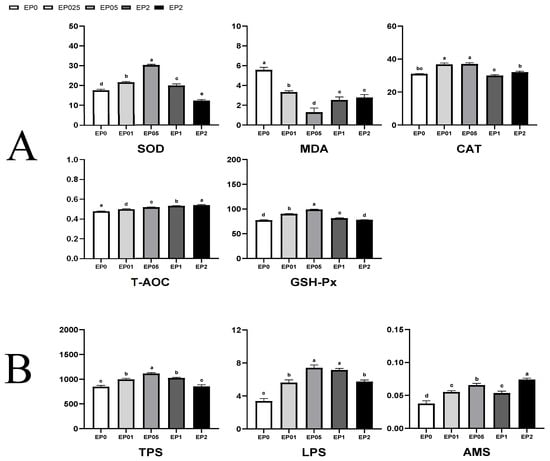
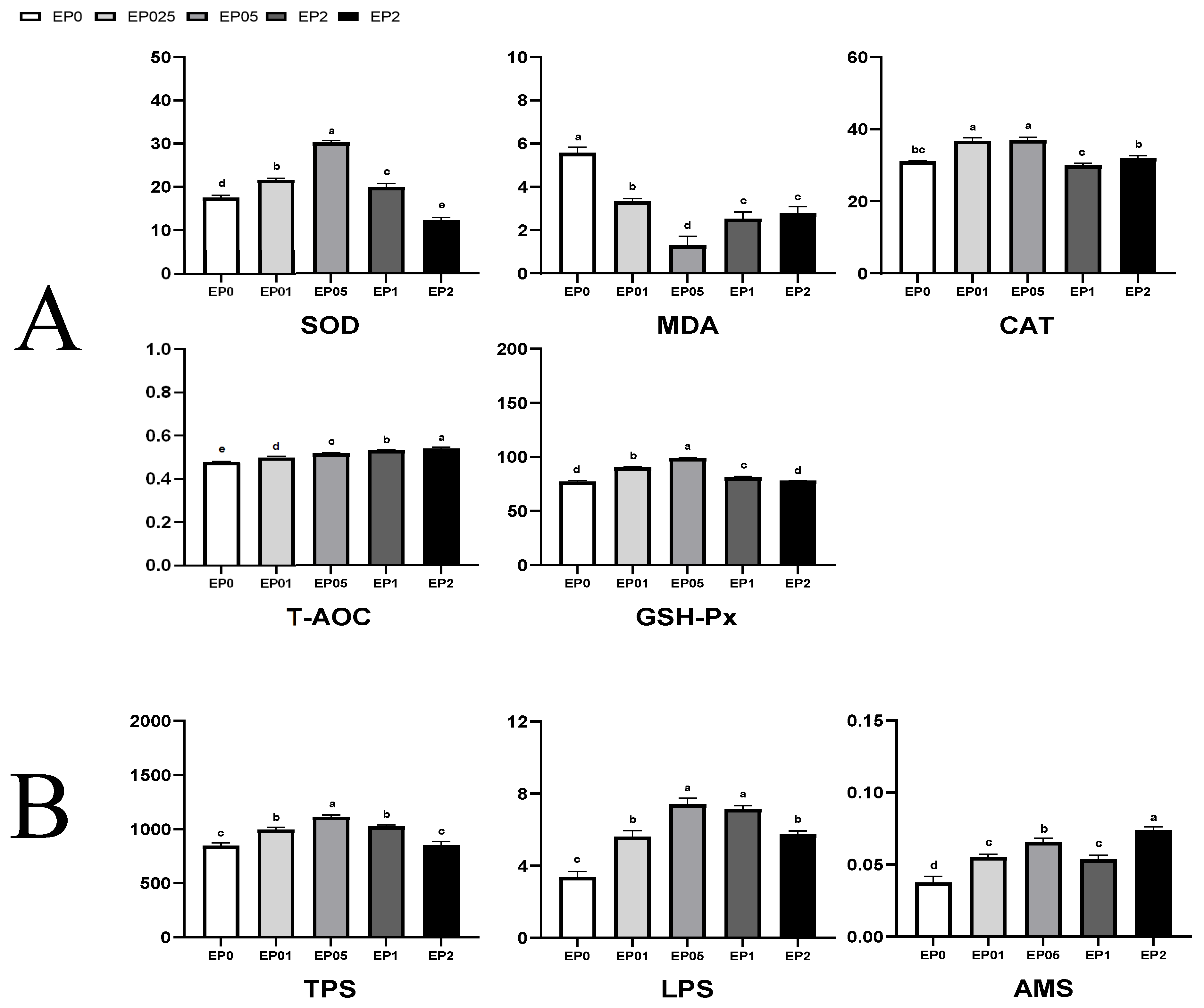
Hepatic antioxidant variables are shown in Figure 1A. SOD and GSH-Px each followed a clear inverted-U dose response, maximal at 0.5% EP and falling away above that level; indeed, SOD in EP2 dropped significantly beneath the control value (p < 0.05). CAT was elevated in EP025 and EP05 relative to both the control and the higher doses (p < 0.05). T-AOC climbed steadily with inclusion level and was greatest in EP2 (p < 0.05). MDA, the lipid-peroxidation marker, was conversely highest in the unsupplemented control and depressed in every EP group (p < 0.05), reaching its minimum at 0.5%.
Figure 1.
Enzyme activities in liver and intestine of juvenile common carp after eight weeks of feeding. (A) Hepatic antioxidant parameters: SOD (superoxide dismutase), CAT (catalase), GSH-Px (glutathione peroxidase), T-AOC (total antioxidant capacity) and MDA (malondialdehyde). (B) Intestinal digestive enzymes: TPS (trypsin), LPS (lipase) and AMS (amylase). Values are means ± SD (n = 3). For a given parameter, bars bearing different superscript letters differ significantly (p < 0.05); where no letters appear, differences are not significant (p > 0.05).
3.4. Intestinal Digestive Enzyme Activities
Intestinal digestive enzymes are shown in Figure 1B. Trypsin and lipase both attained their maxima in EP05 (p < 0.05), in keeping with the superior gut morphology and growth seen at that level. Amylase behaved differently, increasing monotonically with dose to its highest value in EP2 (p < 0.05)—a dose-dependent stimulation of carbohydrate digestion that evidently did not translate into faster growth.
3.5. Intestinal Histomorphology
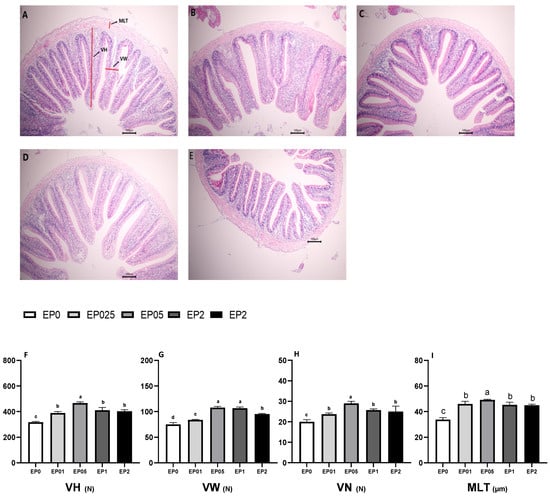
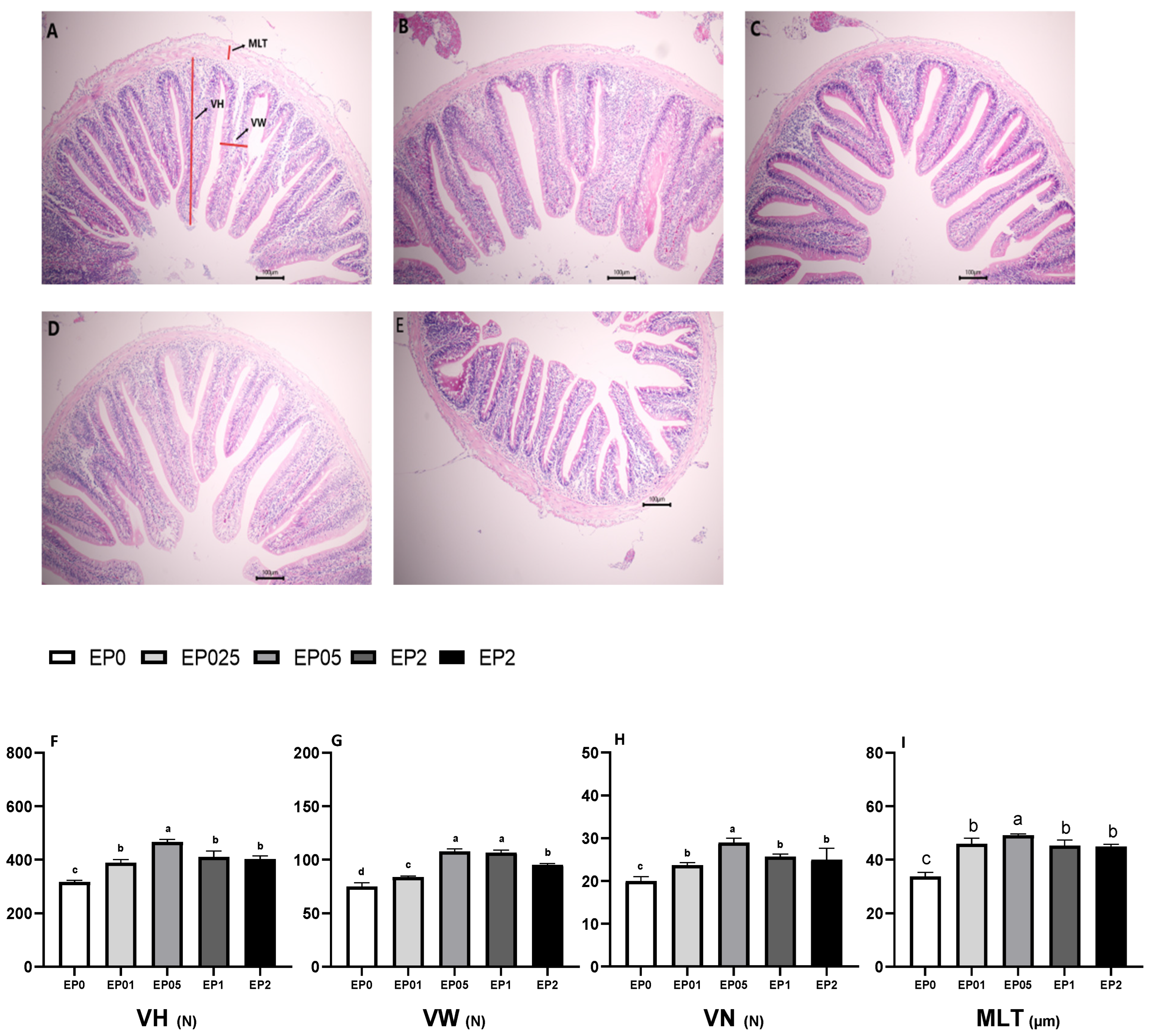
Figure 2 presents representative H&E-stained sections together with the morphometric results. Relative to the control, every supplemented group (EP025, EP05, EP1 and EP2) showed significant gains in villus height, villus width, villus number and muscular layer thickness (p < 0.05). Gains in villus height and width were generally largest in EP05, with EP025 and EP1 also clearly improved over the control. The fact that these structural benefits persisted at 2% inclusion indicates that intestinal architecture was not compromised by the highest dose, even though growth had declined by then.
Figure 2.
H&E staining of mid-intestine from juvenile common carp fed the experimental diets (100× magnification). Panels (A–E) correspond to EP025, EP05, EP1, EP2 and the control (EP0), respectively. Quantified morphometry is shown for (F) villus height, (G) villus width, (H) villus number and (I) muscular layer thickness. VH, villus height; VW, villus width; MLT, muscular layer thickness. Values are means ± SD (n = 3); bars carrying different superscript letters differ significantly (p < 0.05), and bars without letters do not (p > 0.05). Scale bar = 100 μm.
3.6. Hepatic Gene Expression
3.6.1. Antioxidant-Related Gene Expression
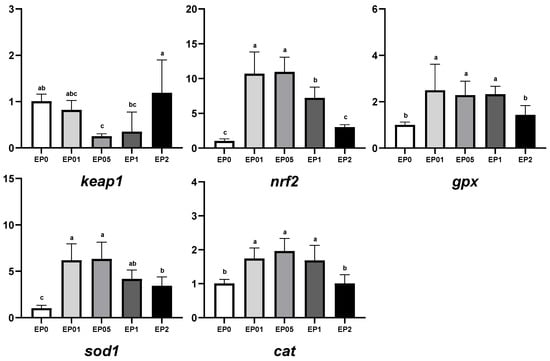
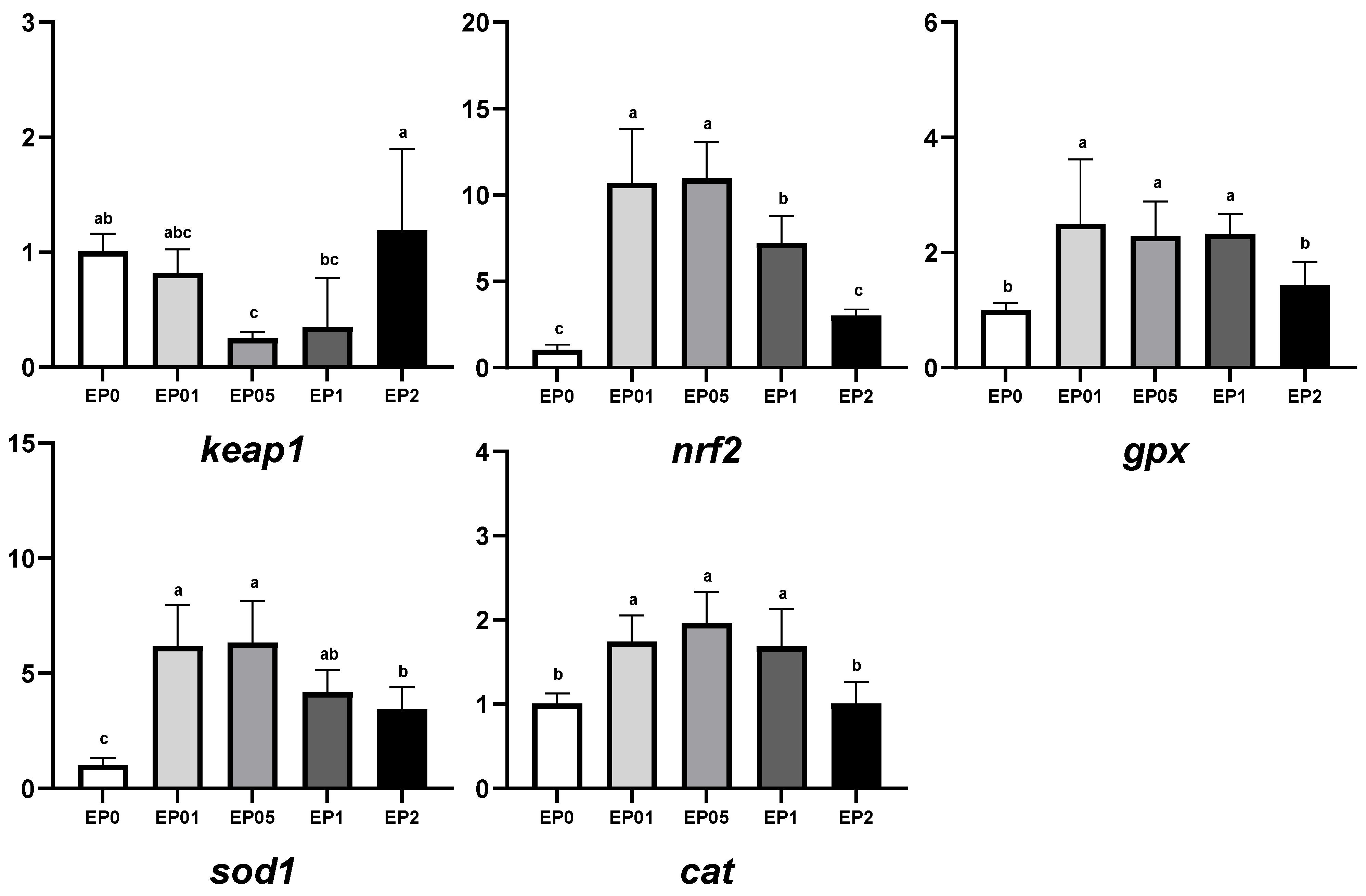
Figure 3 sets out hepatic transcripts of the Nrf2/Keap1 cascade. Relative to the control, nrf2 was induced more than tenfold in EP025, EP05 and EP1 (p < 0.05). The inhibitor keap1 was suppressed in EP05 (p < 0.05) but induced in EP2 (p < 0.05). Downstream effectors gpx, sod1 and cat were all up-regulated in EP025, EP05 and EP1 versus the control (p < 0.05). Agreement with the enzyme data supports the view that moderate EP inclusion effectively switches on Nrf2-dependent antioxidant defence.
Figure 3.
Expression levels of antioxidant-related genes in common carp livers. See Section 2.9 for the full names of the genes. β-actin was used as the internal reference gene. Data are presented as mean ± SD (n = 3); significant differences exist between bar graphs labelled with different superscript letters (p < 0.05), while the absence of superscript letters indicates no significant difference (p > 0.05).
3.6.2. Immune-Related Gene Expression
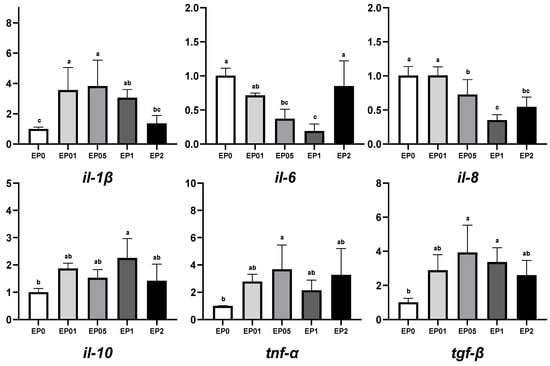
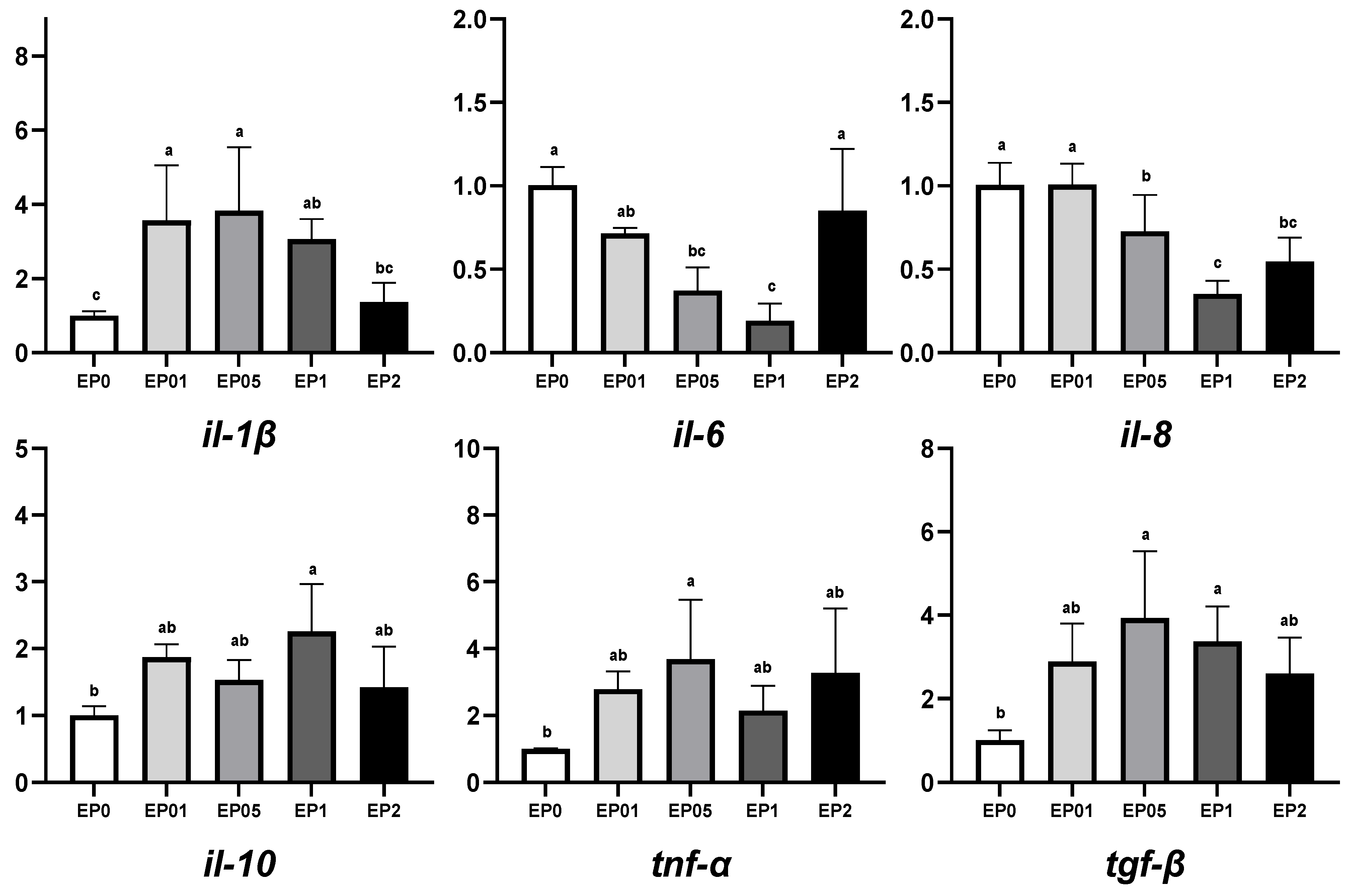
Immune gene transcripts in the liver are given in Figure 4. The pro-inflammatory cytokine il-1β was up-regulated in EP025, EP05 and EP1 relative to the control (p < 0.05), as was tnf-α in EP05 (p < 0.05). By contrast, il-6 and il-8 tended downward and were lowest in EP1 and EP05, respectively (p < 0.05). Anti-inflammatory mediators behaved in the opposite direction: il-10 rose significantly in EP1 (p < 0.05) and tgf-β in EP05 and EP1 (p < 0.05). Far from indicating immune disturbance, this pattern—with certain pro-inflammatory genes induced, others repressed, and anti-inflammatory genes simultaneously enhanced—points to balanced modulation, in which a measured innate response is coupled with prompt resolution rather than allowed to escalate.
Figure 4.
Expression levels of genes associated with liver inflammation in common carp. See Section 2.9 for the full names of the genes. β-actin was used as the internal reference gene. Values are mean ± standard deviation (n = 3). In the bar chart, letters with different superscripts indicate significant differences (p < 0.05), while the absence of letters indicates no significant differences (p > 0.05).
4. Discussion
4.1. Growth Performance and Feed Utilisation
Growth in juvenile common carp responded to dietary E. gracilis powder in a distinctly non-linear, inverted-U fashion: inclusion between 0.25% and 0.5% improved growth and feed efficiency, whereas the 2% level was clearly counterproductive, returning performance to values close to those of the unsupplemented control.
Across this favourable low-dose band, EP025 and EP05 gave higher WGR, SGR and survival than the control while remaining statistically indistinguishable from each other, so either level supports equivalent growth. The two were nonetheless functionally distinct: EP025 produced the greatest whole-body crude protein and lipid deposition, whereas EP05 was characterised by peak trypsin and lipase activities together with the best-developed intestinal morphology (greater villus height and width and a thicker muscular layer). Earlier work points in the same direction—1% E. gracilis gave the best weight gain and SGR in Rasbora lateristriata [24], and 1% paramylon, the β-1,3-glucan of E. gracilis, improved both weight gain and FCR in zebrafish, with no further benefit beyond 2% [25]. The fact that the optimum identified here (0.25–0.5%) lies below those values most likely reflects species differences in basal diet composition, digestive physiology and responsiveness to β-glucan.
The growth advantage conferred by EP is plausibly rooted in its bioactive constituents, most notably β-1,3-glucan and polyunsaturated fatty acids, both of which are recognised immunostimulants [26,27]. These same compounds also reshape the gut: villus height, villus width, villus number and muscular layer thickness were all greatest at 0.5% EP, and the digestive enzymes trypsin and lipase peaked at the same level, so that digestion and absorption were improved together—an adequate explanation for the faster growth. Comparable observations exist elsewhere: in Nile tilapia, dietary β-glucan, especially at 0.4%, favours a beneficial gut microbiota [28]; in coral trout, moderate β-glucan elongates intestinal villi, thickens the muscular layer and raises α-amylase and chymotrypsin activities, advantages that disappear at higher inclusion [29]. One route by which β-1,3-glucan may act is through reshaping the intestinal microbiome towards greater short-chain fatty acid output; these metabolites then fuel enterocytes and promote enzyme secretion [30,31,32].
A less expected result was the functional split between the two effective doses. EP05 had the stronger digestive capacity and the better-developed intestine, yet it was EP025 that deposited the most body protein and lipid. Such decoupling of digestive capacity from nutrient accretion implies a dose-dependent shift in how assimilated energy is allocated: at 0.25%, the balance favours somatic deposition, whereas at 0.5%, a larger share is diverted to maintenance functions—immune activation and antioxidant defence—both of which reach their maxima at that level (Section 4.2 and Section 4.3). The two doses should therefore be read as alternative optima on a common performance plateau, with EP025 favouring deposition and EP05 favouring digestive and defensive competence, rather than as points on a single efficacy ranking. Resource-allocation effects of this kind are seldom reported in aquaculture nutrition and would require further research via metabolic flux analysis.
At 2% inclusion, growth fell away even though feed intake was at its highest, and FCR rose correspondingly. This is the behaviour expected of functional polysaccharides in aquafeed, where a biphasic dose response is typical: surplus non-starch polysaccharide exerts an antinutritional action, restricting enzyme–substrate contact and so depressing protein conversion [33]. Two further observations in the EP2 group support this reading—reduced whole-body ash and an abnormally high hepatic AST—together indicating that the load of bioactive material exceeded the liver’s metabolic and detoxifying capacity, disturbing energy partitioning and causing genuine tissue damage. Precise dose setting therefore matters if EP is to be used in commercial carp feed.
4.2. Antioxidant Capacity and Nrf2/Keap1 Pathway Activation
Oxidative defences are what allow fish to cope with the stresses of intensive rearing; reactive oxygen species arising in the course of development provoke oxidative stress and can overwhelm those defences [34,35]. Redox status is conventionally judged from total antioxidant capacity, the activities of SOD, CAT and GSH-Px, and the concentration of MDA, which reports lipid peroxidation and cellular injury [36,37,38]. Here, SOD and GSH-Px were maximal at 0.5% EP, CAT was highest at 0.25% and 0.5%, and MDA was greatest in the control and lowest at 0.5%. Inclusion of 0.25–0.5% EP therefore strengthens enzymatic antioxidant defence, with 0.5% affording the strongest protection against lipid peroxidation.
The richer antioxidant status is most simply explained by the bioactive load of E. gracilis, which supplies β-1,3-glucan (paramylon) together with further non-enzymatic antioxidants [19]. Such constituents reinforce antioxidant defences, limit accumulation of reactive oxygen species and lower lipid peroxidation, and thereby relieve oxidative stress [39,40]. Our data sit comfortably with earlier reports: Euglena given to turbot raised antioxidant capacity through increased hepatic expression of sod1, cat and gpx [41]; 0.1% β-glucan raised hepatic CAT and GSH-Px and lowered MDA in coral trout, although the same work warned against excessive dosing [29]; and β-glucan improved SOD, GSH-Px and CAT while reducing hepatic MDA in Nile tilapia [42]. Combining β-glucan with probiotics such as Bacillus subtilis has produced similar gains in Pengze crucian carp [43] and Nile tilapia [44].
The qPCR data add a mechanistic layer: EP at low-to-moderate levels raised nrf2 transcripts and lowered those of its inhibitor keap1, with consequent increases in the downstream genes gpx, sod1 and cat, effectively assembling an antioxidant programme built around Keap1–Nrf2. Interestingly, T-AOC was nevertheless highest in EP2, where keap1 was itself up-regulated, implying that antioxidant control draws on more than this single axis. Non-enzymatic antioxidants abundant in E. gracilis—paramylon, carotenoids and related compounds [19]—may raise overall antioxidant capacity directly. The fact that enzyme-related endpoints did not improve further at the top dose suggests that the response either plateaus or triggers adaptive feedback. A comparable dose effect has been described in turbot [41], where moderate Euglena meal inclusion regulated antioxidant genes more strongly than higher inclusion.
4.3. Immunomodulatory Effects and Inflammatory Homeostasis
Fish held under intensive conditions meet repeated environmental challenges that provoke low-grade inflammation or chronic stress; the compensatory output of non-specific stress proteins that follows can ultimately blunt immune function [45,46]. The relatively high serum TP of the control (EP0) may therefore reflect stress-driven compensatory synthesis of immune proteins, whereas the lower TP seen with EP could mean that chronic inflammation was relieved and superfluous immune expenditure curtailed, leaving protein metabolism on a steadier footing.
Supplementation at 0.25–1% evidently improved this situation. TP was highest in the unsupplemented group and declined progressively with EP; ALB peaked in EP025; and LZM, ACP and ALP reached or approached their maxima in EP05. β-1,3-glucan, the principal bioactive in EP, offers a coherent explanation: by damping excessive inflammatory responses, it lowers the metabolic cost of maintaining unnecessary immune activation [16,47], freeing resources for other physiological demands including the upkeep of immune proteins such as LZM and ALB [48]. Lower basal costs and better pathogen resistance follow together.
Transcript data point the same way: EP at 0.25–1% raised hepatic expression of the pro-inflammatory cytokines il-1β and tnf-α, consistent with EP acting as a genuine immunostimulant that the host immune system recognises and that primes innate defences without overwhelming them [49]. Activation of this kind need not imply sustained inflammation. In the same animals, the anti-inflammatory cytokines il-10 and tgf-β were induced while il-6 and il-8 were repressed. Teleosts normally mount a rapid pro-inflammatory response to immune challenge and then impose negative feedback through anti-inflammatory mediators, thereby containing the reaction and preserving tissue homeostasis [50,51]; the pattern seen here should accordingly be read as adaptive immunomodulation—measured activation paired with timely resolution—rather than as immune dysregulation. Such a profile is especially valuable in farming, where chronic inflammation suppresses growth and increases disease risk. Both the immune and the antioxidant responses are reasonably traced to the very high paramylon content (>70% of the biomass) of heterotrophically grown EP [19]. β-1,3-glucan is a classical pathogen-associated molecular pattern, recognised by pattern-recognition receptors such as dectin-1 and Toll-like receptors on macrophages and other immune cells, which in turn engage downstream cascades including the Nrf2/Keap1 antioxidant pathway and NF-κB-mediated inflammation [16,47,52]. The coordinated induction observed here of nrf2 together with gpx, sod1 and cat, and of the cytokines il-1β, tnf-α, il-10 and tgf-β, is consistent with this β-1,3-glucan-mediated mechanism of action.
4.4. Implications for Sustainable Aquafeed Formulation
Taken as a whole, the trial defines a working inclusion window of 0.25–0.5% for EP in common carp, within which the alga acts simultaneously as a growth promoter, an antioxidant and an immunostimulant. The differing emphases of the two effective doses give formulators useful opportunities: 0.25% where maximum deposition and feed efficiency are wanted and 0.5% where disease resistance and stress tolerance matter more, as under suboptimal rearing conditions.
Set against conventional additives, EP has several attractions. Being a renewable microalgal resource, it does not compete with food crops for land, and its cultivation can be coupled to bioremediation. Because the effective inclusion is low (0.25–0.5%), the cost added per tonne of finished feed stays modest relative to the gains in growth and health, which makes EP a plausible means of displacing antibiotic growth promoters and synthetic immunostimulants in carp farming.
Several caveats qualify the conclusions drawn above. Rearing took place in a laboratory recirculating system in which water quality was held close to optimum, and the responses recorded under such conditions need not be reproduced in ponds or cages, where temperature swings, ammonia spikes, crowding and handling impose a far heavier burden; pond-scale confirmation is accordingly required before the inclusion window proposed here can be recommended with confidence. An eight-week exposure suffices to resolve differences in growth, digestive function and antioxidant or immune gene expression, yet it covers only a fraction of a production cycle, so whether the benefits carry over into reproductive output or into cumulative health across seasons remains an open question. A third constraint is anatomical: molecular and histopathological readouts were confined to the hepatopancreas and the gut, whereas systemic immune and metabolic responses—in the spleen and head kidney especially—together with any restructuring of the resident intestinal microbial community, lie outside the present data set. Extending the feeding period, validating the effect under farm conditions, and applying transcriptomic or metabolomic profiling across a wider range of tissues would jointly close these gaps.
5. Conclusions
This work shows that dietary E. gracilis powder acts on juvenile common carp in a biphasic, dose-dependent way. Inclusion at 0.25–0.5% accelerated growth and improved feed conversion, intestinal structure and digestive enzyme activity. At the molecular level, EP activated hepatic Nrf2/Keap1 signalling, inducing the downstream antioxidant genes gpx, sod1 and cat and limiting oxidative damage, while at the same time adjusting the expression of pro-inflammatory (il-1β, tnf-α) and anti-inflammatory (il-10, tgf-β) cytokines so as to preserve immune homeostasis.
Equally noteworthy is the functional split between the two effective doses: 0.25% favours nutrient deposition and feed efficiency, whereas 0.5% delivers the stronger gains in digestive capacity, antioxidant defence and immune stimulation, allowing supplementation to be matched to the production objective. Beyond this range, there is no advantage—at 2% the fish showed hepatic stress, a higher FCR and slower growth—which underlines how necessary precise dosing is.
In sum, E. gracilis powder is a promising natural and sustainable functional additive for carp feed. Inclusion between 0.25% and 0.5% balances growth promotion, physiological condition and cost. These results provide a basis for designing greener, more efficient and more sustainable aquafeeds and support wider use of microalgal biomass in place of synthetic immunostimulants and antibiotic growth promoters.
Supplementary Materials
The following supporting information can be downloaded at: https://www.mdpi.com/article/10.3390/phycology6040119/s1, Figure S1: The recirculating aquaculture system used in this culture experiment of common carp; Table S1: Enzyme activity assay parameters and kit catalog numbers.
Author Contributions
Conceptualisation, methods, analysis, data organisation, and drafting of the first version: X.J.; data visualisation and validation: Y.H., M.T. and S.L.; methods and resource management: J.W. and A.Z.; conceptual design, methods, supervision, review, and funding: H.T. All authors have read and agreed to the published version of the manuscript.
Funding
This research was funded by the earmarked fund for the China Agriculture Research System (CARS-44-47).
Institutional Review Board Statement
The experimental subjects were fish. All procedures were conducted in accordance with the law and were approved by the Animal Experimentation Center at South China Agricultural University (2025G015, 18 June 2025).
Informed Consent Statement
Not applicable, as no human participants were involved in this study.
Data Availability Statement
The data from this study are presented in full in the article. For further information, please contact the corresponding author.
Conflicts of Interest
The experimental subjects were provided by Foshan Yudeli Aquatic Products Development Co., Ltd. Other than this, the authors declare no conflicts of interest.
References
- FAO. The State of World Fisheries and Aquaculture 2022: Towards Blue Transformation; FAO: Rome, Italy, 2022. [Google Scholar]
- Naylor, R.L.; Hardy, R.W.; Buschmann, A.H.; Bush, S.R.; Cao, L.; Klinger, D.H.; Little, D.C.; Lubchenco, J.; Shumway, S.E.; Troell, M. A 20-year retrospective review of global aquaculture. Nature 2021, 591, 551–563. [Google Scholar] [CrossRef] [Scilit] [PubMed]
- Zhang, W.; Xie, S.; Xu, H.; Shan, X.; Xue, C.; Li, D.; Mai, K. High-quality development strategy of fisheries in China. Strateg. Study Chin. Acad. Eng. 2023, 25, 137. [Google Scholar] [CrossRef] [Scilit]
- Yao, T.; Gu, X.; Liang, X.; Fall, F.N.; Cao, A.; Zhang, S.; Lin, H.; Xue, M. Tolerance assessment of dietary bile acids in common carp (Cyprinus carpio L.) fed a high plant protein diet. Aquaculture 2021, 543, 737012. [Google Scholar] [CrossRef] [Scilit]
- Maniat, M.; Salati, A.P.; Zanguee, N.; Mousavi, S.M.; Hoseinifar, S.H. Effects of dietary Pediococcus acidilactici and Isomaltooligosaccharide on growth performance, immunity, and antioxidant defense in juvenile common carp. Aquac. Nutr. 2023, 2023, 1808640. [Google Scholar] [CrossRef] [Scilit] [PubMed]
- Kari, Z.A.; Wee, W.; Hamid, N.K.A.; Mat, K.; Rusli, N.D.; Khalid, H.N.M.; Sukri, S.A.M.; Harun, H.C.; Lee, S.W.; Wei, L.S. Recent advances of phytobiotic utilization in carp farming: A review. Aquac. Nutr. 2022, 2022, 7626675. [Google Scholar] [CrossRef] [Scilit]
- Onomu, A.J.; Okuthe, G.E. The role of functional feed additives in enhancing aquaculture sustainability. Fishes 2024, 9, 167. [Google Scholar] [CrossRef] [Scilit]
- Junior, W.G.M.; Gorgich, M.; Corrêa, P.S.; Martins, A.A.; Mata, T.M.; Caetano, N.S. Microalgae for biotechnological applications: Cultivation, harvesting and biomass processing. Aquaculture 2020, 528, 735562. [Google Scholar] [CrossRef] [Scilit]
- Siddik, M.A.; Sørensen, M.; Islam, S.M.; Saha, N.; Rahman, M.A.; Francis, D.S. Expanded utilisation of microalgae in global aquafeeds. Rev. Aquac. 2024, 16, 6–33. [Google Scholar] [CrossRef] [Scilit]
- Zoltner, M.; Field, M.C. Microbe profile: Euglena gracilis—Photogenic, flexible and hardy. Microbiology 2022, 168, 001241. [Google Scholar] [CrossRef] [Scilit] [PubMed]
- Inwongwan, S.; Sriwari, S.; Pumas, C. Metabolomic insights into the adaptations and biotechnological potential of Euglena gracilis under different trophic conditions. Plants 2025, 14, 1580. [Google Scholar] [CrossRef] [Scilit] [PubMed]
- Chen, C.; Chen, Z.; Chen, C.; Liang, Y. Characteristics of β-glucan and its modulation effects on animals’ immune system. J. Huazhong Agric. Univ. 2003, 22, 95–100. (In Chinese) [Google Scholar]
- Li, Y.J.; Cao, J.M.; Zhao, H.X.; Huang, Y.H.; Wang, G.X.; Wu, C.Y.; Liu, X.L.; Ma, Y.P. Advances in nutritional and physiological effects of β-glucan on aquatic animals. Guangdong Agric. Sci. 2014, 41, 128–134. (In Chinese) [Google Scholar]
- Rørstad, G.; Aasjord, P.M.; Robertsen, B. Adjuvant effect of a yeast glucan in vaccines against furunculosis in Atlantic salmon (Salmo salar L.). Fish Shellfish Immunol. 1993, 3, 179–190. [Google Scholar] [CrossRef] [Scilit]
- Selvaraj, V.; Sampath, K.; Sekar, V. Administration of yeast glucan enhances survival and some non-specific and specific immune parameters in carp (Cyprinus carpio) infected with Aeromonas hydrophila. Fish Shellfish Immunol. 2005, 19, 293–306. [Google Scholar] [PubMed]
- Dalmo, R.A.; Bøgwald, J. β-glucans as conductors of immune symphonies. Fish Shellfish Immunol. 2008, 25, 384–396. [Google Scholar] [CrossRef] [Scilit] [PubMed]
- Yamamoto, F.Y.; Yin, F.; Rossi, W., Jr.; Hume, M.; Gatlin, D.M., III. β-1, 3 glucan derived from Euglena gracilis and Algamune™ enhances innate immune responses of red drum (Sciaenops ocellatus L.). Fish Shellfish Immunol. 2018, 77, 273–279. [Google Scholar] [CrossRef] [Scilit] [PubMed]
- Chettri, J.K.; Kania, P.W.; Buchmann, K. Immunomodulation of rainbow trout (Oncorhynchus mykiss) fry by bath exposure to a β-glucan from Euglena gracilis. Aquac. Res. 2013, 44, 1407–1415. [Google Scholar] [CrossRef] [Scilit]
- Dai, J.; He, J.; Chen, Z.; Qin, H.; Du, M.; Lei, A.; Liao, Y.; Wang, J. Euglena gracilis promotes Lactobacillus growth and antioxidants accumulation as a potential next-generation prebiotic. Front. Nutr. 2022, 9, 864565. [Google Scholar] [CrossRef] [Scilit] [PubMed]
- Reidel, A. Common carp food management (Cyprinus carpio): Food frequency and weighting percentage. Rev. Agrar. Acad. 2018, 1, 76–83. [Google Scholar]
- Yang, J.; Lan, S.; Jia, X.; He, Y.; Li, Z.; Zhou, A.; Tang, H. Comparative Effects of Silkworm Excrement Concentrate Extract Versus Sodium Copper Chlorophyllin on Growth, Metabolic Health and Immune Response in Common Carp (Cyprinus carpio). Animals 2026, 16, 455. [Google Scholar] [CrossRef] [Scilit] [PubMed]
- Su, Q.; Yang, J.; Yang, Z.; Kong, Q.; Xiao, G.; Liu, D.; Tang, H. Toxicology of aspartame to largemouth bass (Micropterus salmoides) on the basis of antioxidant capacity, liver histology and the intestinal microbiota. Anim. Feed Sci. Technol. 2025, 320, 116225. [Google Scholar] [CrossRef] [Scilit]
- Yang, Z.; Su, Q.; Yang, J.; Li, Z.; Lan, S.; Jia, X.; He, Y.; Zhou, A.; Tang, H. Effects of dietary tea polyphenols on the growth, antioxidant status, immune function, and intestinal microbiota of largemouth bass (Micropterus salmoides). Animals 2025, 15, 222. [Google Scholar] [CrossRef] [Scilit] [PubMed]
- Maghfiroh, K.Q.; Retnoaji, B.; Budiman, A.; Suyono, E.A. Functional feed with Euglena sp.: A novel approach to growth and metabolic health in Rasbora lateristriata. Fish. Aquat. Sci. 2025, 28, 501–513. [Google Scholar] [CrossRef] [Scilit]
- Wu, G.; Wu, G.; Wu, Y.; Nong, Y.; Wu, M. Systematic evaluation and multi-omics profiling of Euglena gracilis paramylon’s effects on growth, immunity, and gut health in zebrafish through modulation of the gut-immunity-metabolism axis. Algal Res. 2026, 94, 104544. [Google Scholar] [CrossRef] [Scilit]
- Gissibl, A.; Sun, A.; Care, A.; Nevalainen, H.; Sunna, A. Bioproducts from Euglena gracilis: Synthesis and applications. Front. Bioeng. Biotechnol. 2019, 7, 108. [Google Scholar] [CrossRef] [Scilit] [PubMed]
- Maghfiroh, K.Q.; Erfianti, T.; NurAfifah, I.; Amelia, R.; Kurnianto, D.; Sadewo, B.R.; Suyono, E.A. The effect of photoperiodism on nutritional potency of Euglena sp. Indonesian strains. Malays. J. Nutr. 2023, 29, 453. [Google Scholar] [CrossRef] [Scilit]
- Xu, C.; Suo, Y.; Wang, X.; Qin, J.G.; Chen, L.; Li, E. Recovery from hypersaline-stress-Induced immunity damage and intestinal-microbiota changes through dietary β-glucan supplementation in Nile tilapia (Oreochromis niloticus). Animals 2020, 10, 2243. [Google Scholar] [CrossRef] [Scilit] [PubMed]
- Hao, X.; Lin, Z.; Ma, Z.; Yang, Y.; Zhou, C.; Hu, J.; Zhang, Y.; Lin, H. Effect of dietary β-glucan on growth performance, antioxidant responses, and immunological parameters of coral trout (Plectropomus leopardus). Fishes 2024, 9, 298. [Google Scholar] [CrossRef] [Scilit]
- Wang, H.; Chen, G.; Li, X.; Zheng, F.; Zeng, X. Yeast β-glucan, a potential prebiotic, showed a similar probiotic activity to inulin. Food Funct. 2020, 11, 10386–10396. [Google Scholar] [CrossRef] [Scilit] [PubMed]
- Zhang, X.; Zhang, Y.; He, Y.; Zhu, X.; Ai, Q.; Shi, Y. β-glucan protects against necrotizing enterocolitis in mice by inhibiting intestinal inflammation, improving the gut barrier, and modulating gut microbiota. J. Transl. Med. 2023, 21, 14. [Google Scholar] [CrossRef] [Scilit] [PubMed]
- Li, S.; Peng, H.; Sun, Y.; Yang, J.; Wang, J.; Bai, F.; Li, X.; Chen, G. Yeast β-glucan attenuates dextran sulfate sodium-induced colitis: Involvement of gut microbiota and short-chain fatty acids. Int. J. Biol. Macromol. 2024, 280, 135846. [Google Scholar] [CrossRef] [Scilit] [PubMed]
- Sinha, A.K.; Kumar, V.; Makkar, H.P.; De Boeck, G.; Becker, K. Non-starch polysaccharides and their role in fish nutrition—A review. Food Chem. 2011, 127, 1409–1426. [Google Scholar] [CrossRef] [Scilit]
- Wu, J.; Yang, W.; Song, R.; Li, Z.; Jia, X.; Zhang, H.; Chen, X.; Wu, C. Dietary soybean lecithin improves growth, immunity, antioxidant capability and intestinal barrier functions in largemouth bass Micropterus salmoides juveniles. Metabolites 2023, 13, 512. [Google Scholar] [CrossRef] [Scilit] [PubMed]
- Yang, Z.; Liu, P.; Kong, Q.; Deng, Y.; Zhang, W.; Xu, G.; Tang, H. Effects of co-fermented feed using Lactobacillus acidophilus, Limosilactobacillus reuteri and Lactiplantibacillus plantarum on growth, antioxidant capacity, fatty acids and gut microbiota of largemouth bass (Micropterus salmoides). Fishes 2023, 8, 433. [Google Scholar] [CrossRef] [Scilit]
- Dawood, M.A.; Koshio, S.; El-Sabagh, M.; Billah, M.M.; Zaineldin, A.I.; Zayed, M.M.; Omar, A.A.E.D. Changes in the growth, humoral and mucosal immune responses following β-glucan and vitamin C administration in red sea bream, Pagrus major. Aquaculture 2017, 470, 214–222. [Google Scholar] [CrossRef] [Scilit]
- Ma, J.; Kong, L.; Huang, Z.; Wang, X.; Quan, F.; Zhao, X.; Zhang, J.; Li, Z. Effects of dietary puerarin on growth, digestive enzyme, antioxidant capacity, immune and liver health of Acanthopagrus latus. Aquac. Rep. 2024, 37, 102261. [Google Scholar] [CrossRef] [Scilit]
- Jin, Y.; Meng, S.; Xu, H.; Song, C.; Fan, L.; Qiu, L.; Li, D. Responses of digestive, antioxidant, immunological and metabolic enzymes in the intestines and liver of largemouth bass (Micropterus salmoides) under the biofloc model. Antioxidants 2024, 13, 736. [Google Scholar] [CrossRef] [Scilit] [PubMed]
- Vetvicka, V.; Vannucci, L.; Sima, P.; Richter, J. Beta glucan: Supplement or drug? From laboratory to clinical trials. Molecules 2019, 24, 1251. [Google Scholar] [CrossRef] [Scilit] [PubMed]
- Li, C.; Du, M.; Han, Y.; Sun, W.; Chen, Z.; Liu, Q.; Wang, J. Microalgae in health care and functional foods: β-glucan applications, innovations in drug delivery and synthetic biology. Front. Pharmacol. 2025, 16, 1557298. [Google Scholar] [CrossRef] [Scilit] [PubMed]
- Zhao, J.; Wang, P.; Zheng, L.; Kong, Y.; Xu, H.; Liu, B.; Zhang, Y. Dietary Euglena meal improves immunity, liver health, intestinal barrier function of turbot fed lower-fishmeal diets. Aquac. Rep. 2026, 47, 103467. [Google Scholar] [CrossRef] [Scilit]
- Dou, X.; Huang, H.; Li, Y.; Deng, J.; Tan, B. Effects of dietary β-glucan on growth rate, antioxidant status, immune response, and resistance against Aeromonas hydrophila in genetic improvement of farmed tilapia (GIFT, Oreochromis niloticus). Aquac. Rep. 2023, 29, 101480. [Google Scholar] [CrossRef] [Scilit]
- Cao, H.; Yu, R.; Zhang, Y.; Hu, B.; Jian, S.; Wen, C.; Kajia, K.; Yang, G. Effects of dietary supplementation with β-glucan and Bacillus subtilis on growth, fillet quality, immune capacity, and antioxidant status of Pengze crucian carp (Carassius auratus var. Pengze). Aquaculture 2019, 508, 106–112. [Google Scholar] [CrossRef] [Scilit]
- Fath El-Bab, A.F.; Majrashi, K.A.; Sheikh, H.M.; Shafi, M.E.; El-Ratel, I.T.; Neamat-Allah, A.N.; Al-Maksoud, H.A.; Naiel, M.A. Dietary supplementation of Nile tilapia (Oreochromis niloticus) with β-glucan and/or Bacillus coagulans: Synergistic impacts on performance, immune responses, redox status and expression of some related genes. Front. Vet. Sci. 2022, 9, 1011715. [Google Scholar] [CrossRef] [Scilit] [PubMed]
- Bayne, C.J.; Gerwick, L. The acute phase response and innate immunity of fish. Dev. Comp. Immunol. 2001, 25, 725–743. [Google Scholar] [CrossRef] [Scilit] [PubMed]
- Dai, C.; Zheng, J.; Qi, L.; Deng, P.; Wu, M.; Li, L.; Yuan, J. Chronic stress boosts systemic inflammation and compromises antiviral innate immunity in Carassius gibel. Front. Immunol. 2023, 14, 1105156. [Google Scholar] [CrossRef] [Scilit] [PubMed]
- Meena, D.K.; Das, P.; Kumar, S.; Mandal, S.C.; Prusty, A.K.; Singh, S.K.; Akhtar, M.S.; Behera, B.K.; Kumar, K.; Pal, A.K.; et al. Beta-glucan: An ideal immunostimulant in aquaculture (a review). Fish Physiol. Biochem. 2013, 39, 431–457. [Google Scholar] [CrossRef] [Scilit] [PubMed]
- Lochmiller, R.L.; Deerenberg, C. Trade-offs in evolutionary immunology: Just what is the cost of immunity? Oikos 2000, 88, 87–98. [Google Scholar] [CrossRef] [Scilit]
- Russo, R.; Barsanti, L.; Evangelista, V.; Frassanito, A.M.; Longo, V.; Pucci, L.; Penno, G.; Gualtieri, P. Euglena gracilis paramylon activates human lymphocytes by upregulating pro-inflammatory factors. Food Sci. Nutr. 2017, 5, 205–214. [Google Scholar] [CrossRef] [Scilit] [PubMed]
- Li, K.; Wei, X.; Yang, J. Cytokine networks that suppress fish cellular immunity. Dev. Comp. Immunol. 2023, 147, 104769. [Google Scholar] [CrossRef] [Scilit] [PubMed]
- Liu, Z.Y.; Yu, Y.; Yu, X.Z. Interplay between oxidative stress and inflammation in aquatic animals: Mechanisms, consequences, and implications for aquaculture health. Antioxidants 2026, 15, 208. [Google Scholar] [CrossRef] [Scilit] [PubMed]
- Hadiuzzaman, M.; Moniruzzaman, M.; Shahjahan, M.; Bai, S.C.; Min, T.; Hossain, Z. β-Glucan: Mode of action and its uses in fish immunomodulation. Front. Mar. Sci. 2022, 9, 905986. [Google Scholar] [CrossRef] [Scilit]

Disclaimer/Publisher’s Note: The statements, opinions and data contained in all publications are solely those of the individual author(s) and contributor(s) and not of MDPI and/or the editor(s). MDPI and/or the editor(s) disclaim responsibility for any injury to people or property resulting from any ideas, methods, instructions or products referred to in the content. |
© 2026 by the authors. Licensee MDPI, Basel, Switzerland. This article is an open access article distributed under the terms and conditions of the Creative Commons Attribution (CC BY) license.