


Simple Summary
Improving cattle production on pasture requires practical methods to understand both the plants available to the animals and how well they are using their diet. Traditional laboratory analyses can be accurate, but they are often time-consuming and require specialized equipment. This study evaluated the main plant species present in six grazing paddocks used by Brown Swiss heifers and tested two types of near-infrared spectroscopy instruments, one portable and one laboratory-based, to estimate the chemical composition of 96 feces samples. Ryegrass and Dactylis glomerata were the dominant pasture species. The laboratory-based instrument provided better predictions for feces protein and mineral content, while the portable instrument performed better for fiber and digestibility-related measurements. Both instruments showed good potential for rapidly estimating important nutritional characteristics from feces samples. These findings indicate that near-infrared spectroscopy can complement conventional laboratory analyses and provide farmers, researchers, and livestock managers with faster information about the nutritional status of grazing cattle. This approach may support better pasture management, feeding decisions, and more efficient livestock production while reducing the time required for routine nutritional monitoring.
Abstract
Optimizing livestock production under variable grazing conditions requires rapid and accurate tools to assess forage quality and animal digestive efficiency. Near-infrared spectroscopy (NIRS) offers a fast, reliable, and non-destructive approach for predicting feces chemical composition and indirectly assessing diet quality. This study evaluated pasture floristic composition and the predictive performance of portable and benchtop NIRS instruments for estimating feces chemical composition in grazing Brown Swiss heifers. Floristic composition was assessed in six paddocks, and 96 feces samples were collected for chemical analysis and NIRS prediction. Lolium spp. (31–38%) and Dactylis glomerata (20–37%) were the dominant pasture species. Feces crude protein ranged from 12.39 to 14.08%, ash from 16.15 to 19.59%, NDF from 43.20 to 48.96%, ADF from 31.30 to 37.22%, and IVDMD from 62.09 to 66.20%. Benchtop NIRS performed better for crude protein and ash, with R2CV values of 0.89 and 0.91, respectively. Portable NIRS performed better for NDF, ADF, and IVDMD, with R2CV values of 0.80, 0.76, and 0.73, respectively. Both instruments showed potential for rapid prediction of feces chemical composition in grazing heifers. These findings support the use of NIRS as a practical complementary tool for nutritional monitoring and management of grazing cattle under variable pasture conditions worldwide.
1. Introduction
Near-infrared spectroscopy (NIRS) has emerged as an innovative technology in the agricultural sector, providing a rapid, accurate, non-destructive, and cost-effective tool for evaluating the nutritional composition of agricultural products and biological samples [1]. Unlike traditional chemical methods, which are generally time-consuming, destructive, and costly, NIRS enables the simultaneous determination of multiple components with minimal sample preparation, thereby facilitating the analysis of complex matrices such as forages, feeds, and ruminant feces [1,2,3]. Therefore, NIRS represents a promising alternative for predicting the chemical composition of feces from grazing cattle.
In pasture-based livestock systems, the floristic composition of pastures is a major determinant of the nutritional quality of the animals’ diet and, consequently, of overall production efficiency [4,5]. Floristic composition refers to the relative proportions of plant species present within a forage ecosystem, including grasses, legumes, and undesirable species or weeds [6,7]. This botanical structure directly influences nutrient availability, diet digestibility, and animal productive performance. Studies conducted in temperate and tropical grasslands have shown that the presence of species such as Lolium perenne, Lolium multiflorum, Dactylis glomerata, and Holcus lanatus is associated with high forage biomass production and nutritional quality because of their high photosynthetic capacity and efficient nitrogen use [8,9,10].
Furthermore, the inclusion of legumes such as Trifolium repens and Trifolium pratense plays a key role in increasing forage protein content because of their capacity for biological nitrogen fixation, thereby improving the nutritional value of the diet consumed by ruminants [11,12]. However, systems with high floristic heterogeneity may exhibit greater variability in forage quality, potentially affecting the stability of nutrient intake and digestive efficiency. According to Sanderson et al. [9] and Sollenberger et al. [13], plant species diversity in grasslands can enhance ecosystem functioning, but it may also result in greater variation in nutrient supply when grazing management is inadequate.
In contrast, the presence of undesirable species such as Plantago major and Rumex crispus is often associated with degraded or overgrazed pasture systems, where selective grazing pressure may favor opportunistic species. These changes in floristic composition can significantly affect pasture productivity and the nutritional quality of the available forage [14,15]. In this context, floristic composition not only reflects the ecological condition of the pasture but also influences the efficiency with which ruminants utilize available nutrients.
In ruminants, part of the chemical and spectral information associated with the diet and digestive processes is reflected in feces samples after gastrointestinal transit. This characteristic enables feces NIRS to be used to estimate relevant nutritional parameters, including crude protein (CP), neutral detergent fiber (NDF), acid detergent fiber (ADF), and dry matter digestibility, thereby providing valuable information for assessing diet quality and nutrient utilization under grazing conditions [16,17,18]. Previous studies have reported strong predictive relationships, in some cases with coefficients of determination (R2) greater than 0.90, for estimating the chemical composition of feces from cattle, sheep, and other livestock species, supporting the potential of this technology for the analysis of complex biological matrices [2,19].
Despite these advances, most previous research has relied on benchtop NIRS instruments, which are considered the reference standard for spectroscopic analysis because of their high spectral resolution, optical stability, and high signal-to-noise ratio. However, recent technological developments have enabled the emergence of portable instruments that bring analytical capabilities directly to field conditions [20]. These devices have attracted considerable interest because of their potential to provide rapid, on-site, and real-time measurements, which may be particularly valuable in grazing systems where timely decision-making can directly influence production efficiency [21]. Nevertheless, uncertainty remains as to whether portable NIRS instruments can achieve predictive performance comparable to that of benchtop systems under field conditions, particularly when analyzing complex biological matrices such as ruminant feces, in which dietary, environmental, and physiological variability may affect model accuracy.
The analytical application of NIRS is closely linked to chemometric methods because NIR spectra are characterized by broad and overlapping absorption bands, as well as a high degree of collinearity among adjacent wavelengths, making direct interpretation and quantitative analysis difficult without multivariate statistical approaches [22,23]. Consequently, the quantitative determination of chemical constituents generally requires the development of different prediction models [22,24]. Among these approaches, partial least squares (PLS) regression is one of the most widely used because it effectively handles the high dimensionality and strong collinearity of spectral data [22]. The effectiveness of PLS for NIRS calibration has been demonstrated across different agricultural and animal-feed matrices, including forages and agroindustrial by-products [24,25]. More recently, Mejía et al. [26] applied PLS regression models for predicting the diet of Brown Swiss heifers, obtaining high calibration performance for crude protein (R2C = 0.99) and neutral detergent fiber (R2C = 0.94), as well as good predictive performance for ash and acid detergent fiber. These findings further demonstrate the suitability of PLS for extracting nutritionally relevant information from highly collinear NIR spectral datasets and developing robust calibration models for animal nutrition applications.
In Peru, particularly in the Amazonas region, cattle production is predominantly based on extensive grazing systems characterized by high floristic variability and limited technical information regarding pasture nutritional quality [27]. In these ecosystems, the floristic composition of grasslands can vary considerably among paddocks, potentially resulting in differences in the quality of the diet selected and consumed by grazing animals and, consequently, in the chemical composition of their feces [26,28]. However, scientific information integrating pasture floristic composition, feces chemical composition, and the comparative evaluation of NIRS technologies under these production conditions remains limited.
Therefore, this study aimed to evaluate and compare the predictive performance of portable and benchtop NIRS spectrophotometers for determining crude protein, ash, NDF, ADF, and in vitro digestibility in feces samples from grazing Brown Swiss heifers. In addition, the floristic composition of the associated pastures was characterized to explore the relationships among forage availability, feces chemical composition, animal digestive response, and the predictive accuracy of the spectroscopic models. Therefore, the aim of the study was to validate the potential of NIRS technology as a real-time nutritional monitoring tool in pasture-based cattle production systems, thereby contributing to the development of more efficient and sustainable livestock systems.
2. Materials and Methods
The experimental procedures involving the animals and feces sample collection were approved by the Institutional Ethics Committee for Scientific Research of the Universidad Nacional Toribio Rodríguez de Mendoza de Amazonas (CIEI No. 00165).
2.1. Experimental Location
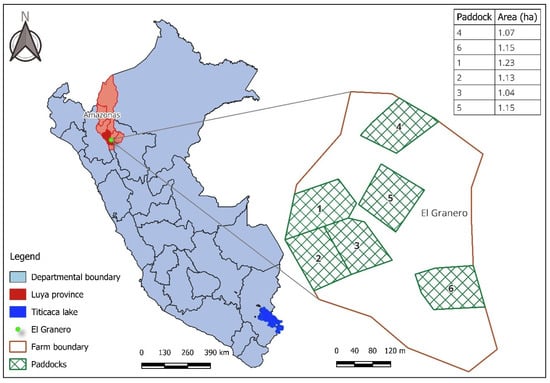
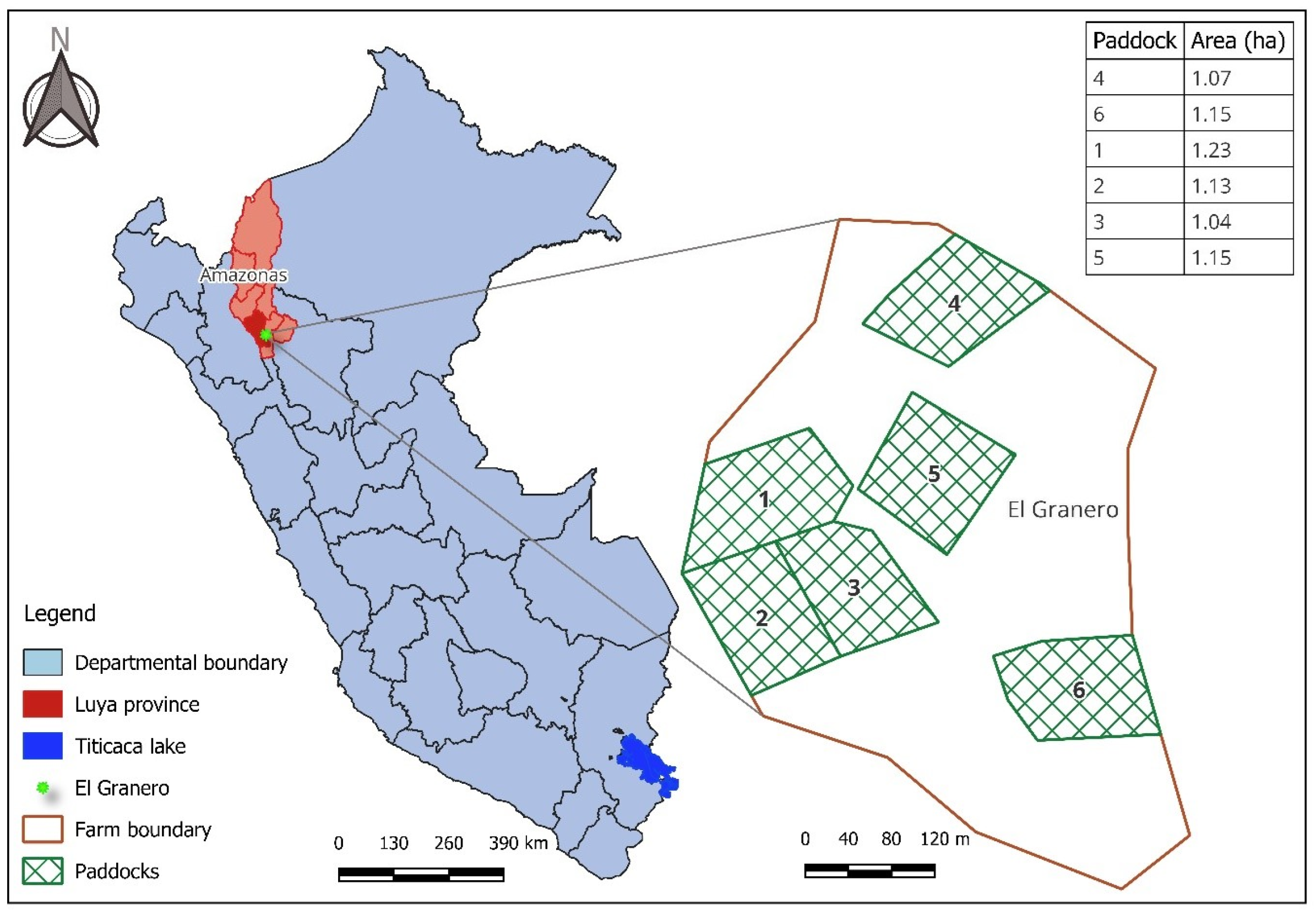
The study was conducted at the Eco2Kuelap farm, located in the Granero annex, Tingo District, Luya Province, Amazonas Region, Peru (Figure 1). The study area has a temperate-cold climate, with an average temperature of 15 °C and a relative humidity of 67%.
Figure 1.
Location of research site and distribution of paddocks.
2.2. Floristic Composition
Floristic composition was determined through a detailed vegetation survey in each paddock. Representative areas of the forage system were selected to ensure adequate spatial representation of the vegetation. The line transect method described by [29] was used. Sampling lines were established within each paddock, and the plant species present along each transect were systematically recorded at approximately 1.4-m intervals, resulting in 100 sampling points per paddock.
2.3. Experimental Animals
Eight Brown Swiss heifers, approximately eight months of age and with an average live weight of 250 ± 17.6 kg, were used in the study. The heifers were managed under an extensive grazing system using electric fencing. Six paddocks were evaluated, with each paddock representing a different grazing diet for the heifers. The diets consumed by the animals were collected via manual simulation [26]. This involved trailing eight heifers and manually replicating their diets in each grazing location adjacent to the grazing chosen by the animal (this ensured a similar sample in terms of vegetation composition and size) [30].
2.4. Feces Sample Collection and Chemical Analysis
Feces samples were collected in the morning after the heifers had grazed each experimental paddock for three consecutive days. Feces collection was performed directly from the rectum following gentle rectal stimulation with a sterile gloved hand. Approximately 500 g of feces was collected from each heifer. A total of 96 feces samples were obtained (6 diets × 8 heifers × 2 seasons). Samples were immediately stored in a cooler at approximately 4 °C and transported to the Laboratorio de Nutrición Animal y Bromatología de Alimentos (LABNUT) of the Universidad Nacional Toribio Rodríguez de Mendoza de Amazonas for subsequent analysis.
Feces samples were oven-dried (Memmert, Schwabach, Germany) at 60 °C for 48 h, ground using a blade mill (Tecnal, São Paulo, Brazil), and stored in screw-cap containers until analysis. Reference chemical analyses were performed to determine crude protein (CP), ash, neutral detergent fiber (NDF), acid detergent fiber (ADF), and in vitro dry matter digestibility (IVDMD). Crude protein was determined using the Kjeldahl method with a Kjeldahl digestion/distillation system (Tecnal, São Paulo, Brazil) according to AOAC [31]. Ash content was determined gravimetrically by incineration in a muffle furnace (Thermo Scientific, Dubuque, IA, USA) according to AOAC [32]. Neutral detergent fiber and ADF were determined according to Van Soest et al. [33] using an ANKOM 200 Fiber Analyzer (ANKOM Technology, Macedon, NY, USA), with sodium sulfite and α-amylase included in the NDF procedure. In vitro dry matter digestibility was determined according to the methodology of Tilley and Terry using a DAISY II incubator system (ANKOM Technology, Macedon, NY, USA).
2.5. Spectral Acquisition
The 96 dried feces samples were analyzed using both benchtop and portable NIRS instruments (Table 1); each sample was scanned in triplicate, resulting in a total of 288 spectra. For the benchtop NIRS instrument (Unity 2500XL, Brookfield, CT, USA), approximately 15 ± 0.5 g of each sample was placed in a quartz sample cup with an internal diameter of 94 mm and a height of 51 mm. Samples were scanned in triplicate at approximately 20 °C over the spectral range of 1100–2500 nm at 1-nm intervals. Spectral data were recorded as absorbance values expressed as log(1/R), where R represents reflectance.
Table 1.
Main characteristics of benchtop and portable NIRS instruments.
The same samples were subsequently analyzed using a portable NeoSpectra instrument (NEO1001, Menlo Park, CA, USA). Approximately 2 ± 0.005 g of each sample was placed in a sapphire sample cup with an internal diameter of 30 mm and a height of 15 mm. Each sample was scanned in triplicate over the spectral range of 1350–2500 nm at approximately 9.2-nm intervals. The resulting spectra were recorded as reflectance (%).
The spectral ranges covered by the two NIRS instruments include absorption regions associated with the overtone and combination vibrations of major chemical bonds, particularly O–H, C–H, and N–H groups. These spectral features are related to major constituents of biological samples, including water, proteins, carbohydrates, and lipids, and therefore provide the basis for predicting the chemical composition of feces samples using NIRS [34].
2.6. Calibration and Cross-Validation
Spectral preprocessing and calibration of the benchtop NIRS data were performed using UCAL v. 3.0.4.9 software. Raw spectra were preprocessed using standard normal variate (SNV) transformation and detrending (D) to minimize scattering effects, baseline shifts, and other sources of spectral variability. Samples with a Mahalanobis distance (H) ≥ 3 from the mean spectrum were considered spectral outliers and excluded from model development.
Four-digit mathematical treatments were evaluated for each parameter. The first digit represents the derivative order, the second indicates the gap, expressed as the number of data points over which the derivative was calculated, and the third and fourth digits indicate the number of data points used in the first and second smoothing operations, respectively (Table 2).
Table 2.
Number of factors, mathematical treatments, and scattering correction applied for benchtop and portable NIRS.
For the portable NIRS instrument, spectral preprocessing and chemometric analyses were performed using Eigenvector software version 9.5.0 (Eigenvector Research Inc., Manson, WA, USA). Raw spectra were preprocessed using standard normal variate (SNV) transformation and mean centering (MC) to reduce unwanted spectral variability and center the predictor variables before model development. Two-parameter mathematical treatments were evaluated for each trait, in which the first value represented the derivative order and the second represented the polynomial order (Table 2).
2.7. Calibration Models for Both the Benchtop and Portable NIRS Instruments Were Developed Using Partial Least Squares (PLS) Regression
Model performance was evaluated using the coefficient of determination for calibration (R2C), coefficient of determination for cross-validation (R2CV), standard error of calibration (SEC), and standard error of cross-validation (SECV). Models with higher R2C and R2CV values and lower, comparable SEC and SECV values were considered to have better predictive performance, greater robustness, and a lower risk of overfitting [22,35,36].
The predictive performance of the calibration models was interpreted according to their R2 values. Values between 0.50 and 0.65 indicate that the model is mainly suitable for discriminating between samples with high and low concentrations; values between 0.66 and 0.81 indicate suitability for approximate quantitative predictions; values between 0.82 and 0.90 indicate good predictive accuracy; and values above 0.91 indicate excellent predictive performance [35,37]. Additionally, the predictive performance was evaluated using the ratio of performance to deviation for cross-validation (RPDCV) using the formula described by Ikeogu et al. [38] and Sousa et al. [39] (RPDcv = SD/RMSECV). It was interpreted according to the following values: RPD ≥ 3, excellent prediction; 2.5 < RPD < 3, good prediction; 2.0 < RPD < 2.5, approximate predictions; and RPD < 2, difficult prediction [40,41].
3. Results
3.1. Pasture Floristic Composition
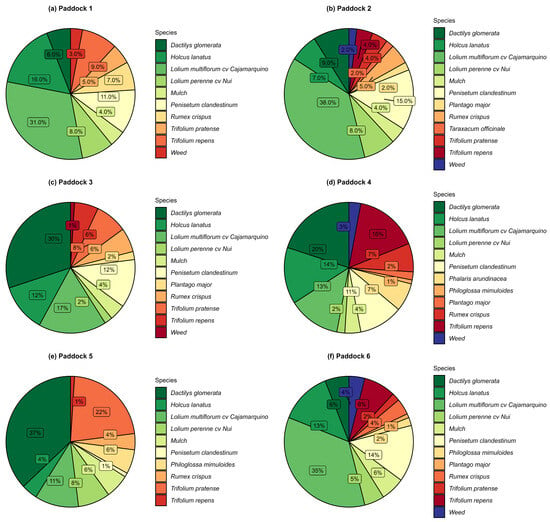
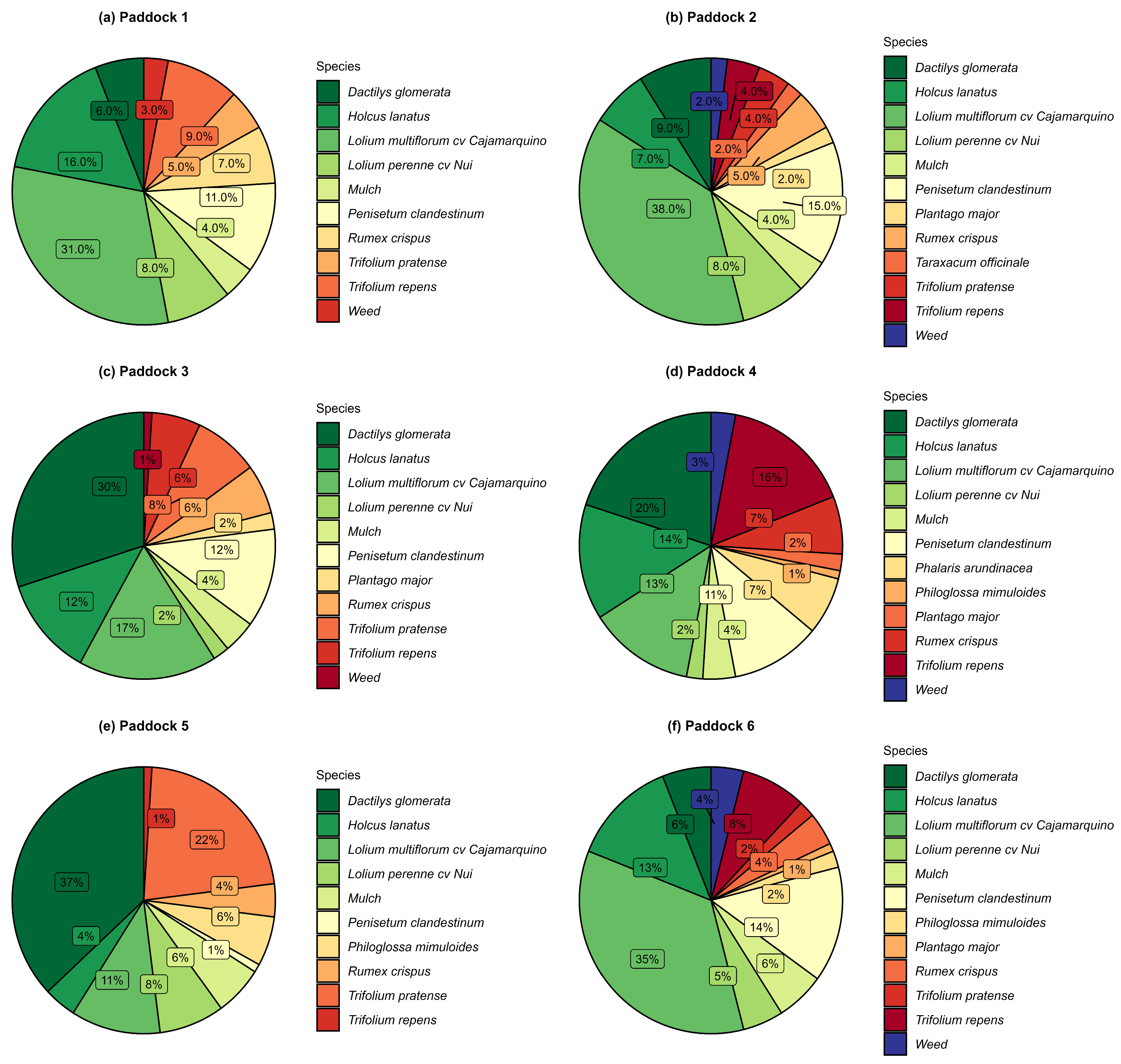
Figure 2 shows the relative proportion of forage species within each paddock. Species such as D. glomerata, H. lanatus, Lolium spp. (including cultivars such as cv. Cajamarquino and cv. Nui), T. pratense, and T. repens were the most representative. In paddock 1, a high predominance of L. multiflorum cv. Cajamarquino (31%) was observed, followed by H. lanatus and D. glomerata in intermediate proportions (6 to 16%), with a moderate presence of legumes (Trifolium spp.) and a low presence of weeds. Paddock 2 showed a marked dominance of L. perenne cv. Nui (38%), making it the most uniform system in terms of the main species. The other species were distributed in smaller proportions (2 to 17%), with a low incidence of weeds.
Figure 2.
Floristic composition of the evaluated paddocks (diets).
Paddock 3 showed greater floristic diversity, with a balanced presence of D. glomerata, H. lanatus, and L. perenne (30, 12, and 17%, respectively), in addition to a more evident presence of weeds. Paddock 4 had a higher proportion of weeds (3%) compared with some of the other paddocks, although D. glomerata and H. lanatus were still present at 20% and 14%, respectively.
Paddock 5 was characterized by a high dominance of D. glomerata (37%), accompanied by a significant contribution of legumes (T. pratense = 22%) and a lower presence of other grasses; no weeds were observed in this paddock. Paddock 6 exhibited a more heterogeneous distribution, with the simultaneous presence of D. glomerata, H. lanatus, Lolium sp., and a moderate presence of weeds (4%).
3.2. Feces Chemical Composition
The chemical composition of the feces from grazing heifers showed clear differences in the dynamics of nutrient utilization in the digestive tract (Table 3). CP content showed mean values ranging from 12.4% to 14.1%, with the highest feces protein concentration observed in diet IV (14.1%), followed by diet III (13.6%) and diet VI (13.2%). Comparatively, feces from diet IV showed approximately 13.6% more crude protein than feces from diet II. The within-diet variability of CP was relatively low in all feces samples, with coefficients of variation ranging from 5.2% (feces from diet II) to 8.2% (feces from diet IV).
Table 3.
Descriptive values of the chemical composition of feces from grazing heifers (n = 96).
Regarding mineral content, expressed as ash, mean values ranged from 16.2% to 19.6%. Feces from diet IV had the highest ash content (19.6%), whereas the lowest concentration was observed in feces from diet II (16.2%), with feces from diet IV exceeding those from diet II by approximately 21.3%. Feces from diets VI and III also showed relatively high mineral contents (18.5% and 17.5%, respectively). The lowest variability was observed in feces from diet IV, with a coefficient of variation of 7.5%.
NDF is an indicator related to the structural fraction of the feed and potential voluntary intake. The highest NDF values were recorded in feces from diet I (49.0%) and diet II (48.8%), whereas the lowest concentrations were observed in feces from diet VI (43.2%) and diet III (43.3%). The reduction in NDF in feces from diet VI compared with feces from diet I was approximately 11.8%. However, feces from diet IV showed high variability for this fraction (CV = 12.5%).
ADF is primarily associated with cellulose and lignin. Feces samples from the different diets showed mean ADF contents ranging from 31.3% to 37.2%. The highest content was observed in feces from diet I (37.2%), followed by diet II (36.7%), whereas the lowest levels corresponded to feces from diet V (31.30%), diet VI (34.0%), and diet III (34.1%). Feces samples from diet V showed an approximate reduction of 15.9% in ADF compared with those from diet I. However, the greatest variability in ADF was observed in feces from diet V, reaching 17.2%, as evidenced by the wide range observed (24.5–42.3%).
IVDMD showed relatively similar mean values among treatments, ranging from 62.1% to 66.2%. The highest IVDMD value was observed in feces from diet VI (66.2%), followed by feces from diet I (63.4%) and diet V (63.4%), whereas the lowest values were recorded in feces from diet IV (62.1%), diet III (62.6%), and diet II (62.7%). Feces from diet VI showed an approximate improvement of 6.6% compared with feces from diet IV. Furthermore, low variability was observed in feces from diet VI (5.8%).
3.3. Prediction of Feces Chemical Composition
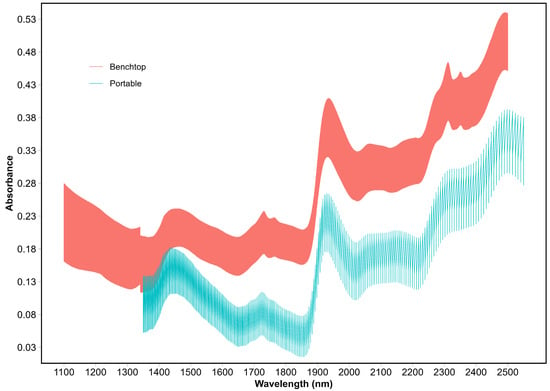
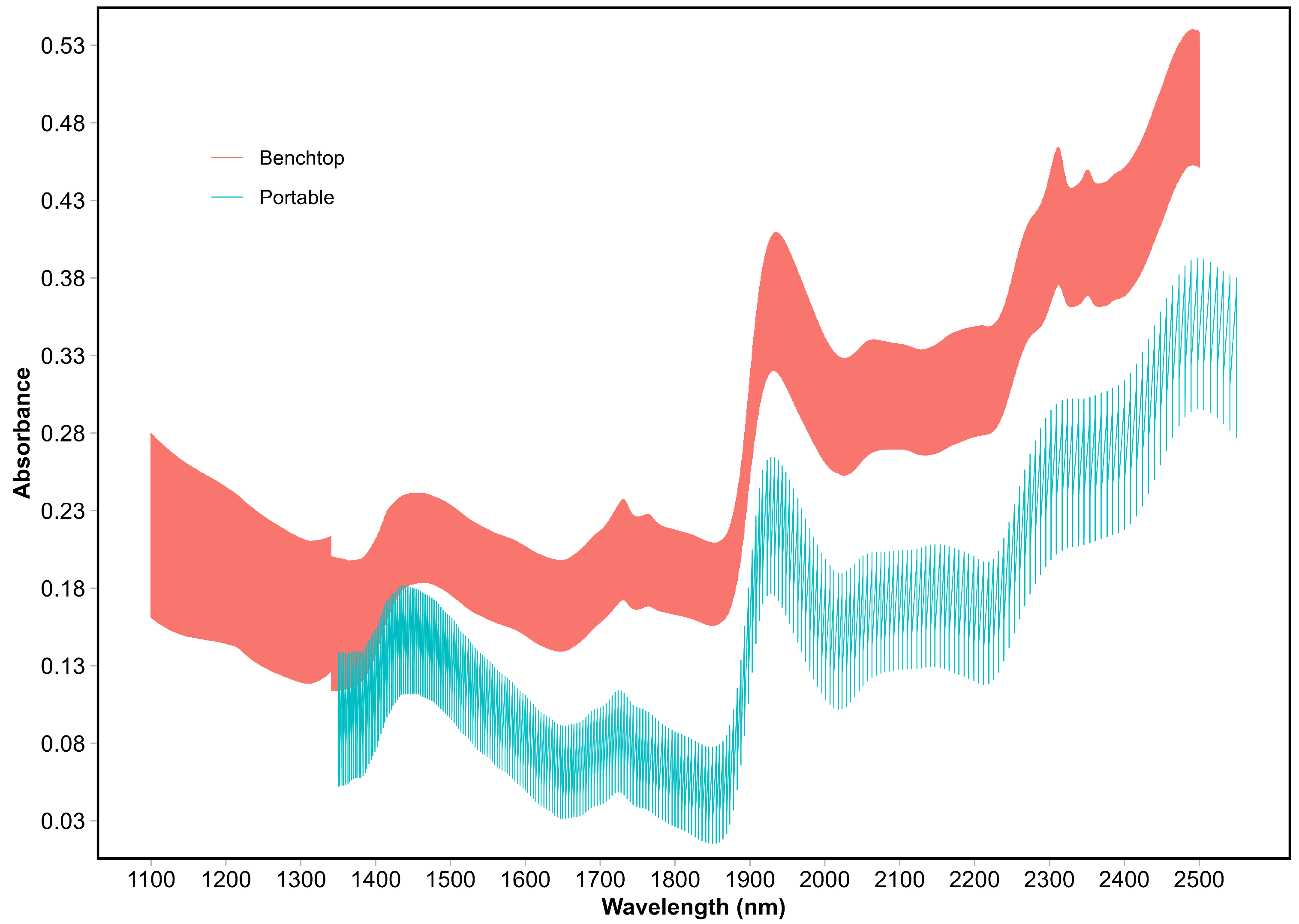
The spectral ranges of the benchtop and portable NIRS systems are shown in Figure 3. The NIR absorbance values for the benchtop system were higher than those for the portable system; furthermore, the spectral range was wider (1100–2500 nm) compared to that of the portable NIRS (1350–2500 nm).
Figure 3.
Portable and benchtop NIR spectra of all samples.
Table 4 shows the predictive performance of two NIRS systems (portable and benchtop) for estimating feces chemical composition in grazing Brown Swiss heifers, with differences in performance depending on the type of instrument and the parameter evaluated.
Table 4.
Evaluation statistics between teams of reference and predicted values obtained from the feces NIRS model.
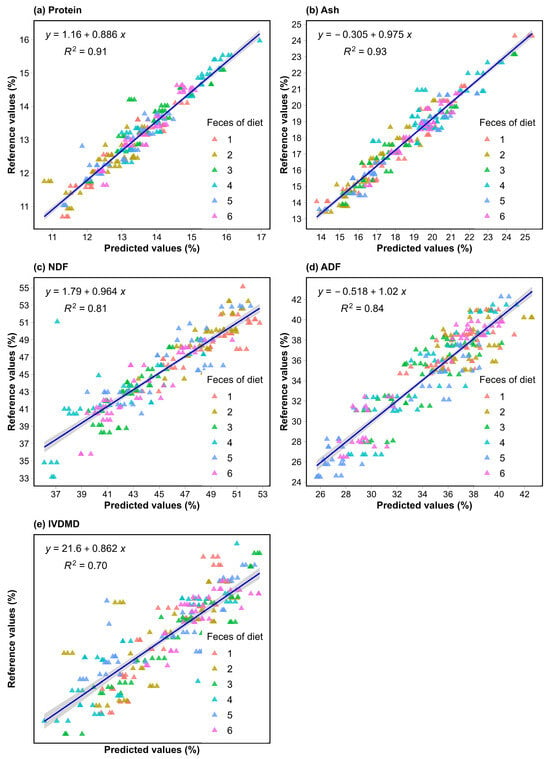
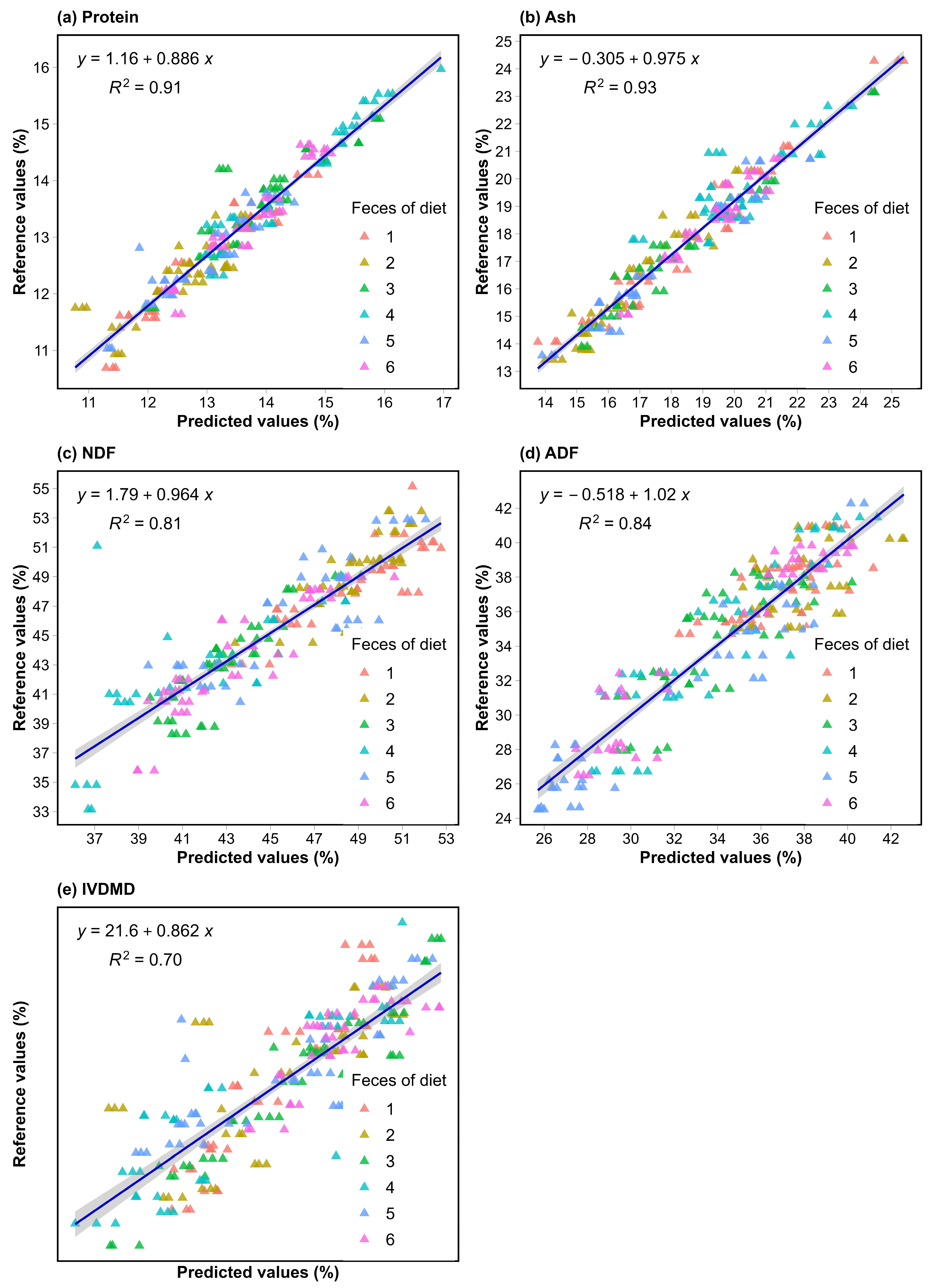
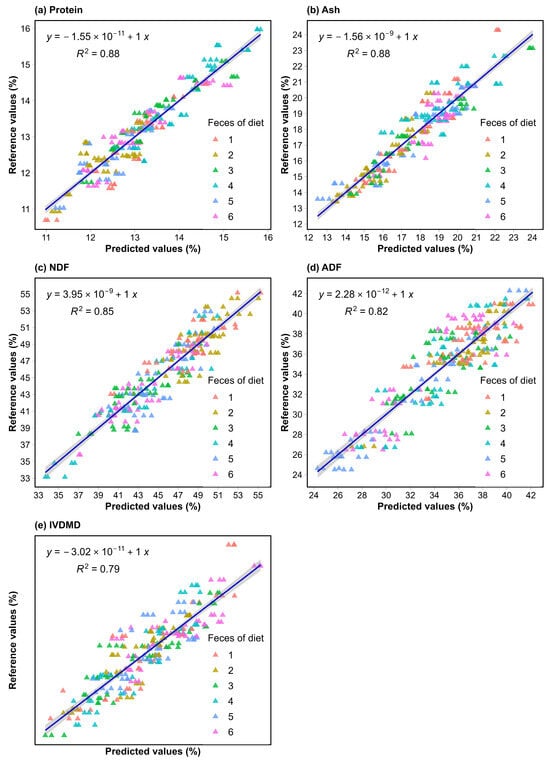
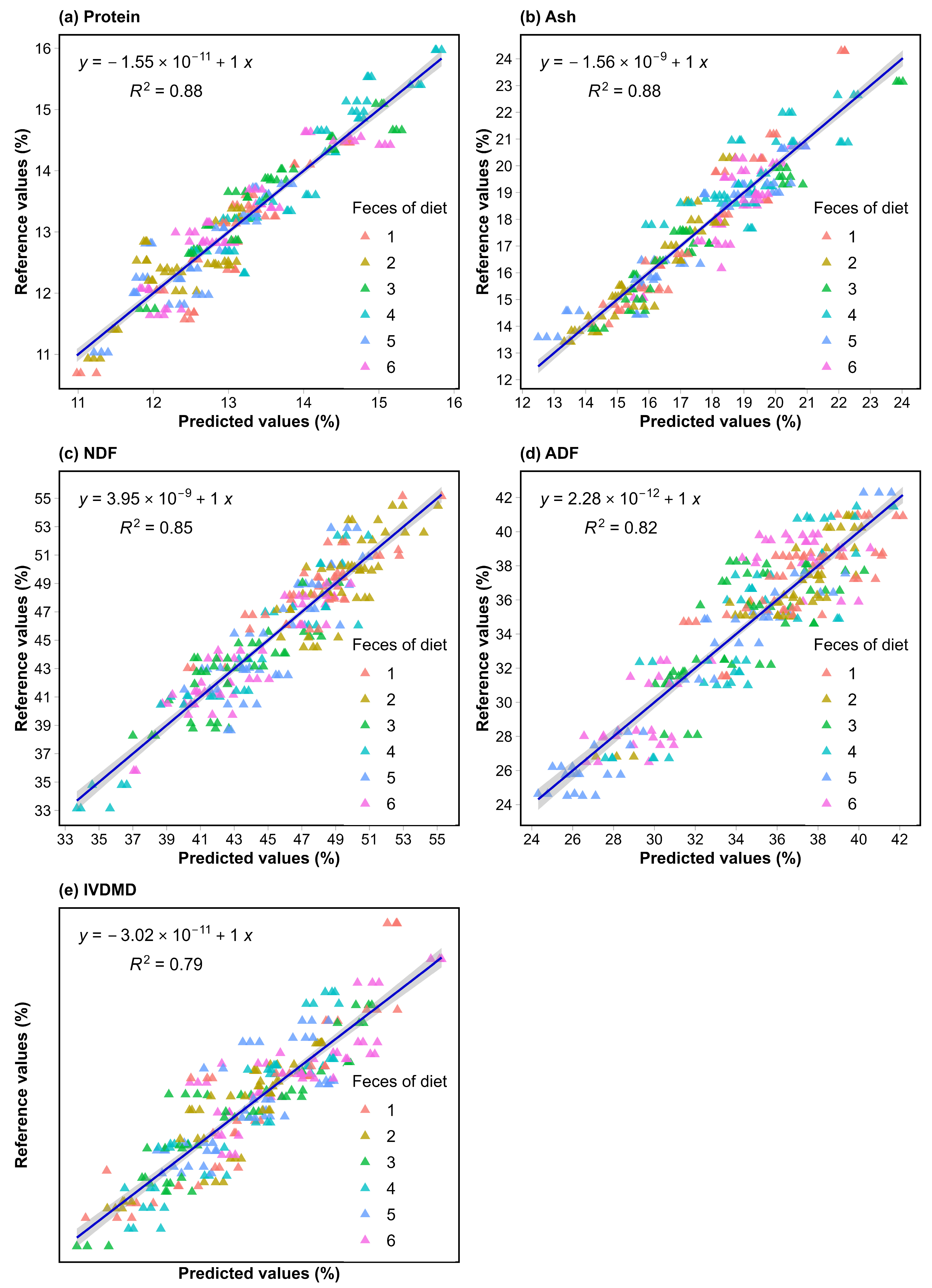
For CP, the benchtop instrument showed the best performance, with a high calibration coefficient of determination (R2C = 0.91; Figure 4) and a high cross-validation coefficient of determination (R2CV = 0.89; Table 4), accompanied by a low standard error of prediction (SEP = 0.34). In contrast, the portable instrument showed a lower fit (R2C = 0.88; Figure 5), with a higher prediction error (SEP = 0.42; Table 4).
Figure 4.
Relationship between reference and predicted values of feces chemical composition obtained with a benchtop instrument. (a) crude protein (%), (b) ash (%), (c) neutral detergent fiber (%), (d) acid detergent fiber (%), (e) in vitro dry matter digestibility (%), the gray lines represent confidence intervals, and the blue line represents the equation for Y.
Figure 5.
Relationship between reference and predicted values of feces chemical composition obtained with portable instrument. (a) crude protein (%), (b) ash (%), (c) neutral detergent fiber (%), (d) acid detergent fiber (%), (e) in vitro dry matter digestibility (%). the gray lines represent confidence intervals, and the blue line represents the equation for Y.
Regarding ash content, the benchtop NIR instrument demonstrated superior performance, achieving high coefficients of determination (R2C = 0.93; R2CV = 0.91; RPDCV = 2.81). The portable spectrometer yielded an acceptable R2C value (0.88) and an RPDCV of 2.57, despite having lower predictive capacity during cross-validation (R2CV = 0.85) (Table 4). For fibrous fractions, both systems showed intermediate performance. In the case of NDF, the portable NIR instrument showed higher R2CV values (0.80) and an RPDCV of 2.23, while the benchtop NIR showed an R2CV of 0.75 and an RPDCV of 1.70. ADF results were better with the benchtop NIR, showing an R2C of 0.84 and an RPDCV of 2.91. IVDMD was the parameter that presented the greatest predictive difficulty for both instruments, with R2C values of 0.70 and 0.79 for the benchtop and portable units, respectively; however, the RPDCV showed better results for the benchtop instrument, with a value of 3.4, indicating an excellent model (Table 4).
4. Discussion
The variability observed in the floristic composition of the six paddocks (diets) revealed important differences in agronomic management, grazing pressure, and ecological stability of the pastures. This variability is consistent with findings from livestock farms in the Peruvian Amazon; pasture health was associated with distinct levels of sustainability, highlighting the importance of evaluating production units according to their specific environmental and management conditions [42].
The systems were dominated by species such as Lolium spp., D. glomerata, and H. lanatus, along with legumes of the genus Trifolium, which is consistent with dairy systems in Andean and tropical temperate zones, where these species are among the main forage resources due to their high nutritional value [43].
Paddock 2 showed the greatest dominance of L. perenne cv. Nui (38%), indicating a productive and stable system. Species of the genus Lolium exhibit high digestibility in grazing systems, making them important for increasing biomass production and the nutritional quality of forage. Their management should consider flexibility in decision-making, integrating phenological stage and seasonality due to their direct influence on leaf area and pasture nutritional value [8]. This pattern suggests appropriate agronomic management with low invasion by undesirable species. Similarly, paddock 1 showed a predominance of L. multiflorum (31%), accompanied by D. glomerata and H. lanatus. It is necessary to develop tools that allow the determination of optimal mixtures of forage species suitable for different soil types, landscapes, climates, and production objectives in order to satisfy multiple functions in livestock systems [9]. In this context, the presence of D. glomerata and H. lanatus reflects a mixed production system characterized by good structural stability; however, it also shows greater floristic heterogeneity, suggesting the need for management strategies that optimize pasture composition and functionality.
Paddocks 1 and 5 showed a greater presence of legumes (T. repens and T. pratense), which is relevant from a nutritional perspective because these species increase forage protein content and contribute to nitrogen fixation in the system. Studies indicate that introducing appropriate legumes into pastures and identifying compatible cultivars suitable for different grass species could improve the adoption of this technology by producers [11]. Paddock 5 stood out due to the dominance of D. glomerata (37%), suggesting a stable system with lower weed pressure and greater persistence of high-yielding species. D. glomerata exhibits high productive potential, contributes to yield stability, improves productivity in forage mixtures, and reduces undesirable species in managed pastures, thus promoting sustainable and efficient long-term systems [10].
Paddocks 3, 4, and, to some extent, 6 showed a greater presence of undesirable species, including P. major, R. crispus, and other invasive species. Floristic composition directly influences the productivity of natural grasslands, making the implementation of sustainable grazing practices crucial. In systems with overgrazing or low fertilization, selection pressure favors opportunistic species, altering the structure and functionality of the ecosystem [14]. Paddock 4 exhibited the highest relative proportion of undesirable species, indicating a more advanced state of pasture degradation. The reduction in improved grass cover and changes in climatic conditions can increase the invasion of opportunistic species or weeds and decrease the productive capacity of the forage system [15].
The differences observed in the chemical composition of feces among diets reflect important variations in the efficiency of nutrient utilization at the ruminal and intestinal levels. In this sense, the variability in CP, ash, NDF, ADF, and IVDMD indicates that the floristic composition of the diets could have influenced fermentation processes and nutrient absorption [44,45,46].
The higher CP content in feces from diet IV suggests a lower efficiency of dietary nitrogen utilization, possibly associated with an imbalance between fermentable energy and degradable nitrogen in the rumen. In addition, the floristic composition of diet IV showed a greater presence of T. repens (16%), which could have increased nitrogen levels. This behavior has been described by Bach et al. [47], who indicated that when the energy-protein ratio is inefficient, the passage of unused nitrogen into the feces increases. Furthermore, the relatively low variability of feces CP in the other diets could be associated with a better balance between legumes and grasses. As indicated by Hristov et al. [48], balanced diets tend to reduce the variability of feces nitrogen excretion.
The higher ash values in feces from diet IV could be associated with greater excretion of unabsorbed minerals or lower mineral retention efficiency in the gastrointestinal tract. According to McDowell [49], feces mineral excretion is closely related to dietary bioavailability and the presence of indigestible complexes in the fibrous fraction. On the other hand, the lower ash concentration in feces from diet II suggests greater mineral absorption efficiency, which could be associated with better degradability of the feed matrix, as reported in systems with lower structural fiber content [50].
The higher NDF values in feces from diets I and II (49 and 48.8%, respectively) indicate a higher proportion of plant cell wall, which may limit voluntary intake due to rumen filling. The higher concentration of NDF in feces from these diets could be related to the greater presence of grasses in the floristic composition. Kendall et al. [51] stated that NDF influences intake and ruminal fermentation, which is slower in cows fed fibrous diets due to its physical effect on rumen distension. On the other hand, the reduction in NDF in feces from diet VI (43.2%) suggests greater potential degradability of the feed, which may favor the passage rate and improve the energy efficiency of the system. Furthermore, the floristic composition of diet IV (NDF = 44.1%) consisted of a higher percentage of legumes, which could be reflected in the lower concentration of NDF in feces. This behavior has been reported by Shi et al. [52], who indicated that diets with lower digestible NDF increase the rate of intake and net energy utilization. Additionally, Mejía et al. [26] reported 49.65% NDF in grazing heifer diets, indicating that NDF plays an important role in determining ruminal fermentation and feed intake.
Higher ADF values in feces from diets I and II (37.2 and 36.7%, respectively) reflect a higher proportion of cell wall components (cellulose and lignin), associated with lower ruminal digestibility. In these diets, the floristic composition consisted mainly of grasses, which agrees with Van Soest [44], who established an inverse relationship between ADF and forage digestibility. In contrast, the decrease in feces ADF in diet V (31.3%) suggests better structural quality of the feed, although the observed variability could be explained by heterogeneity in floristic composition or differences in diet selection [53]. Furthermore, the higher in vitro digestibility of feces from diet VI (66.2%) suggests better synchronization between energy and protein fractions, optimizing ruminal microbial efficiency [47]. Finally, the low variability in these feces suggests more stable and efficient fermentation, consistent with the findings of Offner and Sauvant [54] in comparative digestibility systems in ruminants.
Grazing livestock select plant species and parts based on accessibility, phenological stage, and nutritional quality; consequently, the chemical composition of the selected diet can differ substantially from that of the forage available in the pasture [55,56]. In the present study, the description of the floristic composition covered all species present in the pasture, whereas diet samples were obtained using the method described by Mejía et al. [26]. This distinction is significant because fecal composition represents the post-digestive residue of the selected diet and thus integrates information regarding both diet composition and digestive utilization; this approach has been successfully applied to estimate diet quality, fiber fractions, and digestibility [57,58]. Furthermore, a higher number of species preferred by livestock and a lower frequency of weeds were recorded in the pastures (Figure 2).
The results of this study demonstrate the superiority of the benchtop NIRS equipment over the portable NIRS instrument in predicting the chemical composition of feces from grazing heifers for CP and ash; however, NDF, ADF, and IVDMD showed better R2CV values with the portable instrument. These results confirm the reliability of NIRS equipment for predicting the chemical composition of feces from grazing heifers. Yamada et al. [59] confirmed that portable instruments can achieve adequate accuracy for fiber and protein under uncontrolled conditions. Hernández-Jiménez et al. [60] indicated that portable instruments can even outperform benchtop instruments, depending on the type of variable analyzed. These results agree with Hossain et al. [2], who highlighted the advantages of benchtop NIR equipment due to its optical stability, higher spectral resolution, and better signal-to-noise ratio. Similarly, Mendes et al. [61] and Acosta et al. [62] corroborated that benchtop and portable equipment can be satisfactorily used to predict the chemical composition of forages.
Portable NIR demonstrated higher R2 values, while having lower spectral resolution compared with the benchtop, which may be explained by the broad, overlapping, and highly collinear nature of NIR absorption bands, where a higher number of spectral variables does not necessarily provide proportionally more chemically relevant information [22,63]. The 257-spectrum covering 1350–2500 nm may therefore retain sufficient information associated with C–H and C–O absorption features related to structural carbohydrates and forage digestibility [64,65]. At the 1730 wavelength, which is associated with cellulose and hemicellulose, 2100 is associated with cellulose [66]. However, these results should not be interpreted as an intrinsic advantage of lower spectral resolution, since differences in optical configuration, sample–radiation interaction, spectral preprocessing, and chemometric modeling may also influence predictive performance [63].
Regarding IVDMD, both instruments showed lower performance compared with the other parameters; however, the portable NIR instrument achieved better R2C (0.79) and R2CV (0.76). Digestibility is a highly complex and multifactorial variable that is difficult to predict using NIRS [18,61,67] due to complex plant-microbiome interactions, lignification, and ruminal degradation processes that do not generate linear spectral signals.
Additionally, biological variability in tropical grazing systems increases noise in calibrations [68], which reduces the predictive capacity of linear models. In this context, the use of artificial intelligence and deep neural networks has been shown to improve prediction by capturing nonlinear relationships in the spectra [56]. Peters et al. [18] found R2CV values between 0.65 and 0.74 for digestibility and chemical composition in cattle diets, which is consistent with the low accuracy observed for IVDMD.
Xu et al. [3] reported R2 values for CP (0.93) in cows, (0.89) in calves and ash (0.84) in cow and (0.97) in Holstein calves’ feces. In this same study, R2 values of 0.82 for NDF and 0.74 for ADF were reported for Holstein cow feces, and R2 values of 0.76 and 0.92 for NDF and ADF, respectively, for Holstein calf feces. In tropical systems, Boval et al. [56] observed R2 values of CP = 0.98, NDF = 0.88, and ADF = 0.89 in feces from Creole cattle, confirming the diet-feces relationship. Similarly, in feces from lactating buffaloes, Guerra et al. [67] reported R2 values of 0.86 (CP), 0.88 (ash), and 0.84 (NDF), with lower performance for ADF (R2 = 0.67). We found calibration R2 values between 0.81 and 0.93 (Table 4), which fall within the ranges reported for feces. These differences could be associated with the equipment used, sample size, and the variability of the diet consumed; Xu et al. [3] used benchtop equipment and a homogeneous diet throughout the experiment, whereas in our study, the diet varied according to species availability in each paddock (Figure 2).
Feces NIRS models have also shown high predictive capacity in cross-validation for protein (R2CV = 0.91) and organic matter digestibility (R2CV = 0.85) in cattle and sheep [69]. Similarly, the PLS model achieved R2 = 0.80 for organic matter digestibility in cow feces [70]. Furthermore, R2CV values of 0.83 for NDF and 0.59 for ADF have been reported in cattle receiving variable diets [71]. These results confirm the consistency of the literature regarding the greater accuracy of NIRS for direct chemical variables compared with complex biological variables such as feces digestibility.
On the other hand, the competitive performance of portable NIRS in predicting NDF and ADF (R2C > 0.85 and 0.82) highlights its potential for in situ monitoring. McVey et al. [21] indicated that the spectral bands associated with structural carbohydrates are highly stable, while Jahani et al. [20] emphasized their usefulness in extensive systems due to their rapid diagnostic capabilities. Yamada et al. [59] reinforced that these instruments maintain adequate performance under uncontrolled conditions. Finally, mathematical and computational models allow for the optimization of animal production, reducing costs and emissions through empirical and mechanistic approaches that improve the efficiency of sustainable production systems [45].
5. Conclusions
The floristic composition showed a dominance of Lolium sp. (31–38%) and D. glomerata (20–37%), followed by H. lanatus (6–16%) and Trifolium sp. (11–22%). Paddocks with greater floristic uniformity had a lower proportion of weeds (0–4%), whereas more heterogeneous systems showed greater functional diversity, reflecting structural differences in the stability and productivity of the evaluated pastures.
The chemical composition of feces varied among the evaluated diets. Crude protein content ranged from 12.4% to 14.1%, with the highest value recorded in samples corresponding to diet IV. Ash concentration ranged from 16.2% to 19.6%, indicating differences in the excretion of mineral components. Neutral detergent fiber ranged from 43.2% to 49.0%, while acid detergent fiber ranged from 31.3% to 37.2%, indicating variations in the proportion of residual structural fiber. In vitro digestibility ranged from 62.1% to 66.2% and showed little variation among feces samples, suggesting relatively stable behavior of this parameter among the studied diets.
The behavior of R2 values, prediction errors, and RPD values indicates that no single instrument was consistently superior across all evaluated parameters. These results demonstrate that both portable and benchtop NIR instruments can be used for the rapid characterization of feces from grazing cattle; however, instrument performance depends on the parameter being analyzed and the specific calibration employed. Consequently, model selection should be based on the nutritional parameter of interest rather than solely on the type of instrument. Furthermore, variations in pasture botanical composition were observed to be associated with changes in fecal chemical composition. The results indicate that both portable and benchtop NIR are suitable tools for the rapid and non-destructive estimation of feces composition in grazing heifers.
Author Contributions
Conceptualization, F.L.M. and J.Ñ.; methodology, F.L.M.; software, L.V. and I.Y.; validation, Y.P., W.B. (William Bardales) and S.J.Z.-H.; formal analysis, Y.P. and L.V.; investigation, F.L.M.; resources, W.B. (Wilmer Bernal); data curation, Y.P.; writing—original draft preparation, F.L.M.; writing—review and editing, W.B. (Wilmer Bernal), J.A.S.-U. and W.B. (William Bardales); visualization, J.A.S.-U. and S.J.Z.-H.; supervision, J.Ñ.; project administration, J.Ñ.; funding acquisition, J.Ñ. and W.B. (Wilmer Bernal). All authors have read and agreed to the published version of the manuscript.
Funding
Thanks to Vicerrectorado de Investigación of the Universidad Nacional Toribio Rodríguez de Mendoza de Amazonas for logistical support during the writing process and for paying the APC for this manuscript.
Institutional Review Board Statement
The experimental procedures involving data collection (collection of heifer feces) from animals were approved by the Institutional Ethics Committee for Scientific Research of the National University Toribio Rodríguez de Mendoza of Amazonas, under number CIEI-N° 00165, approved on 7 May 2025.
Informed Consent Statement
Written informed consent was obtained from the owner of the animals involved in this study.
Data Availability Statement
The original contributions presented in this study are included in the article. Further inquiries can be directed to the corresponding author.
Acknowledgments
The authors thank the National Council of Science, Technology and Technological Innovation of Peru (CONCYTEC) for funding the study under grant number 178-2015-FONDECYT. The graphical abstract was done help using ChatGPT, model GPT-6, of OpenAI (San Francisco, CA, USA).
Conflicts of Interest
The authors declare no conflicts of interest.
Abbreviations
The following abbreviations are used in this manuscript:
| NIRS | Near-infrared spectroscopy |
| CP | Crude protein |
| IVDMD | In vitro dry matter digestibility |
| NDF | Neutral detergent fiber |
| ADF | Acid detergent fiber |
| PLS | Partial least squares |
| R2 | Coefficient of determination |
| R2C | Calibration coefficient of determination |
| R2CV | Cross-validation coefficient of determination |
| D | Detrend |
| H | Mahalanobis distance |
| MC | Mean center |
| SNV | Standard normal variate |
| SEC | Standard error of calibration |
| SECV | Standard error of cross-validation |
| RMSEC | Root mean square error of calibration |
| RMSECV | Root mean square error of cross-validation |
| SEP | Standard error of prediction |
| RPDCV | Ratio of performance to deviation for cross-validation |
References
- Dixon, R.; Coates, D. Review: Near infrared spectroscopy of faeces to evaluate the nutrition and physiology of herbivores. J. Near Infrared Spectrosc. 2009, 17, 1–31. [Google Scholar] [CrossRef] [Scilit]
- Hossain, M.E.; Kabir, M.A.; Zheng, L.; Swain, D.L.; McGrath, S.; Medway, J. Near-infrared spectroscopy for analysing livestock diet quality: A systematic review. Heliyon 2024, 10, e40016. [Google Scholar] [CrossRef] [Scilit] [PubMed]
- Xu, Y.; Chen, T.; Zhang, H.; Nuermaimaiti, Y.; Zhang, S.; Wang, F.; Xiao, J.; Liu, S.; Shao, W.; Cao, Z.; et al. Application of Near-Infrared Reflectance Spectroscopy for Predicting Chemical Composition of Feces in Holstein Dairy Cows and Calves. Animals 2024, 14, 52. [Google Scholar] [CrossRef] [Scilit] [PubMed]
- Farruggia, A.; Pomiès, D.; Coppa, M.; Ferlay, A.; Verdier-Metz, I.; Le Morvan, A.; Bethier, A.; Pompanon, F.; Troquier, O.; Martin, B. Animal performances, pasture biodiversity and dairy product quality: How it works in contrasted mountain grazing systems. Agric. Ecosyst. Environ. 2014, 185, 231–244. [Google Scholar] [CrossRef] [Scilit]
- Saucedo-Uriarte, J.A.; Diaz-Quevedo, C.; Milla Pino, M.E.; Durand Chávez, L.M.; Linares Rivera, J.L.; Vásquez Pérez, H.V.; Quispe-Ccasa, H.A. Sustentabilidad productiva de la instalación de sistemas silvopastoriles: Una revisión sistemática basada en la realidad de Perú y Colombia. Cienc. Y Tecnol. Agropecu. 2023, 24, e3048. [Google Scholar] [CrossRef] [Scilit]
- Baudoin, W.T.J.; Avana, T.M.L.; Hamawa, Y.; Nguetsop, V.F.; Tsobou, R.; Ngnignindiwou, M.J. Floristic diversity and management of fodder resources of the natural pastures of the Savanna Highlands of Western Cameroon. J. Exp. Sci. 2020, 11, 28–34. [Google Scholar] [CrossRef] [Scilit]
- Saucedo-Uriarte, J.A.; Oliva-Cruz, S.M.; Maicelo-Quintana, J.L.; Meléndez-Mori, J.B.; Collazos-Silva, R. Silvopastoral arrangements with Alnus acuminata and their effect on productive and nutritional parameters of the forage component. Rev. Mex. Cienc. Pecu. 2022, 13, 573–583. [Google Scholar] [CrossRef] [Scilit]
- Chapman, D.F.; Tharmaraj, J.; Agnusdei, M.; Hill, J. Regrowth dynamics and grazing decision rules: Further analysis for dairy production systems based on perennial ryegrass (Lolium perenne L.) pastures. Grass Forage Sci. 2012, 67, 77–95. [Google Scholar] [CrossRef] [Scilit]
- Sanderson, M.A.; Goslee, S.C.; Soder, K.J.; Skinner, R.H.; Tracy, B.F.; Deak, A. Plant species diversity, ecosystem function, and pasture management: A perspective. Can. J. Plant Sci. 2007, 87, 479–487. [Google Scholar] [CrossRef] [Scilit]
- Verma, S.; Herrmann, A.; Taube, F.; Nyameasem, J.K.; Ehrhard, D.; Malisch, C.S.; Kluß, C.; Poyda, A. Functional diversity enhances grassland productivity, but species identity drives performance. Agric. Ecosyst. Environ. 2026, 397, 110091. [Google Scholar] [CrossRef] [Scilit]
- Khatiwada, B.; Acharya, S.N.; Young, D.; Kopp, K.; Banmann, A.; Lupwayi, N.Z. Benefits of mixed grass–legume pastures and pasture rejuvenation using bloat-free legumes in western Canada: A review. Can. J. Plant Sci. 2020, 100, 463–476. [Google Scholar] [CrossRef] [Scilit]
- Vallejos-Fernández, L.; Alvarez-García, W.; Paredes-Arana, M.; Odriozola, S.S.; Guillén-Sanchez, R.; Pinares-Patiño, C.; Bustíos-Valdivia, J.; García Ticllacuri, R. Comportamiento productivo y valor nutricional de siete genotipos de trébol en tres pisos altitudinales de la sierra norte del Perú. Rev. Investig. Vet. Perú 2021, 32, e17690. [Google Scholar] [CrossRef] [Scilit]
- Sollenberger, L.E.; Kohmann, M.M.; Dubeux, J.C.B.; Silveira, M.L. Grassland management affects delivery of regulating and supporting ecosystem services. Crop Sci. 2019, 59, 441–459. [Google Scholar] [CrossRef] [Scilit]
- Vaca-Cárdenas, M.L.; Oleas-Lopez, J.M.; Jiménez-Yánez, S.F.; Costales Zavala, F.R.; Vaca-Cárdenas, P.V.; Cushquicullma-Colcha, D.F.; Moscoso-Gómez, M.E. Floristic Composition of Andean Moorlands and Its Influence on Natural Pasture Productivity: Implications for the Sustainable Management of Alpaca Grazing in Guamote, Ecuador. Conservation 2026, 6, 15. [Google Scholar] [CrossRef] [Scilit]
- Vélez-Mora, D.P.; Gusmán, E.; Espinosa, C.I.; Quintana-Ascencio, P.F. Changes in climate, grazing pressure and nutrient inputs affect the structural integrity and functioning of Andean shrublands. Plant Ecol. Divers. 2022, 15, 309–327. [Google Scholar] [CrossRef] [Scilit]
- Lyons, R.K.; Stuth, J.W.; Angerer, J.P. Technical Note: Fecal NIRS equation field validation. J. Range Manag. 1995, 48, 380–382. [Google Scholar] [CrossRef] [Scilit]
- Jancewicz, L.J.; Swift, M.L.; Penner, G.B.; Beauchemin, K.A.; Koenig, K.M.; Chibisa, G.E.; He, M.L.; McKinnon, J.J.; Yang, W.Z.; McAllister, T.A. Development of near-infrared spectroscopy calibrations to estimate fecal composition and nutrient digestibility in beef cattle. Can. J. Anim. Sci. 2017, 97, 51–64. [Google Scholar] [CrossRef] [Scilit]
- Peters, J.F.; Swift, M.L.; Penner, G.B.; Lardner, H.A.; McAllister, T.A.; Ribeiro, G.O. Predicting fecal composition, intake, and nutrient digestibility in beef cattle consuming high forage diets using near infrared spectroscopy. Transl. Anim. Sci. 2023, 7, txad043. [Google Scholar] [CrossRef] [Scilit] [PubMed]
- Ramos, R.; Basurto, R.; Ramírez, E.; Reis de Souza, T.C.; Mariscal, G. Predicción de la composición química de las heces y digesta ileal de cerdos mediante espectroscopia de reflectancia en el infrarrojo cercano (NIRS). Rev. Mex. Cienc. Pecu. 2023, 14, 488–504. [Google Scholar] [CrossRef] [Scilit]
- Jahani, R.; van Ruth, S.; Weesepoel, Y.; Alewijn, M.; Kobarfard, F.; Faizi, M.; Shojaee AliAbadi, M.H.; Mahboubi, A.; Nasiri, A.; Yazdanpanah, H. Comparison of Portable and Benchtop Near-Infrared Spectrometers for the Detection of Citric Acid-adultered Lime Juice: A Chemometrics Approach. Iran. J. Pharm. Res. 2022, 21, e128372. [Google Scholar] [CrossRef] [Scilit] [PubMed]
- McVey, C.; Gordon, U.; Haughey, S.A.; Elliott, C.T. Assessment of the analytical performance of three near-infrared spectroscopy instruments (Benchtop, handheld and portable) through the investigation of coriander seed authenticity. Foods 2021, 10, 956. [Google Scholar] [CrossRef] [Scilit] [PubMed]
- Pasquini, C. Near infrared spectroscopy: A mature analytical technique with new perspectives—A review. Anal. Chim. Acta 2018, 1026, 8–36. [Google Scholar] [CrossRef] [Scilit] [PubMed]
- Rinnan, Å.; Van Der Berg, F.W.J.; Engelsen, S.B. Review of the most common pre-processing techniques for near-infrared spectra. TrAC Trends Anal. Chem. 2009, 28, 1201–1222. [Google Scholar] [CrossRef] [Scilit]
- Mejía, F.; Yoplac, I.; Bernal, W.; Castro, W. Evaluación de modelos de predicción de composición química y energía bruta de kikuyo (Pennisetum clandestinum) usando espectroscopía en infrarrojo cercano (NIRS). Rev. Investig. Vet. Perú 2019, 30, 1068–1076. [Google Scholar] [CrossRef] [Scilit]
- Mejía, F.; Bernal, W.; Zamora, J.; Yoplac, I. Predicción de la composición química de harina de sangre bovina mediante Espectroscopia de Reflectancia en el Infrarrojo Cercano (NIRS). Rev. De Investig. Agropecu. Sci. Biotechnol. 2021, 1, 15–21. [Google Scholar] [CrossRef] [Scilit]
- Mejía, F.L.; Yoplac, I.; Flores, E.R.; Paucar, Y.; Saucedo-Uriarte, J.A.; Bardales, W.; Vasquez, H.V.; Ñaupari, J. NIRS for predicting Brown Swiss heifer diet composition on mixed pastures in the Amazon region. Trop. Anim. Health Prod. 2026, 58, 286. [Google Scholar] [CrossRef] [Scilit] [PubMed]
- Oliva, M.; Collazos, R.; Vásquez, H.V.; Rubio, K.; Quintana, J.L.M. Composición florística de especies herbáceas forrajeras en praderas naturales de las principales microcuencas ganaderas de la región Amazonas. Sci. Agropecu. 2019, 10, 109–117. [Google Scholar] [CrossRef] [Scilit]
- Escobar, L.O.; Mejía, F.L.; Vasquez, H.; Bernal, W.; Álvarez, W.Y. Composición botánica y evaluación nutricional de pasturas en diferentes sistemas silvopastoriles en Molinopampa, Región Amazonas, Perú. Livest. Res. Rural Dev. 2020, 32, 96. [Google Scholar]
- Ruyle, G.; Dyess, J. Rangeland Monitoring and the Parker 3-Step Method: Overview, Perspectives and Current Applications; University of Arizona, Arizona Cooperative Extension: Tucson, AZ, USA, 2010. [Google Scholar]
- Quispe, C.; Ñaupari, J.; Distel, R.A.; Flores, E. Feeding selection of sheep and alpaca on puna tussock rangelands grazed previously by cattle. Small Rumin. Res. 2021, 197, 106349. [Google Scholar] [CrossRef] [Scilit]
- AOAC International. Official Methods of Analysis of AOAC International, 19th ed.; Method 984.13: Protein (crude) in animal feed and pet food—Kjeldahl method; AOAC International: Gaithersburg, MD, USA, 2012. [Google Scholar]
- AOAC International. Official Methods of Analysis of AOAC International, 22nd ed.; AOAC International: Gaithersburg, MD, USA, 2023. [Google Scholar]
- Van Soest, P.J.; Robertson, J.B.; Lewis, B.A. Methods for Dietary Fiber, Neutral Detergent Fiber, and Nonstarch Polysaccharides in Relation to Animal Nutrition. J. Dairy Sci. 1991, 74, 3583–3597. [Google Scholar] [CrossRef] [Scilit] [PubMed]
- Stocco, G.; Cipolat-Gotet, C.; Ferragina, A.; Berzaghi, P.; Bittante, G. Accuracy and biases in predicting the chemical and physical traits of many types of cheeses using different visible and near-infrared spectroscopic techniques and spectrum intervals. J. Dairy Sci. 2019, 102, 9622–9638. [Google Scholar] [CrossRef] [Scilit] [PubMed]
- Shenk, J.S.; Westerhaus, M.O. The application of Near Infrared Reflectance Spectroscopy (NIRS) to Forage Analysis. In Forage Quality, Evaluation, and Utilization; Agricultural Research Service; Wiley: Hoboken, NJ, USA, 1994; pp. 406–449. [Google Scholar] [CrossRef] [Scilit]
- Shenk, J.S.; Westerhaus, M.O. Calibration the ISI Way. In Near Infrared Spectroscopy: The Future Waves; Davies, A.M.C., Williams, P.C., Eds.; NIR Publications: Chichester, UK, 1996; pp. 198–202. [Google Scholar]
- Molano, M.L.; Cortés, M.L.; Ávila, P.; Martens, S.D.; Muñoz, L.S. Ecuaciones de calibración en espectroscopía de reflectancia en el infrarrojo cercano (NIRS) para predicción de parámetros nutritivos en forrajes tropicales. Trop. Grassl.-Forrajes Trop. 2016, 4, 139–145. [Google Scholar] [CrossRef] [Scilit][Green Version]
- Ikeogu, U.N.; Davrieux, F.; Dufour, D.; Ceballos, H.; Egesi, C.N.; Jannink, J.-L. Rapid analyses of dry matter content and carotenoids in fresh cassava roots using a portable visible and near infrared spectrometer (Vis/NIRS). PLoS ONE 2017, 12, e0188918. [Google Scholar] [CrossRef] [Scilit] [PubMed]
- Souza Ferreira, I.J.; dos Santos, D.A.L.; Tonetto, S.; Carvalho, N.A.; Teruel, B. Monitoring pesticides with portable NIR spectroscopy in different intact fruits. J. Food Compos. Anal. 2025, 148, 108024. [Google Scholar] [CrossRef] [Scilit]
- Yadav, S.; Tomar, M.; Singhal, T.; Joshi, N.; Bhargavi, H.A.; Aavula, N.; Langyan, S.; Joshi, T.; Satyavathi, C.T.; Rana, J.C.; et al. Near-infrared reflectance spectroscopy (NIRS): An innovative, rapid, economical, easy and non-destructive whole grain analysis method for nutritional profiling of pearl millet genotypes. J. Food Compos. Anal. 2025, 142, 107373. [Google Scholar] [CrossRef] [Scilit]
- Saeys, W.; Mouazen, A.M.; Ramon, H. Potential for onsite and online analysis of pig manure using visible and near infrared reflectance spectroscopy. Biosyst. Eng. 2005, 91, 393–402. [Google Scholar] [CrossRef] [Scilit]
- Torres Jara de García, G.P.; Durand-Chávez, L.M.; Quispe-Ccasa, H.A.; Linares-Rivera, J.L.; Portocarrero, G.T.S.; Tito, R.C.; Vásquez, H.V.; Maicelo, J.L.; Ampuero-Trigoso, G.; Robles, R.; et al. Sustainability of livestock farms: The case of the district of Moyobamba, Peru. Heliyon 2023, 9, e13153. [Google Scholar] [CrossRef] [Scilit] [PubMed]
- Bobadilla, L.G.; Altamirano-Tantalean, M.A.; Carrasco-Chilón, W.; Silva Baca, V.L.; Mejía, F.L.; Paucar, Y.; Valqui, L.; Bardales, W.; Maicelo, J.L.; Vásquez, H.V. Agronomic and Nutritional Potential of Ryegrass (Lolium multiflorum Lam.) Accessions as Raw Material for Silage in the Tropical Andes of Peru. Agronomy 2026, 16, 275. [Google Scholar] [CrossRef] [Scilit]
- Van Soest, P.J. Nutritional Ecology of the Ruminant, 2nd ed.; Cornell University Press: Ithaca, NY, USA, 1994. [Google Scholar]
- Tedeschi, L.O.; Fox, D.G.; Sainz, R.D.; Barioni, L.G.; Medeiros, S.R.; Boin, C. Mathematical models in ruminant nutrition. Sci. Agric. 2005, 62, 76–91. [Google Scholar] [CrossRef] [Scilit]
- Li, W.; Ye, B.; Wu, B.; Yi, X.; Li, X.; A, R.; Cui, X.; Zhou, Z.; Cheng, Y.; Zhu, X.; et al. Effect of Total Mixed Ration on Growth Performance, Rumen Fermentation, Nutrient Digestion, and Rumen Microbiome in Angus Beef Cattle during the Growing and Fattening Phases. Fermentation 2024, 10, 205. [Google Scholar] [CrossRef] [Scilit]
- Bach, A.; Calsamiglia, S.; Stern, M.D. Nitrogen metabolism in the rumen. J. Dairy Sci. 2005, 88, E9–E21. [Google Scholar] [CrossRef] [Scilit] [PubMed]
- Hristov, A.N.; Bannink, A.; Crompton, L.A.; Huhtanen, P.; Kreuzer, M.; McGee, M.; Nozière, P.; Reynolds, C.K.; Bayat, A.R.; Yáñez-Ruiz, D.R.; et al. Invited review: Nitrogen in ruminant nutrition: A review of measurement techniques. J. Dairy Sci. 2019, 102, 5811–5852. [Google Scholar] [CrossRef] [Scilit] [PubMed]
- McDowell, L.R. Minerals in Animal and Human Nutrition, 2nd ed.; Elsevier: Amsterdam, The Netherlands, 2003. [Google Scholar] [CrossRef] [Scilit]
- National Research Council. Nutrient Requirements of Dairy Cattle, 7th revised ed.; The National Academies Press: Washington, DC, USA, 2001. [Google Scholar] [CrossRef] [Scilit] [PubMed]
- Kendall, C.; Leonardi, C.; Hoffman, P.C.; Combs, D.K. Intake and milk production of cows fed diets that differed in dietary neutral detergent fiber and neutral detergent fiber digestibility. J. Dairy Sci. 2009, 92, 313–323. [Google Scholar] [CrossRef] [Scilit] [PubMed]
- Shi, R.; Dong, S.; Mao, J.; Wang, J.; Cao, Z.; Wang, Y.; Li, S.; Zhao, G. Dietary Neutral Detergent Fiber Levels Impacting Dairy Cows’ Feeding Behavior, Rumen Fermentation, and Production Performance during the Period of Peak-Lactation. Animals 2023, 13, 2876. [Google Scholar] [CrossRef] [Scilit] [PubMed]
- Raffrenato, E.; Ross, D.A.; Van Amburgh, M.E. Development of an in vitro method to determine rumen undigested aNDFom for use in feed evaluation. J. Dairy Sci. 2018, 101, 9888–9900. [Google Scholar] [CrossRef] [Scilit] [PubMed]
- Offner, A.; Sauvant, D. Prediction of in vivo starch digestion in cattle from in situ data. Anim. Feed Sci. Technol. 2004, 111, 41–56. [Google Scholar] [CrossRef] [Scilit]
- Cook, C. Symposium on Nutrition of Forages and Pastures: Collecting Forage Samples Representative of Ingested Material of Grazing Animals for Nutritional Studies. J. Anim. Sci. 1964, 23, 265–270. [Google Scholar] [CrossRef] [Scilit]
- Boval, M.; Coates, D.B.; Lecomte, P.; Decruyenaere, V.; Archimède, H. Faecal near infrared reflectance spectroscopy (NIRS) to assess chemical composition, in vivo digestibility and intake of tropical grass by Creole cattle. Anim. Feed Sci. Technol. 2004, 114, 19–29. [Google Scholar] [CrossRef] [Scilit]
- Lyons, R.K.; Stuth, J.W. Fecal NIRS equations for predicting diet quality of free-ranging cattle. J. Range Manag. 1992, 45, 238–244. [Google Scholar] [CrossRef] [Scilit]
- Lyons, R.K.; Stuth, J.W.; Huston, J.E.; Angerer, J.P. Predictions of the nutrient composition of the diets of supplemented versus unsupplemented grazing beef cows based on near-infrared reflectance spectroscopy of feces. J. Anim. Sci. 1993, 71, 530–538. [Google Scholar] [CrossRef] [Scilit] [PubMed]
- Yamada, W.; Cherney, J.; Cherney, D.; Runge, T.; Digman, M. Espectroscopia portátil de infrarrojo cercano para la estimación de la calidad del forraje sin secar. Sensors 2024, 24, 5136. [Google Scholar] [CrossRef] [Scilit] [PubMed]
- Hernández-Jiménez, M.; Revilla, I.; Vivar-Quintana, A.M.; Grabska, J.; Beć, K.B.; Huck, C.W. Performance of benchtop and portable spectroscopy equipment for discriminating Iberian ham according to breed. Curr. Res. Food Sci. 2024, 8, 100675. [Google Scholar] [CrossRef] [Scilit] [PubMed]
- Mendes de Oliveira, D.; Pasquini, C.; de Araújo Nogueira, A.R.; Rabelo, M.D.; Simeone, M.L.F.; de Souza, G.B. Comparative analysis of compact and benchtop near-infrared spectrometers for forage nutritional trait measurements. Microchem. J. 2024, 196, 109682. [Google Scholar] [CrossRef] [Scilit]
- Acosta, J.J.; Castillo, M.S.; Hodge, G.R. Comparison of benchtop and handheld near-infrared spectroscopy devices to determine forage nutritive value. Crop Sci. 2020, 60, 3410–3422. [Google Scholar] [CrossRef] [Scilit]
- Beć, K.B.; Grabska, J.; Huck, C.W. Principles and Applications of Miniaturized Near-Infrared (NIR) Spectrometers. Chemistry 2021, 27, 1514–1532. [Google Scholar] [CrossRef] [Scilit] [PubMed]
- De Boever, J.L.; Cottyn, B.G.; De Brabander, D.L.; Vanacker, J.M.; Boucqué, C.V. Prediction of the feeding value of grass silages by chemical parameters, in vitro digestibility and near-infrared reflectance spectroscopy. Anim. Feed Sci. Technol. 1996, 60, 103–115. [Google Scholar] [CrossRef] [Scilit]
- Türker-Kaya, S.; Huck, C.W. A Review of Mid-Infrared and Near-Infrared Imaging: Principles, Concepts and Applications in Plant Tissue Analysis. Molecules 2017, 22, 168. [Google Scholar] [CrossRef] [Scilit] [PubMed]
- Ahmed, M.W.; Singh, V.; Kamruzzaman, M. Near-infrared spectroscopy as a green analytical tool for sustainable biomass characterization for biofuels and bioproducts: An overview. Bioresour. Technol. 2025, 433, 132722. [Google Scholar] [CrossRef] [Scilit] [PubMed]
- Guerra, A.; Simoni, M.; Longobardi, V.; Goi, A.; Mantovani, G.; Danese, T.; Neglia, G.; De Marchi, M.; Righi, F. Effectiveness of near-infrared spectroscopy to predict the chemical composition of feces and total-tract apparent nutrients digestibility estimated with undigestible neutral detergent fiber or acid-insoluble ash in lactating buffaloes’ feces. J. Dairy Sci. 2024, 107, 5653–5666. [Google Scholar] [CrossRef] [Scilit] [PubMed]
- Ricci, C.; Gadaleta, A.; Gerardino, A.; Didonna, A.; Ferrara, G.; Bertani, F.R. Portable optical spectroscopy and machine learning techniques for quantification of the biochemical content of raw food materials. CABI Agric. Biosci. 2024, 5, 39. [Google Scholar] [CrossRef] [Scilit]
- Dutra, E.B.; Martins, J.D.; Miranda, L.B.; Kepplin, E.J.; Barreto, M.T.; de Oliveira, R.R.; de David, D.B.; Nörnberg, J.L.; de Barbieri, I.; de Azevedo, E.B. Development of a fecal near-infrared spectroscopy model to estimate nutritional parameters in beef cattle and sheep. Anim. Feed Sci. Technol. 2026, 343, 116911. [Google Scholar] [CrossRef] [Scilit]
- Andueza, D.; Martin, C.; Brandolini-Bunlon, M.; Edouard, N.; Lund, P.; Reynolds, C.K.; Crompton, L.A.; Froidmont, E.; Morel, I.; Nozière, P.; et al. Optimization of fecal near infrared spectroscopy for predicting organic matter digestibility in cows using local algorithms. J. Anim. Sci. 2026, 104, skag154. [Google Scholar] [CrossRef] [Scilit] [PubMed]
- Peters, J.F.; Swift, M.L.; Penner, G.B.; Lardner, H.A.; McAllister, T.A.; Ribeiro, G.O. Comparison of two internal markers and near-infrared spectroscopy (NIRS) for predicting nutrient digestibility in beef cattle offered diets varying in forage quantity and quality. Can. J. Anim. Sci. 2025, 105, 1–12. [Google Scholar] [CrossRef] [Scilit]

Disclaimer/Publisher’s Note: The statements, opinions and data contained in all publications are solely those of the individual author(s) and contributor(s) and not of MDPI and/or the editor(s). MDPI and/or the editor(s) disclaim responsibility for any injury to people or property resulting from any ideas, methods, instructions or products referred to in the content. |
© 2026 by the authors. Licensee MDPI, Basel, Switzerland. This article is an open access article distributed under the terms and conditions of the Creative Commons Attribution (CC BY) license.