


Simple Summary
Antibiotic use in livestock production raises concerns because it may contribute to the development of antibiotic-resistant bacteria in humans and to the presence of antibiotic residues in animal-derived foods. This study, based on a survey questionnaire, examined the implementation of biosafety measures among small ruminant farmers in Portugal and assessed their knowledge, attitudes, and practices regarding antibiotic use. Although some protective measures are in place on farms, the results showed that many are difficult to implement, including vehicle disinfection, requiring visitors and workers to change clothing and footwear at the farm entrance, and properly cleaning and disinfecting facilities. Farmers reported moderate levels of knowledge and generally positive attitudes toward responsible antibiotic use. However, important gaps remain, particularly regarding how to avoid overuse and misuse of these medicines. Daily practices revealed significant shortcomings, especially in maintaining treatment records, managing leftover antibiotics, and properly disposing of waste. The study also identified different farmer profiles with varying behaviors and levels of knowledge. These findings underscore the importance of tailoring strategies to farmers’ diverse needs to promote safe and more responsible antibiotic use.
Abstract
There is growing concern that antimicrobial use (AMU) in livestock may contribute to antimicrobial resistance (AMR) in humans and lead to the consumption of animal-derived foods contaminated with antimicrobial residues. As stakeholders in the livestock industry, farmers must participate in the joint effort to reduce AMU. This cross-sectional study, based on a survey questionnaire, was conducted to evaluate the biosafety measures implemented on small ruminant farms and to assess the knowledge, attitudes and practices (KAP) of small ruminant farmers regarding AMU, AMR and residues. The mean biosafety score obtained was 8.4 points on a 0–17 scale. Some biosafety measures appeared difficult to implement, namely vehicle disinfection, requiring visitors to change clothing and footwear at the farm entrance, cleaning and disinfecting farm facilities, using high-pressure washing equipment, and requiring employees to change clothing and footwear upon entering the farm. Although farmers self-reported moderate levels of knowledge (4.9 points on a 0–7 scale) and positive attitudes (5.8 points on a 0–7 scale), significant gaps in knowledge about antibiotics and antimicrobial stewardship persisted. Practices received lower scores (4.7 on a 0–7 scale), especially regarding medication recording, leftover antibiotic management, and waste disposal. Cluster analysis identified distinct farmer profiles with different patterns of knowledge and practices. These findings underscore the importance of considering farmer heterogeneity when designing interventions aimed at improving AMU.
1. Introduction
Portugal has a long tradition of livestock production involving small ruminants. This practice contributes to the economic sustainability of underserved rural regions and helps maintain rural communities by preventing desertification. Additionally, it conserves ecosystems by preventing forest fires and soil erosion [1,2].
According to available data, in 2024, Portugal had approximately 2.2 million sheep, primarily in the Alentejo (63.5%), Centro (21.3%), and Norte (11.9%) regions. The Lisboa (1.7%) and Algarve (1.6%) regions contributed minimally to sheep farming. At the same time, there were 254,382 goats, which were more evenly distributed across the Centro (35.4%), Alentejo (31.5%), and Norte (26.0%) regions. The Algarve (4.2%) and Lisboa (3.2%) regions contributed minimally to goat production [3]. The sheep and goat populations were distributed across 42,667 and 22,880 farms, respectively [3]. However, the decrease in the number of farms and animals, mainly over the last decade, associated with the aging of the farmers and limited access to training and technology, poses significant challenges for small ruminant livestock farming [2,4,5].
Antimicrobial resistance (AMR), particularly to antimicrobials frequently used in animal production, can lead to reduced treatment options and increased animal diseases, resulting in production losses [6,7]. The World Bank estimated a 10% loss in livestock production in low- and middle-income countries by 2050 due to AMR [8]. While all forms of antimicrobial use (AMU) are associated with AMR, overprescription of drugs, incorrect dosages, and incorrect treatment duration can exacerbate the problem [9]. Many countries, including those belonging to the European Union (EU), have banned the addition of sub-therapeutic doses of antibiotics to animal feed for growth promotion. However, AMU for prophylactic (disease prevention in healthy animals considered at risk of infection), metaphylactic (treatment of a group of animals after disease is diagnosed in some of them), and therapeutic (treatment of sick animals) purposes [10] without professional oversight and after poor diagnostic techniques can aggravate AMR development [9,11,12].
There is growing concern that AMU in animals may contribute to AMR in humans. Food-producing animals can serve as reservoirs for resistant commensal and pathogenic strains of zoonotic bacteria, which can be transferred to humans either directly through contact with animals or contaminated animal-derived foods, or indirectly through contaminated environments [9]. Furthermore, failure to observe drug withdrawal periods can result in drug residue exceeding the maximum legal limits in animal-derived foods, such as meat and milk, compromising their safety when consumed by humans [9,13]. Additionally, long-term exposure to low levels of antimicrobial residues may contribute to the development of chronic diseases and alter the composition of the human microbiota [14].
AMR is a complex problem affecting humans, animals and environmental health. Therefore, mitigation approaches require a joint effort, involving relevant sectors. Attempts to improve AMU should first identify the key factors contributing to inappropriate AMU. Considerable pressure has been placed on veterinarians to restrict AMU. New European regulations on veterinary medicines and medicated feed took effect in 2022, substantially influencing antimicrobial prescribing and usage throughout Europe [10]. As livestock stakeholders in the livestock industry, farmers must also participate in the collaborative initiative to reduce AMU by practicing good animal husbandry and implementing disease prevention and biosafety measures [15]. Understanding farmers’ knowledge, attitudes, and practices (KAP) regarding AMU and AMR can help develop tailored interventions to reduce AMU [16,17].
Considering the challenges that small ruminant livestock face in Portugal, including the decline in the number of farms and animals, an aging farming population, and limited access to training and technology, we hypothesize that there are significant gaps in farmers’ KAP regarding AMU, AMR and residues, as well as in the implementation of biosafety practices aimed at preventing the entry and spread of disease on the farms. Thus, we developed a cross-sectional study based on a survey questionnaire to assess farmers’ KAP regarding AMU, AMR, and residues, as well as the biosafety measures implemented on small ruminant farms. This information could be useful for designing educational interventions specifically for small ruminant farmers in Portugal.
2. Materials and Methods
2.1. Study Population and Sample Size
The survey targeted small ruminant farmers from mainland Portugal who were over 18 years old and agreed to answer the questionnaire.
The sample size required to estimate a single proportion was calculated as follows:
where for a 95% confidence level, is the expected proportion, and is the margin of error. After applying the finite population correction:
with farms, the minimum required sample size was 381. Accordingly, 381 small ruminant farmers completed the survey.
2.2. Survey Instrument
To collect metadata for this study, a survey questionnaire consisting of a combination of dichotomous and multiple-choice questions was created. The questionnaire was constructed based on previous studies [6,18,19,20]. The survey comprised five sections: (i) the first section, which included 17 dichotomous questions about biosafety practices; (ii) the second section, which included seven multiple-choice questions about farmers’ knowledge of AMU, AMR and residues; (iii) the third section, which included seven dichotomous questions about farmers’ attitudes; (iv) the fourth section, which included seven multiple-choice questions about farmers’ practices; and (v) the fifth section, which included nine multiple-choice questions about sociodemographic data.
Five veterinarians with expertise in small ruminant practice were selected to pretest the survey tool and perform the final review. The objectives were to verify that the questions were understood correctly, evaluate the relevance of the questions, determine the response time, and identify technical problems related to the online version to improve the quality of the data collected.
The questionnaire was created using an online platform (Google Forms). The sampling method was non-probabilistic (convenience sampling), as the questionnaire was made available online, distributed via email to livestock associations and organizations, and administered in-person at livestock fairs and exhibitions, as well as during visits to small ruminant farms by trained researchers. The survey was conducted between May 2024 and October 2025.
2.3. Data Management and Statistical Analysis
The data were extracted into an Excel spreadsheet (Microsoft Excel 2016®, version 2604, Microsoft Corp., Redmond, WA, USA) for cleaning, processing, and further analysis. Statistical analyses were performed using IBM SPSS Statistics, version 28.0.0.0 (IBM Corp., Armonk, NY, USA, 2020) and included both descriptive and inferential methods. Additionally, the R statistical software environment, version 4.5 (https://www.r-project.org/, accessed on 1 January 2026) was used to perform the Item Response Theory (IRT) and cluster analyses.
The answers were converted into nominal, ordinal, and scale variables. Descriptive statistics were used to summarize the survey results, which were presented as frequency tables. Categories of demographic variables (e.g., age, education, professional experience, production system) were combined for inferential statistical analysis: 18–30 and 31–40 years old were merged into <40 years; 41–50, 51–66 and >60 years old were merged into >40 years old; illiterate and 4th grade were merged; 2nd cycle (6th grade) and 3rd cycle (9th grade) were merged; secondary school and technical course were merged; bachelor’s degree, master’s degree and doctorate were merged; <5, 6–10 and 11–20 years of professional experience were merged into <20 years of professional experience; 21–30, 31–40 and >40 years of professional experience were merged into >20 years of professional experience; and intensive and semi-intensive production systems were merged into one category named intensive + semi-intensive. To perform the IRT analysis, the farmers’ answers were converted into a dichotomous response format (yes/no or correct/incorrect). The farmers’ responses regarding biosafety, knowledge, attitudes and practices were analyzed individually. Yes/correct answers were assigned a score of one point, and no/incorrect answers were assigned a score of zero points. To analyze how farmers performed, the sum of their answers was calculated. The maximum score for biosafety practices was 17 points, and the maximum score for KAP was seven points.
IRT models describe the relationship between a latent trait—an unobservable characteristic, such as an individual’s knowledge of AMU—and the probability of answering a test or questionnaire question correctly [21]. Since the items in this study were coded as dichotomous responses (correct or incorrect), a one-parameter logistic model (Rasch model) was applied. In this model, all items are assumed to have the same ability to distinguish between individuals (i.e., equal discrimination), and differences between items are reflected solely in their level of difficulty (bi). IRT methods require that all items measure a single underlying construct (unidimensionality). Thus, an exploratory factor analysis (EFA) was first performed using tetrachoric correlations, which are suitable for dichotomous data.
For the “knowledge” (KQ) items, the EFA provided strong evidence of unidimensionality. A single factor explained 46% of the total variance, all factor loadings were ≥0.59, RMSR was 0.07, off-diagonal fit was 0.98, and the correlation between factor scores and the latent factor was 0.91. For the “practice” (PQ) items, a single factor explained 38% of the variance. Most factor loadings were ≥0.40, RMSR was 0.14, off-diagonal fit was 0.88, and the factor score correlation was 0.91. In both cases, only one eigenvalue was greater than one, and the scree plot showed a clear dominance of the first factor. Based on these results, only the knowledge and practice items were considered suitable for Rasch analysis.
Model fit was evaluated using information criteria, such as Akaike Information Criterion (AIC) and Bayesian Information Criterion (BIC) as well as residual-based goodness-of-fit measures. Additionally, a z-value was calculated for each item by dividing the estimated item difficulty (bi) by its standard error. Absolute z-values greater than 1.96 indicate that the item difficulty is significantly different from zero at the 95% confidence level, reflecting the precision of the estimate.
Then, item Characteristic Curves (ICCs) were used to illustrate how the probability of a correct response changes with the level of the latent trait. In these curves, the horizontal axis represents the latent trait (), and the vertical axis shows the probability of answering correctly. In the Rasch model, each item has a specific difficulty level (bi), which corresponds to the point at which there is a 50% probability of answering correctly. Items with lower difficulty values (bi < 0) are easier, while higher values indicate more difficult items. The shape of the curve reflects how well an item differentiates between individuals with different levels of the trait. In the Rasch model, all items are assumed to have the same slope, meaning they have a similar ability to distinguish between respondents. Thus, the main difference between items is their level of difficulty (bi), rather than their ability to discriminate between individuals [21].
An exploratory cluster analysis using latent traits (knowledge and practices) that met the assumptions of unidimensionality was conducted to identify groups of respondents with similar levels of knowledge and practices regarding AMU, AMR, and residues. Prior to clustering, the variables were standardized to ensure comparability. K-means clustering was employed to determine the optimal number of clusters. The number of clusters was selected based on the silhouette method and the gap statistics. The resulting clusters were characterized in terms of the original variables to interpret differences in respondent profiles. All analyses were performed in R using the stats package for k-means clustering, the cluster package for silhouette analysis, the factoextra package for gap statistic computation and visualization, and the dplyr package for data preprocessing.
Pearson correlation analysis was performed to assess the relationships between biosafety, knowledge, attitudes, and practices. Correlation coefficients were computed to evaluate the strength and direction of linear associations, and statistical significance was assessed at the 5% level.
2.4. Ethics
The survey instrument was reviewed and approved by the ethics committee of Instituto Politécnico de Viseu (IPV) (reference no. 50/SUB/2023). The first section of the questionnaire listed the study objectives and informed respondents that their participation was voluntary and that all information they provided would be kept confidential. To access the questionnaire, farmers were required to validate their informed consent by marking the sentence with an x: “I declare that I have received the necessary information, have been informed, and agree to participate voluntarily in the study”.
3. Results
3.1. Participant Demographics
Most of the farmers were male (79.3%) and over 50 years old (61.6%). Regarding formal education, 30.1% of the farmers were illiterate or had completed primary school, while 25.2% had completed the 2nd or the 3rd cycles. Most farmers (54.6%) had more than 20 years of professional experience and were dedicated to sheep production (57.0%). Their main production purpose was meat (54.1%). Most farms were located in the Centro region of Portugal (61.7%), employed a semi-extensive management system (57.7%), and operated conventionally (86.6%) (Table 1).
Table 1.
Characterization of Portuguese small ruminant farmers who answered the questionnaire.
3.2. Farm Biosafety
Most farmers stated that they properly store animal feed (BQ15) (85.0%) and appropriately dispose of carcasses (BQ16) (70.3%). Furthermore, most farmers cleaned feeders and waterers frequently (BQ8) (69.8%), ensured that new animals entering the farm were screened for diseases other than brucellosis (BQ12) (66.9%), kept the perimeter of the farm fully fenced (BQ1) (66.7%), properly treated manure before its use (BQ17) (66.1%), and kept farm entrances closed (BQ2) (60.4%). Biosafety practices that were implemented less frequently by farmers included vehicle disinfection (BQ4) (10.2%), ensuring that visitors change their clothing and footwear at the farm entrance (BQ11) (10.8%), cleaning and disinfecting facilities (BQ5) (24.4%), using pressure washing equipment to clean facilities (BQ6) (25.7%), and ensuring that employees change clothing and footwear at the farm entrance (BQ10) (29.9%). The biosafety score was 8.4 ± 3.4 (range of 0–17) (mean ± standard deviation) (Table 2).
Table 2.
Biosafety practices implemented on small ruminant farms in Portugal were assessed using a questionnaire. The number (n) and percentage (%) of farmers who reported having implemented each biosafety practice on their farms are presented.
3.3. Farmers’ Knowledge Regarding Antimicrobial Use, Antimicrobial Resistance and Residues
Most of the farmers answered the following questions correctly: “Antibiotics should be used” (KQ3) (92.1%), “What do you mean by withdrawal period?” (KQ5) (83.2%), “Animal-derived foods (milk, meat, etc.) consumed before the end of the withdrawal period” (KQ7) (75.1%), and “The use of antibiotics in animals” (KQ4) (71,9%). In contrast, only 40.4% of the farmers correctly answered the following question: “Antibiotics have an effect” (KQ2). Knowledge score was 4.9 ± 1.8 (0–7 points) (Table 3).
Table 3.
The knowledge of small ruminant farmers in Portugal regarding antimicrobial use, antimicrobial resistance and residues was assessed by questionnaire. Seven multiple-choice questions were used to produce the knowledge scale. The number (n) and percentage (%) of farmers who gave the correct or incorrect answer to each question are presented. The correct answer option to each question is shown in bold.
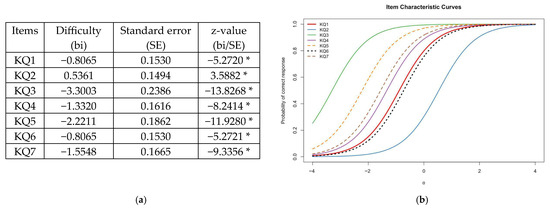
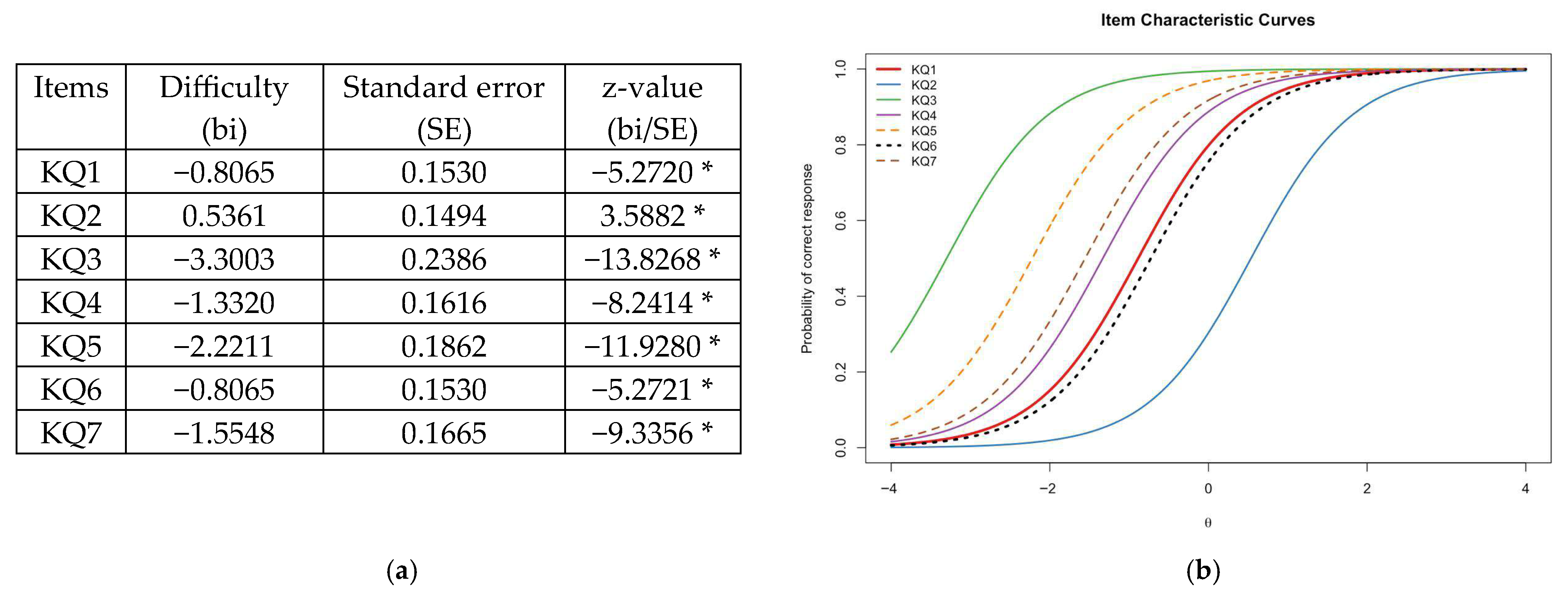
The knowledge items were considered suitable for Rasch modeling. ICCs show how the probability of a correct response varies with the level of the latent trait (θ). Items with lower difficulty parameters (bi) are represented by curves shifted to the left. This indicates that farmers with lower levels of knowledge have a relatively high probability of answering correctly. In contrast, items with higher bi values are represented by curves shifted to the right, meaning that higher levels of knowledge are required to achieve the same probability of answering correctly. Accordingly, items such as “Antibiotics should be used” (KQ3), “What do you mean by withdrawal period?” (KQ5), “Animal-derived foods (milk, meat, etc.) consumed before the end of the withdrawal period” (KQ7), and “The use of antibiotics in animals” (KQ4) had the lowest bi values and were the easiest items. This is reflected by their left-shifted ICCs. In contrast, item KQ2, “Antibiotics have an effect”, showed the highest bi, corresponding to a right-shifted ICC and indicating that it was the most difficult question. Items KQ1 and KQ6 presented identical bi values, resulting in near-overlapping ICCs and indicating that both items required a similar level of the latent trait to achieve the same probability of a correct response (Figure 1).
Figure 1.
Item Response Theory (ITR) was applied using the Rasch model to measure the knowledge scale. (a) Item difficulty parameters (bi), standard error (SE), and corresponding z-values are presented. The z-values (b/SE) assess the statistical significance of the item parameters. Lower bi values indicate easier items, whereas higher bi values indicate more difficult items. (b) Item Characteristic Curves (ICCs) for each item show the probability of a correct response at different levels of the latent trait (θ). Easier items present ICCs that are shifted to the left, while more difficult items present ICCs that are shifted to the right. * Absolute z-values greater than 1.96 indicate statistical significance.
3.4. Farmers’ Attitudes Regarding Antimicrobial Use and Antimicrobial Resistance
Most farmers answered the questions designed to assess their attitudes toward AMU and AMR correctly. However, some farmers (31.8%) stated that they stopped administering the antibiotic as soon as the animal improved, before the recommended treatment period was complete (AQ2). The attitude score was 5.8 ± 1.2 out of 7 points (Table 4).
Table 4.
Attitudes of small ruminant farmers in Portugal regarding antimicrobial use and antimicrobial resistance, assessed by questionnaire. The number (n) and percentage (%) of farmers who answered each question correctly or incorrectly are presented. The correct answer option to each question is shown in bold.
3.5. Farmers’ Practices Regarding Antimicrobial Use
Most of the farmers correctly answered the questions “How do you acquire antibiotics for your farm?” (PQ2) (92.4%), “How do you react when you have a sick animal on your farm?” (PQ1) (75.6%), “Where do you keep antibiotics and other medications?” (PQ7) (75.1%), and “Who administers antibiotics on your farm?” (PQ4) (71.4%). In contrast, only 47.8% of the farmers correctly answered the question “Do you record antibiotic use in the medication book?” (PQ3). Only 48.8% correctly answered the question “Do you usually use leftover antibiotics to treat other animals that become ill in the meantime?” (PQ6). The practice score was 4.7 ± 1.8 (range 0–7 points) (Table 5).
Table 5.
Practices of small ruminant farmers in Portugal regarding antimicrobial use, assessed by questionnaire. Seven multiple-choice questions were used to produce the practices scale. The number (n) and percentage (%) of farmers who gave the correct or incorrect answer to each question are presented. The correct answer option(s) to each question is shown in bold.
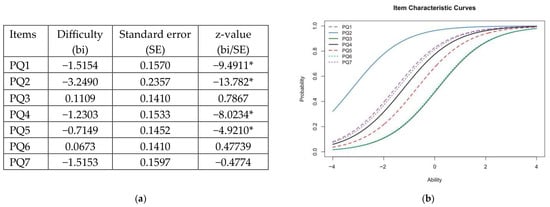
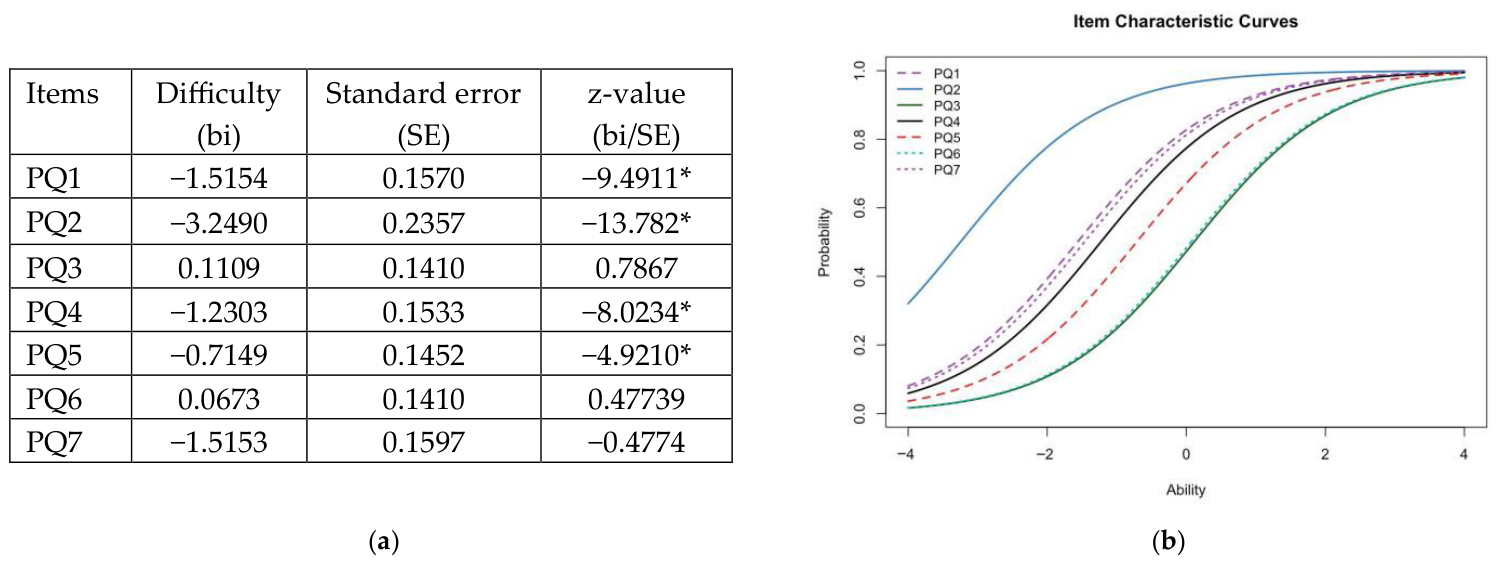
The practice items were considered suitable for Rasch modeling. The items “How do you acquire antibiotics for your farm?” (PQ2), “How do you react when you have a sick animal on your farm?” (PQ1), “Where do you keep antibiotics and other medications?” (PQ7) and “Who administers antibiotics on your farm?” (PQ4) had the lowest bi values and were therefore the easiest items, as reflected by their left-shifted ICCs. In contrast, the item “Do you record antibiotic use in the medication book?” (PQ3) showed the highest difficulty parameter. This corresponds to a right-shifted ICC, indicating that it is the most difficult question (Figure 2).
Figure 2.
Item Response Theory (ITR) was applied using the Rasch model to measure the practices scale. (a) Item difficulty parameters (bi), standard error (SE), and corresponding z-values are presented. The z-values (b/SE) assess the statistical significance of the item parameters. Lower bi values indicate easier items, whereas higher bi values indicate more difficult items. (b) Item Characteristic Curves (ICCs) for each item show the probability of a correct response at different levels of the latent trait (θ). Easier items present ICCs shifted to the left, whereas more difficult items present ICCs shifted to the right. *: Absolute z-values greater than 1.96 indicate statistical significance.
3.6. Correlations Between Biosafety, Knowledge, Attitudes, and Practices
Pearson correlation analysis was conducted to examine the relationships between biosafety, knowledge, attitudes, and practices (Table 6).
Table 6.
Pearson correlations between biosafety, knowledge, attitudes and practices of small ruminant farmers in Portugal who answered the questionnaire.
All variables were positively and significantly correlated (p < 0.001). The strongest association was observed between knowledge and attitudes (r = 0.453), followed by attitudes and practices (r = 0.436) and biosafety and practices (r = 0.405). Knowledge was moderately correlated with practices (r = 0.364).
3.7. Cluster Analysis
Of the four initial measurement scales, only two—knowledge and practices—demonstrated an adequate fit to the IRT model. These scales met the assumptions of unidimensionality and psychometric quality required for computing reliable global scores. They were used for the cluster analysis. The number of clusters was determined based on a combined analysis of the elbow method (WSS), the silhouette method, and the gap statistics. The elbow method suggested k = 3, the average silhouette was maximized at k = 3, and the gap statistic also indicated three clusters as the optimal solution, supporting the final choice.
Cluster 1 was characterized by low knowledge (mean = 2.54) and a moderate level of practices (mean = 4.33). Cluster 2 presented the highest levels of both knowledge (mean = 6.10) and practices (mean = 5.90) and represented the most consistent profile across these domains. Cluster 3 showed moderate knowledge (mean = 4.76) and a low level of practices (mean = 2.42) (Table 7).
Table 7.
Cluster composition based on the mean level of farm biosafety (0–17 points), knowledge (0–7 points), attitudes (0–7 points) and practices (0–7 points) of small ruminant farmers in Portugal regarding antimicrobial use, antimicrobial resistance and residues.
Statistically significant differences were observed among the clusters for several sociodemographic and farm-related variables, including sex (p = 0.013), education level (p < 0.001), professional experience (p = 0.003), region (p = 0.030), production purpose (p = 0.013), production system (p = 0.018), and production type (p = 0.008). However, no statistically significant differences were observed for age (p = 0.177) or species produced (p = 0.355).
Cluster 1 was predominantly composed of male farmers (85.4%) who were mostly over 40 years old (84.4%). These farmers had low levels of formal education, particularly illiterate and 1st cycle (54.2%), and higher levels of professional experience (>20 years: 66.7%). Their farms were mainly located in the Centro region (65.6%). These farmers were dedicated to sheep production (58.3%), in a semi-extensive system (68.8%), and conventional production mode (92.7%).
Cluster 2 included a higher proportion of farmers with higher education levels, particularly bachelor’s, master’s, doctorate (40.7%), as well as a greater proportion of farmers with less experience (<20 years: 53.3%). This cluster also had the highest proportion of organic farmers (18.6%). Most of these farmers were located in the Centro (60.8%) and Alentejo (31.2%) regions and were mainly engaged in meat production (53.3%).
Cluster 3 was characterized by older (>40 years old: 81.4%) and more experienced farmers (>20 years: 59.3%), with relatively low education levels (illiterate and 1st cycle: 40.7%). This group had a high proportion of male farmers (84.9%) and was predominantly engaged in meat production (64.0%). They operated mainly under conventional systems (91.9%) and semi-extensive production (59.3%), primarily in the Centro (59.3%) and Alentejo (26.7%) regions (Table 8).
Table 8.
Cluster characterization according to demographics of small ruminant farmers in Portugal.
4. Discussion
Considerable efforts are being made to reduce AMU in livestock production in order to decrease the development and dissemination of AMR in food-producing animals, and probably in humans [22]. This study investigated the biosafety practices implemented by Portuguese small ruminant farmers, as well as their knowledge, attitudes and practices regarding AMU, AMR and residues, by using a survey questionnaire. To the best of our knowledge, this is the first KAP questionnaire to be applied specifically to Portuguese small ruminant farmers.
In Portugal, the small ruminant population comprises around 2.5 million animals, of which 89.6% are sheep and 10.4% are goats, distributed across the Alentejo, Centro and Norte regions [3]. Small ruminant livestock farming operations are characterized by traditional, family-run farms, managed by older men, with low levels of education [2].
Despite efforts to ensure our sample was representative of Portuguese small ruminant farmers, the present study overrepresented farmers from the Centro region (61.7%), followed by farmers from the Alentejo (30.4%) and Norte regions (5.2%). While the mixed sampling strategy (online distribution and in-person data collection at fairs and visits to rural farmers), was necessary to ensure an adequate number of responses to the questionnaire, it may have introduced sampling bias, resulting in the overrepresentation of farmers from the Centro region. Self-selection bias due to voluntary participation in the online questionnaire was also possible, with overrepresentation of farmers with a higher educational level, digital competence and/or particular interest in the topic, as has been already described in other studies [23].
Biosafety is essential for preventing the entry and spread of diseases on the farm, thereby reducing the need for antibiotics. However, a recent cross-sectional study based on structured interviews concluded that the level of implementation of biosafety practices on small ruminant farms in Portugal is low [2]. In the present study, the mean biosafety score was 8.4 (range 0–17). Some biosafety measures appeared particularly difficult to implement, namely vehicle disinfection (10.2%), ensuring visitors change clothing and footwear at the farm entrance (10.8%), cleaning and disinfecting farm facilities (24.4%), using high-pressure washing equipment (25.7%), and ensuring employees change clothing and footwear upon entering the farm (29.9%), as observed in other studies [2,24]. Several factors can prevent small ruminant farmers from implementing some biosafety measures. The structural characteristics of farm facilities, together with the extensive and semi-extensive management systems, represent major barriers to the implementation of some biosafety measures. Traditional farm facilities, particularly in underserved rural regions and often built of wood and stone, represent a barrier to the implementation of cleaning and disinfection programs [2].
Technically simple measures, such as changing clothing and footwear at the farm entrance, are rarely implemented, probably because small ruminant farmers are unfamiliar with the concepts of biosafety and biocontainment [2]. However, adequate feed storage (85.0%), correct carcass disposal (70.3%), and cleaning feeders and drinkers (69,8%) were adopted by a large proportion of farmers, indicating that these practices require limited technical expertise. Thus, biosafety measures undertaken on small ruminant farms appear to depend not only on economics or feasibility, but also on the farmers’ understanding of biosafety principles and their attitudes towards implementing disease prevention measures [24,25].
In order to identify what drives AMU, it is essential to understand how much farmers know about antimicrobials, AMR and residues, as well as their attitudes and practices towards them. However, these items are not easily measured, so data must be captured through questionnaires, and measurement scales developed. These measurement scales can be evaluated by using two methods: Cronbach’s alpha and IRT models. Cronbach’s alpha is widely used to evaluate the cohesiveness of measurement scales, but it has some serious drawbacks. For example, it provides an overall measure of the scale’s internal consistency and assumes that all items contribute equally to the scale, regardless of question quality. It also depends heavily on the sample in which the questionnaire is applied, and alpha value increases with the number of items in the questionnaire [21]. On the other hand, IRT analysis provides information on the discrimination (a) and difficulty (bi) of each item across different levels of the underlying trait (θ). Since item characteristics (difficulty and discrimination) are “intrinsic” properties of the question—that is, a difficult item tends to remain difficult, and a discriminative item tends to remain discriminative in any comparable population—IRT is less dependent on the sample than Cronbach’s alpha. Furthermore, IRT analysis has already been used to evaluate scales designed to measure KAP towards AMU and AMR [6,21].
The Rasch model was chosen specifically because it provides a probabilistic framework for constructing invariant measurement scales, allowing comparisons between farmers to be made independently of the specific items used. This is particularly relevant in heterogeneous populations, such as Portuguese small ruminant farmers, who vary in terms of age, education level, geographic region, and other factors. Unlike classical test theory approaches such as Cronbach’s alpha or EFA, the Rasch model evaluates whether the observed data fits a unidimensional measurement structure. The Rasch model supports the validity of the scale as a measure of a latent construct, rather than relying solely on internal consistency. In addition, the Rasch approach allows respondents and items to be positioned along the same latent continuum, providing insight into the relative difficulty of items and the distribution of farmers’ knowledge and practices. IRT analysis indicated that the knowledge and practices scales applied in this study were able to distinguish between farmers with different levels of knowledge and practices related to AMU, AMR, and residues. The knowledge scale showed slightly greater measurement precision. The low reliability of the attitude measurement items is likely related to the assessment of different concepts, namely adherence to medical prescriptions, measures to reduce AMU, AMR, and the impact of AMU on human health, resulting in the measurement of different dimensions.
It has been suggested that increased knowledge and awareness about antibiotics and AMR are essential for their rational use. In the present study, small ruminant farmers obtained an average knowledge score of 4.9 out of 7. Most farmers knew that antibiotics should be used to treat diseases (92.1%), were familiar with the concept of withdrawal period (83.2%), and were aware that consuming animal-derived food before the end of the withdrawal period can promote the development of AMR in the consumer (75.1%). IRT analysis indicated that these items were easy and the probability of correct responses was high, regardless of the farmers’ knowledge. In contrast, a large proportion of farmers were unaware of the effects of antibiotics, stating that they had anti-inflammatory (43.3%) or analgesic and antipyretic (16.3%) effects. IRT analysis showed that the probability of answering this question correctly increased with higher levels of knowledge, suggesting that it is a more complex question that requires a deep understanding of the topic in order to select the correct answer “None of the above”. We also found significant knowledge gaps regarding antibiotics action, with 24.7% of farmers stating that they treated viral infections and 11.8% stating that they treated parasitic infections. Similar knowledge gaps regarding antibiotics were observed among Turkish cattle farmers with low levels of education [18] and among relatively young, highly educated Scottish dairy farmers [23]. In low-income countries, however, antibiotic knowledge is even lower. For instance, more than 50.0% of smallholder farmers in Ethiopia thought that antibiotics treat any kind of disease, regardless of the cause, and more than 70.0% were unaware of the recommended withdrawal period for milk and meat after antibiotic treatment [6].
In the present study, small ruminant farmers stated that the milk from animals treated with antibiotics can be used to feed lambs (14.4%), and 10.5% said that it is safe for consumers. In line with this, around 30.0% of Scottish farmers reported feeding milk from treated cows to calves [23]. Feeding suckling animals with milk containing antimicrobial residues can select antimicrobial-resistant bacteria [26].
A positive correlation between educational attainment and knowledge regarding antibiotics has already been established. Farmers with higher levels of formal education performed better in terms of their knowledge about antibiotics than those with lower levels of education [18,20,27]. Thus, the knowledge gaps regarding AMU, AMR and residues demonstrated by the small ruminant farmers who answered this questionnaire may be related to their low level of formal education. However, it seems that knowledge regarding antibiotics is not solely dependent on the level of formal education. Some studies have highlighted the importance of regular training in prudent AMU and antimicrobial administration, with the aim of improving farmers’ knowledge [23]. Nevertheless, our data is in line with the results obtained from other livestock farmer populations in both low- and high-income countries [18,20,27].
Understanding farmers’ attitudes towards AMR is essential for implementing specific strategies to achieve responsible AMU [23]. The mean attitude score attributed to the small ruminant farmers who answered the questionnaire (5.8 points out of 7) was higher than the score attributed to their knowledge and practices. However, some farmers showed inadequate attitudes towards AMU and AMR. For instance, some respondents did not always consult the veterinarian before administering antibiotics to animals (22.0%), shortened the duration of the treatment (31.8%) and adjusted the dose according to the animal’s progress (13.8%). Similarly inappropriate attitudes seem to be widespread among livestock farmers [6,9,18,20]. There are many reasons why farmers use antibiotics without consulting a veterinarian, including self-diagnosis of animal diseases, the cost of veterinary services and difficulty in accessing them, especially in remote regions, as well as over-the-counter access to antibiotics without a prescription from the veterinarian [18]. Excessive and inappropriate AMU plays a role in the development of AMR [9,11,12].
Infection prevention and control are crucial to reducing the incidence of infection and, therefore, the need for AMU. In the present study, a large proportion of farmers agreed that biosafety measures (89.5%) and vaccination (95.3%) can reduce AMR. They also stated that reducing AMU in animals decreases the development of resistance (85.0%). Scottish dairy farmers generally agreed on the association between AMU and AMR in livestock (83.0%) [23], but unlike Portuguese farmers (81.4%), a smaller proportion acknowledged the potential impact of livestock on human health (59.0%). Although many surveyed farmers were aware of AMR, some demonstrated undesirable attitudes toward AMU that can promote AMR development, such as stopping treatment or altering the dose. In line with our results, a questionnaire survey demonstrated that 23.6% of community people adjusted the antibiotic doses by themselves [28]. These results reinforce the need for tailored interventions that address antimicrobial stewardship, i.e., appropriate AMU by promoting the selection of appropriate antimicrobial drug regimes, including dosing, duration of therapy and route of administration [9].
The mean practice score for the surveyed farmers was 4.7 points on a scale of 0–7 points. Most farmers reported proceeding correctly regarding the purchasing of antibiotics (92.4%), handling sick animals (75.6%), storing antibiotics (75.1%), and disposing of packaging, needles, and syringes (62.5%). IRT analysis confirmed that the probability of answering these items correctly was high, even for farmers with a low level of practices. While most farmers said they called or asked the veterinarian for advice (75.6%), 17.6% self-medicated the animal based on their own experience, and 6.8% waited to see how the animal progressed. Around two-thirds of Scottish dairy farmers reported consulting their veterinarian occasionally before using antimicrobials, while the rest asked for advice most of the time (18%) or always (10%) [23]. In the EU, antimicrobials are prescription-only medicines that must be prescribed by a veterinarian after an animal’s clinical assessment. The reasons why some Scottish and Portuguese livestock farmers did not call veterinarians are likely the same, namely sufficient perceived personal experience, cost, and delay in treatment [23].
In contrast, practices such as medication recording and the proper disposal of leftover antibiotics were less frequently reported. In Portugal, veterinarians and producers are required to register medication use [29]. A centralized database on antimicrobial usage is not yet available. Therefore, registration is performed using a medication book. In the present study, however, only 47.8% of the small ruminant farmers reported always recording antibiotic use in a farm medication book, as required by law. A similar proportion of farmers (37.3%) in Bangladesh properly recorded antibiotic use [20]. In contrast, Scottish dairy producers always recorded treatments in a medicine book and sometimes used a computer [23]. Current rules for antimicrobial prescribing stipulate that the quantity of antimicrobial drugs prescribed must be limited to what is necessary for the treatment or purpose in question [29], thus not allowing for leftovers on the farm. Nevertheless, 51.2% of farmers reported using leftover antibiotics to treat animals. This practice was also reported by between 21.7% and 47.1% of livestock farmers in low- and middle-income countries [6,18,20].
Some of the practices reported by the surveyed small ruminant farmers seem apparently contradictory. Although a considerable proportion of farmers reported relying on veterinarians for antibiotic prescriptions or advice, this does not necessarily translate into consistent best practices at the farm level. The concurrent reporting of practices, such as reusing leftover antibiotics and keeping inconsistent records suggests a more complex and context-dependent decision-making process [30]. Farmers appear to seek professional advice when diagnosing and selecting treatments but make autonomous decisions once antibiotics are available on the farm. This apparent tension reflects the realities of day-to-day farm management, where economic factors and habit-driven practices may influence antibiotic use. Therefore, rather than representing contradictory findings, these results highlight the coexistence of formal veterinary oversight and informal on-farm practices.
Suboptimal attitudes and practices, such as administering antibiotics without veterinarian oversight, altering the duration or dosage, and reusing leftover antibiotics, among others, contribute to the emergence and spread of AMR, impacting public health and causing environmental contamination. Recent studies have identified the presence of antibiotic resistance genes (ARGs) in environmental samples, including water, soil, pasture, and bedding collected from small ruminant farms in the Centro region of Portugal [31,32]. These studies highlight small ruminant farm environments as potential reservoirs of clinically relevant ARGs. Furthermore, presumptive ESBL-producing strains of Escherichia coli and methicillin-resistant Staphylococcus aureus strains were isolated from asymptomatic sheep and goats in the same region [33]. The transfer of zoonotic resistant bacteria and ARGs from animals to humans through direct contact with infected animals, their environment, or the food chain is a great concern.
Positive and statistically significant correlations were observed between biosafety, knowledge, attitudes, and practices. The strongest association was found between knowledge and attitudes (r = 0.453). This indicates that higher levels of knowledge about resistance and residues are associated with more favorable attitudes towards prudent AMU. The correlation between attitudes and practices (r = 0.436) suggests that attitudes can contribute to shaping behaviors. However, the moderate strength of this association indicates that additional factors likely influence the translation of attitudes into practices. Similarly, knowledge showed a moderate correlation with practices (r = 0.364), reinforcing the idea that increased knowledge alone may not be sufficient to ensure best practices. Finally, the association between biosafety and practices (r = 0.405) highlights the potential role of structural and management-related factors in the adoption of appropriate practices. Farmers operating under better biosafety conditions may be more likely to implement measures aligned with responsible AMU. Overall, these findings are consistent with the conceptual framework of KAP models, in which knowledge influences attitudes, which in turn contribute to modeling practices. These findings also emphasize the role of contextual factors, such as the biosafety measures implemented on farms [34,35]. From a practical perspective, these findings suggest that strategies aimed at improving antimicrobial stewardship in small ruminant production should adopt a multifaceted approach, combining education, attitude-oriented interventions, and improvements in farm management and biosafety practices.
Identifying subgroups of small ruminant farmers according to their levels of knowledge and practices can help design targeted educational interventions. This study identified three clusters of farmers. Cluster 1 included older farmers with low levels of formal education and high professional experience. These farmers demonstrated low levels of knowledge (2.5 points) and moderate levels of practices (4.3 points). Cluster 2 included farmers with high levels of formal education. These farmers demonstrated the highest levels of knowledge (6.1 points) and practices (5.9 points). Cluster 3 included predominantly older and more experienced farmers with low levels of formal education. These farmers demonstrated moderate levels of knowledge (4.8 points), and low levels of practices (2.4 points). These results highlight the heterogeneity of farmers’ profiles regarding the relationship between knowledge and practices. While cluster 2 presented consistent pattern in both domains, clusters 1 and 3 revealed discrepancies between knowledge and practices. These patterns suggest that factors such as education and experience are associated with the adoption of practices aimed at reducing AMR. However, the exploratory nature of cluster analysis does not allow any causal relationship to be inferred from the presented data. Therefore, these farmers’ subgroups should be interpreted with caution and not as fixed or generalizable typologies.
Several limitations may have influenced the results of this study. Although a KAP questionnaire enables the collection of large amounts of data from a significant number of participants, the data can misrepresent the true knowledge, attitudes and practices of Portuguese small ruminant farmers. First, representativeness of Portuguese small ruminant farmers was compromised by sampling bias, which resulted in the overrepresentation of farmers from the Centro region, and by self-selection bias, which resulted in overrepresentation of farmers with higher educational levels, digital competence, and/or a particular interest in the topic. Thus, the results of this study cannot be generalized. In addition, since farmers self-reported their attitudes and previous practices, the data may be affected by inaccurate recall or confirmation bias, especially if the topic is controversial [20,27]. Additionally, data collected by KAP survey tools is subjected to social desirability bias; that is, participants can inadvertently provide answers that they anticipate are socially appropriate or desirable to the researcher, which does not guarantee truthfulness [20,23,27].
The application of ITR models to KAP questionnaires enables us to identify the strengths and weaknesses of data collection processes. Specifically, it enables us to identify items that are too easy, too difficult, or not aligned with the underlying construct. Items with a low level of difficulty should be replaced with more difficult questions, and more informative questions should be included in future data collections [21]. In the present study, some knowledge and practice items—particularly KQ3, KQ5 and PQ2—were located on the lower end of the difficulty spectrum, as indicated by their ICCs shifted further to the left. These items were relatively easy, providing limited discrimination among farmers with low-to-moderate levels of the latent traits. This information can be used to refine the questionnaire.
Despite these limitations, the present study provided a baseline of Portuguese small ruminant farmers’ KAP regarding AMU, AMR and residues. The information obtained can be used to design targeted educational interventions. These findings underscore the importance of considering farmer heterogeneity when designing interventions aimed at improving AMU.
5. Conclusions
This study found that biosafety practices are not widely implemented on small ruminant farms. Some measures, including vehicle disinfection, the use of specific clothing and footwear for visitors and workers, and the cleaning and disinfection of agricultural facilities, appeared to be particularly difficult to implement.
Farmers’ knowledge and attitudes regarding AMU, AMR, and residues were moderate, though important gaps were identified, primarily regarding basic knowledge of antibiotics and antimicrobial stewardship. Practice levels were generally worse than knowledge and attitude levels, with specific challenges identified in areas such as medication recording, leftover antibiotics management, and waste disposal.
Exploratory cluster analysis identified distinct farmer profiles with different patterns of knowledge and practices. These findings underscore the importance of considering farmer heterogeneity when designing interventions aimed at improving AMU.
Although the sample does not fully represent all Portuguese small ruminant farmers, this study provides an important foundation for understanding antimicrobial-related behaviors in small ruminant production systems in Portugal.
Author Contributions
Conceptualization, M.d.A.P.; methodology, M.d.A.P.; formal analysis, M.d.A.P., A.L.B., M.M. and A.C.F.; investigation, M.d.A.P., A.L.B., M.R., A.C.F., R.C., F.E., N.S., R.F., D.C., C.F., J.S., J.C.B., A.F., L.F., P.C. (Pedro Carreira) and P.C. (Pedro Caseiro); writing—original draft preparation, M.d.A.P., A.L.B. and M.M.; writing—review and editing, M.R., A.C.F., R.C., F.E., N.S., R.F., D.C., C.F., J.S., J.C.B., A.F., L.F., P.C. (Pedro Carreira), P.C. (Pedro Caseiro) and A.F.A.P.; supervision, M.d.A.P.; funding acquisition, M.d.A.P. All authors have read and agreed to the published version of the manuscript.
Funding
This research was funded by the Portuguese Foundation for Science and Technology (FCT) through Research Centre for Natural Resources, Environment and Society—CERNAS (UIDB/0681/2025), https://doi.org/10.54499/UID/00681/2025 and by RumiRes Project “Vigilância epidemiologica de resistências antimi-robianas e residuos medicamentosos em Pequenos ruminantes da Região Centro” (Ref. PRRC05-i03-I-000190).
Institutional Review Board Statement
The questionnaire was approved by the Ethics Committee of Instituto Politécnico de Viseu (IPV) on 23 October 2023 (reference no. 50/SUB/2023).
Informed Consent Statement
Informed consent was obtained from all subjects involved in the study.
Data Availability Statement
The original contributions presented in this study are included in the article. Further inquiries can be directed to the corresponding author.
Conflicts of Interest
The authors declare no conflicts of interest.
References
- Cabo, P.; Matos, A.; Fernandes, A.; Ribeiro, M. Evolução da produção e comercialização de produtos tradicionais qualificados de ovinos e caprinos (2003–2012). Rev. Ciênc. Agrárias 2017, 40, 329–344. [Google Scholar] [CrossRef] [Scilit]
- Alavedra, M.; Moura, D.; Cenci-Goga, B.; Saraiva, S.; Silva, F.; Pires, I.; Saraiva, C.; Coelho, A.C.; García-Díez, J. Biosecurity Practices in Portuguese Small Ruminant Farms: Current Status and Future Directions. Vet. Sci. 2025, 12, 334. [Google Scholar] [CrossRef] [Scilit]
- INE—Instituto Nacional de Estatística. Available online: https://www.ine.pt/xportal/xmain?xpid=INE&xpgid=ine_indicadores&indOcorrCod=0013071&contexto=bd&selTab=tab2&xlang=PT (accessed on 6 March 2026).
- Diez, J.G.; Saraiva, C.; Coelho, A.C. Cattle farmers ‘perceptions about livestock policy. Large Anim. Rev. 2015, 21, 115–123. [Google Scholar]
- Góngora, R.; Milán, M.J.; López-i-Gelats, F. Pathways of incorporation of young farmers into livestock farming. Land Use Policy 2019, 85, 183–194. [Google Scholar] [CrossRef] [Scilit]
- Gemeda, B.A.; Amenu, K.; Magnusson, U.; Dohoo, I.; Hallenberg, G.S.; Alemayehu, G.; Desta, H.; Wieland, B. Antimicrobial Use in Extensive Smallholder Livestock Farming Systems in Ethiopia: Knowledge, Attitudes, and Practices of Livestock Keepers. Front. Vet. Sci. 2020, 7, 55. [Google Scholar] [CrossRef] [Scilit]
- Alhaji, N.B.; Isola, T.O. Antimicrobial usage by pastoralists in food animals in North-central Nigeria: The associated socio-cultural drivers for antimicrobials misuse and public health implications. One Health 2018, 6, 41–47. [Google Scholar] [CrossRef] [Scilit]
- World Bank. Minding the Stock: Bringing Public Policy to Bear on Livestock Sector Development (English); World Bank: Washington, DC, USA, 2010; Available online: http://documents.worldbank.org/curated/en/573701468329065723 (accessed on 9 March 2026).
- Mutua, F.; Sharma, G.; Grace, D.; Bandyopadhyay, S.; Shome, B.; Lindahl, J. A review of animal health and drug use practices in India, and their possible link to antimicrobial resistance. ARIC 2020, 9, 103. [Google Scholar] [CrossRef] [Scilit] [PubMed]
- European Union. Regulamento (UE) 2019/6 do Parlamento Europeu e do Conselho, de 11 de Dezembro de 2018. Available online: http://data.europa.eu/eli/reg/2019/6/oj (accessed on 9 March 2026).
- Morar, A.; Sala, C.; Imre, K. Occurrence and antimicrobial susceptibility of Salmonella isolates recovered from the pig slaughter process in Romania. J. Infect. Dev. Ctries. 2015, 9, 99–104. [Google Scholar] [CrossRef] [Scilit]
- Aidara-Kane, A.; Angulo, F.J.; Conly, J.M.; Minato, Y.; Silbergeld, E.K.; McEwen, S.A.; Collignon, P.J. WHO Guideline Development Group. World Health Organization (WHO) guidelines on use of medically important antimicrobials in food-producing animals. Antimicrob. Resist. Infect. Control 2018, 7, 7. [Google Scholar] [CrossRef] [Scilit] [PubMed]
- Kasimanickam, V.; Kasimanickam, M.; Kasimanickam, R. Antibiotics Use in Food Animal Production: Escalation of Antimicrobial Resistance: Where Are We Now in Combating AMR? Med. Sci. 2021, 9, 14. [Google Scholar] [CrossRef] [Scilit]
- Menkem, Z.E.; Ngangom, B.L.; Tamunjoh, S.S.A.; Boyom, F.F. Antibiotic residues in food animals: Public health concern. Acta Ecol. Sin. 2019, 39, 411–415. [Google Scholar] [CrossRef] [Scilit]
- Courtenay, M.; Castro-Sanchez, E.; Fitzpatrick, M.; Gallagher, R.; Lim, R.; Morris, G. Tackling antimicrobial resistance 2019–2024—The UK’s five-year national action plan. J. Hosp. Infect. 2019, 101, 426–427. [Google Scholar] [CrossRef] [Scilit] [PubMed]
- Llanos-Soto, S.G.; Vezeau, N.; Wemette, M.; Bulut, E.; Greiner Safi, A.; Moroni, P.; Shapiro, M.A.; Ivanek, R. Survey of perceptions and attitudes of an international group of veterinarians regarding antibiotic use and resistance on dairy cattle farms. Prev. Vet. Med. 2021, 188, 105253. [Google Scholar] [CrossRef] [Scilit]
- Vijay, D.; Bedi, J.S.; Dhaka, P.; Singh, R.; Singh, J.; Arora, A.K.; Gill, J.P.S. Knowledge, Attitude, and Practices (KAP) Survey among Veterinarians, and Risk Factors Relating to Antimicrobial Use and Treatment Failure in Dairy Herds of India. Antibiotics 2021, 10, 216. [Google Scholar] [CrossRef] [Scilit] [PubMed]
- Ozturk, Y.; Celik, S.; Sahin, E.; Acik, M.N.; Cetinkaya, B. Assessment of Farmers’ Knowledge, Attitudes and Practices on Antibiotics and Antimicrobial Resistance. Animals 2019, 9, 653. [Google Scholar] [CrossRef] [Scilit]
- Gebeyehu, D.T.; Bekele, D.; Mulate, B.; Gugsa, G.; Tintagu, T. Knowledge, attitude and practice of animal producers towards antimicrobial use and antimicrobial resistance in Oromia zone, north eastern Ethiopia. PLoS ONE 2021, 16, e0251596. [Google Scholar] [CrossRef] [Scilit]
- Hossain, M.T.; Rafiq, K.; Islam, M.Z.; Chowdhury, S.; Islam, P.; Haque, Z.; Samad, M.A.; Sani, A.A.; Ferdous, M.R.A.; Islam, M.R.; et al. A Survey on Knowledge, Attitude, and Practices of Large-Animal Farmers towards Antimicrobial Use, Resistance, and Residues in Mymensingh Division of Bangladesh. Antibiotics 2022, 11, 442. [Google Scholar] [CrossRef] [Scilit] [PubMed]
- Dohoo, I.; Emanuelson, U. The use of item response theory models to evaluate scales designed to measure knowledge of, and attitudes toward, antibiotic use and resistance in Swedish dairy producers. Prev. Vet. Med. 2021, 195, 105465. [Google Scholar] [CrossRef] [Scilit]
- Scott, A.M.; Beller, E.; Glasziou, P.; Clark, J.; Ranakusuma, R.W.; Byambasuren, O.; Bakhit, M.; Page, S.W.; Trott, D.; Mar, C.D. Is antimicrobial administration to food animals a direct threat to human health? A rapid systematic review. Int. J. Antimicrob. Agents 2018, 52, 316–323. [Google Scholar] [CrossRef] [Scilit]
- Borelli, E.; Ellis, K.; Tomlinson, M.; Hotchkiss, E. Antimicrobial usage and resistance in scottish dairy herds: A survey of farmers’ knowledge, behaviours and attitudes. BMC Vet. Res. 2023, 19, 72. [Google Scholar] [CrossRef] [Scilit]
- Behluli, B.; Axhami, D.; Gecaj, R.; Mehmedi, B.; Youngs, C.; Cana, A.; Youngs, C. Assessment of implementation of biosecurity measures on livestock farms in three regions of Kosovo. CRO Vet. J. 2024, 56, 215–223. [Google Scholar] [CrossRef] [Scilit]
- Gilmour, J.; Beilin, R.; Sysak, T. Biosecurity risk and peri-urban landholders—Using a stakeholder consultative approach to build a risk communication strategy. J. Risk Res. 2011, 14, 281–295. [Google Scholar] [CrossRef] [Scilit]
- Firth, C.L.L.; Kremer, K.; Werner, T.; Käsbohrer, A. The Effects of Feeding Waste Milk Containing Antimicrobial Residues on Dairy Calf Health. Pathogens 2021, 10, 112. [Google Scholar] [CrossRef] [Scilit] [PubMed]
- Pham-Duc, P.; Cook, M.A.; Cong-Hong, H.; Nguyen-Thuy, H.; Padungtod, P.; Nguyen-Thi, H.; Dang-Xuan, S. Knowledge, attitudes and practices of livestock and aquaculture producers regarding antimicrobial use and resistance in Vietnam. PLoS ONE 2019, 14, e0223115. [Google Scholar] [CrossRef] [Scilit]
- Kamata, K.; Tokuda, Y.; Gu, Y.; Ohmagari, N.; Yanagihara, K. Public knowledge and perception about antimicrobials and antimicrobial resistance in Japan: A national questionnaire survey in 2017. PLoS ONE 2018, 13, e0207017. [Google Scholar] [CrossRef] [Scilit] [PubMed]
- Portuguese Republic. Decree-Law No. 175/2005 of 25 October. Diário da República, No. 205/2005, Series I-A. 2005. Available online: https://dre.pt (accessed on 18 April 2026).
- Food and Agriculture Organization of the United Nations. FAO Surveys Characterize Antimicrobial Use Practices in the Livestock Sector. Available online: https://www.fao.org/europe/news/detail/fao-surveys-characterize-antimicrobial-use-practices-in-the-livestock-secto/en (accessed on 18 April 2026).
- Bento, J.T.; Gomes-Gonçalves, S.; Cruz, R.; Esteves, F.; Baptista, A.L.; Aires Pereira, M.; Caseiro, P.; Carreira, P.; Figueira, L.; Mesquita, J.R.; et al. The Prevalence of Antimicrobial Resistance Genes in the Environments of Small Ruminant Farms from Central Portugal. Antibiotics 2025, 14, 576. [Google Scholar] [CrossRef] [Scilit] [PubMed]
- Gomes-Gonçalves, S.; Bento, J.T.; Moreira, G.; Mourão, J.; Cruz, R.; Esteves, F.; Baptista, A.L.; Pereira, M.A.; Caseiro, P.; Carreira, P.; et al. Comprehensive Shotgun Metagenomic Profiling of Antibiotic Resistance Genes in Sheep and Goat Farming Environments. Antibiotics 2026, 15, 277. [Google Scholar] [CrossRef] [Scilit]
- Pereira, M.A.; Baptista, A.L.; Cruz, R.; Esteves, F.; Amaro, A.; Mesquita, J.R.; Almeida, E.; Braguez, J.; Malva, M.; Pires, A.F.A. Cross-Sectional Study on Zoonotic Bacteria Carriage by Small Ruminants from Portugal’s Central Region. Pathogens 2025, 14, 1081. [Google Scholar] [CrossRef] [Scilit]
- Caudell, M.A.; Dorado-Garcia, A.; Eckford, S.; Creese, C.; Byarugaba, D.K.; Afakye, K.; Chansa-Kabali, T.; Fasina, F.O.; Kabali, E.; Kiambi, S.; et al. Towards a bottom-up understanding of antimicrobial use and resistance on the farm: A knowledge, attitudes, and practices survey across livestock systems in five African countries. PLoS ONE 2020, 15, e0220274. [Google Scholar] [CrossRef] [Scilit]
- Rahman, M.L.; Ahsan, M.I.; Ahmed, S.; Islam, M.K.; Mahbub-E-Elahi, A.T.M.; Uddin, M.B.; Ahmed, S.S.U. Knowledge, attitudes, and practices regarding antibiotic use and resistance in ruminants and chickens among prescribers and farmers in Bangladesh. J. Glob. Antimicrob. Resist. 2025, 45, 335–344. [Google Scholar] [CrossRef] [Scilit]

Disclaimer/Publisher’s Note: The statements, opinions and data contained in all publications are solely those of the individual author(s) and contributor(s) and not of MDPI and/or the editor(s). MDPI and/or the editor(s) disclaim responsibility for any injury to people or property resulting from any ideas, methods, instructions or products referred to in the content. |
© 2026 by the authors. Licensee MDPI, Basel, Switzerland. This article is an open access article distributed under the terms and conditions of the Creative Commons Attribution (CC BY) license.