


Abstract
Ceiling maintenance is a neglected dimension of residential upkeep in sub-Saharan Africa, where housing quality challenges coincide with limited institutional support and constrained household incomes. This study examines ceiling materials, defects, maintenance barriers and perceived housing quality in Ikole-Ekiti, a semi-urban settlement in Ekiti State, Nigeria. A cross-sectional survey of 150 valid respondents (construction professionals and clients or project owners), selected by stratified proportional random sampling and supported by on-site inspections, was analysed. Three hypotheses were tested with the Pearson chi-square test: H1, ceiling condition is associated with perceived housing quality; H2, ceiling material type is associated with maintenance frequency; H3, occupant awareness is associated with maintenance behaviour. Asbestos-based boards were the dominant ceiling material (74 percent). Leaks and stains, sagging or collapse, and mould were the leading defects, and low awareness or priority, replacement cost and limited access to skilled artisans were the leading barriers. All three hypotheses were supported, with medium effect sizes. Because respondents were professionals and project owners rather than the general public, awareness is probably overstated. A shift from reactive to preventive maintenance, supported by subsidised repair, regulated asbestos phase-out and awareness programmes, is therefore recommended for comparable Nigerian settings.
1. Introduction
Housing is universally recognised as a fundamental human need, functioning not merely as a physical shelter but as a critical determinant of health, social stability, and human dignity. The quality of housing profoundly influences occupant wellbeing, with substandard conditions linked to a range of adverse health outcomes, reduced productivity, and diminished quality of life [1,2,3,4]. In the Nigerian context, sustained population growth and accelerating urbanisation have generated intense demand for residential accommodation, often resulting in the proliferation of buildings constructed with limited adherence to quality standards and accompanied by equally limited post-construction maintenance regimes [5,6]. This dual pressure of quantity over quality produces housing stocks that deteriorate rapidly, placing residents in environments that frequently fail to meet basic habitability criteria.
Poorly maintained housing is a recognised global determinant of respiratory illness, injury and lost property value. The World Health Organization’s guidelines link indoor dampness and mould to increased respiratory symptoms and asthma [7], and systematic evidence identifies dampness, mould and deteriorating building materials as consistent housing risk factors for respiratory disease [2]. Ceilings sit between occupied space and the roof, where leaks and moisture originate, so they are a frequent route for these hazards. Where ceilings contain asbestos, deterioration adds a carcinogenic fibre risk: the WHO reports that about 125 million people are exposed to asbestos at work and that asbestos-related diseases cause more than 200,000 deaths a year [8]. The burden is unevenly distributed. South Africa banned asbestos in 2008, yet more than one million low-cost houses there still carry asbestos-cement roofs [9], which shows how long legacy materials persist. Nigeria is a justified setting for a ceiling-specific study for four reasons: housing demand outpaces quality control; asbestos-based boards remain the dominant ceiling material in its construction industry; the wet-season climate accelerates ceiling deterioration; and institutional support for maintenance is limited [10,11].
Among the numerous structural and finishing elements that collectively define housing quality, the ceiling occupies a position of significant functional importance yet disproportionate neglect. Ceilings serve as thermal regulators, acoustic barriers, aesthetic enhancers, and protective boundaries between the inhabited interior and the structural roof system [12,13,14]. They influence indoor air quality by restricting the infiltration of dust, moisture, and biological contaminants, and contribute to energy efficiency by reducing heat transfer between the roof and the living space below [15,16,17]. Despite this multifaceted role, the ceiling is frequently treated as a peripheral concern in maintenance planning, receiving attention only after visible deterioration has already compromised habitability.
The consequences of ceiling neglect are demonstrably serious. Water infiltration through damaged roof surfaces or failed waterproofing leads to persistent dampness, staining, and the proliferation of mould and mildew, conditions clinically associated with respiratory illnesses including asthma, bronchitis, and hypersensitivity pneumonitis, particularly among children and elderly occupants [3,18]. In communities where asbestos-based ceiling materials remain prevalent, deterioration releases airborne chrysotile and amphibole fibres whose carcinogenic properties are well-established in the epidemiological literature [19,20,21]. Structural failure of ceiling panels, manifesting as sagging and eventual collapse, generates physical injury risks that are entirely preventable through timely inspection and repair. Beyond health and safety, deteriorating ceilings diminish the aesthetic quality of living spaces, reduce property values, and accelerate the broader material degradation of the building envelope.
Ikole-Ekiti, the focus of this investigation, is a Local Government Area headquarters situated in the northeastern region of Ekiti State, Nigeria, at approximately latitude 7.7913 degrees North and longitude 5.5145 degrees East. The settlement exhibits a hybrid urban-peri-urban character, hosting a diverse housing typology that ranges from modern bungalows and blockwork compounds to traditional earthen and mixed-material dwellings, many of which were constructed with varied degrees of ceiling installation [6]. The town experiences a tropical climate characterised by a prolonged wet season during which elevated humidity and torrential rainfall accelerate the deterioration of ceiling materials, particularly those manufactured from organic or moisture-sensitive substrates such as plywood, fibre-reinforced cement boards, and asbestos sheets [22]. These environmental stressors compound pre-existing maintenance deficits, creating conditions in which ceiling deterioration is both widespread and consequential.
The published literature on building maintenance in sub-Saharan Africa has grown considerably in recent years, with studies examining the general challenges of maintenance culture, the economic barriers to upkeep, and the policy frameworks governing housing standards [23,24,25]. However, ceiling-specific maintenance as a discrete area of inquiry remains underdeveloped, particularly within the Nigerian context where the interaction of material choices, climatic vulnerability, economic constraint, and occupant awareness produces a distinctive set of challenges. This study addresses that gap by providing empirical evidence on the current state of ceiling conditions in Ikole-Ekiti, the barriers that impede effective maintenance, and the measurable consequences for housing quality. The aim of this study is to examine how ceiling materials, occupant awareness and maintenance practice relate to ceiling condition and perceived housing quality in Ikole-Ekiti. The objectives are: (1) to document the ceiling materials and defects in the surveyed residential buildings; (2) to identify and rank the barriers to ceiling maintenance; and (3) to test three hypotheses (H1–H3, Section 2.4) on the associations between ceiling condition and perceived housing quality, material type and maintenance frequency, and occupant awareness and maintenance behaviour. The findings are intended to provide evidence for policy, professional practice and further research on housing maintenance in comparable semi-urban Nigerian settings.
The study contributes to several parties. For homeowners and occupants, it identifies the defect and barrier profile that should prompt early repair. For architects, builders and engineers, it shows how ceiling material relates to maintenance behaviour, informing specification and handover advice. For regulators, it gives baseline evidence on asbestos-ceiling prevalence in a semi-urban setting and supports inspection requirements and phased replacement. For artisan associations, NGOs and community bodies, it ranks the barriers that training and awareness work should address. For researchers, it adds ceiling-specific evidence from a Nigerian semi-urban setting and the growing body of knowledge on building maintenance.
2. Literature Review, Theoretical Framework and Conceptual Review
2.1. Ceiling Maintenance and Housing Quality
The relationship between building maintenance practices and housing quality has been examined extensively in the built environment literature, with scholarly consensus confirming that maintenance is not a discretionary activity but a structural determinant of the safety, functionality, and longevity of residential accommodation [23,26]. Within this broader maintenance discourse, ceiling-specific studies constitute a smaller but increasingly relevant subset, driven by growing awareness of the health and safety implications of ceiling deterioration. Owolabi [27] examined maintenance practices across residential buildings in Ondo State, Nigeria, and found that ceilings were among the most consistently neglected building components, with visible deterioration including sagging panels, water staining, and mould colonies observed in a majority of inspected properties. The study attributed this neglect primarily to occupant prioritisation of more visible or functionally urgent repairs and to a general culture of reactive rather than preventive maintenance. Akande et al. [18] conducted a detailed investigation of indoor environmental quality in urban Nigerian housing, finding statistically significant associations between ceiling conditions and occupant reports of respiratory symptoms. Their analysis of housing in the Greater Karu Urban Area revealed that 30.5 percent of sampled dwellings contained asbestos ceilings exhibiting measurable signs of dampness and structural compromise, conditions closely linked to elevated indoor airborne particle counts and increased morbidity among resident children. This work complements broader international evidence reviewed by Wimalasena et al. [2], whose systematic review of housing risk factors for respiratory disease across 47 studies identified dampness, mould, and deteriorating building materials as the most consistently supported predictors of adverse respiratory outcomes, with ceilings representing a primary vector for moisture ingress in tropical climate contexts.
Holden et al. [3] reinforced these findings in a clinical commentary examining the impact of poor housing and indoor air quality on childhood respiratory health in the United Kingdom, noting that even in high-income settings the failure of building maintenance systems to address moisture-related ceiling defects generates measurable increases in paediatric asthma diagnosis rates. The relevance of these findings to Nigerian semi-urban contexts is amplified by the combination of more deterioration-prone materials, limited access to professional maintenance services, and a healthcare system with reduced capacity to manage the consequent chronic disease burden. The particular hazard posed by asbestos-containing ceiling materials has received sustained attention in the literature. Curado et al. [19] provided a comprehensive assessment of the environmental and public health impacts of asbestos across its lifecycle, concluding that building-incorporated asbestos in the maintenance or demolition phase represents the highest-risk exposure pathway for non-occupational populations. Law et al. [20], in a large cohort study, updated the epidemiological evidence on residential asbestos exposure and cancer risk, confirming elevated odds ratios for mesothelioma and lung cancer among residents of buildings containing deteriorating chrysotile ceiling panels. Guth et al. [21] specifically quantified fibre release rates from ceiling boards in various states of decay, establishing that boards exhibiting cracking or sagging release fibre concentrations substantially above occupational safety thresholds during routine domestic activities. These findings have direct policy relevance for Nigerian cities, where asbestos ceilings remain overwhelmingly prevalent despite their known hazards [10].
From a materials science perspective, the selection of ceiling materials is a function of multiple competing considerations including cost, availability, thermal performance, moisture resistance, and aesthetic preference [28,29,30]. In tropical environments, materials that perform well under stable low-humidity conditions often exhibit accelerated degradation when exposed to repeated wetting and drying cycles, thermal expansion, and biological attack [31,32]. Farjami and Mohamedali [15] demonstrated through thermal simulation that ceiling surface properties, including emissivity, thermal mass, and continuity, significantly influence solar heat gain in residential buildings in hot climates. Ali et al. [33] reviewed the technical design requirements for suspended ceiling systems, identifying moisture management, structural load capacity, and acoustic performance as the key performance dimensions that maintenance regimes must protect over the building lifecycle. Anifowose and Olanrewaju [5] examined building maintenance challenges specifically in Ekiti State, finding that financial constraint, limited technical awareness, and the absence of institutional enforcement mechanisms were the primary barriers to effective maintenance across residential building types. This pattern of behaviour, which Olanrewaju and Abdul-Aziz [23] characterize as a reactive maintenance culture, is associated with substantially higher total lifecycle maintenance costs and inferior long-term housing quality outcomes compared to preventive maintenance regimes. Okuntade [22] provided a taxonomy of common building defects in Nigerian residential buildings, identifying ceiling-related failures as among the five most frequently occurring defect categories, with moisture-induced deterioration accounting for the majority of observed cases. Ibrahim and Ufot [34] examined the impact of building material choices on maintenance practices across southwestern Nigeria, confirming that material selection at the construction stage has lasting consequences for maintenance frequency, cost, and complexity, with cumulative lifecycle maintenance costs substantially exceeding the initial procurement savings of cheaper materials.
The role of occupant knowledge and awareness in shaping maintenance behaviour has been examined by Okolnikova et al. [24], who argued that the conceptual foundations of building maintenance are poorly understood by a significant proportion of building users, particularly in settings where formal housing education is limited. Omar et al. [35] developed predictive models for maintenance management in construction projects and found that user engagement and awareness were among the strongest predictors of maintenance compliance. Hamid et al. [25] applied Analytic Hierarchy Process methodology to prioritise maintenance activities across building elements in institutional facilities, concluding that structural and finishing elements, including ceilings, ranked among the highest-priority maintenance categories when evaluated against combined safety, functionality, and cost criteria.
Maintenance culture in Nigeria has been characterised consistently in the literature as reactive, episodic, and driven by crisis response rather than planned preventive action [5,36]. Mohd Zamili [37] argued that the absence of formalised maintenance schedules and records is a fundamental obstacle to evidence-based maintenance decision-making. Where maintenance records do not exist, the accumulation of deterioration goes undocumented until physical manifestation in the form of defects triggers reactive responses, by which point the cost of remediation is substantially higher than preventive intervention would have been [23]. Empirical evidence from Ado-Ekiti demonstrates a significant relationship between household income and housing quality, while studies in nearby Akure identify inadequate financial resources, limited maintenance awareness and poor maintenance practices as important contributors to building deterioration. These findings suggest that financial constraints and behavioral factors may interact to perpetuate maintenance deficiencies within residential housing stock [38,39,40].
2.2. Ceiling and Housing Maintenance in Nigeria and Other Sub-Saharan African Countries
Maintenance neglect is widely reported across sub-Saharan Africa, but its reported drivers differ in emphasis. In Nigeria, studies in Ekiti State identify financial constraint, limited technical awareness and weak enforcement as the main barriers to residential maintenance [4,5,38]. In Ghana, private landlords’ maintenance decisions are shaped by building deterioration, faulty design, misuse after completion, shortage of skilled labour and poor financing [41], and low-income multi-habited houses in Accra are typically maintained reactively, with maintenance closely tied to household income [42]. In South Africa, defects in low-income houses are attributed mainly to poor workmanship and inexperienced contractors [43]. Finance, skills and workmanship therefore recur across the region [44], whereas explicit attention to occupant awareness and to ceilings as a separate maintenance object appears limited in the studies reviewed here.
2.3. Theoretical Framework
2.3.1. Building Lifecycle Maintenance Theory
The theoretical foundation of this study is anchored in the Building Lifecycle Maintenance Theory, which holds that all built assets undergo systematic degradation from the moment of completion and that the rate and severity of that degradation is substantially determined by the quality and regularity of maintenance interventions applied throughout the asset’s operational life [26,45]. This framework distinguishes between corrective maintenance, which restores function after failure; preventive maintenance, which reduces the probability of failure through scheduled inspections and interventions; and predictive maintenance, which uses condition monitoring data to anticipate failure and intervene optimally. For residential ceiling systems, this theory predicts that buildings maintained under preventive or predictive regimes will exhibit significantly lower rates of critical defect manifestation, reduced long-term maintenance costs, and superior habitability outcomes compared to buildings maintained reactively. The British Standard BS 8210:2014 operationalises this framework by establishing systematic processes for maintenance planning, specification, execution, and review [26], while the International Council for Research and Innovation in Building and Construction’s W70 framework codifies maintenance management as a structured professional activity requiring formal planning instruments, stakeholder engagement, and continuous performance evaluation [45].
2.3.2. Housing Quality Framework
The Housing Quality Framework developed by Lawrence [1] provides the conceptual lens through which ceiling condition is situated within the broader determinants of residential quality. This framework conceptualises housing quality as a multidimensional construct encompassing physical adequacy, safety, thermal and acoustic comfort, indoor environmental quality, and aesthetic habitability. It recognises that each physical component of the building envelope contributes to one or more quality dimensions and that failure in any single component produces cascading quality effects across multiple dimensions. Ceiling deterioration thus represents not merely an aesthetic deficiency but a composite failure that simultaneously compromises indoor air quality, thermal comfort, structural safety, and occupant psychological wellbeing. Lawrence’s framework further emphasises the social determinants of housing quality maintenance, recognising that occupant behaviours, economic capacity, and institutional support structures collectively mediate the translation of physical housing conditions into lived quality outcomes, a perspective that is particularly pertinent to the Ikole-Ekiti context.
2.4. Conceptual Framework
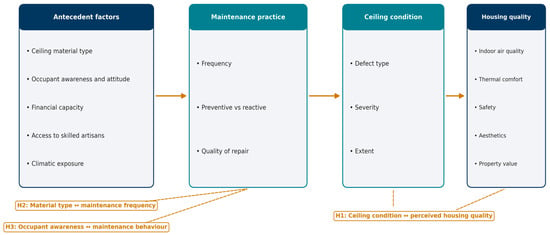
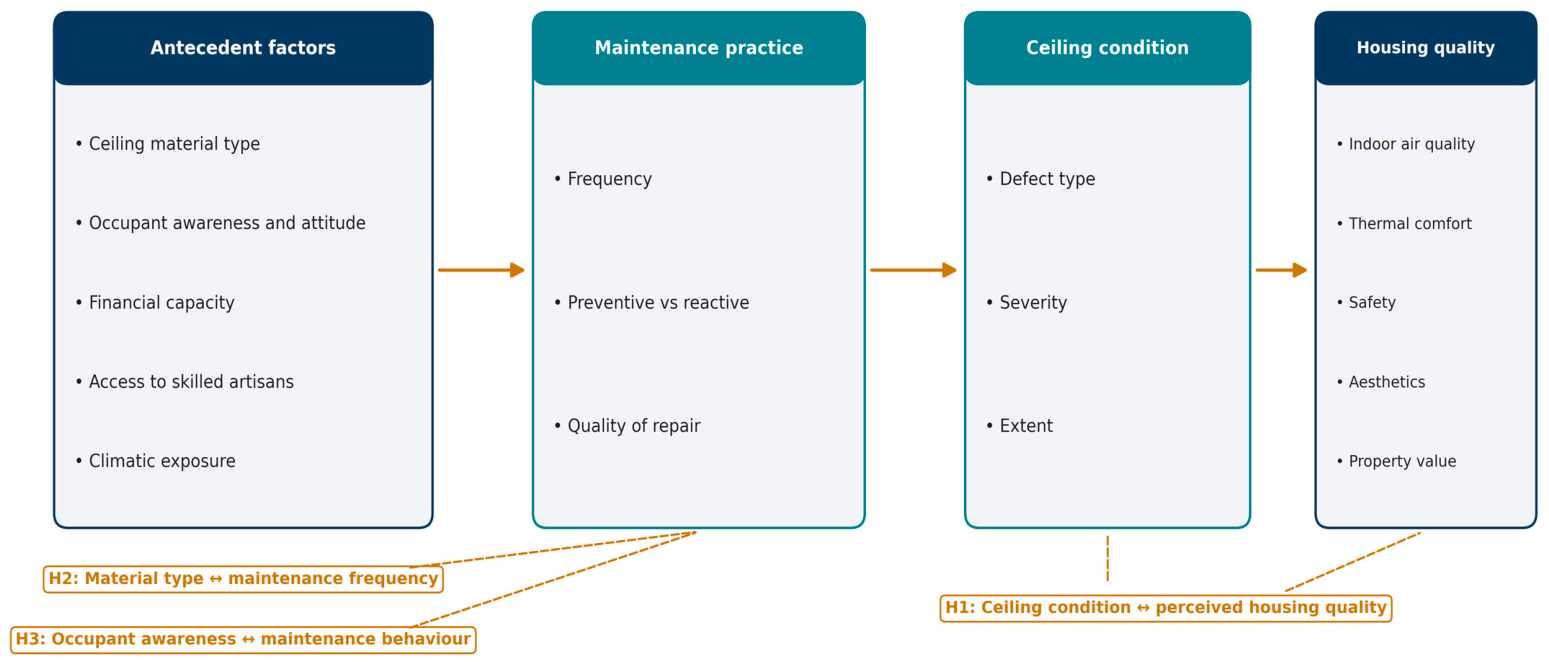
The conceptual framework guiding this research integrates the two theoretical constructs described above into a causal model that positions ceiling maintenance practice as the mediating variable between upstream determinants and downstream housing quality outcomes. The upstream determinants include material type selection, occupant awareness and attitudes, financial capacity, access to professional maintenance services, and climatic exposure. These antecedent conditions collectively shape the nature, frequency, and quality of ceiling maintenance activities undertaken. Maintenance practice, in turn, directly influences the observable condition of ceiling systems, operationalised through a typology of defects including cracking, staining, sagging, mould growth, and discolouration. Ceiling condition then mediates the broader housing quality outcomes experienced by occupants, encompassing indoor environmental quality, thermal comfort, structural safety, aesthetic satisfaction, and property value. This model generates three testable hypotheses stated formally in Section 3.5 and tested in Section 4.5. Figure 1 presents the framework diagrammatically.
Figure 1.
Conceptual framework of ceiling maintenance and housing quality.
Three hypotheses follow from the framework (Figure 1). H1: ceiling condition is associated with perceived overall housing quality [1]. H2: ceiling material type is associated with maintenance frequency, because material choice shapes maintenance demand over the building lifecycle [23,26]. H3: occupant awareness is associated with maintenance behaviour [24,35]. The null forms are stated in Section 3.5. The study is cross-sectional, so the arrows in Figure 1 show expected direction while the tests establish association only.
3. Study Area and Research Methodology
3.1. Study Area
Ikole-Ekiti is the administrative headquarters of Ikole Local Government Area, located in the northeastern zone of Ekiti State, Nigeria. The settlement is geographically situated at approximately latitude 7.7913 degrees North and longitude 5.5145 degrees East, at an elevation of approximately 430 m above sea level. It serves as both an administrative and commercial hub for surrounding rural communities, exercising influence over a hinterland that extends into several smaller settlements with distinct housing typologies [46]. The town exhibits a hybrid spatial character that encompasses formal urban infrastructure concentrated around the local government secretariat, a transitional peri-urban fringe characterised by mixed-use development and incremental housing construction, and rural residential areas reflecting traditional building practices and materials. This heterogeneity makes Ikole-Ekiti a representative and analytically productive context for examining the full spectrum of ceiling material choices and maintenance behaviours present across the socioeconomic gradient of Nigerian semi-urban communities [6].
Ikole-Ekiti experiences a tropical savanna climate characterised by two distinct seasons. The wet season, which extends approximately from April to October, brings cumulative annual rainfall averaging between 1100 and 1400 mm, with peak monthly intensities capable of exceeding 200 mm in September. Relative humidity during the wet season regularly exceeds 80 percent. The dry season, which prevails from November to March, is characterised by the Harmattan wind, which carries fine particulate matter from the Saharan interior and generates significant temperature fluctuations between daytime maxima averaging 32 degrees Celsius and nocturnal minima averaging 18 degrees Celsius [47]. These climatic conditions, particularly the seasonal alternation between high moisture loading and desiccating wind exposure, generate thermal and moisture cycling stresses that accelerate the deterioration of ceiling and building materials, particularly those manufactured from cellulosic or mineral fibre substrates [22,31].
The housing stock of Ikole-Ekiti encompasses a wide range of construction standards and building ages. Modern reinforced concrete bungalows coexist with older laterite-block or mud-brick structures roofed with corrugated iron sheets, the latter representing the most thermally challenging environment for ceiling performance. Traditional compound house arrangements, which organise multiple family units around shared central courtyards, introduce additional maintenance governance challenges due to collective ownership structures and ambiguity of maintenance responsibility [4]. The distribution of ceiling materials reflects both historical supply availability, with asbestos-based boards having been the dominant commercial product for several decades, and more recent but limited access to PVC and Plaster of Paris alternatives in the formal market. The population of Ikole-Ekiti Local Government Area is estimated at approximately 150,000 persons based on projection from the 2006 National Population Commission census, with population growth driven by rural-urban migration sustaining housing demand that consistently exceeds the rate of formal residential construction [48,49].
3.2. Research Design
This is part of a broader inquiry on building maintenance, and the current study adopts a quantitative cross-sectional research design, which is appropriate for investigating the distribution of variables and the associations between them at a single point in time across a defined population of interest [50]. The cross-sectional design enables systematic comparison of ceiling maintenance practices, defect prevalence, and housing quality perceptions across respondents with varied professional backgrounds, building types, and socioeconomic characteristics, while also permitting the statistical testing of hypothesised relationships using inferential methods. The survey research method was selected as the primary data collection strategy because it enables the efficient collection of standardised quantitative data from a relatively large sample in a manner that facilitates statistical aggregation and comparative analysis. Physical on-site inspection of sampled buildings was conducted concurrently with questionnaire administration to provide observational validation of self-reported ceiling conditions, reducing the risk of social desirability bias in respondent reporting and strengthening the overall validity of the study. All sampled buildings were inspected concurrently with questionnaire administration by two trained observers using a standardised schedule. Observers recorded the ceiling material, a condition grade, the defects present and the estimated area affected from interior visual inspection only. No samples were taken and no photographs were made. Asbestos-based boards were identified by visual and product-marking cues, without laboratory confirmation, and are therefore reported as asbestos-based (visually identified).
3.3. Study Population, Sampling and Questionnaire Administration
The total study population comprised 300 registered built environment professionals, property owners, and relevant stakeholders professionally active in Ikole-Ekiti Local Government Area. This population was enumerated through registers maintained by the Ekiti State Ministry of Housing and Urban Development, the Ekiti Chapter of the Nigerian Institute of Architects, the Ekiti Chapter of the Nigerian Institute of Building, the Nigerian Society of Engineers Ekiti Branch, the Nigerian Institute of Quantity Surveyors Ekiti Chapter, and the Ekiti State Ministry of Works. Six professional categories were included in the study, namely Architects, Builders, Clients or Project Owners, Civil or Structural Engineers, Quantity Surveyors, and Ministry of Works professionals, collectively referred to as Others.
The minimum required sample size was determined by applying Taro Yamane’s [51] formula to the total study population at a 5 percent margin of error, as follows:
where n = minimum required sample size; N = total study population (300); e = acceptable margin of error (0.05)
n = N/(1 + Ne2)
n = 300/(1 + 300 × 0.052) = 300/(1 + 300 × 0.0025) = 300/(1 + 0.75) = 300/1.75 = 171.43 ≈ 172
The formula yielded a minimum required sample of 172 respondents. Accordingly, 172 questionnaires were distributed across the six professional categories using stratified proportional random sampling, whereby each stratum received an allocation proportional to its representation in the total study population of 300. Within each stratum, respondents were selected using simple random sampling to ensure objectivity and representativeness. The proportional allocation across professional categories is presented in Section D of Table 1.
Table 1.
Consolidated Respondent Profile and Questionnaire Distribution (Study Population N = 300; Questionnaires Distributed = 172; Valid n = 150; Response Rate = 87.21%).
From the 172 questionnaires distributed, 150 were returned in a fully completed and correctly filled condition and were verified as suitable for analysis. The remaining 22 questionnaires (12.79 percent of those distributed) were excluded from the analysis because they failed the verification screening due to incomplete sections or internally inconsistent responses (18) and nonresponse (4). The resulting valid response rate was 87.21 percent. Because fewer responses were obtained than planned, the achieved margin of error at the 95 percent confidence level is 5.77 percent, calculated as √((N − n)/(N × n)) with N = 300 and n = 150; results are therefore subject to sampling error of about ±5.8 percentage points. The distribution, return, and exclusion statistics by professional category are summarised in Table 1.
3.4. Data Collection Instrument
The primary data collection instrument was a structured questionnaire comprising four sections and an observer inspection schedule. Section A captured respondent demographic and professional profile information including gender, age group, professional qualification, and years of professional experience. Section B gathered data on ceiling material type, installation age, and observable physical condition from the respondent’s primary residential or professionally assessed building context. Section C documented the range and frequency of ceiling defects observed or reported, using a predefined defect typology derived from the literature. Section D assessed maintenance practices, perceived barriers, and improvement strategy preferences using a five-point Likert-type scale ranging from strongly disagree to strongly agree. Section E, completed by the research team during the on-site inspection, recorded the ceiling material, a condition grade and the defects present.
The questionnaire was developed through a systematic review of validated instruments from comparable studies [5,18,24] and subjected to expert review by three senior academics in Building Technology and Architecture before pilot testing. A pilot study involving 15 respondents not included in the main sample was conducted to assess instrument reliability and item comprehensibility. Cronbach’s alpha coefficient calculated from pilot data was 0.81, indicating acceptable internal consistency. Revisions to item wording were made following the pilot exercise prior to final questionnaire administration. Secondary data sources included published academic literature, reports from the Ekiti State Ministry of Housing, building survey records from the Nigerian Institute of Building, and publicly available National Population Commission census data [48,49].
3.5. Research Hypotheses
Three null hypotheses were formulated to structure the inferential statistical analysis:
H1:
There is no statistically significant association between ceiling condition and perceived overall housing quality.
H2:
There is no statistically significant association between ceiling material type and frequency of maintenance activities undertaken.
H3:
There is no statistically significant association between occupant awareness level and actual ceiling maintenance behaviour.
3.6. Data Analysis Methods
Collected data were analysed using both descriptive and inferential statistical techniques. Descriptive analysis employed absolute frequency counts and relative percentage distributions. Inferential analysis used the Pearson Chi-Square test of independence to evaluate the three null hypotheses. The Chi-Square test is appropriate for examining associations between categorical variables and does not require assumptions about the normality of the underlying data distribution, making it well-suited to the ordinal and nominal variables generated by the survey instrument. A significance level of α = 0.05 was adopted for all hypothesis tests, consistent with standard practice in built environment research. Where Chi-Square assumptions regarding minimum expected cell frequencies were not met in any cell of the contingency table, Fisher’s Exact Test was applied as a non-parametric alternative. Effect size was assessed with Cramér’s V, interpreted against Cohen’s (1988) [52] thresholds, which depend on df* = min(r − 1, c − 1): for df* = 1, 0.10, 0.30 and 0.50 (small, medium, large); for df* = 2, 0.07, 0.21 and 0.35; for df* = 3, 0.06, 0.17 and 0.29. All inferential statistical analyses were conducted using IBM SPSS Statistics Version 27. Differences in the composite awareness index across professional categories were not considered in the present study.
4. Results
4.1. Respondent Profile and Questionnaire Distribution
Table 1 presents the consolidated respondent profile across four demographic and professional dimensions, together with the proportional questionnaire distribution across the six professional categories. Data are from the 2024 field survey; sampling and response figures are given in Section 3.3.
In terms of gender, male respondents constituted 60.67 percent (n = 91) of the valid sample, with female respondents accounting for 39.33 percent (n = 59), a distribution broadly consistent with the gender composition of built environment professions in Nigeria. The age profile indicates that the 31 to 40 years cohort was the largest (27.33 percent), followed by the 51 to 60 years cohort (23.33 percent), reflecting a sample dominated by mid-career to senior practitioners. The mean professional experience of the valid sample, computed using frequency-weighted midpoints, was 13.30 years, confirming that respondents possessed substantive professional knowledge of building conditions and maintenance requirements sufficient to support the reliability of their assessments.
With respect to professional category, Clients or Project Owners constituted the largest valid respondent group (26.67 percent, n = 40), followed by registered Builders (24.00 percent, n = 36), Architects (20.00 percent, n = 30), Civil or Structural Engineers (16.67 percent, n = 25), Quantity Surveyors (8.00 percent, n = 12), and Ministry of Works professionals (4.67 percent, n = 7). Per-stratum response rates ranged from 85.7 percent to 88.2 percent, indicating consistently high engagement across all professional categories.
4.2. Ceiling Types and Condition
Table 2 documents the ceiling material distribution across the 150 buildings represented in the valid sample. Asbestos-based ceiling boards were by far the dominant material, installed in 74 percent of buildings. This finding is consistent with the historical pattern of asbestos availability and affordability in Nigerian building supply chains over the preceding four decades and reflects the very limited material diversification that has occurred in Ikole-Ekiti’s residential building stock. PVC was the principal modern alternative, followed by Plaster of Paris (POP) and timber boards, and three buildings had no ceiling installation (Table 2). Asbestos-based boards were identified visually and by product marking, without laboratory confirmation.
Table 2.
Ceiling Material Types Installed in Surveyed Buildings.
Ceiling installation age and building type are reported in Table 3. Building age, roof covering and number of storeys were not recorded and could not be examined as alternative explanations of ceiling condition (Section 6.2).
Table 3.
Distribution of Ceiling Installation Age by Building Type.
The distribution suggests that older buildings dominate the housing stock, with approximately 64% of surveyed dwellings having ceiling installations older than 10 years. Bungalow account for the largest proportion of ageing ceiling systems, particularly among buildings exceeding 20 years of age. This pattern may indicate a growing maintenance burden associated with older housing stock in semi-urban Nigerian communities, where deferred maintenance and material deterioration could increase the likelihood of ceiling defects and failures.
4.3. Analysis of Reported Ceiling Defects
Table 4 shows that leaks and stains ranked first among reported defects, followed by sagging or collapse, cracks, discolouration and mould. Mould and fungal growth was most frequently observed in kitchens, bathrooms, and rooms with poor cross-ventilation. Of the 150 respondents, 35 reported no noticeable ceiling issues; inspection by the research team found at least one active defect in 18 of these buildings 51.43% of the study cases.
Table 4.
Ceiling Defects Observed or Reported by Respondents.
4.4. Challenges Facing Ceiling Maintenance and Recommended Improvement Strategies
Table 5 identifies the principal barriers to effective ceiling maintenance as perceived by the 150 valid respondents. Lack of awareness or low priority ranked first, followed by the high cost of replacement materials and limited access to quality materials and skilled artisans. Only a small share reported no perceived barrier. Table 6 presents respondent-endorsed improvement strategies. Regular inspection and preventive maintenance was endorsed most often, followed by the use of quality and durable materials and the training and certification of artisans. This endorsement shows stated support for proactive approaches; stated support does not show that such approaches are practised.
Table 5.
Principal Challenges Impeding Effective Ceiling Maintenance.
Table 6.
Recommended Strategies for Improving Ceiling Maintenance and Housing Quality.
4.5. Hypothesis Testing
4.5.1. Hypothesis One: Ceiling Condition and Perceived Housing Quality
The null hypothesis H1 posited no statistically significant association between ceiling condition and perceived overall housing quality. A Pearson Chi-Square test of independence was conducted on a contingency table cross-tabulating the six ceiling defect categories observed or reported against respondent ratings of overall housing quality on a five-point scale ranging from very poor to excellent (valid n = 150). Table 7 presents the result of the statistical test.
Table 7.
Chi-Square Test Results for Hypothesis One.
From Table 7, the Chi-Square statistic of 24.317 with 8 degrees of freedom yielded a p-value of 0.002, so H1 is rejected: ceiling condition is significantly associated with perceived housing quality.
4.5.2. Hypothesis Two: Ceiling Material Type and Maintenance Frequency
The null hypothesis H2 posited no statistically significant association between ceiling material type and the frequency of maintenance activities undertaken. A Chi-Square test was applied to a contingency table cross tabulating the five ceiling material categories (Table 2) against five maintenance frequency categories ranging from never to annually (valid n = 150). Table 8 presents the results of the statistical test.
Table 8.
Chi-Square Test Results for Hypothesis Two.
From Table 8, the Chi-Square statistic of 18.743 with 12 degrees of freedom produced a p-value of 0.031, so H2 is rejected: ceiling material type is significantly associated with maintenance frequency.
4.5.3. Hypothesis Three: Occupant Awareness and Maintenance Behaviour
The null hypothesis H3 posited no statistically significant association between occupant awareness level and actual ceiling maintenance behaviour. Awareness was operationalised as a composite index derived from four knowledge-testing items embedded in Section D of the questionnaire, and maintenance behaviour was measured by a validated frequency and quality assessment scale. Respondents were classified into three awareness levels (low, moderate, and high) based on their composite index scores (valid n = 150). Table 9 presents the results of the statistical test.
Table 9.
Chi-Square Test Results for Hypothesis Three.
From Table 9, the Chi-Square statistic of 21.856 with 6 degrees of freedom yielded a p-value of 0.001, so H3 is rejected: occupant awareness is significantly associated with ceiling maintenance behaviour.
5. Discussion
To place the findings in context, Table 10 compares each main finding with evidence from Nigeria, other African countries and global studies. Each statistic is reported once, in the subsection where it is discussed.
Table 10.
Comparison of present findings with African and global evidence.
5.1. Dominant Ceiling Materials and Public Health Implications
The finding that asbestos-based ceiling boards are installed in 74 percent of surveyed buildings in Ikole-Ekiti is among the most consequential results of this study and demands extended consideration in the light of the public health literature. The persistence of asbestos in the residential building stock of Nigerian semi-urban communities reflects a structural lag between scientific consensus, regulatory response, and market transformation. While the carcinogenic properties of asbestos have been documented since the mid-twentieth century and many high-income countries completed their transition away from asbestos building products by the 1990s, the material continued to be manufactured and distributed in Nigerian markets well into the 2000s, leaving a potentially large legacy installation base.
The specific risk posed by these installations is a function of their current physical condition. Asbestos boards that remain intact and undisturbed present minimal fibre release risk. However, as documented in Section 4, a significant proportion of the asbestos ceilings surveyed exhibit active deterioration in the form of cracking, sagging, and surface degradation. These conditions substantially increase fibre release rates, as demonstrated experimentally by Guth et al. [21], whose laboratory measurements confirmed that mechanically damaged asbestos boards release fibre concentrations capable of exceeding occupational health thresholds during normal domestic activity. The convergence of a large installed base and widespread active deterioration may thus create conditions for chronic low-level fibre exposure across a substantial fraction of Ikole-Ekiti’s residential population, with long-term cancer risk implications clearly established by Law et al. [20] and Curado et al. [19]. The finding from Hypothesis Two that asbestos ceilings are associated with significantly lower maintenance frequencies than modern alternatives (Chi-Square = 18.743, p = 0.031) further compounds this concern, a pattern consistent with maintenance disengagement raising the likelihood that latent hazards become active, although condition and maintenance were not measured over time.
5.2. The Perception-Reality Gap in Defect Recognition
The divergence between self-reported and physically observed ceiling conditions constitutes one of the most analytically significant findings of this study. The fact that 23.33 percent of respondents reported no noticeable ceiling issues while concurrent physical inspections revealed active defects in 18 of these 35 buildings suggests that part of the maintenance deficit in Ikole-Ekiti’s housing stock may reflect deterioration that occupants have not recognised, rather than deterioration they recognised but deferred. The reading is tentative because ‘no noticeable issues’ was self-reported and inspection was visual only. This gap between perception and reality may represent a qualitatively different maintenance challenge that may not be addressed through financial subsidies or artisan training alone and may require targeted educational interventions specifically designed to build occupant capacity to recognise the early physical indicators of ceiling deterioration, such as hairline cracking, surface discolouration, and minor moisture staining, before they progress to structurally or biologically hazardous conditions.
This finding is consistent with the theoretical proposition advanced by Okolnikova et al. [24] that the conceptual foundations of building maintenance are poorly understood by a significant proportion of building users in settings where formal housing education is limited. It also aligns with Omar et al.’s [35] empirical demonstration that user awareness is a significant predictor of maintenance compliance. The result for Hypothesis Three is consistent with this interpretation (Chi-Square = 21.856, p = 0.001, Cramér’s V = 0.270); however, reverse causation and confounding by income, tenure or building age cannot be excluded, and a sample of professionals probably overstates awareness among householders. If the association is causal, awareness campaigns might improve maintenance even without additional financial support by helping residents detect deterioration that currently goes unrecognised, but this was not tested.
5.3. Barriers to Maintenance and Their Structural Underpinnings
The barrier profile identified in this study, with attitudinal factors ranking first, followed by financial constraints and supply-side limitations, suggests a maintenance challenge embedded in intersecting social and economic structures rather than reducible to any single cause. The primacy of attitudinal barriers is consistent with the reactive maintenance culture documented by [5,23,36] across Nigerian residential building contexts. The same barrier families (finance, skills and maintenance culture) are reported in Ghana [41,42], although attitude ranked first here whereas finance dominates in those studies (Table 10).
The financial barrier, while ranked second, operates in interaction with the attitudinal barrier in ways that amplify the overall maintenance deficit. Households that do not perceive ceiling maintenance as urgent are less likely to budget for it, and households without dedicated maintenance budgets are more likely to defer action when remediation costs arise. This reinforcing cycle produces deficit accumulation across the housing stock, in which deferred maintenance leads to more severe deterioration requiring more costly remediation, further widening the gap between available resources and remediation needs. Ibrahim and Ufot [34] documented that the cumulative lifecycle maintenance cost of reactive regimes substantially exceeds that of preventive approaches, which suggests that the financial barrier may in part be self-generated by the attitudinal barrier. The supply-side barrier of limited access to skilled artisans reflects a structural deficiency in the local construction labour market common across Nigerian semi-urban settings, where the absence of a well-regulated artisan certification system reduces homeowner confidence in engaging maintenance services and contributes to the preference for complete deferral over uncertain-quality remediation [44].
5.4. Ceiling Condition, Material Substitution and Maintenance Culture Co-Benefits
The association between ceiling condition and perceived housing quality (Chi-Square = 24.317, p = 0.002, Cramér’s V = 0.285) is consistent with the Building Lifecycle Maintenance Theory and the Housing Quality Framework, which treat ceiling condition as an indicator of habitability. Because the design is cross-sectional, direction cannot be inferred: poorer housing quality may also reduce investment in ceiling repair, and building age, income and tenure were not controlled. Property value and maintenance costs were not measured, so no economic conclusion is drawn here.
The statistically significant association between ceiling material type and maintenance frequency (Chi-Square = 18.743, p = 0.031, Cramér’s V = 0.204) is consistent with ceiling material being related not only to the physical performance of the ceiling system but also to occupants’ maintenance engagement. Whether material substitution would also improve maintenance culture was not tested: newer installations, household income and building age may explain why asbestos ceilings attract the lowest maintenance frequencies. PVC ceiling systems offer advantages of moisture resistance, ease of installation, low ongoing maintenance requirements, and complete absence of deterioration-related health hazards. POP systems provide superior aesthetic and acoustic performance and, once properly installed, offer extended service life under the climatic conditions of Ikole-Ekiti. The lower market shares of these alternatives (Table 2) may reflect higher upfront material and installation costs, which were not measured; if so, targeted cost subsidies or accessible financing might accelerate adoption.
5.5. Proposed Multi-Level Intervention Framework
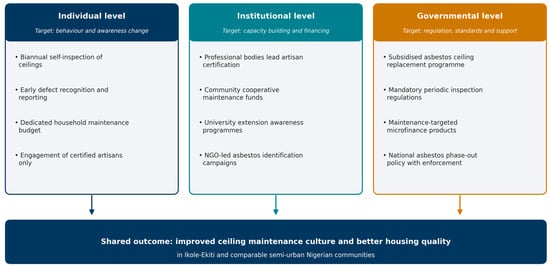
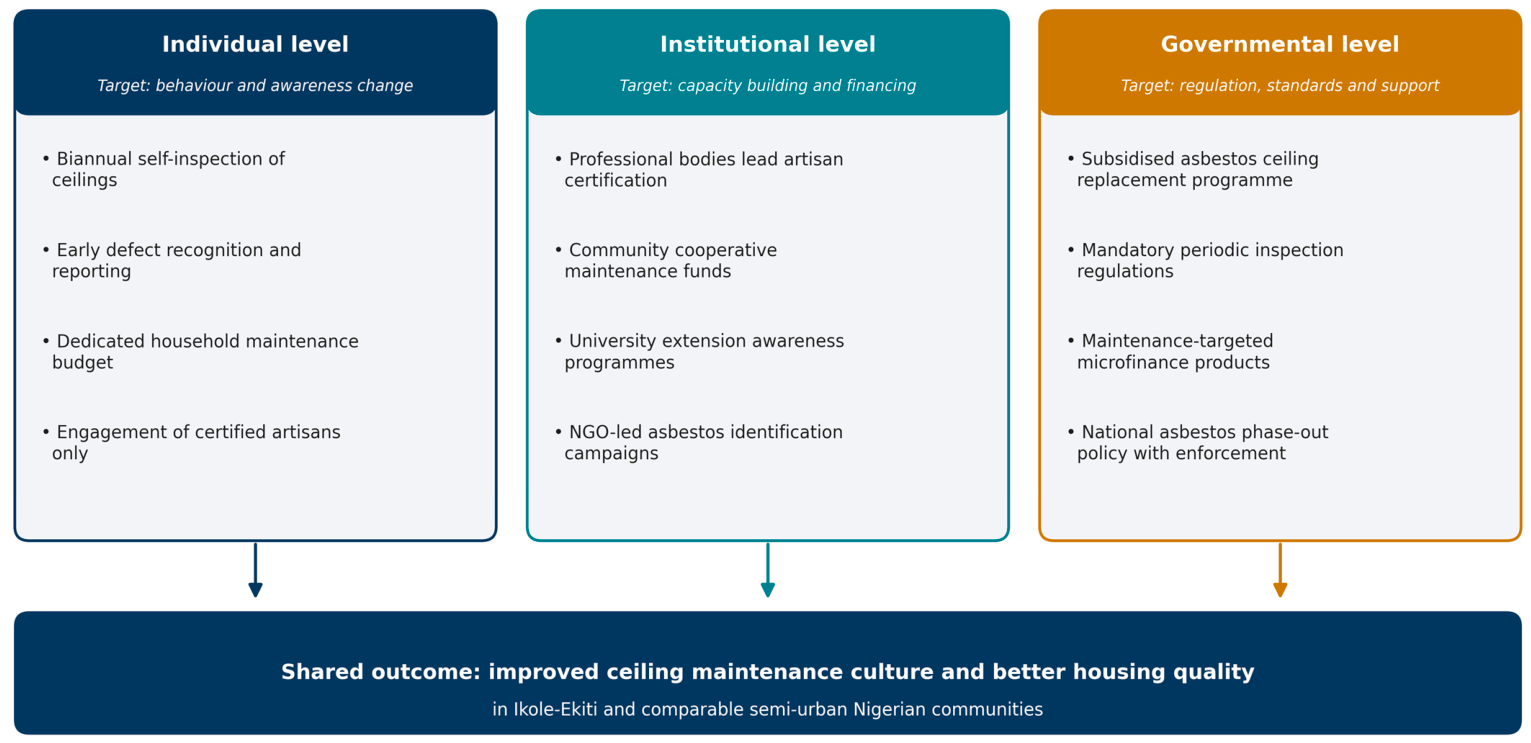
The empirical findings, interpreted within the integrated theoretical framework developed in Section 2, generate a multi-level policy intervention context organised across three strategic levels: individual, institutional, and governmental. At the individual level, the framework targets behaviour and awareness change through biannual ceiling self-inspection, early defect recognition training, dedicated household maintenance budgeting, and exclusive engagement of certified artisans. At the institutional level, professional bodies including the Nigerian Institute of Architects, Nigerian Institute of Building, and Nigerian Society of Engineers are positioned to lead artisan certification schemes; university extension services are identified as community awareness delivery platforms; cooperative maintenance funds are proposed as community-scale financing mechanisms; and non-governmental organisations are identified as partners for asbestos identification campaigns. At the governmental level, the framework calls for a subsidised asbestos ceiling replacement programme, mandatory periodic inspection regulations with priority application to rental properties, microfinance products tailored to home maintenance, and a national asbestos phaseout policy with rigorous enforcement.
Figure 2 translates the empirical findings into an implementation pathway by showing that sustainable ceiling maintenance cannot be achieved through household action alone. The three levels are mutually dependent: individual awareness and budgeting create demand for timely maintenance; institutional certification, community financing, and extension programmes provide the skills and delivery capacity needed to meet that demand; and governmental regulation, subsidies, and asbestos-control measures create the enabling environment for compliance. This interaction is particularly important because the study identified interconnected barriers rather than a single cause of deterioration. Awareness campaigns may improve defect recognition, for example, but their effect will remain limited where households cannot afford replacement materials or locate qualified artisans. Equally, subsidy programmes may achieve only temporary gains if occupants continue to rely on crisis-driven repairs instead of routine inspection and preventive action. The framework therefore provides a practical sequence for intervention: make defects visible through inspection and education, strengthen local maintenance capacity and financing, and institutionalise safer practice through enforceable standards and a phased asbestos replacement programme. It also provides measurable indicators, including inspection uptake, certified-artisan availability, access to maintenance finance, asbestos replacement rates, and reductions in recurring ceiling defects.
Figure 2.
Proposed multi-level intervention framework for ceiling maintenance improvement.
Implications for stakeholders. For occupants and professionals, the findings point to early repair and attention to material choice at specification; for regulators, to inspection requirements and phased asbestos replacement; for artisan associations, NGOs and community bodies, to certification and awareness work aimed at the barriers ranked here. Because the sample comprised professionals and project owners, these implications should be tested with household surveys before wider generalisation.
6. Conclusions and Recommendations
This study has provided evidence consistent with the proposition that ceiling maintenance is associated with residential housing quality in the semi-urban Nigerian community of Ikole-Ekiti, Ekiti State. The research documented a housing stock in which asbestos-based ceiling boards overwhelmingly predominate (74 percent of surveyed buildings), active structural defects are widespread, and the prevailing maintenance culture is characterised by reactive responses to crisis rather than planned preventive action. All three null hypotheses were rejected at the 5 percent significance level, with medium effect sizes. The significant association between ceiling condition and perceived housing quality (p = 0.002) indicates that ceiling condition is associated with perceived housing quality. The significant association between ceiling material type and maintenance frequency (p = 0.031) suggests that material choice is related to occupant maintenance engagement. The significant association between occupant awareness and maintenance behaviour (p = 0.001) suggests that awareness-raising may be a low-cost entry point for improving maintenance outcomes, although its effect was not tested. These three findings are mutually reinforcing, collectively suggesting that the path to improved housing quality in Ikole-Ekiti requires simultaneous improvements in material quality, occupant awareness, and institutional support for maintenance activity. The findings are of use to occupants, professionals, regulators, artisan associations and researchers.
The 74 percent asbestos ceiling prevalence, combined with widespread active deterioration and lower maintenance engagement for this material type, constitutes the most urgent public health finding of the study. The primacy of attitudinal barriers over financial barriers as the most frequently reported impediment to maintenance indicates that awareness and attitude change must be the leading edge of any effective intervention strategy, since financial support alone cannot address the most prevalent obstacle. The proposed multi-level intervention framework, spanning individual behaviour change, institutional capacity building, and governmental regulation and subsidy, provides a structured and evidence-based roadmap for translating these findings into actionable policy and professional practice.
6.1. Recommendations
Based on the empirical findings and the proposed multi-level intervention framework, the following recommendations are advanced for implementation by relevant stakeholders:
- i.
- Federal and State governments should develop a national asbestos ceiling phaseout policy with a clearly defined replacement timeline, targeted subsidies for low-income homeowners, and a certified disposal programme that prevents secondary fibre exposure during removal. The documented 74 percent asbestos prevalence combined with widespread active deterioration justifies treating this as a public health priority requiring structured and time-bound governmental response.
- ii.
- The Ekiti State Ministry of Housing and Urban Development should establish a mandatory periodic inspection regime for ceiling systems in residential buildings across Ikole-Ekiti and similar semi-urban communities, with particular priority accorded to rental properties where tenants typically have less agency over maintenance decisions than owner-occupiers.
- iii.
- Professional bodies including the Nigerian Institute of Architects, Nigerian Institute of Building, and Council for the Regulation of Engineering in Nigeria should jointly develop and operationalise a certification scheme for ceiling maintenance artisans, supported by a publicly searchable register of certified practitioners accessible to homeowners and tenants across Ekiti State.
- iv.
- Community associations, ward development committees, and non-governmental organisations should implement targeted awareness campaigns specifically designed to enable residents to identify the early physical indicators of ceiling deterioration. The association between awareness and maintenance behaviour (p = 0.001) supports piloting such campaigns and evaluating their effect.
- v.
- Microfinance institutions and housing development banks should design maintenance-specific financing products, including small-scale repair loans and community cooperative savings schemes, to enable households facing financial barriers to access timely maintenance services before deterioration escalates to crisis-level remediation requirements.
- vi.
- Federal University of Technology and Environmental Sciences, Iyin-Ekiti, and comparable institutions in Ekiti State should establish building maintenance extension services providing low-cost technical advisory support to homeowners and community associations, leveraging academic expertise to bridge the knowledge gap between professional building science and community-level maintenance practice.
6.2. Limitations of the Study and Directions for Future Research
This study is subject to several limitations that qualify the generalisability of its findings while simultaneously pointing to productive directions for future research. The respondents were construction professionals and project owners rather than a household sample, so awareness and maintenance behaviour are probably better than in the general population and the findings should not be generalised to it; future studies should incorporate direct household surveys targeting non-professional homeowners and tenants. The study is cross-sectional and uses bivariate tests, so the associations may reflect building age, household income or tenure, which were not controlled, and direction cannot be inferred. Asbestos-based boards were identified visually without laboratory confirmation. Building age, roof covering and number of storeys were not recorded. The self-reported nature of certain variables, particularly maintenance frequency, behaviour, and awareness level, introduces the possibility of social desirability bias that the concurrent physical inspections only partially mitigate; future research should complement survey instruments with structured interviews and objective building condition scoring protocols applied by trained assessors. The absence of quantitative indoor air quality measurements and biological sampling for mould spore counts and asbestos fibre concentrations means that the study characterises conditions indicative of health risk without directly quantifying exposure magnitudes; future multi-disciplinary studies incorporating environmental monitoring would substantially strengthen the health-risk argument and provide the dose–response data needed to support regulatory standard-setting. Finally, future research should extend this investigation to multi-community comparative samples across Ekiti State and states with comparable climatic and socioeconomic profiles, to establish whether the patterns documented in Ikole-Ekiti are representative of broader regional phenomena and to generate the comparative evidence base necessary to support state-level and federal housing maintenance policy development.
Author Contributions
Conceptualization, F.O.O., F.C.A. and S.B.O.; Data curation, F.C.A., M.L.A. and F.O.O.; Formal analysis, F.C.A., I.O.O., A.B.O. and F.O.O.; Funding acquisition, F.O.O.; Investigation, F.C.A., F.O.O. and M.L.A.; Methodology, F.O.O.; Project administration, F.C.A., F.O.O. and I.O.O.; Supervision, F.O.O.; Validation, F.C.A., I.O.O. and F.O.O.; Visualization, F.O.O., S.B.O. and A.B.O.; Writing—original draft, M.L.A., A.B.O. and F.O.O.; Writing—review and editing, F.O.O. and S.B.O. All authors have read and agreed to the published version of the manuscript.
Funding
This research received no external funding.
Institutional Review Board Statement
The study was conducted in accordance with the Declaration of Helsinki and approved by the Ethics Review Committee of the Department of Architecture of Federal University of Technology and Environmental Sciences, Iyin-Ekiti (protocol code FESDM/FUTES/EC.1/100/VOL1, date of approval 3 November 2025).
Informed Consent Statement
Informed consent was obtained from all subjects involved in the study.
Data Availability Statement
The authors confirm that the data supporting the findings of this study are available within the article.
Conflicts of Interest
The authors declare no conflicts of interest.
References
- Lawrence, R.J. Housing for health promotion. Int. J. Public Health 2011, 56, 577–578. [Google Scholar] [CrossRef] [Scilit] [PubMed]
- Wimalasena, N.N.; Chang-Richards, A.; Wang, K.I.; Dirks, K.N. Housing risk factors associated with respiratory disease: A systematic review. Int. J. Environ. Res. Public Health 2021, 18, 2815. [Google Scholar] [CrossRef] [Scilit] [PubMed]
- Holden, K.A.; Lee, A.R.; Hawcutt, D.B.; Sinha, I.P. The impact of poor housing and indoor air quality on respiratory health in children. Breathe 2023, 19, 230058. [Google Scholar] [CrossRef] [Scilit] [PubMed]
- Charles, A.F.; Muyiwa, A.L.; Okeke, F.O.; Deborah, A.F. Housing quality and health: An evaluation of influencing variables. E3S Web Conf. 2024, 535, 03004. [Google Scholar] [CrossRef] [Scilit]
- Anifowose, O.S.; Olanrewaju, S.B.O. The challenges of building maintenance in Nigeria: A case study of Ekiti State. Int. J. Eng. Sci. 2015, 3, 30–39. [Google Scholar]
- Ajayi, T.O.; Adeaga, O.W.; Adewale, P.O. A Review of Factors Influencing Public Housing Maintenance in Nigeria. FEDPOLAD J. Eng. Environ. Stud. 2023, 3, 1–11. [Google Scholar] [CrossRef] [Scilit]
- World Health Organization. WHO Guidelines for Indoor Air Quality: Dampness and Mould; WHO Regional Office for Europe: Copenhagen, Denmark, 2009. [Google Scholar]
- World Health Organization. Asbestos. 2024. Available online: https://www.who.int/news-room/fact-sheets/detail/asbestos (accessed on 3 May 2026).
- Mizan, G.E.; Phillips, J.I.; Nthoke, T. Environmental exposure to asbestos fibres before and after removing asbestos cement roofs from two townships in Gauteng. Occup. Health South. Afr. 2018, 24, 140–144. [Google Scholar]
- Kazan-Allen, L. Current Asbestos Bans; International Ban Asbestos Secretariat. 2026. Available online: https://www.ibasecretariat.org/alpha_ban_list.php (accessed on 6 May 2026).
- Okeke, F.O.; Sam-Amobi, C.G.; Okeke, F.I. Role of local town planning authorities in building collapse in Nigeria: Evidence from Enugu metropolis. Heliyon 2020, 6, e04361. [Google Scholar] [CrossRef] [Scilit] [PubMed]
- Ching, F.D.K.; Onouye, B.S.; Zuberbuhler, D. Building Structures Illustrated: Patterns, Systems, and Design; John Wiley & Sons: Hoboken, NJ, USA, 2014. [Google Scholar]
- Molodid, O.; Musiiaka, I.; Bogdan, S.; Yashchenko, Y.; Hryniewicza, M.; Matlak, B.; Novak, Y. Restoration of ceilings in buildings damaged as a result of over-design impacts while preserving the established urban environment. Int. J. Conserv. Sci. 2025, 16, 1347–1362. [Google Scholar] [CrossRef] [Scilit]
- Govalkar, A.U.B.; Rao, R. Structural and non-structural components of buildings: A review. Constr. Technol. Archit. 2024, 3, 1–12. [Google Scholar] [CrossRef] [Scilit]
- Farjami, E.; Mohamedali, A. Evaluating interior surfaces including finishing materials, ceiling, and their contribution to solar energy in residential buildings in Famagusta, North Cyprus. Renew. Sustain. Energy Rev. 2017, 75, 338–353. [Google Scholar] [CrossRef] [Scilit]
- Khovalyg, D.; Kazanci, O.B.; Halvorsen, H.; Gundlach, I.; Bahnfleth, W.P.; Toftum, J.; Olesen, B.W. Critical review of standards for indoor thermal environment and air quality. Energy Build. 2020, 213, 109819. [Google Scholar] [CrossRef] [Scilit]
- Sujanová, P.; Rychtaríková, M.; Sotto Mayor, T.; Hyder, A. A healthy, energy-efficient and comfortable indoor environment: A review. Energies 2019, 12, 1414. [Google Scholar] [CrossRef] [Scilit]
- Akande, O.K.; Yusuf, A.; Sham, R. Effects of indoor environmental quality in urban housing on residents’ health and wellbeing in Nigeria. Environ.-Behav. Proc. J. 2023, 8, 157–165. [Google Scholar] [CrossRef] [Scilit]
- Curado, A.; Nunes, L.J.R.; Carvalho, A.; Abrantes, J.; Lima, E.; Tome, M. The use of asbestos and its consequences: An assessment of environmental impacts and public health risks. Fibers 2024, 12, 102. [Google Scholar] [CrossRef] [Scilit]
- Law, H.D.; Clements, M.; Lazarevic, N.; Smurthwaite, K.; Trevenar, S.; Newman, L.; Chalker, E.; Kirk, M.D.; Korda, R.J. Risk of cancer associated with residential exposure to asbestos insulation: Updated evidence. Lancet Reg. Health—West. Pac. 2025, 63, 101699. [Google Scholar] [CrossRef] [Scilit] [PubMed]
- Guth, K.; Desai, U.; McCluskey, J.; Harbison, R. Asbestos exposure risk from ceiling and other building materials. J. Toxicol. Environ. Health Sci. 2020, 12, 46–59. [Google Scholar]
- Okuntade, T. Common Building Defects: Causes, Types, and Examples; GRIN Verlag: Munich, Germany, 2017. [Google Scholar]
- Olanrewaju, A.L.; Abdul-Aziz, A.R. Building maintenance processes, principles, procedures, practices and strategies. In Building Maintenance Processes and Practices; Springer: Berlin/Heidelberg, Germany, 2015; pp. 79–129. [Google Scholar]
- Okolnikova, G.E.; Zinah, T.A.; Majid, N.H.; Al-Sahlani, R.A. Fundamental concepts on the maintenance of buildings. Syst. Technol. 2022, 1, 102–110. [Google Scholar] [CrossRef] [Scilit]
- Hamid, D.R.S.; Khaleel, T.A.; Omaran, S.M. Evaluating maintenance priority of structural and architectural elements in school facilities using AHP methodology. Jordan J. Civ. Eng. 2025, 19, 19. [Google Scholar] [CrossRef] [Scilit]
- BS 8210:2014; Guide to Facilities Maintenance Management. British Standards Institution (BSI): London, UK, 2014.
- Owolabi, S.B.O. An assessment of building maintenance practices in residential buildings in Owo, Ondo State, Nigeria. J. Niger. Inst. Archit. 2019, 14, 22–31. [Google Scholar]
- Altay, B.; Salci, E. Exploring designers’ finishing materials selection for residential interior spaces. Archit. Eng. Des. Manag. 2024, 20, 269–286. [Google Scholar] [CrossRef] [Scilit]
- Makinde, O.O.; Akangbe, O.O.; Makinde, O.T. Factors influencing the choice of building materials and their relationships to human health. J. Manag. Hosp. 2024, 1, 69–79. [Google Scholar]
- Rahla, K.M.; Mateus, R.; Braganca, L. Selection criteria for building materials and components in line with the circular economy principles in the built environment: A review of current trends. Infrastructures 2021, 6, 49. [Google Scholar] [CrossRef] [Scilit]
- Lopez-Carreon, I.; Jahan, E.; Yari, M.H.; Esmizadeh, E.; Riahinezhad, M.; Lacasse, M.; Dragomirescu, E. Moisture ingress in building envelope materials: Transport mechanisms and practical mitigation approaches. Buildings 2025, 15, 762. [Google Scholar] [CrossRef] [Scilit]
- Shukla, S.K.; Kaul, S. Advanced building materials. In Thermal Evaluation of Indoor Climate and Energy Storage in Buildings; CRC Press: Boca Raton, FL, USA, 2024; pp. 1–36. [Google Scholar]
- Ali, O.G.; Hussein, H.E.; El-Shanwany, H.M.; Nabil, K.I. A review on the technical design considerations of indoor suspended ceilings. Egypt. Int. J. Eng. Sci. Technol. 2023, 44, 54–67. [Google Scholar]
- Ibrahim, H.O.; Ufot, I.A. Impact of building materials on maintenance practices: A study of residential homes in South-West Nigeria. Afr. J. Build. Technol. Constr. 2018, 15, 45–58. [Google Scholar]
- Omar, N.S.; Hatem, W.A.; Najy, H.I. Predictive modelling for developing maintenance management in construction projects. Civ. Eng. J. 2019, 5, 892–900. [Google Scholar] [CrossRef] [Scilit]
- Okpalike, C.; Okeke, F.O.; Ezema, E.C.; Oforji, P.I.; Igwe, A.E. Effects of renovation on ventilation and energy saving in residential building. Civ. Eng. J. 2022, 7, 124–134. [Google Scholar] [CrossRef] [Scilit]
- Mohd Zamili, N.F. Building Maintenance Work: Principles and Practice; UTM Press: Accra, Ghana, 2022. [Google Scholar]
- Awe, F.C.; Adeboye, A.B.; Akinluyi, M.L.; Okeke, F.O.; Yakubu, S.U.; Awe, F.D. Assessment of the relationship between housing quality and income in urbanizing city of Ado-Ekiti, Nigeria. World J. Adv. Res. Rev. 2023, 18, 969–978. [Google Scholar] [CrossRef] [Scilit]
- Ayeni, F.O.; Taiwo, O.D.; Agboola, J.T. Assessment of factors responsible for the inadequacy of quality housing in Ado Ekiti. Afr. J. Educ. Manag. 2024, 25, 129–142. [Google Scholar]
- Owoeye, J.O.; Olasemojo, O.R. Implication of household’s income composition on infrastructure maintenance in residential core of Akure, Nigeria. J. Geogr. Res. 2021, 4, 28–36. [Google Scholar] [CrossRef] [Scilit]
- Ofori, I.; Duodu, P.M.; Bonney, S.O. Establishing factors influencing building maintenance practices: Ghanaian perspective. J. Econ. Sustain. Dev. 2015, 6, 184–193. [Google Scholar]
- Appeaning Addo, I. Housing maintenance in multi-habited low-income houses in Accra. J. Int. Real Estate Constr. Stud. 2016, 4, 39–59. [Google Scholar]
- Zunguzane, N.; Smallwood, J.; Emuze, F. Perceptions of the quality of low-income houses in South Africa: Defects and their causes. Acta Structilia 2012, 19, 19–38. [Google Scholar] [CrossRef] [Scilit]
- Ozigbo, C.A.; Okeke, F.O.; Mba, E.J.; Ozigbo, I.W.; Oforji, P.I.; Ogbuefi, P.C.; Onyia, C.D.F.; Ugwu, B.U.; Onyia, S.C.; Okolo, E.O.; et al. The invisible pillars: Mapping the challenges and sustainable solutions for Nigeria’s construction artisans. Discov. Sustain. 2025, 6, 789. [Google Scholar] [CrossRef] [Scilit]
- CIB W70:2013; Maintenance Management. International Council for Research and Innovation in Building and Construction (CIB): Geneva, Switzerland, 2013.
- Oloye, A.O.; Ilesanmi, O.A.; Alabadan, B.A.; Omofunmi, O.E.; Oni, K.O.; Ebong, M.T. Assessment of potable water accessibility in Ikole-Ekiti, Nigeria. Niger. J. Technol. 2022, 41, 1031–1035. [Google Scholar] [CrossRef] [Scilit]
- Oluwadare, A.O.; Oluwadare, E.J. Analysis of rainfall trend using Mann–Kendall test and Sen’s slope estimator in Ikole Ekiti, Ekiti State, Nigeria. Ajayi Crowther J. Pure Appl. Sci. 2023, 2, 12–21. [Google Scholar] [CrossRef] [Scilit]
- Ekiti State Government. Verification of Building Plans Commences. 3 November 2012. Available online: https://www.ekitistate.gov.ng/archives/5207 (accessed on 3 May 2026).
- National Bureau of Statistics. Annual Abstract of Statistics, 2011; National Bureau of Statistics: Abuja, Nigeria, 2013.
- Creswell, J.W. Research Design: Qualitative, Quantitative, and Mixed Methods Approaches, 4th ed.; SAGE Publications: Singapore, 2014. [Google Scholar]
- Yamane, T. Statistics: An Introductory Analysis, 2nd ed.; Harper & Row: New York, NY, USA, 1967. [Google Scholar]
- Cohen, J. Statistical Power Analysis for the Behavioral Sciences, 2nd ed.; Lawrence Erlbaum Associates: Hillsdale, NJ, USA, 1988. [Google Scholar]

Disclaimer/Publisher’s Note: The statements, opinions and data contained in all publications are solely those of the individual author(s) and contributor(s) and not of MDPI and/or the editor(s). MDPI and/or the editor(s) disclaim responsibility for any injury to people or property resulting from any ideas, methods, instructions or products referred to in the content. |
© 2026 by the authors. Licensee MDPI, Basel, Switzerland. This article is an open access article distributed under the terms and conditions of the Creative Commons Attribution (CC BY) license.