


Abstract
Artificial intelligence (AI) is increasingly acknowledged as a transformative driver in design processes, yet its integration in architectural education often remains limited to image generation and generic productivity tasks. This study explores the feasibility and perceived usefulness of integrating AI into architectural modeling and 3D parametric workflows through an exploratory, observational workshop evaluation. The article reports on an AI-driven parametric architecture workshop held at Smart and Future Cities Laboratory for Sustainable Urban Solutions [SFCL] designed as a research setting aimed at introducing architects to the integration of artificial intelligence within computational design and situating AI as an augmentative, rather than substitutive, design agent. Over five days, participants engaged in a hands-on, design-thinking workflow using Rhino 8 and Grasshopper 1.0 in combination with AI tools including large language models and 3D translation tools to support prompt writing, concept generation, parametric modeling, and high-quality visualization. Data were collected through direct observation of workshop activities and a post-workshop survey assessing participants’ perceptions of usability, relevance, and attitudinal change across design stages, as well as how their views on AI changed from the early design stages to the final visualization. All survey respondents rated the workshop methodology as practical and relevant, and 66.7% reported an improved understanding of AI’s role within parametric workflows, highlighting AI-assisted prompt scripting and visualization as key learning outcomes. The findings indicate that embedding AI tools within architectural education may lower technical barriers and support students’ engagement with contemporary computational design practice; as an exploratory case study with a small convenience sample, these findings are preliminary and not generalized. It introduces a modern methodological framework for AI-driven parametric design.
1. Introduction
In architecture, artificial intelligence (AI) is increasingly recognized as a transformative force that redefines design thinking and production—though its role builds on decades of computational design research whose theoretical foundations reach back to the 1970s [1]. Today, generative AI, powered by machine learning and large language models (LLMs), enables the creation and refinement of design outputs through natural language interaction [2]. Parallel to these developments, parametric architecture offers a computational framework where form and performance emerge from data-driven algorithms and dynamic parameters within platforms such as Rhino and Grasshopper, allowing architects to explore innovative design solutions that respond to specific project requirements and constraints.
While there is broad agreement that AI should be embedded across architectural design education, existing implementations remain partial rather than comprehensive. Systematic reviews report that generative AI is applied predominantly in early, schematic design phases, with images the dominant input and output, while later stages and multi-modal, end-to-end pipelines remain comparatively underexplored [3]. Consistent with this, most studies concentrate on a single stage or task—early-stage design pedagogy and prompt-based concept generation [4] or isolated generative outputs such as synthesis and façade studies [5,6]—rather than a continuous workflow that carries a design from concept, through parametric modeling, to final visualization. Empirical evaluations of AI in architectural education also remain limited relative to the many technical demonstrations reported to date [7,8], with existing hands-on studies typically examining a single tool or stage in isolation [9,10]. Thus, although the value of integrating AI is widely acknowledged, a structured, human-in-the-loop workflow that spans all stages of the design process—together with evidence on its feasibility in an educational setting—has rarely been provided. Delivering and evaluating such an integrated workflow is the first aim of this study.
Accordingly, this research addresses two central questions:
- To what extent can AI support students in employing 2D and 3D modeling to enhance architectural parametric design workflows?
- How do participants perceive the usefulness of this AI-assisted parametric workflow, and how do their perceptions of AI’s role in design change over the course of the workshop?
To address these questions, a workshop was organized Smart and Future Cities Laboratory for Sustainable Urban Solutions [SFCL]. The workshop introduced participants to the integration of large language models, such as ChatGPT (GPT-4o) and Claude (Sonnet 4), within parametric modeling workflows. The group included participants from varying academic and professional backgrounds, ranging from early-stage architecture students to recent graduates working in design practice, allowing the workshop to assess how such workflows could be adopted across different levels of experience.
Through guided experimentation and reflection, participants explored how AI could be used to generate, visualize, and refine design ideas in an iterative, human-in-the-loop process. As such, the workshop served not only as technical training but also as a clear example of how AI can extend creativity and accelerate design education, aligning closely with the perspectives discussed in recent literature [2,11].
An intensive, short-format workshop was selected as the methodological setting because it provides a bounded, observable context in which the uptake of an unfamiliar AI-assisted workflow, and shifts in participants’ attitudes, can be studied over a controlled timeframe. Accordingly, the study is framed as an exploratory, observational workshop evaluation rather than a controlled effectiveness trial. The contribution of this paper is twofold: (i) a structured, replicable AI-integrated parametric workflow spanning ideation, parametric development, and visualization; and (ii) an exploratory account of how learners across different experience levels perceive and adopt that workflow.
2. Literature Review
2.1. AI in Architectural Education
Architectural education has experienced a significant transformation recently due to the incorporation of artificial intelligence into learning environments in architectural education, shifting from a supplementary tool to a catalyst for innovative pedagogical approaches. While knowledge-based models that formalized routine, innovative, and creative design were introduced to the field decades ago [12] their pedagogical integration has only recently accelerated, spanning technical, theoretical, and studio-based learning and profoundly transforming the production and use of knowledge [13,14]. AI-powered technologies such as parametric design and generative systems enable students to work with complex spatial data and performance-based design procedures, improving both decision-making and efficiency. Building Information Modeling (BIM) is treated here not as an AI technology in itself but as a data-rich modeling environment into which AI capabilities are increasingly being embedded [11].
AI is becoming more common in design studios as a teaching tool that encourages creativity and collaboration between human designers and intelligent systems. It also opens new ways to explore design through text-to-image and generative workflows [12]. Studies further illustrate that AI-assisted workflows enhance design quality and innovation, reinforcing its role in enhancing student performance [7,13]. Recent studies have highlighted that these capabilities extend beyond lowering technical barriers and actively expand experimentation within architectural education environments [7,15]. Users, who previously faced technical or time constraints when exploring multiple alternatives, are now able to shift rapidly between design options and compare outcomes with greater flexibility [16].
Empirical research on AI tool use in design studios shows that students often struggle with reconciling AI suggestions with site constraints, programmatic requirements, or cultural context, and that oversight by the designer helps avoid inappropriate or superficial outcomes [17]. In this sense, integrating AI into architectural education involves more than just introducing new tools; it requires actively negotiating the evolving relationship between human creativity and machine intelligence, avoiding passive reliance on AI without human critique, which leads to shallow design outcomes [18].
2.2. Generative AI and Parametric Workflows
AI introduces a new dimension to generative design, in which the goal is not limited to producing parametric forms but also creating integrated workflows that support modeling processes and design development [4,19]. Systematic reviews indicate that AI is used predominantly in early schematic design phases, with images remaining the dominant data type for both input and output, while later stages and multi-modal pipelines remain comparatively underexplored [3]. Generative adversarial networks (GANs), diffusion models, and transformer-based systems have been widely applied to façade generation, massing studies, and urban pattern exploration, often emphasizing formal innovation, rapid iteration, and design efficiency [5,20].
Recent studies also look at generative AI as a collaborative technical assistant that can interpret 2D drawings, produce 3D scripts and parametric workflows, and improve outputs based on feedback [9,10]. Comparative evaluations of language-enabled systems suggest that large models can encode architectural logic into CAD scripts [3,5], yet still struggle with accurate spatial assembly, highlighting the need for human oversight and domain-specific guidance.
While tools like traditional parametric software such as Rhino 8 and Grasshopper 1.0 have long provided a solid foundation for computational design, their effective use often relies on users’ ability to engage with coding and algorithmic logic [21] barriers that can limit accessibility for many beginners. By contrast, AI opens new pathways that enable learners to generate scripts and complex models through natural language prompts or reference images, reducing the technical entry threshold and allowing users to focus more on conceptual development rather than coding details [22].
Nevertheless, this expansion also raises important concerns. Scholars have noted that AI’s ability to produce unexpected outcomes can sometimes lead to what are referred to as “machine hallucinations”-design outputs that may not align with the context or the original design intention [23]. These events prompt essential inquiries regarding authorship and authority in the design process. While such outputs can inspire creativity, they also underscore the necessity of maintaining the architect’s role as a critical decision-maker who shapes, filters, and contextualizes AI-generated suggestions.
Beyond contextually inappropriate outputs, these limitations extend to dataset bias, the absence of built-in structural or spatial verification, and limited reproducibility across runs and tool versions. Together, these shortcomings reinforce the need for sustained human oversight and domain expertise when AI is embedded in design and educational settings.
Moreover, the question of whether creativity is exclusively human or can also be exhibited by machines is not recent; it has been examined in depth in foundational work on computational creativity and developed further in research on computational and co-creative design [24]. Recent studies on generative architectural design and stage-specific AI use in the design process situate the present workshop within this broader literature [19].
2.3. Human–AI Collaboration, Authorship, and Ethics
The growing presence of generative AI in creative and design workflows has brought questions of authorship, agency, and ethical responsibility into sharper focus. What makes this moment different from earlier waves of digital tools is that previous software CAD platforms, parametric environments, and rendering engines responded to explicit commands. Today’s AI systems don’t simply execute; they generate, suggest, and sometimes surprise, which complicates the long-standing assumption that creative output belongs unambiguously to its human maker [25].
In architecture specifically, this distinction matters greatly. Design has always been understood as an expression of the architect’s intention and judgment, but when an AI can produce a dozen spatial configurations from a single prompt, the question of who is really “designing” becomes harder to answer. Some researchers have responded by reframing the relationship altogether—not as human versus machine, but as a collaborative exchange in which both parties contribute across successive iterations of prompting, evaluation, and revision [18]. In this paper, the architect’s role doesn’t disappear; it shifts toward curation and critical judgment, with the designer shaping and filtering AI output rather than generating form from scratch [17].
This shift has real consequences for how design education approaches AI. Studies on human–AI co-creation have found that designers who stay actively involved—who treat AI outputs as raw material rather than finished proposals tend to produce work that is more contextually grounded and conceptually coherent [7]. Where that critical engagement is absent, results tend to be visually compelling but shallow, lacking the site-specific or programmatic reasoning that defines excellent architectural work. The implication for pedagogy is direct: introducing AI tools without also cultivating critical distance from them may do more harm than good.
Beyond authorship, the ethical dimension of human–AI collaboration in architectural design extends into questions of bias, representation, and creative responsibility. Generative AI systems are trained on large datasets of existing design work, and the outputs they produce inevitably reflect the assumptions and preferences embedded in that data, including dominant stylistic conventions, culturally specific spatial norms, and historically uneven representation of different architectural traditions. In design practice, the situation means that AI-generated proposals may systematically favor certain aesthetic or typological directions while marginalizing others, often without the designer being aware of it.
In educational settings, the concern is compounded: students who have not yet developed a strong critical framework may absorb these biases as neutral defaults rather than as choices to be questioned [25]. Addressing this requires more than tool literacy; it calls for a broader conversation within architectural education about what values are encoded in the systems being used and who bears responsibility for the outcomes they produce. Human–AI collaboration in architecture is, in this sense, not purely a technical question; it is bound up with decisions about creativity, accountability, and what design is ultimately for.
2.4. Workshop-Based Studies and Evaluation Methods
Prior workshop- and studio-based studies indicate that short-format workshops offer a useful lens for studying how designers respond to new AI tools [2,23]. Unlike semester-long courses, which involve extended acclimatization and shifting variables, intensive workshops create a concentrated window of observation—one where researchers can track how participants pick up unfamiliar workflows, how their attitudes shift over a few days, and whether initial resistance or enthusiasm translates into actual changes in practice [7,26].
The evidence from such studies is broadly encouraging. Structured engagement with AI tools within design courses has been shown to measurably improve both the originality of student outputs and their perceived efficiency in working through design problems [7]. Comparable findings have emerged from studio-based research, where participants working with AI image generation and parametric scripting reported a more exploratory approach to early-stage design, moving between ideas more freely and revisiting assumptions more often than they might have otherwise. Similar exploratory patterns have been reported in studio-based studies of AI-assisted ideation [23].
Methodologically, these studies typically utilize a combination of observation, questionnaires, and interviews. That combination matters because design learning is not fully visible in the final artifact. Watching how a student navigates an unfamiliar tool, then asking them to reflect on that experience, tends to surface insights that neither method would capture on its own, such as their emotional responses and cognitive strategies during the learning process. The way participants relate to AI, whether as a passive tool or as something closer to a collaborative partner, has been shown to have a direct bearing on the depth and quality of the work they produce [27].
What research also makes clear is that evaluating AI integration cannot be reduced to measuring outputs. Attitudinal change matters too. Even brief, well-structured exposure to AI tools can shift how architecture students perceive technology, improving their sense of readiness to work with it professionally and sharpening their awareness of its ethical dimensions [28]. For researchers and educators alike, this suggests that the workshop format is not just a convenient research setting. It is itself a meaningful form of pedagogical intervention.
3. Workshop Methodology
The workshop was hosted at the Smart and Future Cities Laboratory for Sustainable Urban Solutions (SFCL); the laboratory provided the venue only, and its name does not reflect the scope of the workshop. Within this setting, the methodology used for the study was developed as a multi-phase framework that mirrors the complete lifecycle of the workshop: preparation, delivery, student experimentation, and reflection. This structured approach allowed the instructors to merge traditional parametric modeling techniques with emerging AI tools in a pedagogically coherent manner, ensuring both conceptual exploration and technical rigor.
This study is an exploratory, single-group, observational workshop evaluation. It does not include a control group, a baseline (pre-intervention) skill assessment, or a post-workshop follow-up, and it is therefore positioned to assess feasibility and acceptability rather than to demonstrate effectiveness. The intervention is reported in line with the TIDieR checklist, the observational and survey components follow the STROBE guideline, and the reflective/qualitative material follows the SRQR guideline. Because the study uses a small convenience sample, no formal sample-size calculation was performed, and all findings are treated as preliminary and descriptive.
3.1. Phase 1—Preparation: Tool Research and Workshop Structuring
Extensive preparatory research was undertaken to identify suitable AI tools that could support architectural education. Given the absence of established precedents for integrating AI into parametric workflows, the instructors designed a five-day program that progressively moved from Rhino/Grasshopper foundations to AI-assisted concept generation, modeling, rendering, and optional digital fabrication with VR integration. The five-day schedule is summarized in Table 1.
Table 1.
Five-day workshop schedule (summarized from Section 5). VR and digital fabrication were demonstrations, not evaluated components.
3.2. Phase 2—Delivery: Teaching and Knowledge Transfer
The workshop adopted a blended teaching approach that alternated between conventional computational design methods and AI-driven workflows. Participants were first reintroduced to parametric principles through Rhino and Grasshopper which are software tools used for computational design, and then introduced to AI concepts such as machine learning, a method of data analysis that automates analytical model building, and generative design, a design exploration process that uses algorithms to generate a wide range of design alternatives. Subsequent sessions guided them through AI-assisted modeling—where natural language prompts and GhPython scripting translated conceptual intentions into parametric logic—and AI-based visualization tools to refine their outputs. This sequence emphasized the complementarity of traditional skills and AI-enhanced exploration, illustrating how the integration of these approaches can lead to more innovative and effective design solutions.
3.3. Phase 3—Experimentation: Student Application and Production
Students were tasked with independently applying the integrated workflow. They generated design concepts using AI image-based tools, developed parametric patterns through scripting, and mapped these onto AI-generated surfaces to produce innovative architectural forms. By iterating through this cycle, students experienced AI not as a replacement for design authorship but as a collaborative partner that accelerates experimentation and enriches outcomes.
3.4. Phase 4—Reflection: Feedback and Future Outlook
The final phase centered on student reflection and feedback. Participants expressed enthusiasm about AI’s creative potential and confidence in applying these tools in future projects. Their responses indicated a shift in perception, from viewing AI as a threat to recognizing it as an ally in creativity. For instructors, the workshop validated the feasibility of embedding AI in architectural pedagogy and highlighted its potential scalability for studio-based curricula.
3.5. Participants and Setting
The workshop was delivered to a small convenience sample of participants recruited from the host programme, spanning early-stage architecture students, senior students nearing graduation, and graduates working in design offices. Participants had prior exposure to Rhino/Grasshopper; Day 1 therefore served as a refresher rather than an introduction from zero. Rhino and Grasshopper were selected because their visual approach to parametric modelling keeps each design step clear and traceable, allowing the instructors to observe how participants moved from concept to geometry with AI assistance. The environment also integrates smoothly with the AI tools adopted in the study and is already the standard parametric platform in the participants’ curriculum, which allowed the limited timeframe to focus on AI integration rather than on learning new software. Virtual reality (VR) and digital fabrication were included only as brief demonstrations and were not part of the evaluated workflow. Participant characteristics are summarized in Table 2.
Table 2.
Participant characteristics.
3.6. Data Collection and Analysis
Two data sources were used: (i) structured direct observation of participants during the sessions, recorded by the instructors against a simple coding framework covering task progress, difficulties encountered, and tool use; and (ii) an anonymous post-workshop survey comprising 15 items across three sections (overall evaluation of the workshop; perceptions of AI before and after the workshop; and evaluation of the instructors and interaction). The survey was completed by six of the nine participants (66.7%); all survey-based proportions below refer to these six respondents. The instrument included five single-choice multiple-choice items, two multiple-response (“select all that apply”) items, two five-point rating (Likert-type) items, and six open-ended items. Participants’ “before” and “after” perceptions of AI were collected retrospectively at the end of the workshop; this retrospective design is a recognized limitation and is not treated as a matched pre/post measurement. Closed-item responses are reported as raw counts with percentages; no inferential paired tests were applied and no composite scales were constructed. Open-ended responses were summarized narratively to contextualize the quantitative items rather than analyzed as a formal qualitative coding. Because the instructors designed, delivered, and interpreted the workshop, observer-expectancy and social-desirability effects are plausible alternative explanations for the positive findings; these were mitigated by anonymous survey administration and by reporting all items rather than selected results, and they are acknowledged in the Limitations. The full instrument is provided in Appendix A.
4. Workshop Methods
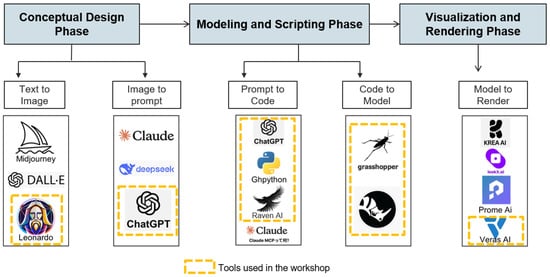
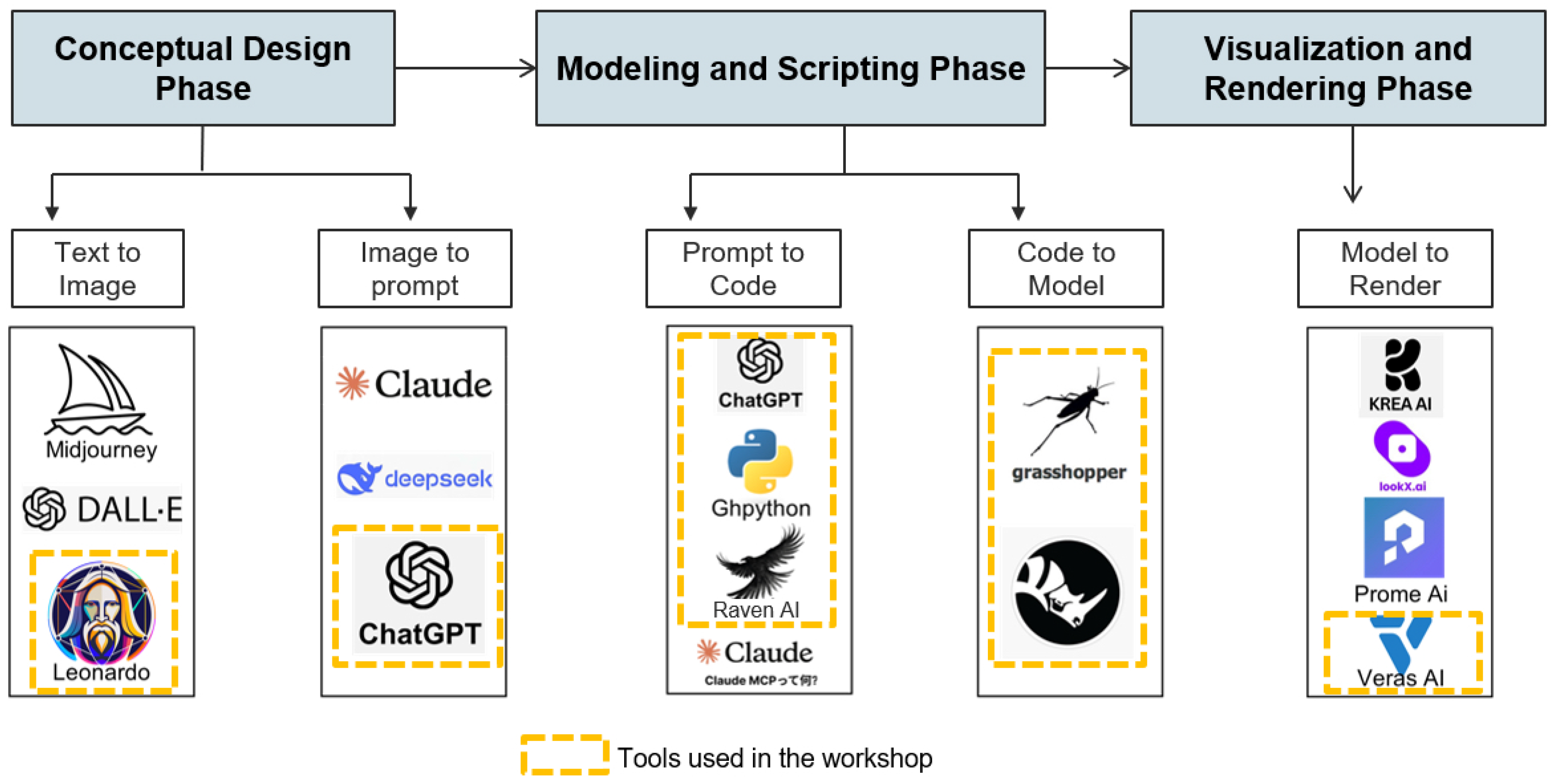
Building on the workshop structure described above, this section turns from how the workshop was run to the AI-integrated workflow itself and the tools that supported it. The workflow spans three main dimensions, applied here to small-scale design objects: a conceptual design dimension for generative ideation; a design development dimension for modelling, scripting, and geometry generation in Rhino/Grasshopper; and a visualization and rendering dimension for presentation outputs. These three dimensions, and the way they follow one another through the workshop, are summarized in Figure 1.
Figure 1.
AI-aided architectural design process developed in the workshop.
4.1. Dimension 1: Conceptual Design
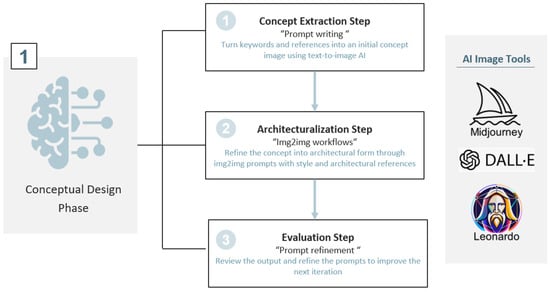
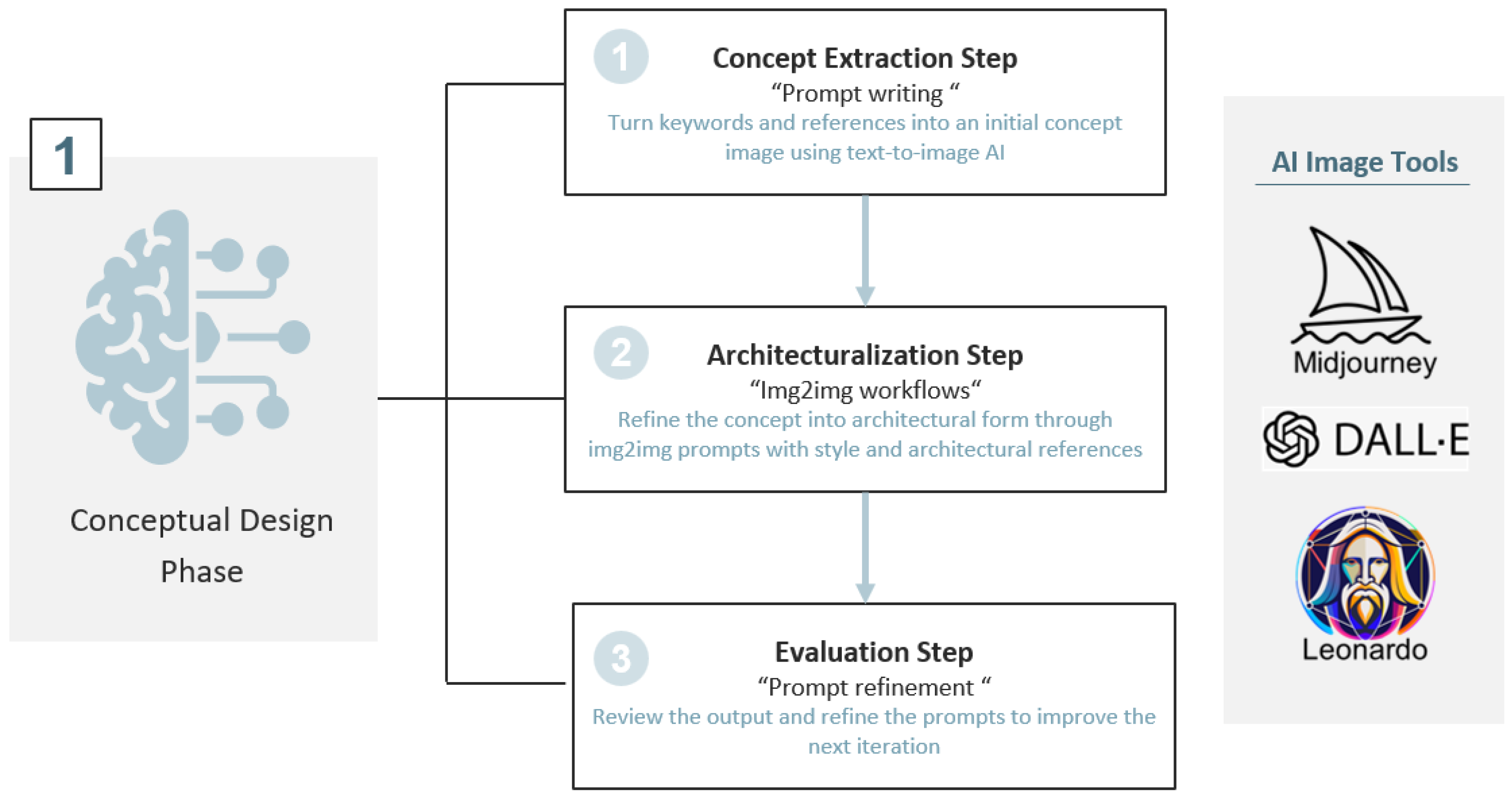
In the early stages, participants employed Leonardo. AI, a web-based generative image platform that uses state-of-the-art text-to-image models to produce stylistically diverse concept imagery from prompts and sketches [29], enabling them to visualize and refine conceptual directions before committing to modeling. The steps of this conceptual design phase are shown in Figure 2.
Figure 2.
Conceptual Design Phase steps. The number 1 denotes the first dimension of the three-part AI-integrated workflow shown in Figure 1. Source: Authors.
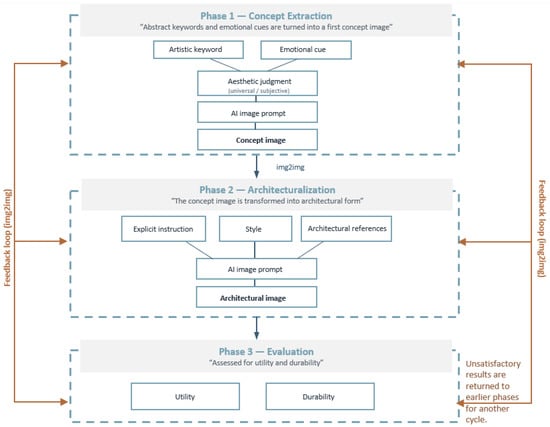
The first dimension integrates AI into three interconnected phases: concept extraction step, architecturalization step, and evaluation step, as shown in Figure 3.
Figure 3.
Flowchart for image generation & evaluation. Source: [30] visualized by Authors.
4.1.1. Concept Extraction Phase
The process begins with abstract prompts based on artistic keywords and emotional cues rather than strict architectural terminology. These prompts are filtered through an aesthetic judgment framework that distinguishes between universal and subjective notions of beauty. AI image generators then translate these inputs into conceptual images, which function as open-ended visual explorations rather than finalized architectural outputs.
4.1.2. The Architecturalization Phase
“Architecturalization” is defined here as the img2img-based transformation of open-ended conceptual imagery into architecturally grounded form, achieved by progressively introducing architectural references, style descriptors, and explicit constraints into the prompts. Using img2img workflows, the initial conceptual images are gradually transformed into more defined architectural forms. At this stage, style descriptors, architectural references, and explicit instructions are incorporated into the prompts, ensuring continuity from the abstract stage while grounding the results in architectural vocabulary. The outputs are no longer purely artistic but evolve into architectural images that bridge creativity and spatial materialization.
4.1.3. Evaluation Phase
Furthermore, generated images are assessed not only against aesthetic frameworks but also according to architectural criteria such as utility, durability, and feasibility. Feedback loops ensure that the process is iterative: results that do not meet the desired balance between artistic vision and architectural logic are refined through repeated img2img cycles. This iterative loop situates AI-driven image generation as more than a visualization tool; it becomes an active component of design logic, bridging the conceptual and parametric dimensions of architecture.
4.2. Dimension 2: Design Development
Beyond conceptual exploration, AI integration extends into the geometry modeling and scripting stage, which is critical for translating abstract ideas into implementable parametric definitions within software environments such as Rhino and Grasshopper. While AI-driven workflows provide early inspiration, the challenge lies in formalizing these ideas into parametric systems that can be iterated, adjusted, and fabricated, which requires a deep understanding of both the design intent and the technical capabilities of the software tools being used.
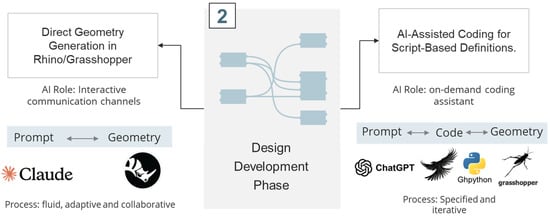
The workshop experiments two principal pathways for AI-assisted parametric modeling as shown in Figure 4:
Figure 4.
Design Development Phase. The number 2 denotes the second dimension of the three-part AI-integrated workflow shown in Figure 1. Source: Authors.
4.2.1. Direct Geometry Generation in Rhino/Grasshopper
Emerging AI-assisted platforms and plug-ins now allow geometry to be generated directly inside Rhino 8/Grasshopper 1.0. Large language models (LLMs) can interpret natural-language prompts and produce code. Two were used here: ChatGPT (OpenAI), which produces code snippets or full scripts from prompts, and Claude (Anthropic), which is optimized for reasoning and coding [31]. Architects state their design intentions in natural language, and the AI turns these into parametric logic by suggesting Grasshopper components, workflows, and relationships [15].
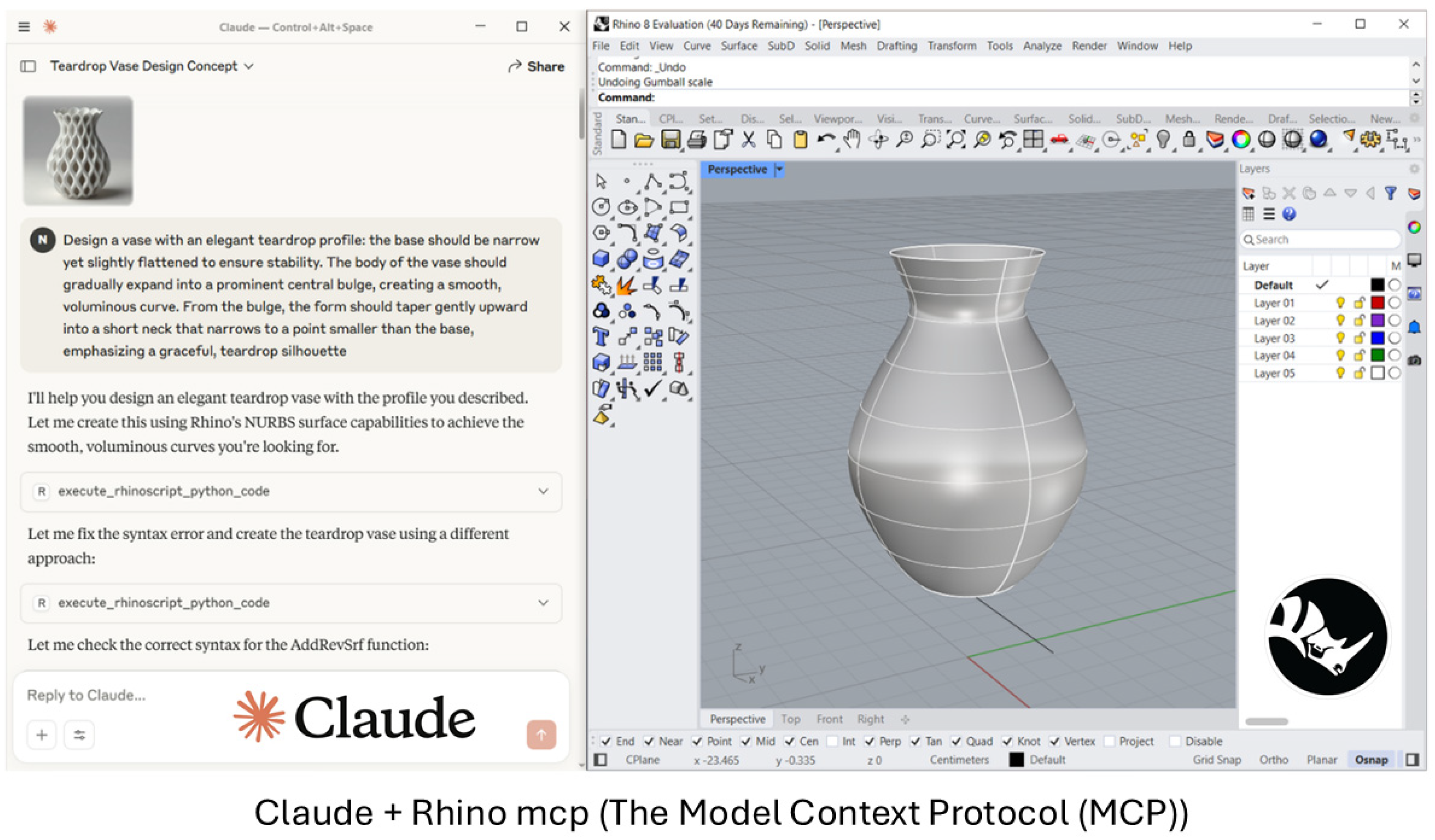
The development of Claude MCP (Model Context Protocol) advanced this further by adding a persistent chat interface linked directly to Rhino and Grasshopper. Unlike static prompt–response systems, in which a single prompt yields a single output, the MCP integration creates an interactive channel between the designer and the AI.
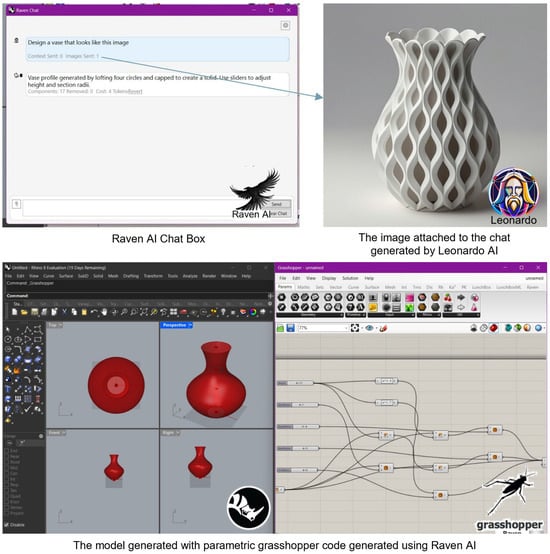
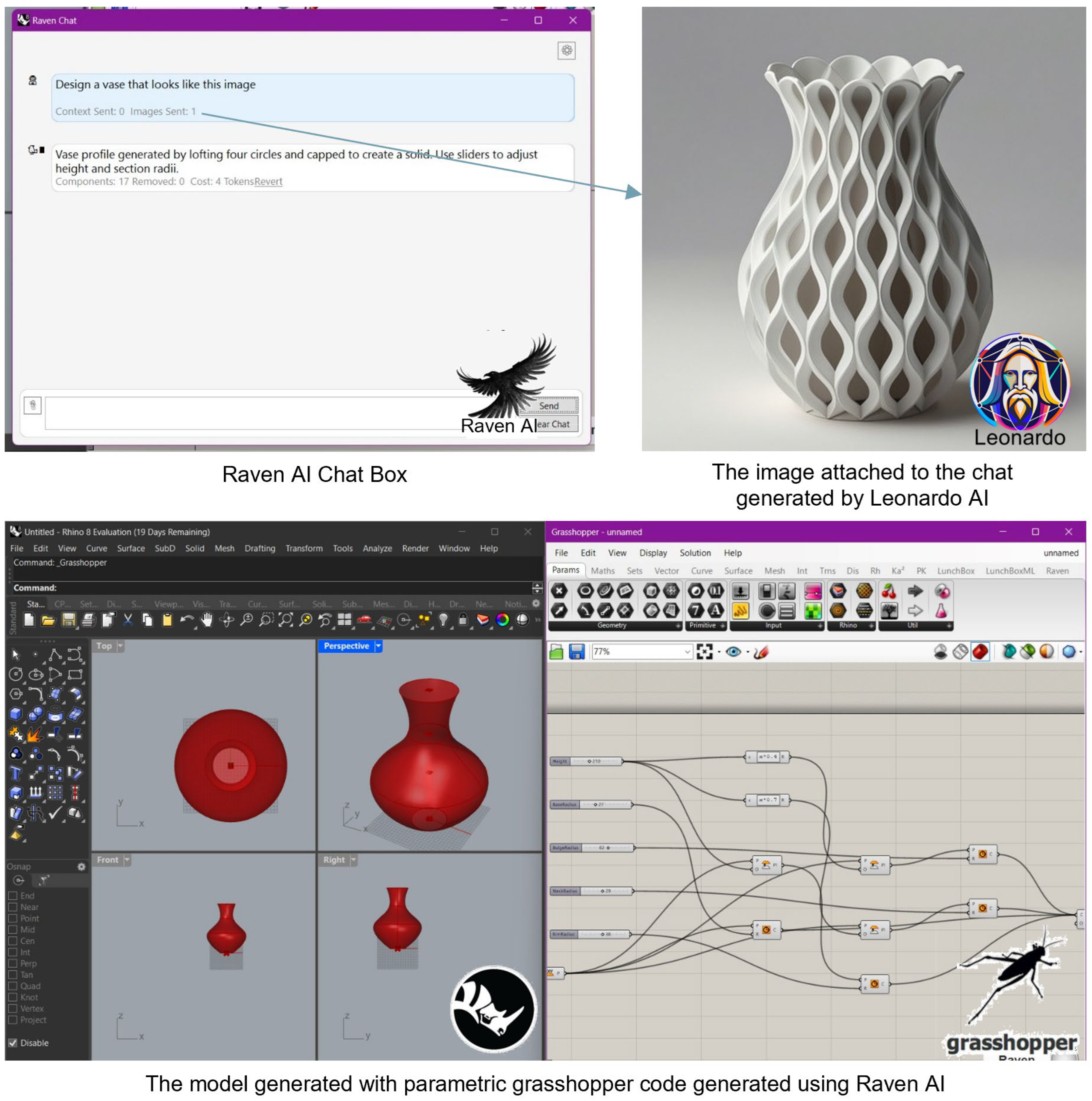
During iterative development, the workshop also explored Raven, an AI assistant and Grasshopper plug-in. Raven interprets natural-language or image prompts and then produces, adjusts, or documents Grasshopper definitions (nodes and wires). This speeds up the generation and refinement of parametric workflows and helps participants prototype algorithmic strategies more quickly. It acts as a co-pilot that understands spatial logic, design constraints, and geometric relationships, generating and modifying parametric models from iterative feedback.
Through this setup, the AI continuously analyses the design context, generates or modifies geometric components, and refines them from the user’s real-time feedback. The result is a fluid, adaptive, and collaborative process—a continuous co-design in which the architect and the AI act as partners, reshaping how designers interact with computational tools and creative decision-making. Figure 5 illustrates this workflow, in which the model is generated using Claude inside Rhino.
Figure 5.
The workflow was used to design the model using Claude inside Rhino (Rhino mcp). Source: The Authors.
4.2.2. AI-Assisted Coding for Script-Based Definitions
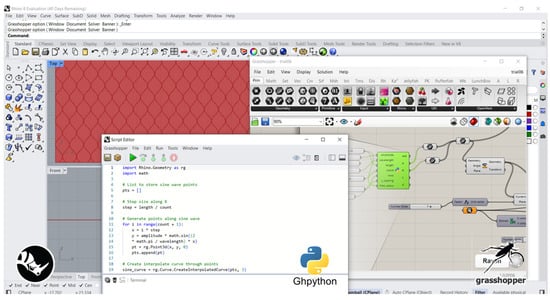
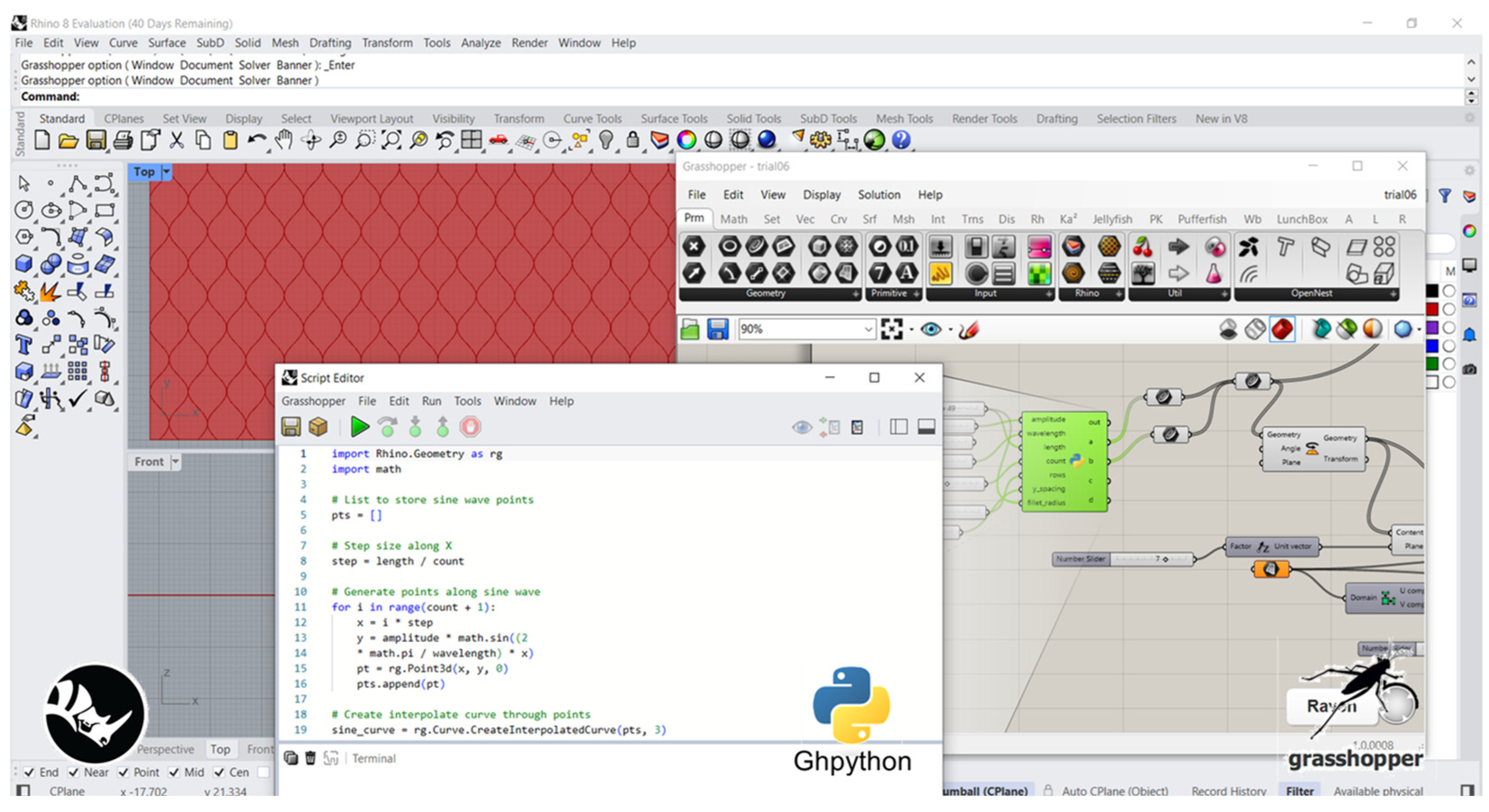
Another significant pathway involves AI support in generating script-based definitions within environments such as GhPython or C#. GhPython is the Python scripting component within the Grasshopper visual programming environment for Rhinoceros 3D that allows parametric rules and algorithms to be written and executed directly in the modeling canvas [32,33].
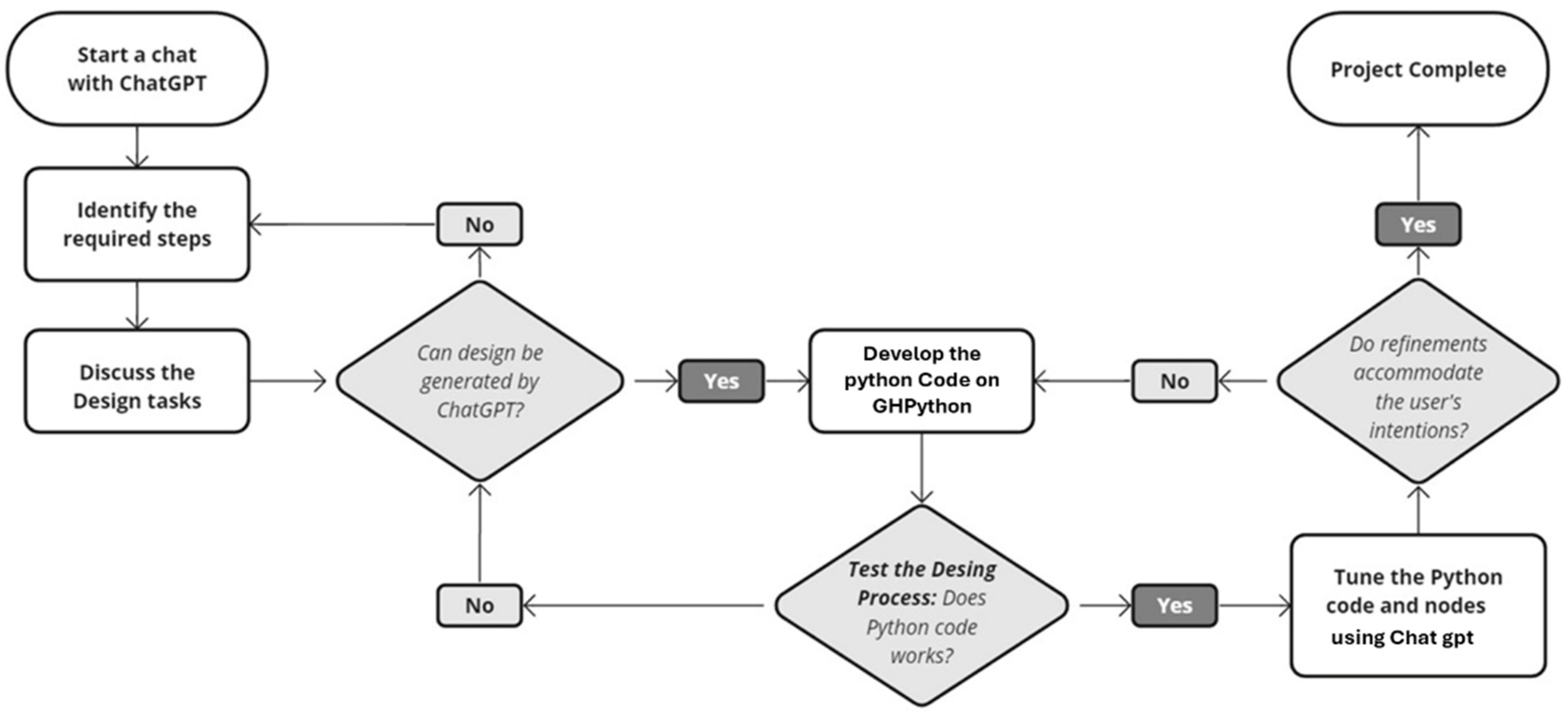
In this workflow, the architect requests assistance from AI tools—most commonly ChatGPT—to draft or debug code. The generated scripts are then tested within Grasshopper for accuracy and functionality. If misalignments occur between design intention and parametric output, conversational feedback loops allow the AI to iteratively refine the script until it aligns with the designer’s vision [34]. This AI-assisted coding workflow for GhPython scripting is shown in Figure 6.
Figure 6.
AI-assisted coding using ChatGPT for GhPython scripting. Source: [2] edited by Authors.
This approach, as shown in Figure 7, reduces the steep learning curve traditionally associated with coding in computational design, enabling architects to engage directly with algorithmic processes without requiring expert programming knowledge. AI serves as an on-demand coding assistant, facilitating rapid prototyping, debugging, and the alteration of intricate parametric systems. Figure 8 shows the parallel workflow, in which Python code generated by ChatGPT is executed inside Grasshopper through GhPython.
Figure 7.
The design workflow of using Raven AI inside Grasshopper to use a prompt and turn it into parametric code in Grasshopper. Source: Authors.
Figure 8.
The design workflow of using the Python code (generated by ChatGPT) inside Grasshopper using GhPython to turn it into parametric code in Grasshopper. Source: Authors.
4.2.3. Toward a Paradigm Shift in Parametric Workflows
Together, these two pathways, AI-to-geometry translation and AI-assisted coding for scripting, indicate a paradigm shift in computational design. Instead of forcing architects to master advanced programming languages or rely solely on node-based parametric systems, AI acts as a mediator between design intent and computational execution. This transformation fosters a more inclusive, iterative, and collaborative design process, where architects can concentrate on conceptual reasoning and spatial creativity, while AI provides the technical precision and efficiency to actualize their ideas.
4.3. Dimension 3: Visualization & Rendering
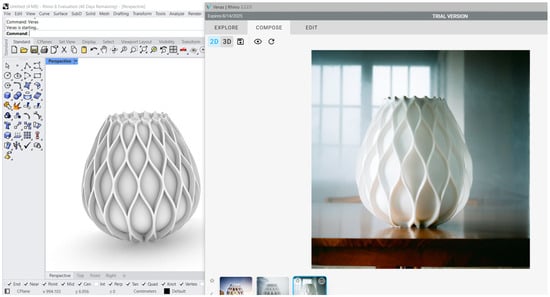
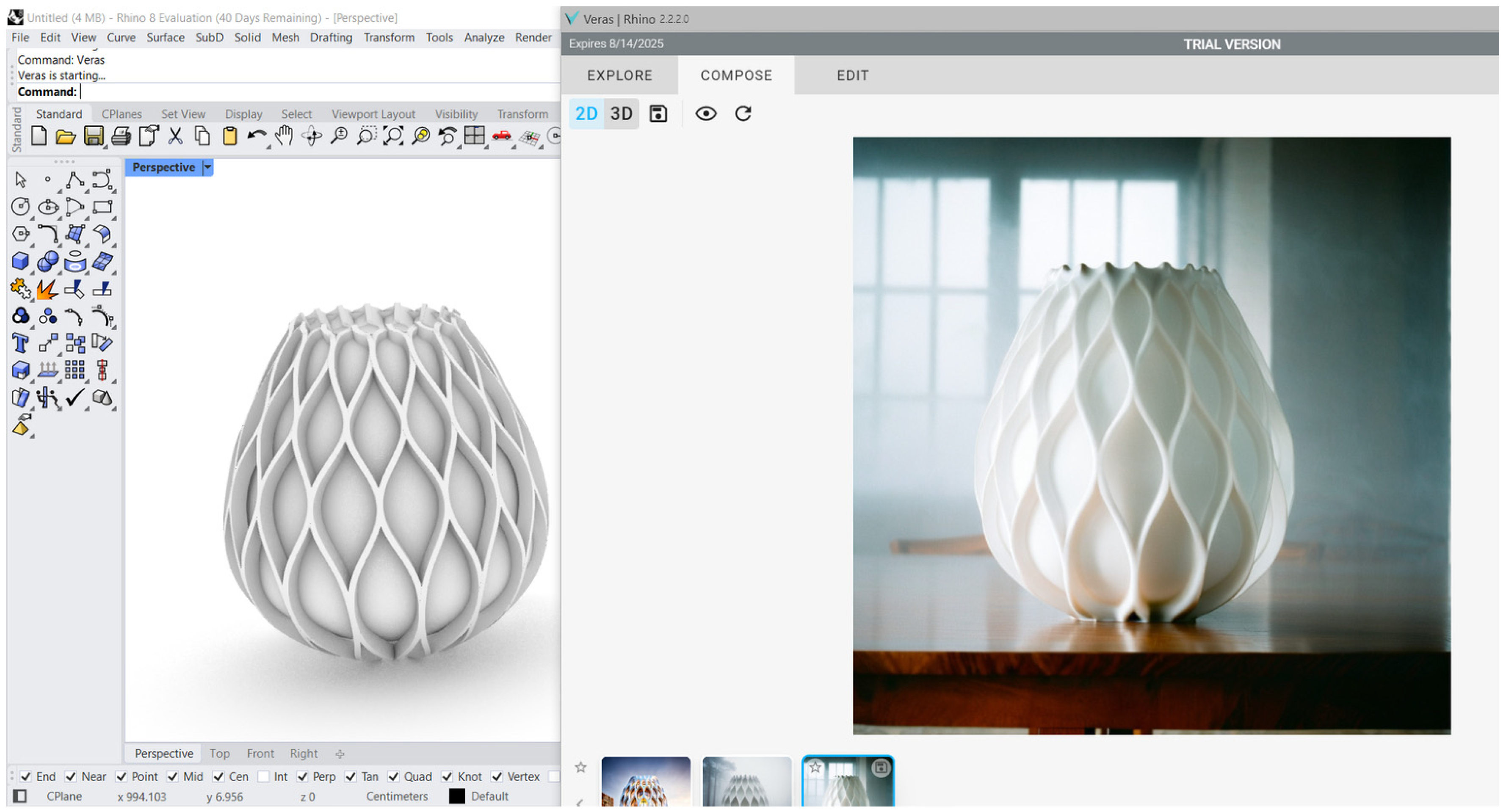
In the final visualization stage, participants used Veras, an AI-powered rendering/visualization app developed by Evolve LAB, to convert parametric design outputs into photorealistic visualizations directly within Rhino and Revit environments by translating model views into polished visual renderings (material inference, lighting suggestions, stylistic post-processing), thus producing high-quality presentation imagery for critique [2]. Figure 9 shows a real-time rendered model produced with Veras inside Rhino.
Figure 9.
The real-time rendered model using Veras in Rhino software. Source: Authors.
Veras connects parametric generation and visual storytelling by working perfectly with computational modeling platforms. This improves the quality of presentations and the way architects communicate their designs. Together, these workflows formed a holistic methodology that integrated AI throughout the entire design lifecycle from ideation to visualization while preserving the architect’s role as the critical decision-maker.
5. Case Study: Workshop Execution
The AI-Driven Parametric Architecture Workshop concluded a five-day exploration of the future of architectural design, highlighting the convergence of artificial intelligence and creativity. The structure of the workshop was designed to gradually guide students from foundational parametric design concepts to advanced AI-assisted workflows, ensuring a balance between theory, experimentation, and application.
The following narrative is drawn from direct observation. It is organized to reflect the study’s two research questions: the parametric refresher, scripting, and modeling days speak to RQ1 (the extent to which AI supported participants in 2D/3D parametric modeling), while participants’ reflections on future use and their before/after ratings inform RQ2 (perceived usefulness and attitudinal change), which is treated as exploratory rather than tested. Given the five-day format, participants worked at small-scale design objects (for example, a pavilion element and a patterned vase) chosen so that a complete ideation-to-visualization workflow could be executed within the available time; this scale limits architectural generalizability and is revisited in the Limitations. Concretely, each participant developed a design concept—typically a pattern or motif—and applied it to an object of their own choosing, carrying it from an initial concept image, through a parametric model, to a rendered output. The objects differed, but every participant produced the same three deliverables (concept, parametric definition, and final visualization), so the shared workflow—not any particular object—was the focus.
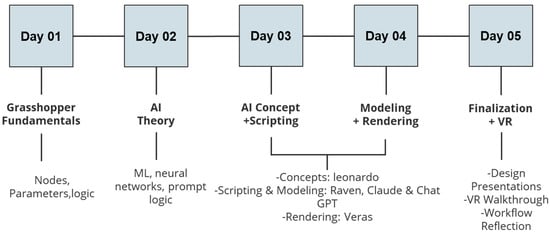
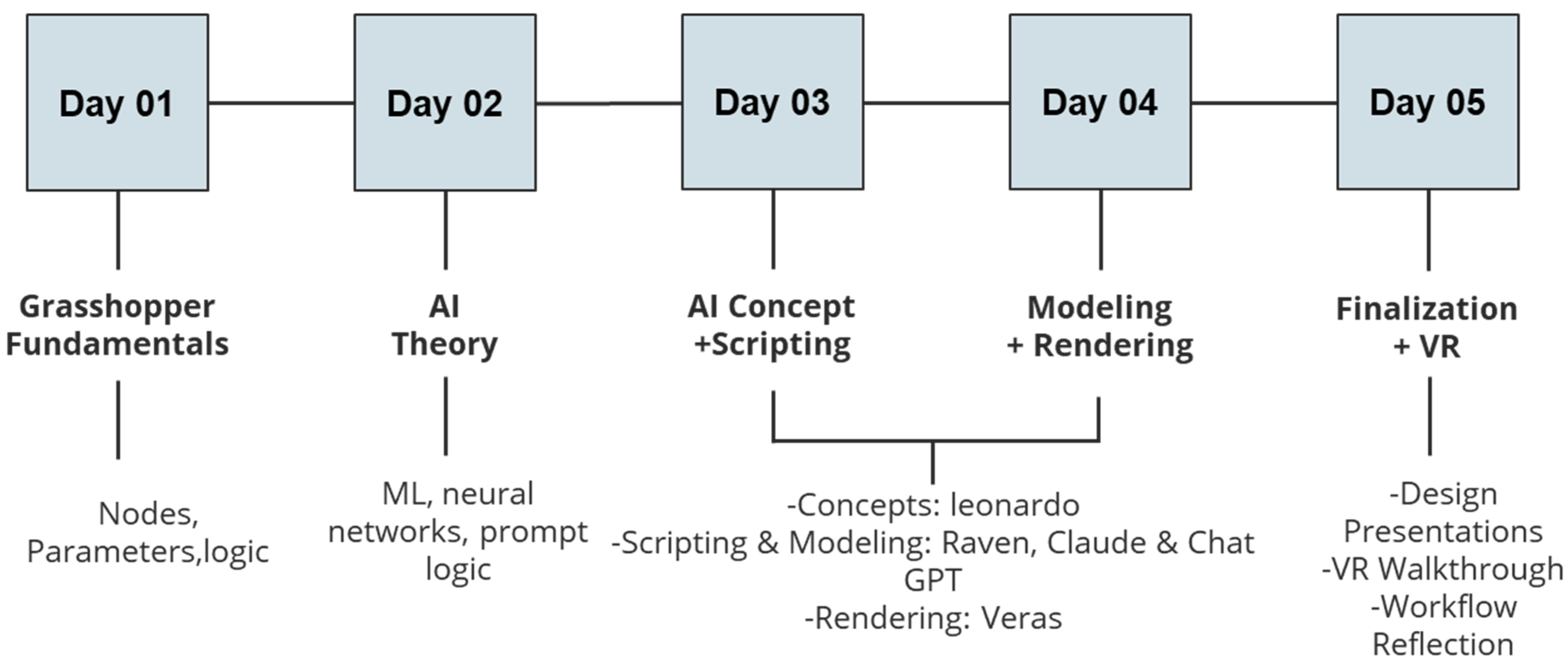
The workshop brought together participants from varied academic and professional backgrounds, including early-stage architecture students, senior students nearing graduation, and recent graduates actively working in design offices. This range of experience allowed the workflow to be observed across multiple levels of familiarity with parametric tools and AI-assisted design. The overall sequence of the five days is shown in Figure 10.
Figure 10.
Workshop timeline. Source: Authors.
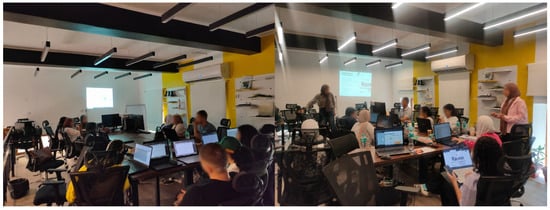
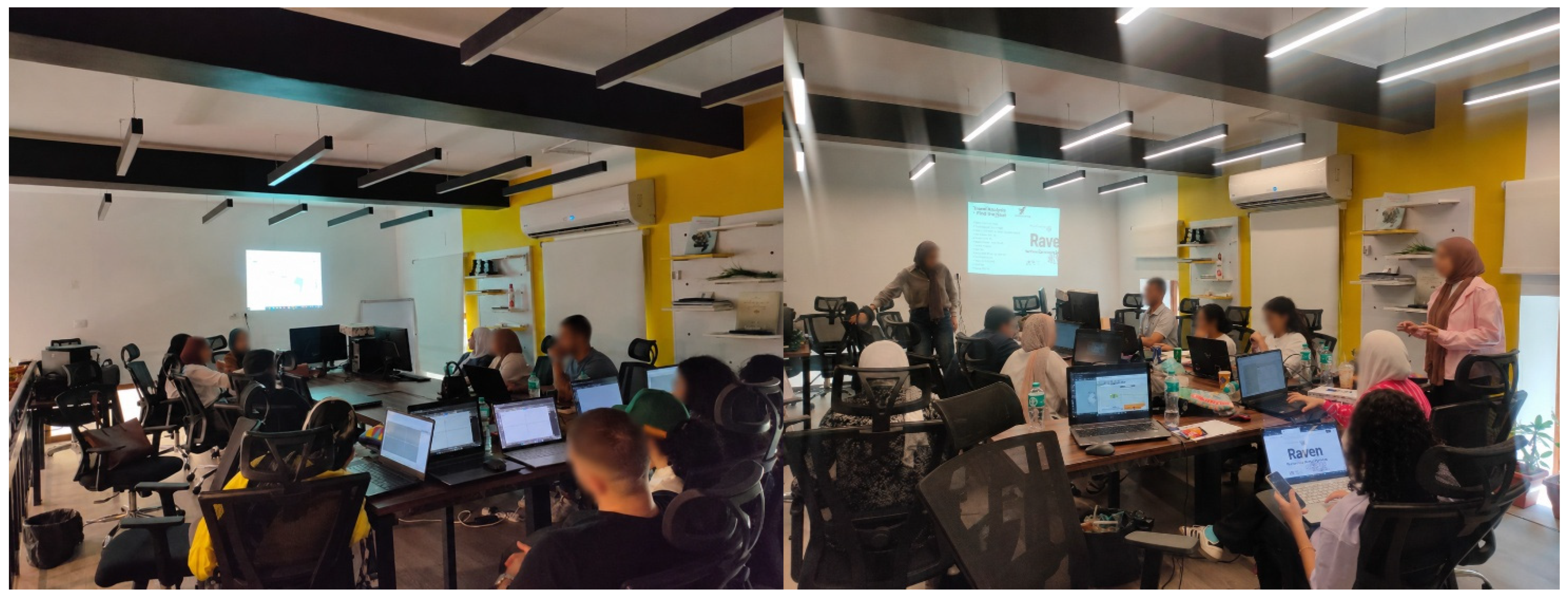
The first day focused on a deep dive into parametric architecture, where participants were reintroduced to the core principles of computational design and refreshed their skills in Rhino 3D and Grasshopper. This step was particularly important given the diversity of the group, as it ensured that all participants, regardless of their prior experience, could begin from a shared foundation before progressing to more advanced AI-integrated stages. Figure 11 shows the introductory sessions.
Figure 11.
Workshop introductory sessions. Source: Authors.
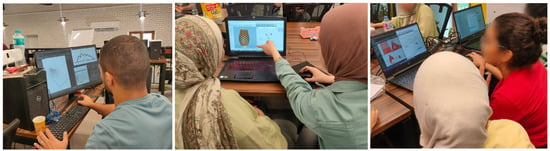
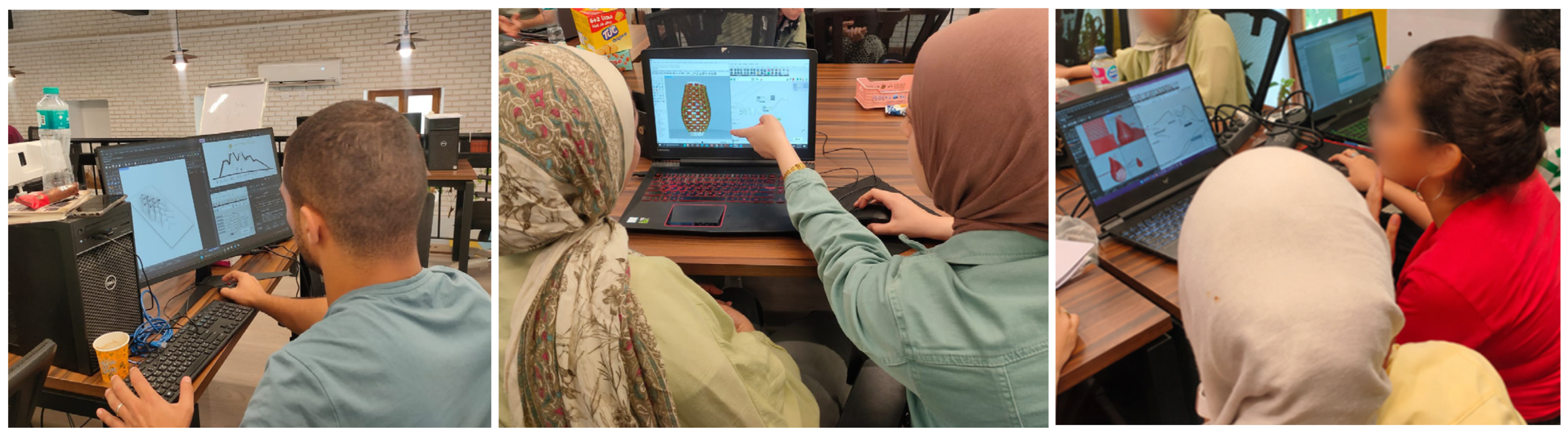
The follow-up sessions began with a theoretical introduction to artificial intelligence, where students were familiarized with essential concepts and terminology, including machine learning, neural networks, and the distinction between discriminative and generative AI. Following this, the workshop shifted toward practice, which continued throughout the third and fourth days. During this stage, participants engaged in an integrated workflow of AI-driven tools: they first used Leonardo AI to generate preliminary images that helped them visualize and refine their design intentions.
They then explored Raven AI as a tool for supporting workflow development and experimentation, enabling them to test how AI could intervene in different phases of the design process. Building on this foundation, they relied on ChatGPT and Claude to produce GhPython scripts, which facilitated the creation of complex parametric geometries in Grasshopper without requiring advanced coding expertise. Finally, Veras AI was introduced to render high-quality visualizations of their parametric outputs, providing immediate feedback and enhancing their design presentations. This sequence of tools allowed students to move seamlessly from conceptualization to scripting to visualization, ultimately preparing their designs for digital fabrication. Figure 12 shows the follow-up sessions with the instructors.
Figure 12.
Follow-up sessions with the instructors. Source: Authors.
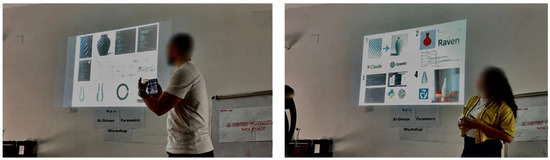
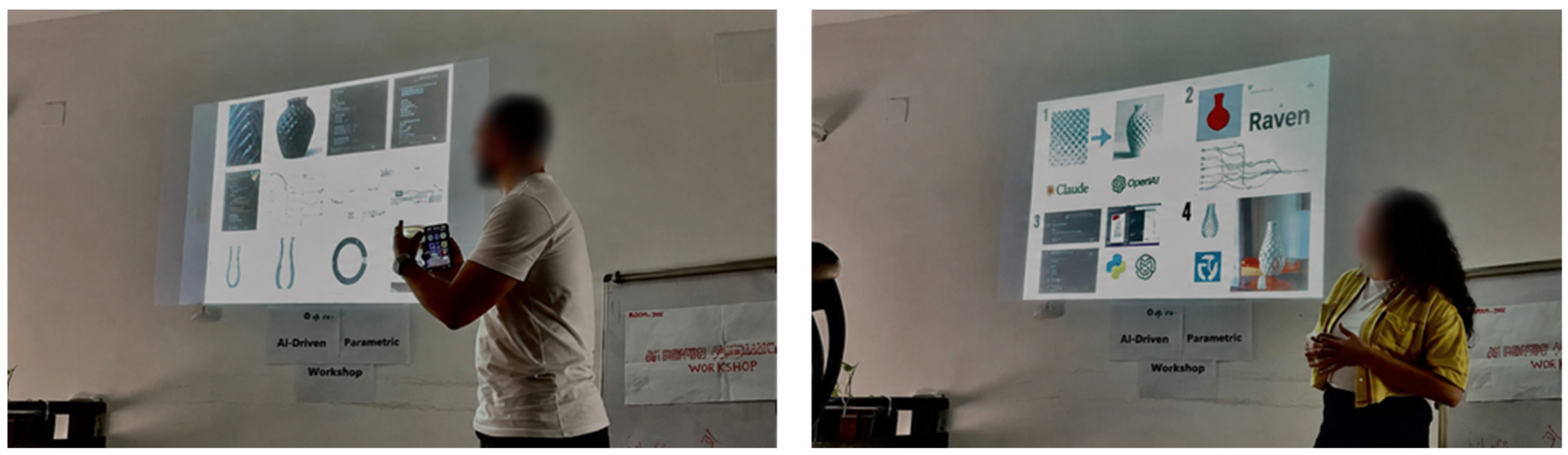
The final day was dedicated to presentations, where students showcased complete workflows developed entirely through AI-integrated methods. Participants’ presentations on the final day. Their outcomes included parametric models, AI-generated scripts, and rendered images, and at the end they also had the chance to briefly experience their work in virtual reality (VR). Students’ Experience with VR Technology. This final step not only demonstrated the technical progress achieved during the workshop but also emphasized the creative opportunities offered by combining AI with computational design. Figure 13 shows the participants’ presentations on that day.
Figure 13.
Participants’ presentations on the final day. Source: Authors.
Through this hands-on journey from AI-assisted concept generation to modeling, visualization, and digital fabrication, students gained new perspectives on AI’s role in architecture and product design. Their feedback reflected this shift: rather than perceiving AI as a threat to design practice, they came to view it as an empowering tool that extends creativity, accelerates workflows, and enhances problem-solving in architectural education.
6. Results
The results of the workshop are presented through both the observed progression of the design workflow and the feedback collected from participants, revealing how artificial intelligence was integrated into parametric design processes. The participant group spanned early-stage students, senior students, and working professionals, and the results reflect how the workflow was performed across this range of experience levels.
All nine participants successfully followed a unified workflow that progressed from AI-assisted concept generation to parametric modeling using Grasshopper and finally to visualization and rendering. While the overall process was consistent, variations emerged in how participants approached the early stages of design, particularly in how they defined and translated their initial ideas into parametric systems, with some participants favoring more structured methods while others opted for more exploratory techniques.
The findings indicate that the development of clear design intentions played a significant role in shaping the efficiency of later stages. Participants who established more structured starting points were generally able to navigate the transition toward parametric modeling with greater stability, while others required additional iterations to refine their outputs and align them with their intended concepts.
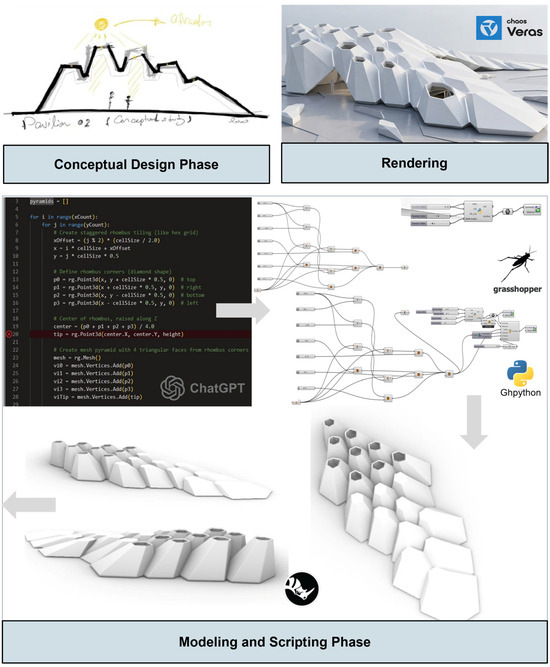
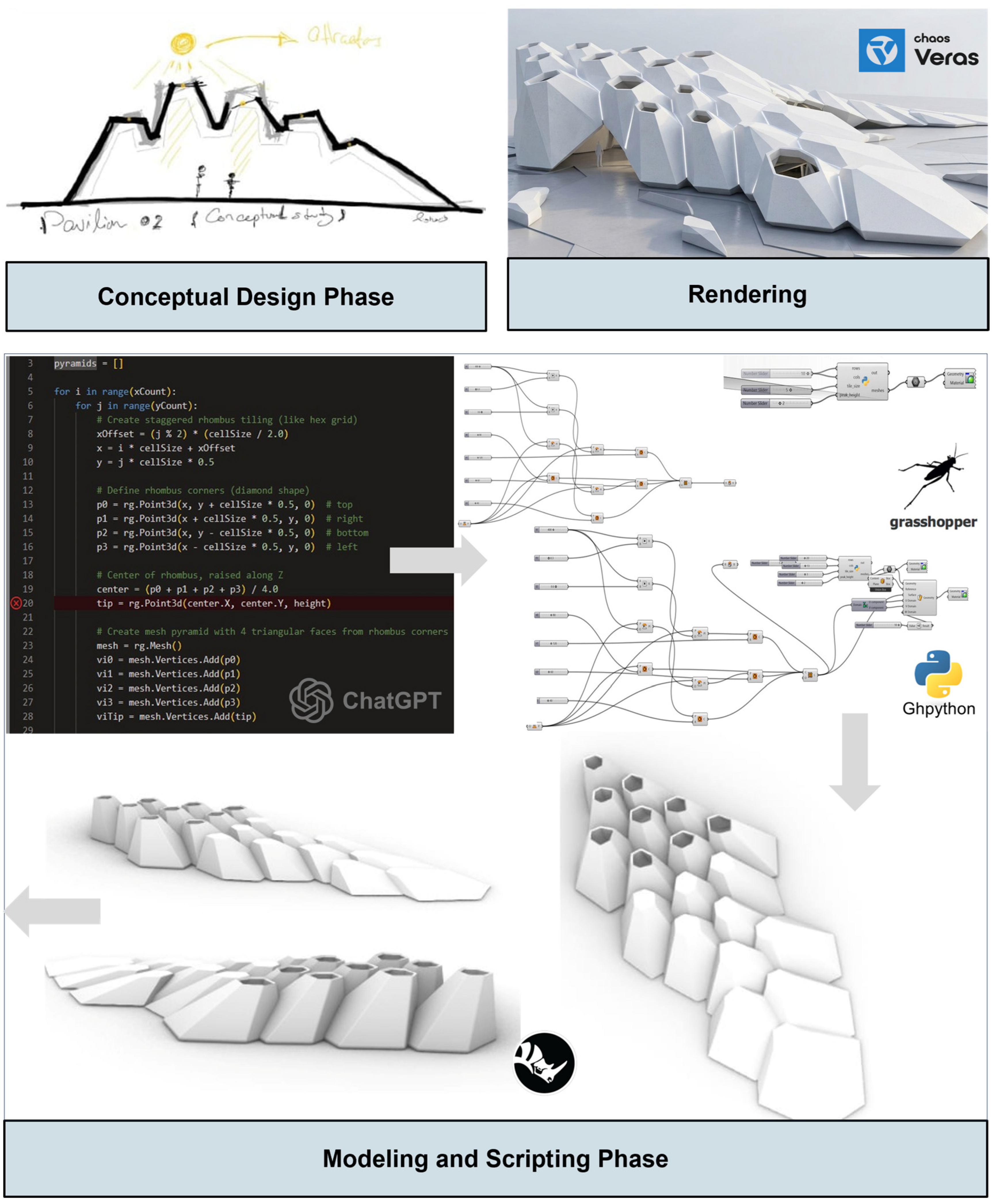
The construction and refinement of prompts also influenced the quality of results. Iterative engagement with AI tools allowed participants to gradually improve their outputs, particularly when moving from conceptual images to more defined parametric geometries within the modeling environment. All nine participants were able to produce complete parametric models and visual outputs within the limited five-day timeframe, illustrating how the AI-supported workflow enabled participants to complete an end-to-end process within the five-day format. Design outputs were not independently assessed against architectural quality criteria; here, “completion” denotes producing a full parametric model and rendered output through the workflow, rather than a judgment of design quality. Post-workshop Survey questions can be viewed in Appendix A. Two representative examples of these outputs are shown in Figure 14 and Figure 15.
Figure 14.
Example 1: a pavilion designed using the Workshop Methods by a participant using ChatGPT to generate Python code to be used in Grasshopper using GhPython and changing the parameters to get the desired output in rendering using Veras, (the arrows refer to the sequence of the design process). Source: Authors.
Figure 15.
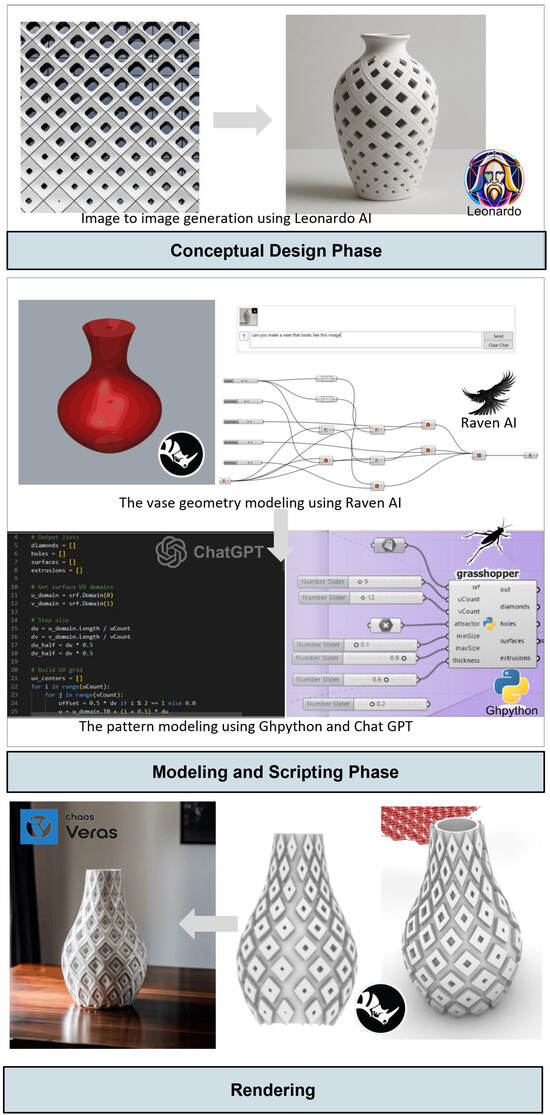
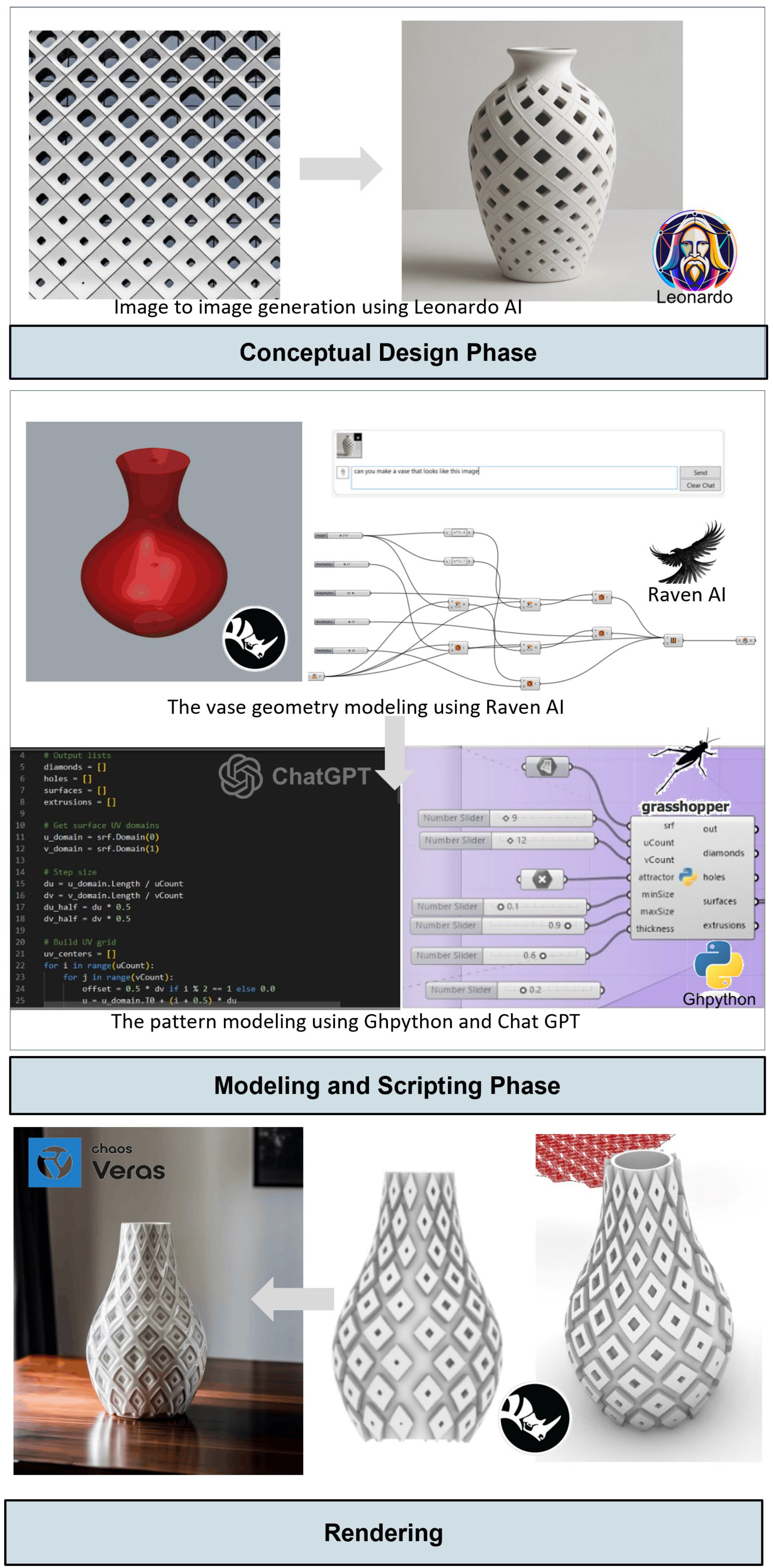
Example 2: A vase with a pattern designed using the Workshop Methods by a participant using Leonardo AI to generate a 2D image of the concept, then by using Raven AI the body geometry of the vase was generated in Grasshopper; after that the pattern of the vase was designed using a Python code generated by ChatGPT and linked to Grasshopper using GhPython, and at last the parameters of the Grasshopper code were altered to get the desired output in rendering using Veras, (the arrows refer to the sequence of the design process). Source: Authors.
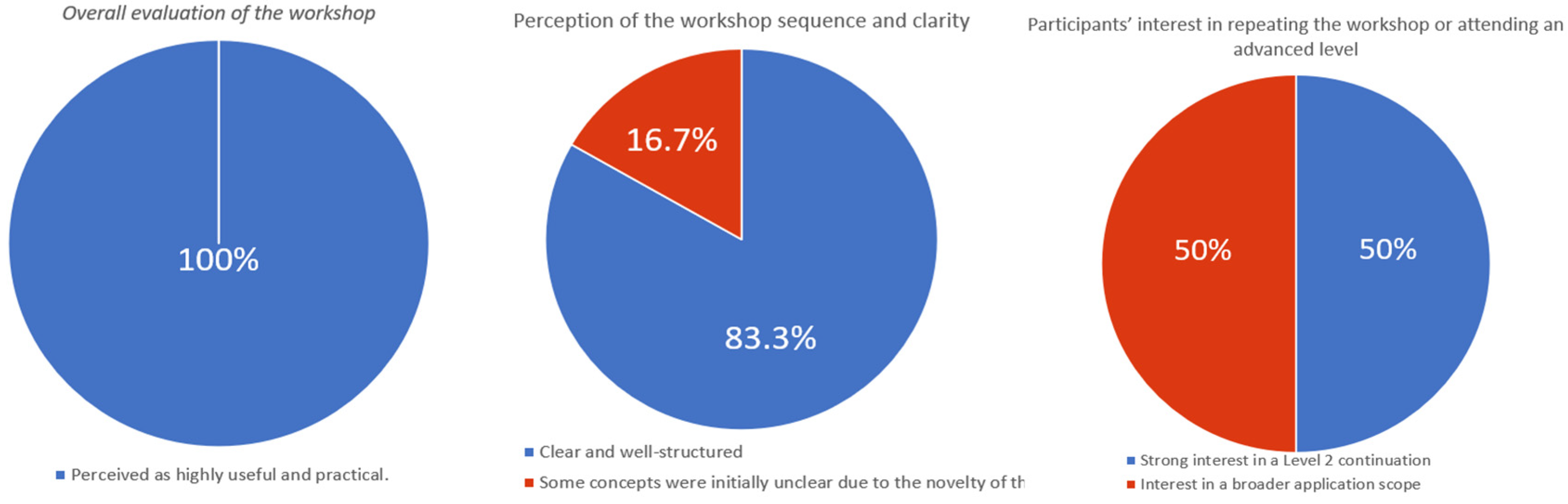
Survey results further support these observations. Among the six survey respondents, all (6/6, 100%) evaluated the workshop as useful and relevant to their academic development, while 5 of 6 (83.3%) found the workflow clear and well-structured. One respondent (1/6, 16.7%) reported initial difficulty, mainly due to unfamiliarity with AI tools and the integration of multiple platforms. Given the small convenience sample, these proportions are reported as preliminary descriptive findings and are not generalizable. Complete item-level results for all closed survey questions are provided in the Supplementary Material (Table S1); open-ended responses are summarized there as well. These ratings are summarized in Figure 16.
Figure 16.
Participants’ overall evaluation of the workshop and sequence clarity (n = 6 survey respondents). Source: Authors.
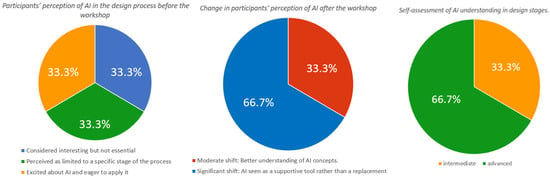
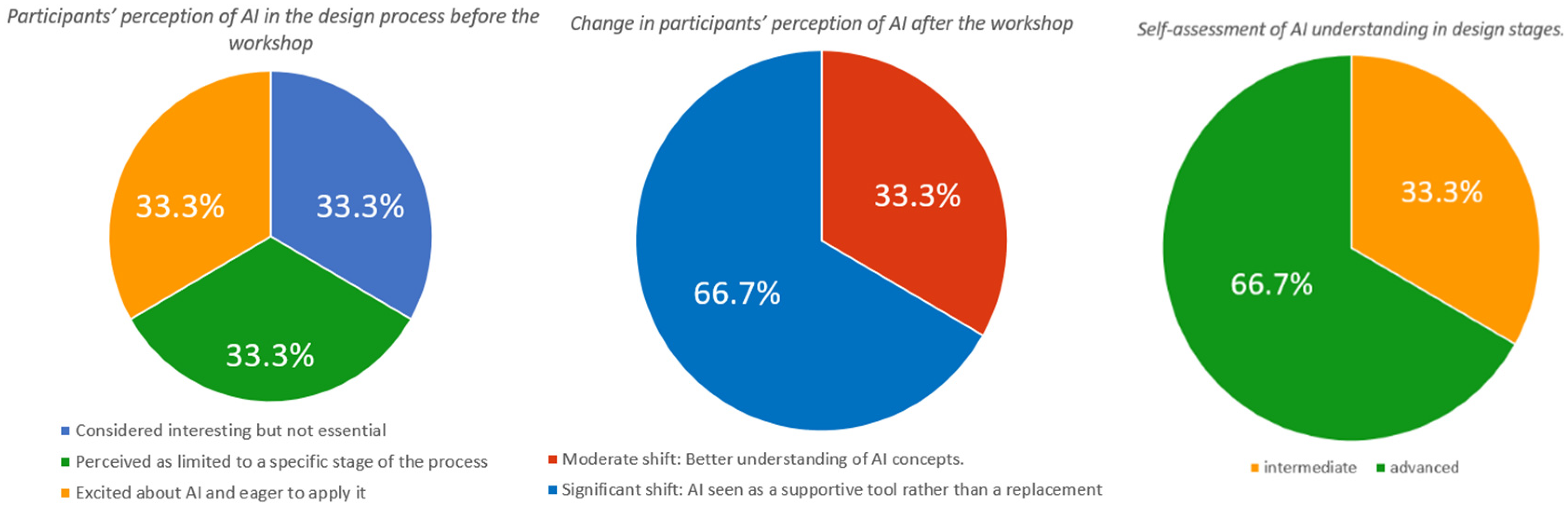
A perceptual shift was also observed among participants. While some initially viewed AI as limited in scope, most participants reported a broader understanding after the workshop and recognized its role across multiple stages of the design process, including ideation, modeling, and visualization. Overall, the results demonstrate that a structured AI-integrated workflow can effectively support rapid design development while enhancing both technical understanding and creative engagement. Figure 17 compares participants’ perceptions of AI before and after the workshop.
Figure 17.
Participants’ perception of AI before and after the workshop (n = 6 survey respondents). Source: Authors.
7. Discussion
The findings of this study highlight that the effectiveness of integrating artificial intelligence into parametric design appeared to depend not only on the tools themselves but also on how they were structured within a coherent, guided workflow, an exploratory observation that would require controlled testing to confirm. A clearly defined process enabled participants to engage with AI in a more focused and meaningful way, rather than using it in a fragmented or exploratory manner. This was reflected across the different experience levels present in the workshop; early-stage students engaged with the tools as an entry point into computational thinking, while senior students and professionals were able to connect the workflow to their existing design knowledge and practice, suggesting that a well-structured AI-integrated framework can accommodate a wider range of users without compromising depth or relevance.
The workshop also revealed distinct approaches to parametric modeling that can be translated into professional contexts, particularly between direct geometry generation and AI-assisted scripting. While direct generation supported rapid exploration and immediate visual feedback, it offered limited flexibility in later stages. In contrast, scripting-based approaches required more initial effort but provided greater control and adaptability, suggesting that combining both methods can lead to more balanced design outcomes.
Participant reflections further illustrate the depth of this experience. Many participants identified the integration of AI with parametric scripting, particularly generating GhPython code through conversational tools, as one of the most valuable aspects of the workshop. This highlights the role of AI in lowering technical barriers and enabling users to engage with computational design without requiring advanced programming expertise.
Participants frequently emphasized the importance of hands-on experimentation, particularly the use of AI-assisted workflows to explore pattern generation and complex geometries. These experiences encouraged participants to adopt a more iterative and exploratory design approach that allowed for continuous refinement and development.
When reflecting on future applications, participants expressed interest in using AI to accelerate design processes, translate conceptual ideas into structured modeling steps, and generate parametric geometries from prompts or reference images. This indicates that AI is increasingly perceived not only as a supporting tool but also as an active component in shaping design methodologies.
In addition to technical outcomes, feedback highlighted the effectiveness of the workshop’s teaching approach. Participants positively evaluated the clarity of communication, the responsiveness to questions, and the interactive nature of the sessions. The balance between structured guidance and open experimentation contributed to a supportive learning environment that encouraged both understanding and creative exploration. Participants’ evaluation of the instructors’ communication and interaction is shown in Figure 18.
Figure 18.
Evaluation of instructors’ communication and interaction with participants.
Limitations
Despite these contributions, the study has several limitations. The workshop was conducted over a short duration of five days, which limited the scope of the projects and did not allow for the development of full-scale architectural or product design proposals. Instead, participants focused on smaller-scale applications, particularly interior design elements and product design, which proved to be a practical approach within the available timeframe.
Another limitation is the relatively small number of participants involved in the workshop, which may affect the generalizability of the findings. In addition, the study did not include the application of these workflows in more complex architectural projects, which may require further investigation to fully assess their potential.
Several further limitations should be emphasized. The study included no control or comparison group, no baseline or follow-up measurement, and no independent assessment of design-output quality, so observed changes cannot be attributed specifically to the AI-integrated workflow rather than to the intensive format, instructor support, novelty effects, or participants’ differing prior skills. The evidence rests on retrospective self-report from a small, non-representative convenience sample, and the exercises were at product/interior scale rather than full architectural projects.
The workflow also depended on several proprietary tools used across multiple platforms, which raises a usability burden and limits reproducibility as tools change. Because the specific tool combinations differed across participants (for example, ChatGPT/Claude with GhPython scripting versus Raven inside Grasshopper), the workflow each participant learned was not identical; whether any participant can learn a single, common workflow therefore cannot be tested here and is left to future controlled study using a shared task. Taken together, the strongest defensible conclusion is that the AI-integrated workshop appeared feasible, acceptable, and promising as a pilot pedagogical approach, and that the findings should be read as preliminary and hypothesis-generating rather than confirmatory.
8. Conclusions
This study set out to evaluate the feasibility and perceived usefulness of a structured, human-in-the-loop workflow that integrates AI across the stages of the parametric design process in an educational setting. Two aims guided the work: first, to propose such an integrated, stage-by-stage workflow (RQ1); and second, to examine, in an exploratory manner, how participants perceived its usefulness and how their views of AI changed through the workshop (RQ2). With respect to the first aim, the workshop showed that participants from varied backgrounds could carry a design from early ideation through parametric modeling to final visualization within a limited timeframe. With respect to the second, participants reported the workflow to be practical and relevant and described a broader understanding of AI’s role across design stages. In this exploratory setting, participants’ progress appeared to relate not only to the AI tools themselves but also to the clarity of their design inputs and the structure of the workflow; this observation is preliminary and would require a controlled study to test.
Consistent with a human-in-the-loop process, participants used AI outputs as material to be curated, evaluated, and refined rather than as finished designs; designers remained essential in guiding, evaluating, and refining outputs—particularly when translating conceptual ideas into coherent parametric systems and meaningful design outcomes. In this context, the findings suggest that AI may lower technical barriers, allowing a wider range of users to engage with parametric design. This has important implications for architectural education, where AI can support both accessibility and innovation while expanding the scope of design exploration.
The diversity of participants’ backgrounds further supports this potential, as the workflow demonstrated adaptability across different levels of expertise, suggesting that AI-integrated parametric design is not limited to a specific academic or professional profile but can serve as a flexible framework across varied educational and practice contexts.
At the same time, the study emphasizes the importance of maintaining a critical approach when working with AI, ensuring that generated outputs are carefully evaluated rather than passively accepted. This balance between automation and human judgment remains central to effective design practice. Building on these insights, several practical considerations can be drawn for future applications: structuring AI-assisted workflows into clear stages, providing initial guidance for newcomers, encouraging iterative experimentation, and simplifying the workflow itself—consolidating the current branching, multi-platform structure into fewer tools and a single guided track, with optional advanced branches introduced only once the core process is mastered—to enhance both learning outcomes and design quality.
Overall, this research contributes to the growing field of AI in architecture by providing an applied and educational perspective on integrating AI into parametric workflows, while also opening the door for future work to extend this approach to more complex design scenarios and broader contexts to further assess its impact.
Supplementary Materials
The following supporting information can be downloaded at: https://www.mdpi.com/article/10.3390/architecture6040172/s1, Table S1. Item-level results of the post-workshop survey.
Author Contributions
Conceptualization, S.E.K. and G.H.; methodology, R.E.S.; software, N.H.; validation, S.E.K., N.H. and G.H.; formal analysis, N.H. and R.E.S.; investigation, G.H., N.H. and R.E.S.; resources, S.E.K.; data curation, G.H. and N.H.; writing—original draft preparation, G.H.; writing—review and editing, G.H., N.H. and R.E.S.; visualization, N.H. and G.H.; supervision, S.E.K.; project administration, S.E.K.; funding acquisition, S.E.K. All authors have read and agreed to the published version of the manuscript.
Funding
This research received no external funding.
Institutional Review Board Statement
The study was reviewed and approved by the Institutional Review Board (IRB) of the Faculty of Engineering, Ain Shams University, under expedited review (ethics approval no. IRB-ASU-26-030). The IRB approved the workshop-based data collection and the use of anonymized survey responses for research and publication purposes. Workshop materials and informed-consent documentation can additionally be provided to the editorial office upon request.
Informed Consent Statement
Verbal and written consent was obtained from all participants to publish this paper prior to data collection. Verbal and written consent was deemed appropriate because the study was non-interventional and conducted with adult students in the context of an educational workshop, in line with common practices in ethnographic and observational research. Participants were informed about the aims of the study, the voluntary nature of their involvement, and that their contributions could be used anonymously for research and publication purposes.
Data Availability Statement
The datasets and materials supporting this study—including the post-workshop survey instrument, consent form, the anonymized response sheet, the observational coding framework, example prompts, GhPython scripts, and representative Grasshopper definitions—are provided as Supplementary Materials and/or are available from the corresponding author on reasonable request. Further inquiries can be directed to the corresponding author.
Acknowledgments
The Authors would like to acknowledge the Smart and Future Cities Laboratory [SFCL] for supporting the workshop conducted on its premises. AI Usage: During the preparation of this manuscript, the authors used ChatGPT (GPT-4o) (OpenAI) and Claude Sonnet 4 (Anthropic) to assist with structuring and revising the text, and QuillBot for English-language editing. All authors have reviewed and edited the resulting content and take full responsibility for the integrity and accuracy of this publication.
Conflicts of Interest
The authors declare no conflicts of interest.
Appendix A. Post-Workshop Survey Instrument
The post-workshop questionnaire was administered anonymously and online at the end of the five-day workshop. It comprised fifteen items organised into three thematic sections: (A) overall evaluation of the workshop, (B) perceptions of AI before and after the workshop, and (C) evaluation of the instructors and interaction. Item formats were as follows: five single-choice items, two five-point rating scales, two multiple-response (“select all that apply”) items, and six open-ended items, in addition to a participant-consent statement and an optional identifier field.
Participant Consent
This survey is anonymous and voluntary. Your responses will be used solely for academic research purposes. There are no right or wrong answers—please respond based on your genuine workshop experience. Estimated completion time: 15–20 min. By completing this survey, you consent to the use of your anonymized responses in this study.
Preliminary field—Name: open-ended (short answer; recorded for attendance verification only and not linked to reported results).
Section A. Overall Evaluation of the Workshop
A1. Overall, how would you rate the workshop? (single choice)
- -
- It was very useful and practical.
- -
- It was enjoyable, but I felt somewhat lost at times.
- -
- It needs further refinement.
A2. Did you feel that the workshop followed a logical sequence? (single choice)
- -
- Yes—the steps were very clear.
- -
- The subject itself was new, so some of the concepts were a little confusing.
- -
- It needs clearer structuring and organisation.
A3. Did the workshop make you want to repeat it or attend a more advanced level? (single choice)
- -
- Definitely—when is Level 2?
- -
- Possibly, if it included a broader range of applications.
- -
- No—I am satisfied with the current content.
A4. Describe your experience in one short sentence. (open-ended)
A5. Which part of the workshop did you find most useful? (open-ended)
A6. Which future workshops would you be interested in attending next? (open-ended)
A7. If you could offer tips to improve the workshop, what would they be? (open-ended)
A8. How likely are you to recommend this workshop to your peers? (5-point scale)
1 = I would never recommend it ••• 5 = I would strongly recommend it
Section B. Perceptions of AI Before and After the Workshop
B1. Before the workshop, how did you perceive the role of AI in the design process? (single choice)
- -
- A nice addition, but not essential.
- -
- A threat to designers.
- -
- Something I was excited about and eager to apply.
- -
- My understanding of it was confined to a specific stage of the design process.
B2. Did the workshop change your view of AI? (single choice)
- -
- Yes, considerably—I now see it as an assistant rather than a replacement.
- -
- Somewhat—I understand it better now.
- -
- No—my view remained the same.
B3. After the workshop, how would you rate your understanding of using AI across the different design stages? (5-point scale)
1 = Still unsure ••• 5 = Confident (“AI master”)
B4. After the workshop, how do you envisage using AI in your own work? (open-ended)
Section C. Instructor and Interaction Evaluation
C1. How would you rate the instructors? (multiple response—select all that apply)
- -
- They were knowledgeable and explained concepts simply.
- -
- They made me very enthusiastic about the topic.
- -
- They answered questions in a clear and helpful manner.
- -
- I felt there was some rushing or time pressure at times.
- -
- They could be more organised or clearer.
C2. During the workshop, communication was… (multiple response—select all that apply)
- -
- Excellent—I felt I was part of the dialogue.
- -
- Clear, and questions were answered on an individual basis.
- -
- At times I did not understand the questions or instructions.
- -
- There was not enough room for participation.
C3. If you have feedback for a specific instructor, please share it here. (open-ended)
References
- Mitchell, W.J. The Theoretical Foundation of Computer-Aided Architectural Design. Environ. Plan. B Plan. Des. 1975, 2, 127–150. [Google Scholar] [CrossRef] [Scilit]
- Ko, J.; Ajibefun, J.; Yan, W. Experiments on Generative AI-Powered Parametric Modeling and BIM for Architectural Design. arXiv 2023, arXiv:2308.00227. [Google Scholar]
- Li, C.; Zhang, T.; Du, X.; Zhang, Y.; Xie, H. Generative AI for Architectural Design: A Literature Review. Front. Archit. Res. 2025, 14, 759–783. [Google Scholar] [CrossRef] [Scilit]
- Uhrík, M.; Cervantes, J.C.L.; Morales, C.E.S.; Hajtmanek, R.; Demčák, J.; Kupko, A. Prompt Choreographies: Dialogues Between Humans and Generative AI in Architecture. Architecture 2026, 6, 46. [Google Scholar] [CrossRef] [Scilit]
- Huang, J. Evaluation of Architectural Synthesis Using Generative AI: A Case Study on Palladio’s Architecture. Tokyo. March 2025. Available online: https://accessibility.huit.harvard.edu/digital-accessibility-policy (accessed on 16 September 2026).
- Zhang, Z.; Fort, J.M.; Mateu, L.G. Exploring the Potential of Artificial Intelligence as a Tool for Architectural Design: A Perception Study Using Gaudí’sWorks. Buildings 2023, 13, 1863. [Google Scholar] [CrossRef] [Scilit]
- Jin, S.; Tu, H.; Li, J.; Fang, Y.; Qu, Z.; Xu, F.; Liu, K.; Lin, Y. Enhancing Architectural Education through Artificial Intelligence: A Case Study of an AI-Assisted Architectural Programming and Design Course. Buildings 2024, 14, 1613. [Google Scholar] [CrossRef] [Scilit]
- Sadek, M. Artificial Intelligence as a pedagogical tool for architectural education: What does the empirical evidence tell us? MSA Eng. J. 2023, 2, 133–148. [Google Scholar] [CrossRef] [Scilit]
- Alamasi, R.; Asfour, O.S.; Ashmeel, R. The impact of generative AI on architectural design education: Insights from hands-on experience with architecture students. Ain Shams Eng. J. 2026, 17, 103879. [Google Scholar] [CrossRef] [Scilit]
- Bölek, B.; Tutal, O.; Özbaşaran, H. A systematic review on artificial intelligence applications in architecture. J. Des. Resil. Archit. Plan. 2023, 4, 91–104. [Google Scholar] [CrossRef] [Scilit]
- Albukhari, I.N. The role of artificial intelligence (AI) in architectural design: A systematic review of emerging technologies and applications. J. Umm AL-Qura Univ. Eng. Archit. 2025, 16, 1457–1476. [Google Scholar] [CrossRef] [Scilit]
- Gero, J.S. Design Prototypes: A Knowledge Representation Schema for Design. AI Mag. 1990, 11, 26. [Google Scholar]
- Almaz, A.F.; El-Agouz, E.A.E.; Abdelfatah, M.T.; Mohamed, I.R. The Future Role of Artificial Intelligence (AI) Design’s Integration into Architectural and Interior Design Education is to Improve Efficiency, Sustainability, and Creativity. Civ. Eng. Archit. 2024, 12, 1749–1772. [Google Scholar] [CrossRef] [Scilit]
- Donduran, C.G.; Kasali, A.; Dogan, F. Artificial Intelligence as a Pedagogical Tool for Architectural Design Education. J. Des. Studio 2024, 6, 219–229. [Google Scholar] [CrossRef] [Scilit]
- Feng, G.; Yan, W. Text2VP: Generative AI for Visual Programming and Parametric Modeling. arXiv 2024, arXiv:2407.07732. [Google Scholar]
- Xu, C.; Huang, Y. Technological Innovation in Architectural Design Education: Empirical Analysis and Future Directions of Midjourney Intelligent Drawing Software. Buildings 2024, 14, 3288. [Google Scholar] [CrossRef] [Scilit]
- Elrawy, S.; Wagdy, B. Perceptions of generative AI in the architectural profession in Egypt: Opportunities, threats, concerns for the future, and steps to improve. AI Soc. 2025, 40, 4235–4263. [Google Scholar] [CrossRef] [Scilit]
- El Moussaoui, M. Future Illiteracies—Architectural Epistemology and Artificial Intelligence. Architecture 2025, 5, 53. [Google Scholar] [CrossRef] [Scilit]
- Nourian, P.; Azadi, S.; Uijtendaal, R.; Bai, N. Augmented Computational Design: Methodical Application of Artificial Intelligence in Generative Design. arXiv 2023. [Google Scholar] [CrossRef] [Scilit]
- Ponzio, A.P.; Fatah, A.; Schieck, G. AI-Driven Pedagogies in Architecture: A framework for early-stage design education. In Proceedings of the SIGraDi 2025: Meta Responsive Approaches, Buenos Aires, Argentina, 19–21 November 2025. [Google Scholar]
- Agarwal, M.K. Paradigm Shift in Architectural Pedagogy incorporating Artificial Intelligence. Int. J. Res. Appl. Sci. Eng. Technol. 2024, 12, 1315–1329. [Google Scholar] [CrossRef] [Scilit]
- Li, Y.; Chen, H.; Yu, P.; Yang, L. A Review of Artificial Intelligence in Enhancing Architectural Design Efficiency. Appl. Sci. 2025, 15, 1476. [Google Scholar] [CrossRef] [Scilit]
- Hegazy, M.; Saleh, A. Evolution of AI role in architectural design: Between parametric exploration and machine hallucination. MSA Eng. J. 2023, 2, 262–288. [Google Scholar] [CrossRef] [Scilit]
- Boden, M.A. The Creative Mind; Routledge: London, UK, 2004. [Google Scholar] [CrossRef] [Scilit]
- Bozkurt, A. GenAI et al.: Cocreation, Authorship, Ownership, Academic Ethics and Integrity in a Time of Generative AI. Open Prax. 2024, 16, 1–10. [Google Scholar] [CrossRef] [Scilit]
- Özorhon, G.; Gelirli, D.N.; Lekesiz, G.; Müezzinoğlu, C. AI-assisted architectural design studio (AI-a-ADS): How artificial intelligence join the architectural design studio? Int. J. Technol. Des. Educ. 2025, 35, 1999–2023. [Google Scholar] [CrossRef] [Scilit]
- Cheung, L.H.; Wang, L.; Lei, D. Conversational, agentic AI-enhanced architectural design process: Three approaches to multimodal AI-enhanced early-stage performative design exploration. Archit. Intell. 2025, 4, 10. [Google Scholar] [CrossRef] [Scilit]
- Aycı, H.; Kinaci, E.B.; Avinç, G.M.; Taş, A. Artificial intelligence in architecture education: Reflections through structural equation modeling. J. Asian Archit. Build. Eng. 2026, 1–19. [Google Scholar] [CrossRef] [Scilit]
- Yildirim, E. COMPARATIVE ANALYSIS OF LEONARDO AI, MIDJOURNEY, AND DALL-E: AI’S PERSPECTIVE ON FUTURE CITIES. Urbanizm 2023, 82–96. [Google Scholar] [CrossRef] [Scilit]
- Lee, D.H.; Ko, S.H. Experiment and Evaluation of Architectural Image Generation through Artificial Intelligence-Based Text Image Generation Tool. KIEAE J. 2023, 23, 13–22. [Google Scholar] [CrossRef] [Scilit]
- Coello, C.E.A.; Alimam, M.N.; Kouatly, R. Effectiveness of ChatGPT in Coding: A Comparative Analysis of Popular Large Language Models. Digital 2024, 4, 5. [Google Scholar] [CrossRef] [Scilit]
- Martín-Mariscal, A.; Fernández-Rodríguez, J.F.; Picardo, A.; Peralta, E. Grasshopper Algorithmic Modelling: Parametric Design for Product Platform Customisation. Appl. Sci. 2025, 15, 6243. [Google Scholar] [CrossRef] [Scilit]
- Elhaman, B.; Palabıyık, S. An Insight into the Educational Buildings of the First National Architecture Period in Turkey Based on Egli’s Architectural Design Language: Development of a Grammar-Based Model. Buildings 2025, 15, 2025. [Google Scholar] [CrossRef] [Scilit]
- Bono, G. Text-to-building: Experiments with AI-generated 3D geometry for building design and structure generation. Archit. Intell. 2024, 3, 24. [Google Scholar] [CrossRef] [Scilit]



Disclaimer/Publisher’s Note: The statements, opinions and data contained in all publications are solely those of the individual author(s) and contributor(s) and not of MDPI and/or the editor(s). MDPI and/or the editor(s) disclaim responsibility for any injury to people or property resulting from any ideas, methods, instructions or products referred to in the content. |
© 2026 by the authors. Licensee MDPI, Basel, Switzerland. This article is an open access article distributed under the terms and conditions of the Creative Commons Attribution (CC BY) license.