


Abstract
The accelerating climate crisis and resource depletion demand new architectural paradigms that move beyond linear models of production and consumption. While the concept of Intelligent Ecologies is often associated with digital and artificial intelligence systems, this study reinterprets it through the lens of Traditional Ecological Knowledge (TEK), vernacular architecture, and constraint-based innovation. Grounded in a critical reading of key references in ecological knowledge, vernacular studies, circular economy theory, and responsible innovation, the paper develops a conceptual framework tracing a trajectory from TEK to adaptive and circular design. Two architectural case studies, the ARCò kindergarten in Sant’Alessio (biological cycle) and the Parabase Elementa housing project in Basel (technical cycle), are analysed to demonstrate how natural and collective intelligence can be operationalised in contemporary practice. The findings show that circularity emerges not as an added sustainability layer but as the logical outcome of design under ecological and material constraints. The study concludes that Intelligent Ecologies should be understood as socio-ecological systems in which architecture participates in living processes through adaptive, regenerative, and temporally open strategies, thereby repositioning innovation as continuity with historically embedded forms of ecological intelligence rather than technological rupture.
1. Introduction
The accelerating climate crisis, resource depletion, and biodiversity loss are forcing a profound reconsideration of how the built environment is conceived, constructed, and maintained. Architecture and urban development account for a substantial share of global material extraction, energy consumption, and carbon emissions. As a result, architectural research is increasingly engaged with concepts such as sustainability, resilience, regenerative design, and circular economy. Within this emerging landscape, the notion of Intelligent Ecologies has gained prominence, particularly in debates that intersect architecture, technology, and environmental adaptation. However, this concept is often framed primarily through the lens of digital systems and artificial intelligence, emphasising computational optimisation, data-driven responsiveness, and smart infrastructures. While such approaches are valuable, they risk narrowing the understanding of intelligence in architecture to technological mediation alone. Long before digital computation, Indigenous and local societies developed sophisticated socio-ecological systems capable of sensing, interpreting, and adapting to environmental variability. These systems, collectively referred to as Traditional Ecological Knowledge (TEK), constitute a cumulative body of knowledge, practice, and belief transmitted across generations and grounded in reciprocal relationships between communities and ecosystems [1,2]. TEK has been widely recognised in ecological and climate adaptation research as a dynamic and adaptive framework that integrates environmental observation with social governance and ethical responsibility [3,4]. Recent studies demonstrate how TEK informs land management, water systems, and settlement patterns that achieve long-term resilience and ecological balance [5,6]. Parallel to this recognition, architectural scholarship has revisited vernacular traditions as repositories of ecological intelligence. Foundational works by Oliver [7], Rudofsky [8], and Rapoport [9] challenged modernist assumptions by demonstrating that vernacular architecture is not a primitive or deterministic response to climate, but a culturally mediated and adaptive system shaped by collective knowledge and environmental constraints. More recent contributions have reinforced this perspective, positioning vernacular and Indigenous infrastructures as intelligent ecological systems [10,11]. At the same time, contemporary sustainability discourse has introduced new frameworks such as appropriate technology [12,13], constraint-based innovation [14,15], responsible innovation [16], and circular economy [17,18]. These approaches share a concern for material cycles, resource efficiency, and long-term viability, yet they are often treated as novel paradigms emerging from industrial and policy contexts. Critical scholarship has pointed out that the circular economy remains conceptually contested and is often limited to technical optimisation of material flows [19]. There remains a gap in the literature between these contemporary frameworks and the deeper epistemological roots in TEK and vernacular intelligence.
To clarify the conceptual scope of this study, the theoretical domains discussed, Traditional Ecological Knowledge (TEK), vernacular architecture, appropriate technologies, constraint-based innovation, and circular architecture, are treated as components of a coherent interpretative framework. In this perspective, TEK is understood as an epistemological foundation of natural and collective intelligence; vernacular architecture as its potential spatial manifestation; appropriate technologies and constraint-based innovation as contemporary reformulations of these principles under conditions of ecological and material constraints; and circular architecture as their current operational expression within design practice. The research question guiding this study can therefore be articulated as follows: how can Intelligent Ecologies be defined in architectural terms through the continuity between these domains? And how can this continuity be observed in contemporary design practices?
This article proposes a reinterpretation of Intelligent Ecologies as an architectural paradigm grounded in natural and collective intelligence. The main aim of this work is therefore threefold: to redefine Intelligent Ecologies within architectural research through the lens of TEK and vernacular systems; to establish conceptual continuity between traditional ecological practices and contemporary circular design strategies; and to demonstrate, through selected case studies, how biological and technical cycles can be architecturally operationalised as expressions of distributed intelligence.
The principal conclusion advanced is that Intelligent Ecologies are a historically embedded architectural condition. Recognising TEK and vernacular traditions as foundational frameworks allows architecture to move beyond performance-driven sustainability metrics toward regenerative, adaptive, and culturally grounded design methodologies. In doing so, the study contributes to the broader discourse of sustainable development and positions architecture as an active participant within living systems, aligned with natural processes and collective knowledge rather than separated from them.
2. Materials & Methods
This study adopts a qualitative, interdisciplinary research approach that combines conceptual analysis from the literature with case study analysis. The literature was investigated comparatively to identify recurring themes, conceptual overlaps, and epistemological gaps. The aim is to construct a coherent interpretative framework. Attention was given to how “intelligence” is defined and operationalised in ecological, architectural, and technological contexts. The methodological framework is structured to trace a coherent theoretical trajectory from Traditional Ecological Knowledge (TEK) to vernacular architecture, and from constraint-based innovation to adaptive and circular design.
It is important to distinguish between Traditional Ecological Knowledge (TEK), local knowledge, and vernacular architecture, which are often conflated but are not equivalent. TEK refers to a cumulative, culturally embedded system of knowledge, practices, and beliefs that governs the relationship between communities and ecosystems over time [1,2]. While it is locally grounded and intergenerational, TEK is not synonymous with “local knowledge”, which may include empirical or technical know-how without necessarily encompassing the ethical, cosmological, and relational dimensions that characterise TEK. Similarly, vernacular architecture should not be automatically interpreted as an expression of TEK. Although vernacular traditions are themselves intergenerational and often embody forms of environmental adaptation and collective knowledge, they do not always reflect the broader relational systems that define TEK. In this study, vernacular architecture is therefore understood as a potential spatial manifestation of TEK, where such relational and ecological principles are present, rather than as its direct or universal equivalent.
Two architectural case studies were selected using purposive sampling to represent the two material cycles (biological and technical) identified in circular economy theory. Each case study was analysed using five dimensions, as explained below, derived from the theoretical framework.
Operational Definition of Intelligent Ecologies
To clarify the conceptual framework proposed, Intelligent Ecologies are defined here in terms of operational architecture. Intelligence is understood as an emergent property arising from the interaction between environmental processes, material systems, and collective practices over time.
Building on the literature on socio-ecological systems and circular economy, particularly the distinction between material flows and socio-organisational structures discussed by Korhonen et al. [19], Intelligent Ecologies can be described through a set of interrelated components that make the concept observable and comparable in architectural practice.
These components are:
- Material intelligence: the capacity of materials to participate in biological or technical cycles through reuse, regeneration, and low entropy processes;
- Environmental intelligence: the ability of the built form to interact with climatic conditions through passive strategies such as ventilation, solar control, and thermal regulation;
- Adaptive capacity: the potential of the building to change over time through repair, reuse, disassembly, or incremental transformation;
- Collective intelligence: the role of social organisation, local knowledge, and multi-actor processes in construction, maintenance, and governance;
- Systemic integration: the degree to which the building is embedded within broader ecological and territorial systems (resource flows, local production, environmental cycles).
These components represent the minimum conditions for an architectural system to be considered an Intelligent Ecology. They are used as analytical criteria for interpreting the case studies. Each project is systematically examined through these dimensions in order to assess how Intelligent Ecologies are operationalised in architectural practice. Intelligence is therefore not located in a single technological element, but emerges from the interaction of these dimensions.
This articulation is consistent with recent TEK scholarship that identifies sacredness, holism, and reciprocity as core dimensions of Indigenous ecological knowledge systems [20]. In architectural terms, these correspond respectively to environmental intelligence, understood as a respectful interaction with ecological processes; systemic integration, which frames the built environment as part of interconnected natural systems; and collective intelligence, expressed through shared practices and reciprocal relationships between human and non-human actors.
3. Traditional Ecological Knowledge as the Foundation of Intelligent Ecologies
Within contemporary architectural discourse, the notion of Intelligent Ecologies is often framed through the lens of emerging technologies and artificial intelligence. However, long before digital computation, indigenous and local societies developed sophisticated systems capable of sensing, learning from, and adapting to environmental change. These systems are collectively recognised as Traditional Ecological Knowledge (TEK) and constitute one of the most coherent historical expressions of what can today be described as natural and collective intelligence. TEK goes beyond knowledge about nature; it is knowledge with nature, emerging from long-term, reciprocal relationships between human communities and their ecosystems. TEK is commonly defined as a cumulative body of knowledge, practices, and beliefs that evolves through adaptive processes and is transmitted across generations through cultural means [1]. This definition, originally articulated by Berkes [2] and widely reaffirmed in contemporary scholarship, emphasises that TEK is dynamic rather than static, experiential rather than abstract, and relational rather than extractive [3,4]. Importantly for architecture, TEK integrates ecological observation, material practices, spatial organisation, social institutions, and worldviews into a single operational system. In this sense, TEK functions as an intelligent ecology: it continuously processes environmental feedback, adjusts human behaviour, and reorganises spatial and material systems in response to climatic, ecological, and social change.
Recent architectural and urban studies increasingly recognise that TEK offers more than cultural heritage; it provides actionable frameworks for designing environments that are resilient, adaptive, and ecologically embedded. The study of Azheke Village and the Hani Rice Terraces, for example, demonstrates how TEK produces friendly human–nature interactions through the integrated design of forests, settlements, terraces, and water systems [5]. Here, architecture is a mediating interface within a broader socio-ecological system. Spatial layouts, building typologies, infrastructural elements, and material choices all encode long-term ecological intelligence derived from centuries of environmental negotiation. The village’s spatial logic, situated between forest and terraces, reveals an architectural intelligence rooted in hydrological cycles, biodiversity management, and collective governance rather than in technological automation.
From this perspective, TEK brings together natural intelligence, understood as the intelligence inherent in ecological systems themselves, and collective intelligence, understood as the shared, socially distributed cognition of communities. Natural intelligence manifests in TEK through deep atonement to seasonal rhythms, species behaviour, soil and water dynamics, and climatic variability. Indigenous communities function as expert observers of ecological signals, often detecting subtle environmental changes long before they become legible through scientific instrumentation [6]. Collective intelligence emerges through shared practices such as communal land management, reciprocal labour systems, ritualised maintenance of infrastructure, and intergenerational transmission of knowledge through stories, ceremonies, and daily work.
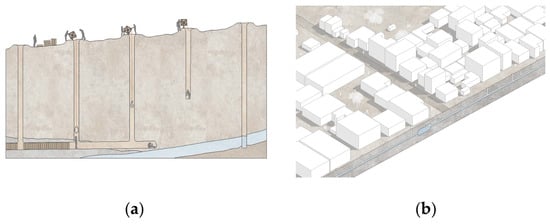
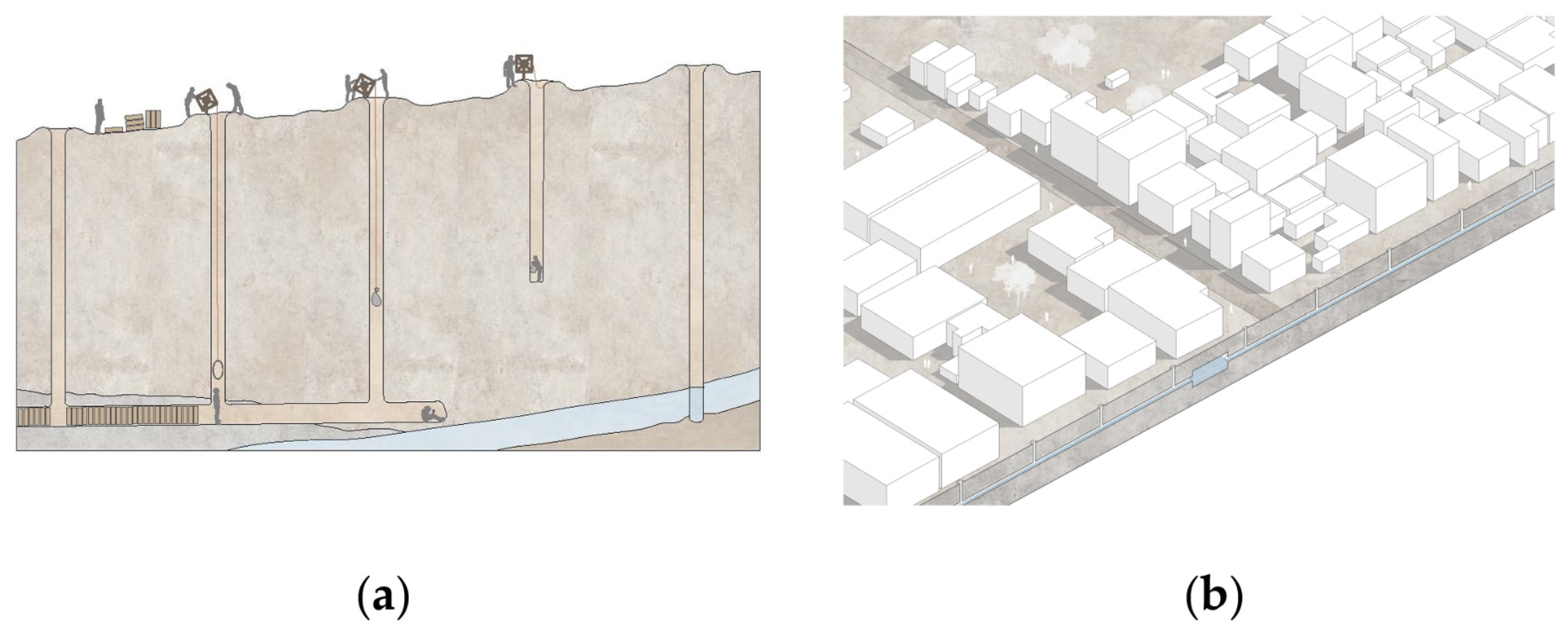
The architectural relevance of this synthesis is profound. TEK demonstrates that intelligence can be distributed across people, materials, landscapes, and time, without requiring centralised control systems or algorithmic optimisation. This idea is central to Julia Watson’s concept of Lo–TEK, which explicitly frames Indigenous infrastructures as highly evolved, ecologically responsive design systems rather than as “low-tech” or primitive solutions [10]. Watson’s work shows how TEK-based infrastructures, such as terraced landscapes, water transport infrastructure (Figure 1a,b), and agro-hydraulic systems, operate through feedback loops, redundancy, and ecological integration, all of which are hallmarks of intelligent systems. These architectures do not dominate nature but collaborate with it, leveraging natural processes such as sedimentation, evapotranspiration, and nutrient cycling as design drivers [11].
Figure 1.
Qanat system as Traditional Ecological Knowledge (TEK) (Graphics by Irene Quaini). The qanat captures groundwater through underground tunnels and distributes it to settlements without mechanical pumping. Based on deep knowledge of geology, hydrology, and climate, and maintained through collective governance, it exemplifies TEK by integrating natural intelligence with community-based management, operating as an early form of intelligent ecological infrastructure. (a) sectional diagram of its excavation and gravity-fed operation; (b) axonometric view of the urban integration of a qanat.
Equally important is the recognition that TEK operates as a knowledge, practice, belief complex, a formulation extensively discussed in climate adaptation research by Hosen and Nakamura [21,22]. This framework clarifies why TEK cannot be reduced to a database of environmental techniques. Knowledge (ecological observation), practice (resource management and construction), and belief (values, ethics, cosmologies) are inseparable. For architecture, this means that form, function, governance, and meaning are deeply intertwined. Buildings and landscapes, besides being technical responses to climate, are expressions of collective responsibility toward future generations and more-than-human entities.
Recent sustainability research further reinforces TEK’s relevance as a relational system that can inform contemporary design without being instrumentalised or abstracted from its cultural context. Silva-Ávila et al. emphasise that TEK should be understood as a living, adaptive practice embedded in territorial management and community governance [23]. Their work highlights how TEK-based knowledge alliances can bridge local and global scales, offering relational models of adaptation particularly relevant to architecture and urbanism facing climate uncertainty. In architectural terms, this suggests a shift away from universalised “smart” solutions toward place-based, culturally grounded design intelligence.
What emerges from this body of research is a clear theoretical positioning: TEK constitutes an original and fully formed paradigm of Intelligent Ecologies. It integrates natural intelligence, encoded in ecosystems, with collective intelligence, encoded in social organisation, into spatial and material practices that are inherently adaptive. For architectural research and practice, beginning with TEK grounds the concept of Intelligent Ecologies in real, historically tested systems [24,25]. It reframes innovation as continuity, adaptation and reciprocity, positioning architecture as a participant in living systems. This interpretation represents a more advanced understanding of architecture and overcoming the approach of it as an external mechanism of control. In this sense, TEK embodies contemporary discussions on Intelligent Ecologies. Recognising TEK as a foundational framework allows architecture to move beyond narrow sustainability metrics and toward a deeper ecological intelligence, one that is collective, relational, and inseparable from the landscapes and cultures that sustain it.
These dimensions reinforce the interpretation of TEK as a form of distributed intelligence embedded in both ecological processes and social practices.
We would like to clarify that TEK is not approached here as a repository of directly transferable techniques, but as an epistemological framework that reveals generalizable principles of ecological intelligence. While certain technical solutions may recur across different geographical and cultural contexts, their significance lies in the relational systems of knowledge, practices, and values from which they emerge. Accordingly, this study engages TEK through conceptual translation rather than direct technical transfer.
4. Vernacular Architecture as Spatialized Intelligence
Traditional Ecological Knowledge (TEK) finds one of its most concrete expressions in vernacular architecture. If TEK can be understood as a relational system of knowing, generated through long-term, place-based interaction between human communities and ecosystems, then vernacular architecture represents the spatial inscription of that system. It is the point at which ecological understanding, social organisation, cultural values, and material practices converge into built form. In this sense, vernacular architecture does not merely reflect environmental conditions; it actively stores, processes, and transmits ecological intelligence across generations.
Paul Oliver’s foundational work provides a rigorous conceptual framework for this transition. In the Encyclopedia of Vernacular Architecture of the World, Oliver defines vernacular architecture as a mode of production embedded in specific cultural, environmental, and economic contexts. He emphasises that vernacular buildings are “the architecture of the people, and by the people,” shaped by locally available resources, customary technologies, and socially shared knowledge systems rather than by formal design authorship. Crucially, Oliver frames vernacular traditions as dynamic, sustained through processes of use, adaptation, repair, and transmission rather than as static survivals of the past [7]. This aligns directly with TEK’s characterisation as cumulative, adaptive, and intergenerational knowledge.
The relationship between vernacular architecture and ecological intelligence was already intuitively grasped, though not yet theorised in these terms, by Bernard Rudofsky in Architecture Without Architects [8]. Rudofsky’s critique of modern architectural authorship foregrounds anonymous, collectively produced environments that respond to climate, topography, and social life with remarkable sophistication. Its lasting contribution lies in exposing how non-professional building cultures achieve environmental attunement and social coherence without encoded design systems. Rudofsky highlights how spatial arrangements (streets, courtyards, thresholds, roofscapes) mediate climate, encourage social interaction, and support everyday practices, suggesting an implicit intelligence embedded in form itself rather than imposed through technical control.
Amos Rapoport provides the most explicit theoretical bridge between TEK and vernacular architecture by dismantling environmental determinism. In House Form and Culture [9], Rapoport argues that climate and materials primarily act as constraints rather than determinants of architectural form. What ultimately shapes vernacular environments, he contends, are cultural variables: social organisation, patterns of use, symbolic meanings, and shared notions of comfort and appropriateness. Environmental factors define the range of possible solutions, but it is collective decision-making, mediated through tradition, that selects, stabilises, and reproduces particular spatial configurations. This argument is crucial for reframing vernacular architecture as a form of intelligence rather than as a mechanical response to climate.
5. Vernacular Architecture Beyond Environmental Determinism
This perspective helps clarify why vernacular architecture is better described as spatialized intelligence rather than as environmentally determined form. Environmental determinism implies a unidirectional causality: climate produces form, materials dictate structure and topography prescribes settlement. Instead, spatialized intelligence recognises vernacular architecture as the outcome of interpretive, collective, and adaptive processes operating within environmental constraints but not governed by them.
Vernacular forms emerge through repeated cycles of observation, feedback, and adjustment, precisely the mechanisms that define intelligent systems. Communities read environmental signals (wind, sun, water flow, soil behaviour), test spatial responses through everyday use, evaluate performance socially and ecologically, and modify practices over time. Successful configurations are retained, transmitted, and refined, while ineffective ones are abandoned. Intelligence, in this sense, is not located in an individual designer or in a technological apparatus, but distributed across people, practices, materials, and time.
Seen through this lens, vernacular architecture functions as a collective cognitive artefact. Walls, roofs, courtyards, and infrastructural elements encode decisions about thermal comfort, resource management, social interaction, and risk mitigation. These decisions are rarely explicit or formalised; they are embedded in routines, rituals, and construction norms. This is why vernacular environments often display resilience and adaptability even under changing climatic or social conditions. They are not optimised for a single performance metric but evolved to negotiate complexity and uncertainty. Recent sustainability and climate-adaptation research reinforces this interpretation. Studies on TEK consistently show that Indigenous and vernacular systems outperform purely technocratic solutions in contexts of environmental variability precisely because they integrate ecological processes with social governance and cultural values [22,23]. Vernacular architecture, as the spatial declination of TEK, materialises this integration. It operates simultaneously as shelter, infrastructure, social framework, and ecological interface, an intelligent ecology made inhabitable.
Within the broader framework of Intelligent Ecologies, focusing on vernacular architecture as spatialized intelligence allows architectural research to shift away from reductive readings of “tradition” and toward an understanding of how intelligence can be embedded in form, practice, and collective memory. This transition establishes a conceptual bridge from TEK to architecture, preparing the ground for subsequent discussions on constraint-based innovation, appropriate technologies, adaptive design, and circular architectural principles, without severing the cultural and ecological roots from which these systems emerged.
6. Constraint-Based Innovation and Appropriate Technologies as Contemporary Continuations of Vernacular Intelligence
If vernacular architecture can be understood as the spatialization of Traditional Ecological Knowledge, then contemporary approaches such as appropriate technology, constraint-based innovation, and responsible innovation can be read as attempts, sometimes explicit, sometimes implicit, to translate that same logic into contemporary technological and design contexts. Rather than representing a break from vernacular intelligence, these approaches emerge historically as responses to the repeated failure of universal, high-energy, context-blind technological models when confronted with ecological limits and socio-cultural diversity.
The notion of appropriate technology crystallised in the second half of the twentieth century precisely as a critique of technological determinism and linear modernisation. As Catherine P. Bishop shows [12], the movement arose from the recognition that transferring industrial technologies across contexts without regard for local ecologies, skills, and social structures often led to technological failure, environmental degradation, and social dependency. Drawing on E.F. Schumacher’s seminal Small Is Beautiful [13], appropriate technology was conceived as “technology with a human face,” emphasising small scale, low energy use, local materials, repairability, and community control. These principles closely mirror those embedded in vernacular building cultures, where construction systems evolve under constraints of climate, material availability, labour organisation, and long-term maintenance. What distinguishes appropriate technology from a purely technical approach is its epistemological alignment with vernacular intelligence. Bishop emphasises that the sustainability of appropriate technologies has historically been measured not by optimisation or efficiency alone, but by persistence over time. Technologies that remain in use for decades demonstrate social embedding, cultural acceptance, and ecological compatibility. This temporal criterion resonates strongly with TEK-based systems, where adaptive success is assessed across generations rather than within short innovation cycles. In this sense, appropriate technology operates as a contemporary analogue to vernacular architecture. Both are shaped through iterative feedback between environment, practice, and collective learning.
More recent discussions of constraint-based innovation further clarify this continuity. Constraint-based innovation explicitly treats scarcity as a generative condition for design. Rather than viewing constraints (limited resources, energy, capital, or infrastructure) as obstacles to be overcome through technological escalation, this approach reframes them as productive boundaries that stimulate inventive and context-sensitive solutions. Reviews by Agarwal et al. [14] and Molina-Maturano et al. [15] show that constraint-based innovations frequently emerge in contexts where designers must work with minimal inputs, privileging robustness, modularity, and multifunctionality over complication and performance maximisation. This logic closely parallels vernacular architectural processes described by Paul Oliver and Amos Rapoport. Environmental and material constraints do not determine form mechanically, but they delimit a solution space within which cultural values, social practices, and accumulated experience operate. Constraint-based innovation, therefore, can be understood as a formalisation, within contemporary innovation discourse, of the same adaptive reasoning that underpins vernacular systems. It reintroduces limits as epistemic tools, aligning technological development with ecological realities rather than abstract market or performance imperatives.
The ethical and epistemological dimensions of this transition are further articulated in the literature on responsible innovation. Boenink and Kudina [16] argue that innovation should not be guided by abstract, predefined values treated as stable entities, but by values as they are lived, negotiated, and enacted in practice. Their practice-based approach resonates strongly with TEK and vernacular intelligence, where values are embedded in everyday routines of building, maintaining, sharing resources, and responding to environmental change. Innovation, from this perspective, becomes an ethical and ecological interpretation rather than a purely technical exercise. Importantly, Boenink and Kudina emphasise that values are dynamic, interactive, and context-dependent, evolving through human, environment and technology relations. This insight provides a crucial theoretical bridge. Vernacular architecture and appropriate technologies are not “ethical” because they conform to an external moral framework, but because they emerge from situated practices of care, responsibility, and adaptation. Responsible innovation, when understood in this practice-based sense, does not supersede vernacular intelligence, it attempts to recover its logic under contemporary conditions of technological mediation and institutional complexity. Seen together, appropriate technology, constraint-based innovation, and responsible innovation articulate a continuum rather than a rupture. They translate the intelligence of vernacular systems, long attuned to ecological limits, collective governance, and material cycles, into modern design and technological languages. Where vernacular architecture encodes intelligence spatially and materially, these contemporary approaches seek to encode it procedurally and ethically, through design processes that foreground limits, participation, and long-term viability.
This continuity is particularly relevant for architecture today. Rather than importing “smart” technologies that promise adaptability through computation alone, a constraint-based and appropriate-technology perspective suggests that adaptation emerges from alignment between materials and climate, techniques and skills, technologies and social organisation. In this sense, contemporary architectural innovation that embraces constraints does not abandon tradition; it extends vernacular intelligence into new domains, reaffirming architecture as an intelligent ecology grounded in natural and collective intelligence.
7. From Vernacular Intelligence to Adaptive and Circular Architecture
The trajectory from Traditional Ecological Knowledge (TEK) through vernacular architecture and constraint-based innovation finds its most coherent contemporary expression in adaptive design and circular architecture. Importantly, this trajectory does not represent a linear evolution toward increasingly complex systems, nor a technological upgrade of traditional practices. Rather, it reveals a continuity of intelligence under constraint, where circularity emerges as a logical consequence of long-term adaptation to ecological, material, and social limits. In TEK-based systems, circularity is not articulated as a design goal or performance metric; it is embedded in everyday practices of living within finite ecosystems. Resource cycles are closed through necessity. Materials are reused because they are scarce, waste is minimised because it threatens survival, and maintenance is prioritised because replacement is costly or impossible. Vernacular architectures translate this logic into spatial and constructive terms. Buildings are conceived as temporary states within longer material cycles, designed for repair, incremental transformation, and eventual reintegration into local ecologies. As Paul Oliver repeatedly emphasises, vernacular traditions are sustained not by permanence but by continuity through change, achieved via maintenance, reuse, and adaptation rather than replacement [7]. This same logic underpins adaptive design, which can be understood as the architectural capacity to respond to environmental variability and social change over time. In vernacular systems, adaptation is achieved through passive means: adjustable openings, seasonal occupation patterns, material assemblies that respond to humidity or temperature, and settlement layouts that accommodate flooding, drought, or resource fluctuation. These strategies exemplify what can be described as natural intelligence. The capacity of ecosystems and materials themselves to regulate flows of energy, water, and matter and collective intelligence; the social systems that coordinate use, maintenance, and governance. Contemporary circular architecture often presents itself as a novel paradigm, associated with lifecycle assessment, material passports, and industrial symbiosis. While these tools are valuable, framing circularity as a disruption risks obscuring its deeper epistemological roots. As scholars such as Guy and Farmer [17] and Stahel [18] have argued, circular design principles, reuse, longevity, reversibility, and low entropy are historically grounded in pre-industrial and vernacular practices. What distinguishes current circular approaches is not the logic itself, but its formalisation within modern regulatory, economic, and technological systems. From this perspective, circular architecture can be understood as the explicit articulation of this vernacular logic. Constraint-based innovation plays a crucial mediating role here. As Bishop [12] demonstrates, appropriate and constraint-based technologies persist when they align with local capacities for production, repair, and governance, rather than when they optimise isolated performance indicators. This persistence over time, rather than efficiency at a single moment, is precisely what circular architecture seeks to recover. Circularity, therefore, is not an added layer of sustainability applied to otherwise linear systems; it is the architectural translation of long-term adaptive intelligence.
8. Results, Biological and Technical Cycles: Adaptive and Circular Intelligence in Practice
Within contemporary circular economy theory, the distinction between biological and technical cycles provides a useful framework for understanding how materials, systems, and buildings can remain productive over time without exhausting natural capital. As articulated by the Ellen MacArthur Foundation, biological cycles involve materials that safely return to the biosphere through regenerative processes, while technical cycles retain materials in use through reuse, repair, disassembly, and remanufacturing [26,27]. Although often framed within industrial and managerial contexts, this dual-cycle logic resonates with the principles of Traditional Ecological Knowledge (TEK) and vernacular architecture, where material flows are historically governed by ecological compatibility and collective stewardship. However, TEK is not approached here as a set of transferable techniques, but as a culturally embedded system integrating knowledge, ethics, and worldview, structured around principles such as sacredness, holism, and reciprocity [20]. In this sense, the ARCò and Parabase projects, which will be detailed in the following sections, do not derive directly from specific Indigenous practices, nor do they claim continuity with TEK traditions; rather, they are interpreted here through a relationship of conceptual alignment and functional analogy. Under conditions of ecological and material constraint, these projects produce outcomes consistent with TEK principles, including systemic integration, resource circularity, and collective forms of organisation. At the same time, it is necessary to acknowledge the limits of this comparison: TEK remains inseparable from its cultural, spiritual, and territorial context, whereas the analysed projects operate within European regulatory, technological, and economic frameworks. The comparison, therefore, does not imply equivalence but highlights convergences in how different systems, traditional and contemporary, can generate forms of intelligence based on ecological integration and collective processes, framing Intelligent Ecologies as a relational paradigm rather than a model of direct translation.
The following two case studies are analysed according to the operational components defined above, allowing a comparative assessment of how natural and collective intelligence are embedded in architectural practice.
9. The Biological Cycle: ARCò Kindergarten (Table 1)
The design of the kindergarten in the municipality of Sant’Alessio, Italy, by ARCò—Architettura e Cooperazione is guided by principles of energy sustainability closely aligned with the logic of the biological cycle, as articulated within circular economy theory. The project exemplifies how architectural form, material choice, and environmental performance can operate as an integrated ecological system in which material flows, energy strategies, and spatial organisation reinforce one another.
Table 1.
Comparative Analysis of Intelligent Ecology Components.
9.1. Material Intelligence
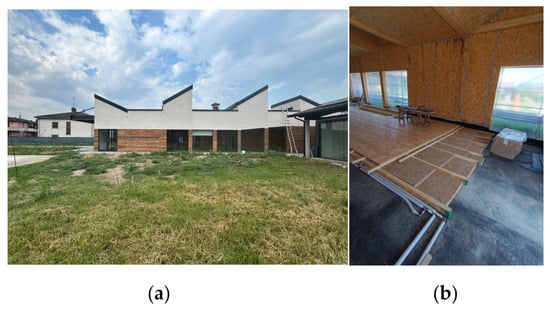
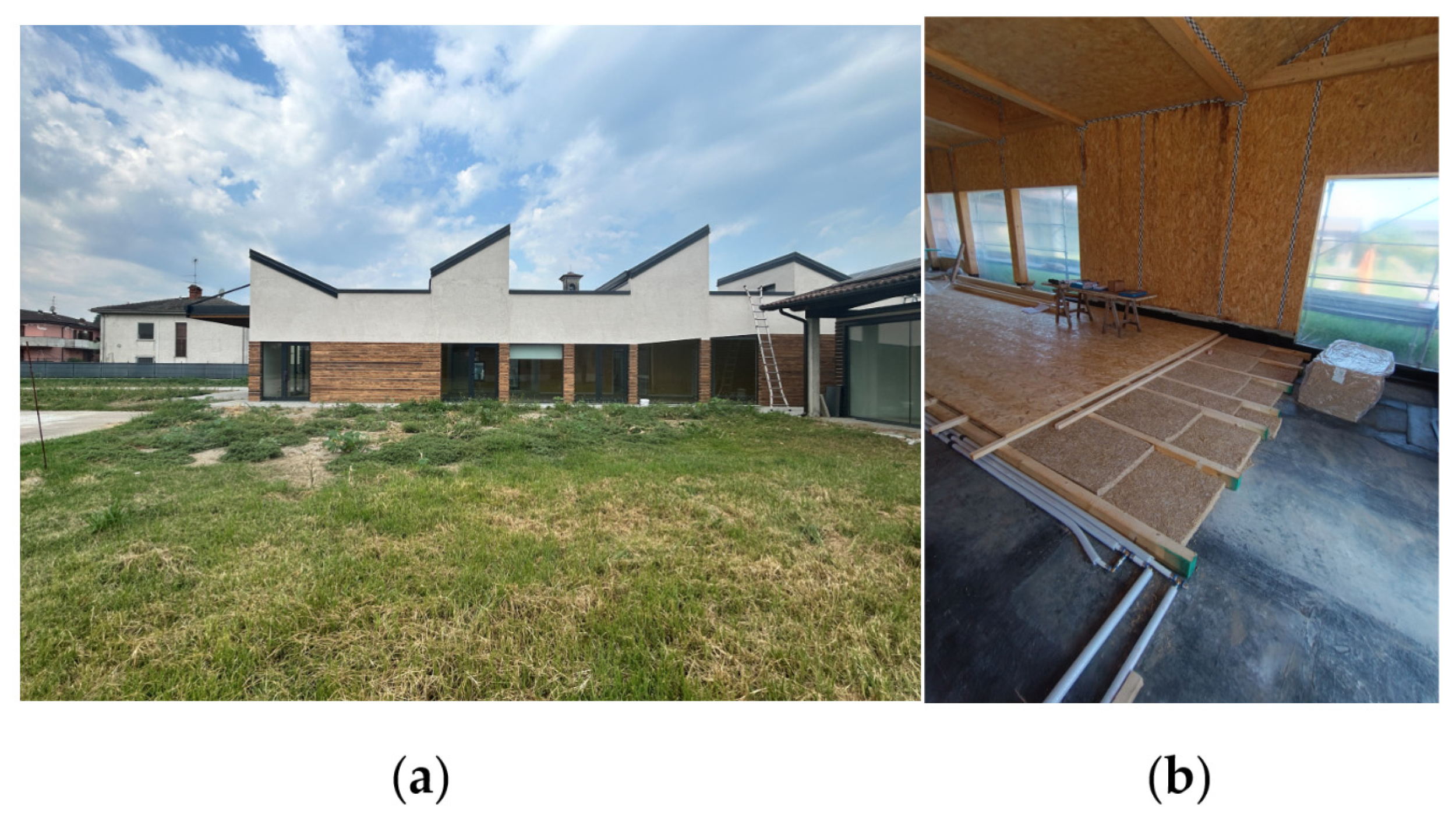
The project uses renewable, locally sourced materials derived from rice production by-products, such as straw and husk, integrated into a dry, reversible timber system. These materials, traditionally considered waste, are reintroduced into the construction process as bio-based components, contributing to the closure of material cycles. Rice straw and rice husk provide excellent thermal insulation while regulating natural humidity, improving indoor air quality, and reducing the risk of mould formation (Figure 2b). Their low density facilitates transportation and installation, reducing embodied energy and overall environmental impact. At the end of their life cycle, these materials can be safely reintegrated into the biosphere, fully aligning with the biological cycle.
Figure 2.
ARCò Kindergarten, Sant’Alessio—Biological cycle in practice. The project exemplifies the biological cycle by employing renewable, locally sourced materials derived from agricultural by-products (rice straw and husk), integrated within a dry, reversible timber system. (a) The façades reveal the articulated roof profile that integrates wind chimneys for stack ventilation and zenithal light; (b) Interior view during construction showing prefabricated timber elements and rice-straw insulation panels.
9.2. Environmental Intelligence
The building adopts a passive environmental strategy based on the intelligent use of natural forces. The articulated roof profile integrates wind chimneys that activate stack ventilation while providing zenithal light, combined with cross ventilation through carefully positioned openings. (Figure 2a) The building orientation is designed to respond to local climatic conditions, including prevailing winds and solar exposure, minimising energy demand for indoor climate control. Rather than relying solely on mechanical systems, the project achieves thermal comfort through bioclimatic design principles consistent with vernacular, climate-responsive architecture.
9.3. Adaptive Capacity
The structural system is based on prefabricated timber elements assembled through dry construction techniques, enabling reversibility and ease of maintenance. This approach enables potential disassembly, repair, and future adaptation, extending the building’s lifecycle and reducing waste over time.
9.4. Collective Intelligence
The project engages local material cycles and supports the agricultural economy by valorising rice production by-products, creating new opportunities for local supply chains. At the same time, the building assumes an educational role: the use of natural materials and visible environmental strategies transforms the school into a pedagogical device, fostering awareness among users, especially children, of resource cycles and ecological responsibility.
9.5. Systemic Integration
The ARCò kindergarten is embedded within a broader territorial and productive system, directly linked to local agricultural practices. The integration of material sourcing, environmental strategies, and social functions positions the building within a larger ecological network rather than as an isolated object.
Taken together, these strategies position the ARCò kindergarten as an architectural expression of the biological cycle, where circularity emerges from the alignment between materials, environmental processes, and collective practices. The project demonstrates how natural and collective intelligence can be translated into contemporary architectural design without relying on technological overdetermination.
10. The Technical Cycle: Parabase Elementa Housing Project (Table 1)
Within the circular economy framework, the technical cycle governs materials that cannot safely re-enter biological systems and must therefore remain in continuous circulation through strategies of reuse, repair, refurbishment, and reassembly. As articulated by the Ellen MacArthur Foundation, technical nutrients retain their value when products and components are designed to remain in use at their highest functional level for as long as possible, minimising downcycling and material loss. The Elementa housing project by Parabase in Basel, Switzerland, offers a paradigmatic architectural interpretation of this logic, demonstrating how technical circularity can operate as a core design principle rather than a post-design sustainability measure.
10.1. Material Intelligence
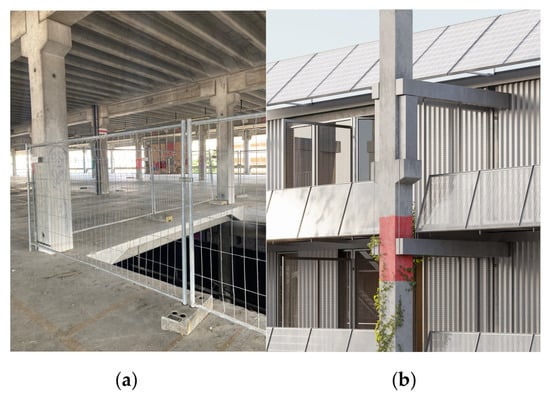
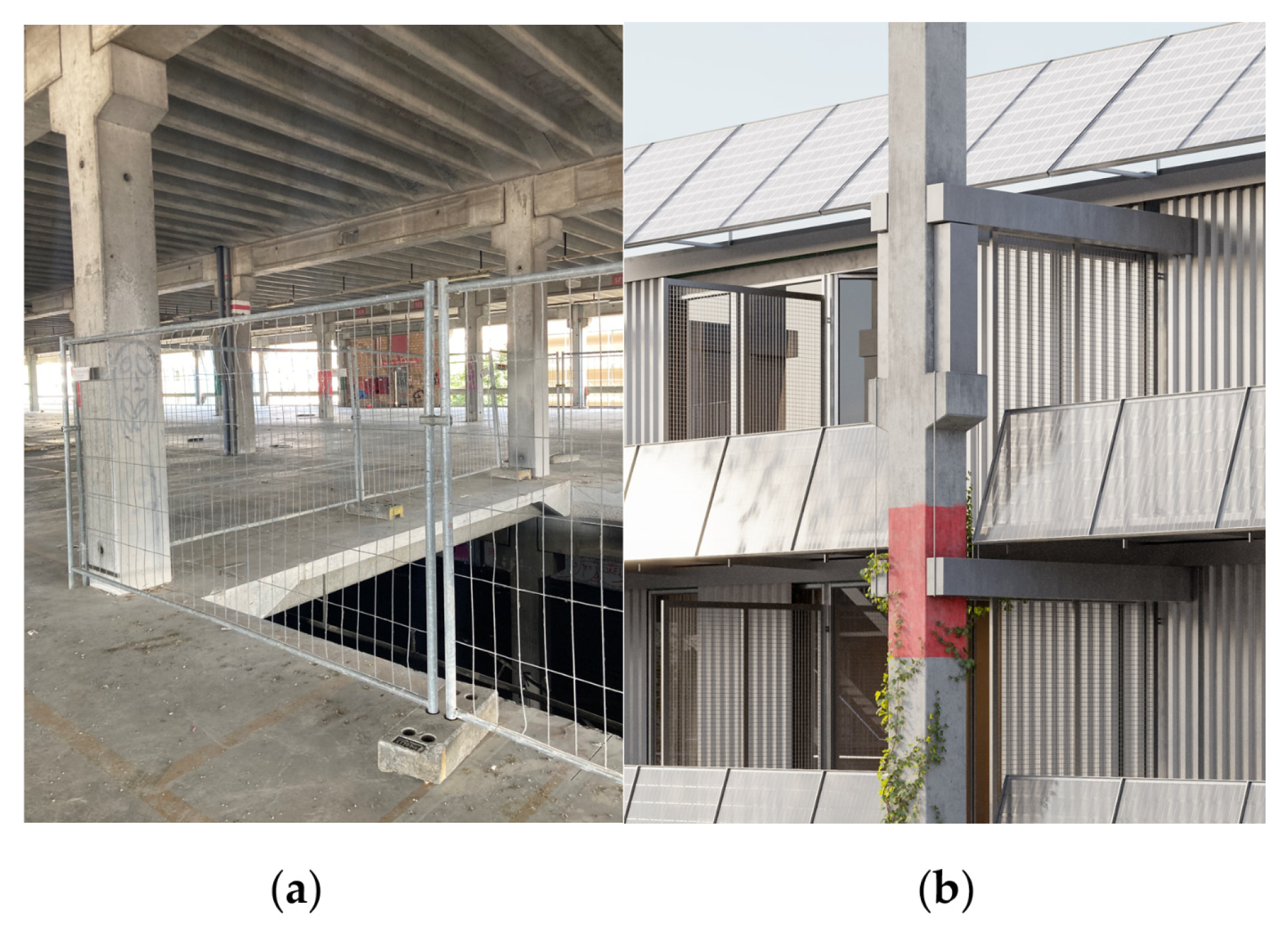
The project activates the technical cycle by preserving and reintegrating structural elements from a dismantled building into the new construction. Prefabricated concrete components, beams, columns, and slabs originally produced in the 1970s, are recovered from the nearby Lysbüchel parking structure, catalogued, and reused as load-bearing and façade elements (Figure 3a). This approach departs from conventional recycling practices, which typically reduce concrete to low-grade aggregate, and instead preserves its structural integrity and embedded carbon. By maintaining the material at its highest functional level, the project activates an inner loop of the technical cycle, significantly reducing environmental impact (Figure 3b).
Figure 3.
Parabase Elementa—Technical cycle of materials. The project activates the technical cycle by preserving and reintegrating structural elements from the dismantled building into the new construction. (a) Existing structure selected for material harvesting; (b) the new Elementa housing building incorporating reused prefabricated concrete components.
10.2. Environmental Intelligence
Environmental performance is addressed through a combination of efficient building envelopes and on-site renewable energy generation. The project is designed to operate without fossil fuels, relying on integrated photovoltaic systems and reduced energy demand. However, energy strategies are not treated as compensatory technologies but as complementary to material longevity, reinforcing a broader approach in which operational efficiency supports rather than replaces embodied intelligence.
10.3. Adaptive Capacity
The building is conceived as a layered assembly in which structure, envelope, and internal systems are clearly separated. This design enables disassembly, substitution, and reconfiguration over time without compromising overall stability. The principle of design for disassembly extends the building’s lifecycle and allows future reuse of its components, aligning with circular design strategies while echoing vernacular logics of incremental transformation and long-term adaptability.
10.4. Collective Intelligence
The reuse process requires coordination among multiple actors, including architects, engineers, public authorities, demolition contractors, and material suppliers. This transforms the construction process into a distributed system of knowledge production, in which information about existing structures, tolerances, and performance is collectively mobilised and reinterpreted. In this sense, technical circularity becomes an expression of collective intelligence embedded in collaborative processes.
10.5. Systemic Integration
Elementa is embedded within a broader urban and material system, responding to contemporary conditions of resource scarcity, land constraints, and carbon reduction policies. The project reframes demolition as a resource-generating process and integrates material reuse into the urban metabolism, positioning the building within a larger technical cycle rather than as an isolated intervention.
Taken together, these strategies demonstrate how the technical cycle can be operationalised architecturally by aligning material reuse, adaptive systems, and collective processes. The Elementa project shows that circularity emerges not as an external sustainability objective, but as the outcome of working within material, environmental, and social constraints, extending the logic of vernacular and TEK-informed intelligence into contemporary urban housing.
11. Intelligent Ecologies as an Architectural Paradigm: Conclusions and Positioning
This study reframes Intelligent Ecologies in architectural research by shifting the focus from artificial intelligence as the primary driver of innovation toward natural and collective forms of intelligence embedded in ecological and cultural systems. By tracing a trajectory from Traditional Ecological Knowledge (TEK) to vernacular architecture, and from constraint-based innovation to adaptive and circular design, the paper positions Intelligent Ecologies not as a technological novelty but as a relational architectural paradigm grounded in long-standing ecological intelligence. At the core of this argument is the recognition of TEK as an intelligent ecology in its own right: a cumulative, adaptive, and relational system integrating environmental observation, social governance, and ethical orientation. Within this framework, vernacular architecture can be understood as a spatialised form of such intelligence, where environmental constraints are interpreted through collective practices, cultural values, and intergenerational knowledge. Contemporary approaches such as appropriate technologies and constraint-based innovation are therefore not departures from this logic, but reformulations that operate under current conditions of resource scarcity, technological mediation, and institutional complexity. From this perspective, the contribution of this study lies in addressing a gap in architectural discourse, where TEK, vernacular intelligence, and circular design are often treated as separate domains. By establishing conceptual continuity across these fields, the paper proposes Intelligent Ecologies as a framework that integrates ecological processes, material systems, and collective practices into architectural design. This leads to a shift in focus from optimisation and control toward adaptation, integration, and systemic thinking. This interpretation has several theoretical implications. It reframes circular architecture not as a technical innovation, but as the explicit articulation of long-standing ecological intelligence, and it positions architectural design as a process embedded in dynamic socio-ecological systems rather than as an isolated technical operation. In doing so, it contributes to redefining sustainability in architecture as a relational condition rather than a performance-based objective.
Looking forward, this framework opens directions for further research. Future studies could test its applicability across different cultural and climatic contexts and explore its integration with contemporary design methodologies. In this perspective, particular attention may be given to the potential synthesis between Traditional Ecological Knowledge and Artificial Intelligence, understood as complementary forms of intelligence. While TEK provides a relational and ecological framework, AI can support the management of complexity within such systems. This suggests that the future of Intelligent Ecologies may lie in aligning technological tools with principles of ecological integration and collective intelligence, while ensuring that TEK informs design practice without being reduced to the direct transfer of specific techniques or to abstract generalisations detached from their cultural and ecological context.
Funding
This research received no external funding.
Institutional Review Board Statement
Not applicable.
Informed Consent Statement
Not applicable.
Data Availability Statement
The original contributions presented in this study are included in the article. Further inquiries can be directed to the corresponding author.
Conflicts of Interest
The author declares no conflicts of interest.
References
- Berkes, F.; Colding, J.; Folke, C. Rediscovery of Traditional Ecological Knowledge as Adaptive Management. Ecol. Appl. 2000, 10, 1251–1262. [Google Scholar] [CrossRef]
- Berkes, F. Sacred Ecology, 3rd ed.; Routledge: New York, NY, USA, 2012. [Google Scholar]
- Hosen, N.; Nakamura, H. Traditional Ecological Knowledge in Climate Change Adaptation: A Review. Asian J. Behav. Stud. 2020, 5, 59–71. [Google Scholar] [CrossRef] [Scilit]
- Martin, J.F.; Roy, E.D.; Diemont, S.A.W.; Ferguson, B.G. Traditional Ecological Knowledge (TEK): Ideas, Inspiration, and Designs for Ecological Engineering. Ecol. Eng. 2010, 36, 839–849. [Google Scholar] [CrossRef] [Scilit]
- Wu, Y.; Ibrahim, R.; Azmi, A.; Salih, S.; Abd Ghafar, A. Framework for Application of Azheke Village’s Traditional Ecological Knowledge for Harmonious Human-Nature Interactions in Contemporary Sustainable Urban Management. Archnet-IJAR Int. J. Archit. Res. 2025, 1–18. [Google Scholar] [CrossRef] [Scilit]
- Byg, A.; Salick, J. Local Perspectives on a Global Phenomenon—Climate Change in Eastern Tibetan Villages. Glob. Environ. Change 2009, 19, 156–166. [Google Scholar] [CrossRef] [Scilit]
- Oliver, P. (Ed.) Encyclopedia of Vernacular Architecture of the World; Cambridge University Press: Cambridge, UK; New York, NY, USA, 1997. [Google Scholar]
- Rudofsky, B. Architecture Without Architects, an Introduction to Nonpedigreed Architecture; The Museum of Modern Art, Distributed by Doubleday: Garden City, NY, USA, 1964. [Google Scholar]
- Rapoport, A. House Form and Culture; Prentice-Hall: Englewood Cliffs, NJ, USA, 1969. [Google Scholar]
- Watson, J. Lo—TEK. Design by Radical Indigenism; Taschen: Cologne, Germany, 2019. [Google Scholar]
- Watson, J.; Abukhodair, H.; Ali, N.A.N.; Robertson, A.; Issaoui, H.; Sun, C. Design by Radical Indigenism: Equitable Underwater & Intertidal Technologies of the Global South. Spool 2021, 8, 57–74. [Google Scholar] [CrossRef]
- Bishop, C.P. Sustainability Lessons from Appropriate Technology. Curr. Opin. Environ. Sustain. 2021, 49, 50–56. [Google Scholar] [CrossRef] [Scilit]
- Schumacher, E.F. Small Is Beautiful: A Study of Economics as If People Mattered; Blond & Briggs: London, UK, 1973. [Google Scholar]
- Agarwal, N.; Grottke, M.; Mishra, S.; Brem, A. A Systematic Literature Review of Constraint-Based Innovations: State of the Art and Future Perspectives. IEEE Trans. Eng. Manag. 2017, 64, 3–15. [Google Scholar] [CrossRef] [Scilit]
- Molina-Maturano, J.; Speelman, S.; De Steur, H. Constraint-Based Innovations in Agriculture and Sustainable Development: A Scoping Review. J. Clean. Prod. 2020, 246, 119001. [Google Scholar] [CrossRef] [Scilit]
- Boenink, M.; Kudina, O. Values in Responsible Research and Innovation: From Entities to Practices. J. Responsible Innov. 2020, 7, 450–470. [Google Scholar] [CrossRef] [Scilit]
- Guy, S.; Farmer, G. Reinterpreting Sustainable Architecture: The Place of Technology. J. Archit. Educ. 2001, 54, 140–148. [Google Scholar] [CrossRef] [Scilit]
- Stahel, W.R. The Circular Economy. Nature 2016, 531, 435–438. [Google Scholar] [CrossRef] [Scilit] [PubMed]
- Korhonen, J.; Nuur, C.; Feldmann, A.; Birkie, S.E. Circular Economy as an Essentially Contested Concept. J. Clean. Prod. 2018, 175, 544–552. [Google Scholar] [CrossRef] [Scilit]
- Mu, Y.; Ma, D. Traditional Ecological Knowledge (TEK) of the Arctic Cultural Circle in Three Ethnographic Works from China, Russia, and Canada. Humanities 2024, 13, 155. [Google Scholar] [CrossRef] [Scilit]
- Hosen, N.; Nakamura, H.; Hamzah, A. Adaptation to Climate Change: Does Traditional Ecological Knowledge Hold the Key? Sustainability 2020, 12, 676. [Google Scholar] [CrossRef] [Scilit]
- Hosen, N.; Nakamura, H. Local Knowledge for Global Actions: The Role of Traditional Ecological Knowledge in Climate Change Adaptation. Environ.-Behav. Proc. J. 2020, 5, 37. [Google Scholar] [CrossRef] [Scilit]
- Silva-Ávila, P.; Rojas Hernández, J.; Barra, R.O. Knowledge Alliances for Global Change Adaptation: A Relational Approach Based on Traditional Ecological Knowledge, Territorial Management, and Community Practices in the Chilean Context. Sustainability 2025, 17, 3653. [Google Scholar] [CrossRef] [Scilit]
- Casi, C.; Guttorm, H.E.; Virtanen, P.K. Traditional Ecological Knowledge. In Situating Sustainability: A Handbook of Contexts and Concepts; Krieg, C.P., Toivanen, R., Eds.; Helsinki University Press: Helsinki, Finland, 2021; pp. 181–194. [Google Scholar]
- Albuquerque, U.P.; Ludwig, D.; Feitosa, I.S.; De Moura, J.M.B.; Gonçalves, P.H.S.; Da Silva, R.H.; Da Silva, T.C.; Gonçalves-Souza, T.; Ferreira Júnior, W.S. Integrating Traditional Ecological Knowledge into Academic Research at Local and Global Scales. Reg. Environ. Change 2021, 21, 45. [Google Scholar] [CrossRef] [Scilit]
- Growth Within: A Circular Economy Vision for a Competitive Europe. Available online: https://www.ellenmacarthurfoundation.org/growth-within-a-circular-economy-vision-for-a-competitive-europe (accessed on 2 February 2026).
- Towards the Circular Economy Vol. 1: An Economic and Business Rationale for an Accelerated Transition. Available online: https://www.ellenmacarthurfoundation.org/towards-the-circular-economy-vol-1-an-economic-and-business-rationale-for-an (accessed on 2 February 2026).
Disclaimer/Publisher’s Note: The statements, opinions and data contained in all publications are solely those of the individual author(s) and contributor(s) and not of MDPI and/or the editor(s). MDPI and/or the editor(s) disclaim responsibility for any injury to people or property resulting from any ideas, methods, instructions or products referred to in the content. |
© 2026 by the author. Licensee MDPI, Basel, Switzerland. This article is an open access article distributed under the terms and conditions of the Creative Commons Attribution (CC BY) license.