


Abstract
This qualitative research investigates the adoption of Circular Economy (CE) principles in contemporary Australian architectural practice, referred to as circularity, to address climate change, resource scarcity, and increasing demands for built-environment resilience. The Australian government’s 2035 national circularity target, which aims to double 2024 levels, will have profound implications for architectural practice. This research examines the current and future ability of practices to adopt circularity. It addresses two specific knowledge gaps: (i) how circularity is currently being adopted by architectural practices in Australia, and (ii) what factors restrict or undermine this adoption. To address these gaps, the research draws on insights developed from focus groups and interviews (n = 33 participants) with professional Australian architectural service providers and closely related design and engineering practitioners. Qualitative data collection captured empirical evidence on the barriers, challenges, and opportunities for circularity, followed by NVivo-based Reflexive Thematic Analysis (RTA) that iteratively and inductively identified emerging themes. The findings indicate that architects’ and associated practitioners’ adoption of circularity in Australia is evident but constrained by short-term project horizons, fragmented responsibilities, limited procurement infrastructure, and uncertainty about material supply and skilled labour. The paper concludes that, despite some conceptual ambiguity and structural limitations in current practice models, adoption remains fragmented and selective and offers actions for architects and other stakeholders to address logistical infrastructure, regulatory frameworks, legal contracts, and barriers stemming from a short-term economic value mindset.
1. Introduction
Australia’s building and construction sector currently generates over 29 million tonnes of waste annually, consumes approximately 45 million tonnes of virgin materials, and produces a further 21 million tonnes of embodied carbon emissions [1,2]. In 2024, the Australian Government released the national Circular Economy Framework, calling for a ‘doubling’ of circularity by 2035 [3]. The framework used the Circular Economy (CE) definition provided by the MacArthur Foundation, which highlights three identifying factors for a CE industrial system: [i] designs out waste and pollution, [ii] keeps products and materials in their highest-value use, and [iii] conserves natural resources and regenerates nature [4]. CE contrasts with the prevalent linear ‘take-make-waste’ (also referred to as ‘take-make-dispose’ [3]) economy, in which materials are extracted, processed, used, and ultimately disposed of [4].
Contemporary architectural practice has increasingly adopted CE principles in response to climate change, resource scarcity, and the built environment’s environmental impacts. In this study, the processes and techniques employed by architects to minimise waste and to facilitate reuse, repair and adaptability, thereby extending the lifecycles of materials and buildings, are referred to as ‘circularity’. Circularity is understood here to encompass circular building and construction strategies, defined as approaches used by building managers and builders that aim to maintain materials, components, and entire buildings in use for as long as possible [5]. Although these strategies extend beyond the traditional scope of architectural practice, such as modular assembly and disassembly, material identification, and cataloguing through material passports, they are included under the banner of circularity because they directly influence architectural processes.
While the adoption of circularity is often framed as a response to unsustainable resource use, it should not be conflated with sustainability, which seeks to achieve long-term environmental, social, and economic well-being [6]. Some consider circularity a tool for achieving sustainability goals [6,7], while others emphasise that circularity is not equivalent to sustainability and that the two concepts should be analysed jointly yet distinctly [8]. Therefore, a further distinction regarding circularity is that it does not encompass broader sustainability principles and metrics, such as carbon accounting, energy performance, or solar/thermal analysis.
Circularity is an international but unevenly distributed policy and industry effort, associated with geographically varying circularity rates. The Netherlands is often cited as a leading case, having made concerted efforts to introduce circularity principles, such as material reuse, into the architectural services industry, driven by experiences of resource scarcity and a desire for material and energy sovereignty [9,10]. According to The Circularity Gap Report, the Netherlands has an overall circularity rate of 24.5%, which is the percentage of recycled or reused materials (secondary materials) fed back into the economy compared to the total volume of materials consumed annually [11]. By comparison, Australia’s circularity rate was reported as 4.6% in 2024, below the global average of 7.2%.
1.1. Purpose of Work
Introducing circularity principles into architectural practice requires changes to how projects address material supply, waste, procurement, and building life-cycle planning. A focus on architects is warranted as they are recognised as having a high level of influence over the lifecycle and performance of a building and are pivotal actors in advancing circular building design due to their strategic position in the design and construction process, between clients, contractors, consultants, and material suppliers [12]. This position is confirmed by the Australian Institute of Architects (AIA), the Australian Institute of Building (AIB), and the Architect Registration Boards (ARBs); however, the AIA highlights that architects’ engagement with circularity is developing, but may be undermined by commercial greenwashing and inconsistent market claims [13]. It has been argued that, in general, Architects’ training lacks detailed awareness of and knowledge about building circularity and the tools to meet circularity goals in practice. Where the aim is to create buildings in which resources circulate in continuous loops rather than being used once and discarded, the Australian Government identifies architects as a key element for improving design and material choices, enhancing modelling and planning, and supporting design for durability, reuse, and disassembly [14]. The federal circularity framework promotes a rethinking of architecture as a systems-based, lifecycle-oriented discipline in which material stewardship becomes a core design responsibility. Specific relevant architectural principles are: [i] refurbishment and adaptive re-use, [ii] designing out waste and pollution, [iii] ensuring material reuse, repair, refurbishment, and high-value recycling, and [iv] designing for future life-cycles [3].
Therefore, due to the architect’s unique position in the building process, they are well placed to contribute to circular transitions and to these emerging demands. However, it remains unclear whether architects currently have the skills, tools, organisational support, and evidence-based guidance needed to adopt CE principles into practice.
Given the limited empirical evidence on circularity adoption in Australian architectural practice, this research examines which principles are currently adopted and what changes may be required to support broader and more consistent implementation. The research provides an empirical understanding of circularity efforts in the Australian architectural services industry, to assess the Australian context and enable comparison with international efforts.
1.2. Research Aim
This research aims to empirically understand how circular architectural principles are being adopted in professional architectural services to address waste, retain material value and regenerate nature. This research addresses two knowledge gaps detailed in the literature review below, related to contemporary Australian architectural practices, in the context of the Australian Federal Government’s 2024 Circular Economy Framework:
- An understanding of the level of adoption of circularity principles at the practice-level among architects and related professionals has not been empirically established.
- The barriers or factors limiting the adoption of circularity in line with the 2024 framework are not adequately understood.
This paper is structured into six sections. Following this introduction, Section 2 provides an overview of current research literature and further evidence for the knowledge gap. Section 3 details the qualitative data collection process, including recruitment and questions, and justifies the use of Reflexive Thematic Analysis to identify themes related to circularity adoption. Section 4 presents the results of the thematic analysis, supported by quotes from the data collection sessions, alongside an interpretation in the context of the research. Section 5 discusses the results in relation to previous studies and the research objective and acknowledges the study’s limitations. Finally, Section 6 provides a conclusion, the implications of the findings and recommends future research directions. The study concludes that circular adoption within practice is more developed than often assumed; however, its implementation remains fragmented and structurally mediated by procurement regimes, compliance cultures, risk-allocation frameworks, supply-chain instability, and short-term economic logics.
2. Literature Review
This section reviews the current state of research on circularity within the Architecture, Engineering, and Construction (AEC) sector and identifies two knowledge gaps. Research has primarily centred on exploring the barriers, challenges, and opportunities in building management and construction across various international contexts, with comparatively limited focus on architects’ ability to adopt circularity. Existing literature demonstrates considerable strength in conceptualising circularity, identifying strategies, documenting systemic barriers, and positioning digitalisation as an enabling mechanism. However, what remains underdeveloped is an empirically grounded understanding of how circular principles are selectively interpreted, prioritised and embedded into circularity approaches, and how organisational, economic and institutional conditions shape the depth and consistency of their integration.
CE is becoming a prominent industrial paradigm across the built environment sector [15,16], and Australia has developed a strong and growing body of scholarship [17]. However, Australia trails Europe, much of Asia, and North America in translating this knowledge into tangible, scalable outcomes [14]. A recurring explanation for limited implementation is that circularity is variously framed as an economic agenda, a resource-management strategy, or a subset of sustainability, producing a definitional ambiguity that complicates its translation into professional practice [16]. There is further caution that some circular narratives can privilege energy efficiency and circular material flows without adequately addressing the broader socio-environmental transformations implied by sustainability transitions [18]. For architectural service providers in the built environment, this conceptual contestation is important because it shapes what is considered a circular response, which strategies are prioritised, and how responsibilities are distributed across project actors and supply chains.
2.1. International Discourse on Circularity Adoption Barriers
A substantial body of literature catalogues barriers and enablers to circularity adoption in the AEC sector, covering organisational, economic, technical, social and political constraints that operate simultaneously across micro (project), meso (industry) and macro (policy) levels [19,20]. Leadership and governance coherence are identified as enabling conditions [21,22]. Still, at the project level, misalignments such as differing notions of quality, aesthetics, and safety can undermine circular ambitions even where digital tools and decision-support processes are available [23]. International scholarship on circular building and construction increasingly frames circularity as a holistic, life-cycle-based approach that extends beyond operational efficiency to encompass disassembly, reuse, reversibility and long-term planning [24,25,26]. However, Pomponi and Moncaster argue that much of this research has focused on macro-scale policy or micro-scale product innovation, with comparatively limited attention to the meso-scale of buildings and the everyday practices that produce them [15]. This meso-scale is a critical site for architectural action as buildings are long-lasting socio-technical assemblages in which material choices, spatial organisation, structural logics, and procurement decisions collectively determine whether resources can be retained at high value over time. Consequently, there is a lack of understanding of whether architectural practice, embedded within commercial, contractual, and regulatory contexts, can consistently deliver projects in which circular principles meaningfully shape design intent and delivery.
2.2. Focus on Downstream Construction Implementation
Circularity reframes buildings as temporary material assemblies capable of multiple life cycles rather than as permanent artefacts [12,27]. Core strategies include design for disassembly, modular coordination, spatial planning flexibility, material reversibility and long-term adaptability [28,29,30]. These strategies are premised on the understanding that early-stage design decisions determine a building’s future capacity for reuse, transformation and material recovery [5,31]. When it comes to integrating circularity into existing practice structures, however, there is a split between those who see potential to integrate material decision flexibility [28] and others who argue that it requires a radical reconceptualisation of logistical and organisational strategies over time [12].
The literature indicates that circular initiatives in the AEC sector focus on downstream waste management or isolated material substitutions rather than on upstream, transformation of the whole-building design process [25,26]. Empirical analysis by Temizel-Sekeryan et al. confirms this trend, in which circular interventions commonly manifest as selective material choices rather than systemic changes in project processes and delivery structures [32]. This distinction underscores a central tension that, although CE principles are conceptually well established, their comprehensive embedding as circular architectural processes remains limited.
2.3. Circularity Adoption Precedents
Recent European research has begun to move beyond conceptual discussions towards empirical investigation of how circularity is operationalised within architectural and construction practice. In Sweden, Dokter et al. conducted semi-structured interviews with architects and industrial designers working at agencies actively pursuing circular design strategies [33]. Their study revealed that Dutch design practices adopted circular principles but that their inclusion expanded the scope of the design process beyond individual artefacts towards systems, business models, collaborative networks, and longer-term visions. The study identified that adopting circularity requires new knowledge, strategies, and skills, as well as extensive collaboration with stakeholders across all design stages. Dokter et al. concluded that architects and industrial designers play an important role in facilitating collaboration networks, effectively “designing” relationships as part of the circular process, but that they interpret the concept differently, with architects focussing on the reuse of construction waste [33]. A key contribution of their study is the recommendation of a shared design language, universal frameworks, adapted business models, and improved training to support more consistent and effective circular design practice. Another study from the Netherlands, by Wandl et al., supports this argument through two years of interdisciplinary discussions. This study concluded that Architects are necessary participants in circular transition, but cannot act through architectural design alone; it requires a collaborative approach and systematic coordination [10]. Similarly, in the context of Sweden, Ollár’s analysis of design strategies that facilitate circular building adaptability found that while architects recognise its importance, its integration is inconsistent and often subordinated to short-term project objectives [30]. Building adaptability strategies were frequently applied in ways that facilitate large-scale future interventions rather than incremental or low-impact change. The study concluded that although circularity techniques are available and understood, they are not systematically embedded within architectural reasoning or decision-making structures.
While empirical studies on architectural service providers exist, many focus primarily on design without considering other aspects of architectural scope, such as early client contact or the tendering/procurement process. Moreover, these studies are limited to Northern European countries, namely the Netherlands and Sweden, providing an opportunity for comparison with an Australian context.
2.4. A Missing Australian Architectural Context
In Australia, recent scholarship has identified entrenched systemic barriers in construction that constrain the transition toward circular principles. Current efforts are predominantly focused on construction and demolition waste management, with limited integration of circular principles across the full building lifecycle. Hosseini et al. argue that the Australian AEC sector is characterised by “linear lock-ins” embedded in regulatory frameworks, procurement models, industry standards, and organisational cultures that continue to privilege virgin materials and conventional delivery logics [34]. Although Hosseini et al. focus on the AEC sector as a whole, their analysis recognises that institutional and knowledge-based limitations outweigh purely technical feasibility, highlighting the role of limited skills, conservative industry cultures, and misconceptions equating circularity solely with recycling in sustaining resistance to change [34]. Survey-based research shows that the absence of clear and enforceable regulations, a lack of financial and market incentives, and insufficient knowledge and organisational capability are the most significant impediments to implementation. At the same time, coordination and governance challenges further constrain integration across project phases and supply chains [35]. Constraints on circularity are sustained by interrelated practical, political, institutional, and personal lock-ins that collectively reinforce linear “business-as-usual” practices. These findings are supported by other empirical studies indicating that institutional and knowledge-based barriers, rather than purely technical feasibility, limit CE uptake [35,36].
Although circularity is well-established conceptually and sectoral barriers are extensively documented, there is limited empirical understanding of how it is currently operationalised within Australian architectural projects, how it is selectively integrated under commercial and institutional constraints, and what this reveal about the profession’s actual ability to drive systemic circular transformation. In all, there is a gap in understanding the meso (industry) scale of circular efforts in Australia, including the degree of adoption, and the factors that restrict or undermine these efforts.
3. Materials and Methods
As the research objective was to understand the experiences of Australian Architectural service providers, the study employed a qualitative method to identify meaning-based patterns in explicit and conceptual ways. The study focused on gathering insights from professional architectural service providers with experience implementing circular principles. Reporting in this section follows the APA standard structure for studies of this type.
3.1. Research Approach
The qualitative methods used in the studies by Dokter et al. [33] and Ollár [30] are comparable to this study’s focus and provide a precedent for the research approach. In both of these precedent cases, semi-structured interviews were chosen to examine human behaviours and develop thematic patterns. This study aimed to primarily use focus groups as the method is recognised for yielding in-depth insights [37]. Specifically, (i) focus groups create group dynamics where participants can build on each other’s responses and generate ideas collaboratively [38] and (ii) they encourage proactive participation and dialogue [39]. Furthermore, the semi-structured format of the focus groups enabled exploration of emergent topics and facilitated in-depth participant responses. Due to participant availability and researcher travel logistics, three focus groups were split into six semi-structured interviews to supplement the focus group findings. Each focus group and interview was then facilitated by three researchers, who guided the discussion by posing questions and intervening minimally as needed to sustain the dialogue. All research activities were conducted following formal human ethics review and approval.
3.2. Participant Selection
The focus group participants were recruited based on the following inclusion criteria.
- Architectural design service providers involved in practical or strategic matters of computation or sustainability.
- Experience working on projects that implemented circular principles (identified in the earlier literature review).
- 18 years or older at the time of the interview.
- Able to attend a focus-group in person, in one of four major cities (Sydney, Adelaide, Melbourne and Brisbane).
Participants were identified through established industry partner networks, with the goal of recruiting either architects from architectural practices or from within engineering practices, construction firms, or circular product companies. Twenty-two partners were contacted by email, which resulted in eighteen organisations represented across thirteen data collection sessions. The n = 33 participants were divided across 8 focus groups (ranging from n = 2 to n = 5) and 6 interviews (n = 1). The eight focus groups, with a total sample size of n = 27, fall within the range commonly reported for qualitative focus-group research [40], and complied with Guest et al.’s recommendation of using a minimum of 2–3 focus groups to uncover the majority of themes in a study [41].
3.3. Data Collection
Table 1 lists the data collection sessions, indicating the session type (Focus Group/Interview), organisation and role information about participant recruitment, and location. The study used Malterud et al.’s notion of ‘information power’ [42], which argues qualitative research should concern itself with the specificity of experiences and knowledge among the participants, rather than the n sample size. Using the framework of information power, we designed two-hour sessions that sought a narrow focus on circularity, drew specificity from practice experience, stimulated strong dialogue that covered applied theory, using case examples drawn from experience. The focus groups and interviews used the same question prompts and were conducted between August and October 2025. Each session was conducted in an air-conditioned meeting room around a central table and lasted up to two hours, with scheduled breaks for refreshments. All sessions were conducted in English, audio-recorded, transcribed per speaker, and de-identified to protect participants’ anonymity, with no role-based identifiers retained. Each session was assigned a numeric code in the format (01–13), and each participant was coded using letters (P-A to E). This annotation is used alongside quotes in the results section to demonstrate the types of views expressed by participants. In accordance with the approved human ethics protocol, all participants provided informed consent. Table 2 lists the five prompt questions used to structure each focus group discussion. These questions were formulated to address specific knowledge gaps identified in the literature review.
Table 1.
Overview of focus group participants.
Table 2.
Semi-Structured Focus Group Questions.
Although two focus groups had to be rearranged into six interviews, the transcripts were retained in the dataset to ensure that participants who were unavailable for group sessions were still represented in the study. Because the interviews did not involve participant interaction or group discussion, they were treated analytically differently from the focus groups, as explained in the next section.
3.4. Data Analysis
To enhance qualitative rigour, the analysis employed Reflexive Thematic Analysis (RTA), as developed by Braun and Clarke [43]. RTA was chosen over traditional thematic analysis approaches because it enables a richer interpretation of data by considering how the researcher’s experiences shape data collection and analysis, and it acknowledges their role in the research process [44]. This approach is particularly suited to examining complex, practice-based phenomena, where meaning is understood as co-constructed through the interaction between participant accounts and researcher interpretation, rather than as a fixed property of the data [43]. The analytical process followed Braun and Clarke’s iterative phases, beginning with repeated reading of transcripts to support familiarisation, followed by inductive coding to identify patterns of meaning relevant to circularity in architectural practice [43].
A reflexive stance was maintained throughout, acknowledging that themes were actively generated through the researchers’ interpretive engagement with the data. The research team’s disciplinary positioning within architecture and prior familiarity with circularity concepts informed both coding and theme development. Reflexivity was enacted as an ongoing, iterative practice, with interpretations refined through repeated engagement with the data and critical discussion among the research team. Given the inclusion of both focus group and interview data, analytical attention was paid to differences in how the data were generated. Focus group data were particularly generative of interactional dynamics, shared assumptions, and points of consensus or disagreement. Interview data (n = 1) provided complementary depth, allowing for more detailed individual reflection and clarification of issues identified across the dataset. To avoid disproportionate influence, themes were developed through patterns observed across the dataset as a whole, with interview material used to refine, extend, or contrast these patterns rather than to establish themes independently.
All the transcript data were organised and thematically coded using NVivo software (version 15.3.1a to 15.3.2), while interpretive theme development remained researcher-led. Inductive coding was conducted iteratively, with codes generated from the data and understood as provisional and subject to ongoing refinement as analytical understanding developed. A total of 306 first-order codes were initially clustered by question-based topic and were subsequently organised into 84 s-order codes. These codes were then analysed with respect to the research questions to derive higher-order analytical themes through iterative review and conceptual abstraction.
4. Results
The following section describes the outcome of the RTA process and the resulting themes related to how circularity is being adopted in contemporary Australian architectural practice, as well as the factors that restrict or undermine this adoption.
4.1. Overview of Analytical Themes
The analysis generated five themes that illuminate how circularity is currently understood, negotiated, and enacted within Australian architectural service provision. Together, these themes reveal that circularity already exists, albeit unevenly across practice, and is shaped by professional interpretation, procurement systems, regulatory environments, and infrastructural conditions.
The reflexive thematic analysis revealed that the Australian architectural sector is in transition. Circularity was widely acknowledged as an emerging imperative; however, its translation into projects was seen as uneven and structurally mediated. Five interrelated themes were identified: (1) conceptual and professional instability in the interpretation of circularity in practice; (2) a tentative selective embedding rather than systematic integration of circularity; (3) a restrictive procurement and contractual reconfiguration of design agency; (4) prevalent risk and compliance legal frameworks reinforcing linear norms; and (5) infrastructural and informational dependencies beyond architectural control. Together, these themes illuminate how the move to circularity is understood, negotiated, and constrained within contemporary practice.
4.2. Inconsistent Conceptual Understanding
A dominant pattern across the data set was the absence of a stable, shared understanding of what circularity principles were. While ‘circularity’ was widely referenced, participants frequently expressed uncertainty regarding its precise meaning and operational boundaries. This instability was evident both in definitional ambiguity and in the conflation of circularity with broader sustainability discourse. There were some who were very clear about how the concept fit into practice “we always go back to the three pillars, that design out waste, keep things at their highest value and regenerate nature” (12: P-A), while others reduced the focus to purely reducing waste in design; “ultimately, it is about waste and understanding the resources are valuable. Where are they coming from? Where they go? And how does design production end of life, looking at the whole picture?” (04: P-C).
Across the dataset, participants also pointed to the absence of shared benchmarks, which restricts conceptual uptake due to the lack of tangible targets. This lack of shared benchmarks was accompanied by a frustration in not knowing what was meant by ‘designing a circular building’. One architect objected, asking “what actually does a circular building look like? What is the target like? I couldn’t define exactly what it is. I started to break it down into different components, like the energy. But what actually does a circular building look like?” (02: P-A). At the same time, there was a degree of scepticism over the concept, with one participant observing directly: “circularity seems to be the buzzword much more actually, than carbon reduction” (02: P-A).
Overall, the conceptual understanding of circularity was varied, with none having an established practical workflow. There was emphasis on individual design actions, such as designing out waste, disassembly and adaptive reuse, with some framing the topic primarily through material reuse. This interpretive instability suggests that while design was recognised as an important site of circular influence, a consistent professional design framework across architectural service providers did not yet exist.
4.3. Informal, Incremental, and Uneven Modes of Circularity
This inconsistent understanding and individual design actions carried over into a theme of isolated or demonstrator projects implementing circular principles through one-off experiments rather than routine workflows. With the exception of one participant whose design service identity was circular from the start, several participants described pilot projects or specific clients willing to experiment with modular or reversible systems but emphasised that these remained exceptions. A reason expressed for this selective embedding of techniques, rather than systematic integration, was the role of client expectations. Two architects in one session expressed that “circularity is an idea that’s mentioned occasionally, but not with high expectations around what it would mean” (01: P-C), and those who were able to experiment through prototypes, often relied heavily on individual champions or favourable conditions, with the other architect pointing out “we try and push our clients… but unless they have that driver, it doesn’t gain traction” (01: P-A).
At the same time, there was an acknowledgement that circular ambitions frequently recede in the face of competing project pressures. As one participant stated, “We talk about it… but do they actually gain traction? I think often our projects are seen as different and just end up being put to the side” (01: P-A). This suggests that there is no absence of circular principles in design and client conversations, but their translation into consistent practice remains fragile due to implementation uncertainty.
Long-term adaptability was framed as aspirational in several discussions. One participant explained that their practice aims to “look into other things, like making our buildings last as long as possible… Instead of a 25- or 50-year building, we’d like to look at 100-year 150-year building” (12: P-A). Yet again, such ambitions were described as contingent rather than systematic, dependent on client priorities and project type. Together, these accounts reveal that circularity principles exist within practices but are selectively embedded, varying significantly by stakeholder expectations rather than being structurally integrated into the design processes.
4.4. Procurement Structures Reconfigure and Often Dilute Circular Design Intent
Participants consistently identified procurement and contractual arrangements as reshaping or diluting circular design intent. Even where Circularity strategies were developed at the concept stage, downstream commercial processes frequently altered outcomes. One participant summarised this dynamic succinctly: “brings us back into procurement” (09: P-A). This remark from one of the interviews captured a common frustration with architects’ progressive removal from the procurement process, which many felt had led to increasingly inaccurate cost estimates and subsequent value-engineering changes, with circular elements the first to go. Add to this the need for decision flexibility to reuse materials and reduce waste, this cost error was made clear through one response “how do you price and engage with a client on something where you might not yet know the outcome, if it can’t be fixed, you’re going to investigate and work with what you have” (03: P-B). Participants correlated price estimation with the adoption of circular principles and found that existing procurement processes are at times incompatible with the adaptability that circularity requires.
The overarching theme of procurement shortcomings was risk and its dominance in governing construction decisions. As one participant put it, “risk, always risk, right? So, the risk is the first currency in anything” (05: P-B). Within this framing, circularity becomes secondary to risk management, and participants often reported abandoning circularity at the construction stage when asked to engage with new materials and assembly techniques. A large part of this risk discussion was the question of responsibility, with one interview participant asking, “who is taken responsibility? who pays?” (08: P-A) pointing to the fragmentation of accountability across project actors to realise circular outcomes beyond the architect’s involvement.
Developer and contractor resistance to circularity, particularly regarding disassembly, was also consistent across the data set. In response to the time and effort to develop disassembly details and systems, one participant remarked, “there’s a massive risk that you’re designing for disassembly upfront, whereas you don’t know necessarily who exactly is going to be in control in twenty years when the point for disassembly and the outcome you want to get comes” (14: P-A), illustrating the uncertainty of construction skill or desire to participate in future disassembly as it generally increased demolition time. These examples demonstrate that architectural intent alone does not determine the implementation of circular principles; rather, procurement and contractual systems currently have greater agency and frequently prioritise cost and liability considerations over circular outcomes.
4.5. Risk and Compliance Discourses Stabilise Linear Construction Norms
Beyond procurement, many participants identified regulatory and certification regimes as key barriers to circularity, as they reinforce established linear construction practices. Participants identified certification timelines, cost structures, and compliance cultures as significant constraints. When speaking about structural certification for material re-use, one participant noted that “we wouldn’t be able to get the certifications happening before construction is at start,” (02: P-B), highlighting the temporal misalignment between innovation and regulatory approval. Another pointed to financial barriers, stating that “certification is expensive…an EPD (Environmental Product Declaration) costs like $30,000 to $40,000” (13: P-A), showing that certification regimes provide a barrier for material re-use or specifying emerging or experimental bio-materials.
Overwhelmingly, participants felt that the greatest barrier was a compliance culture oriented toward immediate project delivery rather than longer-term lifecycle thinking. One architect was optimistic about this relationship and felt that it was a matter of presenting the bigger picture, “you’ve got to kind of take them through the journey and get them to embrace the idea that it (money) would come from assets, the digital and physical asset, an asset being seen as having value, a life cycle value, rather than just get rid of it at the end and demolish it” (03: P-B). There was an overall attitude that current construction practices were not conducive to circularity efforts, and that the solution was to engage contractors earlier in the design process, rather than through a late-stage tender process that led to material-choice consequences. One participant drew a parallel between this change in contractor engagement in the design process has a parallel with Design for Manufacture (DFMA) logics, “I think similar to conversations around the DFMA, the construction parties need to be involved in a project from the outset” (07: P-B) with another highlighting that “once you have arrive at a good design, then construction can come in and help, you know, for detail and technical design, that’s generally how it works with DFMA” (07: P-A).
This conflict with construction norms also emerged in responses regarding digital tools to enable material tracking and organisation. Even where digital systems were implemented to support circularity, their long-term uptake was uncertain. As one architect working in an engineering design practice explained, “you can hand over beautiful digital systems, and they aren’t actually taken up online… They threw it out, and they forgot it was there” (02: P-B). This reflects an unexpected theme in the focus groups, that participants felt that digital systems to achieve circularity existed, but felt that maintaining and improving digital skills in practice was a challenge for consistent use.
4.6. Circularity Depends on Material and Information Infrastructures
Finally, participants emphasised that the degree of circularity implementation depended on infrastructures outside of the architect’s control. Material storage, transport logistics, lifecycle data continuity, and predictable supply chains were all identified as limiting conditions. One participant recounted that after designing a store fit-out that could be reused in the future, “they spent $160,000 in storage fees, and we could have rebuilt the entire ceiling from scratch for cheaper” (03: P-A), illustrating how economic and logistical realities can undermine circular intentions.
Often, the issue of material availability and timing was expressed as problematic. Although material flexibility and the concept of “form follows availability”, meaning the dictation of architectural form based on available materials, came up in many focus groups, there was a limit to this implementation due to practical uncertainty and cost restrictions. As one participant observed, reuse strategies may “cost you a lot if it’s not available at the right time,” (09: P-A), indicating that designing with material uncertainty was often felt to conflict with existing linear just-in-time material logistics.
Uncertainty about information continuity further complicates the implementation of circularity. One participant remarked that “we do all these ‘as-builts’ (drawings), and you don’t know where it goes” (02: P-B), with another highlighting the lack of transparency between the design and what is delivered as built “you put instructions for a contractor to do something, one way doesn’t mean that it will happen that way, and they’ll use their known product or whatever it is” (10: P-B). This fragility of information and data retention emerged as a significant barrier to the enactment of circularity principles, as it depends on material and informational systems that are not aligned with circular objectives.
The data analysis found that circularity is not constrained primarily by a lack of design intent or technical imagination within architectural practice, but by the absence of coordinated material and information infrastructures capable of sustaining circular flows over time. Even when architects design for reuse, disassembly, or future adaptability, the realisation of those intentions depends on storage capacity, predictable supply chains, interoperable data systems, and aligned maintenance cultures. Where these infrastructures are fragmented, temporally misaligned, or economically disincentivised, circular strategies become vulnerable to substitution, value engineering, or simple neglect. Participants already viewed buildings as valuable material banks or long-life assets, yet identified contractors, asset managers, regulators, and market actors operating within systems calibrated to minimise short-term financial exposure rather than maximise long-term material value. In this context, circularity becomes structurally contingent: its implementation relies on actors and systems beyond the architect’s contractual and operational control.
Taken together, the thematic findings indicate that while circularity is widely recognised among Australian architectural service providers, the degree of adoption of circularity principles cannot be understood solely in terms of knowledge, willingness, or digital capability. Rather, it is shaped by conceptual instability and uneven organisational embedding and is significantly restricted by infrastructural and legal factors beyond their control, such as procurement displacement, regulatory risk, and material sourcing, identification, storage, and transport. Circularity efforts are well established in practice but are selectively enacted, structurally mediated by other professional built-environment actors, and dependent on exceptional clients, atypical procurement models, or project-specific alignment.
5. Discussion
The findings suggest that Australian practice occupies a transitional position: circularity is conceptually recognised and increasingly legitimised within professional discourse, yet remains structurally constrained by procurement regimes, regulatory cultures, commercial risk logics and fragmented supply chains. The adoption of circularity is therefore not primarily limited by technical knowledge or design capability, but by systemic misalignments between circular ambitions and the institutional structure of the construction industry. The following section outlines overarching themes derived from an interpretive synthesis of the themes identified in participant accounts in the previous section.
5.1. Institutional Alignment over Professional Will
The findings contribute to the literature by empirically grounding the meso-scale dynamics of circular transition within Australian architectural practice. They demonstrate that circularity adoption is less a matter of professional willingness and more a matter of institutional alignment. Circularity exposes tensions between design ambition and commercial execution, highlighting the need for coordinated reforms across procurement, regulation and industry culture. In doing so, the study advances understanding of how national circular economy strategies intersect with professional practice realities.
The identified themes demonstrate that architectural firms exhibit partial and uneven adoption. Conceptually, circularity is recognised and discussed; practically, however, its integration into project workflows remains contingent and fragile. This confirms Pomponi and Moncaster’s argument that, while circular principles are well articulated at the policy and product levels, their embedding in everyday building design practice remains underdeveloped [15]. This study helps extend and clarify this underdevelopment by showing that circularity in Australian practice is best characterised as a developing professional aspiration constrained by structural misalignment rather than as a peripheral architectural concern.
5.2. Environmental Paradigm Cycles
A key insight emerging from the findings is that circularity is frequently mistaken for familiar sustainability logics, particularly embodied-carbon reduction and adaptive reuse, rather than being operationalised as a design paradigm. This echoes prior research warning that circular economy discourse can collapse into incremental sustainability strategies if not structurally embedded. The findings highlight that such narrowing occurs not because practitioners reject systemic circularity, as suggested by Ipsen et al. [12], but because procurement frameworks, client priorities and regulatory requirements reward metrics that are more readily available than long-term disassembly potential or material re-use. Thus, circularity is selectively interpreted as institutionally legible and subsequently limited to short-term lifecycle thinking.
The literature also emphasised the importance of life-cycle thinking and early-stage decision-making in enabling circular outcomes [29,30]. While participants acknowledged this was a step forward, the themes reveal that early design decisions are frequently overridden by downstream contractual mechanisms. Value-engineering processes and contractor-led substitutions often displace circular specifications with lower-cost alternatives. This substantiates claims that barriers to circularity are not technical but situated within project governance and commercial structures [31]. The adoption of circularity, therefore, must be understood not solely in terms of professional upskilling but as the degree to which institutional arrangements permit those skills to shape outcomes.
5.3. Overcoming Risk Aversion
The risk of increased costs or time emerged as a pervasive theme across the findings and provides a lens for interpreting the persistence of linear norms despite architectural efforts. The literature has identified governance coherence and leadership as enabling conditions for CE transitions [19,20], yet the Australian context appears to be characterised by fragmented regulatory environments and inconsistent will. Participants described certification uncertainty, liability exposure, and project time constraints as disincentives to adopt circular principles due to implementation uncertainty. While this finding aligns with Hosseini et al.’s argument that Australian construction remains embedded in “linear lock-ins”, the findings show that adapting collaboration processes and encouraging early-stage contractor involvement could overcome this. Rather than the architect being responsible for designing with circular principles, a decision-making group working towards a client’s circular target could reduce the likelihood of late-stage single-actor decision-making, which currently occurs in building projects.
5.4. Short-Term Economic Logic
The research findings highlight that economic logics play a decisive role in shaping circularity adoption. Although circular strategies may promise long-term value creation, project feasibility models remain dominated by short-term cost assessments. This reinforces international concerns that CE ambitions often conflict with prevailing commercial rationalities [17]. Within the Australian architectural services sector, the disjunction between long-term asset performance and short-term development cycles constrains the adoption of circularity principles. Consequently, circularity is frequently framed as an aspirational enhancement rather than an economically beneficial strategy.
5.5. Constraint Interaction Model
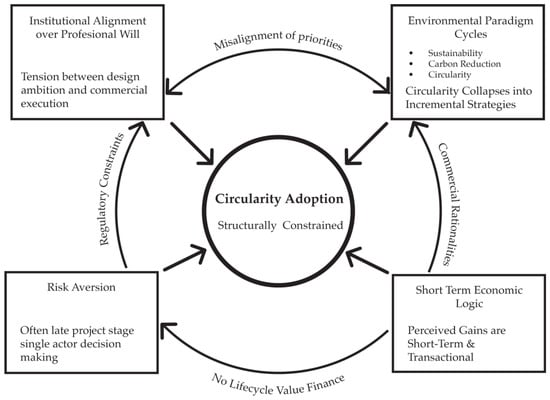
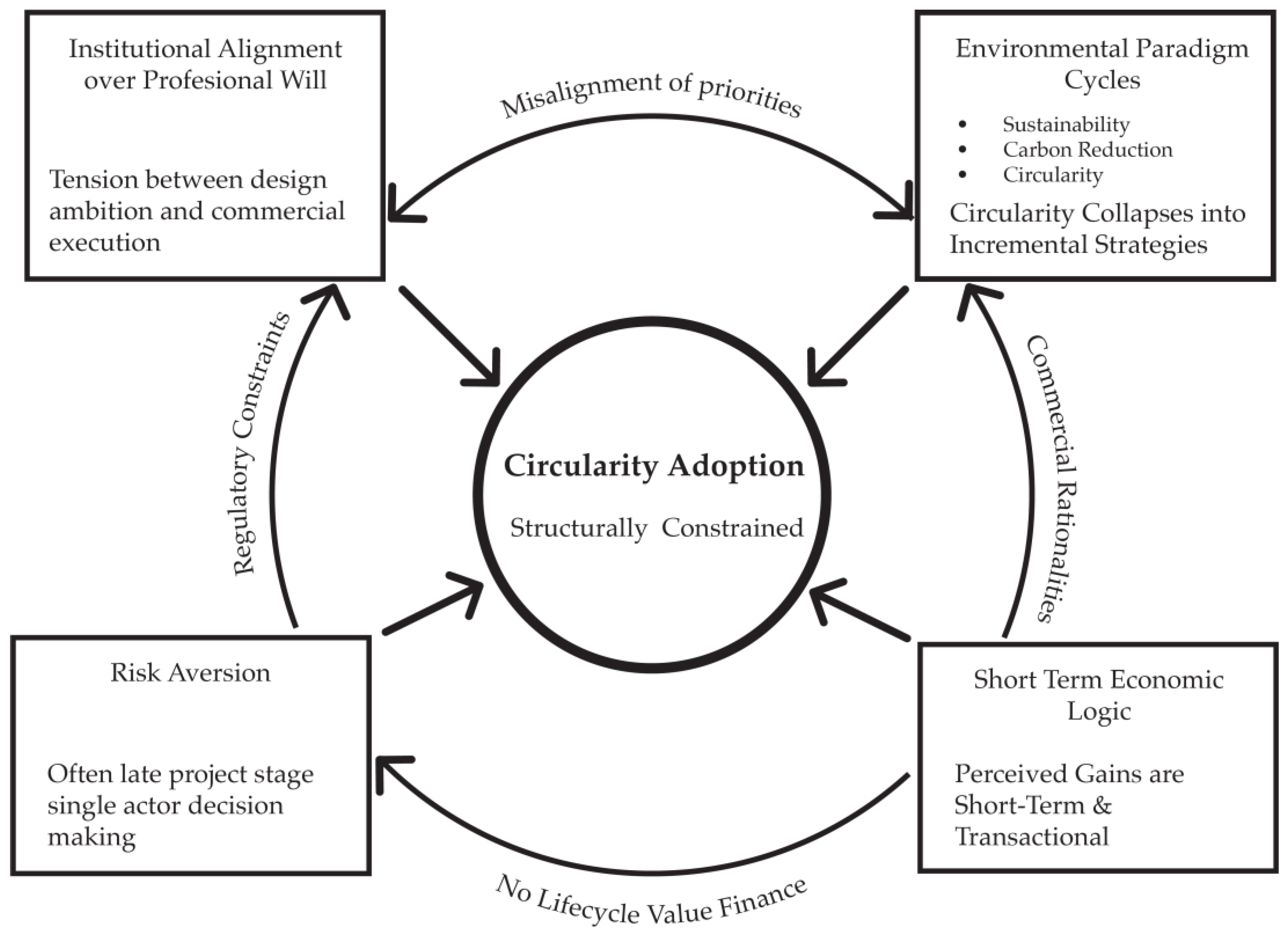
Collectively, these synthesised themes can be understood as a reinforcing condition in which the adoption of circularity is constrained by the interaction among institutional, economic, and professional dynamics. Figure 1 presents a model illustrating the reinforcing condition involving the four interpretively synthesised themes, connected by evidence grounded in participant accounts.
Figure 1.
Constraint Interaction Model.
The two-way ‘misalignment of priorities’ relationship emerged from participant accounts describing tensions between institutional procurement priorities and circular design ambitions, often resulting in circularity being reduced to an incremental strategy. An example of this relationship was the common prioritisation of late-stage project value engineering, with a focus on cost certainty and project delivery efficiency. The one-way ‘regulatory constraints’ relationship reflects repeated discussions highlighting how certification uncertainty and compliance regimes stem from risk-averse project delivery, which shapes commercial execution. Similarly, the one-way relationship of a lack of perceived ‘lifecycle value’ was evident across discussions of procurement, storage, adaptability, and reuse, emerging from an interpreted short-term commercial mindset that, in turn, reinforces risk aversion. Finally, ‘commercial rationalities’ reflect participants’ repeated calls for measurement and value recognition that is compatible with existing procurement structures. The current lack of commercial recognition, therefore, links the prevalent short-term economic logic to a maintenance of environmental agenda cycles and industry paradigms, such as first sustainability, then carbon reduction, and now circularity, rather than enabling systemic transformation.
In the absence of strong regulatory drivers and lifecycle-based value frameworks, these relationships form a self-reinforcing cycle in which circularity remains partial, contingent, and unevenly implemented across practice.
5.6. Limitations
Several limitations must be acknowledged. The research draws on focus group data, which captures perceptions and experiences rather than longitudinal project performance outcomes. The sample, while diverse, is concentrated within metropolitan contexts and may not reflect national or regional conditions. Additionally, as a qualitative study employing Reflexive Thematic Analysis, the findings provide interpretive depth rather than statistical generalisability.
6. Conclusions
This study set out to examine (i) the ability of professional Australian architectural service providers to adopt circularity, and (ii) the barriers that restrict or undermine this adoption in the context of the 2024 Australian Circular Economy Framework. The study advances understanding of how national circular economy strategies intersect with professional practice realities. Overall, the results suggest that the adoption of circularity principles among professional Australian architectural service providers is significant, though unevenly concentrated, inconsistently applied, and structurally constrained. Practices demonstrate an awareness of circular principles, particularly in adaptive reuse and material value retention, yet systemic implementation remains dependent on client leadership, procurement flexibility and regulatory support. Table 3 provides an overview of the identified barriers. While concept ambiguity and fragmented implementation sit within the control of architectural service providers, the majority exist outside their control and operate across multiple scales. The ability of professional architectural service providers to adopt circular principles, therefore, is conditional and opportunistic rather than intrinsic: it expands or contracts in response to project governance contexts.
Table 3.
A description of each barrier identified through the research.
6.1. Implications for Stakeholders
The implication of this research is that, without changes to infrastructure logistics, regulatory frameworks, legal contracts, and a short-term economic value mindset, circularity will continue to be perceived as an aspirational enhancement that attracts additional risk rather than being treated as a baseline built-environment expectation. The findings indicate that circularity adoption is not constrained by design capability alone, but by systemic misalignment across procurement, regulation, and supply chains. As such, its implementation requires coordinated action across stakeholders.
For architects, circularity must move from isolated interventions to standardised practice. This includes embedding material flexibility, design for disassembly and spatial adaptability into baseline workflows, helping to establish measurable circularity targets with regulators, and engaging contractors and suppliers early to align design intent with construction realities. As noted earlier, organising decision-making groups to act as custodians of client circular ambitions could reduce the likelihood of late-stage single-actor decision-making, which currently occurs in building projects.
For clients and developers, the primary shift is to reframe value from upfront cost to lifecycle performance. This can be operationalised through circularity requirements in project briefs, flexible procurement models, and investment strategies that treat buildings as long-term material assets rather than depreciating commodities.
For construction stakeholders, realising circular intent requires early project involvement, new labour capabilities for Building Information Modelling communication, reuse and disassembly, and the adoption of material-tracking systems to ensure alignment between design specifications and as-built outcomes.
For regulators and certifiers, reform is needed to reduce approval delays and cost barriers associated with reused and novel materials. Performance-based compliance pathways, standardised circularity metrics, and integration into planning frameworks are critical to enabling innovation.
For the supply chain, circularity depends on reliable material flows and data infrastructure. This includes developing secondary-material marketplaces, improving material certification systems, and investing in storage, logistics, and digital platforms to support material traceability.
For asset owners and facility managers responsible for maintaining and updating material data over time, they must ensure that material passports and digital systems remain active and usable to enable planning for maintenance, reuse, and eventual disassembly.
Insurers and financiers who control the availability of capital can influence the economic viability of circularity by developing products that recognise the legal benefits of BIM models, the value of secondary material markets, and long-term asset management, and by encouraging the reuse of materials and buildings.
Digital platform providers and technology developers can support implementation by creating interoperable tools for relational design models, material tracking and lifecycle data management, with particular emphasis on long-term data continuity beyond project completion.
Finally, industry bodies, including professional institutes and standards organisations, play a coordinating role by establishing shared guidelines, benchmarks, and contractual frameworks for architects and regulators to operate within, as well as by delivering training and accreditation pathways to build circular competencies across the sector. Together, these actors extend circularity from a project-based ambition to an ongoing, system-wide capability.
Collectively, the variety of stakeholders and required actions suggests that circularity will remain fragmented and opportunistic unless supported by coordinated institutional change across the Australian built environment sector.
6.2. Further Study
A key problem identified through the research was the distribution of risk in relation to reducing waste, and material and spatial re-use. While this study identifies risk aversion within procurement and compliance frameworks as a significant constraint on the adoption of Design for Circularity, it did not empirically examine how risk is formally assessed, allocated, and managed within project contracts and regulatory processes. Further research is therefore needed to investigate how risk is constructed and distributed across clients, contractors, insurers, and regulators in circular projects, and whether alternative contractual or certification models could reduce perceived liability barriers. Additionally, one of the questions referred specifically to digitalisation in circular efforts. While this research used the resulting discussion to thematically analyse in response to the research questions, a future paper will specifically review and analyse this part of the transcript data to explore the role of digital tools and data-driven processes in adopting circularity principles in practice. Such work would provide a more precise understanding of the practical steps needed to achieve national circularity targets.
Author Contributions
Conceptualization, C.B. and M.H.H.; methodology, C.B. and M.H.H.; validation, M.J.O. and C.B.; formal analysis, C.B.; investigation, C.B., M.H.H., J.B., T.S. and M.B.; data curation, C.B.; writing—original draft preparation, C.B., M.K. and Y.A.Y.T.; writing—review and editing, M.J.O., M.K., D.O., J.B., T.S. and Y.A.Y.T.; supervision, M.H.H.; project administration, C.B.; funding acquisition, M.H.H., M.J.O., J.B. and M.B. All authors have read and agreed to the published version of the manuscript.
Funding
This research was conducted by the ARC Centre for Next-Gen Architectural Manufacturing and funded by the Australian Government (ARC IC220100030).
Institutional Review Board Statement
The study was approved by UNSW Human Research Ethics Advisory Panels (HREAP) Executive (iRECS9211 8 July 2025) in accordance with the National Health and Medical Research Council’s (NHMRC) National Statement on Ethical Conduct in Human Research (2023).
Informed Consent Statement
Informed consent was obtained from all subjects involved in the study.
Data Availability Statement
The data presented in this study are available from the corresponding author upon request, in accordance with UNSW Research Data storage protocols.
Acknowledgments
During the preparation of this manuscript/study, the author(s) used Grammarly for the purposes of spelling and grammar. The authors have reviewed and edited the output and take full responsibility for the content of this publication.
Conflicts of Interest
The authors declare no conflicts of interest.
References
- CSIRO. Australian Material Flow Analysis to Progress to a Circular Economy; CSIRO: Canberra, Australia, 2024. [Google Scholar]
- Australian Government. Embodied Carbon Projections for Australian Infrastructure and Buildings; Infrastructure Australia: Sydney, Australia, 2024.
- Australian Government. Australia’s Circular Economy Framework; Department of Climate Change, Energy, the Environment and Water (DCCEEW): Canberra, Australia, 2024.
- Ellen MacArthur Foundation. Towards the Circular Economy: Opportunities for the Industrial Symbiosis for an Accelerated Transition; Ellen MacArthur Foundation: Isle of Wight, UK, 2013. [Google Scholar]
- Eberhardt, L.C.M.; Birkved, M.; Birgisdottir, H. Building design and construction strategies for a circular economy. Archit. Eng. Des. Manag. 2020, 18, 93–113. [Google Scholar] [CrossRef] [Scilit]
- Millar, N.R.; McLaughlin, E.; Börger, T. The Circular Economy: Swings and Roundabouts? Ecol. Econ. 2019, 158, 11–19. [Google Scholar] [CrossRef] [Scilit]
- Ferasso, M.; Beliaeva, T.; Kraus, S.; Clauß, T.; Soriano, D.R. Circular Economy Business Models: The State of Research and Avenues Ahead. Bus. Strategy Environ. 2020, 29, 3006–3024. [Google Scholar] [CrossRef] [Scilit]
- Beckmann, A.; Sivarajah, U.; Irani, Z. Circular Economy Versus Planetary Limits: A Slovak Forestry Sector Case Study. J. Enterp. Inf. Manag. 2020, 34, 1673–1698. [Google Scholar] [CrossRef] [Scilit]
- Circle Economy. The Circularity Gap Report—The Case of Netherlands; Circle Economy: Amsterdam, The Netherlands, 2025. [Google Scholar]
- Wandl, A.; Ioannou, O.; Gruis, V.; Peck, D.; Jenkins, A.; Geldermans, B.; van den Berghe, K.; Bucci-Ancapi, F.; Tsui, T.; van Uden, M.; et al. The Delft scales to aspects circular built environment model: The result of two years of interdisciplinary discussions. Plan. Pract. Res. 2026, 41, 317–338. [Google Scholar] [CrossRef] [Scilit]
- Circle Economy. The Circularity Gap Report Nations: Methodology Document (v 2.2); Circle Economy: Amsterdam, The Netherlands, 2015. [Google Scholar]
- Kanters, J. Circular Building Design: An Analysis of Barriers and Drivers for a Circular Building Sector. Buildings 2020, 10, 77. [Google Scholar] [CrossRef] [Scilit]
- Australian Institute of Architects. Greenwashing—Submission to the Senate Standing Committees on Environment and Communications; Australian Institute of Architects: Melbourne, Australia, 2023. [Google Scholar]
- Australian Government. The Circular Advantage; Department of Climate Change, Energy, the Environment and Water: Canberra, Australia, 2024.
- Pomponi, F.; Moncaster, A. Circular economy for the built environment: A research framework. J. Clean. Prod. 2017, 143, 710–718. [Google Scholar] [CrossRef] [Scilit]
- Geissdoerfer, M.; Savaget, P.; Bocken, N.M.P.; Hultink, E.J. The Circular Economy—A new sustainability paradigm? J. Clean. Prod. 2017, 143, 757–768. [Google Scholar] [CrossRef] [Scilit]
- CSIRO. Australia’s Comparative and Competitive Advantages in Transitioning to a Circular Economy; CSIRO: Canberra, Australia, 2024. [Google Scholar]
- Tukker, A.; Behrens, P.; Deetman, S.; Hu, M.; Alejandre, E.M.; van der Meide, M.; Zhong, X.; Zhang, C. Circular construction: Six key recommendations. One Earth 2023, 6, 1425–1429. [Google Scholar] [CrossRef] [Scilit]
- Charef, R.; Morel, J.-C.; Rakhshan, K. Barriers to Implementing the Circular Economy in the Construction Industry: A Critical Review. Sustainability 2021, 13, 12989. [Google Scholar] [CrossRef] [Scilit]
- Ababio, B.K.; Lu, W. Barriers and enablers of circular economy in construction: A multi-system perspective towards the development of a practical framework. Constr. Manag. Econ. 2022, 41, 3–21. [Google Scholar] [CrossRef] [Scilit]
- Osobajo, O.A.; Oke, A.; Omotayo, T.; Obi, L.I. A systematic review of circular economy research in the construction industry. Smart Sustain. Built Environ. 2020, 11, 39–64. [Google Scholar] [CrossRef] [Scilit]
- Hendrianto, F.C.; Negara, K.P.; Devia, Y.P. Analyzing Critical Success Factors for Implementing a Circular Economy in East Java’s Construction Industries Using Fuzzy Synthetic Evaluation. Civ. Environ. Eng. 2024, 20, 1077–1094. [Google Scholar] [CrossRef] [Scilit]
- van Uden, M.; Wamelink, H.; van Bueren, E.; Heurkens, E. Aligning practices towards a circular economy in the architecture, engineering, and construction sector: Seven transitions in different stages of reconfiguration. Constr. Manag. Econ. 2024, 43, 153–174. [Google Scholar] [CrossRef] [Scilit]
- Rahla, K.M.; Bragança, L.; Mateus, R. Obstacles and barriers for measuring building’s circularity. In Proceedings of the IOP Conference Series: Earth and Environmental Science; IOP Publishing: Bristol, UK, 2019. [Google Scholar]
- Hossain, M.U.; Ng, S.T.; Antwi-Afari, P.; Amor, B. Circular economy and the construction industry: Existing trends, challenges and prospective framework for sustainable construction. Renew. Sustain. Energy Rev. 2020, 130, 109948. [Google Scholar] [CrossRef] [Scilit]
- Gasparri, E.; Arasteh, S.; Kuru, A.; Stracchi, P.; Brambilla, A. Circular economy in construction: A systematic review of knowledge gaps towards a novel research framework. Front. Built Environ. 2023, 9, 1239757. [Google Scholar] [CrossRef] [Scilit]
- Verberne, J.J.H. Building Circularity Indicators an Approach for Measuring Circularity of a Building. Master’s Thesis, Eindhoven University of Technology, Eindhoven, The Netherlands, 2016. [Google Scholar]
- Alhawamdeh, M.; Lee, A.; Saad, A. Designing for a Circular Economy in the Architecture, Engineering, and Construction Industry: Insights from Italy. Buildings 2024, 14, 1946. [Google Scholar] [CrossRef] [Scilit]
- Hamida, M.B.; Remøy, H.; Gruis, V.; Jylhä, T. Circular building adaptability in adaptive reuse: Multiple case studies in the Netherlands. J. Eng. Des. Technol. 2023, 23, 161–183. [Google Scholar] [CrossRef] [Scilit]
- Ollár, A. Circular building adaptability in multi-residential buildings—The status quo and a conceptual design framework. Int. J. Build. Pathol. Adapt. 2024, 42, 1–17. [Google Scholar] [CrossRef] [Scilit]
- ARUP. Cirular Economy in the Built Environment; ARUP: London, UK, 2016. [Google Scholar]
- Temizel-Sekeryan, S.; Rios, F.C.; Geremicca, F.; Bilec, M.M. Circular Design and Embodied Carbon in Living Buildings: The Missing Potential. J. Archit. Eng. 2023, 29, 04023013. [Google Scholar] [CrossRef] [Scilit]
- Dokter, G.; Thuvander, L.; Rahe, U. How circular is current design practice? Investigating perspectives across industrial design and architecture in the transition towards a circular economy. Sustain. Prod. Consum. 2021, 26, 692–708. [Google Scholar] [CrossRef] [Scilit]
- Hosseini, M.R.; Memari, S.; Martek, I.; Kocaturk, T.; Bararzadeh, M.; Arashpour, M. Dismantling linear lock-ins in the Australian AEC industry: A pathway to a circular economy. Sustain. Dev. 2024, 32, 7171–7185. [Google Scholar] [CrossRef] [Scilit]
- Shooshtarian, S.; Hosseini, M.R.; Kocaturk, T.; Arnel, T.; T. Garofano, N. Circular economy in the Australian AEC industry: Investigation of barriers and enablers. Build. Res. Inf. 2022, 51, 56–68. [Google Scholar] [CrossRef] [Scilit]
- Feldman, J.; Seligmann, H.; King, S.; Flynn, M.; Shelley, T.; Helwig, A.; Burey, P. Circular economy barriers in Australia: How to translate theory into practice? Sustain. Prod. Consum. 2024, 45, 582–597. [Google Scholar] [CrossRef] [Scilit]
- Guest, G.; Namey, E.; Taylor, J.; Eley, N.; McKenna, K. Comparing focus groups and individual interviews: Findings from a randomized study. Int. J. Soc. Res. Methodol. 2017, 20, 693–708. [Google Scholar] [CrossRef] [Scilit]
- Kitzinger, J. The methodology of Focus Groups: The importance of interaction between research participants. Sociol. Health Illn. 2008, 16, 103–121. [Google Scholar] [CrossRef] [Scilit]
- Rodriguez, K.L.; Schwartz, J.L.; Lahman, M.K.E.; Geist, M.R. Culturally Responsive Focus Groups: Reframing the Research Experience to Focus on Participants. Int. J. Qual. Methods 2011, 10, 400–417. [Google Scholar] [CrossRef] [Scilit]
- Hennink, M.; Kaiser, B.N.; Weber, M.B. What Influences Saturation? Estimating Sample Sizes in Focus Group Research. Qual. Health Res. 2019, 29, 1483–1496. [Google Scholar] [CrossRef] [Scilit]
- Guest, G.; Namey, E.; McKenna, K. How Many Focus Groups Are Enough? Building an Evidence Base for Nonprobability Sample Sizes. Field Methods 2016, 29, 3–22. [Google Scholar] [CrossRef] [Scilit]
- Malterud, K.; Siersma, V.D.; Guassora, A.D. Sample Size in Qualitative Interview Studies:Guided by Information Power. Qual. Health Res. 2016, 26, 1753–1760. [Google Scholar] [CrossRef] [Scilit]
- Braun, V.; Clarke, V. Thematic Analysis: A Practical Guide; SAGE Publications Ltd.: Thousand Oaks, CA, USA, 2021. [Google Scholar]
- Yanto, E.S. The What and How of Essential Thematic Analysis. Qual. Rep. 2023, 28, 3120–3131. [Google Scholar] [CrossRef] [Scilit]

Disclaimer/Publisher’s Note: The statements, opinions and data contained in all publications are solely those of the individual author(s) and contributor(s) and not of MDPI and/or the editor(s). MDPI and/or the editor(s) disclaim responsibility for any injury to people or property resulting from any ideas, methods, instructions or products referred to in the content. |
© 2026 by the authors. Licensee MDPI, Basel, Switzerland. This article is an open access article distributed under the terms and conditions of the Creative Commons Attribution (CC BY) license.