1. Introduction
Architecture has historically articulated its critical agency through the projection of alternative worlds. Utopian and dystopian imaginaries operate not as escapist fantasies but as epistemological instruments through which the discipline interrogates the present and constructs speculative horizons. By envisioning transformed social orders, radical infrastructures, or post-catastrophic environments, architecture expands its capacity to question dominant paradigms and reconfigure spatial possibilities. In this sense, utopia and dystopia constitute methodological conditions that position design as an anticipatory practice embedded within broader cultural, ecological, and political debates. This anticipatory dimension becomes particularly significant in the contemporary context, marked by ecological instability, technological acceleration, and systemic uncertainty. While recent scholarships have revisited speculative design as a critical practice, the role of artificial intelligence (AI) in transforming speculative reasoning within architectural thinking remains insufficiently examined. In particular, there is a lack of studies that address how AI-mediated processes interact with utopian and dystopian frameworks not only as representational tools, but as epistemological conditions that reshape design thinking.
This paper addresses this gap by investigating the integration of utopian/dystopian thinking and AI-driven speculative design as a methodological framework in architectural education. The central research question guiding this study is: how does AI-mediated speculative design activate and transform utopian and dystopian thinking as a critical practice within architectural design processes? More specifically, the paper examines whether and how AI operates as a cognitive partner capable of influencing speculative reasoning, ethical positioning, and the construction of alternative spatial scenarios.
Historically, architecture has maintained a productive relationship with utopian and dystopian thought. From visionary Enlightenment projects to the radical experiments of the twentieth century, speculative architectural proposals have functioned as instruments to interrogate the present and imagine alternative spatial orders. However, as Manfredo Tafuri argued in
Architecture and Utopia, modern architectural utopias revealed the ideological limits of the discipline when detached from broader socio-economic structures [
1]. Rather than signalling the end of utopian thinking, this critique repositioned speculation as a critical rather than prescriptive practice.
In late capitalism, Fredric Jameson described a ‘waning of utopian imagination’, noting that it has become easier to imagine the end of the world than the end of capitalism [
2]. Within this context, utopia and dystopia operate less as blueprints and more as diagnostic tools that expose the ideological boundaries of the present. The renewed relevance of utopian thought lies precisely in its methodological capacity to challenge what appears inevitable.
This methodological reinterpretation aligns with Ruth Levitas, who defines utopia as a method, an analytical and imaginative practice that explores social desires and alternative possibilities rather than fixed models [
3]. Similarly, Ernst Bloch conceptualizes utopia as a
principle of hope, a forward-looking cognitive force embedded in cultural production [
4]. Together, these perspectives frame utopia not as escapism, but as a critical and anticipatory mode of thinking. In recent decades within the architectural field, speculative and critical design have revitalized this tradition, further strengthened by new representational technologies.
Utopia/dystopia and speculative design are not synonymous. Although both resort to imagination to explore the future, they respond to different disciplinary loci and, therefore, treat the future differently. Utopian/dystopian thought (with sociological and historical-philosophical rootedness) operates as a normative and diagnostic horizon: through projections of fulfillment or catastrophe, it transforms the present, exposes its contradictions, and orients collective desire toward ethical configurations of coexistence (utopia) or warns of technical instrumentalization and exclusion (dystopia). Its holistic and systemic perspective focuses on institutions, social relations, and forms of life in common, supported by social theory and political structures.
By contrast, speculative design is situated in the interstice between the present and possible futures as a critical and agnostic methodology; it interrogates assumptions and tests consequences through design fiction and world-building, provoking questions without requiring an exhaustive sociological plan. It focuses on artifacts, prototypes, and scenarios that render the hypothetical tangible, shifting the unit of analysis toward human–object interaction and situated experience; for this reason, it cultivates ambiguity and provocation to stimulate debates about the implications of contemporary technologies and practices [
5,
6,
7].
This text adopts both orientations (utopia/dystopia as a normative-diagnostic horizon and speculative design as a critical methodology) to reinforce the epistemological condition of architecture as a relational and trans-scalar discipline, capable of encompassing human and non-human planes of life and of articulating institutions, infrastructures, situated knowledges, and more-than-human agencies. The aim is not a conciliatory eclecticism, but to activate their productive tension. While utopia/dystopia dramatizes ends and broadens the normative horizon, speculative design maps pathways, plausible, unsettling, or contradictory, toward more complex, relational, and contestable configurations of dwelling. Thus, architecture reveals itself as cultural and political infrastructure, a medium that imagines, problematizes, and rehearses possibilities, rendering intelligible the ethical, social, ecological, and technological conditions of futures that are thinkable, debatable, and practicable.
For example, Anthony Dunne and Fiona Raby propose speculative design as a practice that uses fictional scenarios and prototypes to question dominant technological narratives rather than reinforce them [
7]. Within architecture, this approach resonates with broader theoretical reflections on infrastructure, systems, and relational spatiality advanced by authors such as Reinhold Martin and Keller Easterling, who interpret architecture as embedded within dynamic socio-technical networks rather than as isolated objects [
8].
Against this theoretical background, the integration of AI represents a significant epistemic shift. AI-assisted tools, ranging from image generation and environmental simulation to advanced textual prompting, do not merely accelerate representation; they alter the structure of design reasoning itself. When embedded within a speculative design framework, AI can function as an intellectual partner that enables reinterpreting historical narratives, simulating ecological transformations, and constructing alternative futures beyond conventional disciplinary constraints.
To investigate this hypothesis, the study is based on two case studies developed in an academic context, representing complementary dimensions of architectural thinking: theoretical reflection and project-based experimentation. Given that architecture inherently articulates theory and practice within a single cognitive process. In both cases, activities and projects were proposed that experimented with utopia/dystopia as a creative, heuristic, and hermeneutic act. Complementarily, a speculative approach was incorporated, enabling the exploration of possible futures through projective artifacts and scenarios, expanding the modes of critical inquiry and the interpretation of consequences. Whereas the integration of artificial intelligence was examined across both domains to assess its impact not merely as an instrumental tool, but as a medium for conceptual and critical articulation. Through these cases, the paper analyses how AI-mediated speculative processes contribute to the activation of utopian/dystopian thinking and to the development of critical and ethical awareness in architectural education.
The research is grounded in the recognition that values such as integrity, responsibility, honesty, and normative awareness constitute essential foundations of architectural practice. In a context characterized by rapid technological transformation and environmental uncertainty, the ethical dimension assumes a central role in the contemporary production of architectural knowledge.
Thus, utopia and dystopia function as an ethical horizon, offering a framework for interpreting and analyzing the present, questioning and reinterpreting the values, hopes, and fears of current reality. Utopian thought does not produce mere fantasies; when interwoven with speculative design, both become tools that, through discovery and representation, allow us to explore possibilities for a better life or to warn against what is undesirable.
Critical reflections on the present and subsequent speculation on new horizons developed through interconnected multimodal exercises culminating in the production of a speculative architectural project, plastic, or audiovisual artifact. These exercises were conceived as research devices aimed at articulating historical analysis, critical thinking, and imaginative projection. The objective was not merely the formulation of formal proposals, but the construction of speculative scenarios capable of reinterpreting historical narratives, contemporary challenges, and possible future configurations of the built environment.
Within this framework, the incorporation of artificial intelligence (AI) expanded processes of analysis, representation, and conceptual exploration. AI was employed as a cognitive medium capable of amplifying variation, comparison, and scenario simulation, thereby facilitating the construction of alternative spatial hypotheses. In this way, speculative design was configured as an epistemological strategy aimed at generating knowledge through project-based experimentation, integrating critical reflection, imagination, and ethical evaluation within a unified process.
Within the context of the Anthropocene and the climate crisis, this pedagogical approach acquires urgency. Ecological instability, accelerated urbanization, migration flows, and socio-political fragmentation demand new modes of architectural thinking capable of operating under uncertainty. Utopian/dystopian thinking, together with speculative design and amplified by AI, makes it possible to conceive architecture as an adaptive and relational system, sensitive to environmental patterns, cultural memory, and technological mediation. The study argues that these multidisciplinary interrelations, when applied to the teaching of the architectural discipline, expand students’ critical capacity to anticipate and shape relational and sustainable futures, while simultaneously reinforcing ethical responsibility and intellectual autonomy.
The contribution of this paper lies in proposing a methodological articulation between utopian/dystopian thought, speculative design, and AI as a cognitive medium, positioning architectural education as a privileged site for the exploration of alternative futures under conditions of ecological and technological uncertainty.
2. Theoretical Framework: Utopia and Dystopia as Method
As is well known, the word
utopia was coined by Thomas More in 1516 as a play on words between
eutopia (good place) and
utopia (no place) [
9]. More removes the “e” and the “o”, leaving the word suspended in a liminal state of ambiguity. Nevertheless, in common usage today, the term has acquired a pejorative meaning, as it is often associated with pure fantasy, an idealism without any grounding, situations or scenarios impossible to realize. However, numerous intellectuals have approached utopian thought from a critical and historically informed perspective, arguing that a form of utopian thinking detached from any anchoring cannot truly exist, for it lacks both transformative form and function.
Ernst Bloch, in
The Principle of Hope [
4], maintains that utopian thought is intrinsic to human nature and consciousness, and that the emotion of hope constitutes the driving force of the utopian function. It is anticipatory and transformative, and its intentions and purposes are those that direct thought and action toward a better future. Utopias thus present themselves as scenarios of agency: they promote, hypothesize, and prefigure a future ethics centered on the care of the planet and all its inhabitants.
Likewise, if utopian thinking is not supported by an education in hope and a pedagogy of desire, as Miguel Abensour argues [
10], it cannot be considered true utopian thought but mere fabulation. Marxist thinkers such as Herbert Marcuse and Fredric Jameson [
2] warn of the importance of utopian thought, as it offers the possibility of overcoming the alienation of labor and the false freedom of capitalism (
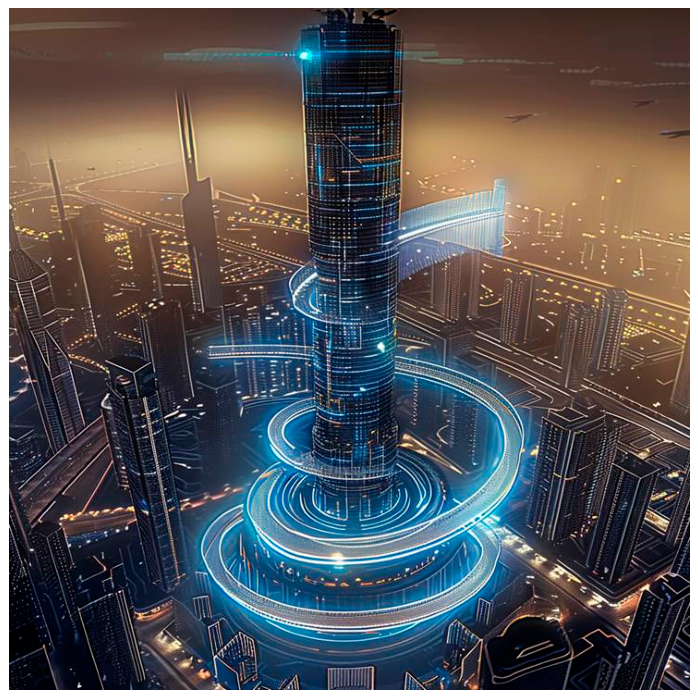
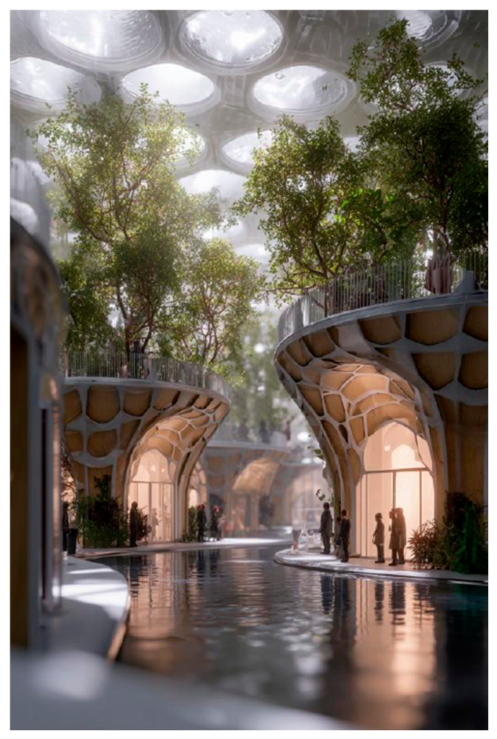
Figure 1).
Within this methodological debate, the contribution of Ruth Levitas is particularly significant. By redefining utopia as method rather than model, Levitas proposes an analytical framework capable of articulating social desires, ethical commitments, and structural critique [
3]. In this formulation, utopia operates less as a projection of an idealized future than as a critical procedure that interrogates the assumptions structuring the present. It functions as a mode of reflexive reconstruction, exposing normative limits while staging the possibility of transformation. Such an understanding resonates with Ernst Bloch’s concept of the principle of hope, not merely as futurity, but as an ontological orientation embedded within cultural production, an anticipatory impulse that persists within material practices and collective imaginaries [
4].
For Fredric Jameson, utopian thinking retains its relevance precisely because it exposes the ideological limits of the present, functioning as a critical instrument in moments of political and cultural impasse [
2]. Similarly, Manfredo Tafuri demonstrated how architectural utopias both reveal and conceal the socio-economic structures within which they operate. Together, these perspectives reposition utopia and dystopia as epistemological devices capable of interrogating contemporary architectural paradigms [
1].
In recent decades, speculative and critical design practices have reactivated this tradition. Anthony Dunne and Fiona Raby frame speculative design to construct fictional yet plausible scenarios that challenge dominant technological narratives [
7]. Within architecture, such approaches intersect with systemic interpretations of infrastructure and spatial networks advanced by authors such as Reinhold Martin and Keller Easterling, reinforcing the understanding of architecture as a dynamic, relational system [
8,
11].
The emergence of AI must therefore be situated within this broader methodological and theoretical genealogy. Rather than representing a purely technical innovation, AI can be understood as a new cognitive environment that reshapes the interplay between analysis, imagination, and representation. When integrated into speculative design pedagogy, AI extends the systemic and relational turn initiated in the twentieth century while simultaneously reintroducing heuristic experimentation and subjective interpretation.
In the context of ecological and social sustainability, central challenges of the twenty-first century, the imagination of new forms of habitat and new modes of coexistence becomes not merely desirable but necessary. As Levitas argues, utopian thinking may enable “new forms of satisfaction, particularly in creativity and human relationships”, suggesting that architectural education must cultivate both critical awareness and imaginative capacity [
3,
12]. Within this framework, AI does not replace human agency but functions as an intellectual partner capable of amplifying speculative inquiry and reconfiguring the methodological foundations of architectural design.
Utopia and Dystopia in Architectural Thought
Utopian and dystopian imaginaries have long structured architectural discourse as modes of critical projection rather than mere stylistic tendencies. Within architectural thought, they operate as cognitive frameworks through which spatial form becomes inseparable from political vision. The city, the dwelling, and infrastructure have repeatedly served as media for articulating alternative social orders, staging scenarios that oscillate between emancipatory transformation and systemic collapse. In this sense, architectural speculation is not only representational but deeply ideological, embedding spatial propositions within broader imaginaries of collective life.
Theoretical accounts of utopia emphasize its structural role in mediating between present conditions and alternative futures. Darko Suvin defines utopia as a literary and cultural form grounded in ‘cognitive estrangement,’ a mechanism that destabilizes familiar realities to reveal their contingency [
13]. When translated into architectural terms, this estrangement materializes through spatial displacements, new typologies, reorganized infrastructures, or radical territorial systems that render visible the assumptions embedded within existing urban and social configurations. Architecture thus becomes a material interface through which estrangement acquires tangible form.
Conversely, dystopia introduces a critical inversion of utopian projection. Rather than presenting perfected orders, dystopian imaginaries expose the latent violence, exclusions, and technological excesses concealed within narratives of progress. Tom Moylan’s notion of the ‘critical dystopia’ highlights how dystopian narratives retain a utopian impulse precisely by refusing closure and foregrounding contradiction [
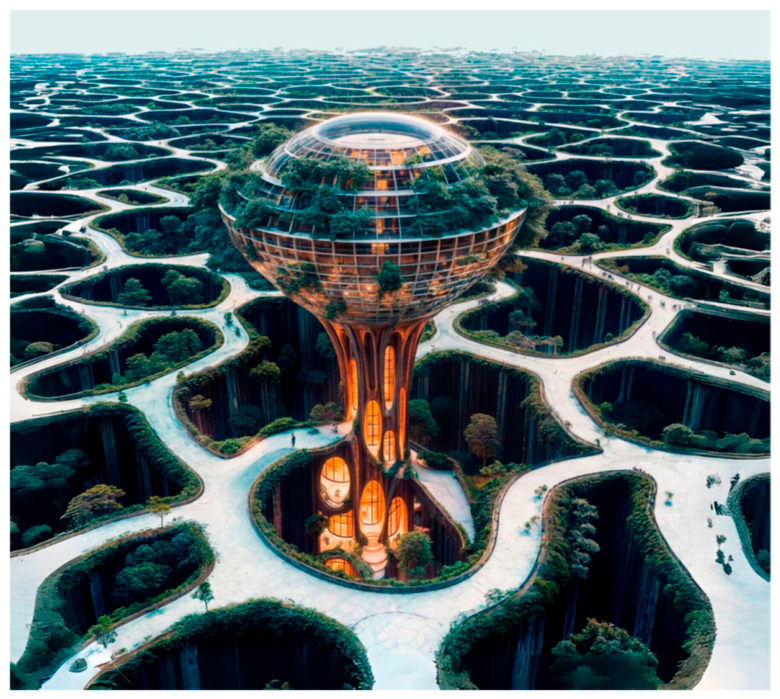
14]. In architecture, dystopian projections frequently manifest as hyper-controlled megastructures, privatized enclaves, or ecologically degraded landscapes, revealing how spatial organization can both reproduce and intensify systemic inequities (
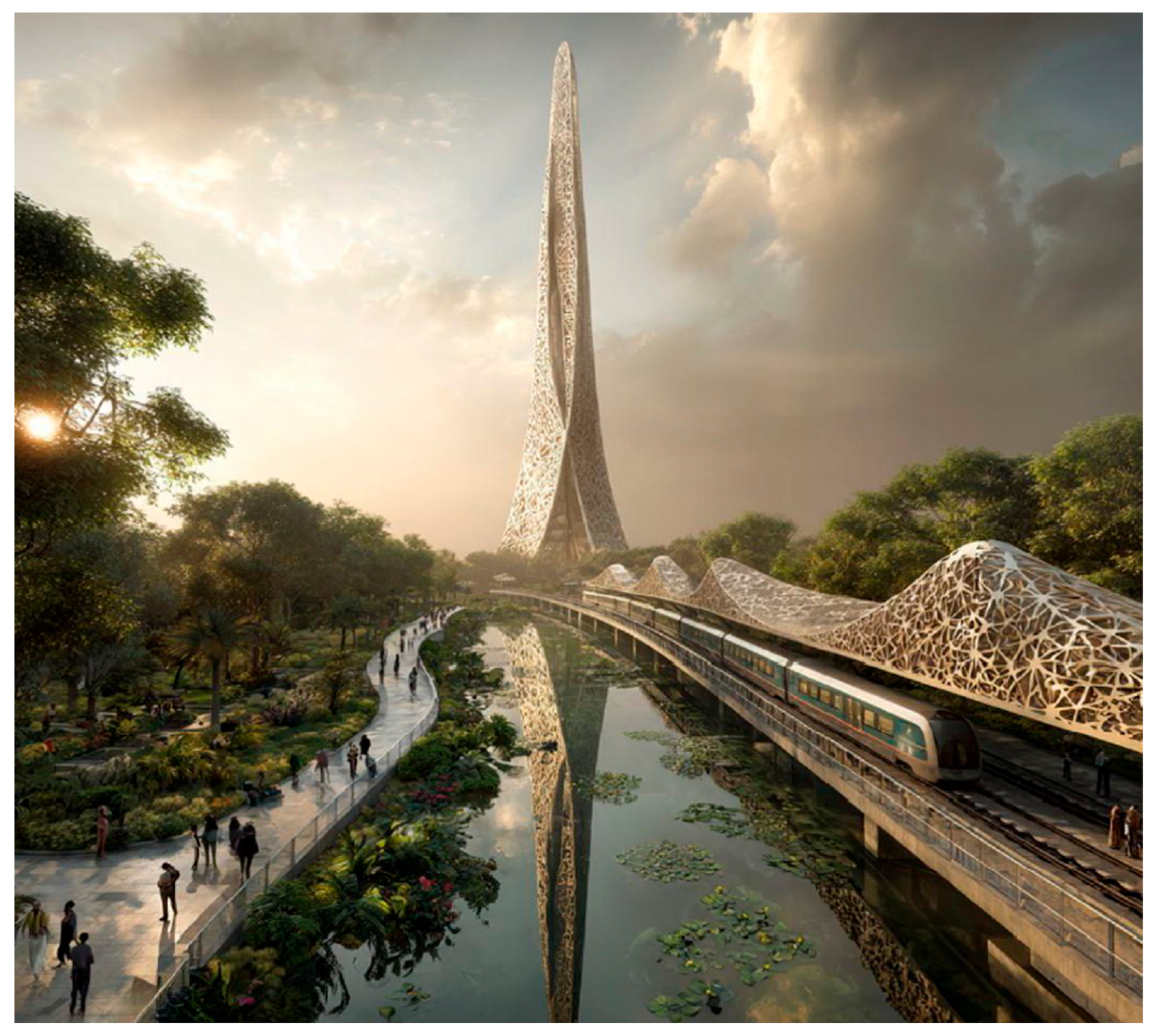
Figure 2).
The twentieth century witnessed the radicalization of these speculative tensions. Architectural avant-gardes deployed visionary drawings and manifestos not merely to propose new forms but to reimagine social relations. Yet as Anthony Vidler argues, modern architecture’s engagement with utopia also produced forms of anxiety and estrangement, particularly as technological rationalization began to dominate spatial production [
15]. The architectural uncanny, in this context, signals the ambivalence of utopian aspiration when confronted with bureaucratic abstraction and mechanized repetition.
Contemporary theory has further complicated the utopia–dystopia dialectic by situating it within processes of globalization, financialization, and digital mediation. David Harvey’s analysis of spatial fixity and capital circulation demonstrates how urban form becomes a vehicle for absorbing systemic crises, often transforming utopian redevelopment into speculative commodification [
16]. Similarly, Pier Vittorio Aureli’s reflections on architectural autonomy reveal how projects that appear formally radical may remain entangled within broader regimes of economic power [
17]. These critiques underscore that utopian form cannot be detached from the material conditions of its production.
Recent scholarship has also examined how technological imaginaries reshape architectural projection. Antoine Picon argues that digital technologies have reconfigured architectural representation, enabling simulations that blur the boundary between visionary speculation and operational design [
18]. Within this environment, dystopian anxieties surrounding automation, surveillance, and environmental collapse intersect with renewed utopian aspirations for regenerative systems and adaptive infrastructures. Mark Fisher’s diagnosis of ‘capitalist realism’ further suggests that contemporary culture struggles to envision systemic alternatives, reinforcing the importance of speculative practices that reopen the horizon of possibility [
19].
Taken together, these perspectives reveal that utopia and dystopia function less as opposing categories than as dialectical mechanisms within architectural thought. Each projection simultaneously critiques and constructs, destabilizes and proposes. The tension between them generates a productive field in which spatial imagination becomes a site of ideological negotiation. Far from being marginal to architectural theory, utopian and dystopian imaginaries constitute a structural dimension of the discipline’s capacity to anticipate, contest, and reconfigure the socio-spatial order.
3. Methods
This study adopts a qualitative, practice-based research approach to investigate how AI-mediated speculative design can activate utopian and dystopian thinking within architectural education. The research is structured around two case studies developed in an academic context, selected to represent complementary dimensions of architectural inquiry: critical-theoretical reflection and project-based experimentation.
The approach is grounded in the recognition of architecture’s liminal condition as a discipline situated between technical pragmatism, objectivity, and quantification associated with applied sciences, and a dimension linked to the humanities, art, poetics, and intuition. Rather than constituting an epistemological weakness, this ambivalence defines architecture’s distinctive character, enabling it to engage with methodological paradigms associated both with the exact sciences and with the social sciences and humanities.
From a theoretical perspective, this hybrid condition has been interpreted in multiple ways. While Herbert A. Simon [
20] proposed understanding design within the framework of a ‘science of the artificial’, oriented toward the systematization of decision-making processes, Donald Schön [
21] emphasized the reflective, situated, and indeterminate nature of professional practice. In a related vein, Nigel Cross [
22] identified design as a specific mode of knowledge that integrates rational analysis with heuristic and intuitive reasoning. Together, these perspectives support an understanding of architectural design as simultaneously analytical and interpretative, systematic and exploratory.
The study was conducted at the Universidad de las Américas Puebla, San Andrés Cholula, Mexico (UDLAP) within two courses in architectural education (Contemporary Architecture and Speculative Design Workshop). Participants were final-year undergraduate architecture students (approx. 80 students in total), working over a one-semester period. The selected case studies were chosen because they explicitly integrated utopian/dystopian thinking, speculative design methodologies, and AI-assisted processes as part of their pedagogical and projective framework.
The selection and evaluation of the case studies were guided by a structured assessment framework designed to ensure consistency, rigor, and comparability across projects. This framework combined qualitative and design-based criteria, emphasizing both conceptual development and material articulation. Projects were assessed according to five main dimensions: (1) the integration of utopian and dystopian imaginaries within the design, considering the coherence, functionality, and critical depth of the speculative scenario; (2) the relationship between user and architectural proposal, including the degree of synthesis, spatial innovation, and alignment between programmatic intention and formal resolution; (3) the clarity and effectiveness of project communication, evaluated through drawings, models, and supporting materials; (4) the accuracy and conceptual fidelity of physical or digital models in conveying the core ideas of the project; and (5) the capacity for critical reflection, particularly the ability to articulate the ethical, social, and conceptual implications of the speculative proposal. Case studies included in this paper were selected from the highest-performing projects within this framework, specifically those that demonstrated strong coherence between speculative premise, architectural translation, and critical reflection, as well as a consistent and iterative engagement with AI-assisted processes.
The exercises developed within the case studies were conceived as a union between analytical tools capable of exploring social desires, ethical horizons, and alternative configurations of habitability and speculative design experiment oriented toward the production of alternative future scenarios. These exercises were not intended to validate definitive architectural solutions but to generate knowledge through critical exploration. Thus, Speculative design and utopian thinking function as a methodological instrument that integrates analysis, imagination, and ethical evaluation within a unified process.
Consistent with this orientation, architecture is understood as a relational and dynamic system embedded within complex socio-technical and infrastructural networks, as suggested by Reinhold Martin and Keller Easterling. This systemic perspective enables speculative scenarios to be interpreted not as isolated objects but as open configurations interacting with environmental, cultural, and technological variables.
The tools employed combined conventional academic instruments, critical readings, analytical essays, and structured debates, with the integration of AI for the generation of visual models, environmental simulations, and conceptual explorations through textual prompting systems with Midjourney V6, ChatGPT 5.0 and Gemini 2.5. Artificial intelligence was incorporated not merely as a technical aid but as a cognitive medium capable of amplifying processes of imagination, comparison, and iterative variation. Its implementation was framed within an ethical perspective, encouraging reflection on authorship, responsibility, and transparency in the production of images and narratives.
The study is therefore positioned as a methodological investigation into how the articulation between utopian/dystopian thought, speculative design and artificial intelligence can operate as a mechanism for generating architectural knowledge. The methodological objective is not limited to evaluating formal outcomes but extends to analyzing how utopian/dystopian thought and AI-assisted speculative processes foster critical thinking, creative autonomy, and ethical awareness in response to the ecological and social challenges of the twenty-first century.
3.1. Research Framework
The speculative design framework was structured to explore utopia and dystopia as operative conditions within contemporary architectural thought. Rather than treating speculation as a stylistic tendency, the framework positioned it as a methodological device capable of interrogating the present and projecting alternative spatial, ecological, and socio-technical configurations. AI was incorporated as a generative and analytical medium that intensifies this speculative capacity, expanding architecture’s ability to construct and visualize possible futures.
To articulate this inquiry, two complementary domains of architectural production were mobilized: one centred on critical-theoretical reflection and the other on project-based experimentation. This dual structure reflects architecture’s intrinsic condition as a discipline in which interpretation and projection are inseparable. Utopian and dystopian thinking were therefore activated both discursively and spatially, operating simultaneously as conceptual lenses and as drivers of formal and systemic transformation.
Within the theoretical domain, speculative design functioned as a critical hermeneutic instrument. Historical precedents, contemporary discourses, and infrastructural systems were examined to identify the ideological and environmental assumptions embedded within them. From this analytical groundwork, speculative artifacts, graphic, spatial, or audiovisual, were produced to reinterpret these conditions through alternative narrative trajectories. These artifacts did not seek to offer prescriptive solutions; rather, they operated as diagnostic constructs that exposed tensions between technological acceleration, ecological instability, and socio-political fragmentation. Utopia and dystopia thus became analytical amplifiers, revealing structural contradictions within dominant architectural paradigms.
In the project-based domain, speculation was embedded directly within the iterative development of architectural proposals. Projects addressed scenarios shaped by environmental transformation, resource scarcity, migratory flows, and evolving technological mediation. Artificial intelligence was employed through image generation, environmental simulation, and structured prompting to facilitate rapid variation and comparative scenario construction. In this context, AI acted as a speculative catalyst, enabling the visualization of multiple spatial hypotheses and expanding the field of possible configurations. The design process unfolded as a dynamic negotiation between human intentionality and algorithmic suggestion, reinforcing architecture’s systemic and relational character.
Therefore, the methodology is not oriented towards the quantitative validation of results, but towards the qualitative analysis of reasoning processes, spatial narrative translation and ethical decision-making in complex design contexts.
3.2. Epistemic Procedure
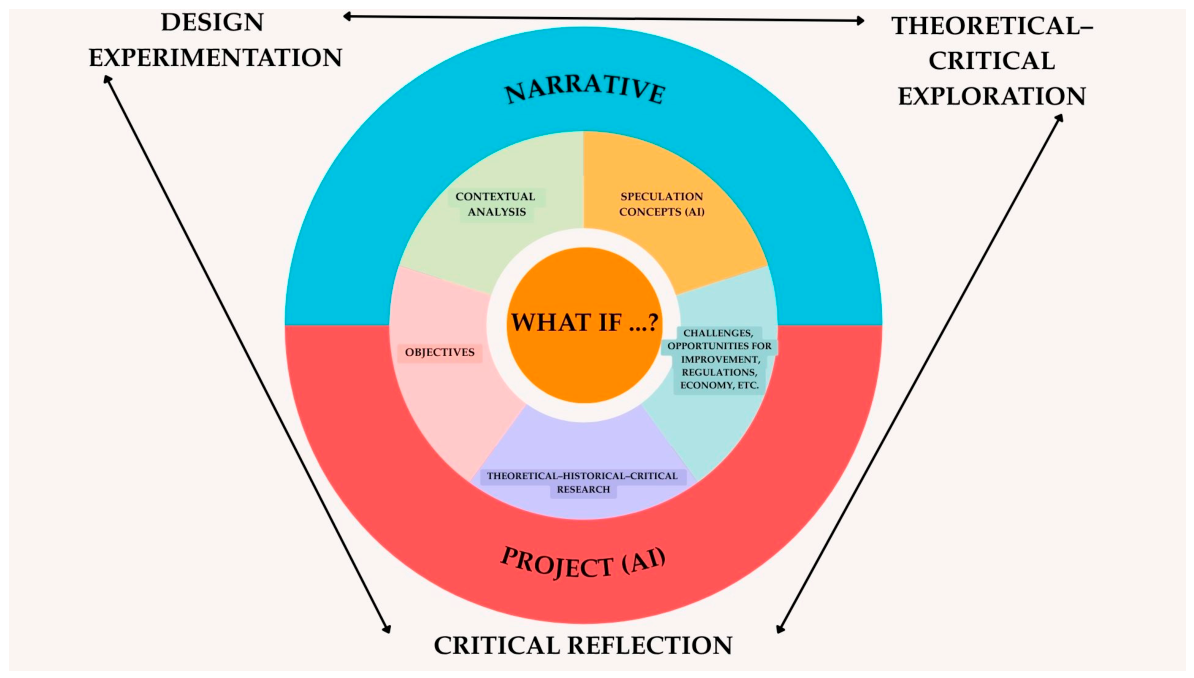
The speculative framework was implemented through a structured sequence composed of three interrelated phases, theoretical–ethical exploration, projective experimentation, and critical reflection, conceived not as a linear progression but as a recursive process in which conceptual analysis, spatial projection, and evaluative synthesis continuously inform one another. Professional ethics, understood as commitment, responsibility, transparent authorship, care for the planet, and social justice, was integrated transversally, guiding both speculative inquiry and the interpretation of its outcomes. Within this framework, utopia and dystopia operate as a critical projective method: they diagnose what is not working, orient collective desire toward desirable alternatives, and assess their socio-technical and ecological consequences; AI supports this process as a cognitive medium that amplifies imagination and comparison without substituting ethical and professional judgment.
Theoretical and Ethical Exploration: The process began with structured debates on the cultural, ecological, and ethical implications of architectural practice in technologically mediated contexts. Moving beyond an instrumentalist focus, the discussion interrogated authorship, agency, representation, responsibility, and planetary limits, with care positioned as a guiding principle. Participants developed multimodal exercises (textual, visual, and audiovisual) culminating in speculative artifacts conceived as narrative constructs capable of articulating utopian or dystopian trajectories. Rather than illustrating predetermined ideas, these artifacts operated as epistemic devices, making latent tensions visible (inequality, extractivism, techno-solutionism, territorial amnesia), while testing ethical criteria (environmental justice, inter-species reciprocity, memory, and repair). Ethical reflection accompanied each stage of production, particularly regarding transparency in generative processes and the acknowledgment of algorithmic mediation.
Projective Experimentation: In the project-based domain, the sequence shifted toward spatial and experiential speculation as a pedagogy of desire: imagining to desire and desiring to transform. Speculative habitats were conceived to respond to ecological transformations, cultural reconfigurations, and socio-technical conflicts, employing AI-assisted tools to explore variation and simulate scenarios. Image generation and conceptual exploration were conducted through multiple platforms, including Midjourney, ChatGPT, and Gemini, with selected outputs further refined through post-processing in Photoshop to align visual representations with the intended narrative and spatial qualities. Generative systems produced machine hallucinations that destabilized conventional typologies, while short audiovisual simulations probed user experience and atmospheres in the projected environments. AI also functioned as an interactive interlocutor (site-informed client, thematic expert) via structured prompting and targeted training, expanding the informational and conceptual parameters of the design process. Each algorithmic output was subjected to critical judgment, contextualization, and reformulation, with priority given to non-maleficence, sociocultural appropriateness, and ecological compatibility. The focus remains on responsible human authorship and the ethical–projective coherence of decisions.
Critical reflection and Analytical Synthesis: The outcomes of both domains were examined through triangulation of qualitative evidence (
Figure 3), including generated artifacts, observational records, written reflections, and, in selected cases, transcripts of AI-mediated dialogues. This multi-layered analysis enabled the identification of patterns in the evolving relationship between speculative reasoning and computational mediation.
This procedure is schematically summarized in
Figure 3, which illustrates the three phases, theoretical-ethical exploration, project experimentation and critical reflection, as a recursive and non-linear process.
3.3. Ethical Considerations and Limitations
All student participants were informed about the academic use of their work for research and publication purposes, ensuring transparency and anonymity where required. The study follows institutional academic standards for the use of student-generated material.
This research presents several limitations. First, it is situated within a specific educational context and therefore does not aim at generalizable results. Second, the qualitative and exploratory nature of the methodology prioritizes depth of interpretation over statistical validation. Third, while AI is analyzed as a cognitive medium, the study does not establish a controlled comparison between AI-assisted and non-AI processes, which could be addressed in future research.
Furthermore, the incorporation of artificial intelligence into speculative design processes introduces specific risks that must be critically acknowledged. These include the reproduction of cultural biases present in training data, the formal homogenization resulting from generative models, algorithmic opacity in decision-making processes, and the environmental implications associated with the energy consumption of these systems. While these aspects were not addressed exhaustively within the scope of this study, their identification is fundamental for future research aimed at developing a situated ethics of AI-mediated design.
During the exercises, specific risks associated with the use of generative systems were identified, including the reproduction of cultural stereotypes, the tendency towards formally homogeneous solutions, imprecision or hallucination in discursive content, and the opacity of algorithmic processes. These limitations were addressed pedagogically through processes of critical review, rewriting of prompts, iterative comparison, and collective discussion, reinforcing the principle of responsible human authorship and avoiding the uncritical delegation of design decisions to automated systems.
4. Utopian and Dystopian Projections
The projects presented in this section materialize the analytical trajectories identified in the preceding methodological framework. Rather than functioning as illustrative examples, these works operate as empirical evidence through which the interaction between utopian/dystopian thinking, speculative design, and AI-mediated processes can be examined.
Across both domains, the results reveal that AI-mediated speculation does not simply expand representational possibilities but reconfigures the structure of architectural reasoning itself. In particular, three recurrent patterns were identified:
In the theoretical context, the artifacts functioned as critical constructs that translated discursive analysis into alternative spatial narratives. In the project-based context, speculative habitats and systemic spatial models extended this inquiry into the realm of environmental and experiential configuration. AI-assisted processes enabled iterative scenario-building, comparative visualization, and dialogical exploration, generating multiple possible futures situated along a gradient between regenerative transformation and systemic collapse.
The convergence of speculative methodology and computational mediation reveals a shift from object-centred design toward systemic anticipatory thinking.
The process culminated in a reflective synthesis in which projects were critically evaluated in relation to their ethical, social, and spatial implications. This stage emphasized the articulation of internal contradictions, the assessment of AI-mediated decisions, and the verification of ethical–projective coherence. Through this final reflection, speculative outcomes were not treated as definitive proposals, but as analytical constructions that reveal the underlying assumptions and consequences of the imagined futures.
Taken together, these projects demonstrate how utopian and dystopian imaginaries operate as operative mechanisms rather than representational themes. The following subsections examine these speculative projections as manifestations of broader conceptual categories, highlighting the evolving relationship between critical reasoning, technological agency, and the architectural construction of possible futures.
The artificial intelligence tools employed included image generation systems and large-scale language models used for speculative visualization, narrative simulation, and critical dialogue through structured prompting. The study’s focus was not on comparing specific tools, but rather on analyzing their function as cognitive mediators within the design process. Within this framework, particular emphasis was placed on the role of final reflection as a critical stage in which generated outputs were not only evaluated, but also interpreted in relation to their ethical, social, and spatial implications. This reflective dimension enabled the identification of internal contradictions, latent assumptions, and unintended consequences emerging from both human and AI-mediated design decisions. By foregrounding reflection as an integral component of the process, the study reinforces the position that AI-assisted design does not culminate in the production of images or forms, but in the development of critical understanding, where architectural speculation becomes a means of interrogating the conditions and values embedded in the projected futures.
4.1. Theoretical Speculative Constructs
In the Contemporary Architecture course, utopia/dystopia was adopted as a critical projective method, while AI was integrated as a methodological tool to support the critical interpretation of different expressive media (storytelling, architectural and urban imagery, podcasts, and comics). The exercises were conceived as a critique of critique, from the situated perspective of the present, addressing modern and postmodern discourses. Through these fictional devices, the tensions, limits, and projections embedded in the proposed hypotheses were amplified.
This process demonstrates that utopia/dystopia functioned effectively as diagnostic and projective frameworks, enabling students to reinterpret architectural history and contemporary conditions through speculative narratives. Importantly, the integration of AI into this phase introduced a dialogical dimension to the design process: rather than producing fixed interpretations, students engaged in iterative exchanges with AI systems that challenged, expanded, and sometimes destabilized their initial assumptions.
In this way, the methodology demonstrated its potential to articulate, within a single formative process, historical memory, analysis of contemporary social, environmental, cultural, economic, and political conditions, interpretive experimentation, and architectural projection guided by ethical criteria of non-maleficence, responsibility, and care for the planet.
The objectives were to explain the plural condition that characterizes contemporary architecture; to foreground emerging themes; to reflect on the present and future perspectives of the discipline; to present the relationships architecture establishes with the culture of its time; and to discuss and critically analyze the various architectural periods and trends. Likewise, the course sought to strengthen the ethical dimension of the profession at a time of significant challenges such as climate change, natural disasters, social inequalities, gentrification, shortages of affordable housing, and global conflicts.
To implement these objectives, the program was structured into three distinct modules, each comprising its own content and targeted activities.
Theoretical–critical foundation (individual and group). Guided readings (e.g., “Más allá del minimalismo” in La modernidad superada; “De la crítica radical a los colectivos: arquitecturas de la informalidad” and “Arquitecturas medioambientales” in La condición contemporánea de la arquitectura, J. M. Montaner [
23]) to consolidate a conceptual–critical scaffold. Based on these readings, students collaboratively produced a Venn diagram relating three emergent ethical stances (climatic, social, aesthetic) and assessed whether they are mutually exclusive or convergent/hybridizability within an architectural project.
Formulation of stance and ethical stress-test (group + individual). In teams, students drafted a manifesto articulating their ethical stance and the guiding principles of the creative artifact, citing at least three architectures as ethical exemplars. Individually, each student engaged in a formal debate with AI, assuming the role of ‘Architectural Ethics Inquisitor’, to stress-test the robustness and possible contradictions of the manifesto. Finally, they wrote an individual critical reflection on the use of AI as a medium to enhance processes of study, analysis, and conceptual understanding, emphasizing authorship, transparency, and limitations.
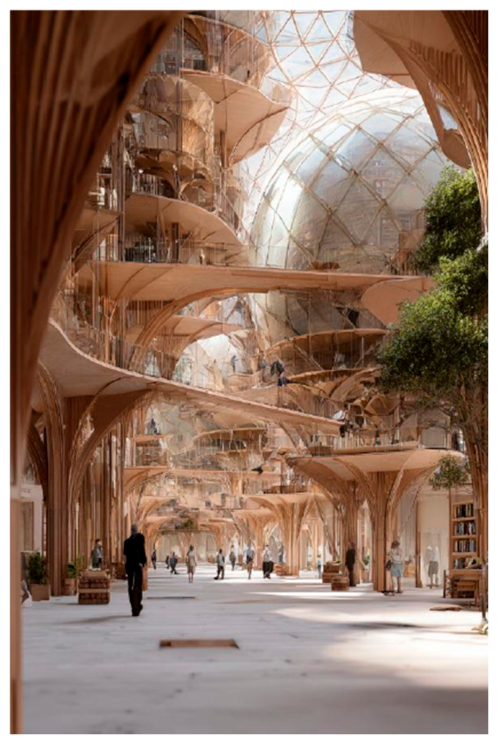
Speculative project (embodiment of the ethical stance). A speculative architectural project was developed as the embodiment of the manifesto and of the ideas refined through dialogue with AI (utopia/dystopia as method). Emphasis was placed on testing scenarios, visualizing socio-technical and ecological implications, and verifying ethical–projective coherence. The images and projects illustrated in
Figure 4,
Figure 5 and
Figure 6 do not represent statistically selected samples, individual case studies, or authorial diversity; rather, they function as representative instances of a shared speculative process and methodological framework. These projects exemplify how speculative hypotheses were translated into spatial systems. Beyond their formal qualities, these proposals reveal a consistent alignment between narrative premise and architectural configuration. In particular:
Environmental narratives were translated into tectonic and climatic strategies.
Ethical positions materialized through spatial organization and infrastructural logic.
AI-generated iterations enabled the exploration of multiple design trajectories, leading to more refined and coherent outcomes.
This indicates that the “What if…?” hypothesis functioned as an operative driver linking conceptual, ethical, and spatial dimensions.
4.2. Projective Spatial Constructs
The workshop was structured around the deliberate activation of utopian and dystopian imaginaries through the generative question What if…?, conceived as a methodological instrument for radical displacement rather than predictive plausibility. Each project originated from a speculative hypothesis that redefined the structural conditions of inhabitation, whether ecological collapse, algorithmic governance, post-carbon regeneration, or intensified social fragmentation. The question functioned as a conceptual threshold: by suspending the constraints of the present, it enabled participants to articulate alternative regimes of spatial organization and collective life. In this framework, speculation did not seek moderation or feasibility; instead, it operated through intensification, pushing contemporary tendencies toward their transformative or catastrophic limits in order to expose their latent spatial consequences.
Fiction was integrated as an operative dimension of the design process, not as an illustrative supplement. Narratives, scripts, scenario construction, visual sequences, prototypes, and simulations were employed as instruments of world-building, allowing each proposal to construct a coherent socio-spatial environment. Rather than producing isolated architectural objects, projects were required to define governance structures, infrastructural systems, ecological conditions, and modes of everyday experience consistent with their founding hypothesis. Architecture was thus approached as cultural and political infrastructure, an interface through which ideology materializes spatially. In utopian scenarios, spatial configurations articulated regenerative systems, collective agency, and alternative economies of resource distribution; in dystopian constructs, they revealed mechanisms of surveillance, exclusion, or environmental degradation. In both cases, the architectural project functioned as a systemic expression of a broader imagined order.
The expected outcomes of this framework were measured not in terms of technical feasibility, but in the coherence and critical intensity of the worlds constructed. Projects were evaluated according to the internal consistency between narrative premise and spatial configuration, the clarity with which they articulated underlying ideological structures, and their capacity to generate reflective tension. By operating deliberately within conceptual extremes, the workshop sought to expand architectural imagination beyond programmatic problem-solving and to reposition design as a laboratory for testing the spatial implications of radical hypotheses. Through this process, utopian and dystopian speculation became operative tools for interrogating the present, revealing the cultural assumptions embedded in the built environment, and constructing alternative horizons of architectural possibility.
The speculative process was initiated through the selection and critical analysis of an iconic photograph, which functioned as a visual catalyst for narrative construction. Rather than serving as mere inspiration, the image was treated as a condensed socio-political document, an artifact embedding spatial, cultural, and environmental tensions within a single frame. Through close reading and interpretative amplification, the photograph became the point of departure for the formulation of the What if…? hypothesis. By extrapolating latent conditions present in the image, whether signals of crisis, transformation, exclusion, or resilience, participants translated visual evidence into speculative narratives that unfolded into utopian or dystopian worlds. The photograph thus operated as a threshold between documentation and projection, anchoring speculative imagination in a recognizable reality while enabling its radical transformation into an alternative spatial order.
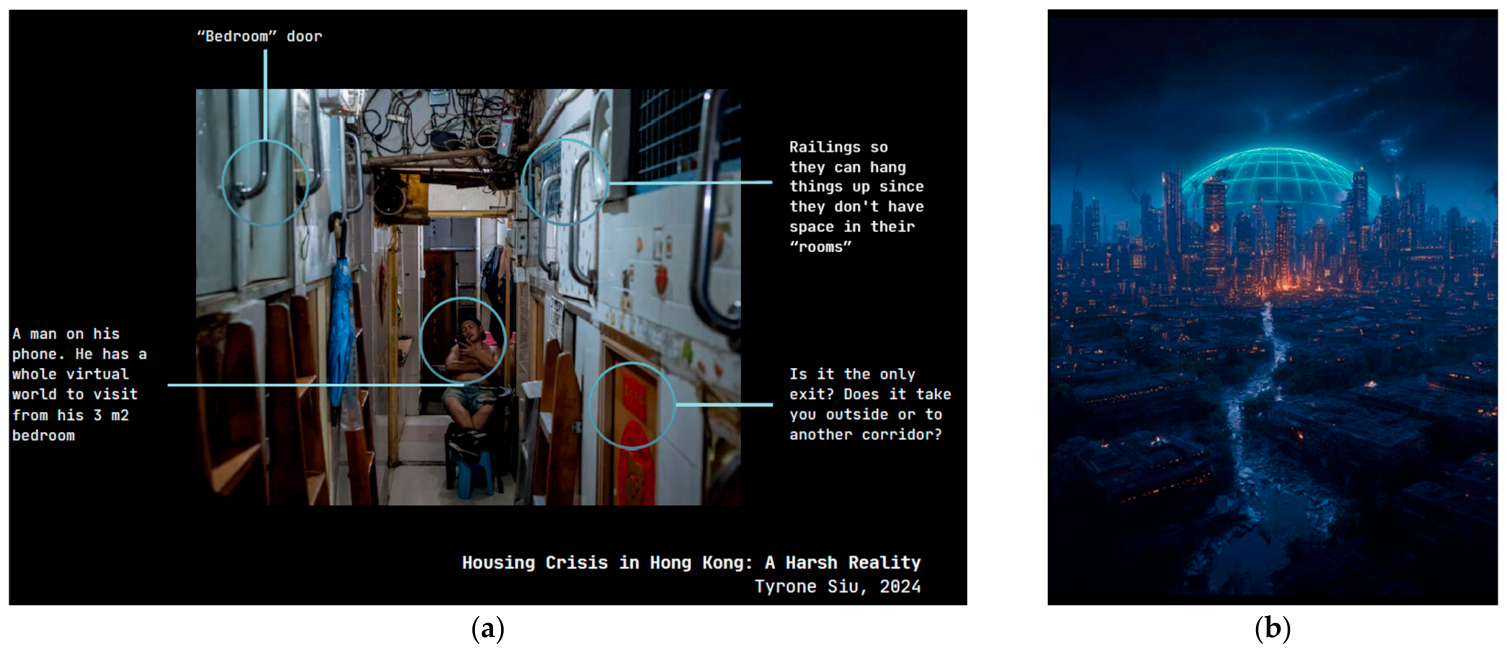
A particularly illustrative example is the project presented in
Figure 7, which starts from the hypothesis: What would happen if habitability were subordinated to a permanently toxic atmosphere? This narrative premise translates architecturally into a stratified spatial logic, where the section acquires a central role as an environmental control device. The tectonic decisions, sealed envelopes, filter layers, and differential ventilation systems, function not only as technical solutions but also as spatial arguments that materialize a political condition of regulated survival. However, the project also reveals an unresolved tension between resilience and exclusion: while architecture guarantees continued life for certain bodies, it simultaneously reinforces a regime of selective access. This ambivalence confirms the value of the utopian/dystopian approach not as a solution to problems but as a critical mechanism for exposing the ethical contradictions inscribed in the projected spatial configurations. As the students reflected, “The ‘What if…?’ scenario helped me understand that architecture is not neutral. Through the project, I realized that spatial decisions can reinforce exclusion, even when they are framed as protective or progressive”.
The experimental outcomes of the studio articulate architecture as a speculative medium capable of materializing the political, environmental, and ethical tensions embedded within contemporary society. Rather than proposing feasible solutions, the projects deliberately operate within utopian and dystopian worlds to intensify existing conditions and reveal their latent spatial consequences. Each proposal originates from the critical interpretation of an iconic photograph, treated not as illustration but as a condensed socio-historical document from which an alternative world unfolds. Through this methodological shift, architecture is repositioned as an instrument of inquiry, less concerned with optimization than with exposing the ideological infrastructures that organize inhabitation.
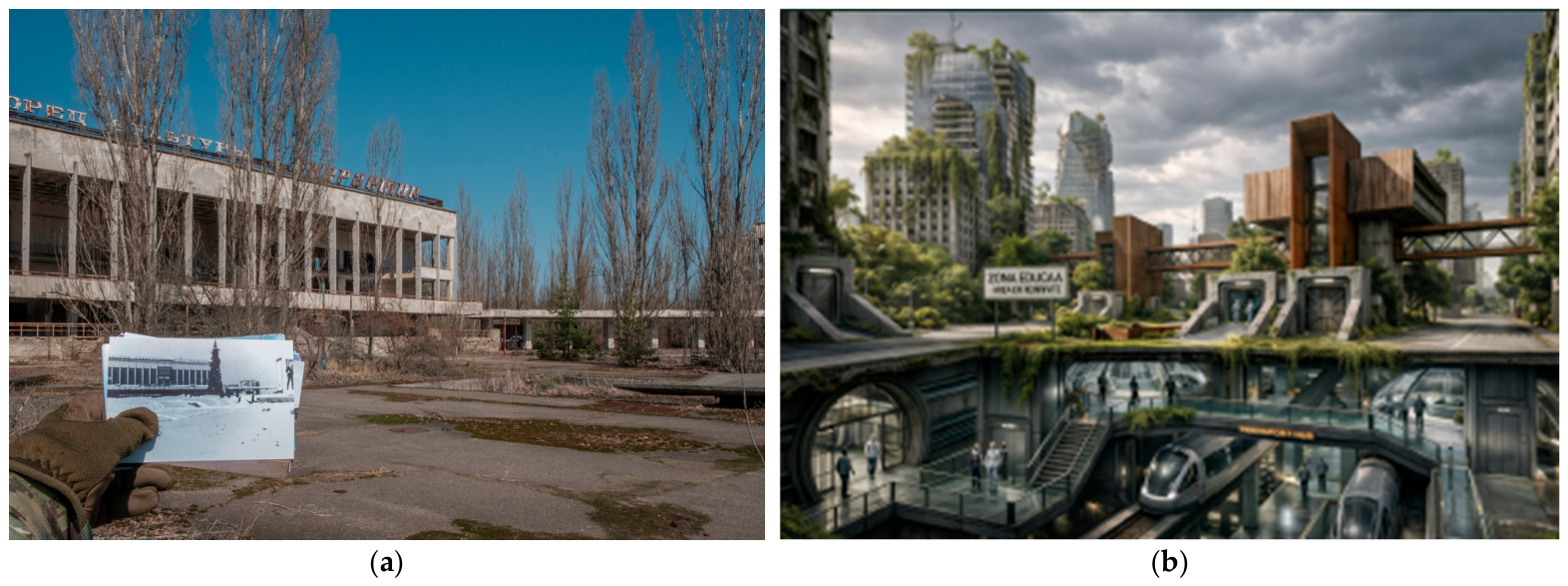
Several projects reinterpret environmental catastrophe not as a singular moment of destruction, but as a prolonged atmospheric condition that transforms the very definition of habitability (
Figure 8). In these speculative worlds, architecture becomes a regulated infrastructure of survival: life migrates underground, retreats into controlled interiors, or reorganizes itself through technologically mediated ecologies. The surface, abandoned, contaminated, or symbolically preserved, operates as a site of memory and warning, while the architectural object structures new forms of permanence under constraint. Here, section, enclosure, and environmental control systems become spatial arguments about resilience, adaptation, and the governance of life under invisible risk. As the students reflected, “The ‘What if…?’ question led me to understand that architecture can expose failure rather than resolve it, showing how even human values like care can become empty when they are imposed”.
Other proposals explore architecture as a mechanism of rationalized exclusion, extrapolating from historical instances of segregation into futures where technical neutrality conceals ethical violence. In these scenarios, architectural devices initially framed as protective or efficient evolve into instruments that classify bodies, regulate access, and redefine survival as a selective privilege. The architectural object, sealed, autonomous, and controlled, simultaneously functions as shelter and border. When later recontextualized as an artifact of memory, it reveals how spatial decisions can institutionalize inequality while maintaining the appearance of rational necessity. Architecture is thus exposed as a political apparatus capable of legitimizing abandonment without overt force.
A further line of inquiry radicalizes contemporary housing precarity and urban scarcity into dystopian ecologies of environmental stratification. In these worlds, extreme density, resource depletion, and the erosion of public life contrast with technologically perfected enclaves reserved for a limited population. Transparent membranes, atmospheric filters, and controlled interiors formalize the separation between scarcity and abundance. Within these environments, perfection itself becomes unsettling, as silence, purity, and total regulation expose the cost of exclusion. Architecture, in this context, operates not merely as container but as system, managing access to air, light, territory, and ultimately belonging.
Collectively, the studio outcomes demonstrate how the integration of fiction and architectural design enables the construction of systemic worlds rather than isolated objects (
Figure 9). Through narrative development, sectional exploration, generative imagery, and speculative prototyping, the projects foreground architecture’s capacity to regulate bodies, organize environments, and structure social hierarchies. By activating the question
What if…? within utopian and dystopian extremes, design becomes a laboratory for examining the spatialization of power and the ethical implications embedded in the built environment. In doing so, the work reaffirms architecture not as a neutral discipline, but as a cultural infrastructure through which collective futures are imagined, contested, and constructed. As the students reflected, “By imagining life underground, I understood that adaptation can become a form of resignation, where architecture stabilizes existence but also disconnects us from the world we once inhabited”.
4.3. In-Depth Analysis of a Speculative Project: The Stacked Refuge Tower
The project
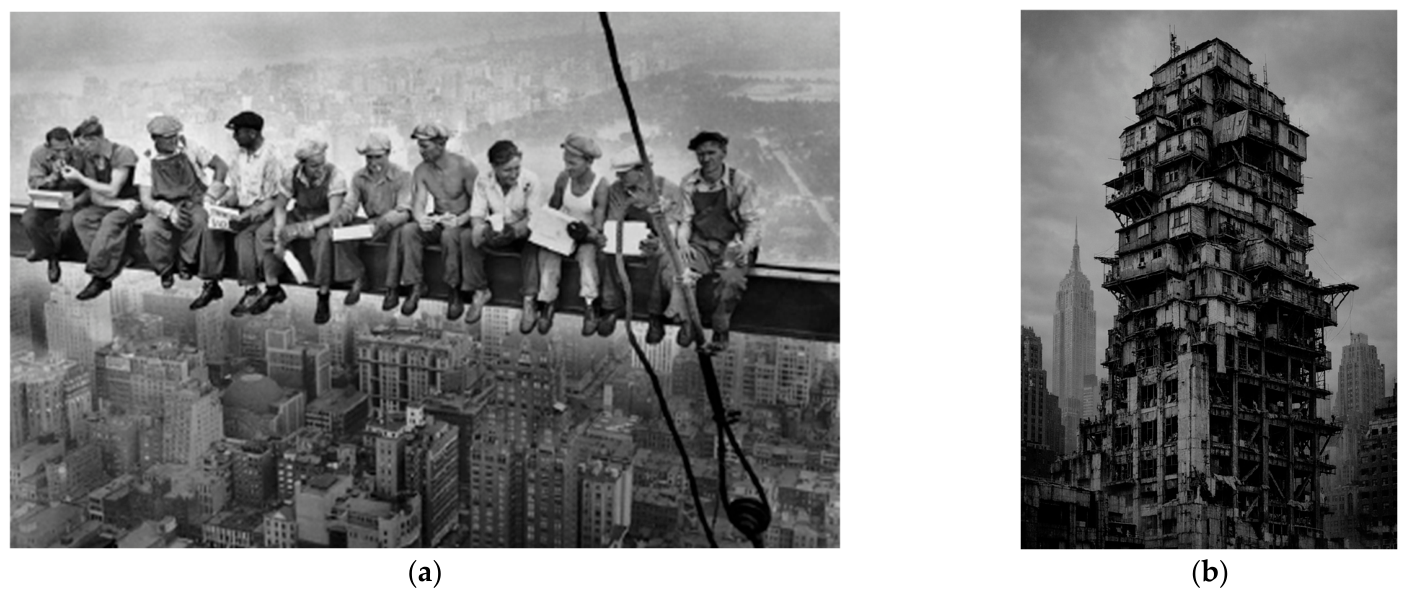
The Stacked Refuge Tower (
Figure 8b) operates as a critical speculative construct that translates a historically situated image into an architectural hypothesis, revealing the ideological exhaustion embedded within contemporary narratives of progress. Originating from the iconic photograph
Lunch atop a Skyscraper (1932) (
Figure 8a), the project reinterprets verticality not as an aspirational condition, but as a systemic inertia sustained by human bodies and normalized risk. The initial
What if question, implicitly framed as what remains when the American Dream collapses, functions as the conceptual hinge that shifts the project from historical analysis to speculative projection.
This transition is materialized through a clear sequence of architectural operations. The project evolves from a rational, modern base structure toward an irregular and unstable accumulation of stacked dwellings, where growth no longer responds to planning or ambition, but to urgency and necessity. Verticality, historically associated with power and economic expansion, is redefined as a residual condition: a form of growth that persists despite the disappearance of its original meaning. The superposition of units, absence of hierarchy, and progressive densification construct a spatial logic of accumulation rather than design, positioning architecture as a physical record of social and systemic exhaustion. In this sense, the tower does not propose a solution, but rather embodies a condition, an architecture of inertia.
The narrative framework further reinforces this inversion. The project imagines a failed transition from a capitalist system toward a regulated utopia of care, in which empathy becomes quantified, enforced, and ultimately emptied of meaning. This speculative premise reveals an internal contradiction: the attempt to institutionalize care results in its transformation into obligation, thereby reproducing the same structural logic it sought to overcome. Architecture becomes the medium through which this paradox is spatialized, supporting bodies while simultaneously exposing the erosion of social bonds. The building thus operates as both infrastructure and critique, situating itself within the lineage of dystopian architectural thought as a diagnostic device rather than a prescriptive model.
Artificial intelligence plays a specific and operative role within this process, not as an autonomous generator of form, but as a mediating system between intention and representation. The project development demonstrates an iterative workflow in which initial sketches are translated into textual prompts, generating visual outputs that are subsequently evaluated, corrected, and refined. This cyclical interaction reveals that AI does not replace design authorship, but externalizes and accelerates processes of variation, allowing the exploration of multiple atmospheric, material, and spatial configurations. Importantly, the need to continuously adjust prompts highlights the limits of AI interpretation, making explicit the gap between conceptual intention and generated imagery. In this sense, AI operates as a reflective surface that both amplifies and destabilizes the design process.
The analytical value of the project lies precisely in this tension. While the speculative narrative is coherent and spatially legible, the architectural resolution reveals unresolved contradictions between representation and inhabitation. The tower is conceived as an infrastructure of care, yet its spatial logic, density, repetition, and lack of hierarchy suggests conditions of isolation rather than collectivity. This disjunction is not a failure of the project, but a critical insight: it exposes how even well-intentioned systems can reproduce forms of control, exhaustion, and alienation when translated into spatial and organizational structures.
Ultimately, The Stacked Refuge Tower demonstrates how speculative design, when mediated by AI, can function as a method for revealing latent ideological structures within architectural production. Rather than validating utopian or dystopian scenarios, the project operates as a critical artifact that makes visible the consequences of extending contemporary logics to their limits. Through this process, architecture is repositioned not as a solution-oriented discipline, but as a medium capable of interrogating the conditions that shape collective futures.
4.4. In-Depth Analysis of a Speculative Project: The Underground City
The project
Underground City, Enduring Humanity (
Figure 9b) operates as a speculative construct that reinterprets an iconic image of the Chernobyl disaster as a spatial hypothesis, transforming a condition of abandonment into an architectural system of regulated survival. Rather than framing catastrophe as an event, the project situates it as a persistent atmospheric condition that redefines habitability. The implicit
What if…? Question, what if the surface became permanently uninhabitable, acts as the conceptual hinge that shifts the project from historical interpretation to speculative projection, repositioning architecture from expansion toward endurance.
This shift is materialized through a reconfiguration of spatial hierarchy in which the section becomes the primary architectural instrument. The proposal develops a subterranean city organized through layered systems of circulation, production, and habitation, where vertical depth replaces horizontal extension. The surface is no longer occupied, but operates as a monitored boundary and a landscape of memory, while the underground environment becomes a closed ecological system sustained through artificial light, controlled atmospheres, and resource management. Architecture, in this context, is no longer a mediator between inside and outside, but an autonomous infrastructure of life support.
The narrative reinforces this inversion by framing adaptation as both necessity and constraint. While the project imagines a stable and self-sufficient society oriented toward collective well-being, this condition depends on the regulation of space, time, and access to the exterior. A tension emerges between resilience and autonomy: survival is ensured, yet at the cost of environmental disconnection and reduced spatial agency. Thus, the project interrogates not only alternative modes of inhabitation, but also the conditions under which adaptation becomes a form of confinement.
AI operates as a mediating system that supports the translation of narrative into spatial representation. Through iterative prompting, AI enables the visualization of complex sectional systems and controlled subterranean environments. However, this process also reveals interpretative limits, requiring continuous refinement to align outputs with conceptual intent. AI thus functions as a cognitive interface that expands possibilities while exposing the gap between imagination and representation.
The analytical value of the project lies in its capacity to reveal the paradoxes of designing for survival under environmental collapse. While the proposal constructs a coherent system, it also exposes how stability often depends on increased control and separation. The underground city becomes both refuge and restriction, preserving life while redefining its relationship to freedom and environment. This ambivalence constitutes its critical contribution, positioning architecture not as a solution, but as a medium for interrogating the ethical and spatial consequences of adaptation.
5. Conclusions
This study positions its primary contribution in framing the convergence of AI and utopian–dystopian thinking as a critical and epistemological tool within architectural practice. Rather than understanding AI as a neutral instrument for representation or optimization, the research demonstrates that, when coupled with speculative methodologies, it operates as a medium for knowledge production and critical inquiry. The articulation of AI with utopian and dystopian frameworks enables architecture to move beyond projection toward interrogation, exposing the underlying assumptions, contradictions, and ideological structures embedded in the present. In this sense, AI-assisted speculative design is not simply a technique for imagining futures, but a methodological apparatus through which alternative socio-spatial conditions can be constructed, tested, and critically evaluated. This repositioning underscores architecture’s capacity to function as a reflective discipline, where imagination becomes a means of understanding rather than escaping reality.
In the contemporary context, this study demonstrates that architecture can no longer be conceived as a neutral or purely technical practice. The findings confirm that design decisions inherently embed ethical and political positions, affecting both human and non-human systems. Within this framework, utopian and dystopian imaginaries operate effectively as methodological devices, enabling the diagnosis of present conditions and the projection of alternative socio-spatial configurations.
The analysis of the case studies reveals that the integration of utopia/dystopia with speculative design produces a shift from representational thinking toward systemic and anticipatory reasoning. Rather than generating isolated formal proposals, students developed coherent spatial scenarios in which narrative hypotheses (“What if…?”) were consistently translated into architectural systems, including tectonic strategies, environmental responses, and infrastructural logics. This confirms that utopian and dystopian thinking can function as operative frameworks linking conceptual, ethical, and spatial dimensions of design.
Furthermore, the results indicate that AI plays a significant role in transforming the design process. Rather than acting solely as a generative tool, AI operated as a cognitive mediator, enabling iterative variation, comparative exploration, and dialogical interaction. In several cases, AI-mediated processes exposed inconsistencies between initial design intentions and their spatial implications, prompting critical revisions. This suggests that AI contributes to enhancing reflexivity and conceptual depth, while simultaneously requiring continuous human evaluation to avoid homogenization, bias, or superficial coherence.
At the same time, the study highlights important limitations. The research is situated within a specific educational context and does not aim to produce generalizable results. Moreover, while AI demonstrated its capacity to expand the design space, the absence of a controlled comparison between AI-assisted and non-AI processes limits the ability to measure its impact quantitatively. These limitations point toward future research directions, particularly in developing comparative methodologies and more systematic evaluation frameworks.
Overall, the study contributes to the ongoing debate on the role of speculative design and AI in architecture by proposing a methodological articulation between utopian/dystopian thinking, project-based experimentation, and computational mediation. The findings suggest that this integration redefines architectural design as a form of critical and anticipatory practice, capable of engaging with ecological uncertainty, technological transformation, and socio-political complexity.
Ultimately, to speculate is to take a position. The results of this study reinforce that architectural imagination cannot be reduced to aesthetic exploration but must be understood as a mode of ethical inquiry. By constructing alternative worlds, whether regenerative or catastrophic, architecture reveals the assumptions that structure the present and opens space for their transformation. In this sense, utopian and dystopian thinking, when mediated by speculative design and AI, reaffirm architecture as a cultural practice actively engaged in shaping, questioning, and reconfiguring collective futures.