
Retrofitting a Grade II Listed Building for Operational Carbon Reduction and Climate Resilience: The Inland Revenue Centre Case Study, Nottingham, UK



Abstract
1. Introduction
1.1. Research Questions, Aims and Objectives
- RQ1: Which retrofit strategies can be feasibly implemented in a Grade II listed non-domestic building (the Inland Revenue Centre, Nottingham) without compromising its heritage value?
- RQ2: To what extent can these retrofit strategies reduce operational carbon and energy demand under current and future climate conditions?
- RQ3: How resilient is the proposed retrofit pathway when assessed against projected climate change scenarios, particularly in relation to overheating risk and energy performance stability?
1.2. Contribution of the Study
2. Background Research
2.1. Retrofit of Listed Buildings
2.2. Retrofitting for Climate Resilience and Operational Carbon
3. Materials and Methods
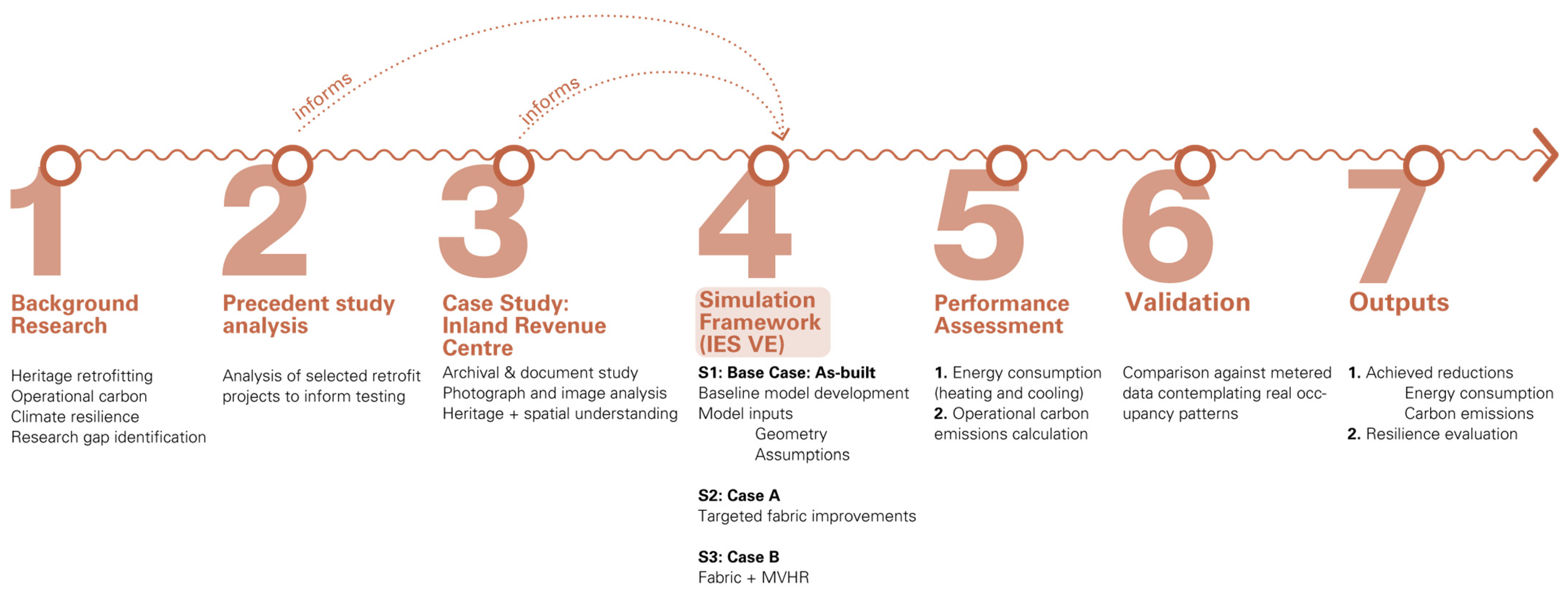
3.1. Research Design
- (1)
- policy review to establish the retrofit and heritage context, discussed in Section 2;
- (2)
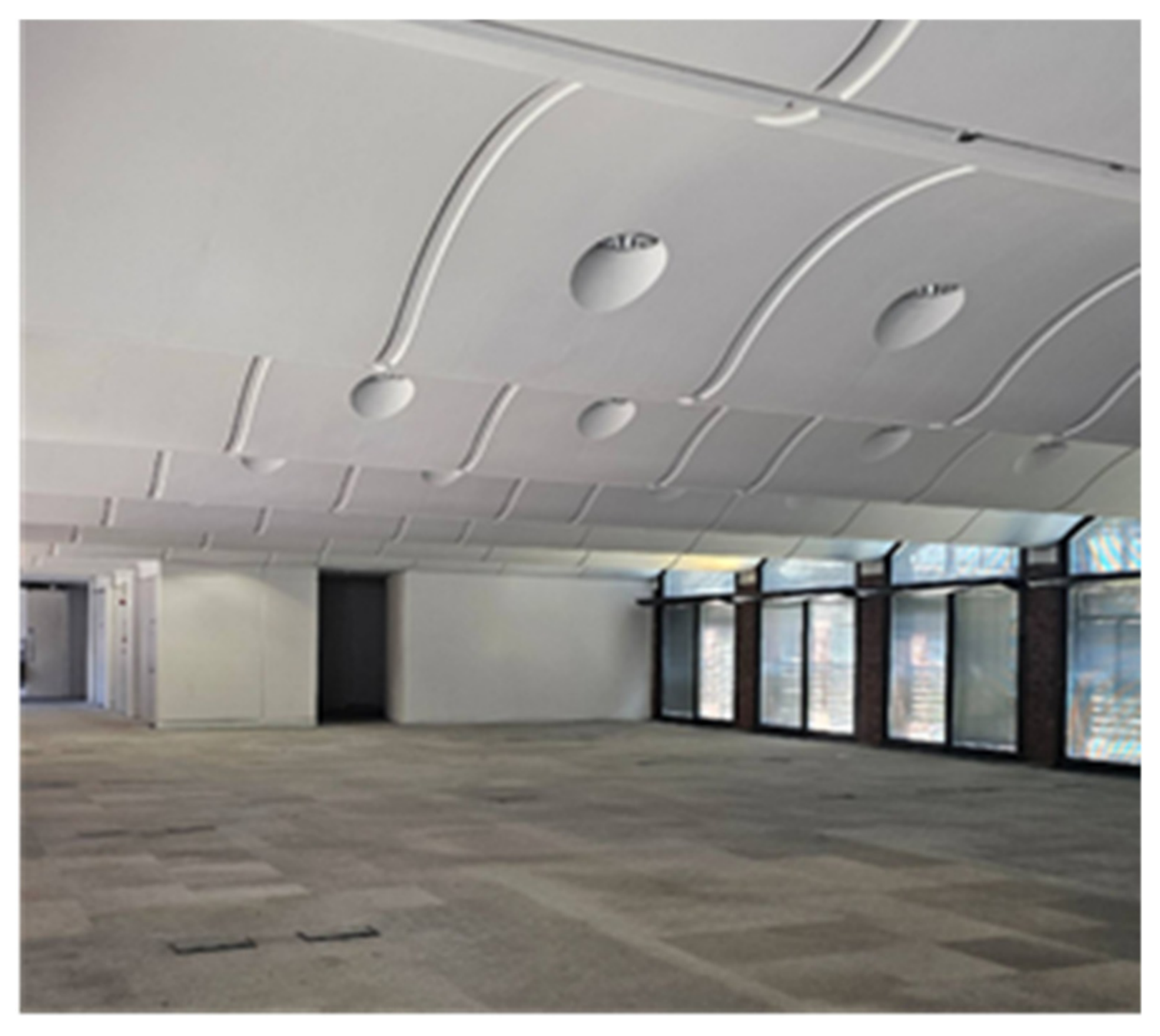
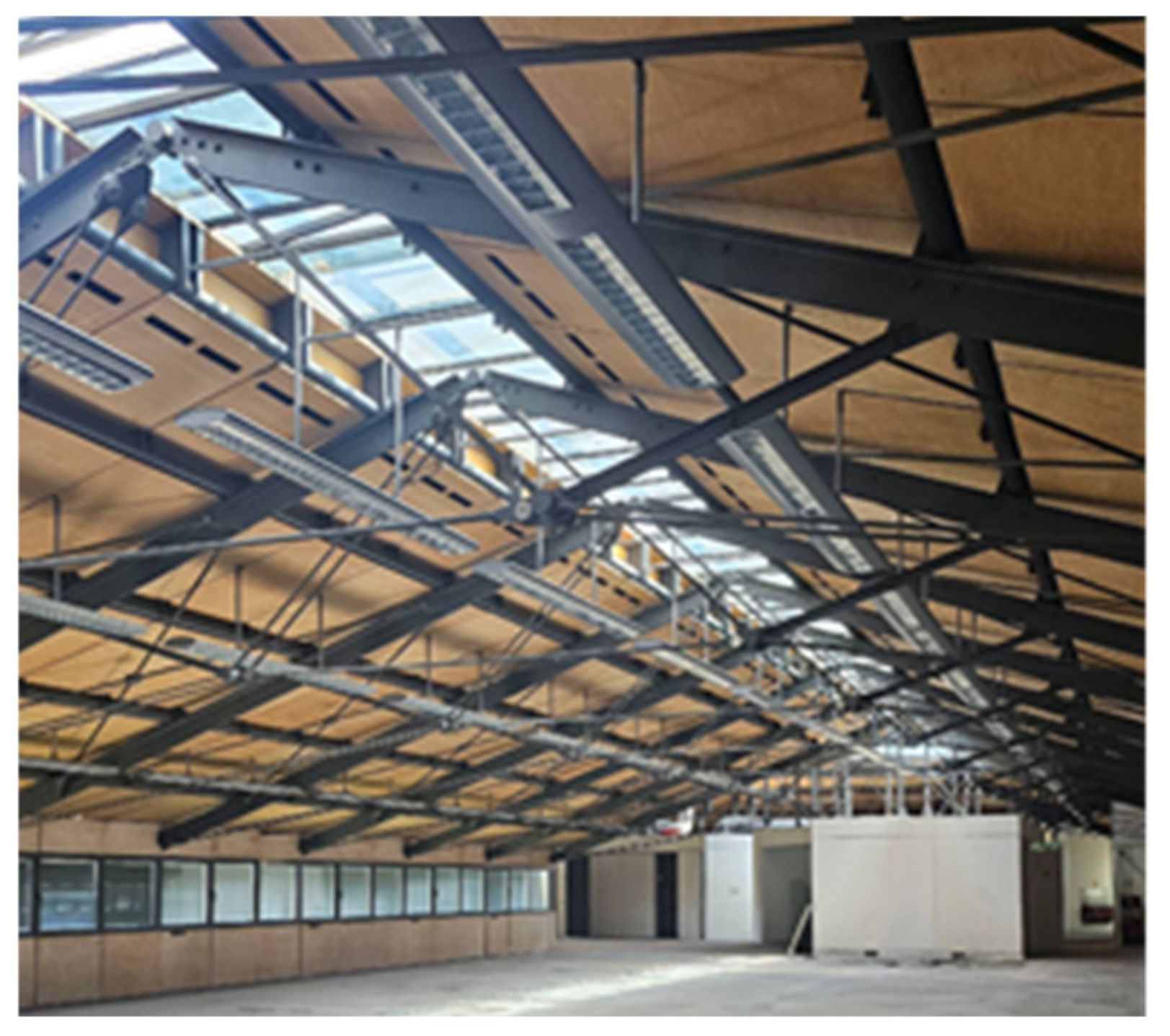
- qualitative case study analysis through archival, documentary, and photographic sources; and
- (3)
- quantitative simulation-based energy and carbon assessment using Integrated Environmental Solutions Virtual Environment (IES VE) in current and future climate scenarios.
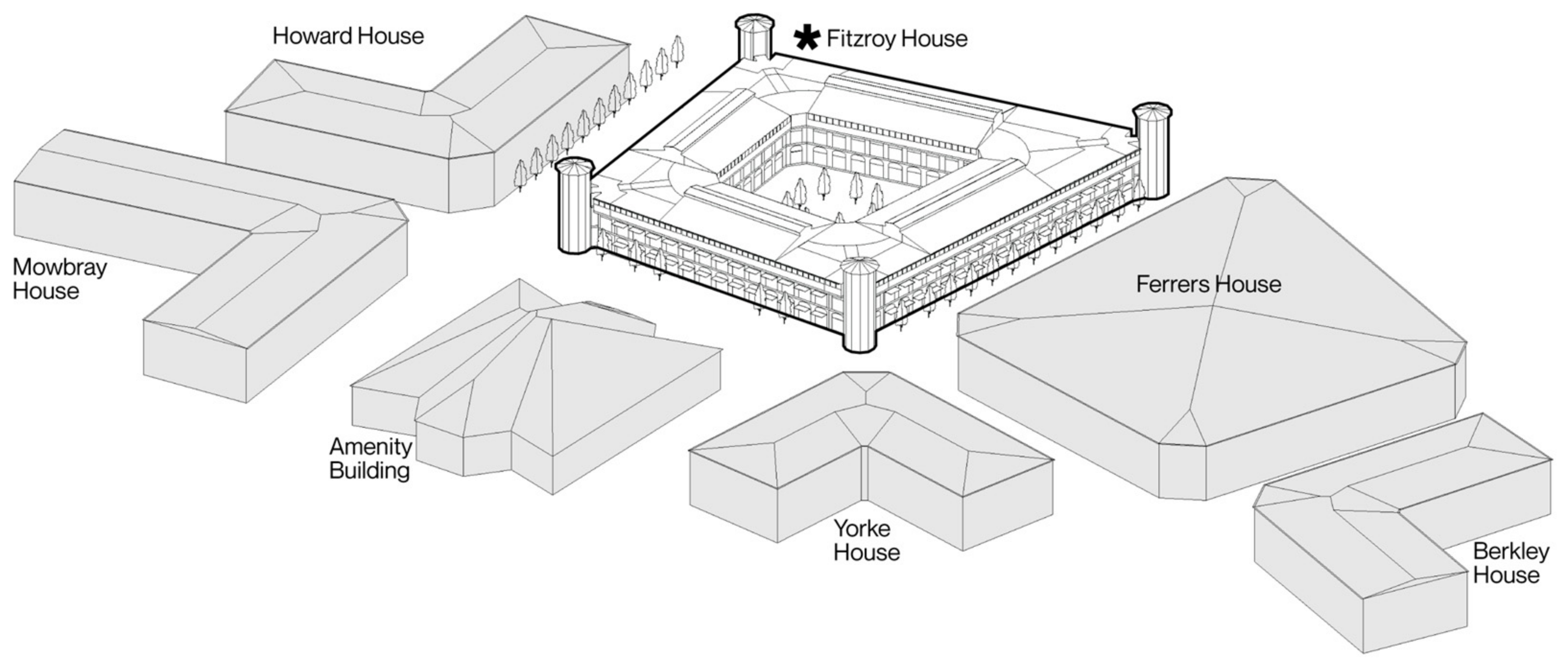
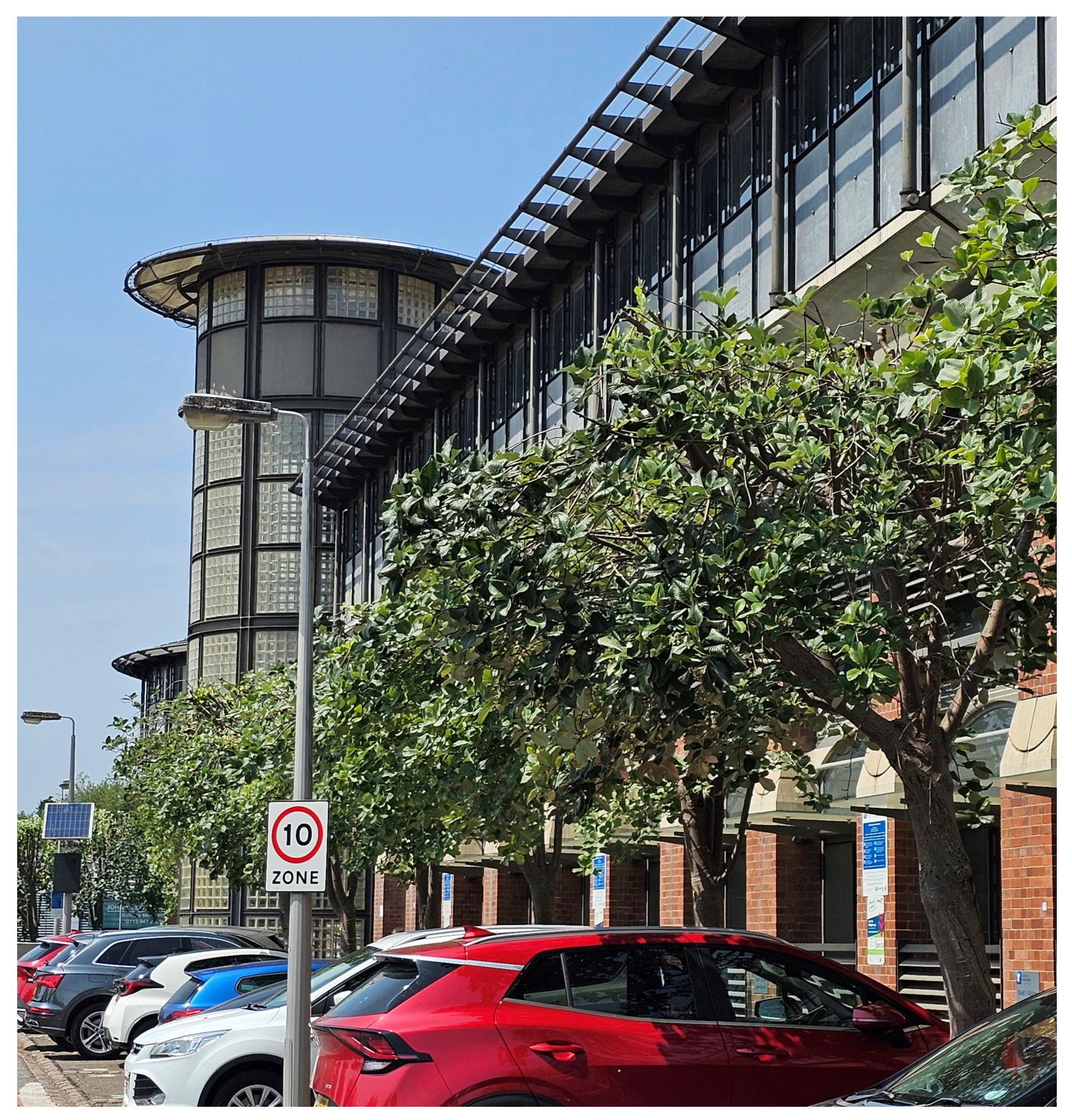
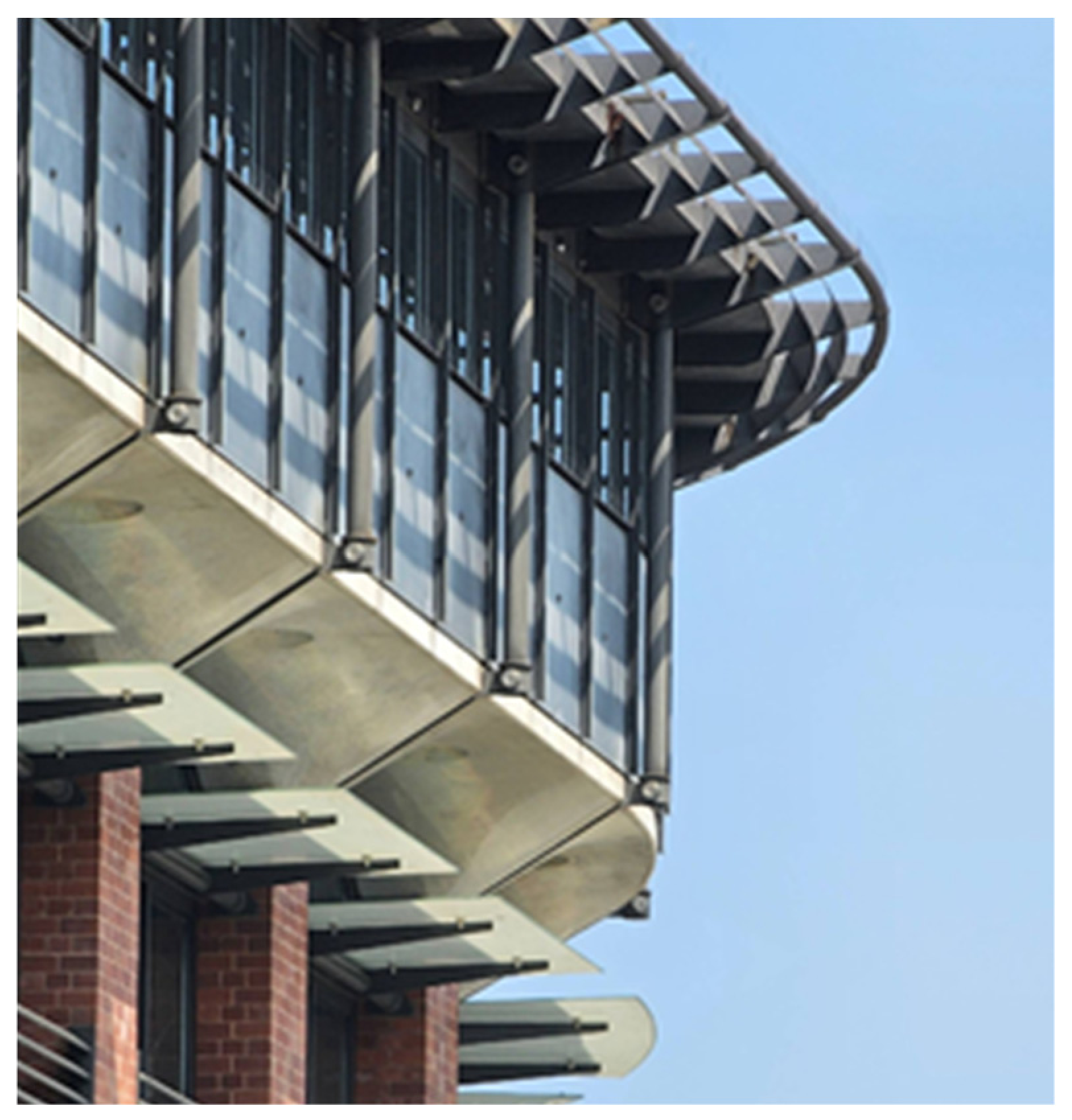
3.2. Case Study Description and Climate
3.3. Simulation Framework
3.3.1. Stage 1: Energy Performance Assessment
- Base Case: As-built
- Retrofit Case A: Fabric Improvements
- Retrofit Case B: Fabric + MVHR
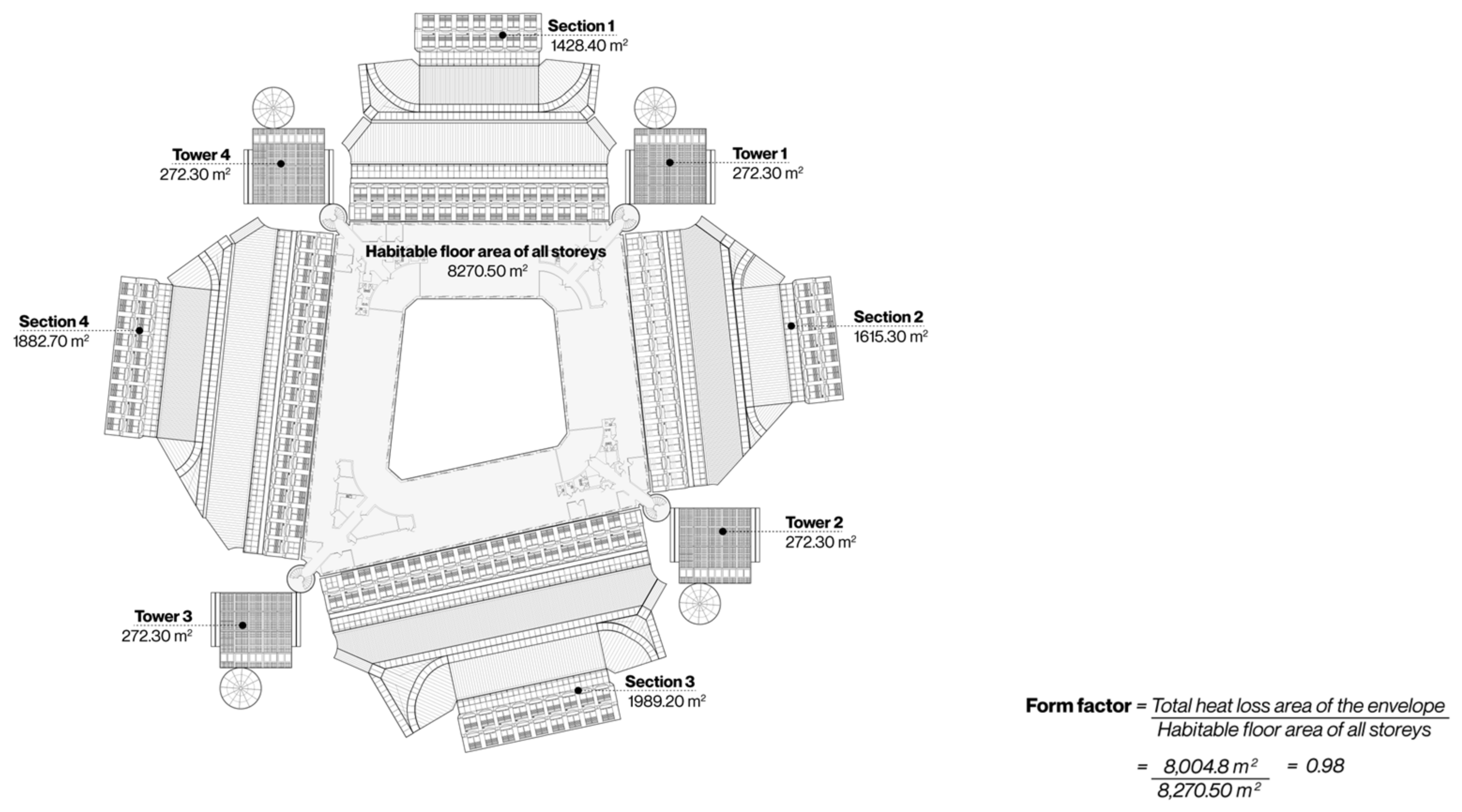
- Stage 1 Modelling Assumptions
3.3.2. Model Validation and Limitations
3.3.3. Stage 2: Operational Carbon Assessment
3.3.4. Stage 3: Climate Resilience Assessment
4. Results and Discussion
4.1. Stage 1: Energy Performance Assessment
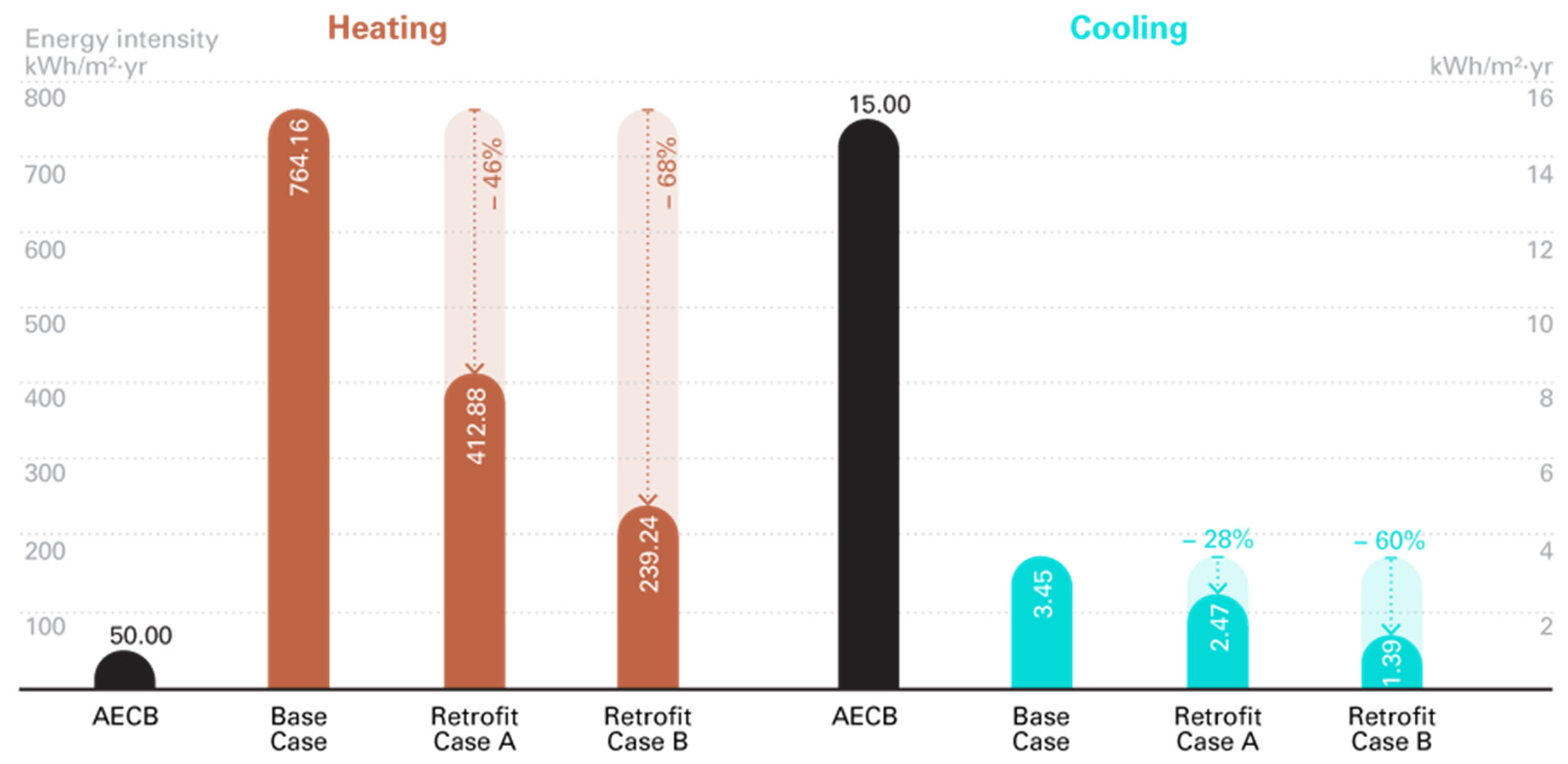
- Base Case: As-Built
- Retrofit Performance: Case A and Case B
4.2. Stages 2 and 3: Operational Carbon and Climate Resilience Assessments
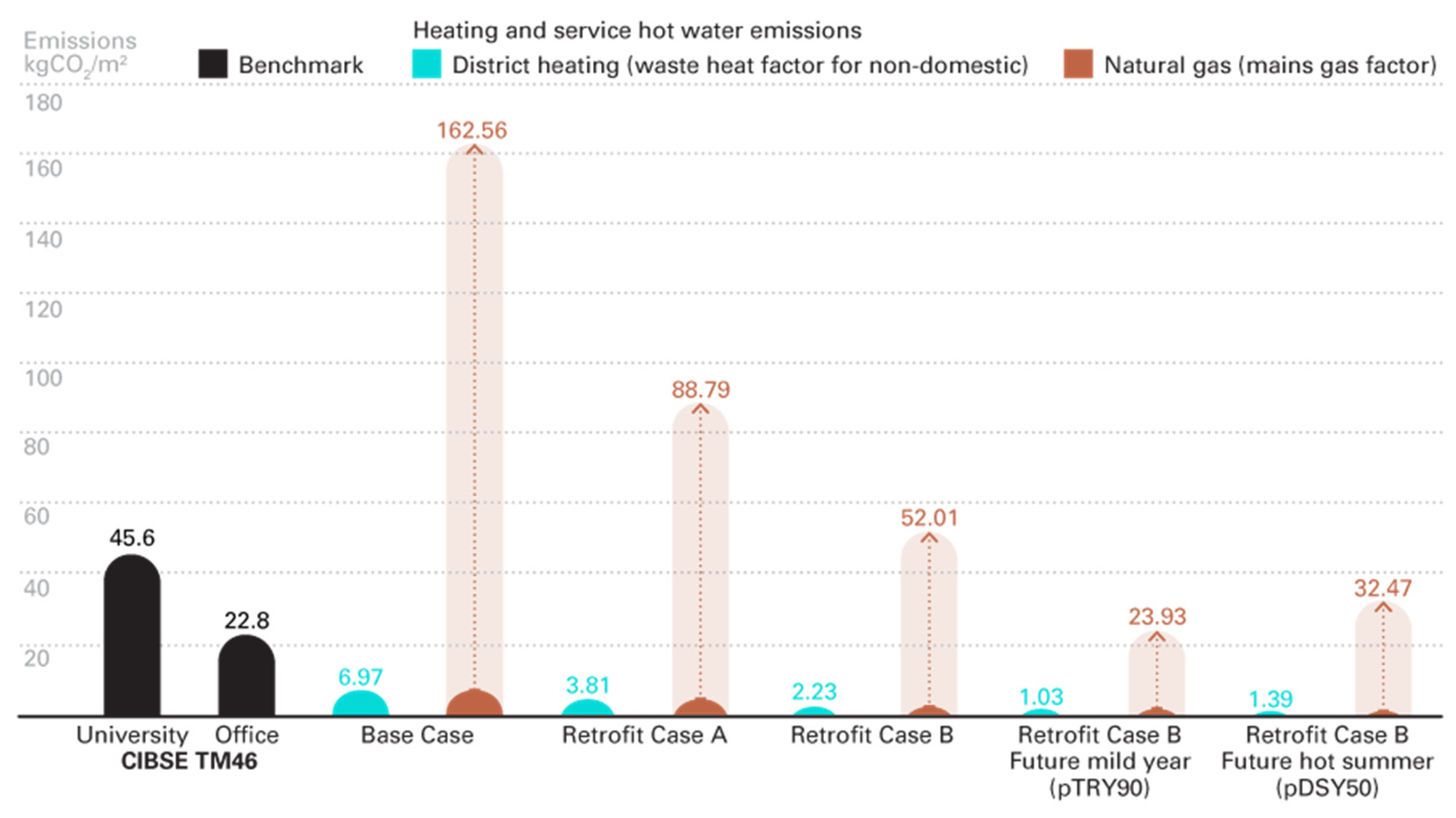
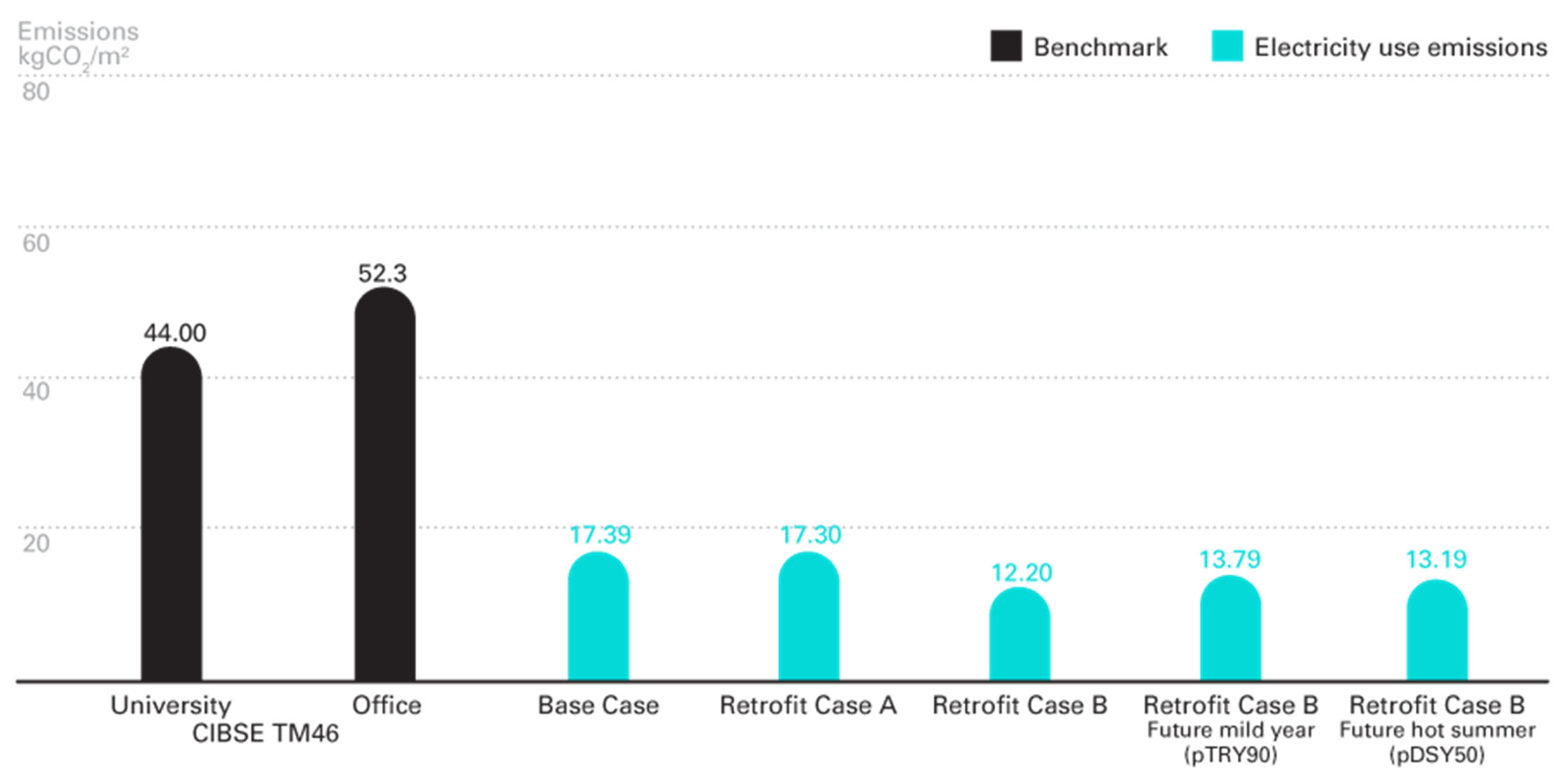
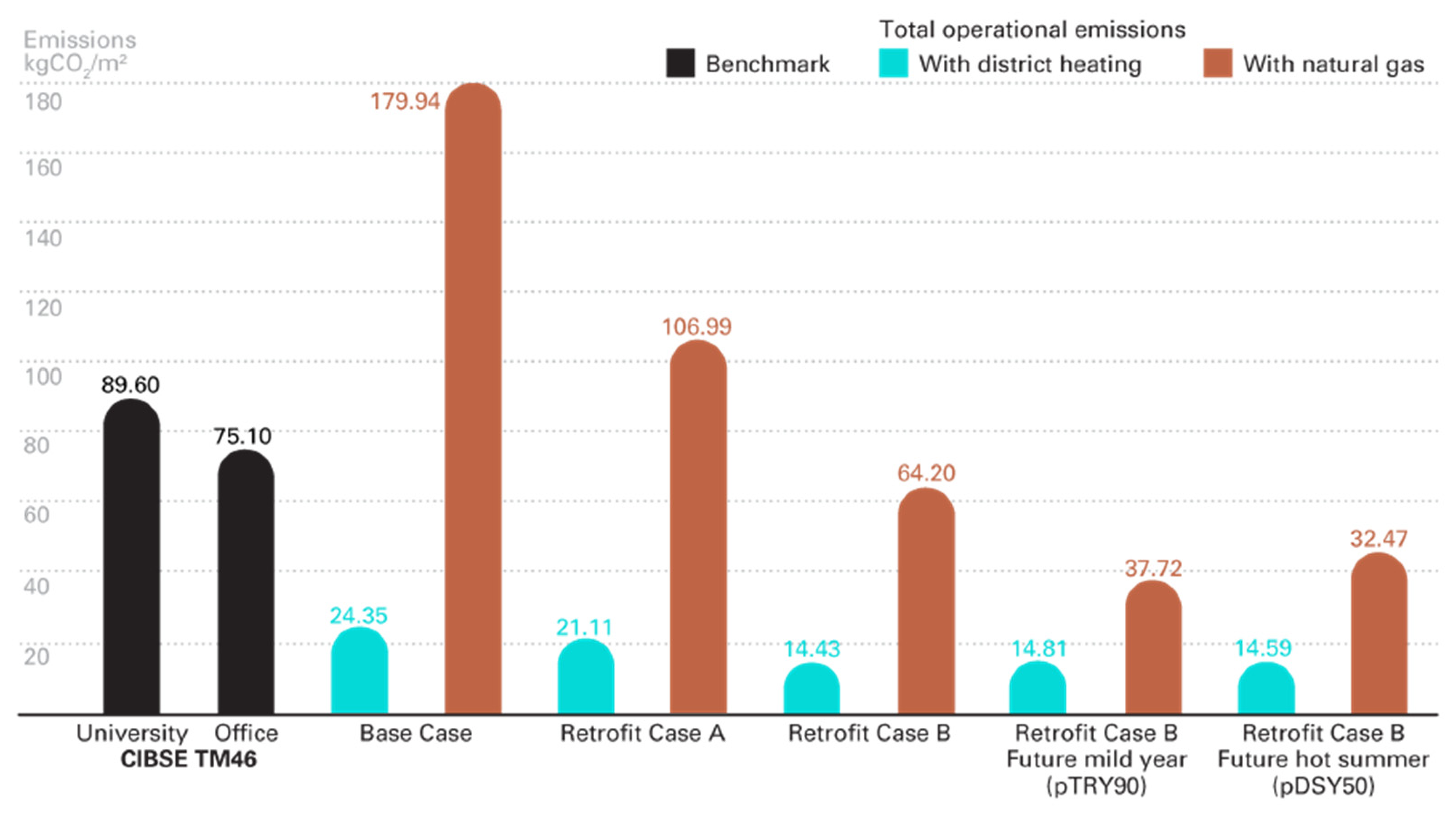
- Baseline: 24.35 kgCO2e/m2 (district heating) vs. 179.94 kgCO2e/m2 (gas)
- Retrofit: 14.43–21.11 kgCO2e/m2 (district heating) vs. 64.20–106.09 kgCO2e/m2 (gas)
- Climate resilience: 14.59–14.81 kgCO2e/m2 (district heating) vs. 37.72–45.67 kgCO2e/m2 (gas)
5. Conclusions
5.1. Research Question 1: Feasible Retrofit Strategies
5.2. Research Question 2: Extent of Energy and Carbon Reduction
5.3. Research Question 3: Climate Resilience and Future Performance
5.4. Interpretive Framework and Knowledge Contribution
5.5. Implications and Transferability for Research, Policy, and Practice
Author Contributions
Funding
Institutional Review Board Statement
Informed Consent Statement
Data Availability Statement
Acknowledgments
Conflicts of Interest
Abbreviations
| ach | Air Changes per Hour |
| AECB | Association for Environment Conscious Building |
| ASHP | Air Source Heat Pump |
| ASHRAE | American Society of Heating, Refrigerating and Air-Conditioning Engineers |
| CIBSE | Chartered Institution of Building Services Engineers |
| CO2e | Carbon Dioxide Equivalent |
| COLBE | Creation of Localized Current and Future Weather for the Built Environment |
| DSY | Design Summer Year |
| EAHP | Exhaust Air Heat Pump |
| EnerPHit | Passive House retrofit standard |
| EWI | External Wall Insulation |
| GSHP | Ground Source Heat Pump |
| GWh | Gigawatt-hours |
| HEAN18 | Historic England Advice Note 18 |
| HEMS/HEMFHS | Home Energy Model/Future Homes Standard (fuel factors methodology) |
| IES VE | Integrated Environmental Solutions Virtual Environment (simulation software) |
| IRC | Inland Revenue Centre |
| IWI | Internal Wall Insulation |
| kgCO2e | Kilograms of carbon dioxide equivalent |
| KgCO2e/m2 | Kilograms of Carbon Dioxide Equivalent per square metre |
| kgCO2e/m2·yr | Kilograms of Carbon Dioxide Equivalent per square metre per year |
| KgCO2e/kWh | Carbon intensity factor |
| kWh | Kilowatt-hours |
| kWh/m2·yr | Kilowatt-hours per square metre per year |
| LETI | London Energy Transformation Initiative |
| m3/m2·h @50Pa | Cubic metres per square metre per hour at 50 Pascals (airtightness) |
| MWh | Megawatt-hour |
| MVHR | Mechanical Ventilation with Heat Recovery |
| OSB | Oriented Strand Board |
| pDSY-50 | Probabilistic Design Summer Year (50th percentile) |
| PHPP | Passive House Planning Package |
| PIR | Polyisocyanurate (insulation) |
| pTRY-90 | Probabilistic Test Reference Year (90th percentile) |
| PV | Photovoltaic |
| RQ | Research Question |
| TM46 | Technical Memorandum 46 (CIBSE operational energy benchmarks) |
| TRY | Test Reference Year |
| UFH | Underfloor Heating |
| UK | United Kingdom |
| UKGBC | UK Green Building Council |
| W/m2K | Watts per square metre Kelvin (thermal transmittance/U-value) |
| XPS | Extruded Polystyrene |
References
- Parliamentary Office of Science and Technology. Net Zero and the UK’s Historic Building Stock; Parliamentary Office of Science and Technology (POST): London, UK, 2025. Available online: https://post.parliament.uk/net-zero-and-the-uk-historic-building-stock/#_edn5 (accessed on 30 June 2025).
- Taylor, J. Heritage Protection. In The Building Conservation Directory; Cathedral Communications Limited: Wiltshire, UK, 2021. [Google Scholar]
- UK Green Building Council. Building Zero Carbon: The Case for Action; UK Green Building Council, 2014. [Google Scholar]
- Traynor, J. Enerphit: A Step by Step Guide to Low-Energy Retrofit; RIBA Publishing: London, UK, 2019. [Google Scholar]
- Historic England. Adapting Historic Buildings for Energy and Carbon Efficiency: Historic England Advice Note 18. In Historic England Advice Note; Historic England: Swindon, UK, 2024. [Google Scholar]
- AECB CarbonLite. The CarbonLite Standards: Guidance for Certifiers v7; AECB CarbonLite: Llandysul, Wales, 2025. [Google Scholar]
- Baeli, M. Residential Retrofit: 20 Case Studies; RIBA Publishing: London, UK, 2013. [Google Scholar]
- Hulathdoowage, N.D.; Karunasena, G.; Udawatta, N.; Liu, C. Reviewing the contribution of retrofitting for climate resilience in residential buildings. Int. J. Disaster Resil. Built Environ. 2024, 15, 324–340. [Google Scholar] [CrossRef]
- de Selincourt, K.; Passive House Plus. Victorian Stone Building Becomes EnerPhit Youth Hostel; Temple Media Ltd.: Dublin, Ireland, 2018. [Google Scholar]
- Hopkins Architects. Inland Revenue Centre. 1994. Available online: https://www.hopkins.co.uk/projects/workplace/inland-revenue-centre/ (accessed on 2 July 2025).
- DETAIL Magazine. Administration Building in Nottingham. In DETAIL Magazine; Institut für Internationale Architektur-Dokumentation: München, Germany, 1995; pp. 658–666. [Google Scholar]
- ARUP. Castle Meadow Campus Masterplanning & Engineering Principles; University of Nottingham: Nottingham, UK, 2022. [Google Scholar]
- de Selincourt, K.; Passive House Plus. Historic London House Gets Near Passive Transformation; Temple Media Ltd.: Dublin, Ireland, 2017. [Google Scholar]
- Passive House Institute. Criteria for Buildings: Passive House, EnerPHit and PHI Low Energy Building Standard; Passive House Institute: Darmstadt, Germany, 2023. [Google Scholar]
- Ecodesign Consultants. EnerPHit Standard. 2024. Available online: https://www.ecodesignconsultants.co.uk/passivhaus/enerphit/ (accessed on 20 July 2025).
- AECB CarbonLite. Volume Three: The Energy Standards; AECB CarbonLite: Llandysul, Wales, 2007. [Google Scholar]
- LETI. LETI Climate Emergency Design Guide; LETI (Low Energy Transformation Initiative): London, UK, 2020. [Google Scholar]
- The Concrete Centre. Thermal Performance: Part L1A 2013; The Concrete Centre: London, UK, 2016. [Google Scholar]
- Department for Energy Security & Net Zero. Fuel Factors Within the Home Energy Model: FHS Assessment, A Technical Explanation of the Methodology. In HEMFHS-TP-05 Fuel Factors; Department for Energy Security & Net Zero: London, UK, 2023. [Google Scholar]
- CIBSE. Energy Benchmarks-CIBSE TM46: 2008; The Chartered Institution of Building Services Engineers (CIBSE): London, UK, 2008. [Google Scholar]
- Historic England. Inland Revenue Centre Office Buildings, Nottingham (List Entry Number: 1481344); Historic England: Swindon, UK, 2023.
- Davey, P.; Gardner, A. Raising the Revenue. In The Architectural Review; Emap Architecture: London, UK, 1995; pp. 30–45. [Google Scholar]
- CIBSE. UK Weather Data–Future DSYs Only–Nottingham (Part O Compliance); CIBSE: London, UK, 2017. [Google Scholar]
- Bath, U.O.; Eames, M.; Kershaw, T.; Coley, D. Test Reference Years (pTRYs) and Design Summer Years (pDSY) for the 2080s (i.e., 2070–2099); University of Bath: Bath, UK, 2011. [Google Scholar]
- Vallejo, J.A.P.; Ford, B. OptiVent 2.0 Natural Ventilation Calculation Tool. 2026. Available online: https://optivent.tools/ (accessed on 5 July 2025).
- Integrated Environmental Solutions Ltd. IES Virtual Environment (IES VE); Integrated Environmental Solutions Ltd.: Glasgow, UK, 2025. [Google Scholar]
- Stephen, R. Airtightness in UK dwellings. In CI/SfB 81(L2); BRE Environmental Engineering Centre: Watford, UK, 2000. [Google Scholar]
- UK National Calculation Methodology (NCM). NCM Database: Internal Gains and Activity Profiles; Department for Energy Security & Net Zero: London, UK, 2022.



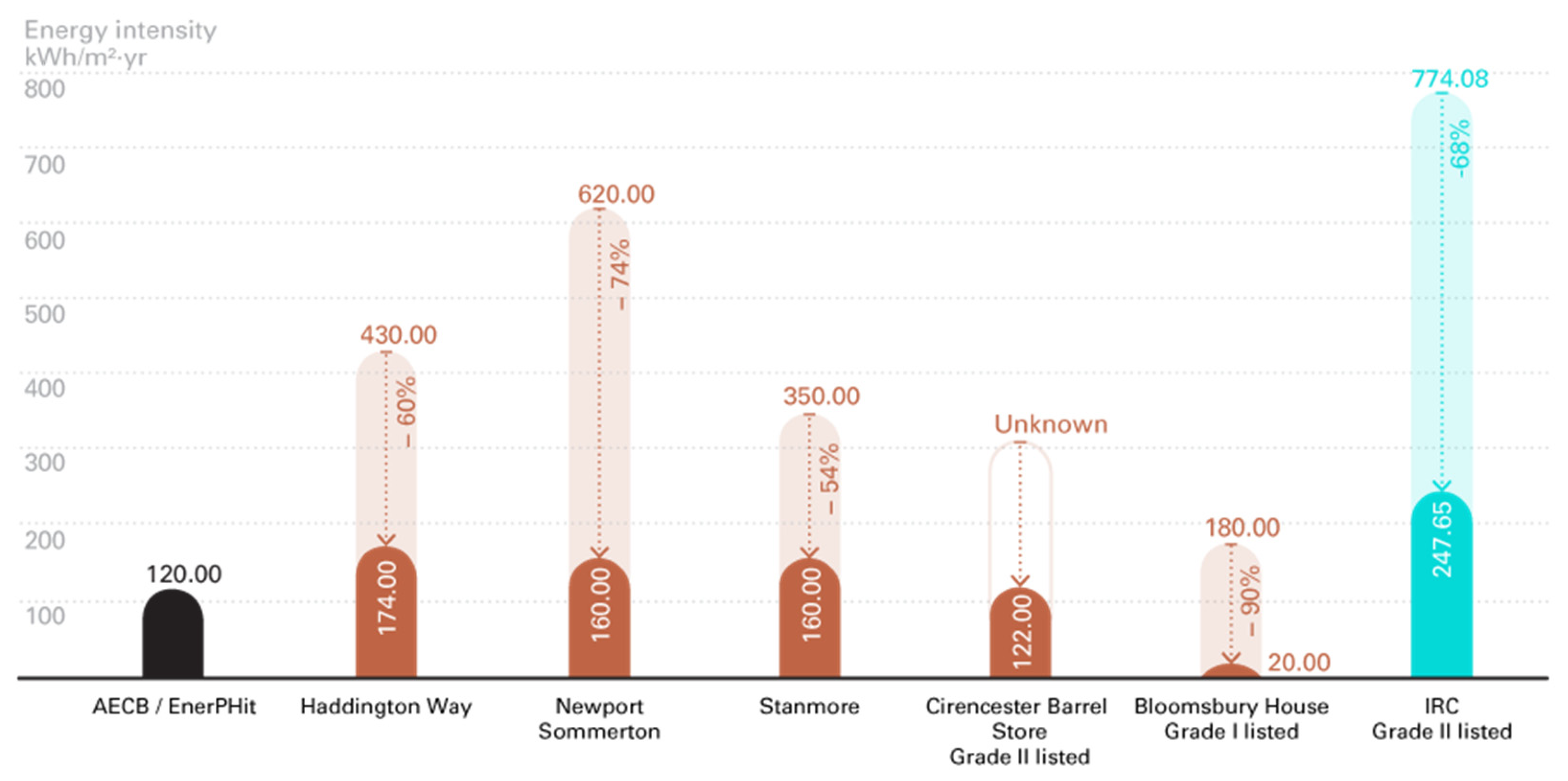
| Haddington Way Mid 1990s Not Grade Listed Fabric-First Approach | Newport Sommerton 1989 Not Grade Listed Fabric-First Approach | Stanmore 1960s Not Grade Listed Fabric-First Approach | Cirencester Barrel Store 19th Century Grade II Listed Certified EnerPHit | Bloomsbury House 18th Century Grade II Listed Achieved EnerPHit |
|---|---|---|---|---|
| Existing construction type | ||||
| Masonry cavity walls | Masonry cavity walls | Masonry cavity walls | 500 mm solid stone walls | Brick plastered walls |
| Pitched roof on timber structure | Seam metal roof | Tiled pitched roof | Pitched roof with 50 mm Styrofoam | Slate tiles on roofing felt |
| Suspended concrete ground floor | Ground floor concrete slab | Ground floor concrete slab | Ground floor concrete slab | Ground floor concrete slab |
| Timber single-glazed windows | Timber double-glazed windows | Timber single-glazed windows | Timber single-glazed windows | Timber single-glazed windows |
| Improvements | ||||
| Walls | ||||
| 40 mm Aerogel sheet | Internal dry-line foam | Knauf Techniterm for cavity and Aerogel (25 mm) for internal wall insulation | Wood-fibre insulation | Vapour closed spray-foam |
| Roof | ||||
| 150 mm of Celotex | Warmcell insulation | Warmcell between joists, topped up with Thermafleece wool insulation | Polyisocyanurate (PIR) insulation added internally | 300 mm cellulose with Oriented Strand Board (OSB) |
| Ground floor | ||||
| Rigid phenolic insulation (75 mm) | Perimeter insulation | Kingspan Kooltherm K3 insulation boards | 350 mm Hexatherm Extruded Polystyrene (XPS) insulation above | Over 125 mm XPS insulation on existing concrete slab |
| Windows | ||||
| Argon-filled low-e double glazing | Triple glazing | Triple-glazed aluminium-clad timber units | Triple glazing | Additional secondary double-glazing system |
| Building services | ||||
| MVHR, solar photovoltaic (PV) and Exhaust Air Heat Pump (EAHP) | Ground Source Heat Pump (GSHP) + MVHR, solar PV | High efficiency boiler, solar PV | MVHR | MVHR, Air Source Heat Pump (ASHP) and solar PV |
| Achieved | ||||
| U-values ((Watts per square metre Kelvin (W/m2K) | ||||
| Walls: 0.23 | Walls: 0.19 | Walls: 0.28 | Walls: 0.19 | Walls: 0.27 |
| Roof: 0.15 | Roof: 0.16 | Roof: 0.12 | Roof: 0.104 | Roof: 0.12 |
| Ground floor: 0.17 | Ground floor: 0.35 | Ground floor: 0.37 | Ground floor: 0.094 | Ground floor: 0.23 |
| Windows: 1.10–1.24 | Windows: 0.9 | Windows: 0.88 | Windows: 1.1 | Windows: not specified |
| Airtightness (m3/m2h @50Pa) | ||||
| Before: 13 After: 5 | Before: 9.68 After: 7.73 | Before: 7.84 After: 5 | Before: unknown After: 0.58 | Before: >25 After: 2.8 |
| Energy (kWh/m2·yr) | ||||
| Before: 430 After: 174 | Before: 620 After: 160 | Before: 350 After: 160 | Before: not modelled After: 122 | Before: not modelled After: 114 |
| Metric | Part L | LETI (New-Build) | AECB CarbonLite | EnerPHit (Temperate Climate) |
|---|---|---|---|---|
| Total energy consumption | <190 kWh/m2·yr | <55 kWh/m2/yr | <120 kWh/m2·yr | <120 kWh/m2·yr |
| Delivered space energy for heating | <54 kWh/m2·yr | - | <50 kWh/m2·yr | - |
| Heating demand | - | <15 kWh/m2/yr | - | <25 kWh/m2·yr |
| Delivered space energy for cooling | <54 kWh/m2·yr | - | <15 kWh/m2·yr | - |
| Cooling demand | - | - | - | <15 kWh/m2·yr |
| Frequency of overheating (>25 °C)% | - | - | <10% | <10% |
| Heat recovery efficiency | - | ≥90% | ≥75% | ≥75% |
| Airtightness (n50 1/h) | 5.0 | 1.0 | 1.5 | 1.0 |
| U-values (W/m2K) | Walls: 0.18 Roof: 0.13 Windows: ≤1.4 Ground floor: 0.13 | Walls: 0.12–0.15 Roof: 0.10–0.12 Windows: ≤1.0 Ground floor: 0.10–0.12 | Walls: ≤0.25 Roof: ≤0.15 Windows: ≤1.5 Roof lights: ≤1.8 Ground floor: ≤0.2 | Walls (EWI): ≤0.15 Walls (IWI): ≤0.35 Roof: ≤0.35 Windows: ≤0.85 Roof lights: ≤1.10 |
| Scenario | Description |
|---|---|
| Base Case: As-built | Existing envelope, glazing, ventilation and services configuration |
| Retrofit Case A | Fabric upgrades |
| Retrofit Case B | Fabric upgrades + MVHR |
| Parameter | Base Case: As-Built | Retrofit Case A | Retrofit Case B | ||
|---|---|---|---|---|---|
| Climate | Nottingham CIBSE-DSY (typical weather year) | Same as As-built | Same as As-built | ||
| Location | Nottingham Watnall (ASHRAE Climate Zone: 5A) Latitude (°): 53.01 N Longitude (°): 1.25 W Elevation (m): 117.0 Holiday template: England & Wales | Same as As-built | Same as As-built | ||
| Fabric U-values (W/m2K) | Brick cavity wall (Ground and first floor) | 1.54 | Same as As-built | Same as Retrofit Case A | |
| Alu-framed panel wall (Second floor) | 0.20 | +50 mm phenolic insulation * | 0.13 * | ||
| Glass block wall (Vent. towers) | 3.12 | Same as As-built | |||
| Lead sheet roof | 0.19 | +50 mm phenolic insulation * | 0.12 * | ||
| Polytetrafluoroethylene tower canopy roof | 6.14 | Same as As-built | |||
| Precast concrete floor | 4.67 | +50 mm mineral wool insulation * | 0.45 * | ||
| Triple-glazed with micro-blinds | 1.34 | Triple low-e argon glazing, micro-blinds (replacement) * | 0.68 * | ||
| Rooflight with rolling-blind | 2.01 | Roof light with rolling-blind, triple glazing (replacement) * | 0.95 * | ||
| Internal gains [28] | |||||
| Occupancy | Occupancy density of 4 m2/person 07–09 partial, 09–12 full, 12–14 lunch, 14–17 full, 17–19 exit | Same as As-built | Same as As-built | ||
| Lighting | 1300 light fittings—old fluorescent lamps Maximum power consumption: 9.53 W/m2 Full on from 07:00 a.m. to 19:00 p.m. | Same as As-built | Same as As-built | ||
| Equipment | Maximum power consumption: 12 W/m2 Full on from 07:00 a.m. to 19:00 p.m. | Same as As-built | Same as As-built | ||
| Ventilation system Cooling season | Natural ventilation stack effect + mechanical ventilation Summer season (May–September) | Same as As-built | Same as As-built | ||
| Natural ventilation Operation profile | Chimney ventilation strategy gt (ta,24,4) & (to < ta) & (to < 26) Controller is on if Room air temp. (°C) > 24 AND Outside air temp. (°C) < Room air temp. (°C) AND Outside air temperature (°C) < 26 °C | Same as As-built | Same as As-built | ||
| Opening criteria | Sliding (Ground and first floor)—50% effective opening 1:1 exposed wall for exterior facades 1:1 semi-exposed wall for interior courtyard facades | Same as As-built | Same as As-built | ||
| Bottom hung (Second floor)—18% effective opening 1:1 exposed wall for exterior facades 1:1 semi-exposed wall for interior courtyard facades Chimney outlet (Vent. towers)—100% effective opening 1:1 exposed wall | Changed to 50% effective opening * | Same as Retrofit Case A | |||
| Mechanical ventilation | Underfloor fans, no heat recovery | Same as As-built | +MVHR (80% efficiency) * | ||
| Operation profile | Matches occupancy schedule (09:00–17:00) | ||||
| Set point | 24 °C | ||||
| Airtightness | Post-1995 dwellings—11.7 air changes per hour (ach) @ 50 Pa [27] | 6 ach @ Pa * | Same as Retrofit Case A | ||
| Heating system Heating season Operation profile | District heating via plate heat exchangers 1 October–30 April Matches occupancy schedule (09:00–17:00) Heating setpoint ≤ 21 °C to avoid conflict with natural ventilation (per TM59) Heating setback: 16 °C | Same as As-built | Same as As-built | ||
Disclaimer/Publisher’s Note: The statements, opinions and data contained in all publications are solely those of the individual author(s) and contributor(s) and not of MDPI and/or the editor(s). MDPI and/or the editor(s) disclaim responsibility for any injury to people or property resulting from any ideas, methods, instructions or products referred to in the content. |
© 2026 by the authors. Licensee MDPI, Basel, Switzerland. This article is an open access article distributed under the terms and conditions of the Creative Commons Attribution (CC BY) license.
Share and Cite
Farfan, I.; Tubelo, R. Retrofitting a Grade II Listed Building for Operational Carbon Reduction and Climate Resilience: The Inland Revenue Centre Case Study, Nottingham, UK. Architecture 2026, 6, 71. https://doi.org/10.3390/architecture6020071
Farfan I, Tubelo R. Retrofitting a Grade II Listed Building for Operational Carbon Reduction and Climate Resilience: The Inland Revenue Centre Case Study, Nottingham, UK. Architecture. 2026; 6(2):71. https://doi.org/10.3390/architecture6020071
Chicago/Turabian StyleFarfan, Ingrid, and Renata Tubelo. 2026. "Retrofitting a Grade II Listed Building for Operational Carbon Reduction and Climate Resilience: The Inland Revenue Centre Case Study, Nottingham, UK" Architecture 6, no. 2: 71. https://doi.org/10.3390/architecture6020071
APA StyleFarfan, I., & Tubelo, R. (2026). Retrofitting a Grade II Listed Building for Operational Carbon Reduction and Climate Resilience: The Inland Revenue Centre Case Study, Nottingham, UK. Architecture, 6(2), 71. https://doi.org/10.3390/architecture6020071