


Abstract
Background: Lipoprotein(a) [Lp(a)] is a genetically determined cardiovascular risk factor. Whether Lp(a) levels differ according to age at onset among patients with established coronary artery disease (CAD) has been less studied. We evaluated the association between Lp(a) and early-onset CAD, and its relation to traditional risk factors, in a contemporary cohort. Methods: We performed a retrospective, single-centre analysis of 190 patients with established CAD admitted in 2023 with Lp(a) measured at admission. Patients were classified by age at first coronary event (≤50 vs. >50 years). Associations were assessed with Firth penalised logistic regression adjusted for pre-specified covariates (smoking, hypertension, diabetes); discrimination was explored with receiver operating characteristic (ROC) analysis. Results: Forty-one patients (22%) had early-onset CAD. Lp(a) was higher in early-onset than in late-onset patients (median 43 [IQR 18–71] vs. 21 [10–57] mg/dL; p = 0.017), with widely overlapping distributions. After adjustment, Lp(a) (odds ratio [OR] 1.42 per doubling, 95% CI 1.09–1.84; p = 0.008) and smoking (OR 2.49, 95% CI 1.10–5.61; p = 0.028) were associated with early onset. Lp(a) ≥ 50 mg/dL was present in 44% vs. 30% of patients (p = 0.082). Discrimination was poor (area under the curve 0.62, 95% CI 0.53–0.72), and no stable cut-off was identified. Conclusions: In patients with established CAD, higher Lp(a) levels and smoking were associated with a first coronary event at or before 50 years of age. The association with Lp(a) was modest and did not identify a clinically useful threshold.
1. Introduction
Lipoprotein(a), or Lp(a), is a particle composed of a lipid component and a protein component, apolipoprotein(a), which is covalently bound to apolipoprotein B100, the main structural protein of low-density lipoproteins (LDLs) [1]. Apolipoprotein(a) contains a series of structural domains known as kringles; variability in molecular size is determined by the number of kringle IV type 2 repeats. Unlike LDL, plasma Lp(a) levels are regulated almost exclusively by genetic factors, through the autosomal codominant inheritance of the LPA gene [2].
Plasma Lp(a) levels are minimally influenced by diet, physical activity or other environmental factors. They tend to be higher in women, particularly after menopause, and in individuals of African ancestry [3,4]. Lp(a) is recognised as an independent, genetically determined risk factor for coronary artery disease (CAD), ischaemic stroke, peripheral arterial disease and aortic valve stenosis, owing to its pro-atherogenic and pro-inflammatory properties [5,6,7,8]. Its structural homology with plasminogen also suggests a potential role in thrombosis, although this has not been fully elucidated [9]. Large prospective cohorts and Mendelian randomisation studies support a causal, dose-dependent relation between Lp(a) and coronary risk [7,10,11].
Consensus documents identify Lp(a) > 50 mg/dL (>125 nmol/L) as a risk-enhancing threshold [8,12,13]. Elevated Lp(a) has been associated with premature atherosclerotic cardiovascular disease [14], but whether Lp(a) levels differ according to age at onset among patients who already have CAD, and whether a different threshold applies to premature disease, is less clear.
No Lp(a)-targeted therapy is currently approved. Statins do not lower Lp(a) [15], whereas proprotein convertase subtilisin/kexin type 9 (PCSK9) inhibitors and inclisiran reduce it modestly, by about 20–30%, and lipoprotein apheresis is reserved for selected patients [9]. Antisense oligonucleotides and small interfering RNA agents lower Lp(a) substantially [16,17,18,19], but whether this reduces cardiovascular events remains unproven: the first outcome trial, Lp(a)HORIZON, did not meet its primary endpoint according to topline results announced in September 2026 [20,21].
We hypothesised that, among patients with established CAD, those with an earlier onset of coronary disease have higher Lp(a) levels than those with later onset. The aim of this study was to compare Lp(a) levels between patients with early-onset and late-onset CAD in a contemporary cohort, and to assess the association of Lp(a) with early onset relative to traditional cardiovascular risk factors.
2. Materials and Methods
2.1. Study Population
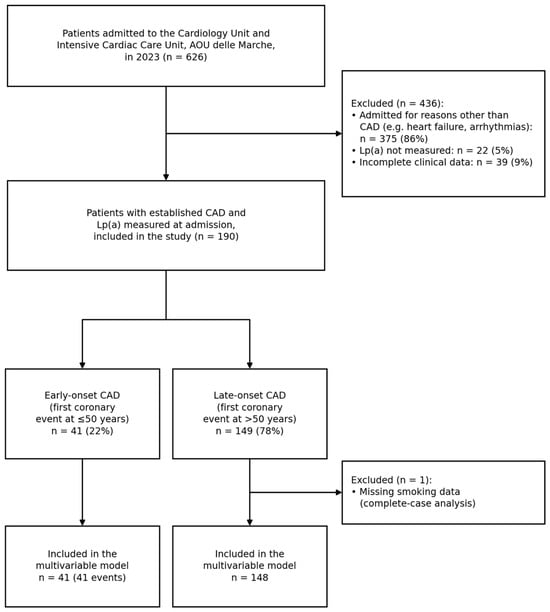
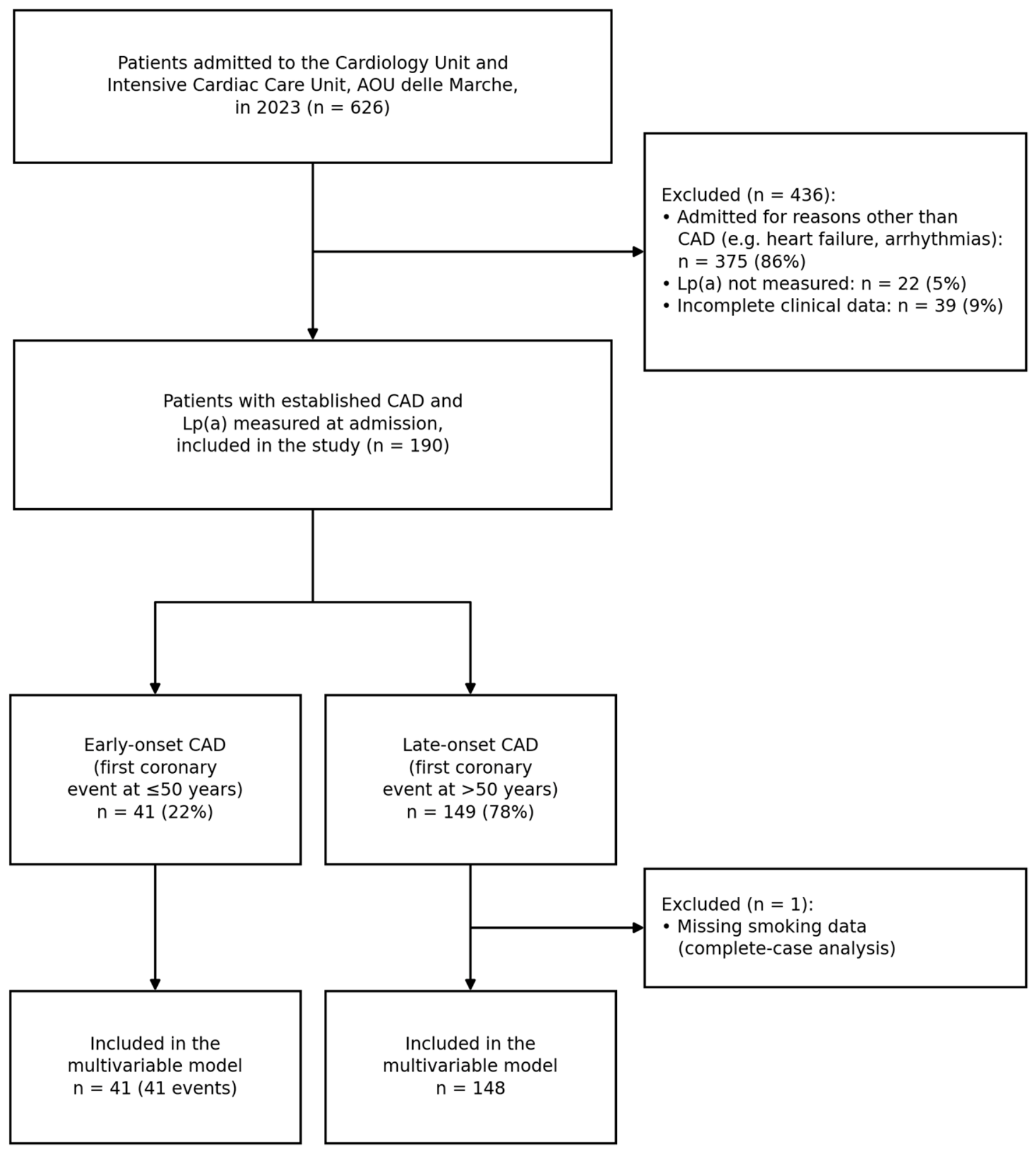
This retrospective, single-centre study was conducted at the inpatient Cardiology Unit and Intensive Cardiac Care Unit of the Azienda Ospedaliero Universitaria delle Marche (Ancona, Italy) and is reported according to the Strengthening the Reporting of Observational Studies in Epidemiology (STROBE) statement [22]. We included patients with established CAD, either with a previous diagnosis or with a new diagnosis during the index admission, who were admitted in 2023 and in whom Lp(a) had been measured. Patients admitted for reasons other than CAD (for example, heart failure or arrhythmias), patients without Lp(a) measurement and patients with incomplete clinical data were excluded. Lp(a) was part of the standard admission panel for patients with CAD (Figure 1).
Figure 1.
STROBE flow chart of patient selection and analysis populations. CAD: coronary artery disease; Lp(a): lipoprotein(a). Early-onset CAD was defined as a first coronary event at or before 50 years of age.
Lp(a) was measured at the hospital’s central laboratory during the index admission with an immunoturbidimetric assay [23]. Results are reported in mg/dL. Lipid values (LDL cholesterol calculated with the Friedewald formula, non-HDL cholesterol and triglycerides) were measured during the same admission, while patients were on their usual lipid-lowering therapy.
The first coronary event was defined as the first acute coronary syndrome (ACS) or coronary revascularisation (percutaneous coronary intervention [PCI], coronary artery bypass grafting [CABG] or fibrinolysis) documented in the clinical record, either in the medical history or as the reason for the index admission. Patients were classified as having early-onset CAD when the first event occurred at or before 50 years of age, and late-onset CAD when it occurred after 50 years [24]. For events preceding 2023, the age category was verified in the clinical history; the exact age at the first event was not systematically recorded.
Cardiovascular risk factors (smoking history, defined as current or former smoking; hypertension; diabetes mellitus), lipid-lowering therapy at the time of admission and clinical presentation were collected from the clinical records. Sex, family history of premature CAD, body mass index, renal function and a formal diagnosis of familial hypercholesterolaemia were not available in the dataset.
2.2. Statistical Analysis
Continuous variables are presented as median (interquartile range, IQR) and were compared with the Mann–Whitney U test. Categorical variables are presented as number and percentage of patients with available data and were compared with the Pearson chi-square test, or Fisher’s exact test when the expected cell count was <5. Missing data were handled by complete-case analysis.
Lp(a) was log2-transformed because of its skewed distribution so that odds ratios (ORs) would express the change per doubling of Lp(a); ORs per standard deviation (SD) of log Lp(a) and per 10-fold increase are also reported. Lp(a) was also analysed in categories (<30, 30–49 and ≥50 mg/dL) [8]. Univariable logistic regression was performed for each candidate variable. Covariates for the multivariable model were pre-specified on clinical grounds and limited by the number of events (41 events; about 10 events per variable): smoking, hypertension and diabetes. The model was fitted with Firth’s penalised logistic regression [25]; the original model including Lp(a) and smoking was also fitted by maximum likelihood. High-intensity statin therapy was not considered a candidate covariate, because it is a consequence rather than a determinant of early onset. Effect modification by smoking was tested with an interaction term. Sensitivity analyses added on-treatment LDL cholesterol or high-intensity statin therapy to the model, excluded patients treated with PCSK9 inhibitors or inclisiran, and classified the two patients aged 50 years at admission as late-onset.
Discrimination was explored with receiver operating characteristic (ROC) analysis. The 95% CI of the area under the curve (AUC) was calculated with DeLong’s method; sensitivity, specificity and predictive values are reported with Wilson 95% CIs, and likelihood ratios with the log method. The stability of the Youden-optimal cut-off was assessed in 2000 bootstrap resamples. The incremental value of Lp(a) over a clinical model (smoking, hypertension, diabetes) was assessed as the bootstrap optimism-corrected change in AUC and the continuous net reclassification index. In patients whose first coronary event was the index 2023 admission, the relation between Lp(a) and age at onset was assessed with Spearman correlation and linear regression.
Given the exploratory nature of the study, no correction for multiple comparisons was applied; Benjamini–Hochberg false discovery rate-adjusted q values are reported in Supplementary Table S2. A two-tailed p < 0.05 was considered statistically significant. Analyses were performed with jamovi version 2.6.19.
3. Results
A total of 190 patients with established CAD were analysed (Figure 1). The median age at admission was 69 years (IQR 59–76), and 39% of patients were admitted for an ACS.
Overall, 41 patients (22%) had early-onset CAD and 149 (78%) late-onset CAD (Table 1).
Table 1.
Clinical and biochemical characteristics according to age at first coronary event.
Lp(a) was higher in patients with early-onset CAD (median 43 [IQR 18–71] vs. 21 [10–57] mg/dL; p = 0.017), although the distributions overlapped widely. Lp(a) ≥ 50 mg/dL was present in 44% vs. 30% of patients (p = 0.082). Non-HDL cholesterol was lower in the early-onset group (84 vs. 98 mg/dL; p = 0.040), whereas the difference in LDL cholesterol did not reach statistical significance (62 vs. 75 mg/dL; p = 0.051).
High-intensity statin therapy (59% vs. 33%; p = 0.003), ezetimibe (54% vs. 34%; p = 0.023) and bempedoic acid (7% vs. 0%; p = 0.010) were more frequently prescribed in early-onset patients; PCSK9 inhibitors (e.g., evolocumab, alirocumab, inclisiran) were rarely used and did not differ between groups.
Early-onset patients more often had a smoking history (76% vs. 53%; p = 0.011), whereas hypertension (56% vs. 81%; p = 0.001) and diabetes (15% vs. 31%; p = 0.039) were more prevalent in late-onset patients.
In univariable logistic regression (Table 2), Lp(a) (OR 1.35 per doubling, 95% CI 1.05–1.72; p = 0.019) and smoking (OR 2.71, 95% CI 1.24–5.92; p = 0.013) were associated with early-onset CAD, whereas hypertension (OR 0.31, 95% CI 0.15–0.65; p = 0.002) and diabetes (OR 0.38, 95% CI 0.15–0.98; p = 0.044) showed inverse associations. On-treatment LDL cholesterol, non-HDL cholesterol and triglycerides were not associated with early onset.
Table 2.
Univariable logistic regression for early-onset CAD.
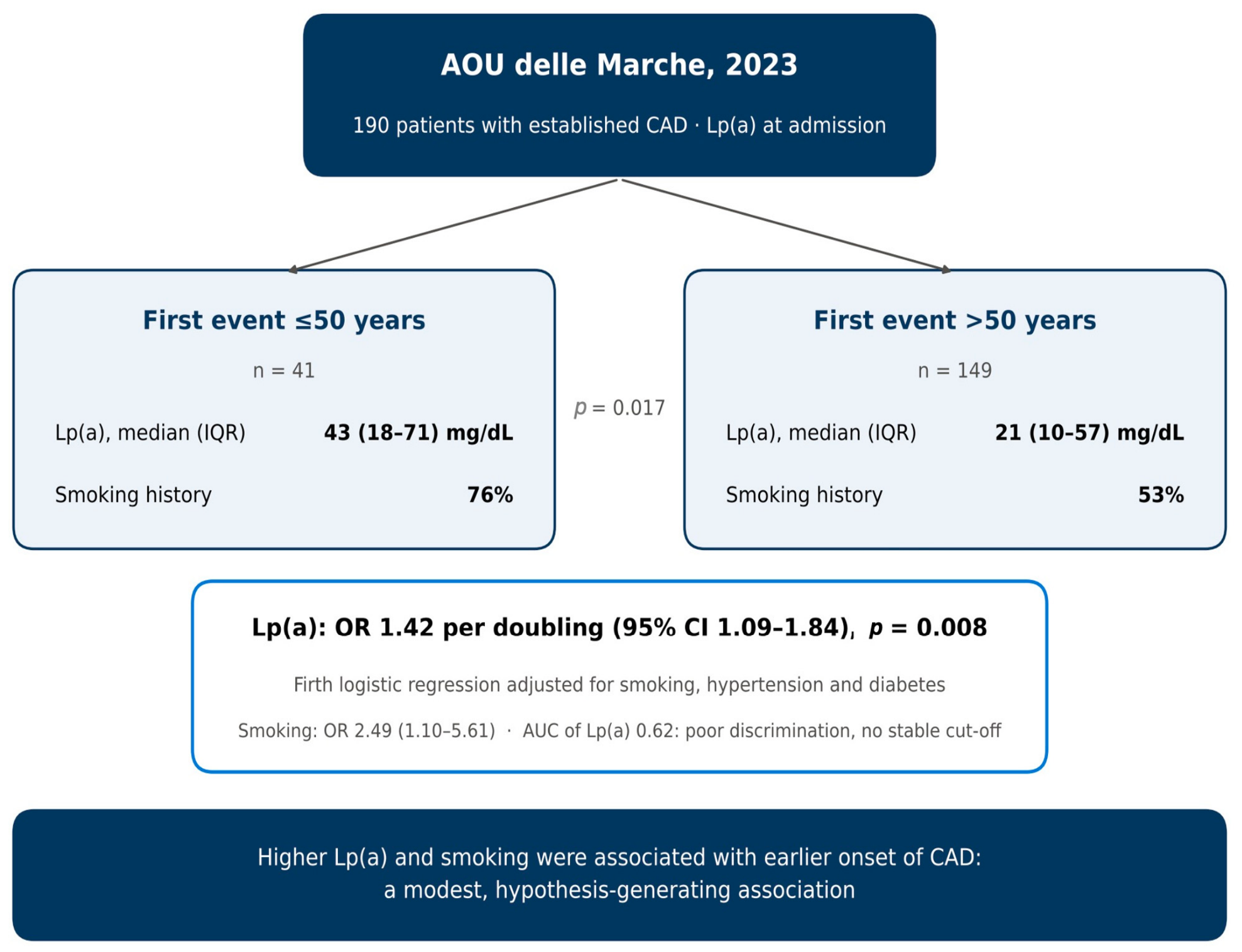
In the pre-specified multivariable model (Table 3), Lp(a) remained associated with early-onset CAD (OR 1.42 per doubling, 95% CI 1.09–1.84; p = 0.008), as did smoking (OR 2.49, 95% CI 1.10–5.61; p = 0.028) (Figure 3). The model including only Lp(a) and smoking gave similar results (Lp(a): OR 1.41, 95% CI 1.09–1.82; p = 0.008). Compared with Lp(a) < 30 mg/dL, the adjusted OR was 3.24 (95% CI 1.03–10.20) for 30–49 mg/dL and 2.48 (95% CI 1.11–5.51) for ≥50 mg/dL. The estimate for Lp(a) was similar in all sensitivity analyses (Supplementary Table S1), and there was no evidence of interaction between Lp(a) and smoking (p = 0.65).
Table 3.
Multivariable logistic regression for early-onset CAD.
Lp(a) did not differ between patients receiving and not receiving high-intensity statin therapy (median 26 vs. 23 mg/dL; p = 0.54), whereas LDL and non-HDL cholesterol were lower in treated patients (Table 4).
Table 4.
Lipid values according to high-intensity statin therapy.
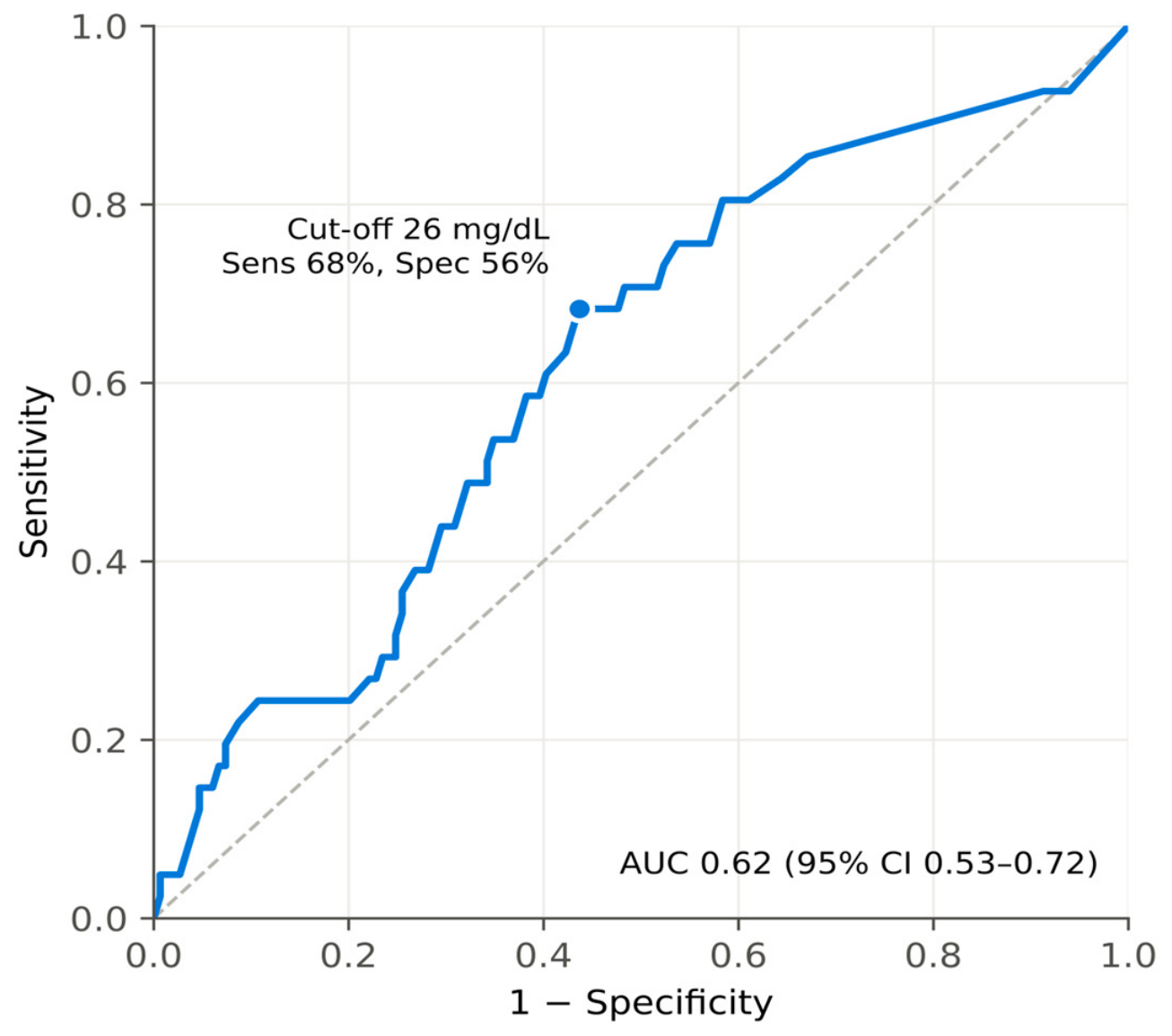
In an exploratory ROC analysis (Figure 2), the AUC of Lp(a) for early-onset CAD was 0.62 (95% CI 0.53–0.72). The Youden-optimal cut-off was 26 mg/dL (sensitivity 68%, specificity 56%; Table 5), but it was unstable across bootstrap resamples (95% range 11–88 mg/dL). Adding Lp(a) to a clinical model including smoking, hypertension and diabetes did not significantly improve discrimination (optimism-corrected AUC 0.69 vs. 0.70; ΔAUC 0.026, 95% CI −0.004 to 0.098).
Table 5.
Discrimination of early-onset CAD by Lp(a) at selected cut-offs (exploratory analysis).
Figure 2.
Receiver operating characteristic curve of Lp(a) for early-onset CAD (exploratory analysis). The dot marks the Youden-optimal cut-off (26 mg/dL); the dashed line indicates no discrimination.
4. Discussion
In this retrospective cohort of patients with established CAD, those with a first coronary event at or before 50 years of age had higher Lp(a) levels than those with later onset. The association was independent of smoking, sex, hypertension and diabetes and was consistent across sensitivity analyses: each doubling of Lp(a) was associated with about 40% higher odds of early onset. Smoking was the other factor independently associated with early onset.
These findings are consistent with the epidemiological and genetic evidence linking Lp(a) to coronary disease [6,7,10,11] and with studies reporting higher Lp(a) levels in patients with premature atherosclerotic disease and premature acute coronary syndromes [14,24,26]. Our study does not provide a novel demonstration, but a real-world confirmation of this association in a contemporary cohort of patients with established CAD receiving intensive lipid-lowering therapy.
Several features of the data argue for caution. The distributions of Lp(a) overlapped widely between groups, and the proportion of patients above the consensus threshold of 50 mg/dL did not differ significantly; categorical analyses did not show a clear threshold effect. In addition, among patients whose first event occurred in 2023, all but one after 50 years of age, Lp(a) was not lower in those with later onset. These observations suggest that if Lp(a) contributes to earlier onset of coronary disease, its effect is not a simple gradient across ages, and they do not support a specific Lp(a) threshold for premature disease.
The higher prevalence of hypertension and diabetes in late-onset patients is expected, because these conditions accumulate with age and the outcome is defined by age at onset; their inverse associations should not be interpreted as a lower burden of conventional risk factors in early-onset patients. Likewise, the lower on-treatment non-HDL cholesterol and the more frequent use of high-intensity statins, ezetimibe and bempedoic acid in early-onset patients most plausibly reflect longer and more intensive secondary prevention after an earlier event [13,27].
The association of smoking with early onset is consistent with its established role in premature myocardial infarction [24]. We found no evidence of interaction between smoking and Lp(a), and our data do not support a synergistic effect of the two factors.
Lp(a) did not differ according to high-intensity statin therapy, in line with evidence that statins do not lower Lp(a) [15,28]; however, this cross-sectional comparison cannot establish whether therapy modified Lp(a) levels in individual patients.
Discrimination of early-onset CAD by Lp(a) was poor, the optimal cut-off was unstable and close to the cohort median, and Lp(a) did not significantly improve discrimination beyond clinical factors. Because all patients had CAD and the proportion of early-onset patients reflects this sample, predictive values cannot be transferred to screening settings, and these analyses should be regarded as descriptive. Our findings are consistent with recommendations to measure Lp(a) at least once in adults, particularly in those with premature CAD [8,27], but they do not test the value of screening.
Whether lowering Lp(a) reduces cardiovascular events remains unproven. Population data suggest that large absolute reductions may be required to achieve clinically meaningful benefit in secondary prevention [29], and the first outcome trial of an Lp(a)-lowering agent, Lp(a)HORIZON, did not meet its primary endpoint with pelacarsen according to the topline results announced in September 2026 [21]; the full data, including the response by baseline Lp(a) and achieved reduction, are awaited. Outcome trials of other agents, such as olpasiran and lepodisiran, are ongoing. Our data, which are cross-sectional and confined to patients with established CAD, cannot inform this question; they describe how Lp(a) levels relate to age at onset in a contemporary clinical cohort.
This study has several limitations. First, it is a retrospective, single-centre analysis of patients who all had CAD: it compares age at onset among affected patients and cannot assess the risk of developing CAD, nor its causality or prognosis. Second, prevalent-case and survivor bias are possible, because patients were drawn from admissions in a single year and individuals with very early or fatal events are not represented. Third, family history of premature CAD, body mass index, renal function, ancestry, a formal diagnosis of familial hypercholesterolaemia, untreated LDL cholesterol, apolipoprotein B and C-reactive protein were not available, so residual confounding is likely, with familial hypercholesterolaemia being of particular concern. Fourth, LDL cholesterol was calculated with the Friedewald formula, which is less accurate at low levels, and the number of early-onset patients (n = 41) limited the number of covariates and the precision of all estimates.
In addition, early-onset CAD was defined with a single age threshold (≤50 years) for both sexes, and the exact age at first event was not systematically recorded for events preceding 2023, which precluded sex-specific definitions and analyses of age at onset as a continuous variable in the whole cohort. Moreover the angiographic extent and severity of CAD (for example, number of diseased vessels, SYNTAX score, or number of stents and procedures) were not available, so the association between Lp(a) and disease extent could not be assessed; ACS at presentation was the only marker of clinical presentation available.
5. Conclusions
In a single-centre cohort of patients with established CAD, higher Lp(a) levels and smoking were associated with a first coronary event at or before 50 years of age. The association with Lp(a) was independent of hypertension, sex, and diabetes, and did not identify a clinically useful threshold. These hypothesis-generating findings warrant confirmation in prospective cohorts.
Figure 3.
Lipoprotein(a) and age at onset of coronary artery disease (CAD) in 190 patients with established CAD admitted in 2023 (AOU delle Marche). Patients with a first coronary event at ≤50 years had higher Lp(a) levels than those with later onset (median 43 vs. 21 mg/dL). After adjustment for smoking, hypertension and diabetes, Lp(a) was associated with early onset (OR 1.42 per doubling, 95% CI 1.09–1.84; p = 0.008). The association was modest and hypothesis-generating.
Supplementary Materials
The following supporting information can be downloaded at https://www.mdpi.com/article/10.3390/ijtm6040054/s1: Table S1: Sensitivity analyses of the association between Lp(a) and early-onset CAD; Table S2: False discovery rate-adjusted q values for the comparisons in Table 1.
Author Contributions
Conceptualization, E.P.; methodology, E.P. and F.C.; formal analysis, F.C.; investigation, M.T., L.P., C.C., M.F., M.M. (Marco Moretti) and E.S.; writing—original draft preparation, M.T. and F.C.; writing—review and editing, E.P. and M.T.; supervision, M.M. (Marco Marini). All authors have read and agreed to the published version of the manuscript.
Funding
This research received no external funding. The article processing charge was paid by Novartis Farma S.p.A.
Institutional Review Board Statement
Requirement for individual consent was waived given the retrospective design. Data were pseudonymised before analysis. In accordance with Italian regulations and the European General Data Protection Regulation (GDPR-EU Regulation 2016/679), patients admitted to our institution (Azienda Ospedaliero-Universitaria delle Marche) sign the hospital’s official institutional privacy notice and consent form upon admission. Since these are standard administrative documents issued directly by the Hospital Administration and its Data Protection Officer (DPO) for routine healthcare, they do not require separate approval from an Institutional Ethics Committee.
Informed Consent Statement
Patient consent was waived due to the retrospective design; all patients had signed the hospital’s consent form for the use of clinical data for research.
Data Availability Statement
Data are available from the corresponding author on reasonable request.
Conflicts of Interest
The article processing charge for this article was funded by Novartis, which is developing pelacarsen, an Lp(a)-lowering therapy. Novartis had no role in the design of the study; in the collection, analysis or interpretation of data; in the writing of the manuscript; or in the decision to publish. The authors declare no conflicts of interest.
Abbreviations
The following abbreviations are used in this manuscript:
| ACS | Acute Coronary Syndrome |
| AUC | Area Under the Curve |
| CABG | Coronary Artery Bypass Grafting |
| CAD | Coronary Artery Disease |
| CI | Confidence Interval |
| HDL | High-Density Lipoprotein |
| IQR | Interquartile Range |
| LDL | Low-Density Lipoprotein |
| Lp(a) | Lipoprotein(a) |
| LR | Likelihood Ratio |
| NPV | Negative Predictive Value |
| OR | Odds Ratio |
| PCI | Percutaneous Coronary Intervention |
| PCSK9 | Proprotein Convertase Subtilisin/Kexin Type 9 |
| PPV | Positive Predictive Value |
| ROC | Receiver Operating Characteristic |
| SD | Standard Deviation |
| STROBE | Strengthening the Reporting of Observational Studies in Epidemiology |
References
- Schmidt, K.; Noureen, A.; Kronenberg, F.; Utermann, G. Structure, function, and genetics of lipoprotein (a). J. Lipid Res. 2016, 57, 1339–1359. [Google Scholar] [CrossRef] [Scilit] [PubMed]
- Mack, S.; Coassin, S.; Rueedi, R.; Yousri, N.A.; Seppälä, I.; Gieger, C.; Schönherr, S.; Forer, L.; Erhart, G.; Marques-Vidal, P.; et al. A genome-wide association meta-analysis on lipoprotein (a) concentrations adjusted for apolipoprotein (a) isoforms. J. Lipid Res. 2017, 58, 1834–1844. [Google Scholar] [CrossRef] [Scilit] [PubMed]
- Patel, A.P.; Wang, M.; Pirruccello, J.P.; Ellinor, P.T.; Ng, K.; Kathiresan, S.; Khera, A.V. Lp(a) (Lipoprotein[a]) concentrations and incident atherosclerotic cardiovascular disease: New insights from a large national biobank. Arterioscler. Thromb. Vasc. Biol. 2021, 41, 465–474. [Google Scholar] [PubMed]
- Tsimikas, S.; Marcovina, S.M. Ancestry, lipoprotein(a), and cardiovascular risk thresholds: JACC Review Topic of the Week. J. Am. Coll. Cardiol. 2022, 80, 934–946. [Google Scholar] [PubMed]
- Dzobo, K.E.; Kraaijenhof, J.M.; Stroes, E.S.G.; Nurmohamed, N.S.; Kroon, J. Lipoprotein(a): An underestimated inflammatory mastermind. Atherosclerosis 2022, 349, 101–109. [Google Scholar] [CrossRef] [Scilit] [PubMed]
- Emerging Risk Factors Collaboration. Lipoprotein(a) concentration and the risk of coronary heart disease, stroke, and nonvascular mortality. JAMA 2009, 302, 412–423. [PubMed]
- Kamstrup, P.R.; Tybjaerg-Hansen, A.; Steffensen, R.; Nordestgaard, B.G. Genetically elevated lipoprotein(a) and increased risk of myocardial infarction. JAMA 2009, 301, 2331–2339. [Google Scholar] [CrossRef] [Scilit] [PubMed]
- Kronenberg, F.; Mora, S.; Stroes, E.S.G.; Ference, B.A.; Arsenault, B.J.; Berglund, L.; Dweck, M.R.; Koschinsky, M.; Lambert, G.; Mach, F.; et al. Lipoprotein(a) in atherosclerotic cardiovascular disease and aortic stenosis: A European Atherosclerosis Society consensus statement. Eur. Heart J. 2022, 43, 3925–3946. [Google Scholar] [CrossRef] [Scilit] [PubMed]
- Greco, A.; Finocchiaro, S.; Spagnolo, M.; Faro, D.C.; Mauro, M.S.; Raffo, C.; Sangiorgio, G.; Imbesi, A.; Laudani, C.; Mazzone, P.M.; et al. Lipoprotein(a) as a pharmacological target: Premises, promises, and prospects. Circulation 2025, 151, 400–415. [Google Scholar] [CrossRef] [Scilit] [PubMed]
- Wong, N.D.; Fan, W.; Hu, X.; Ballantyne, C.; Hoodgeveen, R.C.; Tsai, M.Y.; Browne, A.; Budoff, M.J. Lipoprotein(a) and long-term cardiovascular risk in a multi-ethnic pooled prospective cohort. J. Am. Coll. Cardiol. 2024, 83, 1511–1525. [Google Scholar] [CrossRef] [Scilit] [PubMed]
- Burgess, S.; Ference, B.A.; Staley, J.R.; Freitag, D.F.; Mason, A.M.; Nielsen, S.F.; Willeit, P.; Young, R.; Surendran, P.; Karthikeyan, S.; et al. Association of LPA variants with risk of coronary disease and the implications for lipoprotein(a)-lowering therapies: A Mendelian randomization analysis. JAMA Cardiol. 2018, 3, 619–627. [Google Scholar] [PubMed]
- Nordestgaard, B.G.; Chapman, M.J.; Ray, K.; Borén, J.; Andreotti, F.; Watts, G.F.; Ginsberg, H.; Amarenco, P.; Catapano, A.; Descamps, O.S.; et al. Lipoprotein(a) as a cardiovascular risk factor: Current status. Eur. Heart J. 2010, 31, 2844–2853. [Google Scholar] [CrossRef] [Scilit] [PubMed]
- Mach, F.; Baigent, C.; Catapano, A.L.; Koskinas, K.C.; Casula, M.; Badimon, L.; Chapman, M.J.; De Backer, G.G.; Delgado, V.; Ference, B.A.; et al. 2019 ESC/EAS Guidelines for the management of dyslipidaemias: Lipid modification to reduce cardiovascular risk. Eur. Heart J. 2020, 41, 111–188, Correction in Eur. Heart J. 2020, 20, 4255.. [Google Scholar] [CrossRef] [Scilit] [PubMed]
- Tian, X.; Zhang, N.; Tse, G.; Li, G.; Sun, Y.; Liu, T. Association between lipoprotein(a) and premature atherosclerotic cardiovascular disease: A systematic review and meta-analysis. Eur. Heart J. Open 2024, 4, oeae031. [Google Scholar] [CrossRef] [Scilit] [PubMed]
- De Boer, L.; Oorthuys, A.; Wiegman, A.; Langendam, M.; Kroon, J.; Spijker, R.; Zwinderman, A.; Hutten, B. Statin therapy and lipoprotein(a) levels: A systematic review and meta-analysis. Eur. J. Prev. Cardiol. 2022, 29, 779–792. [Google Scholar] [CrossRef] [Scilit] [PubMed]
- Viney, N.J.; van Capelleveen, J.C.; Geary, R.S.; Xia, S.; Tami, J.A.; Yu, R.Z.; Marcovina, S.M.; Hughes, S.G.; Graham, M.J.; Crooke, R.M.; et al. Antisense oligonucleotides targeting apolipoprotein(a) in people with raised lipoprotein(a): Two randomised, double-blind, placebo-controlled, dose-ranging trials. Lancet 2016, 388, 2239–2253. [Google Scholar] [CrossRef] [Scilit] [PubMed]
- O’dOnoghue, M.L.; Rosenson, R.S.; Gencer, B.; López, J.A.G.; Lepor, N.E.; Baum, S.J.; Stout, E.; Gaudet, D.; Knusel, B.; Kuder, J.F.; et al. Small interfering RNA to reduce lipoprotein(a) in cardiovascular disease. N. Engl. J. Med. 2022, 387, 1855–1864. [Google Scholar] [CrossRef] [Scilit] [PubMed]
- O’Donoghue, M.L.; Rosenson, R.S.; López, J.A.G.; Lepor, N.E.; Baum, S.J.; Stout, E.; Gaudet, D.; Knusel, B.; Kuder, J.F.; Murphy, S.A. The off-treatment effects of olpasiran on lipoprotein(a) lowering: OCEAN(a)-DOSE extension period results. J. Am. Coll. Cardiol. 2024, 84, 790–797. [Google Scholar] [PubMed]
- Nicholls, S.J.; Ni, W.; Rhodes, G.M.; Nissen, S.E.; Navar, A.M.; Michael, L.F.; Haupt, A.; Krege, J.H. Oral muvalaplin for lowering of lipoprotein(a): A randomized clinical trial. JAMA 2025, 333, 222–231. [Google Scholar] [PubMed]
- Cho, L.; Nicholls, S.J.; Nordestgaard, B.G.; Landmesser, U.; Tsimikas, S.; Blaha, M.J.; Leitersdorf, E.; Lincoff, A.M.; Lesogor, A.; Manning, B.; et al. Design and rationale of Lp(a)HORIZON trial: Assessing the effect of lipoprotein(a) lowering with pelacarsen on major cardiovascular events in patients with CVD and elevated Lp(a). Am. Heart J. 2025, 287, 1–9. [Google Scholar] [CrossRef] [Scilit] [PubMed]
- Novartis. Novartis Announces Lp(a)HORIZON Phase III Topline Results for Pelacarsen in Patients with Elevated Lp(a) and Established Cardiovascular Disease (CVD). Media Release, 4 September 2026. Available online: https://www.novartis.com/news/media-releases/novartis-announces-lpahorizon-phase-iii-topline-results-pelacarsen-patients-elevated-lpa-and-established-cardiovascular-disease-cvd (accessed on 10 September 2026).
- Von Elm, E.; Altman, D.G.; Egger, M.; Pocock, S.J.; Gøtzsche, P.C.; Vandenbroucke, J.P.; Initiative, S. The Strengthening the Reporting of Observational Studies in Epidemiology (STROBE) statement: Guidelines for reporting observational studies. Lancet 2007, 370, 1453–1457. [Google Scholar] [CrossRef] [Scilit] [PubMed]
- Marcovina, S.M.; Albers, J.J. Lipoprotein(a) measurements for clinical application. J. Lipid Res. 2016, 57, 526–537. [Google Scholar] [CrossRef] [Scilit] [PubMed]
- Rallidis, L.S.; Xenogiannis, I.; Brilakis, E.S.; Bhatt, D.L. Causes, angiographic characteristics, and management of premature myocardial infarction: JACC State-of-the-Art Review. J. Am. Coll. Cardiol. 2022, 79, 2431–2449. [Google Scholar] [PubMed]
- Firth, D. Bias reduction of maximum likelihood estimates. Biometrika 1993, 80, 27–38. [Google Scholar] [CrossRef] [Scilit]
- Cesaro, A.; Acerbo, V.; Scialla, F.; Scherillo, G.; De Michele, G.; Panico, D.; Porcelli, G.; de Sio, V.; Capolongo, A.; Sperlongano, S.; et al. Role of LipoprotEin(a) in CardiovascuLar diseases and premature acute coronary syndromes (RELACS study): Impact of lipoprotein(a) levels on the premature coronary event and the severity of coronary artery disease. Nutr. Metab. Cardiovasc. Dis. 2025, 35, 103843. [Google Scholar] [CrossRef] [Scilit] [PubMed]
- Vrints, C.; Andreotti, F.; Koskinas, K.C.; Rossello, X.; Adamo, M.; Ainslie, J.; Banning, A.P.; Budaj, A.; Buechel, R.R.; Chiariello, G.A.; et al. 2024 ESC Guidelines for the management of chronic coronary syndromes. Eur. Heart J. 2024, 45, 3415–3537. [Google Scholar] [CrossRef] [Scilit] [PubMed]
- Khera, A.V.; Everett, B.M.; Caulfield, M.P.; Hantash, F.M.; Wohlgemuth, J.; Ridker, P.M.; Mora, S. Lipoprotein(a) concentrations, rosuvastatin therapy, and residual vascular risk: An analysis from the JUPITER Trial. Circulation 2014, 129, 635–642. [Google Scholar] [CrossRef] [Scilit]
- Madsen, C.M.; Kamstrup, P.R.; Langsted, A.; Varbo, A.; Nordestgaard, B.G. Lipoprotein(a)-lowering by 50 mg/dL (105 nmol/L) may be needed to reduce cardiovascular disease 20% in secondary prevention: A population-based study. Arterioscler. Thromb. Vasc. Biol. 2020, 40, 255–266. [Google Scholar] [CrossRef] [Scilit] [PubMed]

Disclaimer/Publisher’s Note: The statements, opinions and data contained in all publications are solely those of the individual author(s) and contributor(s) and not of MDPI and/or the editor(s). MDPI and/or the editor(s) disclaim responsibility for any injury to people or property resulting from any ideas, methods, instructions or products referred to in the content. |
© 2026 by the authors. Licensee MDPI, Basel, Switzerland. This article is an open access article distributed under the terms and conditions of the Creative Commons Attribution (CC BY) license.